𝗙𝗨𝗟𝗟 𝗦𝗧𝗢𝗥𝗬 HOA Built 22 Lakefront Villas on My Land—Then One Missing Signature Put Every Lease at Risk
𝗣𝗔𝗥𝗧 𝟮
They did not want to buy.
They wanted to lease.
So the clause stayed.
Construction began in 2013.
By 2016, twenty-two villas stood on the parcel.
They were attractive buildings.
Stone facades.
Wide porches.
Lake-facing windows.
The buyers paid substantial money for them.
Crestline created the Lake View Shores HOA to maintain common areas and administer community standards.
Everything appeared to function normally.
The lease payments arrived.
Quarter after quarter.
I did not attend board meetings.
I did not care what color they painted mailboxes.
Their internal rules were their business as long as they stayed inside the leased parcel and complied with the lease.
For years, that arrangement worked.
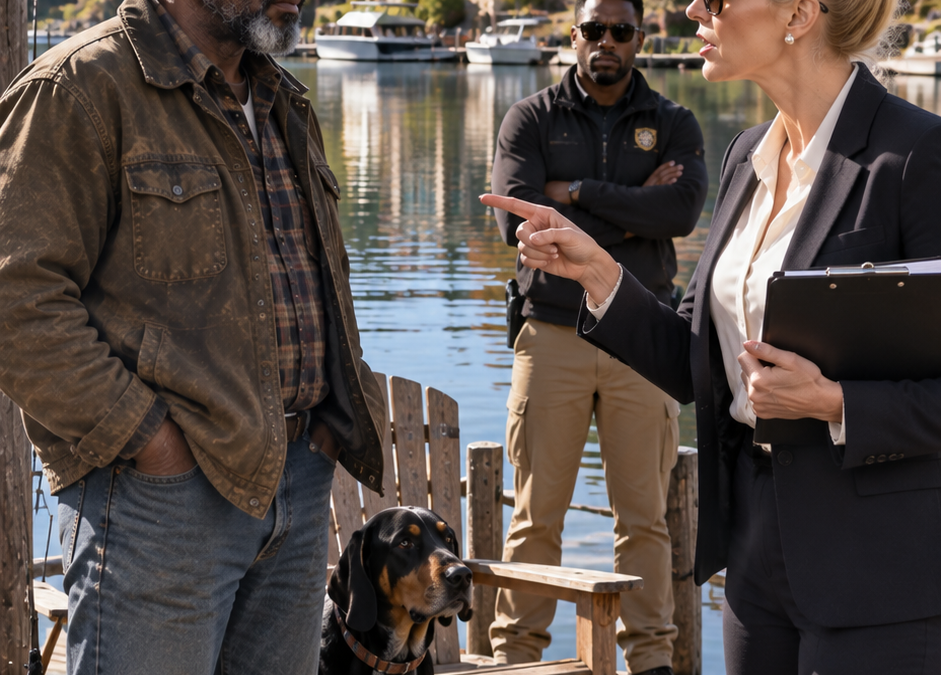
Then Patricia Holden came to my dock.
The first certified letter arrived five days after her visit.
Violation of Section 4, Subsection 3.
Unauthorized private pier.
Fine: $450.
The second arrived three days later.
Unauthorized use of the shared waterfront dock.
Fine: $275.
That one actually made me laugh.
The HOA had apparently concluded I needed permission to use a dock sitting on land I owned beneath a lease I had granted.
Then came the third letter.
It said the board had voted to pursue a “compliance lien” if I failed to pay.
I set all three documents beside the fireproof box on my kitchen table.
The total dispute was $725.
That amount meant very little to me.
The principle meant considerably more.
I opened the box.
Deed.
Survey.
Lease.
Amendments.
Tax records.
Everything.
Then I called Warren Kale.
Warren had handled my father’s estate and my 2003 acquisition of Gerald’s interest.
He had practiced property law for nearly forty years.
I read him Patricia’s letters.
When I finished, he said nothing for several seconds.
Finally:
“They’re trying to lien the fee owner?”
“That appears to be the plan.”
“Send me everything.”
“I will.”
“Not just their letters.”
“I know.”
“Lease?”
“Yes.”
“Original?”
“Yes.”
“Assignment history?”
“I don’t know if there was one.”
That silence came again.
“Let me look.”
Two days later Warren called.
His voice sounded different.
“Daniel, did you consent to an assignment in 2018?”
“No.”
“You’re certain?”
“I would remember notarizing and recording consent.”
“Did anyone ask?”
“No.”
“All right.”
“What happened in 2018?”
“Crestline assigned its leasehold interest to Lake View Shores HOA.”
I stood beside the kitchen window looking toward the water.
“That cannot be right.”
“The assignment is recorded.”
“My consent isn’t.”
“I know.”
I sat down.
Warren read Section 12, Clause 2 aloud.
Any assignment, sublease, or transfer without prior written consent of the lessor, executed, notarized, and recorded with the transfer, would be null and void.
He stopped.
“Daniel.”
“Yes?”
“They may not have a valid leasehold.”
I wrote those words on a legal pad.
Not with satisfaction.
With caution.
A legal conclusion that serious needed more than one attorney reading one clause.
“Verify it.”
“I intend to.”
We spent the next three weeks doing exactly that.
Warren ordered a full title search.
A current survey confirmed the twenty-eight-acre lease boundary.
Every amendment to the original lease was pulled.
Every recorded instrument involving Crestline was reviewed.
Then Warren brought in Helen Marsh.
Helen had practiced real-property law for thirty years.
She had a reputation for approaching contracts the way I approached structural plans.
Line by line.
Assumption by assumption.
She called me after completing her review.
“I’m sending you a written opinion.”
“How long?”
“Twelve pages.”
“That sounds encouraging.”
“It’s not encouraging for them.”
She explained.
The 2018 transfer to the HOA had been executed without the consent required by Section 12.
The lease did not say an unauthorized assignment was merely voidable.
It said null and void.
There was a difference.
The HOA’s entire assertion of leaseholder authority rested on an instrument the original lease expressly prohibited.
Then Helen added something worse.
“Crestline Properties dissolved in 2020.”
“I knew they had closed operations.”
“Legally dissolved.”
“What does that change?”
“Possibly everything.”
I walked to the window.
The villas stood beyond the trees.
Twenty-two roofs.
Twenty-two families.
“What are you saying?”
“I’m saying the assignment to the HOA may have been void from the beginning, and the original lessee no longer exists.”
“And the lease?”
“That is the next question.”
I did not feel pleased.
Those villas belonged to people who, as far as I knew, had bought them honestly.
They had relied on Crestline.
Title companies.
Closing attorneys.
HOA documents.
They had not written Section 12.
They had not ignored it.
But property law does not rearrange itself according to who deserves sympathy.
It follows instruments.
The HOA, meanwhile, had just threatened to cloud my title with a lien.
That made waiting impossible.
Helen filed a quiet-title action in late April.
The complaint named Lake View Shores HOA, the twenty-two villa owners, and interests associated with dissolved Crestline Properties.
Forty-one pages.
Eleven exhibits.
My deed.
The original lease.
The 2018 assignment.
Section 12.
The missing consent.
Survey.
Title records.
HOA violation notices.
Their threatened lien.
The relief requested was straightforward.
Declare the assignment void.
Declare that the HOA possessed no authority over my fee-simple property.
Vacate the fines.
Prevent the lien.
Determine what legal leasehold interest, if any, remained.
Patricia Holden was served on a Thursday morning.
I was repairing fence when Warren called.
“Service complete.”
“Good.”
“How do you feel?”
I looked down the fence line.
“Like I’m setting posts.”
“That sounds like you.”
“If they’re straight, you don’t need to feel anything about them.”
Ten days later, the HOA moved to dismiss.
Their attorney was Garrett Fossey, a Nashville lawyer whose motion argued that the missing consent was merely a curable defect.
According to him, everyone had behaved for years as though the assignment were effective.
Lease payments had been accepted.
The HOA managed the property.
Owners relied on it.
Therefore, he argued, the assignment could be ratified after the fact.
The motion was forty pages.
Warren emailed it to me with one sentence.
Forty pages is a lot of writing for a technicality.
Helen’s response was nineteen.
She went directly to the problem.
Ratification required parties capable of ratifying.
Crestline no longer existed.
More importantly, the lease had specified the method by which assignment became effective.
Prior consent.
Not later consent.
Prior.
Executed.
Notarized.
Recorded with the transfer.
None of that had happened.
A missing bolt can sometimes be replaced.
A missing foundation cannot.
That was how Helen described it to me.
The discovery process made things worse for the HOA.
Ruth Alderman, a former board secretary, was deposed.
Ruth did not strike me as dishonest.
Quite the opposite.
She appeared embarrassed.
Warren asked whether the board had reviewed the original ground lease before accepting the 2018 assignment.
“No.”
“Did anyone discuss Section 12?”
“Not that I remember.”
“Did the board have a copy?”
“I assume so.”
“That wasn’t my question.”
Ruth lowered her eyes.
“I don’t know.”
“Did anyone contact Daniel Voss?”
“No.”
“Did anyone ask whether his consent was required?”
“No.”
“Why not?”
“We believed the transfer was routine.”
That sentence probably cost the HOA more than anything Patricia ever wrote.
The board had assumed.
Land records punish assumptions.
Then my neighbor Carl Pruitt remembered something.
Carl owned roughly two hundred acres north of mine.
Seventy-three years old.
Cattleman.
The kind of man who remembers who bought what parcel in 1986 because he remembers helping pull their truck out of a ditch that winter.
He stopped at my fence one afternoon.
“You know Crestline was asking county planning about your shoreline before they transferred that lease.”
“When?”
“Year before, maybe.”
“What were they asking?”
“Something about moving the boundary north.”
I called Warren.
Warren called Helen.
Helen filed a records request.
The county produced an October 2017 boundary-adjustment inquiry from Crestline.
They had asked whether the leased parcel could be expanded by six additional lakefront acres.
The county’s response said the request could not proceed without written consent from the fee-simple owner because Crestline was only the lessee.
Me.
They had been reminded in writing that they did not own the land.
Four months later, they transferred their lease interest without obtaining my consent.
Helen called that “useful context.”
I called it difficult to explain away.
The judge denied the HOA’s motion to dismiss in July.
The defect was substantive.
The case would proceed.
The hearing was scheduled for October.
Then something happened that made the situation more human.
Seven villa owners filed cross-claims against the HOA and Crestline-related interests.
Their argument was simple.
They had purchased homes believing the legal structure underneath the development was valid.
They had been told the HOA possessed legitimate control of the leased parcel.
If those representations were false, somebody other than the homeowners should bear the consequences.
I read their filing twice.
Then I went to the dock.
For the first time since Patricia had arrived, I felt something close to sadness.
I had not built those villas.
I had not sold them.
I had not transferred the lease improperly.
But there were families inside them.
Retired couples.
Working people.
Parents.
People who had signed closing documents believing professionals had done their jobs.
The law might make the answer clear.
That did not mean every consequence felt good.
Helen understood.
“Do not confuse sympathy with surrendering your rights,” she told me.
“I’m not.”
“Good.”
“But I don’t want those people destroyed.”
“I know.”
“What happens if we win?”
“That depends on precisely what the court rules.”
“And after?”
“Afterward, you decide what kind of landlord you want to be.”
That was the first time anyone framed it that way.
Not winner.
Landlord.
Owner.
The person left holding the legal ground after everyone else’s paperwork failed.
The months before the hearing moved slowly.
Depositions.
Exhibits.
Responses.
Supplemental filings.
I organized everything in banker’s boxes in my workshop.
Thirty-two years of engineering had trained me to distrust unorganized information.
Every document got a date.
Every exhibit got a tab.
Every correspondence had a place.
Meanwhile, the land did what land does.
Grass grew.
Fence wires loosened.
Cattle found places I thought were secure and proved me wrong.
Mallards returned in August.
The heron continued appearing in the shallows.
The lake did not care who held a leasehold.
The hearing came on the third Tuesday in October.
Helen.
Warren.
Me.
One banker’s box.
Across the courtroom sat Patricia Holden and Garrett Fossey.
Patricia wore a dark blue blazer.
No clipboard.
She stared mostly at the legal pad in front of her.
Judge Miriam Cantrell called the matter at nine.
Helen began with the deed.
Then the ground lease.
Then Section 12.
She displayed the language.
“Any assignment, sublease, or transfer of lessee’s interest in this agreement shall be null and void unless accompanied by the prior written consent of the lessor, executed and notarized and recorded with the instrument of transfer…”
The judge looked at Garrett.
He did not dispute the language.
Helen continued.
“Was consent obtained?”
“No.”
“Was it executed?”
“No.”
“Notarized?”
“No.”
“Recorded?”
“No.”
Four questions.
Four answers.
Then Helen introduced the 2018 assignment.
Then Crestline’s dissolution.
Then the county planning correspondence showing Crestline had been specifically reminded months earlier that owner consent was required for changes affecting leased land.
Then Ruth Alderman’s testimony.
No board review of the original lease.
No discussion with me.
No request for consent.
No verification.
Garrett argued equity.
And to be fair, parts of his argument deserved to be heard.
Twenty-two innocent purchasers had relied on the arrangement.
The HOA had operated openly.
Lease payments had been transmitted.
The development had functioned for years.
Voiding the assignment could create substantial hardship.
Judge Cantrell listened.
Then she asked a question.
“Mr. Fossey, where in the lease is the court given discretion to treat an assignment made without prior written consent as valid?”
Garrett began answering.
She stopped him gently.
“I am not asking about equity.”
Silence.
“I am asking about the instrument.”
He looked down.
“There is no clause expressly giving that discretion, Your Honor.”
The judge nodded.
That was the case.
She recessed.
Forty minutes later, she returned.
The 2018 assignment was void under the plain language of Section 12.
The HOA therefore had no enforceable leasehold authority derived from that assignment.
Its fines against me were vacated.
The threatened compliance lien was prohibited and any resulting cloud on title removed.
The HOA’s internal community guidelines created no obligations on land outside whatever rights were established by the recorded lease.
Patricia did not look at me.
I wrote two words on my legal pad.
Assignment void.
That should have ended the matter.
Instead, it opened the bigger one.
If the HOA did not hold the lease, who did?
Crestline?
Crestline had dissolved in 2020.
Helen had anticipated that.
A companion action was already pending.
The January hearing addressed whether the original lease survived Crestline’s dissolution when no valid successor had been established.
The HOA argued that the villa owners possessed equitable interests sufficient to preserve the leasehold.
Helen argued that equitable expectations could not create a valid assignment where the contractual chain had failed at the first transfer.
Again, Judge Cantrell returned to the documents.
Did the lease contain a survivorship clause applicable to Crestline’s dissolution?
No.
Was there a valid assignment before dissolution?
No.
Was there an authorized successor named?
No.
Then what leasehold estate remained?
The court ruled that the original lease had terminated when Crestline dissolved without a lawful successor under the terms of the agreement.
The twenty-eight acres reverted to me free of the disputed leasehold encumbrance.
Fee simple.
Unencumbered.
The land beneath all twenty-two villas was legally mine without an operative ground lease covering them.
That was the moment people later described as me “foreclosing on twenty-two villas.”
That description was dramatic.
It was also wrong.
I did not foreclose on anyone.
There was no mortgage foreclosure.
No sheriff sale.
No twenty-two eviction notices.
No families thrown into the road.
What happened was more fundamental.
The legal instrument supporting the development’s occupation of my land collapsed.
Every villa owner suddenly needed a new lawful ground arrangement with the fee-simple owner.
Me.
The HOA appealed.
The appeal failed.
The appellate court affirmed the lower court’s interpretation of the assignment provision and Crestline’s dissolution.
By the time the appeal ended, the HOA had spent roughly $47,000 more in legal fees.
Patricia resigned from the board shortly after the January ruling.
Carl told me at the fence.
“She quit.”
“When?”
“Two weeks ago.”
I nodded.
“That all?”
“Board’s changing too.”
“Probably should.”
Carl smiled.
“You going to bulldoze twenty-two villas?”
I looked at him.
“No.”
“Good.”
“I don’t own a bulldozer that large.”
He laughed until he started coughing.
By spring, the board had been completely reconstituted.
The new president was Alan Ferris.
Retired schoolteacher.
One of the villa owners who had joined the cross-claim.
His letter to me was three paragraphs.
No threats.
No community-guideline citations.
No talk about compliance.
He asked whether I would negotiate a new ground lease covering the twenty-eight acres so the homeowners could stabilize their legal interests.
I took the letter to Warren.
Then Helen.
“What do you want?” Warren asked.
“I want the people who bought those homes honestly to keep them.”
Helen looked at me.
“That is achievable.”
“I want a valid lease.”
“Obviously.”
“I want individual owners protected if another HOA board loses its mind.”
Helen nodded.
“That can be drafted.”
“I want every assignment rule clear enough that nobody needs a lawsuit to interpret it.”
“Also achievable.”
“And I don’t ever want someone standing on Elias’s dock telling me I need their permission to use my lakefront.”
Warren smiled.
“We can probably solve that one.”
The negotiations were not simple.
Nothing involving twenty-two homes ever is.
But they were different from litigation.
We were no longer asking what had gone wrong.
We were deciding how to make it right.
The villa owners would receive stable long-term ground rights.
The HOA’s role would be defined precisely.
The boundaries would be incorporated from certified surveys.
No imagined “associated waterfront.”
No jurisdiction over the remainder of my 340 acres.
No liens against my fee interest for HOA rules.
No assignments without the process required by the new instrument.
The annual ground rent would reflect current value while remaining reasonable enough not to punish families for mistakes they did not make.
That mattered to me.
I had won the legal dispute.
I had no interest in turning that victory into cruelty.
The morning after Judge Cantrell’s January ruling, before any of those negotiations began, I walked down to the dock.
Frost covered the boards.
The lake reflected a pale sky.
The heron stood near the reeds.
I walked to the end.
Twenty-two villas stood to the south.
For months, lawyers had discussed them as leasehold interests.
Improvements.
Respondent properties.
Equitable interests.
Encumbrances.
But from the dock they were simply houses.
Lights in kitchens.
Chairs on porches.
One bicycle leaning against a railing.
Someone’s blue kayak pulled above the winter waterline.
People lived there.
I thought about Elias.
He bought those 340 acres in 1938 because he believed land should be held carefully.
My father believed the same thing.
So did I.
Careful ownership did not mean squeezing every possible dollar from a legal advantage.
It meant knowing where your rights began and where they should stop.
Patricia Holden had forgotten the second part.
She believed authority expanded with confidence.
Her HOA had a rule book.
Therefore, she assumed the rule book governed whatever she associated with the community.
Crestline made a different mistake.
They believed a transaction was routine.
Therefore, nobody went back and read the lease.
Ruth Alderman trusted someone else had checked.
Garrett’s first argument relied on summaries that did not fully account for Section 12.
Again and again, people acted on what they believed the paperwork probably said.
I had spent my career around bridges.
There is a reason engineers do not calculate what a beam probably carries.
You calculate what it carries.
There is a reason surveyors do not put boundary markers where everyone believes a line probably runs.
They establish where it runs.
Property law is not entirely different.
Patricia came to my dock with a fourteen-day deadline.
The first thing I asked was:
Which document gives you authority?
She never answered.
Everything that happened afterward grew from that unanswered question.
The HOA sent fines.
I opened the lease.
They threatened a lien.
Warren pulled the assignment.
The assignment lacked consent.
Helen examined the chain.
Crestline had dissolved.
Discovery produced the county planning letter.
Ruth admitted nobody had read Section 12.
The court read Section 12.
And the entire structure of assumed authority failed exactly where the document said it would.
Not because I was clever.
Not because I was powerful.
Not because I was wealthier than the HOA.
Because someone had ignored the foundation.
Eventually, Alan Ferris and I met on the dock.
No lawyers that morning.
Just the two of us.
He was probably sixty-seven.
Thin.
Glasses.
The posture of a man who had spent decades in classrooms.
He looked south toward the development.
“My wife loves that house,” he said.
“I imagine she does.”
“We thought we bought everything clean.”
“I know.”
“Some of the owners are terrified you’re going to force them out.”
“I’m not.”
He looked at me.
“You’ve already decided?”
“Yes.”
His shoulders lowered slightly.
“Then why fight the case all the way?”
“Because there is a difference between choosing to grant someone a right and being told they already own a right they never received.”
Alan thought about that.
Finally he nodded.
“That’s fair.”
“No. It’s more basic than fair.”
“What is it?”
“Ownership.”
We walked farther down the dock.
He looked at the north shoreline.
“This is the pier Patricia fined you over?”
“Yes.”
He laughed quietly.
“I’m sorry.”
I looked at him.
“For what?”
“For all of it.”
“You didn’t send the letters.”
“No.”
“But I’m president now.”
“That means you get to prevent the next ones.”
He nodded.
That was enough for me.
By summer, the basic terms of the new ground arrangement were settled.
The homeowners would stay.
The villas would remain.
Nobody would lose a home because Crestline and an old HOA board failed to read a lease correctly.
But the legal structure underneath those homes would finally match reality.
My family owned the ground.
The homeowners held defined rights to occupy and use it.
The HOA managed what the lease specifically authorized it to manage.
Nothing more.
Nothing less.
The new documents identified every boundary.
Every dock.
Every access area.
Every maintenance obligation.
Every assignment mechanism.
Every remedy.
The parts that lawyers like to call boilerplate were not treated as boilerplate.
I had learned enough to know that boilerplate is often where future lawsuits wait.
One clause received particular attention.
No internal HOA rule could expand the association’s jurisdiction beyond the leased premises or create any lien against my fee-simple interest without my express written agreement.
Helen read it aloud during the final review.
Then she looked at me.
“Too direct?”
“No.”
Warren smiled.
“I think direct has earned its place.”
The following March, almost two years after Patricia first appeared on my dock, I opened the fireproof box again.
Inside were Elias’s old records.
My father’s papers.
My 2003 deed.
The original Crestline lease.
The court orders.
Appellate decision.
And now the new recorded ground agreement.
I placed it beside the old lease.
Two contracts.
Same dirt.
One had failed because people stopped reading it.
The other had been written precisely because we had learned what that failure cost.
I closed the box and carried my coffee outside.
The lake was green that morning.
Early spring.
Cattails beginning to rise.
The heron was back.
At least I assumed it was the same one.
I had no evidence for that.
I walked down the dock.
South of me, the twenty-two villas stood exactly where they had stood throughout the litigation.
Nobody had foreclosed on them.
Nobody had demolished them.
Nobody had been evicted.
Yet everything beneath them had changed.
Before the case, their legal foundation depended on assumptions.
Afterward, it depended on a recorded instrument everyone had read.
That difference was invisible from the water.
But it was the most important difference on the property.
I sometimes thought back to Patricia standing at the edge of the dock.
“Your property is in violation.”
Four words built on nothing.
Then fourteen days.
Then $450.
Then another $275.
Then the threatened lien.
At any point, someone at the HOA could have stopped.
Pulled the deed.
Read the lease.
Checked Section 12.
Called Warren.
Asked me a question.
Instead, they kept adding weight to a structure without checking the foundation.
Eventually the foundation gave way.
Not mine.
Theirs.
People tend to imagine property disputes as fights between angry neighbors standing over fences.
Sometimes they are.
But the serious ones are usually quieter.
They happen in deed books.
Lease clauses.
Notary blocks.
Recording offices.
Survey monuments.
Dates.
A missing signature can matter more than a shouted threat.
One word like prior can change everything.
One phrase like null and void can determine what survives ten years later.
Elias understood something similar long before I became an engineer.
He bought his property because the deed was clean.
My father kept every record because he believed paper mattered.
I used to think that was simply his generation.
Now I understand it differently.
Memory weakens.
People die.
Companies dissolve.
Boards change.
Attorneys retire.
Stories become distorted.
Documents remain.
And when somebody arrives with institutional authority and tells you what your rights are, there is one question worth asking before all others.
Where is it written?
Not in a handbook.
Not in meeting minutes.
Not in a glossy development brochure.
Not in an internal guideline somebody approved three years after the houses were built.
Where is the recorded legal right?
Show me.
If it exists, respect it.
If it does not, confidence cannot manufacture it.
I stayed on the dock until the coffee went cold.
The heron finally moved.
One slow step through the shallows.
Then another.
The water barely rippled.
Elias’s white-oak boards creaked under my boots.
Behind me stood 340 acres my family had held since 1938.
Ahead of me stood twenty-two villas whose owners could finally say, accurately and without relying on broken paperwork, that they had a lawful right to remain where they were.
That was enough.
I never wanted their houses.
I wanted the record corrected.
I wanted the false fines erased.
I wanted the threatened lien stopped.
I wanted the boundaries respected.
And when the court stripped away the defective lease structure and returned the twenty-eight acres to my unencumbered ownership, I had the opportunity to decide what came next.
I chose not to punish families for an HOA’s arrogance or a developer’s carelessness.
I chose to write the agreement correctly.
That decision probably lacked the drama of twenty-two foreclosure notices.
But it was better.
Because ownership, at least as Elias taught it to my father and my father taught it to me, was never supposed to be about how much damage you could legally cause.
It was about stewardship.
Know the land.
Know the line.
Know the document.
Hold people to what they signed.
And never claim more than what is actually yours.
Patricia Holden came to my dock believing I was the man outside the community who needed to learn where the boundaries were.
In the end, the court showed her association exactly where its boundary had always been.
And all it took was one clause they should have read before they ever built their authority on top of my land.
Have you finished reading the story and want to read it again?
HOA Built 22 Lakefront Villas on My Land—Then One Missing Signature Put Every Lease at Risk
The HOA president stood on my grandfather’s dock, fined me for using my own shoreline, and threatened to place a lien on property my family had owned since 1938.
What she did not understand was that the land beneath all twenty-two lakefront villas behind her was still mine—and the HOA’s right to occupy those twenty-eight acres depended on one lease provision I had written myself years earlier.
By the time my attorney found what was missing from their 2018 paperwork, a $725 compliance dispute had become a legal problem capable of unraveling the foundation beneath every villa they had built.
My name is Daniel Voss.
I was sixty-one years old when Patricia Holden walked onto my dock with a clipboard in one hand and her phone in the other and told me I had fourteen days to comply with Lake View Shores HOA rules.
The dock had been there longer than she had.
My grandfather, Elias Voss, built the first version of it in 1951 from white oak harvested on the property.
He rebuilt it twice over the years because Elias had a particular relationship with things he considered permanent.
He believed permanence did not mean something never changed.
It meant you repaired it correctly whenever it did.
The dock I stood on that morning was the third version.
Some of the pilings were newer.
Several boards had been replaced.
But the footprint was Elias’s.
So was the shoreline.
So was the land under Patricia’s polished shoes.
And so, though she did not understand it yet, was the ground beneath the twenty-two villas whose roofs I could see beyond the cattails to the south.
“Your property is in violation,” Patricia said. “You have fourteen days to bring it into compliance, or the association will take further action.”
The lake was still behind her.
March air moved lightly through the reeds.
A great blue heron stood in the shallows forty feet away, absolutely motionless, as though it had already concluded Patricia was not worth reacting to.
I looked at her clipboard.
“What violation?”
“You installed an unauthorized private fishing pier in common waterfront space.”
I turned my head toward the small pier extending from the northern bank.
“My pier?”
“Yes.”
“On my property?”
She hesitated.
“The HOA considers this entire waterfront associated with the development.”
“Associated?”
“That’s correct.”
“Is that a legal description?”
Her expression changed slightly.
“It’s covered by our community guidelines.”
“Which recorded instrument gives your HOA authority over shoreline outside the twenty-eight-acre leased parcel?”
For the first time, Patricia looked down at her clipboard instead of at me.
“Section Four of the community guidelines governs waterfront access.”
“That wasn’t my question.”
She looked up.
“The guidelines cover all waterfront areas associated with Lake View Shores.”
There was that word again.
Associated.
I had spent thirty-two years as a civil engineer for the State of Tennessee.
I had reviewed bridge contracts, drainage easements, highway acquisitions, right-of-way plans, construction disputes, survey corrections, and enough legal descriptions to know that vague language usually appeared where precise authority was missing.
Every structure built on earth sits somewhere.
That somewhere has a legal description.
The description either gives you a right or it does not.
There is very little useful territory between those two conditions.
So I asked Patricia again.
“What deed, easement, lease provision, or recorded covenant gives your association authority over the shoreline north of your leased boundary?”
Her mouth tightened.
“I’m not here to debate legal technicalities.”
That told me almost everything I needed to know.
I nodded.
“Then I suppose we’re finished.”
She wrote something on her clipboard.
“You have fourteen days, Mr. Voss.”
I watched her walk south along the shore.
Beyond her were twenty-two expensive lakefront villas arranged across twenty-eight acres of land that had belonged to my family since before any of those buyers had been born.
I was not angry.
Not yet.
I was attentive.
There is a moment in structural work when a crack appears where you did not expect one.
A good engineer does not immediately declare the structure unsafe.
He measures.
He photographs.
He checks loading.
He studies plans.
He determines whether the crack is cosmetic or whether it reaches the foundation.
Patricia Holden had just shown me a crack.
I intended to find out how deep it went.
My grandfather, Elias Voss, came to that valley in 1938 with two hundred dollars, a draft horse, and a tax-sale plat.
The country was still digging itself out of the Depression.
Land nobody wanted could occasionally be bought for less than the cost of the timber standing on it.
Elias understood timber.
More importantly, he understood title.
The county had taken possession of 340 acres of hardwood ridge, bottomland, pasture, and shoreline after earlier taxes went unpaid.
Elias studied the record before he bought it.
He made sure the deed was clean.
Then he paid.
The property bordered what county records then called Voss Creek Reservoir, though reservoir was not quite accurate.
The lake was fed by limestone springs and natural drainage.
People in the valley eventually began calling it Voss Lake.
Elias never corrected them.
He cleared twelve acres by hand during his first two years.
He built a farmhouse from timber cut on the property.
Then a barn.
Then fencing.
Then the dock.
He raised cattle.
Hay.
Two sons.
One was my father, Robert.
When Elias died in 1974, my father inherited the eastern portion of the property.
My uncle Gerald inherited the rest.
My father was never rich.
He did not care much about being rich.
He cared about owing nobody unnecessarily.
He ran a small timber operation on the back forty acres and kept cattle on the middle pasture.
When something broke, he repaired it.
When taxes came due, he paid them early.
When deeds arrived from the county, he put them in a fireproof box.
I inherited the eastern half when he died in 2003.
Gerald had moved to Georgia by then and wanted no part of Tennessee winters, fence repair, or property taxes.
I bought his interest.
The transaction was ordinary.
Title search.
Survey review.
Closing.
Recording.
The resulting deed placed the entire 340 acres in my name.
April 14, 2003.
Harland County Register of Deeds.
I still kept the stamped copy.
I had read the metes-and-bounds description often enough that I could follow most of it without a map.
For nearly nine years afterward, nothing unusual happened.
I leased timber selectively.
Kept cattle.
Maintained the shoreline.
Allowed a handful of local fishermen access because they had been asking my family for permission since I was a boy.
Then Crestline Properties called.
It was 2012.
Their representative arrived with preliminary development drawings.
They wanted to lease twenty-eight acres along the southern shore.
It was good land for residential construction.
Relatively flat.
Excellent water access.
Enough elevation to avoid ordinary flooding.
Their proposal was called Lake View Shores.
Forty-year ground lease.
Twenty-year renewal option.
Thirty-eight thousand dollars annually, adjusted for inflation.
They would build villas, internal roads, utilities, common areas, and a community dock.
I spent three days reading the draft lease.
Then I sent it back with changes.
Most were ordinary.
Insurance requirements.
Drainage responsibilities.
Erosion control.
Maintenance.
Environmental provisions.
But two changes mattered more than the rest.
The first limited structural height to two stories without my written approval.
The second was Section 12, Clause 2.
No assignment.
No sublease.
No transfer of Crestline’s leasehold interest.
Not without my prior written consent.
The consent had to be executed, notarized, and recorded with the transfer.
Their attorney called me.
“This is restrictive.”
“It’s supposed to be.”
“You understand we may eventually transfer the development?”
“I understand.”
“Then why require your consent?”
“Because I own the ground.”
There was silence.
I continued.
“If you want the right to transfer without asking me, buy the land.”
They did not want to buy.
They wanted to lease.
So the clause stayed.
Construction began in 2013.
By 2016, twenty-two villas stood on the parcel.
They were attractive buildings.
Stone facades.
Wide porches.
Lake-facing windows.
The buyers paid substantial money for them.
Crestline created the Lake View Shores HOA to maintain common areas and administer community standards.
Everything appeared to function normally.
The lease payments arrived.
Quarter after quarter.
I did not attend board meetings.
I did not care what color they painted mailboxes.
Their internal rules were their business as long as they stayed inside the leased parcel and complied with the lease.
For years, that arrangement worked.
Then Patricia Holden came to my dock.
The first certified letter arrived five days after her visit.
Violation of Section 4, Subsection 3.
Unauthorized private pier.
Fine: $450.
The second arrived three days later.
Unauthorized use of the shared waterfront dock.
Fine: $275.
That one actually made me laugh.
The HOA had apparently concluded I needed permission to use a dock sitting on land I owned beneath a lease I had granted.
Then came the third letter.
It said the board had voted to pursue a “compliance lien” if I failed to pay.
I set all three documents beside the fireproof box on my kitchen table.
The total dispute was $725.
That amount meant very little to me.
The principle meant considerably more.
I opened the box.
Deed.
Survey.
Lease.
Amendments.
Tax records.
Everything.
Then I called Warren Kale.
Warren had handled my father’s estate and my 2003 acquisition of Gerald’s interest.
He had practiced property law for nearly forty years.
I read him Patricia’s letters.
When I finished, he said nothing for several seconds.
Finally:
“They’re trying to lien the fee owner?”
“That appears to be the plan.”
“Send me everything.”
“I will.”
“Not just their letters.”
“I know.”
“Lease?”
“Yes.”
“Original?”
“Yes.”
“Assignment history?”
“I don’t know if there was one.”
That silence came again.
“Let me look.”
Two days later Warren called.
His voice sounded different.
“Daniel, did you consent to an assignment in 2018?”
“No.”
“You’re certain?”
“I would remember notarizing and recording consent.”
“Did anyone ask?”
“No.”
“All right.”
“What happened in 2018?”
“Crestline assigned its leasehold interest to Lake View Shores HOA.”
I stood beside the kitchen window looking toward the water.
“That cannot be right.”
“The assignment is recorded.”
“My consent isn’t.”
“I know.”
I sat down.
Warren read Section 12, Clause 2 aloud.
Any assignment, sublease, or transfer without prior written consent of the lessor, executed, notarized, and recorded with the transfer, would be null and void.
He stopped.
“Daniel.”
“Yes?”
“They may not have a valid leasehold.”
I wrote those words on a legal pad.
Not with satisfaction.
With caution.
A legal conclusion that serious needed more than one attorney reading one clause.
“Verify it.”
“I intend to.”
We spent the next three weeks doing exactly that.
Warren ordered a full title search.
A current survey confirmed the twenty-eight-acre lease boundary.
Every amendment to the original lease was pulled.
Every recorded instrument involving Crestline was reviewed.
Then Warren brought in Helen Marsh.
Helen had practiced real-property law for thirty years.
She had a reputation for approaching contracts the way I approached structural plans.
Line by line.
Assumption by assumption.
She called me after completing her review.
“I’m sending you a written opinion.”
“How long?”
“Twelve pages.”
“That sounds encouraging.”
“It’s not encouraging for them.”
She explained.
The 2018 transfer to the HOA had been executed without the consent required by Section 12.
The lease did not say an unauthorized assignment was merely voidable.
It said null and void.
There was a difference.
The HOA’s entire assertion of leaseholder authority rested on an instrument the original lease expressly prohibited.
Then Helen added something worse.
“Crestline Properties dissolved in 2020.”
“I knew they had closed operations.”
“Legally dissolved.”
“What does that change?”
“Possibly everything.”
I walked to the window.
The villas stood beyond the trees.
Twenty-two roofs.
Twenty-two families.
“What are you saying?”
“I’m saying the assignment to the HOA may have been void from the beginning, and the original lessee no longer exists.”
“And the lease?”
“That is the next question.”
I did not feel pleased.
Those villas belonged to people who, as far as I knew, had bought them honestly.
They had relied on Crestline.
Title companies.
Closing attorneys.
HOA documents.
They had not written Section 12.
They had not ignored it.
But property law does not rearrange itself according to who deserves sympathy.
It follows instruments.
The HOA, meanwhile, had just threatened to cloud my title with a lien.
That made waiting impossible.
Helen filed a quiet-title action in late April.
The complaint named Lake View Shores HOA, the twenty-two villa owners, and interests associated with dissolved Crestline Properties.
Forty-one pages.
Eleven exhibits.
My deed.
The original lease.
The 2018 assignment.
Section 12.
The missing consent.
Survey.
Title records.
HOA violation notices.
Their threatened lien.
The relief requested was straightforward.
Declare the assignment void.
Declare that the HOA possessed no authority over my fee-simple property.
Vacate the fines.
Prevent the lien.
Determine what legal leasehold interest, if any, remained.
Patricia Holden was served on a Thursday morning.
I was repairing fence when Warren called.
“Service complete.”
“Good.”
“How do you feel?”
I looked down the fence line.
“Like I’m setting posts.”
“That sounds like you.”
“If they’re straight, you don’t need to feel anything about them.”
Ten days later, the HOA moved to dismiss.
Their attorney was Garrett Fossey, a Nashville lawyer whose motion argued that the missing consent was merely a curable defect.
According to him, everyone had behaved for years as though the assignment were effective.
Lease payments had been accepted.
The HOA managed the property.
Owners relied on it.
Therefore, he argued, the assignment could be ratified after the fact.
The motion was forty pages.
Warren emailed it to me with one sentence.
Forty pages is a lot of writing for a technicality.
Helen’s response was nineteen.
She went directly to the problem.
Ratification required parties capable of ratifying.
Crestline no longer existed.
More importantly, the lease had specified the method by which assignment became effective.
Prior consent.
Not later consent.
Prior.
Executed.
Notarized.
Recorded with the transfer.
None of that had happened.
A missing bolt can sometimes be replaced.
A missing foundation cannot.
That was how Helen described it to me.
The discovery process made things worse for the HOA.
Ruth Alderman, a former board secretary, was deposed.
Ruth did not strike me as dishonest.
Quite the opposite.
She appeared embarrassed.
Warren asked whether the board had reviewed the original ground lease before accepting the 2018 assignment.
“No.”
“Did anyone discuss Section 12?”
“Not that I remember.”
“Did the board have a copy?”
“I assume so.”
“That wasn’t my question.”
Ruth lowered her eyes.
“I don’t know.”
“Did anyone contact Daniel Voss?”
“No.”
“Did anyone ask whether his consent was required?”
“No.”
“Why not?”
“We believed the transfer was routine.”
That sentence probably cost the HOA more than anything Patricia ever wrote.
The board had assumed.
Land records punish assumptions.
Then my neighbor Carl Pruitt remembered something.
Carl owned roughly two hundred acres north of mine.
Seventy-three years old.
Cattleman.
The kind of man who remembers who bought what parcel in 1986 because he remembers helping pull their truck out of a ditch that winter.
He stopped at my fence one afternoon.
“You know Crestline was asking county planning about your shoreline before they transferred that lease.”
“When?”
“Year before, maybe.”
“What were they asking?”
“Something about moving the boundary north.”
I called Warren.
Warren called Helen.
Helen filed a records request.
The county produced an October 2017 boundary-adjustment inquiry from Crestline.
They had asked whether the leased parcel could be expanded by six additional lakefront acres.
The county’s response said the request could not proceed without written consent from the fee-simple owner because Crestline was only the lessee.
Me.
They had been reminded in writing that they did not own the land.
Four months later, they transferred their lease interest without obtaining my consent.
Helen called that “useful context.”
I called it difficult to explain away.
The judge denied the HOA’s motion to dismiss in July.
The defect was substantive.
The case would proceed.
The hearing was scheduled for October.
Then something happened that made the situation more human.
Seven villa owners filed cross-claims against the HOA and Crestline-related interests.
Their argument was simple.
They had purchased homes believing the legal structure underneath the development was valid.
They had been told the HOA possessed legitimate control of the leased parcel.
If those representations were false, somebody other than the homeowners should bear the consequences.
I read their filing twice.
Then I went to the dock.
For the first time since Patricia had arrived, I felt something close to sadness.
I had not built those villas.
I had not sold them.
I had not transferred the lease improperly.
But there were families inside them.
Retired couples.
Working people.
Parents.
People who had signed closing documents believing professionals had done their jobs.
The law might make the answer clear.
That did not mean every consequence felt good.
Helen understood.
“Do not confuse sympathy with surrendering your rights,” she told me.
“I’m not.”
“Good.”
“But I don’t want those people destroyed.”
“I know.”
“What happens if we win?”
“That depends on precisely what the court rules.”
“And after?”
“Afterward, you decide what kind of landlord you want to be.”
That was the first time anyone framed it that way.
Not winner.
Landlord.
Owner.
The person left holding the legal ground after everyone else’s paperwork failed.
The months before the hearing moved slowly.
Depositions.
Exhibits.
Responses.
Supplemental filings.
I organized everything in banker’s boxes in my workshop.
Thirty-two years of engineering had trained me to distrust unorganized information.
Every document got a date.
Every exhibit got a tab.
Every correspondence had a place.
Meanwhile, the land did what land does.
Grass grew.
Fence wires loosened.
Cattle found places I thought were secure and proved me wrong.
Mallards returned in August.
The heron continued appearing in the shallows.
The lake did not care who held a leasehold.
The hearing came on the third Tuesday in October.
Helen.
Warren.
Me.
One banker’s box.
Across the courtroom sat Patricia Holden and Garrett Fossey.
Patricia wore a dark blue blazer.
No clipboard.
She stared mostly at the legal pad in front of her.
Judge Miriam Cantrell called the matter at nine.
Helen began with the deed.
Then the ground lease.
Then Section 12.
She displayed the language.
“Any assignment, sublease, or transfer of lessee’s interest in this agreement shall be null and void unless accompanied by the prior written consent of the lessor, executed and notarized and recorded with the instrument of transfer…”
The judge looked at Garrett.
He did not dispute the language.
Helen continued.
“Was consent obtained?”
“No.”
“Was it executed?”
“No.”
“Notarized?”
“No.”
“Recorded?”
“No.”
Four questions.
Four answers.
Then Helen introduced the 2018 assignment.
Then Crestline’s dissolution.
Then the county planning correspondence showing Crestline had been specifically reminded months earlier that owner consent was required for changes affecting leased land.
Then Ruth Alderman’s testimony.
No board review of the original lease.
No discussion with me.
No request for consent.
No verification.
Garrett argued equity.
And to be fair, parts of his argument deserved to be heard.
Twenty-two innocent purchasers had relied on the arrangement.
The HOA had operated openly.
Lease payments had been transmitted.
The development had functioned for years.
Voiding the assignment could create substantial hardship.
Judge Cantrell listened.
Then she asked a question.
“Mr. Fossey, where in the lease is the court given discretion to treat an assignment made without prior written consent as valid?”
Garrett began answering.
She stopped him gently.
“I am not asking about equity.”
Silence.
“I am asking about the instrument.”
He looked down.
“There is no clause expressly giving that discretion, Your Honor.”
The judge nodded.
That was the case.
She recessed.
Forty minutes later, she returned.
The 2018 assignment was void under the plain language of Section 12.
The HOA therefore had no enforceable leasehold authority derived from that assignment.
Its fines against me were vacated.
The threatened compliance lien was prohibited and any resulting cloud on title removed.
The HOA’s internal community guidelines created no obligations on land outside whatever rights were established by the recorded lease.
Patricia did not look at me.
I wrote two words on my legal pad.
Assignment void.
That should have ended the matter.
Instead, it opened the bigger one.
If the HOA did not hold the lease, who did?
Crestline?
Crestline had dissolved in 2020.
Helen had anticipated that.
A companion action was already pending.
The January hearing addressed whether the original lease survived Crestline’s dissolution when no valid successor had been established.
The HOA argued that the villa owners possessed equitable interests sufficient to preserve the leasehold.
Helen argued that equitable expectations could not create a valid assignment where the contractual chain had failed at the first transfer.
Again, Judge Cantrell returned to the documents.
Did the lease contain a survivorship clause applicable to Crestline’s dissolution?
No.
Was there a valid assignment before dissolution?
No.
Was there an authorized successor named?
No.
Then what leasehold estate remained?
The court ruled that the original lease had terminated when Crestline dissolved without a lawful successor under the terms of the agreement.
The twenty-eight acres reverted to me free of the disputed leasehold encumbrance.
Fee simple.
Unencumbered.
The land beneath all twenty-two villas was legally mine without an operative ground lease covering them.
That was the moment people later described as me “foreclosing on twenty-two villas.”
That description was dramatic.
It was also wrong.
I did not foreclose on anyone.
There was no mortgage foreclosure.
No sheriff sale.
No twenty-two eviction notices.
No families thrown into the road.
What happened was more fundamental.
The legal instrument supporting the development’s occupation of my land collapsed.
Every villa owner suddenly needed a new lawful ground arrangement with the fee-simple owner.
Me.
The HOA appealed.
The appeal failed.
The appellate court affirmed the lower court’s interpretation of the assignment provision and Crestline’s dissolution.
By the time the appeal ended, the HOA had spent roughly $47,000 more in legal fees.
Patricia resigned from the board shortly after the January ruling.
Carl told me at the fence.
“She quit.”
“When?”
“Two weeks ago.”
I nodded.
“That all?”
“Board’s changing too.”
“Probably should.”
Carl smiled.
“You going to bulldoze twenty-two villas?”
I looked at him.
“No.”
“Good.”
“I don’t own a bulldozer that large.”
He laughed until he started coughing.
By spring, the board had been completely reconstituted.
The new president was Alan Ferris.
Retired schoolteacher.
One of the villa owners who had joined the cross-claim.
His letter to me was three paragraphs.
No threats.
No community-guideline citations.
No talk about compliance.
He asked whether I would negotiate a new ground lease covering the twenty-eight acres so the homeowners could stabilize their legal interests.
I took the letter to Warren.
Then Helen.
“What do you want?” Warren asked.
“I want the people who bought those homes honestly to keep them.”
Helen looked at me.
“That is achievable.”
“I want a valid lease.”
“Obviously.”
“I want individual owners protected if another HOA board loses its mind.”
Helen nodded.
“That can be drafted.”
“I want every assignment rule clear enough that nobody needs a lawsuit to interpret it.”
“Also achievable.”
“And I don’t ever want someone standing on Elias’s dock telling me I need their permission to use my lakefront.”
Warren smiled.
“We can probably solve that one.”
The negotiations were not simple.
Nothing involving twenty-two homes ever is.
But they were different from litigation.
We were no longer asking what had gone wrong.
We were deciding how to make it right.
The villa owners would receive stable long-term ground rights.
The HOA’s role would be defined precisely.
The boundaries would be incorporated from certified surveys.
No imagined “associated waterfront.”
No jurisdiction over the remainder of my 340 acres.
No liens against my fee interest for HOA rules.
No assignments without the process required by the new instrument.
The annual ground rent would reflect current value while remaining reasonable enough not to punish families for mistakes they did not make.
That mattered to me.
I had won the legal dispute.
I had no interest in turning that victory into cruelty.
The morning after Judge Cantrell’s January ruling, before any of those negotiations began, I walked down to the dock.
Frost covered the boards.
The lake reflected a pale sky.
The heron stood near the reeds.
I walked to the end.
Twenty-two villas stood to the south.
For months, lawyers had discussed them as leasehold interests.
Improvements.
Respondent properties.
Equitable interests.
Encumbrances.
But from the dock they were simply houses.
Lights in kitchens.
Chairs on porches.
One bicycle leaning against a railing.
Someone’s blue kayak pulled above the winter waterline.
People lived there.
I thought about Elias.
He bought those 340 acres in 1938 because he believed land should be held carefully.
My father believed the same thing.
So did I.
Careful ownership did not mean squeezing every possible dollar from a legal advantage.
It meant knowing where your rights began and where they should stop.
Patricia Holden had forgotten the second part.
She believed authority expanded with confidence.
Her HOA had a rule book.
Therefore, she assumed the rule book governed whatever she associated with the community.
Crestline made a different mistake.
They believed a transaction was routine.
Therefore, nobody went back and read the lease.
Ruth Alderman trusted someone else had checked.
Garrett’s first argument relied on summaries that did not fully account for Section 12.
Again and again, people acted on what they believed the paperwork probably said.
I had spent my career around bridges.
There is a reason engineers do not calculate what a beam probably carries.
You calculate what it carries.
There is a reason surveyors do not put boundary markers where everyone believes a line probably runs.
They establish where it runs.
Property law is not entirely different.
Patricia came to my dock with a fourteen-day deadline.
The first thing I asked was:
Which document gives you authority?
She never answered.
Everything that happened afterward grew from that unanswered question.
The HOA sent fines.
I opened the lease.
They threatened a lien.
Warren pulled the assignment.
The assignment lacked consent.
Helen examined the chain.
Crestline had dissolved.
Discovery produced the county planning letter.
Ruth admitted nobody had read Section 12.
The court read Section 12.
And the entire structure of assumed authority failed exactly where the document said it would.
Not because I was clever.
Not because I was powerful.
Not because I was wealthier than the HOA.
Because someone had ignored the foundation.
Eventually, Alan Ferris and I met on the dock.
No lawyers that morning.
Just the two of us.
He was probably sixty-seven.
Thin.
Glasses.
The posture of a man who had spent decades in classrooms.
He looked south toward the development.
“My wife loves that house,” he said.
“I imagine she does.”
“We thought we bought everything clean.”
“I know.”
“Some of the owners are terrified you’re going to force them out.”
“I’m not.”
He looked at me.
“You’ve already decided?”
“Yes.”
His shoulders lowered slightly.
“Then why fight the case all the way?”
“Because there is a difference between choosing to grant someone a right and being told they already own a right they never received.”
Alan thought about that.
Finally he nodded.
“That’s fair.”
“No. It’s more basic than fair.”
“What is it?”
“Ownership.”
We walked farther down the dock.
He looked at the north shoreline.
“This is the pier Patricia fined you over?”
“Yes.”
He laughed quietly.
“I’m sorry.”
I looked at him.
“For what?”
“For all of it.”
“You didn’t send the letters.”
“No.”
“But I’m president now.”
“That means you get to prevent the next ones.”
He nodded.
That was enough for me.
By summer, the basic terms of the new ground arrangement were settled.
The homeowners would stay.
The villas would remain.
Nobody would lose a home because Crestline and an old HOA board failed to read a lease correctly.
But the legal structure underneath those homes would finally match reality.
My family owned the ground.
The homeowners held defined rights to occupy and use it.
The HOA managed what the lease specifically authorized it to manage.
Nothing more.
Nothing less.
The new documents identified every boundary.
Every dock.
Every access area.
Every maintenance obligation.
Every assignment mechanism.
Every remedy.
The parts that lawyers like to call boilerplate were not treated as boilerplate.
I had learned enough to know that boilerplate is often where future lawsuits wait.
One clause received particular attention.
No internal HOA rule could expand the association’s jurisdiction beyond the leased premises or create any lien against my fee-simple interest without my express written agreement.
Helen read it aloud during the final review.
Then she looked at me.
“Too direct?”
“No.”
Warren smiled.
“I think direct has earned its place.”
The following March, almost two years after Patricia first appeared on my dock, I opened the fireproof box again.
Inside were Elias’s old records.
My father’s papers.
My 2003 deed.
The original Crestline lease.
The court orders.
Appellate decision.
And now the new recorded ground agreement.
I placed it beside the old lease.
Two contracts.
Same dirt.
One had failed because people stopped reading it.
The other had been written precisely because we had learned what that failure cost.
I closed the box and carried my coffee outside.
The lake was green that morning.
Early spring.
Cattails beginning to rise.
The heron was back.
At least I assumed it was the same one.
I had no evidence for that.
I walked down the dock.
South of me, the twenty-two villas stood exactly where they had stood throughout the litigation.
Nobody had foreclosed on them.
Nobody had demolished them.
Nobody had been evicted.
Yet everything beneath them had changed.
Before the case, their legal foundation depended on assumptions.
Afterward, it depended on a recorded instrument everyone had read.
That difference was invisible from the water.
But it was the most important difference on the property.
I sometimes thought back to Patricia standing at the edge of the dock.
“Your property is in violation.”
Four words built on nothing.
Then fourteen days.
Then $450.
Then another $275.
Then the threatened lien.
At any point, someone at the HOA could have stopped.
Pulled the deed.
Read the lease.
Checked Section 12.
Called Warren.
Asked me a question.
Instead, they kept adding weight to a structure without checking the foundation.
Eventually the foundation gave way.
Not mine.
Theirs.
People tend to imagine property disputes as fights between angry neighbors standing over fences.
Sometimes they are.
But the serious ones are usually quieter.
They happen in deed books.
Lease clauses.
Notary blocks.
Recording offices.
Survey monuments.
Dates.
A missing signature can matter more than a shouted threat.
One word like prior can change everything.
One phrase like null and void can determine what survives ten years later.
Elias understood something similar long before I became an engineer.
He bought his property because the deed was clean.
My father kept every record because he believed paper mattered.
I used to think that was simply his generation.
Now I understand it differently.
Memory weakens.
People die.
Companies dissolve.
Boards change.
Attorneys retire.
Stories become distorted.
Documents remain.
And when somebody arrives with institutional authority and tells you what your rights are, there is one question worth asking before all others.
Where is it written?
Not in a handbook.
Not in meeting minutes.
Not in a glossy development brochure.
Not in an internal guideline somebody approved three years after the houses were built.
Where is the recorded legal right?
Show me.
If it exists, respect it.
If it does not, confidence cannot manufacture it.
I stayed on the dock until the coffee went cold.
The heron finally moved.
One slow step through the shallows.
Then another.
The water barely rippled.
Elias’s white-oak boards creaked under my boots.
Behind me stood 340 acres my family had held since 1938.
Ahead of me stood twenty-two villas whose owners could finally say, accurately and without relying on broken paperwork, that they had a lawful right to remain where they were.
That was enough.
I never wanted their houses.
I wanted the record corrected.
I wanted the false fines erased.
I wanted the threatened lien stopped.
I wanted the boundaries respected.
And when the court stripped away the defective lease structure and returned the twenty-eight acres to my unencumbered ownership, I had the opportunity to decide what came next.
I chose not to punish families for an HOA’s arrogance or a developer’s carelessness.
I chose to write the agreement correctly.
That decision probably lacked the drama of twenty-two foreclosure notices.
But it was better.
Because ownership, at least as Elias taught it to my father and my father taught it to me, was never supposed to be about how much damage you could legally cause.
It was about stewardship.
Know the land.
Know the line.
Know the document.
Hold people to what they signed.
And never claim more than what is actually yours.
Patricia Holden came to my dock believing I was the man outside the community who needed to learn where the boundaries were.
In the end, the court showed her association exactly where its boundary had always been.
And all it took was one clause they should have read before they ever built their authority on top of my land.








