𝗙𝗨𝗟𝗟 𝗦𝗧𝗢𝗥𝗬 Every Night, a Starving Dog Took Food From My Shop—Then I Followed Her and Found Out Why
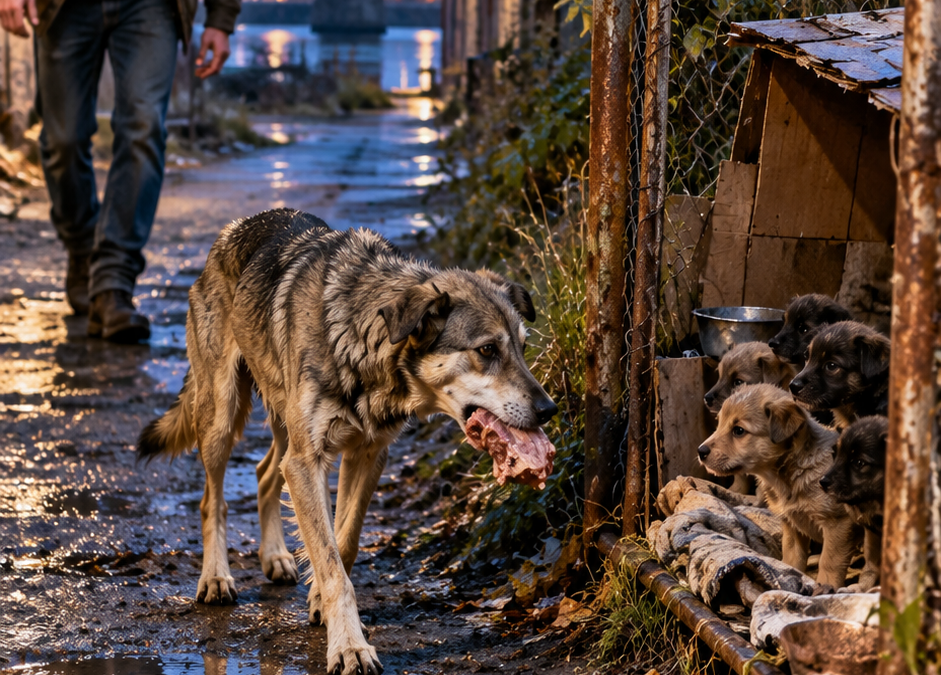
𝗣𝗔𝗥𝗧 𝟮
She came when the street was quiet.
She approached the dumpster.
She searched.
She took what she could.
Then she left quickly.
She never begged.
Never came close enough for me to touch her.
Never made a sound.
Eventually, I started putting food aside specifically for her.
Not garbage.
Food.
At the end of the day, if there were scraps that were still fresh but couldn’t be sold the next morning, I saved them.
Bones with meat on them.
Tendon.
Small pieces of beef.
Occasionally some chicken.
I placed everything in a wooden crate beside the dumpster.
I tried to make it look casual.
As if it had just ended up there.
She always found it.
She would arrive.
Sniff.
Take the food.
Then leave.
I started talking to her even though she wouldn’t let me near.
“Evening.”
She’d stare.
“Long day?”
Nothing.
“You know, normal dogs wag their tails when someone feeds them.”
She ignored me.
“You’re not very grateful.”
Still nothing.
Then she’d take the food and disappear.
I liked her.
I didn’t want to admit that.
But I did.
There was dignity in her.
Something reserved.
Something careful.
Like she had learned not to ask the world for too much.
Weeks passed.
And that was when I began noticing something that bothered me.
She wasn’t gaining weight.
Not even a little.
If anything, she looked worse.
Her ribs remained visible.
Her hips stuck out.
Her shoulders looked sharp beneath her coat.
Sometimes when she walked away, I noticed a slight weakness in her back legs.
I started leaving more food.
It didn’t help.
One evening, I watched her take enough meat to feed a dog her size for at least two meals.
The next evening, she returned looking just as hungry.
I stood in the doorway and frowned.
“What are you doing with all that food?”
Her ears lifted.
“Seriously.”
She took a piece of meat.
“You’re obviously not eating it.”
She turned.
“Where are you going?”
She disappeared around the corner.
For the first time, curiosity turned into concern.
There were possibilities I didn’t like.
Maybe she was sick.
Maybe parasites were preventing her from gaining weight.
Maybe another dog was taking the food from her.
Maybe someone was.
That thought bothered me most.
The next few nights, I watched more carefully.
She always carried the food away.
Always in the same direction.
Never ate behind the shop.
Not once.
Then, on a Thursday night, I made a decision.
I was going to follow her.
I didn’t tell anyone.
It felt ridiculous enough already.
A grown man following a stray dog through town after closing his butcher shop.
But something inside me wouldn’t let it go.
That evening, I put out the usual food.
Then I turned off the lights in the back room and waited.
Right on time, she appeared.
She checked the crate.
Took several pieces.
Then trotted away.
I gave her maybe fifty yards.
Then I followed.
She moved faster than I expected for such a thin animal.
Down the alley.
Across a side street.
Through a narrow passage between two buildings.
I kept my distance.
At one point, she stopped.
I froze behind a parked van.
She looked back.
For a second, I thought she had spotted me.
Then she continued.
We crossed an old pedestrian bridge over a drainage canal.
Beyond it was an industrial area that had been half-abandoned for years.
Old warehouses.
Broken windows.
Rusting loading docks.
Chain-link fencing.
Places most people had no reason to visit after dark.
The dog turned behind one of the warehouses.
I followed.
Then I saw the fence.
It surrounded a narrow overgrown lot behind two buildings.
Parts of it leaned badly.
Some sections were covered in weeds.
But it was still intact enough to prevent a dog from getting through.
She stopped beside one corner.
Then she dropped the food.
My eyes adjusted.
At first, I saw movement.
Then shapes.
Two dogs.
They were inside the fenced area.
One black and white.
One brown.
Both lying on the ground.
I stepped closer.
My stomach turned.
They were worse than she was.
Much worse.
The black-and-white dog tried to raise its head when she approached.
It couldn’t.
The brown dog moved one front paw.
That was all.
The gray-brown dog pushed the food through a gap beneath the fence.
The black-and-white dog crawled toward it.
Slowly.
Painfully.
The brown dog followed.
Then they began eating.
And the dog I had been feeding—
the dog who had come to my shop hungry every night—
stood outside the fence and watched them.
She did not eat.
Not one bite.
I stayed hidden in the darkness.
I couldn’t move.
I had spent weeks wondering why she never gained weight.
Now I knew.
She had been giving everything away.
Every scrap she found behind my shop.
Every piece of meat I left for her.
Every bone.
Every bit of food.
She carried it across town.
Across the bridge.
Behind the warehouses.
To these two dogs.
And she stayed hungry.
I watched her nose one piece closer to the brown dog.
Then another.
The black-and-white dog ate quickly.
She stepped back.
There was no hesitation.
No fight over food.
No instinct to take something for herself.
She just made sure they had it.
I whispered, “Oh, sweetheart.”
My throat closed.
The gray-brown dog sat beside the fence.
The two trapped dogs ate.
She watched.
That was all.
Suddenly, every evening behind my shop looked different in my memory.
She had never been coming for herself.
She had been on a mission.
Every night.
Hungry.
Weak.
Exhausted.
Still coming.
Still carrying food.
Still going back.
I don’t know how those three dogs ended up there.
Maybe they had all belonged to someone.
Maybe they were abandoned together.
Maybe the gray-brown one had managed to escape through a gap that the others couldn’t fit through.
Maybe someone had intentionally trapped them.
I had no answers.
But one thing was obvious.
The fence was keeping two of them inside.
And the third one had chosen not to leave them behind.
I could have gone home and told myself it wasn’t my responsibility.
People do that all the time.
You see suffering.
You feel bad.
Then you say someone else will handle it.
Someone else will call.
Someone else will stop.
Someone else will care.
I stood behind that warehouse for several minutes and realized I could not be that person.
Not after seeing what she had done.
That dog had been starving herself to keep the others alive.
If she could do that, I could make a phone call.
I backed away quietly.
I didn’t want to scare them.
When I reached the bridge, I pulled out my phone.
I called a local animal rescue organization I knew through customers.
Someone answered.
I explained what I had found.
The woman on the phone asked questions.
Location.
Number of dogs.
Condition.
Immediate danger.
Access.
Fence type.
When I described the two trapped dogs, her voice changed.
“We’ll come first thing in the morning.”
“Can you come now?”
There was a pause.
“We don’t have a full team available right this second.”
“They’re extremely weak.”
“Are they conscious?”
“Yes.”
“Can they move?”
“Barely.”
Another pause.
“Stay nearby if you safely can. We’ll contact the emergency veterinary service and see if we can move this up.”
I went home only long enough to grab water, a flashlight, and a warmer jacket.
Then I returned.
The gray-brown dog was gone.
The two dogs inside the fence had eaten.
They were curled together near the corner.
I sat maybe twenty feet away.
I didn’t approach.
“Help is coming.”
The black-and-white dog opened its eyes.
“I know you don’t know what that means.”
The brown dog barely moved.
“But help is coming.”
I stayed until dawn.
At around six, a white rescue van pulled up.
Three people got out.
Two men and one woman.
The woman introduced herself as Laura.
She was maybe forty, with dark hair tied back and the kind of voice that immediately made you trust her.
The men were Marc and Tom.
Both carried equipment.
Bolt cutters.
Blankets.
Water.
Crates.
Medical supplies.
Laura looked at me.
“You’re Samuel?”
“Yeah.”
“The butcher?”
I nodded.
“You found them?”
“One of them found me.”
She looked confused.
I pointed toward the road.
“The gray-brown one. She’s been coming to my shop for food.”
Laura scanned the area.
“Where is she?”
“Not here right now.”
I led them behind the warehouse.
Morning light made everything look worse.
The fence was rusted.
Trash covered part of the ground.
The two dogs inside were clearly visible.
Laura’s face tightened.
“Okay.”
She crouched.
“Hey, babies.”
The black-and-white dog lifted its eyes.
“You’re okay.”
Laura kept her voice low.
“We’re not going to hurt you.”
The brown dog’s ear moved.
“We’re getting you out.”
Marc inspected the fence.
“Locked from the outside.”
Tom looked at the padlock.
“Old.”
“You can cut it?”
“Yeah.”
Laura nodded.
“Slowly. Don’t scare them.”
The two men positioned bolt cutters.
Metal creaked.
The black-and-white dog flinched.
Laura stayed close.
“Easy.”
Another cut.
Then another.
The fence shifted.
Neither dog moved toward the opening.
That was the part that broke something inside me.
Freedom was less than ten feet away.
They couldn’t reach it.
When Marc finally opened a section large enough to enter, Laura climbed through.
She approached slowly.
No sudden movements.
She put down a shallow dish of water.
The black-and-white dog sniffed.
Then drank.
At first slowly.
Then desperately.
Laura pulled the dish back after a few seconds.
“Not too fast.”
The brown dog drank next.
Its tongue barely moved.
I knelt outside the fence.
“Are they going to make it?”
Laura didn’t answer immediately.
“We’re going to do everything we can.”
It was not a promise.
I respected her for that.
Marc brought in blankets.
Tom prepared a stretcher.
Then I heard footsteps behind us.
Soft.
Familiar.
I turned.
The gray-brown dog stood near the warehouse wall.
She was watching.
She didn’t approach.
She just stood there, alert.
Making sure.
Laura saw her.
“Is that her?”
“Yeah.”
“The one bringing food?”
“Every night.”
Laura looked at the thin dog.
Then back at the two inside.
“How long?”
“I don’t know.”
“How long have you been feeding her?”
“Several weeks.”
“And she’s been carrying it here?”
“Apparently.”
Laura’s eyes filled.
She swallowed.
“Wow.”
The dog stared at us.
I crouched.
“It’s okay.”
She didn’t move.
“We’re helping them.”
Her ears tilted forward.
Laura moved slowly toward her.
“Hey, sweetheart.”
The dog watched.
No growl.
No retreat.
Laura stopped a few feet away.
Held out one hand.
The dog sniffed the air.
Then took one cautious step.
Another.
I held my breath.
She reached Laura.
Sniffed her fingers.
Then she did something I never expected.
She lowered her head into Laura’s palm.
Just rested it there.
Laura closed her eyes.
“Oh, honey.”
The dog stayed.
Laura gently touched her cheek.
“You’ve been doing all this by yourself, haven’t you?”
The dog leaned closer.
Then Laura wrapped one arm around her.
The dog didn’t resist.
She pressed into Laura’s chest.
I turned away for a second because my eyes were burning.
When I looked back, Laura had tears running down her face.
So did I.
I walked over.
“She’s never let me touch her.”
Laura looked at me.
“Maybe she knows she doesn’t have to be in charge anymore.”
That sentence stayed with me.
They carried the two trapped dogs out on blankets.
The black-and-white one barely reacted.
The brown one gave a weak sigh when Tom lifted him.
The gray-brown dog followed.
Every step.
When the rescue team loaded the two weak dogs into the van, she tried to climb in after them.
Laura smiled through tears.
“Of course.”
We lifted her in too.
I drove behind them to the veterinary clinic.
Dr. Ellis met us there.
She was in her early fifties and had been treating animals for more than twenty years.
She examined all three.
Dehydration.
Malnutrition.
Parasites.
Muscle wasting.
Skin infections.
Old injuries.
But no immediate evidence of disease that made recovery impossible.
“The two inside the enclosure are critical,” she told us.
My stomach tightened.
“And her?”
She looked toward the gray-brown dog.
“She’s in better shape than they are, but that’s not saying much.”
“Will they survive?”
Dr. Ellis removed her gloves.
“They’ve made it this far.”
“Because of her.”
Laura nodded.
Dr. Ellis looked at the dog.
“Then she bought them time.”
That was exactly what she had done.
Time.
One mouthful at a time.
One bone.
One scrap.
One nightly walk across that bridge.
She had kept them alive long enough for someone to notice.
The clinic kept all three.
I went back to my shop that afternoon.
I tried to work.
I couldn’t concentrate.
Every time I cut meat, I remembered that dog carrying pieces away.
At closing time, I automatically set aside scraps.
Then I stopped.
The crate behind the shop was empty.
She wasn’t coming.
For the first time in weeks, that thought made me smile.
She didn’t need to.
The next morning, I visited the clinic.
The gray-brown dog was awake.
When she saw me, she stood.
Her tail moved.
Just once.
It was the first time I’d seen it happen.
“Well, look at that.”
I crouched.
She came closer.
I held out my hand.
She sniffed.
Then let me touch her head.
I nearly laughed.
“So now I’m allowed?”
She leaned against my leg.
“Typical.”
The black-and-white dog was receiving fluids.
The brown one was sleeping.
Dr. Ellis said both had eaten tiny amounts.
Not enough.
But something.
“That’s good?”
“It’s a start.”
I began visiting every day.
And because I was a butcher, I brought food.
Dr. Ellis controlled portions carefully.
“You cannot just feed starving dogs unlimited meat,” she warned me.
“I know.”
She gave me a look.
“You look like a man who would.”
I raised both hands.
“I’ll follow instructions.”
“Good.”
I brought small portions of fresh meat approved for their recovery diet.
The black-and-white dog recovered faster.
I started calling him Blackie.
Not very original.
But it fit.
The brown dog became Brownie.
Even less original.
Laura laughed the first time she heard the names.
“Creative.”
“I’m a butcher, not a novelist.”
“And her?”
She pointed toward the gray-brown dog.
I hesitated.
I had been thinking about it.
“Hannah.”
Laura smiled.
“Hannah?”
“Yeah.”
“Why?”
“I don’t know.”
That was true.
The name simply felt right.
I leaned toward her.
“Hannah.”
Her ears lifted.
I said it again.
“Hannah.”
She walked over.
Laura shrugged.
“Looks like she agrees.”
From then on, she was Hannah.
Her recovery was faster than the others.
Within a few weeks, her coat began to improve.
Her ribs became less visible.
Her eyes looked brighter.
But she had one obsession.
Blackie and Brownie.
Every time I visited them, Hannah rushed to their enclosure.
She sniffed their faces.
Licked their ears.
Inspected their bowls.
If they were eating, she watched.
If they weren’t, she lay beside them.
One afternoon, Blackie was too tired to eat.
Hannah took a piece of meat from her own bowl.
I watched closely.
She picked it up.
Carried it toward Blackie.
Dropped it beside him.
I shook my head.
“No.”
Hannah looked at me.
“Absolutely not.”
She tilted her head.
“You’re eating your own food now.”
Blackie sniffed the piece.
I moved it back.
Hannah stared at me like I had committed a crime.
Laura laughed.
“She’s offended.”
“She nearly starved herself once.”
I pointed at Hannah.
“We are not doing that again.”
Hannah sat.
Her expression made me laugh.
“Don’t argue.”
Eventually, she ate.
But she continued checking on them.
Some habits come from love.
Others come from fear.
Hannah had spent so long believing their survival depended on her that she didn’t know how to stop.
Little by little, we taught her.
You’re allowed to eat.
They’re still safe.
You’re allowed to sleep.
They’ll still be here.
You’re allowed to walk away.
Someone else will watch them.
It took time.
Blackie was the first of the two to stand.
I was there.
He pushed himself up on trembling legs.
His whole body shook.
He took one step.
Then another.
Then sat heavily.
I clapped without thinking.
“You did it.”
Hannah jumped up.
She rushed over.
Licked his face.
Blackie leaned into her.
Brownie recovered more slowly.
For another week, he needed help standing.
But then one afternoon, he surprised us.
I entered the room.
He was upright.
Not steady.
But standing.
Dr. Ellis smiled.
“He waited until you got here.”
“Of course he did.”
I crouched.
“Show-off.”
Brownie took three steps.
Then five.
Hannah followed beside him.
Close enough to catch him if dogs could catch each other.
That image stayed with me.
For weeks, she had carried food to him.
Now she walked beside him while he learned to carry himself again.
Once the immediate danger had passed, we began discussing long-term plans.
Blackie and Brownie would eventually need homes.
So would Hannah.
Laura asked me one afternoon, “Have you thought about taking her?”
I pretended not to understand.
“Taking who?”
She looked at Hannah, who was sleeping beside my chair.
“Very funny.”
“I run a business.”
“So?”
“I live alone.”
“So?”
“I’m at the shop all day.”
“She already goes there every evening.”
“That’s different.”
Laura smiled.
“You know she’s yours.”
“She’s not mine.”
Hannah opened one eye.
Laura pointed.
“Tell her.”
I looked down.
Hannah put her head on my shoe.
I sighed.
“That’s manipulation.”
Laura laughed.
The truth was, I had already started imagining her at my house.
A bed near the kitchen.
A bowl by the back door.
Walks before opening the shop.
Maybe a mat behind the counter during quiet hours.
The thought scared me.
Not because I didn’t want her.
Because I did.
My father had loved dogs.
We had one when I was young.
After he died, I never got another.
I told myself I was too busy.
Maybe that was partly true.
But grief makes people invent practical excuses for emotional choices.
Having another dog felt like reopening a room in my life I had locked years earlier.
Hannah didn’t care about any of that.
She just kept choosing me.
One day, I was sitting beside her at the clinic.
She rested her head on my knee.
I scratched behind her ear.
“You know, this is your fault.”
Her tail moved.
“I had a perfectly uncomplicated life.”
She looked up.
“Shop. House. Work. Sleep.”
Another tail wag.
“Now look.”
She closed her eyes.
I laughed.
“Fine.”
That evening, I filled out the adoption paperwork.
When I signed the last page, Laura looked at me.
“Congratulations.”
“On what?”
“Being adopted.”
I frowned.
“I adopted her.”
Laura shook her head.
“Sure you did.”
Hannah came home with me the next day.
At first, I worried she would be nervous.
She wasn’t.
She inspected every room.
Sniffed the furniture.
Found the kitchen.
Found the back door.
Then she lay down beside my chair.
As if she had always lived there.
The next morning, I woke before my alarm.
Hannah stood beside the bed.
“What?”
Her tail wagged.
“It’s five.”
Another wag.
“You don’t know what five means.”
She sneezed.
I laughed.
“Okay.”
I took her outside.
Then we went to the shop.
She walked through the front door behind me.
Sniffed everything.
Then sat near the back room.
“You understand something.”
I pointed at her.
“You don’t eat merchandise.”
She stared.
“That’s important.”
She lay down.
Customers noticed immediately.
“Who is this?”
“Her name is Hannah.”
“New dog?”
“Yeah.”
Some knew the story.
Word had spread through the neighborhood.
Soon people started bringing treats.
I had to stop them.
“Ask first.”
One older woman came in with a bag of dog biscuits.
“For the hero.”
Hannah stared at her.
The woman crouched.
“You saved your friends, didn’t you?”
Hannah licked her hand.
For the first time, I began to understand that her story wasn’t only changing me.
It affected everyone who heard it.
People expected survival to be selfish.
It often has to be.
When you’re starving, you eat.
When you’re afraid, you run.
When you’re hurt, you protect yourself.
Hannah had done the opposite.
She had been starving.
Yet she shared.
She could have escaped.
Yet she returned.
She could have chosen herself.
Yet night after night, she chose them.
Blackie and Brownie continued improving.
I took Hannah to see them several times each week.
The reunion was always the same.
Hannah ran toward them.
Blackie became excited.
Brownie followed.
The three pressed together.
They were family.
Not because they looked alike.
Not because anyone had assigned them to each other.
Because somewhere before I met them, they had decided they belonged together.
About three months after the rescue, Laura called.
“We have an adoption application for Blackie and Brownie.”
My chest tightened.
“Together?”
“Yes.”
“Both?”
“Both.”
I relaxed.
“Who?”
“A couple named Catherine and James.”
I met them a few days later.
They were kind.
Patient.
They had a fenced yard.
Previous rescue experience.
No intention of separating the dogs.
Catherine sat on the floor while Blackie sniffed her.
James waited for Brownie to approach at his own pace.
Hannah watched everything.
Catherine looked at her.
“She’s the one who kept them alive?”
“Yes.”
She shook her head.
“Incredible.”
James rubbed Blackie’s chest.
“We wouldn’t separate these two.”
“Good.”
“They’ve been through too much together.”
That was exactly what I needed to hear.
The adoption was approved.
On the day Blackie and Brownie left, Hannah came with me.
Catherine and James loaded the dogs into their vehicle.
Blackie climbed in easily.
Brownie hesitated.
Hannah touched noses with him.
Brownie stepped up.
Then the door closed.
Hannah stood beside me.
She watched the car leave.
She didn’t bark.
Didn’t chase.
Didn’t pull against the leash.
She simply watched.
Until the vehicle disappeared.
I crouched beside her.
“They’re okay.”
Her eyes remained on the road.
“They have a home.”
I placed my hand on her neck.
“You did it.”
She looked at me.
I swallowed.
“You kept them alive.”
Hannah leaned into me.
“Now you get to live for yourself.”
She licked my hand.
I smiled.
“Or maybe not entirely for yourself.”
Her tail moved.
We went home.
Life became quieter after that.
Good quiet.
Hannah settled into a routine.
Every morning, she came to the shop.
She had a bed near the back.
During busy hours, she usually slept.
When the front bell rang, one ear lifted.
Customers learned her habits.
Children asked to pet her.
Older customers talked to her while waiting for their orders.
One man brought her a tennis ball every month because she destroyed them faster than expected.
A woman knitted her a blanket.
Someone else brought a collar with her name engraved on the tag.
Hannah became part of the shop.
My father would have loved her.
I thought about that often.
Sometimes, when the store was empty, I would sit on the stool near the front window.
Hannah would lie in the sunlight.
I’d look at her and imagine my father standing behind the counter.
“Respect hunger,” he had said.
I finally understood what he meant.
Not pity.
Respect.
Hunger isn’t weakness.
It’s need.
And there is dignity in recognizing need without judgment.
Hannah understood that better than anyone.
A year passed.
I turned thirty-nine.
Hannah was healthy.
Her coat became thick and shiny.
Her muscles filled out.
Nobody who met her for the first time would have guessed she was the same skeletal dog who once waited behind my dumpster.
Catherine and James sent updates about Blackie and Brownie.
Photos.
Videos.
Blackie sleeping on a couch.
Brownie running through grass.
The two curled together on the same oversized bed even though they had two separate ones.
Whenever I showed Hannah a photo, I knew she didn’t understand what she was looking at.
Still, I showed her.
“Look.”
She sniffed the phone.
“That’s Blackie.”
Another sniff.
“And Brownie.”
She looked at me.
“They’re good.”
Her tail moved.
I chose to believe she understood my tone.
One summer afternoon, I sat outside the shop during a slow period.
Hannah was playing with two children from the neighborhood.
A girl about eight years old threw a ball.
Hannah chased it.
Brought it back.
The girl laughed.
After several rounds, she walked over and sat beside me.
“Mr. Carter?”
“Yeah?”
“Why is Hannah so nice?”
I looked at the dog.
She was lying in the grass now, tongue out, tail moving.
“What do you mean?”
“She’s nice to everybody.”
I thought for a second.
“Maybe because she knows what it feels like to need something.”
The girl frowned.
“What did she need?”
“Food.”
“Was she hungry?”
“Very.”
The girl’s eyes widened.
“Did you feed her?”
“Yeah.”
“Then why was she still hungry?”
I looked at Hannah.
“Because she gave the food to her friends.”
The girl stared.
“All of it?”
“Almost.”
“Why?”
That question stayed between us for a moment.
Why?
Adults always want complicated explanations.
Instinct.
Pack behavior.
Bonding.
Trauma.
Social attachment.
Maybe all of those played a part.
But sitting beside that little girl, none of them felt necessary.
“Because she loved them.”
The girl looked at Hannah.
Then said quietly, “I want to be like that.”
I smiled.
“You don’t have to starve yourself for anybody.”
She laughed.
“That’s not what I mean.”
“I know.”
She watched Hannah.
“I want to share.”
“That’s a good place to start.”
Hannah brought the ball to us.
The girl threw it again.
As I watched them, I thought about that night behind the warehouse.
I had asked myself the same question hundreds of times since.
What if I hadn’t followed her?
What if I had looked at a skinny stray behind my shop and decided it wasn’t my problem?
What if I had assumed she was simply ungrateful because she never stayed to eat?
What if I had stopped leaving food?
There were too many possibilities.
None of them mattered anymore.
I had followed.
I had seen.
I had called.
The rescue team had come.
Blackie survived.
Brownie survived.
Hannah survived.
And somehow, my own life changed too.
Before Hannah, I had thought I was content.
I worked.
I paid my bills.
I knew my customers.
I had a decent house.
A reliable truck.
A business my father would have been proud of.
I wasn’t unhappy.
But there is a difference between not being unhappy and feeling connected to something.
Hannah gave me that connection.
Every morning, she waited by the door while I grabbed my keys.
Every night, she followed me home.
If I sat outside, she sat beside me.
If I stayed late at the shop, she slept near the counter.
She didn’t need much.
Food.
Water.
A safe place.
A little attention.
The same things she had once given away when she had almost nothing.
One evening, after closing, I carried a bag of trash out back.
For a moment, I stopped beside the dumpster.
The same place where I had first seen her.
Hannah stood behind me.
I pointed.
“Right there.”
She sniffed.
“That’s where you used to stand.”
Her ears lifted.
“You looked terrible.”
She wagged her tail.
“Don’t take that personally.”
I laughed.
“You were all ribs.”
She stepped closer.
“And stubborn.”
She leaned against my leg.
I rested my hand on her back.
“But you kept coming.”
The alley was quiet.
Streetlights glowed beyond the buildings.
For a second, I could see it as it had been that first night.
The thin dog.
The cold pavement.
The cautious eyes.
I remembered thinking she wanted food.
That was only partly true.
She needed food.
But she wanted something bigger.
She wanted her friends to live.
I crouched.
“You know what’s funny?”
Hannah licked my chin.
“I thought I was helping you.”
Her tail thumped against the ground.
“But you were already doing more for someone else than most people ever notice.”
I hugged her.
She accepted it calmly.
That was Hannah.
No drama.
No demands.
Just presence.
Over time, I stopped thinking of her as the dog I rescued.
That description felt wrong.
I had made a phone call.
Laura, Marc, Tom, and Dr. Ellis did the technical work.
They cut the fence.
Provided veterinary care.
Managed nutrition.
Monitored recovery.
Hannah had done the hardest part.
She had kept hope alive long enough for help to arrive.
Every night she crossed that bridge.
Every night she returned to those warehouses.
Every night she pushed food through that fence.
Every night she went hungry.
Maybe she didn’t think about it in the language we use.
Maybe there was no heroic idea in her mind.
No concept of sacrifice.
Maybe she simply knew two members of her little family couldn’t get out.
And she could.
So she went.
That was enough.
People sometimes ask me whether I believe animals love the way humans do.
I don’t know if love has to be exactly the same to be real.
Maybe dogs don’t write poetry about it.
Maybe they don’t sit awake trying to define it.
Maybe that is why they sometimes understand it better than we do.
Hannah’s version of love was practical.
Find food.
Carry it home.
Go back tomorrow.
Stay nearby.
Make sure they eat.
When they’re safe, rest.
It wasn’t complicated.
And maybe love isn’t supposed to be.
A few months after the first anniversary of the rescue, Catherine and James invited Hannah and me to visit Blackie and Brownie.
I hadn’t seen the dogs in person since their adoption.
We drove out on a Saturday morning.
The moment I pulled into their driveway, Hannah became alert.
I don’t know what she smelled.
But she knew.
Before I opened the door, she was already whining softly.
“Okay.”
I attached her leash.
“Easy.”
Catherine opened the gate.
Blackie appeared first.
He froze.
Hannah froze.
Then everything happened at once.
Blackie ran.
Hannah pulled the leash so hard I almost lost my footing.
Brownie came behind him.
I released Hannah inside the fenced yard.
The three collided.
Not aggressively.
Joyfully.
They sniffed.
Licked.
Ran in circles.
Brownie, who had once been too weak to stand, chased Hannah across the yard.
Blackie barked.
Hannah spun around and ran back.
I stood beside Catherine.
She had tears in her eyes.
“So they remember.”
“Yeah.”
James came outside.
“I don’t think we’re going to have any peace today.”
I laughed.
“Good.”
For almost an hour, the three dogs played.
Eventually, they collapsed beneath a tree.
Hannah lay in the middle.
Blackie on one side.
Brownie on the other.
Exactly the way family sits together without needing to think about it.
I walked over.
Crouched.
“You happy?”
Hannah looked up.
She was breathing hard.
Eyes bright.
I rubbed her chest.
“You did good.”
For once, those words felt too small.
I sat in the grass beside them.
And I thought about where each of them had been.
Behind a butcher shop.
Behind a fence.
Behind abandoned warehouses.
Now they were lying under a tree in a safe yard after eating breakfast from full bowls.
Maybe miracles aren’t sudden.
Maybe some of them happen one small decision at a time.
A dog decides to carry food.
A butcher decides to follow.
A rescue worker decides to answer the phone.
A veterinarian decides to keep trying.
A couple decides two dogs should not be separated.
No single action looks enormous.
Together, they change lives.
When Hannah and I left that afternoon, she looked back through the car window.
Blackie and Brownie stood beside Catherine.
I touched Hannah’s shoulder.
“They’re okay.”
She turned toward me.
“You know that now.”
She lay down.
Ten minutes later, she was asleep.
That’s one of the things I love most about her now.
She knows how to sleep deeply.
When I first met her, I don’t think she ever truly rested.
Even when she sat behind my shop, she watched everything.
Listened.
Calculated.
Then hurried away.
There was always someone waiting.
Now she sleeps.
Sometimes on her side.
Sometimes upside down with all four legs in ridiculous positions.
Sometimes snoring loudly enough that customers laugh.
Safety looks different on every animal.
On Hannah, it looks like sleep.
It looks like a full bowl she doesn’t feel obligated to carry away.
It looks like leaving a piece of food behind because she knows there will be more tomorrow.
It looks like lying in sunlight without checking the road.
I still run the same butcher shop.
The red awning is still there.
The bell still rings.
I still arrive at six.
I still arrange the meat the way my father taught me.
But there is one difference.
Near the front window is a dog bed.
Most mornings, Hannah is in it.
Customers know her.
Children ask for her.
People tell new customers her story.
Sometimes someone will point and say, “That’s the dog who fed the other two.”
I always smile.
Because that’s true.
But it is not the whole story.
Hannah didn’t only keep Blackie and Brownie alive.
She changed Laura.
Changed me.
Changed people who heard what she did.
She reminded us that generosity is not measured by how much you have.
It is measured by what you’re willing to give when you have very little.
A wealthy person can give a thousand dollars and never feel it.
Hannah gave dinner while starving.
There is a difference.
She also taught me something about paying attention.
Suffering doesn’t always announce itself.
Sometimes it appears quietly behind your shop.
Sometimes it takes food and leaves.
Sometimes the mystery isn’t why someone keeps coming.
The mystery is where they go afterward.
If I hadn’t paid attention to the fact that Hannah remained thin, I might never have followed her.
If I hadn’t followed, I might never have found Blackie and Brownie.
Compassion is often less about grand gestures than curiosity.
Why is that person struggling?
Why does that animal behave that way?
What’s happening that I cannot see?
Ask one more question.
Look one step farther.
Follow when something doesn’t make sense.
Sometimes the answer changes everything.
Hannah is beside me as I think about all this.
Older now.
Still healthy.
Still gentle.
Her head rests on my boot while I close the shop.
Outside, evening settles over the street.
Years ago, this was the hour when she would appear behind the dumpster.
Hungry.
Exhausted.
Ready to take whatever she could find and carry it to someone who needed it more.
Now she doesn’t have to search for food.
She doesn’t have to cross the bridge.
She doesn’t have to stand outside a fence wondering whether her friends will survive another night.
Blackie and Brownie are safe.
She is safe.
I am no longer the man who believes the world ends at the edge of his own responsibilities.
Hannah changed that.
Before her, I thought kindness was something you did when it was convenient.
Help someone if you have extra.
Give when you can spare it.
Hannah showed me another version.
Give because someone needs it.
Stay because leaving would mean they are alone.
Come back because yesterday wasn’t enough.
That is a harder kind of kindness.
A better one.
Sometimes, late at night, I think about my father.
I think he would have liked Hannah.
Actually, no.
He would have loved her.
He probably would have spoiled her worse than my customers do.
I imagine him watching her carry those first scraps away.
He would have noticed too.
He always noticed hunger.
Maybe that is why I followed.
Because somewhere inside me, his voice was still there.
Respect hunger.
Respect need.
Pay attention.
One night, I sat on the front step after closing.
Hannah lay beside me.
The street was quiet.
I placed my hand on her head.
“You know something?”
She looked up.
“You taught me more than I expected.”
She yawned.
I laughed.
“Great. Very emotional response.”
She put her head back down.
I stared at the street.
“I used to think taking care of someone meant making sure they had enough.”
Food.
Money.
A roof.
Practical things.
Those things matter.
But Hannah showed me another part.
Sometimes caring means remembering who isn’t in the room.
Who is still behind the fence.
Who can’t get out on their own.
Who is waiting for someone else to come back.
That is what she did.
Every single day.
And maybe that is the most important lesson of all.
The world becomes easier to ignore when you only look at what is directly in front of you.
Hannah forced me to look farther.
She showed me that the piece of meat disappearing into the night had a destination.
A story.
Two lives attached to it.
I stood.
“Come on.”
Hannah rose.
We went inside.
I turned off the lights.
She waited by the door.
As I locked the shop, I looked once more toward the back alley.
Nothing there.
No thin dog.
No scraping claws.
No desperate search through trash.
Just quiet.
I smiled.
“Ready?”
Hannah’s tail moved.
We walked home together.
And that is how I choose to remember the story.
Not as a story about three starving dogs.
Not as a story about abandonment.
Not even as a story about rescue.
I remember it as a story about one small, exhausted animal who had almost nothing and still decided what she had belonged to someone else too.
Blackie survived because of that.
Brownie survived because of that.
And in a different way, part of me woke up because of that.
Hannah taught me that loyalty can look like crossing the same bridge night after night.
That friendship can look like pushing food beneath a fence.
That love can look like staying hungry so someone weaker gets another day.
And she taught me something else.
Sometimes the life you save doesn’t end up being only the one in front of you.
Sometimes kindness travels farther than you ever know.
One dog feeds two others.
One man notices.
Three animals survive.
Two find a home together.
One comes home with him.
A child hears the story and says, “I want to be like that.”
Maybe someday she will be.
Maybe she’ll notice someone else everyone has ignored.
Maybe she’ll stop.
Maybe she’ll share.
Maybe Hannah’s story will keep moving forward in ways none of us can see.
I hope so.
Because the best thing Hannah ever taught me was that a good heart doesn’t need to be powerful.
It doesn’t need money.
Status.
Words.
It doesn’t even need to understand what heroism means.
Sometimes it only needs to notice that someone else is hungry.
And then decide not to walk away.
Have you finished reading the story and want to read it again?
Every Night, a Starving Dog Took Food From My Shop—Then I Followed Her and Found Out Why
Every night, a starving gray-brown dog came behind my butcher shop, took whatever food she could find, and disappeared into the darkness before I could get anywhere near her.
What bothered me was that even though I started leaving better scraps out for her every evening, she kept getting thinner, weaker, and more exhausted—as if she weren’t eating any of it.
So one night I followed her across an old bridge and behind a row of abandoned warehouses, and what I found waiting for her on the other side of a rusted fence changed the way I understood loyalty forever.
My name is Samuel Carter.
I’m thirty-eight years old, and nearly my entire life has revolved around a small butcher shop I inherited from my father.
It’s not the kind of place people drive across the state to visit.
There is no fancy sign.
No polished marble counter.
No expensive branding.
Just an old brick storefront on a quiet street, a red awning my father installed when I was still a teenager, two refrigerated display cases, a heavy wooden chopping block, and a bell above the front door that has been ringing for longer than I’ve been alive.
Every morning, I arrive before sunrise.
At six, I unlock the front door.
I switch on the lights.
I clean the counters even if I cleaned them the night before.
Then I arrange the day’s meat in the display case the same way my father taught me.
Beef on one side.
Pork on the other.
Chicken farther down.
Fresh cuts in front.
Bones and trimmings kept separately in the back.
My father believed a butcher shop should smell clean, look orderly, and never waste more than necessary.
“Respect the animal,” he used to tell me.
“Respect the customer.”
Then he would point toward whatever scraps remained from the day’s work.
“And respect hunger.”
When I was younger, I didn’t fully understand what he meant by that last part.
I do now.
Hunger strips away pride.
Human or animal, it changes the way a body moves.
The way eyes follow food.
The way someone hesitates before taking what they need.
And maybe that was why I noticed Hannah the first night.
At the time, of course, I didn’t know her name.
She didn’t have one.
At least not one I knew.
I was closing the shop after a long day.
The street was mostly empty.
It was cold enough that I could see my breath when I carried the trash bags out through the back door.
I had just thrown one bag into the dumpster when I heard a faint scraping noise.
Metal against claw.
I turned.
A dog stood near the far side of the dumpster.
She was medium-sized, some kind of mixed breed.
Gray-brown coat.
Long legs.
Narrow face.
Her fur was dirty and rough.
Her body was so thin I could count her ribs without trying.
She didn’t growl.
Didn’t bark.
Didn’t run.
She just stood there watching me.
There was something unusual in her expression.
Most hungry strays I had encountered either begged or fled.
Some kept their distance but watched your hands.
Others became frantic around food.
This dog did none of that.
She looked at me calmly.
Almost politely.
As if she were saying, I don’t want trouble. I just need whatever you’re throwing away.
I set down the trash bag.
“You’re hungry.”
Her ears moved.
“Yeah. I can see that.”
I expected her to back away when I stepped toward the door.
She did.
But only a little.
I went back inside.
There was a tray of beef trimmings I hadn’t yet discarded.
Nothing fancy.
Small pieces.
Tendon.
Fat.
A little meat that wasn’t going to be sold the next morning.
I carried some outside and placed it on the ground several feet from her.
“There.”
She stared at me.
I walked backward.
“Go ahead.”
She waited until I reached the doorway.
Then she moved.
Carefully.
One step.
Then another.
She sniffed the meat.
I expected her to eat right there.
Instead, she picked up the largest piece.
Then another.
She held what she could in her mouth.
And left.
I watched her disappear down the alley.
“Strange dog,” I muttered.
Then I went home.
The next evening, she came back.
Almost at the same time.
The sun had gone down.
I had just finished cleaning the cutting table when I heard the familiar scrape outside.
I opened the back door.
There she was.
Same distance.
Same quiet stare.
“You again.”
Her tail didn’t move.
I put out more scraps.
She waited until I stepped away.
Then she took them and disappeared.
The third night, she returned.
Then the fourth.
After a week, I realized she wasn’t arriving randomly.
She appeared almost every evening just after sunset.
Never during business hours.
Never when customers were around.
Never in the morning.
She came when the street was quiet.
She approached the dumpster.
She searched.
She took what she could.
Then she left quickly.
She never begged.
Never came close enough for me to touch her.
Never made a sound.
Eventually, I started putting food aside specifically for her.
Not garbage.
Food.
At the end of the day, if there were scraps that were still fresh but couldn’t be sold the next morning, I saved them.
Bones with meat on them.
Tendon.
Small pieces of beef.
Occasionally some chicken.
I placed everything in a wooden crate beside the dumpster.
I tried to make it look casual.
As if it had just ended up there.
She always found it.
She would arrive.
Sniff.
Take the food.
Then leave.
I started talking to her even though she wouldn’t let me near.
“Evening.”
She’d stare.
“Long day?”
Nothing.
“You know, normal dogs wag their tails when someone feeds them.”
She ignored me.
“You’re not very grateful.”
Still nothing.
Then she’d take the food and disappear.
I liked her.
I didn’t want to admit that.
But I did.
There was dignity in her.
Something reserved.
Something careful.
Like she had learned not to ask the world for too much.
Weeks passed.
And that was when I began noticing something that bothered me.
She wasn’t gaining weight.
Not even a little.
If anything, she looked worse.
Her ribs remained visible.
Her hips stuck out.
Her shoulders looked sharp beneath her coat.
Sometimes when she walked away, I noticed a slight weakness in her back legs.
I started leaving more food.
It didn’t help.
One evening, I watched her take enough meat to feed a dog her size for at least two meals.
The next evening, she returned looking just as hungry.
I stood in the doorway and frowned.
“What are you doing with all that food?”
Her ears lifted.
“Seriously.”
She took a piece of meat.
“You’re obviously not eating it.”
She turned.
“Where are you going?”
She disappeared around the corner.
For the first time, curiosity turned into concern.
There were possibilities I didn’t like.
Maybe she was sick.
Maybe parasites were preventing her from gaining weight.
Maybe another dog was taking the food from her.
Maybe someone was.
That thought bothered me most.
The next few nights, I watched more carefully.
She always carried the food away.
Always in the same direction.
Never ate behind the shop.
Not once.
Then, on a Thursday night, I made a decision.
I was going to follow her.
I didn’t tell anyone.
It felt ridiculous enough already.
A grown man following a stray dog through town after closing his butcher shop.
But something inside me wouldn’t let it go.
That evening, I put out the usual food.
Then I turned off the lights in the back room and waited.
Right on time, she appeared.
She checked the crate.
Took several pieces.
Then trotted away.
I gave her maybe fifty yards.
Then I followed.
She moved faster than I expected for such a thin animal.
Down the alley.
Across a side street.
Through a narrow passage between two buildings.
I kept my distance.
At one point, she stopped.
I froze behind a parked van.
She looked back.
For a second, I thought she had spotted me.
Then she continued.
We crossed an old pedestrian bridge over a drainage canal.
Beyond it was an industrial area that had been half-abandoned for years.
Old warehouses.
Broken windows.
Rusting loading docks.
Chain-link fencing.
Places most people had no reason to visit after dark.
The dog turned behind one of the warehouses.
I followed.
Then I saw the fence.
It surrounded a narrow overgrown lot behind two buildings.
Parts of it leaned badly.
Some sections were covered in weeds.
But it was still intact enough to prevent a dog from getting through.
She stopped beside one corner.
Then she dropped the food.
My eyes adjusted.
At first, I saw movement.
Then shapes.
Two dogs.
They were inside the fenced area.
One black and white.
One brown.
Both lying on the ground.
I stepped closer.
My stomach turned.
They were worse than she was.
Much worse.
The black-and-white dog tried to raise its head when she approached.
It couldn’t.
The brown dog moved one front paw.
That was all.
The gray-brown dog pushed the food through a gap beneath the fence.
The black-and-white dog crawled toward it.
Slowly.
Painfully.
The brown dog followed.
Then they began eating.
And the dog I had been feeding—
the dog who had come to my shop hungry every night—
stood outside the fence and watched them.
She did not eat.
Not one bite.
I stayed hidden in the darkness.
I couldn’t move.
I had spent weeks wondering why she never gained weight.
Now I knew.
She had been giving everything away.
Every scrap she found behind my shop.
Every piece of meat I left for her.
Every bone.
Every bit of food.
She carried it across town.
Across the bridge.
Behind the warehouses.
To these two dogs.
And she stayed hungry.
I watched her nose one piece closer to the brown dog.
Then another.
The black-and-white dog ate quickly.
She stepped back.
There was no hesitation.
No fight over food.
No instinct to take something for herself.
She just made sure they had it.
I whispered, “Oh, sweetheart.”
My throat closed.
The gray-brown dog sat beside the fence.
The two trapped dogs ate.
She watched.
That was all.
Suddenly, every evening behind my shop looked different in my memory.
She had never been coming for herself.
She had been on a mission.
Every night.
Hungry.
Weak.
Exhausted.
Still coming.
Still carrying food.
Still going back.
I don’t know how those three dogs ended up there.
Maybe they had all belonged to someone.
Maybe they were abandoned together.
Maybe the gray-brown one had managed to escape through a gap that the others couldn’t fit through.
Maybe someone had intentionally trapped them.
I had no answers.
But one thing was obvious.
The fence was keeping two of them inside.
And the third one had chosen not to leave them behind.
I could have gone home and told myself it wasn’t my responsibility.
People do that all the time.
You see suffering.
You feel bad.
Then you say someone else will handle it.
Someone else will call.
Someone else will stop.
Someone else will care.
I stood behind that warehouse for several minutes and realized I could not be that person.
Not after seeing what she had done.
That dog had been starving herself to keep the others alive.
If she could do that, I could make a phone call.
I backed away quietly.
I didn’t want to scare them.
When I reached the bridge, I pulled out my phone.
I called a local animal rescue organization I knew through customers.
Someone answered.
I explained what I had found.
The woman on the phone asked questions.
Location.
Number of dogs.
Condition.
Immediate danger.
Access.
Fence type.
When I described the two trapped dogs, her voice changed.
“We’ll come first thing in the morning.”
“Can you come now?”
There was a pause.
“We don’t have a full team available right this second.”
“They’re extremely weak.”
“Are they conscious?”
“Yes.”
“Can they move?”
“Barely.”
Another pause.
“Stay nearby if you safely can. We’ll contact the emergency veterinary service and see if we can move this up.”
I went home only long enough to grab water, a flashlight, and a warmer jacket.
Then I returned.
The gray-brown dog was gone.
The two dogs inside the fence had eaten.
They were curled together near the corner.
I sat maybe twenty feet away.
I didn’t approach.
“Help is coming.”
The black-and-white dog opened its eyes.
“I know you don’t know what that means.”
The brown dog barely moved.
“But help is coming.”
I stayed until dawn.
At around six, a white rescue van pulled up.
Three people got out.
Two men and one woman.
The woman introduced herself as Laura.
She was maybe forty, with dark hair tied back and the kind of voice that immediately made you trust her.
The men were Marc and Tom.
Both carried equipment.
Bolt cutters.
Blankets.
Water.
Crates.
Medical supplies.
Laura looked at me.
“You’re Samuel?”
“Yeah.”
“The butcher?”
I nodded.
“You found them?”
“One of them found me.”
She looked confused.
I pointed toward the road.
“The gray-brown one. She’s been coming to my shop for food.”
Laura scanned the area.
“Where is she?”
“Not here right now.”
I led them behind the warehouse.
Morning light made everything look worse.
The fence was rusted.
Trash covered part of the ground.
The two dogs inside were clearly visible.
Laura’s face tightened.
“Okay.”
She crouched.
“Hey, babies.”
The black-and-white dog lifted its eyes.
“You’re okay.”
Laura kept her voice low.
“We’re not going to hurt you.”
The brown dog’s ear moved.
“We’re getting you out.”
Marc inspected the fence.
“Locked from the outside.”
Tom looked at the padlock.
“Old.”
“You can cut it?”
“Yeah.”
Laura nodded.
“Slowly. Don’t scare them.”
The two men positioned bolt cutters.
Metal creaked.
The black-and-white dog flinched.
Laura stayed close.
“Easy.”
Another cut.
Then another.
The fence shifted.
Neither dog moved toward the opening.
That was the part that broke something inside me.
Freedom was less than ten feet away.
They couldn’t reach it.
When Marc finally opened a section large enough to enter, Laura climbed through.
She approached slowly.
No sudden movements.
She put down a shallow dish of water.
The black-and-white dog sniffed.
Then drank.
At first slowly.
Then desperately.
Laura pulled the dish back after a few seconds.
“Not too fast.”
The brown dog drank next.
Its tongue barely moved.
I knelt outside the fence.
“Are they going to make it?”
Laura didn’t answer immediately.
“We’re going to do everything we can.”
It was not a promise.
I respected her for that.
Marc brought in blankets.
Tom prepared a stretcher.
Then I heard footsteps behind us.
Soft.
Familiar.
I turned.
The gray-brown dog stood near the warehouse wall.
She was watching.
She didn’t approach.
She just stood there, alert.
Making sure.
Laura saw her.
“Is that her?”
“Yeah.”
“The one bringing food?”
“Every night.”
Laura looked at the thin dog.
Then back at the two inside.
“How long?”
“I don’t know.”
“How long have you been feeding her?”
“Several weeks.”
“And she’s been carrying it here?”
“Apparently.”
Laura’s eyes filled.
She swallowed.
“Wow.”
The dog stared at us.
I crouched.
“It’s okay.”
She didn’t move.
“We’re helping them.”
Her ears tilted forward.
Laura moved slowly toward her.
“Hey, sweetheart.”
The dog watched.
No growl.
No retreat.
Laura stopped a few feet away.
Held out one hand.
The dog sniffed the air.
Then took one cautious step.
Another.
I held my breath.
She reached Laura.
Sniffed her fingers.
Then she did something I never expected.
She lowered her head into Laura’s palm.
Just rested it there.
Laura closed her eyes.
“Oh, honey.”
The dog stayed.
Laura gently touched her cheek.
“You’ve been doing all this by yourself, haven’t you?”
The dog leaned closer.
Then Laura wrapped one arm around her.
The dog didn’t resist.
She pressed into Laura’s chest.
I turned away for a second because my eyes were burning.
When I looked back, Laura had tears running down her face.
So did I.
I walked over.
“She’s never let me touch her.”
Laura looked at me.
“Maybe she knows she doesn’t have to be in charge anymore.”
That sentence stayed with me.
They carried the two trapped dogs out on blankets.
The black-and-white one barely reacted.
The brown one gave a weak sigh when Tom lifted him.
The gray-brown dog followed.
Every step.
When the rescue team loaded the two weak dogs into the van, she tried to climb in after them.
Laura smiled through tears.
“Of course.”
We lifted her in too.
I drove behind them to the veterinary clinic.
Dr. Ellis met us there.
She was in her early fifties and had been treating animals for more than twenty years.
She examined all three.
Dehydration.
Malnutrition.
Parasites.
Muscle wasting.
Skin infections.
Old injuries.
But no immediate evidence of disease that made recovery impossible.
“The two inside the enclosure are critical,” she told us.
My stomach tightened.
“And her?”
She looked toward the gray-brown dog.
“She’s in better shape than they are, but that’s not saying much.”
“Will they survive?”
Dr. Ellis removed her gloves.
“They’ve made it this far.”
“Because of her.”
Laura nodded.
Dr. Ellis looked at the dog.
“Then she bought them time.”
That was exactly what she had done.
Time.
One mouthful at a time.
One bone.
One scrap.
One nightly walk across that bridge.
She had kept them alive long enough for someone to notice.
The clinic kept all three.
I went back to my shop that afternoon.
I tried to work.
I couldn’t concentrate.
Every time I cut meat, I remembered that dog carrying pieces away.
At closing time, I automatically set aside scraps.
Then I stopped.
The crate behind the shop was empty.
She wasn’t coming.
For the first time in weeks, that thought made me smile.
She didn’t need to.
The next morning, I visited the clinic.
The gray-brown dog was awake.
When she saw me, she stood.
Her tail moved.
Just once.
It was the first time I’d seen it happen.
“Well, look at that.”
I crouched.
She came closer.
I held out my hand.
She sniffed.
Then let me touch her head.
I nearly laughed.
“So now I’m allowed?”
She leaned against my leg.
“Typical.”
The black-and-white dog was receiving fluids.
The brown one was sleeping.
Dr. Ellis said both had eaten tiny amounts.
Not enough.
But something.
“That’s good?”
“It’s a start.”
I began visiting every day.
And because I was a butcher, I brought food.
Dr. Ellis controlled portions carefully.
“You cannot just feed starving dogs unlimited meat,” she warned me.
“I know.”
She gave me a look.
“You look like a man who would.”
I raised both hands.
“I’ll follow instructions.”
“Good.”
I brought small portions of fresh meat approved for their recovery diet.
The black-and-white dog recovered faster.
I started calling him Blackie.
Not very original.
But it fit.
The brown dog became Brownie.
Even less original.
Laura laughed the first time she heard the names.
“Creative.”
“I’m a butcher, not a novelist.”
“And her?”
She pointed toward the gray-brown dog.
I hesitated.
I had been thinking about it.
“Hannah.”
Laura smiled.
“Hannah?”
“Yeah.”
“Why?”
“I don’t know.”
That was true.
The name simply felt right.
I leaned toward her.
“Hannah.”
Her ears lifted.
I said it again.
“Hannah.”
She walked over.
Laura shrugged.
“Looks like she agrees.”
From then on, she was Hannah.
Her recovery was faster than the others.
Within a few weeks, her coat began to improve.
Her ribs became less visible.
Her eyes looked brighter.
But she had one obsession.
Blackie and Brownie.
Every time I visited them, Hannah rushed to their enclosure.
She sniffed their faces.
Licked their ears.
Inspected their bowls.
If they were eating, she watched.
If they weren’t, she lay beside them.
One afternoon, Blackie was too tired to eat.
Hannah took a piece of meat from her own bowl.
I watched closely.
She picked it up.
Carried it toward Blackie.
Dropped it beside him.
I shook my head.
“No.”
Hannah looked at me.
“Absolutely not.”
She tilted her head.
“You’re eating your own food now.”
Blackie sniffed the piece.
I moved it back.
Hannah stared at me like I had committed a crime.
Laura laughed.
“She’s offended.”
“She nearly starved herself once.”
I pointed at Hannah.
“We are not doing that again.”
Hannah sat.
Her expression made me laugh.
“Don’t argue.”
Eventually, she ate.
But she continued checking on them.
Some habits come from love.
Others come from fear.
Hannah had spent so long believing their survival depended on her that she didn’t know how to stop.
Little by little, we taught her.
You’re allowed to eat.
They’re still safe.
You’re allowed to sleep.
They’ll still be here.
You’re allowed to walk away.
Someone else will watch them.
It took time.
Blackie was the first of the two to stand.
I was there.
He pushed himself up on trembling legs.
His whole body shook.
He took one step.
Then another.
Then sat heavily.
I clapped without thinking.
“You did it.”
Hannah jumped up.
She rushed over.
Licked his face.
Blackie leaned into her.
Brownie recovered more slowly.
For another week, he needed help standing.
But then one afternoon, he surprised us.
I entered the room.
He was upright.
Not steady.
But standing.
Dr. Ellis smiled.
“He waited until you got here.”
“Of course he did.”
I crouched.
“Show-off.”
Brownie took three steps.
Then five.
Hannah followed beside him.
Close enough to catch him if dogs could catch each other.
That image stayed with me.
For weeks, she had carried food to him.
Now she walked beside him while he learned to carry himself again.
Once the immediate danger had passed, we began discussing long-term plans.
Blackie and Brownie would eventually need homes.
So would Hannah.
Laura asked me one afternoon, “Have you thought about taking her?”
I pretended not to understand.
“Taking who?”
She looked at Hannah, who was sleeping beside my chair.
“Very funny.”
“I run a business.”
“So?”
“I live alone.”
“So?”
“I’m at the shop all day.”
“She already goes there every evening.”
“That’s different.”
Laura smiled.
“You know she’s yours.”
“She’s not mine.”
Hannah opened one eye.
Laura pointed.
“Tell her.”
I looked down.
Hannah put her head on my shoe.
I sighed.
“That’s manipulation.”
Laura laughed.
The truth was, I had already started imagining her at my house.
A bed near the kitchen.
A bowl by the back door.
Walks before opening the shop.
Maybe a mat behind the counter during quiet hours.
The thought scared me.
Not because I didn’t want her.
Because I did.
My father had loved dogs.
We had one when I was young.
After he died, I never got another.
I told myself I was too busy.
Maybe that was partly true.
But grief makes people invent practical excuses for emotional choices.
Having another dog felt like reopening a room in my life I had locked years earlier.
Hannah didn’t care about any of that.
She just kept choosing me.
One day, I was sitting beside her at the clinic.
She rested her head on my knee.
I scratched behind her ear.
“You know, this is your fault.”
Her tail moved.
“I had a perfectly uncomplicated life.”
She looked up.
“Shop. House. Work. Sleep.”
Another tail wag.
“Now look.”
She closed her eyes.
I laughed.
“Fine.”
That evening, I filled out the adoption paperwork.
When I signed the last page, Laura looked at me.
“Congratulations.”
“On what?”
“Being adopted.”
I frowned.
“I adopted her.”
Laura shook her head.
“Sure you did.”
Hannah came home with me the next day.
At first, I worried she would be nervous.
She wasn’t.
She inspected every room.
Sniffed the furniture.
Found the kitchen.
Found the back door.
Then she lay down beside my chair.
As if she had always lived there.
The next morning, I woke before my alarm.
Hannah stood beside the bed.
“What?”
Her tail wagged.
“It’s five.”
Another wag.
“You don’t know what five means.”
She sneezed.
I laughed.
“Okay.”
I took her outside.
Then we went to the shop.
She walked through the front door behind me.
Sniffed everything.
Then sat near the back room.
“You understand something.”
I pointed at her.
“You don’t eat merchandise.”
She stared.
“That’s important.”
She lay down.
Customers noticed immediately.
“Who is this?”
“Her name is Hannah.”
“New dog?”
“Yeah.”
Some knew the story.
Word had spread through the neighborhood.
Soon people started bringing treats.
I had to stop them.
“Ask first.”
One older woman came in with a bag of dog biscuits.
“For the hero.”
Hannah stared at her.
The woman crouched.
“You saved your friends, didn’t you?”
Hannah licked her hand.
For the first time, I began to understand that her story wasn’t only changing me.
It affected everyone who heard it.
People expected survival to be selfish.
It often has to be.
When you’re starving, you eat.
When you’re afraid, you run.
When you’re hurt, you protect yourself.
Hannah had done the opposite.
She had been starving.
Yet she shared.
She could have escaped.
Yet she returned.
She could have chosen herself.
Yet night after night, she chose them.
Blackie and Brownie continued improving.
I took Hannah to see them several times each week.
The reunion was always the same.
Hannah ran toward them.
Blackie became excited.
Brownie followed.
The three pressed together.
They were family.
Not because they looked alike.
Not because anyone had assigned them to each other.
Because somewhere before I met them, they had decided they belonged together.
About three months after the rescue, Laura called.
“We have an adoption application for Blackie and Brownie.”
My chest tightened.
“Together?”
“Yes.”
“Both?”
“Both.”
I relaxed.
“Who?”
“A couple named Catherine and James.”
I met them a few days later.
They were kind.
Patient.
They had a fenced yard.
Previous rescue experience.
No intention of separating the dogs.
Catherine sat on the floor while Blackie sniffed her.
James waited for Brownie to approach at his own pace.
Hannah watched everything.
Catherine looked at her.
“She’s the one who kept them alive?”
“Yes.”
She shook her head.
“Incredible.”
James rubbed Blackie’s chest.
“We wouldn’t separate these two.”
“Good.”
“They’ve been through too much together.”
That was exactly what I needed to hear.
The adoption was approved.
On the day Blackie and Brownie left, Hannah came with me.
Catherine and James loaded the dogs into their vehicle.
Blackie climbed in easily.
Brownie hesitated.
Hannah touched noses with him.
Brownie stepped up.
Then the door closed.
Hannah stood beside me.
She watched the car leave.
She didn’t bark.
Didn’t chase.
Didn’t pull against the leash.
She simply watched.
Until the vehicle disappeared.
I crouched beside her.
“They’re okay.”
Her eyes remained on the road.
“They have a home.”
I placed my hand on her neck.
“You did it.”
She looked at me.
I swallowed.
“You kept them alive.”
Hannah leaned into me.
“Now you get to live for yourself.”
She licked my hand.
I smiled.
“Or maybe not entirely for yourself.”
Her tail moved.
We went home.
Life became quieter after that.
Good quiet.
Hannah settled into a routine.
Every morning, she came to the shop.
She had a bed near the back.
During busy hours, she usually slept.
When the front bell rang, one ear lifted.
Customers learned her habits.
Children asked to pet her.
Older customers talked to her while waiting for their orders.
One man brought her a tennis ball every month because she destroyed them faster than expected.
A woman knitted her a blanket.
Someone else brought a collar with her name engraved on the tag.
Hannah became part of the shop.
My father would have loved her.
I thought about that often.
Sometimes, when the store was empty, I would sit on the stool near the front window.
Hannah would lie in the sunlight.
I’d look at her and imagine my father standing behind the counter.
“Respect hunger,” he had said.
I finally understood what he meant.
Not pity.
Respect.
Hunger isn’t weakness.
It’s need.
And there is dignity in recognizing need without judgment.
Hannah understood that better than anyone.
A year passed.
I turned thirty-nine.
Hannah was healthy.
Her coat became thick and shiny.
Her muscles filled out.
Nobody who met her for the first time would have guessed she was the same skeletal dog who once waited behind my dumpster.
Catherine and James sent updates about Blackie and Brownie.
Photos.
Videos.
Blackie sleeping on a couch.
Brownie running through grass.
The two curled together on the same oversized bed even though they had two separate ones.
Whenever I showed Hannah a photo, I knew she didn’t understand what she was looking at.
Still, I showed her.
“Look.”
She sniffed the phone.
“That’s Blackie.”
Another sniff.
“And Brownie.”
She looked at me.
“They’re good.”
Her tail moved.
I chose to believe she understood my tone.
One summer afternoon, I sat outside the shop during a slow period.
Hannah was playing with two children from the neighborhood.
A girl about eight years old threw a ball.
Hannah chased it.
Brought it back.
The girl laughed.
After several rounds, she walked over and sat beside me.
“Mr. Carter?”
“Yeah?”
“Why is Hannah so nice?”
I looked at the dog.
She was lying in the grass now, tongue out, tail moving.
“What do you mean?”
“She’s nice to everybody.”
I thought for a second.
“Maybe because she knows what it feels like to need something.”
The girl frowned.
“What did she need?”
“Food.”
“Was she hungry?”
“Very.”
The girl’s eyes widened.
“Did you feed her?”
“Yeah.”
“Then why was she still hungry?”
I looked at Hannah.
“Because she gave the food to her friends.”
The girl stared.
“All of it?”
“Almost.”
“Why?”
That question stayed between us for a moment.
Why?
Adults always want complicated explanations.
Instinct.
Pack behavior.
Bonding.
Trauma.
Social attachment.
Maybe all of those played a part.
But sitting beside that little girl, none of them felt necessary.
“Because she loved them.”
The girl looked at Hannah.
Then said quietly, “I want to be like that.”
I smiled.
“You don’t have to starve yourself for anybody.”
She laughed.
“That’s not what I mean.”
“I know.”
She watched Hannah.
“I want to share.”
“That’s a good place to start.”
Hannah brought the ball to us.
The girl threw it again.
As I watched them, I thought about that night behind the warehouse.
I had asked myself the same question hundreds of times since.
What if I hadn’t followed her?
What if I had looked at a skinny stray behind my shop and decided it wasn’t my problem?
What if I had assumed she was simply ungrateful because she never stayed to eat?
What if I had stopped leaving food?
There were too many possibilities.
None of them mattered anymore.
I had followed.
I had seen.
I had called.
The rescue team had come.
Blackie survived.
Brownie survived.
Hannah survived.
And somehow, my own life changed too.
Before Hannah, I had thought I was content.
I worked.
I paid my bills.
I knew my customers.
I had a decent house.
A reliable truck.
A business my father would have been proud of.
I wasn’t unhappy.
But there is a difference between not being unhappy and feeling connected to something.
Hannah gave me that connection.
Every morning, she waited by the door while I grabbed my keys.
Every night, she followed me home.
If I sat outside, she sat beside me.
If I stayed late at the shop, she slept near the counter.
She didn’t need much.
Food.
Water.
A safe place.
A little attention.
The same things she had once given away when she had almost nothing.
One evening, after closing, I carried a bag of trash out back.
For a moment, I stopped beside the dumpster.
The same place where I had first seen her.
Hannah stood behind me.
I pointed.
“Right there.”
She sniffed.
“That’s where you used to stand.”
Her ears lifted.
“You looked terrible.”
She wagged her tail.
“Don’t take that personally.”
I laughed.
“You were all ribs.”
She stepped closer.
“And stubborn.”
She leaned against my leg.
I rested my hand on her back.
“But you kept coming.”
The alley was quiet.
Streetlights glowed beyond the buildings.
For a second, I could see it as it had been that first night.
The thin dog.
The cold pavement.
The cautious eyes.
I remembered thinking she wanted food.
That was only partly true.
She needed food.
But she wanted something bigger.
She wanted her friends to live.
I crouched.
“You know what’s funny?”
Hannah licked my chin.
“I thought I was helping you.”
Her tail thumped against the ground.
“But you were already doing more for someone else than most people ever notice.”
I hugged her.
She accepted it calmly.
That was Hannah.
No drama.
No demands.
Just presence.
Over time, I stopped thinking of her as the dog I rescued.
That description felt wrong.
I had made a phone call.
Laura, Marc, Tom, and Dr. Ellis did the technical work.
They cut the fence.
Provided veterinary care.
Managed nutrition.
Monitored recovery.
Hannah had done the hardest part.
She had kept hope alive long enough for help to arrive.
Every night she crossed that bridge.
Every night she returned to those warehouses.
Every night she pushed food through that fence.
Every night she went hungry.
Maybe she didn’t think about it in the language we use.
Maybe there was no heroic idea in her mind.
No concept of sacrifice.
Maybe she simply knew two members of her little family couldn’t get out.
And she could.
So she went.
That was enough.
People sometimes ask me whether I believe animals love the way humans do.
I don’t know if love has to be exactly the same to be real.
Maybe dogs don’t write poetry about it.
Maybe they don’t sit awake trying to define it.
Maybe that is why they sometimes understand it better than we do.
Hannah’s version of love was practical.
Find food.
Carry it home.
Go back tomorrow.
Stay nearby.
Make sure they eat.
When they’re safe, rest.
It wasn’t complicated.
And maybe love isn’t supposed to be.
A few months after the first anniversary of the rescue, Catherine and James invited Hannah and me to visit Blackie and Brownie.
I hadn’t seen the dogs in person since their adoption.
We drove out on a Saturday morning.
The moment I pulled into their driveway, Hannah became alert.
I don’t know what she smelled.
But she knew.
Before I opened the door, she was already whining softly.
“Okay.”
I attached her leash.
“Easy.”
Catherine opened the gate.
Blackie appeared first.
He froze.
Hannah froze.
Then everything happened at once.
Blackie ran.
Hannah pulled the leash so hard I almost lost my footing.
Brownie came behind him.
I released Hannah inside the fenced yard.
The three collided.
Not aggressively.
Joyfully.
They sniffed.
Licked.
Ran in circles.
Brownie, who had once been too weak to stand, chased Hannah across the yard.
Blackie barked.
Hannah spun around and ran back.
I stood beside Catherine.
She had tears in her eyes.
“So they remember.”
“Yeah.”
James came outside.
“I don’t think we’re going to have any peace today.”
I laughed.
“Good.”
For almost an hour, the three dogs played.
Eventually, they collapsed beneath a tree.
Hannah lay in the middle.
Blackie on one side.
Brownie on the other.
Exactly the way family sits together without needing to think about it.
I walked over.
Crouched.
“You happy?”
Hannah looked up.
She was breathing hard.
Eyes bright.
I rubbed her chest.
“You did good.”
For once, those words felt too small.
I sat in the grass beside them.
And I thought about where each of them had been.
Behind a butcher shop.
Behind a fence.
Behind abandoned warehouses.
Now they were lying under a tree in a safe yard after eating breakfast from full bowls.
Maybe miracles aren’t sudden.
Maybe some of them happen one small decision at a time.
A dog decides to carry food.
A butcher decides to follow.
A rescue worker decides to answer the phone.
A veterinarian decides to keep trying.
A couple decides two dogs should not be separated.
No single action looks enormous.
Together, they change lives.
When Hannah and I left that afternoon, she looked back through the car window.
Blackie and Brownie stood beside Catherine.
I touched Hannah’s shoulder.
“They’re okay.”
She turned toward me.
“You know that now.”
She lay down.
Ten minutes later, she was asleep.
That’s one of the things I love most about her now.
She knows how to sleep deeply.
When I first met her, I don’t think she ever truly rested.
Even when she sat behind my shop, she watched everything.
Listened.
Calculated.
Then hurried away.
There was always someone waiting.
Now she sleeps.
Sometimes on her side.
Sometimes upside down with all four legs in ridiculous positions.
Sometimes snoring loudly enough that customers laugh.
Safety looks different on every animal.
On Hannah, it looks like sleep.
It looks like a full bowl she doesn’t feel obligated to carry away.
It looks like leaving a piece of food behind because she knows there will be more tomorrow.
It looks like lying in sunlight without checking the road.
I still run the same butcher shop.
The red awning is still there.
The bell still rings.
I still arrive at six.
I still arrange the meat the way my father taught me.
But there is one difference.
Near the front window is a dog bed.
Most mornings, Hannah is in it.
Customers know her.
Children ask for her.
People tell new customers her story.
Sometimes someone will point and say, “That’s the dog who fed the other two.”
I always smile.
Because that’s true.
But it is not the whole story.
Hannah didn’t only keep Blackie and Brownie alive.
She changed Laura.
Changed me.
Changed people who heard what she did.
She reminded us that generosity is not measured by how much you have.
It is measured by what you’re willing to give when you have very little.
A wealthy person can give a thousand dollars and never feel it.
Hannah gave dinner while starving.
There is a difference.
She also taught me something about paying attention.
Suffering doesn’t always announce itself.
Sometimes it appears quietly behind your shop.
Sometimes it takes food and leaves.
Sometimes the mystery isn’t why someone keeps coming.
The mystery is where they go afterward.
If I hadn’t paid attention to the fact that Hannah remained thin, I might never have followed her.
If I hadn’t followed, I might never have found Blackie and Brownie.
Compassion is often less about grand gestures than curiosity.
Why is that person struggling?
Why does that animal behave that way?
What’s happening that I cannot see?
Ask one more question.
Look one step farther.
Follow when something doesn’t make sense.
Sometimes the answer changes everything.
Hannah is beside me as I think about all this.
Older now.
Still healthy.
Still gentle.
Her head rests on my boot while I close the shop.
Outside, evening settles over the street.
Years ago, this was the hour when she would appear behind the dumpster.
Hungry.
Exhausted.
Ready to take whatever she could find and carry it to someone who needed it more.
Now she doesn’t have to search for food.
She doesn’t have to cross the bridge.
She doesn’t have to stand outside a fence wondering whether her friends will survive another night.
Blackie and Brownie are safe.
She is safe.
I am no longer the man who believes the world ends at the edge of his own responsibilities.
Hannah changed that.
Before her, I thought kindness was something you did when it was convenient.
Help someone if you have extra.
Give when you can spare it.
Hannah showed me another version.
Give because someone needs it.
Stay because leaving would mean they are alone.
Come back because yesterday wasn’t enough.
That is a harder kind of kindness.
A better one.
Sometimes, late at night, I think about my father.
I think he would have liked Hannah.
Actually, no.
He would have loved her.
He probably would have spoiled her worse than my customers do.
I imagine him watching her carry those first scraps away.
He would have noticed too.
He always noticed hunger.
Maybe that is why I followed.
Because somewhere inside me, his voice was still there.
Respect hunger.
Respect need.
Pay attention.
One night, I sat on the front step after closing.
Hannah lay beside me.
The street was quiet.
I placed my hand on her head.
“You know something?”
She looked up.
“You taught me more than I expected.”
She yawned.
I laughed.
“Great. Very emotional response.”
She put her head back down.
I stared at the street.
“I used to think taking care of someone meant making sure they had enough.”
Food.
Money.
A roof.
Practical things.
Those things matter.
But Hannah showed me another part.
Sometimes caring means remembering who isn’t in the room.
Who is still behind the fence.
Who can’t get out on their own.
Who is waiting for someone else to come back.
That is what she did.
Every single day.
And maybe that is the most important lesson of all.
The world becomes easier to ignore when you only look at what is directly in front of you.
Hannah forced me to look farther.
She showed me that the piece of meat disappearing into the night had a destination.
A story.
Two lives attached to it.
I stood.
“Come on.”
Hannah rose.
We went inside.
I turned off the lights.
She waited by the door.
As I locked the shop, I looked once more toward the back alley.
Nothing there.
No thin dog.
No scraping claws.
No desperate search through trash.
Just quiet.
I smiled.
“Ready?”
Hannah’s tail moved.
We walked home together.
And that is how I choose to remember the story.
Not as a story about three starving dogs.
Not as a story about abandonment.
Not even as a story about rescue.
I remember it as a story about one small, exhausted animal who had almost nothing and still decided what she had belonged to someone else too.
Blackie survived because of that.
Brownie survived because of that.
And in a different way, part of me woke up because of that.
Hannah taught me that loyalty can look like crossing the same bridge night after night.
That friendship can look like pushing food beneath a fence.
That love can look like staying hungry so someone weaker gets another day.
And she taught me something else.
Sometimes the life you save doesn’t end up being only the one in front of you.
Sometimes kindness travels farther than you ever know.
One dog feeds two others.
One man notices.
Three animals survive.
Two find a home together.
One comes home with him.
A child hears the story and says, “I want to be like that.”
Maybe someday she will be.
Maybe she’ll notice someone else everyone has ignored.
Maybe she’ll stop.
Maybe she’ll share.
Maybe Hannah’s story will keep moving forward in ways none of us can see.
I hope so.
Because the best thing Hannah ever taught me was that a good heart doesn’t need to be powerful.
It doesn’t need money.
Status.
Words.
It doesn’t even need to understand what heroism means.
Sometimes it only needs to notice that someone else is hungry.
And then decide not to walk away.








