𝗙𝗨𝗟𝗟 𝗦𝗧𝗢𝗥𝗬 I Found a Dog Dragging a Fawn Through a Wildfire—Then He Refused to Leave My Side
𝗣𝗔𝗥𝗧 𝟮
He looked toward the fawn.
Then he took its leg again.
“I know.”
I raised my voice.
“Daniel!”
A few seconds later, a figure emerged from the smoke.
“Jack?”
“Over here!”
Daniel approached quickly.
“What did you find?”
Then he saw them.
He stopped beside me.
The dog dragged the fawn again.
Daniel stared.
“Is he—”
“Yeah.”
“He’s pulling it out?”
“That’s what it looks like.”
For a moment, neither of us moved.
Then Daniel said, “We have to get them both.”
I nodded.
The problem was convincing the dog that we weren’t taking away the animal he had apparently decided was his responsibility.
Daniel moved toward the fawn.
The dog immediately stepped between them.
His body shook.
Still, he stood there.
Daniel stopped.
“Okay.”
I crouched lower.
“Nobody’s hurting him.”
The dog looked at me.
“Listen, buddy. You’ve done enough.”
He didn’t believe me.
Why would he?
He had no idea who we were.
All he knew was that somehow, somewhere inside a burning forest, he had found a young deer that couldn’t escape.
He had made his decision.
The fawn was coming with him.
Daniel whispered, “Can you keep his attention?”
“I’ll try.”
I held out my hand.
The dog sniffed the air.
“Come on.”
He took one uncertain step toward me.
Then looked behind him.
The fawn moved weakly.
Immediately, the dog turned back.
“No.”
I shifted closer.
“I know you’re worried.”
His eyes met mine.
“I’m worried too.”
Maybe it was my tone.
Maybe it was exhaustion.
Maybe he simply had nothing left.
But he let me move closer.
I slowly touched the side of his neck.
His fur was hot beneath the ash.
He flinched.
I stopped.
“Easy.”
Then I touched him again.
This time, he stayed.
Daniel moved to the fawn.
The dog noticed.
His muscles tightened.
“It’s okay,” I repeated.
Daniel slid one arm under the fawn’s chest and the other beneath its hindquarters.
When he lifted it, the dog jerked away from me.
He tried to follow.
His legs gave out.
I caught him around the chest before he hit the ground.
“Whoa.”
He struggled weakly in my arms.
“Hey. Look.”
Daniel held the fawn where the dog could see it.
“It’s right here,” Daniel said softly. “We have it.”
The dog stopped struggling.
His eyes locked on the fawn.
I felt his entire weight settle against me.
“We’re all going out together,” I told him.
I had no idea whether he understood a single word.
But I meant every one of them.
I wrapped one arm under his chest and helped him stand.
Daniel carried the fawn.
We started toward the road.
For the first several yards, the dog tried to walk.
He leaned heavily against me, but he kept moving.
Every few steps, he turned his head to make sure Daniel was still there.
Each time he saw the fawn, he continued.
Then his legs buckled again.
This time, he couldn’t get back up.
“That’s enough.”
I crouched and lifted him.
He was heavier than I expected.
Under normal circumstances, carrying him through uneven ground would have been difficult.
With smoke burning my lungs and ash covering the trail, it felt twice as hard.
But I wasn’t putting him down.
His head rested against my shoulder.
Even then, he kept trying to look behind me.
“Still there,” I told him.
Daniel walked beside us.
“He’s checking.”
“I know.”
“Every time.”
I adjusted my grip.
“You stubborn son of a gun.”
The dog’s ear moved slightly.
I smiled despite everything.
“I mean that as a compliment.”
The walk out of the forest felt endless.
I don’t know how far we actually traveled.
Distance becomes strange when you’re frightened.
Fifty yards can feel like a mile.
At one point, a gust of wind pushed another wall of smoke across us.
Daniel stopped.
I turned my body to shield the dog’s face.
“Jack!”
“I’m good.”
“You sure?”
“No. Keep moving.”
We did.
Then, gradually, the trees began to thin.
The light changed.
Through the smoke I could see the open roadside.
Someone spotted us.
“Coming out!”
Several people ran toward us.
Daniel handed the fawn to the wildlife team.
The dog immediately lifted his head.
“It’s okay.”
I carried him toward my truck and lowered him onto a blanket.
The second I released him, he tried to stand.
“No.”
A veterinarian knelt beside him.
“Keep him down.”
She checked his breathing.
His paws.
His eyes.
His gums.
“Smoke exposure. Severe exhaustion. Dehydration.”
“Burns?”
“Some irritation. Minor cuts. Nothing severe that I can see right now.”
She glanced at me.
“How long was he inside?”
“I have no idea.”
Someone brought water.
I held the bowl.
The dog drank too quickly.
“Slow.”
I pulled it back for a second.
He stared at the bowl.
“You’ll get more.”
I let him drink again.
After several mouthfuls, he stopped.
His breathing remained heavy.
I thought that would be the end of it.
He was safe.
The fawn was receiving treatment.
Surely now the dog would lie down.
Instead, he pushed himself upright.
The veterinarian tried to stop him.
“Hey.”
He staggered past her.
I stood.
“What are you doing?”
Then I followed his gaze.
Twenty feet away, Daniel and another volunteer were examining the fawn.
The dog had seen them.
Of course.
He took another step.
Then another.
I got in front of him.
“Buddy.”
He tried to go around me.
“You can barely walk.”
He didn’t care.
I placed both hands on his shoulders.
“The fawn is safe.”
His body shook beneath my palms.
“You did it.”
He tried once more.
Then Daniel looked over.
He understood immediately.
“Bring him closer.”
We carried the fawn, still wrapped in a blanket, to the dog’s side.
The dog’s head came up.
His eyes changed.
Until that second, I had never realized how much tension could exist in an animal’s face.
He sniffed.
The fawn moved.
A tiny movement.
But enough.
The dog leaned forward.
He touched the fawn with his nose.
Once.
Very gently.
Then the strength went out of him.
He lay down.
Not collapsed.
Not fell.
Lay down.
Like he had finally given himself permission.
Daniel looked at me.
“That’s what he was waiting for.”
I swallowed.
“Yeah.”
The dog closed his eyes.
For several minutes, I stayed beside him.
Then, unexpectedly, he opened them again.
He looked around.
His gaze found me.
I crouched.
“Hey.”
He slowly got up.
Before I could stop him, he stepped toward me.
Then his front paws came up.
One landed against my shoulder.
The other against my chest.
He leaned into me.
I caught him.
And suddenly this exhausted, ash-covered dog was clinging to me with his whole body.
I sat down on the ground.
“All right.”
His head pressed into my neck.
I could feel his breathing.
Still rough.
Still too fast.
But gradually slowing.
I wrapped my arms around him.
“You’re safe.”
His paw tightened against my jacket.
“You’re out.”
I ran my hand over the top of his head.
“No more smoke.”
For the first time, the tension left him.
Daniel approached slowly.
“Jack.”
I looked up.
“I think you have a problem.”
“What?”
He nodded toward the dog.
“He doesn’t seem interested in letting you go.”
I smiled.
“Yeah.”
I tried gently to lower him back onto the blanket.
Immediately, one paw hooked into my jacket.
I laughed.
“Okay. I get it.”
Daniel crouched beside us.
“Looks like you made a friend.”
I looked at the dog.
I didn’t know then how much that sentence would come to mean.
That evening, both animals were transferred to a temporary care facility outside the evacuation zone.
The fawn went to the wildlife section.
The dog was placed in a quieter area where he could receive fluids, food, and monitoring.
I helped transport him.
I told myself I was only making sure he got there safely.
When we arrived, a veterinary technician tried to lead him to a bed.
He kept looking at me.
“Go on.”
He didn’t move.
The technician smiled.
“Maybe you should walk him in.”
So I did.
I sat beside his blanket.
He drank more water.
He ate a small amount.
Then he stared at the door.
Every time someone passed, his head lifted.
“You can stop now,” I told him.
He looked at me.
“You don’t have to keep watch.”
I stroked his forehead.
“The fawn is safe.”
His ears shifted.
“You got him out.”
I don’t know why I kept explaining it.
Maybe I needed to hear it myself.
“You did your job.”
Eventually, he stretched out.
I stayed.
Ten minutes.
Then twenty.
At some point, his eyes closed.
His breathing became deeper.
I thought he was asleep, so I stood.
His eyes opened immediately.
“Seriously?”
He lifted his head.
I sat back down.
“Fine.”
His head lowered again.
That happened three times.
The fourth time, I stopped trying.
I sat beside him until he was completely asleep.
Driving home that night felt strange.
The truck was empty again.
The blankets in the back were dirty.
My clothes smelled like smoke.
There was ash under my fingernails.
But none of those things occupied my mind.
I kept seeing the dog.
Pull.
Release.
Look back.
Return.
Pull again.
I wondered where he had come from.
Had he been camping with someone?
Had he escaped a nearby home?
Had he been living wild?
Did he already have a family somewhere desperately searching for him?
And why the fawn?
Had he found it injured?
Had they been together for minutes?
Hours?
There was no way to know.
I slept badly.
At sunrise, I was already awake.
By eight that morning, I was back at the facility.
I hadn’t called ahead.
I just went.
A volunteer recognized me.
“Here to see your friend?”
“He’s not my friend.”
She smiled.
“Sure.”
I found him standing behind the gate of his enclosure.
The instant he saw me, his tail began moving.
Thump.
Thump.
Thump.
Something in my chest loosened.
“Well, look at you.”
His tail moved faster.
The technician opened the gate.
I sat on the floor.
He walked straight over and dropped his head into my lap.
I laughed.
“You actually remember me.”
Of course he did.
For the next several days, I visited whenever I could.
The fawn improved quickly.
So did the dog.
The veterinarians cleaned the ash from his coat, treated the small cuts on his paws, and monitored his lungs.
Nobody could find a microchip.
No collar had been found.
No one matching his description had reported him missing.
Local shelters were contacted.
Notices were posted.
People from the evacuation area were asked.
Nothing.
No owner.
No name.
At first, everyone simply called him “the dog.”
I didn’t like that.
He wasn’t “the dog” to me.
He had become the animal I saw refusing to leave another creature behind while a forest burned around him.
A few days later, Daniel found me sitting beside him.
“You still haven’t named him?”
“He’s not mine.”
Daniel leaned against the wall.
“You say that every time.”
“Because it’s true.”
“Technically.”
I looked at him.
“What does that mean?”
“It means he disagrees.”
The dog was lying with his chin across my shoe.
Daniel pointed.
“Exhibit A.”
I shook my head.
“He might belong to somebody.”
“Maybe.”
“If he does, they deserve to find him.”
“I agree.”
Daniel paused.
“But until then, he still needs a name.”
I looked down.
The dog opened one eye.
I had been thinking about it.
“Ray.”
Daniel repeated it.
“Ray?”
“Yeah.”
“Why?”
I rubbed the dog’s ear.
“Because the first time I really saw him, everything around us was dark.”
Daniel waited.
“Smoke everywhere. Ash. Couldn’t see ten feet.”
I looked at the dog.
“And somehow this idiot was still trying to bring another animal out.”
Daniel smiled.
“A ray of light?”
“Don’t make it sound sentimental.”
“It is sentimental.”
“Then don’t tell anyone.”
Daniel crouched.
“Ray.”
The dog raised his head.
Daniel laughed.
“I think that’s settled.”
From that day on, he was Ray.
The name somehow made everything more complicated.
Before he had a name, I could pretend I was simply helping a rescued animal.
Once he became Ray, he became someone I knew.
Someone who recognized my truck.
Someone who waited for my footsteps.
Someone who would wake from sleep if he heard my voice.
As the weeks passed, the fawn grew stronger.
Its appetite returned.
It began moving normally.
The wildlife specialists deliberately reduced its contact with people.
That mattered.
A wild animal needed to remain wild.
Ray’s situation was different.
He wanted contact.
Especially with me.
Every time I arrived, his reaction was the same.
Tail moving.
Body leaning against my legs.
Eyes following me.
One afternoon, Daniel sat beside me.
“So what’s the plan?”
“For what?”
He nodded at Ray.
“That.”
“The rescue center will find him a home.”
Daniel looked at me.
I ignored him.
“What?”
“Nothing.”
“You have that face.”
“What face?”
“The face people make when they’re trying not to say something annoying.”
Daniel smiled.
“He’s already found a home.”
“No.”
“Okay.”
“I’m serious.”
“So am I.”
“I work long hours.”
“Lots of dog owners work.”
“I drive.”
“He likes trucks.”
“I don’t know his history.”
“You know plenty.”
“Like what?”
Daniel counted on his fingers.
“He doesn’t bite. He’s good with people. He doesn’t panic around wildlife. He’s loyal to the point of insanity. He dragged a deer through a wildfire.”
I sighed.
“That’s not a standard adoption profile.”
“Should be.”
I looked down at Ray.
He had fallen asleep with his side pressed against my boot.
“I didn’t come here looking for a dog.”
Daniel’s voice softened.
“Maybe he wasn’t looking for you either.”
I didn’t answer.
The decision became more difficult when the day came to release the fawn.
Several weeks had passed.
The young deer had recovered completely.
It could run.
It could feed normally.
It showed the alertness and caution the wildlife team wanted.
A protected area near the forest had been selected for release, far enough from active fire damage to provide food and cover.
I asked if Ray could come.
The wildlife specialist hesitated.
“As long as he’s controlled.”
“He will be.”
I kept him beside me on a leash.
The transport crate was placed near the edge of the trees.
We stood back.
The door opened.
Nothing happened.
For several seconds, the fawn stayed inside.
Then its nose appeared.
Its head.
One front leg.
Then the rest of its body.
It stood still.
Ears high.
Listening.
Ray froze beside me.
The fawn took one step.
Then another.
It looked toward the trees.
Ray leaned forward.
“Easy.”
He didn’t pull.
He just watched.
The fawn suddenly ran.
A few seconds later, it disappeared between the trees.
I felt something I hadn’t expected.
Relief mixed with sadness.
For weeks, that small animal had been part of Ray’s story.
Now it was gone.
I knelt beside him.
Ray continued staring into the forest.
“That’s it.”
He looked at me.
“You got him here.”
I scratched his neck.
“He belongs out there.”
We stayed another minute.
Then I walked toward my truck.
Ray followed.
That was normal by then.
What wasn’t normal was what happened when I opened the passenger door.
Ray immediately put his front paws on the running board.
“Whoa.”
He looked back at me.
“No.”
His tail wagged.
“This is not your truck.”
He climbed in.
I stared at him.
Daniel was standing near the wildlife van.
I turned toward him.
“Don’t.”
He held up his hands.
“I didn’t say anything.”
“You’re smiling.”
“No, I’m not.”
“You absolutely are.”
Ray sat in the passenger seat.
Daniel finally laughed.
“Looks like he made the decision for you.”
“This is temporary.”
“Of course.”
“I mean it.”
“Absolutely.”
“I’ll take him home until someone adopts him.”
“Very responsible.”
“Stop agreeing like that.”
He walked away laughing.
Ray watched me through the open door.
I pointed at him.
“You’re trouble.”
His tail hit the seat.
That evening, I brought him home.
My house wasn’t large.
It didn’t need to be.
I lived alone.
There was a fenced yard, a small porch, and more empty space than I had ever really noticed.
I put a bed near the kitchen.
Food and water beside the wall.
I found an old blanket.
“This is your spot.”
Ray sniffed it.
Then followed me.
“No. Bed.”
He followed me into the living room.
“Ray.”
He sat.
I sighed.
“Fine.”
That first night taught me more about him than the previous weeks had.
Ray didn’t know how to relax in a house.
Every sound woke him.
Every door mattered.
If I walked from the living room into the kitchen, he followed.
If I went upstairs, he followed.
If I closed the bathroom door, I found him sitting immediately outside when I opened it.
At first, I thought it was simple attachment.
Then I noticed the expression on his face.
It wasn’t excitement.
It was worry.
He seemed unable to believe that when I disappeared behind a door, I would come back.
So I stopped telling him not to follow.
If he wanted to wait outside the bathroom, he could.
If he wanted to sleep beside the bedroom door instead of on his new bed, fine.
He had spent enough time believing something terrible might happen if he looked away.
I wasn’t going to punish him for needing reassurance.
Several times during the first week, I woke in the night and found him standing beside my bed.
“Ray?”
His tail moved once.
I reached down.
My fingertips touched his head.
“Still here.”
He would lie down again.
Slowly, the behavior changed.
He stopped following me every second.
Then one afternoon, I walked into another room and realized he hadn’t come.
I went back.
Ray was asleep on the living-room rug.
I smiled.
That may sound like nothing.
To me, it was progress.
He finally trusted that I could leave the room without leaving him.
He had other things to learn too.
Toys confused him.
The first time I threw a tennis ball, he watched it land.
Then he looked at me as if I had lost something important through stupidity.
“Go get it.”
Nothing.
“Ray.”
He stared.
I walked to the ball and picked it up.
“See?”
I threw it again.
He watched.
I sighed.
“You’re going to make this difficult.”
A week later, I found him alone in the backyard with a rubber toy someone from the rescue center had given us.
He had it in his mouth.
I stopped on the porch.
Ray froze.
Then he shook the toy.
Hard.
I laughed.
“Oh, now you understand.”
He ran toward me.
I grabbed one end.
He pulled.
I pulled back.
Suddenly he bounded sideways, nearly knocking me off balance.
For the next ten minutes, he became a completely different dog.
No worried eyes.
No following doors.
No checking behind himself.
Just play.
When we finished, he collapsed in the grass.
I sat beside him.
“That’s better.”
He rolled onto his side.
I rubbed his stomach.
“You know, normal dogs are allowed to have fun.”
His tail moved against the grass.
There was another decision I hadn’t officially made.
The rescue center continued trying to identify his previous owner.
No one came forward.
After the required period had passed, they called me.
A woman named Susan handled the conversation.
“Jack, we’re ready to place Ray for adoption.”
I was silent.
“We already have several families interested.”
My stomach tightened.
“Good families?”
“Very.”
“Yard?”
“Most of them.”
“Other dogs?”
“Some.”
“Children?”
“A few.”
Susan was quiet for a second.
“You’re interviewing hypothetical adopters.”
“I’m asking questions.”
“Jack.”
“What?”
“Do you want to adopt him?”
I looked across the kitchen.
Ray was asleep near the door.
I had spent weeks pretending the answer wasn’t obvious.
“I don’t know.”
Susan laughed gently.
“You know.”
I rubbed my forehead.
“What if I’m not the best home?”
“Does he seem unhappy?”
“No.”
“Does he trust you?”
“Yes.”
“Do you love him?”
That question shut me up.
Ray opened his eyes.
He looked at me.
I stared back.
“Yeah.”
Susan waited.
“Yeah, I do.”
“Then come sign the paperwork.”
The next morning, I did.
When we left the facility, I held the adoption papers in one hand and Ray’s leash in the other.
Daniel happened to be there.
He looked at the papers.
“I thought it was temporary.”
I gave him a look.
He grinned.
“Congratulations.”
Ray jumped into the truck.
This time, I didn’t argue.
“Home?”
His tail moved.
“Yeah. Home.”
Life with Ray became ordinary.
And that was beautiful.
The extraordinary part of his life had been fire, smoke, fear, and rescue.
What he needed afterward was ordinary.
Morning walks.
Food at regular times.
A favorite spot near the window.
The sound of my truck pulling into the driveway.
The freedom to sleep deeply because someone else was finally keeping watch.
He started coming with me whenever it was safe.
He loved the truck.
He would climb into the passenger seat, turn around twice, and settle down.
Sometimes he watched the road.
Sometimes he slept.
People who had heard his story recognized him.
“Is that the wildfire dog?”
I’d nod.
Ray would wag his tail, completely unaware that anyone found him remarkable.
That was one of the things I loved most about him.
He didn’t know he’d done anything heroic.
There was no pride in it.
No expectation.
He had simply seen a creature that couldn’t save itself and refused to walk away.
One evening, months after the fire, we sat together in the backyard.
Summer had begun fading toward fall.
The air was cooler.
The forest was a dark line in the distance.
Ray lay beside my chair.
I thought about that first day again.
“You know what you did?”
He lifted his head.
“I’m serious.”
His ears tilted toward me.
“You could’ve left.”
He stared.
“You could’ve run out by yourself.”
I leaned down.
“But you kept going back.”
Ray placed his chin on my knee.
I scratched behind his ear.
“I used to think courage was something dramatic.”
A firefighter running into a burning building.
A soldier charging into danger.
Someone standing before a crowd and making a great speech.
Those things could be courage.
Of course they could.
But Ray had shown me another kind.
Quiet courage.
The kind that doesn’t know anyone is watching.
The kind that receives no applause.
The kind that sees someone weaker and simply decides:
I’m not leaving you here.
“You weren’t trying to be a hero,” I said.
Ray’s eyes began closing.
“You were just being you.”
I smiled.
“Maybe that’s better.”
Months later, the authorities reopened more of the forest.
New growth had already started.
The fire had scarred entire sections, but nature was doing what nature does.
Tiny green shoots rose between blackened trunks.
Grass returned.
Birds returned.
Deer tracks appeared in the mud.
One morning, I decided to take Ray back.
I wasn’t sure how he would react.
The smell of smoke was gone, but I wondered whether the place itself might frighten him.
We walked slowly.
At first, Ray stayed close.
He sniffed everything.
Then he moved ahead.
Twenty feet.
Stopped.
Looked back.
I waved.
“Go on.”
He went farther.
Then came back.
There was no panic.
No fear.
Only curiosity.
We followed a trail toward a clearing.
That was when Ray stopped.
His ears went forward.
I followed his gaze.
Several deer stood among the trees.
One adult.
Another farther back.
And a younger deer near the edge of the group.
My breath caught.
Could it be the same one?
There was no way to know.
The fawn we had rescued had grown.
Its markings would have changed.
The forest held plenty of deer.
Still, part of me wanted to believe.
Ray stood perfectly still.
The younger deer looked toward us.
For several seconds, neither animal moved.
“Do you remember?” I whispered.
Ray’s ears twitched.
The deer stepped back.
Ray did not chase.
He didn’t bark.
He simply watched.
Then he turned away.
He walked back to me.
When he reached my side, he leaned against my leg.
I crouched beside him.
“That’s all?”
He licked my chin.
I laughed.
“Okay.”
I looked toward the deer one final time.
Maybe Ray recognized the young animal.
Maybe he didn’t.
It didn’t really matter.
The fawn had survived.
That was enough.
I stood.
“Ready to go home?”
Ray’s tail moved.
We walked back through the forest together.
Near the truck, I stopped and looked behind us.
I remembered the smoke.
The ash.
The frightened voices.
Daniel appearing through the trees.
A dog who could barely stand dragging another animal one painful foot at a time.
So much had changed since then.
Ray jumped into the passenger seat.
I got behind the wheel.
Before starting the engine, I looked at him.
“You know something?”
He stared back.
“Two animals came out of that forest that day.”
His head tilted.
“One went back.”
I reached across and scratched his chest.
“And one came home with me.”
We drove away.
That evening, when I pulled into the driveway, Ray jumped down first.
He ran toward the house.
Halfway across the yard, he stopped.
He turned.
I was still getting out of the truck.
Ray waited.
It was a habit he’d developed.
No matter how excited he was to reach the house, he always checked that I was coming.
“I’m right here.”
He ran back.
His front paws came up against my legs.
I laughed and steadied myself.
“You still doing that?”
For one instant, I remembered the first time.
Ash on his fur.
His body trembling.
His paws hooked into my jacket because he didn’t want me to put him down.
Now his coat was clean.
His body was strong.
His eyes were bright.
I rubbed his head.
“You know, Ray, I used to think I carried you out of that forest.”
His tail moved.
“And technically, I did.”
I opened the front door.
“But that’s only half the story.”
Ray stepped inside.
Then he turned toward me.
I stood on the threshold.
For years, I had been perfectly comfortable living alone.
At least that was what I told myself.
My house had been quiet.
Orderly.
Easy.
Nothing depended on me once I walked through the door.
I had mistaken that for peace.
Ray had changed the sound of the place.
The click of his nails across the floor.
The thump of his tail against the cabinet.
The impatient breath beside my bed when breakfast was late.
The ridiculous way he carried his favorite toy from room to room.
The silence wasn’t empty anymore.
Ray walked toward the kitchen.
This time, he didn’t stop at the doorway.
He didn’t look back nervously to make sure I was still following.
Those days were gone.
He knew where he belonged.
I watched him settle into his usual place and understood that the biggest change hadn’t happened to him alone.
That day in the forest, I thought I was watching an animal rescue another animal.
Then I thought I was helping rescue him.
For a while, that was the story I told myself.
I had found Ray.
I had carried him out.
I had given him water.
I had stayed beside him.
I had brought him home.
I had adopted him.
All of that was true.
But it wasn’t the whole truth.
Because Ray had brought something out of that forest too.
He had brought me back with him.
He had reminded me that loyalty did not always arrive with explanations.
That courage didn’t have to make noise.
That kindness could exist even when nobody had taught it to expect a reward.
And that sometimes the strongest bond begins before either side understands what is happening.
Ray had refused to abandon a frightened young deer.
Later, he had refused to let go of my jacket.
Then, little by little, I stopped wanting him to.
I walked over and sat beside him.
He immediately rested his head across my leg.
“Long day?”
His eyes closed.
I smiled.
My hand rested on the same sandy fur that had once been almost invisible beneath ash.
The fawn was somewhere out there in the woods, living the life Ray had fought to give it.
Ray was here.
Safe.
Fed.
Loved.
Home.
And if there was one thing that day had taught me, it was that rescue didn’t always mean what people thought it meant.
Sometimes you pull an animal from danger and give it a house.
Sometimes you nurse it back to health.
Sometimes you open a cage and watch it return to the wild.
But every once in a while, something much rarer happens.
You reach down believing you are the one doing the saving.
Then months later, you look across your home at the animal sleeping peacefully beside you and realize that somewhere along the way, the direction of the rescue changed.
I thought I had saved Ray from a burning forest.
In truth, Ray had spent that entire day showing me exactly who he was.
He was the dog who wouldn’t leave someone behind.
And once he became part of my life, he never left me behind either.
Have you finished reading the story and want to read it again?
I Found a Dog Dragging a Fawn Through a Wildfire—Then He Refused to Leave My Side
I thought the most haunting thing I would see that day was a forest disappearing behind smoke, until an ash-covered dog stumbled out between the trees dragging a helpless fawn by its back leg.
He had every chance to abandon the little animal and save himself, yet each time his body failed him, he turned around, took hold of that tiny leg again, and kept pulling toward safety.
But what happened after I finally carried them both out of the smoke made me realize that the dog had been fighting for far more than survival—and before the day was over, I would have to make a decision I never expected.
My name is Jack Miller.
Before that day, I would have described myself as an ordinary man with an ordinary truck and a life that had settled into predictable routines.
I worked hard.
I kept to myself.
I fixed things when they broke, showed up when people needed a hand, and generally believed that most problems could be handled with patience, a decent set of tools, and a willingness to stay until the job was finished.
Then the wildfire came.
It had started miles away, somewhere beyond the ridge, but dry weather and violent wind had turned it into something no one could control.
By early afternoon, smoke had swallowed the sky.
Emergency vehicles crowded the roadside near the forest.
Firefighters moved in and out of the trees.
Animal rescue volunteers had established a temporary staging area near an open stretch of road, where frightened animals were being examined, given water, and transported farther from the fire.
I had heard they needed vehicles and extra hands.
So I drove down.
That was all.
I wasn’t trying to be brave.
I wasn’t part of any official rescue team.
I didn’t have special training.
I had a pickup truck with a large empty bed, several old blankets, some water containers, and enough common sense to follow instructions.
When I reached the staging area, I found people working with the kind of exhausted concentration that comes when nobody has time to complain.
A woman in a reflective vest pointed toward an open space near the shoulder.
“Park there.”
I did.
“What do you need?”
“Can you transport animals if necessary?”
“Sure.”
“Then clear the back and put down anything soft.”
I immediately started unloading tools.
Within minutes, I had covered the truck bed with blankets and filled several containers with clean water.
For the next few hours, I helped wherever I was needed.
A rabbit came out first.
Then two dogs found near a campground.
A fox that had inhaled too much smoke.
Several smaller animals arrived in carriers.
Most were terrified.
Some fought.
Others had become so exhausted that they barely reacted when we touched them.
Every time someone emerged from the smoke carrying another living thing, everyone nearby seemed to breathe a little easier.
One more had made it.
That was how we began measuring the day.
Not by hours.
By survivors.
Then, sometime in the afternoon, I heard someone shout from deeper inside the forest.
“There’s something else in here!”
I grabbed one of the blankets without thinking.
A rescue worker named Daniel Hayes had been operating in that section of the woods.
I knew him only because we had spent part of the morning moving animals together.
He was younger than me, probably in his thirties, with a calm way of speaking that made frightened people listen.
I headed toward the voice.
The smoke thickened almost immediately.
At the roadside, visibility had been bad.
Under the trees, it became almost nonexistent.
Ash drifted down like gray snow.
Every breath tasted bitter.
I pulled my shirt over my mouth and moved slowly.
“Daniel?”
No answer.
I took another few steps.
The world around me had become strangely quiet except for the distant engines, snapping branches, and the low roar of the fire somewhere beyond the ridge.
Then I heard something else.
Breathing.
Heavy.
Uneven.
Close.
I stopped.
“Hey!”
The sound stopped.
I listened.
Nothing.
“Anybody there?”
Something moved between the trees.
At first, all I could make out was a shadow.
Then the smoke shifted.
A dog appeared.
He was medium to large, probably a Labrador mix, with sandy-colored fur.
At least I assumed it was sandy.
Most of him was gray with ash.
His head hung low.
His mouth was open.
His chest rose and fell violently.
Each step seemed to require a decision.
I started toward him.
“Come here, buddy.”
He didn’t.
He looked at me.
Then he looked behind himself.
That was when I noticed the fawn.
For a moment, I couldn’t understand what I was seeing.
The young deer lay on its side several feet behind the dog.
It was small.
Maybe four months old.
Its legs moved weakly.
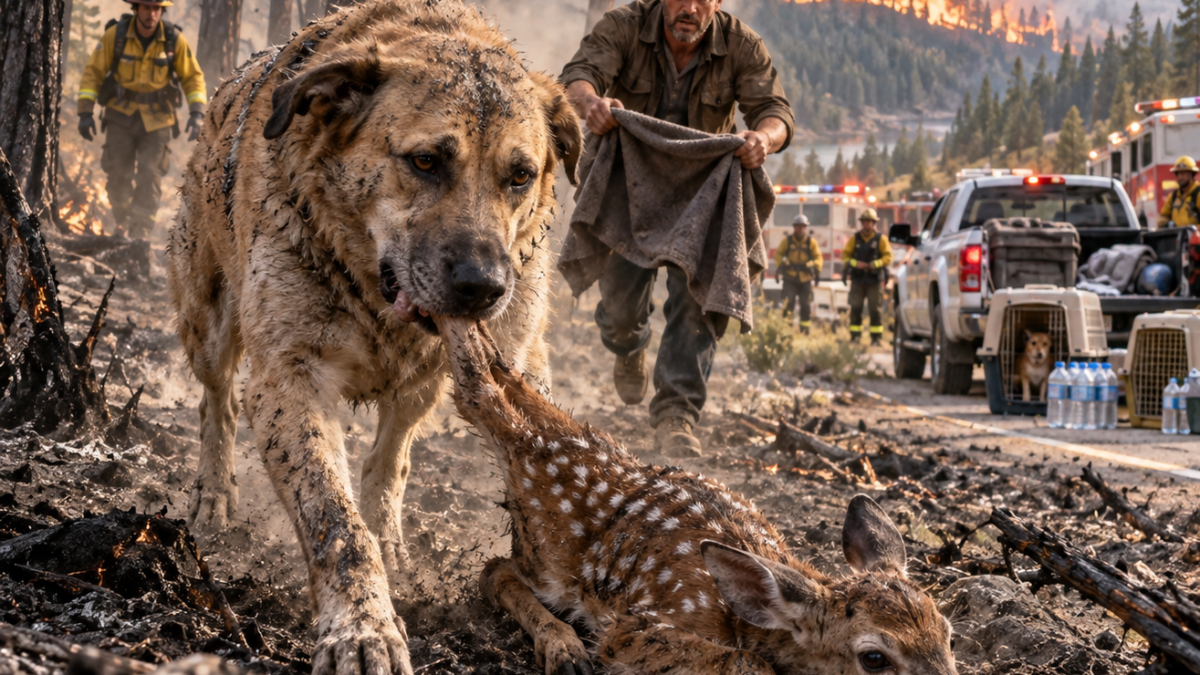
The dog turned around, walked back toward it, lowered his head, and gently took hold of one rear leg.
Then he pulled.
The fawn slid across the dirt.
The dog released the leg.
He stumbled forward several steps.
Stopped.
Looked back.
Then returned and did it again.
I didn’t move.
There are moments when your mind needs a few seconds to catch up with your eyes.
This was one of them.
The dog wasn’t attacking the fawn.
He wasn’t trying to carry away prey.
He was trying to move it.
Toward me.
Toward the road.
Away from the fire.
“Good God,” I whispered.
He dragged the fawn another few inches.
Then he lost his footing.
His front legs folded.
He hit the ground.
For several seconds, he stayed there.
I thought he was finished.
Then he pushed himself upright.
He looked behind him.
The fawn had not moved.
So the dog went back.
Again.
That was when something tightened in my chest.
He could have left.
Nothing was physically keeping him there.
He could still walk.
Slowly, yes.
Painfully, yes.
But he could walk.
He could have abandoned the fawn and saved himself.
Instead, whatever instinct told most animals to run from danger had somehow been overruled by another instinct.
Don’t leave it.
I stepped closer.
“Hey, buddy.”
His head snapped toward me.
He didn’t growl.
He didn’t bark.
He just watched.
His eyes were red from smoke.
There was exhaustion in them.
But there was something else too.
Urgency.
I crouched.
“It’s okay.”
He looked toward the fawn.
Then he took its leg again.
“I know.”
I raised my voice.
“Daniel!”
A few seconds later, a figure emerged from the smoke.
“Jack?”
“Over here!”
Daniel approached quickly.
“What did you find?”
Then he saw them.
He stopped beside me.
The dog dragged the fawn again.
Daniel stared.
“Is he—”
“Yeah.”
“He’s pulling it out?”
“That’s what it looks like.”
For a moment, neither of us moved.
Then Daniel said, “We have to get them both.”
I nodded.
The problem was convincing the dog that we weren’t taking away the animal he had apparently decided was his responsibility.
Daniel moved toward the fawn.
The dog immediately stepped between them.
His body shook.
Still, he stood there.
Daniel stopped.
“Okay.”
I crouched lower.
“Nobody’s hurting him.”
The dog looked at me.
“Listen, buddy. You’ve done enough.”
He didn’t believe me.
Why would he?
He had no idea who we were.
All he knew was that somehow, somewhere inside a burning forest, he had found a young deer that couldn’t escape.
He had made his decision.
The fawn was coming with him.
Daniel whispered, “Can you keep his attention?”
“I’ll try.”
I held out my hand.
The dog sniffed the air.
“Come on.”
He took one uncertain step toward me.
Then looked behind him.
The fawn moved weakly.
Immediately, the dog turned back.
“No.”
I shifted closer.
“I know you’re worried.”
His eyes met mine.
“I’m worried too.”
Maybe it was my tone.
Maybe it was exhaustion.
Maybe he simply had nothing left.
But he let me move closer.
I slowly touched the side of his neck.
His fur was hot beneath the ash.
He flinched.
I stopped.
“Easy.”
Then I touched him again.
This time, he stayed.
Daniel moved to the fawn.
The dog noticed.
His muscles tightened.
“It’s okay,” I repeated.
Daniel slid one arm under the fawn’s chest and the other beneath its hindquarters.
When he lifted it, the dog jerked away from me.
He tried to follow.
His legs gave out.
I caught him around the chest before he hit the ground.
“Whoa.”
He struggled weakly in my arms.
“Hey. Look.”
Daniel held the fawn where the dog could see it.
“It’s right here,” Daniel said softly. “We have it.”
The dog stopped struggling.
His eyes locked on the fawn.
I felt his entire weight settle against me.
“We’re all going out together,” I told him.
I had no idea whether he understood a single word.
But I meant every one of them.
I wrapped one arm under his chest and helped him stand.
Daniel carried the fawn.
We started toward the road.
For the first several yards, the dog tried to walk.
He leaned heavily against me, but he kept moving.
Every few steps, he turned his head to make sure Daniel was still there.
Each time he saw the fawn, he continued.
Then his legs buckled again.
This time, he couldn’t get back up.
“That’s enough.”
I crouched and lifted him.
He was heavier than I expected.
Under normal circumstances, carrying him through uneven ground would have been difficult.
With smoke burning my lungs and ash covering the trail, it felt twice as hard.
But I wasn’t putting him down.
His head rested against my shoulder.
Even then, he kept trying to look behind me.
“Still there,” I told him.
Daniel walked beside us.
“He’s checking.”
“I know.”
“Every time.”
I adjusted my grip.
“You stubborn son of a gun.”
The dog’s ear moved slightly.
I smiled despite everything.
“I mean that as a compliment.”
The walk out of the forest felt endless.
I don’t know how far we actually traveled.
Distance becomes strange when you’re frightened.
Fifty yards can feel like a mile.
At one point, a gust of wind pushed another wall of smoke across us.
Daniel stopped.
I turned my body to shield the dog’s face.
“Jack!”
“I’m good.”
“You sure?”
“No. Keep moving.”
We did.
Then, gradually, the trees began to thin.
The light changed.
Through the smoke I could see the open roadside.
Someone spotted us.
“Coming out!”
Several people ran toward us.
Daniel handed the fawn to the wildlife team.
The dog immediately lifted his head.
“It’s okay.”
I carried him toward my truck and lowered him onto a blanket.
The second I released him, he tried to stand.
“No.”
A veterinarian knelt beside him.
“Keep him down.”
She checked his breathing.
His paws.
His eyes.
His gums.
“Smoke exposure. Severe exhaustion. Dehydration.”
“Burns?”
“Some irritation. Minor cuts. Nothing severe that I can see right now.”
She glanced at me.
“How long was he inside?”
“I have no idea.”
Someone brought water.
I held the bowl.
The dog drank too quickly.
“Slow.”
I pulled it back for a second.
He stared at the bowl.
“You’ll get more.”
I let him drink again.
After several mouthfuls, he stopped.
His breathing remained heavy.
I thought that would be the end of it.
He was safe.
The fawn was receiving treatment.
Surely now the dog would lie down.
Instead, he pushed himself upright.
The veterinarian tried to stop him.
“Hey.”
He staggered past her.
I stood.
“What are you doing?”
Then I followed his gaze.
Twenty feet away, Daniel and another volunteer were examining the fawn.
The dog had seen them.
Of course.
He took another step.
Then another.
I got in front of him.
“Buddy.”
He tried to go around me.
“You can barely walk.”
He didn’t care.
I placed both hands on his shoulders.
“The fawn is safe.”
His body shook beneath my palms.
“You did it.”
He tried once more.
Then Daniel looked over.
He understood immediately.
“Bring him closer.”
We carried the fawn, still wrapped in a blanket, to the dog’s side.
The dog’s head came up.
His eyes changed.
Until that second, I had never realized how much tension could exist in an animal’s face.
He sniffed.
The fawn moved.
A tiny movement.
But enough.
The dog leaned forward.
He touched the fawn with his nose.
Once.
Very gently.
Then the strength went out of him.
He lay down.
Not collapsed.
Not fell.
Lay down.
Like he had finally given himself permission.
Daniel looked at me.
“That’s what he was waiting for.”
I swallowed.
“Yeah.”
The dog closed his eyes.
For several minutes, I stayed beside him.
Then, unexpectedly, he opened them again.
He looked around.
His gaze found me.
I crouched.
“Hey.”
He slowly got up.
Before I could stop him, he stepped toward me.
Then his front paws came up.
One landed against my shoulder.
The other against my chest.
He leaned into me.
I caught him.
And suddenly this exhausted, ash-covered dog was clinging to me with his whole body.
I sat down on the ground.
“All right.”
His head pressed into my neck.
I could feel his breathing.
Still rough.
Still too fast.
But gradually slowing.
I wrapped my arms around him.
“You’re safe.”
His paw tightened against my jacket.
“You’re out.”
I ran my hand over the top of his head.
“No more smoke.”
For the first time, the tension left him.
Daniel approached slowly.
“Jack.”
I looked up.
“I think you have a problem.”
“What?”
He nodded toward the dog.
“He doesn’t seem interested in letting you go.”
I smiled.
“Yeah.”
I tried gently to lower him back onto the blanket.
Immediately, one paw hooked into my jacket.
I laughed.
“Okay. I get it.”
Daniel crouched beside us.
“Looks like you made a friend.”
I looked at the dog.
I didn’t know then how much that sentence would come to mean.
That evening, both animals were transferred to a temporary care facility outside the evacuation zone.
The fawn went to the wildlife section.
The dog was placed in a quieter area where he could receive fluids, food, and monitoring.
I helped transport him.
I told myself I was only making sure he got there safely.
When we arrived, a veterinary technician tried to lead him to a bed.
He kept looking at me.
“Go on.”
He didn’t move.
The technician smiled.
“Maybe you should walk him in.”
So I did.
I sat beside his blanket.
He drank more water.
He ate a small amount.
Then he stared at the door.
Every time someone passed, his head lifted.
“You can stop now,” I told him.
He looked at me.
“You don’t have to keep watch.”
I stroked his forehead.
“The fawn is safe.”
His ears shifted.
“You got him out.”
I don’t know why I kept explaining it.
Maybe I needed to hear it myself.
“You did your job.”
Eventually, he stretched out.
I stayed.
Ten minutes.
Then twenty.
At some point, his eyes closed.
His breathing became deeper.
I thought he was asleep, so I stood.
His eyes opened immediately.
“Seriously?”
He lifted his head.
I sat back down.
“Fine.”
His head lowered again.
That happened three times.
The fourth time, I stopped trying.
I sat beside him until he was completely asleep.
Driving home that night felt strange.
The truck was empty again.
The blankets in the back were dirty.
My clothes smelled like smoke.
There was ash under my fingernails.
But none of those things occupied my mind.
I kept seeing the dog.
Pull.
Release.
Look back.
Return.
Pull again.
I wondered where he had come from.
Had he been camping with someone?
Had he escaped a nearby home?
Had he been living wild?
Did he already have a family somewhere desperately searching for him?
And why the fawn?
Had he found it injured?
Had they been together for minutes?
Hours?
There was no way to know.
I slept badly.
At sunrise, I was already awake.
By eight that morning, I was back at the facility.
I hadn’t called ahead.
I just went.
A volunteer recognized me.
“Here to see your friend?”
“He’s not my friend.”
She smiled.
“Sure.”
I found him standing behind the gate of his enclosure.
The instant he saw me, his tail began moving.
Thump.
Thump.
Thump.
Something in my chest loosened.
“Well, look at you.”
His tail moved faster.
The technician opened the gate.
I sat on the floor.
He walked straight over and dropped his head into my lap.
I laughed.
“You actually remember me.”
Of course he did.
For the next several days, I visited whenever I could.
The fawn improved quickly.
So did the dog.
The veterinarians cleaned the ash from his coat, treated the small cuts on his paws, and monitored his lungs.
Nobody could find a microchip.
No collar had been found.
No one matching his description had reported him missing.
Local shelters were contacted.
Notices were posted.
People from the evacuation area were asked.
Nothing.
No owner.
No name.
At first, everyone simply called him “the dog.”
I didn’t like that.
He wasn’t “the dog” to me.
He had become the animal I saw refusing to leave another creature behind while a forest burned around him.
A few days later, Daniel found me sitting beside him.
“You still haven’t named him?”
“He’s not mine.”
Daniel leaned against the wall.
“You say that every time.”
“Because it’s true.”
“Technically.”
I looked at him.
“What does that mean?”
“It means he disagrees.”
The dog was lying with his chin across my shoe.
Daniel pointed.
“Exhibit A.”
I shook my head.
“He might belong to somebody.”
“Maybe.”
“If he does, they deserve to find him.”
“I agree.”
Daniel paused.
“But until then, he still needs a name.”
I looked down.
The dog opened one eye.
I had been thinking about it.
“Ray.”
Daniel repeated it.
“Ray?”
“Yeah.”
“Why?”
I rubbed the dog’s ear.
“Because the first time I really saw him, everything around us was dark.”
Daniel waited.
“Smoke everywhere. Ash. Couldn’t see ten feet.”
I looked at the dog.
“And somehow this idiot was still trying to bring another animal out.”
Daniel smiled.
“A ray of light?”
“Don’t make it sound sentimental.”
“It is sentimental.”
“Then don’t tell anyone.”
Daniel crouched.
“Ray.”
The dog raised his head.
Daniel laughed.
“I think that’s settled.”
From that day on, he was Ray.
The name somehow made everything more complicated.
Before he had a name, I could pretend I was simply helping a rescued animal.
Once he became Ray, he became someone I knew.
Someone who recognized my truck.
Someone who waited for my footsteps.
Someone who would wake from sleep if he heard my voice.
As the weeks passed, the fawn grew stronger.
Its appetite returned.
It began moving normally.
The wildlife specialists deliberately reduced its contact with people.
That mattered.
A wild animal needed to remain wild.
Ray’s situation was different.
He wanted contact.
Especially with me.
Every time I arrived, his reaction was the same.
Tail moving.
Body leaning against my legs.
Eyes following me.
One afternoon, Daniel sat beside me.
“So what’s the plan?”
“For what?”
He nodded at Ray.
“That.”
“The rescue center will find him a home.”
Daniel looked at me.
I ignored him.
“What?”
“Nothing.”
“You have that face.”
“What face?”
“The face people make when they’re trying not to say something annoying.”
Daniel smiled.
“He’s already found a home.”
“No.”
“Okay.”
“I’m serious.”
“So am I.”
“I work long hours.”
“Lots of dog owners work.”
“I drive.”
“He likes trucks.”
“I don’t know his history.”
“You know plenty.”
“Like what?”
Daniel counted on his fingers.
“He doesn’t bite. He’s good with people. He doesn’t panic around wildlife. He’s loyal to the point of insanity. He dragged a deer through a wildfire.”
I sighed.
“That’s not a standard adoption profile.”
“Should be.”
I looked down at Ray.
He had fallen asleep with his side pressed against my boot.
“I didn’t come here looking for a dog.”
Daniel’s voice softened.
“Maybe he wasn’t looking for you either.”
I didn’t answer.
The decision became more difficult when the day came to release the fawn.
Several weeks had passed.
The young deer had recovered completely.
It could run.
It could feed normally.
It showed the alertness and caution the wildlife team wanted.
A protected area near the forest had been selected for release, far enough from active fire damage to provide food and cover.
I asked if Ray could come.
The wildlife specialist hesitated.
“As long as he’s controlled.”
“He will be.”
I kept him beside me on a leash.
The transport crate was placed near the edge of the trees.
We stood back.
The door opened.
Nothing happened.
For several seconds, the fawn stayed inside.
Then its nose appeared.
Its head.
One front leg.
Then the rest of its body.
It stood still.
Ears high.
Listening.
Ray froze beside me.
The fawn took one step.
Then another.
It looked toward the trees.
Ray leaned forward.
“Easy.”
He didn’t pull.
He just watched.
The fawn suddenly ran.
A few seconds later, it disappeared between the trees.
I felt something I hadn’t expected.
Relief mixed with sadness.
For weeks, that small animal had been part of Ray’s story.
Now it was gone.
I knelt beside him.
Ray continued staring into the forest.
“That’s it.”
He looked at me.
“You got him here.”
I scratched his neck.
“He belongs out there.”
We stayed another minute.
Then I walked toward my truck.
Ray followed.
That was normal by then.
What wasn’t normal was what happened when I opened the passenger door.
Ray immediately put his front paws on the running board.
“Whoa.”
He looked back at me.
“No.”
His tail wagged.
“This is not your truck.”
He climbed in.
I stared at him.
Daniel was standing near the wildlife van.
I turned toward him.
“Don’t.”
He held up his hands.
“I didn’t say anything.”
“You’re smiling.”
“No, I’m not.”
“You absolutely are.”
Ray sat in the passenger seat.
Daniel finally laughed.
“Looks like he made the decision for you.”
“This is temporary.”
“Of course.”
“I mean it.”
“Absolutely.”
“I’ll take him home until someone adopts him.”
“Very responsible.”
“Stop agreeing like that.”
He walked away laughing.
Ray watched me through the open door.
I pointed at him.
“You’re trouble.”
His tail hit the seat.
That evening, I brought him home.
My house wasn’t large.
It didn’t need to be.
I lived alone.
There was a fenced yard, a small porch, and more empty space than I had ever really noticed.
I put a bed near the kitchen.
Food and water beside the wall.
I found an old blanket.
“This is your spot.”
Ray sniffed it.
Then followed me.
“No. Bed.”
He followed me into the living room.
“Ray.”
He sat.
I sighed.
“Fine.”
That first night taught me more about him than the previous weeks had.
Ray didn’t know how to relax in a house.
Every sound woke him.
Every door mattered.
If I walked from the living room into the kitchen, he followed.
If I went upstairs, he followed.
If I closed the bathroom door, I found him sitting immediately outside when I opened it.
At first, I thought it was simple attachment.
Then I noticed the expression on his face.
It wasn’t excitement.
It was worry.
He seemed unable to believe that when I disappeared behind a door, I would come back.
So I stopped telling him not to follow.
If he wanted to wait outside the bathroom, he could.
If he wanted to sleep beside the bedroom door instead of on his new bed, fine.
He had spent enough time believing something terrible might happen if he looked away.
I wasn’t going to punish him for needing reassurance.
Several times during the first week, I woke in the night and found him standing beside my bed.
“Ray?”
His tail moved once.
I reached down.
My fingertips touched his head.
“Still here.”
He would lie down again.
Slowly, the behavior changed.
He stopped following me every second.
Then one afternoon, I walked into another room and realized he hadn’t come.
I went back.
Ray was asleep on the living-room rug.
I smiled.
That may sound like nothing.
To me, it was progress.
He finally trusted that I could leave the room without leaving him.
He had other things to learn too.
Toys confused him.
The first time I threw a tennis ball, he watched it land.
Then he looked at me as if I had lost something important through stupidity.
“Go get it.”
Nothing.
“Ray.”
He stared.
I walked to the ball and picked it up.
“See?”
I threw it again.
He watched.
I sighed.
“You’re going to make this difficult.”
A week later, I found him alone in the backyard with a rubber toy someone from the rescue center had given us.
He had it in his mouth.
I stopped on the porch.
Ray froze.
Then he shook the toy.
Hard.
I laughed.
“Oh, now you understand.”
He ran toward me.
I grabbed one end.
He pulled.
I pulled back.
Suddenly he bounded sideways, nearly knocking me off balance.
For the next ten minutes, he became a completely different dog.
No worried eyes.
No following doors.
No checking behind himself.
Just play.
When we finished, he collapsed in the grass.
I sat beside him.
“That’s better.”
He rolled onto his side.
I rubbed his stomach.
“You know, normal dogs are allowed to have fun.”
His tail moved against the grass.
There was another decision I hadn’t officially made.
The rescue center continued trying to identify his previous owner.
No one came forward.
After the required period had passed, they called me.
A woman named Susan handled the conversation.
“Jack, we’re ready to place Ray for adoption.”
I was silent.
“We already have several families interested.”
My stomach tightened.
“Good families?”
“Very.”
“Yard?”
“Most of them.”
“Other dogs?”
“Some.”
“Children?”
“A few.”
Susan was quiet for a second.
“You’re interviewing hypothetical adopters.”
“I’m asking questions.”
“Jack.”
“What?”
“Do you want to adopt him?”
I looked across the kitchen.
Ray was asleep near the door.
I had spent weeks pretending the answer wasn’t obvious.
“I don’t know.”
Susan laughed gently.
“You know.”
I rubbed my forehead.
“What if I’m not the best home?”
“Does he seem unhappy?”
“No.”
“Does he trust you?”
“Yes.”
“Do you love him?”
That question shut me up.
Ray opened his eyes.
He looked at me.
I stared back.
“Yeah.”
Susan waited.
“Yeah, I do.”
“Then come sign the paperwork.”
The next morning, I did.
When we left the facility, I held the adoption papers in one hand and Ray’s leash in the other.
Daniel happened to be there.
He looked at the papers.
“I thought it was temporary.”
I gave him a look.
He grinned.
“Congratulations.”
Ray jumped into the truck.
This time, I didn’t argue.
“Home?”
His tail moved.
“Yeah. Home.”
Life with Ray became ordinary.
And that was beautiful.
The extraordinary part of his life had been fire, smoke, fear, and rescue.
What he needed afterward was ordinary.
Morning walks.
Food at regular times.
A favorite spot near the window.
The sound of my truck pulling into the driveway.
The freedom to sleep deeply because someone else was finally keeping watch.
He started coming with me whenever it was safe.
He loved the truck.
He would climb into the passenger seat, turn around twice, and settle down.
Sometimes he watched the road.
Sometimes he slept.
People who had heard his story recognized him.
“Is that the wildfire dog?”
I’d nod.
Ray would wag his tail, completely unaware that anyone found him remarkable.
That was one of the things I loved most about him.
He didn’t know he’d done anything heroic.
There was no pride in it.
No expectation.
He had simply seen a creature that couldn’t save itself and refused to walk away.
One evening, months after the fire, we sat together in the backyard.
Summer had begun fading toward fall.
The air was cooler.
The forest was a dark line in the distance.
Ray lay beside my chair.
I thought about that first day again.
“You know what you did?”
He lifted his head.
“I’m serious.”
His ears tilted toward me.
“You could’ve left.”
He stared.
“You could’ve run out by yourself.”
I leaned down.
“But you kept going back.”
Ray placed his chin on my knee.
I scratched behind his ear.
“I used to think courage was something dramatic.”
A firefighter running into a burning building.
A soldier charging into danger.
Someone standing before a crowd and making a great speech.
Those things could be courage.
Of course they could.
But Ray had shown me another kind.
Quiet courage.
The kind that doesn’t know anyone is watching.
The kind that receives no applause.
The kind that sees someone weaker and simply decides:
I’m not leaving you here.
“You weren’t trying to be a hero,” I said.
Ray’s eyes began closing.
“You were just being you.”
I smiled.
“Maybe that’s better.”
Months later, the authorities reopened more of the forest.
New growth had already started.
The fire had scarred entire sections, but nature was doing what nature does.
Tiny green shoots rose between blackened trunks.
Grass returned.
Birds returned.
Deer tracks appeared in the mud.
One morning, I decided to take Ray back.
I wasn’t sure how he would react.
The smell of smoke was gone, but I wondered whether the place itself might frighten him.
We walked slowly.
At first, Ray stayed close.
He sniffed everything.
Then he moved ahead.
Twenty feet.
Stopped.
Looked back.
I waved.
“Go on.”
He went farther.
Then came back.
There was no panic.
No fear.
Only curiosity.
We followed a trail toward a clearing.
That was when Ray stopped.
His ears went forward.
I followed his gaze.
Several deer stood among the trees.
One adult.
Another farther back.
And a younger deer near the edge of the group.
My breath caught.
Could it be the same one?
There was no way to know.
The fawn we had rescued had grown.
Its markings would have changed.
The forest held plenty of deer.
Still, part of me wanted to believe.
Ray stood perfectly still.
The younger deer looked toward us.
For several seconds, neither animal moved.
“Do you remember?” I whispered.
Ray’s ears twitched.
The deer stepped back.
Ray did not chase.
He didn’t bark.
He simply watched.
Then he turned away.
He walked back to me.
When he reached my side, he leaned against my leg.
I crouched beside him.
“That’s all?”
He licked my chin.
I laughed.
“Okay.”
I looked toward the deer one final time.
Maybe Ray recognized the young animal.
Maybe he didn’t.
It didn’t really matter.
The fawn had survived.
That was enough.
I stood.
“Ready to go home?”
Ray’s tail moved.
We walked back through the forest together.
Near the truck, I stopped and looked behind us.
I remembered the smoke.
The ash.
The frightened voices.
Daniel appearing through the trees.
A dog who could barely stand dragging another animal one painful foot at a time.
So much had changed since then.
Ray jumped into the passenger seat.
I got behind the wheel.
Before starting the engine, I looked at him.
“You know something?”
He stared back.
“Two animals came out of that forest that day.”
His head tilted.
“One went back.”
I reached across and scratched his chest.
“And one came home with me.”
We drove away.
That evening, when I pulled into the driveway, Ray jumped down first.
He ran toward the house.
Halfway across the yard, he stopped.
He turned.
I was still getting out of the truck.
Ray waited.
It was a habit he’d developed.
No matter how excited he was to reach the house, he always checked that I was coming.
“I’m right here.”
He ran back.
His front paws came up against my legs.
I laughed and steadied myself.
“You still doing that?”
For one instant, I remembered the first time.
Ash on his fur.
His body trembling.
His paws hooked into my jacket because he didn’t want me to put him down.
Now his coat was clean.
His body was strong.
His eyes were bright.
I rubbed his head.
“You know, Ray, I used to think I carried you out of that forest.”
His tail moved.
“And technically, I did.”
I opened the front door.
“But that’s only half the story.”
Ray stepped inside.
Then he turned toward me.
I stood on the threshold.
For years, I had been perfectly comfortable living alone.
At least that was what I told myself.
My house had been quiet.
Orderly.
Easy.
Nothing depended on me once I walked through the door.
I had mistaken that for peace.
Ray had changed the sound of the place.
The click of his nails across the floor.
The thump of his tail against the cabinet.
The impatient breath beside my bed when breakfast was late.
The ridiculous way he carried his favorite toy from room to room.
The silence wasn’t empty anymore.
Ray walked toward the kitchen.
This time, he didn’t stop at the doorway.
He didn’t look back nervously to make sure I was still following.
Those days were gone.
He knew where he belonged.
I watched him settle into his usual place and understood that the biggest change hadn’t happened to him alone.
That day in the forest, I thought I was watching an animal rescue another animal.
Then I thought I was helping rescue him.
For a while, that was the story I told myself.
I had found Ray.
I had carried him out.
I had given him water.
I had stayed beside him.
I had brought him home.
I had adopted him.
All of that was true.
But it wasn’t the whole truth.
Because Ray had brought something out of that forest too.
He had brought me back with him.
He had reminded me that loyalty did not always arrive with explanations.
That courage didn’t have to make noise.
That kindness could exist even when nobody had taught it to expect a reward.
And that sometimes the strongest bond begins before either side understands what is happening.
Ray had refused to abandon a frightened young deer.
Later, he had refused to let go of my jacket.
Then, little by little, I stopped wanting him to.
I walked over and sat beside him.
He immediately rested his head across my leg.
“Long day?”
His eyes closed.
I smiled.
My hand rested on the same sandy fur that had once been almost invisible beneath ash.
The fawn was somewhere out there in the woods, living the life Ray had fought to give it.
Ray was here.
Safe.
Fed.
Loved.
Home.
And if there was one thing that day had taught me, it was that rescue didn’t always mean what people thought it meant.
Sometimes you pull an animal from danger and give it a house.
Sometimes you nurse it back to health.
Sometimes you open a cage and watch it return to the wild.
But every once in a while, something much rarer happens.
You reach down believing you are the one doing the saving.
Then months later, you look across your home at the animal sleeping peacefully beside you and realize that somewhere along the way, the direction of the rescue changed.
I thought I had saved Ray from a burning forest.
In truth, Ray had spent that entire day showing me exactly who he was.
He was the dog who wouldn’t leave someone behind.
And once he became part of my life, he never left me behind either.








