They buried me up to my neck in the backyard dirt while I was pregnant and called it punishment for disobedience.
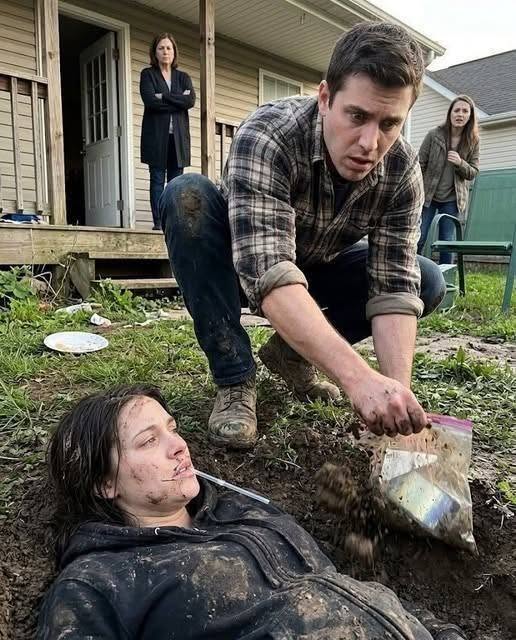
They buried me up to my neck in the backyard dirt while I was pregnant and called it punishment for disobedience.
My husband laughed from the porch.
His mother called it a lesson.
His sister Mara dragged a lawn chair into the shade, crossed one ankle over the other, and told me families were supposed to solve their problems privately.
I breathed through a hidden straw and said nothing.
That silence was the only reason I lasted as long as I did.
Wet soil pressed against my jaw, cold before sunrise and fever warm by afternoon. Every time the wind shifted, I could smell mud, cut grass, and the sour water they kept pouring over my hair. The yard looked ordinary from where I was trapped. A wooden fence. A patch of hydrangeas. A grill beneath a faded cover. Wind chimes hanging near the kitchen door.
If someone had walked past the front of the house, they would have seen a place that looked cared for.
They would never have known there was a pregnant woman behind the fence with only her head above the ground.
Whenever the porch boards creaked, I counted the footsteps without lifting my eyes.
One set belonged to my husband.
Heavy. Slow. Unhurried.
He walked like a man who believed he owned every consequence inside his fence.
His mother was lighter on her feet. Even then, she avoided muddy patches. She would step carefully from stone to stone as though keeping her sandals clean still mattered while her daughter in law was trapped in the ground.
Mara dragged one foot slightly whenever she crossed the porch. I had noticed that long before any of this happened. A childhood injury, she once said. Most people would never hear the difference.
I did.
By the second day, I could tell which one of them was coming before I saw a shadow.
Listening was one of the few things they had not taken from me.
My husband called what he was doing discipline.
His mother called it a lesson.
Mara said I had forced everyone into an uncomfortable situation.
None of them used words like cruelty.
None of them used the word abuse.
That was important to them.
People can do terrible things while protecting themselves with softer language.
My husband had been doing that for months.
He never said he controlled me.
He said he was helping me make better decisions.
He never said he isolated me.
He said certain friends filled my head with negativity.
He never said he lied about me.
He said he was correcting misunderstandings.
He never said I was afraid of him.
He said pregnancy had made me emotional.
And when I cried, he would lower his voice and become gentler.
That was the version everyone else saw.
The patient husband.
The reasonable man.
The one who apologized for me before I had even spoken.
By the time they put me in the yard, he had practiced that version so thoroughly that he almost believed it himself.
I learned something about fear during those days.
It was not always loud.
Sometimes fear was the pressure of my tongue against a plastic straw while I waited for my baby to move.
The first morning, I felt a slow shift beneath my ribs.
It was small.
So small I almost thought I imagined it.
I stopped breathing for one second and waited.
Nothing.
I pressed my tongue against the straw and counted.
One.
Two.
Three.
Four.
The air coming through it sounded too loud inside my own head.
I could feel the soil against my neck every time I swallowed.
The straw was narrow, the kind people use for cold drinks. I had managed to keep one end above the surface while they packed the final dirt around my shoulders.
They had been laughing.
That helped.
My husband had been telling Mara that I would finally learn what happened when I pushed people too far.
His mother told him not to make the soil too tight around my neck because she did not want anything “obvious” if someone eventually saw me.
Mara said, “This is insane,” but she was smiling when she said it.
That was one of the things I kept thinking about.
She knew.
Maybe not enough to stop them.
But enough to name it.
Then she sat down.
People like to imagine that cruelty requires everyone involved to be equally cruel.
It does not.
Sometimes one person plans.
One person approves.
One person laughs nervously and stays.
That is enough.
I kept my eyes on the ground.
Looking frightened entertained them.
Arguing gave them something to answer.
Crying turned into proof that I was unstable.
Silence made them careless.
My husband leaned over the porch railing.
“Ready to behave?”
I lowered my eyes.
He laughed softly.
“She’s getting there.”
His mother answered, “She always needs time to calm down.”
Mara asked whether they should bring me water.
My husband said, “Later.”
My baby moved again.
This time I was sure.
I closed my eyes.
Just for a second.
That movement became my clock.
Not the sun.
Not the porch light.
Not their meals.
The baby.
Each time I felt movement, I told myself we were still here.
Still two people.
Still not theirs to define.
Beneath the loose soil near my right shoulder, inside a freezer bag, my phone rested with the screen dark and the microphone uncovered.
That phone was the only thing in the yard my husband did not know about.
I had hidden it before they dragged me outside.
The idea came to me less than fifteen minutes before they put me in the hole.
I had been standing in the upstairs hallway when I heard my husband speaking to his mother in the kitchen.
He thought I was in the bedroom.
His voice carried through the stairwell.
“She needs to understand embarrassment is the only language she respects.”
His mother said, “Fine, but don’t do something that leaves marks she can explain.”
I froze.
There are sentences that change the shape of a room.
That was one.
Until then, I knew he was angry.
I knew his mother had come over because he had called her.
I knew Mara was on her way.
I knew they believed I had embarrassed him by refusing to apologize after our argument.
But I had not understood that they were planning something physical.
Not until his mother said marks.
I stood barefoot in the hallway with my phone in my hand.
Calling someone openly would have alerted them.
Running out the front door meant passing the kitchen.
The back door was worse.
My husband was between me and both exits.
I did not have a perfect plan.
I had seconds.
So I turned off every sound on my phone.
Slid it into a freezer bag.
Folded the loose plastic around it.
Tucked it beneath my shirt.
Then I walked downstairs.
My husband smiled when he saw me.
That smile terrified me more than shouting would have.
“Ready to talk?”
I looked at his mother.
She was rinsing a coffee mug as if she had come over for breakfast.
Mara arrived two minutes later.
She did not ask why everyone was so quiet.
My husband said, “We’re going outside.”
I asked why.
He replied, “Because this conversation keeps going in circles.”
His mother added, “Fresh air might help you think.”
Even then, they needed the language.
Conversation.
Fresh air.
Think.
Normal words wrapped around something that was not normal.
I should have run.
People always think that afterward.
Why didn’t she run?
Why didn’t she scream?
Why didn’t she call?
But choices look different when three people stand between you and the door and one of them has spent months teaching everyone that you are irrational.
I was pregnant.
I was outnumbered.
And I knew the first person I needed to convince was not them.
It was whoever eventually heard the story.
That was why the phone mattered.
Not rescue.
Memory.
My husband had spent months telling people I became confused whenever I was upset.
He told relatives I exaggerated.
He said I misremembered conversations.
At dinner, if someone asked me a question, he would sometimes answer first.
If I corrected him, he laughed.
“She’s tired.”
If I went quiet, he smiled apologetically at everyone else.
“Pregnancy hormones.”
Once, after an argument in the car, I told his mother he had screamed at me for twenty minutes.
He interrupted.
“I raised my voice once.”
Then he described the conversation in calm detail.
Wrong detail.
But calm.
By the time he finished, even I felt confused.
Had it been twenty minutes?
Had it been ten?
Had he called me selfish before or after I started crying?
That was his gift.
Not creating convincing lies from nothing.
Making the edges of truth soft enough that I questioned my grip.
I needed something that could remember without shaking.
So I brought the phone outside.
They did not search me.
Why would they?
In their minds, the outcome was already decided.
My husband told me to stand near the garden.
There was disturbed soil there from landscaping work.
I remember looking down and seeing a worm disappear beneath a clump of earth.
I remember thinking the hole was too deep for a plant.
Then my mother in law said, “You can make this easy.”
After that, the memory becomes pieces.
Hands.
Mud.
My husband telling me not to fight because of the baby.
Mara saying my name once.
My knees against cold dirt.
My breathing too fast.
The freezer bag pressed beneath my shirt.
I protected it without letting them see.
That may have looked like obedience.
Good.
Let them think it.
By the time they finished, my body was below the soil.
Only my head remained above it.
The first thing my husband did was step backward and laugh.
Not loudly.
A short, satisfied laugh.
His mother looked at me for a long moment.
Then said, “Maybe now you’ll understand what family means.”
Mara moved her lawn chair out of the mud.
That was the beginning.
Months earlier, I would not have believed I could ever become this quiet around him.
I had always argued when something mattered.
Not loudly. Not for sport. But I believed words were supposed to clarify things.
With my husband, words gradually became traps.
If I said, “That isn’t what happened,” he asked why I was calling him a liar.
If I said, “That hurt me,” he asked why I was attacking his intentions.
If I said I needed time alone, he told his mother I was withdrawing from the family.
If I tried to explain too much, he said I was building a case against him.
Eventually every conversation became a trial in which he was both defendant and judge.
His mother reinforced the pattern without ever needing to raise her voice.
At family dinners, she would ask a question about the pregnancy and then look at him for the answer.
If I answered differently, she smiled and said, “You two need to get on the same page.”
That sentence sounded neutral.
It never was.
The page was always his.
Once, someone asked whether I was sleeping well.
I said not really.
My husband immediately laughed.
“She sleeps constantly.”
Everyone smiled.
I said, “No, I’m tired constantly. That isn’t the same thing.”
The table went quiet.
His mother touched my hand.
“Sweetheart, nobody is accusing you of anything.”
I had not said they were.
But now I looked defensive.
My husband leaned back and gave everyone a patient smile.
By dessert, the conversation had become a story about how sensitive I was lately.
That was how it worked.
Not one enormous lie.
A hundred small corrections.
A raised eyebrow.
A joke.
A version repeated first.
I began talking less around his family because every sentence required a defense.
Then he used my silence too.
“She doesn’t like being around us.”
“She thinks she’s better than everyone.”
“She’s distant.”
There was no safe position.
Speak and become difficult.
Stay silent and become cold.
Leave the room and become dramatic.
Stay and become proof that nothing was wrong.
I kept thinking if I could find the exact right combination of calmness, precision, and patience, he would finally understand.
That was the mistake.
The problem was never that he misunderstood me.
The problem was that misunderstanding benefited him.
Once I accepted that, certain memories changed.
The time he corrected the story of an argument before I finished telling it.
The time he told me, smiling, that I was “remembering emotionally.”
The time his mother said, “He would never speak to you that way,” even though she had not been present.
The time Mara shrugged and said, “You know how he is,” as if familiarity turned behavior into permission.
I had treated each moment separately.
In the dirt, they lined up.
That was why I could not trust a future conversation to save me.
If I made it inside and said they had buried me, they would already have language.
Temporary.
Lesson.
She agreed to come outside.
She could breathe.
We gave her water.
We were nearby.
She refused to apologize.
We were trying to calm her.
Each statement could contain a fragment of fact while hiding the whole truth.
That frightened me more than a simple lie.
Simple lies can be disproved.
Distorted truths make witnesses hesitate.
My husband understood hesitation.
He created it instinctively.
So I decided that if I survived, I wanted something more stable than my own exhausted account.
A voice recording would not explain everything.
It would not show the soil pressing against my ribs.
It would not show the fear every time the baby went still.
But it could hold tone.
Sequence.
Exact words.
It could capture people who believed there was no one outside the family to impress.
That was the version I needed.
Not because I wanted revenge.
Because I had begun to understand that telling the truth is sometimes only the first half of being believed.
The second half is surviving the other person’s confidence.
My husband had confidence.
He could look directly at someone and say, “That isn’t what happened,” with such calm certainty that the room rearranged itself around him.
I had seen him do it to me.
I had watched his mother accept the rearranged version because it was more comfortable.
I had watched Mara retreat from conflict because deciding who was right would require her to act.
The phone did not care who was comfortable.
That mattered.
The baby moved once while I thought about all of this.
A gentle shift.
I held onto it.
Before pregnancy, I might have risked more.
A scream.
A struggle.
An attempt to force my way free.
Now every decision passed through a second question.
What could this do to the baby?
My husband knew that too.
He repeatedly invoked our child whenever he wanted obedience.
“You need to stop stressing yourself.”
“You have to think about the baby.”
“You can’t keep getting worked up.”
He said those things after provoking arguments, after dismissing me, after refusing to let conversations end.
Concern became another form of control because he was the one deciding what counted as stress.
Even now, with my body trapped beneath soil, he could tell himself my refusal to submit was the dangerous part.
That was why I stopped expecting logic to reach him.
Logic works only when both people accept the same basic premise.
My premise was that nobody had the right to do this to me.
His premise was that he had the right if I behaved badly enough.
There was no perfect sentence that could bridge that.
So I saved my breath.
Literally.
And I let the phone listen.
The hardest part was accepting that I could not solve the situation by being reasonable.
Reasonableness had always been my refuge.
If emotions rose, I lowered my voice.
If somebody misunderstood me, I explained more carefully.
If a conflict became personal, I returned to facts.
Those habits had served me everywhere else.
Here, they only gave my husband more material.
A calm objection became disrespect delivered in a cold tone.
A detailed explanation became evidence that I had rehearsed my story.
A boundary became punishment.
Even tears could be translated into manipulation.
Buried in the yard, I finally stopped auditioning for the role of reasonable wife.
I did not need his agreement about what was happening.
I did not need his mother to admit it was wrong.
I did not need Mara to decide I had suffered enough.
Their recognition was no longer the goal.
Survival was.
Evidence was.
The child inside me was.
That shift felt strange because it removed the argument I had been having for months.
I no longer had to persuade him that my memory was accurate.
The phone could preserve his words.
I no longer had to persuade his mother that a boundary was reasonable.
The yard itself answered.
I no longer had to persuade Mara that neutrality was a choice.
Her chair was already in the recording, not visually, but through her voice and laughter.
For once, I could stop explaining.
My silence did not mean they had won.
It meant I had finally stopped using my energy on people committed to misunderstanding me.
Before that week, I had already started noticing that my husband’s most effective weapon was not anger.
It was certainty.
He could be wrong and sound calm.
I could be right and sound shaken.
Most rooms reward the calmer person.
He understood that long before I did.
When we disagreed around other people, he rarely raised his voice. He waited until I became frustrated, then softened his own. The difference made me look unreasonable even when the subject was something he had done.
He had a way of repeating my words with one important piece removed.
I would say, “I’m not comfortable with you making that decision without me.”
He would later tell someone, “She said she isn’t comfortable with the decision.”
One sentence was about partnership.
The other made me sound difficult.
If I corrected him, he said:
“That’s basically what you said.”
Basically.
That word did enormous work in our marriage.
Basically meant details did not matter if they helped me.
Basically meant intention mattered when his did and impact mattered when mine did.
Basically meant the version that sounded easiest in public became the official one.
His mother was drawn to that certainty.
She did not need evidence when her son sounded sure.
If I said a conversation upset me, she asked what I had said first.
If I said he had shouted, she wanted to know whether I had “pushed his buttons.”
If he apologized, she praised him for being mature.
If I remained hurt after the apology, she asked how long I planned to punish him.
She could turn every consequence into an injury against him.
Mara’s role was softer.
She saw more.
That sometimes made her worse to me.
There were moments when her expression told me she knew exactly what was happening.
Then she would say:
“I’m staying out of it.”
I used to think that meant she was neutral.
I learned in the backyard that neutrality is not a fixed point.
If one person has all the power, standing still usually helps that person.
Mara sat in the lawn chair.
She did not pack the soil.
She did not pour the water.
She did not plan the punishment.
But every minute she stayed made the scene feel more normal to the people doing it.
An audience can become permission without ever saying yes.
I thought about that while I watched her scroll through her phone.
What would I have done in her place?
The answer was easy from the dirt.
Stand up.
Leave.
Call someone.
But I also knew how families train people.
Mara had spent years smoothing conflicts between her brother and their mother.
She called it keeping the peace.
Peace, in that family, usually meant the angriest person got what they wanted quickly.
That day, the angriest person was my husband.
The easiest path for everyone else was to make me yield.
I had done that before.
Not because I agreed.
Because I was tired.
That was another pattern I only saw clearly when I could no longer physically leave.
Arguments with my husband often ended when I became exhausted enough to say:
Fine.
He treated fine as agreement.
Later, if I reopened the subject, he looked offended.
“We already settled this.”
No.
We had stopped talking because I needed sleep.
But the result was the same.
He learned endurance could substitute for persuasion.
If he kept going long enough, eventually I would stop.
The backyard was that strategy made physical.
He could not persuade me that I had done something wrong.
So he could wait for discomfort to produce the words he wanted.
That knowledge made my silence feel different.
Every minute I did not say the apology was a refusal to let pain write my beliefs for me.
I was not trying to win.
I was trying not to hand him ownership of my own explanation.
The hidden phone mattered for the same reason.
I had started recording some conversations before that morning, though never as systematically as I wished later.
At first I felt guilty.
Recording your spouse can feel like admitting something has already broken.
I told myself I was only doing it because I wanted to check my own memory.
That was true.
After arguments, he often insisted specific sentences had never been said.
Sometimes I lay awake reconstructing the sequence.
Did he say that before I cried?
Did I raise my voice first?
Did I misunderstand?
I hated becoming a detective inside my own marriage.
So once or twice, I let my phone remember.
The first time I listened back to one of those arguments, I felt sick.
Not because the recording was worse than I remembered.
Because it was almost exactly what I remembered.
My confusion had been taught.
That discovery should have sent me running.
Instead, it made me hope the problem could be fixed.
Maybe if I could show him.
Maybe if we could hear ourselves.
Maybe if facts were clear enough, he would stop telling me I imagined things.
I never got the chance to test that hope.
By the time I stood in the upstairs hallway and heard his mother warn him not to leave marks, the question was no longer whether communication could improve.
The question was what I could preserve.
The freezer bag was not clever.
It was available.
The phone was not part of a sophisticated plan.
It was in my hand.
I did not know whether I would get a signal from the yard.
I did not know whether the microphone could hear through plastic and soil.
I did not know whether the recordings would matter to police, a lawyer, a doctor, or no one.
I only knew I could not let their version be the only version.
That thought became even more important because I was pregnant.
Pregnancy had changed the way everyone spoke about my body.
My husband asked what I ate.
His mother commented on sleep.
Relatives offered advice I had not requested.
Most of that was ordinary.
Sometimes loving.
But in a controlling family, ordinary concern can become a door.
Once people decide the baby gives them a vote, they stop noticing when the vote becomes authority.
My husband increasingly spoke as though protecting the pregnancy gave him final say.
Stress was bad for the baby, so I should stop difficult conversations.
Rest was good for the baby, so I should cancel plans he disliked.
Family support was good for the baby, so his mother should be involved in decisions I wanted private.
Every disagreement could be reframed as me choosing myself over the child.
That accusation terrified me.
He knew it.
In the dirt, he used the same logic.
If I cared about the baby, I would apologize.
If I kept resisting, I was creating stress.
If anything went wrong, the story was already waiting:
She was stubborn.
That was why every movement inside me mattered so much.
The baby was not evidence.
The baby was not leverage.
The baby was a child whose safety had become the one thing I could not assess from where I was trapped.
When movement stopped for too long, my mind filled every silence with catastrophe.
I tried to remember how long had passed since the last kick.
Time would not cooperate.
Was it twenty minutes?
An hour?
Fear stretches and compresses time.
The sun moved.
Porch shadows changed.
My husband refilled a drink.
None of those told me what I needed to know.
So I created little markers.
After Mara checked her phone, the baby moved.
After his mother went inside, there was another shift.
After the water pitcher, one clear push.
I stored those moments like coordinates.
They gave me something to return to when panic told me the baby had been still forever.
I also watched my own mind.
That may sound strange.
But my husband had told me so often that I became confused under stress that I feared stress itself.
What if exhaustion really did scramble the order?
What if thirst made me forget?
What if I survived and could not describe the days cleanly?
So I named facts silently.
The color of Mara’s chair.
The pattern on my husband’s boots.
The chipped corner of the porch step.
The screen door squeaking once before it latched.
The pitcher was clear plastic.
The sandwich landed face down.
His mother carried it away.
These details were not important because they were dramatic.
They were important because they anchored me in reality.
I knew what I saw.
I knew what I heard.
I knew where I was.
His version could come later.
Mine existed now.
At some point, I realized I no longer cared whether the recordings made me sound good.
I probably sounded terrible.
My breathing was loud.
Sometimes I whimpered without intending to.
There were long stretches where I said nothing.
That did not matter.
I was not building a performance.
I was preserving context.
My husband was the one performing.
The recordings caught the shift in his voice whenever he answered the phone.
They caught how quickly anger became concern when an outsider might hear.
They caught the patient tone he used when he wanted me to accept blame.
They caught his mother’s practical questions about what neighbors might notice.
They caught Mara’s nervous laughter.
No single sentence explained everything.
Together, they formed a pattern.
Patterns were what he had always prevented me from seeing.
He wanted each incident isolated.
That was a bad night.
That was stress.
That was a joke.
That was a misunderstanding.
That was one argument.
Do not connect them.
The yard connected them for me.
Control of the story.
Control of the house.
Control of privacy.
Control of my body.
Control of what family members were allowed to say.
All of it led to the same place.
Obedience.
Once I saw that, the apology became impossible.
Not because I was heroic.
I was terrified.
I wanted water.
Food.
Warmth.
Movement.
I wanted to put both hands over my stomach and feel my child.
I wanted to crawl into bed and sleep for a week.
There were moments when two words seemed cheap compared with all of that.
I’m sorry.
Just say it.
Get out.
But I knew he did not want those two words alone.
He wanted the meaning attached to them.
I’m sorry I caused this.
I’m sorry you had to punish me.
I’m sorry I embarrassed you.
I’m sorry I made you do it.
That was the price.
And if I paid it once, I did not know what the next price would be.
So I breathed through the straw.
Moved one finger.
Listened.
Let them mistake survival for surrender.
They had spent months teaching me to doubt myself.
The backyard did one thing they never intended.
It made the truth too physical to reinterpret.
There was dirt against my jaw.
There was a phone under my shoulder.
There was a baby inside me.
There were three people on the porch.
Whatever words came later, those facts remained.
By then, I had stopped thinking of the recordings as a weapon.
A weapon implied retaliation.
I did not want to punish anyone while I was still trapped beneath their feet.
I wanted a record strong enough that nobody could later turn the yard into a misunderstanding.
That difference mattered to me.
Revenge asks what will hurt them.
Evidence asks what actually happened.
So I kept listening for exact words instead of the ones I wished they would say.
I noticed who asked questions.
Who answered.
Who laughed.
Who became quiet whenever the conversation approached responsibility.
I noticed how often my husband used we when describing decisions he had made alone.
How often his mother used family when she meant obedience.
How often Mara said this is too much but never stood up.
Those details kept my mind anchored.
The phone was not promising justice.
It was promising sequence.
One voice after another.
A record that did not need me to be calm, articulate, or convincing after I was finally free.
I did not know what would happen when somebody outside the fence finally heard all of it.
I did not imagine handcuffs.
I did not imagine a courtroom.
I did not imagine revenge.
Those possibilities belonged to a future I could not afford to live in yet.
I imagined only one thing: another person listening without my husband standing beside them to translate.
Someone hearing the pause before his mother spoke.
Someone hearing Mara ask whether this had gone too far.
Someone hearing him say I was choosing what happened to me.
A witness who did not owe the family loyalty.
That was enough.
For the first time in months, I did not need to win an argument.
I only needed the truth to reach one person intact.
My right hand was buried too, but there was a small amount of looseness near my wrist.
Enough to move one finger.
Not much.
Enough.
I worked the phone slowly toward that side after they went inside.
Every movement shifted dirt against my chest.
I had to stop several times because breathing became harder.
Eventually I felt the freezer bag.
Then the edge of the phone.
I knew where the record button sat because I had practiced finding it by touch during the months when I first began saving arguments.
I pressed.
Nothing happened that I could hear.
Good.
I waited.
Pressed again.
A tiny vibration against my finger.
Recording.
That first file captured birds.
Wind.
My breathing through the straw.
Then the screen door.
My husband’s footsteps.
He came outside carrying coffee.
“Comfortable?”
I did not answer.
“I asked you a question.”
Nothing.
He crouched.
“You know what your problem is?”
I stared at a blade of grass.
“You think silence means you’re winning.”
My phone listened.
He continued.
“A wife who respects her husband never ends up in a situation like this.”
There.
I remember thinking:
Say more.
That thought horrified me.
Part of me wanted him to stop.
Another part wanted every sentence.
Proof is a cruel thing when you have to survive long enough to collect it.
He stood.
“I’ll come back when you’re ready.”
The first morning moved in fragments.
Sunlight crossing the fence.
The shade shrinking.
A dog barking somewhere beyond the next yard.
The sound of a trash truck several streets away.
Thirst.
Pain in my back.
Pins and needles in my left foot.
Then numbness.
I tried not to think about circulation.
I tried not to think about blood pressure.
I tried not to think about what prolonged stress could do to pregnancy.
Every fear led to another.
So I made smaller tasks.
Breathe ten times.
Listen for the baby.
Move the finger.
Record.
Rest.
Repeat.
At some point, Mara came outside alone.
She stood several feet away.
“Are you okay?”
I almost laughed.
Instead, I looked at her.
Her face changed.
“What?”
I gave her nothing.
She crossed her arms.
“You know, you really did push him.”
Still nothing.
“He told you not to contradict him in front of his mother.”
My heart beat harder.
That was the original sin.
Not an affair.
Not theft.
Not violence.
I had contradicted my husband.
At dinner the night before, he told his mother we had agreed I would stop working after the baby arrived.
We had not.
I corrected him.
Calmly.
He laughed.
I corrected him again.
His mother said a child needed a mother at home.
I said a child also needed parents who made decisions together.
My husband’s face changed.
Not much.
But I knew.
Later, upstairs, he told me I had humiliated him.
I said he had lied about a decision we never made.
He said I always had to prove I was smarter.
I said that was not what happened.
He said I was rewriting reality.
That phrase.
His favorite.
Now Mara stood over me and said:
“You could have just let it go.”
I kept looking at her.
She became uncomfortable.
“You make everything so intense.”
Then she returned to the porch.
The phone captured that too.
By noon, the sun was directly overhead.
The soil dried at the surface but stayed wet beneath.
Heat collected around my neck.
A fly landed near my ear.
I shook my head once.
The motion scraped my jaw.
I stopped.
Another insect crawled near my hairline.
I could not lift a hand.
That loss of choice was worse than pain.
A tiny itch could become torture because there was nothing I could do about it.
Mara brought out a jar.
I saw it from the corner of my eye.
Dark shapes inside.
She looked at my husband.
“Is that really necessary?”
He smiled.
“She hates bugs.”
His mother said, “Don’t put them on her.”
“I’m not.”
He poured them into loose dirt several feet away.
Close enough for me to hear movement.
Far enough that he could later say he never put insects on me.
That distinction mattered to him.
Mara backed away.
My husband laughed.
“Relax.”
She said, “I am relaxed.”
But she moved her chair another foot.
I stared at the soil.
One insect appeared near a small ridge.
Then disappeared.
I wanted to scream.
Instead, I pressed the record button.
The phone remembered Mara asking whether it was necessary.
It remembered my husband telling her not to ruin the lesson.
It remembered his mother saying, “She has to associate consequences with choices.”
They spoke about me as though I were not there.
That was another thing I learned.
Once people decide you are not entitled to participate in your own reality, they become astonishingly honest in front of you.
They discussed lunch.
Mara wanted takeout.
My husband wanted sandwiches.
His mother said they should not spend money when there was food in the refrigerator.
They debated bread.
Turkey.
Mustard.
While I listened from the dirt.
The normality was almost worse than the punishment.
Cruelty should have changed the weather.
Stopped the clocks.
Silenced birds.
Instead, somebody nearby mowed a lawn.
A delivery truck backed up.
My husband complained that his phone battery was low.
The world refused to recognize what was happening.
At some point, he answered a call.
His voice changed immediately.
Warm.
Concerned.
“No, she’s resting.”
Pause.
“Pregnancy’s been hard on her.”
Another pause.
“Yeah, I’m taking good care of her.”
My eyes closed.
The lie came easily.
He had practiced smaller versions for months.
At family dinners, he said I was tired before I could say I was angry.
He described my choices as moods.
My boundaries as anxiety.
My objections as confusion.
Now he had a full story prepared.
I was resting.
He was caring for me.
Everything was fine.
He ended the call.
His mother asked who it was.
He named a relative.
She said, “Good answer.”
I moved my finger.
Saved the recording.
Started another.
I did not know whether the dampness would destroy the phone.
I did not know how much battery remained.
I did not know if anyone would ever hear the files.
Still, touching that button gave me one decision they did not control.
The first day became hotter.
Then colder.
Clouds moved in during the afternoon.
Wind pushed across the yard.
The sweat on my face chilled.
My teeth began to chatter against the straw.
My husband noticed.
“Cold?”
I did not answer.
“You know how to end this.”
His mother said, “She needs to apologize properly.”
Mara asked, “What counts as properly?”
My husband looked toward me.
“She admits she disrespected me.”
His mother added, “And me.”
Mara said nothing.
My husband continued.
“She admits the stress is bad for the baby.”
Something inside me hardened.
He was going to make my fear into my guilt.
If anything happened to our child, he was already preparing the sentence.
You caused stress.
You refused to apologize.
You made this last longer.
I understood then that there would be no correct apology.
Not really.
The point was not words.
The point was surrender.
He needed me to accept his version of why I was in the ground.
If I said:
This happened because I disobeyed.
Then he could later say I understood.
Maybe even agreed.
No.
I kept breathing through the straw.
His smile thinned.
“You always make things harder than they need to be.”
The phone caught it.
By late afternoon, the porch light came on.
My husband carried a folded blanket outside.
For one stupid, hopeful second, I thought it might be for me.
He placed it across the back of Mara’s lawn chair.
She thanked him.
I looked away before they saw my face.
His mother stood in the doorway.
“The neighbors could notice if she stays out all night.”
“The fence is high.”
“What if someone comes over?”
“No one is coming.”
“What if they do?”
He answered immediately.
“I’ll say she went to stay with a friend after an argument.”
His mother nodded.
“That’s believable.”
Mara asked, “Which friend?”
He named someone I had not spoken to in almost a year.
Why that woman?
Because she lived far enough away that no one would casually check.
Because our friendship had faded after my husband repeatedly complained she did not respect our marriage.
Because isolation creates plausible alibis.
He had thought about this.
Maybe only for minutes.
Maybe longer.
I could not know.
But he had an answer ready.
Mara said, “What if they call her?”
My husband laughed.
“Nobody is going to check. People are tired of her drama.”
I pressed record.
Every word.
The baby moved again.
Stronger this time.
A rolling pressure that made me want to sob from relief.
I did not react.
My husband watched me constantly when he was outside.
I could not let him discover which fear still controlled me.
Darkness came slowly.
The yard became shapes.
Porch rail.
Chair.
Fence.
The screen door opening and closing.
They went inside for dinner.
The smell reached me.
Something roasted.
Garlic.
Butter.
Food had never smelled so sharp.
My stomach cramped.
I had not eaten since before they brought me outside.
There had been half a sandwich on a paper plate earlier.
My husband placed it on the porch railing.
He said:
“When you’re ready to apologize, you can have that.”
The wind pushed the plate off.
Bread landed face down in the grass.
I stared.
His mother noticed.
She walked over.
Picked it up.
For one moment, I thought she might bring it to me.
Instead, she carried it inside.
The screen door shut.
No one mentioned food again.
At night, the temperature dropped.
I could no longer feel my left foot.
My lower back burned.
Every breath required attention.
I worried that if I slept deeply, my mouth would slip from the straw.
So I did not sleep.
Not really.
I drifted for seconds.
Woke panicked.
Found the straw again.
Counted.
Listened.
Waited for movement.
The phone stayed under the soil.
I recorded less at night to preserve the battery.
The house lights moved from room to room.
At one point, Mara came outside alone.
She stood beside the porch railing.
“I told him this was too much.”
My eyes moved toward her.
“I did.”
She sounded defensive.
As if I had accused her.
“He’s my brother.”
I said nothing.
“I can’t just…”
She stopped.
Then:
“You don’t understand how he gets when people embarrass him.”
I almost smiled.
No.
I understood perfectly.
She continued.
“If you would just say sorry, he’ll let you out.”
Maybe she believed that.
Maybe she needed to.
I looked at her.
She looked away.
“I’m going inside.”
Her steps dragged across the porch.
One foot slightly.
Screen door.
Gone.
I started a recording after she left.
Not because the file captured anything useful.
Because I needed the vibration under my finger.
Proof that I still controlled one action.
The second morning arrived gray.
I knew it was morning because birds began before the sky changed.
My lips had split around the straw.
The skin on my neck burned.
My tongue felt swollen.
I had lost track of how many hours had passed.
The baby had moved during the night.
Not often enough for my fear.
But enough.
I whispered inside my head:
Again.
Please.
Again.
Nothing.
The porch door opened.
Heavy steps.
My husband.
He carried a plastic pitcher.
I could see clear water inside.
Thirst became a physical ache.
He stopped beside me.
“Still stubborn?”
I watched the pitcher.
He crouched.
“You know, Mom thinks I should let you come inside.”
Hope rose before I could stop it.
Then:
“I told her you haven’t learned anything yet.”
The hope collapsed.
He smiled.
“Do you know what I need to hear?”
I knew.
I would not give it.
His voice changed.
Soft.
Patient.
The voice neighbors trusted.
“All you have to say is that you understand why this happened.”
I breathed.
He tilted the pitcher.
Water poured over my hair.
Face.
Neck.
He was careful to miss the straw.
His mother watched from the doorway.
“There,” he said. “We’re taking care of you, even after what you did.”
Some water reached my mouth.
I swallowed.
The rest soaked the soil.
Mud shifted against my chest.
For one terrifying second, the pressure changed and breathing became harder.
I panicked.
Not visibly.
Inside.
My lungs demanded more air.
The straw felt too narrow.
I counted.
One breath.
Two.
Three.
Slow.
Slow.
Then the baby moved.
One clear push.
Relief nearly broke me.
I moved my buried finger.
Started recording.
My husband leaned closer.
“You always make things harder than they need to be.”
He whispered that part.
The phone captured it.
He stood.
Brushed mud from his knees.
Returned to the porch.
His mother asked:
“Did she apologize?”
“She’s getting close.”
Mara laughed because he did.
I stared at the ground.
I was not getting close.
I was getting quieter.
They mistook the difference.
That helped me.
Later that morning, they sat on the porch drinking cold drinks.
Mara complained about work.
Her supervisor was unfair.
A coworker had taken credit for something she did.
She spoke for twenty minutes about how humiliating it felt not to be believed.
I remember thinking:
Do you hear yourself?
She did not.
My mother in law talked about groceries.
My husband scrolled through his phone.
They discussed whether to order dinner.
Someone complained about humidity.
The three of them lived an ordinary day three yards from me.
At one point, Mara said:
“Should she at least use the bathroom?”
My husband replied:
“She lost that privilege.”
His mother said, “Don’t make this disgusting.”
He answered, “Then she should apologize.”
The phone recorded it.
Every use of the word privilege.
Every use of family.
Every attempt to make their decision sound like my choice.
I began understanding why people stay silent during abuse even when witnesses are nearby.
Because language matters.
If I had screamed:
They buried me!
My husband would have said:
It was temporary.
If I said:
They denied me food!
His mother would say:
There was a sandwich.
If I said:
They tortured me with insects!
Mara would say:
The insects were several feet away.
Each person had already created a technical version in which the worst word did not apply.
So I stopped trying to choose the right label.
I collected facts.
The phone could hold facts.
Later, other people could decide the words.
Near noon, my husband came down again.
He squatted beside me.
“Look at me.”
I kept my eyes down.
“Look at me.”
Nothing.
His fingers touched my chin.
I flinched.
He smiled.
“There she is.”
He liked reactions.
They made him feel powerful.
“You think you’re proving something?”
I breathed through the straw.
“You’re proving you care more about being right than your own baby.”
There it was again.
The child.
Weaponized.
My pulse quickened.
He saw it.
His smile widened.
“I knew that would get you.”
I forced myself to look past him.
Fence.
Grass.
A small white flower near the patio.
Something ordinary.
He leaned closer.
“Say it.”
No.
“Say you were wrong.”
No.
“Say you embarrassed me.”
No.
“You did.”
No.
His voice hardened.
“You think anyone is going to believe your version after the way you’ve been acting?”
That sentence almost made me laugh.
If he only knew.
The phone under the soil had his voice.
Not my memory.
Not my interpretation.
His voice.
He stood.
Kicked dirt near my shoulder.
Walked away.
His mother called from the porch:
“Stop provoking her.”
He answered:
“I’m not.”
She said:
“You know what I mean.”
That interested me.
I pressed the button again.
Maybe she understood more than she admitted.
Maybe all of them did.
People often know exactly where the line is because they spend so much effort staying one word away from admitting they crossed it.
The afternoon became warmer.
My skin felt feverish.
I was thirsty again.
Weakness moved through my body in waves.
Sometimes I had to fight not to drift.
I thought about my doctor.
The appointments.
The ultrasound screen.
The first time I heard the heartbeat.
My husband had held my hand then.
He cried.
Real tears.
That memory hurt.
People always want abusers to have been monsters from the first date.
Mine was not.
He had been funny.
Thoughtful.
He remembered my coffee order.
He once drove forty minutes because I said I had a migraine and wanted the soup from one particular restaurant.
When my father was sick, he sat beside me in a hospital hallway all night.
Those memories were real.
That made everything harder.
If the beginning had been terrible, I would have left.
It was good.
Then gradually, goodness became debt.
After he did something kind, disagreement felt like ingratitude.
After he supported me, he expected obedience.
After we married, he began talking about loyalty as though it meant agreement.
His mother reinforced it.
“In this family, we don’t embarrass each other.”
Meaning:
Do not correct us publicly.
Do not tell outsiders what happens privately.
Do not make consequences visible.
Mara repeated it.
Families handle things privately.
That phrase appeared everywhere.
At birthdays.
Holidays.
Arguments.
Privacy became the locked door behind which accountability disappeared.
I had grown used to it slowly.
Then pregnancy changed the balance.
My husband became more certain.
He spoke about “our decisions” when he meant his.
He told people I would stop working.
He discussed moving closer to his mother.
He criticized what I ate.
How long I slept.
Who I spoke to.
Each thing individually small enough to defend.
Together, a cage.
The yard was simply the first time the cage became visible.
That realization kept me awake.
The punishment felt impossible.
But emotionally, it was not new.
My body had finally caught up to the situation my mind had been living in for months.
They stayed outside through much of the afternoon.
My husband answered another call.
“Yes, she’s resting.”
Pause.
“No, she’s fine.”
Pause.
“You know how she gets.”
He laughed.
I started recording.
His mother said:
“Don’t tell people too much.”
He replied:
“I’m not.”
“You’re making it sound like she’s sick.”
“She is sick.”
Mara asked:
“What do you mean?”
He tapped the side of his head.
Even buried, I understood the gesture.
His mother laughed.
The phone recorded that too.
I wanted to scream.
Instead, I breathed.
The battery.
I kept thinking about the battery.
Would it last?
I had started too many files.
Maybe I should stop recording ordinary conversations.
Then my husband would say something important.
His mother would add a sentence.
Mara would laugh.
I could not know which detail would matter.
So I kept touching the screen.
Record.
Stop.
Save.
Record.
My finger became sore from moving against the phone through plastic and dirt.
That pain became reassuring.
It meant my hand still had feeling.
My left foot did not.
I tried moving my toes.
Nothing.
I stopped.
Some questions I did not want answered yet.
Late in the afternoon, clouds covered the sun again.
The temperature dropped.
Mara pulled the blanket around her shoulders.
My husband brought his mother tea.
Steam rose from the mug.
I could smell it.
Lemon.
Maybe honey.
My mouth filled with saliva from the smell.
I swallowed painfully.
His mother noticed.
For a moment, our eyes met.
Something like shame crossed her face.
Then it disappeared.
She looked toward my husband.
“How much longer?”
“Until she admits it.”
“Today?”
“If necessary.”
Mara said:
“This has already been two days.”
My heart shifted.
Two days.
Hearing the number out loud was different.
I had known.
Of course I knew.
But time had become light and darkness.
Two days.
My husband shrugged.
“She decides when it ends.”
That sentence went into the phone.
I remember thinking it might be the most important one.
Not because it was the cruelest.
Because it explained his whole system.
He did something.
Then assigned responsibility for stopping it to me.
If I apologized, he was merciful.
If I did not, I chose the punishment.
If I cried, I was unstable.
If I stayed silent, I was stubborn.
There was no action I could take that did not confirm his story.
Except one.
Record.
The porch light came on early because of the clouds.
Mara checked her phone.
His mother went inside.
My husband sat with his legs stretched out.
For a few minutes, nobody spoke.
Then the phone vibrated beneath the soil.
Faint.
More sensation than sound.
My entire body went cold.
A call.
A message.
Something.
I had forgotten that despite silent mode, certain vibrations could still happen.
Mara heard it.
Her head turned.
“Was that the sprinkler timer?”
The sprinkler box was on the opposite fence.
My husband did not answer.
He set his drink down.
Slowly.
The atmosphere changed.
I felt it before he stepped off the porch.
Until that moment, he had believed he knew everything in the yard.
The hole.
The pitcher.
The insects.
My body.
The rules.
Now there was a sound he had not created.
“What was that?”
I kept my lips around the straw.
He scanned the ground.
His mother returned to the doorway.
“What?”
He held up one hand.
“Quiet.”
Mara sat forward.
He approached me.
Slow at first.
Then stopped.
His eyes moved across the dirt around my shoulders.
“You didn’t bring something out here, did you?”
I stared at the ground.
The calm voice was gone.
He crouched near my left shoulder.
Pressed his palm into the wet soil.
My heart hammered.
The phone was on the right.
He searched the left.
His fingers broke through the dried surface.
Moved dirt.
Nothing.
He shifted.
Closer.
My breathing became too fast.
I slowed it.
He watched my face.
Saw something.
Maybe fear.
His eyes narrowed.
“What did you do?”
I gave him nothing.
He moved to my right.
My buried finger stayed against the phone.
I could feel the freezer bag.
His hand pressed into the soil above it.
Stopped.
Then moved away.
For one second, hope.
Then he came back.
Fingers digging.
The pressure shoved dirt against my neck.
I fought the urge to gasp.
He scraped harder.
His fingernails hit plastic.
Everything stopped.
His face changed.
Not anger at first.
Recognition.
Then fear.
He pulled at the cloudy edge of the freezer bag.
The phone shifted against my hand.
He stared down.
“No.”
Mara stood so quickly her lawn chair tipped backward.
His mother came down one porch step.
“What is it?”
He did not answer.
He dug faster.
The freezer bag appeared through mud.
My phone.
Screen dark.
His eyes locked on mine.
The fear in his face was not fear for me.
Not fear for the baby.
Fear of being remembered accurately.
I understood that with perfect clarity.
He could survive my tears.
He could correct my memory.
He could explain bruises.
He could describe dirt as discipline.
But a recording did not become confused because he spoke calmly.
He hooked two fingers beneath the bag.
Pulled.
I had one chance.
My finger found the side button beneath the soil.
The screen lit through cloudy plastic.
He jerked back.
Did not let go.
Mara said:
“Oh my God.”
His mother whispered:
“What did she record?”
He stared.
That was the wrong question.
Not:
Is she hurt?
Not:
How long has that been there?
What did she record?
I pressed the button again.
A tiny electronic tone.
Then a woman’s voice came through the soil.
Calm.
Professional.
“Sheriff’s dispatch. We have your location. Keep him talking.”
For one second, nobody understood.
Then everyone did.
My husband’s entire posture changed.
His shoulders dropped.
His hand froze in the mud.
Mara stopped breathing.
His mother stepped backward.
The dispatcher spoke again.
“Can you hear me?”
I could.
I could not answer without taking my mouth from the straw.
I moved my finger.
The phone made another small tone.
“I heard that,” she said.
My eyes closed.
Not surrender.
Relief so sharp it hurt.
“Help is coming.”








