NINE MONTHS PREGNANT, MY HUSBAND PUSHED ME OFF AN ICY CLIFF FOR MY $50 MILLION LIFE INSURANCE THEN SMILED AT MY FUNERAL BESIDE HIS SECRET LOVER NOT KNOWING I WAS STILL ALIVE
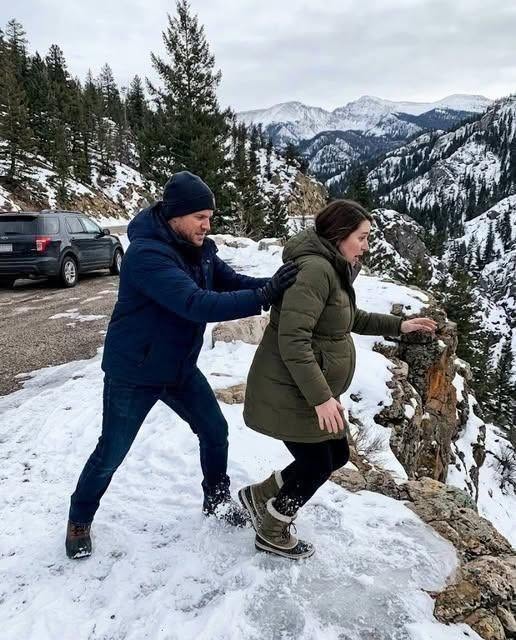
NINE MONTHS PREGNANT, MY HUSBAND PUSHED ME OFF AN ICY CLIFF FOR MY $50 MILLION LIFE INSURANCE THEN SMILED AT MY FUNERAL BESIDE HIS SECRET LOVER NOT KNOWING I WAS STILL ALIVE
The last thing I saw before my husband pushed me off the cliff was his smile.
Not anger.
Not panic.
Not the wild expression of a man who had lost control during an argument.
A smile.
Calm.
Certain.
Almost relieved.
I was nine months pregnant when Michael Carter put both hands against me on an icy ridge in Rocky Mountain National Park and shoved me backward into open air.
For one impossible second, my boots left the ground and I did not understand what had happened.
Then there was nothing beneath me.
No trail.
No rock.
No snow.
Only the drop.
I reached for Michael.
My fingertips caught empty air.
I clawed toward the edge.
My gloves scraped ice.
Then the cliff disappeared above me.
I screamed his name.
The wind tore the sound away.
My body struck the rock once, spun, and dropped again.
Pain exploded through my side.
Then I crashed onto a narrow ledge partway down the cliff.
The impact knocked every breath from my lungs.
For several seconds, I could not move.
I could not breathe.
I could not even understand whether I was still alive.
Then instinct took over.
Both hands flew to my stomach.
My son.
“Please.”
My voice barely existed.
“Please stay with me.”
Snow blew across my face.
The ledge beneath me was so narrow that one wrong movement could send me over the rest of the mountain.
I curled as tightly as my pregnancy allowed and waited for my baby to move.
Nothing.
My heart began pounding harder.
“Come on.”
Nothing.
“Please.”
Then I felt the smallest pressure beneath my palm.
A movement.
Tiny.
Weak.
But there.
I began crying.
“You’re here.”
Another movement.
“You’re still here.”
Above me, I heard Michael’s voice.
I looked up.
The ridge was almost hidden behind blowing snow.
Michael stood near the edge.
He looked down.
I expected shock.
Fear.
Maybe regret.
Instead, he was smiling.
“Michael!”
He did not reach for me.
He did not call for help.
He did not tell me to hold on.
He simply watched.
“Help me!”
The wind carried my voice upward.
“Please!”
He leaned closer to the edge.
For one second, I thought he might finally understand what he had done.
Then he called down.
“Don’t worry.”
I froze.
“You and the baby won’t suffer long.”
The sentence hit harder than the fall.
I stared up at the man I had married.
The man whose son I was carrying.
The man who had kissed my stomach weeks earlier and told me he could not wait to become a father.
He wanted us dead.
Not just me.
Both of us.
I heard footsteps in the snow above.
Someone else approached him.
A woman.
Then her voice reached me.
“Is she dead?”
I knew that voice.
Ashley.
Michael’s executive assistant.
The woman he had repeatedly told me was “basically family.”
The woman whose late night calls he said were about business.
The woman who had accompanied him to conferences.
The woman he insisted I was insecure for questioning.
I pressed myself against the cliff.
Michael laughed softly.
“For fifty million dollars, she better be.”
For a moment, the cold disappeared.
So did the pain.
All I could hear was the number.
Fifty million.
My life insurance policy.
Michael and I had argued about it months earlier.
He had insisted the coverage made sense because of my company, my assets, the baby, our financial responsibilities.
He said wealthy families planned for worst case scenarios.
At the time, I had thought it was excessive.
He had called it responsible.
Now I understood.
The policy had never been about protecting anyone if tragedy happened.
The tragedy was the plan.
Ashley said something I could not hear.
Michael answered.
“She won’t last out here.”
My stomach tightened.
I bit down on my glove to keep from making a sound.
Ashley walked closer to the edge.
I could see the shape of her coat through the snow.
“What if they find her?”
“They won’t.”
“What about rescue teams?”
“Look at this weather.”
“I don’t like this.”
Michael laughed again.
“You liked the plan when it meant we’d never have to worry about money again.”
My entire body went rigid.
We.
There it was.
Not just my husband.
Not just a mistress.
A conspiracy.
I thought back through every moment I had ignored.
Every look.
Every text Michael turned away from me to answer.
Every sudden business trip.
Every time Ashley came to our house and behaved as if she belonged there.
I remembered asking Michael once if something was happening between them.
He had become furious.
“You’re pregnant and paranoid.”
I had apologized.
Now she was standing beside him while I lay broken on a ledge below them.
Ashley spoke again.
“We need to go.”
Michael looked down one last time.
Even through the storm, I could feel the satisfaction in his posture.
He believed he had won.
Then they walked away.
Their voices faded.
Footsteps disappeared.
And I was alone.
Snow began collecting on my coat.
My hair was wet.
My fingers were losing feeling.
Every breath hurt.
I tried to move my left leg and pain shot through my hip.
I stopped immediately.
The ledge was not wide enough to experiment.
I pressed both hands against my stomach again.
My son moved.
“Okay.”
I breathed through my teeth.
“Okay, baby.”
I did not know whether I was talking to him or myself.
“We’re staying awake.”
The wind screamed across the cliff.
I counted breaths.
One.
Two.
Three.
Every time my eyes closed, I forced them open again.
I thought about my son’s nursery.
The little blue blanket folded across the rocking chair.
The stuffed bear my father had bought before he died.
The tiny socks lined in a drawer because I had been absurdly organized during pregnancy.
I thought about holding my son for the first time.
I had not even met him yet.
Michael had already tried to decide he would never get that chance.
“No.”
I whispered it into the storm.
“No.”
Darkness pressed around the edges of my vision.
I shook my head.
“You don’t get to decide.”
My husband had decided where we would hike.
He had chosen the trail.
He had told me the views would be beautiful.
I had protested because I was nine months pregnant.
He had laughed.
“We’re not climbing Everest.”
He said the walk would be short.
Safe.
Private.
A final peaceful weekend before the baby came.
The phrase made me sick now.
Private weekend.
No witnesses.
Bad weather.
An icy cliff.
A pregnant wife.
He had built the story before we ever left home.
I remembered him taking my wedding ring off my hand before we reached the cliff.
At the time, we had been arguing.
He had grabbed my fingers.
The ring caught against my knuckle.
“What are you doing?”
“You don’t deserve to wear this while accusing me of cheating.”
“Give it back.”
“You think marriage means nothing anyway.”
He slipped the ring into his pocket.
I had been furious.
But I had not understood.
He was not taking it because he was angry.
He needed it.
For later.
I did not know that yet.
All I knew was that the cold was spreading deeper.
Minutes became impossible to measure.
Maybe twenty passed.
Maybe forty.
Maybe more.
At one point, I woke without remembering falling asleep.
That terrified me.
“Stay awake.”
My teeth were chattering so hard I could barely form words.
“Stay awake.”
I rubbed my hands over my stomach.
My son moved again.
Every movement became a command.
Live.
I thought about Michael standing at my funeral.
I did not know yet that there would be one.
But I could imagine him.
Black suit.
Head lowered.
Accepting sympathy.
Pretending to be devastated.
Ashley somewhere nearby.
Maybe pretending to be the loyal employee helping her grieving boss.
Maybe waiting until enough time passed before they could publicly become what they already were.
And behind all of it, fifty million dollars.
Anger warmed me for maybe three seconds.
Then the cold returned.
I stared at the white air.
“Someone.”
No answer.
“Please.”
Nothing.
Another wave of exhaustion hit.
I closed my eyes.
My son moved.
I opened them.
Then I saw light.
Faint.
Moving.
I blinked.
Gone.
My mind had begun playing tricks.
I almost laughed.
Then the light returned.
It swept across the rock above me.
A beam.
Searchlight.
I tried to move my arm.
Pain ripped through my side.
I screamed.
The beam disappeared.
“Here!”
My voice was pathetic.
“Here!”
Then I heard it.
Rotor blades.
At first distant.
Then louder.
The storm itself seemed to pulse.
A black helicopter appeared through the snow above the ridge.
My heart stopped.
“No.”
I began crying.
“No, no, please see me.”
The searchlight moved again.
Past me.
Back.
Stopped.
Directly over the ledge.
Someone had seen me.
A cable dropped.
A rescuer descended through the snow.
He struck the ledge hard on one knee, stabilized himself, and moved toward me.
“Ma’am!”
I tried to answer.
Nothing came out.
He crouched in front of me.
“Can you hear me?”
I nodded.
He brushed snow away from my face.
“Stay awake. Look at me.”
I forced my eyes toward his goggles.
His gloved hand went to my shoulder.
“Are you injured?”
I tried to speak.
“My…”
The word broke.
He leaned closer.
“What?”
“My baby.”
His gaze dropped toward my stomach.
For half a second, he froze.
Then everything about him changed.
“Are you pregnant?”
I nodded.
“How far along?”
“Nine.”
“Nine weeks?”
I shook my head violently.
“Months.”
His face tightened.
“Nine months?”
“Yes.”
He immediately reached for his radio.
“Control, Alpine Three. I have one live female patient, advanced pregnancy, approximately full term. Significant cold exposure, possible traumatic injuries.”
Static.
A response.
He began preparing a rescue harness.
I grabbed his sleeve.
“My husband.”
He looked at me.
“What about your husband?”
I could barely say it.
“He pushed me.”
The rescuer stopped.
“What?”
“He pushed me off.”
I saw something shift in his eyes.
Not disbelief.
Alertness.
“Was anyone else there?”
“Yes.”
“Who?”
“Ashley.”
“Last name?”
“I don’t know.”
“And your husband?”
“Michael Carter.”
The rescuer stared at me.
Then toward his radio.
I saw the recognition.
My stomach tightened.
“How do you know his name?”
He did not answer immediately.
Instead, he pressed the radio.
“Control, patient identifies husband as Michael Carter. She reports she was pushed from upper ridge by husband. Possible second involved party named Ashley.”
Static.
Then a voice.
“Copy.”
The rescuer looked back at me.
“What’s your full name?”
I told him.
He repeated it.
Silence came through the radio.
Long enough that even in my condition I noticed.
Then the controller spoke again.
“Say again patient name.”
The rescuer repeated it.
Another pause.
“Search and rescue records show no active missing person matching that description.”
I stared.
“That’s impossible.”
The rescuer’s jaw tightened.
He pressed the radio again.
“Control, confirm Michael Carter report.”
Another voice answered.
“The only emergency report connected to that area was filed by Michael Carter.”
My pulse accelerated.
“What did he say?”
The rescuer looked at me.
“He reported an accident.”
“What accident?”
“He said his wife fell.”
Of course.
Michael had called.
Not to save me.
To create the record.
I tried to breathe.
“He lied.”
“I believe you.”
“You don’t understand.”
He waited.
“He wanted me dead.”
A sharp pain tore through my abdomen.
I cried out.
The rescuer steadied me.
“Don’t move.”
“My baby.”
“We’re getting both of you out.”
The harness tightened around my body.
Every movement hurt.
Then I looked up.
Through the blowing snow, the ridge was barely visible.
But I could see marks near the edge.
Footprints.
Two sets.
Michael.
Ashley.
And beside them, a long deep line cut through the snow.
Something had been dragged.
I pointed.
“There.”
The rescuer looked.
“What?”
“That mark.”
He followed my finger.
“What is it?”
“I don’t know.”
But something inside me knew it mattered.
Evidence.
Maybe equipment.
Maybe something Michael had moved.
Maybe part of the plan.
The rescuer looked toward the ridge and spoke into his radio again.
“Document upper ridge before weather destroys tracks.”
The helicopter cable tightened.
I closed my eyes.
The ledge disappeared beneath me.
For the first time since Michael pushed me, I was moving upward.
As I rose through the snow, I made myself one promise.
If I survived, Michael Carter would not get to tell the final version of my death.
Not because I wanted to hurt him.
Not then.
I wanted truth.
Truth about the cliff.
Truth about Ashley.
Truth about fifty million dollars.
Truth about the husband who had already begun mourning a wife he knew was still alive when he walked away.
Then everything went dark.
When I woke again, there was a ceiling above me.
White.
Bright.
Still.
A monitor beeped nearby.
For several seconds, I could not understand why there was no wind.
Then memory returned all at once.
The ridge.
Michael’s hands.
The fall.
The ledge.
Ashley.
My son.
My hands flew toward my stomach.
A nurse appeared immediately.
“Easy.”
“My baby?”
She placed one hand near my shoulder.
“Your son is alive.”
I stared at her.
“What?”
“He’s alive.”
The words broke something open inside me.
I started crying.
“He’s alive?”
“Yes.”
“Is he okay?”
“He has a heartbeat. The doctors are monitoring both of you closely.”
I covered my face.
Every muscle in my body hurt, but the pain no longer mattered.
“He’s alive.”
The nurse smiled gently.
“Yes.”
I remembered Michael’s voice.
You and the baby won’t suffer long.
He had been wrong.
I lowered my hands.
“Michael.”
The nurse’s expression changed.
“Your husband?”
“Where is he?”
“He’s not here.”
“Does he know?”
“Know what?”
“That I’m alive.”
She hesitated.
That hesitation told me something.
“Who knows?”
“The medical team. Search and rescue. Police.”
“Michael?”
“I don’t believe so.”
My heart began pounding.
“Keep it that way.”
The nurse blinked.
“Ma’am?”
“Please.”
I reached for her hand.
“My husband pushed me.”
Her face went still.
“The police are already aware of what you reported.”
“He tried to kill me.”
“I understand.”
“And he thinks he succeeded.”
She looked toward the door.
“The officers will want to speak with you.”
“Good.”
I lay back.
For the first time since the cliff, the fact that Michael believed I was dead did not terrify me.
It gave me something.
Time.
He had built his plan around a dead woman.
A dead woman could not talk.
A dead woman could not identify Ashley.
A dead woman could not dispute his accident story.
A dead woman could not ask why he had arranged a fifty million dollar insurance policy.
But I was not dead.
And Michael did not know it.
Two officers came into the room later.
They asked careful questions.
I answered everything.
Michael planned the hiking trip.
Ashley had been there.
Michael pushed me.
He spoke about the baby dying.
I heard Ashley ask if I was dead.
I heard Michael mention fifty million dollars.
I described the wedding ring.
The argument.
His hand removing it.
One officer stopped.
“He took your wedding ring before the fall?”
“Yes.”
“Did he return it?”
“No.”
“Do you know where it is?”
“No.”
The officer wrote something.
“Why is that important?”
“We don’t know yet.”
The phrase irritated me.
I wanted answers.
Instead, I had facts.
They told me Michael had reported that I slipped.
According to him, I had insisted on walking near the ridge despite the conditions.
He claimed he tried to catch me.
He claimed Ashley happened to be nearby because she had joined part of the trip for work related reasons.
I laughed.
It hurt my ribs.
The officer looked at me.
“Something funny?”
“He brought his mistress to kill his pregnant wife and called it business.”
“We have not established the nature of their relationship.”
“I have.”
The officer did not argue.
“Did you know she would be there?”
“No.”
“Did you see her before the fall?”
“No.”
That bothered me.
Ashley had been close enough to appear almost immediately.
She must have been following.
Or waiting.
The plan had layers.
The officer explained that weather had damaged much of the scene.
Snow.
Wind.
Movement from rescue operations.
But photographs had been taken.
Footprints.
The strange drag mark.
The area where I landed.
The trail.
They were preserving what they could.
“What happens now?”
“You recover.”
“No.”
I looked directly at him.
“What happens to Michael?”
“We investigate.”
“He tried to murder me.”
“I understand.”
“He’s walking around free?”
“For the moment.”
I hated the answer.
The officer held my gaze.
“If he believes you are dead, that belief may help us.”
I stopped.
“What do you mean?”
“He may behave differently.”
I understood immediately.
Relaxed people make mistakes.
Victorious people make more.
“Do not tell him.”
The officer nodded.
“We are limiting information.”
My son moved beneath my palm.
I smiled despite everything.
For the first time, Michael and I were both waiting.
The difference was that he thought he was waiting for money.
I was waiting for evidence.
Three days later, I learned Michael had held my funeral.
Three days.
That was all it took him.
I was still in a hospital bed.
Doctors were still monitoring my son.
My body was bruised from the fall.
And my husband was already standing beside a coffin telling people goodbye.
The officer who had been working with me came into the room carrying a folder.
He looked tired.
“What?”
I asked.
He sat.
“Your funeral was yesterday.”
For a second, I thought I had misunderstood.
“My what?”
“Michael arranged a memorial and funeral service.”
I stared.
“There’s no body.”
“He claimed conditions made recovery uncertain.”
“Then what did they bury?”
“An empty coffin.”
I laughed.
Then stopped because suddenly none of it felt funny.
“He buried me.”
“Yes.”
“While no body existed.”
“Yes.”
“And nobody thought that was strange?”
“There were circumstances presented as a tragic unrecovered death.”
I looked toward the window.
Michael had not waited.
He did not need my body.
He only needed death accepted.
The officer opened the folder.
“Would you like to see photographs?”
“Yes.”
The first showed Michael near the park during the early search.
Head bowed.
Hands covering his face.
The perfect grieving husband.
If I had not known the truth, I might have believed it.
He looked shattered.
I studied the photograph.
“He’s good.”
The officer said nothing.
“He knows exactly what people expect grief to look like.”
Another photograph.
Michael beside a rescue worker.
Another.
Michael speaking to someone while wiping his eyes.
Then the officer showed me a photograph from outside the funeral home.
Michael stood near Ashley.
Her hand was wrapped around his arm.
Neither looked devastated.
Their faces were different.
Relaxed.
Relieved.
Almost intimate.
“That’s her.”
“We identified her.”
“Ashley.”
“Yes.”
“My husband’s executive assistant.”
“Yes.”
“She was on the mountain.”
“We’re investigating that.”
“They’re sleeping together.”
“We’re investigating that too.”
I looked again.
Michael’s posture told me enough.
I had seen it before.
At company parties.
Business dinners.
The way he leaned toward her.
The way she touched his arm casually.
I had noticed.
Then allowed myself to be convinced I was imagining it.
The officer placed another document in front of me.
My life insurance policy.
Fifty million dollars.
Beneficiary.
Michael Carter.
I stared at it.
“Where did you get this?”
“Insurance company.”
“He filed a claim?”
The officer did not answer immediately.
My stomach sank.
“He did.”
“How soon?”
“Very soon after the death was presumed.”
I closed my eyes.
Of course.
He had barely finished pretending to grieve before reaching for the money.
The officer slid a plastic evidence photograph toward me.
A handwritten note.
Five words.
After the funeral, we collect.
My entire body went cold.
“Where was this?”
“Michael’s vehicle.”
I stared at the handwriting.
I knew it.
Michael made his capital A in a distinctive way.
He always had.
I had seen it on anniversary cards.
Birthday notes.
Company documents.
Now it appeared beneath a plan for collecting money after my death.
“That’s his.”
“You’re sure?”
“Yes.”
I did not hesitate.
“When is the funeral?”
The officer’s eyes changed.
“It was yesterday.”
Yesterday.
Michael had stood beside an empty coffin.
Ashley beside him.
Mourners around them.
People probably hugged him.
Told him how sorry they were.
Maybe someone spoke about my son.
Our unborn child presumed dead with me.
Maybe Michael cried.
Maybe Ashley lowered her eyes.
Then they went home knowing they believed fifty million dollars was moving toward them.
The officer continued.
“The insurance claim is under scrutiny.”
“It better be.”
“He believes the process is moving.”
“Does he know anyone doubts his story?”
“He knows questions are being asked. He does not know you survived.”
I felt something unfamiliar.
Not happiness.
Not revenge exactly.
Power.
For the first time since the cliff, Michael knew less than I did.
He believed the key witness against him was dead.
I was breathing.
My son kicked.
I put my hand over him.
“We survived.”
The officer looked down.
Then his phone rang.
He answered.
His expression changed almost immediately.
“What?”
He listened.
“That’s impossible.”
I sat up.
“What happened?”
He lowered the phone.
“The funeral home contacted investigators.”
“Why?”
“They found something inside the coffin.”
My pulse quickened.
“What?”
“A wedding ring.”
I stared.
“What wedding ring?”
He looked at the folder.
Then at me.
“Yours.”
My breath disappeared.
“No.”
The officer placed a photograph in front of me.
Gold.
Small.
Familiar.
My ring.
The one Michael pulled from my finger on the mountain.
The one I thought had been lost.
I touched my bare hand.
“He put it there.”
“That’s one possibility.”
“No.”
I looked up.
“He put it there.”
I remembered the exact moment.
Michael gripping my hand.
Twisting my fingers.
Pulling the ring away.
I thought he was humiliating me.
Now the action made perfect sense.
He needed something identifying.
Something symbolic.
Something that could sit inside an empty coffin and make the story feel complete.
But then another thought arrived.
“If the coffin was empty…”
The officer waited.
“Why plant my ring?”
“To create the appearance that personal effects were recovered.”
“Was anything else inside?”
“Not according to the initial report.”
I stared at the photograph.
Something felt wrong.
Then I asked the question that changed the investigation again.
“If he put my ring in there, why did the funeral home say they found it later?”
The officer frowned.
“What do you mean?”
“If it was supposed to be part of the funeral, Michael would know it was there.”
“Yes.”
“Then why was it discovered as something unusual?”
The officer considered that.
I felt my stomach tighten.
“Whose coffin was it really?”
The room went quiet.
Outside, footsteps passed.
Then stopped.
The handle on my hospital door moved.
The officer stood immediately.
His hand went toward his side.
The door opened.
Ashley walked in.
I could not breathe.
For several seconds, neither of us moved.
The woman I believed had watched Michael leave me to die stood in front of me.
Her face was pale.
Her eyes swollen from crying.
She looked terrified.
“You’re alive,” I whispered.
Ashley nodded.
Tears spilled down her face.
“So are you.”
She nodded again.
The officer stepped between us.
“How did you get in here?”
“I told the nurse I had information.”
“You need to stay where I can see your hands.”
Ashley lifted them.
I stared at her.
“Why are you here?”
Her eyes moved toward the hallway.
“Because Michael thinks I’m dead.”
That made no sense.
“What?”
“He thinks you’re dead.”
“Yes.”
“And now he thinks I’m dead too.”
The officer’s expression hardened.
“You need to explain.”
Ashley wiped her face.
“He planned everything.”
“I know.”
She shook her head.
“No. You know part of it.”
My body tensed.
“What else?”
She reached slowly into her coat.
The officer immediately told her to stop.
“It’s a phone.”
He took it first.
Checked it.
Then handed it back.
Ashley unlocked the screen.
“There are recordings.”
“Of what?”
“Michael.”
I looked at her.
She selected a video.
The officer watched over my shoulder as she pressed play.
Michael appeared on screen.
His office.
His desk.
I recognized everything.
The dark shelves.
The framed photographs.
The chair I bought him for our anniversary.
He leaned toward someone off camera.
“If she dies, everything becomes mine.”
My stomach twisted.
Then Ashley’s voice.
“But what if she finds out?”
Michael answered.
“She won’t.”
The video ended.
I stared at the phone.
“What was I supposed to find out?”
Ashley looked away.
“What?”
She took a breath.
“Michael had been stealing from your company.”
The words did not register.
“My company?”
“Yes.”
“My father’s company?”
“Yes.”
“How much?”
She whispered the number.
“Almost eighteen million dollars.”
I stared at her.
The room seemed to move slightly.
“No.”
“I saw the transfers.”
“No.”
“He had been moving money through vendor accounts and shell entities.”
“He couldn’t.”
“He had access.”
I closed my eyes.
I had given him access.
Not full ownership.
Not complete control.
But enough.
My father built the company over thirty years.
When he died, he left it to me.
Michael told me managing a corporation while pregnant would be too much.
He offered to take more responsibility.
I had trusted him.
“How long?”
“Years.”
The answer was worse than I expected.
“Years?”
Ashley nodded.
My hands curled around the blanket.
“And the insurance?”
“That was the way out.”
I looked at her.
“Explain.”
“Michael knew the discrepancies were getting too large.”
“Someone was going to find them.”
“Yes.”
“The insurance payout would replace the money.”
“In part. Enough to move things, settle accounts, and hide what he’d done.”
I stared.
“He wasn’t killing me just for fifty million.”
“No.”
“He was killing me because I could discover eighteen million missing.”
“Yes.”
My marriage changed shape inside my memory.
The sudden pressure to update estate documents.
Michael insisting on the huge life insurance policy.
His growing involvement in company finances.
His irritation when I said I wanted a full audit after the baby was born.
I remembered the exact conversation.
“We need someone independent to review the accounts.”
Michael had become defensive.
“Why?”
“Because Dad always did annual external reviews.”
“We already have accountants.”
“I want another review.”
“That’s wasteful.”
“It’s my company.”
The room had gone silent.
At the time, I thought I hurt his pride.
Now I understood.
I had almost uncovered him.
“When did he decide to kill me?”
Ashley cried harder.
“I don’t know exactly.”
“You helped him.”
“I helped arrange things.”
“What things?”
“The trip.”
My skin went cold.
“You made the reservations.”
“Yes.”
“You knew.”
“At first I thought he was planning to stage an accident for an insurance claim without…”
She stopped.
“Without what?”
“I don’t know.”
“Without murdering me?”
She looked down.
“You helped him bring a nine month pregnant woman onto an isolated mountain.”
“I know.”
“You followed us.”
“Yes.”
“You watched him push me.”
Her face crumpled.
“Yes.”
I wanted to hit her.
I wanted to scream.
Instead, I spoke quietly.
“And then you left.”
“I was terrified.”
“You left me under the snow.”
“I know.”
“You heard him say our baby would die.”
“Yes.”
“You heard me scream.”
Her shoulders shook.
“Yes.”
I looked at the officer.
“Get her out.”
Ashley panicked.
“Please.”
“Get her out.”
“Michael is going to kill me.”
I stared.
“Why should I care?”
She flinched.
The question was cruel.
I meant it at the time.
Ashley reached for the phone again.
“Because I have what you need.”
The officer stopped her movement.
“What?”
“Messages.”
She opened them.
Michael.
It’s done.
Another.
You know too much.
Then:
Meet me tonight.
I read them twice.
“What does he think happened to you?”
Ashley swallowed.
“He told someone I had driven away after the funeral.”
“That doesn’t mean he thinks you’re dead.”
“No.”
She looked toward the officer.
“I made him think I was going to meet him tonight.”
The officer understood.
“You believe he intends to kill you.”
“Yes.”
“How?”
“I found another note.”
“What note?”
She handed him a photograph.
A map.
A location.
Remote.
Michael had written something beside it.
One loose end.
My stomach turned.
The same man who wanted to kill me now wanted to kill the woman who helped him.
Of course he did.
Ashley had evidence.
She knew about the money.
She knew about the cliff.
She had heard everything.
Michael could not collect and live freely while she remained capable of speaking.
I looked at her.
“Did you love him?”
She cried silently.
“Yes.”
“Did he love you?”
She did not answer.
I almost laughed.
“He was always going to kill you too.”
“I know that now.”
“That’s why you’re here.”
“Yes.”
“Not because you’re sorry.”
Ashley shook her head.
“Both.”
I looked away.
I could not forgive her.
I did not even want to think about forgiveness.
I wanted my son alive.
I wanted Michael stopped.
I wanted my company protected.
I wanted the truth documented before another person disappeared.
The officer began making calls.
Everything moved quickly after that.
Ashley gave investigators access to recordings, messages, financial information, and locations.
She agreed to cooperate.
She agreed to go to the planned meeting under law enforcement control.
I did not attend.
I was still hospitalized.
Still pregnant.
Still recovering.
Part of me hated that.
I wanted to see Michael’s face when he realized everything had collapsed.
Another part understood I did not need to be there.
My survival had already destroyed the center of his plan.
That night, Michael drove to the location near the same funeral home where he had pretended to mourn me.
He expected Ashley.
He expected another problem he could remove.
Instead, officers surrounded his vehicle.
I learned the details later.
They ordered him out.
He hesitated.
Then tried to drive away.
Another vehicle blocked him.
He abandoned the car and ran.
Michael had always been proud of his fitness.
He had run races.
Talked endlessly about discipline.
That night, he did not get far.
Officers caught him.
When they put him in handcuffs, he kept repeating the same thing.
“You don’t understand.”
For once, nobody cared about his explanation.
His car was searched.
They found documents tied to the company money.
Copies of my insurance policy.
Photographs of the hiking trail.
Notes.
Financial information.
And one more thing.
A recording.
Ashley had been recording on the mountain.
A small device inside her coat had captured the storm.
Michael.
Me.
His voice.
Clear enough.
“Don’t worry. You and the baby won’t suffer long.”
He thought the wind had erased the sentence.
It had not.
There was more.
Ashley asking whether I was dead.
Michael mentioning fifty million dollars.
Conversations after they walked away.
Discussion of what would happen next.
Not every word was perfect.
But enough survived.
Michael had spent years controlling stories.
This time, his own voice told one he could not rewrite.
When detectives came to tell me he had been arrested, I did not celebrate.
I expected to.
Instead, I asked one question.
“Can he get near me?”
“No.”
“My son?”
“No.”
“Good.”
That was enough.
My son was born weeks later.
Healthy.
Loud.
Angry at the world in the way newborn babies are angry at everything.
The first time they placed him against my chest, I started crying before I even saw his whole face.
He screamed.
I laughed.
“You made it.”
His tiny fingers opened.
Then closed.
“We made it.”
For months, Michael had treated my pregnancy as part of his calculation.
Two deaths.
One accident.
One payout.
But my son was not a number in an insurance scheme.
He was warm.
Alive.
Breathing against me.
I thought about the cliff.
My hands around my stomach.
The tiny movement that forced me to keep opening my eyes.
He had saved me too.
Not consciously.
But every kick gave me another reason to take one more breath.
Michael never got to hold him.
I did not feel guilty about that.
The criminal case expanded beyond attempted murder.
Financial crimes.
Fraud.
Conspiracy.
Insurance related offenses.
Evidence connected to the company theft.
The exact legal process became complicated.
Different investigators.
Different prosecutors.
Different categories of evidence.
I stopped trying to understand every procedural detail.
I had lawyers for that.
What mattered was simple.
Michael’s story did not survive contact with evidence.
He said I slipped.
The recording contradicted him.
He said Ashley was merely an assistant.
Their communications contradicted him.
He said the insurance policy was ordinary planning.
His notes contradicted him.
He said company transfers were legitimate.
Financial records contradicted him.
He said he was a grieving husband.
The funeral photographs showed something very different.
And most importantly, I was alive.
I could testify.
I could describe his hands on me.
His smile.
His words.
The officer who rescued me could describe what I said before anyone had time to build a new story.
The timing mattered.
I identified Michael and Ashley while I was still half frozen on the mountain.
Before knowing what Michael had told police.
Before learning about the funeral.
Before seeing financial evidence.
My account existed before I knew how useful it would become.
That mattered.
Ashley cooperated.
Her cooperation did not make her innocent.
She had helped arrange the trip.
She had participated in creating the circumstances.
She had been there.
She had walked away.
But she also preserved recordings.
She provided evidence.
She testified about the money.
She revealed Michael’s plan to silence her.
Her sentence reflected those facts.
I never forgave her.
People asked whether I eventually would.
I stopped answering.
Forgiveness had become a word other people seemed to need more than I did.
Some believed forgiving her would prove I had healed.
I disagreed.
Healing did not require me to pretend Ashley’s choices were smaller than they were.
She had been frightened.
She had been manipulated.
Michael had planned to kill her.
All of that could be true.
So could this:
She left a pregnant woman beneath a cliff and walked away.
Understanding her fear did not erase mine.
I could accept her cooperation without giving her absolution.
Both truths fit in the same room.
Michael received decades in prison.
The exact sentence mattered less to me than I expected.
People thought I would feel victorious hearing it.
I felt tired.
Relieved.
Then sad.
Not for Michael.
For the version of my life I once thought was real.
The husband I believed I had.
The father I imagined my son would know.
The marriage photographs.
The house.
The dinners.
The vacations.
The moments I had believed were sincere.
Some probably were.
That was one of the hardest things to accept.
People who do terrible things are not necessarily terrible in every single moment.
Michael had made me laugh.
He had held me after my father died.
He had once driven three hours in the middle of the night because I was sick during a business trip.
Those memories existed.
So did the cliff.
I did not need to erase the first set to accept the second.
But I did need to stop using good memories as evidence that the bad ones could not be true.
My company recovered.
Not instantly.
Eighteen million dollars does not vanish without consequences.
There were audits.
Lawyers.
Financial experts.
Insurance specialists.
Board meetings.
People who had trusted Michael had to accept what he had done.
Some money was recovered.
Some losses took longer to unwind.
Controls changed.
Access changed.
I stopped treating trust as a substitute for oversight.
That lesson was expensive.
It was also necessary.
My father had built the business carefully.
I used to feel ashamed that I had let Michael close enough to damage it.
One day, an older executive who had worked with my father stopped me after a meeting.
“You keep saying you let him do this.”
I stared.
“I gave him access.”
“Yes.”
“I trusted him.”
“Yes.”
“That was my mistake.”
The man shook his head.
“No.”
“What?”
“Trust was not theft.”
I looked at him.
“He stole.”
I said nothing.
“He committed the wrongdoing. Do not rewrite accounting language so the theft becomes your failure to predict theft.”
The sentence stayed with me.
Michael had trained me to carry responsibility for his choices.
The habit outlived the marriage.
I worked to break it.
My son grew.
The first year passed faster than I expected.
He became curious about everything.
Cabinet doors.
Shoes.
Dogs.
Leaves.
Anything he could reach.
The first time he laughed hard enough to lose his balance, I laughed until I cried.
He had no memory of the cliff.
That felt like a gift.
I did.
My body remembered cold for a long time.
The first winter after the attack, snow frightened me.
Not intellectually.
I knew I was safe.
But when I saw heavy snow collecting outside, my shoulders tightened.
Wind against windows could wake me.
An icy parking lot made my heart race.
Sometimes I dreamed about falling.
In the dream, Michael always stood above me.
But over time, something changed.
In later dreams, the rescuer appeared sooner.
Then my son’s cry.
Then sunlight.
Memory stopped ending at the fall.
That mattered.
Survival slowly changed the shape of what I remembered.
For months, when I thought of Rocky Mountain National Park, I saw Michael’s hands.
Then his smile.
Then the ledge.
Eventually, I started seeing the helicopter.
The cable.
The rescuer.
The moment I rose instead of fell.
That image became stronger.
Almost a year after Michael was sentenced, I decided to return.
People told me not to.
My therapist did not tell me either way.
She only asked why I wanted to go.
“I want to know it’s still just a mountain.”
“What do you mean?”
“I don’t want Michael to own that place in my head.”
She nodded.
“Then go when you feel ready.”
I brought my son.
Not onto the dangerous route.
We stayed in safe public areas with proper guidance.
I stood where I could see the mountains without approaching the cliff itself.
The snow was gone.
Summer sunlight covered the rock.
Wildflowers grew in places that had been white when Michael tried to kill me.
My son held my finger.
He was not quite steady enough to walk alone for long.
He looked up at me.
I looked toward the mountain.
For a second, I heard the wind from that day.
Then I heard my son laugh.
I looked down.
“We made it.”
He smiled because I was smiling.
He had no idea what the words meant.
That was okay.
They were for me.
“We made it.”
I thought about the funeral.
The empty coffin.
Michael in black.
Ashley holding his arm.
The ring he stole from my hand.
The insurance claim.
The note.
After the funeral, we collect.
He had counted money before my body was found.
He had planned grief as carefully as murder.
He had expected paperwork to finish what the cliff started.
Death certificate.
Insurance claim.
Estate transfer.
Company control.
Fifty million dollars.
Then eighteen million hidden.
Then Ashley eliminated.
Then a new life.
Michael imagined the future in straight lines.
That was his biggest mistake.
People are not financial entries.
Weather does not always cooperate.
Victims do not always die.
Mistresses do not always stay silent.
Recordings survive.
Rescuers search.
Officers ask questions.
Paper trails remain.
And sometimes the woman you bury in an empty coffin is still breathing.
I learned details about the funeral later that I almost wish I had not.
Michael had given a short speech.
He talked about how much he loved me.
He described me as his best friend.
He talked about our son.
He said losing both wife and child had left a hole nothing could fill.
People cried.
He cried too.
A family friend later told me she had hugged him and said she did not know how he remained standing.
He answered, “She would want me to be strong.”
I felt sick hearing that.
But then the friend told me something else.
“At the time, I believed him.”
She looked ashamed.
I told her not to be.
Michael was practiced.
He understood appearances.
The shame belonged to him.
Not the people who believed a husband grieving at his wife’s funeral.
Ashley stood near him much of the day.
Not openly intimate.
Careful.
But people noticed.
One person remembered Michael touching her lower back.
Another remembered them disappearing together for several minutes after the service.
At the time, it seemed like an assistant helping her employer.
Later, it looked different.
That is how evidence often works.
The detail itself does not change.
Context does.
The same was true of my marriage.
Michael encouraging life insurance once seemed responsible.
Later, it became part of a pattern.
His interest in company accounts once seemed helpful.
Later, theft.
His insistence on hiking once seemed romantic.
Later, planning.
Taking my ring seemed cruel in the middle of an argument.
Later, staging.
My life had not changed backward.
My understanding had.
That difference mattered.
I spent a long time wondering when Michael stopped loving me.
Eventually, I stopped asking.
Maybe he loved me at the beginning.
Maybe he loved what I represented.
Maybe he loved access.
Maybe somewhere along the way money became more important.
I could never know exactly what lived inside his mind.
Courts could judge his acts.
Investigators could trace his planning.
Records could show his money.
But love is not a forensic category.
I stopped needing an answer.
What he felt did not change what he did.
He pushed me.
That was enough.
My son would eventually ask about his father.
I knew that day would come.
I did not plan to lie.
I also would not burden a child with every terrible detail before he was ready.
The story belonged to him too, in some way.
But it would not define him.
Michael had tried to kill his mother while he was still inside me.
That did not make my son damaged.
It did not make him connected to his father’s crime in some mystical way.
He was a child.
His life began with survival.
Not violence.
I wanted him to understand that distinction.
One night, when he was almost one, I sat beside his crib and watched him sleep.
His hand was curled near his face.
I thought about the ledge.
The tiny movement beneath my palm.
How close the distance had been between this child existing and everything ending in snow.
I whispered, “You saved me.”
Then corrected myself.
“No.”
I smiled.
“We saved each other.”
The truth was more complicated.
Rescuers saved us.
Doctors saved us.
Chance saved us.
My body protected him.
His movements gave me reason to stay conscious.
No single hero.
Survival rarely belongs to one person.
That was another lesson.
People later described me as strong.
I never liked that word much.
Strength sounded too clean.
I had been terrified.
I had begged.
I had nearly lost consciousness.
I had cried.
I had wanted revenge at moments.
I had hated Ashley.
I had blamed myself.
I had woken screaming.
None of those things canceled survival.
Maybe strength was simply continuing while carrying all of them.
Michael believed strength meant control.
I learned it could mean endurance.
He believed power meant deciding who lived.
I learned power could mean telling the truth after someone tried to erase you.
He believed money made consequences negotiable.
I watched money fail him.
Fifty million dollars never arrived.
The insurance company did not reward murder.
The stolen company money became evidence.
The assets he thought would protect him became another map investigators could follow.
Even his wealth turned against him because every transaction left records.
That irony did not make me joyful.
But it did teach me something.
The systems he tried to manipulate were imperfect.
Yet enough people did their jobs.
Search and rescue did not stop because weather was bad.
Doctors did not dismiss me.
Police listened when I said my husband pushed me.
Investigators preserved the ridge.
Financial experts traced money.
Ashley ultimately provided evidence.
Prosecutors built the case.
No one person defeated Michael.
His plan collapsed because too many facts survived.
The cliff did not erase them.
The storm did not erase them.
The funeral did not erase them.
And most importantly, I did not disappear.
Years later, people would probably remember the case as the fifty million dollar insurance murder attempt.
That was the headline.
It was dramatic.
Wealthy husband.
Pregnant wife.
Cliff.
Mistress.
Funeral.
Insurance.
But to me, the story was never really about fifty million dollars.
It was about a man becoming so convinced that people were objects in his plan that he forgot they could act unpredictably.
He thought I would die because he pushed me.
I landed on a ledge.
He thought snow would finish me.
A searchlight found me.
He thought Ashley would remain loyal.
She discovered she was next.
He thought my company records could be hidden.
Investigators traced them.
He thought the funeral made death official.
I woke up in a hospital bed.
He thought my wedding ring could help bury the truth.
Instead, it became another question.
Every piece of control created another weakness.
Eventually, his plan collapsed under the weight of its own certainty.
The last time I saw Michael in person was in court.
He looked smaller.
That surprised me.
Not physically.
He was still the same man.
But the version of him on the mountain had seemed enormous.
He controlled the location.
The weather.
The surprise.
My balance.
My future.
In court, he sat behind a table.
Other people controlled the room.
The judge.
Attorneys.
Security.
Procedure.
Evidence.
For once, Michael had to listen.
He glanced at me.
Our eyes met.
I expected an apology.
Maybe hatred.
Maybe shame.
His face revealed almost nothing.
That bothered me for about five seconds.
Then I understood something.
I no longer needed his face to explain anything.
I did not need remorse to validate what happened.
I did not need him to confess emotionally.
His voice existed on tape.
The records existed.
The judgment existed.
My body existed.
My son existed.
That was enough.
After sentencing, reporters waited outside.
I did not give a dramatic speech.
I said only that my focus was my son, my recovery, my company, and rebuilding my life.
One reporter shouted, “Do you forgive your husband?”
I kept walking.
Another asked, “Do you hate Ashley?”
I kept walking.
People wanted clean emotional endings.
I had none.
I was alive.
That was the ending.
Everything after was rebuilding.
And rebuilding is quieter than revenge.
It is meetings.
Therapy.
Baby bottles.
Audits.
Sleep.
Legal documents.
Learning to trust people again.
Learning to trust yourself.
The first time I signed a major company document without Michael reviewing it, my hand shook.
That embarrassed me.
I had run the company before him.
But control changes habits.
I had become accustomed to hearing his opinion before making decisions.
After he was gone, silence felt strange.
I stared at the page.
Then signed.
Nothing terrible happened.
That became another recovery moment.
Not dramatic.
No one applauded.
But I remembered it.
The first time I drove into the mountains again, my hands tightened on the wheel.
I almost turned around.
Then my son made a noise from his car seat.
I looked at him in the mirror.
He was chewing on a toy.
Completely uninterested in my fear.
I laughed.
Then kept driving.
I did not go near the cliff that day.
I did not need to.
Recovery was not proving I could conquer every trigger immediately.
It was choosing where fear got to decide.
Sometimes I respected it.
Sometimes I challenged it.
Always I chose.
That word became precious.
Choose.
Michael had taken choice away on the mountain.
I rebuilt my life by making thousands of small ones.
Who entered my home.
Who accessed my accounts.
Who held my son.
Who worked at my company.
Where I traveled.
What I wore.
When I spoke publicly.
When I stayed private.
Whether I answered questions.
Whether I forgave.
Whether I returned to the park.
My life became mine again through choice.
I eventually replaced my wedding ring.
Not with another wedding ring.
With a simple band I bought for myself.
Nothing symbolic to anyone else.
No marriage.
No promise to another person.
Just something I liked.
The first time I wore it, I looked at my hand and remembered Michael twisting the old ring from my finger.
For months, the memory made my stomach turn.
That day, I looked at the new ring and thought only this:
My hand.
My choice.
That was enough.
Ashley wrote to me once from prison.
I almost threw the letter away.
Instead, I opened it.
She apologized.
Not elegantly.
Not perfectly.
She said fear had made her weak.
She said she should have called for help immediately.
She said hearing my scream replayed in her mind every night.
She said she knew she did not deserve forgiveness.
At the end, she wrote:
I thought Michael chose me because he loved me. I finally understand he chose people according to how useful they were.
I read the sentence several times.
Then folded the letter.
I did not respond.
But I understood.
Michael had categorized everyone.
Me.
Wife.
Company owner.
Insurance value.
Ashley.
Mistress.
Assistant.
Accomplice.
Thomas in accounting.
Useful.
Then risky.
Our son.
Collateral.
Future heir.
Whatever role served his calculation.
He had confused knowing what someone could provide with knowing who they were.
That was his deepest failure.
Not financial.
Human.
I refused to repeat it.
Ashley was not only the woman who left me.
She was also a frightened accomplice who later helped expose him.
That did not require forgiveness.
It required accuracy.
Michael was not only the husband who once comforted me.
He was also the man who pushed me.
Accuracy again.
I had learned that truth could hold contradictions without becoming weaker.
Years before, I might have thought accepting complexity meant excusing people.
It did not.
Sometimes seeing someone fully makes accountability clearer.
Michael was not a monster from another species.
He was a human man who made deliberate choices.
That was more frightening.
And more important.
Because if I turned him into something inhuman, I might miss the smaller warning signs in ordinary people.
Control.
Entitlement.
Financial secrecy.
Isolation.
Disdain for boundaries.
Anger when questioned.
The belief that affection creates ownership.
Those things often look ordinary long before they become a cliff.
I taught my company leadership team lessons from the financial side too.
No spouse gets automatic access because of marriage.
No executive bypasses controls because of trust.
Dual approvals.
Independent audits.
Clear documentation.
Personal relationships do not replace systems.
Michael exploited intimacy.
We built barriers against that happening again.
Some people called the changes excessive.
I did not care.
Trust thrives better when accountability exists.
That lesson cost eighteen million dollars and almost two lives.
I intended to remember it.
My son eventually learned to walk.
His first steps happened in my living room.
He let go of the couch and moved toward me.
One step.
Two.
Then he fell directly onto his diaper.
He looked shocked.
I laughed.
He frowned.
Then laughed too.
I picked him up.
For a second, holding him against me, I remembered falling.
My body dropping.
No ground.
No control.
Then I looked at him.
His fall was tiny.
Safe.
Part of learning.
I kissed his hair.
“Try again.”
He did.
That became a metaphor whether I wanted it to or not.
Falling did not always mean the end.
Sometimes there was a ledge.
A rescuer.
A second attempt.
A child taking another step.
I became suspicious of inspirational language after what happened.
People loved saying everything happens for a reason.
I hated that sentence.
There was no good reason Michael pushed me.
No reason that justified it.
No cosmic lesson worth the risk to my son.
I did not need suffering to be meaningful in order to survive it.
Meaning came afterward.
I chose what to build from it.
That distinction protected me.
I did not thank the cliff for making me stronger.
I thanked the people who saved me.
I thanked my body for surviving.
I thanked the stranger in alpine gear who descended into a storm.
I thanked investigators who believed evidence over influence.
I thanked my son for simply being alive.
Michael received no gratitude.
His violence was not a gift.
My survival was mine.
The rescuer and I eventually met again.
His name was Daniel.
The first time I saw him without goggles and snow covering his face, I almost did not recognize him.
He smiled.
“You look warmer.”
I laughed.
“Much.”
My son was with me.
Daniel looked at him.
“This him?”
“Yes.”
He crouched.
My son stared.
Daniel smiled.
“You caused a lot of trouble before you were even born.”
I laughed.
“Runs in the family.”
Then I became emotional.
Daniel stood.
“I never properly thanked you.”
“You don’t need to.”
“I do.”
“You stayed conscious.”
“You came down.”
“That’s the job.”
“No.”
I shook my head.
“To me, it’s more than that.”
He accepted the thanks then.
I asked how he found me.
Another team had noticed irregular tracks and search information did not match the expected fall trajectory.
They expanded the sweep.
The weather briefly opened enough for the light to catch movement and contrast on the ledge.
Chance.
Training.
Persistence.
A few minutes in either direction might have changed everything.
I stopped thinking about that after a while.
There is no peace in calculating how close you came to death.
Close still means alive.
I chose to live in that word.
Alive.
My father once told me that money reveals people more than it changes them.
I used to disagree.
After Michael, I understood.
Fifty million dollars had not created his entitlement.
It exposed how far he was willing to go when he believed the reward justified it.
Eighteen million stolen dollars showed the same pattern.
One compromise became another.
One lie protected the previous one.
One crime required another.
Eventually, killing me probably felt to him like the logical continuation of choices he had already normalized.
That frightened me.
Not because I thought everyone who lies becomes violent.
Of course not.
Because Michael had built a private moral system where his goals increasingly justified whatever protected them.
Once a person believes consequences belong only to others, almost anything becomes possible.
The courtroom restored something basic.
Not revenge.
Limits.
Michael had lived as if no one could tell him no.
The law finally did.
Prison was not poetic justice to me.
It was containment.
He could not access me.
He could not access my son.
He could not access company accounts.
He could not create another hiking trip.
That was enough.
One afternoon, years after the cliff, I found the old funeral program in a legal archive box.
My photograph was on the front.
The date beneath it.
Born.
Died.
Except the second date was wrong.
I sat at my desk holding a document announcing my own death.
For a moment, it felt unreal.
Then funny.
Then deeply sad.
Michael had written a short message inside.
My beloved wife and unborn son will remain with me forever.
I stared at it.
He had already planned to erase our son too.
Not even born.
Reduced to a sentence.
I put the program back in the box.
Then changed my mind.
I took it outside.
I did not burn it.
Burning felt too dramatic.
I simply tore it in half.
Then again.
Then put it in the trash.
The document had no authority over me.
It was paper.
A lie printed in elegant font.
I was alive.
My son was upstairs making noise.
Reality did not need ceremony.
The company eventually stabilized.
We recovered enough assets that the future felt secure again.
But money stopped impressing me.
Not because it did not matter.
Money buys medical care.
Lawyers.
Security.
Housing.
Freedom.
I understood its importance more than ever.
But fifty million dollars had almost become the price attached to my death.
After that, numbers felt different.
I cared more about control.
Who controlled the accounts.
Who controlled access.
Who controlled information.
And whether any person believed money placed them above boundaries.
I also changed my estate plans.
Not because I expected another murder attempt.
Because I understood good planning does not rely on one person.
Trusts.
Independent fiduciaries.
Multiple layers.
Protection for my son.
Nothing dependent on romantic loyalty.
It felt cold at first.
Then responsible.
Love and safeguards can coexist.
Only people threatened by accountability insist otherwise.
The hardest work remained emotional.
There were days I hated myself for not seeing Michael sooner.
Then I remembered the smiling grieving husband in the photographs.
He fooled entire rooms.
He had practiced deception.
I had practiced trust.
Those were not equivalent skills.
I stopped punishing myself for losing a contest I never knew I was in.
That was healing too.
When my son was old enough to run, we returned to the park again.
He loved rocks.
Every rock.
He picked them up, examined them, asked whether he could keep them.
Mostly he could not.
Park rules.
He was offended.
I watched him crouch beside one and thought about how completely life had changed.
Once, rock meant impact.
Ledge.
Blood.
Cold.
Now it meant a child asking whether a gray stone was treasure.
Maybe this was how places returned to us.
Not through forgetting.
Through layering new memories over old ones until terror was no longer the only thing there.
I never stood on the exact cliff edge again.
I did not need to.
People sometimes asked whether avoiding it meant Michael still had power.
No.
Freedom includes deciding not to revisit the exact location where someone tried to kill you.
I could reclaim the park without proving anything to a piece of rock.
That distinction felt important.
Recovery does not have to perform bravery for an audience.
I already knew what I survived.
One evening, my son asked why there were no pictures of his father in our home.
He was still too young for everything.
I sat beside him.
“Your father made choices that made it unsafe for him to be with us.”
“Bad choices?”
“Yes.”
“Like breaking rules?”
“Much more serious.”
“Is he in jail?”
Children hear things.
“Yes.”
“Because of you?”
That question stopped me.
“No.”
He waited.
“Because of what he did.”
I wanted that sentence to become part of his foundation.
Not because of you.
Not because of me.
Because of what he did.
Accountability belongs to actions.
Children should not inherit guilt.
Neither should victims.
My son thought for a moment.
“Do I look like him?”
“Yes.”
He looked worried.
I immediately understood.
“You also look like me.”
“Am I like him?”
I took his hand.
“You are yourself.”
He watched my face.
“Having someone’s eyes does not give you their choices.”
He nodded slowly.
Then asked for a snack.
Children are merciful that way.
The question felt enormous to me.
To him, it lasted thirty seconds.
I carried the rest.
I would tell him more as he grew.
Truth in age appropriate pieces.
Never using his father as a weapon against him.
Michael had already caused enough damage.
I would not make our son responsible for hating him correctly.
He could process that relationship in his own time.
My job was safety and honesty.
Nothing more theatrical.
By then, my scar from the cliff had faded.
Not disappeared.
A line near my hip.
Another near my side.
Sometimes my son saw them.
“What happened?”
“I got hurt.”
“How?”
“I fell.”
Not the whole truth.
But true.
Later came:
“Someone hurt me.”
Then eventually:
“Your father hurt me.”
Truth can grow with a child.
It does not have to arrive all at once.
The first time I used Michael’s name while explaining it, I felt my chest tighten.
Then my son asked another question.
“Did you get better?”
I smiled.
“I did.”
That was the part I wanted him to remember.
Not invulnerability.
Recovery.
People get hurt.
They can still build lives.
The final financial audit eventually closed.
Eighteen million dollars.
Accounts.
Transfers.
Shell companies.
False invoices.
It all became numbers on pages.
I sat in the final meeting looking at the total.
For years, that number had lived invisibly inside my marriage.
Michael knew it.
Ashley knew pieces.
I did not.
Now it was exposed.
One accountant asked whether I wanted the documents archived.
“Yes.”
“For how long?”
“Permanently.”
Not because I wanted to live in the past.
Because institutions should remember what people prefer to forget.
Memory protects.
The same way the recording protected truth.
The same way the rescue report protected what I said.
The same way photographs preserved footprints before snow erased them.
Documentation had become part of survival.
Not obsession.
Structure.
I learned the difference.
My life slowly became boring again.
That was wonderful.
School forms.
Groceries.
Meetings.
Laundry.
Birthday parties.
Doctor appointments.
The ordinary weight of raising a child.
No cliff.
No investigators.
No funeral.
No insurance claim.
Sometimes boredom felt luxurious.
I had once thought excitement meant life.
After Michael, predictable mornings felt like wealth.
My son eating cereal.
Sunlight through windows.
A calendar full of ordinary obligations.
No one plotting anything.
No one hiding accounts.
No one measuring my life against a payout.
That became success.
I stopped following news about Michael.
At first, every legal update consumed me.
Appeals.
Filings.
Prison transfers.
Then one day I realized I had gone three weeks without thinking about where he was.
The realization made me smile.
That was freedom.
Not his suffering.
My forgetting to check.
His importance shrinking.
Michael had once occupied the center of my emotional world.
Then the center of my fear.
Eventually, he became a fact.
A dangerous one.
A historical one.
But not the organizing principle of my day.
I wanted that more than revenge.
Revenge keeps the person central.
Recovery lets them become peripheral.
Years after the attack, someone asked me what I thought Michael’s greatest punishment was.
Prison?
Losing the money?
Losing his reputation?
Losing the company access?
I thought about it.
Then answered.
“He doesn’t get our life.”
That was it.
He did not get my son’s first steps.
First words.
First day of school.
Birthdays.
Ordinary breakfasts.
He did not get the company my father built.
He did not get fifty million dollars.
He did not get Ashley.
He did not get the story he planned.
Most importantly, he did not get to decide that my life ended on that cliff.
His punishment was not that I destroyed him.
It was that he failed to destroy me.
That was enough.
The mountain still exists.
The ledge still exists.
Winter still covers it in snow.
Every year, storms move across the same ridge.
Somewhere below that cliff is a place where a pregnant woman once lay half frozen with both hands over her stomach.
That woman believed she might die.
I think about her sometimes.
Not as me exactly.
As someone I want to reach backward and comfort.
I want to tell her:
The light is coming.
The helicopter will see you.
Your son is alive.
You will wake up in a hospital.
Michael will hold a funeral.
Let him.
The coffin will be empty.
The insurance money will not save him.
Ashley will eventually talk.
The recordings will survive.
The theft will be found.
Your company will still be yours.
Your son will grow.
You will return to these mountains under sunlight.
And one day, you will go hours without thinking about the man above the cliff.
She would not believe me.
That is okay.
All she needed then was one more breath.
One.
Then another.
That was how the future began.
Not with revenge.
Breathing.
Michael had wanted silence.
A frozen body.
An unborn child.
An empty space no one could contradict.
Instead, he got a survivor.
A witness.
A mother.
A company owner who could follow the money.
A recording of his own voice.
A mistress who realized she was next.
A rescue team that documented the scene.
A funeral built around the wrong assumption.
A life insurance claim that became evidence instead of profit.
He had planned everything except survival.
That was the flaw.
People who believe they control everything often fail to imagine the one thing they cannot command.
Someone else choosing to keep living.
I did.
Not heroically.
Not beautifully.
I was terrified.
Bleeding.
Freezing.
Half conscious.
But I kept opening my eyes.
My son moved.
I breathed.
A light appeared.
I lifted my head.
That was enough.
At the funeral they believed was mine, Michael stood beside Ashley and looked like a man who had already won.
He had a coffin.
A death story.
A fifty million dollar claim.
My wedding ring.
A grieving husband performance.
And no wife left to disagree.
Except I was alive.
That truth was moving toward him even while he smiled.
First through a hospital room.
Then a rescue report.
Then photographs.
Then financial records.
Then Ashley’s phone.
Then his own recorded voice.
Truth did not arrive dramatically all at once.
It accumulated.
One piece.
Then another.
Until his story could no longer stand.
That is what I remember most now.
Not the fall.
Not the funeral.
The accumulation.
How reality can survive even when powerful people work hard to bury it.
How a ring can become evidence.
How one sentence recorded in a storm can outlive the person who said it.
How a woman declared dead can sit in a hospital bed and tell police exactly what happened.
And how a child who was never supposed to be born can one day stand beside his mother in the mountains and hold her hand.
My son did that.
The last time we visited Rocky Mountain National Park, he was old enough to understand that the place mattered to me.
He did not know every detail.
Not yet.
We stood at a safe overlook.
Sunlight covered the range.
No snowstorm.
No screaming wind.
He took my hand.
“You okay, Mom?”
I looked at him.
At the child Michael said would not survive.
Healthy.
Alive.
Impatient.
Curious.
I smiled.
“Yes.”
He squeezed my fingers.
“Why are you crying?”
I laughed.
“Because I’m happy.”
“That’s weird.”
“I know.”
He looked toward the mountains.
“Are these the mountains where you got hurt?”
“Yes.”
He became serious.
“Do you hate them?”
I thought about it.
“No.”
“Why?”
I looked at the ridge.
“Because the mountain didn’t hurt me.”
He waited.
“A person did.”
He nodded.
Then asked, “But people saved you too?”
I stared at him.
Children sometimes find the cleanest truth.
“Yes.”
“Then it’s both.”
I smiled.
“Yes.”
It was both.
A place where someone tried to kill me.
A place where someone else came down through a storm to save me.
A place where I almost lost my son.
A place where I first learned he was still fighting inside me.
A place of terror.
A place of survival.
Both.
We stayed until the light began changing.
Then I turned away from the mountain.
My son walked beside me.
For years, Michael Carter had been the last face I saw whenever I remembered that cliff.
His smile.
His certainty.
His belief that fifty million dollars was already his.
Not anymore.
Now when I remember that day, I see the beam of light moving through snow.
I see the rescuer landing on one knee.
I hear a heartbeat in a hospital room.
I hear my son’s first cry.
I see him walking beside me years later.
Michael has become smaller in the memory.
He is still there.
But he no longer owns the ending.
That belongs to me.
He pushed me from an icy cliff because he believed a dead wife was worth fifty million dollars.
He stood at a funeral built around a lie and smiled beside the woman who helped him.
He filed the claim.
He counted money that was never going to arrive.
He believed my company would become his.
He believed eighteen million dollars in theft would disappear.
He believed Ashley would stay silent.
He believed the storm had erased his words.
He believed the coffin made me dead.
He was wrong about every important thing.
I survived.
My son survived.
Ashley talked.
The recording survived.
The financial trail survived.
The truth survived.
And Michael lived long enough to watch all of it reach him.
People sometimes say the greatest revenge is living well.
I do not think of my life as revenge.
That would still give Michael too much ownership.
My life is simply mine.
My son’s laughter is not revenge.
My company surviving is not revenge.
Walking through the mountains is not revenge.
Sleeping without fear is not revenge.
They are things he tried to take and failed to take.
That is different.
I do not wake every morning thinking about making Michael pay.
I wake up because my son is usually making too much noise.
I make coffee.
I check emails.
I argue about breakfast.
I work.
I live.
And perhaps that is the one outcome Michael never planned for.
Not that I would return dramatically.
Not that I would stand over him and deliver some perfect line.
Something much more ordinary.
I would keep going.
I would outlive the story he wrote for me.
He thought the cliff was my ending.
It was not.
He thought the funeral made his lie permanent.
It did not.
He thought fifty million dollars could turn murder into freedom.
It could not.
The last thing he gave me on that mountain was a sentence.
“You and the baby won’t suffer long.”
For years, I remembered it with fear.
Now I hear something different.
A man making a prediction.
And being completely wrong.
My son survived long enough to hold my hand.
I survived long enough to watch him grow.
We survived long enough to watch evidence dismantle the life Michael built on lies.
And every ordinary day after that became another answer to the man who thought he could decide when our story ended.
He could not.
He never could.
Because the woman he buried was still alive.
The child he dismissed was still fighting.
And the truth he left beneath the snow eventually came home with us.








