My Wife Got Pulled Over for Speeding Then the Officer Pulled Me Aside and Whispered Seven Words That Destroyed Everything I Knew About Her
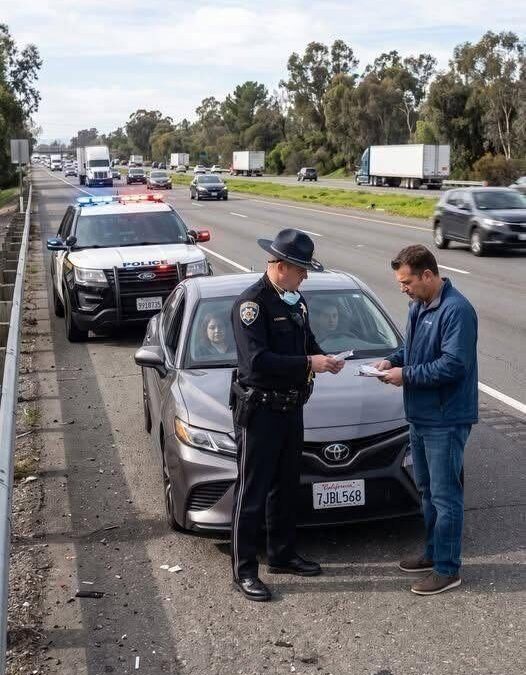
My Wife Got Pulled Over for Speeding Then the Officer Pulled Me Aside and Whispered Seven Words That Destroyed Everything I Knew About Her
The police lights appeared behind us so suddenly that Sarah cursed under her breath.
They washed across the inside of our Honda in slow, alternating flashes, turning my wife’s face strange for half a second at a time.
We were driving north on Route 35 on a gray Saturday afternoon, heading toward her mother’s house in Millbrook.
Sarah glanced at the speedometer.
“Damn it.”
I looked too.
Seventy eight.
The limit was sixty five.
Not exactly a high speed chase.
Just enough to earn a ticket if the trooper felt like writing one.
“Pull over,” I said.
“I know.”
She signaled, slowed, and guided the car onto the shoulder.
Traffic hissed past us.
Sarah put the transmission in park and exhaled.
“Well, there goes a hundred bucks.”
“Could be worse.”
She gave me a look.
“Very comforting.”
I smiled.
At that moment, it felt completely ordinary.
That is the thing I remember most.
There was no warning in my body.
No strange feeling.
No instinct telling me my life was about to split into a before and an after.
My wife had been speeding.
A state trooper had caught her.
We were going to get a ticket.
That was all.
The patrol car sat behind us with its lights still flashing.
In the mirror, I saw the trooper open his door.
Sarah reached into the center console.
“Registration.”
I pulled it out and handed it to her.
She already had her license.
The officer approached her side of the car.
His name tag read MARTINEZ.
He looked to be in his forties.
Calm face.
Professional voice.
Nothing unusual.
“Afternoon.”
“Officer.”
“License and registration.”
Sarah handed them over.
He glanced at the documents.
“Do you know why I stopped you?”
Sarah gave him the same apologetic smile I had seen her use for more than ten years.
The smile that had once caught my attention across a crowded coffee shop near Columbia.
Small.
Warm.
Just enough embarrassment to look sincere.
“I’m guessing I was a little fast.”
“Seventy eight in a sixty five.”
She winced.
“That sounds worse when you say it.”
Martinez did not smile.
But he did not seem angry either.
“Sit tight.”
He took the documents and walked back toward his cruiser.
Sarah leaned into her seat.
“There goes dinner.”
“I thought your mother was cooking.”
“Then there goes dessert.”
I laughed.
She smiled.
Normal.
That word would become painful later.
Normal.
Everything about our marriage had always looked normal.
Maybe better than normal.
We had a house.
Stable jobs.
Two cars.
A retirement account.
Vacations twice a year when schedules allowed.
A mortgage we complained about but could afford.
We argued over laundry.
Groceries.
Thermostat settings.
What movie to watch.
Ordinary things.
I trusted ordinary things.
I trusted routine.
I trusted the idea that if two people shared enough small details of life, there could not possibly be a giant secret hiding underneath them.
That was the assumption Officer Martinez destroyed on the shoulder of Route 35.
I watched him in the side mirror.
At first, nothing seemed unusual.
He sat in his cruiser.
Looked at his computer.
Typed.
The usual traffic stop routine.
Then a minute passed.
Then another.
Sarah checked the clock.
“He’s taking forever.”
“He’s probably running the registration.”
“He has my entire life story by now.”
I glanced in the mirror again.
Something about Martinez had changed.
He was leaning closer to the computer.
Not typing now.
Reading.
He looked at Sarah’s license.
Then the screen.
Then the license again.
He reached toward his radio.
I could not hear what he said.
Sarah adjusted the rearview mirror.
“Maybe I have warrants.”
“Do you?”
“Only for being married to you.”
“Very funny.”
She brushed lint off her sleeve.
Another minute.
The strange feeling started then.
Small.
Nothing I would have remembered if the rest had not happened.
Just an awareness that the stop was taking longer than it should.
Martinez finally opened the cruiser door.
Sarah straightened.
“Here comes my financial ruin.”
But he did not return to her window.
He walked around the rear of our car.
Then along the passenger side.
My side.
He tapped on my glass.
I lowered the window.
“Sir, could I speak with you for a moment?”
I stared at him.
“Me?”
“Just step out here with me.”
Sarah looked across at me.
“What’s that about?”
Martinez said, “It’ll only take a minute.”
There was nothing threatening in his tone.
That somehow made me more nervous.
I opened the door.
Traffic rushed past only a few yards away.
The air smelled like hot asphalt and exhaust.
Martinez led me several steps behind our car.
Far enough that Sarah would not hear clearly over the highway noise.
I glanced back.
She was watching us through the rear window.
Martinez positioned himself so his body partly blocked her view of my face.
That was when my stomach tightened.
“Is something wrong?”
He looked directly at me.
“Sir, I need you to listen carefully.”
I felt my heartbeat change.
“Okay.”
“Don’t go home tonight.”
I stared.
“What?”
“Get somewhere safe.”
“What are you talking about?”
“A hotel. A friend’s house. Somewhere she doesn’t know about.”
For a second, I genuinely thought there had been some kind of misunderstanding.
I looked back at Sarah.
Then at him.
“Is Sarah in trouble?”
Martinez’s jaw tightened.
He did not answer.
Instead, he reached into his shirt pocket and removed a folded piece of paper.
Small.
Torn from a notepad.
He pressed it into my hand.
“Read this later.”
“What is this?”
“When you’re alone.”
My confusion turned into fear.
“We’ve been married ten years.”
“I understand.”
“We’re literally driving to her mother’s house.”
“I understand.”
“So tell me what you’re talking about.”
He lowered his voice.
“Her name triggered something serious in our system.”
I looked at the paper.
Then him.
“What kind of serious?”
“I can’t explain it here.”
“You just told me not to go home with my wife.”
“Yes.”
“And now you won’t tell me why?”
“I’m telling you as much as I safely can right now.”
Safely.
That word changed everything.
“Am I in danger?”
His expression was enough.
He did not need to answer.
“Be careful who you trust right now.”
I looked back toward the Honda again.
Sarah was sitting exactly as I had left her.
One hand on the steering wheel.
The other pushing a strand of hair behind her ear.
The cruiser’s lights pulsed across her face.
Red.
Blue.
Red.
Blue.
For the first time in ten years, I looked at my wife and felt like I was looking at a stranger.
Not completely.
That would have been easier.
She was still Sarah.
Same face.
Same hair.
Same little crease between her eyebrows when she was impatient.
Same ring on her left hand.
Same woman whose head had rested against my chest the night before while we watched television.
But something had shifted.
Like a familiar photograph had been altered so slightly that you could feel the change before identifying it.
Martinez walked back toward her side.
I slipped the folded paper into my pocket.
By the time he reached Sarah’s window, his professional expression had returned.
He handed her the license.
Registration.
“You’re getting a verbal warning today.”
Sarah smiled.
“Seriously?”
“Yes, ma’am.”
“Thank you.”
“Slow it down.”
“I absolutely will.”
“Drive safe.”
He stepped away.
That was it.
Anyone watching would have seen an ordinary traffic stop.
A driver caught speeding.
A warning.
Two people continuing their Saturday.
Nobody would have known that Officer Martinez had just blown a hole through the center of my marriage.
I got back into the car.
Sarah looked at me.
“What did he want?”
My mind stopped.
I had not prepared an answer.
“Seat belt.”
“What?”
“He said mine wasn’t sitting right when we stopped.”
Sarah frowned.
“That’s weird.”
“Yeah.”
She looked at me for a second longer.
I thought she knew.
My hand moved unconsciously toward my pocket.
The note felt like a burning object against my leg.
Then Sarah shrugged.
“Cops.”
She put the car in drive.
We merged back into traffic.
For the next forty minutes, I pretended nothing had happened.
It was one of the longest performances of my life.
Sarah became quieter.
Maybe she was simply annoyed about being stopped.
Maybe she knew exactly why Martinez had pulled me aside.
I could not tell anymore.
That was the beginning of something I had never experienced before.
Suspicion changes ordinary behavior.
Sarah checked the mirrors.
Was she nervous?
Or just driving?
She adjusted her grip on the wheel.
Was she tense?
Or were my eyes inventing tension?
She asked me whether I wanted music.
Was that normal?
Was she testing my voice?
I suddenly distrusted every movement.
“Everything okay?” she asked.
“Fine.”
“You’re quiet.”
“So are you.”
“I almost got a ticket.”
“You didn’t.”
“That doesn’t mean I enjoyed the experience.”
She smiled.
The smile looked wrong now.
Too smooth.
I hated myself for thinking that.
Forty five minutes earlier, the same smile would have meant nothing.
Now it seemed rehearsed.
We reached her mother’s house shortly after five.
Her mother hugged Sarah.
Then me.
Asked about traffic.
Complained about grocery prices.
Normal.
Again.
Always normal.
Dinner was roast chicken, potatoes, green beans.
Sarah poured wine.
Her mother told stories about neighbors.
Sarah laughed.
Asked questions.
Passed the salad.
At one point, she touched my forearm beneath the table.
A familiar gesture.
I nearly pulled away.
Did she notice?
I do not know.
If danger was sitting at that table, it wore lipstick and used a napkin and asked whether anyone wanted more potatoes.
That was the strangest part.
I kept waiting for Sarah to transform.
To reveal something.
To suddenly look like the person Officer Martinez had warned me about.
She never did.
She looked exactly like my wife.
That was worse.
After dinner, she helped her mother clear the plates.
I sat at the table.
The folded note remained in my pocket.
I had not read it.
I was afraid to.
As long as it remained folded, whatever Martinez knew still existed in a vague space.
Serious.
Danger.
Be careful.
Those words were frightening.
But vague fear still allowed hope.
Maybe Sarah had been a victim of identity theft.
Maybe someone with her name was wanted.
Maybe there was a threat against her.
Maybe Martinez had misunderstood something.
Maybe he had been overly cautious.
I built explanations because the alternative was too large.
Sarah returned.
“Coffee?”
“No.”
“You okay?”
“Headache.”
She studied me.
“You’ve been weird since the stop.”
I laughed.
Too quickly.
“I’m tired.”
“From sitting in the passenger seat?”
“I had a week too.”
She smiled.
“There he is.”
There he is.
The words made my skin tighten.
I wondered how many versions of me she had learned to manage over ten years.
That thought was unfair.
Or maybe it was not.
I no longer knew.
We went upstairs around eleven.
The guest room had floral curtains and a mattress that sagged slightly toward the middle.
Sarah changed into pajamas.
I brushed my teeth.
She climbed into bed and opened a book.
I lay beside her.
Waited.
Ten minutes.
Twenty.
She turned off the lamp.
“Goodnight.”
“Night.”
She kissed my cheek.
Then rolled away.
I stared into darkness.
Her breathing eventually changed.
Slow.
Deep.
I waited another ten minutes.
Then got up.
“Bathroom,” I whispered, though she was asleep.
I took my phone.
Closed the bathroom door.
Locked it.
Sat on the edge of the bathtub.
My hands were shaking when I pulled the note from my pocket.
It was folded twice.
I opened it.
Seven words.
That was all.
SHE ISN’T WHO SHE SAYS SHE IS.
Below that was a phone number.
And one word.
DETECTIVE.
I read the sentence again.
Then again.
She isn’t who she says she is.
The bathroom seemed smaller.
I stared at my reflection.
Pale.
Confused.
I wanted something more.
A name.
A crime.
A reason.
Instead, seven words.
I almost called the number right then.
My thumb hovered over my phone.
Then I remembered where I was.
Sarah’s mother’s house.
Sarah asleep fifteen feet away.
Martinez had told me to call when I was alone.
I folded the note.
Put it back into my pocket.
Unlocked the door.
Returned to bed.
Sarah had not moved.
I lay beside her until morning.
I did not sleep.
I watched the ceiling and allowed ten years of memory to rearrange itself.
Her job came first.
Sarah told everyone she worked in marketing for a pharmaceutical company called Meridian.
I had never visited her office.
That suddenly mattered.
Before that night, it had not.
Lots of spouses never see each other’s workplaces.
I had seen photographs of conference rooms.
A logo on her laptop.
Business cards.
Hotel receipts.
Travel schedules.
Enough details to create the outline of a job.
But no people.
That realization sat heavily in my stomach.
I had never met her boss.
Not once.
Never met a coworker.
No Christmas party.
No office picnic.
No drinks after work where spouses were invited.
No colleague whose stories became familiar.
She had names.
Of course she had names.
Greg.
Tanya.
Rachel.
David.
I had heard them in stories.
But had I ever met any of them?
No.
Had I ever spoken to one on the phone?
No.
Had one ever sent a holiday card?
No.
I thought about Sarah’s business trips.
Chicago.
Boston.
Atlanta.
Philadelphia.
Always reasonable.
Never extravagant.
She came home with conference badges sometimes.
Hotel toiletries.
Receipts.
She complained about airports.
Exactly the kind of details that made everything seem real.
What if those details were real?
Just not for the reason I believed?
My stomach turned.
I rolled toward her.
In the darkness, I could barely see her face.
She slept peacefully.
My wife.
Or someone pretending to be my wife.
No.
That was too dramatic.
I rejected the thought immediately.
People do not fake ten year marriages.
Do they?
The question kept me awake until dawn.
The drive home Sunday morning felt unbearable.
Sarah chatted about her mother.
Groceries.
A neighbor remodeling a bathroom.
I answered when required.
Once, she looked at me.
“Still have that headache?”
“Yeah.”
“You should take something.”
“I will.”
“Are you sure you’re okay?”
I almost told her.
I wanted to.
That instinct surprised me.
For ten years, Sarah had been the first person I told when something frightened me.
The absurdity of being afraid of her while wanting comfort from her nearly broke me.
“I’m fine.”
She reached over and touched my hand.
Her fingers were warm.
Familiar.
I let her hold them.
By the time we reached home, I hated Officer Martinez.
Not because I thought he had lied.
Because one conversation had made every affectionate gesture unbearable.
Sarah told me she had a Saturday client meeting.
I almost corrected her.
It was Sunday.
Then she laughed.
“God, see? I’m already thinking about next weekend.”
I smiled.
She showered.
Dressed.
Packed her laptop.
The Meridian logo was silver against the black case.
I stared at it.
Fake?
Impossible.
She kissed me.
“I’ll be a few hours.”
“Okay.”
“Love you.”
My throat tightened.
“Love you too.”
She left.
I watched her car disappear.
Then I locked the front door.
Closed the curtains.
Sat at our kitchen table.
Took out the note.
Dialed the number.
A man answered.
“Reynolds.”
I hesitated.
“Detective Reynolds?”
“Speaking.”
“My name is Daniel.”
I gave my last name.
There was silence.
Then:
“How did you get this number?”
“Officer Martinez.”
Another pause.
“Are you alone?”
“Yes.”
“You sure?”
I looked around my own kitchen.
“Yes.”
“Where’s your wife?”
“Client meeting.”
The phrase sounded stupid now.
“Okay.”
His voice changed.
Professional.
Controlled.
“Listen carefully.”
The same phrase Martinez had used.
My hands turned cold.
“Your wife has been under surveillance for approximately eight months.”
I gripped the phone.
“For what?”
“Financial crimes.”
“What kind?”
“Money laundering.”
I laughed once.
Not because I was amused.
Because my brain rejected the words.
“You have the wrong Sarah.”
“We don’t.”
“She works in pharmaceutical marketing.”
“No.”
“Yes.”
“There is no legitimate company operating under the employer identity she gave you.”
I stared at the Meridian coffee mug in the sink.
“What?”
“Meridian Pharmaceutical Marketing does not exist in the way she represented it.”
“No.”
“We checked.”
“She has a website.”
“Staged.”
“A laptop.”
“Staged.”
“Business cards.”
“Staged.”
“A company email.”
“Staged.”
I stood.
Sat again.
“You’re saying my wife invented a job?”
“I’m saying the job was part of a cover identity.”
I could barely breathe.
“For what?”
Reynolds continued.
Slowly.
As if explaining something to someone standing too close to a cliff.
Millions of dollars.
Shell businesses.
Transfers.
Personal accounts.
Organized criminal operations.
Drug money.
Illegal gambling.
Extortion proceeds.
Money that needed to move through businesses that looked legitimate.
My wife allegedly helped move it.
“No.”
The word left me automatically.
Reynolds waited.
“That’s not possible.”
“I understand why you’re saying that.”
“She handles marketing.”
“I know what she told you.”
“She has clients.”
“She has contacts.”
“She travels.”
“Yes.”
“That’s her job.”
“That travel appears to be connected to the financial operation.”
My stomach turned.
I looked around our kitchen.
The refrigerator.
Coffee machine.
Fruit bowl.
Calendar.
Ten years of ordinary life.
“Are you telling me my entire marriage is fake?”
“No.”
The answer surprised me.
“What?”
“I can’t tell you what she feels.”
“Then what are you telling me?”
“I’m telling you the identity she built around her work appears designed to protect criminal activity.”
I closed my eyes.
Reynolds continued.
“Your marriage has also been useful.”
The sentence landed harder than everything before it.
“Useful how?”
“You look stable.”
I said nothing.
“Married couple. Mortgage. Suburban home. Routine income. Predictable social life.”
My mouth went dry.
“Banks like stability. Institutions like stability. Investigators initially overlook people who look boring.”
“Boring.”
“I’m not insulting you.”
I laughed bitterly.
“No. Apparently boring was the point.”
Reynolds did not deny it.
“Are you saying I was cover?”
“I’m saying your marriage helped make her life appear ordinary.”
I stared at Sarah’s mug.
Our wedding photo was visible from the kitchen.
We were laughing.
I had forgotten what caused the laughter.
Something the photographer said.
Sarah’s head was tilted toward me.
Her eyes looked happy.
Was that staged too?
I hated that question.
Reynolds began asking me things.
Had I ever seen her office?
No.
Met a coworker?
No.
Supervisor?
No.
Company party?
No.
Did she take private calls?
Yes.
Travel often?
Yes.
Become irritated when I asked detailed questions?
Sometimes.
Keep finances separate in certain areas?
Yes.
Have multiple business accounts I did not understand?
She said they were expense accounts.
Had I seen tax paperwork clearly naming Meridian?
I thought about it.
“No.”
Every answer became another brick falling out of the house I thought I lived in.
Then Reynolds told me something worse.
Sarah was preparing to leave.
“What?”
“Financial activity suggests she’s repositioning money.”
“For what?”
“We don’t know with certainty.”
“You said leave.”
“There are signs of a second financial identity.”
I stood again.
My chair scraped loudly.
“Second identity?”
“Documents associated with an offshore account.”
I walked to the window.
“Possible relocation planning.”
“Where?”
“I can’t disclose everything.”
“Is she planning to leave me?”
“I don’t know whether you were part of the relocation plan.”
That sentence stayed with me.
Not whether she was leaving.
Whether I was part of it.
For ten years, I assumed my place beside Sarah was permanent because that was what marriage meant to me.
Apparently somewhere in her hidden life, I may have been optional.
I pressed my forehead against the window.
“What am I supposed to do?”
Reynolds answered honestly.
“You can leave.”
I turned.
“Now?”
“Yes.”
“Go where?”
“Hotel. Family. Friend.”
“And then?”
“Stay away from her.”
“That’s it?”
“If that’s what you want.”
I almost laughed.
“You just told me my wife is involved in organized crime and I should get a hotel.”
“I told you that because your safety matters more than the case.”
That stopped me.
“Case.”
“Yes.”
“What happens to her?”
“That depends on evidence.”
“Do you have enough?”
“Not yet.”
There it was.
The choice.
I understood before he asked.
“You want my help.”
“I’m not asking yet.”
“But you will.”
He paused.
“Yes.”
Reynolds explained the risks.
I could walk away.
The investigation would continue.
Sarah might be arrested eventually.
Maybe sooner.
Maybe later.
I could stay outside it.
Or I could help document what happened inside our house.
Calls.
Files.
Meetings.
Financial records.
Information investigators could not easily access without alerting her.
My marriage could become evidence.
I felt physically sick.
“You want me to spy on my wife.”
“I want you to decide whether you are willing to cooperate.”
“What happens if she finds out?”
“That’s the risk.”
“And if I don’t?”
“You leave.”
I looked at the wedding photo again.
Sarah smiling.
Me smiling.
“What would you do?”
“I don’t answer that question.”
“Why?”
“Because I’m not married to her.”
That was fair.
I sat for a long time.
Then asked, “How long?”
“If you cooperate?”
“Yes.”
“We don’t know exactly.”
“I need better than that.”
“Weeks, most likely.”
Weeks.
Could I sit across from Sarah for weeks knowing what I now knew?
Could I sleep beside her?
Kiss her?
Say good morning?
Listen to invented stories about fake clients?
I thought about the note.
She isn’t who she says she is.
Then I thought about leaving.
Simply disappearing.
Letting everything happen without me.
That would have been safer.
Maybe wiser.
But something inside me needed truth.
Not revenge.
Truth.
I had spent ten years unknowingly participating in a story written for me.
For the first time, I wanted to see behind it.
“I’ll help.”
Reynolds was quiet.
“You’re sure?”
“No.”
“That’s not what I asked.”
I almost smiled.
“No. I’m not sure.”
“Then don’t decide right now.”
“I already did.”
The next six weeks were the longest six weeks of my life.
I became an actor inside my own marriage.
Reynolds’s team taught me things I never imagined learning.
How to place a small camera where it looked like part of an ordinary object.
How to preserve digital files.
How to record certain conversations without changing my behavior.
How to notice patterns without staring at them.
How to copy documents.
How to stop asking questions that might alert Sarah.
The irony was brutal.
For ten years, I had been curious about her work and accepted vague answers because I trusted her.
Now I needed to pretend I was even less interested than before.
Sarah never seemed suspicious.
That frightened me.
Or maybe she was suspicious and simply better at hiding it.
I stopped knowing which interpretation was worse.
The first useful recording came three nights later.
Sarah took a call in the dining room after dinner.
She thought I was upstairs.
I was actually sitting on the floor of our bedroom, headphones on, listening through a device investigators had placed downstairs.
Her voice was different.
Not dramatically.
No fake accent.
No secret persona.
Just colder.
More precise.
Numbers.
Dates.
Transfer amounts.
Words that meant nothing to me.
Reynolds later explained some were coded references.
At one point, a male voice asked whether “the domestic situation” was stable.
Sarah said:
“He doesn’t know anything.”
I froze.
The man asked something else.
Sarah laughed.
“He never asks the right questions.”
My stomach turned.
I removed the headphones.
I could not listen anymore.
Five minutes later, Sarah came upstairs.
She opened the bedroom door.
I was pretending to read.
“Hey.”
I looked up.
“Hey.”
She changed clothes.
Climbed into bed.
“What are you reading?”
I told her.
She smiled.
“Any good?”
“Not really.”
She leaned over.
Kissed me.
I let her.
That was the first night I hated myself for cooperating.
Not because the investigation was wrong.
Because the performance felt like betrayal even though she had apparently built our entire marriage around deception.
That contradiction nearly destroyed me.
Love does not vanish the moment evidence appears.
I wish it did.
It would have been easier.
Sarah was still the woman I knew.
And the woman I did not know.
Both existed inside my head at once.
The woman who remembered exactly how I liked coffee.
The woman who moved criminal money.
The woman who held my hand through my father’s surgery years earlier.
The woman who referred to our marriage as cover.
The woman who laughed at my worst jokes.
The woman with encrypted folders full of numbers connected to men under federal investigation.
Every day forced those versions closer together.
One morning, she stood in the kitchen wearing my old college sweatshirt.
Hair messy.
No makeup.
Eating cereal straight from the box.
She looked so harmless that I nearly called Reynolds and told him they were wrong.
Then her phone rang.
She glanced at the screen.
Walked into the garage.
Locked the door.
Twenty minutes later, she returned.
“Client problem.”
I nodded.
Of course.
I began copying files when she showered.
At first, my hands shook so badly I nearly dropped the flash drive.
Her laptop password had not changed in years.
That hurt too.
Trust worked in both directions, apparently.
She trusted me not to look because I had never looked.
The first encrypted folder was hidden beneath ordinary work files.
Inside were spreadsheets.
Transactions.
Account numbers.
Names.
Nothing dramatic.
No photographs of criminals.
No giant label saying MONEY LAUNDERING.
Just numbers.
That was the unsettling thing about financial crime.
On a screen, it looked boring.
Columns.
Dates.
Amounts.
Reynolds explained later that those columns represented millions moving through layers of companies created to make illegal money look legitimate.
Sarah knew how to make crime look like accounting.
That had apparently been part of her value.
I found messages too.
Those were harder.
One referred to me as “cover.”
Another used the phrase “home front stable.”
Then:
“He’s useful because he doesn’t pry.”
I stared at the sentence for a long time.
Useful.
That word injured me more deeply than I expected.
I had believed trust was a gift I gave my wife.
To Sarah, apparently, my trust may have been functionality.
I did not pry.
Therefore I was useful.
That night, she cooked pasta.
I sat across from her.
She told me a story about a difficult client.
I knew the client did not exist.
Or at least not in the way she described.
She smiled.
I smiled.
She asked about my day.
I told her.
My real day.
That difference became unbearable.
I was still giving her pieces of myself that were true.
My frustrations.
My jokes.
A problem at work.
A friend’s divorce.
My mother’s birthday plans.
Sarah continued receiving the real me even while I received a constructed version of her.
That imbalance had existed for years.
I was only now conscious of it.
The investigators gathered more.
Calls.
Documents.
Financial records.
Information from people above Sarah in the organization.
I learned only what I needed.
Reynolds did not turn our conversations into gossip.
That helped.
He kept the focus on evidence.
Occasionally I would ask personal questions.
“Do you think she ever loved me?”
He always answered the same way.
“That’s not something the investigation can tell you.”
I hated that answer.
It was also the only honest one.
My worst night came during week four.
Sarah and I went out for our anniversary.
Ten years.
I had forgotten the date until she reminded me that morning.
“Dinner?”
I stared at her.
“You forgot.”
“No.”
“You absolutely forgot.”
I laughed.
“Maybe.”
She kissed me.
“Seven thirty.”
I called Reynolds.
“I can’t do this.”
“Then don’t.”
“She planned anniversary dinner.”
Silence.
“How am I supposed to sit there?”
“You’re allowed to leave.”
“If I leave now, she’ll know something is wrong.”
“Your safety comes first.”
“I know.”
I went.
That decision still bothers me.
The restaurant was the same one where we celebrated our fifth anniversary.
Sarah wore a black dress.
She looked beautiful.
We ordered wine.
She gave me a gift.
A watch.
I had bought her earrings weeks earlier, before Route 35.
She opened them.
Her eyes watered.
“These are beautiful.”
She leaned across the table and kissed me.
I wanted to ask:
Who are you?
Instead, I said:
“Happy anniversary.”
She squeezed my hand.
“Ten years.”
Ten years.
A decade.
Nearly four thousand mornings.
Thousands of dinners.
Illness.
Holidays.
Arguments.
Sex.
Laughter.
Mortgage paperwork.
Hospital visits.
Flights.
Funerals.
Birthdays.
How could someone fake all of that?
Maybe she did not.
That was the question that nearly drove me insane.
Maybe the criminal life was the deception and the marriage was real.
Maybe the marriage was the deception and some affection was real anyway.
Maybe humans are capable of compartmentalizing truths so completely that both can coexist.
I never found an answer.
Halfway through dinner, Sarah looked at me.
“You seem sad.”
“I’m fine.”
“No.”
She studied me.
“Something’s been different lately.”
My blood went cold.
“What?”
“You.”
I forced a smile.
“Work.”
“You sure?”
“Yeah.”
She kept watching.
Then said:
“I worry about you.”
The sentence almost broke me.
I looked down at my wine.
“I’m okay.”
“If there’s something wrong, you can tell me.”
I nearly laughed.
Instead, I said:
“I know.”
That was the cruelest conversation of those six weeks.
Because part of me still wanted to tell her everything.
Part of me wanted to say:
I know.
I know about Meridian.
I know about the money.
I know about the accounts.
I know I was cover.
Tell me I misunderstood.
Tell me something that makes ten years real again.
But I said none of it.
We finished dinner.
Went home.
She fell asleep with her head on my shoulder.
I stayed awake until morning.
By week five, the investigation had grown beyond Sarah.
Reynolds told me several men connected to the financial network were being targeted.
Federal agents were involved.
Indictments were being prepared.
The size of the operation was larger than I had understood.
Millions.
Shell companies.
Layered transactions.
Accounts I had never heard of.
I asked whether I could be charged.
“For what?”
“I signed joint tax returns.”
“You didn’t knowingly participate.”
“How do you know?”
“Because we spent eight months watching her before Officer Martinez ever stopped that car.”
That answer chilled me.
Eight months.
Investigators had been looking at our lives while I remained completely unaware.
They knew things about my wife before I did.
Possibly things about my own house before I did.
“You watched me too?”
“We had to understand the household.”
“Did you think I was involved?”
“At first, we didn’t know.”
“And now?”
“No.”
The answer should have relieved me.
Instead, I felt humiliated.
Strangers had studied my marriage and concluded I was simply ignorant.
Reynolds must have heard something in my silence.
“Daniel.”
“What?”
“Being deceived by someone skilled at deception does not make you stupid.”
I laughed bitterly.
“That sounds like something people tell idiots.”
“It’s something I tell witnesses who think hindsight means the signs were obvious.”
I did not answer.
“You had no reason to investigate your wife.”
“There were signs.”
“There are signs in every marriage when you know the ending.”
That sentence stayed with me.
Every relationship contains unexplained calls.
Private moments.
Work travel.
Irritation.
Missing details.
Most of them mean nothing.
After betrayal, memory becomes unfair.
It highlights everything.
Makes you believe you should have known.
Maybe I could have asked more questions.
Maybe I would have found something earlier.
Maybe not.
At some point, I stopped trying to rewrite ten years using information I had only learned after the fact.
The final week arrived quietly.
Reynolds called on a Thursday afternoon.
“We have enough.”
I sat in my car outside work.
“What does that mean?”
“We’re preparing to move.”
“When?”
“Soon.”
“How soon?”
“Days.”
My mouth went dry.
“Does Sarah know?”
“No.”
“What do I do?”
“Exactly what you’ve been doing.”
I closed my eyes.
“I don’t know if I can.”
“One more ordinary stretch.”
Ordinary.
I hated that word now.
Three days later, I came home and found Sarah in the kitchen.
Wine beside her laptop.
Reading glasses pushed into her hair.
The exact pose I had seen a hundred times.
She closed the laptop when I entered.
A familiar gesture.
Now I understood it.
“Hey.”
“Hey.”
“How was work?”
“Long.”
She stood.
Kissed me.
“What do you want for dinner?”
“You cooked?”
“Don’t sound so shocked.”
I smiled.
We ate.
Talked.
Nothing important.
She described a client problem.
I listened.
Asked one question.
She gave an easy answer.
A lie.
I knew it was a lie.
And for the first time, it did not destroy me.
Something had changed.
Grief had begun replacing confusion.
I looked at Sarah across the table and understood I might never know which pieces of her were real.
But I no longer needed to solve that before accepting what the evidence showed.
She had lied about her work.
She had moved money connected to criminal operations.
She had used the stability of our marriage as camouflage.
She had apparently prepared financial options for leaving.
Those facts existed regardless of whether she loved me while doing them.
Maybe love was not powerful enough to make the other facts disappear.
That was the painful answer.
Three days later, federal agents came for her.
Tuesday morning.
Sarah was in our kitchen.
Robe.
Coffee.
No makeup.
Reynolds had asked me to be elsewhere.
Partly safety.
Partly strategy.
They did not want Sarah looking at me when she realized the case had reached her front door.
So I sat in a diner three towns away.
I ordered coffee.
Did not drink it.
The waitress refilled the cup twice.
I kept staring at my phone.
8:10.
8:18.
8:23.
At 8:31 it rang.
Reynolds.
I answered immediately.
“It’s done.”
My stomach dropped.
“She’s okay?”
The question came automatically.
Even then.
Even after everything.
“Yes.”
I closed my eyes.
“We have her.”
I breathed.
“The operation went smoothly.”
I did not know what I felt.
Relief.
Grief.
Fear.
Nothing.
Everything.
“Did she ask about me?”
Reynolds paused.
“Yes.”
“What did you say?”
“That you were safe.”
I looked at the coffee.
“Did she know?”
“Know what?”
“That I helped.”
“I don’t know what she understands yet.”
Other arrests happened that day.
Men I had heard only as voices.
Names in files.
People linked to financial structures I barely understood.
Federal indictments followed.
Numbers appeared in news reports that seemed unreal.
Millions.
When money reaches certain amounts, it stops sounding like money.
It becomes abstraction.
I did not go home that night.
I went to my brother’s house.
He knew enough by then.
Not everything.
I sat on his couch holding a beer I barely touched.
He did not interrogate me.
That was a gift.
Television played quietly.
At one point he said:
“You want me to turn this off?”
“No.”
Neither of us watched it.
Around midnight, he said:
“You can stay as long as you want.”
I nodded.
Then I started crying.
Not loudly.
Just suddenly.
My brother sat beside me.
“I loved her.”
“I know.”
“I still love her.”
“I know.”
“I hate her.”
“I know.”
“I don’t know what I feel.”
“You don’t have to.”
That was what I needed.
Not an explanation.
Permission not to have one.
The weeks afterward were filled with paperwork.
Statements.
Meetings.
Prosecutors.
Financial documents.
Dates.
Numbers.
I became familiar with rooms I never wanted to enter.
Conference rooms.
Federal offices.
Law firms.
I learned terms I wished I had never needed.
Layering.
Shell corporation.
Beneficial owner.
Financial intermediary.
Predicate offense.
The vocabulary of Sarah’s hidden life.
I gave them everything.
Files.
Recordings.
My timeline.
Anything investigators needed.
Sarah’s lawyer contacted me once.
Not directly.
Through counsel.
There was discussion of some quiet arrangement.
Privacy.
Avoiding unnecessary public exposure.
Protecting personal matters.
Once, those phrases might have worked.
I had spent ten years protecting privacy.
Now I understood privacy had been one of the places deception lived.
I declined.
I gave prosecutors what they asked for.
Months later, I saw Sarah in court.
That was harder than the arrest.
She sat across the room.
Different clothes.
Different environment.
Still Sarah.
But smaller somehow.
Not physically.
The confidence around her had changed.
For ten years, she had controlled what I knew.
In court, control belonged to documents.
Records.
Witnesses.
Transactions.
She did not look at me.
Not once.
At first, I wanted her to.
I wanted a reaction.
Anger.
Regret.
Anything.
Then I realized I did not need it.
That surprised me.
I had spent months imagining a confrontation.
Why?
Did you love me?
Was anything real?
When did you decide to use me?
Were you going to leave?
Would you have said goodbye?
Each question assumed Sarah possessed an answer capable of repairing something.
Maybe she did.
Maybe not.
By then, I understood answers and healing are not the same thing.
Sometimes an explanation becomes simply another thing you have to carry.
I stopped waiting.
The following spring, Sarah was sentenced to a long federal prison term.
Other people connected to the network received sentences too.
Some longer.
Some involving crimes broader than the financial conduct I had seen.
I read parts of the reporting.
Then stopped.
I had learned enough.
Reynolds called after sentencing.
“You doing okay?”
“I don’t know.”
“That’s fair.”
There was silence.
Then he said:
“You did the right thing.”
I laughed softly.
“Didn’t feel right most days.”
“I know.”
“You ever get used to this?”
“To what?”
“Watching families fall apart.”
He thought for a moment.
“No.”
That answer made me respect him more.
“Good.”
“What?”
“I’m glad.”
He understood.
We stayed in touch.
Not constantly.
A call every few months.
A text around holidays.
The strange relationship between two men who had spent six weeks quietly dismantling the same lie from opposite sides.
The house became unbearable.
I tried living there after the investigation.
Three weeks.
I would walk into the kitchen and see Sarah’s laptop.
Not physically.
Memory.
I would sit in the dining room and remember recorded calls.
The bedroom was worse.
I remembered lying beside her after hearing evidence of another life.
The whole house felt like a stage set.
Furniture selected for a production I did not understand.
I sold it.
Moved into a smaller place across town.
One bedroom.
Simple kitchen.
No history.
The first night, I slept on a mattress on the floor because my furniture had not arrived.
It was the best sleep I had gotten in months.
Silence did not feel suspicious there.
Nothing belonged to Sarah.
I started therapy.
Reluctantly.
My brother pushed me.
Reynolds suggested it once.
I ignored both of them for months.
Then one night I woke at three in the morning because I dreamed Sarah was sitting beside me asking why I had betrayed her.
The word stayed with me.
Betrayed.
I had helped investigators.
She had lied for years.
Yet part of my mind still framed my actions as betrayal.
That was when I realized I needed help untangling what trust had become.
My therapist asked me something during our second session.
“What do you think this says about you?”
I hated the question.
“That I’m an idiot.”
“Why?”
“I lived with her ten years.”
“And?”
“I didn’t know.”
“Should you have?”
“Yes.”
“How?”
I stared.
“She was my wife.”
“That explains why you trusted her.”
“Exactly.”
“It does not explain why trusting your wife makes you stupid.”
I said nothing.
She continued.
“If you begin every relationship by investigating the other person as though they are running a criminal enterprise, you will prevent intimacy.”
I laughed despite myself.
“That sounds reasonable now.”
“My point is that trust creates vulnerability.”
“I noticed.”
“Vulnerability is not the same thing as foolishness.”
It took months before I believed that.
The hardest thing was separating Sarah’s deception from my value.
Being used makes you feel like an object.
Something chosen for utility.
I replayed the word cover.
Useful.
Stable.
Respectable.
At first, those words made me feel pathetic.
Later, I saw them differently.
Sarah had exploited ordinary goodness.
Trust.
Consistency.
Stability.
Those things were not flaws simply because someone used them.
I did not want her actions to transform me into someone incapable of trusting anybody again.
That would have allowed the deception to continue shaping my life long after she was gone.
Still, I changed.
Of course I did.
I ask more questions now.
Not interrogations.
Questions.
I notice when stories never contain names.
I notice when someone’s entire work life exists behind a closed door.
I notice discomfort.
But I also learned not to confuse vigilance with wisdom.
You can examine every receipt and still misunderstand a human being.
There are no guarantees.
That realization was frightening.
Eventually it became freeing.
Two years passed.
Route 35 returned to being a highway.
Mostly.
Sometimes I drive that way and remember.
The overpass.
The shoulder.
The flash of red and blue.
Martinez tapping on my window.
I tried to find him once.
Called the department.
He had transferred.
Different county.
I left a message.
Never heard back.
That bothered me at first.
I wanted to thank him.
Not in a dramatic way.
Simply tell him his choice mattered.
He could have written the warning and walked away.
The investigation would still have continued.
Maybe I would have discovered everything when federal agents entered my house.
Maybe Sarah would have disappeared first.
I do not know.
Martinez gave me something important.
Time.
And agency.
He allowed me to understand enough to decide what role I wanted to play.
I still keep his note.
The paper has softened along the folds.
The block letters remain clear.
SHE ISN’T WHO SHE SAYS SHE IS.
Seven words.
Sometimes I think about how easily they could have been wrong in another context.
Human beings contain contradictions.
No spouse knows everything.
But in Sarah’s case, they were literal.
A job that did not exist.
A network I did not know.
Money I did not know.
Plans I did not know.
A second financial identity.
A private language.
A separate life.
Those seven words changed every room I entered for months.
Eventually they became something else.
Not only a warning.
A marker.
Before.
After.
My life now is quieter.
I cook dinner most nights.
Nothing elaborate.
Pasta.
Chicken.
Something in a skillet.
For a while, eating alone felt lonely.
Then it became peaceful.
Nobody performing.
Nobody hiding a laptop.
Nobody explaining a fake client.
Just food.
A table.
Silence.
Ordinary life.
I learned to love ordinary again.
That surprised me.
After Sarah, I assumed normality itself had been the problem.
The suburban house.
Predictable routine.
Marriage.
Comfort.
But normality had not deceived me.
Sarah had.
There was nothing wrong with coffee in the morning.
Mortgage payments.
Shared groceries.
The danger came from using those things as camouflage.
I did not need to reject ordinary life.
I needed to stop believing ordinary life guaranteed truth.
Those are different lessons.
About eighteen months after Sarah’s arrest, I met Claire.
A friend introduced us.
I nearly canceled the first date.
Then almost the second.
Claire teaches middle school.
English.
She talks about students constantly.
By the third date, I knew the names of at least six children I had never met.
That amused me.
Sarah’s work stories had always been smooth and vague.
Claire’s were chaotic.
Specific.
A kid forgot a project.
Another wrote something ridiculous in an essay.
A parent emailed at midnight.
The copier broke.
Her department chair hated a certain textbook.
Nothing polished.
Nothing impressive.
I found it comforting.
The first time Claire invited me to a school event, I nearly laughed.
“What?”
“Nothing.”
“You look weird.”
“I’ve just never attended someone’s workplace event before.”
“That’s strange.”
“You have no idea.”
She introduced me to coworkers.
Her principal.
Another teacher.
The custodian.
People teased her about stealing yogurt from the faculty refrigerator.
The mundane visibility of her life nearly made me emotional.
I did not tell her why.
Not then.
We moved slowly.
Very slowly.
Claire did not push.
That mattered.
One evening, months later, we sat across from each other eating takeout.
She stopped mid sentence.
“What?”
I realized I had been staring past her.
“Sorry.”
“You do that sometimes.”
“Do what?”
“Disappear.”
I smiled weakly.
“Occupational hazard.”
“Of what occupation?”
“Being me.”
She laughed.
Then saw I was serious.
“You don’t have to tell me.”
That made me want to.
Not everything.
Not yet.
But enough.
“I was married before.”
“I know.”
“She wasn’t who I thought she was.”
Claire waited.
No questions.
“I mean that literally.”
I explained part of it.
The traffic stop.
The note.
The investigation.
Not every detail.
When I finished, Claire sat silently.
I waited for the usual reactions.
Shock.
Questions.
How did you not know?
Instead, she reached across the table and took my hand.
Simple.
No speech.
No attempt to analyze me.
Her hand felt warm.
Real.
That gesture nearly undid me.
Because there was nothing hidden in it.
At least nothing I needed to fear.
Maybe that sounds naive after everything.
I do not think it is.
Absolute certainty about another person is impossible.
That does not mean trust is foolish.
Trust is a choice made with the information available.
Sarah abused that choice.
Claire did not cause that.
I refused to punish someone new for another person’s deception.
That became part of healing too.
Reynolds and I still talk occasionally.
Once, over coffee, he told me cases like Sarah’s were unusual.
“Financial crime isn’t unusual,” he clarified.
“What she did with the personal life was.”
“Meaning?”
“Most people don’t build an entire marriage as part of a cover environment.”
I looked at him.
“That supposed to make me feel better?”
“Probably not.”
“It doesn’t.”
“I figured.”
He smiled.
Then added:
“But it might help you stop thinking anybody would have spotted it.”
I understood.
Sarah had been patient.
That was perhaps the most frightening part.
Ten years.
Whatever combination of real feeling and calculated usefulness existed in our marriage, she maintained the hidden structure for a decade.
That required discipline.
Compartmentalization.
Secrecy.
I had not failed some obvious test.
I had lived with someone extraordinarily skilled at being known only in controlled portions.
That understanding did not erase pain.
It did reduce shame.
There is a difference.
The shame had always been mine.
The deception was hers.
I eventually learned to return each to its proper owner.
People sometimes ask whether I hate Sarah.
The answer changes.
Some days, yes.
Other days, no.
Mostly I feel distance.
She occupies a specific section of my life.
Ten years.
A marriage.
A betrayal.
A federal case.
But she no longer occupies every future room.
That matters.
I do not visit.
I do not write.
I stopped waiting for an apology.
An explanation might come someday.
Maybe not.
I no longer need one.
That would have been unimaginable during those six weeks.
Back then, understanding Sarah felt like survival.
Now I understand something simpler.
I may never know the entire truth about another human being.
What I can know is what I am willing to accept once the truth I do have becomes clear.
That was the choice I failed to recognize at first.
I did not need to understand why Sarah built two lives before deciding I could not remain inside one of them.
The evidence was enough.
The facts were enough.
Sometimes closure is simply stopping the demand for one final answer.
Officer Martinez never got to see any of that.
At least not from me.
Maybe he read about the arrests.
Maybe someone told him.
Maybe he forgot the traffic stop completely.
Police officers probably meet hundreds of people whose lives continue after one brief encounter.
But I remember him.
The shoulder smelled like exhaust.
Cars passed.
Sun on my face.
Sarah waiting in the driver’s seat.
Martinez saying:
“Don’t go home tonight.”
At the time, I thought home meant our house.
Later I realized his warning was larger.
Do not go back blindly into the life you thought you understood.
That life was already gone.
I just did not know yet.
These days, the old note stays folded inside a wallet I no longer carry.
I keep the wallet in a drawer.
Most months I do not open it.
Sometimes I do.
Usually late at night.
I unfold the paper carefully.
The handwriting remains blocky.
Direct.
SHE ISN’T WHO SHE SAYS SHE IS.
Then the number.
Detective.
I read it.
Fold it again.
Put it away.
Not because I am still trapped in the past.
Because memory can become dishonest in the opposite direction.
Time softens things.
It creates nostalgia.
Makes you remember vacations instead of lies.
Breakfasts instead of recordings.
Sarah laughing instead of the file where she called me cover.
I do not want hatred.
But I also do not want revision.
Both truths can exist.
I loved her.
She deceived me.
Some memories were happy.
The structure beneath them was not what I believed.
I survived that knowledge.
All of those things are true.
The last time I drove Route 35, Claire was beside me.
We were heading to see friends.
I recognized the overpass before I consciously knew why.
My hands tightened slightly on the steering wheel.
Claire noticed.
“You okay?”
“Yeah.”
I looked toward the shoulder.
Empty.
No police car.
No flashing lights.
Nothing remarkable.
“That’s where it happened.”
She knew enough to understand.
“The traffic stop?”
“Yeah.”
She looked out the window.
“That exact spot?”
“Pretty close.”
We drove past.
I expected something dramatic.
A rush of anger.
Fear.
Grief.
Instead, I felt quiet.
The place had shrunk.
For two years, that stretch of road had existed in my mind as the location where my old life ended.
Now it was asphalt.
Grass.
Guardrail.
Cars.
A road.
Claire touched my hand.
I kept driving.
Maybe that was closure.
Not forgetting.
Not forgiving everything.
Not pretending it did not matter.
Just discovering the place where your life changed no longer has the power to make you stop.
I think about love differently now.
Before Sarah, I believed love meant complete knowledge.
If you loved someone long enough, you would know them.
Their habits.
Their fears.
Their lies.
Their hidden corners.
I was wrong.
Love is not surveillance.
Love does not grant omniscience.
People still choose what they reveal.
Trust cannot force honesty.
What love can do is create a space where honesty is possible.
Sarah used that space differently.
That was her choice.
Not mine.
I used to believe I had lost ten years.
Therapy helped me question that.
Were all ten years meaningless because part of Sarah’s life was hidden?
I do not think so anymore.
I existed during those years.
My experiences were real.
My friendships.
My work.
My growth.
The way I cared for my parents.
The holidays.
My brother’s wedding.
The morning I learned to make bread.
The stupid vacation where our rental car broke down.
My laughter was real even if Sarah’s inner world was not what I believed.
She does not get to own my entire decade simply because she lied through part of it.
That realization gave me back something important.
My past.
I do not have to erase it.
I can keep what was mine.
Leave what was hers.
Reynolds once told me criminal investigations are built on separating assumption from evidence.
At the time, he meant bank records.
Transfers.
Recorded calls.
Later I realized the same principle helped me rebuild emotionally.
Assumption:
I was stupid.
Evidence:
I trusted my spouse, who maintained an elaborate deception over many years.
Assumption:
My marriage meant nothing.
Evidence:
I experienced love, commitment and shared life sincerely, even if Sarah’s relationship to those things was more complicated.
Assumption:
I could never trust anyone again.
Evidence:
Trust had been violated by one person.
Not by humanity as a whole.
That process took time.
But it worked.
There are still moments.
Claire gets a text and turns her phone slightly.
My body notices.
A tiny alarm.
Then I check reality.
She is showing me a photo.
Or answering a student’s parent.
Or ordering groceries.
I breathe.
Trauma can leave echoes without becoming prophecy.
That was another lesson.
My past explains some reactions.
It does not have to control them.
I told Claire once that unremarkable had become the greatest compliment I could give.
She laughed.
“That sounds terrible.”
“I mean it nicely.”
“So you’re saying I’m boring.”
“I’m saying your life does not require federal agents.”
“Romantic.”
“Very.”
She threw a napkin at me.
I laughed.
That kind of joke would have been impossible two years earlier.
Now it feels normal.
There is that word again.
Normal.
I trust it differently now.
Not as proof.
As a pleasure.
Ordinary can be good without being guaranteed safe.
The difference sounds small.
It is not.
Sarah taught me that appearances can be engineered.
Claire has helped me learn that openness does not need performance.
But the person who first gave me the chance to learn any of it was Officer Martinez.
A stranger.
One traffic stop.
One decision.
A folded piece of paper.
Seven words.
Sometimes life changes through enormous events.
Deaths.
Births.
Accidents.
Sometimes it changes because someone notices something on a computer screen and decides not to ignore the person sitting beside the name.
I often wonder what Martinez saw.
A flag.
A notice.
Instructions.
Maybe my name.
Maybe Reynolds’s.
I never learned.
He followed enough of whatever protocol existed to protect the case.
Then went slightly beyond routine by warning me.
I am grateful.
Not because what followed was easy.
It was brutal.
But truth is sometimes painful in the way surgery is painful.
It removes something that cannot safely remain.
My marriage as I understood it could not survive the truth.
That did not mean I would have been better off without knowing.
Ignorance had felt comfortable only because I did not know what it was protecting.
Two years later, I can say something I could not say in the beginning.
I am glad I found out.
Not glad it happened.
Never that.
Glad I was given reality.
Reality allowed choice.
I could leave.
Cooperate.
Sell the house.
Get therapy.
Start again.
A lie removes choice because you are responding to circumstances that do not actually exist.
That was what Sarah took from me for years.
Information.
And therefore agency.
Martinez gave some of it back with a piece of paper.
Reynolds gave more through evidence.
I gave the rest back to myself by refusing to remain trapped in the question of why.
The old wallet is still in my drawer.
The note still inside.
Maybe someday I will throw it away.
I am not ready yet.
Not because I need the warning anymore.
Because it reminds me of something larger.
One person can live beside you and hide an entire world.
Another person can know you for five minutes and choose to protect you.
Human beings are capable of both.
Cruelty and kindness.
Deception and intervention.
I do not want Sarah’s choices to make me forget Martinez’s.
When I cannot sleep, I sometimes unfold the note.
I no longer feel the same shock.
No racing heart.
No urge to reread it ten times.
I see seven words.
Old ink.
Soft paper.
Then I remember the man I was before that traffic stop.
He believed proximity guaranteed knowledge.
He believed love made deception impossible at a certain scale.
He believed his life was too ordinary for danger to hide inside it.
I do not hate that man.
He was trusting.
There are worse things to be.
I simply know more now.
I know truth does not automatically come with intimacy.
I know stability can be real or staged.
I know asking questions is not the enemy of love.
I know someone who asks you to trust them should also be willing to be known.
Most importantly, I know betrayal does not make the person who trusted foolish.
It makes the person who exploited that trust responsible for what they did with it.
That lesson took me almost two years to believe.
Now I do.
Last week, Claire and I sat at my table after dinner.
No hidden cameras.
No coded calls.
No fake company laptop.
Just two people.
She was grading papers.
I was reading.
At some point, I looked up and realized how quiet everything was.
Not suspicious quiet.
Comfortable quiet.
Claire noticed me looking.
“What?”
“Nothing.”
“You’re doing the staring thing.”
“I know.”
“Should I be worried?”
“No.”
She smiled.
Then went back to the papers.
I looked around.
Small apartment.
Cheap dining table.
One lamp.
Dishes still in the sink.
Nothing impressive.
Nothing engineered.
For years, I thought safety would mean having proof that nothing bad could happen again.
I know better.
Nobody gets that proof.
Safety is not certainty.
Trust is not certainty.
Love is not certainty.
What I have now is something more realistic.
A life where questions can be asked.
A relationship where ordinary things do not need complicated explanations.
A home that does not feel like a set built around someone else’s secret.
That is enough.
Maybe more than enough.
Sarah once gave me a polished life full of hidden architecture.
Now I prefer visible imperfections.
Laundry on a chair.
An argument resolved badly and revisited the next morning.
A story with too many unnecessary details.
A workplace where people actually know Claire exists.
A person whose life matches itself from one room to another.
I will never again confuse mystery with sophistication.
I have had enough mystery.
Sometimes people hear my story and focus on the arrest.
Or the money.
Or organized crime.
Those are dramatic details.
They are not the part that changed me most.
The worst moment was not finding out Sarah helped move illegal money.
It was realizing intimacy had existed asymmetrically.
She knew me.
Really knew me.
My family.
Fears.
Passwords.
Childhood stories.
Embarrassments.
Dreams.
Weaknesses.
I knew the version of her she allowed me to know.
That imbalance hurt more than the numbers in the indictment.
Healing meant becoming comfortable with being known again.
That took longer.
Claire knows more now.
Not everything.
Nobody knows everything.
But enough.
And when I tell her something difficult, she does not store it as leverage.
She just listens.
That still amazes me more than it should.
Maybe one day it will stop feeling remarkable.
Maybe that will be the final sign I am okay.
Until then, I accept the surprise.
Two years ago, one stranger on a highway told me not to go home.
At the time, I thought he was taking my home away from me.
Now I understand he was pointing out that the place I believed was home had never been as secure as I thought.
That hurt.
But it also created space for something real.
I still do not know exactly where Sarah’s performance ended and the woman I loved began.
Maybe nobody does.
Maybe not even Sarah.
I stopped needing to know.
The life I have now does not require solving her.
That is freedom.
When I put the old note away, I close the drawer.
Then I return to whatever I was doing.
Sometimes Claire is there.
Sometimes I am alone.
Either is okay.
That may be the biggest difference between now and the man sitting in that Honda on Route 35.
Back then, I thought losing Sarah would mean losing the structure of my life.
Now I know a life can survive the collapse of its structure.
Sometimes it becomes more honest after the walls fall.
I remember Martinez’s last words before he walked away.
“Be careful who you trust right now.”
For months, I heard only the warning.
Be careful.
Trust is dangerous.
Now I hear the other part.
Right now.
Not forever.
He did not tell me never to trust again.
That interpretation was mine.
Fear wrote it.
Time corrected it.
I can trust again.
Carefully.
Not cynically.
I can love without demanding absolute certainty.
I can ask questions without turning intimacy into an investigation.
I can accept that another human being will always contain rooms I do not enter.
What matters is whether those rooms require lies to remain hidden.
Sarah’s did.
Claire’s, as far as I know, contain stacks of ungraded essays and an embarrassing amount of candy.
I can live with that.
Sometimes I imagine an alternate Saturday.
Sarah drives seventy eight.
No trooper behind the overpass.
No lights.
No stop.
We reach Millbrook.
Eat dinner.
Sleep.
Come home.
Sarah continues.
The money continues.
Her relocation plans continue.
Maybe one day I walk into an empty house.
Maybe federal agents arrive before she leaves.
Maybe I discover everything in some other terrible way.
I do not stay inside those alternate lives for long.
There is no value in them.
This is the one that happened.
A speeding ticket that never became a ticket.
A police officer who saw a name.
A private warning.
A note.
A detective.
Six weeks of pretending.
An arrest.
A courtroom.
A sold house.
Therapy.
A smaller apartment.
A new relationship.
A life rebuilt.
That sequence belongs to me now.
Not Sarah.
Not the government.
Not Officer Martinez.
Mine.
And when I think about the entire thing, the most important moment is still not the arrest.
It is not sentencing.
It is not the first file I copied from her laptop.
It is the shoulder of Route 35.
Cars rushing past.
Hot asphalt.
My wife waiting inside our Honda.
Officer Martinez standing in front of me with a folded piece of paper in his hand.
“Don’t go home tonight.”
At the time, I thought he was warning me about where I slept.
He was really warning me about the life I was about to walk back into.
I did go home eventually.
But not as the same man.
Once you know a door hides something, you cannot unknow it.
Once the truth enters, even through seven handwritten words, the structure changes.
Maybe that is why I kept the note.
It did not destroy my life.
Sarah’s deception had already done that beneath the surface.
The note simply turned on the light.
And painful as that light was, I would choose it again.
Every time.
Because I know now what I did not know then.
A comfortable lie can feel exactly like home.
Until someone cares enough to stop you at the door.








