My Son Locked Me Out After Turning My Wife Into His Servant But The Property Deed He Never Read Destroyed Everything He Tried To Steal
PART2
He turned and looked at Gianna.
It was only a glance.
But I saw what it did to her.
Her shoulders folded inward.
Her eyes dropped.
That was when the truth began moving through me, slow and poisonous.
This had not happened in one bad afternoon.
This had been built.
List by list.
Order by order.
Insult by insult.
Austin stepped closer to me.
“You need to go.”
I heard myself ask, “What did you say to her before I came in?”
He did not answer.
Gianna started crying silently.
Peyton sighed like my wife’s tears were poor manners.
Austin reached for the door.
I tried to step around him.
He shoved the door open with one hand and used his body to force me backward onto the porch.
I was sixty nine years old, but I had spent most of my life under cars, lifting engines, hauling parts, and working through pain. I could have pushed past him.
But Gianna was behind him.
Afraid.
And I saw Peyton reach for her phone.
Austin lowered his voice.
“You don’t want a scene, Dad.”
A scene.
My wife was bleeding from housework in a home I had purchased, and he was worried about a scene.
“Gianna,” I called.
She took one step.
Austin slammed the door in my face.
The sound cracked through the porch like a gunshot.
For a few seconds, I stood there in the freezing air with my hand still half raised.
Inside, through the door, I heard him shout loud enough for me to hear from the street.
“Who told you that you could stop working? Get back to cleaning.”
Everything in me went quiet.
Not calm.
Worse.
Quiet in the way a shop goes quiet right before a machine fails and throws metal across the room.
I knocked once.
Then again.
Then I pounded.
“Austin! Open this door!”
No answer.
I walked around the side of the house and looked through the kitchen window.
Peyton pulled the blinds shut.
That was when I understood the second truth.
They were not ashamed.
They were prepared.
I went back to my truck and sat behind the wheel with both hands gripping it so hard my fingers hurt.
In the passenger seat was the gift bag I had packed for Jesse, my ten year old grandson. A model car kit. The kind Austin and I used to build together when he was little.
Beside it was a wrapped scarf for Peyton because Gianna had reminded me not to arrive empty handed.
In the back seat were two casserole dishes Gianna had made before she left Detroit months earlier and frozen for me because she still worried I would forget to eat vegetables without her.
My wife had been taking care of everyone.
Everyone.
And no one had been taking care of her.
I checked into a hotel fifteen minutes away.
The clerk smiled and asked if I was in town for the holiday.
I said yes because if I said the truth, I thought my voice might break in front of a stranger.
In my room, I opened my suitcase with shaking hands.
At the bottom, wrapped in a plastic folder, was the original property deed.
I had brought it for sentimental reasons.
That sounds ridiculous now, but it was true.
I had planned to show it to Austin on New Year’s Eve. I wanted to tell him again how proud I was that the house had become his family home. I wanted to remind him that his mother and I had built something worth passing down.
Instead, I sat on the edge of a hotel bed and read the deed under cheap yellow light while my wife scrubbed floors in the house we gave him.
My eyes kept blurring.
Then I found the clause.
I had not thought about it in years.
The notary’s voice came back to me.
Just in case.
I read the paragraph once.
Then again.
Then a third time.
The grantors, Joshua Bailey and Gianna Bailey, retain a lifetime right of access and occupancy for reasonable family use and emergency residence. In the event the grantee denies either grantor access to the property, financially exploits either grantor, or subjects either grantor to abuse, neglect, coercion, or unlawful deprivation of personal property, the grantors reserve a right of reentry and reversionary interest enforceable by civil action.
I stopped breathing.
A lifetime right of access.
Financial exploitation.
Abuse.
Neglect.
Right of reentry.
Reversionary interest.
My son had never read it.
Or if he had, he never believed his own parents would use it.
I picked up my phone and called Paula Mercer.
Paula had been our attorney in Detroit for years. She handled the sale of one of our small rental properties after my knee surgery. She helped us update wills. She knew enough about our family finances to understand the house in Columbus was not just a gift.
It was the largest thing Gianna and I had ever given away.
Paula answered on the fourth ring.
“Joshua?”
“Paula,” I said.
My voice sounded wrong.
She noticed immediately.
“What happened?”
I looked at the deed in my lap.
“I need you to read a clause.”
By the time I finished explaining, Paula was silent.
That scared me more than any question would have.
Finally, she said, “Where is Gianna right now?”
“In the house.”
“With Austin and Peyton?”
“Yes.”
“Is she safe?”
I closed my eyes.
“No.”
“Did you see injuries?”
“Her hands. Weight loss. She looked afraid. She was on her knees cleaning with bleach.”
Paula’s voice sharpened.
“Did she leave with you?”
“No. He closed the door before she could.”
“Joshua, listen to me carefully. Do not go back tonight alone. Do not force entry. Do not give Austin a chance to accuse you of violence. We need evidence, medical documentation, bank records, and immediate protection.”
“He’s hurting her.”
“I believe you.”
That almost broke me.
I had not realized how badly I needed someone to say those words.
“I believe you,” she repeated. “And that clause may be very powerful, but we have to move correctly.”
“I want my wife out.”
“That comes first. The house comes second.”
I pressed my fingers against my eyes.
“She lied to me for months.”
“She may have been afraid.”
“She’s my wife.”
“Yes,” Paula said gently. “And shame keeps people quiet even when they have nothing to be ashamed of.”
I sat there until the room stopped spinning.
Paula continued, “I’m driving down tomorrow morning. I’ll contact local counsel tonight. Keep your phone on. Save every message. Do you have access to Gianna’s pension records?”
“Not yet.”
“Then we get them. And Joshua?”
“Yes?”
“Bring the deed to my office in the morning. Do not let that document out of your sight.”
I did not sleep.
I lay on top of the hotel blanket fully dressed, staring at the ceiling while memories attacked me one by one.
Austin at five years old, asleep in the back seat after Little League.
Austin at twelve, crying because he thought he had disappointed me after failing a math test.
Austin at twenty, hugging Gianna so hard at his college graduation that she cried into his gown.
Austin at thirty one, standing in front of that Columbus house, saying, “I’ll make you proud, Dad.”
Where had that boy gone?
Had he vanished?
Or had I refused to see what replaced him?
The next morning, I parked two streets away from the house and waited.
At 8:17, Austin’s truck pulled out of the driveway. Peyton was in the passenger seat. Jesse sat in the back, wearing headphones and staring out the window.
I waited until they turned the corner.
Then I went to the back door and knocked.
For a moment, nothing happened.
Then the curtain moved.
Gianna saw me.
Her face crumpled.
She unlocked the door with trembling fingers, and the second it opened, she collapsed into my arms.
Not a little cry.
Not a polite one.
A sound came out of her that I had never heard in forty three years of marriage. It was the sound of a person who had been holding up a wall with her bare hands and finally let it fall.
“I’m sorry,” she sobbed. “Joshua, I’m so sorry.”
I held her so tightly I was afraid I might hurt her.
“You have nothing to be sorry for.”
“I can’t abandon him,” she cried. “He’s our son. He lost his job. Peyton had surgery. Jesse needs stability. I thought if I just helped a little longer…”
I pulled back and took her hands.
She tried to hide them again.
I did not let her.
Her fingers were cracked. The skin across her knuckles was raw and red. Some places had split open. There were bandages wrapped around two fingers, dirty from work.
I held her hands in front of her face.
“Look at them.”
She shook her head.
“Gianna. Look.”
She did.
Tears ran down her cheeks.
“A son does not turn his mother’s love into unpaid labor,” I said. “This isn’t help. This is abuse.”
Her knees weakened again.
I caught her.
“We’re leaving.”
“My clothes…”
“We’ll buy clothes.”
“My medicine…”
“We’ll get more.”
“My pension card…”
That stopped me.
“What?”
Her eyes filled with shame.
“Austin has it.”
The quiet inside me returned.
“What do you mean he has it?”
“He said he could manage household expenses better. He said since I was staying here, my pension should help with groceries.”
“How long?”
She looked away.
“Seven months.”
Seven months.
For seven months, my wife had been trapped in a house we bought, cleaning for our son and daughter in law while they spent her pension.
I wanted to tear the kitchen apart.
Instead, I picked up her small bag from the maid’s room.
The maid’s room.
That was what Peyton called it.
Not guest room.
Not Mom’s room.
A narrow room beside the laundry area with an old mattress, one thin blanket, and a plastic bin where Gianna kept her folded clothes.
No photos.
No books.
No dignity.
On the wall above the mattress was a handwritten list taped with blue painter’s tape.
Monday
Bathrooms
Laundry
Iron Jesse’s uniforms
Prep Peyton’s client lunch
Clean patio glass
Inventory pantry
No naps before 3
No naps.
My wife was sixty six years old, and they had written no naps.
I took the paper off the wall and folded it into my pocket.
Gianna whispered, “Please don’t yell.”
I turned to her.
I realized then that she was not afraid of me yelling.
She was afraid of what would happen after.
“I won’t yell,” I said. “Not here.”
I took her to the hotel.
Then I bought clean clothes, unscented lotion, bandages, a phone, and hot soup from a diner because she kept insisting she was not hungry while her hands shook around the spoon.
By noon, Paula arrived with a local attorney named Marcus Reed.
Paula hugged Gianna carefully.
Then she looked at me.
Her face told me she had seen enough.
“We document everything today.”
At a private medical clinic, doctors examined Gianna for two hours.
Eight kilos lost.
Severe chemical dermatitis on both hands.
Elevated blood pressure.
Anxiety symptoms.
Sleep disruption.
Nutritional deficiency.
The doctor asked how often she had been using bleach.
Gianna looked at the floor.
“Every day.”
“With gloves?”
“Sometimes.”
“Why sometimes?”
She swallowed.
“Peyton said gloves made me slower.”
I had to leave the room for five minutes.
In the hallway, I stood with my hands against the wall and breathed like an old engine trying not to overheat.
Paula came out and stood beside me.
“Joshua.”
“I gave him that house.”
“I know.”
“I gave him everything.”
“No,” she said. “You gave him opportunities. He chose what to become with them.”
I wanted to believe that.
I still do.
But any parent who tells you betrayal by a child does not make you question your entire life is lying.
You go back through every birthday.
Every spoiled moment.
Every time you paid the bill instead of teaching the lesson.
Every time you mistook gratitude for character.
Every time you said, He’s a good boy, while the world quietly showed you he was becoming a selfish man.
That afternoon, we went to the bank.
Gianna sat beside me at the banker’s desk with her new phone clutched in both hands. She looked humiliated before anyone even spoke.
“I should have stopped it,” she whispered.
“You were being controlled,” Paula said.
Gianna shook her head.
“I gave him the card.”
“Under pressure.”
“I’m his mother.”
“You are also a victim of financial exploitation.”
The banker printed the records.
Seven months of withdrawals.
Almost her entire monthly pension gone within days of deposit.
Grocery charges, yes.
But not just groceries.
Luxury gym membership.
Designer clothing stores.
A fine dining restaurant downtown.
Monthly payments on Austin’s new truck.
A spa membership in Peyton’s name.
Online purchases.
A ski equipment deposit.
I stared at the papers until the numbers blurred.
Austin had not been surviving with help.
He had been living comfortably on his mother’s pension while making her scrub floors.
Gianna covered her mouth.
“I thought it was groceries.”
I touched her shoulder.
Peyton had sent texts too.
Once we recovered Gianna’s email and synced her old message history to the new phone, the proof poured out like poison.
The upstairs bathroom is still unfinished. Do not go to sleep until you have ironed everything.
Your pension will be used for groceries this week. Austin will handle it.
Jesse’s uniforms were wrinkled again. I need you to pay attention.
Do not sit in the living room when my guests arrive. It confuses people.
If Joshua calls, do not make this dramatic. Austin is under enough pressure.
One message made Gianna begin shaking.
Remember, if you leave now, Austin will know you chose your comfort over your grandson.
That was Peyton’s favorite weapon.
Jesse.
A child used as a chain.
But the second truth was worse than the money.
It came from Mrs. Irene Whitfield, the neighbor next door.
She was seventy four, widowed, sharp as a tack, and clearly had been waiting for someone to ask the right questions.
She invited us into her living room, served tea none of us touched, and looked at Gianna with tears in her eyes.
“I’m sorry,” she said. “I should have done more.”
Gianna whispered, “You were kind to me.”
Mrs. Irene shook her head.
“Kind is not enough when someone is suffering next door.”
She told us she had seen Gianna hanging heavy laundry outside before sunrise.
She had heard Austin shouting through open windows.
She had seen Peyton make Gianna carry trays during parties, then introduce her to guests as “Austin’s mother, who insists on keeping busy,” while laughing as if it were charming.
Then Mrs. Irene said, “There was a man at the house two weeks ago.”
Marcus leaned forward.
“What man?”
“A realtor.”
My stomach dropped.
Mrs. Irene continued, “I heard Peyton say they wanted photos after the holidays once they got the old woman’s things out of the back room.”
Gianna went still.
“The old woman?” I repeated.
Mrs. Irene’s eyes filled with anger.
“That’s what she called her.”
Paula looked at Marcus.
“Did they list the property?”
Marcus opened his laptop right there at Mrs. Irene’s coffee table.
Within minutes, he found a private premarket listing.
The house was not publicly posted yet, but photos had been uploaded to a broker portal.
Expected listing date: January 3.
Seller: Austin Bailey.
Projected price: far more than what Gianna and I had paid.
The description mentioned “fully updated family home in exclusive gated neighborhood.”
No mention of the parents who bought it.
No mention of the mother sleeping in the maid’s room.
No mention of the deed clause.
Then Marcus found another document.
A draft seller disclosure form.
Attached to it was a relocation note.
Austin and Peyton were preparing to move to Scottsdale.
My chest tightened.
“They were selling the house?”
Paula’s voice was low.
“Trying to.”
Gianna looked confused.
“But where was I supposed to go?”
No one answered.
Because the answer arrived ten minutes later.
Mrs. Irene produced a folded brochure she had taken from the trash bin after wind blew it into her hedge.
A senior residential care facility outside Dayton.
Low cost.
Shared rooms.
Medicaid pending accepted.
On the back, Peyton had written in neat blue ink:
Ask about intake if family member refuses to return home.
Family member.
Not mother.
Not Gianna.
Family member.
Gianna stared at the brochure.
Her lips parted, but no sound came.
That was the moment I stopped grieving the son I thought I had.
Not because the grief ended.
Because rage stood up beside it.
Austin had taken her pension.
Peyton had worked her until her hands split open.
They had planned to sell the house.
Then they had planned to dump her somewhere cheap and call it necessary.
I stood so abruptly the teacup rattled on its saucer.
“I’m going over there.”
Paula’s voice cut through the room.
“No.”
I turned.
“He was going to put my wife in a facility.”
“And if you go there now, angry, he will call police and make this about you.”
“He deserves…”
“Yes,” Paula said. “He does. But Gianna deserves justice that sticks.”
I breathed hard.
Marcus said, “We file emergency motions today.”
“What kind?”
“Temporary restraining order to prevent sale or transfer. Petition to enforce the deed clause. Claim for financial exploitation. Demand for accounting of pension funds. Protective order if warranted. And we notify Adult Protective Services.”
Gianna flinched.
“No.”
I turned to her.
“Gianna.”
“No,” she said, panic rising. “Please. I don’t want strangers thinking Austin…”
“Thinking Austin what?” Paula asked gently.
Gianna’s eyes filled.
“That he’s a monster.”
The room went quiet.
Because that was the cruelest part.
Even after everything, some part of her still wanted to protect him from the name he had earned.
I knelt in front of her chair.
“Listen to me,” I said. “Our son looked at your bleeding hands and told you to get back to cleaning.”
She cried silently.
“He took your pension.”
“He said they needed help.”
“He planned to sell the house.”
She shook her head as if the movement could unmake it.
“He has Jesse.”
“And Jesse needs to learn that love does not mean letting people abuse his grandmother.”
That reached her.
Not fully.
But enough.
She nodded once.
Paula filed the emergency documents that night.
Austin called me at 9:43 p.m.
I answered because Paula told me to let him talk while recording legally under Ohio’s one party consent rules. Marcus confirmed it twice. I still felt sick doing it, but I pressed record.
“Dad,” Austin said.
No warmth now.
Only fury.
“Where is Mom?”
“Safe.”
“You had no right to remove her from my home.”
“Your home?”
He laughed coldly.
“Yes. The house you gave me. Remember?”
“I remember the deed.”
Silence.
Only for a second.
Then he said, “What is that supposed to mean?”
“It means you should have read what you signed.”
His breathing changed.
Peyton’s voice sounded faintly in the background.
“What is he saying?”
Austin snapped away from the phone, “Quiet.”
Then back to me.
“You’re confused. Mom has been confused too. She gets overwhelmed. Peyton and I have done everything for her.”
I looked across the hotel room at Gianna, asleep on top of the blanket after the doctor gave her something mild for anxiety. Her bandaged hands rested near her face like injured birds.
“You mean she did everything for you.”
“Don’t start this,” Austin said.
“I’m not starting anything. You started it when you took her pension card.”
“She contributed to household expenses.”
“You used her pension for your truck.”
“That’s not your business.”
“She is my wife.”
“She is my mother.”
“Then act like it.”
He inhaled sharply.
“Careful, Dad.”
There it was.
A threat.
From my son.
To me.
“You do not want this to get ugly,” he continued. “Mom is not well. She lies to avoid conflict. If you drag this into court, Peyton and I will tell the truth.”
“What truth?”
“That Mom insisted on staying. That she wanted to help. That you abandoned her here because you couldn’t handle taking care of her yourself.”
My hand tightened around the phone.
He kept going.
“And if you try to take my house, I’ll make sure everyone knows you’re losing it. You’re almost seventy. You drove across state lines and kidnapped your own wife from a stable home.”
For a moment, I could not speak.
Not because I was afraid.
Because I remembered him at age four, holding my hand in a parking lot.
I remembered him asking, “Daddy, if I get lost, you’ll find me, right?”
I had said, “Always.”
Now I wondered if finding him had been useless because somewhere along the way, he had chosen to stay lost.
“Austin,” I said quietly, “you are being recorded.”
The silence that followed was the first honest thing he had given me in years.
Then he hung up.
The emergency hearing was set for December 31.
New Year’s Eve.
The day I had planned to sit at my son’s dining table and raise a glass to family.
Instead, I sat in a courthouse conference room beside my wife while our attorneys prepared to prove that our only child had exploited her.
Gianna wore a blue sweater I had bought her the day before. Her hands were bandaged. She kept them folded in her lap as if she were ashamed of them.
Austin arrived with Peyton and an attorney who looked like he had been hired very quickly and paid very well.
Austin did not look at his mother at first.
Peyton did.
Her eyes went straight to the bandages, then away.
Not shame.
Calculation.
The judge entered, and everyone stood.
The hearing began with Austin’s attorney claiming this was an unfortunate family misunderstanding.
That phrase made something inside me almost laugh.
Family misunderstanding.
As if Gianna’s wounds were a scheduling error.
As if stolen pension money was a miscommunication.
As if selling the house from under us was an awkward holiday mix up.
Marcus presented the deed first.
He explained the lifetime access and occupancy clause.
He explained the right of reentry.
He explained that Austin had accepted the property subject to recorded conditions and that those conditions were enforceable.
Austin’s attorney argued that the clause was old, vague, sentimental, and not intended to restrict Austin’s ownership.
Paula stood.
Then she played the recording from the night before.
You had no right to remove her from my home.
She contributed to household expenses.
If you try to take my house, I’ll make sure everyone knows you’re losing it.
The judge’s expression did not change.
That somehow made it worse.
Then Marcus presented the photos of Gianna’s hands.
The medical report.
The pension withdrawals.
The chore lists.
The text messages.
Mrs. Irene’s sworn statement.
The private premarket listing.
The care facility brochure.
By the time he finished, Austin’s attorney looked like a man who wished he had asked more questions before agreeing to represent my son.
The judge looked at Austin.
“Mr. Bailey, did your mother sleep in the maid’s room?”
Austin cleared his throat.
“She preferred a smaller room. Less stairs.”
Gianna whispered, “There were no stairs to the guest room.”
The judge turned to her.
“Mrs. Bailey, please speak up.”
Gianna lifted her head.
Her voice shook, but it came.
“The guest room was for Peyton’s craft supplies. I slept by the laundry.”
Peyton’s mouth tightened.
The judge asked, “Did you have access to your pension card?”
Gianna looked at Austin.
He stared straight ahead.
“No,” she said.
“Did you voluntarily authorize the luxury gym, restaurant, clothing, and truck payments shown in these records?”
“No.”
Austin leaned toward his attorney.
Peyton whispered something sharply.
The judge continued.
“Did you want to leave with your husband on December 29?”
Gianna closed her eyes.
I held my breath.
Then she opened them.
“Yes.”
Austin’s face snapped toward her.
“Mom.”
The judge said, “Do not address her.”
Austin sat back, flushed.
Gianna’s hands trembled.
“I wanted to leave,” she said. “But I was afraid.”
The courtroom went so quiet I could hear the air vent.
The judge asked, “Afraid of what?”
Gianna looked at our son.
This time, he looked away first.
“Afraid he would hate me,” she whispered. “Afraid he would keep Jesse from me. Afraid I had failed as a mother if I left.”
Her voice grew stronger.
“But I was also afraid of him.”
That was the sentence that broke my heart completely.
Not because I had not known.
Because she had finally said it where he had to hear.
The judge issued temporary orders that afternoon.
Austin was prohibited from selling, transferring, refinancing, leasing, or encumbering the property.
Gianna and I were granted immediate access and occupancy under the deed clause.
Austin and Peyton were ordered to vacate temporarily pending further proceedings, except to retrieve personal belongings under supervision.
Austin was ordered to return Gianna’s pension card and account access.
Adult Protective Services and law enforcement were notified.
The judge also ordered all parties to preserve financial records, communications, property documents, and listing agreements.
When the judge said “financial exploitation,” Austin lowered his head.
Peyton stared at the table like the wood had betrayed her.
Afterward, in the hallway, Austin approached us.
Marcus stepped in front of him.
Austin looked past him at Gianna.
“Mom,” he said, voice soft now. “You know this isn’t what it looks like.”
Gianna froze.
I felt her body lean, just slightly, toward the old instinct.
Mother.
Comfort him.
Fix it.
Austin saw it too.
His eyes filled with tears.
Real or fake, I still do not know.
“You know I was under pressure,” he said. “I lost my job. Peyton’s surgery was expensive. We were scared. You wanted to help.”
Gianna’s lips trembled.
Peyton stepped beside him and added, “We’re sorry if you felt unappreciated.”
If.
That tiny word did what all the evidence could not.
Gianna straightened.
“If?” she repeated.
Peyton blinked.
Gianna lifted her bandaged hands.
“I felt bleach in my skin. I felt hunger because I was too tired to eat. I felt shame sleeping beside the washing machine. I felt fear every time Austin raised his voice. Do not stand in front of me and say if.”
Peyton’s face reddened.
Austin whispered, “Mom, please.”
Gianna looked at him.
“My son would have opened the door for his father.”
He flinched.
“My son would have helped me stand up.”
Austin’s eyes filled again.
“My son would have read those chore lists and thrown them away.”
“Mom…”
“You may be the boy I gave birth to,” she said, voice breaking, “but I do not know the man who made me kneel.”
I covered my mouth.
Austin stared at her as if she had slapped him.
Maybe she had.
Not with a hand.
With truth.
We returned to the house that evening with a sheriff’s deputy, Marcus, Paula, and Mrs. Irene standing on her porch like a witness sent by God.
Austin and Peyton had been given two hours to pack essentials.
Jesse was with Peyton’s sister.
That was good.
He did not need to watch.
When we entered, the house looked staged for a party.
Silver decorations.
Champagne glasses.
A long dining table set for guests.
Fresh flowers.
A New Year’s Eve menu written in Peyton’s looping handwriting.
At the bottom was a note.
Gianna
Serve appetizers at 7
Clear plates quietly
No sitting in dining room
Gianna read it.
Then she picked up the paper and tore it in half.
I watched my wife do that and felt more pride than I had felt in almost anything.
Peyton rushed in from the hallway.
“That was my event list.”
Gianna looked at her.
“Then consider the event canceled.”
Peyton’s mouth fell open.
Austin appeared behind her carrying a suitcase.
“Dad, you’re really throwing your own son out on New Year’s Eve?”
I looked at the room.
At the table.
At the flowers.
At the woman I loved standing in bandages.
“No,” I said. “You did that when you threw your mother out of her own dignity.”
His face hardened.
“This house is mine.”
Marcus held up the court order.
“Not tonight.”
Austin turned to me.
“You always did this.”
I frowned.
“What?”
“Acted like gifts were love, then held them over my head.”
That accusation hit an old bruise.
Because maybe there had been truth near it once.
I had given too much. Paid too often. Rescued too quickly. Mistaken provision for parenting long after Austin was grown.
But I had never asked for obedience.
I had never asked him to repay me by breaking his mother.
“I gave you a house,” I said. “You gave your mother a bucket.”
He looked away.
Peyton muttered, “This is insane.”
Gianna turned.
“No, Peyton. Insane was making a sixty six year old woman iron your clothes while you spent her pension at a spa.”
Peyton’s eyes flashed.
“You offered.”
Gianna laughed.
It was a terrible sound.
“No. I loved. You exploited.”
The deputy gave Austin and Peyton a time warning.
They packed in furious silence.
Peyton tried to take several silver serving dishes Gianna had brought from Detroit.
Paula stopped her.
Peyton claimed they were gifts.
Gianna said, “Name one holiday I gave them to you.”
Peyton put them down.
Austin tried to take tools from the garage.
My tools.
The same set I had given him with the understanding that half belonged to the shop equipment I kept when visiting. Marcus checked the property list. Austin cursed and left them.
Then he went into Jesse’s room.
I followed.
He stood in the middle of the boy’s room holding the model car kit I had left wrapped in my truck.
He must have brought it inside earlier.
Or maybe Jesse had.
Austin looked at it.
“You brought him a gift?”
“He’s my grandson.”
He swallowed.
For a second, I saw something human in him.
Then it vanished under resentment.
“He loves you more than me.”
I stared at my son.
“No, Austin. He is afraid to disappoint you. That is not the same as love.”
His jaw tightened.
“You think you’re better than me.”
“No. I think I failed to teach you enough before you became someone who could say that in this house.”
That landed.
But not the way I hoped.
He turned toward me, eyes wet with anger.
“You raised me to want things.”
“I raised you to work for them.”
“You gave me everything.”
“Yes,” I said. “And that may have been my biggest mistake.”
For the first time, he had nothing to say.
At 6:15 p.m., Austin and Peyton left the house.
No party.
No champagne.
No guests.
No mother serving appetizers quietly from the kitchen.
Just tire tracks in the driveway and a house full of evidence.
At midnight, Gianna and I sat at the kitchen table with takeout soup because neither of us could cook.
New Year’s Eve fireworks cracked somewhere in the distance.
She held my hand with bandaged fingers.
“I’m sorry,” she whispered.
“Stop.”
“I should have told you.”
“You were scared.”
“I was ashamed.”
“You survived.”
Her face crumpled.
“I still love him.”
That was the part nobody wants to admit.
Abuse does not erase love on command.
Especially not a mother’s love.
“I know,” I said.
“Does that make me weak?”
“No.”
“What does it make me?”
I looked toward the hallway where Jesse’s drawings hung on the wall.
“A mother with a broken heart.”
She cried then.
I held her until the fireworks stopped.
The investigations began in January.
Adult Protective Services interviewed Gianna.
Police took reports about the pension withdrawals.
The bank opened a fraud review.
The realtor withdrew the listing immediately after receiving notice of the deed clause and pending litigation.
Peyton claimed she knew nothing about the pension spending, until bank records showed several charges were made from her phone.
Austin claimed Gianna had consented, until text messages showed Peyton instructing her not to question household spending.
Then the emails surfaced.
That was the final betrayal.
Paula found them through discovery.
Austin had written to Peyton in October:
If we sell in January, we can clear enough to move and reset. Mom can go back to Detroit or we place her somewhere temporarily. Dad will be mad but he’ll get over it.
Peyton replied:
She won’t go back willingly if she thinks Jesse needs her.
Austin:
Then we keep using Jesse.
I read those words alone in Paula’s office.
Then we keep using Jesse.
My son had turned his own child into bait for his grandmother.
Paula watched me carefully.
“Joshua.”
“I’m fine.”
“No, you’re not.”
She was right.
I was not fine.
I was a father reading proof that his son had become a man who calculated love like a payment plan.
Gianna refused to read the email at first.
Then she asked for it.
She sat at the dining table in the Columbus house, the same place Peyton had planned for her to serve guests, and read every line.
When she finished, she folded the paper.
She did not cry.
That frightened me more than tears.
“He knew,” she said.
I sat beside her.
“Yes.”
“He knew I stayed because of Jesse.”
“Yes.”
“And he used that.”
I reached for her hand.
She let me take it.
Then she said, “I want supervised visits with Jesse. Not through Austin. Through the court if necessary.”
That was my Gianna.
Broken, but still thinking of the child.
The civil case moved faster than expected because Austin had tried to sell the house while violating the deed clause. The court enforced our right of occupancy while the reversion claim proceeded.
Austin’s attorney advised settlement.
Austin refused.
Peyton wanted money.
Austin wanted victory.
That difference destroyed them.
By March, Peyton filed for separation.
By April, she agreed to testify in exchange for being removed from certain financial claims. I did not like it. Gianna hated it. Paula explained that Peyton’s testimony could prove intent.
The deposition was brutal.
Peyton sat across from us wearing a black blouse and no wedding ring.
She looked smaller without her clipboard.
Marcus asked, “Did Gianna Bailey perform household labor in your home?”
“Yes.”
“Was she paid?”
“No.”
“Did she have free access to her pension card?”
Peyton hesitated.
“No.”
“Who controlled it?”
“Austin mostly.”
“Did you use funds from that account?”
“Yes.”
“For what?”
“Household needs.”
Marcus slid bank statements across the table.
“Is your spa membership a household need?”
Peyton flushed.
“No.”
“Is your clothing purchase at L’Amour Boutique a household need?”
“No.”
“Were truck payments for Austin’s new vehicle made from Gianna’s pension account?”
“Yes.”
Gianna sat beside me, hands now healing but still scarred.
Marcus continued.
“Did you leave chore lists for Gianna?”
“Yes.”
“Why?”
“Because she forgot things.”
Gianna flinched.
Marcus looked up.
“Forgot things like what?”
Peyton looked at the paper.
“Cleaning tasks. Laundry. Meal prep.”
“Did you ever instruct her not to sleep until chores were finished?”
Peyton’s mouth tightened.
“Maybe once.”
Marcus showed the texts.
“More than once?”
“Yes.”
“Did you and Austin plan to sell the house?”
“Yes.”
“Did you know Joshua and Gianna Bailey had retained rights under the deed?”
“No.”
“Would that have changed your plans?”
Peyton looked toward her attorney.
He said nothing.
Finally, she answered.
“Yes.”
Then Marcus asked the question I had been waiting for.
“What was the plan for Gianna after the sale?”
Peyton’s face went pale.
Austin’s attorney objected.
Marcus rephrased.
“Did you research residential care facilities for Gianna Bailey?”
“Yes.”
“Did Gianna ask to be placed in a facility?”
“No.”
“Did Joshua Bailey agree to that?”
“No.”
“Why did you research it?”
Peyton’s eyes watered.
Not enough for me.
“Because Austin said his mother was becoming difficult and we couldn’t take her to Scottsdale.”
Gianna whispered, “Difficult?”
Peyton looked at her for the first time.
“I’m sorry.”
Gianna’s face did not change.
“No,” she said quietly. “You’re exposed.”
Peyton looked down.
That was the most honest thing my wife had said to her.
Austin’s deposition was worse because he still believed he could talk his way out.
He blamed stress.
He blamed unemployment.
He blamed Peyton’s surgery.
He blamed the economy.
He blamed me for giving him unrealistic expectations.
He blamed Gianna for refusing to communicate.
He said she liked feeling needed.
He said she insisted on helping.
He said the maid’s room was “cozy.”
At that, I stood up.
Paula touched my sleeve.
“Sit down.”
I did.
Barely.
Marcus asked, “Did you tell your mother she was not your mother in that house, but the help she owed you?”
Austin leaned back.
“I don’t recall.”
Marcus played audio from Mrs. Irene’s phone.
The neighbor had captured part of the argument through an open kitchen window.
Austin’s voice filled the conference room.
You’re not my mother here. You’re the help you owe us for everything we’ve spent on you.
Gianna closed her eyes.
Austin stared at the recorder like it had betrayed him.
Marcus asked, “Do you recall now?”
Austin’s face hardened.
“I was angry.”
“At what?”
“She was slow.”
I will never forget that answer.
Not because it was the cruelest thing he had said.
Because it was the smallest.
She was slow.
His mother.
The woman who carried him.
Fed him.
Washed his clothes.
Paid his tuition.
Slept beside hospital beds when he broke his arm at eleven.
And he had reduced her suffering to inconvenience.
Marcus let the silence sit.
Then he asked, “Slow at what?”
Austin looked away.
“Cleaning.”
That was the moment I saw the judge’s future ruling before it happened.
By summer, the court enforced the reversionary interest.
The deed clause held.
The house returned to Joshua and Gianna Bailey under the recorded conditions Austin had violated.
Austin appealed at first.
Then dropped it when his criminal attorney advised him to stop creating evidence.
He was charged related to financial exploitation and unauthorized use of Gianna’s pension funds. Some charges were reduced through plea negotiations. He avoided prison, which made me angry for months, but he did not avoid consequences.
Restitution.
Probation.
Mandatory counseling.
No contact with Gianna except through approved channels.
No access to her finances.
No access to the house.
Peyton’s separation became divorce.
Jesse spent more time with Peyton’s sister at first, then eventually with Peyton under court supervision. Gianna and I were granted scheduled grandparent visitation, carefully arranged so Austin could not use Jesse as leverage.
The first time Jesse visited us after everything, he stood in the foyer of the Columbus house holding the model car kit I had finally given him.
“Grandpa,” he said quietly, “is Grandma mad at me?”
Gianna made a soft sound.
She knelt slowly in front of him. Her knees were better now, though not perfect. Her hands had healed enough to hold his face.
“No, my sweet boy,” she said. “Never.”
He looked at her hands.
“Dad said you left because you didn’t want to help us.”
Gianna’s eyes filled.
I sat down because standing suddenly felt impossible.
“No,” she said. “I left because grown ups were asking for the wrong kind of help.”
Jesse frowned.
“What does that mean?”
She took a breath.
“It means love should never make someone sick or scared.”
He looked down.
“Dad yells a lot.”
Gianna closed her eyes.
Then opened them.
“I know.”
“Are you going to stop loving him?”
Her face crumpled.
“No,” she whispered. “But I am going to stop letting him hurt me.”
Jesse nodded slowly, as if filing that sentence somewhere important.
Then he hugged her.
Gianna held him and cried silently over his shoulder.
I turned away because some moments are too sacred to watch directly.
We sold the Columbus house the following year.
Not because Austin had won.
Because the house no longer felt like a gift.
It felt like a crime scene with good landscaping.
Gianna made the decision.
One morning, she stood in the kitchen where I had found her on her knees and said, “I don’t want to heal in the place where they broke me.”
So we sold it.
The sale proceeds went into a trust.
Part for our retirement.
Part for Jesse’s education, protected so Austin could never touch it.
Part donated to a local elder advocacy group that helped people recover stolen benefits.
When the closing documents were signed, Gianna wore her best blue dress and the pearl earrings I had given her on our thirtieth anniversary.
Her hands still had scars.
She no longer hid them.
Austin did not come to the closing.
He sent one email.
Dad,
I hope you’re happy. You chose money over your son.
I read it once.
Then I showed it to Gianna.
She looked at it for a long time.
Then she said, “Do not answer.”
So I did not.
That was harder than I expected.
There is an instinct in fathers to keep reaching, even when the hand comes back bleeding.
But silence, I learned, can be a boundary too.
Two years after that New Year’s Eve, Gianna and I were back in Detroit.
Our old house was smaller than the Columbus property, older too. The floors creaked. The windows complained in winter. The kitchen cabinets needed repainting.
It was home.
Not because it was perfect.
Because nobody inside it was forced to earn a chair at the table.
Gianna started volunteering twice a week at the elder advocacy center. At first, she said she would only file papers. Then she started answering phones. Then one afternoon, I walked in and heard her speaking gently to a woman whose daughter had taken her Social Security card.
“No,” Gianna said softly. “You are not selfish for wanting your own money.”
I stood in the doorway and felt tears rise before I could stop them.
My wife had turned her wounds into a lamp for somebody else.
That is the kind of woman Austin almost destroyed.
Almost.
On New Year’s Eve, exactly three years after I found her on the floor, we hosted dinner.
Not fancy.
Just real.
Jesse came with Peyton’s sister.
Mrs. Irene came from Columbus because Gianna insisted and because I think the woman enjoyed knowing she had helped bring down a tyrant in designer sneakers.
Paula came.
Marcus came.
A few old friends from the repair shop came.
At seven, Gianna carried out a tray of appetizers.
Then she sat down with it.
Everyone noticed.
No one said anything at first.
Then Jesse smiled.
“Grandma gets first.”
Gianna laughed.
“Yes,” she said. “Grandma gets first.”
At midnight, we stood in the living room while fireworks flashed over Detroit.
Gianna held my hand.
Her scars were pale now.
Still visible.
Still part of her.
She looked at me and said, “Do you ever miss him?”
I knew who she meant.
Not Jesse.
Not the boy Austin had been.
The son we lost without a funeral.
“Yes,” I said.
She nodded.
“Me too.”
Then she whispered, “But I do not miss being afraid of him.”
I kissed her forehead.
“That’s enough.”
A few weeks later, a letter arrived from Austin.
No return address, but I knew his handwriting.
I placed it on the table.
Gianna looked at it for a long time before opening it.
Mom and Dad,
I have been in counseling. I know you probably don’t believe that. I know I did things I can’t explain without sounding like I’m making excuses.
I was angry. I was ashamed of losing my job. I hated needing help. I let Peyton and myself turn Mom into someone to blame because it was easier than admitting I had failed.
That does not excuse what I did.
I stole from you. I scared you. I used Jesse. I let Mom work until she was hurt.
I do not expect forgiveness. I am writing because my counselor said accountability is not supposed to be a performance where I get something at the end.
I am sorry.
Austin
Gianna read it twice.
Then she set it down.
“What do you think?” I asked.
She looked out the window.
“I think it is the first thing he has written that does not ask for anything.”
That was true.
“Do you want to answer?”
She thought about it.
“Not yet.”
So we did not.
Maybe someday.
Maybe not.
People want clean endings.
They want the son to fall to his knees.
The mother to forgive.
The father to soften.
The family to gather around a table while music swells and old cruelty dissolves into one tearful apology.
Real life is not that obedient.
Austin hurt us.
He hurt his mother in ways I still cannot think about without my hands curling into fists.
He turned our generosity into entitlement.
He turned Gianna’s love into labor.
He turned his own child into leverage.
And yes, somewhere beneath all of that, he was still our son.
That is what made it complicated.
That is what made it hurt.
But complicated does not mean unclear.
The lesson came too late, but it came.
A gift without boundaries can become a weapon in the wrong hands.
Love without self respect can become a cage.
Family without accountability can become a place where abuse wears your last name and expects you to call it duty.
I still keep the original deed in our safe.
Sometimes I think about that clause.
The one the notary included.
The one Austin never bothered to read.
The one I barely understood when I signed it.
A lifetime right of access.
Protection from exploitation.
A right of reentry.
A door left open for the people who paid for the house when the person who received it tried to lock them out.
That clause did not save Gianna by itself.
Evidence did.
Neighbors did.
Doctors did.
Lawyers did.
My wife’s courage did.
But the clause gave us a key when Austin thought he had taken every key away.
And I will never forget the look on his face when he realized the house he used to control his mother still had our names hidden inside its bones.
He thought slamming the door in my face made him powerful.
He thought my wife’s silence meant permission.
He thought the pension card, the chore lists, the locked phone, the maid’s room, and the planned sale would disappear under the word family.
He thought we were too old, too ashamed, too heartbroken to fight back.
He was wrong.
I did not argue on that porch because the fight was never going to be won by shouting through a door.
I went back to my hotel.
I opened the deed.
I called the lawyer.
And then I brought my wife home from a house our son had turned into a prison.
Now, when Gianna sits at our kitchen table with coffee in her hands and sunlight touching the scars she no longer hides, I understand something I wish I had known sooner.
Children are blessings.
But they are not gods.
A home is a gift.
But it should never become a throne.
And no son, no matter how loved, has the right to make his mother kneel in the house she helped build.
Not while I am alive.
Not while the truth is recorded.
And not while there is still one clause left that he was arrogant enough not to read.
REVIEW
SH0CKING My Son Locked Me Out After Turning My Wife Into His Servant But The Property Deed He Never Read Destroyed Everything He Tried To Steal
I traveled seven hours to spend New Year’s Eve with my son.
I came with gifts in the trunk, a bottle of wine for dinner, and one foolish hope still sitting in my chest like a candle that refused to go out.
I thought maybe grief had made me suspicious.
I thought maybe old age had made me sensitive.
I thought maybe my wife, Gianna, really was staying longer with our son because he needed her.
Then I saw her on her knees.
The house was the same one I had paid for.
The same brick house in a gated Columbus community that my wife and I bought for our only child when he got married.
The same house where I had stood in the driveway years earlier with a ridiculous red bow tied around the front door while Austin and his wife, Peyton, cried and called us the best parents in the world.
The same house I thought would be a safe place for my grandchildren to grow.
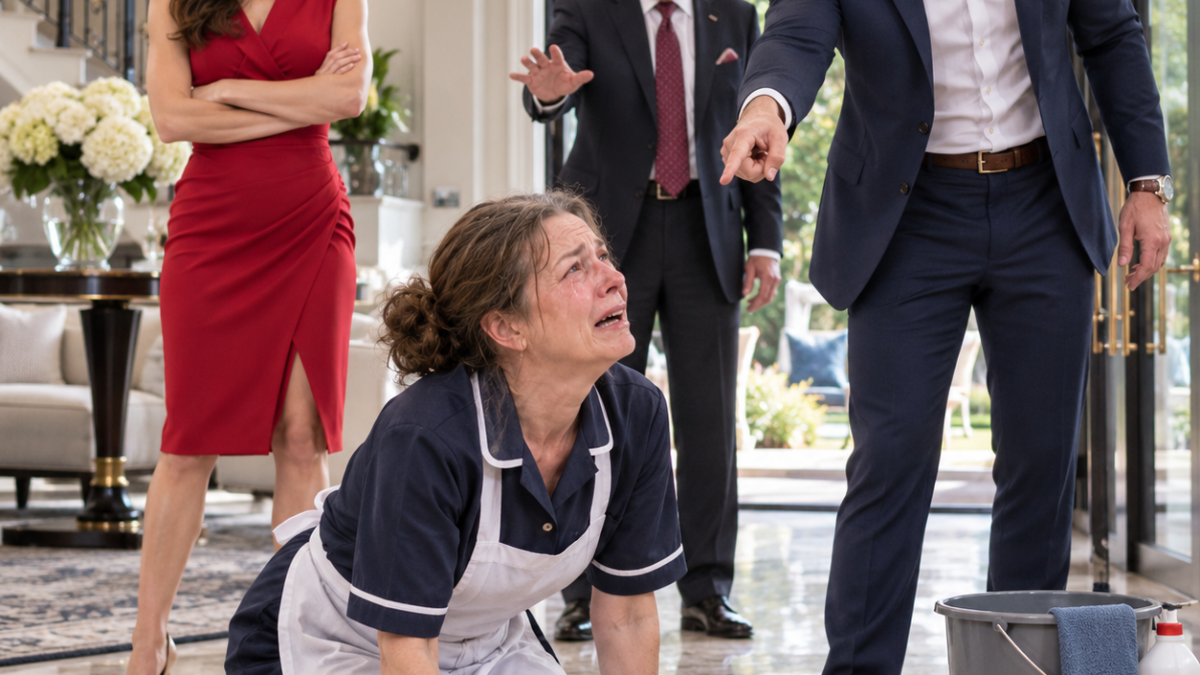
But on December 29, in the cold gray afternoon before New Year’s Eve, I opened that front door and found my sixty six year old wife kneeling on the kitchen floor with a bucket beside her, bleach burning the air, and both hands covered in raw red wounds.
For one second, I did not understand what I was seeing.
Gianna turned toward me.
The relief on her face almost killed me.
Then came the fear.
“Joshua,” she whispered.
Her apron was thin and faded. Her hair was pinned messily at the back of her neck. Her face looked smaller than it had the last time I had seen her. Her cheeks had hollowed. Her eyes had that exhausted, watchful look people get when they have spent too long listening for footsteps.
I had come to surprise my family for New Year’s Eve.
Instead, I had walked into something rotten.
“What happened to your hands?” I asked.
Gianna tried to hide them in the apron.
That was when our son stepped into the kitchen.
Austin Bailey.
My only child.
My boy.
The same boy I once carried on my shoulders through snow because he wanted to see the Christmas lights downtown. The same boy whose tuition I paid from repair shop profits and weekend overtime. The same boy whose first car came from my own garage after I rebuilt the engine myself.
He stood over his mother wearing brand new sneakers, an expensive watch, and an expression I did not recognize.
Not guilt.
Not surprise.
Annoyance.
“You weren’t supposed to be here,” he said.
I looked from him to Gianna.
“She’s on the floor.”
“She was cleaning.”
“She is your mother.”
Austin’s jaw tightened.
Then Peyton appeared behind him, holding a clipboard and wearing a cream sweater that probably cost more than the coat Gianna had been wearing for fifteen years.
“We don’t accept unannounced visitors here,” Peyton said.
I looked at her.
“This is my son’s house.”
Austin stepped forward.
“No,” he said. “It’s my house.”
That sentence hit me harder than it should have because technically, he believed it was true.
Years earlier, when Gianna and I gave him that house, I signed papers with pride and a little fear. Gianna had asked whether we should keep some legal protection. I told her we had raised a good son. The notary, an older woman with sharp glasses and a sharper mind, suggested a clause.
“Just in case,” she had said.
I barely listened.
I trusted blood.
That was my first mistake.
Now my son stood in that house, blocking me from my wife.
Behind him, Gianna slowly tried to stand. Her knees shook.
I moved toward her.
Austin stepped in front of me.
“Unannounced visitors aren’t welcome here.”
The words came out cold and rehearsed.
I stared at him.
“Move.”
He smiled, but there was no warmth in it.
“No.”
Peyton crossed her arms. “Joshua, this is not a good time. We’re hosting New Year’s Eve dinner, and Gianna still has things to finish.”
Gianna.
Not Mom.
Not Mrs. Bailey.
Gianna.
As if my wife were hired help.
I looked at Austin again.
“Your mother is leaving with me.”
His face changed.
Just enough.
“Mom is staying.”
“She can decide that herself.”
He turned and looked at Gianna.
It was only a glance.
But I saw what it did to her.
Her shoulders folded inward.
Her eyes dropped.
That was when the truth began moving through me, slow and poisonous.
This had not happened in one bad afternoon.
This had been built.
List by list.
Order by order.
Insult by insult.
Austin stepped closer to me.
“You need to go.”
I heard myself ask, “What did you say to her before I came in?”
He did not answer.
Gianna started crying silently.
Peyton sighed like my wife’s tears were poor manners.
Austin reached for the door.
I tried to step around him.
He shoved the door open with one hand and used his body to force me backward onto the porch.
I was sixty nine years old, but I had spent most of my life under cars, lifting engines, hauling parts, and working through pain. I could have pushed past him.
But Gianna was behind him.
Afraid.
And I saw Peyton reach for her phone.
Austin lowered his voice.
“You don’t want a scene, Dad.”
A scene.
My wife was bleeding from housework in a home I had purchased, and he was worried about a scene.
“Gianna,” I called.
She took one step.
Austin slammed the door in my face.
The sound cracked through the porch like a gunshot.
For a few seconds, I stood there in the freezing air with my hand still half raised.
Inside, through the door, I heard him shout loud enough for me to hear from the street.
“Who told you that you could stop working? Get back to cleaning.”
Everything in me went quiet.
Not calm.
Worse.
Quiet in the way a shop goes quiet right before a machine fails and throws metal across the room.
I knocked once.
Then again.
Then I pounded.
“Austin! Open this door!”
No answer.
I walked around the side of the house and looked through the kitchen window.
Peyton pulled the blinds shut.
That was when I understood the second truth.
They were not ashamed.
They were prepared.
I went back to my truck and sat behind the wheel with both hands gripping it so hard my fingers hurt.
In the passenger seat was the gift bag I had packed for Jesse, my ten year old grandson. A model car kit. The kind Austin and I used to build together when he was little.
Beside it was a wrapped scarf for Peyton because Gianna had reminded me not to arrive empty handed.
In the back seat were two casserole dishes Gianna had made before she left Detroit months earlier and frozen for me because she still worried I would forget to eat vegetables without her.
My wife had been taking care of everyone.
Everyone.
And no one had been taking care of her.
I checked into a hotel fifteen minutes away.
The clerk smiled and asked if I was in town for the holiday.
I said yes because if I said the truth, I thought my voice might break in front of a stranger.
In my room, I opened my suitcase with shaking hands.
At the bottom, wrapped in a plastic folder, was the original property deed.
I had brought it for sentimental reasons.
That sounds ridiculous now, but it was true.
I had planned to show it to Austin on New Year’s Eve. I wanted to tell him again how proud I was that the house had become his family home. I wanted to remind him that his mother and I had built something worth passing down.
Instead, I sat on the edge of a hotel bed and read the deed under cheap yellow light while my wife scrubbed floors in the house we gave him.
My eyes kept blurring.
Then I found the clause.
I had not thought about it in years.
The notary’s voice came back to me.
Just in case.
I read the paragraph once.
Then again.
Then a third time.
The grantors, Joshua Bailey and Gianna Bailey, retain a lifetime right of access and occupancy for reasonable family use and emergency residence. In the event the grantee denies either grantor access to the property, financially exploits either grantor, or subjects either grantor to abuse, neglect, coercion, or unlawful deprivation of personal property, the grantors reserve a right of reentry and reversionary interest enforceable by civil action.
I stopped breathing.
A lifetime right of access.
Financial exploitation.
Abuse.
Neglect.
Right of reentry.
Reversionary interest.
My son had never read it.
Or if he had, he never believed his own parents would use it.
I picked up my phone and called Paula Mercer.
Paula had been our attorney in Detroit for years. She handled the sale of one of our small rental properties after my knee surgery. She helped us update wills. She knew enough about our family finances to understand the house in Columbus was not just a gift.
It was the largest thing Gianna and I had ever given away.
Paula answered on the fourth ring.
“Joshua?”
“Paula,” I said.
My voice sounded wrong.
She noticed immediately.
“What happened?”
I looked at the deed in my lap.
“I need you to read a clause.”
By the time I finished explaining, Paula was silent.
That scared me more than any question would have.
Finally, she said, “Where is Gianna right now?”
“In the house.”
“With Austin and Peyton?”
“Yes.”
“Is she safe?”
I closed my eyes.
“No.”
“Did you see injuries?”
“Her hands. Weight loss. She looked afraid. She was on her knees cleaning with bleach.”
Paula’s voice sharpened.
“Did she leave with you?”
“No. He closed the door before she could.”
“Joshua, listen to me carefully. Do not go back tonight alone. Do not force entry. Do not give Austin a chance to accuse you of violence. We need evidence, medical documentation, bank records, and immediate protection.”
“He’s hurting her.”
“I believe you.”
That almost broke me.
I had not realized how badly I needed someone to say those words.
“I believe you,” she repeated. “And that clause may be very powerful, but we have to move correctly.”
“I want my wife out.”
“That comes first. The house comes second.”
I pressed my fingers against my eyes.
“She lied to me for months.”
“She may have been afraid.”
“She’s my wife.”
“Yes,” Paula said gently. “And shame keeps people quiet even when they have nothing to be ashamed of.”
I sat there until the room stopped spinning.
Paula continued, “I’m driving down tomorrow morning. I’ll contact local counsel tonight. Keep your phone on. Save every message. Do you have access to Gianna’s pension records?”
“Not yet.”
“Then we get them. And Joshua?”
“Yes?”
“Bring the deed to my office in the morning. Do not let that document out of your sight.”
I did not sleep.
I lay on top of the hotel blanket fully dressed, staring at the ceiling while memories attacked me one by one.
Austin at five years old, asleep in the back seat after Little League.
Austin at twelve, crying because he thought he had disappointed me after failing a math test.
Austin at twenty, hugging Gianna so hard at his college graduation that she cried into his gown.
Austin at thirty one, standing in front of that Columbus house, saying, “I’ll make you proud, Dad.”
Where had that boy gone?
Had he vanished?
Or had I refused to see what replaced him?
The next morning, I parked two streets away from the house and waited.
At 8:17, Austin’s truck pulled out of the driveway. Peyton was in the passenger seat. Jesse sat in the back, wearing headphones and staring out the window.
I waited until they turned the corner.
Then I went to the back door and knocked.
For a moment, nothing happened.
Then the curtain moved.
Gianna saw me.
Her face crumpled.
She unlocked the door with trembling fingers, and the second it opened, she collapsed into my arms.
Not a little cry.
Not a polite one.
A sound came out of her that I had never heard in forty three years of marriage. It was the sound of a person who had been holding up a wall with her bare hands and finally let it fall.
“I’m sorry,” she sobbed. “Joshua, I’m so sorry.”
I held her so tightly I was afraid I might hurt her.
“You have nothing to be sorry for.”
“I can’t abandon him,” she cried. “He’s our son. He lost his job. Peyton had surgery. Jesse needs stability. I thought if I just helped a little longer…”
I pulled back and took her hands.
She tried to hide them again.
I did not let her.
Her fingers were cracked. The skin across her knuckles was raw and red. Some places had split open. There were bandages wrapped around two fingers, dirty from work.
I held her hands in front of her face.
“Look at them.”
She shook her head.
“Gianna. Look.”
She did.
Tears ran down her cheeks.
“A son does not turn his mother’s love into unpaid labor,” I said. “This isn’t help. This is abuse.”
Her knees weakened again.
I caught her.
“We’re leaving.”
“My clothes…”
“We’ll buy clothes.”
“My medicine…”
“We’ll get more.”
“My pension card…”
That stopped me.
“What?”
Her eyes filled with shame.
“Austin has it.”
The quiet inside me returned.
“What do you mean he has it?”
“He said he could manage household expenses better. He said since I was staying here, my pension should help with groceries.”
“How long?”
She looked away.
“Seven months.”
Seven months.
For seven months, my wife had been trapped in a house we bought, cleaning for our son and daughter in law while they spent her pension.
I wanted to tear the kitchen apart.
Instead, I picked up her small bag from the maid’s room.
The maid’s room.
That was what Peyton called it.
Not guest room.
Not Mom’s room.
A narrow room beside the laundry area with an old mattress, one thin blanket, and a plastic bin where Gianna kept her folded clothes.
No photos.
No books.
No dignity.
On the wall above the mattress was a handwritten list taped with blue painter’s tape.
Monday
Bathrooms
Laundry
Iron Jesse’s uniforms
Prep Peyton’s client lunch
Clean patio glass
Inventory pantry
No naps before 3
No naps.
My wife was sixty six years old, and they had written no naps.
I took the paper off the wall and folded it into my pocket.
Gianna whispered, “Please don’t yell.”
I turned to her.
I realized then that she was not afraid of me yelling.
She was afraid of what would happen after.
“I won’t yell,” I said. “Not here.”
I took her to the hotel.
Then I bought clean clothes, unscented lotion, bandages, a phone, and hot soup from a diner because she kept insisting she was not hungry while her hands shook around the spoon.
By noon, Paula arrived with a local attorney named Marcus Reed.
Paula hugged Gianna carefully.
Then she looked at me.
Her face told me she had seen enough.
“We document everything today.”
At a private medical clinic, doctors examined Gianna for two hours.
Eight kilos lost.
Severe chemical dermatitis on both hands.
Elevated blood pressure.
Anxiety symptoms.
Sleep disruption.
Nutritional deficiency.
The doctor asked how often she had been using bleach.
Gianna looked at the floor.
“Every day.”
“With gloves?”
“Sometimes.”
“Why sometimes?”
She swallowed.
“Peyton said gloves made me slower.”
I had to leave the room for five minutes.
In the hallway, I stood with my hands against the wall and breathed like an old engine trying not to overheat.
Paula came out and stood beside me.
“Joshua.”
“I gave him that house.”
“I know.”
“I gave him everything.”
“No,” she said. “You gave him opportunities. He chose what to become with them.”
I wanted to believe that.
I still do.
But any parent who tells you betrayal by a child does not make you question your entire life is lying.
You go back through every birthday.
Every spoiled moment.
Every time you paid the bill instead of teaching the lesson.
Every time you mistook gratitude for character.
Every time you said, He’s a good boy, while the world quietly showed you he was becoming a selfish man.
That afternoon, we went to the bank.
Gianna sat beside me at the banker’s desk with her new phone clutched in both hands. She looked humiliated before anyone even spoke.
“I should have stopped it,” she whispered.
“You were being controlled,” Paula said.
Gianna shook her head.
“I gave him the card.”
“Under pressure.”
“I’m his mother.”
“You are also a victim of financial exploitation.”
The banker printed the records.
Seven months of withdrawals.
Almost her entire monthly pension gone within days of deposit.
Grocery charges, yes.
But not just groceries.
Luxury gym membership.
Designer clothing stores.
A fine dining restaurant downtown.
Monthly payments on Austin’s new truck.
A spa membership in Peyton’s name.
Online purchases.
A ski equipment deposit.
I stared at the papers until the numbers blurred.
Austin had not been surviving with help.
He had been living comfortably on his mother’s pension while making her scrub floors.
Gianna covered her mouth.
“I thought it was groceries.”
I touched her shoulder.
Peyton had sent texts too.
Once we recovered Gianna’s email and synced her old message history to the new phone, the proof poured out like poison.
The upstairs bathroom is still unfinished. Do not go to sleep until you have ironed everything.
Your pension will be used for groceries this week. Austin will handle it.
Jesse’s uniforms were wrinkled again. I need you to pay attention.
Do not sit in the living room when my guests arrive. It confuses people.
If Joshua calls, do not make this dramatic. Austin is under enough pressure.
One message made Gianna begin shaking.
Remember, if you leave now, Austin will know you chose your comfort over your grandson.
That was Peyton’s favorite weapon.
Jesse.
A child used as a chain.
But the second truth was worse than the money.
It came from Mrs. Irene Whitfield, the neighbor next door.
She was seventy four, widowed, sharp as a tack, and clearly had been waiting for someone to ask the right questions.
She invited us into her living room, served tea none of us touched, and looked at Gianna with tears in her eyes.
“I’m sorry,” she said. “I should have done more.”
Gianna whispered, “You were kind to me.”
Mrs. Irene shook her head.
“Kind is not enough when someone is suffering next door.”
She told us she had seen Gianna hanging heavy laundry outside before sunrise.
She had heard Austin shouting through open windows.
She had seen Peyton make Gianna carry trays during parties, then introduce her to guests as “Austin’s mother, who insists on keeping busy,” while laughing as if it were charming.
Then Mrs. Irene said, “There was a man at the house two weeks ago.”
Marcus leaned forward.
“What man?”
“A realtor.”
My stomach dropped.
Mrs. Irene continued, “I heard Peyton say they wanted photos after the holidays once they got the old woman’s things out of the back room.”
Gianna went still.
“The old woman?” I repeated.
Mrs. Irene’s eyes filled with anger.
“That’s what she called her.”
Paula looked at Marcus.
“Did they list the property?”
Marcus opened his laptop right there at Mrs. Irene’s coffee table.
Within minutes, he found a private premarket listing.
The house was not publicly posted yet, but photos had been uploaded to a broker portal.
Expected listing date: January 3.
Seller: Austin Bailey.
Projected price: far more than what Gianna and I had paid.
The description mentioned “fully updated family home in exclusive gated neighborhood.”
No mention of the parents who bought it.
No mention of the mother sleeping in the maid’s room.
No mention of the deed clause.
Then Marcus found another document.
A draft seller disclosure form.
Attached to it was a relocation note.
Austin and Peyton were preparing to move to Scottsdale.
My chest tightened.
“They were selling the house?”
Paula’s voice was low.
“Trying to.”
Gianna looked confused.
“But where was I supposed to go?”
No one answered.
Because the answer arrived ten minutes later.
Mrs. Irene produced a folded brochure she had taken from the trash bin after wind blew it into her hedge.
A senior residential care facility outside Dayton.
Low cost.
Shared rooms.
Medicaid pending accepted.
On the back, Peyton had written in neat blue ink:
Ask about intake if family member refuses to return home.
Family member.
Not mother.
Not Gianna.
Family member.
Gianna stared at the brochure.
Her lips parted, but no sound came.
That was the moment I stopped grieving the son I thought I had.
Not because the grief ended.
Because rage stood up beside it.
Austin had taken her pension.
Peyton had worked her until her hands split open.
They had planned to sell the house.
Then they had planned to dump her somewhere cheap and call it necessary.
I stood so abruptly the teacup rattled on its saucer.
“I’m going over there.”
Paula’s voice cut through the room.
“No.”
I turned.
“He was going to put my wife in a facility.”
“And if you go there now, angry, he will call police and make this about you.”
“He deserves…”
“Yes,” Paula said. “He does. But Gianna deserves justice that sticks.”
I breathed hard.
Marcus said, “We file emergency motions today.”
“What kind?”
“Temporary restraining order to prevent sale or transfer. Petition to enforce the deed clause. Claim for financial exploitation. Demand for accounting of pension funds. Protective order if warranted. And we notify Adult Protective Services.”
Gianna flinched.
“No.”
I turned to her.
“Gianna.”
“No,” she said, panic rising. “Please. I don’t want strangers thinking Austin…”
“Thinking Austin what?” Paula asked gently.
Gianna’s eyes filled.
“That he’s a monster.”
The room went quiet.
Because that was the cruelest part.
Even after everything, some part of her still wanted to protect him from the name he had earned.
I knelt in front of her chair.
“Listen to me,” I said. “Our son looked at your bleeding hands and told you to get back to cleaning.”
She cried silently.
“He took your pension.”
“He said they needed help.”
“He planned to sell the house.”
She shook her head as if the movement could unmake it.
“He has Jesse.”
“And Jesse needs to learn that love does not mean letting people abuse his grandmother.”
That reached her.
Not fully.
But enough.
She nodded once.
Paula filed the emergency documents that night.
Austin called me at 9:43 p.m.
I answered because Paula told me to let him talk while recording legally under Ohio’s one party consent rules. Marcus confirmed it twice. I still felt sick doing it, but I pressed record.
“Dad,” Austin said.
No warmth now.
Only fury.
“Where is Mom?”
“Safe.”
“You had no right to remove her from my home.”
“Your home?”
He laughed coldly.
“Yes. The house you gave me. Remember?”
“I remember the deed.”
Silence.
Only for a second.
Then he said, “What is that supposed to mean?”
“It means you should have read what you signed.”
His breathing changed.
Peyton’s voice sounded faintly in the background.
“What is he saying?”
Austin snapped away from the phone, “Quiet.”
Then back to me.
“You’re confused. Mom has been confused too. She gets overwhelmed. Peyton and I have done everything for her.”
I looked across the hotel room at Gianna, asleep on top of the blanket after the doctor gave her something mild for anxiety. Her bandaged hands rested near her face like injured birds.
“You mean she did everything for you.”
“Don’t start this,” Austin said.
“I’m not starting anything. You started it when you took her pension card.”
“She contributed to household expenses.”
“You used her pension for your truck.”
“That’s not your business.”
“She is my wife.”
“She is my mother.”
“Then act like it.”
He inhaled sharply.
“Careful, Dad.”
There it was.
A threat.
From my son.
To me.
“You do not want this to get ugly,” he continued. “Mom is not well. She lies to avoid conflict. If you drag this into court, Peyton and I will tell the truth.”
“What truth?”
“That Mom insisted on staying. That she wanted to help. That you abandoned her here because you couldn’t handle taking care of her yourself.”
My hand tightened around the phone.
He kept going.
“And if you try to take my house, I’ll make sure everyone knows you’re losing it. You’re almost seventy. You drove across state lines and kidnapped your own wife from a stable home.”
For a moment, I could not speak.
Not because I was afraid.
Because I remembered him at age four, holding my hand in a parking lot.
I remembered him asking, “Daddy, if I get lost, you’ll find me, right?”
I had said, “Always.”
Now I wondered if finding him had been useless because somewhere along the way, he had chosen to stay lost.
“Austin,” I said quietly, “you are being recorded.”
The silence that followed was the first honest thing he had given me in years.
Then he hung up.
The emergency hearing was set for December 31.
New Year’s Eve.
The day I had planned to sit at my son’s dining table and raise a glass to family.
Instead, I sat in a courthouse conference room beside my wife while our attorneys prepared to prove that our only child had exploited her.
Gianna wore a blue sweater I had bought her the day before. Her hands were bandaged. She kept them folded in her lap as if she were ashamed of them.
Austin arrived with Peyton and an attorney who looked like he had been hired very quickly and paid very well.
Austin did not look at his mother at first.
Peyton did.
Her eyes went straight to the bandages, then away.
Not shame.
Calculation.
The judge entered, and everyone stood.
The hearing began with Austin’s attorney claiming this was an unfortunate family misunderstanding.
That phrase made something inside me almost laugh.
Family misunderstanding.
As if Gianna’s wounds were a scheduling error.
As if stolen pension money was a miscommunication.
As if selling the house from under us was an awkward holiday mix up.
Marcus presented the deed first.
He explained the lifetime access and occupancy clause.
He explained the right of reentry.
He explained that Austin had accepted the property subject to recorded conditions and that those conditions were enforceable.
Austin’s attorney argued that the clause was old, vague, sentimental, and not intended to restrict Austin’s ownership.
Paula stood.
Then she played the recording from the night before.
You had no right to remove her from my home.
She contributed to household expenses.
If you try to take my house, I’ll make sure everyone knows you’re losing it.
The judge’s expression did not change.
That somehow made it worse.
Then Marcus presented the photos of Gianna’s hands.
The medical report.
The pension withdrawals.
The chore lists.
The text messages.
Mrs. Irene’s sworn statement.
The private premarket listing.
The care facility brochure.
By the time he finished, Austin’s attorney looked like a man who wished he had asked more questions before agreeing to represent my son.
The judge looked at Austin.
“Mr. Bailey, did your mother sleep in the maid’s room?”
Austin cleared his throat.
“She preferred a smaller room. Less stairs.”
Gianna whispered, “There were no stairs to the guest room.”
The judge turned to her.
“Mrs. Bailey, please speak up.”
Gianna lifted her head.
Her voice shook, but it came.
“The guest room was for Peyton’s craft supplies. I slept by the laundry.”
Peyton’s mouth tightened.
The judge asked, “Did you have access to your pension card?”
Gianna looked at Austin.
He stared straight ahead.
“No,” she said.
“Did you voluntarily authorize the luxury gym, restaurant, clothing, and truck payments shown in these records?”
“No.”
Austin leaned toward his attorney.
Peyton whispered something sharply.
The judge continued.
“Did you want to leave with your husband on December 29?”
Gianna closed her eyes.
I held my breath.
Then she opened them.
“Yes.”
Austin’s face snapped toward her.
“Mom.”
The judge said, “Do not address her.”
Austin sat back, flushed.
Gianna’s hands trembled.
“I wanted to leave,” she said. “But I was afraid.”
The courtroom went so quiet I could hear the air vent.
The judge asked, “Afraid of what?”
Gianna looked at our son.
This time, he looked away first.
“Afraid he would hate me,” she whispered. “Afraid he would keep Jesse from me. Afraid I had failed as a mother if I left.”
Her voice grew stronger.
“But I was also afraid of him.”
That was the sentence that broke my heart completely.
Not because I had not known.
Because she had finally said it where he had to hear.
The judge issued temporary orders that afternoon.
Austin was prohibited from selling, transferring, refinancing, leasing, or encumbering the property.
Gianna and I were granted immediate access and occupancy under the deed clause.
Austin and Peyton were ordered to vacate temporarily pending further proceedings, except to retrieve personal belongings under supervision.
Austin was ordered to return Gianna’s pension card and account access.
Adult Protective Services and law enforcement were notified.
The judge also ordered all parties to preserve financial records, communications, property documents, and listing agreements.
When the judge said “financial exploitation,” Austin lowered his head.
Peyton stared at the table like the wood had betrayed her.
Afterward, in the hallway, Austin approached us.
Marcus stepped in front of him.
Austin looked past him at Gianna.
“Mom,” he said, voice soft now. “You know this isn’t what it looks like.”
Gianna froze.
I felt her body lean, just slightly, toward the old instinct.
Mother.
Comfort him.
Fix it.
Austin saw it too.
His eyes filled with tears.
Real or fake, I still do not know.
“You know I was under pressure,” he said. “I lost my job. Peyton’s surgery was expensive. We were scared. You wanted to help.”
Gianna’s lips trembled.
Peyton stepped beside him and added, “We’re sorry if you felt unappreciated.”
If.
That tiny word did what all the evidence could not.
Gianna straightened.
“If?” she repeated.
Peyton blinked.
Gianna lifted her bandaged hands.
“I felt bleach in my skin. I felt hunger because I was too tired to eat. I felt shame sleeping beside the washing machine. I felt fear every time Austin raised his voice. Do not stand in front of me and say if.”
Peyton’s face reddened.
Austin whispered, “Mom, please.”
Gianna looked at him.
“My son would have opened the door for his father.”
He flinched.
“My son would have helped me stand up.”
Austin’s eyes filled again.
“My son would have read those chore lists and thrown them away.”
“Mom…”
“You may be the boy I gave birth to,” she said, voice breaking, “but I do not know the man who made me kneel.”
I covered my mouth.
Austin stared at her as if she had slapped him.
Maybe she had.
Not with a hand.
With truth.
We returned to the house that evening with a sheriff’s deputy, Marcus, Paula, and Mrs. Irene standing on her porch like a witness sent by God.
Austin and Peyton had been given two hours to pack essentials.
Jesse was with Peyton’s sister.
That was good.
He did not need to watch.
When we entered, the house looked staged for a party.
Silver decorations.
Champagne glasses.
A long dining table set for guests.
Fresh flowers.
A New Year’s Eve menu written in Peyton’s looping handwriting.
At the bottom was a note.
Gianna
Serve appetizers at 7
Clear plates quietly
No sitting in dining room
Gianna read it.
Then she picked up the paper and tore it in half.
I watched my wife do that and felt more pride than I had felt in almost anything.
Peyton rushed in from the hallway.
“That was my event list.”
Gianna looked at her.
“Then consider the event canceled.”
Peyton’s mouth fell open.
Austin appeared behind her carrying a suitcase.
“Dad, you’re really throwing your own son out on New Year’s Eve?”
I looked at the room.
At the table.
At the flowers.
At the woman I loved standing in bandages.
“No,” I said. “You did that when you threw your mother out of her own dignity.”
His face hardened.
“This house is mine.”
Marcus held up the court order.
“Not tonight.”
Austin turned to me.
“You always did this.”
I frowned.
“What?”
“Acted like gifts were love, then held them over my head.”
That accusation hit an old bruise.
Because maybe there had been truth near it once.
I had given too much. Paid too often. Rescued too quickly. Mistaken provision for parenting long after Austin was grown.
But I had never asked for obedience.
I had never asked him to repay me by breaking his mother.
“I gave you a house,” I said. “You gave your mother a bucket.”
He looked away.
Peyton muttered, “This is insane.”
Gianna turned.
“No, Peyton. Insane was making a sixty six year old woman iron your clothes while you spent her pension at a spa.”
Peyton’s eyes flashed.
“You offered.”
Gianna laughed.
It was a terrible sound.
“No. I loved. You exploited.”
The deputy gave Austin and Peyton a time warning.
They packed in furious silence.
Peyton tried to take several silver serving dishes Gianna had brought from Detroit.
Paula stopped her.
Peyton claimed they were gifts.
Gianna said, “Name one holiday I gave them to you.”
Peyton put them down.
Austin tried to take tools from the garage.
My tools.
The same set I had given him with the understanding that half belonged to the shop equipment I kept when visiting. Marcus checked the property list. Austin cursed and left them.
Then he went into Jesse’s room.
I followed.
He stood in the middle of the boy’s room holding the model car kit I had left wrapped in my truck.
He must have brought it inside earlier.
Or maybe Jesse had.
Austin looked at it.
“You brought him a gift?”
“He’s my grandson.”
He swallowed.
For a second, I saw something human in him.
Then it vanished under resentment.
“He loves you more than me.”
I stared at my son.
“No, Austin. He is afraid to disappoint you. That is not the same as love.”
His jaw tightened.
“You think you’re better than me.”
“No. I think I failed to teach you enough before you became someone who could say that in this house.”
That landed.
But not the way I hoped.
He turned toward me, eyes wet with anger.
“You raised me to want things.”
“I raised you to work for them.”
“You gave me everything.”
“Yes,” I said. “And that may have been my biggest mistake.”
For the first time, he had nothing to say.
At 6:15 p.m., Austin and Peyton left the house.
No party.
No champagne.
No guests.
No mother serving appetizers quietly from the kitchen.
Just tire tracks in the driveway and a house full of evidence.
At midnight, Gianna and I sat at the kitchen table with takeout soup because neither of us could cook.
New Year’s Eve fireworks cracked somewhere in the distance.
She held my hand with bandaged fingers.
“I’m sorry,” she whispered.
“Stop.”
“I should have told you.”
“You were scared.”
“I was ashamed.”
“You survived.”
Her face crumpled.
“I still love him.”
That was the part nobody wants to admit.
Abuse does not erase love on command.
Especially not a mother’s love.
“I know,” I said.
“Does that make me weak?”
“No.”
“What does it make me?”
I looked toward the hallway where Jesse’s drawings hung on the wall.
“A mother with a broken heart.”
She cried then.
I held her until the fireworks stopped.
The investigations began in January.
Adult Protective Services interviewed Gianna.
Police took reports about the pension withdrawals.
The bank opened a fraud review.
The realtor withdrew the listing immediately after receiving notice of the deed clause and pending litigation.
Peyton claimed she knew nothing about the pension spending, until bank records showed several charges were made from her phone.
Austin claimed Gianna had consented, until text messages showed Peyton instructing her not to question household spending.
Then the emails surfaced.
That was the final betrayal.
Paula found them through discovery.
Austin had written to Peyton in October:
If we sell in January, we can clear enough to move and reset. Mom can go back to Detroit or we place her somewhere temporarily. Dad will be mad but he’ll get over it.
Peyton replied:
She won’t go back willingly if she thinks Jesse needs her.
Austin:
Then we keep using Jesse.
I read those words alone in Paula’s office.
Then we keep using Jesse.
My son had turned his own child into bait for his grandmother.
Paula watched me carefully.
“Joshua.”
“I’m fine.”
“No, you’re not.”
She was right.
I was not fine.
I was a father reading proof that his son had become a man who calculated love like a payment plan.
Gianna refused to read the email at first.
Then she asked for it.
She sat at the dining table in the Columbus house, the same place Peyton had planned for her to serve guests, and read every line.
When she finished, she folded the paper.
She did not cry.
That frightened me more than tears.
“He knew,” she said.
I sat beside her.
“Yes.”
“He knew I stayed because of Jesse.”
“Yes.”
“And he used that.”
I reached for her hand.
She let me take it.
Then she said, “I want supervised visits with Jesse. Not through Austin. Through the court if necessary.”
That was my Gianna.
Broken, but still thinking of the child.
The civil case moved faster than expected because Austin had tried to sell the house while violating the deed clause. The court enforced our right of occupancy while the reversion claim proceeded.
Austin’s attorney advised settlement.
Austin refused.
Peyton wanted money.
Austin wanted victory.
That difference destroyed them.
By March, Peyton filed for separation.
By April, she agreed to testify in exchange for being removed from certain financial claims. I did not like it. Gianna hated it. Paula explained that Peyton’s testimony could prove intent.
The deposition was brutal.
Peyton sat across from us wearing a black blouse and no wedding ring.
She looked smaller without her clipboard.
Marcus asked, “Did Gianna Bailey perform household labor in your home?”
“Yes.”
“Was she paid?”
“No.”
“Did she have free access to her pension card?”
Peyton hesitated.
“No.”
“Who controlled it?”
“Austin mostly.”
“Did you use funds from that account?”
“Yes.”
“For what?”
“Household needs.”
Marcus slid bank statements across the table.
“Is your spa membership a household need?”
Peyton flushed.
“No.”
“Is your clothing purchase at L’Amour Boutique a household need?”
“No.”
“Were truck payments for Austin’s new vehicle made from Gianna’s pension account?”
“Yes.”
Gianna sat beside me, hands now healing but still scarred.
Marcus continued.
“Did you leave chore lists for Gianna?”
“Yes.”
“Why?”
“Because she forgot things.”
Gianna flinched.
Marcus looked up.
“Forgot things like what?”
Peyton looked at the paper.
“Cleaning tasks. Laundry. Meal prep.”
“Did you ever instruct her not to sleep until chores were finished?”
Peyton’s mouth tightened.
“Maybe once.”
Marcus showed the texts.
“More than once?”
“Yes.”
“Did you and Austin plan to sell the house?”
“Yes.”
“Did you know Joshua and Gianna Bailey had retained rights under the deed?”
“No.”
“Would that have changed your plans?”
Peyton looked toward her attorney.
He said nothing.
Finally, she answered.
“Yes.”
Then Marcus asked the question I had been waiting for.
“What was the plan for Gianna after the sale?”
Peyton’s face went pale.
Austin’s attorney objected.
Marcus rephrased.
“Did you research residential care facilities for Gianna Bailey?”
“Yes.”
“Did Gianna ask to be placed in a facility?”
“No.”
“Did Joshua Bailey agree to that?”
“No.”
“Why did you research it?”
Peyton’s eyes watered.
Not enough for me.
“Because Austin said his mother was becoming difficult and we couldn’t take her to Scottsdale.”
Gianna whispered, “Difficult?”
Peyton looked at her for the first time.
“I’m sorry.”
Gianna’s face did not change.
“No,” she said quietly. “You’re exposed.”
Peyton looked down.
That was the most honest thing my wife had said to her.
Austin’s deposition was worse because he still believed he could talk his way out.
He blamed stress.
He blamed unemployment.
He blamed Peyton’s surgery.
He blamed the economy.
He blamed me for giving him unrealistic expectations.
He blamed Gianna for refusing to communicate.
He said she liked feeling needed.
He said she insisted on helping.
He said the maid’s room was “cozy.”
At that, I stood up.
Paula touched my sleeve.
“Sit down.”
I did.
Barely.
Marcus asked, “Did you tell your mother she was not your mother in that house, but the help she owed you?”
Austin leaned back.
“I don’t recall.”
Marcus played audio from Mrs. Irene’s phone.
The neighbor had captured part of the argument through an open kitchen window.
Austin’s voice filled the conference room.
You’re not my mother here. You’re the help you owe us for everything we’ve spent on you.
Gianna closed her eyes.
Austin stared at the recorder like it had betrayed him.
Marcus asked, “Do you recall now?”
Austin’s face hardened.
“I was angry.”
“At what?”
“She was slow.”
I will never forget that answer.
Not because it was the cruelest thing he had said.
Because it was the smallest.
She was slow.
His mother.
The woman who carried him.
Fed him.
Washed his clothes.
Paid his tuition.
Slept beside hospital beds when he broke his arm at eleven.
And he had reduced her suffering to inconvenience.
Marcus let the silence sit.
Then he asked, “Slow at what?”
Austin looked away.
“Cleaning.”
That was the moment I saw the judge’s future ruling before it happened.
By summer, the court enforced the reversionary interest.
The deed clause held.
The house returned to Joshua and Gianna Bailey under the recorded conditions Austin had violated.
Austin appealed at first.
Then dropped it when his criminal attorney advised him to stop creating evidence.
He was charged related to financial exploitation and unauthorized use of Gianna’s pension funds. Some charges were reduced through plea negotiations. He avoided prison, which made me angry for months, but he did not avoid consequences.
Restitution.
Probation.
Mandatory counseling.
No contact with Gianna except through approved channels.
No access to her finances.
No access to the house.
Peyton’s separation became divorce.
Jesse spent more time with Peyton’s sister at first, then eventually with Peyton under court supervision. Gianna and I were granted scheduled grandparent visitation, carefully arranged so Austin could not use Jesse as leverage.
The first time Jesse visited us after everything, he stood in the foyer of the Columbus house holding the model car kit I had finally given him.
“Grandpa,” he said quietly, “is Grandma mad at me?”
Gianna made a soft sound.
She knelt slowly in front of him. Her knees were better now, though not perfect. Her hands had healed enough to hold his face.
“No, my sweet boy,” she said. “Never.”
He looked at her hands.
“Dad said you left because you didn’t want to help us.”
Gianna’s eyes filled.
I sat down because standing suddenly felt impossible.
“No,” she said. “I left because grown ups were asking for the wrong kind of help.”
Jesse frowned.
“What does that mean?”
She took a breath.
“It means love should never make someone sick or scared.”
He looked down.
“Dad yells a lot.”
Gianna closed her eyes.
Then opened them.
“I know.”
“Are you going to stop loving him?”
Her face crumpled.
“No,” she whispered. “But I am going to stop letting him hurt me.”
Jesse nodded slowly, as if filing that sentence somewhere important.
Then he hugged her.
Gianna held him and cried silently over his shoulder.
I turned away because some moments are too sacred to watch directly.
We sold the Columbus house the following year.
Not because Austin had won.
Because the house no longer felt like a gift.
It felt like a crime scene with good landscaping.
Gianna made the decision.
One morning, she stood in the kitchen where I had found her on her knees and said, “I don’t want to heal in the place where they broke me.”
So we sold it.
The sale proceeds went into a trust.
Part for our retirement.
Part for Jesse’s education, protected so Austin could never touch it.
Part donated to a local elder advocacy group that helped people recover stolen benefits.
When the closing documents were signed, Gianna wore her best blue dress and the pearl earrings I had given her on our thirtieth anniversary.
Her hands still had scars.
She no longer hid them.
Austin did not come to the closing.
He sent one email.
Dad,
I hope you’re happy. You chose money over your son.
I read it once.
Then I showed it to Gianna.
She looked at it for a long time.
Then she said, “Do not answer.”
So I did not.
That was harder than I expected.
There is an instinct in fathers to keep reaching, even when the hand comes back bleeding.
But silence, I learned, can be a boundary too.
Two years after that New Year’s Eve, Gianna and I were back in Detroit.
Our old house was smaller than the Columbus property, older too. The floors creaked. The windows complained in winter. The kitchen cabinets needed repainting.
It was home.
Not because it was perfect.
Because nobody inside it was forced to earn a chair at the table.
Gianna started volunteering twice a week at the elder advocacy center. At first, she said she would only file papers. Then she started answering phones. Then one afternoon, I walked in and heard her speaking gently to a woman whose daughter had taken her Social Security card.
“No,” Gianna said softly. “You are not selfish for wanting your own money.”
I stood in the doorway and felt tears rise before I could stop them.
My wife had turned her wounds into a lamp for somebody else.
That is the kind of woman Austin almost destroyed.
Almost.
On New Year’s Eve, exactly three years after I found her on the floor, we hosted dinner.
Not fancy.
Just real.
Jesse came with Peyton’s sister.
Mrs. Irene came from Columbus because Gianna insisted and because I think the woman enjoyed knowing she had helped bring down a tyrant in designer sneakers.
Paula came.
Marcus came.
A few old friends from the repair shop came.
At seven, Gianna carried out a tray of appetizers.
Then she sat down with it.
Everyone noticed.
No one said anything at first.
Then Jesse smiled.
“Grandma gets first.”
Gianna laughed.
“Yes,” she said. “Grandma gets first.”
At midnight, we stood in the living room while fireworks flashed over Detroit.
Gianna held my hand.
Her scars were pale now.
Still visible.
Still part of her.
She looked at me and said, “Do you ever miss him?”
I knew who she meant.
Not Jesse.
Not the boy Austin had been.
The son we lost without a funeral.
“Yes,” I said.
She nodded.
“Me too.”
Then she whispered, “But I do not miss being afraid of him.”
I kissed her forehead.
“That’s enough.”
A few weeks later, a letter arrived from Austin.
No return address, but I knew his handwriting.
I placed it on the table.
Gianna looked at it for a long time before opening it.
Mom and Dad,
I have been in counseling. I know you probably don’t believe that. I know I did things I can’t explain without sounding like I’m making excuses.
I was angry. I was ashamed of losing my job. I hated needing help. I let Peyton and myself turn Mom into someone to blame because it was easier than admitting I had failed.
That does not excuse what I did.
I stole from you. I scared you. I used Jesse. I let Mom work until she was hurt.
I do not expect forgiveness. I am writing because my counselor said accountability is not supposed to be a performance where I get something at the end.
I am sorry.
Austin
Gianna read it twice.
Then she set it down.
“What do you think?” I asked.
She looked out the window.
“I think it is the first thing he has written that does not ask for anything.”
That was true.
“Do you want to answer?”
She thought about it.
“Not yet.”
So we did not.
Maybe someday.
Maybe not.
People want clean endings.
They want the son to fall to his knees.
The mother to forgive.
The father to soften.
The family to gather around a table while music swells and old cruelty dissolves into one tearful apology.
Real life is not that obedient.
Austin hurt us.
He hurt his mother in ways I still cannot think about without my hands curling into fists.
He turned our generosity into entitlement.
He turned Gianna’s love into labor.
He turned his own child into leverage.
And yes, somewhere beneath all of that, he was still our son.
That is what made it complicated.
That is what made it hurt.
But complicated does not mean unclear.
The lesson came too late, but it came.
A gift without boundaries can become a weapon in the wrong hands.
Love without self respect can become a cage.
Family without accountability can become a place where abuse wears your last name and expects you to call it duty.
I still keep the original deed in our safe.
Sometimes I think about that clause.
The one the notary included.
The one Austin never bothered to read.
The one I barely understood when I signed it.
A lifetime right of access.
Protection from exploitation.
A right of reentry.
A door left open for the people who paid for the house when the person who received it tried to lock them out.
That clause did not save Gianna by itself.
Evidence did.
Neighbors did.
Doctors did.
Lawyers did.
My wife’s courage did.
But the clause gave us a key when Austin thought he had taken every key away.
And I will never forget the look on his face when he realized the house he used to control his mother still had our names hidden inside its bones.
He thought slamming the door in my face made him powerful.
He thought my wife’s silence meant permission.
He thought the pension card, the chore lists, the locked phone, the maid’s room, and the planned sale would disappear under the word family.
He thought we were too old, too ashamed, too heartbroken to fight back.
He was wrong.
I did not argue on that porch because the fight was never going to be won by shouting through a door.
I went back to my hotel.
I opened the deed.
I called the lawyer.
And then I brought my wife home from a house our son had turned into a prison.
Now, when Gianna sits at our kitchen table with coffee in her hands and sunlight touching the scars she no longer hides, I understand something I wish I had known sooner.
Children are blessings.
But they are not gods.
A home is a gift.
But it should never become a throne.
And no son, no matter how loved, has the right to make his mother kneel in the house she helped build.
Not while I am alive.
Not while the truth is recorded.
And not while there is still one clause left that he was arrogant enough not to read.








