My son had been in the ground for less than an hour when his wife decided I no longer belonged in his home.
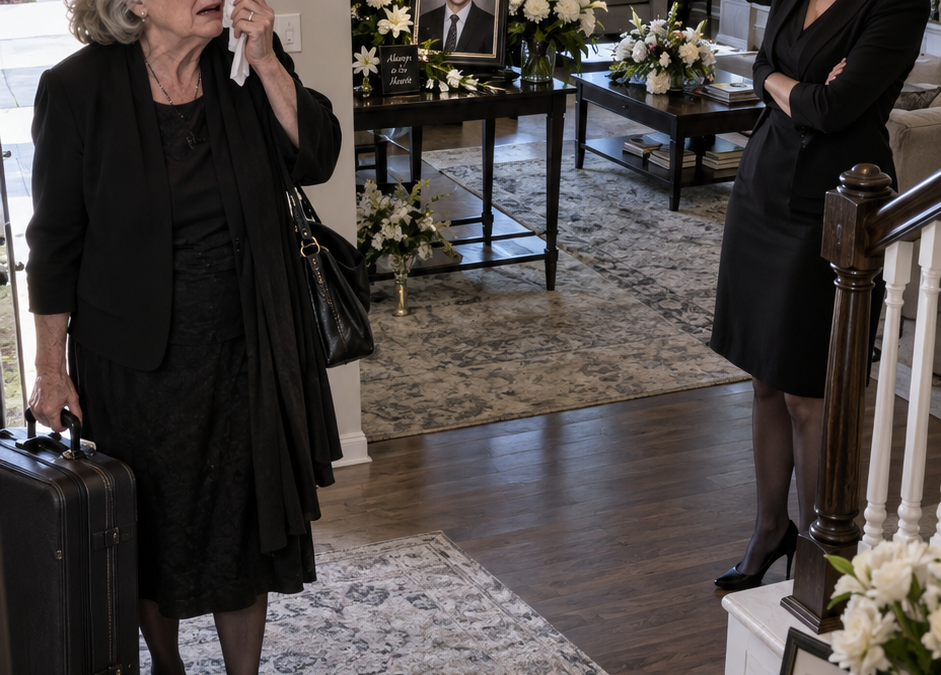
My son had been in the ground for less than an hour when his wife decided I no longer belonged in his home.
I was still wearing the black dress I had worn to the cemetery.
There was mud on the hem from standing beside Neftalí’s grave. My hands still smelled faintly of the lilies I had placed on his coffin. I could still hear the dull sound of earth falling over the wood.
I had buried my only son that morning.
By that afternoon, my daughter in law was throwing me out.
Mireya stood in the enormous front hall of the four million dollar house with her arms folded over her chest, watching me come through the door as if I were a stranger who had wandered onto private property.
For years, I had lived under that roof.
I had cooked in its kitchen.
I had polished its floors until they shone.
I had ironed Neftalí’s shirts.
I had prepared dinners for people Mireya wanted to impress.
I had opened the door for guests who barely looked at me.
I had swallowed insult after insult because my son was there, and I had convinced myself that peace was more important than pride.
Whenever Mireya spoke sharply to me, I told myself not to make Neftalí choose.
Whenever she excluded me from family decisions, I stayed quiet.
Whenever she reminded me that I was living in “their” house, I smiled and changed the subject.
I told myself I could endure almost anything as long as I could still hear my son’s footsteps coming down the hallway.
Then Neftalí died.
And the moment he was gone, Mireya stopped pretending.
Two old suitcases were waiting beside the staircase.
Mine.
At first, I simply stared at them.
“What is this?”
Mireya looked toward the luggage.
“Your things.”
I thought I had misunderstood.
I had barely slept in three days. Grief does strange things to the mind. It makes simple words difficult to understand.
“My things?”
“You’re leaving.”
I actually laughed.
Not because anything was funny.
Because the sentence was so cruel that my mind refused to accept it as real.
“Mireya, we just buried Neftalí.”
“I know.”
“You know?”
My voice cracked.
She showed no emotion.
“The funeral is over, Eulalia. There’s no reason to drag this out.”
I looked around the entrance hall.
The chandelier above us had been selected by Neftalí.
The long wooden table near the wall had been restored because I had admired it once in an antique shop.
The framed family photographs were still arranged exactly as I had arranged them before the funeral.
One of them showed Neftalí at thirty years old, laughing with his arm around my shoulders.
I walked toward it.
“If I have to leave today, at least let me take his photograph.”
Mireya moved before I reached it.
She stepped directly between me and the frame.
I stared at her.
“It is a photograph of my son.”
“Everything in this house belongs to me now.”
She said it quietly.
That was what made it worse.
She did not scream.
She did not lose control.
She sounded calm.
Prepared.
Satisfied.
As if she had been waiting years to say those words without Neftalí being there to stop her.
I looked at her face and suddenly wondered how many times she had imagined this moment.
“How long?” I whispered.
Her eyebrows moved slightly.
“How long have you been waiting to get rid of me?”
She exhaled impatiently.
“This isn’t the time for one of your scenes.”
“My scene?”
I stepped closer.
“My son is dead.”
“I know that.”
“I carried him inside me. I raised him. I watched them lower him into the ground this morning, and you’re standing here telling me I cannot even take his picture?”
“He was my husband.”
“And he was my child.”
Something flashed in her eyes.
Not grief.
Anger.
“You always did that.”
“Did what?”
“Act as though loving him first meant you loved him more.”
I stared at her.
“That is not what I said.”
“You never had to say it.”
Her voice became colder.
“You were always here. Always in the kitchen. Always asking if he had eaten. Always asking where he was going. Always looking at me like I had stolen him.”
“I never thought that.”
“Of course you did.”
“I wanted him happy.”
“No. You wanted him close.”
I felt something inside me break.
Perhaps because part of what she said touched a fear I had carried for years.
Perhaps because I was too exhausted to defend myself.
Or perhaps because, for the first time, I realized that there would never again be anyone standing between us.
No Neftalí entering the room.
No Neftalí saying, “Enough.”
No son trying to soften his wife’s cruelty with a joke.
There was only Mireya.
And me.
She walked to the front door and opened it.
Cold air swept into the house.
“You have somewhere to go.”
I looked at her.
“Where?”
“The mountain cabin.”
I nearly thought she was joking again.
“That place?”
“It belongs to the family.”
“It has been abandoned for years.”
“You’ll survive.”
“There’s no electricity.”
She shrugged.
“No running water.”
Another shrug.
“There are no neighbors for miles.”
Mireya looked directly into my eyes.
“Then no one will bother you.”
The meaning was impossible to miss.
I felt my grief harden into anger.
“You want me to disappear.”
“I want my life back.”
“Your life?”
“My husband is dead too, Eulalia.”
For one second, I searched her face for grief.
I desperately wanted to see it.
Anything.
Pain.
Fear.
Emptiness.
But what I saw was impatience.
She wanted me gone.
That was stronger than everything else.
I reached past her and took the photograph from the wall.
Her hand snapped around my wrist.
“Put it back.”
“No.”
“Everything in this house belongs to me.”
“This does not.”
Her fingers tightened.
I looked at her hand.
Then at her face.
Something in my expression must have changed because she released me.
I pressed the photograph against my chest.
Mireya pointed through the open door toward the long dirt road leading away from the mansion.
“Go.”
I didn’t move.
Her lips tightened.
Then she said the words I would remember for the rest of my life.
“You wanted so badly to be his mother. Now go mourn him somewhere else.”
She looked toward the mountains.
“Go die up there if that’s what it takes, but stop making yourself my problem.”
I had thought burying my son would be the cruelest thing I experienced that day.
I was wrong.
I picked up my two suitcases.
And I walked out of the four million dollar house without looking back.
At least, not until I reached the end of the driveway.
Then I turned.
Mireya was still standing in the doorway.
Watching me.
She did not wave.
She did not cry.
She simply closed the door.
The sound reached me even from that distance.
And somehow, it felt like being buried alive.
The trip into the mountains felt less like moving and more like being erased.
A driver left me near the end of an old dirt road because the ground was too muddy for his car.
He unloaded my two suitcases.
“Are you sure this is the place?”
I looked toward the dark trees.
“No.”
He waited.
I almost asked him to take me back.
Back where?
That question stopped me.
The mansion was no longer home.
My son was no longer alive.
And the only person waiting behind me wanted me gone.
So I lifted the suitcases.
“I’ll manage.”
The driver hesitated before leaving.
By the time his taillights disappeared, evening had begun swallowing the mountain.
The path was worse than I remembered.
Mud pulled at my shoes.
Branches caught the sleeves of my funeral dress.
Cold mist settled into my hair.
More than once, I had to put a suitcase down and simply stand there, breathing hard, staring into the darkness.
I was not young anymore.
My knees hurt.
My hands were numb.
And with every step, one thought repeated itself inside my head.
My son left me here.
It was unfair.
I knew that.
Neftalí had not physically sent me into the mountains.
He had not packed my luggage.
He had not opened the mansion door and pointed toward the road.
But grief is not fair.
By the time I reached the cabin, I was furious with him.
The building looked worse than I remembered.
One window was cracked.
Part of the roof sagged.
The wooden porch leaned slightly to one side.
When I pushed open the door, a sour smell rolled toward me.
Damp wood.
Dust.
Old fabric.
Years of trapped air.
I stood in the doorway staring.
“This is where she expects me to die.”
Hearing the words aloud frightened me.
There was an old cradle in one corner.
A broken chair near the wall.
Cobwebs hung from the beams.
A thin mattress had been left in a back room, but the fabric was stained.
I set my suitcases down.
Then I placed Neftalí’s photograph on the floor.
For several minutes, I just looked at him.
He was smiling in the picture.
I hated that smile.
I hated how alive he looked.
I hated how easily a photograph could lie.
“You knew she hated me.”
My voice echoed through the empty cabin.
“You knew.”
I sank onto the floor.
“You knew exactly what she was like.”
Tears came so suddenly that I could barely breathe.
“I spent years staying quiet for you.”
I picked up the photograph.
“I let her insult me for you.”
My fingers shook.
“I pretended not to hear things for you.”
My voice became louder.
“I let her make me feel like a servant in your house because I did not want you trapped between us.”
I was crying so hard that the words came apart.
“And then you died.”
I pressed the frame against my chest.
“You died and left me with her.”
For one ugly moment, I wanted to throw the photograph against the wall.
Then something even worse entered my mind.
Burn it.
I stared at the old fireplace.
A few pieces of dry wood remained nearby.
I imagined flames climbing over his face.
I imagined watching the smiling photograph blacken.
My anger scared me.
“You should have protected me.”
I whispered it.
Then again.
“You should have protected me.”
I held the frame over the fireplace.
But I could not let go.
My arms collapsed against my body.
I hugged the photograph instead.
I cried until I was too exhausted to sit upright.
That first night, I slept on the floor beside my suitcases with my dead son’s photograph against my chest.
Morning entered through cracks in the walls.
Cold air pushed through the broken window.
For a few seconds, I did not know where I was.
Then I saw the cabin ceiling.
And remembered everything.
Neftalí.
The funeral.
Mireya.
The suitcases.
The mountains.
A pressure settled over my chest.
I wanted to close my eyes again.
Instead, I sat up.
The cabin looked even uglier in daylight.
Dust covered everything.
Broken jars filled one shelf.
An old broom leaned in a corner.
I stared at it.
Something inside me changed.
Not hope.
Not yet.
Anger.
If Mireya expected me to disappear in that cabin, I would not make it easy for her.
I stood.
My back hurt.
My knees protested.
I picked up the broom.
“If this is where I’m supposed to die,” I muttered, “I’ll at least die somewhere clean.”
I swept.
At first, every movement hurt.
Then the work took over.
Dust rose in clouds.
I pulled cobwebs down.
I opened the cracked windows.
I stacked broken objects outside.
I found an old cloth and wiped years of dirt from the shelves.
Wet pine air entered the cabin.
For the first time, I could breathe without tasting rot.
Near the far wall, beneath layers of grime and discarded objects, I found something I recognized.
A small wooden altar.
I stopped moving.
“Neftalí.”
He had brought it there years earlier.
I remembered the day.
He had carried it with both hands as though it were fragile.
At the time, I had laughed at him.
“Why are you bringing that old thing all the way up here?”
“Because I like it.”
“You like everything nobody else wants.”
“That includes you.”
I had slapped his arm.
He had laughed.
The memory hit me so hard that I had to sit down.
After a while, I cleaned the altar with my sleeve.
The wood beneath the grime was still beautiful.
I placed Neftalí’s photograph on top.
“There.”
My voice trembled.
“At least you have somewhere to sit.”
I searched for something that could hold a candle.
Among rusted utensils and broken glass, I found an iron candlestick.
It was heavy.
Rough.
Nearly useless.
My fingers were stiff from the cold.
The candlestick slipped.
It struck the floor beside the altar.
The sound made me freeze.
Hollow.
I looked down.
I picked up the candlestick and tapped the floor again.
The same sound.
Not the dull thud of solid earth beneath old wood.
Hollow.
I knelt.
My fingertips moved across the floorboards.
Dust caught under my nails.
At first, I found nothing.
Then my finger stopped.
A seam.
Too straight.
Too deliberate.
My heart began beating faster.
I almost stood up.
Then a memory returned.
Six years earlier, Neftalí had brought me to that same cabin.
He had been nervous.
I remembered because he had arrived at my house without telling Mireya.
He barely touched the coffee I made for him.
“Mom,” he had said, “if something ever happens to me, promise me you won’t trust everyone who tells you they loved me.”
I had laughed.
“Neftalí, you’re thirty eight years old. Stop talking like an old man.”
He smiled.
But there had been no humor in his eyes.
Then he asked me something strange.
“Do you still have that brass key I gave you?”
“What key?”
“The little one. From when I was young.”
I had thought for a moment.
“Yes.”
“Keep it.”
“Why?”
“Just keep it.”
That had been all.
I had forgotten the conversation.
Until that moment.
My hands began to shake.
I moved the altar.
Underneath it, the seam continued.
I pushed the edge of the iron candlestick into the crack.
Nothing.
I tried again.
The board groaned.
My heart began hammering.
For a ridiculous second, I turned toward the cabin door.
No one was there.
Only the mountain.
Only wind through the trees.
Only me.
I pushed harder.
The floorboard lifted.
Cold air touched my fingers.
There was empty space beneath it.
I widened the gap.
Then I saw something black.
A metal box.
It was wrapped in old oilcloth and covered in dust.
I dragged it into the light.
My breath stopped.
One word had been scratched deeply into the metal.
NEFTALÍ.
I touched the letters.
“Oh, my son.”
There was a small lock on the front.
My hand automatically moved toward my dress pocket.
I had worn that black dress to the funeral.
Before leaving the mansion, I had emptied an old bowl from my bedside table into the pocket without thinking.
Coins.
A button.
And one small brass key.
I pulled it out.
For several seconds, I simply stared.
Then I placed it in the lock.
It turned.
Click.
The sound filled the cabin.
I lifted the lid.
Envelopes.
Photographs.
A leather notebook.
A USB drive.
Legal papers.
And beneath everything else, one thick folder.
One word had been written across the front.
MOTHER.
My eyes filled immediately.
“You knew.”
I covered my mouth.
“You knew I would come here.”
My fingers shook as I opened the folder.
The first page was a legal document.
The second was a bank statement.
Then I found a photograph.
My son was standing beside the four million dollar mansion.
A man stood beside him.
I had never seen the man before.
Neither of them was smiling.
I turned the photograph over.
My son’s handwriting covered the back.
If you are reading this, he already knows I am dead.
The photograph slipped from my fingers.
I stared at it on the floor.
“No.”
I picked it up again.
There was another sentence.
Do not believe my death was an accident.
I stopped breathing.
Neftalí had died suddenly.
Cardiac arrest.
That was what Mireya had told us.
That was what everyone repeated.
He had collapsed.
His heart had stopped.
A terrible tragedy.
Nothing more.
At the funeral, Mireya had held my arm beside the grave.
“He loved you, Eulalia,” she whispered.
I remembered how grateful I had been for those words.
Now they sounded different.
A lie spoken softly was still a lie.
I began tearing through the box.
Property records.
Bank transfers.
Insurance papers.
Photographs of Mireya entering a hotel.
Pictures of the strange man.
Photographs of Neftalí meeting people I did not recognize.
Then I found an envelope addressed to me.
Eulalia.
I pressed it against my chest.
For several moments, I could not open it.
Because I knew.
Whatever was inside would divide my life into two parts.
Before I read it.
And after.
Finally, I tore the envelope.
Mom,
If this letter reached you, I failed to tell you the truth while I was alive.
I wanted to protect you.
I thought I had time.
I was wrong.
My vision blurred.
I wiped my eyes.
The house was never really Mireya’s.
And it was never really mine.
There is something connected to that house that she has been searching for since the day we married.
She believes I hid what I discovered somewhere inside the mansion.
She is looking in the wrong place.
I looked around the cabin.
My pulse pounded in my ears.
Then I read the next paragraph.
Mom, I need you to understand something.
I did not bring you to this cabin because I wanted you to suffer.
I brought you here because it is the only place I believe she cannot find you.
A sob escaped me.
“That doesn’t make sense.”
Mireya had sent me there.
She had thrown me out.
She had chosen the cabin herself.
Unless she had not.
Unless Neftalí had arranged things so long ago that Mireya believed sending me there was her own decision.
Unless he had known her well enough to predict exactly what she would do when he was gone.
I turned the page.
One sentence waited there.
If Mireya tells you I died because of my heart, don’t believe her.
My fingers went numb.
I searched deeper into the box.
Under the notebook was another envelope.
MEDICAL REPORT.
Inside was a copy of a toxicology report.
I did not understand most of the medical language.
But one sentence had been underlined in red.
Presence of an unidentified sedative compound.
I read it again.
And again.
And again.
Someone had drugged my son.
Maybe the substance had affected his heart.
Maybe it had been used to make his death look natural.
I did not know.
But Neftalí had known enough to be afraid before he died.
Then I heard something outside.
Crack.
A branch.
I froze.
Another sound.
A footstep.
Slow.
Careful.
Someone was approaching the cabin.
I slammed the metal box shut.
My mind went blank.
Where could I hide it?
The footsteps stopped outside.
Three knocks.
My entire body jerked.
“Who is it?”
No answer.
Three more knocks.
I backed away.
Then a man spoke through the door.
“Mrs. Eulalia?”
My skin went cold.
There was something familiar about the voice.
Not because I had met him.
Because I had just been staring at his face.
The man in Neftalí’s photograph.
“Who are you?”
Silence.
“My name is Tomás.”
I gripped the brass key.
“I knew your son.”
I looked toward the hidden compartment.
“Neftalí told me that if he died, I should find you.”
My mouth went dry.
Then Tomás said something that made every hair on my arms rise.
“He also told me not to trust anyone who came looking for that box.”
A pause.
“Especially your daughter in law.”
Headlights suddenly appeared between the trees.
Tomás turned.
A vehicle climbed the mountain road.
Its beams cut through the rain.
Then it stopped.
A door opened.
And a woman shouted my name.
“Eulalia!”
I knew that voice.
Mireya.
Tomás looked at me.
“She found you.”
My heart slammed against my ribs.
He grabbed my wrist.
“Whatever happens, do not tell her you found the box.”
“Why?”
His eyes dropped toward the floor.
“Because Neftalí didn’t hide the most important thing in that box.”
I stared at him.
“What?”
“The real secret is somewhere else.”
The cabin door handle moved.
Slowly.
Deliberately.
And beneath my feet, somewhere under the old floorboards, I heard a faint metallic sound.
Click.
Something else had unlocked.
Mireya entered the cabin as though she still owned the right to enter every room I occupied.
Rain dripped from her hair.
Her expensive coat was wet around the shoulders.
Two men stood behind her.
One was the driver.
The other was the man from the photograph.
My stomach dropped.
The same man who had stood beside my son.
The same man Neftalí had warned me about.
Mireya looked around the cabin with open disgust.
“So this is where you’ve been hiding.”
I stared at her.
“You sent me here.”
She ignored that.
Her eyes moved over the floor.
The altar.
The dust.
My suitcases.
Then she looked directly at me.
“What did you find?”
I forced myself not to glance at the floorboards.
“I don’t know what you mean.”
She smiled.
“You always were a terrible liar.”
Tomás stepped forward.
“Leave her alone.”
For the first time since entering, Mireya’s expression changed.
She saw him.
“You.”
Fear crossed her face.
Only for a second.
But I saw it.
The strange man behind her stepped forward.
“Where is it?”
I looked between them.
Mireya turned sharply.
“Search everything.”
The men moved immediately.
They opened cabinets.
Pulled blankets aside.
Threw my belongings onto the floor.
One man kicked the broken chair across the room.
Another ripped loose boards from the wall.
I watched strangers destroy the place where Mireya had sent me to disappear.
Something about it made my fear change.
“This isn’t your house.”
Mireya turned.
“What?”
“You threw me out of your mansion and sent me here.”
My voice shook, but I kept speaking.
“You said everything there belonged to you.”
I stepped forward.
“Fine.”
I pointed around us.
“Then this belongs to me.”
She laughed.
“You think I care about this rotten cabin?”
“You cared enough to come here in the middle of the night.”
Her smile disappeared.
I saw it then.
I had struck something.
Fear.
Mireya was afraid.
One man kicked the altar.
It shifted.
My heart stopped.
Tomás grabbed my arm.
“Now.”
He pulled me toward the back wall.
Behind an old cupboard was a narrow door I had never noticed.
He shoved the cupboard aside.
A black opening appeared.
“What is that?”
“A passage.”
My mouth fell open.
“Neftalí built it.”
Behind us, Mireya shouted.
“Stop them!”
Tomás pushed me through.
We entered darkness.
He slammed the hidden door shut.
The passage smelled of wet soil and stone.
I could barely see.
“Move.”
“My shoes.”
“Forget your shoes.”
I lifted my dress and followed him.
The tunnel sloped downward.
Twice, I slipped.
Twice, Tomás caught me.
“Where are we going?”
“To the mine.”
“What mine?”
“The old one beneath the ridge.”
I stopped.
“Neftalí knew about this?”
“He knew more than anyone realized.”
A crash sounded behind us.
They had discovered the passage.
Voices echoed through the tunnel.
Tomás looked back.
“Run.”
I nearly laughed at the absurdity.
I was an old woman in a funeral dress, running through an underground passage while men chased me because my dead son had hidden evidence beneath a cabin floor.
Nothing about my life seemed real anymore.
But something changed inside me as I ran.
For days, grief had hollowed me out.
I had felt useless.
Discarded.
Finished.
Now, for the first time since Neftalí died, I had a purpose.
He had left me a trail.
And I intended to follow it.
The tunnel opened into a wide underground chamber.
Tomás lifted a flashlight.
The beam swept across rusted machinery.
Old supports.
Mining tools.
A metal cabinet.
Then the light reached the far wall.
I stopped.
Photographs covered it.
Dozens.
Hundreds, perhaps.
My son.
Mireya.
The strange man.
Bankers.
Lawyers.
Officials.
People I recognized from newspapers.
Dates had been written beneath many of the photographs.
Arrows connected names.
Companies.
Properties.
Accounts.
“What is all this?”
Tomás walked to the metal cabinet.
“This is what Neftalí was investigating.”
He opened it.
Folders sealed in plastic filled the shelves.
“Your son uncovered a property fraud and money laundering operation.”
I stared at him.
“The mansion?”
“Part of it.”
He handed me a folder.
I opened it.
Transfers.
Corporations.
Offshore accounts.
Construction contracts.
Land purchases.
Millions moving from one company to another.
Names I did not know.
Properties I had never seen.
Numbers so large they almost stopped meaning anything.
I looked at Tomás.
“Why was Neftalí involved?”
“He wasn’t.”
“Then how did he discover this?”
Tomás hesitated.
“Because he thought Mireya was cheating on him.”
Despite everything, the answer shocked me.
“He followed her?”
“One night.”
“And?”
“She was meeting another man.”
My stomach tightened.
“Not for an affair.”
Tomás pointed toward the wall.
“She was meeting people involved in laundering money through luxury properties.”
I thought about the mansion.
The visitors.
The rooms Mireya kept locked.
The papers she never allowed anyone to touch.
The sudden renovations.
The financial conversations that stopped when I entered a room.
All those years, I had assumed wealth had rules I simply did not understand.
Now those memories rearranged themselves into something much darker.
“Neftalí confronted her?”
“Not immediately.”
“Why?”
“He wanted proof.”
“And when he got it?”
“He realized it was bigger than Mireya.”
My eyes moved toward photographs of officials.
“He tried to go to the police?”
“Yes.”
“What happened?”
“He became convinced at least one powerful person inside the system was connected to the scheme.”
I felt suddenly cold.
“So he was trapped.”
Tomás did not answer.
He did not need to.
My gaze returned to the wall.
Then one photograph caught my attention.
Neftalí stood beside the small altar from the cabin.
A little boy was in his arms.
Dark hair.
Serious eyes.
I pulled the photograph down.
“Who is this?”
Tomás’s face changed.
He looked away.
“Tomás.”
He said nothing.
I turned the photograph over.
Three words were written on the back.
My son, Mateo.
My heart stumbled.
“Mateo?”
Tomás remained silent.
“Who is Mateo?”
The footsteps behind us grew louder.
Someone shouted Tomás’s name from the tunnel.
He took my arm.
“We have to move.”
I pulled away.
“Who is Mateo?”
“Eulalia.”
“Tell me.”
He looked at me.
“Mireya had a child before she married Neftalí.”
I stared at him.
“No.”
“Yes.”
“She never had a son.”
“She did.”
“Where is he?”
Tomás looked toward the tunnel.
“Mateo disappeared eight years ago.”
My blood went cold.
“Disappeared?”
“Neftalí believed the boy was still alive.”
“Why would Mireya hide her own child?”
Another crash echoed nearby.
Tomás grabbed the folder.
“This is not the place.”
I held up the photograph.
“My son wrote ‘My son, Mateo.’”
“Yes.”
“What does that mean?”
“It means Neftalí loved him.”
“Was he his father?”
Tomás looked at me carefully.
“Not in the simple way you’re asking.”
That answer only created more questions.
“He protected Mateo. He considered him family. He made sure the boy was kept away from the people who were looking for him.”
“Why were people looking for a child?”
Tomás’s expression hardened.
“Because Mateo had seen something.”
“What?”
“I’ll tell you if we get out alive.”
A metal object struck the cabinet behind us.
Someone had reached the chamber.
Tomás pulled me toward another passage.
This time, I ran without arguing.
Not only because I wanted to live.
Because somewhere beyond that mountain was a child my son had called his own.
A child named Mateo.
And suddenly I knew Neftalí’s secret was not about money.
It was about family.
We emerged from the tunnel behind the mountain.
Night air hit my face.
A vehicle waited near an old road.
Tomás opened the passenger door.
“Get in.”
I climbed inside.
My legs trembled so badly I could barely lift them.
Tomás started the engine.
We drove.
For several minutes, neither of us spoke.
I held the photograph of Mateo in my lap.
Then I noticed an envelope beside me.
My name was written on it.
Again.
In Neftalí’s handwriting.
I looked at Tomás.
“Where did this come from?”
His eyes remained on the road.
“Neftalí gave it to me three days before he died.”
Anger surged through me.
“You had this the entire time?”
“He gave me instructions.”
“What instructions?”
“To give it to you only if Mireya found the cabin.”
“She found it.”
“That’s why it’s there.”
I tore the envelope open.
Inside was a photograph.
A little boy.
Perhaps seven years old.
Dark hair.
Neftalí’s eyes.
Not exactly the same face.
But something about the expression was so familiar it hurt.
Around the boy’s neck hung a small brass key.
Just like mine.
I turned the photograph over.
Mom, if you see this boy, don’t tell him who you are.
I frowned.
Below it was another sentence.
He doesn’t know you are his grandmother.
My hands began trembling.
I stared at Tomás.
“My grandson?”
He nodded slowly.
“I don’t understand.”
“Neither did I at first.”
“Then explain it.”
Tomás exhaled.
“Neftalí discovered Mateo years ago.”
“I thought you said he was Mireya’s child.”
“He is.”
“Then how can I be his grandmother?”
“Because that’s how Neftalí wanted you to understand him.”
I stared at him.
Tomás continued.
“Your son protected that boy as his own. Loved him as his own. Whatever blood says, Neftalí considered Mateo his son.”
My eyes returned to the photograph.
My son had left me no children.
That was what I had believed.
Now, in my hands, was the face of a boy who had apparently carried Neftalí’s love in secret.
“Where is he?”
Tomás did not answer immediately.
“Where is Mateo?”
“We’re going to him.”
The vehicle suddenly slowed.
A black SUV stood across the highway ahead.
Headlights off.
Blocking the road.
Tomás swore under his breath.
“They’re waiting for us.”
I looked at the photograph.
Then at the roadblock.
Strangely, I was no longer afraid of dying.
I was afraid I would die before understanding what had happened to my son.
Tomás turned sharply onto a narrow side road.
“Where are we going?”
“To the one place Neftalí told me never to take you unless every other option failed.”
“What place?”
Tomás looked at me.
“His first home.”
I frowned.
“Neftalí’s first home was mine.”
“No.”
He turned back toward the road.
“There was another one.”
I felt irritation rise.
“I gave birth to him, Tomás. I know where my son lived.”
Then he said something that silenced me.
“The house where Neftalí was born.”
My childhood home.
I had not seen it in years.
And somehow, without telling me, my son had bought it.
The house stood at the edge of a small village beyond the mountains.
It was nothing like the mansion.
No gates.
No marble.
No chandeliers.
No rooms designed to impress strangers.
The roof sagged.
Wildflowers grew beside the stone path.
The walls had faded.
But when I stepped out of the car, my knees nearly gave way.
I knew that house.
I knew the shape of the windows.
I knew the crooked stone beside the front step.
I knew the tree that leaned toward the roof.
“This was my home.”
Tomás nodded.
“Neftalí bought it years ago.”
I turned toward him.
“Why didn’t he tell me?”
“He wanted it protected.”
“From what?”
“From everything that happened.”
My throat tightened.
“He bought this for me?”
“He wanted you to have somewhere to return to if his life collapsed.”
I looked back at the house.
All the anger I had felt toward Neftalí inside the cabin returned in a different form.
Pain.
“You foolish boy.”
My eyes filled.
“Why didn’t you tell your mother anything?”
Tomás unlocked the door.
Inside, dust covered the furniture.
But the house had been preserved.
Old photographs still hung on the walls.
Neftalí as a baby.
Neftalí at five.
Neftalí on his first day of school, holding my hand so tightly that his knuckles were white.
I touched the photograph.
“I thought I lost everything.”
Tomás stood behind me.
“Your son was trying to make sure you didn’t lose yourself.”
A floorboard creaked in the next room.
I turned.
Tomás froze.
Then came a child’s voice.
“Grandma?”
My heart stopped.
A little boy stood in the doorway.
Dark hair.
Those eyes.
The brass key hung around his neck.
I could not speak.
He studied me.
“Are you Eulalia?”
My throat closed.
“Yes.”
He smiled.
“My father said you’d come someday.”
I covered my mouth.
“Your father?”
“Neftalí.”
The room disappeared around me.
All I could see was that child.
I sank to my knees.
Mateo took a few cautious steps toward me.
“My dad said you make the best soup.”
A broken laugh escaped through my tears.
“He said that?”
Mateo nodded.
“He said nobody could make it like you.”
I began crying.
“He remembered.”
“He remembered everything.”
I opened my arms.
Mateo hesitated.
Only for a moment.
Then he ran into them.
I held him.
At first, carefully.
Then desperately.
The way I had once held Neftalí after nightmares.
The way I had held him when he was sick.
The way I wished I could have held him one last time before he died.
Mateo’s small arms wrapped around my neck.
And for the first time since the funeral, grief did not feel like an empty room.
There was someone else inside it with me.
“My grandson,” I whispered.
Mateo pulled back.
“Dad said you might cry.”
I laughed through my tears.
“Your father knew me very well.”
“Did he cry?”
“All the time.”
Mateo looked surprised.
I smiled.
“He would deny it.”
That made the boy laugh.
The sound nearly broke my heart.
It sounded like hope.
The truth came slowly after that.
Not because Tomás wanted to hide it.
Because there was too much.
Mireya had been married before Neftalí.
Her previous husband had died under circumstances that later looked far more suspicious than anyone understood at the time.
Mateo had been very young.
But he had seen enough to become dangerous to people who had built their lives on secrecy.
There were financial connections.
Meetings.
Properties.
Documents.
People whose names appeared again years later in the operation Neftalí uncovered.
Mireya had spent years keeping Mateo hidden from anyone who might connect him to the past.
When Neftalí discovered the boy existed, everything changed.
At first, he thought Mireya’s secret was simply that she had hidden a child from him.
Then he learned why.
He secretly located Mateo.
He arranged for trusted people to protect him.
He visited when he could.
He never told me.
That part hurt.
For several days, it hurt almost as much as everything else.
“He should have trusted me.”
I said it one evening while Mateo slept in another room.
Tomás sat across from me at the kitchen table.
“He trusted you more than anyone.”
“Then why keep me ignorant?”
“Because Mireya watched you.”
I frowned.
“She considered you Neftalí’s weakness.”
I looked toward the hallway.
“If I had known about Mateo, I could have helped.”
“And if Mireya had realized you knew, she could have used you to find him.”
I hated that answer.
Because it made sense.
Tomás slid another envelope toward me.
“Neftalí was trying to protect both of you.”
I stared at it.
“I spent the first night in that cabin cursing him.”
Tomás said nothing.
“I told his photograph he had failed me.”
My voice broke.
“All this time, he had been preparing for me.”
“He believed he could fix everything while he was alive.”
“He was always like that.”
I smiled bitterly.
“He thought he had to solve every problem himself.”
Tomás nodded.
“That may be what got him killed.”
The word killed landed differently when spoken aloud.
I looked at him.
“Do you believe Mireya murdered him?”
Tomás did not answer quickly.
“I believe Neftalí was drugged.”
“That is not what I asked.”
“I believe the people he was investigating had reasons to stop him.”
“And Mireya?”
His expression changed.
“I believe she knew more about his death than she told anyone.”
I stared at the table.
The woman who stood beside me at my son’s grave had known.
Perhaps not every detail.
Perhaps more than I could imagine.
Either possibility made me sick.
“Then we expose her.”
Tomás looked at me.
“We expose all of them.”
For the next several weeks, everything moved quietly.
Lawyers were contacted through people Neftalí trusted.
Copies of documents were sent to authorities outside the local network he had feared.
Financial records were duplicated.
The USB drive from the metal box was examined.
It contained recordings.
Meetings.
Conversations.
Dates.
Names.
Neftalí’s voice.
The first time I heard him speak from one of those recordings, I had to leave the room.
It was too much.
His voice was calm.
Alive.
Focused.
I stood in the hallway with both hands over my mouth while my dead son explained a money trail to someone he trusted.
Mateo found me there.
“Grandma?”
I wiped my face.
“I’m fine.”
He gave me the same look Neftalí used to give me when he knew I was lying.
“No, you’re not.”
I almost laughed.
“You really are his son.”
Mateo took my hand.
He did not tell me to stop crying.
He simply stood there.
That became one of the greatest gifts he gave me.
He understood instinctively that grief did not need to be repaired every time it appeared.
Sometimes it simply needed company.
The investigation grew.
The four million dollar mansion was frozen as part of the financial case.
Accounts connected to Mireya were restricted.
Properties were examined.
People who had once seemed untouchable began hiring lawyers.
And then, one morning, Tomás entered the kitchen.
“They arrested her.”
I stopped stirring soup.
“Who?”
I knew.
But I made him say it.
“Mireya.”
The spoon slipped from my hand.
Mateo looked up from the table.
I felt no joy.
That surprised me.
For weeks, I had imagined the moment.
I thought I would feel victory.
Instead, I felt tired.
“Where?”
“At the mansion.”
I closed my eyes.
The same front door she had opened while ordering me into the mountains.
The same house she believed was finally hers.
“What did she say?”
“She denied everything.”
“Of course.”
“Others were arrested too.”
“The man from the photograph?”
“Yes.”
I gripped the counter.
“And Neftalí?”
Tomás understood the real question.
“The investigation into his death has been reopened.”
I sat down.
Mateo watched me carefully.
“Grandma?”
I reached for his hand.
“I’m all right.”
This time, I almost meant it.
Justice did not bring Neftalí back.
Nothing would.
But truth mattered.
Late truth was still truth.
Late justice was still justice.
And after months of living beneath Mireya’s version of reality, there was something powerful about finally watching facts speak louder than she did.
The legal process lasted months.
I learned more about money laundering, property ownership and corporate structures than I ever wanted to know.
The mansion was not simply a home purchased through normal wealth.
It had become part of a larger network of transactions designed to hide money and ownership.
Mireya’s claim that everything automatically belonged to her began collapsing under scrutiny.
Records Neftalí had collected became crucial.
So did his recordings.
So did the toxicology evidence.
Piece by piece, the life Mireya had built began to come apart.
One afternoon, a lawyer asked me whether I wanted to return to the mansion after legitimate ownership issues were resolved.
I looked at him.
“Live there?”
“If the court restores the relevant property rights, that may be an option.”
I thought about the enormous kitchen.
The polished floors.
The staircase.
The room where my suitcases had waited after the funeral.
The front door.
Mireya’s finger pointing toward the road.
Everything in this house belongs to me now.
I shook my head.
“No.”
The lawyer seemed surprised.
“You may want to consider the financial value.”
“I did not say I wanted it destroyed.”
“Of course not.”
“Sell it. Preserve it. Do whatever the court decides is proper.”
I looked out the window toward Mateo, who was trying to repair an old bicycle.
“But I will never live there again.”
The lawyer closed his folder.
“May I ask why?”
“That house has too many ghosts.”
He nodded.
I watched Mateo struggle with the bicycle chain.
“This house has memories.”
There was a difference.
A mansion could be expensive and still not be a home.
I knew that now.
I stayed in the little house where Neftalí had been born.
At first, it felt temporary.
Then Mateo asked if we could plant tomatoes.
That changed everything.
You do not plant tomatoes in a place you intend to abandon.
We repaired the roof.
Painted the walls.
Replaced broken boards.
I planted roses beside the windows.
Mateo insisted on helping with everything.
He was terrible at painting.
Paint ended up on his clothes, his hair and once, somehow, on the dog from the neighboring farm.
I laughed harder that afternoon than I had laughed in a year.
At breakfast, Mateo asked about Neftalí.
“What was Dad like when he was little?”
“Stubborn.”
“Like me?”
“Exactly like you.”
He grinned.
“Did he get in trouble?”
“Constantly.”
“Tell me.”
So I did.
I told him how Neftalí used to steal cookies and then deny it with chocolate still on his face.
How he once climbed onto the roof because he believed he could see the ocean from there.
How he cried when his first bicycle broke.
“How old was he?”
“About your age.”
“Did you fix it?”
“I tried.”
“Was Dad mad?”
“For ten minutes.”
“Then what?”
“He hugged me.”
Mateo smiled.
I told him how Neftalí used to hold my hand when he was afraid.
How he hated thunderstorms as a child but pretended he did not.
How he once brought home an injured bird and refused to sleep until he knew it would live.
Some stories made us laugh.
Some made me cry.
Mateo never looked uncomfortable when I cried.
He simply reached across the table and held my hand.
Love and grief learned to live beside each other in that house.
Neither defeated the other.
They became part of the same family.
Almost a year after Neftalí’s death, I returned to the mountain cabin.
I had avoided it.
Too many memories lived there.
The first night.
The anger.
The broken floorboard.
The black box.
Mireya arriving through the rain.
But Mateo asked to go.
“Dad liked that place, right?”
“Yes.”
“Then I want to see it.”
So we went together.
The cabin had been repaired and secured during the investigation.
The broken window had been replaced.
The roof no longer leaked.
The old altar remained where I had found it.
I placed Neftalí’s photograph on top.
Then I lit a candle.
For a long time, I stood there in silence.
Finally, I spoke.
“You were right, my son.”
The flame moved slightly.
“I thought you abandoned me.”
My voice cracked.
“I was so angry with you.”
Tears filled my eyes.
“I thought you died and left me with nothing.”
I touched the edge of the photograph.
“But you were protecting me.”
A breeze moved through the open window.
“You should have told me.”
I almost laughed.
“You were always terrible at asking for help.”
My fingers rested on the frame.
“You gave me a reason to keep living.”
Footsteps sounded behind me.
I turned.
Mateo stood in the doorway holding a small wooden box.
“What do you have?”
“I found it at the house.”
He walked toward me.
“It was behind a loose panel.”
My heart quickened.
Another hidden thing.
With Neftalí, apparently nothing could simply be left on a table.
Mateo handed it to me.
Inside was a folded note.
I recognized the handwriting immediately.
Mom,
If you found Mateo, then everything happened the way I hoped.
My throat tightened.
Please don’t spend the rest of your life fighting for what was taken from you.
Build something better.
Love him for me.
And when you miss me, look at the mountains.
I’m there.
I could not finish without crying.
Mateo wrapped his arms around me.
For several minutes, we stood together beside the little altar.
I thought about the first night I had spent in that cabin.
I had believed I had reached the end of my life.
My son was dead.
My home was gone.
My daughter in law had thrown me away.
Everything familiar had disappeared within days.
Yet beneath the floor was a truth Neftalí had risked his life to preserve.
A path.
A warning.
A child.
A future.
I looked at Mateo.
“Your father loved you very much.”
“I know.”
“He loved you enough to be afraid.”
Mateo frowned.
“What does that mean?”
“It means sometimes when people love you, they make difficult choices because they are trying to protect you.”
“Like hiding things?”
I smiled sadly.
“Yes.”
“Was that good?”
I thought carefully.
“Not always.”
He waited.
“Your father made mistakes.”
Mateo looked surprised.
I continued.
“Loving someone doesn’t make you perfect. It makes your mistakes matter more.”
“Are you mad at him?”
I looked toward Neftalí’s photograph.
“I was.”
“And now?”
I took Mateo’s hand.
“Now I understand him better.”
That was the closest thing to forgiveness I could give.
Perhaps the closest thing I needed.
Years passed.
The legal cases ended one by one.
Mireya lost the life she had fought so viciously to control.
The mansion was no longer hers to command.
The fraudulent accounts were frozen.
The property scheme was exposed.
People who believed wealth and influence would protect them learned that evidence could outlive fear.
The full truth about every moment of Neftalí’s death was complicated, and no courtroom could restore what had been taken from me.
But the evidence proved enough.
He had been right to be afraid.
He had been right to hide what he found.
And Mireya had not been the grieving widow she pretended to be.
I did not attend every hearing.
I did not need to look at her.
Once, I saw her from across a courtroom.
She looked smaller.
Not physically.
Something else.
The certainty was gone.
The arrogance.
The woman who had once stood in a four million dollar house and told me everything belonged to her now sat surrounded by lawyers while other people decided what remained hers at all.
Our eyes met.
For a moment, I was back in the mansion.
My black funeral dress.
My suitcases.
Her finger pointing toward the door.
Go die in the mountains.
I expected anger.
Instead, I felt something close to pity.
Not forgiveness.
I did not owe her that.
But I finally understood how empty her victory had been.
She had believed winning meant possessing the house.
The furniture.
The money.
The doors.
The keys.
She had wanted control.
And because she wanted control more than love, she had lost everything that could have made any of those possessions matter.
I looked away first.
Not because I was afraid of her.
Because I was finished with her.
Mateo grew.
He became taller than I expected.
Then taller than me.
He learned how to repair almost anything.
The little boy who had once appeared in a doorway wearing a brass key around his neck became a young man who could fix leaking roofs, broken gates and stubborn engines.
He planted trees along the mountain road.
“Why so many?” I asked.
“So there’ll be shade.”
“For who?”
“Whoever comes after us.”
That answer made me smile.
He had Neftalí’s habit of thinking about people who were not yet there.
Every year on Neftalí’s birthday, we cooked his favorite meal.
Soup.
Roasted vegetables.
A cake that always came out slightly uneven because Mateo refused to let me fix the icing.
We told stories.
At first, they ended in tears.
Eventually, they ended in laughter through tears.
Then sometimes just laughter.
Grief changed shape.
It never vanished.
I did not want it to.
Losing all grief would have felt too much like losing the love attached to it.
One afternoon, Mateo came home carrying a wooden board.
“What is that?”
“Nothing.”
“That is obviously something.”
He hid it behind his back.
“Don’t come outside.”
“Mateo.”
“Grandma.”
“You are terrible at secrets.”
He looked offended.
“Runs in the family.”
I laughed.
A few minutes later, I heard hammering.
I went outside despite his instructions.
He stood beside the front gate.
A wooden sign had been nailed beside it.
THE NEFTALÍ HOUSE.
I stopped.
Mateo turned.
“You weren’t supposed to look yet.”
My eyes filled.
“You didn’t have to name it after him.”
“I wanted to.”
He wiped sawdust from his hands.
“This is where our family came back together.”
I looked at the sign.
Then at the house.
The small house.
The old house.
The house that would never appear in magazines.
The house that was not worth four million dollars.
The house where my son had been born.
The house where my grandson had found me.
The house where we ate breakfast.
Argued.
Laughed.
Cried.
Fixed things.
Burned dinners.
Planted flowers.
Remembered.
Lived.
“This is home,” I said.
Mateo nodded.
“Yes.”
I started crying.
He groaned playfully.
“Again?”
“Be quiet.”
He hugged me.
I held on.
For years, I had believed inheritance meant property.
Money.
Jewelry.
Land.
A house with expensive windows and polished floors.
Mireya believed it too.
That was why she fought so hard for the mansion.
That was why she thought putting my belongings into two old suitcases meant she had defeated me.
She believed removing me from that house removed me from Neftalí’s life.
She was wrong.
A house can be taken.
Money can disappear.
Furniture can be sold.
Silver can be locked away.
Even photographs can be kept from a grieving mother.
But there are things no person can confiscate.
I still remembered Neftalí’s first cry.
I remembered the weight of him sleeping against my chest.
I remembered his first day of school.
His scraped knees.
His terrible teenage haircut.
His first heartbreak.
The day he introduced me to Mireya.
The last time he hugged me.
I remembered his voice.
His impatience.
His stubbornness.
His ridiculous confidence that he could solve everything before anyone he loved discovered there was a problem.
And I had Mateo.
Not as a replacement.
No human being replaces another.
He was something different.
Proof that love had survived the secrets.
Proof that Neftalí had built something beyond fear.
One evening, many years after the funeral, Mateo and I sat outside while the sun disappeared behind the mountains.
He had grown into a kind young man.
Strong.
Quiet.
Much wiser than I had been at his age.
He looked toward the peaks.
“Do you really think Dad is up there?”
I followed his gaze.
“No.”
Mateo turned toward me.
I smiled.
“Not literally.”
He laughed.
“I know.”
I looked at the mountains again.
“But I understand what he meant.”
“What?”
“When someone loves you enough, they leave pieces of themselves in the places that changed you.”
Mateo was quiet.
“So he’s in the cabin?”
“In a way.”
“And here?”
“Yes.”
He touched his chest.
“And here?”
I looked at him.
“Especially there.”
We sat quietly.
The sky turned orange.
Then purple.
Then dark.
For a moment, I could almost hear footsteps inside the house.
Not a ghost.
Not Neftalí coming back.
Memory.
That was enough.
I thought about the woman I had been when Mireya opened the mansion door.
Black dress.
Two suitcases.
Hands trembling.
A mother convinced she had lost every reason to wake up the next morning.
Mireya had looked at that woman and seen weakness.
She believed sending me into the mountains would erase me.
Instead, the mountains gave me back the truth.
The broken cabin gave me my son’s final message.
The floorboard gave me his evidence.
The evidence gave me answers.
And his secret gave me Mateo.
I had not disappeared.
I had found my way home.
In the end, I did not need the four million dollar mansion to prove that I had won.
Winning was never keeping the house.
Winning was surviving long enough to understand what Neftalí had tried to protect.
Winning was seeing truth outlast lies.
Winning was sitting at an old wooden table while my grandson asked for another bowl of soup.
Winning was hearing laughter in rooms that had once been silent.
Winning was learning that losing everything you can touch does not mean losing everything that belongs to you.
Mireya had taken the mansion.
She had taken the furniture.
She had tried to take my dignity.
For a while, she even took my belief that my son had protected me.
But she could not take my memories.
She could not erase Neftalí’s love.
She could not destroy the truth he had hidden.
And she could never take Mateo.
Sometimes, late in the evening, I still think about that first night in the cabin.
I see myself sitting on the floor in my damp funeral dress.
Holding Neftalí’s photograph.
Angry enough to burn it.
Broken enough to believe I had reached the end.
If I could speak to that woman now, I would tell her only one thing.
Do not leave before the floor breaks beneath you.
Because sometimes the thing that feels like one final collapse is actually the moment the truth opens.
Sometimes what is hidden under the ruins is not another reason to grieve.
Sometimes it is the reason you survive.
My son died believing he had failed to tell me everything.
But in the end, he told me enough.
He told me where to look.
He told me who not to trust.
He left me the key.
He left me the truth.
And most importantly, he left me someone to love.
Now, when the sun disappears behind the mountains and the house becomes quiet, I still miss him.
I always will.
But I am no longer afraid of tomorrow.
For a long time, I thought the greatest thing Neftalí could leave behind was the four million dollar house.
I was wrong.
The greatest inheritance was waiting far beyond those gates.
It was a little boy with my son’s love in his heart.
It was a small house filled with memories.
It was the truth buried beneath a broken floor.
It was family.
And that is something no one can ever throw out into the mountains.
No one can steal it.
No one can lock it behind a mansion door.
No one can bury it deep enough to make it disappear.
Not even death.








