My sister watched her twin boys snap my ten-year-old son’s sailboat in half, spill orange soda across my hardwood floor, and take over the guest room in the Malibu cottage I had paid nine hundred forty thousand dollars to buy.
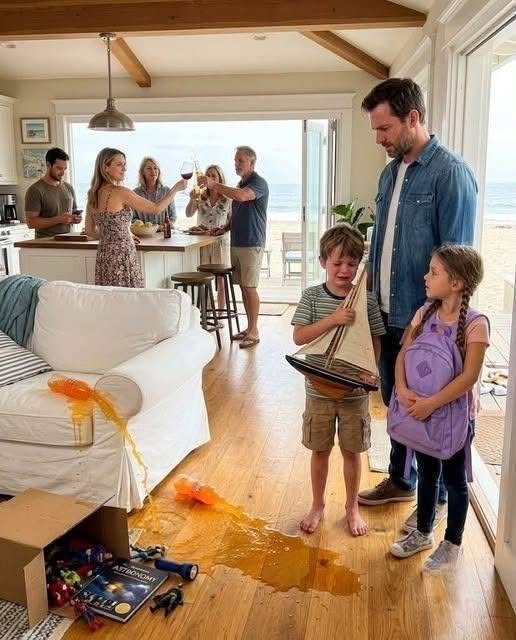
My sister watched her twin boys snap my ten-year-old son’s sailboat in half, spill orange soda across my hardwood floor, and take over the guest room in the Malibu cottage I had paid nine hundred forty thousand dollars to buy.
Then she lifted her wineglass and laughed.
“Your kids can’t stay at our beach house this summer.”
She smiled at my mother.
“This summer is for real family.”
My parents raised their glasses with her.
The sharp crack of Eli’s wooden mast still seemed to hang in the air.
Orange soda hissed beneath the white sofa, sliding between the seams of floorboards I had paid to refinish less than a year earlier.
Outside, warm Pacific air pushed through the open sliding doors.
The ocean glittered beyond the bluff.
It should have been one of the happiest afternoons of my children’s summer.
Instead, my son stood barefoot beside the patio holding a broken sailboat against his chest while everyone else drank to his exclusion.
His name was Eli.
Ten years old.
Quiet.
Patient.
The kind of child who could spend four hours sanding a piece of wood because one corner still “didn’t feel right.”
He had built that sailboat with me over three weekends.
Blue hull.
White sail.
Tiny brass hook.
His initials written beneath the mast in black marker.
E.M.
He had packed it carefully between two towels because he wanted to launch it in the shallow water below the cottage.
He had also packed an astronomy book.
A flashlight.
Two superhero figures he pretended he was getting too old for.
And a spiral notebook with SUMMER AT THE BEACH HOUSE written across the front.
He had shown it to me the night before.
Inside was a list.
Learn to surf.
Sleep on the porch.
Watch a movie outside.
See the stars with Dad.
Fix breakfast for Zoe.
Catch a crab.
Build something.
My six-year-old daughter, Zoe, had brought a purple backpack so overstuffed she could barely zip it.
She had packed three swimsuits for a two-week stay.
A plastic mermaid.
Five hair clips.
A coloring book.
And a stuffed rabbit named Captain.
They had spent the entire drive talking about which bedroom they wanted.
Eli wanted the guest room because the window faced west.
Zoe said she didn’t care as long as she could hear the ocean.
Then we arrived.
And discovered that Jenna had already decided neither room belonged to them.
One of her twins kicked through the cardboard box that had carried Eli’s sailboat.
The other ran across the living room with an open can of orange soda.
I heard the crack before I understood what happened.
Eli froze.
The mast had snapped in two.
One twin looked down.
“Oops.”
No apology.
No concern.
Just a grin.
Jenna barely turned.
“Boys, watch where you’re going.”
Then the soda slipped.
It struck the hardwood.
Orange liquid sprayed beneath the sofa.
The boy laughed.
Jenna sighed.
“Daryl can hire someone.”
My father laughed too.
My mother raised her glass.
Zoe stared at the floor.
Then at me.
“Daddy?”
I went to Eli first.
He was kneeling now.
Trying to fit the broken mast back into the hull as if pressure alone could undo what happened.
I crouched beside him.
“Hey.”
He looked at me.
His eyes were wet but he refused to cry.
“Can it be fixed?”
I picked up one half of the mast.
“Yes.”
He studied my face.
“You promise?”
“Yes.”
I wasn’t only talking about the boat.
I had bought the Malibu cottage after my divorce.
Six years of extra surgical shifts.
Missed vacations.
Careful investments.
Year-end bonuses that went into savings instead of new cars.
Weekend call.
Holiday coverage.
Every financial choice I made had moved toward one goal.
A place my children would never have to wonder whether they belonged.
My divorce from their mother had been civil enough.
We shared custody.
Shared school decisions.
Shared birthdays when possible.
But children know when a home is divided.
I wanted one place where there were no handoffs.
No overnight bag by the door.
No schedule taped to a refrigerator.
Just Dad.
Ocean.
Summer.
Them.
When I signed the closing papers, I stood on the deck and imagined Eli reading under the porch light while Zoe fell asleep in a hammock.
That was what I thought nine hundred forty thousand dollars had bought me.
Not prestige.
Not an investment.
Belonging.
Then Jenna called.
“My renovation is running late.”
“How late?”
“A few days.”
She asked to use the cottage for one weekend.
“Just us.”
One weekend became three early arrival days.
Three days became twelve suitcases.
Her twins took one bedroom.
She and Mark took another.
Then my parents arrived.
I asked what they were doing there.
Mom said:
“Jenna told us we were spending the summer at the family beach house.”
The phrase bothered me.
Family beach house.
Not Daryl’s.
Not the cottage.
Family.
Still, I let it go.
That was my mistake.
Then a locksmith called that morning.
“Dr. Mercer?”
“Yes.”
“I’m confirming the keypad change requested by Ms. Jenna Mercer.”
I sat in the hospital parking garage staring at the steering wheel.
“What keypad change?”
“She said she needed an owner code.”
“She isn’t an owner.”
Silence.
“Oh.”
“Cancel it.”
“I apologize.”
“Do not apologize. Just cancel it.”
I hung up.
Then made another call.
A call I had been considering for two weeks.
By the time I reached the cottage that afternoon, the realtor was already on standby.
Jenna walked toward the guest room while I gathered pieces of Eli’s boat.
She opened the closet.
Pulled out my son’s folded clothes.
“These can go in the hallway cabinet.”
She dropped his pajamas on the floor.
Zoe immediately bent to pick them up.
My mother touched her shoulder.
“Leave it, sweetheart. Your aunt is organizing.”
Jenna smiled.
“The twins need space.”
I stood.
“Eli is using that room.”
“He was.”
“No.”
She turned.
“What?”
“He is.”
She laughed.
“You’re seriously going to make my boys sleep somewhere else?”
“Your boys have another bedroom.”
“That room is smaller.”
“So?”
“They’re twins.”
“So?”
She stared.
Then looked toward my parents as though requesting adult intervention.
My mother sighed.
“Daryl, don’t create a scene.”
I almost laughed.
“Me?”
“Jenna’s family needs this place more than you do.”
I stared.
“You’re always at the hospital anyway.”
My father lifted his beer.
“Exactly.”
Then he gestured toward Eli’s shattered sailboat.
“Kids are kids. It’s stuff.”
No one helped Eli.
No one wiped up the soda.
No one told Jenna’s sons to apologize.
No one noticed Zoe’s hands tightening around the straps of her backpack.
Mark stood near the kitchen island scrolling through his phone.
He had never paid a utility bill for the cottage.
Never paid property tax.
Insurance.
Repairs.
Maintenance.
Nothing.
Yet he looked through the glass doors and said:
“We should put a hot tub out there.”
I turned.
“We?”
He did not notice the tone.
“Yeah. Patio extension too.”
Jenna smiled.
“We were thinking the same thing.”
We.
Again.
I checked my watch.
Nineteen minutes.
My mother lifted her wineglass.
“To summer.”
Jenna raised hers higher.
“To real family.”
Crystal touched crystal.
A tiny sound.
That was the moment something inside me settled.
I looked at Eli.
Then Zoe.
Then the people celebrating inside the home I had bought for my children.
I took out my phone.
Sent one message.
Proceed as scheduled.
Jenna watched me.
“Calling a cleaner?”
“No.”
I walked to the kitchen counter.
Beside her wineglass sat the spare key.
I picked it up.
Slipped it into my pocket.
Her smile changed.
“What are you doing?”
“Everyone out.”
Silence.
“What?”
“The showing starts in twenty minutes.”
Mark finally lowered his phone.
My father stopped drinking.
My mother stared.
Jenna laughed once.
Dry.
“Showing?”
“Yes.”
“What showing?”
“The house.”
“What about it?”
“I’m selling it.”
The color drained from her face.
“You can’t sell our house.”
I looked at her.
“Watch me.”
A black SUV turned into the driveway.
Jenna’s eyes moved toward the window.
A woman stepped out wearing a navy suit.
Claire.
My realtor.
Behind her came a photographer.
Then three prospective buyers.
Claire walked toward the porch carrying a thick folder.
She stepped inside.
Looked once at the orange soda.
Then the broken boat.
Then Eli.
Her expression tightened.
“Mr. Mercer.”
“Claire.”
She opened the folder.
“I have the deed, listing documents, attorney authorization, inspection file, and lock-change confirmation.”
Jenna’s wineglass trembled slightly.
Claire continued.
“Shall we begin?”
Nobody spoke.
Then Jenna laughed.
Not the confident laugh from thirty seconds earlier.
Sharper.
“You’re serious?”
“I usually am when my children are involved.”
She stared.
Claire held out the folder.
“Everything is in here.”
Jenna’s face changed.
“My attorney?”
I nodded.
“You hired a lawyer?”
“For months.”
Mark put his phone into his pocket for the first time all afternoon.
“What the hell is going on?”
Claire glanced toward the children.
“I think Mr. Mercer should explain.”
My mother stood.
“This is ridiculous.”
“Is it?”
“You can’t throw your sister out.”
“I can.”
“This is a family home.”
“No.”
I looked directly at her.
“It isn’t.”
My father set down his beer.
“Watch your tone.”
I almost smiled.
That sentence.
All my childhood.
Watch your tone.
Not:
Are you okay?
Not:
What happened?
Not:
Why is your son standing there trying not to cry?
Tone.
Always tone.
I crouched beside Eli.
“Buddy.”
He looked at me.
“Are we leaving?”
My throat tightened.
“No.”
His eyes moved toward Jenna.
“Are they?”
“Yes.”
His shoulders lowered.
Not joy.
Relief.
That hurt more than anger would have.
Zoe ran to me and wrapped both arms around my waist.
“Do we still get the porch?”
“Yes.”
“The stars?”
“Yes.”
“Can Eli fix the boat?”
I looked at him.
“We’re going to try.”
Behind me, Jenna slammed her glass onto the counter.
“You cannot sell this house because you’re angry.”
“I’m not.”
“Then why?”
“Because I finally understood what this place is supposed to be.”
She stared.
“What?”
“A place where my children feel safe.”
I pointed toward the door.
“And right now they don’t.”
Silence.
Claire cleared her throat.
“The buyers are waiting outside.”
Jenna looked at her.
“You already have buyers?”
“Three.”
“When did you list?”
“Yesterday.”
Her eyes widened.
“You listed the house yesterday?”
“No.”
I paused.
“Yesterday was when it became public.”
Mark stepped forward.
“When did you decide?”
I looked at him.
“Two weeks ago.”
His face changed.
Two weeks.
The exact day Jenna had called about needing “a few days.”
The same day she asked whether I could send her a copy of the deed so she could “help with insurance.”
I had nearly done it.
Then something about the request bothered me.
Why would my sister need the deed?
The cottage insurance was already active.
My accountant had every document needed.
I asked what she wanted it for.
She became vague.
That same morning, Claire called about another matter.
A title company had contacted her brokerage.
Someone was asking questions about my property.
Not browsing.
Not valuation.
Ownership.
Possible financing.
That was when I hired an attorney.
Quietly.
Jenna crossed her arms.
“You’ve been planning to sell while we were here?”
“No.”
I looked directly at her.
“I was planning it before you came.”
“Why?”
“Because I found something.”
Mark stopped moving.
My mother noticed.
“What did you find?”
I did not answer.
Deliberately.
Claire opened the folder.
“Before the showing begins, Dr. Mercer asked me to clarify ownership.”
Jenna’s laugh sounded nervous.
“Ownership?”
Claire removed a document.
“Public property records identify Daryl Mercer as sole legal owner of this cottage.”
My father scoffed.
“We know.”
Claire looked at him.
“Apparently not everybody does.”
Another document.
“There is no family trust interest.”
Jenna’s jaw tightened.
“No shared ownership.”
Mark glanced at her.
“No recorded tenancy.”
My mother stopped smiling.
“No family-use agreement.”
Silence.
“And no other person has authority to represent themselves as owner, manager, seller, borrower, or authorized occupant.”
Jenna stared.
“Why are you saying this?”
“Because someone has been doing exactly that.”
Mark stepped forward.
“Are you threatening us?”
“No.”
I looked around the room.
“I’m correcting a misunderstanding.”
My mother said:
“You’re humiliating your sister.”
I nodded toward Eli.
“She did that first.”
Mom finally looked at him.
Really looked.
Red eyes.
Splinters in his fingers.
Broken mast.
She looked away.
I gathered the boat pieces.
“Eli, take these upstairs.”
He hesitated.
“Which room?”
“The guest room.”
Jenna stepped forward immediately.
“No.”
I turned.
“No?”
“The twins are using that.”
“They were.”
“They still are.”
“Not anymore.”
“You can’t do that.”
I walked to the keypad.
Entered the new code.
A green light flashed.
Jenna stared.
“You changed it?”
“Yes.”
“When?”
“Yesterday.”
She grabbed her phone.
Tapped her old code.
Red light.
Again.
Red.
Her face drained.
“You disabled mine.”
“Yes.”
“Before you even told us.”
“Yes.”
“Daryl…”
The anger left her voice.
Something else replaced it.
Fear.
“What did you find?”
There it was.
Not fear of losing summer.
Not fear of moving suitcases.
Fear of information.
Suddenly the orange soda felt small.
The broken sailboat still mattered because it hurt my son.
But Jenna was afraid of something larger.
I looked at Claire.
“Second document.”
She hesitated.
“Are you sure?”
“Yes.”
She removed a photocopied email.
Jenna recognized it instantly.
Her face froze.
My father frowned.
“What is that?”
I took it.
“Email from Jenna.”
She whispered:
“Daryl.”
“To a real estate investor.”
Mark went white.
That interested me.
“His name is Daniel Voss.”
Mark looked away.
My mother saw it.
“Mark?”
Nothing.
Jenna grabbed the page.
“You went through my email?”
“No.”
“Then how did you get this?”
I remained silent.
That frightened her more.
My father moved closer.
“Jenna, what is this?”
“Nothing.”
I laughed softly.
“That’s what you said about the keypad.”
She glared.
“That’s what you said when you asked for the deed.”
Nothing.
“And what you said when you told Mom and Dad they were spending the entire summer here.”
My mother turned.
“You told us this arrangement was permanent.”
Jenna’s mouth opened.
Then closed.
I looked at Claire.
“Tell them.”
Claire took a breath.
“The email appears to discuss a proposed private transaction involving this property.”
My father frowned.
“Sale?”
Claire looked at Jenna.
“Yes.”
Silence.
My mother covered her mouth.
Mark stepped back.
Even the twins stopped moving.
My daughter Zoe stood near the staircase watching adults she trusted turn into strangers.
My father looked at Jenna.
“You were selling Daryl’s house?”
“No.”
Too fast.
Then:
“I wasn’t selling it.”
“What were you doing?”
“Negotiating.”
“For my property?”
No answer.
“For how much?”
“Daryl…”
“How much?”
Mark snapped:
“Enough.”
I turned.
His face had changed.
No bored phone scrolling.
No hot tub plans.
Anger.
“This has gone far enough.”
“No.”
I shook my head.
“It hasn’t.”
I took another document from Claire.
“This is the part you apparently haven’t told everybody.”
Mark’s face went blank.
I laid the page down.
“Not just emails.”
Jenna stared.
Then whispered:
“Where did you get that?”
“The title company.”
“No.”
“Yes.”
“That isn’t possible.”
“It was recorded as an attempted instrument.”
Mark went pale.
My father picked up the page.
Read.
Looked at Jenna.
“What did you sign?”
She began crying.
Quietly.
My mother reached for her.
“What did you sign, sweetheart?”
I answered.
“A lien.”
My father stared.
“What?”
“A lien against my cottage.”
Mark shouted:
“You don’t understand!”
“Explain it.”
He couldn’t.
Two weeks earlier, my sister had tried to use my property as collateral for a private loan.
Six hundred thousand dollars.
The lender rejected the transaction because Jenna was not the owner.
But someone had still provided enough documentation for the process to begin.
Copy of my deed.
My old signature.
Property information.
Family details.
Financial numbers.
Information nobody outside the family should have had.
I looked at Jenna.
“Where did you get my signature?”
She covered her face.
My mother whispered her name.
Behind me:
“Dad?”
Eli.
He stood at the bottom of the stairs.
“Can we go outside?”
I nodded immediately.
“Of course.”
He walked toward the sliding door.
Then stopped beside Jenna.
He did not yell.
He did not cry.
He simply looked at her.
“You broke my boat.”
Jenna wiped her cheeks.
“I didn’t mean to.”
Eli glanced at the snapped mast.
“You didn’t say sorry.”
Her mouth opened.
No sound.
He walked outside.
Zoe followed.
I watched them sit on the porch.
Then turned back.
“Now we talk about the rest.”
Jenna stared.
“What rest?”
I looked at Mark.
His eyes dropped.
“You already know.”
“No.”
“Yes.”
I pulled out my phone.
Opened an audio recording.
Placed it on the counter.
Timestamp:
Three days earlier.
Hotel parking garage.
Jenna’s voice came through.
“We can’t let Daryl find out who actually owns the money.”
Mark answered.
“He won’t.”
Jenna:
“If he finds out Dad used the cottage as collateral years ago, everything falls apart.”
My mother gasped.
My father froze.
That reaction was different from everyone else’s.
Not confusion.
Recognition.
Fear.
I stopped the recording.
Outside, Eli sat with the sailboat in his lap.
Ocean turning copper.
I looked at Dad.
“What did you do?”
He stared at the floor.
Then me.
“It wasn’t supposed to be your house.”
My stomach tightened.
“What does that mean?”
Jenna began crying harder.
Mark grabbed her arm.
“Tell him.”
She jerked away.
“No.”
“Tell him.”
“No!”
Dad sank into a chair.
Suddenly older.
Twenty years older.
“I bought that land before you were born.”
I frowned.
“What?”
“The original property.”
He swallowed.
“The cottage wasn’t yours because of the money you spent.”
I stared.
“Then whose was it?”
He looked toward the ocean.
“Your mother’s.”
For a second, I thought he meant the woman standing ten feet away.
My mother.
The woman who raised me.
Then Dad added:
“She died before you were born.”
The woman beside him screamed:
“Don’t.”
Every face turned toward her.
She had gone white.
And suddenly I understood that I had just been handed a question bigger than the cottage.
Who was my mother?
I looked at Dad.
“Who was she?”
My mother shook her head.
“Daryl, don’t.”
I turned toward her.
“You do not get to tell me not to ask.”
Then back to him.
“Who was my mother?”
He closed his eyes.
“Her name was Rebecca.”
The name meant nothing.
Then something shifted.
Not memory exactly.
An image.
Old photo album.
Woman at the beach.
Dark hair blowing across her face.
I had been told she was a cousin.
“Rebecca Mercer?”
Dad nodded.
“She owned the land.”
My mother sat down.
“She was supposed to leave it to you.”
I stared.
“Then why didn’t she?”
Dad looked at her.
That glance told me there was another lie.
“She died.”
“How?”
Silence.
“Dad.”
He answered:
“Car accident.”
Cold moved through me.
“And you?”
His head lowered.
“I was driving.”
The room tilted.
“You killed her?”
“No.”
His voice broke.
“It was an accident.”
“Then why hide her?”
No answer.
My mother answered instead.
“We were afraid.”
“Of what?”
“Losing you.”
I laughed without humor.
“No.”
I pointed at the house.
“You were afraid of losing this.”
“That’s not true.”
“Then tell me why I grew up believing I had no mother before you.”
She cried.
“Because Rebecca wasn’t your biological mother.”
I stopped breathing.
“What?”
Dad looked at me.
“She was your aunt.”
Silence.
My mother whispered:
“Your biological mother was someone else.”
“Who?”
She stared at the ocean.
“Sarah.”
That name hit differently.
Sarah.
My chest tightened.
Blue scarf.
Jasmine.
Someone humming.
A hand smoothing my hair.
Not clear memories.
Fragments.
Sensations.
I had always assumed they belonged to the woman who raised me.
She saw my face.
“You remember.”
“Something.”
“She was my sister.”
I stared at her.
The woman who raised me was Sarah’s sister.
Dad added:
“Rebecca and Sarah owned the land together.”
“So this cottage…”
“Was theirs.”
“What happened to Sarah?”
My mother closed her eyes.
“She disappeared.”
“When?”
“Shortly after you were born.”
My stomach turned.
“You told me my birth mother died.”
“We didn’t know what happened.”
“You lied.”
“Yes.”
So softly.
Almost worse.
I looked at Jenna.
“You knew?”
She nodded.
“Not everything.”
“How much?”
“Enough.”
“Enough for what?”
“Enough to know Dad had hidden money.”
I turned toward him.
“What money?”
He rubbed his face.
“Sarah’s inheritance.”
“How much?”
No answer.
“Dad.”
“Almost two million.”
Everything stopped.
Nine hundred forty thousand dollar cottage.
Six hundred thousand dollar attempted loan.
Two million dollar inheritance.
My sister didn’t want a summer vacation.
She wanted access.
Deeds.
Records.
Property.
Money.
And my father had been sitting on a secret for decades.
Claire opened the title folder again.
“There is something else.”
I looked at her.
She handed me an envelope.
My name handwritten across it.
DARYL.
The handwriting looked familiar.
Not because I knew it.
Because I had seen it in old albums.
“Where did this come from?”
“The title company received it last week.”
“From whom?”
“They wouldn’t disclose immediately. Their counsel forwarded it after matching it to the historical file.”
I opened the envelope.
A letter.
Twenty eight years old.
The first line:
If you’re reading this, then Daryl is old enough to know the truth.
My vision blurred.
I continued.
Sarah wrote that she was afraid.
That money had disappeared from a family trust.
That she suspected my father.
That she intended to leave.
Take me.
Protect my share.
Then:
I left something for my son at the cottage.
I looked up.
“Something?”
Claire nodded.
“The letter references a sealed compartment beneath original floorboards.”
Dad stood so fast the chair scraped backward.
“No.”
We all looked at him.
His hands shook.
“There is nothing there.”
I stared.
“You said you never saw this letter.”
Silence.
I walked toward the living room.
The white sofa remained where the orange soda had spilled.
I pulled it aside.
Sticky liquid shone across the floor.
One board looked darker.
Not dramatically.
Enough.
I crouched.
Small brass screw.
Then another.
My father whispered:
“Daryl.”
I ignored him.
Found a screwdriver.
Removed the screws.
Lifted the board.
Beneath it:
A narrow compartment.
Inside:
Metal box.
Dust.
Old tape around the edges.
A key taped beneath the lid.
My hands shook as I opened it.
Bank statements.
Photographs.
Another deed.
Documents.
And a cassette.
On top:
For my son.
I stared.
Then searched the cottage.
There was an old cassette player in a cabinet.
Dad had insisted we keep it because “old machines still work.”
For once, I was grateful.
I inserted the tape.
Pressed play.
Static.
Then a woman’s voice.
Soft.
Frightened.
“My baby…”
My knees weakened.
My mother began sobbing.
Dad turned away.
“If you’re hearing this…”
The voice trembled.
“I need you to know something.”
I closed my eyes.
“I didn’t abandon you.”
My chest cracked open.
“I wanted to take you with me.”
Pause.
Static.
Then:
“Your father knows where I am.”
I opened my eyes.
Dad was crying now.
Not quietly.
Not strategically.
Afraid.
The tape continued.
“If he tells you I died, don’t believe him.”
I stopped it.
Nobody moved.
“Where is she?”
Dad said nothing.
I stepped closer.
“Where is my mother?”
He covered his face.
The woman who raised me whispered:
“She came back.”
I turned.
“What?”
“Years later.”
Dad finally spoke.
“She was alive.”
My heart pounded.
“Where is she?”
He looked directly at me.
“Oregon.”
I stared.
Twenty eight years.
Twenty eight years believing the woman who gave birth to me had vanished or died.
Twenty eight years of birthdays.
Graduations.
Marriage.
Children.
Divorce.
All while she existed somewhere else.
“Does she know about me?”
“Yes.”
Dad’s answer came quietly.
“Does she know I’m alive?”
“Yes.”
“Does she know where I live?”
Silence.
“Dad.”
“Yes.”
I laughed once.
It sounded terrible.
“Did she try to contact me?”
He looked down.
“Yes.”
The woman who raised me started crying harder.
“Daryl…”
“How many times?”
Neither answered.
“How many?”
Dad whispered:
“Several.”
My chest tightened.
“What did you tell her?”
“That you were happy.”
“What did you tell me?”
Nothing.
Exactly.
I looked at the woman who had called herself my mother my entire life.
“You helped?”
She could not look at me.
“We were afraid of losing the family.”
“You didn’t protect a family.”
My voice shook.
“You controlled one.”
She sobbed.
I looked toward the porch.
Eli and Zoe.
My children.
The entire afternoon suddenly rearranged itself.
Jenna telling my children they were not real family.
My mother agreeing.
My father raising his beer.
The guest room.
The boat.
The house.
For years, this family had treated belonging like something they had authority to assign.
Sarah did not belong.
So they erased her.
I did not deserve the truth.
So they hid it.
My children did not fit Jenna’s summer.
So she removed them.
Same pattern.
Different scale.
I picked up my phone.
My hands shook.
I searched Sarah’s name.
One result.
Oregon.
A woman in her late fifties.
Gray beginning at her temples.
Same eyes.
Same smile.
I stared.
Something inside me recognized her before logic did.
Dad whispered:
“She didn’t know if you wanted to see her.”
I turned so sharply he stepped back.
“You made sure I never had the chance to decide.”
He nodded.
“I was afraid.”
“You were selfish.”
“Yes.”
No defense.
That almost made it worse.
I looked at the woman who raised me.
“And you?”
She whispered:
“I loved you.”
“That was not my question.”
She closed her eyes.
“I was afraid you would choose her.”
I stared.
There it was.
Not protection.
Competition.
A child turned into a possession.
“You did not lose me today because Sarah exists.”
She looked up.
“You lost me because you spent twenty eight years making sure I couldn’t choose.”
Jenna whispered:
“Daryl…”
I turned.
She flinched.
“You.”
Her eyes filled.
“I’m sorry.”
“For which part?”
“The loan.”
“The house.”
“Your kids.”
I looked toward the broken sailboat.
“You mean Eli.”
She cried.
“Yes.”
“Say his name.”
“Eli.”
“And Zoe.”
“Zoe.”
“They’re not an inconvenience attached to me.”
“I know.”
“No.”
I shook my head.
“You know now.”
She looked down.
Mark said nothing.
I turned to him.
“Your things need to be out today.”
His head snapped up.
“Today?”
“Yes.”
“Where are we supposed to go?”
“That is not my problem.”
“We have kids.”
I almost laughed.
“So do I.”
Silence.
He looked ashamed.
Good.
“You tried to borrow six hundred thousand dollars against property you did not own.”
“It wasn’t like that.”
“It was exactly like that.”
“We had a business opportunity.”
“Then use your property.”
“We didn’t have enough collateral.”
“Correct.”
“And you thought mine would solve that.”
He looked down.
Jenna whispered:
“We were going to pay it back.”
“People always say that before taking money they weren’t entitled to.”
My father flinched.
Good.
That sentence belonged to him too.
Claire stepped forward.
“Daryl.”
I looked at her.
“The showing.”
Outside, the prospective buyers still waited.
For the first time since she arrived, I remembered why.
I looked around.
White sofa.
Orange soda.
Broken mast.
Hidden box.
Sarah’s letter.
The cottage had become something different in less than an hour.
I had planned to sell because my children no longer felt safe there.
Now I knew the house carried my mother’s history.
A truth hidden beneath the floor.
I looked at Claire.
“Cancel it.”
Jenna looked up.
My mother too.
Claire did not ask why.
“Done.”
Jenna’s face changed.
Relief.
She misunderstood.
“This doesn’t mean you stay.”
Her relief vanished.
“The house is not being sold today.”
I looked at everyone.
“But everyone except my children is leaving.”
Dad whispered:
“Daryl…”
“You too.”
His eyes filled.
“I want to explain.”
“You have had twenty eight years.”
“I know.”
“Not today.”
He nodded.
My mother whispered:
“Where will we go?”
I stared at her.
“Home.”
“This is home.”
“No.”
I shook my head.
“This is a property where you happened to be invited.”
Silence.
“You taught my children that distinction today.”
She looked away.
Claire quietly went outside to speak with the buyers.
Mark started collecting luggage.
Jenna stood frozen.
Then:
“The twins.”
“What about them?”
“They don’t understand.”
“Neither did Eli.”
She closed her eyes.
“Daryl.”
“Tell them they broke something important.”
“They’re kids.”
“Yes.”
“So teach them.”
She stared.
“Teach them that ‘oops’ is not an apology.”
No answer.
“Teach them that somebody else’s belongings matter.”
Still nothing.
“And teach them that a house does not become theirs because their parents want it.”
She cried again.
I felt no satisfaction.
That surprised me.
I had imagined exposing the lien would feel triumphant.
It didn’t.
Everything had become too large.
By sunset, the cottage emptied.
Twelve suitcases.
Coolers.
Beach bags.
Wine.
The twins complained.
Mark loaded the SUV.
Jenna barely spoke.
My mother cried while folding clothes.
Dad sat on the porch steps for ten minutes before leaving.
He looked toward Eli.
Then at me.
No speeches.
No apology large enough.
Before getting into his car, he returned.
Placed a photograph beside me.
Sarah holding a baby.
Me.
On the back:
I loved you every day.
Dad walked away.
I did not call after him.
Inside, the house looked wrecked.
Soda stain.
Sand.
Open cabinets.
Half packed food.
The guest room smelled like sunscreen and wet towels.
Zoe stood in the doorway.
“Are they coming back?”
“Not tonight.”
“Ever?”
“I don’t know.”
She nodded.
Children accept uncertainty better than adults when you tell them the truth.
“Can I put my backpack here?”
“Yes.”
“Really?”
“Yes.”
She dropped it onto the bed.
Then smiled.
“Mine?”
“For this trip.”
That was enough.
Eli sat on the porch holding the broken boat.
I joined him.
For a while, neither of us spoke.
The first star appeared over the water.
Then another.
Zoe ran outside.
“Daddy!”
“I see it.”
She pointed.
“Is that Venus?”
Eli glanced up.
“No. Probably Sirius.”
“It’s too early for Sirius.”
He opened his astronomy book.
I smiled.
There they were.
Exactly where they were supposed to be.
Eli looked at me.
“Are we staying?”
“Yes.”
“Even after Aunt Jenna?”
“Especially after Aunt Jenna.”
He looked at the mast.
“Can you really fix it?”
I took it.
Examined the break.
“Epoxy. New dowel. Probably.”
“Probably?”
“Engineering answer.”
He smiled.
“Mom says surgeons think they can fix everything.”
“Your mother is occasionally right.”
Zoe climbed beside us.
“Can we sleep out here?”
“Yes.”
“Tonight?”
“Yes.”
“Both of us?”
“Yes.”
She looked suspicious.
“You too?”
I laughed.
“Yes.”
Eli looked toward the cottage.
“Are you still selling it?”
“No.”
“Why?”
I thought.
Because my mother’s voice was hidden under the floor.
Because my father had lied.
Because Jenna tried to leverage it.
Because Sarah was alive.
All too large.
So I gave him the answer he needed.
“Because I bought it for you and Zoe.”
He nodded.
“That’s what you said before.”
“I know.”
“Then Aunt Jenna said it was family.”
“She was wrong.”
“What does that mean?”
I looked toward the ocean.
“It means being family doesn’t make something yours.”
He thought about that.
Then:
“Are Grandma and Grandpa family?”
“Yes.”
“Even if they were mean?”
“Yes.”
“Do we have to let them come back?”
“No.”
He looked surprised.
“Why?”
“Because family and access are different things.”
He absorbed that slowly.
At ten, he understood more than I wanted him to.
“Can Aunt Jenna still be family if she doesn’t stay here?”
“Yes.”
“Can you be mad at family?”
“Yes.”
“Can you not talk to them?”
“Yes.”
He nodded.
“Okay.”
Zoe had stopped listening.
She was counting stars.
Good.
I wanted her childhood to remain small enough for stars.
That night, after the children fell asleep on the porch beneath blankets, I returned inside.
The metal box sat on the coffee table.
I went through it carefully.
Bank statements.
Old trusts.
Property records.
Photographs.
Rebecca.
Sarah.
My father.
The woman who raised me.
Me as a baby.
There were records showing money transferred from an account tied to Sarah’s inheritance.
Some went to business debts.
Some into investments.
Some toward property.
The cottage.
Not bought by me originally.
Rebuilt and repurchased through layers of ownership years later.
I had believed I created something new.
In truth, I had unknowingly returned to something connected to me before I could walk.
That unsettled me.
I called my attorney.
He answered on the third ring.
“You okay?”
“No.”
“What happened?”
“How much coffee do you have?”
“That bad?”
“Worse.”
I explained.
Not everything.
Enough.
Lien attempt.
Historical title.
Sarah.
Hidden box.
He went quiet.
“Do not sign anything.”
“I won’t.”
“Do not confront your father further tonight.”
“I won’t.”
“Secure the documents.”
“I already photographed everything.”
He sighed.
“Of course you did.”
“Occupational hazard.”
“You’re a surgeon.”
“Different kind of evidence.”
He laughed once.
Then serious.
“We’ll get a forensic title review.”
“Good.”
“And the two million?”
“I need to know whether any of it still exists.”
“That becomes a separate issue.”
“I know.”
“What about the listing?”
“Canceled.”
“Good.”
I looked outside.
Eli asleep with the sailboat beside him.
Zoe curled around Captain the stuffed rabbit.
“There’s something else.”
“What?”
“My biological mother is alive.”
Silence.
Then:
“I’m sorry. What?”
“Oregon.”
“Does she know you found out?”
“No.”
“Are you going to call?”
I looked at the photograph.
“Tomorrow.”
He said nothing.
“What?”
“Nothing.”
“Say it.”
“You don’t have to do everything tomorrow.”
“I know.”
“You can take a day.”
“I know.”
“You can take a week.”
“I know.”
“Then why tomorrow?”
I looked toward my children.
“Because somebody stole twenty eight years from both of us.”
That was reason enough.
I barely slept.
At sunrise, Zoe woke first.
She climbed onto my stomach.
“Daddy.”
I opened one eye.
“What?”
“The ocean is loud.”
“It was loud yesterday.”
“Different loud.”
I smiled.
“What kind?”
“Morning loud.”
Hard to argue.
Eli woke twenty minutes later.
We made pancakes.
He used too much syrup.
Zoe spilled milk.
Nobody yelled.
Nobody called it a five thousand dollar disaster.
The house breathed differently.
After breakfast, we carried the sailboat to the workbench in the garage.
I sanded the broken mast.
Eli held the flashlight even though sunlight poured through the window.
“You don’t need that.”
“I know.”
“Then why?”
“Feels professional.”
Fair.
We cut a small dowel.
Mixed epoxy.
Aligned the mast.
Clamped it.
Eli watched.
“Will you see the crack?”
“Yes.”
His face fell.
“Can’t you hide it?”
“Probably.”
“Then why not?”
I thought about the house.
The family.
Sarah.
“Sometimes a repair is stronger when you know where it broke.”
He considered that.
“So leave it?”
“Your boat.”
He looked.
“Leave it.”
Good.
Later, Zoe and I cleaned the soda stain.
It took almost an hour.
She scrubbed one spot too aggressively.
“Daddy, it’s sticky forever.”
“No.”
“Feels forever.”
“That’s different.”
By noon, the floor looked almost normal.
Almost.
Like the mast.
Some things keep evidence.
That afternoon, I opened the photograph of Sarah again.
Found the number attached to the Oregon listing.
My thumb hovered over it.
I did not call yet.
The source of the listing mattered.
A public contact associated with an environmental consulting firm.
Sarah Mercer.
Same face.
Same eyes.
She was real.
That was enough for one day.
My father called.
I did not answer.
My mother called.
No.
Jenna texted:
I’m sorry.
Then:
I know that isn’t enough.
Then:
The twins want to apologize to Eli.
I showed him nothing.
That was his choice later.
Not mine now.
Dad finally sent one message.
Sarah never stopped asking about you.
I stared at it.
Then deleted nothing.
Evidence.
Not legal.
Personal.
My entire life had been built around adults telling me only the version they believed I could handle.
I was done letting anyone curate truth for me.
At sunset, we carried blankets back to the porch.
Eli’s repaired boat rested inside while the epoxy cured.
Zoe brought her astronomy book upside down.
“Ready?”
“Ready.”
We waited.
One star.
Then another.
Then more.
The ocean went dark.
The cottage windows glowed behind us.
For years, I thought buying this house was about giving my children something permanent.
A deed.
An asset.
Security.
But permanence is not what children need most.
They need certainty of a different kind.
If something breaks, Dad helps.
If someone excludes us, Dad notices.
If adults laugh when we are hurt, Dad does not join them.
If people tell us we do not belong, Dad chooses us.
I looked at Eli.
“Boat tomorrow.”
He smiled.
“Promise?”
“Promise.”
Zoe pointed.
“There!”
“I see it.”
Eli leaned against me.
The house behind us felt quiet.
Not empty.
Not haunted.
Free.
I picked up the photograph of Sarah one last time.
Tomorrow I would call.
Tonight, I stayed with my children.
The beach house was finally ours.
Not because I had paid nine hundred forty thousand dollars for it.
Not because only my name appeared on the deed.
Not because my sister had been forced out.
Because nobody would ever again stand in that living room and make my children wonder whether they belonged there.
Somewhere beneath those old floorboards, the last secret had finally been found.
The truth cost me the family I thought I had.
But sitting beneath the stars with Eli and Zoe, I understood something better.
It gave me the chance to build one honestly.
REVIEW
My sister watched her twin boys snap my ten-year-old son’s sailboat in half, spill orange soda across my hardwood floor, and take over the guest room in the Malibu cottage I had paid nine hundred forty thousand dollars to buy.
Then she lifted her wineglass and laughed.
“Your kids can’t stay at our beach house this summer.”
She smiled at my mother.
“This summer is for real family.”
My parents raised their glasses with her.
The sharp crack of Eli’s wooden mast still seemed to hang in the air.
Orange soda hissed beneath the white sofa, sliding between the seams of floorboards I had paid to refinish less than a year earlier.
Outside, warm Pacific air pushed through the open sliding doors.
The ocean glittered beyond the bluff.
It should have been one of the happiest afternoons of my children’s summer.
Instead, my son stood barefoot beside the patio holding a broken sailboat against his chest while everyone else drank to his exclusion.
His name was Eli.
Ten years old.
Quiet.
Patient.
The kind of child who could spend four hours sanding a piece of wood because one corner still “didn’t feel right.”
He had built that sailboat with me over three weekends.
Blue hull.
White sail.
Tiny brass hook.
His initials written beneath the mast in black marker.
E.M.
He had packed it carefully between two towels because he wanted to launch it in the shallow water below the cottage.
He had also packed an astronomy book.
A flashlight.
Two superhero figures he pretended he was getting too old for.
And a spiral notebook with SUMMER AT THE BEACH HOUSE written across the front.
He had shown it to me the night before.
Inside was a list.
Learn to surf.
Sleep on the porch.
Watch a movie outside.
See the stars with Dad.
Fix breakfast for Zoe.
Catch a crab.
Build something.
My six-year-old daughter, Zoe, had brought a purple backpack so overstuffed she could barely zip it.
She had packed three swimsuits for a two-week stay.
A plastic mermaid.
Five hair clips.
A coloring book.
And a stuffed rabbit named Captain.
They had spent the entire drive talking about which bedroom they wanted.
Eli wanted the guest room because the window faced west.
Zoe said she didn’t care as long as she could hear the ocean.
Then we arrived.
And discovered that Jenna had already decided neither room belonged to them.
One of her twins kicked through the cardboard box that had carried Eli’s sailboat.
The other ran across the living room with an open can of orange soda.
I heard the crack before I understood what happened.
Eli froze.
The mast had snapped in two.
One twin looked down.
“Oops.”
No apology.
No concern.
Just a grin.
Jenna barely turned.
“Boys, watch where you’re going.”
Then the soda slipped.
It struck the hardwood.
Orange liquid sprayed beneath the sofa.
The boy laughed.
Jenna sighed.
“Daryl can hire someone.”
My father laughed too.
My mother raised her glass.
Zoe stared at the floor.
Then at me.
“Daddy?”
I went to Eli first.
He was kneeling now.
Trying to fit the broken mast back into the hull as if pressure alone could undo what happened.
I crouched beside him.
“Hey.”
He looked at me.
His eyes were wet but he refused to cry.
“Can it be fixed?”
I picked up one half of the mast.
“Yes.”
He studied my face.
“You promise?”
“Yes.”
I wasn’t only talking about the boat.
I had bought the Malibu cottage after my divorce.
Six years of extra surgical shifts.
Missed vacations.
Careful investments.
Year-end bonuses that went into savings instead of new cars.
Weekend call.
Holiday coverage.
Every financial choice I made had moved toward one goal.
A place my children would never have to wonder whether they belonged.
My divorce from their mother had been civil enough.
We shared custody.
Shared school decisions.
Shared birthdays when possible.
But children know when a home is divided.
I wanted one place where there were no handoffs.
No overnight bag by the door.
No schedule taped to a refrigerator.
Just Dad.
Ocean.
Summer.
Them.
When I signed the closing papers, I stood on the deck and imagined Eli reading under the porch light while Zoe fell asleep in a hammock.
That was what I thought nine hundred forty thousand dollars had bought me.
Not prestige.
Not an investment.
Belonging.
Then Jenna called.
“My renovation is running late.”
“How late?”
“A few days.”
She asked to use the cottage for one weekend.
“Just us.”
One weekend became three early arrival days.
Three days became twelve suitcases.
Her twins took one bedroom.
She and Mark took another.
Then my parents arrived.
I asked what they were doing there.
Mom said:
“Jenna told us we were spending the summer at the family beach house.”
The phrase bothered me.
Family beach house.
Not Daryl’s.
Not the cottage.
Family.
Still, I let it go.
That was my mistake.
Then a locksmith called that morning.
“Dr. Mercer?”
“Yes.”
“I’m confirming the keypad change requested by Ms. Jenna Mercer.”
I sat in the hospital parking garage staring at the steering wheel.
“What keypad change?”
“She said she needed an owner code.”
“She isn’t an owner.”
Silence.
“Oh.”
“Cancel it.”
“I apologize.”
“Do not apologize. Just cancel it.”
I hung up.
Then made another call.
A call I had been considering for two weeks.
By the time I reached the cottage that afternoon, the realtor was already on standby.
Jenna walked toward the guest room while I gathered pieces of Eli’s boat.
She opened the closet.
Pulled out my son’s folded clothes.
“These can go in the hallway cabinet.”
She dropped his pajamas on the floor.
Zoe immediately bent to pick them up.
My mother touched her shoulder.
“Leave it, sweetheart. Your aunt is organizing.”
Jenna smiled.
“The twins need space.”
I stood.
“Eli is using that room.”
“He was.”
“No.”
She turned.
“What?”
“He is.”
She laughed.
“You’re seriously going to make my boys sleep somewhere else?”
“Your boys have another bedroom.”
“That room is smaller.”
“So?”
“They’re twins.”
“So?”
She stared.
Then looked toward my parents as though requesting adult intervention.
My mother sighed.
“Daryl, don’t create a scene.”
I almost laughed.
“Me?”
“Jenna’s family needs this place more than you do.”
I stared.
“You’re always at the hospital anyway.”
My father lifted his beer.
“Exactly.”
Then he gestured toward Eli’s shattered sailboat.
“Kids are kids. It’s stuff.”
No one helped Eli.
No one wiped up the soda.
No one told Jenna’s sons to apologize.
No one noticed Zoe’s hands tightening around the straps of her backpack.
Mark stood near the kitchen island scrolling through his phone.
He had never paid a utility bill for the cottage.
Never paid property tax.
Insurance.
Repairs.
Maintenance.
Nothing.
Yet he looked through the glass doors and said:
“We should put a hot tub out there.”
I turned.
“We?”
He did not notice the tone.
“Yeah. Patio extension too.”
Jenna smiled.
“We were thinking the same thing.”
We.
Again.
I checked my watch.
Nineteen minutes.
My mother lifted her wineglass.
“To summer.”
Jenna raised hers higher.
“To real family.”
Crystal touched crystal.
A tiny sound.
That was the moment something inside me settled.
I looked at Eli.
Then Zoe.
Then the people celebrating inside the home I had bought for my children.
I took out my phone.
Sent one message.
Proceed as scheduled.
Jenna watched me.
“Calling a cleaner?”
“No.”
I walked to the kitchen counter.
Beside her wineglass sat the spare key.
I picked it up.
Slipped it into my pocket.
Her smile changed.
“What are you doing?”
“Everyone out.”
Silence.
“What?”
“The showing starts in twenty minutes.”
Mark finally lowered his phone.
My father stopped drinking.
My mother stared.
Jenna laughed once.
Dry.
“Showing?”
“Yes.”
“What showing?”
“The house.”
“What about it?”
“I’m selling it.”
The color drained from her face.
“You can’t sell our house.”
I looked at her.
“Watch me.”
A black SUV turned into the driveway.
Jenna’s eyes moved toward the window.
A woman stepped out wearing a navy suit.
Claire.
My realtor.
Behind her came a photographer.
Then three prospective buyers.
Claire walked toward the porch carrying a thick folder.
She stepped inside.
Looked once at the orange soda.
Then the broken boat.
Then Eli.
Her expression tightened.
“Mr. Mercer.”
“Claire.”
She opened the folder.
“I have the deed, listing documents, attorney authorization, inspection file, and lock-change confirmation.”
Jenna’s wineglass trembled slightly.
Claire continued.
“Shall we begin?”
Nobody spoke.
Then Jenna laughed.
Not the confident laugh from thirty seconds earlier.
Sharper.
“You’re serious?”
“I usually am when my children are involved.”
She stared.
Claire held out the folder.
“Everything is in here.”
Jenna’s face changed.
“My attorney?”
I nodded.
“You hired a lawyer?”
“For months.”
Mark put his phone into his pocket for the first time all afternoon.
“What the hell is going on?”
Claire glanced toward the children.
“I think Mr. Mercer should explain.”
My mother stood.
“This is ridiculous.”
“Is it?”
“You can’t throw your sister out.”
“I can.”
“This is a family home.”
“No.”
I looked directly at her.
“It isn’t.”
My father set down his beer.
“Watch your tone.”
I almost smiled.
That sentence.
All my childhood.
Watch your tone.
Not:
Are you okay?
Not:
What happened?
Not:
Why is your son standing there trying not to cry?
Tone.
Always tone.
I crouched beside Eli.
“Buddy.”
He looked at me.
“Are we leaving?”
My throat tightened.
“No.”
His eyes moved toward Jenna.
“Are they?”
“Yes.”
His shoulders lowered.
Not joy.
Relief.
That hurt more than anger would have.
Zoe ran to me and wrapped both arms around my waist.
“Do we still get the porch?”
“Yes.”
“The stars?”
“Yes.”
“Can Eli fix the boat?”
I looked at him.
“We’re going to try.”
Behind me, Jenna slammed her glass onto the counter.
“You cannot sell this house because you’re angry.”
“I’m not.”
“Then why?”
“Because I finally understood what this place is supposed to be.”
She stared.
“What?”
“A place where my children feel safe.”
I pointed toward the door.
“And right now they don’t.”
Silence.
Claire cleared her throat.
“The buyers are waiting outside.”
Jenna looked at her.
“You already have buyers?”
“Three.”
“When did you list?”
“Yesterday.”
Her eyes widened.
“You listed the house yesterday?”
“No.”
I paused.
“Yesterday was when it became public.”
Mark stepped forward.
“When did you decide?”
I looked at him.
“Two weeks ago.”
His face changed.
Two weeks.
The exact day Jenna had called about needing “a few days.”
The same day she asked whether I could send her a copy of the deed so she could “help with insurance.”
I had nearly done it.
Then something about the request bothered me.
Why would my sister need the deed?
The cottage insurance was already active.
My accountant had every document needed.
I asked what she wanted it for.
She became vague.
That same morning, Claire called about another matter.
A title company had contacted her brokerage.
Someone was asking questions about my property.
Not browsing.
Not valuation.
Ownership.
Possible financing.
That was when I hired an attorney.
Quietly.
Jenna crossed her arms.
“You’ve been planning to sell while we were here?”
“No.”
I looked directly at her.
“I was planning it before you came.”
“Why?”
“Because I found something.”
Mark stopped moving.
My mother noticed.
“What did you find?”
I did not answer.
Deliberately.
Claire opened the folder.
“Before the showing begins, Dr. Mercer asked me to clarify ownership.”
Jenna’s laugh sounded nervous.
“Ownership?”
Claire removed a document.
“Public property records identify Daryl Mercer as sole legal owner of this cottage.”
My father scoffed.
“We know.”
Claire looked at him.
“Apparently not everybody does.”
Another document.
“There is no family trust interest.”
Jenna’s jaw tightened.
“No shared ownership.”
Mark glanced at her.
“No recorded tenancy.”
My mother stopped smiling.
“No family-use agreement.”
Silence.
“And no other person has authority to represent themselves as owner, manager, seller, borrower, or authorized occupant.”
Jenna stared.
“Why are you saying this?”
“Because someone has been doing exactly that.”
Mark stepped forward.
“Are you threatening us?”
“No.”
I looked around the room.
“I’m correcting a misunderstanding.”
My mother said:
“You’re humiliating your sister.”
I nodded toward Eli.
“She did that first.”
Mom finally looked at him.
Really looked.
Red eyes.
Splinters in his fingers.
Broken mast.
She looked away.
I gathered the boat pieces.
“Eli, take these upstairs.”
He hesitated.
“Which room?”
“The guest room.”
Jenna stepped forward immediately.
“No.”
I turned.
“No?”
“The twins are using that.”
“They were.”
“They still are.”
“Not anymore.”
“You can’t do that.”
I walked to the keypad.
Entered the new code.
A green light flashed.
Jenna stared.
“You changed it?”
“Yes.”
“When?”
“Yesterday.”
She grabbed her phone.
Tapped her old code.
Red light.
Again.
Red.
Her face drained.
“You disabled mine.”
“Yes.”
“Before you even told us.”
“Yes.”
“Daryl…”
The anger left her voice.
Something else replaced it.
Fear.
“What did you find?”
There it was.
Not fear of losing summer.
Not fear of moving suitcases.
Fear of information.
Suddenly the orange soda felt small.
The broken sailboat still mattered because it hurt my son.
But Jenna was afraid of something larger.
I looked at Claire.
“Second document.”
She hesitated.
“Are you sure?”
“Yes.”
She removed a photocopied email.
Jenna recognized it instantly.
Her face froze.
My father frowned.
“What is that?”
I took it.
“Email from Jenna.”
She whispered:
“Daryl.”
“To a real estate investor.”
Mark went white.
That interested me.
“His name is Daniel Voss.”
Mark looked away.
My mother saw it.
“Mark?”
Nothing.
Jenna grabbed the page.
“You went through my email?”
“No.”
“Then how did you get this?”
I remained silent.
That frightened her more.
My father moved closer.
“Jenna, what is this?”
“Nothing.”
I laughed softly.
“That’s what you said about the keypad.”
She glared.
“That’s what you said when you asked for the deed.”
Nothing.
“And what you said when you told Mom and Dad they were spending the entire summer here.”
My mother turned.
“You told us this arrangement was permanent.”
Jenna’s mouth opened.
Then closed.
I looked at Claire.
“Tell them.”
Claire took a breath.
“The email appears to discuss a proposed private transaction involving this property.”
My father frowned.
“Sale?”
Claire looked at Jenna.
“Yes.”
Silence.
My mother covered her mouth.
Mark stepped back.
Even the twins stopped moving.
My daughter Zoe stood near the staircase watching adults she trusted turn into strangers.
My father looked at Jenna.
“You were selling Daryl’s house?”
“No.”
Too fast.
Then:
“I wasn’t selling it.”
“What were you doing?”
“Negotiating.”
“For my property?”
No answer.
“For how much?”
“Daryl…”
“How much?”
Mark snapped:
“Enough.”
I turned.
His face had changed.
No bored phone scrolling.
No hot tub plans.
Anger.
“This has gone far enough.”
“No.”
I shook my head.
“It hasn’t.”
I took another document from Claire.
“This is the part you apparently haven’t told everybody.”
Mark’s face went blank.
I laid the page down.
“Not just emails.”
Jenna stared.
Then whispered:
“Where did you get that?”
“The title company.”
“No.”
“Yes.”
“That isn’t possible.”
“It was recorded as an attempted instrument.”
Mark went pale.
My father picked up the page.
Read.
Looked at Jenna.
“What did you sign?”
She began crying.
Quietly.
My mother reached for her.
“What did you sign, sweetheart?”
I answered.
“A lien.”
My father stared.
“What?”
“A lien against my cottage.”
Mark shouted:
“You don’t understand!”
“Explain it.”
He couldn’t.
Two weeks earlier, my sister had tried to use my property as collateral for a private loan.
Six hundred thousand dollars.
The lender rejected the transaction because Jenna was not the owner.
But someone had still provided enough documentation for the process to begin.
Copy of my deed.
My old signature.
Property information.
Family details.
Financial numbers.
Information nobody outside the family should have had.
I looked at Jenna.
“Where did you get my signature?”
She covered her face.
My mother whispered her name.
Behind me:
“Dad?”
Eli.
He stood at the bottom of the stairs.
“Can we go outside?”
I nodded immediately.
“Of course.”
He walked toward the sliding door.
Then stopped beside Jenna.
He did not yell.
He did not cry.
He simply looked at her.
“You broke my boat.”
Jenna wiped her cheeks.
“I didn’t mean to.”
Eli glanced at the snapped mast.
“You didn’t say sorry.”
Her mouth opened.
No sound.
He walked outside.
Zoe followed.
I watched them sit on the porch.
Then turned back.
“Now we talk about the rest.”
Jenna stared.
“What rest?”
I looked at Mark.
His eyes dropped.
“You already know.”
“No.”
“Yes.”
I pulled out my phone.
Opened an audio recording.
Placed it on the counter.
Timestamp:
Three days earlier.
Hotel parking garage.
Jenna’s voice came through.
“We can’t let Daryl find out who actually owns the money.”
Mark answered.
“He won’t.”
Jenna:
“If he finds out Dad used the cottage as collateral years ago, everything falls apart.”
My mother gasped.
My father froze.
That reaction was different from everyone else’s.
Not confusion.
Recognition.
Fear.
I stopped the recording.
Outside, Eli sat with the sailboat in his lap.
Ocean turning copper.
I looked at Dad.
“What did you do?”
He stared at the floor.
Then me.
“It wasn’t supposed to be your house.”
My stomach tightened.
“What does that mean?”
Jenna began crying harder.
Mark grabbed her arm.
“Tell him.”
She jerked away.
“No.”
“Tell him.”
“No!”
Dad sank into a chair.
Suddenly older.
Twenty years older.
“I bought that land before you were born.”
I frowned.
“What?”
“The original property.”
He swallowed.
“The cottage wasn’t yours because of the money you spent.”
I stared.
“Then whose was it?”
He looked toward the ocean.
“Your mother’s.”
For a second, I thought he meant the woman standing ten feet away.
My mother.
The woman who raised me.
Then Dad added:
“She died before you were born.”
The woman beside him screamed:
“Don’t.”
Every face turned toward her.
She had gone white.
And suddenly I understood that I had just been handed a question bigger than the cottage.
Who was my mother?
I looked at Dad.
“Who was she?”
My mother shook her head.
“Daryl, don’t.”
I turned toward her.
“You do not get to tell me not to ask.”
Then back to him.
“Who was my mother?”
He closed his eyes.
“Her name was Rebecca.”
The name meant nothing.
Then something shifted.
Not memory exactly.
An image.
Old photo album.
Woman at the beach.
Dark hair blowing across her face.
I had been told she was a cousin.
“Rebecca Mercer?”
Dad nodded.
“She owned the land.”
My mother sat down.
“She was supposed to leave it to you.”
I stared.
“Then why didn’t she?”
Dad looked at her.
That glance told me there was another lie.
“She died.”
“How?”
Silence.
“Dad.”
He answered:
“Car accident.”
Cold moved through me.
“And you?”
His head lowered.
“I was driving.”
The room tilted.
“You killed her?”
“No.”
His voice broke.
“It was an accident.”
“Then why hide her?”
No answer.
My mother answered instead.
“We were afraid.”
“Of what?”
“Losing you.”
I laughed without humor.
“No.”
I pointed at the house.
“You were afraid of losing this.”
“That’s not true.”
“Then tell me why I grew up believing I had no mother before you.”
She cried.
“Because Rebecca wasn’t your biological mother.”
I stopped breathing.
“What?”
Dad looked at me.
“She was your aunt.”
Silence.
My mother whispered:
“Your biological mother was someone else.”
“Who?”
She stared at the ocean.
“Sarah.”
That name hit differently.
Sarah.
My chest tightened.
Blue scarf.
Jasmine.
Someone humming.
A hand smoothing my hair.
Not clear memories.
Fragments.
Sensations.
I had always assumed they belonged to the woman who raised me.
She saw my face.
“You remember.”
“Something.”
“She was my sister.”
I stared at her.
The woman who raised me was Sarah’s sister.
Dad added:
“Rebecca and Sarah owned the land together.”
“So this cottage…”
“Was theirs.”
“What happened to Sarah?”
My mother closed her eyes.
“She disappeared.”
“When?”
“Shortly after you were born.”
My stomach turned.
“You told me my birth mother died.”
“We didn’t know what happened.”
“You lied.”
“Yes.”
So softly.
Almost worse.
I looked at Jenna.
“You knew?”
She nodded.
“Not everything.”
“How much?”
“Enough.”
“Enough for what?”
“Enough to know Dad had hidden money.”
I turned toward him.
“What money?”
He rubbed his face.
“Sarah’s inheritance.”
“How much?”
No answer.
“Dad.”
“Almost two million.”
Everything stopped.
Nine hundred forty thousand dollar cottage.
Six hundred thousand dollar attempted loan.
Two million dollar inheritance.
My sister didn’t want a summer vacation.
She wanted access.
Deeds.
Records.
Property.
Money.
And my father had been sitting on a secret for decades.
Claire opened the title folder again.
“There is something else.”
I looked at her.
She handed me an envelope.
My name handwritten across it.
DARYL.
The handwriting looked familiar.
Not because I knew it.
Because I had seen it in old albums.
“Where did this come from?”
“The title company received it last week.”
“From whom?”
“They wouldn’t disclose immediately. Their counsel forwarded it after matching it to the historical file.”
I opened the envelope.
A letter.
Twenty eight years old.
The first line:
If you’re reading this, then Daryl is old enough to know the truth.
My vision blurred.
I continued.
Sarah wrote that she was afraid.
That money had disappeared from a family trust.
That she suspected my father.
That she intended to leave.
Take me.
Protect my share.
Then:
I left something for my son at the cottage.
I looked up.
“Something?”
Claire nodded.
“The letter references a sealed compartment beneath original floorboards.”
Dad stood so fast the chair scraped backward.
“No.”
We all looked at him.
His hands shook.
“There is nothing there.”
I stared.
“You said you never saw this letter.”
Silence.
I walked toward the living room.
The white sofa remained where the orange soda had spilled.
I pulled it aside.
Sticky liquid shone across the floor.
One board looked darker.
Not dramatically.
Enough.
I crouched.
Small brass screw.
Then another.
My father whispered:
“Daryl.”
I ignored him.
Found a screwdriver.
Removed the screws.
Lifted the board.
Beneath it:
A narrow compartment.
Inside:
Metal box.
Dust.
Old tape around the edges.
A key taped beneath the lid.
My hands shook as I opened it.
Bank statements.
Photographs.
Another deed.
Documents.
And a cassette.
On top:
For my son.
I stared.
Then searched the cottage.
There was an old cassette player in a cabinet.
Dad had insisted we keep it because “old machines still work.”
For once, I was grateful.
I inserted the tape.
Pressed play.
Static.
Then a woman’s voice.
Soft.
Frightened.
“My baby…”
My knees weakened.
My mother began sobbing.
Dad turned away.
“If you’re hearing this…”
The voice trembled.
“I need you to know something.”
I closed my eyes.
“I didn’t abandon you.”
My chest cracked open.
“I wanted to take you with me.”
Pause.
Static.
Then:
“Your father knows where I am.”
I opened my eyes.
Dad was crying now.
Not quietly.
Not strategically.
Afraid.
The tape continued.
“If he tells you I died, don’t believe him.”
I stopped it.
Nobody moved.
“Where is she?”
Dad said nothing.
I stepped closer.
“Where is my mother?”
He covered his face.
The woman who raised me whispered:
“She came back.”
I turned.
“What?”
“Years later.”
Dad finally spoke.
“She was alive.”
My heart pounded.
“Where is she?”
He looked directly at me.
“Oregon.”
I stared.
Twenty eight years.
Twenty eight years believing the woman who gave birth to me had vanished or died.
Twenty eight years of birthdays.
Graduations.
Marriage.
Children.
Divorce.
All while she existed somewhere else.
“Does she know about me?”
“Yes.”
Dad’s answer came quietly.
“Does she know I’m alive?”
“Yes.”
“Does she know where I live?”
Silence.
“Dad.”
“Yes.”
I laughed once.
It sounded terrible.
“Did she try to contact me?”
He looked down.
“Yes.”
The woman who raised me started crying harder.
“Daryl…”
“How many times?”
Neither answered.
“How many?”
Dad whispered:
“Several.”
My chest tightened.
“What did you tell her?”
“That you were happy.”
“What did you tell me?”
Nothing.
Exactly.
I looked at the woman who had called herself my mother my entire life.
“You helped?”
She could not look at me.
“We were afraid of losing the family.”
“You didn’t protect a family.”
My voice shook.
“You controlled one.”
She sobbed.
I looked toward the porch.
Eli and Zoe.
My children.
The entire afternoon suddenly rearranged itself.
Jenna telling my children they were not real family.
My mother agreeing.
My father raising his beer.
The guest room.
The boat.
The house.
For years, this family had treated belonging like something they had authority to assign.
Sarah did not belong.
So they erased her.
I did not deserve the truth.
So they hid it.
My children did not fit Jenna’s summer.
So she removed them.
Same pattern.
Different scale.
I picked up my phone.
My hands shook.
I searched Sarah’s name.
One result.
Oregon.
A woman in her late fifties.
Gray beginning at her temples.
Same eyes.
Same smile.
I stared.
Something inside me recognized her before logic did.
Dad whispered:
“She didn’t know if you wanted to see her.”
I turned so sharply he stepped back.
“You made sure I never had the chance to decide.”
He nodded.
“I was afraid.”
“You were selfish.”
“Yes.”
No defense.
That almost made it worse.
I looked at the woman who raised me.
“And you?”
She whispered:
“I loved you.”
“That was not my question.”
She closed her eyes.
“I was afraid you would choose her.”
I stared.
There it was.
Not protection.
Competition.
A child turned into a possession.
“You did not lose me today because Sarah exists.”
She looked up.
“You lost me because you spent twenty eight years making sure I couldn’t choose.”
Jenna whispered:
“Daryl…”
I turned.
She flinched.
“You.”
Her eyes filled.
“I’m sorry.”
“For which part?”
“The loan.”
“The house.”
“Your kids.”
I looked toward the broken sailboat.
“You mean Eli.”
She cried.
“Yes.”
“Say his name.”
“Eli.”
“And Zoe.”
“Zoe.”
“They’re not an inconvenience attached to me.”
“I know.”
“No.”
I shook my head.
“You know now.”
She looked down.
Mark said nothing.
I turned to him.
“Your things need to be out today.”
His head snapped up.
“Today?”
“Yes.”
“Where are we supposed to go?”
“That is not my problem.”
“We have kids.”
I almost laughed.
“So do I.”
Silence.
He looked ashamed.
Good.
“You tried to borrow six hundred thousand dollars against property you did not own.”
“It wasn’t like that.”
“It was exactly like that.”
“We had a business opportunity.”
“Then use your property.”
“We didn’t have enough collateral.”
“Correct.”
“And you thought mine would solve that.”
He looked down.
Jenna whispered:
“We were going to pay it back.”
“People always say that before taking money they weren’t entitled to.”
My father flinched.
Good.
That sentence belonged to him too.
Claire stepped forward.
“Daryl.”
I looked at her.
“The showing.”
Outside, the prospective buyers still waited.
For the first time since she arrived, I remembered why.
I looked around.
White sofa.
Orange soda.
Broken mast.
Hidden box.
Sarah’s letter.
The cottage had become something different in less than an hour.
I had planned to sell because my children no longer felt safe there.
Now I knew the house carried my mother’s history.
A truth hidden beneath the floor.
I looked at Claire.
“Cancel it.”
Jenna looked up.
My mother too.
Claire did not ask why.
“Done.”
Jenna’s face changed.
Relief.
She misunderstood.
“This doesn’t mean you stay.”
Her relief vanished.
“The house is not being sold today.”
I looked at everyone.
“But everyone except my children is leaving.”
Dad whispered:
“Daryl…”
“You too.”
His eyes filled.
“I want to explain.”
“You have had twenty eight years.”
“I know.”
“Not today.”
He nodded.
My mother whispered:
“Where will we go?”
I stared at her.
“Home.”
“This is home.”
“No.”
I shook my head.
“This is a property where you happened to be invited.”
Silence.
“You taught my children that distinction today.”
She looked away.
Claire quietly went outside to speak with the buyers.
Mark started collecting luggage.
Jenna stood frozen.
Then:
“The twins.”
“What about them?”
“They don’t understand.”
“Neither did Eli.”
She closed her eyes.
“Daryl.”
“Tell them they broke something important.”
“They’re kids.”
“Yes.”
“So teach them.”
She stared.
“Teach them that ‘oops’ is not an apology.”
No answer.
“Teach them that somebody else’s belongings matter.”
Still nothing.
“And teach them that a house does not become theirs because their parents want it.”
She cried again.
I felt no satisfaction.
That surprised me.
I had imagined exposing the lien would feel triumphant.
It didn’t.
Everything had become too large.
By sunset, the cottage emptied.
Twelve suitcases.
Coolers.
Beach bags.
Wine.
The twins complained.
Mark loaded the SUV.
Jenna barely spoke.
My mother cried while folding clothes.
Dad sat on the porch steps for ten minutes before leaving.
He looked toward Eli.
Then at me.
No speeches.
No apology large enough.
Before getting into his car, he returned.
Placed a photograph beside me.
Sarah holding a baby.
Me.
On the back:
I loved you every day.
Dad walked away.
I did not call after him.
Inside, the house looked wrecked.
Soda stain.
Sand.
Open cabinets.
Half packed food.
The guest room smelled like sunscreen and wet towels.
Zoe stood in the doorway.
“Are they coming back?”
“Not tonight.”
“Ever?”
“I don’t know.”
She nodded.
Children accept uncertainty better than adults when you tell them the truth.
“Can I put my backpack here?”
“Yes.”
“Really?”
“Yes.”
She dropped it onto the bed.
Then smiled.
“Mine?”
“For this trip.”
That was enough.
Eli sat on the porch holding the broken boat.
I joined him.
For a while, neither of us spoke.
The first star appeared over the water.
Then another.
Zoe ran outside.
“Daddy!”
“I see it.”
She pointed.
“Is that Venus?”
Eli glanced up.
“No. Probably Sirius.”
“It’s too early for Sirius.”
He opened his astronomy book.
I smiled.
There they were.
Exactly where they were supposed to be.
Eli looked at me.
“Are we staying?”
“Yes.”
“Even after Aunt Jenna?”
“Especially after Aunt Jenna.”
He looked at the mast.
“Can you really fix it?”
I took it.
Examined the break.
“Epoxy. New dowel. Probably.”
“Probably?”
“Engineering answer.”
He smiled.
“Mom says surgeons think they can fix everything.”
“Your mother is occasionally right.”
Zoe climbed beside us.
“Can we sleep out here?”
“Yes.”
“Tonight?”
“Yes.”
“Both of us?”
“Yes.”
She looked suspicious.
“You too?”
I laughed.
“Yes.”
Eli looked toward the cottage.
“Are you still selling it?”
“No.”
“Why?”
I thought.
Because my mother’s voice was hidden under the floor.
Because my father had lied.
Because Jenna tried to leverage it.
Because Sarah was alive.
All too large.
So I gave him the answer he needed.
“Because I bought it for you and Zoe.”
He nodded.
“That’s what you said before.”
“I know.”
“Then Aunt Jenna said it was family.”
“She was wrong.”
“What does that mean?”
I looked toward the ocean.
“It means being family doesn’t make something yours.”
He thought about that.
Then:
“Are Grandma and Grandpa family?”
“Yes.”
“Even if they were mean?”
“Yes.”
“Do we have to let them come back?”
“No.”
He looked surprised.
“Why?”
“Because family and access are different things.”
He absorbed that slowly.
At ten, he understood more than I wanted him to.
“Can Aunt Jenna still be family if she doesn’t stay here?”
“Yes.”
“Can you be mad at family?”
“Yes.”
“Can you not talk to them?”
“Yes.”
He nodded.
“Okay.”
Zoe had stopped listening.
She was counting stars.
Good.
I wanted her childhood to remain small enough for stars.
That night, after the children fell asleep on the porch beneath blankets, I returned inside.
The metal box sat on the coffee table.
I went through it carefully.
Bank statements.
Old trusts.
Property records.
Photographs.
Rebecca.
Sarah.
My father.
The woman who raised me.
Me as a baby.
There were records showing money transferred from an account tied to Sarah’s inheritance.
Some went to business debts.
Some into investments.
Some toward property.
The cottage.
Not bought by me originally.
Rebuilt and repurchased through layers of ownership years later.
I had believed I created something new.
In truth, I had unknowingly returned to something connected to me before I could walk.
That unsettled me.
I called my attorney.
He answered on the third ring.
“You okay?”
“No.”
“What happened?”
“How much coffee do you have?”
“That bad?”
“Worse.”
I explained.
Not everything.
Enough.
Lien attempt.
Historical title.
Sarah.
Hidden box.
He went quiet.
“Do not sign anything.”
“I won’t.”
“Do not confront your father further tonight.”
“I won’t.”
“Secure the documents.”
“I already photographed everything.”
He sighed.
“Of course you did.”
“Occupational hazard.”
“You’re a surgeon.”
“Different kind of evidence.”
He laughed once.
Then serious.
“We’ll get a forensic title review.”
“Good.”
“And the two million?”
“I need to know whether any of it still exists.”
“That becomes a separate issue.”
“I know.”
“What about the listing?”
“Canceled.”
“Good.”
I looked outside.
Eli asleep with the sailboat beside him.
Zoe curled around Captain the stuffed rabbit.
“There’s something else.”
“What?”
“My biological mother is alive.”
Silence.
Then:
“I’m sorry. What?”
“Oregon.”
“Does she know you found out?”
“No.”
“Are you going to call?”
I looked at the photograph.
“Tomorrow.”
He said nothing.
“What?”
“Nothing.”
“Say it.”
“You don’t have to do everything tomorrow.”
“I know.”
“You can take a day.”
“I know.”
“You can take a week.”
“I know.”
“Then why tomorrow?”
I looked toward my children.
“Because somebody stole twenty eight years from both of us.”
That was reason enough.
I barely slept.
At sunrise, Zoe woke first.
She climbed onto my stomach.
“Daddy.”
I opened one eye.
“What?”
“The ocean is loud.”
“It was loud yesterday.”
“Different loud.”
I smiled.
“What kind?”
“Morning loud.”
Hard to argue.
Eli woke twenty minutes later.
We made pancakes.
He used too much syrup.
Zoe spilled milk.
Nobody yelled.
Nobody called it a five thousand dollar disaster.
The house breathed differently.
After breakfast, we carried the sailboat to the workbench in the garage.
I sanded the broken mast.
Eli held the flashlight even though sunlight poured through the window.
“You don’t need that.”
“I know.”
“Then why?”
“Feels professional.”
Fair.
We cut a small dowel.
Mixed epoxy.
Aligned the mast.
Clamped it.
Eli watched.
“Will you see the crack?”
“Yes.”
His face fell.
“Can’t you hide it?”
“Probably.”
“Then why not?”
I thought about the house.
The family.
Sarah.
“Sometimes a repair is stronger when you know where it broke.”
He considered that.
“So leave it?”
“Your boat.”
He looked.
“Leave it.”
Good.
Later, Zoe and I cleaned the soda stain.
It took almost an hour.
She scrubbed one spot too aggressively.
“Daddy, it’s sticky forever.”
“No.”
“Feels forever.”
“That’s different.”
By noon, the floor looked almost normal.
Almost.
Like the mast.
Some things keep evidence.
That afternoon, I opened the photograph of Sarah again.
Found the number attached to the Oregon listing.
My thumb hovered over it.
I did not call yet.
The source of the listing mattered.
A public contact associated with an environmental consulting firm.
Sarah Mercer.
Same face.
Same eyes.
She was real.
That was enough for one day.
My father called.
I did not answer.
My mother called.
No.
Jenna texted:
I’m sorry.
Then:
I know that isn’t enough.
Then:
The twins want to apologize to Eli.
I showed him nothing.
That was his choice later.
Not mine now.
Dad finally sent one message.
Sarah never stopped asking about you.
I stared at it.
Then deleted nothing.
Evidence.
Not legal.
Personal.
My entire life had been built around adults telling me only the version they believed I could handle.
I was done letting anyone curate truth for me.
At sunset, we carried blankets back to the porch.
Eli’s repaired boat rested inside while the epoxy cured.
Zoe brought her astronomy book upside down.
“Ready?”
“Ready.”
We waited.
One star.
Then another.
Then more.
The ocean went dark.
The cottage windows glowed behind us.
For years, I thought buying this house was about giving my children something permanent.
A deed.
An asset.
Security.
But permanence is not what children need most.
They need certainty of a different kind.
If something breaks, Dad helps.
If someone excludes us, Dad notices.
If adults laugh when we are hurt, Dad does not join them.
If people tell us we do not belong, Dad chooses us.
I looked at Eli.
“Boat tomorrow.”
He smiled.
“Promise?”
“Promise.”
Zoe pointed.
“There!”
“I see it.”
Eli leaned against me.
The house behind us felt quiet.
Not empty.
Not haunted.
Free.
I picked up the photograph of Sarah one last time.
Tomorrow I would call.
Tonight, I stayed with my children.
The beach house was finally ours.
Not because I had paid nine hundred forty thousand dollars for it.
Not because only my name appeared on the deed.
Not because my sister had been forced out.
Because nobody would ever again stand in that living room and make my children wonder whether they belonged there.
Somewhere beneath those old floorboards, the last secret had finally been found.
The truth cost me the family I thought I had.
But sitting beneath the stars with Eli and Zoe, I understood something better.
It gave me the chance to build one honestly.








