MY PARENTS SKIPPED MY HUSBAND AND CHILDREN’S FUNERAL FOR MY SISTER’S BIRTHDAY THEN SIX MONTHS LATER ONE HEADLINE EXPOSED WHY THEY REALLY STAYED AWAY
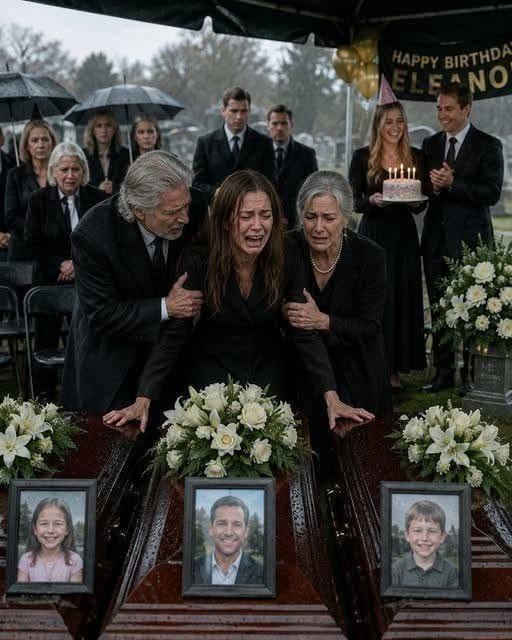
MY PARENTS SKIPPED MY HUSBAND AND CHILDREN’S FUNERAL FOR MY SISTER’S BIRTHDAY THEN SIX MONTHS LATER ONE HEADLINE EXPOSED WHY THEY REALLY STAYED AWAY
When I called my father from the hospital chapel, my hands were still streaked with ash from the accident scene.
I remember staring at the dark gray lines across my palms while the phone rang.
I remember thinking I should wash them off.
Then immediately feeling guilty.
Ash was all I had left from the car.
From Julian’s jacket.
From Maya’s pink backpack.
From Leo’s red toy fire truck.
Everything else had already been taken away.
My name is Sienna Vance.
That morning, my husband and both of our children died on Interstate 95 outside Richmond, Virginia.
Julian was thirty-nine.
Maya was seven.
Leo was four.
A truck driver fell asleep, crossed the median, and crushed their SUV before Julian had time to get out of the way.
The police officer kept saying it was instantaneous.
As if that was supposed to make it better.
As if speed mattered when all three people who made my house feel alive were gone.
I survived because I had not been in the car.
That sentence became a knife.
I was alive because I stayed behind.
Julian had offered to wait for me.
I told him no.
I had a headache.
The kids were impatient.
They were going to spend the morning visiting Julian’s parents outside Richmond, and I said I would drive separately later if I felt better.
Maya had leaned through the doorway and shouted,
“Mom, you better come!”
Leo held up his fire truck.
“Grandpa said we can make pancakes!”
Julian kissed my forehead.
“Sleep another hour.”
Those were the last words my husband ever said to me.
Sleep another hour.
I did.
When I woke, I had seventeen missed calls.
Two from Julian’s mother.
Three from numbers I did not recognize.
Then police.
By the time I reached the hospital, there was nothing for doctors to do.
They brought me into a private room.
Someone said words like catastrophic impact.
Pronounced at scene.
I’m so sorry.
Would you like a chaplain?
I kept waiting for the part where they corrected themselves.
Wrong family.
Wrong SUV.
Wrong Julian.
But nobody did.
Eventually, I ended up in the chapel because I needed somewhere quiet enough to call my parents.
My father answered on the sixth ring.
Music flooded through the phone.
Laughter.
Dishes.
Glasses.
Someone singing badly.
Then Eleanor.
My younger sister.
“Everybody come here! Candles!”
Birthday.
Of course.
She had turned thirty-two that morning.
I closed my eyes.
“Dad.”
“Sienna?”
His voice was distracted.
“Where are you?”
“Hospital.”
The background noise continued.
“What happened?”
“There was an accident.”
He became slightly more attentive.
“Are you okay?”
I stared at the chapel wall.
The crucifix above the altar was blurry.
“I wasn’t in the car.”
Pause.
“What car?”
“Julian.”
My throat closed.
“Julian was driving the kids.”
Another pause.
Then:
“What happened?”
“A truck crossed the median.”
My fingers began shaking.
“Julian is gone.”
Silence.
“Maya and Leo too.”
For several seconds, I heard only party noise.
Somebody in the background shouted,
“Eleanor, make a wish!”
Then my mother’s voice.
“Who is it?”
My father covered the phone badly.
“Sienna.”
“What does she need?”
I heard it.
What does she need?
Not:
Is she okay?
Not:
What happened?
What does she need?
My father returned.
“Sienna?”
“They died.”
He finally went quiet.
“All three?”
“Yes.”
My mother took the phone.
“What do you mean, died?”
“The accident.”
I tried again.
“They died this morning.”
My mother gasped.
A real reaction.
For one second, I thought everything was going to change.
Then she asked,
“What are you doing now?”
“I don’t know.”
That was the truth.
I did not know how to arrange three funerals.
I did not know how to call Julian’s parents.
I did not know whether Maya wanted the purple dress or the blue one.
I did not know whether a four-year-old could be buried with a toy.
I did not know how to breathe.
“The funeral will probably be Friday.”
“Friday?”
My father was back on the line.
“Yes.”
He sighed.
Not cried.
Not choked.
Sighed.
“Friday is Eleanor’s birthday dinner.”
I actually looked at the phone because I thought I had heard wrong.
“What?”
“That reservation has been booked for weeks.”
I could hear my sister laughing in the background.
Someone started singing Happy Birthday.
“Dad.”
“Yes?”
“My husband is dead.”
My voice cracked.
“My children are dead.”
“I understand.”
“No, I don’t think you do.”
“Sienna.”
“Please come.”
There.
I said it.
I begged.
I did not care about pride.
I did not care about the years of favoritism.
The missed graduations.
Eleanor’s emergencies becoming family emergencies while mine became inconveniences.
I needed my parents.
“Please.”
My father breathed out slowly.
“Today is your sister’s birthday.”
My heart stopped.
“We can’t come.”
The line stayed open for another second.
Then ended.
I stared at the screen.
CALL ENDED.
That was it.
No promise to call later.
No question about funeral arrangements.
No offer to send anything.
I sat alone in the chapel with ash on my hands while my parents went back to birthday cake.
The funeral was Friday.
Three caskets.
I had not known people could manufacture coffins that small.
Now I do.
Julian’s was dark walnut.
Maya’s was white.
Leo’s was pale blue because his grandmother remembered he liked blue better than any other color.
I stood between them.
Or tried to.
Julian’s mother, Margaret, held one side of me.
His father, Thomas, held the other.
Margaret cried so hard she struggled to breathe.
Thomas kept one hand against my shoulder.
Firm.
Steady.
Like he believed I might disappear if he let go.
Their son was dead.
Their grandchildren were dead.
And they were holding me up.
My own side of the church was almost empty.
My parents were not there.
Eleanor was not there.
None of my cousins came.
No uncles.
No family friends from childhood.
Only Aunt Ruth.
My father’s older sister.
She lived six hours away.
She heard about the accident from a neighbor because apparently nobody in my immediate family had bothered to tell her.
She drove through the night.
When she entered the church, her coat was still damp from rain.
She did not say anything.
She just walked to me.
Wrapped both arms around me.
Held on.
I cried into her shoulder.
At the graveside, the wind was brutal.
The minister spoke.
I heard almost none of it.
I stared at Maya’s photograph.
Missing front teeth.
Leo’s tiny shoes.
Julian’s wedding ring hanging from a chain around my neck.
At one point, I looked behind me.
Still hoping.
Ridiculous.
Some part of me had believed my father would change his mind.
That he would walk up the cemetery path looking ashamed.
My mother would be behind him.
Eleanor too.
No one came.
Later, I learned they had stayed for the birthday dinner.
Photos appeared online.
Eleanor in front of candles.
My mother smiling.
My father holding a glass.
A caption:
FAMILY IS EVERYTHING.
I threw my phone across the bedroom.
Three days later, my mother texted.
HOPE YOU’RE MANAGING.
Then:
ELEANOR FELT HURT THAT YOU DIDN’T CALL HER ON HER BIRTHDAY.
I read it once.
Twice.
Again.
I almost laughed.
Not because it was funny.
Because grief sometimes reaches a point where absurdity and cruelty begin to sound the same.
My husband and both children had been buried.
My sister was hurt because I had not wished her happy birthday.
Something inside me became quiet.
Not numb.
Not peaceful.
Final.
I did not respond.
For the first time in my life, I had absolutely nothing left to say to my mother.
I turned the phone facedown.
Across the room were three framed photographs.
Julian laughing with his head tilted back.
Maya missing two teeth.
Leo holding his fire truck like he had discovered the secret to happiness.
Three photographs.
Three lives.
And a family that had chosen dinner reservations over their funeral.
That night, Aunt Ruth stayed with me.
She did not say everything happens for a reason.
Thank God.
She did not tell me Julian and the children were in a better place.
She did not tell me I was strong.
I hated that word.
Strong was what people called you when they wanted your grief to become convenient.
Ruth made soup.
I did not eat it.
She sat at the kitchen table with me until midnight.
We said almost nothing.
Then she said,
“You don’t have to forgive them.”
I looked at her.
Most people had already begun warning me against anger.
Don’t make permanent decisions while grieving.
Your parents made a terrible mistake.
One day you’ll regret cutting them off.
Family is family.
Ruth said none of that.
“You don’t have to forgive them.”
I swallowed.
“I wasn’t planning to.”
She nodded.
“Good.”
It was the first honest thing anyone said to me after the funeral.
The next morning, I started making arrangements.
Not for death.
For whatever life was supposed to be now.
Julian had left an investment account.
A life-insurance policy.
Retirement funds.
The house.
Our house.
Suddenly all of it felt obscene.
The refrigerator still contained juice boxes.
Maya’s pink sneakers sat beside the back door.
Leo’s dinosaur pajamas were folded under his pillow.
Julian’s coffee mug was still in the dishwasher.
I could not move it.
I would open the dishwasher.
See the mug.
Close it.
Three weeks passed that way.
Rooms became traps.
The hallway contained Maya’s height marks.
The bathtub still had Leo’s toy boat.
Julian’s side of the closet smelled like him.
People suggested selling.
I hated them for saying it.
Then hated myself because maybe they were right.
One afternoon, I entered Julian’s office.
I had avoided it.
His desk looked exactly as he left it.
Legal pad.
Two pens.
A charging cable.
Three unopened letters.
I sat in his chair.
For several minutes, I did nothing.
Then I opened the top drawer.
Work papers.
Receipts.
Business cards.
Second drawer.
More of the same.
Then I saw a black envelope.
My name across the front.
SIENNA.
Nothing else.
My hands began shaking before I touched it.
I opened it.
One sheet of paper.
Julian’s handwriting.
If you’re reading this, something has happened that I desperately hoped never would.
I stopped.
My entire body went cold.
I read again.
There are things I never told you because I thought keeping them from you would keep you safe.
I sat down harder.
“Julian.”
I actually said his name.
As though he might answer.
The letter described a company he had been working with.
Not his employer.
A client.
Financial irregularities.
Contracts that appeared fabricated.
Money moving through accounts that did not belong to the businesses listed.
Shell companies.
Duplicate vendors.
Someone inside the organization frightened of exposure.
Julian did financial consulting and risk analysis.
He often worked unusual projects.
He rarely discussed client details.
Confidentiality.
I never pushed.
Then the line at the bottom.
If anything happens to me, don’t trust anyone who tells you it was an accident.
I read it.
Again.
Again.
My eyes moved to the date.
Two months before the crash.
I stopped breathing.
Police had ruled the collision an accident.
Truck driver fatigue.
Median crossing.
No evidence of intentional contact.
Three deaths.
No criminal charges beyond the consequences associated with the driver.
An awful tragedy.
That was the story.
Julian’s letter said not to trust anyone who called it an accident.
I called Aunt Ruth.
Immediately.
She answered.
“Sienna?”
“I found something.”
Her voice changed.
“What?”
I read the letter.
Silence.
Then:
“Does anyone know you found it?”
“No.”
“Good.”
“Why?”
“Listen carefully.”
I sat straighter.
“Don’t tell your parents.”
My stomach tightened.
“I wasn’t planning to.”
“Good.”
“Why are you saying that?”
“Because I remember something.”
“What?”
“Your father called me three days before the accident.”
I went cold.
“Dad?”
“Yes.”
“What did he want?”
“He asked about Julian.”
“What about him?”
“He wanted to know whether Julian seemed worried.”
I stared at the wall.
Ruth continued.
“I asked why.”
“What did he say?”
“He said Julian had been acting secretive.”
“Did he say anything else?”
Ruth hesitated.
That terrified me.
“Aunt Ruth.”
“Yes.”
“What?”
“He said…”
Pause.
“If Julian tells Sienna anything, she’ll destroy this family.”
The words entered me slowly.
My father.
The man who refused to attend the funeral.
The man who had sounded inconvenienced when I told him his grandchildren were dead.
Maybe his absence was not only cruelty.
Maybe it was fear.
I ended the call.
Went straight back to Julian’s desk.
Every drawer.
Every file.
Nothing.
Then I noticed the bottom drawer did not close all the way.
I removed it.
Behind it, a narrow recessed compartment.
Flash drive.
Photograph.
My breath caught.
The photograph was six months old.
Taken at my parents’ house.
Family dinner.
Dad.
Mom.
Eleanor.
Julian.
Me.
Someone had circled Eleanor in red.
Underneath, Julian wrote:
SHE KNOWS EVERYTHING.
I dropped it.
Then screamed.
For the first time since the funeral, it was not a grief scream.
It was fear.
My sister.
Eleanor.
The sister whose birthday had mattered more than three funerals.
The sister my parents always protected.
The sister who did not call.
The sister who posted photographs of cake while my family was dead.
She knew everything.
What did that mean?
I called Eleanor.
No answer.
Again.
No answer.
Text.
WE NEED TO TALK.
Nothing.
My mother called ten minutes later.
Not Eleanor.
Interesting.
I did not answer.
Then my father.
I stared at the screen.
DAD.
Let it ring.
Voicemail.
“Sienna, your mother says you’re upset. You need to stop shutting everyone out.”
I almost threw the phone again.
Instead, I saved the voicemail.
Something in Julian’s letter had changed me.
Preserve.
Do not react.
I took photographs of the envelope.
The letter.
The compartment.
The flash drive before touching it.
Julian would have been proud.
Or maybe horrified.
I did not plug it into our home computer that evening.
I barely slept.
At 4:17 the next morning, I used an old laptop disconnected from everything else.
Three folders.
FINANCIALS.
NAMES.
SIENNA.
My hands shook.
I opened SIENNA first.
A document dated days before Julian died.
Sienna, if you’re reading this, I’m sorry.
I should have told you everything.
Then:
Eleanor is involved, but she’s not the person you should be afraid of.
Dad is.
My father.
I stared.
Dad.
Not your father.
Julian had known my father for fifteen years.
He called him Dad sometimes.
Now that word looked poisoned.
I kept reading.
Julian had discovered my father’s company was moving money through shell businesses.
Fake service contracts.
Inflated invoices.
Consulting entities with no staff.
Money leaving legitimate company accounts and reappearing elsewhere.
Millions over several years.
Eleanor discovered it too.
She had threatened to expose him.
Julian tried to help her.
That explained the distance between Eleanor and me during the previous months.
I thought she had become self-absorbed.
Maybe she was terrified.
Then the final paragraph.
The truck driver wasn’t supposed to kill us.
My hand flew to my mouth.
He was supposed to scare me.
Someone tampered with the truck’s braking system, but they didn’t expect the driver to fall asleep and cross the median.
If I’m wrong, forgive me.
If I’m right, don’t come home.
Go public.
I read the words until dawn.
The crash was not designed as murder.
According to Julian’s files, someone had arranged for the truck to tail him aggressively.
Brake malfunction.
Close calls.
Fear.
A warning.
Stop investigating.
But the driver fell asleep.
The truck crossed the median.
The warning became three deaths.
Julian.
Maya.
Leo.
My children died because somebody wanted to frighten my husband.
I vomited in the office trash can.
Then sat on the floor.
For six months—
No.
Not six.
Only weeks had passed.
But grief had made time meaningless.
I had believed surviving was punishment.
That maybe I should have been in the car.
Now another thought replaced it.
What if I had been?
Would I be dead too?
Was my survival accidental?
Had whoever planned this expected me to be there?
Julian wrote:
Don’t come home.
Go public.
Home.
My parents.
My father.
I called police.
Not my parents.
Not Eleanor.
Police.
Then Julian’s attorney.
Then the investigator whose card I had received after the accident.
I gave them everything.
Original letters.
Copies.
Flash drive.
Photograph.
Financial records.
The investigator asked one question that stayed with me.
“Mrs. Vance, do you believe your father is capable of harming you?”
I opened my mouth.
No came automatically.
Then I remembered the funeral.
The birthday.
Julian’s note.
Aunt Ruth.
“If Julian tells Sienna anything, she’ll destroy this family.”
“I don’t know.”
The investigator nodded.
“That is a better answer.”
I left the house that night.
Aunt Ruth drove down.
We stayed in a hotel under another name.
Police advised discretion while they verified the material.
I hated leaving Julian’s things.
Maya’s shoes.
Leo’s pajamas.
But I went.
For once, I followed the warning.
The investigation lasted four months.
Four months during which my family became increasingly desperate to reach me.
My mother called.
Texted.
Emailed.
Your father is worried.
Eleanor is devastated.
You are grieving and making irrational choices.
Please come home.
Come home.
Exactly what Julian told me not to do.
My father’s messages were different.
Short.
Controlled.
Call me.
We need to resolve this privately.
You don’t understand what Julian was involved in.
Do not talk to strangers about family business.
That one I forwarded to police.
Eleanor sent nothing.
Not one message.
That frightened me more.
Then investigators found the shell companies.
Julian had been right.
My father’s business appeared healthy publicly.
Behind it was a network of entities shifting money.
Construction consulting.
Real estate services.
Procurement companies.
Advisory firms that existed mostly on paper.
Money moved.
Returned.
Disappeared.
My father had spent years building it.
My mother claimed ignorance.
Maybe she truly did not understand the mechanics.
But she knew enough to protect him.
That became obvious.
Then came evidence related to the truck.
Maintenance records had been altered.
A subcontractor admitted being paid to interfere with the braking system.
Not to make it fail catastrophically.
To make the truck difficult to control.
The driver was supposed to frighten Julian on a stretch of highway.
Close distance.
Make him believe an accident was possible.
Then send a warning.
Stop asking questions.
Instead, the driver—already exhausted—fell asleep.
The vehicle crossed the median.
Physics did the rest.
My children had not been targeted.
That knowledge did not comfort me.
People kept saying it should.
“At least they weren’t trying to kill the kids.”
At least.
I came to hate those words.
Maya was still dead.
Leo was still dead.
Julian was still dead.
Intent did not put them back in their beds.
Then my father’s company collapsed.
Accounts frozen.
Contracts suspended.
Partners fled.
Employees spoke.
Investigators seized records.
News began to leak.
And one morning, Eleanor walked into the police station.
Alone.
She carried a recording.
That recording broke everything open.
She had secretly captured my father speaking with the man who arranged the sabotage.
His voice.
Clear.
He wanted Julian followed.
He wanted the truck altered.
He wanted him frightened.
He said Julian needed to understand what would happen if he kept digging.
Then, after the crash, another part.
My father saying:
Nobody talks.
It was an accident.
We protect the family.
Eleanor had recorded him because she thought she might be next.
When I learned that, something inside me shifted.
Not forgiveness.
Understanding.
There is a difference.
Eleanor had known.
For months.
She knew Dad had arranged the warning.
She knew Julian was investigating him.
After the crash, she understood what had happened.
And she had been too afraid to tell me.
That was why she did not attend the funeral.
Not because her birthday mattered more to her.
Because my father had convinced her silence was survival.
The birthday dinner had become cover.
Normal life.
Photos.
Candles.
Proof that nothing was wrong.
My parents could tell everyone:
Terrible accident.
Sienna is grieving.
Eleanor had a birthday.
Life continues.
If they attended the funeral, questions might come.
Eleanor might break.
My father could not risk it.
When I finally saw my sister again, she looked nothing like the woman in those birthday photographs.
Thinner.
No makeup.
Hands shaking.
We met in a conference room with attorneys nearby.
She stood when I entered.
“Sienna.”
I sat.
She sat too.
Then started crying.
“I should have told you.”
“Yes.”
No comforting lie.
“Yes, you should have.”
“I was scared.”
“So was I.”
She covered her face.
“Dad said if I talked, he’d destroy all of us.”
“He already did.”
She cried harder.
“I didn’t know Maya and Leo would be in the car.”
I stared.
That sentence nearly made me leave.
“You knew something might happen to Julian.”
Her face collapsed.
“I knew Dad wanted to scare him.”
“And you said nothing.”
“I thought it would be a threat.”
“You said nothing.”
“Yes.”
“My husband took my children into a car you knew might be targeted.”
“I didn’t know the truck.”
“But you knew Dad was threatening him.”
“Yes.”
I stood.
“Sienna.”
“No.”
She reached out.
I stepped back.
“I cannot do this right now.”
“I understand.”
“No.”
I looked at her.
“You don’t.”
I left.
I did not hug her.
Some wounds do not close because context arrives.
Some context makes the wound larger.
Eleanor eventually cooperated fully.
Her recording helped prosecutors.
Her testimony mattered.
She admitted what she knew.
She admitted what she did not.
She did not pretend innocence.
That mattered later.
Not then.
My father was charged with fraud, conspiracy, obstruction, and offenses connected to the sabotage scheme.
Other people were charged too.
The truck driver faced his own consequences related to fatigue and the crash, though investigators eventually established that he did not know the full purpose of the altered braking system.
The man hired to arrange the sabotage cooperated.
Every layer exposed another.
My father had spent decades building a reputation for control.
He lost it in months.
Then, six months after Julian, Maya, and Leo died, the story became public.
Not small local coverage.
National.
A headline appeared across every major news site.
WIDOW EXPOSES FAMILY FRAUD NETWORK AFTER HUSBAND’S MYSTERIOUS CRASH.
My phone exploded.
Cousins who never attended the funeral.
Family friends who had not sent a card.
People who had not called once.
Sienna, are you safe?
Sienna, I had no idea.
Sienna, we’re praying for you.
Sienna, please call.
Everyone suddenly remembered I existed.
Everyone suddenly remembered they loved Julian.
Loved Maya.
Loved Leo.
My mother called seventeen times.
I counted.
Seventeen.
I answered none.
Then a prison number appeared.
My father.
I almost ignored it.
Then answered.
Not because I missed him.
Because I wanted to hear what a man like him said after there was nowhere left to hide.
Silence.
Then:
“Sienna.”
I closed my eyes.
“You missed their funeral.”
His breathing changed.
“I know.”
“You chose Eleanor’s birthday.”
“I was trying to protect her.”
“You were protecting yourself.”
Silence.
“You knew Eleanor was frightened.”
“Yes.”
“You knew Julian had discovered your fraud.”
Nothing.
“You knew you had threatened him.”
Nothing.
“You knew what happened to that truck.”
His voice broke.
“I never meant for the children—”
I hung onto the phone harder.
“Do not.”
“Sienna.”
“Do not use my children to make your guilt sound accidental.”
“I didn’t know they were going.”
“You created the danger.”
“I know.”
“You sent that truck.”
“I wanted Julian scared.”
“And now Maya is dead.”
He started crying.
“Leo is dead.”
More crying.
“Julian is dead.”
“Sienna, I’m sorry.”
It was the first time I had ever heard fear in my father’s voice.
Not annoyance.
Not disappointment.
Fear.
I looked toward the fireplace.
Three photographs.
Same three.
Julian.
Maya.
Leo.
“I don’t forgive you.”
He cried harder.
“I know.”
“And I never will.”
Silence.
Then:
“I understand.”
“No.”
I whispered.
“You understand consequences now.”
Then I ended the call.
My mother sent a letter.
Twelve pages.
I read three.
She said she did not know about the sabotage.
I believed that might be true.
She said she knew about the financial problems only vaguely.
Maybe.
She said my father told her Eleanor was in danger and that attending the funeral would make everything “worse.”
That was the part I could not accept.
Worse than burying my husband and children alone?
She made a choice.
Maybe under manipulation.
Still a choice.
I did not respond.
Months later, Aunt Ruth asked,
“Do you hate her?”
“My mother?”
“Yes.”
I thought.
“No.”
“Your father?”
I looked away.
“I don’t know.”
Ruth nodded.
“You don’t have to know.”
Another honest sentence.
Grief does not produce clean emotions.
Neither does betrayal.
My mother could be manipulated and still fail me.
Eleanor could be terrified and still abandon me.
My father could claim he never intended death and still cause three deaths.
People want one category.
Victim.
Villain.
Innocent.
Guilty.
Life is often harder.
But complexity does not erase accountability.
That became important to me.
I did not need my father to intend the deaths.
His actions were enough.
I did not need Eleanor to hate me.
Her silence still hurt.
I did not need my mother to know every detail.
She still stayed away.
A year after the funeral, I returned to the cemetery on a cold Virginia morning.
Three stones.
Julian.
Maya.
Leo.
I brought flowers.
One white rose for Julian.
One pink flower for Maya.
One yellow flower for Leo.
I placed them carefully.
Aunt Ruth waited several feet behind me.
She always knew when to give space.
I touched Julian’s name.
“I found it.”
My voice sounded strange in the cold.
“The letter.”
Wind moved through the trees.
“I did what you said.”
I laughed softly through tears.
“You could have just told me while you were alive, idiot.”
That sounded like us.
Julian kept things from me because he believed secrecy protected me.
He was wrong.
But he also left enough for me to survive the truth after he was gone.
I touched Maya’s stone.
“I miss your teeth.”
Ridiculous.
But I did.
Her smile with those two missing front teeth.
I touched Leo’s.
“I still have the truck.”
I kept it.
Red.
Scratched on one side.
I could not bring myself to put it in a box.
Aunt Ruth stepped closer.
“I think they’re proud of you.”
I smiled.
“I hope so.”
For months, I had asked the same question.
Why did I survive?
Why wasn’t I in the SUV?
Why did I stay home?
Why did my children die while I slept?
Survivor guilt is strange.
It turns random choices into moral crimes.
I had a headache.
That was all.
I stayed behind because my head hurt.
For months, my brain translated that into betrayal.
Then the investigation gave me a new version.
If I had gone, I might be dead too.
That did not make survival feel like luck.
At first it felt like debt.
I had to expose everything.
Had to make Julian’s death mean something.
Had to live perfectly enough for Maya and Leo.
Eventually therapy taught me something I hated because it was true.
Survival is not a debt.
I did not owe my dead family perfection.
I owed myself a life.
That was harder.
Justice had tasks.
Healing did not.
Justice had files.
Statements.
Charges.
Hearings.
Evidence.
Healing was waking up in a house that no longer had children’s voices.
Healing was deciding whether to keep Maya’s shoes.
Healing was realizing I could laugh once without betraying them.
Healing was eating at a restaurant and suddenly remembering Leo putting ketchup on everything.
Healing was seeing a seven-year-old girl in a grocery store and having to leave the aisle.
Healing was not a courtroom.
It was repetition.
Day after day.
Eventually, I sold the house.
Not immediately.
Two years later.
People asked how I could.
I asked myself the opposite.
How could I stay?
Every room carried someone.
But memories are not real estate.
I packed carefully.
Maya’s drawings.
Leo’s fire truck.
Julian’s letters.
His mug.
Yes.
The mug.
I finally took it out of the dishwasher.
Washed it.
Wrapped it in newspaper.
Cried so hard I sat on the kitchen floor.
Then kept packing.
I moved to a smaller home closer to Aunt Ruth.
Not because I wanted to erase Richmond.
Because I needed rooms that did not come preloaded with absence.
The first morning in the new house was terrible.
No footsteps.
No toy mess.
No history.
Then sunlight came through the kitchen.
I made coffee.
Used Julian’s mug.
That became my compromise.
I could carry pieces.
Not the whole structure.
Eleanor and I did not reconcile quickly.
That mattered.
People expected sisters to hug after the truth emerged.
She helped expose Dad.
Therefore forgiveness.
No.
Life is not a headline.
For almost two years, we spoke only when legally necessary.
Then she sent me one message.
No excuses.
No explanation.
I think about Maya and Leo every day.
I should have warned you.
You don’t owe me an answer.
I did not respond for a week.
Then:
I know.
That was it.
Months later, coffee.
Public place.
She looked nervous.
“I don’t expect you to forgive me.”
“Good.”
She almost smiled.
“I deserved that.”
“Yes.”
Then silence.
She said,
“I kept thinking Dad would fix it.”
“What?”
“The threat.”
She looked down.
“He always fixed everything.”
Our father.
The man who controlled money.
Problems.
Family narratives.
If something went wrong, Dad handled it.
Until he caused the thing that could not be handled.
“I thought Julian would get scared.”
“And stop?”
“Yes.”
“You knew Dad had people following him.”
“Yes.”
“Did you know about the truck?”
“Not specifically.”
“Do I believe you?”
“I don’t know.”
She looked at me.
“You don’t have to.”
That helped.
Truth did not demand trust.
Trust had to grow separately.
Years passed.
We rebuilt something.
Not childhood closeness.
Something more cautious.
Maybe more honest.
She visited the cemetery once with me.
Brought Maya pink tulips.
Leo a small yellow toy car.
Julian a white rose.
She stood there crying.
“I’m sorry.”
I said nothing.
No need.
The dead did not need a speech.
My mother remained harder.
She had not committed the crimes.
But sometimes the betrayal that hurts most is not criminal.
It is choosing comfort over your child’s devastation.
We had occasional contact.
Birthdays.
Health updates.
Then one day she said,
“You have punished me long enough.”
I became very calm.
“This is not punishment.”
“What is it?”
“Distance.”
“Same thing.”
“No.”
I looked at her.
“Punishment is designed to make you suffer.”
She stared.
“Distance is designed to keep me safe.”
She cried.
“What am I unsafe from?”
“Being told my grief was inconvenient.”
Silence.
She whispered,
“I made a mistake.”
“Yes.”
“I was afraid of your father.”
“So was everyone.”
“I didn’t know what to do.”
“You could have come to the funeral.”
Her eyes closed.
“Yes.”
That was the first time she simply admitted it.
No Eleanor.
No Dad.
No circumstances.
Yes.
She could have come.
After that, something softened.
Not erased.
Softened.
My father remained in prison.
Years later, he wrote.
I rarely read the letters.
One began:
I have replayed that Friday every day.
I stopped.
Because the day he should replay was the day he ordered Julian frightened.
The funeral was consequence.
The sabotage was choice.
Still, I kept the letter.
Not because I planned to forgive him.
Because he was my father.
Another complicated truth.
I could hate what he did and remember him teaching me to ride a bike.
I could remember fishing trips.
Christmas mornings.
The time he drove three hours when my college car broke down.
Human beings do not become simple when they commit unforgivable acts.
Sometimes that makes forgiveness harder.
Sometimes it makes boundaries clearer.
I never visited him.
That was my boundary.
Aunt Ruth once asked whether I might regret it after he died.
“Maybe.”
She nodded.
“Regret doesn’t automatically mean the decision was wrong.”
Another Ruth sentence.
I wrote it down.
The news headline followed me for years.
WIDOW EXPOSES FAMILY FRAUD NETWORK AFTER HUSBAND’S MYSTERIOUS CRASH.
People recognized my name occasionally.
Asked for interviews.
Documentaries.
Podcasts.
I declined most.
My children were not content.
Julian was not a mystery character.
The worst day of my life did not belong to strangers because it made a dramatic story.
Eventually, I spoke once.
Not about my father.
About financial whistleblowers and family retaliation.
I said one thing I still believe.
“When someone tells you exposing the truth will destroy the family, ask who benefits from the family staying exactly as it is.”
My father used family as camouflage.
Protect Eleanor.
Protect Mom.
Protect employees.
Protect reputation.
Protect the company.
Every version meant:
Protect me.
Julian understood too late.
Eleanor understood too late.
I understood after losing everything.
But I understood.
There is one photograph I keep hidden.
Not Julian.
Not the children.
The old family photograph from my parents’ house.
Red circle around Eleanor.
SHE KNOWS EVERYTHING.
For years, I hated looking at it.
Then one day I realized Julian had not written:
SHE DID IT.
He wrote:
SHE KNOWS EVERYTHING.
He knew the difference.
Evidence.
Responsibility.
Nuance.
Julian always thought like that.
I wish he had trusted me sooner.
I wish Eleanor had spoken sooner.
I wish my mother had walked out of that birthday dinner.
I wish my father had been a different man.
I wish the truck driver had slept eight hours.
I wish the brake system had never been touched.
I wish I had gone in the car.
I wish I had not.
Grief contains contradictory wishes.
Eventually you stop trying to solve them.
You carry them.
That is what I learned.
I carried Julian.
Maya.
Leo.
Not as punishment.
Not as an obligation to stay sad.
As part of me.
Years later, on what would have been Maya’s sixteenth birthday, I went to the cemetery.
Eleanor came.
No press.
No parents.
No lawyers.
We sat on the grass.
“She’d hate that I’m crying,” Eleanor said.
“She’d tell you your mascara looks bad.”
Eleanor laughed.
“She was mean.”
“She was seven.”
“Still mean.”
I laughed.
Then cried.
We sat.
Eventually Eleanor said,
“Do you think she would forgive me?”
I looked at Maya’s name.
“I don’t know.”
Honest.
Eleanor nodded.
“What about you?”
I looked at my sister.
“I don’t know.”
She nodded again.
No demand.
That was why we could keep trying.
A person who demands forgiveness usually wants relief.
A person willing to live without it may actually be changing.
That became another lesson.
Leo would have been thirteen that year.
Julian fifty.
I hated doing the math.
Still do.
There are ages they never reached.
Graduations.
Driving.
First dates.
Arguments.
College.
Middle age.
All missing.
Justice does not replace those futures.
No prison sentence does.
No headline.
No exposed fraud network.
Nothing.
People sometimes called the case closure.
I hated that word too.
The case closed.
My grief did not.
It changed shape.
That is different.
One winter morning, many years after the crash, I stood at the cemetery again.
Cold Virginia wind.
Three flowers.
Still.
White for Julian.
Pink for Maya.
Yellow for Leo.
Aunt Ruth was older.
Walking with a cane now.
She stood behind me.
“You still come every year.”
“Yes.”
“Good.”
I smiled.
“You’ve always been bossy.”
“Someone had to be.”
I touched Julian’s stone.
Then Maya’s.
Then Leo’s.
“I love you.”
Simple.
Enough.
When I turned to leave, I did not feel like I was abandoning them.
That took years.
At first, every departure from the cemetery felt like betrayal.
Now I understood.
Leaving the cemetery is not leaving the dead.
Living is not forgetting.
Laughing is not disrespect.
Buying a new house is not replacing home.
Having relationships again is not replacing Julian.
Loving people in the future does not reduce the love that existed before.
Grief taught me multiplication.
Not subtraction.
I walked toward the path.
Ruth followed.
The silence behind us was not empty anymore.
Peaceful.
Not because the story had become beautiful.
It had not.
My father’s crimes remained ugly.
My family’s absence remained unforgivable to me.
Three people remained dead.
But peace does not require pretending tragedy had a purpose.
It requires no longer fighting the fact that it happened.
Julian left me the truth.
Maya and Leo left me a reason to keep living.
My father taught me how dangerous family loyalty becomes when it demands silence.
My mother taught me that fear can still be a choice.
Eleanor taught me that regret does not erase responsibility, but accountability can still matter.
Aunt Ruth taught me something simpler.
You do not have to forgive people just because they share your blood.
And I learned one final thing myself.
The day my father said,
“Today is your sister’s birthday. We can’t come,”
I believed that was the worst betrayal my family could ever commit.
I was wrong.
The birthday dinner was only the visible part.
Underneath it were years of secrets.
Money.
Fear.
Threats.
A husband trying to expose them.
A sister too terrified to speak.
A mother choosing silence.
A father so desperate to protect himself that he ordered another man frightened and set in motion the deaths of three people he claimed to love.
Six months later, one headline finally forced everyone to look.
Relatives panicked.
Phones rang.
People apologized.
Everyone suddenly cared whether I was safe.
But by then, I had stopped measuring love by who called after the truth became public.
I measured it by who came when there was nothing to gain.
Aunt Ruth came.
Julian’s parents came.
Friends came.
People who loved my children came.
My parents did not.
That mattered.
It still matters.
And if there is one thing I know now, it is this:
Sometimes the people who are supposed to stand beside you are the first ones to walk away.
Sometimes the people you never expected become the ones holding you upright.
And sometimes surviving the worst thing that ever happened to you does not mean you were chosen for some grand purpose.
It simply means you are still here.
Still breathing.
Still carrying names.
Still allowed to build a life around the empty spaces.
I looked back at the three stones one last time.
Julian.
Maya.
Leo.
“I love you.”
Then I walked away.
Not because I had moved on.
Not because I had forgotten.
Not because justice made the loss acceptable.
I walked away because, after all those years, I finally understood that carrying them with me did not require staying beside their graves.
And for the first time since that hospital chapel, I knew the difference between being left behind…
and being alive.
REVIEW
When I called my father from the hospital chapel, my hands were still streaked with ash from the accident scene.
I remember staring at the dark gray lines across my palms while the phone rang.
I remember thinking I should wash them off.
Then immediately feeling guilty.
Ash was all I had left from the car.
From Julian’s jacket.
From Maya’s pink backpack.
From Leo’s red toy fire truck.
Everything else had already been taken away.
My name is Sienna Vance.
That morning, my husband and both of our children died on Interstate 95 outside Richmond, Virginia.
Julian was thirty-nine.
Maya was seven.
Leo was four.
A truck driver fell asleep, crossed the median, and crushed their SUV before Julian had time to get out of the way.
The police officer kept saying it was instantaneous.
As if that was supposed to make it better.
As if speed mattered when all three people who made my house feel alive were gone.
I survived because I had not been in the car.
That sentence became a knife.
I was alive because I stayed behind.
Julian had offered to wait for me.
I told him no.
I had a headache.
The kids were impatient.
They were going to spend the morning visiting Julian’s parents outside Richmond, and I said I would drive separately later if I felt better.
Maya had leaned through the doorway and shouted,
“Mom, you better come!”
Leo held up his fire truck.
“Grandpa said we can make pancakes!”
Julian kissed my forehead.
“Sleep another hour.”
Those were the last words my husband ever said to me.
Sleep another hour.
I did.
When I woke, I had seventeen missed calls.
Two from Julian’s mother.
Three from numbers I did not recognize.
Then police.
By the time I reached the hospital, there was nothing for doctors to do.
They brought me into a private room.
Someone said words like catastrophic impact.
Pronounced at scene.
I’m so sorry.
Would you like a chaplain?
I kept waiting for the part where they corrected themselves.
Wrong family.
Wrong SUV.
Wrong Julian.
But nobody did.
Eventually, I ended up in the chapel because I needed somewhere quiet enough to call my parents.
My father answered on the sixth ring.
Music flooded through the phone.
Laughter.
Dishes.
Glasses.
Someone singing badly.
Then Eleanor.
My younger sister.
“Everybody come here! Candles!”
Birthday.
Of course.
She had turned thirty-two that morning.
I closed my eyes.
“Dad.”
“Sienna?”
His voice was distracted.
“Where are you?”
“Hospital.”
The background noise continued.
“What happened?”
“There was an accident.”
He became slightly more attentive.
“Are you okay?”
I stared at the chapel wall.
The crucifix above the altar was blurry.
“I wasn’t in the car.”
Pause.
“What car?”
“Julian.”
My throat closed.
“Julian was driving the kids.”
Another pause.
Then:
“What happened?”
“A truck crossed the median.”
My fingers began shaking.
“Julian is gone.”
Silence.
“Maya and Leo too.”
For several seconds, I heard only party noise.
Somebody in the background shouted,
“Eleanor, make a wish!”
Then my mother’s voice.
“Who is it?”
My father covered the phone badly.
“Sienna.”
“What does she need?”
I heard it.
What does she need?
Not:
Is she okay?
Not:
What happened?
What does she need?
My father returned.
“Sienna?”
“They died.”
He finally went quiet.
“All three?”
“Yes.”
My mother took the phone.
“What do you mean, died?”
“The accident.”
I tried again.
“They died this morning.”
My mother gasped.
A real reaction.
For one second, I thought everything was going to change.
Then she asked,
“What are you doing now?”
“I don’t know.”
That was the truth.
I did not know how to arrange three funerals.
I did not know how to call Julian’s parents.
I did not know whether Maya wanted the purple dress or the blue one.
I did not know whether a four-year-old could be buried with a toy.
I did not know how to breathe.
“The funeral will probably be Friday.”
“Friday?”
My father was back on the line.
“Yes.”
He sighed.
Not cried.
Not choked.
Sighed.
“Friday is Eleanor’s birthday dinner.”
I actually looked at the phone because I thought I had heard wrong.
“What?”
“That reservation has been booked for weeks.”
I could hear my sister laughing in the background.
Someone started singing Happy Birthday.
“Dad.”
“Yes?”
“My husband is dead.”
My voice cracked.
“My children are dead.”
“I understand.”
“No, I don’t think you do.”
“Sienna.”
“Please come.”
There.
I said it.
I begged.
I did not care about pride.
I did not care about the years of favoritism.
The missed graduations.
Eleanor’s emergencies becoming family emergencies while mine became inconveniences.
I needed my parents.
“Please.”
My father breathed out slowly.
“Today is your sister’s birthday.”
My heart stopped.
“We can’t come.”
The line stayed open for another second.
Then ended.
I stared at the screen.
CALL ENDED.
That was it.
No promise to call later.
No question about funeral arrangements.
No offer to send anything.
I sat alone in the chapel with ash on my hands while my parents went back to birthday cake.
The funeral was Friday.
Three caskets.
I had not known people could manufacture coffins that small.
Now I do.
Julian’s was dark walnut.
Maya’s was white.
Leo’s was pale blue because his grandmother remembered he liked blue better than any other color.
I stood between them.
Or tried to.
Julian’s mother, Margaret, held one side of me.
His father, Thomas, held the other.
Margaret cried so hard she struggled to breathe.
Thomas kept one hand against my shoulder.
Firm.
Steady.
Like he believed I might disappear if he let go.
Their son was dead.
Their grandchildren were dead.
And they were holding me up.
My own side of the church was almost empty.
My parents were not there.
Eleanor was not there.
None of my cousins came.
No uncles.
No family friends from childhood.
Only Aunt Ruth.
My father’s older sister.
She lived six hours away.
She heard about the accident from a neighbor because apparently nobody in my immediate family had bothered to tell her.
She drove through the night.
When she entered the church, her coat was still damp from rain.
She did not say anything.
She just walked to me.
Wrapped both arms around me.
Held on.
I cried into her shoulder.
At the graveside, the wind was brutal.
The minister spoke.
I heard almost none of it.
I stared at Maya’s photograph.
Missing front teeth.
Leo’s tiny shoes.
Julian’s wedding ring hanging from a chain around my neck.
At one point, I looked behind me.
Still hoping.
Ridiculous.
Some part of me had believed my father would change his mind.
That he would walk up the cemetery path looking ashamed.
My mother would be behind him.
Eleanor too.
No one came.
Later, I learned they had stayed for the birthday dinner.
Photos appeared online.
Eleanor in front of candles.
My mother smiling.
My father holding a glass.
A caption:
FAMILY IS EVERYTHING.
I threw my phone across the bedroom.
Three days later, my mother texted.
HOPE YOU’RE MANAGING.
Then:
ELEANOR FELT HURT THAT YOU DIDN’T CALL HER ON HER BIRTHDAY.
I read it once.
Twice.
Again.
I almost laughed.
Not because it was funny.
Because grief sometimes reaches a point where absurdity and cruelty begin to sound the same.
My husband and both children had been buried.
My sister was hurt because I had not wished her happy birthday.
Something inside me became quiet.
Not numb.
Not peaceful.
Final.
I did not respond.
For the first time in my life, I had absolutely nothing left to say to my mother.
I turned the phone facedown.
Across the room were three framed photographs.
Julian laughing with his head tilted back.
Maya missing two teeth.
Leo holding his fire truck like he had discovered the secret to happiness.
Three photographs.
Three lives.
And a family that had chosen dinner reservations over their funeral.
That night, Aunt Ruth stayed with me.
She did not say everything happens for a reason.
Thank God.
She did not tell me Julian and the children were in a better place.
She did not tell me I was strong.
I hated that word.
Strong was what people called you when they wanted your grief to become convenient.
Ruth made soup.
I did not eat it.
She sat at the kitchen table with me until midnight.
We said almost nothing.
Then she said,
“You don’t have to forgive them.”
I looked at her.
Most people had already begun warning me against anger.
Don’t make permanent decisions while grieving.
Your parents made a terrible mistake.
One day you’ll regret cutting them off.
Family is family.
Ruth said none of that.
“You don’t have to forgive them.”
I swallowed.
“I wasn’t planning to.”
She nodded.
“Good.”
It was the first honest thing anyone said to me after the funeral.
The next morning, I started making arrangements.
Not for death.
For whatever life was supposed to be now.
Julian had left an investment account.
A life-insurance policy.
Retirement funds.
The house.
Our house.
Suddenly all of it felt obscene.
The refrigerator still contained juice boxes.
Maya’s pink sneakers sat beside the back door.
Leo’s dinosaur pajamas were folded under his pillow.
Julian’s coffee mug was still in the dishwasher.
I could not move it.
I would open the dishwasher.
See the mug.
Close it.
Three weeks passed that way.
Rooms became traps.
The hallway contained Maya’s height marks.
The bathtub still had Leo’s toy boat.
Julian’s side of the closet smelled like him.
People suggested selling.
I hated them for saying it.
Then hated myself because maybe they were right.
One afternoon, I entered Julian’s office.
I had avoided it.
His desk looked exactly as he left it.
Legal pad.
Two pens.
A charging cable.
Three unopened letters.
I sat in his chair.
For several minutes, I did nothing.
Then I opened the top drawer.
Work papers.
Receipts.
Business cards.
Second drawer.
More of the same.
Then I saw a black envelope.
My name across the front.
SIENNA.
Nothing else.
My hands began shaking before I touched it.
I opened it.
One sheet of paper.
Julian’s handwriting.
If you’re reading this, something has happened that I desperately hoped never would.
I stopped.
My entire body went cold.
I read again.
There are things I never told you because I thought keeping them from you would keep you safe.
I sat down harder.
“Julian.”
I actually said his name.
As though he might answer.
The letter described a company he had been working with.
Not his employer.
A client.
Financial irregularities.
Contracts that appeared fabricated.
Money moving through accounts that did not belong to the businesses listed.
Shell companies.
Duplicate vendors.
Someone inside the organization frightened of exposure.
Julian did financial consulting and risk analysis.
He often worked unusual projects.
He rarely discussed client details.
Confidentiality.
I never pushed.
Then the line at the bottom.
If anything happens to me, don’t trust anyone who tells you it was an accident.
I read it.
Again.
Again.
My eyes moved to the date.
Two months before the crash.
I stopped breathing.
Police had ruled the collision an accident.
Truck driver fatigue.
Median crossing.
No evidence of intentional contact.
Three deaths.
No criminal charges beyond the consequences associated with the driver.
An awful tragedy.
That was the story.
Julian’s letter said not to trust anyone who called it an accident.
I called Aunt Ruth.
Immediately.
She answered.
“Sienna?”
“I found something.”
Her voice changed.
“What?”
I read the letter.
Silence.
Then:
“Does anyone know you found it?”
“No.”
“Good.”
“Why?”
“Listen carefully.”
I sat straighter.
“Don’t tell your parents.”
My stomach tightened.
“I wasn’t planning to.”
“Good.”
“Why are you saying that?”
“Because I remember something.”
“What?”
“Your father called me three days before the accident.”
I went cold.
“Dad?”
“Yes.”
“What did he want?”
“He asked about Julian.”
“What about him?”
“He wanted to know whether Julian seemed worried.”
I stared at the wall.
Ruth continued.
“I asked why.”
“What did he say?”
“He said Julian had been acting secretive.”
“Did he say anything else?”
Ruth hesitated.
That terrified me.
“Aunt Ruth.”
“Yes.”
“What?”
“He said…”
Pause.
“If Julian tells Sienna anything, she’ll destroy this family.”
The words entered me slowly.
My father.
The man who refused to attend the funeral.
The man who had sounded inconvenienced when I told him his grandchildren were dead.
Maybe his absence was not only cruelty.
Maybe it was fear.
I ended the call.
Went straight back to Julian’s desk.
Every drawer.
Every file.
Nothing.
Then I noticed the bottom drawer did not close all the way.
I removed it.
Behind it, a narrow recessed compartment.
Flash drive.
Photograph.
My breath caught.
The photograph was six months old.
Taken at my parents’ house.
Family dinner.
Dad.
Mom.
Eleanor.
Julian.
Me.
Someone had circled Eleanor in red.
Underneath, Julian wrote:
SHE KNOWS EVERYTHING.
I dropped it.
Then screamed.
For the first time since the funeral, it was not a grief scream.
It was fear.
My sister.
Eleanor.
The sister whose birthday had mattered more than three funerals.
The sister my parents always protected.
The sister who did not call.
The sister who posted photographs of cake while my family was dead.
She knew everything.
What did that mean?
I called Eleanor.
No answer.
Again.
No answer.
Text.
WE NEED TO TALK.
Nothing.
My mother called ten minutes later.
Not Eleanor.
Interesting.
I did not answer.
Then my father.
I stared at the screen.
DAD.
Let it ring.
Voicemail.
“Sienna, your mother says you’re upset. You need to stop shutting everyone out.”
I almost threw the phone again.
Instead, I saved the voicemail.
Something in Julian’s letter had changed me.
Preserve.
Do not react.
I took photographs of the envelope.
The letter.
The compartment.
The flash drive before touching it.
Julian would have been proud.
Or maybe horrified.
I did not plug it into our home computer that evening.
I barely slept.
At 4:17 the next morning, I used an old laptop disconnected from everything else.
Three folders.
FINANCIALS.
NAMES.
SIENNA.
My hands shook.
I opened SIENNA first.
A document dated days before Julian died.
Sienna, if you’re reading this, I’m sorry.
I should have told you everything.
Then:
Eleanor is involved, but she’s not the person you should be afraid of.
Dad is.
My father.
I stared.
Dad.
Not your father.
Julian had known my father for fifteen years.
He called him Dad sometimes.
Now that word looked poisoned.
I kept reading.
Julian had discovered my father’s company was moving money through shell businesses.
Fake service contracts.
Inflated invoices.
Consulting entities with no staff.
Money leaving legitimate company accounts and reappearing elsewhere.
Millions over several years.
Eleanor discovered it too.
She had threatened to expose him.
Julian tried to help her.
That explained the distance between Eleanor and me during the previous months.
I thought she had become self-absorbed.
Maybe she was terrified.
Then the final paragraph.
The truck driver wasn’t supposed to kill us.
My hand flew to my mouth.
He was supposed to scare me.
Someone tampered with the truck’s braking system, but they didn’t expect the driver to fall asleep and cross the median.
If I’m wrong, forgive me.
If I’m right, don’t come home.
Go public.
I read the words until dawn.
The crash was not designed as murder.
According to Julian’s files, someone had arranged for the truck to tail him aggressively.
Brake malfunction.
Close calls.
Fear.
A warning.
Stop investigating.
But the driver fell asleep.
The truck crossed the median.
The warning became three deaths.
Julian.
Maya.
Leo.
My children died because somebody wanted to frighten my husband.
I vomited in the office trash can.
Then sat on the floor.
For six months—
No.
Not six.
Only weeks had passed.
But grief had made time meaningless.
I had believed surviving was punishment.
That maybe I should have been in the car.
Now another thought replaced it.
What if I had been?
Would I be dead too?
Was my survival accidental?
Had whoever planned this expected me to be there?
Julian wrote:
Don’t come home.
Go public.
Home.
My parents.
My father.
I called police.
Not my parents.
Not Eleanor.
Police.
Then Julian’s attorney.
Then the investigator whose card I had received after the accident.
I gave them everything.
Original letters.
Copies.
Flash drive.
Photograph.
Financial records.
The investigator asked one question that stayed with me.
“Mrs. Vance, do you believe your father is capable of harming you?”
I opened my mouth.
No came automatically.
Then I remembered the funeral.
The birthday.
Julian’s note.
Aunt Ruth.
“If Julian tells Sienna anything, she’ll destroy this family.”
“I don’t know.”
The investigator nodded.
“That is a better answer.”
I left the house that night.
Aunt Ruth drove down.
We stayed in a hotel under another name.
Police advised discretion while they verified the material.
I hated leaving Julian’s things.
Maya’s shoes.
Leo’s pajamas.
But I went.
For once, I followed the warning.
The investigation lasted four months.
Four months during which my family became increasingly desperate to reach me.
My mother called.
Texted.
Emailed.
Your father is worried.
Eleanor is devastated.
You are grieving and making irrational choices.
Please come home.
Come home.
Exactly what Julian told me not to do.
My father’s messages were different.
Short.
Controlled.
Call me.
We need to resolve this privately.
You don’t understand what Julian was involved in.
Do not talk to strangers about family business.
That one I forwarded to police.
Eleanor sent nothing.
Not one message.
That frightened me more.
Then investigators found the shell companies.
Julian had been right.
My father’s business appeared healthy publicly.
Behind it was a network of entities shifting money.
Construction consulting.
Real estate services.
Procurement companies.
Advisory firms that existed mostly on paper.
Money moved.
Returned.
Disappeared.
My father had spent years building it.
My mother claimed ignorance.
Maybe she truly did not understand the mechanics.
But she knew enough to protect him.
That became obvious.
Then came evidence related to the truck.
Maintenance records had been altered.
A subcontractor admitted being paid to interfere with the braking system.
Not to make it fail catastrophically.
To make the truck difficult to control.
The driver was supposed to frighten Julian on a stretch of highway.
Close distance.
Make him believe an accident was possible.
Then send a warning.
Stop asking questions.
Instead, the driver—already exhausted—fell asleep.
The vehicle crossed the median.
Physics did the rest.
My children had not been targeted.
That knowledge did not comfort me.
People kept saying it should.
“At least they weren’t trying to kill the kids.”
At least.
I came to hate those words.
Maya was still dead.
Leo was still dead.
Julian was still dead.
Intent did not put them back in their beds.
Then my father’s company collapsed.
Accounts frozen.
Contracts suspended.
Partners fled.
Employees spoke.
Investigators seized records.
News began to leak.
And one morning, Eleanor walked into the police station.
Alone.
She carried a recording.
That recording broke everything open.
She had secretly captured my father speaking with the man who arranged the sabotage.
His voice.
Clear.
He wanted Julian followed.
He wanted the truck altered.
He wanted him frightened.
He said Julian needed to understand what would happen if he kept digging.
Then, after the crash, another part.
My father saying:
Nobody talks.
It was an accident.
We protect the family.
Eleanor had recorded him because she thought she might be next.
When I learned that, something inside me shifted.
Not forgiveness.
Understanding.
There is a difference.
Eleanor had known.
For months.
She knew Dad had arranged the warning.
She knew Julian was investigating him.
After the crash, she understood what had happened.
And she had been too afraid to tell me.
That was why she did not attend the funeral.
Not because her birthday mattered more to her.
Because my father had convinced her silence was survival.
The birthday dinner had become cover.
Normal life.
Photos.
Candles.
Proof that nothing was wrong.
My parents could tell everyone:
Terrible accident.
Sienna is grieving.
Eleanor had a birthday.
Life continues.
If they attended the funeral, questions might come.
Eleanor might break.
My father could not risk it.
When I finally saw my sister again, she looked nothing like the woman in those birthday photographs.
Thinner.
No makeup.
Hands shaking.
We met in a conference room with attorneys nearby.
She stood when I entered.
“Sienna.”
I sat.
She sat too.
Then started crying.
“I should have told you.”
“Yes.”
No comforting lie.
“Yes, you should have.”
“I was scared.”
“So was I.”
She covered her face.
“Dad said if I talked, he’d destroy all of us.”
“He already did.”
She cried harder.
“I didn’t know Maya and Leo would be in the car.”
I stared.
That sentence nearly made me leave.
“You knew something might happen to Julian.”
Her face collapsed.
“I knew Dad wanted to scare him.”
“And you said nothing.”
“I thought it would be a threat.”
“You said nothing.”
“Yes.”
“My husband took my children into a car you knew might be targeted.”
“I didn’t know the truck.”
“But you knew Dad was threatening him.”
“Yes.”
I stood.
“Sienna.”
“No.”
She reached out.
I stepped back.
“I cannot do this right now.”
“I understand.”
“No.”
I looked at her.
“You don’t.”
I left.
I did not hug her.
Some wounds do not close because context arrives.
Some context makes the wound larger.
Eleanor eventually cooperated fully.
Her recording helped prosecutors.
Her testimony mattered.
She admitted what she knew.
She admitted what she did not.
She did not pretend innocence.
That mattered later.
Not then.
My father was charged with fraud, conspiracy, obstruction, and offenses connected to the sabotage scheme.
Other people were charged too.
The truck driver faced his own consequences related to fatigue and the crash, though investigators eventually established that he did not know the full purpose of the altered braking system.
The man hired to arrange the sabotage cooperated.
Every layer exposed another.
My father had spent decades building a reputation for control.
He lost it in months.
Then, six months after Julian, Maya, and Leo died, the story became public.
Not small local coverage.
National.
A headline appeared across every major news site.
WIDOW EXPOSES FAMILY FRAUD NETWORK AFTER HUSBAND’S MYSTERIOUS CRASH.
My phone exploded.
Cousins who never attended the funeral.
Family friends who had not sent a card.
People who had not called once.
Sienna, are you safe?
Sienna, I had no idea.
Sienna, we’re praying for you.
Sienna, please call.
Everyone suddenly remembered I existed.
Everyone suddenly remembered they loved Julian.
Loved Maya.
Loved Leo.
My mother called seventeen times.
I counted.
Seventeen.
I answered none.
Then a prison number appeared.
My father.
I almost ignored it.
Then answered.
Not because I missed him.
Because I wanted to hear what a man like him said after there was nowhere left to hide.
Silence.
Then:
“Sienna.”
I closed my eyes.
“You missed their funeral.”
His breathing changed.
“I know.”
“You chose Eleanor’s birthday.”
“I was trying to protect her.”
“You were protecting yourself.”
Silence.
“You knew Eleanor was frightened.”
“Yes.”
“You knew Julian had discovered your fraud.”
Nothing.
“You knew you had threatened him.”
Nothing.
“You knew what happened to that truck.”
His voice broke.
“I never meant for the children—”
I hung onto the phone harder.
“Do not.”
“Sienna.”
“Do not use my children to make your guilt sound accidental.”
“I didn’t know they were going.”
“You created the danger.”
“I know.”
“You sent that truck.”
“I wanted Julian scared.”
“And now Maya is dead.”
He started crying.
“Leo is dead.”
More crying.
“Julian is dead.”
“Sienna, I’m sorry.”
It was the first time I had ever heard fear in my father’s voice.
Not annoyance.
Not disappointment.
Fear.
I looked toward the fireplace.
Three photographs.
Same three.
Julian.
Maya.
Leo.
“I don’t forgive you.”
He cried harder.
“I know.”
“And I never will.”
Silence.
Then:
“I understand.”
“No.”
I whispered.
“You understand consequences now.”
Then I ended the call.
My mother sent a letter.
Twelve pages.
I read three.
She said she did not know about the sabotage.
I believed that might be true.
She said she knew about the financial problems only vaguely.
Maybe.
She said my father told her Eleanor was in danger and that attending the funeral would make everything “worse.”
That was the part I could not accept.
Worse than burying my husband and children alone?
She made a choice.
Maybe under manipulation.
Still a choice.
I did not respond.
Months later, Aunt Ruth asked,
“Do you hate her?”
“My mother?”
“Yes.”
I thought.
“No.”
“Your father?”
I looked away.
“I don’t know.”
Ruth nodded.
“You don’t have to know.”
Another honest sentence.
Grief does not produce clean emotions.
Neither does betrayal.
My mother could be manipulated and still fail me.
Eleanor could be terrified and still abandon me.
My father could claim he never intended death and still cause three deaths.
People want one category.
Victim.
Villain.
Innocent.
Guilty.
Life is often harder.
But complexity does not erase accountability.
That became important to me.
I did not need my father to intend the deaths.
His actions were enough.
I did not need Eleanor to hate me.
Her silence still hurt.
I did not need my mother to know every detail.
She still stayed away.
A year after the funeral, I returned to the cemetery on a cold Virginia morning.
Three stones.
Julian.
Maya.
Leo.
I brought flowers.
One white rose for Julian.
One pink flower for Maya.
One yellow flower for Leo.
I placed them carefully.
Aunt Ruth waited several feet behind me.
She always knew when to give space.
I touched Julian’s name.
“I found it.”
My voice sounded strange in the cold.
“The letter.”
Wind moved through the trees.
“I did what you said.”
I laughed softly through tears.
“You could have just told me while you were alive, idiot.”
That sounded like us.
Julian kept things from me because he believed secrecy protected me.
He was wrong.
But he also left enough for me to survive the truth after he was gone.
I touched Maya’s stone.
“I miss your teeth.”
Ridiculous.
But I did.
Her smile with those two missing front teeth.
I touched Leo’s.
“I still have the truck.”
I kept it.
Red.
Scratched on one side.
I could not bring myself to put it in a box.
Aunt Ruth stepped closer.
“I think they’re proud of you.”
I smiled.
“I hope so.”
For months, I had asked the same question.
Why did I survive?
Why wasn’t I in the SUV?
Why did I stay home?
Why did my children die while I slept?
Survivor guilt is strange.
It turns random choices into moral crimes.
I had a headache.
That was all.
I stayed behind because my head hurt.
For months, my brain translated that into betrayal.
Then the investigation gave me a new version.
If I had gone, I might be dead too.
That did not make survival feel like luck.
At first it felt like debt.
I had to expose everything.
Had to make Julian’s death mean something.
Had to live perfectly enough for Maya and Leo.
Eventually therapy taught me something I hated because it was true.
Survival is not a debt.
I did not owe my dead family perfection.
I owed myself a life.
That was harder.
Justice had tasks.
Healing did not.
Justice had files.
Statements.
Charges.
Hearings.
Evidence.
Healing was waking up in a house that no longer had children’s voices.
Healing was deciding whether to keep Maya’s shoes.
Healing was realizing I could laugh once without betraying them.
Healing was eating at a restaurant and suddenly remembering Leo putting ketchup on everything.
Healing was seeing a seven-year-old girl in a grocery store and having to leave the aisle.
Healing was not a courtroom.
It was repetition.
Day after day.
Eventually, I sold the house.
Not immediately.
Two years later.
People asked how I could.
I asked myself the opposite.
How could I stay?
Every room carried someone.
But memories are not real estate.
I packed carefully.
Maya’s drawings.
Leo’s fire truck.
Julian’s letters.
His mug.
Yes.
The mug.
I finally took it out of the dishwasher.
Washed it.
Wrapped it in newspaper.
Cried so hard I sat on the kitchen floor.
Then kept packing.
I moved to a smaller home closer to Aunt Ruth.
Not because I wanted to erase Richmond.
Because I needed rooms that did not come preloaded with absence.
The first morning in the new house was terrible.
No footsteps.
No toy mess.
No history.
Then sunlight came through the kitchen.
I made coffee.
Used Julian’s mug.
That became my compromise.
I could carry pieces.
Not the whole structure.
Eleanor and I did not reconcile quickly.
That mattered.
People expected sisters to hug after the truth emerged.
She helped expose Dad.
Therefore forgiveness.
No.
Life is not a headline.
For almost two years, we spoke only when legally necessary.
Then she sent me one message.
No excuses.
No explanation.
I think about Maya and Leo every day.
I should have warned you.
You don’t owe me an answer.
I did not respond for a week.
Then:
I know.
That was it.
Months later, coffee.
Public place.
She looked nervous.
“I don’t expect you to forgive me.”
“Good.”
She almost smiled.
“I deserved that.”
“Yes.”
Then silence.
She said,
“I kept thinking Dad would fix it.”
“What?”
“The threat.”
She looked down.
“He always fixed everything.”
Our father.
The man who controlled money.
Problems.
Family narratives.
If something went wrong, Dad handled it.
Until he caused the thing that could not be handled.
“I thought Julian would get scared.”
“And stop?”
“Yes.”
“You knew Dad had people following him.”
“Yes.”
“Did you know about the truck?”
“Not specifically.”
“Do I believe you?”
“I don’t know.”
She looked at me.
“You don’t have to.”
That helped.
Truth did not demand trust.
Trust had to grow separately.
Years passed.
We rebuilt something.
Not childhood closeness.
Something more cautious.
Maybe more honest.
She visited the cemetery once with me.
Brought Maya pink tulips.
Leo a small yellow toy car.
Julian a white rose.
She stood there crying.
“I’m sorry.”
I said nothing.
No need.
The dead did not need a speech.
My mother remained harder.
She had not committed the crimes.
But sometimes the betrayal that hurts most is not criminal.
It is choosing comfort over your child’s devastation.
We had occasional contact.
Birthdays.
Health updates.
Then one day she said,
“You have punished me long enough.”
I became very calm.
“This is not punishment.”
“What is it?”
“Distance.”
“Same thing.”
“No.”
I looked at her.
“Punishment is designed to make you suffer.”
She stared.
“Distance is designed to keep me safe.”
She cried.
“What am I unsafe from?”
“Being told my grief was inconvenient.”
Silence.
She whispered,
“I made a mistake.”
“Yes.”
“I was afraid of your father.”
“So was everyone.”
“I didn’t know what to do.”
“You could have come to the funeral.”
Her eyes closed.
“Yes.”
That was the first time she simply admitted it.
No Eleanor.
No Dad.
No circumstances.
Yes.
She could have come.
After that, something softened.
Not erased.
Softened.
My father remained in prison.
Years later, he wrote.
I rarely read the letters.
One began:
I have replayed that Friday every day.
I stopped.
Because the day he should replay was the day he ordered Julian frightened.
The funeral was consequence.
The sabotage was choice.
Still, I kept the letter.
Not because I planned to forgive him.
Because he was my father.
Another complicated truth.
I could hate what he did and remember him teaching me to ride a bike.
I could remember fishing trips.
Christmas mornings.
The time he drove three hours when my college car broke down.
Human beings do not become simple when they commit unforgivable acts.
Sometimes that makes forgiveness harder.
Sometimes it makes boundaries clearer.
I never visited him.
That was my boundary.
Aunt Ruth once asked whether I might regret it after he died.
“Maybe.”
She nodded.
“Regret doesn’t automatically mean the decision was wrong.”
Another Ruth sentence.
I wrote it down.
The news headline followed me for years.
WIDOW EXPOSES FAMILY FRAUD NETWORK AFTER HUSBAND’S MYSTERIOUS CRASH.
People recognized my name occasionally.
Asked for interviews.
Documentaries.
Podcasts.
I declined most.
My children were not content.
Julian was not a mystery character.
The worst day of my life did not belong to strangers because it made a dramatic story.
Eventually, I spoke once.
Not about my father.
About financial whistleblowers and family retaliation.
I said one thing I still believe.
“When someone tells you exposing the truth will destroy the family, ask who benefits from the family staying exactly as it is.”
My father used family as camouflage.
Protect Eleanor.
Protect Mom.
Protect employees.
Protect reputation.
Protect the company.
Every version meant:
Protect me.
Julian understood too late.
Eleanor understood too late.
I understood after losing everything.
But I understood.
There is one photograph I keep hidden.
Not Julian.
Not the children.
The old family photograph from my parents’ house.
Red circle around Eleanor.
SHE KNOWS EVERYTHING.
For years, I hated looking at it.
Then one day I realized Julian had not written:
SHE DID IT.
He wrote:
SHE KNOWS EVERYTHING.
He knew the difference.
Evidence.
Responsibility.
Nuance.
Julian always thought like that.
I wish he had trusted me sooner.
I wish Eleanor had spoken sooner.
I wish my mother had walked out of that birthday dinner.
I wish my father had been a different man.
I wish the truck driver had slept eight hours.
I wish the brake system had never been touched.
I wish I had gone in the car.
I wish I had not.
Grief contains contradictory wishes.
Eventually you stop trying to solve them.
You carry them.
That is what I learned.
I carried Julian.
Maya.
Leo.
Not as punishment.
Not as an obligation to stay sad.
As part of me.
Years later, on what would have been Maya’s sixteenth birthday, I went to the cemetery.
Eleanor came.
No press.
No parents.
No lawyers.
We sat on the grass.
“She’d hate that I’m crying,” Eleanor said.
“She’d tell you your mascara looks bad.”
Eleanor laughed.
“She was mean.”
“She was seven.”
“Still mean.”
I laughed.
Then cried.
We sat.
Eventually Eleanor said,
“Do you think she would forgive me?”
I looked at Maya’s name.
“I don’t know.”
Honest.
Eleanor nodded.
“What about you?”
I looked at my sister.
“I don’t know.”
She nodded again.
No demand.
That was why we could keep trying.
A person who demands forgiveness usually wants relief.
A person willing to live without it may actually be changing.
That became another lesson.
Leo would have been thirteen that year.
Julian fifty.
I hated doing the math.
Still do.
There are ages they never reached.
Graduations.
Driving.
First dates.
Arguments.
College.
Middle age.
All missing.
Justice does not replace those futures.
No prison sentence does.
No headline.
No exposed fraud network.
Nothing.
People sometimes called the case closure.
I hated that word too.
The case closed.
My grief did not.
It changed shape.
That is different.
One winter morning, many years after the crash, I stood at the cemetery again.
Cold Virginia wind.
Three flowers.
Still.
White for Julian.
Pink for Maya.
Yellow for Leo.
Aunt Ruth was older.
Walking with a cane now.
She stood behind me.
“You still come every year.”
“Yes.”
“Good.”
I smiled.
“You’ve always been bossy.”
“Someone had to be.”
I touched Julian’s stone.
Then Maya’s.
Then Leo’s.
“I love you.”
Simple.
Enough.
When I turned to leave, I did not feel like I was abandoning them.
That took years.
At first, every departure from the cemetery felt like betrayal.
Now I understood.
Leaving the cemetery is not leaving the dead.
Living is not forgetting.
Laughing is not disrespect.
Buying a new house is not replacing home.
Having relationships again is not replacing Julian.
Loving people in the future does not reduce the love that existed before.
Grief taught me multiplication.
Not subtraction.
I walked toward the path.
Ruth followed.
The silence behind us was not empty anymore.
Peaceful.
Not because the story had become beautiful.
It had not.
My father’s crimes remained ugly.
My family’s absence remained unforgivable to me.
Three people remained dead.
But peace does not require pretending tragedy had a purpose.
It requires no longer fighting the fact that it happened.
Julian left me the truth.
Maya and Leo left me a reason to keep living.
My father taught me how dangerous family loyalty becomes when it demands silence.
My mother taught me that fear can still be a choice.
Eleanor taught me that regret does not erase responsibility, but accountability can still matter.
Aunt Ruth taught me something simpler.
You do not have to forgive people just because they share your blood.
And I learned one final thing myself.
The day my father said,
“Today is your sister’s birthday. We can’t come,”
I believed that was the worst betrayal my family could ever commit.
I was wrong.
The birthday dinner was only the visible part.
Underneath it were years of secrets.
Money.
Fear.
Threats.
A husband trying to expose them.
A sister too terrified to speak.
A mother choosing silence.
A father so desperate to protect himself that he ordered another man frightened and set in motion the deaths of three people he claimed to love.
Six months later, one headline finally forced everyone to look.
Relatives panicked.
Phones rang.
People apologized.
Everyone suddenly cared whether I was safe.
But by then, I had stopped measuring love by who called after the truth became public.
I measured it by who came when there was nothing to gain.
Aunt Ruth came.
Julian’s parents came.
Friends came.
People who loved my children came.
My parents did not.
That mattered.
It still matters.
And if there is one thing I know now, it is this:
Sometimes the people who are supposed to stand beside you are the first ones to walk away.
Sometimes the people you never expected become the ones holding you upright.
And sometimes surviving the worst thing that ever happened to you does not mean you were chosen for some grand purpose.
It simply means you are still here.
Still breathing.
Still carrying names.
Still allowed to build a life around the empty spaces.
I looked back at the three stones one last time.
Julian.
Maya.
Leo.
“I love you.”
Then I walked away.
Not because I had moved on.
Not because I had forgotten.
Not because justice made the loss acceptable.
I walked away because, after all those years, I finally understood that carrying them with me did not require staying beside their graves.
And for the first time since that hospital chapel, I knew the difference between being left behind…
and being alive.








