MY PARENTS ABANDONED ME AT 13 WHEN CANCER GOT TOO EXPENSIVE THEN SHOWED UP AT MY MEDICAL GRADUATION SAYING I OWED THEM THIS MOMENT UNTIL THE DEAN CALLED THE VALEDICTORIAN DR. HANNAH MORGAN
PART2
Very good.
I heard that.
Treatable.
Survival.
Chance.
Those were the words that mattered to me.
I looked at my mother.
I expected her to take my hand.
She did not.
I looked at my father.
I expected him to say we would handle it.
He leaned forward.
“How much?”
Dr. Grant paused.
“Excuse me?”
“What does all this cost?”
The doctor’s expression changed.
He began explaining insurance.
Deductibles.
Out of pocket maximums.
Assistance programs.
Hospital social workers.
Foundations.
Payment plans.
Depending on complications and coverage, a family might face tens of thousands in expenses over several years.
Possibly much more.
My father interrupted.
“Give me a number.”
“Mr. Barrett, there isn’t one number.”
“Then estimate it.”
Dr. Grant hesitated.
“Potentially sixty to one hundred thousand dollars out of pocket over the course of treatment, but again, there are assistance options.”
My father laughed.
Not because anything was funny.
A short, bitter sound.
“So we have to spend a hundred thousand dollars because she got sick?”
I stared at him.
I remember thinking I had misheard.
My mother whispered, “Richard.”
“What?”
“Not in front of her.”
“She needs to understand reality too.”
I did not want reality.
I wanted my father.
Instead, he started talking about Allison.
“Allison applies to universities next year.”
Dr. Grant looked confused.
“I’m sorry?”
“We have money saved for her.”
My mother looked toward the floor.
My father continued.
“One hundred eighty thousand dollars.”
“For Allison’s college?” Dr. Grant asked.
“Yes.”
Dr. Grant’s voice became careful.
“That money is separate from Hannah’s medical treatment.”
“Money isn’t separate when there’s only so much of it.”
“There are assistance programs.”
“You keep saying that.”
“Because there are.”
My father shook his head.
“You don’t understand.”
“No,” Dr. Grant replied. “I don’t think I do.”
My father looked at me.
And then he said the sentence I carried for fifteen years.
“Allison has potential. She is brilliant and focused. Hannah has always been average.”
The room became very still.
My mother whispered his name again.
“Richard.”
He ignored her.
“We are not sacrificing one promising future to save an average one.”
Average.
That word hurt more than leukemia in that moment.
Cancer meant my body had betrayed me.
My father’s words meant my family had evaluated whether I was worth saving and decided the answer depended on my potential return.
I whispered, “I’m your daughter too.”
My mother finally looked at me.
Her eyes were wet.
For one second, I thought she would reach for me.
She did not.
Dr. Grant stood.
His chair scraped across the floor.
“I need both of you to leave.”
My father looked at him.
“What?”
“I need to speak with Hannah privately.”
“We are her parents.”
“Leave the room.”
“You don’t have the authority to order us out.”
Dr. Grant pressed a button near the wall.
“I can call hospital security and social services immediately.”
My father stood.
“This is ridiculous.”
Dr. Grant stepped between him and me.
“No. Discussing whether your thirteen-year-old daughter is financially worth treating while she is sitting three feet away is ridiculous.”
My mother’s face turned red.
My father said, “You don’t know anything about our finances.”
“I know enough about my patient.”
“She is our daughter.”
“Then act like it.”
I had never seen an adult speak to my father that way.
Richard Barrett was successful.
Confident.
The kind of man who entered a room expecting people to make space.
Dr. Grant did not.
He opened the door.
“Leave.”
My parents walked out.
Neither hugged me.
Neither touched my shoulder.
Neither said, “We’ll be back.”
I watched the door close.
Then I asked Dr. Grant something no thirteen-year-old should have to ask.
“Are they going to let me die?”
His face changed completely.
He sat beside me.
“No.”
“You heard him.”
“I heard him.”
“He said I’m average.”
Dr. Grant looked directly at me.
“Hannah, listen to me.”
I did.
“Your medical care does not depend on whether your father understands your value.”
I started crying.
“What if they won’t pay?”
“Then we find another way.”
“What way?”
“That is the adults’ problem.”
I laughed through tears.
“I thought they were the adults.”
He was quiet.
Then he said, “So did I.”
That afternoon, everything moved quickly.
Social services.
Hospital administration.
Emergency custody paperwork.
Phone calls.
My parents returned once.
Not to see me.
To sign documents.
I heard them arguing with a social worker in the hall.
My father said he was not abandoning me.
The social worker asked what else he would call refusing responsibility for a child receiving cancer treatment.
My mother cried.
Then they left.
That night, I lay in Room 314 listening to the machines beside me.
The hospital had quiet hours.
But hospitals are never truly quiet.
Wheels rolled through hallways.
Monitors beeped.
Doors opened.
Someone coughed.
Somewhere down the hall, a child cried for his mother.
I stared at the ceiling.
Cancer scared me.
Death scared me.
Chemotherapy scared me.
But that night, another thought scared me more.
Maybe my parents would be relieved if I died.
No more bills.
No custody hearings.
No embarrassment.
No difficult explanation.
Just Allison’s college fund still untouched.
I pulled the blanket over my face.
That was when Rachel Morgan walked into my room.
I had seen her once before.
Thirty-four years old.
Dark curly hair.
Blue scrubs.
Worn sneakers.
No exaggerated smile.
No cartoon voice adults sometimes used around sick children.
She checked my IV.
“Hey, Hannah.”
I turned toward the window.
“I’m Rachel. I’ll be your night nurse.”
“I feel terrible.”
She nodded.
“I believe you.”
I looked at her.
Most adults responded to pain with optimism.
You’re strong.
You’ll beat this.
Stay positive.
Rachel did not.
She pulled a chair beside the bed.
“I heard some of what happened today.”
I looked away again.
“My parents don’t want me.”
Rachel’s face tightened.
“I’m sorry.”
“They want Allison.”
She did not correct me.
“They think she matters more.”
Rachel sat quietly.
That was the first thing she gave me.
Silence without abandonment.
I started crying.
She did not tell me to stop.
Did not hand me tissues and try to distract me immediately.
She stayed.
When I could finally breathe normally again, she said, “I’m going to get crackers.”
“I’m not hungry.”
“They’re terrible crackers.”
I looked at her.
“That’s not helping.”
“I believe in informed consent.”
A tiny laugh escaped me.
She noticed.
Pretended not to.
She came back with crackers and a deck of cards.
We played until nearly two in the morning.
She cheated.
I accused her.
She denied it badly.
Then she told me about her cat.
Muffin.
“He’s enormous,” she said.
“How enormous?”
“Emotionally or physically?”
“Physically.”
“Also emotionally.”
I laughed again.
She showed me a photograph.
A gray-and-white cat stretched across an entire couch cushion.
“He looks angry.”
“He is angry.”
“Why?”
“Because I bought diet cat food.”
That was how Rachel entered my life.
Not with a promise.
Not with a dramatic speech.
With bad crackers and a fat cat.
My parents did not return the next morning.
Or the next day.
Or the next week.
Chemotherapy began.
I learned quickly that surviving something does not look heroic most of the time.
It looks like vomiting into plastic containers.
It looks like being too tired to walk ten feet.
It looks like hair covering your pillow.
It looks like mouth sores and headaches and food tasting like metal.
It looks like trying not to cry when someone changes your IV because you are tired of being touched.
Rachel kept showing up.
Some nights she was assigned to me.
Other nights she found reasons to stop by.
“Checking the equipment,” she would say.
“You checked it ten minutes ago.”
“Very suspicious equipment.”
Sometimes she brought mystery novels.
Sometimes new card games.
Once she brought nail polish and painted my nails green.
“Why green?”
“You said pink looked like a hospital gift basket.”
“That is true.”
She remembered.
Rachel remembered everything.
That mattered more than I understood then.
Twenty-eight days after diagnosis, Dr. Grant entered my room smiling.
That made me suspicious.
“You look too happy.”
“I have good news.”
“I don’t trust people who say that.”
“Your counts are responding well.”
I stared.
“Meaning?”
“Meaning treatment is working.”
My eyes filled.
“Am I cured?”
“Not yet.”
He never lied.
“But this is what we wanted to see.”
I smiled.
Then he said outpatient care might begin soon if progress continued.
The smile disappeared.
“Where would I go?”
A social worker named Janet Brooks entered.
She carried a folder.
“We’ve been working on a foster placement.”
Foster.
The word made me feel like an object being reassigned.
Rachel was standing beside the window.
She was not scheduled that day.
I noticed.
Janet opened the folder.
“We found a medically appropriate home outside the city.”
“How far?”
“About two hours.”
My stomach dropped.
Two hours from Dr. Grant.
Two hours from the hospital.
Two hours from Rachel.
Janet continued.
“The foster parents have experience with children with chronic medical conditions.”
Rachel interrupted.
“I’ll take her.”
Everyone looked at her.
Janet blinked.
“What?”
“I’ll foster Hannah.”
“Rachel.”
“I’m already approved.”
I looked between them.
Janet lowered her voice.
“This is different.”
“How?”
“She is your patient.”
“She won’t be once discharged into outpatient care.”
“There are professional boundaries.”
“There are regulations. We can follow them.”
“Hannah will need medications on strict schedules, frequent appointments, school coordination, transportation, emergency monitoring, possibly readmission.”
Rachel nodded.
“I know.”
“This could last years.”
“I know.”
“You work full time.”
“I’ll adjust.”
Janet stared at her.
“Why?”
Rachel finally looked at me.
Then back at Janet.
“Because she needs somewhere to go.”
That answer nearly broke me.
Not because she said she loved me.
She did not.
Not because she said I was special.
She did not.
She simply saw a child who needed somewhere to go and decided her house had space.
Janet spent hours explaining everything.
Requirements.
Background checks.
Schedules.
Case reviews.
Medical responsibility.
Financial limitations.
Rachel listened.
Then she turned to me.
“Only if you want to.”
I stared.
“You mean live with you?”
“Yes.”
“And Muffin?”
“Muffin will unfortunately also be there.”
I smiled.
Then I started crying.
Rachel came closer.
“You don’t have to decide right now.”
“Yes.”
“You’re sure?”
“Yes.”
My voice broke.
“Please.”
She hugged me carefully.
I did not know then that one word would change my life.
Yes.
The first night in Rachel’s apartment, I woke three times convinced I was still in the hospital.
The first time, the refrigerator motor sounded like ventilation.
The second time, I smelled disinfectant from a cleaning spray and panicked.
The third time, I opened my eyes and saw a little yellow lamp beside a bookshelf.
No IV.
No monitor.
No curtain.
No nurses’ station.
Just a room.
My room.
A scratching sound came from the doorway.
Muffin appeared.
He stared at me.
I stared back.
He walked into the room like he owned the apartment.
Rachel appeared behind him.
“That’s Muffin.”
I jumped.
She grimaced.
“Sorry.”
Muffin jumped onto the bed and began kneading the blanket.
I looked at him.
“He’s fat.”
Rachel laughed.
“He’ll be devastated.”
I smiled.
Not a huge smile.
Not everything is okay now smile.
Just real.
Rachel noticed and said nothing.
She placed water on the bedside table.
“Try to sleep.”
“Rachel?”
She turned.
“Are you really my foster mom?”
The question stopped her.
“Yes.”
“Forever?”
She sat beside me.
“I don’t know what forever looks like yet.”
I looked down.
Forever had become a dangerous word.
My parents had once said forever.
Family forever.
Always here.
Never leave you.
Adults liked permanent language.
Then disappeared.
Rachel seemed to understand.
“But I can promise something.”
“What?”
“I will not disappear without telling you why.”
I stared.
Such a small promise.
To me, enormous.
“Okay.”
She stood.
“Sleep.”
“Rachel?”
“Yes?”
“Thank you.”
Her expression softened.
“You do not need to thank me for taking care of you.”
Then she left.
Muffin curled beside my legs.
For the first time since Room 314, I fell asleep without wondering whether I would wake up alone.
The next morning, Rachel’s apartment looked like a miniature clinic.
Medication charts on the refrigerator.
Appointment calendar.
Containers labeled MORNING, NOON, NIGHT.
A notebook on the table.
HANNAH BARRETT
MEDICAL AND SCHOOL NOTES.
I touched the cover.
“You made this?”
Rachel poured cereal.
“You need your own record.”
“Why?”
“Because adults are terrible at remembering what they said.”
I smiled.
The notebook contained medication names.
Dosages.
Blood counts.
Questions for doctors.
School assignments.
Appointment dates.
Everything.
Nobody had ever organized my life like that.
My biological parents had tracked Allison’s SAT preparation.
Her piano competitions.
Grades.
Applications.
Scholarships.
Internships.
Future.
I wondered whether either of them had ever written one thing about me.
Rachel slid cereal toward me.
“I don’t like cereal.”
“I know.”
She put toast beside it.
“I don’t like toast.”
“I know.”
I looked at her.
“How?”
“You told me.”
“When?”
“Hospital.”
I had forgotten.
She had not.
That became one of the first things I learned about Rachel.
She remembered.
That I hated grape flavored medicine.
That strawberries had to be cold.
That I slept badly if the closet door stayed open.
That thunderstorms terrified me.
That I liked mysteries.
That I pretended birthdays did not matter when people forgot them.
Rachel remembered the small things.
And eventually, I understood that remembering is one form of love.
The next two years were brutal.
Chemotherapy did not become easier because I had a home.
Some days I could not stand.
Some days my bones hurt so badly I cried into the pillow because I did not want Rachel to hear.
She always heard.
She would sit beside the bed.
“This hurts,” she would say.
“I know.”
“I’m here.”
She never promised everything would be fine.
There was freedom in that.
My biological parents had wanted certainty before deciding whether I deserved sacrifice.
Rachel loved me while everything was uncertain.
Three months after I moved in, Janet came to the apartment with paperwork.
“There are unresolved issues involving your biological parents.”
My stomach tightened.
Rachel looked at me.
“What issues?”
Janet sighed.
“They have stopped responding to calls.”
I looked up.
“They haven’t asked about me?”
Janet hesitated.
“No.”
One word.
No.
I hated how much it still hurt.
Rachel reached for my hand.
I pulled away.
She let me.
I still wanted Linda to come.
That was the humiliating truth.
After everything, some part of thirteen-year-old me still imagined a knock at the door.
My mother standing there crying.
I made a mistake.
Come home.
I hated myself for wanting it.
Rachel never made me feel stupid for it.
Two months later, a letter arrived.
No return address.
Rachel handed it to me.
My name.
Mother’s handwriting.
My hands shook.
Hannah,
We know you’re being told things about us that aren’t true.
Your father and I never stopped loving you.
There are reasons you don’t understand yet.
Allison’s future was never the reason we made the decisions we made.
When you’re older, you’ll understand.
I read it three times.
Rachel watched from the kitchen.
“What does it say?”
“Nothing.”
She knew that was a lie.
She did not force me.
I hid the letter inside my pillowcase.
There are reasons you don’t understand yet.
What reason justified leaving a thirteen-year-old during cancer treatment?
I could imagine none.
Years passed.
At sixteen, I returned to school full time.
I was behind.
Then caught up.
Then moved ahead.
Science became an obsession.
Biology.
Chemistry.
Anatomy.
I understood things better when they had systems.
Cells divided.
Blood circulated.
Drugs followed pathways.
Bodies could be complicated.
But bodies did not lie the way people did.
At seventeen, I told Rachel I wanted to become a doctor.
She looked unsurprised.
“Of course.”
“What does that mean?”
“You spent enough time in hospitals.”
“That’s not why.”
“Then why?”
I thought about Dr. Grant.
The day he looked at me and said my medical care did not depend on whether my father understood my value.
I thought about Rachel staying beside my bed.
“I want to become the person who stays.”
Rachel went quiet.
Then smiled.
“You will.”
I studied constantly.
Not because I needed to prove my father wrong.
At least that was what I told myself.
Some nights, though, his voice appeared.
Average.
Allison has potential.
Promising future.
Average one.
Those words became fuel.
Maybe unhealthy fuel.
But fuel.
At nineteen, I was accepted into medical school.
Rachel screamed when the letter arrived.
Actually screamed.
Muffin ran out of the room.
“You got in!”
“I know.”
“You’re going to be a doctor!”
“I know.”
She started crying.
“You’re crying.”
“Yes.”
“This is embarrassing.”
“I don’t care.”
She hugged me.
“I always knew.”
I pulled back.
“No, you didn’t.”
“Yes, I did.”
“You couldn’t know.”
Rachel looked at me.
“I knew the first night you came home.”
“What?”
“That you were never going to let them decide who you became.”
I never forgot that.
When I turned twenty-one, Rachel adopted me legally.
I was already an adult.
People asked why it mattered.
It mattered because paperwork can mean almost nothing until you have spent years feeling temporary.
Court documents were signed.
My name changed.
Hannah Barrett Morgan.
Later, professionally, I used Hannah Morgan.
I kept Barrett as a middle name.
Not because I wanted Richard and Linda’s approval.
Because I refused to erase the girl who had survived them.
Rachel cried in the courthouse.
Again.
“You cry too much.”
“You judge too much.”
“Occupational hazard.”
“You’re not a doctor yet.”
“Future occupational hazard.”
Afterward, we ate cheap cake in her apartment.
Muffin stole frosting.
It was one of the happiest days of my life.
Medical school consumed me.
There were exams.
Rotations.
Sleepless nights.
Moments when I wondered whether I was becoming a doctor because I loved medicine or because I was still arguing with a father who was not in the room.
Rachel reminded me to eat.
Sent texts.
YOU ARE NOT ALLOWED TO LIVE ON COFFEE.
I responded.
WATCH ME.
She responded.
I RAISED YOU BETTER THAN THIS.
During clinical rotations, I gravitated toward pediatrics and oncology.
That surprised nobody.
The first time I entered a room with a thirteen-year-old newly diagnosed with leukemia, my hands almost shook.
She was named Sophie.
Her mother sat beside her crying.
Her father kept asking medical questions too quickly.
Sophie stared at the floor.
I sat beside her.
“You don’t have to understand everything today.”
She looked up.
“Am I going to die?”
Her parents stopped breathing.
I remembered being thirteen.
I remembered wanting honesty.
“We are going to do everything we can to treat you,” I said. “And you are not doing this alone.”
Her mother reached for her hand.
Her father moved his chair closer.
I had to look away for a second.
Not from envy.
From grief for what thirteen-year-old Hannah should have had.
Years passed.
Medical school.
Residency.
Research.
Publications.
Awards.
I worked harder than necessary.
Rachel told me so repeatedly.
“You don’t need to earn oxygen.”
“What?”
“You act like rest has to be justified.”
“That sounds fake.”
“It sounds like your therapist.”
“You’ve been talking to my therapist?”
“No, but I should.”
“Absolutely not.”
She smiled.
Rachel aged.
That scared me more than I admitted.
Gray appeared in her curls.
Her knees hurt.
Muffin died at seventeen.
We both cried.
Rachel insisted he had lived an “obscenely privileged life.”
I kept his collar.
Eventually, graduation approached.
The ceremony where I would formally complete the next stage and receive recognition as valedictorian.
I thought about Room 314 constantly.
Not because I wanted revenge.
Because time had folded strangely.
Thirteen-year-old me and adult me seemed to stand beside each other.
Then, six months before graduation, a letter arrived.
Not from Linda.
Not from Richard.
A lawyer.
Daniel Pierce.
The letter said my biological father wanted to meet.
I almost threw it away.
Then I reached the final paragraph.
Mr. Barrett has authorized me to provide documents concerning medical expenses and financial decisions made during your childhood.
He believes you deserve to understand the full circumstances surrounding your treatment.
I read it again.
Then noticed one sentence.
Your father did not make the decision you believe he made.
I stared.
Rachel sat across from me.
“What?”
I handed her the letter.
She read.
Her expression hardened.
“You don’t have to go.”
“I know.”
“You don’t owe him anything.”
“I know.”
“You’re going anyway.”
“Yes.”
Rachel sighed.
“I’m coming.”
“I can handle it.”
“I know.”
“Then why?”
“Because I’m coming.”
That was Rachel.
She never forced herself into my life.
She simply made sure I never had to enter the hardest rooms alone.
Daniel Pierce’s office was twenty-two floors above the city.
Glass walls.
Expensive furniture.
A view that made everything below look small.
He greeted us.
Placed a thick brown folder on the table.
“Everything here concerns the period around your diagnosis.”
I stared.
“Why now?”
“Your father recently decided you should know.”
“After fifteen years?”
“Yes.”
“That is generous.”
He looked uncomfortable.
I opened the folder.
Hospital bills.
Insurance records.
State custody paperwork.
Then bank statements.
Richard’s accounts.
I stared at the balances.
More than six hundred thousand dollars.
Liquid funds.
Available.
I looked at Daniel.
“He had the money.”
“Yes.”
“He sat in Room 314 and said they could not afford me.”
Daniel remained quiet.
Rachel answered.
“Yes.”
Anger made my hands shake.
“So the entire thing was a lie.”
“Partly,” Daniel said.
I looked at him.
“Partly?”
“There were financial complications involving your father’s business.”
He slid forward investment documents.
Richard’s company had been under pressure.
Certain withdrawals could expose assets to creditors.
But there were still options.
Plenty.
My treatment could have been paid.
I knew that immediately.
Then I saw Allison’s name.
A trust.
Nearly four hundred thousand dollars.
But the beneficiary structure did not make sense.
I looked at Daniel.
“What is this?”
He took a breath.
“This is where the family circumstances become complicated.”
“I am a doctor. I understand complicated.”
He opened another folder.
“Shortly before your diagnosis, your father learned that Allison was not biologically his daughter.”
Silence.
I stared.
“What?”
“Your mother had an affair.”
Rachel whispered my name.
I barely heard.
“Allison knew?”
“No.”
“Did Linda?”
“Yes.”
“Did Richard know?”
“He learned shortly before your diagnosis.”
I looked again at the documents.
Allison.
Her future.
Potential.
Promising.
For fifteen years, I had believed my parents had simply valued Allison more.
The truth was uglier.
Richard had learned that the daughter he had spent sixteen years raising was not biologically his.
His marriage was collapsing.
His business was unstable.
His finances were tangled.
Then I got cancer.
Instead of choosing honesty, he tried to preserve the illusion of the family he thought he controlled.
“There’s more,” Daniel said.
“Of course there is.”
He placed a DNA report on the table.
Richard Barrett was my biological father.
Not Allison’s.
I stared until the letters blurred.
“So I was his only biological daughter.”
Daniel nodded.
“And he abandoned me.”
Rachel squeezed my hand.
I started crying.
Not because I wanted Richard’s biology.
Because somehow the truth made his decision worse.
My whole childhood narrative had been:
They chose Allison because she was better.
The truth was:
They chose fear.
Secrecy.
Money.
Reputation.
Control.
Over the sick child sitting directly in front of them.
“They could have treated me,” I whispered.
Rachel said, “Yes.”
“They could have told the truth.”
“Yes.”
“They could have stayed.”
“Yes.”
“They could have loved both of us.”
Rachel pulled me close.
“Yes.”
That was the cruelest part.
There had been choices.
They simply chose wrong.
I met Richard three days later.
Rachel waited nearby.
We met in a restaurant.
He stood when I entered.
He looked old.
Far older than the father in my memories.
Gray hair.
Thinner.
Shoulders slightly bent.
“Hannah.”
I did not sit.
“Why?”
He swallowed.
“Please sit.”
“No.”
“Hannah.”
“Why did you leave me?”
His eyes filled.
“I was afraid.”
“That is not an answer.”
He nodded.
“No.”
“Then answer.”
He sat slowly.
“I had just discovered the truth about Allison.”
“So?”
“My business was unstable.”
“So?”
“I thought if I started liquidating assets, everything would collapse.”
“So?”
He looked at me.
“I panicked.”
“You let the state take your daughter because you panicked.”
“Yes.”
“You told a doctor I was not worth sacrificing her future.”
His face twisted.
“I said terrible things.”
“You said exactly what you wanted me to hear.”
“No.”
“Yes.”
“I was angry at your mother.”
“So you punished me.”
His head lowered.
I continued.
“You had money.”
“Yes.”
“You had insurance.”
“Yes.”
“There were hospital assistance programs.”
“Yes.”
“You had choices.”
“Yes.”
Each yes made me angrier.
“You did not lose me.”
He looked up.
“You gave me away.”
He started crying.
I felt nothing.
Then he said, “Your mother wanted to stay.”
I froze.
“What?”
“She wanted to pay.”
“Then why didn’t she?”
His eyes moved toward the window.
“I threatened her.”
My stomach turned.
“With what?”
“I told her I would expose the affair.”
I stared.
“You blackmailed my mother.”
“She was afraid Allison would find out.”
“Allison was sixteen.”
“I know.”
“She was a child.”
“I know.”
“So was I.”
He covered his face.
“I know.”
I stepped back.
“You used one daughter to control your wife and abandoned the other daughter so your life would not collapse.”
He did not defend himself.
“Yes.”
That answer hurt more than an excuse.
I had spent fifteen years dreaming that someday my parents would reveal a reason so extraordinary that everything made sense.
There was none.
No hidden heroism.
No tragic necessity.
Just cowardice.
Richard whispered, “I am proud of you.”
I almost laughed.
“No.”
He looked confused.
“You do not get to be proud of me.”
“Hannah.”
“No.”
I touched my folded white coat.
“You did not make me this.”
“I know I failed you.”
“You did not fail a test. You left.”
He cried harder.
“I’m sorry.”
“Good.”
He stared.
“That apology belongs to you. It does not purchase anything from me.”
I pointed behind me.
Rachel stood near the entrance.
“She stayed.”
Richard looked at her.
“She took me to chemotherapy.”
I continued.
“She held my hair when I threw up.”
My voice shook.
“She learned every medication.”
“She sat through every appointment.”
“She argued with schools when I fell behind.”
“She adopted me.”
“She paid what she could.”
“She worked nights.”
“She showed up.”
Richard lowered his head.
“She is why I know what love looks like.”
Then I left.
Linda came next.
She brought Allison.
I had imagined seeing my sister for years.
I thought I might hate her.
Instead, I saw a woman carrying guilt for something she had not done.
Allison spoke first.
“I didn’t know.”
“I believe you.”
Her eyes filled.
“They told me you were being treated somewhere else.”
I looked at Linda.
My mother began crying.
“I wanted to come.”
“But you didn’t.”
“No.”
“Why?”
“I was afraid.”
I almost smiled.
Everyone was afraid.
Apparently, I was the only one expected to survive it.
Linda reached for me.
I stepped back.
“I forgive you.”
Her eyes widened.
“You do?”
“Yes.”
She started crying harder.
“But I don’t want you in my life.”
Her face collapsed.
“Please.”
“I spent years wanting you to come back.”
“I know.”
“No. You don’t.”
She covered her mouth.
“I wanted my mother when I was thirteen.”
“I know.”
“I wanted you when I was vomiting from chemotherapy.”
Her shoulders shook.
“I wanted you when my hair came out.”
“Hannah.”
“I wanted you at sixteen when scans showed remission.”
She cried.
“I wanted you when I got into medical school.”
“I’m sorry.”
“I wanted you until I didn’t.”
Silence.
That was the truth.
There had been a day when I stopped checking doors.
Stopped wondering whether she might call.
Stopped imagining reconciliation.
Not because I stopped hurting.
Because Rachel filled the space with something stronger than absence.
Presence.
Linda whispered, “Can we start again?”
“No.”
“Never?”
“I don’t know what never means.”
Rachel had taught me to be careful with that word.
“But not now.”
Linda nodded through tears.
Allison asked whether she could contact me.
I looked at her.
“You didn’t abandon me.”
“No.”
“You didn’t know.”
“No.”
“You’re not responsible for what they did.”
She started crying.
“Thank you.”
We hugged.
It felt strange.
But not wrong.
Over the next months, Allison and I began speaking occasionally.
Carefully.
We discovered we had both been raised inside different versions of the same family lie.
She had spent years believing she was the successful daughter.
The chosen daughter.
Then learned part of that “choice” had been built around Richard’s resentment toward her biology.
That destroyed things in her too.
One evening she called.
“Do you hate me?”
“No.”
“You should.”
“Why?”
“Because they chose me.”
“They chose themselves.”
She went quiet.
That distinction mattered.
“They used you too,” I said.
“How?”
“Dad used your future to justify abandoning me.”
She cried.
“I’m sorry.”
“You don’t need to apologize.”
“I benefited.”
“You were sixteen.”
She laughed bitterly.
“I always thought you were the lucky one.”
I stared at the phone.
“What?”
“You got away.”
That sentence shocked me.
“Allison.”
“I know that sounds awful.”
“You thought foster care and cancer were lucky?”
“No.”
She sighed.
“I mean later.”
She told me things I had not known.
Richard controlled her college.
Her relationships.
Her career.
He constantly reminded her what he had sacrificed.
Linda became anxious, dependent, obsessed with appearances.
Allison grew up inside a house where my name was rarely spoken.
“I thought you were free,” she said.
I looked across my apartment at a photograph of Rachel and me.
“In some ways I was.”
We both cried.
Graduation came six months later.
That morning, Rachel helped me with the white coat.
“You’re wrinkling it.”
“I’m emotional.”
“You are always emotional.”
“You have cancer survivor doctor graduation once.”
“Technically this exact ceremony, yes.”
She smoothed the collar.
Then looked at the embroidery.
DR. HANNAH MORGAN.
Her eyes filled.
“No.”
I pointed at her.
“Absolutely not.”
“What?”
“You are not crying before we leave.”
“I can cry whenever I want.”
“You’ll ruin your makeup.”
“I barely wear makeup.”
“Then you’ll ruin your face.”
She laughed and hugged me.
“You ready?”
“Yes.”
I thought I was.
Then I saw Linda, Richard, and Allison in the reserved family section.
Allison had asked me whether they could attend.
I had not invited them.
I also had not prohibited it.
The ceremony was public enough that arrangements could be made.
Part of me wondered why I allowed it.
Maybe I wanted them to see.
Not revenge exactly.
Witness.
I wanted them to sit inside the result of the life they had walked away from.
I wanted them to understand that survival had happened without them.
Then Linda whispered:
“She owes us this moment after everything.”
And I realized she still did not understand.
The dean approached the microphone.
The auditorium settled.
Faculty introductions.
Honors.
Awards.
My heartbeat remained steady.
Behind me, I heard Linda whispering to someone.
“That’s our daughter.”
Our.
Interesting word.
Richard said something I could not hear.
Then the dean said:
“And now, it is my privilege to recognize this year’s valedictorian.”
The auditorium quieted.
I unfolded my white coat.
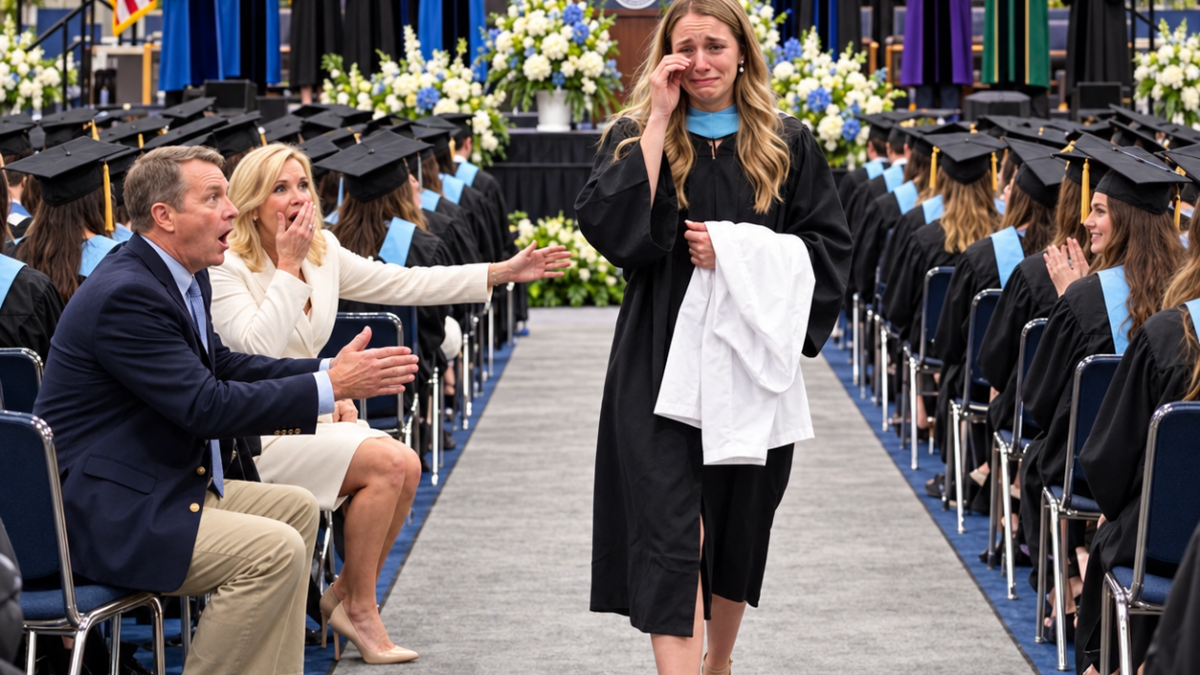
The embroidered name became visible.
I stood.
The dean smiled.
“Ladies and gentlemen, Dr. Hannah Morgan.”
Applause erupted.
I heard Rachel before anyone else.
She shouted.
Actually shouted.
I laughed.
Then I glanced behind me.
Linda’s face had changed.
Her mouth was slightly open.
Richard stared at the white coat.
DR. HANNAH MORGAN.
Not Barrett.
Morgan.
The name of the woman who showed up.
Allison was crying.
Smiling too.
I stepped into the aisle.
For fifteen years, Richard’s sentence had followed me.
Allison has potential.
Hannah is average.
Now the dean had called me valedictorian.
I wish I could say that erased the wound.
It did not.
Achievement does not rewrite childhood.
But it did prove something.
My father’s evaluation of a frightened thirteen-year-old girl had never been prophecy.
It had only been cruelty.
I walked toward the stage.
The applause continued.
Each step felt strange.
Not triumphant.
Heavy.
Room 314.
Chemotherapy.
Rachel’s apartment.
Muffin.
Medication charts.
School notes.
College acceptance.
Adoption.
Medical school.
The lawyer’s folder.
Richard crying.
Linda asking for another chance.
Every version of me walked toward that stage.
The dean handed me my diploma.
Then helped me into the white coat.
The embroidery sat over my heart.
Hannah Morgan.
I looked at Rachel.
She covered her mouth.
Crying uncontrollably now.
I shook my head at her.
She laughed through tears.
The dean stepped aside.
The microphone waited.
Valedictorian speech.
I had written one.
Rewritten it.
Then changed it again the night before.
I placed my notes on the podium.
Then ignored them.
“My journey into medicine began when I was thirteen.”
The room became quiet.
“I learned what illness can take from a person.”
I paused.
“Strength.”
“Hair.”
“Appetite.”
“Control.”
“Certainty.”
I looked toward my classmates.
“But I also learned something else.”
My eyes found Rachel.
“I learned what kindness can give back.”
Rachel bowed her head.
“I survived because people chose to stay.”
There was a murmur.
“One physician stayed in a room after my family left.”
I thought of Dr. Grant.
“One nurse stayed after her shift should have ended.”
Rachel wiped her face.
“One woman opened her home when she had every reason to protect her own life from becoming more complicated.”
I smiled.
“She became my mother.”
The auditorium erupted in applause.
Rachel cried harder.
I waited.
Then continued.
“Medicine teaches us to diagnose disease.”
“To understand pathology.”
“To choose treatments.”
“To evaluate risk.”
“But patients remember something else too.”
“They remember who stayed in the room.”
I looked across the graduating class.
“Sometimes medicine is not about saying the perfect thing.”
“Sometimes it is saying, ‘This hurts. I’m here.’”
I saw several nurses in the audience crying.
I continued.
“I became a physician because when I was thirteen, people showed me the difference between being treated and being cared for.”
“Treatment saved my body.”
“Care saved the person inside it.”
My voice shook.
“I stand here today because a nurse named Rachel Morgan decided that a frightened child was worth showing up for.”
Rachel shook her head as if to say I had done the work.
I smiled.
“She gave me a home.”
“She gave me stability.”
“She gave me her name.”
I touched the embroidery.
“And she taught me that family is not simply who shares your blood.”
“It is who stays when staying costs something.”
Silence.
Powerful silence.
Then applause.
I did not look toward Linda or Richard.
Not once.
They had already occupied too much of my life.
This speech belonged to someone else.
When I finished, the entire auditorium stood.
I hated standing ovations.
Too dramatic.
But that one broke me.
I covered my mouth.
Rachel stood.
Allison stood.
Dr. Grant, now older and seated with medical faculty guests, stood too.
I saw him.
That surprised me.
He smiled.
For one moment, I was thirteen.
He had said:
Your medical care does not depend on whether your father understands your value.
Fifteen years later, he was watching me become a doctor.
After the ceremony, the building exploded into noise.
Photographs.
Families.
Flowers.
Graduates embracing.
I searched for Rachel.
She found me first.
She threw her arms around me.
“You did it.”
I held her.
“We did.”
“No.”
She pulled back.
“You did.”
“You kept me alive.”
“The oncologists kept you alive.”
“You fed me.”
“Barely. You hated everything.”
“You adopted me.”
“That part was selfish.”
I laughed.
“What?”
“You were already mine.”
I started crying.
“Rachel.”
“What?”
“I love you.”
Her face collapsed.
“I love you too.”
Then I heard Richard.
“Hannah.”
My body stiffened.
Rachel noticed.
I turned.
He stood several feet away.
Linda beside him.
Allison slightly behind them.
Richard looked at my white coat.
His eyes lingered on Morgan.
“I wanted to congratulate you.”
I said nothing.
He swallowed.
“You were extraordinary.”
“I had good teachers.”
“Yes.”
He looked at Rachel.
“Thank you.”
Rachel’s expression became hard.
“Do not thank me for doing what you should have done.”
Richard flinched.
I almost smiled.
That was Rachel.
Same woman who would tell a frightened child the crackers were terrible instead of pretending they were good.
Linda stepped forward.
“Hannah.”
I waited.
“We are proud of you.”
I stared.
Behind them, families moved past.
Cameras flashed.
People laughed.
“I heard what you said before the ceremony.”
Linda’s face changed.
“What?”
“She owes us this moment.”
Her mouth opened.
Richard looked at her.
Allison closed her eyes.
Linda whispered, “I didn’t mean it like that.”
“How did you mean it?”
“I meant we’re your family.”
“No.”
“Hannah.”
“No.”
I remained calm.
“That is exactly the mistake you keep making.”
Tears filled her eyes.
“You think because you gave birth to me, every achievement eventually comes back to you.”
“That isn’t what I think.”
“You said I owed you.”
“I was emotional.”
“Then explain.”
She could not.
I continued.
“What exactly do I owe you for?”
“Hannah.”
“The chemotherapy appointment you attended?”
She looked down.
“The nights you stayed awake beside my hospital bed?”
Nothing.
“The school meetings?”
Nothing.
“The medical bills?”
Richard looked away.
“The foster reviews?”
Silence.
“The college applications?”
Linda started crying.
“The medical school tuition?”
“Hannah, please.”
“No.”
My voice stayed quiet.
“That woman behind me did those things.”
Rachel stepped closer.
I continued.
“You do not get to arrive at the graduation and insert yourself into the work.”
Linda whispered, “We gave you life.”
“And then decided it was too expensive to keep saving.”
Her face crumpled.
Richard said, “That is not fair.”
I turned to him.
“Would you like to discuss fair?”
He shut his mouth.
“I know the truth now.”
“I know.”
“You had money.”
“Yes.”
“You lied.”
“Yes.”
“You blackmailed Mom.”
Linda closed her eyes.
Allison moved farther away from them.
Richard whispered, “I was wrong.”
“Yes.”
No anger.
No screaming.
Just truth.
He looked at my coat again.
“Morgan.”
“Yes.”
“Rachel adopted you.”
“Yes.”
He nodded.
“I understand.”
“No.”
His eyes returned to mine.
“You understand the paperwork.”
He looked confused.
“You do not understand what it means to be chosen.”
That silenced him.
Rachel touched my shoulder.
Richard’s eyes filled.
“I wish I could change it.”
“I believe you.”
He looked surprised.
“Really?”
“Yes.”
“Does that mean…”
“No.”
Hope disappeared.
“I can believe you regret what you did without pretending it never happened.”
He nodded slowly.
Linda asked, “Will there ever be room for us?”
I looked at Allison.
Then at Linda.
“I don’t know.”
She started crying again.
“But you owe me patience now.”
She blinked.
“What?”
“You had fifteen years.”
That landed.
“I get to decide what happens next.”
She nodded.
“Yes.”
“And if the answer is nothing?”
Her lips trembled.
“I’ll accept it.”
“For once, do.”
Allison stepped toward me after our parents moved away.
“Can I hug you?”
I smiled.
“Yes.”
She held me carefully.
“I’m proud of you.”
“That I can accept.”
She laughed through tears.
“Why?”
“Because you are not claiming credit.”
“No.”
She looked at Rachel.
“I think I finally understand why you use Morgan.”
I touched the embroidery.
“It isn’t punishment.”
“I know.”
“It’s gratitude.”
Allison nodded.
“I know.”
Dr. Grant approached a few minutes later.
Older.
Gray hair.
Same calm eyes.
“Dr. Morgan.”
I smiled.
“Dr. Grant.”
He looked at the white coat.
“That suits you.”
“You said I would survive.”
“I said we had a strong chance.”
“Still incapable of emotional exaggeration.”
“Medical training.”
I laughed.
Then became serious.
“Do you remember Room 314?”
His smile disappeared.
“Yes.”
“You told me my medical care did not depend on whether my father understood my value.”
He looked down.
“I remember.”
“I carried that.”
He nodded.
“I’m glad.”
“Thank you.”
“For what?”
“Getting angry.”
He seemed surprised.
“Nobody had ever been angry for me before.”
His eyes filled slightly.
“I’m sorry you needed me to be.”
“That’s medicine sometimes, right?”
“What?”
“Staying in the room.”
He smiled.
“Apparently your valedictorian speech says so.”
We hugged.
That night, Rachel and I returned to her house.
Not the old apartment.
She had moved years earlier.
But some things followed.
The original medication notebook sat in a box upstairs.
HANNAH BARRETT.
MEDICAL AND SCHOOL NOTES.
Rachel brought it down.
“Look.”
I flipped through.
Blood counts.
Homework.
Medication changes.
One page:
HANNAH ATE HALF A SANDWICH.
GOOD DAY.
I laughed.
“That was worth documenting?”
“You would not eat.”
Another page:
THUNDERSTORM.
SLEPT ON COUCH.
PRETENDED SHE WAS NOT SCARED.
I looked at Rachel.
“You wrote that?”
“You were a terrible liar.”
“Still am.”
“Yes.”
I turned pages.
Then found one from the first year.
PARENTS DID NOT CALL.
H DID NOT ASK.
VERY HARD DAY.
My throat closed.
Rachel reached for the notebook.
I held it.
“No.”
I read it again.
“Did you write about them often?”
“Sometimes.”
“Why?”
“Because I wanted the record to show what was happening.”
“For social services?”
“Partly.”
“What else?”
She thought.
“Because I was afraid you would grow up thinking you imagined how bad it was.”
That broke me.
Children are good at rewriting pain to protect parents.
Maybe I would have.
Maybe someday Richard would have said it was complicated.
Linda would have said she tried.
Time would blur the edges.
Rachel wrote it down.
They did not call.
Hannah did not ask.
Very hard day.
Truth preserved.
I put the notebook on my lap.
“Mom.”
Rachel froze.
I had called her Mom before.
Many times.
But that night it sounded different.
“Yes?”
“Why did you do it?”
“Foster you?”
“Yes.”
She smiled.
“I told you.”
“You said I needed somewhere to go.”
“You did.”
“That cannot be the whole reason.”
Rachel leaned back.
“No.”
“What was the rest?”
She looked toward a photograph of her younger brother.
“He died at twenty-six.”
I knew he had survived childhood leukemia.
I did not know this.
“What?”
“Different cancer.”
My chest tightened.
“I’m sorry.”
“He survived leukemia as a child. Then years later, different cancer.”
She looked down.
“When you came into the hospital, you reminded me of him.”
“Because leukemia?”
“Because you were angry.”
I laughed softly.
“He was angry too?”
“Furious.”
She smiled.
“At everyone.”
“So you fostered me because I reminded you of your brother?”
“Not exactly.”
“Then why?”
Rachel thought for a long time.
“Because when I was younger, I watched my parents reorganize their entire lives around keeping my brother alive.”
My eyes filled.
“They never debated whether he was worth the cost.”
“No.”
“They stayed.”
“Yes.”
Rachel continued.
“When I heard what your parents said, I kept thinking about that.”
She looked at me.
“No child should hear someone calculate whether their future is valuable enough to justify treatment.”
I swallowed.
“So you took me.”
“I asked.”
“You changed your whole life.”
“Yes.”
“Why?”
Rachel smiled.
“Because you said please.”
I laughed and cried simultaneously.
“That is a terrible answer.”
“It’s the true one.”
We sat together until midnight.
Eventually, I asked about something else.
“Do you think I should have forgiven Linda?”
“You did.”
“I mean let her back.”
Rachel shook her head.
“Not my decision.”
“What would you do?”
“Also irrelevant.”
“That is annoying.”
“I raised you to make your own decisions.”
“You raised me to overthink everything.”
“Yes.”
I stared at the notebook.
“I don’t hate them.”
“I know.”
“Sometimes I wish I did.”
“I know.”
“Hate would be simpler.”
“Yes.”
“But I also don’t want to pretend biology creates obligation.”
Rachel nodded.
“It doesn’t.”
“I don’t owe them a relationship.”
“No.”
“Even if they regret it.”
“No.”
I looked at her.
“Do you think people can change?”
“Of course.”
“Then shouldn’t changed people get another chance?”
Rachel considered.
“Sometimes.”
“Sometimes?”
“Change does not create a debt in the person you hurt.”
That stayed with me.
“You can become better,” she said, “and the person you hurt can still choose distance.”
I nodded.
“That is fair.”
“Usually the hardest things are.”
Over the next year, Richard wrote letters.
I did not always answer.
Linda called occasionally.
I rarely picked up.
Allison and I became closer.
Carefully.
One afternoon she brought an old photo album.
Inside were pictures I had never seen.
Me at five.
Allison at eight.
Christmas.
Beach trip.
School plays.
Then the pictures stopped around thirteen.
My life disappeared from the album after diagnosis.
I touched an empty page.
“What happened here?”
Allison looked ashamed.
“Dad removed some.”
“Why?”
“He said it was healthier to move forward.”
My stomach turned.
Move forward.
As though I had died.
“I found these in a box.”
She handed me photographs.
Hospital? No.
There were none.
My parents had no pictures from treatment.
Of course.
But there were old childhood ones.
I took them.
Not because I wanted the family back.
Because that little girl belonged to me.
I refused to let them keep her.
Richard eventually asked to meet again.
I agreed once.
He brought no excuses this time.
“I started therapy,” he said.
“Good.”
“I know that does not matter to you.”
“It matters to you.”
“Yes.”
He looked older again.
“I spent years telling myself I protected the family.”
“You protected the structure.”
He nodded.
“That is what my therapist says.”
“I charge less.”
He almost laughed.
Then stopped.
“I wanted to ask something.”
“What?”
“Do you believe I loved you?”
I stared.
Hard question.
“Yes.”
His eyes widened.
“You do?”
“Yes.”
He looked relieved.
Then I finished.
“I also believe you abandoned me.”
The relief disappeared.
“Both can be true.”
He stared at the table.
“That is worse.”
“Why?”
“Because if I did not love you, maybe I could explain it.”
I nodded.
Exactly.
Love does not prevent cowardice.
That is one of the most frightening truths about families.
People can love you and still choose themselves.
Richard whispered, “I am sorry.”
“I know.”
“I will be sorry for the rest of my life.”
“That is yours to carry.”
He nodded.
“Do you ever think of me as your father?”
I answered honestly.
“Biologically.”
He closed his eyes.
“And Rachel?”
“My parent.”
He nodded.
He did not argue.
That was the first sign he might truly be changing.
Linda took longer.
She wanted forgiveness to restore access.
It did not.
She sent birthday cards.
Flowers.
Long texts.
Once she wrote:
I was afraid of losing Allison.
I responded:
You lost me instead.
She replied:
I know.
No defense.
Progress, perhaps.
But not enough to erase anything.
My career moved forward.
I chose pediatric oncology.
Nobody was surprised.
The first time I introduced myself to a frightened child as Dr. Morgan, I nearly cried.
My name mattered.
Not because Barrett was contaminated.
Because Morgan represented a choice.
Rachel chose me.
I chose her.
Family did not happen to us.
We built it.
Years later, I returned to Room 314.
The hospital had renovated the floor.
Different paint.
New equipment.
Room numbers remained.
I stood outside.
A nurse asked whether I needed help.
“No.”
I smiled.
“I used to be a patient.”
She looked at my badge.
DR. HANNAH MORGAN
PEDIATRIC ONCOLOGY.
“Here?”
“Yes.”
She smiled.
“That must be strange.”
“It is.”
Inside the room was another child.
Not my patient.
I did not enter.
I just stood in the hallway.
For a second, I could see thirteen-year-old Hannah sitting on the bed.
Bald.
Terrified.
Wondering whether anybody would stay.
I wanted to tell her everything.
You survive.
The nurse comes back.
She takes you home.
The cat is very fat.
You become a doctor.
Your parents return, but by then you understand that their return does not define your healing.
Your name changes.
You are loved.
You are still angry sometimes.
You still cry.
But the future your father called average becomes yours.
I could not tell her.
So I told the children I treated instead.
Not the details.
Just the truth that mattered.
“You are not alone.”
I learned to say it carefully.
Because promises matter.
I never said everything would be fine.
Rachel taught me that.
I said:
“This is hard.”
“I’m here.”
“We will make the next decision together.”
Parents often cried when I said those things.
Sometimes they apologized for crying.
I always told them not to.
One father once asked me how I stayed calm.
I almost laughed.
I was not calm.
I simply knew what fear looked like from the bed.
That was the inheritance my biological parents accidentally gave me.
Not resilience.
I dislike when people romanticize suffering.
Cancer did not make me better.
Abandonment did not make me stronger.
Good people helped me survive things that should never have happened.
That distinction matters.
Pain is not a gift.
What people do in response to pain can become one.
Rachel was that gift.
Dr. Grant was.
Janet was.
Teachers.
Doctors.
Friends.
People whose names Richard and Linda never knew.
The success my biological parents tried to claim at graduation was built by an entire community of people who showed up after they left.
That is why Linda’s whisper hurt.
She owes us this moment.
No.
I owed myself honesty.
I owed Rachel gratitude.
I owed my patients presence.
I owed nobody ownership of my survival.
Several years after graduation, Rachel became ill.
Nothing immediately catastrophic.
Cardiac issue.
Manageable.
Still, when she called me from the hospital, I felt thirteen again.
“I’m fine,” she said.
I nearly screamed.
“Do not say that word to me.”
She laughed.
“Doctor Morgan, I think you are being dramatic.”
“Where are you?”
“St. Anne’s.”
“What room?”
She hesitated.
“Rachel.”
“412.”
“I’m coming.”
“You’re working.”
“I’m coming.”
When I arrived, she was annoyed.
“You did not need to leave work.”
“Yes, I did.”
“No.”
I sat beside the bed.
“You took off work for me for years.”
“That was different.”
“How?”
“You were a child.”
“You are old.”
She gasped.
“Get out.”
I laughed.
Then cried.
Rachel’s face softened.
“Oh.”
“I hate hospitals when you’re in the bed.”
“I know.”
I took her hand.
“I’m scared.”
“I know.”
“This hurts.”
“I know.”
Then she smiled.
“I’m here.”
I laughed through tears.
“That’s my line now.”
“I had it first.”
She recovered.
But that hospital stay taught me another lesson.
Parents become fragile too.
The people who saved you do not remain invincible.
I spent more time with Rachel after that.
Not from fear exactly.
From awareness.
Years earlier, I had learned the cost of waiting too long to say what mattered.
I refused to repeat that.
I told Rachel I loved her constantly.
She complained.
“Enough.”
“No.”
“This is excessive.”
“No.”
“Very unhealthy.”
“You started it.”
I also continued seeing Allison.
Our relationship grew into something neither of us expected.
Sisters.
Actual sisters.
Not rivals.
The rivalry had belonged to our parents.
Not us.
One night, Allison said, “I spent my childhood thinking I had to be exceptional or Dad would stop loving me.”
I stared.
“What?”
“He called me brilliant constantly.”
“I remember.”
“It sounds good.”
“It did not feel good?”
“No.”
She looked at her wine.
“It felt conditional.”
That shocked me.
Allison continued.
“I thought if I got one bad grade, I would become you.”
Silence.
“What does that mean?”
“The daughter he was disappointed in.”
My chest tightened.
“He made you afraid of becoming me.”
“Yes.”
“I’m sorry.”
She looked at me.
“For what?”
“For being used as the threat.”
We both cried.
That was another family truth.
Richard’s cruelty harmed both daughters differently.
He called one average.
He called the other brilliant.
Both labels became cages.
Allison eventually confronted him.
I was not there.
She told me later.
“I asked if he loved me after finding out I wasn’t biologically his.”
“What did he say?”
“He said yes.”
“Do you believe him?”
“Yes.”
“That’s good.”
She shook her head.
“Then I asked why he used me against you.”
I waited.
“He cried.”
I smiled bitterly.
“Dad cries a lot now.”
“Therapy.”
“Apparently.”
She laughed.
Then became serious.
“I told him he doesn’t get to use either of us to explain what he did.”
“Good.”
“I think he finally understood.”
“Maybe.”
“Do you want him to?”
I thought.
“Yes.”
That answer surprised me.
Not because I wanted reconciliation.
Because if Richard truly understood, perhaps he would stop hurting people.
Healing does not require indifference.
You can want someone to become better without inviting them back into your life.
That was another thing Rachel taught me.
My graduation white coat hangs framed in my office now.
Not because I am obsessed with the accomplishment.
Because of the name.
DR. HANNAH MORGAN.
Patients sometimes ask why I framed an old coat.
I usually say, “Family history.”
That is true.
Occasionally a parent recognizes my story from something the hospital published.
They ask how I forgave.
I tell them forgiveness was not the dramatic part.
Boundaries were.
Forgiveness happened privately.
Trust did not automatically follow.
Reconciliation was not required.
Those distinctions saved me.
Years after graduation, Linda and I could eventually share a room without me feeling thirteen.
That was progress.
She stopped calling herself Mom around Rachel.
That mattered.
Richard stopped saying he was proud as though my achievements reflected on him.
That mattered too.
Allison became family in a way she had never been allowed to be as a child.
Rachel remained Mom.
Nothing changed that.
Once, at a holiday dinner, Richard accidentally referred to me as Hannah Barrett.
I corrected him.
“Morgan.”
He froze.
Then nodded.
“Morgan.”
No argument.
No wounded expression.
Just correction.
Sometimes accountability is quiet.
Linda helped Rachel carry dishes to the kitchen.
I watched them.
Two women.
One gave me life.
One built a life with me.
I did not need to flatten them into simple categories forever.
Linda did something unforgivable at thirteen.
Rachel did something extraordinary.
Both truths remained.
The difference was that only one woman had earned the word Mom.
That was not revenge.
It was history.
When Rachel turned seventy, we held a party.
I gave a speech.
She hated it.
Perfect.
I told the story about Muffin.
The bad crackers.
The yellow lamp.
The promise.
I will not disappear without telling you why.
Rachel cried.
“Still true,” she said.
“You’re seventy. You may eventually have to disappear.”
“Hannah.”
“What? Statistically…”
“Worst daughter.”
“Best doctor.”
People laughed.
Then I became serious.
“You never promised forever.”
Rachel watched me.
“You promised honesty.”
I looked around the room.
“That became more valuable.”
Afterward, Linda approached Rachel privately.
I accidentally heard.
“Thank you for raising her.”
Rachel replied, “I did not raise her for you.”
Silence.
Then Linda said, “I know.”
That was perhaps the most mature thing my biological mother ever said.
Not:
Thank you for taking care of my daughter.
Not:
We both love her.
Not:
I’m still her mother too.
Just:
I know.
She understood the line.
Years earlier, she would have hated it.
Now she accepted it.
People can change.
Sometimes too late to reclaim what they lost.
But change still matters.
Richard eventually wrote me a final long letter.
Not because he was dying.
Because his therapist apparently believed he needed to stop sending apologies that demanded response.
The opening line was:
You do not need to answer this.
Good start.
He wrote about fear.
Control.
Pride.
The moment in Room 314.
He admitted something I had never known.
After Dr. Grant threw them out, Linda begged him in the hallway to reconsider.
Richard refused.
He threatened divorce.
Threatened to expose the affair.
Threatened to tell Allison the truth immediately and withdraw every dollar he had promised for college.
Linda chose silence.
Richard wrote:
I spent fifteen years blaming your mother for agreeing with me because that was easier than admitting I created the conditions that made her afraid to resist.
That did not absolve Linda.
But it was true.
Then he wrote:
I called you average because I needed to make the decision sound rational.
There was nothing rational about it.
I was terrified, furious, humiliated, and desperate to control something.
You were the person in the room with the least power, so I made you carry all of it.
I cried when I read that.
Not because it repaired anything.
Because finally, he named it correctly.
Abuse often begins when powerful people hand their fear to the person least able to escape.
At thirteen, that person was me.
Richard ended:
I am not asking you to call me Dad.
I am not asking you to forgive me again.
I only want you to know that the sentence I regret most in my life is not that you were average.
It is that I believed a child had to prove exceptional potential before deserving sacrifice.
You deserved treatment because you were my daughter.
You deserved love because you were a child.
You deserved both even if you had grown up to do nothing extraordinary.
That last line mattered.
For years, I had unconsciously believed becoming a doctor proved my parents wrong.
It did.
But it also risked accepting their original premise.
That worth could be demonstrated through achievement.
What if I had survived cancer and become a cashier?
What if I had never gone to college?
What if treatment left me disabled?
What if I had needed help for the rest of my life?
Would abandoning me have been more acceptable?
No.
The most important thing was not that average Hannah became valedictorian.
It was that average Hannah deserved saving too.
I wish I had understood that at thirteen.
I spent years trying to become extraordinary enough to retroactively prove I should have been loved.
Rachel never asked me to prove anything.
That was why her love healed what success never could.
One evening, I brought Richard’s letter to Rachel.
She read it.
“What do you think?”
I asked.
“He finally understands one part.”
“One part?”
“He still thinks this story is about what you became.”
I looked at her.
“What do you mean?”
Rachel folded the letter.
“You were worth taking home before medical school.”
I started crying.
She rolled her eyes.
“Oh, now who cries too much?”
I laughed.
She continued.
“You were worth it when you were bald and vomiting and angry and refusing cereal.”
“I still hate cereal.”
“I know.”
“You knew nothing about my future.”
“Correct.”
“I could have become a disaster.”
“Very possible.”
“Rachel.”
She smiled.
“You were still worth it.”
That was the lesson.
Simple.
Devastating.
I eventually stopped describing myself as the daughter my parents did not save.
Not because the fact changed.
Because I became more than the sentence.
I was Rachel’s daughter.
Allison’s sister.
A physician.
A survivor.
A colleague.
A friend.
A woman who still sometimes panicked during thunderstorms.
A terrible cook.
An excellent doctor.
Someone who kept Muffin’s collar in a desk drawer twenty years after meeting him.
Identity expands when you stop organizing it around the people who hurt you.
The graduation remained important.
Not because my biological parents’ faces changed when they saw Morgan.
Not because Richard realized the “average” daughter became valedictorian.
Not because Linda understood she had no claim to the moment.
Those were satisfying details.
But the real moment came later.
After everyone left.
After photographs.
After speeches.
After my biological parents walked away.
Rachel and I stood alone near the parking lot.
I held my diploma.
She carried the flowers.
The sunlight was fading.
For one second, she looked exactly like she had fifteen years earlier in blue scrubs.
Steady.
Present.
“Ready to go home?” she asked.
I smiled.
Home.
At thirteen, that word had been terrifying.
Home was where people could decide you cost too much.
Then Rachel changed its meaning.
“Yes,” I said.
We walked toward the car.
I looked down at my white coat.
DR. HANNAH MORGAN.
I finally understood why seeing that name had changed my biological parents’ faces.
They thought my success would prove I belonged to them.
Instead, the coat showed exactly who had stood beside me while that success was being built.
Morgan.
The name of the nurse who stayed.
The woman who took a sick child home.
The parent who learned every medication.
The mother who sat through chemotherapy.
The person who remembered that I hated grape medicine and loved cold strawberries.
The woman who did not know whether I would survive and loved me anyway.
For fifteen years, I had wondered why Richard and Linda did not save me.
Eventually, I learned the financial truth.
The affair.
The blackmail.
The business trouble.
The fear.
The lies.
Those facts explained the machinery behind their decision.
They did not excuse it.
They were given options.
They had money.
They had doctors.
They had social workers.
They had a sick daughter asking them to stay.
They chose themselves.
That truth once destroyed me.
Now it no longer controls me.
Because someone else chose differently.
A thirty-four-year-old nurse walked into Room 314 with bad crackers and a deck of cards.
She did not know she was changing a life.
She just stayed.
Then she stayed again.
And again.
Until one night became a home.
A home became a family.
A family became a name.
And that name eventually appeared on a white coat in front of an auditorium full of people.
Dr. Hannah Morgan.
The name was not proof that I had defeated my biological parents.
It was not revenge.
It was not punishment.
It was evidence.
Evidence of who stayed.
Evidence of what love looks like when it is measured in action instead of blood.
Evidence that a child can be abandoned without being unworthy.
Evidence that family can begin in the worst room of your life and still become the best thing that ever happened to you.
My biological parents walked into my graduation believing I owed them the moment.
They were wrong.
I owed them nothing.
Not my degree.
Not my speech.
Not my name.
Not my forgiveness.
Not my future.
That future belonged to the thirteen-year-old girl who survived.
To the doctor who told her she was worth treating.
To the social worker who found a way forward.
To the nurse who refused to leave.
And most of all, to the woman who eventually became my mother.
Years later, when Rachel died peacefully in her sleep, I found the old notebook in her house.
HANNAH BARRETT
MEDICAL AND SCHOOL NOTES.
The pages were yellowed.
The ink faded.
Near the back, there was an entry I had never seen.
It was dated the night before my adoption became final.
Rachel had written:
Hannah asked today if I think people can really choose family.
I told her yes.
Truth is, I think she chose me long before I realized I had chosen her.
Tomorrow the paperwork catches up.
I sat on the floor and cried until my chest hurt.
Then I turned the page.
One final line.
She is not lucky I found her.
I am lucky she stayed too.
That was Rachel.
Even at the end, she refused to let me turn love into debt.
I framed that page beside my graduation coat.
Patients sometimes ask about both.
I tell them the shortest version.
“A nurse saved my life twice.”
They usually assume I mean medically.
I do not correct them.
Some truths are too large for small conversations.
When I stand beside frightened children now, I still hear Rachel.
This hurts.
I’m here.
I say it too.
And every time I do, I understand that her life continues in rooms she never entered.
A little girl asks whether chemotherapy will make her hair fall out.
A scared teenager asks whether her parents are angry because she got sick.
A mother cries because she cannot fix what is happening.
A father asks how to stay strong.
I never tell them to be strong.
I tell them to stay.
Stay in the room.
Stay during the fear.
Stay when you have no perfect words.
Stay when treatment is ugly.
Stay when hope is uncertain.
Stay when the child is angry.
Stay when the future does not look impressive.
Stay because love is not a scholarship awarded for potential.
Stay because a child should never have to earn the right to be saved.
That is the lesson Room 314 gave me.
That is the lesson Rachel gave me.
And that is the lesson my biological parents learned too late.
The last time Richard attended one of my public lectures, he sat in the back.
He did not approach afterward.
He simply listened.
My lecture was about pediatric treatment adherence and family support.
At the end, I said:
“A child’s medical outcome is shaped by medicine, but the child’s memory of illness is shaped by people.”
I saw Richard lower his head.
Afterward, I received a text.
I heard you.
That was all.
I did not answer.
I did not need to.
Sometimes understanding arrives after the relationship is already over.
It still matters.
Just differently.
Linda eventually stopped asking whether I would call her Mom.
She signed birthday cards:
Linda.
That was respectful.
Allison remained in my life.
Richard and I exchanged occasional letters.
Never father and daughter in the conventional sense.
Something quieter.
More honest.
No one replaced Rachel.
No one could.
People often believe forgiveness restores the original relationship.
Sometimes the original relationship deserved to end.
Forgiveness can simply mean you stop carrying poison while keeping the door closed.
I learned that too.
When I look at my white coat now, I do not see the moment Linda’s confidence disappeared.
I see Rachel in the audience.
Crying.
Of course.
I see Allison smiling.
I see Dr. Grant standing.
I see myself walking toward the stage with fifteen years behind me.
And I remember one thought.
I made it.
Not:
I proved them wrong.
That came later.
The first thought was simpler.
I made it.
The thirteen-year-old who wondered whether her parents would be relieved if she died made it.
The girl who lost her hair made it.
The foster child made it.
The student who studied through fear made it.
The daughter who changed her name made it.
The woman who learned that forgiveness and trust are different made it.
The doctor who wanted to become the person who stays made it.
That was the moment.
And nobody owned it except me.
Still, if I could go back to Room 314 for five minutes, I would sit beside that girl.
I would not tell her about valedictorian.
I would not tell her about medical school.
I would not tell her she becomes a doctor.
Those things are wonderful.
But they are not what she needs to hear.
I would tell her:
“You are not average in any way that matters.”
Then I would correct myself.
“No. Forget that.”
Because even that accepts the idea that extraordinary value is required.
I would say:
“You do not need to be exceptional.”
“You do not need to prove your potential.”
“You do not need to become impressive.”
“You do not have to earn treatment.”
“You do not have to earn love.”
“You are thirteen.”
“You are sick.”
“You are scared.”
“And that is enough reason for someone to stay.”
Then I would tell her about Rachel.
Not everything.
Just enough.
“A woman is coming tonight.”
“She has curly hair.”
“Bad crackers.”
“A fat cat.”
“She is going to sit beside you.”
“When she does, let her.”
That is the only advice I would give.
Let her stay.
Because sometimes the family that saves you does not arrive carrying your blood.
Sometimes she arrives wearing blue scrubs.
And sometimes, fifteen years later, her name is embroidered over your heart.








