My nine year old patient’s stepfather dragged him into my emergency room by the wrist at 3:14 in the morning, demanded antibiotics, and told me the boy was not worth missing a shift over.
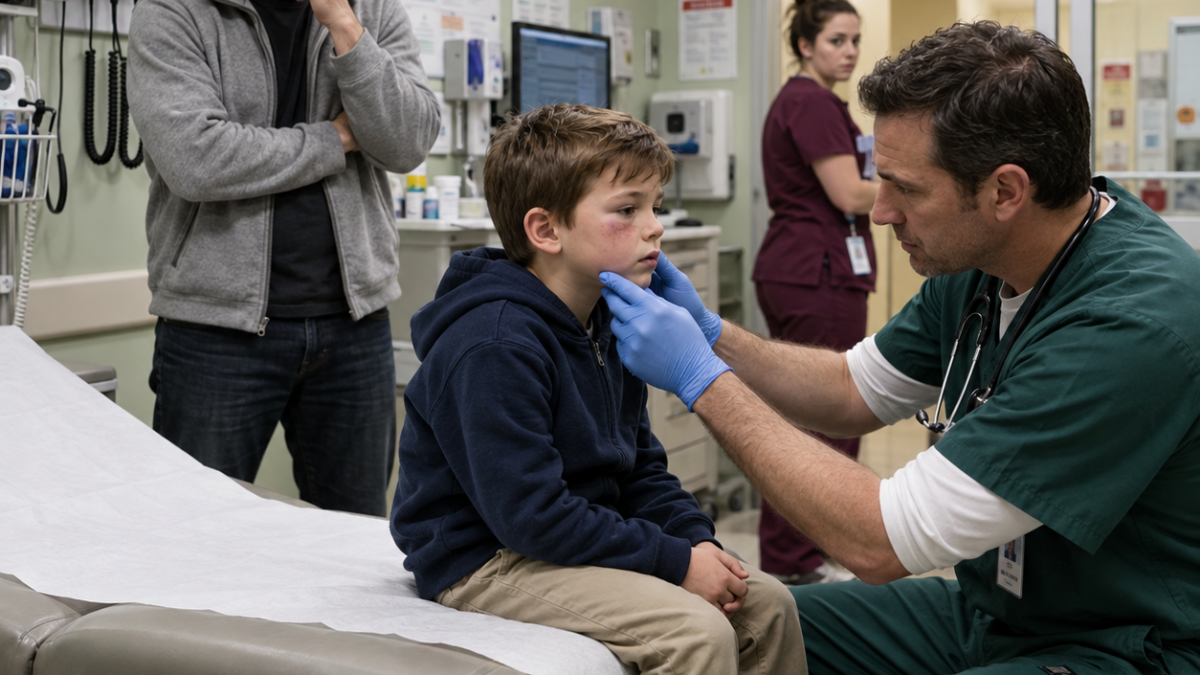
My nine year old patient’s stepfather dragged him into my emergency room by the wrist at 3:14 in the morning, demanded antibiotics, and told me the boy was not worth missing a shift over.
Twenty minutes later, I touched the swollen side of that child’s face.
Something beneath his skin moved away from my fingers.
Then it pushed back.
The man stopped breathing.
So did I.
I had spent enough nights in emergency medicine to know that human beings could surprise you in ways textbooks never prepared you for. I had seen people walk in with injuries they should not have survived. I had seen parents collapse over fevers that turned out to be harmless and parents remain strangely calm while their children were dangerously sick.
But there was something about the way Greg reacted that night that stayed with me.
He did not ask what was moving.
He did not ask whether Leo was going to be okay.
He did not even look shocked in the way most people would if a doctor touched a child’s swollen face and something visibly shifted underneath the skin.
He looked caught.
That was the moment the entire room changed.
Outside, rain tapped against the ambulance bay doors of our small coastal Oregon hospital. It had been falling for hours, a cold, relentless rain that followed people indoors on their jackets and shoes. Wet footprints crossed the emergency department waiting room. A forgotten paper cup sat beside a crooked stack of magazines. Fluorescent lights hummed overhead while phones rang and monitors beeped behind closed curtains.
It was the kind of night when the hospital felt like its own little universe.
Then Greg had walked through the doors with Leo.
I noticed Greg’s hand first.
It was wrapped tightly around the boy’s wrist.
He was not holding Leo’s hand.
He was not guiding him.
He was pulling him.
Leo stumbled once while trying to keep up, but he did not complain. He simply caught his balance and continued forward.
Greg barely looked down.
“Spider bite,” he announced at triage. “Give him a Z Pak. I work in three hours.”
No hello.
No explanation.
No nervous question about whether the child was going to be all right.
He had already diagnosed Leo himself, decided what medication he wanted, and apparently decided how quickly the rest of us were supposed to finish.
The boy beside him was nine years old.
His name was Leo.
When registration asked for his date of birth, Greg stared at the form.
I watched him hesitate.
Then he frowned.
“My wife handles that paperwork garbage.”
Leo lowered his eyes.
Greg tightened his hand around the boy’s wrist.
Leo immediately shifted his body sideways.
He did not pull away.
That would have been easier to understand.
Instead, he adjusted himself around the pressure.
Children communicate long before they decide whether they trust you enough to speak.
Some children scream.
Some cling to their parents.
Some become angry.
Some refuse to sit still.
And some children become extraordinarily talented at making themselves small.
Leo was one of those children.
I stepped between them.
“I’m Dr. Thomas,” I said. “I’ll examine him in Room 4.”
Greg followed us without waiting to be invited.
Leo climbed onto the paper covered examination bed and sat close to the edge. Both hands disappeared inside the front pocket of his gray hoodie.
Rainwater dripped from his shoes.
At first glance, his clothing looked normal enough for a child who had been brought outside in bad weather.
His posture did not.
His knees stayed close together.
His elbows remained tucked against his body.
His chin was slightly lowered.
Greg remained standing beside the bed.
“Sit straight.”
Leo’s shoulders snapped backward before Greg had even finished the sentence.
It was automatic.
My nurse, Sarah, appeared in the doorway carrying the chart.
She looked at me and tapped the chart twice with one finger.
That gesture was enough.
She had noticed it too.
Greg had told triage that a spider caused the swelling.
He could not say when the swelling started.
He did not know whether Leo had a fever.
He did not know when the child had last eaten.
Every time Sarah had asked Leo a question, Greg answered before Leo had a chance.
“Looks dental,” Sarah murmured when Greg turned toward the counter.
It could have been.
The right side of Leo’s face was significantly swollen beneath the hood of his sweatshirt. An untreated tooth infection could absolutely cause swelling like that.
But possible was not the same thing as convincing.
I rolled my stool closer, stopping before I entered Leo’s personal space.
I wanted him to see that I was not going to grab him.
“Can I lower your hood?”
He did not look at me.
He looked at Greg.
Then he nodded.
That told me nearly as much as the examination would.
I gently moved the hood away.
The swelling extended from Leo’s right cheekbone toward his jaw. Purple bruising was visible beneath skin that looked tight and warm.
Near the center was a small circular opening.
Someone looking quickly might have called it an insect bite.
I did not.
The opening was too deep.
Too defined.
Too strange.
There was also an odor.
Not the sharp smell I associated with certain infected wounds.
This smelled almost earthy.
Damp soil.
Underneath that was something faintly sweet.
Greg wrinkled his nose.
“Nasty, right?”
Leo stared at the pens in my scrub pocket.
“Does it burn?” I asked.
“No.”
“Sting?”
He shook his head.
“What does it feel like?”
He took several seconds to answer.
“Heavy.”
Greg checked his watch.
That was the third time I had seen him do it.
Everything about the man suggested that the most important emergency in the room was the possibility that he might be late to work.
I needed space between him and Leo.
Not enough to create a confrontation.
Just enough to see what changed.
“For the next part of the pediatric exam,” I told Greg, “I need you against the far wall.”
There was no such hospital rule.
Greg looked at Sarah.
Sarah did not blink.
He moved.
The difference was immediate.
Leo slowly pulled his left hand from his hoodie pocket.
Bruises covered several of his fingers.
A narrow red mark circled his wrist.
It was not random irritation.
It was a line.
My stomach tightened.
“When did you eat last, Leo?”
He hesitated.
“Yesterday.”
“What time?”
He shrugged.
“Afternoon.”
Greg answered from the wall.
“He had food. He’s dramatic.”
I did not look at him.
“Leo, did you eat dinner?”
The boy shook his head.
“Breakfast?”
Another shake.
Greg sighed loudly.
“For God’s sake.”
I raised my eyes.
“Mr. Carter, I need you to let him answer.”
“He lies.”
Leo’s shoulders immediately tightened.
I filed that reaction away.
Whatever else was happening, the swelling needed treatment.
That remained my immediate responsibility.
I cleaned the skin carefully around the opening.
Leo did not flinch.
Then I placed two gloved fingertips against the swollen tissue and applied gentle pressure.
Something moved.
I froze.
At first, my exhausted brain tried to explain it.
Inflamed tissue can shift.
Fluid can move.
A pocket of infection can give under pressure.
But this was different.
Something rolled away from my touch.
I lifted my hand.
For one irrational second, I wondered whether three in the morning had finally caught up with me.
Then the skin moved again.
Toward me.
Not dramatically.
Just enough.
A subtle rise beneath the inflamed cheek.
A pressure from inside.
As though something underneath had responded to being touched.
I stared.
Sarah stopped moving.
Greg stopped checking his watch.
That was the moment I looked at him.
His entire expression had changed.
Five seconds earlier, he had been bored.
Annoyed.
Impatient.
Now he was watching Leo’s face with an intensity that made the hair on my arms rise.
“We’re leaving.”
He crossed the room.
Fast.
His hand reached for Leo’s jacket.
Leo moved faster.
The boy slid from the opposite side of the examination bed so suddenly that his shoe caught the paper and tore it.
The sound cracked through the room.
Sarah moved her thumb toward the silent security button.
Greg saw her.
“You can’t hold my kid here.”
I stood.
“You brought a seriously ill child into my emergency department. He needs imaging, IV antibiotics, and a surgical evaluation.”
“He needs to stop lying.”
The room went silent.
Those words disturbed me more than his shouting would have.
Because Leo reacted before I did.
His eyes dropped.
Then he moved closer to me.
Only one step.
He did not grab my coat.
He did not hide.
He simply positioned himself so that I stood between him and Greg.
That was enough.
Two security officers appeared outside the doorway.
Greg immediately transformed.
I had seen that transformation before.
His face softened.
His hands opened.
His voice became reasonable.
Suddenly he was not the man who had dragged a sick child through an emergency department and complained about missing work.
Now he was a tired stepfather dealing with a difficult kid.
“I’m exhausted,” he told the officers. “The boy plays rough. His mother knows how he is.”
Leo did not look at him.
“The doctor’s overreacting,” Greg continued. “We thought it was a spider bite. I’m trying to take care of him.”
I almost admired the speed with which he reconstructed himself.
Almost.
The officers escorted him into the hallway.
He kept talking as he went.
Leo watched the floor.
Sarah closed the door.
The latch clicked.
For the first time since Leo entered the hospital, nobody else was answering for him.
I did not immediately ask the questions screaming inside my head.
Children who spend enough time monitoring an adult’s moods do not suddenly relax because a door closes.
Their bodies keep following rules long after the person who created those rules leaves the room.
Leo still sat stiffly.
His hands disappeared into his hoodie again.
He looked at my pens.
The examination paper.
A loose thread near his sleeve.
Anything except my face.
Sarah stepped quietly toward the counter.
I lowered myself onto the stool.
“Leo, I want to ask about your wrist.”
His fingers shifted.
“Did a spider make that mark?”
He shook his head.
No hesitation.
That answer changed everything Greg had told us.
A spider did not explain the bruises.
It did not explain the mark around Leo’s wrist.
It did not explain why a nine year old had apparently gone without food since the previous afternoon.
And it certainly did not explain why Greg’s first reaction to something moving beneath Leo’s skin had been to remove him from the hospital.
“What happened to your face?”
Leo stared down at the loose thread.
He wound it around his finger.
Once.
Twice.
Then unwound it.
I waited.
The rain continued outside.
The emergency department continued around us.
Phones.
Footsteps.
A stretcher rolling down the hall.
But inside Room 4, we waited for one nine year old boy to decide whether the adults in front of him were safe.
Finally, he looked at me.
“He put me in the shed.”
I kept my expression steady.
“Who did?”
Leo looked toward the closed door.
“Greg.”
My chest tightened.
“Why?”
The boy swallowed.
“Because I made him mad.”
Sarah turned away from the counter.
I could see from her face that she wanted to ask a dozen questions.
She did not.
Neither did I.
“What happened after you went into the shed?”
Leo rubbed his thumb against the seam of his hoodie.
“He locked it.”
“Were you alone?”
A nod.
“How long?”
“I don’t know.”
“Was it dark?”
Another nod.
The words came slowly.
Greg had picked Leo up from school the previous afternoon.
Leo’s mother, Amanda, normally picked him up, but she had been called into an extra shift at the assisted living facility where she worked.
Greg was angry before Leo even got into the truck.
Leo did not know why.
Or perhaps he knew but was afraid to say.
Children living around unpredictable anger often become experts at searching backward through a day, trying to locate the exact moment they caused someone else’s explosion.
Leo told us Greg asked why his teacher had sent another note home.
“What note?” I asked.
Leo shrugged.
“I forgot my homework.”
“That was it?”
He nodded.
Greg had yelled all the way home.
Leo tried to explain that he had finished the worksheet but left it in his desk.
Greg told him excuses were lies.
When they reached the house, Greg ordered Leo to stand in the kitchen.
Then Greg opened the school backpack and dumped everything onto the floor.
Folders.
Pencils.
Library books.
A half finished drawing.
A lunch container.
“He said I was lazy.”
Leo’s voice became quieter.
“He said Mom was making me soft.”
I felt Sarah become still behind me.
“What happened next?”
“I said I wasn’t lying.”
Leo’s eyes immediately filled with regret, as though repeating those words might still get him punished.
“What did Greg do?”
“He grabbed me.”
Leo touched his left wrist.
The red line.
“He took me outside.”
“Did he hit you?”
The boy stared at the wall.
I waited.
Finally, he whispered, “Not with his fist.”
That sentence made my stomach turn.
“What did he use?”
“His hand.”
“Where?”
Leo touched the swollen side of his face.
Everything inside me went cold.
“He slapped you there?”
“He pushed me first.”
“Into what?”
“The shelf.”
Now the injury began to make more sense.
The shed behind their house was old.
According to Leo, Greg used it for tools, fishing equipment, gasoline cans, animal traps, and boxes he never unpacked.
The walls leaked when it rained.
Mice got inside.
There were nests beneath an old workbench.
Leo hated the shed because it smelled bad and because something scratched inside the walls at night.
Greg knew that.
“He said if I wanted to act like a baby, I could sit somewhere babies cry.”
Sarah closed her eyes for half a second.
“How did your face get cut?”
“I fell.”
“On the shelf?”
“I think.”
Leo touched his cheek but stopped before his fingers reached the swollen skin.
“There was a nail or something.”
“Did it bleed?”
“Yes.”
“A lot?”
He nodded.
“What did Greg do?”
“He got mad because I got blood on his stuff.”
That answer nearly broke the professional calm I had been forcing myself to maintain.
Not because it surprised me anymore.
Because Leo said it as if Greg’s anger made sense.
“He tied the door.”
“With what?”
“A cord.”
“Were your hands tied?”
Leo did not answer.
I glanced at his wrist.
He followed my eyes.
Then slowly pulled his other hand from the hoodie.
There was a similar mark on that wrist too.
Sarah inhaled sharply.
“Leo,” I said, “did Greg tie your hands?”
“He said I kept messing with things.”
“How?”
“He used the orange cord.”
“Extension cord?”
A nod.
“He wrapped it around my wrists and the metal part under the shelf.”
My jaw clenched so hard it hurt.
I forced myself to relax it before I spoke.
“How long were you there?”
“I don’t know.”
“Was it still light outside when he put you in?”
“Yes.”
“And was it dark when he came back?”
“Yes.”
That was hours.
Potentially many hours.
“Did you have water?”
“No.”
“Food?”
“No.”
“Could you get out?”
He shook his head.
“What happened to your face while you were inside?”
Leo frowned.
“It hurt.”
“Anything touch it?”
He hesitated.
“I heard buzzing.”
That got my attention.
“Buzzing?”
“There were flies.”
“What kind?”
“I don’t know.”
“That’s okay. Were they around your face?”
He nodded.
“I couldn’t make them go away because my hands were stuck.”
Sarah and I looked at each other.
The small opening.
The movement.
The strange odor.
My brain moved through possibilities.
Most were unusual.
Some were extremely unusual in Oregon.
But medicine does not allow you to reject something simply because you do not expect to see it.
“When did Greg come back?”
“After it got dark.”
“What did he say?”
Leo looked down.
“He asked if I learned.”
“What did you say?”
“I said yes.”
“Did he let you inside?”
“Not right away.”
I did not want the answer to my next question.
“Why not?”
“He said I didn’t sound like I meant it.”
For several seconds nobody spoke.
Leo’s eyes stayed on the floor.
“He left again.”
My hand tightened around the edge of the stool.
“How much longer?”
“I don’t know.”
“Did your mom come home?”
“No.”
That was when I understood something important.
“Leo, where is your mother right now?”
“At work, maybe.”
“What time does she usually get home?”
“Morning.”
I looked at Sarah.
We needed to contact Amanda immediately.
But first I needed to know whether Greg had brought Leo here willingly or because the situation had become impossible to hide.
“What happened when Greg finally let you out?”
“He told me to wash.”
“Your face?”
“Yes.”
“With what?”
“The hose.”
I stared at him.
“Outside?”
He nodded.
“It was cold.”
Of course it was.
The rain had already started by then.
“He said I was fine,” Leo continued. “I went to bed.”
“Did your mom see you?”
“No. She had already gone to work.”
“So what happened tonight?”
“My face got bigger.”
“How much did it hurt?”
“A lot.”
“Did you tell Greg?”
“No.”
“Why?”
That was the first question that seemed to confuse him.
He looked at me as though the answer should have been obvious.
“Because he gets mad.”
There are moments in emergency medicine when your training gives you a path forward.
Airway.
Breathing.
Circulation.
Vitals.
Imaging.
Medication.
Consult.
Protocols can be comforting.
But there is no protocol that protects you from the emotional force of hearing a frightened child explain abuse as though it were weather.
Something that simply happens.
Something you endure.
Something you cannot change.
“What made him bring you here?”
“I threw up.”
“When?”
“Tonight.”
“Anything else?”
“My face moved.”
Sarah looked at me.
“What do you mean?”
Leo raised one finger toward his cheek.
“There.”
“Something moved under the skin?”
He nodded.
“Did Greg see it?”
“Yes.”
“What did he do?”
Leo swallowed.
“He told me not to tell Mom.”
There it was.
The panic I had seen on Greg’s face finally had an explanation.
“What did he say happened?”
“He said to tell everybody a spider bit me.”
“And if you didn’t?”
Leo’s expression changed.
I immediately wished I had phrased the question differently.
“You don’t have to answer that right now.”
But he did.
“He said Mom would have to choose.”
“Choose what?”
“Me or him.”
The cruelty of that threat was almost elegant in its simplicity.
Do not tell anyone what I did, because if you do, you will be responsible for destroying your family.
Children carry burdens adults place on them with terrifying seriousness.
“Leo,” I said, “listen to me carefully.”
His eyes lifted.
“What happened to you is not your responsibility.”
He said nothing.
“Coming to the hospital was the right thing. Telling us was the right thing.”
His lip trembled.
“Is Mom going to be mad?”
“I don’t know exactly how your mom will feel when she hears everything. She may feel scared. She may feel angry. She may feel a lot of things at once. But none of this happened because you told us.”
He stared at me.
“I don’t want her to cry.”
That almost did me in.
Before I could respond, someone knocked.
Sarah opened the door only a few inches.
One of the security officers spoke quietly to her.
Greg was demanding to leave with Leo.
He had called someone.
He was now claiming we were illegally holding his stepson.
I stepped into the hallway, closing the door behind me.
Greg stood about twenty feet away with one security officer between us.
His phone was in his hand.
“You’ve had enough time,” he said.
“Leo is not leaving.”
“You don’t have that authority.”
“I have a critically ill nine year old patient whose condition requires treatment.”
“I’m his parent.”
“You’re his stepfather.”
His face tightened.
“My wife gave me permission.”
“We’re contacting her.”
That changed him.
It was subtle.
But I saw it.
His eyes sharpened.
“No.”
“I’m sorry?”
“She’s working. You don’t need to bother her.”
“Her child is in the emergency department.”
“He’s fine.”
“He is not fine.”
“It’s a bite.”
“We don’t know what it is yet.”
“You said infection.”
“I said he needs imaging, medication, and evaluation.”
Greg stepped toward me.
The security officer moved immediately.
Greg stopped.
Then he smiled.
That calm smile again.
“You doctors love making everything dramatic because you get paid for it.”
I had no interest in debating him.
“We’ll update you when appropriate.”
“I’m leaving with him.”
“No.”
“You can’t stop me.”
A police officer was already walking around the corner behind him.
Apparently security had decided it was time.
Greg looked back.
His confidence flickered.
The officer introduced himself and asked Greg to move farther down the hall so they could speak.
“I didn’t do anything.”
Nobody had accused him yet.
That was the first thing he said.
I returned to Room 4.
Sarah had started an IV.
Leo had barely reacted to the needle.
Sometimes children who have experienced too much pain become strangely calm about the pain they understand.
We drew blood.
His inflammatory markers were elevated.
His white blood cell count was high.
His temperature had climbed since triage.
The infection was not minor.
I ordered broad spectrum IV antibiotics and urgent imaging.
Because of the location of the wound and the possibility of a foreign body, I called our surgical consultant.
Dr. Patel answered with the exhausted voice of a man who had been asleep four minutes earlier.
“What exactly are you seeing?”
“I’m not sure.”
“That is not my favorite answer at three forty in the morning.”
“Something is moving.”
Silence.
“Moving how?”
“Independently.”
Another silence.
“You mean pulsatile?”
“No.”
“Vascular?”
“No.”
“Gas?”
“No.”
“What are you telling me, Thomas?”
“I’m telling you something under the kid’s cheek moved away from my fingers and then moved back.”
He was fully awake now.
“I’m coming in.”
The CT scan showed extensive inflammation in the soft tissue of Leo’s cheek, but the finding that caught our attention was a small irregular cavity near the opening.
There was something inside it.
Not metal.
Not bone.
Not something the radiologist was willing to confidently name.
Dr. Patel arrived in wrinkled scrubs and studied the images.
Then he examined Leo.
By then the boy was exhausted.
His eyelids drooped.
The antibiotics were running.
Fluids were going in.
Sarah had brought him a warm blanket.
Dr. Patel approached the wound with the same careful patience I had used.
“Hey, Leo. I’m Raj. I’m another doctor. Dr. Thomas asked me to help.”
Leo nodded.
“I’m going to look at your cheek. I won’t touch it until I tell you.”
Another nod.
Patel leaned closer.
For nearly thirty seconds nothing happened.
Then the small opening changed.
Something pale appeared inside it.
Patel stopped.
It disappeared.
He looked at me.
“You saw that?”
“Yes.”
Sarah whispered, “What is it?”
Patel straightened.
“I don’t want to guess.”
But all three adults in the room were thinking the same thing.
Something alive was inside Leo’s wound.
The word sounded grotesque even inside my own mind.
I looked at the child lying beneath the blanket.
Whatever was inside his cheek mattered medically.
But it was no longer the most disturbing thing about this case.
The most disturbing thing was how it had become possible.
A nine year old had been injured, restrained, locked in an outdoor shed, denied food and water, and left unable to protect an open wound while insects moved around him.
Then the adult responsible had tried to reduce the entire nightmare to a spider bite because he needed to get to work.
We moved Leo to a more secure treatment area.
The surgical team prepared for a procedure under sedation.
Meanwhile, a hospital social worker named Elena arrived.
Elena had the extraordinary ability to enter tense rooms without making them feel more crowded.
She sat several feet from Leo and introduced herself.
“I’m here because hospitals can be confusing and sometimes kids need another person on their team.”
Leo looked at me.
I nodded.
“She’s okay.”
That seemed to matter.
“Where’s Greg?” he asked.
“He’s talking to police,” Elena said.
Leo’s face went white.
“He’s going to be mad.”
“He is not coming into this room.”
“He’ll be mad at Mom.”
Elena leaned forward slightly.
“Your mom is on her way.”
His eyes widened.
“You called her?”
“Yes.”
He pulled the blanket closer.
“I wasn’t supposed to.”
“Supposed to what?”
“Tell.”
Elena’s voice remained calm.
“Adults do not get to make rules that require children to hide being hurt.”
Leo looked toward the door.
“What if she believes him?”
Nobody in that room had an easy answer.
Because children do not invent that fear out of nothing.
Somebody had taught him that Greg’s version of reality might matter more than his own.
I heard raised voices in the hallway.
Then a woman’s voice.
“What room is my son in?”
Leo heard it too.
His entire body changed.
“Mom.”
Amanda appeared in the doorway seconds later wearing navy blue scrubs and a rain jacket she had not zipped correctly.
Her hair was pulled back.
There were dark circles under her eyes.
She looked as though she had run from the parking lot.
Then she saw Leo.
“Oh my God.”
She rushed toward the bed.
Leo flinched.
Not away from her exactly.
But enough that Amanda stopped.
I watched realization move through her face.
“Baby?”
Leo started crying.
It was the first time I had seen him cry.
Not when we placed the IV.
Not when I touched the swollen cheek.
Not when he described the shed.
Now.
The moment his mother entered the room, something inside him finally gave way.
Amanda covered her mouth.
“What happened to your face?”
Leo cried harder.
She looked at me.
“What happened?”
I stepped closer.
“Mrs. Carter, we need to talk.”
“Where’s Greg?”
I paused.
“He’s speaking with police.”
Her head jerked toward the door.
“Police?”
“Your son told us he was injured and confined in a shed.”
The color disappeared from her face.
“What?”
Leo turned away.
Amanda stared at him.
“No. No, Greg said he found him like this after he came home from playing near the woodpile.”
I heard Leo whisper, “No.”
Amanda froze.
“What?”
Leo wiped his nose with the blanket.
“He put me there.”
The words were barely audible.
Amanda stepped backward as though someone had physically struck her.
“No.”
Leo looked at her then.
“He did.”
Her face changed.
Not disbelief exactly.
More like a mind desperately trying to rearrange several years of memories at once.
“He said you were outside.”
“I wasn’t.”
“He said you got bitten.”
“He told me to say that.”
Amanda sank into the chair beside the bed.
“Oh my God.”
She looked at Leo’s wrists.
The red marks were visible.
Her fingers began to shake.
“What are those?”
Leo shoved his hands beneath the blanket.
Amanda looked at me.
“What are those marks?”
“We believe he was restrained.”
She stopped breathing for a second.
Then she stood.
“Where is Greg?”
The question sounded completely different this time.
Elena moved between Amanda and the door.
“I need you to stay here.”
“Where is he?”
“Police are handling that.”
“He tied my son?”
“Amanda.”
“He tied him?”
Her voice broke.
Leo was watching her.
That mattered more than anything happening in the hallway.
I stepped closer.
“Your son needs you here.”
She looked at me.
Then at Leo.
Anger can feel useful when terror is unbearable.
But Leo did not need his mother charging into a hallway.
He needed her beside him.
Amanda returned to the chair.
Slowly.
She held out one hand.
“Can I touch you?”
Leo stared at it.
Then nodded.
She took his fingers.
“I’m sorry.”
His face crumpled again.
“I’m sorry, Mom.”
Amanda’s head snapped up.
“No.”
He cried harder.
“I made him mad.”
“No.”
“I forgot my homework.”
“No, baby.”
“He said you’d have to choose.”
Amanda closed both hands around Leo’s.
“There is no choice.”
Those four words changed the room.
Leo looked directly at her.
“There was never a choice,” she said. “Do you understand me?”
He sniffed.
“But he said…”
“I don’t care what he said.”
Her voice shook violently.
“You are my son.”
Leo stared at her.
Amanda leaned forward, careful not to touch his injured face.
“You are my son. Nobody gets to make me choose between you and them. Ever.”
I looked away for a moment.
Not because I was embarrassed.
Because some moments belong primarily to the people living them.
When I looked back, Amanda was crying silently.
Leo still held her hand.
Dr. Patel returned and explained what we needed to do.
“We need to clean the wound thoroughly. There appears to be a foreign organism or material inside the cavity.”
Amanda blinked.
“Organism?”
“We believe something living may be inside the wound.”
Her hand flew to her mouth.
Leo looked terrified.
I immediately moved beside him.
“That sounds scarier than it needs to. We can remove it.”
“Is it going to hurt?”
“We’re going to give you medicine so you’re sleepy and comfortable.”
“Will I feel it moving?”
“No.”
He looked at Patel.
“Promise?”
Patel answered without hesitation.
“Promise.”
The procedure itself took less time than the hours leading to it.
Under controlled sedation, Patel enlarged the opening just enough to safely access the cavity.
What he removed was a thick, pale larval organism lodged within the infected tissue.
Even after years in medicine, the sight was unsettling.
Sarah turned her eyes away for half a second.
Amanda did not see it.
We made sure she did not need to.
The specimen went to pathology and infectious disease for identification.
The important part was that it was out.
The wound was irrigated extensively.
Damaged tissue was cleaned.
There was no evidence that the infection had spread into deeper facial structures.
Leo was lucky.
Painfully, brutally lucky.
Another day might have changed everything.
When he woke, his first question was not about his face.
“Is Mom still here?”
Amanda immediately stood.
“I’m here.”
His eyes closed again.
“Okay.”
That single word seemed to release something in her.
She lowered her forehead to his hand.
Outside the room, the investigation had become more complicated.
Greg had stopped cooperating.
According to the officer, he first insisted Leo had fabricated the story.
Then he said Leo had locked himself in the shed.
Then he admitted putting the boy there but claimed it had only been for “a few minutes.”
When confronted with the marks on Leo’s wrists, he said the child had probably made them himself.
Each version contradicted the one before it.
But Greg seemed to believe that confidence could substitute for consistency.
Amanda agreed to speak with police separately.
Before she left Leo’s bedside, she asked him, “Do you want me to go?”
He hesitated.
“Are you coming back?”
“Yes.”
“Promise?”
“I promise.”
Only then did he let go of her hand.
I stepped into the hallway sometime after five in the morning.
The rain had weakened.
Gray light had begun touching the windows at the end of the corridor.
Greg was sitting in a chair near the nurses’ station with a police officer beside him.
When he saw me, he stood.
“What did you do to him?”
I stopped.
“What?”
“You cut his face open?”
“We treated your stepson.”
“He didn’t need surgery.”
“You are not making his medical decisions right now.”
His jaw tightened.
“Amanda will straighten this out.”
Before I could answer, Amanda appeared behind me.
Greg looked relieved.
“There you are.”
She did not move toward him.
“Amanda, tell these people.”
She stared at him.
“Tell them what?”
“That Leo lies.”
I watched her expression harden.
Greg continued.
“He’s been acting out for months. You know that. He lies about school. He lies about homework. Now he’s making up this shed thing because he knows you’ll baby him.”
Amanda said nothing.
Greg took a step closer.
The officer shifted.
“He admitted you locked him in there,” Amanda said.
Greg rolled his eyes.
“I put him in there for maybe five minutes because he was throwing a tantrum.”
“You tied his wrists.”
“No.”
“I saw the marks.”
“He gets marks from everything.”
“He said you tied him.”
“And you believe him over me?”
There it was.
The same weapon.
Choice.
Loyalty.
Me or him.
Greg apparently used it on both of them.
Amanda stared at him.
“Yes.”
Greg looked genuinely surprised.
“What?”
“I believe my son.”
His face changed.
The softness disappeared.
“You have got to be kidding me.”
“No.”
“That kid has been trying to get rid of me since I moved in.”
“He is nine.”
“He knows exactly what he’s doing.”
“He is nine.”
“You always do this.”
Amanda’s voice rose.
“Do what?”
“You undermine me.”
The word made her laugh once.
There was no humor in it.
“You locked my child in a shed.”
“He needed discipline.”
“You tied him up.”
“I did not tie him up.”
“You left him bleeding.”
“He scratched his face.”
“He has an infected wound because you left him outside.”
Greg looked at me.
“You told her that?”
“The medical findings are being documented.”
“This is insane.”
Amanda stepped toward him.
The officer immediately raised one hand.
“Ma’am, stay where you are.”
She stopped.
Greg shook his head.
“See? This is exactly what Leo wanted.”
Amanda’s face twisted.
“My son is lying in a hospital bed.”
“Because you encourage this.”
“He had something living inside his face.”
For the first time, Greg had no immediate answer.
Amanda took another breath.
“You saw it moving, didn’t you?”
His eyes shifted.
“You saw his face and you knew something was wrong.”
“I brought him here.”
“After how long?”
No answer.
“How long, Greg?”
“I had work.”
The sentence escaped before he could stop it.
Amanda stared at him.
Even the police officer seemed momentarily stunned by the simplicity of it.
“You had work.”
“That’s not what I meant.”
“Yes, it is.”
“You’re twisting everything.”
“No.”
Amanda shook her head.
“I think I’ve spent three years untwisting everything for you.”
Greg frowned.
“What the hell is that supposed to mean?”
“It means every time Leo was scared of you, you told me he was sensitive.”
“Amanda.”
“Every time he got quiet when you walked into a room, you told me he needed discipline.”
“You’re emotional.”
“Every time you grabbed him too hard, you said you were playing.”
“I never hurt him.”
“I saw his wrists.”
“He did that himself.”
“Stop.”
Her voice suddenly became very quiet.
That was more powerful than shouting.
“Just stop.”
Greg opened his mouth.
She cut him off.
“I am done listening to you explain why everybody else causes the things you do.”
The hallway became silent.
“You said your boss made you angry.”
“You said your ex made you angry.”
“You said I made you angry.”
“You said Leo made you angry.”
“Every story ends with somebody else being responsible for you.”
Greg’s expression darkened.
“Amanda, you need to think carefully about what you’re doing.”
She stared at him.
“I am.”
“You’re blowing up your family.”
“No.”
She looked toward Leo’s room.
“You did that when you put my son in a shed.”
Greg stepped toward her.
The officer blocked him immediately.
“Sit down.”
“I’m talking to my wife.”
“She asked you to stop.”
“This is between us.”
“No,” Amanda said. “It isn’t anymore.”
For the first time since Greg entered my emergency department, I saw something close to fear on his face.
Not fear for Leo.
Fear of losing control over the story.
Police continued questioning him.
Child protective services was notified.
Because of the nature of Leo’s disclosure and the documented injuries, he would not be released into Greg’s care.
Amanda agreed immediately.
She also agreed that neither she nor Leo would return home while Greg had access to the property.
That decision hurt her.
I could see it.
People sometimes imagine these situations as simple moral equations.
Bad person hurts child.
Good parent immediately leaves bad person.
Life is rarely that neat.
Amanda had a mortgage.
A job.
Bills.
A marriage.
Shared bank accounts.
A house full of clothing, documents, photographs, school supplies, and ordinary pieces of life.
Leaving meant detonating all of it.
But some decisions become simple precisely because everything around them is complicated.
When Amanda looked at her son’s swollen face and bruised wrists, the central question was no longer complicated.
She chose Leo.
Not because Greg had demanded a choice.
Because protecting her son should never have required one.
By seven in the morning, the rain had stopped.
Leo was admitted for observation and continued IV antibiotics.
The swelling would take time to resolve.
Infectious disease later identified the organism as a type of fly larva associated with animal environments.
Nobody could say with absolute certainty exactly when it entered the wound.
But the combination of an open injury, exposure to insects, and prolonged confinement in an unsanitary shed provided an obvious route.
The medical answer was disturbing.
The human answer was worse.
Leo had not arrived at the hospital because a spider happened to bite him.
He was there because an adult had hurt him, restrained him, isolated him, and then failed to get help when the consequences became impossible to ignore.
I visited him again before my shift ended.
He was awake.
Amanda sat beside him.
A cartoon played quietly on the television.
For the first time all night, Leo was eating.
Nothing dramatic.
A few bites of toast.
Some applesauce.
But I watched Amanda notice every bite.
She did not tell him to hurry.
She did not tell him to sit straighter.
She did not correct how he held the spoon.
She simply sat beside him.
“How’s the face?” I asked.
Leo considered the question.
“Lighter.”
I smiled.
That was the opposite of the word he had used when he arrived.
Heavy.
Now lighter.
“I’ll take that.”
He looked at my scrub pocket.
“You still have all those pens.”
“I lose approximately twelve a day.”
“You have four.”
“I started with sixteen.”
For the first time, he smiled.
Only a little.
Amanda looked at me.
“Can I talk to you outside?”
I nodded.
In the hallway, she folded her arms tightly across herself.
“Was I supposed to know?”
There are questions doctors are trained to answer.
That was not one of them.
“I don’t know what you saw at home.”
“I saw things.”
Her eyes filled.
“I saw him get scared when Greg got loud.”
She wiped her face.
“I saw him stop talking at dinner sometimes. I saw bruises. Greg always had an explanation.”
She looked toward the room.
“And I wanted the explanations.”
That sentence was painfully honest.
“He’d say Leo fell off his bike. Or they were wrestling. Or Leo was exaggerating because he didn’t like having rules.”
Amanda pressed her lips together.
“I wanted our marriage to work.”
I did not tell her she should have known.
I did not tell her she could not possibly have known.
Neither statement belonged to me.
“What matters right now,” I said, “is what you do with what you know today.”
She nodded.
“I’m not going back.”
“Make that plan with the social worker and police. Don’t handle it alone.”
“I won’t.”
She looked through the window in the door.
“Does he think I failed him?”
I thought about Leo apologizing for making Greg angry.
I thought about him asking whether his mother would choose him.
“He was afraid you’d be angry because he told us.”
Amanda closed her eyes.
“Oh God.”
“He needs to hear, probably more than once, that telling the truth did not cause this.”
“I told him.”
“Tell him again tomorrow.”
She nodded.
“And the day after that.”
Another nod.
“Children sometimes understand safety intellectually before they feel it physically. His body may keep reacting to things even when he knows he’s safe.”
Amanda looked back at him.
“I’ll tell him as many times as he needs.”
That was the best answer she could have given.
My shift ended after eight.
I changed out of my coat, washed my hands, and walked toward the staff exit.
The emergency department had fully entered morning.
Different nurses.
Different patients.
Fresh coffee.
Daylight.
A janitor was mopping the muddy footprints from the tile where Greg had dragged Leo in only hours earlier.
I stood there for a moment longer than necessary.
Emergency medicine trains you to move.
You cannot carry every room into the next room.
You stabilize.
You treat.
You document.
You hand off.
You move on.
But sometimes a case refuses to remain inside its chart.
Leo’s did.
I kept thinking about how close Greg had come to controlling the ending.
If I had accepted “spider bite” without examining carefully.
If Sarah had not noticed the bruises.
If Greg had pulled Leo out of the department before we investigated.
If the swelling had temporarily improved.
If Leo had decided not to speak.
There are so many moments in a child’s life when an adult can look closer or look away.
That thought stayed with me.
Several weeks later, I received a follow up through our child protection team.
I did not expect one.
Usually emergency physicians meet people at the worst moment and never learn what came afterward.
Leo’s infection had resolved.
The wound was healing.
He had a small scar on his cheek.
He and Amanda were staying with Amanda’s sister while legal proceedings and the investigation continued.
A protective order was in place.
Greg was not permitted contact with Leo.
The criminal process had only begun, and nobody could promise what the final outcome would be.
Real life rarely provides courtroom endings on schedule.
But Leo was safe.
For the moment, that was enough.
There was one other detail.
Elena told me Leo had started therapy.
During one of his early sessions, he was asked to draw the place where he felt safest.
He did not draw his old house.
He did not draw the hospital.
He drew a kitchen table.
Two people sat at it.
One was him.
One was his mother.
There was food between them.
No Greg.
No shed.
No locked door.
Just a table.
Months passed.
Winter gave way to spring.
I treated dozens of other children.
Broken arms.
High fevers.
Asthma attacks.
Stitches.
Stomach pain.
Emergency medicine keeps moving whether you are ready or not.
Then one afternoon, long after I had stopped expecting to hear anything else, a small envelope appeared in my hospital mailbox.
My name was printed on the front in uneven handwriting.
Inside was a piece of folded paper.
There was no long letter.
Just a drawing.
A boy stood beside a woman beneath a large yellow sun.
The boy had a small line on one cheek.
Beside them was a doctor wearing blue scrubs with an absurd number of pens in his pocket.
At the bottom, someone had written:
DR THOMAS
THANK YOU FOR BELIEVING ME.
I sat down.
I had seen worse injuries than Leo’s.
I had treated patients closer to death.
I had performed procedures that were technically more difficult.
But those five words hit me harder than almost anything I had encountered in an emergency room.
Thank you for believing me.
Because that was the part that had terrified him.
Not only the shed.
Not only Greg.
Not only the pain.
He had been terrified that when he finally spoke, the adults around him might decide his truth was inconvenient.
I kept that drawing.
Not because I wanted a reminder of what we had done right.
I kept it because I wanted a reminder of how easily adults can do the opposite.
Years in medicine teach you to trust evidence.
Numbers.
Scans.
Cultures.
Pathology.
Vital signs.
Those things matter.
That night, the evidence was everywhere.
The bruises on Leo’s fingers.
The narrow marks around his wrists.
The swelling in his cheek.
The infection.
The moving organism inside the wound.
The inconsistent story.
Greg’s urgency to leave.
But before any laboratory result came back, Leo’s body had already been telling us something.
The way he checked Greg’s face before answering.
The way he adjusted himself around the grip on his wrist instead of resisting it.
The way his shoulders straightened at a command.
The way he became smaller every time Greg became louder.
The way he waited until a locked door separated them before telling the truth.
People sometimes ask how professionals recognize abuse.
The uncomfortable answer is that there is no magical instinct.
No single expression.
No perfect sign.
You look.
You listen.
You notice when the pieces do not fit.
And when something feels wrong, you do not let somebody else’s impatience make you rush past it.
Greg wanted antibiotics.
He wanted a prescription.
He wanted to leave.
He wanted us to accept a spider bite because a spider could not answer questions.
A spider could not contradict him.
A spider could not tell us about the extension cord.
A spider could not describe the shed.
A spider could not tell a mother that her husband had forced her child to choose silence over safety.
Leo could.
He simply needed someone to give him enough room to speak.
I still remember the exact second everything changed.
My fingers pressed against the swollen side of his face.
Something beneath his skin pushed back.
At the time, I thought that was the most horrifying thing I would discover that night.
I was wrong.
The thing inside Leo’s face could be removed.
We had instruments for that.
Medicine for that.
Antibiotics.
Surgery.
Dressings.
Time.
The harder thing to remove was the belief Greg had spent months or perhaps years building inside that child.
The belief that fear was normal.
That pain was discipline.
That adults were allowed to hurt you if you disappointed them.
That telling the truth destroyed families.
That his mother’s love could be taken away if he said the wrong thing.
There was no surgical tool for that.
Healing it would take longer.
But the process began before sunrise in Room 4.
It began when a scared nine year old looked directly at me and finally said four words.
“He put me in the shed.”
It continued when his mother stood in that hallway and refused to let Greg turn the truth into another argument.
And maybe, in the simplest possible way, it continued at a kitchen table where a boy could finally eat without watching somebody else’s face to decide whether he was allowed to feel safe.
I never saw Greg again.
I did not need to.
The last image I wanted from that case was not his face.
It was Leo’s drawing.
The sun.
The kitchen table.
His mother beside him.
And the boy himself standing in the middle of the page, no longer drawn small enough to disappear.
REVIEW
My nine year old patient’s stepfather dragged him into my emergency room by the wrist at 3:14 in the morning, demanded antibiotics, and told me the boy was not worth missing a shift over.
Twenty minutes later, I touched the swollen side of that child’s face.
Something beneath his skin moved away from my fingers.
Then it pushed back.
The man stopped breathing.
So did I.
I had spent enough nights in emergency medicine to know that human beings could surprise you in ways textbooks never prepared you for. I had seen people walk in with injuries they should not have survived. I had seen parents collapse over fevers that turned out to be harmless and parents remain strangely calm while their children were dangerously sick.
But there was something about the way Greg reacted that night that stayed with me.
He did not ask what was moving.
He did not ask whether Leo was going to be okay.
He did not even look shocked in the way most people would if a doctor touched a child’s swollen face and something visibly shifted underneath the skin.
He looked caught.
That was the moment the entire room changed.
Outside, rain tapped against the ambulance bay doors of our small coastal Oregon hospital. It had been falling for hours, a cold, relentless rain that followed people indoors on their jackets and shoes. Wet footprints crossed the emergency department waiting room. A forgotten paper cup sat beside a crooked stack of magazines. Fluorescent lights hummed overhead while phones rang and monitors beeped behind closed curtains.
It was the kind of night when the hospital felt like its own little universe.
Then Greg had walked through the doors with Leo.
I noticed Greg’s hand first.
It was wrapped tightly around the boy’s wrist.
He was not holding Leo’s hand.
He was not guiding him.
He was pulling him.
Leo stumbled once while trying to keep up, but he did not complain. He simply caught his balance and continued forward.
Greg barely looked down.
“Spider bite,” he announced at triage. “Give him a Z Pak. I work in three hours.”
No hello.
No explanation.
No nervous question about whether the child was going to be all right.
He had already diagnosed Leo himself, decided what medication he wanted, and apparently decided how quickly the rest of us were supposed to finish.
The boy beside him was nine years old.
His name was Leo.
When registration asked for his date of birth, Greg stared at the form.
I watched him hesitate.
Then he frowned.
“My wife handles that paperwork garbage.”
Leo lowered his eyes.
Greg tightened his hand around the boy’s wrist.
Leo immediately shifted his body sideways.
He did not pull away.
That would have been easier to understand.
Instead, he adjusted himself around the pressure.
Children communicate long before they decide whether they trust you enough to speak.
Some children scream.
Some cling to their parents.
Some become angry.
Some refuse to sit still.
And some children become extraordinarily talented at making themselves small.
Leo was one of those children.
I stepped between them.
“I’m Dr. Thomas,” I said. “I’ll examine him in Room 4.”
Greg followed us without waiting to be invited.
Leo climbed onto the paper covered examination bed and sat close to the edge. Both hands disappeared inside the front pocket of his gray hoodie.
Rainwater dripped from his shoes.
At first glance, his clothing looked normal enough for a child who had been brought outside in bad weather.
His posture did not.
His knees stayed close together.
His elbows remained tucked against his body.
His chin was slightly lowered.
Greg remained standing beside the bed.
“Sit straight.”
Leo’s shoulders snapped backward before Greg had even finished the sentence.
It was automatic.
My nurse, Sarah, appeared in the doorway carrying the chart.
She looked at me and tapped the chart twice with one finger.
That gesture was enough.
She had noticed it too.
Greg had told triage that a spider caused the swelling.
He could not say when the swelling started.
He did not know whether Leo had a fever.
He did not know when the child had last eaten.
Every time Sarah had asked Leo a question, Greg answered before Leo had a chance.
“Looks dental,” Sarah murmured when Greg turned toward the counter.
It could have been.
The right side of Leo’s face was significantly swollen beneath the hood of his sweatshirt. An untreated tooth infection could absolutely cause swelling like that.
But possible was not the same thing as convincing.
I rolled my stool closer, stopping before I entered Leo’s personal space.
I wanted him to see that I was not going to grab him.
“Can I lower your hood?”
He did not look at me.
He looked at Greg.
Then he nodded.
That told me nearly as much as the examination would.
I gently moved the hood away.
The swelling extended from Leo’s right cheekbone toward his jaw. Purple bruising was visible beneath skin that looked tight and warm.
Near the center was a small circular opening.
Someone looking quickly might have called it an insect bite.
I did not.
The opening was too deep.
Too defined.
Too strange.
There was also an odor.
Not the sharp smell I associated with certain infected wounds.
This smelled almost earthy.
Damp soil.
Underneath that was something faintly sweet.
Greg wrinkled his nose.
“Nasty, right?”
Leo stared at the pens in my scrub pocket.
“Does it burn?” I asked.
“No.”
“Sting?”
He shook his head.
“What does it feel like?”
He took several seconds to answer.
“Heavy.”
Greg checked his watch.
That was the third time I had seen him do it.
Everything about the man suggested that the most important emergency in the room was the possibility that he might be late to work.
I needed space between him and Leo.
Not enough to create a confrontation.
Just enough to see what changed.
“For the next part of the pediatric exam,” I told Greg, “I need you against the far wall.”
There was no such hospital rule.
Greg looked at Sarah.
Sarah did not blink.
He moved.
The difference was immediate.
Leo slowly pulled his left hand from his hoodie pocket.
Bruises covered several of his fingers.
A narrow red mark circled his wrist.
It was not random irritation.
It was a line.
My stomach tightened.
“When did you eat last, Leo?”
He hesitated.
“Yesterday.”
“What time?”
He shrugged.
“Afternoon.”
Greg answered from the wall.
“He had food. He’s dramatic.”
I did not look at him.
“Leo, did you eat dinner?”
The boy shook his head.
“Breakfast?”
Another shake.
Greg sighed loudly.
“For God’s sake.”
I raised my eyes.
“Mr. Carter, I need you to let him answer.”
“He lies.”
Leo’s shoulders immediately tightened.
I filed that reaction away.
Whatever else was happening, the swelling needed treatment.
That remained my immediate responsibility.
I cleaned the skin carefully around the opening.
Leo did not flinch.
Then I placed two gloved fingertips against the swollen tissue and applied gentle pressure.
Something moved.
I froze.
At first, my exhausted brain tried to explain it.
Inflamed tissue can shift.
Fluid can move.
A pocket of infection can give under pressure.
But this was different.
Something rolled away from my touch.
I lifted my hand.
For one irrational second, I wondered whether three in the morning had finally caught up with me.
Then the skin moved again.
Toward me.
Not dramatically.
Just enough.
A subtle rise beneath the inflamed cheek.
A pressure from inside.
As though something underneath had responded to being touched.
I stared.
Sarah stopped moving.
Greg stopped checking his watch.
That was the moment I looked at him.
His entire expression had changed.
Five seconds earlier, he had been bored.
Annoyed.
Impatient.
Now he was watching Leo’s face with an intensity that made the hair on my arms rise.
“We’re leaving.”
He crossed the room.
Fast.
His hand reached for Leo’s jacket.
Leo moved faster.
The boy slid from the opposite side of the examination bed so suddenly that his shoe caught the paper and tore it.
The sound cracked through the room.
Sarah moved her thumb toward the silent security button.
Greg saw her.
“You can’t hold my kid here.”
I stood.
“You brought a seriously ill child into my emergency department. He needs imaging, IV antibiotics, and a surgical evaluation.”
“He needs to stop lying.”
The room went silent.
Those words disturbed me more than his shouting would have.
Because Leo reacted before I did.
His eyes dropped.
Then he moved closer to me.
Only one step.
He did not grab my coat.
He did not hide.
He simply positioned himself so that I stood between him and Greg.
That was enough.
Two security officers appeared outside the doorway.
Greg immediately transformed.
I had seen that transformation before.
His face softened.
His hands opened.
His voice became reasonable.
Suddenly he was not the man who had dragged a sick child through an emergency department and complained about missing work.
Now he was a tired stepfather dealing with a difficult kid.
“I’m exhausted,” he told the officers. “The boy plays rough. His mother knows how he is.”
Leo did not look at him.
“The doctor’s overreacting,” Greg continued. “We thought it was a spider bite. I’m trying to take care of him.”
I almost admired the speed with which he reconstructed himself.
Almost.
The officers escorted him into the hallway.
He kept talking as he went.
Leo watched the floor.
Sarah closed the door.
The latch clicked.
For the first time since Leo entered the hospital, nobody else was answering for him.
I did not immediately ask the questions screaming inside my head.
Children who spend enough time monitoring an adult’s moods do not suddenly relax because a door closes.
Their bodies keep following rules long after the person who created those rules leaves the room.
Leo still sat stiffly.
His hands disappeared into his hoodie again.
He looked at my pens.
The examination paper.
A loose thread near his sleeve.
Anything except my face.
Sarah stepped quietly toward the counter.
I lowered myself onto the stool.
“Leo, I want to ask about your wrist.”
His fingers shifted.
“Did a spider make that mark?”
He shook his head.
No hesitation.
That answer changed everything Greg had told us.
A spider did not explain the bruises.
It did not explain the mark around Leo’s wrist.
It did not explain why a nine year old had apparently gone without food since the previous afternoon.
And it certainly did not explain why Greg’s first reaction to something moving beneath Leo’s skin had been to remove him from the hospital.
“What happened to your face?”
Leo stared down at the loose thread.
He wound it around his finger.
Once.
Twice.
Then unwound it.
I waited.
The rain continued outside.
The emergency department continued around us.
Phones.
Footsteps.
A stretcher rolling down the hall.
But inside Room 4, we waited for one nine year old boy to decide whether the adults in front of him were safe.
Finally, he looked at me.
“He put me in the shed.”
I kept my expression steady.
“Who did?”
Leo looked toward the closed door.
“Greg.”
My chest tightened.
“Why?”
The boy swallowed.
“Because I made him mad.”
Sarah turned away from the counter.
I could see from her face that she wanted to ask a dozen questions.
She did not.
Neither did I.
“What happened after you went into the shed?”
Leo rubbed his thumb against the seam of his hoodie.
“He locked it.”
“Were you alone?”
A nod.
“How long?”
“I don’t know.”
“Was it dark?”
Another nod.
The words came slowly.
Greg had picked Leo up from school the previous afternoon.
Leo’s mother, Amanda, normally picked him up, but she had been called into an extra shift at the assisted living facility where she worked.
Greg was angry before Leo even got into the truck.
Leo did not know why.
Or perhaps he knew but was afraid to say.
Children living around unpredictable anger often become experts at searching backward through a day, trying to locate the exact moment they caused someone else’s explosion.
Leo told us Greg asked why his teacher had sent another note home.
“What note?” I asked.
Leo shrugged.
“I forgot my homework.”
“That was it?”
He nodded.
Greg had yelled all the way home.
Leo tried to explain that he had finished the worksheet but left it in his desk.
Greg told him excuses were lies.
When they reached the house, Greg ordered Leo to stand in the kitchen.
Then Greg opened the school backpack and dumped everything onto the floor.
Folders.
Pencils.
Library books.
A half finished drawing.
A lunch container.
“He said I was lazy.”
Leo’s voice became quieter.
“He said Mom was making me soft.”
I felt Sarah become still behind me.
“What happened next?”
“I said I wasn’t lying.”
Leo’s eyes immediately filled with regret, as though repeating those words might still get him punished.
“What did Greg do?”
“He grabbed me.”
Leo touched his left wrist.
The red line.
“He took me outside.”
“Did he hit you?”
The boy stared at the wall.
I waited.
Finally, he whispered, “Not with his fist.”
That sentence made my stomach turn.
“What did he use?”
“His hand.”
“Where?”
Leo touched the swollen side of his face.
Everything inside me went cold.
“He slapped you there?”
“He pushed me first.”
“Into what?”
“The shelf.”
Now the injury began to make more sense.
The shed behind their house was old.
According to Leo, Greg used it for tools, fishing equipment, gasoline cans, animal traps, and boxes he never unpacked.
The walls leaked when it rained.
Mice got inside.
There were nests beneath an old workbench.
Leo hated the shed because it smelled bad and because something scratched inside the walls at night.
Greg knew that.
“He said if I wanted to act like a baby, I could sit somewhere babies cry.”
Sarah closed her eyes for half a second.
“How did your face get cut?”
“I fell.”
“On the shelf?”
“I think.”
Leo touched his cheek but stopped before his fingers reached the swollen skin.
“There was a nail or something.”
“Did it bleed?”
“Yes.”
“A lot?”
He nodded.
“What did Greg do?”
“He got mad because I got blood on his stuff.”
That answer nearly broke the professional calm I had been forcing myself to maintain.
Not because it surprised me anymore.
Because Leo said it as if Greg’s anger made sense.
“He tied the door.”
“With what?”
“A cord.”
“Were your hands tied?”
Leo did not answer.
I glanced at his wrist.
He followed my eyes.
Then slowly pulled his other hand from the hoodie.
There was a similar mark on that wrist too.
Sarah inhaled sharply.
“Leo,” I said, “did Greg tie your hands?”
“He said I kept messing with things.”
“How?”
“He used the orange cord.”
“Extension cord?”
A nod.
“He wrapped it around my wrists and the metal part under the shelf.”
My jaw clenched so hard it hurt.
I forced myself to relax it before I spoke.
“How long were you there?”
“I don’t know.”
“Was it still light outside when he put you in?”
“Yes.”
“And was it dark when he came back?”
“Yes.”
That was hours.
Potentially many hours.
“Did you have water?”
“No.”
“Food?”
“No.”
“Could you get out?”
He shook his head.
“What happened to your face while you were inside?”
Leo frowned.
“It hurt.”
“Anything touch it?”
He hesitated.
“I heard buzzing.”
That got my attention.
“Buzzing?”
“There were flies.”
“What kind?”
“I don’t know.”
“That’s okay. Were they around your face?”
He nodded.
“I couldn’t make them go away because my hands were stuck.”
Sarah and I looked at each other.
The small opening.
The movement.
The strange odor.
My brain moved through possibilities.
Most were unusual.
Some were extremely unusual in Oregon.
But medicine does not allow you to reject something simply because you do not expect to see it.
“When did Greg come back?”
“After it got dark.”
“What did he say?”
Leo looked down.
“He asked if I learned.”
“What did you say?”
“I said yes.”
“Did he let you inside?”
“Not right away.”
I did not want the answer to my next question.
“Why not?”
“He said I didn’t sound like I meant it.”
For several seconds nobody spoke.
Leo’s eyes stayed on the floor.
“He left again.”
My hand tightened around the edge of the stool.
“How much longer?”
“I don’t know.”
“Did your mom come home?”
“No.”
That was when I understood something important.
“Leo, where is your mother right now?”
“At work, maybe.”
“What time does she usually get home?”
“Morning.”
I looked at Sarah.
We needed to contact Amanda immediately.
But first I needed to know whether Greg had brought Leo here willingly or because the situation had become impossible to hide.
“What happened when Greg finally let you out?”
“He told me to wash.”
“Your face?”
“Yes.”
“With what?”
“The hose.”
I stared at him.
“Outside?”
He nodded.
“It was cold.”
Of course it was.
The rain had already started by then.
“He said I was fine,” Leo continued. “I went to bed.”
“Did your mom see you?”
“No. She had already gone to work.”
“So what happened tonight?”
“My face got bigger.”
“How much did it hurt?”
“A lot.”
“Did you tell Greg?”
“No.”
“Why?”
That was the first question that seemed to confuse him.
He looked at me as though the answer should have been obvious.
“Because he gets mad.”
There are moments in emergency medicine when your training gives you a path forward.
Airway.
Breathing.
Circulation.
Vitals.
Imaging.
Medication.
Consult.
Protocols can be comforting.
But there is no protocol that protects you from the emotional force of hearing a frightened child explain abuse as though it were weather.
Something that simply happens.
Something you endure.
Something you cannot change.
“What made him bring you here?”
“I threw up.”
“When?”
“Tonight.”
“Anything else?”
“My face moved.”
Sarah looked at me.
“What do you mean?”
Leo raised one finger toward his cheek.
“There.”
“Something moved under the skin?”
He nodded.
“Did Greg see it?”
“Yes.”
“What did he do?”
Leo swallowed.
“He told me not to tell Mom.”
There it was.
The panic I had seen on Greg’s face finally had an explanation.
“What did he say happened?”
“He said to tell everybody a spider bit me.”
“And if you didn’t?”
Leo’s expression changed.
I immediately wished I had phrased the question differently.
“You don’t have to answer that right now.”
But he did.
“He said Mom would have to choose.”
“Choose what?”
“Me or him.”
The cruelty of that threat was almost elegant in its simplicity.
Do not tell anyone what I did, because if you do, you will be responsible for destroying your family.
Children carry burdens adults place on them with terrifying seriousness.
“Leo,” I said, “listen to me carefully.”
His eyes lifted.
“What happened to you is not your responsibility.”
He said nothing.
“Coming to the hospital was the right thing. Telling us was the right thing.”
His lip trembled.
“Is Mom going to be mad?”
“I don’t know exactly how your mom will feel when she hears everything. She may feel scared. She may feel angry. She may feel a lot of things at once. But none of this happened because you told us.”
He stared at me.
“I don’t want her to cry.”
That almost did me in.
Before I could respond, someone knocked.
Sarah opened the door only a few inches.
One of the security officers spoke quietly to her.
Greg was demanding to leave with Leo.
He had called someone.
He was now claiming we were illegally holding his stepson.
I stepped into the hallway, closing the door behind me.
Greg stood about twenty feet away with one security officer between us.
His phone was in his hand.
“You’ve had enough time,” he said.
“Leo is not leaving.”
“You don’t have that authority.”
“I have a critically ill nine year old patient whose condition requires treatment.”
“I’m his parent.”
“You’re his stepfather.”
His face tightened.
“My wife gave me permission.”
“We’re contacting her.”
That changed him.
It was subtle.
But I saw it.
His eyes sharpened.
“No.”
“I’m sorry?”
“She’s working. You don’t need to bother her.”
“Her child is in the emergency department.”
“He’s fine.”
“He is not fine.”
“It’s a bite.”
“We don’t know what it is yet.”
“You said infection.”
“I said he needs imaging, medication, and evaluation.”
Greg stepped toward me.
The security officer moved immediately.
Greg stopped.
Then he smiled.
That calm smile again.
“You doctors love making everything dramatic because you get paid for it.”
I had no interest in debating him.
“We’ll update you when appropriate.”
“I’m leaving with him.”
“No.”
“You can’t stop me.”
A police officer was already walking around the corner behind him.
Apparently security had decided it was time.
Greg looked back.
His confidence flickered.
The officer introduced himself and asked Greg to move farther down the hall so they could speak.
“I didn’t do anything.”
Nobody had accused him yet.
That was the first thing he said.
I returned to Room 4.
Sarah had started an IV.
Leo had barely reacted to the needle.
Sometimes children who have experienced too much pain become strangely calm about the pain they understand.
We drew blood.
His inflammatory markers were elevated.
His white blood cell count was high.
His temperature had climbed since triage.
The infection was not minor.
I ordered broad spectrum IV antibiotics and urgent imaging.
Because of the location of the wound and the possibility of a foreign body, I called our surgical consultant.
Dr. Patel answered with the exhausted voice of a man who had been asleep four minutes earlier.
“What exactly are you seeing?”
“I’m not sure.”
“That is not my favorite answer at three forty in the morning.”
“Something is moving.”
Silence.
“Moving how?”
“Independently.”
Another silence.
“You mean pulsatile?”
“No.”
“Vascular?”
“No.”
“Gas?”
“No.”
“What are you telling me, Thomas?”
“I’m telling you something under the kid’s cheek moved away from my fingers and then moved back.”
He was fully awake now.
“I’m coming in.”
The CT scan showed extensive inflammation in the soft tissue of Leo’s cheek, but the finding that caught our attention was a small irregular cavity near the opening.
There was something inside it.
Not metal.
Not bone.
Not something the radiologist was willing to confidently name.
Dr. Patel arrived in wrinkled scrubs and studied the images.
Then he examined Leo.
By then the boy was exhausted.
His eyelids drooped.
The antibiotics were running.
Fluids were going in.
Sarah had brought him a warm blanket.
Dr. Patel approached the wound with the same careful patience I had used.
“Hey, Leo. I’m Raj. I’m another doctor. Dr. Thomas asked me to help.”
Leo nodded.
“I’m going to look at your cheek. I won’t touch it until I tell you.”
Another nod.
Patel leaned closer.
For nearly thirty seconds nothing happened.
Then the small opening changed.
Something pale appeared inside it.
Patel stopped.
It disappeared.
He looked at me.
“You saw that?”
“Yes.”
Sarah whispered, “What is it?”
Patel straightened.
“I don’t want to guess.”
But all three adults in the room were thinking the same thing.
Something alive was inside Leo’s wound.
The word sounded grotesque even inside my own mind.
I looked at the child lying beneath the blanket.
Whatever was inside his cheek mattered medically.
But it was no longer the most disturbing thing about this case.
The most disturbing thing was how it had become possible.
A nine year old had been injured, restrained, locked in an outdoor shed, denied food and water, and left unable to protect an open wound while insects moved around him.
Then the adult responsible had tried to reduce the entire nightmare to a spider bite because he needed to get to work.
We moved Leo to a more secure treatment area.
The surgical team prepared for a procedure under sedation.
Meanwhile, a hospital social worker named Elena arrived.
Elena had the extraordinary ability to enter tense rooms without making them feel more crowded.
She sat several feet from Leo and introduced herself.
“I’m here because hospitals can be confusing and sometimes kids need another person on their team.”
Leo looked at me.
I nodded.
“She’s okay.”
That seemed to matter.
“Where’s Greg?” he asked.
“He’s talking to police,” Elena said.
Leo’s face went white.
“He’s going to be mad.”
“He is not coming into this room.”
“He’ll be mad at Mom.”
Elena leaned forward slightly.
“Your mom is on her way.”
His eyes widened.
“You called her?”
“Yes.”
He pulled the blanket closer.
“I wasn’t supposed to.”
“Supposed to what?”
“Tell.”
Elena’s voice remained calm.
“Adults do not get to make rules that require children to hide being hurt.”
Leo looked toward the door.
“What if she believes him?”
Nobody in that room had an easy answer.
Because children do not invent that fear out of nothing.
Somebody had taught him that Greg’s version of reality might matter more than his own.
I heard raised voices in the hallway.
Then a woman’s voice.
“What room is my son in?”
Leo heard it too.
His entire body changed.
“Mom.”
Amanda appeared in the doorway seconds later wearing navy blue scrubs and a rain jacket she had not zipped correctly.
Her hair was pulled back.
There were dark circles under her eyes.
She looked as though she had run from the parking lot.
Then she saw Leo.
“Oh my God.”
She rushed toward the bed.
Leo flinched.
Not away from her exactly.
But enough that Amanda stopped.
I watched realization move through her face.
“Baby?”
Leo started crying.
It was the first time I had seen him cry.
Not when we placed the IV.
Not when I touched the swollen cheek.
Not when he described the shed.
Now.
The moment his mother entered the room, something inside him finally gave way.
Amanda covered her mouth.
“What happened to your face?”
Leo cried harder.
She looked at me.
“What happened?”
I stepped closer.
“Mrs. Carter, we need to talk.”
“Where’s Greg?”
I paused.
“He’s speaking with police.”
Her head jerked toward the door.
“Police?”
“Your son told us he was injured and confined in a shed.”
The color disappeared from her face.
“What?”
Leo turned away.
Amanda stared at him.
“No. No, Greg said he found him like this after he came home from playing near the woodpile.”
I heard Leo whisper, “No.”
Amanda froze.
“What?”
Leo wiped his nose with the blanket.
“He put me there.”
The words were barely audible.
Amanda stepped backward as though someone had physically struck her.
“No.”
Leo looked at her then.
“He did.”
Her face changed.
Not disbelief exactly.
More like a mind desperately trying to rearrange several years of memories at once.
“He said you were outside.”
“I wasn’t.”
“He said you got bitten.”
“He told me to say that.”
Amanda sank into the chair beside the bed.
“Oh my God.”
She looked at Leo’s wrists.
The red marks were visible.
Her fingers began to shake.
“What are those?”
Leo shoved his hands beneath the blanket.
Amanda looked at me.
“What are those marks?”
“We believe he was restrained.”
She stopped breathing for a second.
Then she stood.
“Where is Greg?”
The question sounded completely different this time.
Elena moved between Amanda and the door.
“I need you to stay here.”
“Where is he?”
“Police are handling that.”
“He tied my son?”
“Amanda.”
“He tied him?”
Her voice broke.
Leo was watching her.
That mattered more than anything happening in the hallway.
I stepped closer.
“Your son needs you here.”
She looked at me.
Then at Leo.
Anger can feel useful when terror is unbearable.
But Leo did not need his mother charging into a hallway.
He needed her beside him.
Amanda returned to the chair.
Slowly.
She held out one hand.
“Can I touch you?”
Leo stared at it.
Then nodded.
She took his fingers.
“I’m sorry.”
His face crumpled again.
“I’m sorry, Mom.”
Amanda’s head snapped up.
“No.”
He cried harder.
“I made him mad.”
“No.”
“I forgot my homework.”
“No, baby.”
“He said you’d have to choose.”
Amanda closed both hands around Leo’s.
“There is no choice.”
Those four words changed the room.
Leo looked directly at her.
“There was never a choice,” she said. “Do you understand me?”
He sniffed.
“But he said…”
“I don’t care what he said.”
Her voice shook violently.
“You are my son.”
Leo stared at her.
Amanda leaned forward, careful not to touch his injured face.
“You are my son. Nobody gets to make me choose between you and them. Ever.”
I looked away for a moment.
Not because I was embarrassed.
Because some moments belong primarily to the people living them.
When I looked back, Amanda was crying silently.
Leo still held her hand.
Dr. Patel returned and explained what we needed to do.
“We need to clean the wound thoroughly. There appears to be a foreign organism or material inside the cavity.”
Amanda blinked.
“Organism?”
“We believe something living may be inside the wound.”
Her hand flew to her mouth.
Leo looked terrified.
I immediately moved beside him.
“That sounds scarier than it needs to. We can remove it.”
“Is it going to hurt?”
“We’re going to give you medicine so you’re sleepy and comfortable.”
“Will I feel it moving?”
“No.”
He looked at Patel.
“Promise?”
Patel answered without hesitation.
“Promise.”
The procedure itself took less time than the hours leading to it.
Under controlled sedation, Patel enlarged the opening just enough to safely access the cavity.
What he removed was a thick, pale larval organism lodged within the infected tissue.
Even after years in medicine, the sight was unsettling.
Sarah turned her eyes away for half a second.
Amanda did not see it.
We made sure she did not need to.
The specimen went to pathology and infectious disease for identification.
The important part was that it was out.
The wound was irrigated extensively.
Damaged tissue was cleaned.
There was no evidence that the infection had spread into deeper facial structures.
Leo was lucky.
Painfully, brutally lucky.
Another day might have changed everything.
When he woke, his first question was not about his face.
“Is Mom still here?”
Amanda immediately stood.
“I’m here.”
His eyes closed again.
“Okay.”
That single word seemed to release something in her.
She lowered her forehead to his hand.
Outside the room, the investigation had become more complicated.
Greg had stopped cooperating.
According to the officer, he first insisted Leo had fabricated the story.
Then he said Leo had locked himself in the shed.
Then he admitted putting the boy there but claimed it had only been for “a few minutes.”
When confronted with the marks on Leo’s wrists, he said the child had probably made them himself.
Each version contradicted the one before it.
But Greg seemed to believe that confidence could substitute for consistency.
Amanda agreed to speak with police separately.
Before she left Leo’s bedside, she asked him, “Do you want me to go?”
He hesitated.
“Are you coming back?”
“Yes.”
“Promise?”
“I promise.”
Only then did he let go of her hand.
I stepped into the hallway sometime after five in the morning.
The rain had weakened.
Gray light had begun touching the windows at the end of the corridor.
Greg was sitting in a chair near the nurses’ station with a police officer beside him.
When he saw me, he stood.
“What did you do to him?”
I stopped.
“What?”
“You cut his face open?”
“We treated your stepson.”
“He didn’t need surgery.”
“You are not making his medical decisions right now.”
His jaw tightened.
“Amanda will straighten this out.”
Before I could answer, Amanda appeared behind me.
Greg looked relieved.
“There you are.”
She did not move toward him.
“Amanda, tell these people.”
She stared at him.
“Tell them what?”
“That Leo lies.”
I watched her expression harden.
Greg continued.
“He’s been acting out for months. You know that. He lies about school. He lies about homework. Now he’s making up this shed thing because he knows you’ll baby him.”
Amanda said nothing.
Greg took a step closer.
The officer shifted.
“He admitted you locked him in there,” Amanda said.
Greg rolled his eyes.
“I put him in there for maybe five minutes because he was throwing a tantrum.”
“You tied his wrists.”
“No.”
“I saw the marks.”
“He gets marks from everything.”
“He said you tied him.”
“And you believe him over me?”
There it was.
The same weapon.
Choice.
Loyalty.
Me or him.
Greg apparently used it on both of them.
Amanda stared at him.
“Yes.”
Greg looked genuinely surprised.
“What?”
“I believe my son.”
His face changed.
The softness disappeared.
“You have got to be kidding me.”
“No.”
“That kid has been trying to get rid of me since I moved in.”
“He is nine.”
“He knows exactly what he’s doing.”
“He is nine.”
“You always do this.”
Amanda’s voice rose.
“Do what?”
“You undermine me.”
The word made her laugh once.
There was no humor in it.
“You locked my child in a shed.”
“He needed discipline.”
“You tied him up.”
“I did not tie him up.”
“You left him bleeding.”
“He scratched his face.”
“He has an infected wound because you left him outside.”
Greg looked at me.
“You told her that?”
“The medical findings are being documented.”
“This is insane.”
Amanda stepped toward him.
The officer immediately raised one hand.
“Ma’am, stay where you are.”
She stopped.
Greg shook his head.
“See? This is exactly what Leo wanted.”
Amanda’s face twisted.
“My son is lying in a hospital bed.”
“Because you encourage this.”
“He had something living inside his face.”
For the first time, Greg had no immediate answer.
Amanda took another breath.
“You saw it moving, didn’t you?”
His eyes shifted.
“You saw his face and you knew something was wrong.”
“I brought him here.”
“After how long?”
No answer.
“How long, Greg?”
“I had work.”
The sentence escaped before he could stop it.
Amanda stared at him.
Even the police officer seemed momentarily stunned by the simplicity of it.
“You had work.”
“That’s not what I meant.”
“Yes, it is.”
“You’re twisting everything.”
“No.”
Amanda shook her head.
“I think I’ve spent three years untwisting everything for you.”
Greg frowned.
“What the hell is that supposed to mean?”
“It means every time Leo was scared of you, you told me he was sensitive.”
“Amanda.”
“Every time he got quiet when you walked into a room, you told me he needed discipline.”
“You’re emotional.”
“Every time you grabbed him too hard, you said you were playing.”
“I never hurt him.”
“I saw his wrists.”
“He did that himself.”
“Stop.”
Her voice suddenly became very quiet.
That was more powerful than shouting.
“Just stop.”
Greg opened his mouth.
She cut him off.
“I am done listening to you explain why everybody else causes the things you do.”
The hallway became silent.
“You said your boss made you angry.”
“You said your ex made you angry.”
“You said I made you angry.”
“You said Leo made you angry.”
“Every story ends with somebody else being responsible for you.”
Greg’s expression darkened.
“Amanda, you need to think carefully about what you’re doing.”
She stared at him.
“I am.”
“You’re blowing up your family.”
“No.”
She looked toward Leo’s room.
“You did that when you put my son in a shed.”
Greg stepped toward her.
The officer blocked him immediately.
“Sit down.”
“I’m talking to my wife.”
“She asked you to stop.”
“This is between us.”
“No,” Amanda said. “It isn’t anymore.”
For the first time since Greg entered my emergency department, I saw something close to fear on his face.
Not fear for Leo.
Fear of losing control over the story.
Police continued questioning him.
Child protective services was notified.
Because of the nature of Leo’s disclosure and the documented injuries, he would not be released into Greg’s care.
Amanda agreed immediately.
She also agreed that neither she nor Leo would return home while Greg had access to the property.
That decision hurt her.
I could see it.
People sometimes imagine these situations as simple moral equations.
Bad person hurts child.
Good parent immediately leaves bad person.
Life is rarely that neat.
Amanda had a mortgage.
A job.
Bills.
A marriage.
Shared bank accounts.
A house full of clothing, documents, photographs, school supplies, and ordinary pieces of life.
Leaving meant detonating all of it.
But some decisions become simple precisely because everything around them is complicated.
When Amanda looked at her son’s swollen face and bruised wrists, the central question was no longer complicated.
She chose Leo.
Not because Greg had demanded a choice.
Because protecting her son should never have required one.
By seven in the morning, the rain had stopped.
Leo was admitted for observation and continued IV antibiotics.
The swelling would take time to resolve.
Infectious disease later identified the organism as a type of fly larva associated with animal environments.
Nobody could say with absolute certainty exactly when it entered the wound.
But the combination of an open injury, exposure to insects, and prolonged confinement in an unsanitary shed provided an obvious route.
The medical answer was disturbing.
The human answer was worse.
Leo had not arrived at the hospital because a spider happened to bite him.
He was there because an adult had hurt him, restrained him, isolated him, and then failed to get help when the consequences became impossible to ignore.
I visited him again before my shift ended.
He was awake.
Amanda sat beside him.
A cartoon played quietly on the television.
For the first time all night, Leo was eating.
Nothing dramatic.
A few bites of toast.
Some applesauce.
But I watched Amanda notice every bite.
She did not tell him to hurry.
She did not tell him to sit straighter.
She did not correct how he held the spoon.
She simply sat beside him.
“How’s the face?” I asked.
Leo considered the question.
“Lighter.”
I smiled.
That was the opposite of the word he had used when he arrived.
Heavy.
Now lighter.
“I’ll take that.”
He looked at my scrub pocket.
“You still have all those pens.”
“I lose approximately twelve a day.”
“You have four.”
“I started with sixteen.”
For the first time, he smiled.
Only a little.
Amanda looked at me.
“Can I talk to you outside?”
I nodded.
In the hallway, she folded her arms tightly across herself.
“Was I supposed to know?”
There are questions doctors are trained to answer.
That was not one of them.
“I don’t know what you saw at home.”
“I saw things.”
Her eyes filled.
“I saw him get scared when Greg got loud.”
She wiped her face.
“I saw him stop talking at dinner sometimes. I saw bruises. Greg always had an explanation.”
She looked toward the room.
“And I wanted the explanations.”
That sentence was painfully honest.
“He’d say Leo fell off his bike. Or they were wrestling. Or Leo was exaggerating because he didn’t like having rules.”
Amanda pressed her lips together.
“I wanted our marriage to work.”
I did not tell her she should have known.
I did not tell her she could not possibly have known.
Neither statement belonged to me.
“What matters right now,” I said, “is what you do with what you know today.”
She nodded.
“I’m not going back.”
“Make that plan with the social worker and police. Don’t handle it alone.”
“I won’t.”
She looked through the window in the door.
“Does he think I failed him?”
I thought about Leo apologizing for making Greg angry.
I thought about him asking whether his mother would choose him.
“He was afraid you’d be angry because he told us.”
Amanda closed her eyes.
“Oh God.”
“He needs to hear, probably more than once, that telling the truth did not cause this.”
“I told him.”
“Tell him again tomorrow.”
She nodded.
“And the day after that.”
Another nod.
“Children sometimes understand safety intellectually before they feel it physically. His body may keep reacting to things even when he knows he’s safe.”
Amanda looked back at him.
“I’ll tell him as many times as he needs.”
That was the best answer she could have given.
My shift ended after eight.
I changed out of my coat, washed my hands, and walked toward the staff exit.
The emergency department had fully entered morning.
Different nurses.
Different patients.
Fresh coffee.
Daylight.
A janitor was mopping the muddy footprints from the tile where Greg had dragged Leo in only hours earlier.
I stood there for a moment longer than necessary.
Emergency medicine trains you to move.
You cannot carry every room into the next room.
You stabilize.
You treat.
You document.
You hand off.
You move on.
But sometimes a case refuses to remain inside its chart.
Leo’s did.
I kept thinking about how close Greg had come to controlling the ending.
If I had accepted “spider bite” without examining carefully.
If Sarah had not noticed the bruises.
If Greg had pulled Leo out of the department before we investigated.
If the swelling had temporarily improved.
If Leo had decided not to speak.
There are so many moments in a child’s life when an adult can look closer or look away.
That thought stayed with me.
Several weeks later, I received a follow up through our child protection team.
I did not expect one.
Usually emergency physicians meet people at the worst moment and never learn what came afterward.
Leo’s infection had resolved.
The wound was healing.
He had a small scar on his cheek.
He and Amanda were staying with Amanda’s sister while legal proceedings and the investigation continued.
A protective order was in place.
Greg was not permitted contact with Leo.
The criminal process had only begun, and nobody could promise what the final outcome would be.
Real life rarely provides courtroom endings on schedule.
But Leo was safe.
For the moment, that was enough.
There was one other detail.
Elena told me Leo had started therapy.
During one of his early sessions, he was asked to draw the place where he felt safest.
He did not draw his old house.
He did not draw the hospital.
He drew a kitchen table.
Two people sat at it.
One was him.
One was his mother.
There was food between them.
No Greg.
No shed.
No locked door.
Just a table.
Months passed.
Winter gave way to spring.
I treated dozens of other children.
Broken arms.
High fevers.
Asthma attacks.
Stitches.
Stomach pain.
Emergency medicine keeps moving whether you are ready or not.
Then one afternoon, long after I had stopped expecting to hear anything else, a small envelope appeared in my hospital mailbox.
My name was printed on the front in uneven handwriting.
Inside was a piece of folded paper.
There was no long letter.
Just a drawing.
A boy stood beside a woman beneath a large yellow sun.
The boy had a small line on one cheek.
Beside them was a doctor wearing blue scrubs with an absurd number of pens in his pocket.
At the bottom, someone had written:
DR THOMAS
THANK YOU FOR BELIEVING ME.
I sat down.
I had seen worse injuries than Leo’s.
I had treated patients closer to death.
I had performed procedures that were technically more difficult.
But those five words hit me harder than almost anything I had encountered in an emergency room.
Thank you for believing me.
Because that was the part that had terrified him.
Not only the shed.
Not only Greg.
Not only the pain.
He had been terrified that when he finally spoke, the adults around him might decide his truth was inconvenient.
I kept that drawing.
Not because I wanted a reminder of what we had done right.
I kept it because I wanted a reminder of how easily adults can do the opposite.
Years in medicine teach you to trust evidence.
Numbers.
Scans.
Cultures.
Pathology.
Vital signs.
Those things matter.
That night, the evidence was everywhere.
The bruises on Leo’s fingers.
The narrow marks around his wrists.
The swelling in his cheek.
The infection.
The moving organism inside the wound.
The inconsistent story.
Greg’s urgency to leave.
But before any laboratory result came back, Leo’s body had already been telling us something.
The way he checked Greg’s face before answering.
The way he adjusted himself around the grip on his wrist instead of resisting it.
The way his shoulders straightened at a command.
The way he became smaller every time Greg became louder.
The way he waited until a locked door separated them before telling the truth.
People sometimes ask how professionals recognize abuse.
The uncomfortable answer is that there is no magical instinct.
No single expression.
No perfect sign.
You look.
You listen.
You notice when the pieces do not fit.
And when something feels wrong, you do not let somebody else’s impatience make you rush past it.
Greg wanted antibiotics.
He wanted a prescription.
He wanted to leave.
He wanted us to accept a spider bite because a spider could not answer questions.
A spider could not contradict him.
A spider could not tell us about the extension cord.
A spider could not describe the shed.
A spider could not tell a mother that her husband had forced her child to choose silence over safety.
Leo could.
He simply needed someone to give him enough room to speak.
I still remember the exact second everything changed.
My fingers pressed against the swollen side of his face.
Something beneath his skin pushed back.
At the time, I thought that was the most horrifying thing I would discover that night.
I was wrong.
The thing inside Leo’s face could be removed.
We had instruments for that.
Medicine for that.
Antibiotics.
Surgery.
Dressings.
Time.
The harder thing to remove was the belief Greg had spent months or perhaps years building inside that child.
The belief that fear was normal.
That pain was discipline.
That adults were allowed to hurt you if you disappointed them.
That telling the truth destroyed families.
That his mother’s love could be taken away if he said the wrong thing.
There was no surgical tool for that.
Healing it would take longer.
But the process began before sunrise in Room 4.
It began when a scared nine year old looked directly at me and finally said four words.
“He put me in the shed.”
It continued when his mother stood in that hallway and refused to let Greg turn the truth into another argument.
And maybe, in the simplest possible way, it continued at a kitchen table where a boy could finally eat without watching somebody else’s face to decide whether he was allowed to feel safe.
I never saw Greg again.
I did not need to.
The last image I wanted from that case was not his face.
It was Leo’s drawing.
The sun.
The kitchen table.
His mother beside him.
And the boy himself standing in the middle of the page, no longer drawn small enough to disappear.








