MY MOTHER IN LAW SLAPPED ME WHILE I HELD MY NEWBORN AND SHE HIT THE FLOOR THEN AT THE HOSPITAL SHE BEGGED ME TO LIE UNTIL I CALLED POLICE
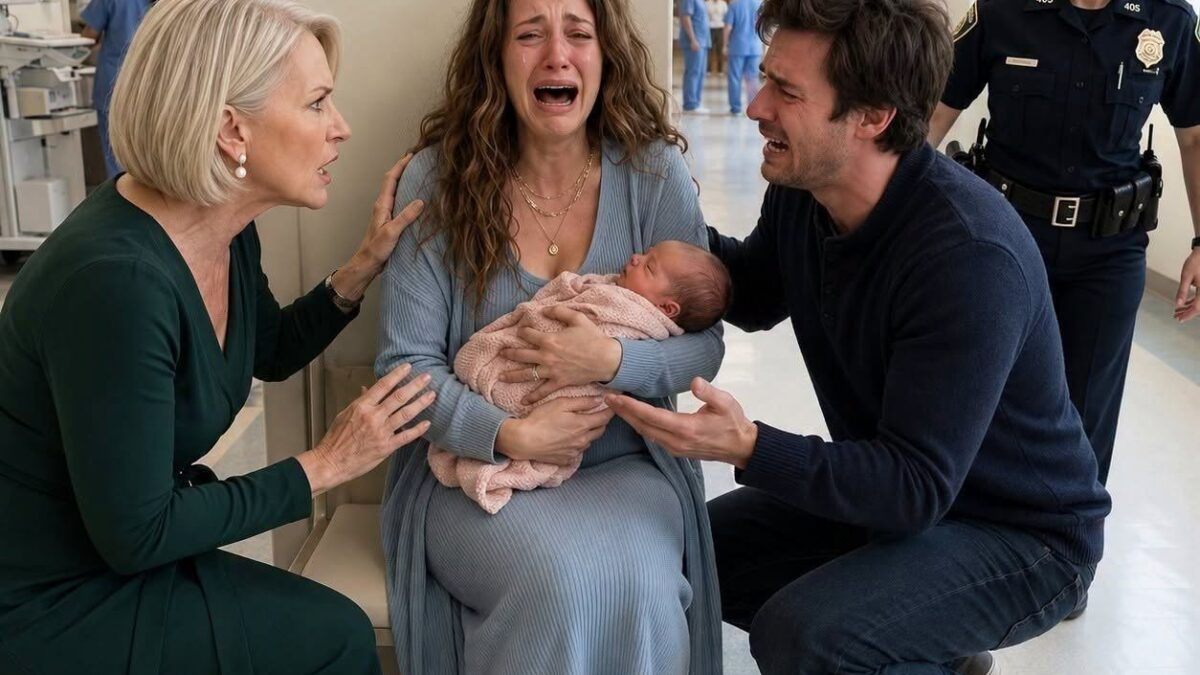
MY MOTHER IN LAW SLAPPED ME WHILE I HELD MY NEWBORN AND SHE HIT THE FLOOR THEN AT THE HOSPITAL SHE BEGGED ME TO LIE UNTIL I CALLED POLICE
The slap came so fast that I never saw Patricia Miller raise her hand.
One second, I was standing in the dim upstairs hallway of our house in Columbus, Ohio, rocking my three week old daughter against my shoulder while she screamed herself hoarse.
The next, Patricia’s palm cracked across my face.
My head snapped sideways.
My ears rang.
The hallway tilted.
And Lily slipped from my arms.
There are sounds a mother expects to hear after midnight.
A newborn crying.
A bottle warming.
A husband shifting beneath the blankets and asking whether the baby needs another feeding.
A drawer opening in the dark.
A tired sigh.
A whispered lullaby.
There are other sounds you never imagine will become permanent memories.
The sound of my daughter’s body hitting the hardwood floor was one of them.
It was not loud.
That is one of the things that still horrifies me.
Something so small should not have been able to make a sound that changed my entire life.
But it did.
Lily’s crying stopped immediately.
The hallway went silent.
Not peaceful.
Wrong.
Completely, terrifyingly wrong.
“Lily!”
I dropped to my knees so hard pain shot through both legs.
I barely noticed.
My daughter was lying on the floor beside me.
Her eyes were closed.
One tiny fist rested beside her cheek.
Her mouth was slightly open.
She looked impossibly small against the dark hardwood.
Three weeks old.
Three weeks.
That was all the life she had known.
Twenty one days of bottles, diapers, sleepless nights, tiny yawns, milk drunk lips, and the strange little sounds newborns make when they dream.
Twenty one days of me checking whether she was breathing every time the room became too quiet.
Now I was staring at her chest and begging it to move.
“Lily?”
Nothing.
“Baby?”
Nothing.
“Come on.”
My hands hovered above her.
I wanted to scoop her up.
I also suddenly remembered every warning I had ever heard about moving someone after a serious fall.
My mind was trying to be logical while every instinct in my body screamed one command.
Pick up your baby.
“Lily, please.”
Behind me, Patricia said nothing.
That silence lasted maybe three seconds.
It felt like a lifetime.
Then Daniel came running from our bedroom.
“What happened?”
His bare feet slapped against the floor.
He stopped when he saw me kneeling.
Then his eyes moved to Lily.
His entire face changed.
“Call 911!” I screamed.
Daniel grabbed for his phone.
Patricia spoke before he could dial.
“She dropped the baby.”
I turned so fast the hallway blurred.
For a second, I genuinely thought I had misheard her.
The side of my face was still burning.
My ear still rang.
“You hit me.”
Patricia’s expression tightened.
“I barely touched you.”
Daniel looked from me to his mother.
“Mom?”
I will never forget that one word.
Not because he defended her.
He did not.
Not because he accused me.
He did not do that either.
It was the uncertainty.
That hesitation was worse than yelling.
Our newborn daughter was motionless on the floor, and my husband was staring between his wife and his mother as if both versions deserved consideration.
“You slapped me,” I said.
Patricia shook her head instantly.
“She’s exhausted.”
I stared at her.
“She doesn’t know what she’s saying.”
“What?”
“She’s been awake all night. She was carrying that baby around half asleep.”
“You hit me!”
“Emily.”
Daniel’s voice was low.
I turned toward him.
“What?”
“I’m trying to understand.”
“There is nothing to understand!”
My voice cracked.
“Your mother slapped me while Lily was in my arms!”
Patricia folded her arms.
“I did not slap you.”
My cheek was burning.
I touched it.
“You hit me right here.”
“I was trying to get your attention.”
“You just said you barely touched me.”
“Because I did.”
“You hit me hard enough that I lost my balance.”
“She was already stumbling.”
“No, I wasn’t.”
Patricia looked at Daniel.
“This is exactly what I’ve been telling you.”
Something inside me went cold.
Not because of the accusation.
Because of the speed.
Lily had been on the floor for less than a minute.
Already Patricia had three different explanations.
I dropped the baby.
She barely touched me.
I was exhausted and confused.
She had not even asked whether Lily was breathing.
“Daniel, call 911.”
He nodded and started dialing.
I looked back at Lily.
Nothing else mattered.
The argument could wait.
Patricia could wait.
My marriage could wait.
My baby could not.
I reached down carefully.
“Lily.”
I slid both hands beneath her body.
My fingers shook so badly that I was terrified I would drop her again.
That thought sent a wave of nausea through me.
Again.
The word felt like an accusation even inside my own head.
I had not chosen to let go of her.
Patricia had hit me.
My balance had shifted.
My arms had opened for one horrifying fraction of a second.
But Lily had still fallen from my arms.
My body did not care about the difference.
Every instinct screamed that I should have prevented it.
I brought Lily against my chest.
Her head rested too heavily against me.
“Come on, baby.”
Daniel was talking to the dispatcher.
Patricia moved closer.
“Put her down.”
I looked at her.
“What?”
“You don’t know if she hurt her neck.”
The fact that she suddenly sounded concerned made something inside me snap.
“You don’t get to tell me what to do.”
“I’m trying to help.”
“You hit me.”
“Oh my God, Emily.”
She rolled her eyes.
“She needs medical help, not another argument.”
I almost laughed from disbelief.
Another argument.
That was how Patricia had always described everything.
Not what she said.
Not what she did.
An argument.
A misunderstanding.
A clash of personalities.
Never her responsibility.
Daniel stepped toward me.
“They’re sending an ambulance.”
“How long?”
“He said several minutes.”
“Riverside is ten minutes away.”
“Emily.”
“I’m taking her.”
“The ambulance is coming.”
“I am not standing here.”
“You shouldn’t drive like this.”
I pushed past him.
“Move.”
“Emily, listen to me.”
“No.”
I was already moving toward the stairs.
Daniel followed.
“Please.”
“Get out of my way.”
“You’re shaking.”
“I know.”
“You could crash.”
“Then you drive.”
He looked toward Patricia.
That one glance was enough.
I stopped.
“No.”
“What?”
“I’m driving.”
“Why?”
“Because I am not sitting in a car with her.”
Patricia stood at the top of the stairs.
Her robe was pulled tightly around her.
She looked offended.
Offended.
Not terrified.
Not broken.
Offended.
“This is ridiculous.”
I stared up at her.
“My daughter is unconscious.”
“Our granddaughter.”
The correction made me sick.
“Then act like it.”
Her face hardened.
“You are hysterical.”
I turned away.
That word had been waiting for me since Lily was born.
Hysterical.
Emotional.
Overprotective.
Sensitive.
Tired.
Hormonal.
Every word meant the same thing when Patricia used it.
Do not trust your own reaction.
I kept moving.
I grabbed the keys from the bowl near the front door.
No coat.
No diaper bag.
No proper shoes.
I did not even know whether my shirt was inside out.
I remember looking down and seeing a dried formula stain near the collar.
That stupid stain became one of the clearest images from that night.
Maybe because the mind sometimes grabs ordinary details when everything else is unbearable.
I carried Lily outside.
Cold air hit my face.
My cheek burned harder.
Daniel followed.
“Let me drive.”
“No.”
“Emily.”
“I said no.”
“I’m her father.”
“Then follow me.”
Patricia appeared behind him.
“Daniel, let her go.”
I looked back.
For one second, I thought maybe Patricia had finally understood.
Then she finished.
“She’s going to make herself look worse.”
I stared.
Daniel turned toward his mother.
“Stop.”
“I’m serious.”
“Mom.”
“She is panicking. She needs to calm down before she tells people things she’ll regret.”
I walked toward the car.
I could not listen anymore.
I secured Lily as carefully as I could.
My hands would not stop trembling.
I got behind the wheel.
The ignition took two attempts.
I called 911 on speaker.
“911, what’s your emergency?”
“My newborn fell.”
My voice collapsed.
“My baby fell. She’s three weeks old. She won’t wake up.”
The dispatcher’s voice was steady.
“Ma’am, where are you?”
I gave our location.
Then I pulled away.
“Are you driving?”
“Yes.”
“Can you pull over safely?”
“I’m almost at Riverside.”
“How far?”
“Less than ten minutes.”
“We can send an ambulance to meet you.”
“I’m already moving.”
I heard Daniel’s car start behind me.
The dispatcher asked whether Lily was breathing.
I looked toward her at the next red light.
“I don’t know.”
“Can you see her chest moving?”
“I can’t tell.”
“Do not attempt to examine her while the vehicle is moving.”
“I know.”
“Stay focused on driving.”
Focused.
The word seemed impossible.
Every cell in my body wanted to turn around.
Touch her.
Listen.
Check.
But I drove.
The light stayed red.
I looked back again.
“Lily.”
No sound.
“Baby, please.”
Nothing.
Five minutes earlier I had wanted her to stop crying.
Not because I was angry at her.
Because I was tired beyond anything I had experienced before.
Her cries had filled the hallway for what felt like hours.
I had checked everything.
Bottle.
Diaper.
Temperature.
Burping.
Swaddle.
Too warm.
Too cold.
Gas.
I walked.
Rocked.
Hummed.
Whispered.
Cried a little myself.
I had wanted thirty seconds of quiet.
Now the silence felt like punishment.
“Cry.”
My voice shook.
“Please cry.”
The light turned green.
I drove.
The dispatcher kept talking.
Her calmness gave me something to hold on to.
“What happened immediately before the fall?”
I swallowed.
“My mother in law hit me.”
“Your mother in law struck you?”
“Yes.”
“While you were holding the baby?”
“Yes.”
“Is she with you now?”
“No.”
“Are you safe from her?”
“I’m driving.”
“Is she following you?”
“My husband is.”
“Is your husband a threat to you?”
The question startled me.
“No.”
Then I thought about his hesitation.
“I don’t know.”
That answer hurt.
I had never been afraid of Daniel.
Not physically.
But safety was suddenly more complicated than I thought.
Could someone be safe if they watched the truth being rewritten and could not decide whether to believe you?
The dispatcher continued.
“Focus on getting to the emergency department safely.”
“I am.”
Another red light.
I stopped.
I remembered Lily’s first night home.
Daniel and I had sat on the couch staring at her.
She was wrapped in a hospital blanket even though we had bought ten better ones.
Daniel touched one finger to her hand.
She curled around it.
He started crying.
I laughed.
“Are you crying?”
“No.”
“You are.”
“I just have something in my eye.”
“At midnight?”
“It’s possible.”
I leaned against him.
He kissed the top of my head.
“She’s perfect.”
That man had seemed so certain.
Our daughter.
Our family.
Our house.
Now I could still hear him saying “Mom?” after Patricia denied hitting me.
One word.
One hesitation.
I hated how much space it occupied in my mind while Lily was silent.
I pushed it away.
“Stay with me, Lily.”
I turned into the hospital entrance.
The dispatcher told me where to stop.
People were already moving toward the car.
I barely remember opening the door.
“Newborn!”
Someone reached for Lily.
“She fell.”
“How long ago?”
“Maybe ten minutes.”
“Was she conscious afterward?”
“No.”
“Breathing?”
“I don’t know.”
A nurse took her.
The emptiness in my arms was immediate.
I reached after her.
“Wait.”
“We’ve got her.”
“I’m coming.”
Another staff member stopped me.
“Let them work.”
“I’m her mother.”
“I know.”
“I need to go with her.”
“They need space.”
Lily disappeared through the emergency doors.
I stood there with both arms still shaped around a baby who was no longer in them.
For three weeks I had been the person who fixed every problem I could fix.
Hungry?
Feed her.
Wet diaper?
Change it.
Cold?
Blanket.
Hot?
Remove one.
Tired?
Rock.
Scared?
Hold.
Now I had nothing to do.
That helplessness was unbearable.
Someone guided me toward a chair.
I sat for maybe ten seconds.
Then stood.
I walked three steps.
Turned.
Three steps back.
A nurse asked for my name.
“Emily Miller.”
“Baby’s name?”
“Lily Grace Miller.”
“Date of birth?”
I answered.
The questions felt absurd.
Not because they were unnecessary.
Because the world was still demanding ordinary information while my daughter was behind a locked door without a pulse I could see.
Address.
Insurance.
Allergies.
Pediatrician.
I answered everything.
Then the nurse looked at my face.
“What happened there?”
I touched my cheek.
The skin felt hot and tight.
“My mother in law slapped me.”
The nurse stopped typing.
“When?”
“Right before Lily fell.”
“While you were holding her?”
“Yes.”
Her eyes sharpened.
“Has anyone documented that yet?”
“No.”
“I’d like to have another nurse photograph the visible injury.”
The first instinct that rose inside me was shame.
Not fear.
Not anger.
Shame.
I thought about Patricia.
About Daniel.
About people learning.
Family business.
I heard Patricia’s voice inside my head.
Do not embarrass the family.
I realized she had never said those exact words to me.
She did not need to.
She had built an entire household around them.
Any disagreement became dangerous if outsiders might hear.
When Patricia criticized me, I was supposed to smile.
When she walked into our room without knocking, I was supposed to understand she was helping.
When she ignored the pediatrician’s instructions, I was supposed to respect her experience.
When she told relatives I was struggling with motherhood, Daniel said, “She’s worried about you.”
Every boundary had to be softened.
Every objection translated into something polite enough that Patricia would not feel criticized.
I looked at the nurse.
“Yes.”
“What?”
“Document it.”
She nodded.
A second nurse came.
She asked permission before touching my face.
That almost made me cry.
Permission.
A stranger in an emergency room showed me more respect in thirty seconds than Patricia had shown me in three weeks.
The nurse photographed the redness.
“Does your jaw hurt?”
“A little.”
“Any dizziness?”
“Yes, but I don’t know if that’s panic.”
“We’ll have someone assess you too.”
“No.”
I shook my head.
“Lily first.”
“Lily has a full team.”
“I don’t want anybody pulled away from her.”
“They won’t be.”
I nodded.
Then waited.
The emergency room had a rhythm I had never noticed before.
Doors.
Shoes.
Machines.
Voices.
People trying to stay calm while terrible things happened behind curtains.
Every time a door opened, I looked.
Every time someone in scrubs walked toward me, I stopped breathing.
Twenty minutes passed.
Maybe twenty two.
Maybe seventeen.
I checked the clock too often and somehow remembered none of it correctly afterward.
Daniel arrived.
Patricia was with him.
I saw them before they saw me.
Daniel looked destroyed.
Patricia looked controlled.
That difference hit me immediately.
Daniel searched for Lily.
His eyes went to every door.
Patricia searched for me.
She found me instantly.
Daniel hurried forward.
“Emily.”
I stood.
“Where is she?”
“They’re working on her.”
“What does that mean?”
“I don’t know.”
His face crumpled.
Then Patricia reached us.
“Emily.”
I looked at her.
She moved closer.
Her voice dropped.
“Tell them it was an accident.”
For several seconds I forgot how to breathe.
Not:
How is Lily?
Not:
Is she alive?
Not:
What did the doctor say?
Tell them it was an accident.
I stared.
“What?”
Patricia glanced around.
“Keep your voice down.”
“You haven’t even asked about her.”
“I know she’s being treated.”
“How?”
“Daniel told me.”
“He doesn’t know anything.”
“I know enough.”
“No, you don’t.”
She leaned closer.
“You need to think carefully.”
Daniel looked between us.
“Mom, what are you talking about?”
Patricia ignored him.
“You are exhausted. You were overwhelmed. Accidents happen.”
The phrase sounded rehearsed.
“Accidents happen.”
I repeated it.
“Yes.”
“You think this was an accident?”
“You lost your grip.”
“Because you hit me.”
Her jaw tightened.
“I did not hit you.”
“The hospital photographed my face.”
For the first time, genuine fear crossed her expression.
It was quick.
But I saw it.
“They did what?”
Daniel turned toward me.
“Your face?”
I pointed.
He stared.
The red mark had become clearer under hospital lighting.
His mouth opened.
“Emily.”
Patricia interrupted.
“She probably rubbed it.”
I looked at her.
“What?”
“You’ve been touching your face constantly.”
Daniel stared at his mother.
“Mom.”
“She has.”
“You said you barely touched her.”
“I did.”
“Then why are you saying she caused the mark herself?”
Patricia’s eyes flashed.
“Because all of you are acting like I attacked her.”
“You did.”
My voice was quiet now.
Patricia turned.
“I was frustrated.”
There.
A tiny opening.
I heard it.
Daniel heard it too.
“Frustrated?”
Patricia realized she had stepped too close to the truth.
“With the situation.”
“What situation?” Daniel asked.
“The screaming.”
“Lily’s?”
“Yes.”
My stomach turned.
“She’s three weeks old.”
“I know how old she is.”
“She was crying because babies cry.”
“I know.”
“Then why did her crying make you angry?”
Patricia looked at me.
“I was tired.”
“So was I.”
“You were making it worse.”
“How?”
“You kept walking through the hall.”
“I was trying to soothe her.”
“Outside my room.”
“I live there.”
Patricia’s lips tightened.
Daniel looked from her to me.
Something in his face had begun changing.
Not enough.
But something.
Before he could say anything, a doctor approached.
I knew immediately.
There is a particular expression professionals use when they are trying to tell someone something awful without destroying them before the sentence is finished.
He stopped in front of me.
“Mrs. Miller?”
“Yes.”
“I’m Dr. Aaron Blake.”
“Is she okay?”
He took a breath.
The hesitation nearly killed me.
“Your daughter arrived in cardiac arrest.”
For a second, the words did not connect.
“What?”
“She did not have a detectable pulse when she arrived.”
“No.”
“We’re performing CPR.”
“No.”
My knees gave out.
A nurse caught me.
Daniel grabbed my arm.
I pulled away without meaning to.
“Can you save her?”
Dr. Blake did not lie.
“We’re doing everything we can.”
“Is she alive?”
“We are actively resuscitating her.”
I hated every word.
Clinical.
Careful.
Necessary.
But I wanted one.
Yes.
He could not give it.
“There are signs of significant head trauma.”
My stomach dropped.
“We need to know exactly what happened.”
I heard the floor again.
That sound.
Lily’s crying stopping.
“I was holding her.”
Dr. Blake listened.
“She had been crying.”
“Okay.”
“My mother in law came out.”
I pointed toward Patricia.
Dr. Blake glanced at her.
“She complained about Lily.”
Patricia stepped forward.
“This isn’t necessary.”
Dr. Blake looked at her.
“I need an accurate mechanism of injury.”
Patricia closed her mouth.
I continued.
“She slapped me across the face.”
Dr. Blake’s expression remained controlled.
“And then?”
“I lost my balance.”
My voice broke.
“Lily slipped.”
“From your arms?”
“Yes.”
“Were you standing?”
“Yes.”
“Approximately how far did she fall?”
“I don’t know.”
I started crying.
“Three feet? Four? I don’t know.”
“That’s okay.”
“She hit the floor.”
“Do you know which area of her body struck first?”
“I think her head.”
The words almost made me vomit.
“I think.”
“Did she cry afterward?”
“No.”
“Move?”
“I don’t remember.”
“Were her eyes open?”
“No.”
“Did anyone shake her?”
“No.”
“Strike her directly?”
“No.”
“Any prior injuries?”
“Never.”
“Any medical conditions?”
“No.”
He nodded.
The nurse wrote.
I suddenly understood that this was no longer only a mother telling a doctor what happened.
This was being documented.
Patricia understood too.
“Doctor.”
He looked at her.
“It was an accident.”
I stared.
Dr. Blake remained neutral.
“Were you present?”
“Yes.”
“Did you strike Mrs. Miller?”
“No.”
I laughed.
It came out harsh.
Patricia glared.
“I touched her.”
Dr. Blake looked at my face.
Then back at Patricia.
“With an open hand?”
Patricia hesitated.
“I was trying to calm her.”
“That is not what I asked.”
Daniel looked at the floor.
Patricia folded her arms.
“I put my hand against her face.”
I stared.
“You slapped me.”
“Emily, stop.”
“Why?”
“Because this is not helping Lily.”
That sentence enraged me.
“You are the reason she’s in there.”
Patricia’s face changed.
“You dropped her.”
The words hit harder than the slap.
For one second, guilt rushed through me so fast I could not breathe.
I saw Lily falling.
My arms opening.
Her body slipping.
Maybe Patricia noticed.
Because she continued.
“You were holding her.”
Daniel looked up.
“Mom.”
“I’m stating a fact.”
“She hit me.”
I pointed to my face.
“She hit me while I was holding a newborn.”
Patricia shook her head.
“You want someone else to blame.”
“No.”
My voice became steadier.
“I want the truth.”
Daniel whispered my name.
I looked at him.
His eyes were wet.
“I didn’t see it.”
“I know.”
“I came out afterward.”
“I know.”
“I’m not saying you’re lying.”
“But you’re not saying she is.”
His face tightened.
“That isn’t fair.”
I almost screamed.
“Fair?”
“Our daughter is in cardiac arrest.”
“I know.”
“Your mother is telling a doctor I dropped her for no reason.”
“I know.”
“You saw my face.”
“Yes.”
“You heard her say she barely touched me.”
“Yes.”
“Then you heard her say she only put her hand against my face.”
“Yes.”
“How many versions does she get before you stop calling this uncertainty?”
Patricia cut in.
“He is my son.”
I looked at her.
“What does that have to do with anything?”
“You are forcing him to choose.”
“No.”
I stepped toward her.
“You forced him to choose the second you hit his wife while she was holding his daughter.”
Patricia’s face went red.
“I did not know she would drop Lily.”
That sentence stopped everyone.
Daniel stared at his mother.
Dr. Blake went still.
The nurse’s pen paused.
Patricia realized it a second too late.
Daniel spoke quietly.
“What did you just say?”
Patricia looked at him.
“Nothing.”
“You said you didn’t know she would drop Lily.”
“I meant…”
“You hit her.”
“No.”
“You just admitted it.”
“I said I touched her.”
Daniel’s voice changed.
“How?”
Patricia looked toward me.
I did not help her.
“How did you touch her, Mom?”
“She was yelling.”
“How?”
“Daniel.”
“How?”
Patricia’s eyes filled.
I almost hated myself for not caring.
“I slapped her.”
The hallway became completely silent.
There it was.
No dramatic confession.
No collapse.
Just three words.
I slapped her.
Daniel closed his eyes.
I thought hearing Patricia admit it would make me feel vindicated.
It did not.
My daughter still had no detectable pulse when she arrived.
Truth did not rewind time.
Daniel’s shoulders dropped.
“Why?”
Patricia started crying.
“I was tired.”
He stared.
“You were tired?”
“She had been screaming all night.”
“Lily?”
“Yes.”
“And that made you slap Emily?”
“I didn’t think.”
“No.”
I spoke before I could stop myself.
“You didn’t.”
Patricia looked at me.
“I’m sorry.”
The apology landed strangely.
For three weeks I had wanted Patricia to respect me.
Apologize when she crossed boundaries.
Acknowledge when she was wrong.
Now she was saying the words I had once wanted.
They meant almost nothing.
“What are you sorry for?”
She stared.
“What?”
“Are you sorry you hit me?”
“Yes.”
“Or sorry Lily fell?”
“Both.”
“Or sorry there are witnesses now?”
Her face hardened again.
“There it is.”
“What?”
“This is who you really are.”
I laughed bitterly.
“My baby is behind those doors being given CPR.”
“You are using that to destroy me.”
I stared.
Even now, Patricia could make herself the victim.
Daniel turned toward her.
“Enough.”
She looked at him.
“You’re going to let her talk to me like that?”
“Enough.”
His voice was louder.
Patricia froze.
Daniel had probably never spoken to her that way.
Neither had I heard it before.
He continued.
“Lily is fighting for her life.”
“I know.”
“No.”
He shook his head.
“You keep saying you know.”
His voice broke.
“But the first thing you did at home was blame Emily.”
Patricia opened her mouth.
“The first thing you did here was tell her to lie.”
“I did not tell her to lie.”
“You said call it an accident.”
“It was.”
“You slapped someone holding a baby.”
“I did not mean for…”
“That does not make it an accident.”
Patricia stared at her son as if he had betrayed her.
That expression told me something about their relationship I had never fully understood.
Patricia did not only expect Daniel’s love.
She expected allegiance.
Permanent.
Automatic.
Love meant taking her side.
Marriage had complicated that.
Lily had made the conflict worse.
And now the consequences were impossible to hide.
Patricia looked at me.
“You are happy.”
I stared.
“What?”
“You finally got what you wanted.”
Daniel looked horrified.
“Mom.”
“You’ve been trying to push me out since Lily was born.”
“My daughter might die.”
My voice broke.
“How could you say that?”
“You hated having me there.”
“Yes.”
The truth surprised even me.
Patricia’s face changed.
I continued.
“Yes. By the end, I hated having you in my house.”
Daniel stared.
“I hated being corrected every time I picked up my own baby.”
I stepped closer.
“I hated you walking into my bedroom without knocking.”
Another step.
“I hated you telling relatives I was too anxious to be a mother.”
Patricia swallowed.
“I hated Daniel telling me to ignore it because you meant well.”
My tears were falling freely now.
“But I never wanted this.”
I pointed toward the emergency doors.
“I wanted boundaries.”
My voice cracked.
“I wanted my house back.”
Another breath.
“I wanted to raise my daughter without defending every decision.”
I shook my head.
“I never wanted Lily hurt.”
Patricia looked away.
“I would take every insult from you again if it meant I could rewind the last hour.”
Daniel covered his face.
That was when I understood how tired I truly was.
Not newborn tired.
Not physically tired.
Tired of translating my pain into language comfortable enough for everyone else.
Tired of explaining.
Tired of proving.
Tired of waiting for Daniel to validate what I already knew.
I reached into my pocket.
My phone was there.
Patricia saw it.
Her expression changed instantly.
“What are you doing?”
I unlocked it.
“Emily.”
She stepped toward me.
“Who are you calling?”
I looked directly at her.
“The police.”
She actually laughed.
“Oh, for God’s sake.”
Daniel turned toward me.
“Emily, wait.”
“No.”
“We should talk first.”
“We have talked.”
“Not like this.”
“What does that mean?”
“This is huge.”
I stared.
“Our three week old daughter arrived here without a pulse.”
He flinched.
“This was huge before I touched my phone.”
“I know.”
“Do you?”
“Yes.”
His voice cracked.
“I’m scared.”
“So am I.”
“Then don’t make decisions while…”
He stopped.
I knew what word had almost come next.
Emotional.
I laughed bitterly.
“Go ahead.”
“No.”
“Say it.”
“I wasn’t…”
“Tell me I’m too emotional to call police after your mother just admitted hitting me.”
He looked down.
Patricia stepped forward.
“This will ruin the family.”
I turned.
There it was.
Finally.
Not Lily.
Not me.
The family.
The image.
The story.
The consequence.
“What family?”
Patricia stared.
“This family.”
She gestured between us.
I looked at Daniel.
Then the emergency doors.
“A family where I have to lie about why my daughter is in cardiac arrest?”
“No one is asking you to lie.”
“You did.”
“I asked you not to overstate it.”
“What is the accurate amount of force I should describe when someone slaps me and a newborn hits the floor?”
Patricia’s mouth tightened.
“I lost my temper for one second.”
“One second was enough.”
She looked wounded.
I did not care.
I dialed.
My hand shook so hard I almost pressed the wrong number.
The dispatcher answered.
“Columbus Division of Police.”
I took a breath.
“My name is Emily Miller.”
Patricia went pale.
“My newborn daughter was injured tonight.”
Daniel stared.
“My mother in law assaulted me while I was holding her.”
Patricia whispered, “Emily.”
I kept going.
“My baby fell because I lost my balance after being struck.”
The dispatcher asked where I was.
“Riverside Methodist Hospital.”
“Is the person who assaulted you present?”
“Yes.”
Patricia stepped closer.
Daniel moved between us.
It was the first time that night he physically placed himself on my side of the space.
“Mom.”
She stared at him.
“Move.”
“No.”
“Daniel.”
“No.”
The dispatcher asked whether I felt safe.
I looked at Patricia.
Her face was full of fury now.
“I don’t know.”
“Hospital security is nearby?”
“Yes.”
“Stay where staff can see you.”
A nurse had already moved closer.
“I’m right here,” she told me.
The dispatcher asked for Patricia’s name.
“Patricia Miller.”
Patricia shook her head.
“You are making the biggest mistake of your life.”
I looked at her.
“No.”
I was suddenly calmer than I had been all night.
“The biggest mistake was believing I had to keep everything inside this family.”
She stared.
Daniel looked at me.
“Emily.”
I turned.
“What?”
His voice dropped.
“What did you mean when you told me earlier this was something you should have done a long time ago?”
Patricia became still.
I had not even realized I had said it aloud.
I looked at my husband.
“Because this did not start tonight.”
His face changed.
“What do you mean?”
I took a breath.
“Your mother has been pushing boundaries since before Lily was born.”
“I know you two didn’t get along.”
“No.”
I shook my head.
“That is the phrase you use because it lets you avoid what actually happened.”
Daniel said nothing.
“She criticized every decision.”
“I know.”
“She called me unstable.”
His eyes moved toward Patricia.
“She told people I was too anxious to take care of Lily.”
Patricia interrupted.
“I was concerned.”
I ignored her.
“She walked into our bedroom while I was feeding Lily and refused to leave.”
Daniel looked ashamed.
“I remember.”
“You laughed.”
His face tightened.
“I thought…”
“You thought it was awkward.”
“Yes.”
“I told you it made me feel violated.”
“I know.”
“And you told me she was your mother.”
He looked down.
“She took Lily out of my arms after I told her not to.”
Patricia rolled her eyes.
“One time.”
I turned.
“She was four days old.”
“You were panicking.”
“I said no.”
“I was helping.”
“I said no.”
The nurse beside me was listening.
That made Patricia uncomfortable.
I saw it.
She lowered her voice.
“This is family business.”
The nurse replied before I could.
“An assault resulting in a critically injured newborn is not simply family business.”
Patricia stared at her.
For once, she had no immediate response.
Daniel sat down.
He looked suddenly older.
“When did it get this bad?”
I almost laughed.
“It was bad every time I told you I was uncomfortable.”
“I didn’t know.”
“I told you.”
“I didn’t understand.”
“That is different.”
He covered his face.
“I thought you two just needed time.”
“I needed you.”
The words came out before I could stop them.
Daniel looked up.
“I needed my husband to say, ‘This is our house. These are our rules. Emily is Lily’s mother.’”
His eyes filled.
“Instead you kept trying to make sure nobody was upset.”
“I was trying to keep peace.”
“Peace for who?”
He could not answer.
“For your mother.”
I swallowed.
“Because every time she became upset, everyone had to fix it.”
Daniel looked at Patricia.
She crossed her arms.
“I sacrificed everything for you.”
Daniel closed his eyes.
There it was.
The old weapon.
Everything I did for you.
I raised you.
I sacrificed.
I gave you everything.
Maybe it was all true.
Maybe Patricia had been a devoted mother.
That did not give her ownership of her adult son.
Daniel looked at her.
“This isn’t about raising me.”
“You wouldn’t have anything without me.”
“Mom.”
“I gave my whole life to you and your brothers.”
“I know.”
“And now your wife calls police because I made one mistake.”
Daniel stared.
“One mistake put my daughter in cardiac arrest.”
Patricia’s face collapsed.
“Don’t say it like that.”
“How should I say it?”
“It sounds like I tried to hurt Lily.”
“I don’t think you tried to hurt her.”
For the first time, Patricia looked relieved.
Then Daniel continued.
“But you decided your anger mattered more than the fact Emily was holding her.”
Relief disappeared.
“You hit someone holding a newborn.”
His voice was shaking now.
“That was your decision.”
Patricia began crying again.
“I didn’t think.”
Daniel nodded.
“I know.”
I looked away.
The dispatcher was still on the line.
She told me officers were coming.
I gave her the necessary information.
Then an alarm sounded behind the emergency room doors.
Every conversation stopped.
My entire body went cold.
The sound was sharp.
Fast.
Urgent.
Dr. Blake, who had moved toward the nurses’ station, spun around and ran back through the doors.
Another nurse followed.
Then another.
“Lily.”
I dropped my phone slightly.
The dispatcher’s voice came through.
“Ma’am?”
I could not answer.
Daniel stood.
“What’s happening?”
No one answered.
I moved toward the doors.
A nurse intercepted me.
“Please stay back.”
“That’s my baby.”
“I know.”
“What’s happening?”
“The team needs room.”
“What does that alarm mean?”
“I can’t give you an update yet.”
“Is she dying?”
The nurse’s eyes changed.
That was all I needed to see to become hysterical.
Not the kind Patricia had accused me of being.
Real panic.
Raw.
Uncontrolled.
“No.”
I tried to move around the nurse.
“Please.”
She held out both hands.
“Emily.”
“I need to see her.”
“You cannot go in there.”
“I’m her mother!”
“I know.”
“Then let me see her!”
Daniel came behind me.
He did not touch me at first.
“Emily.”
“No.”
I shook my head.
“No.”
I could not lose another second of my daughter’s life behind a door.
The nurse spoke gently.
“If you enter that room, you may interfere with the team helping her.”
That stopped me.
I hated her for being right.
I backed away.
One step.
Then another.
Daniel stood beside me.
Neither of us spoke.
The alarm continued.
Patricia was somewhere behind us.
For once, she was silent.
I looked through the narrow window.
I could see movement.
Blue scrubs.
Gloves.
Someone leaning over a bed.
Then another person blocked the view.
My knees felt weak.
Daniel reached for my hand.
I pulled away.
He lowered his arm.
“I’m sorry.”
I kept staring through the window.
“For what?”
“Everything.”
I turned.
His eyes were red.
“I should have listened to you.”
“You should have.”
“I know.”
“I told you she was making me feel unsafe in my own house.”
“I know.”
“You told me I was stressed.”
“I know.”
“I told you she was undermining me with Lily.”
“I know.”
“You said she was excited.”
His eyes closed.
“I know.”
“I asked you to make her leave.”
The words hit him hardest.
Because that conversation had happened two days before.
I remembered it perfectly.
Lily had finally fallen asleep.
Patricia had criticized how often I was holding her.
“You’ll spoil her.”
“She’s three weeks old.”
“She needs to learn.”
“Learn what?”
“That crying doesn’t get her picked up every second.”
I stared at Patricia.
“She’s three weeks old.”
Patricia rolled her eyes.
Later I found Daniel in the bedroom.
“I need your mom to go home.”
He looked exhausted.
“Can we not do this tonight?”
“No.”
“She’s helping.”
“She is making everything harder.”
“She cooks.”
“I can order food.”
“She does laundry.”
“I can wash clothes.”
“She watches Lily.”
“I do not want her watching Lily.”
That had gotten his attention.
“Why?”
“Because she keeps ignoring what I say.”
“She raised three kids.”
“So?”
“So she knows how to handle a baby.”
“She is not Lily’s mother.”
“Emily.”
“No.”
I had started crying.
“I am asking you.”
He rubbed his face.
“Give me another week.”
“I don’t want another week.”
“She’ll be offended.”
I had stared at him.
There it was.
Not what is best for Emily.
Not what makes my wife comfortable three weeks after childbirth.
His mother would be offended.
“Daniel.”
“Please.”
He kissed my forehead.
“Just a few more days.”
Two days later, Patricia slapped me.
Now we stood outside an emergency room while an alarm sounded around our daughter.
Daniel remembered too.
“I made you keep her there.”
His voice broke.
I shook my head.
“No.”
He looked surprised.
“You asked me to wait.”
“Yes.”
“You did not make Patricia hit me.”
His face twisted.
“I should have…”
“I am not doing that.”
“What?”
“Taking responsibility away from the person who actually raised her hand.”
I looked toward Patricia.
She stood near the wall with both arms wrapped around herself.
She looked small.
For the first time, she looked old.
That did not make her harmless.
Daniel followed my gaze.
“I should have protected you.”
“Yes.”
I let that answer stand.
Because absolving him immediately would have been another way of making his emotions easier.
He had failed me.
Not in the same way Patricia had.
But he had.
He needed to sit with that.
The police arrived while the medical team was still working on Lily.
Two uniformed officers walked down the corridor.
The nurse pointed toward me.
One approached.
“Mrs. Miller?”
“Yes.”
“You called?”
“Yes.”
Patricia stepped away from the wall.
“Officer, this is a misunderstanding.”
He held up one hand.
“Ma’am, I’ll speak with everyone separately.”
“I’m the grandmother.”
“I understand.”
“She dropped the baby.”
The officer looked toward me.
Then back at Patricia.
“I said I’ll speak with everyone.”
Patricia closed her mouth.
That simple boundary affected her more than anything I had said all night.
She was accustomed to controlling conversations.
Interrupting.
Reframing.
Correcting.
The officer did not argue with her.
He simply did not allow it.
He asked me to move several feet away.
“Are you comfortable speaking here?”
“Yes.”
“Do you need medical treatment?”
“No.”
“Your face appears injured.”
“It hurts, but Lily…”
“I understand. We’ll document it.”
The phrase again.
Document.
It became important.
For years, everything with Patricia had existed in memory.
Comments.
Tone.
Boundary crossings.
Daniel remembered some.
Forgot others.
Patricia denied whatever was inconvenient.
Tonight was different.
Nurses.
Doctors.
Photographs.
A police report.
Time.
Statements.
I gave my name.
Patricia’s.
Daniel’s.
The address.
Then the officer asked what happened.
I told him.
Not dramatically.
I surprised myself with how calmly the facts came.
“My daughter was crying.”
“Approximately what time?”
“Just after midnight.”
“Where were you?”
“Upstairs hallway.”
“Who was present?”
“Initially me and Lily. Patricia came out of her room.”
“What happened?”
“She complained about the crying.”
“Then?”
“I told her Lily was three weeks old and I was trying to calm her.”
“Then?”
“She slapped me across the left side of my face.”
He looked.
“Left side?”
“Yes.”
“And the baby?”
“In my arms.”
“What happened after the strike?”
“My balance shifted. My arms opened and Lily fell.”
“Did Patricia make contact with the baby?”
“Not directly.”
“Did anyone else?”
“No.”
“Did you see how Lily landed?”
“I think head first or side of her head.”
My voice started shaking.
The officer noticed.
“Take your time.”
I swallowed.
“She stopped crying immediately.”
“Was she conscious?”
“No.”
“Did you call 911?”
“Daniel did. Then I drove her here and called while driving.”
“Why did you leave rather than wait for the ambulance?”
“I panicked.”
I looked down.
“The hospital was close.”
“Okay.”
He did not scold.
He did not praise.
He documented.
“Did Patricia admit striking you?”
“At first she denied it.”
“And later?”
“She said she barely touched me.”
“Later?”
“She told the doctor she put her hand against my face.”
“Anything else?”
I looked toward Daniel.
He was speaking with the second officer.
“Then she said she slapped me.”
The officer wrote.
“Who heard that?”
“Daniel. Dr. Blake. A nurse.”
He nodded.
“That’s helpful.”
Helpful.
The word felt wrong in the context of Lily.
But I understood.
Truth needed witnesses now.
The officer asked about prior violence.
“No.”
Then I hesitated.
“Not like this.”
“What do you mean?”
“She has never hit me before.”
“Any threats?”
“Not exactly.”
“Any aggressive behavior?”
I thought.
“She has taken Lily from my arms after I said no.”
“How?”
“Just reached for her.”
“Any physical struggle?”
“No.”
“Any other incidents tonight before the strike?”
“No.”
He asked whether Patricia lived with us.
“Temporarily.”
“Whose home?”
“Daniel and mine.”
“Do you want her returning tonight?”
The question stunned me.
“No.”
The answer came instantly.
Then guilt followed.
Daniel’s mother.
Her clothes were there.
Her belongings.
Would Daniel think I was going too far?
I stopped myself.
No.
My daughter was being resuscitated.
I was finished making decisions around Patricia’s comfort.
“No.”
I repeated it.
“I do not want her in our house.”
The officer nodded.
“Understood.”
Behind him, Patricia raised her voice.
“This is insane!”
Everyone turned.
The second officer had apparently told her the same thing.
“You cannot remove me from my son’s house.”
Daniel spoke.
“It’s my house too.”
Patricia stared.
He continued.
“And I don’t want you there tonight.”
Her face collapsed.
“Daniel.”
“No.”
“I’m your mother.”
“I know.”
“Where am I supposed to go?”
“I don’t know.”
“You’re throwing me out?”
“Tonight, yes.”
“Because of her?”
I heard it.
Her.
Not Emily.
Not my wife.
Her.
Daniel shook his head.
“Because of what happened.”
Patricia began crying harder.
“You’ve chosen.”
Daniel looked toward the emergency doors.
“My daughter is behind that door.”
His voice was quiet.
“I should have chosen sooner.”
Patricia flinched.
The statement cut through me too.
Not because it fixed anything.
Because for the first time, Daniel understood that refusing to choose had always been a choice.
He had chosen comfort.
Delay.
Avoidance.
He had chosen not to upset his mother.
And I had absorbed the cost.
The officer returned his attention to me.
“You mentioned your daughter arrived in cardiac arrest?”
“Yes.”
“Do you know her current condition?”
“No.”
My voice broke.
“No one’s told me.”
He nodded.
“We’ll keep this as brief as possible.”
I appreciated that.
Then Patricia shouted.
“She was exhausted!”
The officer turned.
“Ma’am.”
“She was half asleep!”
“Ma’am, you need to remain with the other officer.”
“She admitted she was tired!”
I stared.
There it was again.
If Patricia could not deny the slap anymore, she could still build a shared blame.
Yes, I hit her.
But she was tired.
Yes, I lost my temper.
But Lily had been crying.
Yes, I slapped her.
But Emily dropped the baby.
Every sentence needed a but.
The officer looked back at me.
“Anything you want to add?”
“Yes.”
I swallowed.
“I was tired.”
He waited.
“I was exhausted.”
Patricia looked almost triumphant.
I continued.
“I had slept maybe two hours total.”
The officer wrote.
“But I was standing steadily before she struck me.”
I looked toward Patricia.
“I want that included.”
He nodded.
“It will be.”
“I had Lily secure against my shoulder.”
Another note.
“The reason my grip changed was because Patricia hit me without warning.”
He nodded again.
“Understood.”
I felt something loosen inside me.
Not because everything was fixed.
Because I could tell the full truth without editing out facts that Patricia might use against me.
Yes, I was exhausted.
That did not give her permission to hit me.
Yes, Lily had been crying.
That did not give Patricia permission to hit me.
Yes, Lily fell from my arms.
That did not erase what caused me to lose balance.
Truth did not require me to pretend I had been perfectly rested or perfectly calm.
It only required accuracy.
That realization mattered.
Dr. Blake emerged again.
Every person in the hallway went silent.
The police officers stopped.
Daniel stood.
I moved before anyone could say my name.
“Doctor.”
He came toward me.
His face was unreadable.
I hated him for being professionally controlled.
I needed his expression to tell me something before the words arrived.
“Mrs. Miller.”
“Yes.”
“We are still working.”
My knees weakened from relief and terror at the same time.
Still working meant not over.
It also meant not stable.
“We need additional imaging if we can stabilize her enough.”
“Is her heart beating?”
He paused.
My stomach dropped.
“We have intermittently regained circulation, but she remains extremely unstable.”
I covered my mouth.
Intermittently.
A pulse.
Then not.
Then maybe again.
“What does that mean?”
“It means the team is continuing resuscitation and intensive support.”
“Is she alive?”
“She is critically ill.”
“Please.”
My voice broke.
“Please just tell me what chance she has.”
Dr. Blake’s eyes softened.
“I cannot give you a reliable percentage right now.”
I started crying.
He continued.
“I know that’s not the answer you want.”
“No.”
“Her condition is extremely serious.”
Daniel came beside me.
“Can we see her?”
“Not yet.”
“Can one of us?”
“Not while the team is actively working.”
I nodded because I understood.
I hated understanding.
I wanted to be selfish.
Burst through the doors.
Hold her.
But I knew every second belonged to the people trying to keep her alive.
Dr. Blake looked toward the officers.
Then at me.
“Police?”
“I called them.”
He nodded.
“Good.”
Patricia heard him.
Her face hardened.
“Doctor, you don’t know what happened.”
Dr. Blake looked at her.
“No. That is why accurate statements are important.”
“I told you it was an accident.”
“You also told me you did not strike Mrs. Miller.”
Patricia froze.
Dr. Blake continued.
“Then I heard you acknowledge slapping her.”
The officer beside Patricia began writing.
Patricia stared at the doctor.
“I was upset.”
Dr. Blake’s voice remained neutral.
“That is not a medical explanation for Lily’s injuries.”
No anger.
No accusation.
Somehow that made the sentence more powerful.
Patricia fell silent.
Dr. Blake returned through the doors.
The officer asked if I wanted a victim advocate contacted.
The term made me uncomfortable.
Victim.
I looked toward Lily’s door.
“She’s the victim.”
The officer nodded.
“She is.”
Then he looked at my cheek.
“And you were assaulted.”
I did not answer.
It was strange how difficult that word was.
Assaulted.
Not disagreement.
Not family tension.
Not Patricia losing patience.
Assaulted.
Language matters because it decides what we allow ourselves to understand.
For three weeks, I had softened everything.
Intrusive.
Excited.
Old fashioned.
Overbearing.
Opinionated.
Tonight there was no softer word left.
Patricia had hit me.
My daughter had fallen.
The doctor was fighting to keep Lily alive.
The officer asked whether I felt comfortable remaining near Patricia.
“No.”
Daniel looked at me.
I expected him to object.
He did not.
He walked toward his mother.
“Mom.”
She looked at him hopefully.
“I’m going to ask you to wait somewhere else.”
Her face fell.
“You’re asking me to leave while my granddaughter is dying?”
The words struck me.
“Don’t say that.”
My voice came out sharp.
Everyone looked at me.
Patricia’s mouth opened.
“Do not say she is dying.”
“I…”
“You do not get to say that.”
I was shaking.
“She is alive while they are working on her.”
Patricia looked away.
Daniel nodded.
“Go downstairs.”
“I want to stay.”
“I don’t.”
The honesty stunned both of us.
Patricia stared at him.
“You don’t want your mother here?”
“Not right now.”
Her face hardened.
“Because she told you to say that?”
“No.”
Daniel shook his head.
“Because every time I look at you, I see Lily on that floor.”
Patricia recoiled.
That was the first moment I saw something resembling real devastation cross her face.
Not fear of police.
Not offense.
Something deeper.
She whispered, “I didn’t mean it.”
Daniel closed his eyes.
“I know.”
“I would never hurt her.”
“But you did.”
“No.”
“Yes.”
His voice cracked.
“You hurt Emily.”
He swallowed.
“And Lily fell because of it.”
Patricia shook her head repeatedly.
“I didn’t mean…”
Daniel looked at her.
“Intent doesn’t change what happened.”
That sentence stayed with me.
Intent.
Patricia had used intention as armor for years.
I meant well.
I was helping.
I was worried.
I was excited.
I am her grandmother.
Maybe most of those statements were true.
But good intentions do not erase the impact of crossing boundaries.
And anger without intent to cause catastrophic injury can still cause catastrophic injury.
Patricia left the immediate hallway with one officer.
I watched her go.
I expected relief.
Instead, I felt empty.
Daniel sat beside me.
For several minutes, we said nothing.
Then he whispered, “Do you hate me?”
The question made me angry.
Not because I hated him.
Because once again, someone wanted me to manage their emotion while Lily was fighting for her life.
I looked at him.
“I cannot answer that tonight.”
He nodded immediately.
“Okay.”
“I don’t know what I feel.”
“Okay.”
“I’m furious.”
“I know.”
“I’m terrified.”
“I know.”
“I don’t know if I trust you.”
That one hurt him.
I saw it.
He did not argue.
“Okay.”
“I asked you to make her leave.”
“Yes.”
“And you chose her feelings.”
“Yes.”
I swallowed.
“If Lily…”
I could not finish.
Daniel started crying.
“If something happens to Lily, I don’t know what happens to us.”
He covered his face.
I wanted to comfort him.
Habit.
Love.
Marriage.
I almost reached for his shoulder.
Then stopped.
I did not have to caretake everyone while my own world was collapsing.
Daniel lowered his hands.
“You don’t have to take care of me.”
I stared.
Maybe he knew me better than I thought.
“I’m sorry.”
“I know.”
“That sounds useless.”
“It does.”
He almost smiled.
I did not.
He looked toward the doors.
“I keep thinking about the first night she came home.”
“So do I.”
“She held my finger.”
“I remember.”
“I thought I knew what being a father meant.”
His voice shook.
“I thought providing money, diapers, getting up when I could, that was enough.”
I said nothing.
“I didn’t understand that protecting you mattered too.”
I looked at him.
“We shouldn’t need protection from your mother.”
“I know.”
“But once I told you I felt unsafe, you should have listened.”
“Yes.”
“You don’t need to beat yourself up forever.”
He looked surprised.
“I’m not saying I forgive you tonight.”
He nodded.
“I’m saying your guilt cannot become another problem I have to manage.”
The words came from somewhere deeper than conscious thought.
Daniel inhaled.
“Understood.”
For the first time all night, I believed he actually did.
A nurse brought me water.
I realized I had not drunk anything for hours.
My hands trembled around the cup.
She sat beside me briefly.
“Do you have anyone else you want called?”
I thought about my mother.
She lived two hours away.
I had not called her.
The thought of saying Lily’s name aloud to my mother made my throat close.
“My mom.”
“Do you want me to contact her?”
“No.”
“I’ll do it.”
I held my phone.
I could not press call.
Daniel noticed.
“Do you want me to?”
“No.”
I still could not.
Finally I dialed.
My mother answered on the third ring.
“Emily?”
Her sleepy voice almost destroyed me.
“Mom.”
Instantly awake.
“What happened?”
I tried.
Nothing came out.
“Emily?”
“It’s Lily.”
Silence.
“What happened to Lily?”
“She fell.”
My mother’s breath caught.
“Is she okay?”
“No.”
The word broke me.
“She’s in cardiac arrest. They’re trying to…”
I started sobbing.
My mother did not ask a hundred questions.
She said only, “I’m coming.”
Then:
“Are you alone?”
“No.”
“Daniel?”
“Yes.”
“Okay.”
She paused.
“Emily, breathe.”
I tried.
“I’m leaving now.”
“Mom.”
“Yes?”
“Patricia hit me.”
Silence.
“What?”
“She slapped me while I was holding Lily.”
My mother inhaled sharply.
“Is she there?”
“Police are here.”
Another pause.
“Good.”
No hesitation.
No demand for a balanced version.
No maybe.
Just good.
I did not realize how desperately I needed that certainty until I heard it.
My mother continued.
“You stay with Lily. I’m coming.”
The call ended.
I sat holding the phone.
Daniel looked at me.
“She’s coming?”
“Yes.”
He nodded.
I could tell he felt relief too.
Then guilt because my mother was coming while his was being interviewed by police.
Families were colliding.
But that no longer mattered.
The only family relationship that mattered to me was behind those emergency doors.
I stared at them.
“Lily Grace.”
Daniel looked at me.
“What?”
“I named her Grace because I thought it sounded peaceful.”
He smiled sadly.
“You rejected every name I suggested.”
“They were terrible.”
“Madison wasn’t terrible.”
“It was.”
“Olivia?”
“Too popular.”
“Sophie?”
“My cousin’s dog.”
Daniel almost laughed.
The sound caught in his throat.
For one second, normal life flickered.
Then disappeared.
I thought about how close ordinary life always is to catastrophe.
A few hours earlier, we had a sink full of bottles.
Laundry on the couch.
A grocery list.
Daniel complaining about work.
Me wondering whether Lily would ever sleep longer than two hours.
Problems that seemed enormous because we did not know a worse one was coming.
I would have given anything to go back.
To dirty bottles.
To sleep deprivation.
To Patricia complaining from her room.
No.
Even that thought felt wrong.
I did not want Patricia there.
I wanted to go back and make the decision I had delayed.
Tell her to leave.
Tell Daniel no.
Not one more week.
But time does not bargain.
The officer returned.
“Mrs. Miller?”
“Yes.”
“We have an initial statement from Patricia.”
My body tensed.
“Okay.”
“She acknowledges striking you with an open hand.”
I closed my eyes.
Acknowledges.
“She continues to characterize the baby’s fall as unintended.”
“It was unintended.”
The officer nodded.
I stared.
“I don’t think she wanted Lily to fall.”
Saying it mattered.
Because I was not trying to make Patricia more monstrous than reality.
I did not need to.
“What she wanted was to hit me.”
The officer wrote.
“And she knew I was holding the baby.”
He nodded again.
“She admits that.”
My chest tightened.
No more denial.
“What happens now?”
“That depends on the investigation, medical findings, and charging decisions.”
I hated the procedural answer.
But it was accurate.
“Is she being arrested?”
“I can’t give you a final answer yet.”
“Why not?”
“We’re still gathering information.”
I looked toward the emergency room.
“Her granddaughter is in there.”
“I understand.”
“Because she hit me.”
“I understand your statement.”
I almost snapped at him.
Then stopped.
He was doing what needed to be done.
Not telling me what I wanted.
Documenting.
The same thing Dr. Blake had done.
Truth does not always feel emotionally satisfying while it is being processed.
Sometimes it feels slow.
Cold.
Technical.
That does not mean it is not working.
My mother arrived before we had another medical update.
I saw her walking quickly down the hallway in jeans, sneakers, and a coat thrown over pajamas.
The moment she saw me, her face collapsed.
“Emily.”
I stood.
She wrapped both arms around me.
I became a child for maybe ten seconds.
Not a mother.
Not a wife.
Just her daughter.
“Mom.”
“I’m here.”
“She’s so little.”
“I know.”
“I dropped her.”
My mother pulled back.
“No.”
My stomach tightened.
“She fell from my arms.”
“That is not the same sentence.”
I stared.
“Do not do that to yourself.”
“I should have held tighter.”
“You were hit.”
“I’m her mother.”
“And you are human.”
Tears ran down my face.
“I should have protected her.”
My mother touched my cheek carefully.
“You were protecting her.”
I shook my head.
“Not enough.”
She did not argue harder.
She simply hugged me again.
Sometimes love understands when logic cannot enter.
Daniel stood nearby.
My mother looked at him over my shoulder.
I felt her body stiffen.
She released me.
“Daniel.”
“Mrs. Hayes.”
“What happened?”
He looked at the floor.
“My mom hit Emily.”
My mother’s face went still.
“And Lily fell.”
“Yes.”
“And your mother is where?”
“With police.”
My mother nodded.
That was all.
No screaming.
No scene.
That frightened Daniel more than yelling might have.
My mother sat beside me.
She held my hand.
Minutes passed.
Then Dr. Blake returned again.
This time, his face looked different.
Not better.
Not exactly.
But less urgent.
I stood so fast the chair moved.
“Doctor?”
“We have circulation at the moment.”
I gasped.
Daniel covered his mouth.
My mother squeezed my hand.
“At the moment?”
Dr. Blake nodded.
“She remains in extremely critical condition.”
“Can I see her?”
“We’re preparing for imaging and pediatric critical care transfer.”
“Is she stable?”
“I would not use that word yet.”
I nodded.
Accuracy.
Always accuracy.
“But she has a pulse?”
“Yes.”
The word hit me like sunlight.
Yes.
My knees weakened.
“A pulse.”
“Yes.”
I started crying.
Daniel did too.
My mother wrapped one arm around me.
Dr. Blake continued.
“The next hours are very important.”
“I understand.”
“We are concerned about her brain and the head trauma.”
My relief shattered around the edges.
“What does that mean?”
“We need imaging.”
“Could she have brain damage?”
“It is possible.”
I closed my eyes.
“Could she die?”
“Yes.”
The honesty hurt.
But after a night full of lies, I needed it.
Dr. Blake did not tell me she would be fine.
He did not tell me to stay positive.
He gave me the truth available at that moment.
My daughter had a pulse.
She was alive.
She was critically ill.
The future was unknown.
Those facts became my world.
“Can I see her before they move her?”
“Briefly.”
He led me toward the doors.
Daniel stood.
I looked at him.
“Just me.”
Pain crossed his face.
Then he nodded.
“Okay.”
I followed Dr. Blake.
The room was brighter than the hallway.
Machines surrounded the bed.
My daughter looked even smaller beneath them.
Tubes.
Wires.
People.
I stopped.
For three weeks, Lily had been mine in the simple physical way newborn babies belong to their mothers.
Warm body.
Soft head.
Tiny fingers.
Now medical equipment seemed to occupy more space than she did.
I walked closer.
“Can I touch her?”
A nurse nodded.
“Her hand.”
I touched one finger to Lily’s palm.
Nothing.
No reflexive grip.
I swallowed a sob.
“Hi, baby.”
My voice shook.
“Mommy’s here.”
The nurse adjusted something.
I leaned closer.
“You don’t have to cry.”
Tears fell onto my shirt.
“I was wrong.”
My voice broke.
“Cry as loud as you want.”
No movement.
“You can scream every night.”
I touched her tiny fingers.
“You can keep me awake forever.”
The monitor continued.
I had never loved a sound so much.
Beep.
Beep.
Beep.
Machines were doing things I did not understand.
But there was a pulse.
I held onto that.
“Stay.”
I whispered.
“That’s all you have to do.”
I thought about Patricia saying, Shut her up or get out of the house.
The sentence suddenly seemed obscene.
Newborn babies cry because crying is language.
Lily had no other way to say hunger.
Pain.
Cold.
Fear.
Hold me.
She had been communicating.
An adult had answered with anger.
I bent closer.
“You never have to be quiet for anyone.”
The nurse looked away.
Maybe giving me privacy.
Maybe because she was emotional.
I did not know.
“I’m sorry.”
I whispered.
“I’m so sorry.”
I knew logically I had not chosen the fall.
Still, motherhood contains guilt logic cannot immediately touch.
I stayed until they needed to move her.
Then I stepped away.
I walked back into the hallway.
Daniel stood immediately.
“She has a pulse.”
He cried.
“Thank God.”
“She’s still critical.”
“I know.”
“They’re worried about her brain.”
His face changed.
I continued.
“They don’t know.”
He nodded.
“Can I see her?”
“They’re moving her.”
“Okay.”
He looked disappointed but did not challenge my choice.
That mattered.
Small.
Too late for some things.
But it mattered.
The police officer approached again.
“Mrs. Miller, I know this is difficult.”
I almost laughed.
Difficult felt inadequate.
“Do you need anything else?”
“One clarification.”
“What?”
“Patricia says before she struck you, you told her to leave you alone and stepped toward her.”
I stared.
“That’s not true.”
“Okay.”
“I was walking with Lily.”
“Did you move toward Patricia at any time?”
“I turned.”
“Toward her?”
“Yes.”
“Did you threaten her?”
“No.”
“Raise your voice?”
“I said Lily was three weeks old and did not have an off switch.”
He wrote.
“Anything else?”
“No.”
“Did you physically touch Patricia?”
“No.”
He nodded.
I appreciated the question.
Even though it irritated me.
Because accurate investigations ask things that are uncomfortable.
He was not supposed to simply adopt my version because I was crying in a hospital.
He was supposed to test it.
That was how truth became stronger.
“Does the hallway have cameras?” he asked.
“At home?”
“Yes.”
“No.”
“Doorbell camera?”
“Outside.”
“Any interior baby cameras?”
I thought.
“Lily’s nursery monitor.”
“Would it capture the hallway?”
“No.”
“Audio?”
I froze.
The baby monitor.
I had forgotten.
The nursery was next to the hall.
We had a monitor because Lily sometimes slept there during the day.
At night she stayed in our room.
The device had audio recording alerts.
I looked at Daniel.
“The monitor.”
His eyes widened.
“What?”
“The nursery monitor.”
“It records?”
“Motion and sound clips.”
Daniel pulled out his phone.
“The app is on mine too.”
The officer stepped closer.
“Do not delete or modify anything.”
Daniel opened the app.
His hands shook.
“There are clips.”
“What times?”
“Midnight.”
My heart pounded.
The officer asked Daniel to stop interacting beyond identifying that files existed.
“We may need to preserve them properly.”
Daniel nodded.
The possibility hit me.
Patricia’s voice.
Lily crying.
Maybe my voice.
Maybe the slap.
Maybe not.
But evidence.
Something outside memory.
Patricia had already changed her story multiple times.
The monitor might not prove everything.
But it might prove something.
I felt almost guilty for caring.
Lily was still fighting.
Yet the truth mattered more now precisely because she was fighting.
If she survived, I would protect her from ever being placed near Patricia again.
If she did not…
I stopped the thought.
No.
Pulse.
Beep.
Alive.
Stay with facts.
My mother squeezed my hand.
“Breathe.”
I did.
The officer arranged for the digital evidence to be preserved.
Daniel handed over necessary details.
I watched him.
He looked sick.
“What?”
He shook his head.
“I keep thinking if the recording catches it…”
“What?”
“Then there’s no excuse.”
I stared.
“There is no excuse now.”
“I know.”
“Do you?”
He nodded.
“I mean for me.”
I understood.
“If the monitor recorded you asking Mom to leave before this…”
He stopped.
“I’ll have to hear everything I ignored.”
I looked at him.
“You already know.”
“Yes.”
“But knowing abstractly is easier.”
He looked toward the floor.
“I know.”
That night was full of people discovering that reality becomes heavier when it is documented.
For me too.
I had spent weeks telling myself Patricia was difficult but manageable.
If I heard my own voice on those recordings sounding exhausted, pleading, trying to hold boundaries, maybe I would finally stop minimizing what the house had felt like.
Maybe.
But tonight was not about replaying the past.
It was about Lily.
She was transferred to a higher level of pediatric care.
We followed.
My mother rode with me.
Daniel drove separately.
Patricia did not come.
Police remained involved.
I did not ask where she went.
For the first time since she moved into our house, I did not care about Patricia’s comfort, transportation, feelings, or plans.
That freedom felt terrible because of what it had cost.
At the next unit, doctors repeated questions.
I answered again.
The fall.
The strike.
The silence.
The time.
Every repetition hurt.
But I noticed something.
The more I told the story accurately, the less Patricia’s version lived inside my head.
At first, I heard her every time I said, “Lily fell.”
You dropped her.
Then I began correcting the internal sentence.
Lily fell after Patricia struck me.
Both facts.
Neither erased the other.
The distinction became a lifeline.
I sat beside Lily for hours.
Machines.
Numbers.
Doctors.
Nurses.
My mother slept in a chair.
Daniel sat across the room.
We barely spoke.
At some point, dawn began lightening the windows.
Midnight felt like another lifetime.
Twenty four hours earlier, I had been worried about whether we had enough formula.
Now I had a police report number written on a piece of paper.
My mother woke.
“Any change?”
I shook my head.
“Still critical.”
She nodded.
Then looked at Daniel.
He was asleep sitting upright.
“You love him?”
The question surprised me.
“Yes.”
“Still?”
I stared.
“I don’t know what still means after tonight.”
My mother nodded.
“That’s fair.”
“I’m angry.”
“You should be.”
“I’m angry at him, but Patricia hit me.”
“Yes.”
“I don’t want to blame him for her hand.”
“You shouldn’t.”
“But he kept her in the house.”
“Yes.”
“I asked him.”
“Yes.”
“I don’t know how to hold both.”
My mother looked at Lily.
“You don’t have to decide today.”
I started crying quietly.
“I thought marriage meant we decide together.”
“It does.”
“What happens when deciding together means one person keeps asking you to tolerate what hurts?”
My mother sighed.
“Then something is already wrong.”
I looked toward Daniel.
He opened his eyes.
Maybe he had heard.
I did not know.
He stood and came closer.
“Can I sit?”
I nodded.
My mother moved away.
Daniel looked at Lily.
Then at me.
“I called my brothers.”
“Why?”
“To tell them what happened.”
My stomach tightened.
“What did you tell them?”
“The truth.”
The answer surprised me.
“What truth?”
“That Mom hit you while you were holding Lily.”
I studied his face.
“And?”
“And Lily fell.”
“And?”
“And Mom first denied it, then admitted it.”
I felt something inside me ease slightly.
Not forgiveness.
But relief.
He was not carrying Patricia’s revised story outward.
“What did they say?”
“One believes me.”
“And the other?”
“He said Mom would never do that.”
I laughed bitterly.
Daniel nodded.
“I know.”
“What did you say?”
“I told him I heard her admit it.”
“And?”
“He said she must have had a reason.”
I closed my eyes.
Of course.
A reason.
Family systems survive on reasons.
Patricia was stressed.
Patricia was tired.
Patricia loved too much.
Patricia had sacrificed.
Patricia had a temper.
Patricia did not mean it.
Everyone had explanations ready.
“What did you say?”
Daniel looked at Lily.
“I told him reasons aren’t permission.”
I stared.
He had learned that sentence quickly.
Maybe too late.
But he had learned.
“I also told them she isn’t staying with us again.”
My chest tightened.
“You decided that?”
He looked alarmed.
“I mean unless you…”
“No.”
I shook my head.
“She is never living with us again.”
“Okay.”
“Actually…”
I stopped.
“What?”
“I don’t want her around Lily.”
Daniel’s face changed.
I continued.
“If Lily survives…”
The sentence almost broke me.
“She survives.”
My voice shook.
“If she survives, Patricia does not hold her.”
Daniel swallowed.
“Okay.”
“She does not babysit.”
“Okay.”
“She does not come into our house unless I agree.”
“Okay.”
“And I don’t want to hear ‘but she’s my mother.’”
He nodded.
“You won’t.”
I looked at him.
“Do not promise me things because you’re scared.”
“I’m not.”
“You are.”
“Yes.”
He exhaled.
“I’m terrified.”
“So am I.”
“But I mean it.”
I studied him.
“I cannot prove that tonight.”
“No.”
He nodded.
“I know.”
That was one of the first honest things our marriage had held in weeks.
No promises about forever.
No instant repair.
Just:
I know.
Patricia called Daniel repeatedly.
He ignored the first few.
Then showed me the screen.
“Do you want me to answer?”
“No.”
He put the phone down.
It rang again.
Voicemail.
Then a text.
PLEASE CALL ME. THEY ARE MAKING THIS SOUND WORSE THAN IT WAS.
I stared.
“Worse.”
Daniel locked the phone.
Another message.
I AM YOUR MOTHER.
Then:
EMILY IS DESTROYING THIS FAMILY.
Daniel read it silently.
His face went pale.
He turned the phone toward me.
I saw it.
For once, I did not feel rage.
I felt clarity.
Even after police.
Even after Lily’s cardiac arrest.
Patricia’s central fear remained the family she believed I was destroying.
Not Lily’s body.
Not my face.
The family image.
I handed the phone back.
“Save everything.”
Daniel nodded.
“I will.”
Patricia kept texting.
I did not read them.
I did not need more evidence of her priorities.
Hours later, one of the officers called.
Daniel handed me the phone.
“Mrs. Miller?”
“Yes.”
“We’ve preserved the baby monitor files.”
My heart accelerated.
“Did they record anything?”
“There is audio from shortly before and after the incident.”
I closed my eyes.
“What does it capture?”
“I don’t want to characterize evidence beyond what we can confirm, but it includes the baby crying, voices consistent with the people identified, a verbal exchange, an impact sound, and the baby’s crying ceasing.”
My stomach turned.
“Can you hear the slap?”
“There is a sound.”
“And Patricia?”
“There are statements after the incident.”
“What statements?”
“We will go through this formally.”
I hated the restraint.
But understood.
“Does she still say I dropped Lily because I was tired?”
“There are inconsistencies in her statements.”
That was enough.
My truth no longer depended solely on memory.
I thanked him.
After the call, Daniel asked.
“The monitor?”
“Yes.”
He sat down.
“What did they say?”
“It captured enough to matter.”
He covered his eyes.
I watched him.
“You don’t have to keep punishing yourself every time evidence confirms reality.”
He lowered his hands.
“You said you weren’t going to manage my guilt.”
“I’m not.”
“Then what are you doing?”
“Setting a boundary.”
He looked confused.
“Your guilt is starting to fill this room.”
He stared.
I continued.
“I need you present.”
He nodded slowly.
“For Lily?”
“For yourself too.”
I looked at him.
“Feel guilty later. Right now, be her father.”
Something changed in his posture.
He moved closer to Lily’s bed.
He took one tiny foot between his fingers.
“Hey, baby girl.”
His voice cracked.
“Dad’s here.”
I turned away because watching him broke my heart in a new way.
Marriage is difficult when the person who failed you is also the person suffering beside you.
It would have been easier if Daniel were cruel.
He was not.
He was weak where I needed strength.
Avoidant where I needed loyalty.
Conflict averse where boundaries required conflict.
Those failures mattered.
But they did not erase the father crying beside Lily.
Life refused to become simple enough for easy hatred.
That was probably healthy.
It did not feel healthy.
It felt exhausting.
My mother brought coffee.
I held the cup.
Did not drink.
She looked at Daniel.
Then me.
“Any news?”
“No.”
“Police?”
“Monitor recorded something.”
My mother nodded.
“Good.”
Daniel flinched.
My mother noticed.
“I don’t mean good that it happened.”
“I know.”
“I mean good that truth has something outside memory.”
He nodded.
That was exactly it.
Truth with witnesses.
Truth with audio.
Truth with medical findings.
For weeks, Patricia had thrived in ambiguity.
Tone.
Interpretation.
Who meant what.
Who was too sensitive.
Tonight was different.
A newborn does not go into cardiac arrest because someone is “too sensitive.”
My cheek was not a difference of opinion.
The impact sound was not a personality clash.
There are moments when reality becomes too concrete to soften.
This was one.
Sometime that afternoon, Dr. Blake’s team transferred care completely to the pediatric specialists.
Another physician sat with us.
She explained Lily remained critically ill.
There were concerns.
There would be monitoring.
Imaging.
More answers might come later.
Not now.
I listened.
I asked questions.
I wrote things down because my brain could not hold them.
Daniel wrote too.
My mother sat beside me.
I kept waiting for a final sentence.
She will be okay.
No one gave it.
That was the hardest thing.
Medicine sometimes gives action without certainty.
We are doing this.
We are watching this.
We are concerned about this.
We hope.
We do not know.
The phrase I do not know became less unbearable over the next hours.
Not because I liked it.
Because I began understanding that honest uncertainty was safer than false reassurance.
Patricia had been certain all night.
Certain I was dramatic.
Certain she barely touched me.
Certain it was an accident.
Certain police were unnecessary.
Her certainty protected only herself.
The doctors’ uncertainty protected Lily from promises they could not support.
Truth can be frightening and still be kinder than a comforting lie.
By evening, I had been awake for more than a day.
A nurse encouraged me to rest.
I laughed.
“How?”
“You don’t have to sleep. Close your eyes.”
“I’m afraid.”
“Of what?”
“If I stop watching…”
I could not finish.
The nurse understood.
“You are not keeping her alive by looking at the monitor.”
The sentence hurt.
Then helped.
“You have a team.”
I nodded.
“I know.”
“You can rest for ten minutes.”
I looked at Lily.
Then at the nurse.
“Promise someone stays.”
“Someone is always here.”
I closed my eyes.
For maybe five minutes.
Then I was back in the hallway.
Patricia’s hand.
The slap.
Lily falling.
I woke gasping.
Daniel was beside me.
“You’re okay.”
I shoved his hand away instinctively.
He froze.
“Sorry.”
“No.”
I rubbed my face.
“I’m sorry.”
“Don’t apologize.”
I looked toward Lily.
Same machines.
Same bed.
Still there.
I breathed.
“I dreamed it.”
“I know.”
“It happened again.”
“I know.”
“I couldn’t catch her.”
Daniel said nothing.
Good.
There was nothing useful to say.
He simply sat beside me.
That night, Patricia sent me a message directly.
I had blocked her before.
Somehow she used another number.
Emily, I am sorry for what happened, but please understand I never intended to hurt Lily. You are telling people I attacked you when I only reacted because everyone was exhausted. Please think about what criminal charges will do to Daniel and the entire family.
I read it twice.
Then gave the phone to my mother.
She read it.
“What do you want to do?”
“Save it.”
“Anything else?”
“No.”
“Reply?”
“No.”
My mother nodded.
I looked at the message again.
Not:
How is Lily?
Not:
Can I help?
Not:
I should never have hit you.
Please think about what criminal charges will do to the family.
I took a screenshot.
Sent it to the officer.
Then blocked the number.
That action felt small.
It was not.
For months, maybe years, I had felt obligated to respond to Patricia.
Explaining.
Correcting.
Softening.
Now I did not.
Silence became a boundary instead of submission.
Daniel watched me.
“You okay?”
“No.”
He nodded.
“Do you want me to tell her to stop contacting you?”
“Yes.”
“I will.”
“Do not negotiate.”
“I won’t.”
“Do not tell her maybe later.”
“I won’t.”
“No ‘once things calm down.’”
“I understand.”
I stared.
“Say it.”
He looked surprised.
Then:
“I will tell her not to contact you.”
“Thank you.”
He left the room to make the call.
My mother looked at me.
“That was hard.”
“Yes.”
“You did it.”
“I shouldn’t need congratulations for asking my husband to stop his mother from contacting me after she slapped me.”
“No.”
My mother smiled sadly.
“But sometimes basic boundaries feel enormous when people have trained you to feel guilty for having them.”
I looked at Lily.
That sentence stayed with me.
If my daughter survived, I wanted something different for her.
Not a life without conflict.
Impossible.
A life where no one taught her that love required abandoning her own boundaries.
A life where “family” did not mean unlimited access.
A life where being kind did not mean being available for mistreatment.
I had thought motherhood began with feeding schedules and car seats.
Maybe it also meant examining every harmful lesson you had tolerated before your child learned to copy it.
Daniel returned.
“She’s furious.”
“I don’t care.”
He nodded.
“I told her not to contact you.”
“Good.”
“She said you’re controlling me.”
I almost laughed.
“Of course.”
“I told her I made the decision.”
“Did she believe you?”
“No.”
We both knew why.
In Patricia’s world, if Daniel disagreed with her, someone else must be controlling him.
He could not simply choose differently.
That worldview explained more than I wanted.
“Are you going to see her?”
Daniel hesitated.
“Eventually.”
I stiffened.
He noticed.
“Not now.”
I said nothing.
“She’s my mother.”
The familiar phrase returned.
I closed my eyes.
Daniel corrected himself immediately.
“I’m not saying that to excuse anything.”
I opened my eyes.
“I know she’s your mother.”
“I know.”
“You can have whatever relationship you decide to have with her.”
He stared.
“But?”
“She does not get a relationship with Lily through you.”
Daniel nodded.
“Agreed.”
“If we stay married…”
The words were hard.
He went still.
“If?”
“Yes.”
I held his gaze.
“We are not deciding our marriage tonight.”
“Okay.”
“But if we stay married, you do not bring Patricia back into our daughter’s life because you feel guilty.”
“I won’t.”
“And you do not use Lily to repair things with your mother.”
“I won’t.”
“And if your brothers or relatives call me cruel…”
“I handle them.”
I looked at him.
“Yes.”
For the first time, I was not asking him to agree that Patricia had behaved badly.
I was telling him what access to me and Lily would require.
That felt different.
Stronger.
Also heartbreaking.
Because I wished we had established those rules before catastrophe made them obvious.
Another medical update came.
No definitive outcome.
More waiting.
Night became morning again.
The world outside continued.
Cars.
Coffee shops.
People waking up angry about traffic.
Ordinary problems.
I used to resent that after major losses.
How could the world keep moving?
Now I found comfort in it.
If ordinary life continued, maybe someday I could return to it.
Maybe someday I would complain about diapers again.
Maybe Lily would scream through another midnight.
Maybe I would be exhausted and irritated and grateful all at once.
I wanted that future desperately.
I leaned close to her.
“Be loud.”
I whispered.
“Please.”
A nurse checked something.
I watched.
“Can she hear me?”
“Possibly.”
“What should I say?”
“Anything.”
I smiled through tears.
“Okay.”
I told Lily about home.
Not the hallway.
Her room.
The curtains.
The stuffed rabbit.
The ridiculous mobile Daniel had spent two hours assembling incorrectly.
Her father swore the pieces were defective.
They were not.
I told her about the pink sleeper that was too big.
The blanket my mother knitted.
The first bath she hated.
The way she made a tiny offended face whenever cold air touched her stomach during diaper changes.
I talked until my throat hurt.
No one told me to shut her up.
No one told me to be quiet.
I filled the room with my daughter’s life.
Because she was more than what happened at midnight.
That mattered.
At some point, an officer called again.
There were next steps.
Statements.
Potential legal procedures.
I listened.
But the exact future remained uncertain.
That was true medically.
Legally.
Maritally.
Everything was suspended.
I used to think clarity meant knowing what happened next.
Now I understood clarity could be simpler.
I knew what had happened.
Patricia hit me.
Lily fell.
Patricia lied.
Then admitted it.
Daniel hesitated.
Then finally confronted reality.
I called police.
The hospital documented the injuries.
The monitor preserved audio.
Those facts existed even if I had no idea where they would lead.
Sometimes that is enough clarity for one day.
My mother went home briefly to collect clothes for me.
Daniel stayed.
He asked if I wanted anything.
“To wake up yesterday.”
He looked down.
“Me too.”
“Different answer.”
He thought.
“Coffee?”
I shook my head.
“Food?”
“No.”
“Shower?”
“Maybe later.”
He nodded.
Then sat.
He had finally learned that not every problem required immediate fixing.
We waited.
Hours later, I looked at him.
“What would you have done if your mother never admitted it?”
He took a long time.
“I don’t know.”
The answer angered me.
He saw it.
“I want to say I would have believed you.”
“But?”
“I don’t know.”
I stared.
“At least that’s honest.”
“I’m ashamed of it.”
“You should think about why.”
“I have.”
“And?”
He rubbed his hands together.
“Because she raised me to think questioning her was betrayal.”
I stayed quiet.
“She could be wrong about small things.”
He continued.
“But if someone accused her of something big, my instinct was to defend.”
“Even me?”
“Yes.”
The admission hurt.
He looked directly at me.
“That is not your fault.”
“I know.”
“I need to change it.”
“Yes.”
“Whether we stay together or not.”
That surprised me.
“Yes.”
He nodded.
“I don’t want Lily growing up watching me do that.”
My throat tightened.
Lily.
Future tense.
Growing up.
I held onto it.
Daniel continued.
“I don’t want her learning that the louder family member gets protected because confronting them is uncomfortable.”
I stared.
“That’s exactly what happened.”
“I know.”
Maybe he did.
Not enough to undo anything.
But enough to begin changing himself.
I did not forgive him.
I also did not reject that change.
Both could exist.
Patricia eventually stopped contacting me directly.
Her relatives did not.
Messages arrived.
Some supportive.
Some cruel.
One aunt wrote:
Patricia made a mistake, but sending an older woman to jail will not heal your baby.
I stared at the sentence.
I forwarded it to no one.
Deleted it.
Another:
Families should handle tragedies privately.
Deleted.
Another:
We’re praying for Lily and for you. You do not owe anyone an explanation.
I saved that one.
The contrast taught me something.
Family loyalty is often invoked most aggressively by the person asking you to tolerate harm.
Real care did not demand silence.
It asked how Lily was.
That became my test.
Who asked about the injured person first?
Who centered consequences?
Patricia’s defenders talked about Patricia’s age.
Reputation.
Intent.
Stress.
They rarely began with Lily.
People reveal priorities through order.
I noticed everything now.
Maybe too much.
But trauma sharpens certain senses.
A social worker visited.
She asked about home.
Safety.
Support.
I answered.
“Do you feel safe returning there?”
The question surprised me.
“Patricia won’t be there.”
“That isn’t what I asked.”
I looked at Daniel.
He was not in the room.
“My husband has never hit me.”
“Do you feel safe with him?”
Physically?
Yes.
Emotionally?
I did not know.
“I’m not sure.”
She nodded.
No judgment.
“What would help?”
“Space.”
“From Daniel?”
“Maybe.”
She wrote something.
“You can decide later.”
Everybody kept saying that.
Decide later.
At first, it frustrated me.
I wanted certainty.
Then I understood.
I had spent weeks being pressured into quick compromises.
A few more days.
Give her another chance.
Do not overreact.
Now people were giving me time.
Time to decide.
That was a gift.
When Daniel returned, I told him I might stay with my mother after Lily was discharged, if Lily was discharged.
He looked hurt.
Then corrected himself.
“Okay.”
“You don’t have to like it.”
“I don’t.”
“Good.”
He almost smiled.
“What?”
“That’s the first normal response you’ve had.”
He laughed quietly.
“I’m learning.”
“Slowly.”
“Very.”
The tiny humor felt almost wrong.
Then I realized Lily’s life did not require us to remain solemn every second.
Love contains laughter even near fear.
We did not need to punish ourselves constantly to prove we cared.
Another day passed.
Then another.
The medical details became more complex than I can compress into one memory.
Tests.
Monitoring.
Consultations.
Sometimes a doctor spoke and I understood every word.
Other times I wrote things down and looked them up later.
The most important thing remained the same.
Lily was still there.
Still fighting.
No final answer.
No easy reassurance.
Still there.
Police continued their investigation.
I gave a fuller recorded statement.
Daniel gave his.
The nurses documented my facial injury.
Medical records documented Lily.
The baby monitor files existed.
Patricia’s own admissions existed.
For the first time, I stopped obsessing over whether people would believe me.
Not because everyone did.
Because belief was no longer the only structure holding the truth.
Evidence existed.
And even without evidence, I knew what happened.
That was new too.
Abuse of reality can make a person dependent on external validation.
Did I hear that correctly?
Was it really that bad?
Maybe I misunderstood.
Patricia had used those cracks.
Tonight sealed them.
I knew.
That would have to be enough even if every relative on earth called me dramatic.
Daniel received another message from Patricia.
He showed me only because it involved Lily.
Please tell Emily I am praying for my granddaughter and would like to visit.
I stared.
“No.”
He nodded.
“I already told her no.”
“Then why show me?”
“Because I don’t want secrets.”
That was fair.
I read it again.
Praying for my granddaughter.
Not Lily.
Maybe I was being unfair.
Maybe language meant nothing.
But possession bothered me now.
My granddaughter.
My son.
My house.
Patricia used relationships like claims.
Lily did not belong to her.
Lily belonged to herself, though she was too small to know it.
Daniel and I were responsible for her.
That was different.
“No visit.”
“I know.”
“Not through a window.”
“I know.”
“No photos.”
He hesitated.
“Okay.”
I looked at him.
“No information beyond what I agree to share.”
He swallowed.
“Okay.”
“That includes your brothers.”
“That will be harder.”
“It is still my boundary.”
“And mine.”
I studied him.
He added, “I don’t want Mom receiving updates through them either.”
I nodded.
“Good.”
Small decisions.
They formed a wall.
Not vengeance.
Safety.
Patricia had called boundaries cruelty for weeks.
Now I understood boundaries are often experienced as cruelty by people accustomed to unlimited access.
That did not make them cruel.
My mother said that sentence was something I should write down.
I did.
I began keeping notes.
Not about Patricia.
About myself.
Things I did not want to forget.
I am allowed to say no.
Intent does not erase impact.
Family is not a license.
I do not have to defend boundaries to people committed to crossing them.
Daniel’s guilt is not mine to manage.
Lily’s crying was not the problem.
That final sentence made me cry every time.
Lily’s crying was not the problem.
She was a newborn.
Her crying was communication.
The adult who responded with violence created the emergency.
I repeated that until my guilt loosened slightly.
Not disappear.
Loosen.
One night, I dreamed Lily was crying again.
In the dream, I was walking the same hallway.
Patricia’s door opened.
But this time I turned away before she reached me.
I went downstairs.
Opened the front door.
Walked outside.
When I woke, I was crying.
My mother slept in the chair beside me.
She opened her eyes.
“Nightmare?”
“Yes.”
“Same one?”
“No.”
I told her.
She smiled sadly.
“In this one you left.”
“Yes.”
“Maybe your brain is trying to give you another ending.”
I looked at Lily.
“I wish real life worked that way.”
“So do I.”
It does not.
You cannot revise an injury by imagining a different hallway.
But maybe you can revise what comes after.
That became my focus.
I could not change the slap.
I could change who had access to us afterward.
I could not change Daniel’s hesitation.
I could decide what accountability I required.
I could not control Patricia’s relatives.
I could stop reading their messages.
I could not force Lily’s body to heal faster.
I could stay.
Talk.
Hold her hand.
Wait.
Control became smaller and more honest.
That helped.
Eventually, the police investigation moved forward in ways I was told not to discuss publicly at the time.
I did not need to know every step immediately.
I cared more about one thing.
Lily.
People sometimes imagine that when police become involved, the family drama becomes the center.
It did not.
Legal consequences were a parallel line.
Important.
Necessary.
But my life was sitting beside a tiny hospital bed.
I no longer fantasized about Patricia being punished.
Not because I forgave her.
Because punishment would not wake Lily.
I wanted accountability.
That was different.
Accountability meant the truth was recognized.
Safety was enforced.
Consequences followed evidence.
Revenge would have required me to keep Patricia emotionally central.
I did not want that.
I wanted her smaller.
Farther away.
Less important.
I wanted my daughter bigger than the story of what Patricia did.
That idea saved me.
Lily was not the baby who fell because Grandma slapped Mom.
She was Lily.
A person.
A life.
A future, if we were lucky.
I refused to let Patricia own her story.
So I talked about other things.
Her ridiculous newborn sneezes.
Her hair sticking up after baths.
The way she hated being swaddled too tightly.
The way Daniel called her Peanut and I hated the nickname.
He kept using it.
“Hey, Peanut.”
I glared.
He smiled.
“She likes it.”
“She is unconscious.”
“Still likes it.”
I almost smiled.
Then did.
Small.
Painful.
Real.
My mother saw.
She looked away to give us privacy.
That moment did not fix my marriage.
But it reminded me there had been love before failure.
Whether love was enough afterward remained unknown.
I stopped asking myself to decide.
One afternoon, Daniel said, “I found an apartment.”
I stared.
“What?”
“For Mom.”
I stiffened.
“Why are you finding her housing?”
He understood immediately.
“I’m not paying for it.”
“Oh.”
“My brothers asked if I knew somewhere.”
“Okay.”
“I told them she’s not coming back to the house.”
“Good.”
“They’re angry.”
“I don’t care.”
“I know.”
He sat down.
“I also changed the garage code.”
I looked at him.
“Why?”
“Mom knows it.”
A tiny chill went through me.
“Good.”
“And locks?”
“She has a key.”
My heart started pounding.
“I scheduled a locksmith.”
“Good.”
He nodded.
“I should have thought of it sooner.”
“Do not make me comfort you.”
“I wasn’t asking.”
I smiled faintly.
“You’re learning.”
“Slowly.”
“Very slowly.”
Again, a little laughter.
I began understanding that humor can coexist with trauma without disrespecting it.
Sometimes it is oxygen.
The locksmith changed everything.
Patricia’s access ended.
Literal and symbolic.
Keys matter.
Who can enter your home matters.
I had never questioned Patricia having one.
She was Daniel’s mother.
Of course she had a key.
Why?
Because family.
That had been the entire explanation.
Afterward, I stopped accepting “family” as a complete argument.
Family can be reason for closeness.
It cannot be automatic permission.
Weeks earlier, that idea would have sounded harsh to me.
After the hospital, it sounded obvious.
I wished obvious truths did not sometimes require terrible tuition.
My own cheek healed quickly.
That almost offended me.
Within days, the redness faded.
The physical evidence of Patricia’s strike disappeared from my face while Lily remained surrounded by machines.
The imbalance felt cruel.
I would look in the mirror and see nothing.
No mark.
No proof.
Then remember photographs existed.
Evidence existed.
My skin healing did not erase what happened.
That became another lesson.
Visible injuries disappear faster than consequences.
Sometimes the person who was hit looks fine while the damage continues elsewhere.
Never use appearance as a timeline for pain.
I wrote that down too.
Daniel eventually asked whether I would come home with him when Lily left the hospital.
“If she leaves.”
He corrected immediately.
“When she leaves.”
I did not correct him.
Hope had its own place.
“I don’t know.”
He nodded.
“I cleaned the house.”
I stared.
“Everything?”
“Mostly.”
“Patricia’s room?”
“Empty.”
That word hit me.
Empty.
I had wanted it empty.
Now the idea made me cry.
Not because I wanted Patricia back.
Because that room represented the life before.
Before the slap.
Before the floor.
Before police.
Before our marriage split open.
Grief can attach itself to places you wanted changed.
“I boxed her things.”
“Where are they?”
“With my brother.”
“Good.”
“I also moved Lily’s bassinet.”
“Why?”
“I didn’t know if you’d want it near that hallway.”
He had thought about it.
That mattered.
“I don’t know.”
“Okay.”
“I may not be able to go back.”
“Okay.”
He did not argue.
Maybe someday I would.
Maybe never.
A house can become unsafe in memory even after the unsafe person leaves.
I would decide later.
I had learned to respect later.
The hospital staff became familiar.
Nurses changed shifts.
We learned names.
They learned ours.
One nurse, Caroline, always spoke to Lily before touching her.
“Hi, Lily. I’m going to check your line.”
At first, I thought it was unnecessary.
Then I loved it.
Respect offered to someone too small to consent.
A habit.
A principle.
I began imagining teaching Lily about bodily autonomy.
No forced hugs.
No adults demanding affection.
No “but she’s Grandma” if Lily did not want contact.
The thought immediately brought Patricia back.
Would she ever be Grandma again?
Not now.
Maybe never.
I could not know.
But I knew one thing.
Grandmother would never again outrank mother in decisions about Lily.
The title did not grant access.
Neither did being Daniel’s mother.
Words are relationships, not ownership papers.
I wish I had understood that before.
Maybe Lily would grow up understanding it from the beginning.
That possibility gave some meaning to the boundary work ahead.
Not meaning to what happened.
I refused to make violence into a lesson I was grateful for.
But I could still learn afterward.
There is a difference.
One morning, an officer called to tell me the case had been referred onward for review.
He explained enough for me to understand.
I thanked him.
Then sat quietly.
Daniel asked, “What did they say?”
I told him.
He nodded.
“Are you okay?”
“I don’t know.”
“Do you want charges?”
The question surprised me.
“I want the truth taken seriously.”
“That wasn’t my question.”
“No.”
I looked at Lily.
“I don’t know what I want her punishment to be.”
Daniel stayed quiet.
“I don’t want to choose it.”
“You don’t have to.”
“I want professionals to decide based on what happened.”
He nodded.
“That makes sense.”
“I also never want to see her again right now.”
“Okay.”
“Those are different things.”
“Yes.”
I had learned that too.
Boundaries are not sentencing.
I could decide Patricia had no access to me without needing to control every legal outcome.
The law had its job.
I had mine.
Mine was Lily.
Mine was healing.
Mine was deciding whether my marriage could survive what Daniel’s avoidance had allowed.
That was already more than enough.
Daniel started therapy.
He told me before the first appointment.
“My therapist says…”
I held up a hand.
“One appointment and you’re already saying ‘my therapist says’?”
He smiled.
“Fair.”
“What did they say?”
“That I confuse peace with absence of confrontation.”
I looked at him.
“That sounds accurate.”
He sighed.
“Very.”
“And?”
“That I was trained to manage Mom’s feelings.”
I nodded.
“I could have told you that for free.”
He laughed.
Then became serious.
“I’m sorry you had to live inside that dynamic.”
I looked at him.
“That apology is better.”
“Why?”
“It doesn’t ask me to make you feel forgiven.”
He nodded.
“I’m working on that.”
I believed him.
Belief did not equal reconciliation.
Another lesson.
I could believe Daniel was changing and still decide later that staying was wrong.
Relationships do not become obligations because someone improves.
I did not know what I would choose.
That uncertainty frightened him.
He learned to tolerate it.
Good.
I had tolerated too much certainty from everyone else.
The hospital days continued.
My life shrank to updates.
Numbers.
Food I barely tasted.
Phone calls.
Sleep in chairs.
The story of midnight became something that had happened to another woman.
Then every time I touched my cheek, even after the bruise faded, I remembered.
One second.
That was all.
One impulsive act.
One shift in balance.
One fall.
People talk about life changing in a moment as if it is a metaphor.
Sometimes it is literal.
I became obsessed with that one second.
What if I had stepped backward?
What if Lily had been in her bassinet?
What if Patricia had gone to the kitchen instead of hitting me?
What if Daniel had come out ten seconds earlier?
What if I had insisted Patricia leave two days before?
My therapist later called it counterfactual thinking.
At the time, it was torture.
Every alternate timeline ended with Lily crying safely in my arms.
Reality did not.
My mother eventually stopped me one night.
“You are trying to solve an equation that has no answer.”
I looked at her.
“If I figure out the exact moment I could have changed…”
“You cannot.”
“But…”
“You cannot.”
Her voice was firm.
“You did not know Patricia would hit you.”
“I knew she was angry.”
“Angry adults do not automatically slap people holding newborns.”
“I should have moved.”
“You did not know.”
“I should have…”
My mother took my hands.
“Emily.”
I looked at her.
“You cannot become omniscient after the fact and punish your past self for not having knowledge your present self has.”
I started crying.
That sentence hurt.
Then helped.
Present me knew.
Past me did not.
That distinction became essential.
Past me thought Patricia was rude.
Overbearing.
Controlling.
I did not know she would become physically aggressive while Lily was in my arms.
Maybe I should have acted on discomfort sooner.
Maybe.
But Patricia’s decision remained Patricia’s.
I repeated that until the guilt became something I could carry rather than something crushing me.
Daniel had his own version.
He said one night, “I should have known.”
I almost repeated my mother’s sentence.
Then stopped.
Because Daniel did have information I gave him.
That was different.
“You couldn’t know she would slap me.”
He nodded.
“But you did know I was asking for help.”
His face fell.
“Yes.”
“That is what you need to own.”
He swallowed.
“I do.”
“Not the slap.”
“Okay.”
“Not Lily falling.”
“Okay.”
“Your failure was not believing my discomfort deserved action until something catastrophic happened.”
He cried.
I did not soften the sentence.
Because accurate responsibility helps healing more than generalized self hatred.
Daniel was not responsible for Patricia’s hand.
He was responsible for dismissing me.
Those were different.
If we were going to rebuild anything, distinctions mattered.
Patricia’s relatives eventually stopped contacting me after an attorney advised all communication to go through appropriate channels.
Silence returned.
This time, I welcomed it.
Not Lily’s silence.
Never that.
The silence of my phone.
No accusations.
No demands.
No family politics.
I realized how noisy Patricia’s presence had been even before the baby.
Texts.
Calls.
Opinions.
Unexpected visits.
Questions disguised as instructions.
Her absence created space.
I felt guilty enjoying it.
Then stopped.
Safety sometimes feels like relief before it feels like happiness.
That is allowed.
One afternoon, I sat beside Lily and said, “You’re going to have the quietest house ever.”
Daniel, sitting across from me, raised an eyebrow.
“With you?”
I looked at him.
“What?”
“You talk constantly.”
My mother laughed from the corner.
I almost threw a tissue box at him.
The laughter startled all of us.
Then we kept laughing.
Not because anything was funny.
Because the body sometimes releases pressure through laughter when crying has been exhausted.
A nurse peeked in.
“Everything okay?”
“Yes.”
I looked at Lily.
“Almost.”
Not okay.
Almost.
Hope lived in that word.
Almost.
My daughter remained alive.
That was enough for the next minute.
Then the next.
I began thinking about the opening sentence of the story Patricia wanted.
Emily dropped the baby.
Simple.
Devastating.
Convenient.
If she had succeeded in making that the official version, everything would have bent around it.
Exhausted mother.
Postpartum stress.
Accident.
Maybe guilt.
Maybe suspicion.
Patricia knew that.
Maybe not consciously in every detail.
But she understood immediately that narratives matter.
That was why her first sentence was not “I hit Emily.”
It was “She dropped the baby.”
She put the visible event first and erased the cause.
I learned something from that.
Truth often depends on sequence.
She dropped the baby.
Versus:
Patricia slapped me, causing me to lose balance, and Lily fell.
Same fall.
Completely different truth.
Sequence matters.
Cause matters.
Context matters.
I became careful with language.
Not dramatic.
Precise.
Patricia did not “make a mistake.”
She struck me.
Lily did not “have an accident” in isolation.
She sustained a fall after the strike.
Daniel did not “stay out of it.”
He avoided confronting his mother.
I did not “cause family drama” by calling police.
I reported an assault connected to a critically injured newborn.
Words can blur accountability.
I stopped helping people blur it.
That change reached beyond Patricia.
I noticed how often women soften things automatically.
He got angry.
Instead of:
He screamed at me.
She overstepped.
Instead of:
She entered my room after I told her not to.
We had a disagreement.
Instead of:
I said no and they ignored me.
Maybe the softer words are useful sometimes.
Sometimes they are camouflage.
I wanted Lily to learn the difference.
If she grew up.
The phrase still haunted me.
If.
I forced myself back.
She is here now.
Present tense.
The hospital did not allow me to live too far ahead.
Each day had its own facts.
I clung to them.
Doctors eventually told us more, but I will never forget those first days of uncertainty because they stripped everything else away.
Money.
Jobs.
Family reputation.
Social expectations.
None mattered.
Life.
Truth.
Safety.
That was the hierarchy.
Everything else fell below.
Patricia had inverted it.
Family image above truth.
Her comfort above my boundaries.
Her frustration above Lily’s crying.
One night exposed how dangerous that hierarchy was.
I vowed not to recreate it.
Not with Lily.
Not with myself.
Not with Daniel if we stayed together.
One afternoon, Daniel asked, “Do you think Mom loves Lily?”
I stared at him.
“Yes.”
He looked surprised.
“You do?”
“I think she does.”
“How can you say that?”
“Because love is not the same as safe behavior.”
He went quiet.
“I think your mother loves you too.”
“Yes.”
“And she still trained you to treat disagreement like betrayal.”
He looked down.
“Love does not automatically make someone safe.”
The sentence frightened me.
Because most people are taught the opposite.
If someone loves you, forgive.
If someone is family, trust.
If someone means well, tolerate.
No.
Love without boundaries can still hurt.
Intent without self control can still injure.
I did not need Patricia to be incapable of love in order to keep her away.
That realization released me from another trap.
I no longer needed to prove she was evil.
I only needed to decide what was safe.
That was enough.
Daniel nodded slowly.
“So even if she loves Lily…”
“She does not get access.”
He closed his eyes.
“That’s hard.”
“I know.”
“But I understand.”
Good.
I did not need it to be easy for him.
I needed it to be clear.
I received a letter from Patricia weeks later through proper channels.
I almost refused it.
Then I read.
She apologized.
This time, not immediately qualified.
She wrote that she was ashamed.
That she had been angry at the crying.
That she had told herself I was disrespectful.
That when she hit me, she did not think about Lily being in my arms until it was too late.
She wrote that she panicked after the fall.
That blaming me was cowardice.
I read that sentence several times.
Cowardice.
Accurate.
Then she wrote that she understood if I never forgave her.
I cried.
Not because I forgave.
Because it was the first time Patricia described the night without making me responsible.
Maybe someone helped her write it.
Maybe a lawyer advised her.
Maybe therapy.
Maybe fear.
I did not know.
I did not respond.
An apology can be meaningful without creating an obligation to reconnect.
That was another boundary.
People sometimes think accepting an apology means restoring access.
It does not.
I could believe Patricia was sorry and still choose distance.
Maybe permanent distance.
Remorse changes the person feeling it.
It does not automatically change what the harmed person needs.
I placed the letter in a folder.
Not destroyed.
Not displayed.
Just stored.
Evidence of another stage.
Daniel asked whether he could read it.
“Yes.”
He did.
Then cried quietly.
“What?”
He shook his head.
“She never apologizes.”
I almost laughed.
“That isn’t comforting.”
“I know.”
He folded the letter.
“Do you believe her?”
“I believe she regrets what happened.”
“That isn’t the same thing.”
“No.”
“What would make it enough?”
“Nothing.”
He stared.
“Nothing?”
“Enough for what?”
“To forgive?”
“I don’t know.”
“To let her back?”
“No.”
He nodded.
That answer was clear.
Some consequences are not temporary waiting rooms until the person who caused harm says the correct words.
Sometimes trust changes permanently.
That is not cruelty.
It is reality.
My own mother supported that without pushing me toward hatred.
“I don’t care if you forgive her,” she said.
“What do you care about?”
“That you stop abandoning yourself to keep other adults comfortable.”
I smiled sadly.
“That sounds like therapy.”
“It’s free.”
“Daniel’s therapist charges more.”
“Then mine is a bargain.”
We laughed.
Again, ordinary moments appeared inside extraordinary pain.
I began wanting more of them.
That desire felt like healing.
Not forgetting.
Wanting life outside the event.
The story had begun with crying.
Lily crying.
Patricia demanding quiet.
Me exhausted.
I used to replay that sound and feel dread.
Over time, I started remembering something else.
How stubbornly alive Lily had sounded.
She had filled the whole hallway.
Three weeks old and already capable of making every adult hear her.
Patricia hated the noise.
I came to treasure it.
A newborn’s cry is inconvenient.
Piercing.
Repetitive.
It is also proof.
Breath moving.
Lungs working.
Need expressed.
Life insisting on attention.
I never again used the phrase “shut her up.”
Not even jokingly.
Words carry history.
Some become unusable.
When I thought back to Patricia shouting, “Shut her up, or get out of the house,” another truth became obvious.
It was our house.
Mine and Daniel’s.
Patricia had been a guest.
Yet she had spoken like an owner.
That did not happen in one night.
We had given away authority gradually.
Not intentionally.
Every time I deferred because challenging her would create tension.
Every time Daniel said, “Just let Mom have this.”
Every time Patricia made a decision and we let it stand because reversing it felt rude.
By midnight, she felt entitled to tell me to leave my own home.
That was how boundaries eroded.
Not through one dramatic takeover.
Through a thousand small surrenders.
I learned to notice them afterward.
“Do you mind if…”
“Yes, I mind.”
“Just this once…”
“No.”
“But I’m family…”
Still no.
The word no became simpler.
Not cruel.
Not angry.
Complete.
If Lily grew up, I wanted her to hear me use it without apology.
I wanted her to use it too.
Daniel learned.
Sometimes I watched him practice on the phone with relatives.
“No, we’re not discussing Emily’s decision.”
Pause.
“No.”
Another pause.
“I understand you disagree.”
Pause.
“That does not change it.”
The first few times, he looked physically uncomfortable.
Then less.
Conflict tolerance is a muscle.
His had been weak.
He strengthened it.
I noticed.
Again, not forgiveness.
Evidence.
Marriage after crisis becomes observation.
Do actions match apologies?
Does change survive discomfort?
Does the person keep doing the work after the emergency fades?
I did not know the final answer.
I stopped demanding one immediately.
The hospital taught me patience in the harshest possible way.
Wait for the next scan.
Wait for the next doctor.
Wait for the next heartbeat.
Life was suddenly measured in uncertainty.
Marriage could wait too.
One night Daniel asked, “If Lily had not fallen, would we still be living with Mom?”
I stared at him.
“Probably.”
He looked sick.
“That scares me.”
“It should.”
“I needed catastrophe to wake up.”
I hated the sentence.
But it was true.
“That cannot happen again.”
“No.”
“If I tell you something feels wrong…”
“I listen.”
“Not blindly.”
He looked confused.
“I don’t need blind agreement.”
I continued.
“I need you to treat my discomfort as information worth taking seriously.”
He nodded.
“And I owe you the same.”
“Yes.”
“We investigate together.”
“Yes.”
“No dismissing.”
“No.”
“No forcing one person to tolerate something because confronting the other is inconvenient.”
“Agreed.”
That sounded like partnership.
Not always agreement.
Mutual seriousness.
I had thought peace meant everybody staying calm.
Now I understood peace built on one person swallowing discomfort is not peace.
It is delayed conflict.
Sometimes delayed danger.
I wished we had learned cheaper.
We had not.
The police case continued through formal channels.
Patricia faced consequences appropriate to what authorities determined from the evidence.
I did not control that process.
That became important to my recovery.
I did not have to become prosecutor, judge, or executioner.
I gave truthful statements.
Preserved evidence.
Cooperated.
Then stepped back when possible.
My nervous system had enough jobs.
Lily remained mine.
The case belonged to professionals.
That separation protected me.
Whenever relatives accused me of “doing this to Patricia,” I reminded myself:
I did not create the evidence.
I did not create the injury.
I did not raise her hand.
Reporting an event is not causing the event.
Another sentence written down.
Another small repair.
The night I called police, Patricia had looked at me as if my phone were the weapon.
That image stayed with me.
My hand shaking.
Her face going white.
Daniel asking, “What are you doing?”
Something I should have done a long time ago.
At the time, I meant involving someone outside the family.
Later, I realized I also meant trusting myself.
The phone call mattered because an official record began.
But the deeper change happened before the dispatcher answered.
I stopped asking permission to call the truth true.
That was the real line crossed.
Everything afterward grew from it.
I no longer needed Patricia to admit it.
Though she eventually did.
I no longer needed Daniel to immediately validate it.
Though he eventually did.
I knew.
That certainty became a foundation.
I wish it had come without Lily’s fall.
Of course.
I would trade every lesson to undo one second.
But since time refused, I would not waste what I learned.
I would build differently.
If Lily woke.
If she grew.
If we had midnight crying again.
I would walk the hallway.
Alone if necessary.
No adult who resented her sound would remain in the house.
The thought became almost ceremonial.
Her crying would be welcome.
Not pleasant.
I was still human.
At three in the morning, crying is exhausting.
But welcome.
Because crying means need.
Need means life.
I wanted life.
Loud.
Messy.
Inconvenient.
I wanted bottles at midnight.
Laundry.
Doctor appointments.
Teething.
Tantrums.
Every ordinary thing Patricia had treated as disruption.
I wanted all of it.
One evening, after many hours at Lily’s bedside, Daniel said something I will never forget.
“I used to think Mom was strong because she never apologized.”
I looked at him.
“And now?”
“I think she was afraid.”
“Of what?”
“Losing control.”
I considered that.
He continued.
“She treated backing down like losing.”
“That sounds right.”
“So I learned avoiding confrontation was respectful.”
He looked at Lily.
“But it really meant she always won.”
I nodded slowly.
“Until she didn’t.”
He looked at me.
“Until you called the police.”
No.
I shook my head.
“Until reality became bigger than her story.”
Daniel stared.
The police call mattered.
But Lily’s medical condition mattered more.
The mark on my face.
The monitor.
Witnesses.
Patricia’s own words.
No single act defeated her version.
Facts accumulated.
That is how truth often works.
Quietly.
One piece.
Then another.
Until denial becomes too expensive to maintain.
Patricia had spent the first minutes after Lily fell trying to control language.
By the hospital, the facts were already escaping her.
That gave me faith.
Not that truth always wins automatically.
It does not.
But truth gains strength when preserved.
I began documenting other things in life more carefully.
Medical instructions.
Financial decisions.
Agreements.
Not obsessively.
Responsibly.
Memory is human.
Records help.
That lesson reached far beyond the case.
The baby monitor, purchased to let us hear Lily cry from another room, became an unexpected witness to the moment someone demanded she be silent.
The irony was almost unbearable.
A device built around listening to a baby preserved the evidence of an adult who could not tolerate listening.
I thought about that often.
Listening.
What if Patricia had listened?
Not to the volume.
To the meaning.
What if Daniel had listened to me earlier?
What if I had listened to my own discomfort instead of judging it?
Listening became another theme I could not ignore.
Lily had been telling us something in the only language she had.
I had been responding.
Patricia responded to the noise instead of the need.
Daniel had heard my complaints for weeks but responded to the conflict they created instead of the need beneath them.
I had heard my own instincts and sometimes responded with self doubt.
Maybe the future could be different if we learned to listen for meaning.
That sounded almost too neat.
Real life rarely organizes itself into lessons so perfectly.
Still, it helped.
My mother eventually went home for a night because I forced her.
“You need sleep.”
“So do you.”
“I have a hospital chair.”
“That is not sleep.”
“You’re sixty.”
She glared.
“Be careful.”
I smiled.
“Go.”
She pointed at Daniel.
“You.”
He looked startled.
“Yes?”
“If anything changes, call me before you breathe.”
“Yes, ma’am.”
My mother looked satisfied.
She left.
I laughed.
Daniel looked at me.
“Your mother is terrifying.”
“Now you know how I felt.”
He winced.
“Fair.”
Again, laughter.
Not betrayal of Lily.
Life beside her.
I started understanding that waiting required small normal moments or we would collapse.
We ate.
Showered.
Slept.
Laughed sometimes.
Cried often.
None of those actions meant we cared less.
The human body cannot remain at maximum panic indefinitely.
It finds pauses.
I became grateful for them.
During one pause, I looked at my phone’s photo gallery.
Thousands of Lily.
Ridiculous.
Same baby.
Same face.
Different angle.
Sleeping.
Yawning.
Stretching.
One picture showed Patricia holding her.
I froze.
Patricia looked happy.
Lily asleep against her chest.
The photo had been taken a week before the slap.
I expected rage.
Instead, sadness.
There had been tenderness.
That complicated everything.
Patricia was not pretending in every moment.
She could love Lily and still become dangerous.
Again, love and safety were not identical.
I almost deleted the photo.
Then stopped.
It belonged to the past.
Deleting it would not simplify reality.
I moved it into a hidden folder.
Not ready.
Maybe never.
That was okay.
Healing does not require immediate decisions about every artifact.
Some things can wait.
Later became one of my favorite words.
Not avoidance.
Permission.
Decide later.
Forgive later or never.
Return home later.
Review photos later.
Talk to relatives later.
Right now, Lily.
That focus protected me.
Daniel eventually asked if I wanted to see the baby monitor recording once police released the necessary information.
“No.”
He seemed surprised.
“Not ever?”
“Maybe later.”
“You don’t need it?”
“I lived it.”
He nodded.
At first, I had craved proof.
Now that proof existed, I did not need to re injure myself to validate memory.
That was growth.
Evidence can exist without becoming something a victim must replay.
I trusted the investigators to preserve it.
I trusted myself to remember enough.
No need to hear Lily’s crying stop again.
Once was already too many times.
When I thought about the officer asking if I wanted to add anything, one answer stayed with me.
I was tired.
That fact had frightened me because Patricia used it against me.
Now I reclaimed it.
Yes.
I was tired.
Exhaustion is not negligence.
New mothers are often tired.
That is why families should support them, not attack them.
I had checked Lily’s diaper.
Bottle.
Temperature.
Breathing.
Comfort.
I was doing what exhausted mothers do.
Continuing.
Patricia’s argument required exhaustion to become guilt.
I refused.
Tired women still deserve bodily safety.
Tired mothers still deserve credibility.
Tired people do not become responsible for being struck.
That mattered beyond me.
I wished someone had told me earlier.
Maybe I would have been less vulnerable to Patricia’s language.
She had called every sign of postpartum exhaustion evidence that I was not coping.
In reality, I was coping constantly.
Too much.
Coping was all I did.
What I needed was support.
Support respects.
It does not supervise.
Another lesson written down.
By then my notebook contained pages.
Daniel joked I was writing a manifesto.
“Maybe.”
“For Lily?”
“For me.”
“That’s probably better.”
He was right.
I could not raise Lily well if I abandoned myself.
Motherhood had made self sacrifice feel noble.
But uncontrolled self sacrifice can teach children dangerous things.
If Lily watched me constantly accept disrespect to preserve family harmony, what would she learn?
That being loved means tolerating harm?
No.
I wanted better.
Whether Daniel remained beside me would depend partly on whether he wanted better too.
So far, he was trying.
Trying mattered.
Consistency would matter more.
Time would tell.
I stopped predicting.
I had predicted my marriage was safe.
Wrong.
I had predicted Patricia was irritating but harmless.
Wrong.
I had predicted one more week would be manageable.
Wrong.
Prediction had lost its charm.
I focused on observable behavior.
Today, Daniel respected a boundary.
Today, he told his mother no.
Today, he attended therapy.
Today, he stayed beside Lily.
Tomorrow would arrive when it arrived.
This approach reduced anxiety.
Not eliminated.
Reduced.
The future had become too fragile to live inside constantly.
Present facts.
Lily’s pulse.
My mother’s hand.
Daniel’s actions.
Police documentation.
That was enough.
When people eventually asked what I remembered most about the night, they expected me to say the slap.
Sometimes I did.
But the true answer was the silence afterward.
Lily’s crying stopped.
That silence changed the meaning of noise forever.
I began to understand why grief attaches to sensory details.
The hallway light.
Patricia’s robe.
The formula stain.
The cold steering wheel.
The red traffic light.
The hospital smell.
Dr. Blake’s face.
The phone shaking in my hand.
None were important before.
Now they carried everything.
I wondered whether one day they would fade.
Maybe.
Trauma memories often lose sharpness.
Part of me wanted that.
Another part feared forgetting.
Then I understood forgetting detail is not the same as denying truth.
I could heal without preserving every second at full volume.
That gave me hope.
Maybe someday the hallway would be a hallway again.
Maybe hardwood would be wood.
Maybe midnight crying would be annoying and ordinary.
Maybe.
I did not rush it.
The first time I eventually returned to the house, I stood at the bottom of the stairs.
Daniel was beside me but several feet away.
He knew not to crowd.
“You okay?”
“No.”
“Want to leave?”
“Yes.”
I stayed.
Not to prove strength.
Because I wanted Lily’s things.
I climbed slowly.
The hallway looked identical.
That offended me.
No dramatic scar.
No visible marker.
Same walls.
Same light.
The floor had been cleaned.
Of course.
I stood where I had been holding Lily.
My body remembered before my mind finished processing.
Heart racing.
Hands cold.
Cheek tingling.
I almost turned around.
Then looked toward Patricia’s old bedroom.
Door open.
Empty.
I breathed.
The house had changed because she was gone.
I walked into Lily’s nursery.
The monitor was missing, still evidence.
The crib waited.
Blankets folded.
Everything prepared for a baby.
I sat in the rocking chair and cried.
Daniel remained at the doorway.
He did not enter until I nodded.
“I don’t know if I can bring her here.”
“If you don’t want to, we move.”
I looked up.
“Just like that?”
“Yes.”
“This is your house too.”
“It’s a building.”
He shrugged.
“If it feels unsafe to you, we sell it.”
I stared.
Weeks earlier, he had asked me to tolerate his mother because asking her to leave would be uncomfortable.
Now he was willing to leave the house.
People can change.
The question was whether change would hold.
I nodded.
“Not deciding today.”
“Later?”
“Later.”
He smiled.
“My favorite word now.”
“Mine too.”
We collected clothes.
A few things for Lily.
Then left.
The hallway stayed behind.
That was enough.
Back at the hospital, I placed one of Lily’s own blankets near her.
A nurse arranged it safely.
I touched the fabric.
Home without the house.
That helped.
I realized family might need rebuilding from the smallest pieces.
Not walls.
Objects.
People.
Rules.
Trust.
Maybe home could eventually be somewhere else.
Maybe with Daniel.
Maybe not.
But Patricia would not define it.
That certainty remained.
The night of the slap had stripped away one illusion.
I had believed families stay together because people tolerate one another.
No.
Healthy families stay connected because people can disagree without demanding surrender.
Tolerance has limits.
Respect is the real structure.
We had confused them.
Patricia demanded tolerance.
I wanted respect.
Daniel avoided the difference.
Lily’s fall made the cost visible.
I wish the lesson had arrived through conversation.
It did not.
But I would never confuse them again.
At one point, the social worker asked what I wanted most.
“Lily healthy.”
“Besides that?”
I stared.
The question felt almost offensive.
Then I thought.
“I want my own instincts back.”
She nodded.
That was it.
I had spent too long outsourcing judgment.
Patricia says.
Daniel thinks.
Maybe I’m too tired.
Maybe I’m overprotective.
Maybe I’m hormonal.
Maybe I’m wrong.
No.
I wanted to hear discomfort and take it seriously.
Not always obey it blindly.
But listen.
Investigate.
Act.
My instincts had told me Patricia’s presence was becoming harmful.
I had not imagined that.
I had simply believed avoiding conflict was more important.
Never again.
My daughter’s safety would not be negotiated against another adult’s hurt feelings.
Neither would mine.
That statement felt almost radical.
It should not have.
Eventually, my face looked normal.
The photographs remained.
Eventually, the police stopped needing new statements.
The recordings remained.
Eventually, Patricia’s frantic messages slowed.
The screenshots remained.
Evidence stayed when visible chaos faded.
That gave me comfort.
Because family pressure often intensifies after visible injuries heal.
“See? You’re fine.”
No.
Healing does not retroactively make harm acceptable.
I prepared myself for that.
If relatives said Patricia had suffered enough, that was their opinion.
If they said I should move on, I would move on in the direction I chose.
If they wanted reconciliation, they could want it from afar.
My boundaries did not require consensus.
That sentence became another favorite.
No consensus required.
Daniel laughed when he saw it in my notebook.
“You really are writing a manifesto.”
“I’m charging you for copies.”
“Therapy is already expensive.”
“Then consider this supplemental reading.”
He smiled.
Small ordinary affection.
Again, complicated.
I let it exist.
I did not punish myself for loving him.
Love does not obligate staying.
Anger does not cancel love.
People can carry both.
I had learned enough about false binaries from Patricia.
Either you support family or you betray it.
Either you forgive or you’re cruel.
Either you believe your mother or your wife.
No.
Life contains more choices.
Daniel could love Patricia and hold her accountable.
I could love Daniel and question the marriage.
I could understand Patricia’s regret and deny access.
I could hope for Lily and remain terrified.
Multiple truths.
Adult life is often the ability to hold them without forcing one to erase another.
That was emotionally harder than choosing a villain and ending the story.
But it was more accurate.
Accuracy had become sacred.
The day I called police, I thought clarity meant action.
Later, I understood clarity meant naming things correctly.
Action followed.
That was the sequence I wanted Lily to learn.
Notice.
Name.
Then decide.
Not panic.
Not minimize.
Not obey family pressure.
See reality.
Name it.
Protect yourself.
If she grew up, that would be one of the most important things I taught her.
I imagined telling her one day why Grandma Patricia was not around.
Age appropriate.
Honest.
Not cruel.
“Grandma made a dangerous choice when you were a baby.”
Then later more.
I did not want Lily carrying inherited hatred.
Hatred would keep Patricia central.
I wanted boundaries without obsession.
Truth without mythology.
Her life would be hers.
Not a monument to our conflict.
That goal grounded me.
My newborn daughter was more than the victim of one midnight.
I was more than the mother who called police.
Daniel was more than the husband who hesitated.
Even Patricia was more than the woman who slapped me.
But specific actions still mattered.
Complexity does not erase accountability.
That was the balance.
One evening, my mother sat beside me and said, “You sound different.”
“How?”
“Less like you’re asking whether you’re allowed to feel what you feel.”
I considered it.
“Maybe.”
“You used to explain Patricia before you described your own reaction.”
“What do you mean?”
“You’d say, ‘She means well, but…’”
I remembered.
“She’s just excited, but…”
“She’s from a different generation, but…”
“She raised three kids, but…”
Every complaint came wrapped in Patricia’s defense.
My mother smiled sadly.
“You don’t do that anymore.”
I looked at Lily.
“I’m tired of writing everyone else’s defense before my own sentence.”
My mother squeezed my hand.
“Good.”
That change felt quiet.
Maybe the deepest ones are.
The police call had sounded dramatic.
Sirens.
Uniforms.
Statements.
But the deeper liberation came later.
No more automatic defense.
No more “but.”
Patricia hit me.
Full stop.
Daniel dismissed my concerns.
Full stop.
I still loved him.
Also true.
No need to combine every truth into one sentence where one cancels another.
That mental clarity helped me breathe.
It also made me less angry.
Strangely.
Anger had been doing the work of boundaries before.
Once boundaries existed, anger could soften.
Not disappear.
But stop working overtime.
I no longer needed rage to keep Patricia away.
The rule did that.
No contact.
Simple.
Rage could rest.
I hoped one day fear would too.
I looked at Lily and imagined her sleeping in a room where no one resented her crying.
Maybe our future house.
Maybe my mother’s for a while.
Maybe the same house after enough change.
I did not know.
Later.
Always later.
For now, there was one thing I knew with complete certainty.
The night Patricia slapped me, she expected silence afterward.
Maybe not literal silence.
She expected the kind families are trained to create.
Do not tell outsiders.
Do not make it bigger.
Think about Daniel.
Think about Patricia’s reputation.
Think about how a police report will affect everyone.
She expected me to absorb the event privately.
At first, Daniel almost helped create that silence.
His hesitation could have become the beginning of another family secret.
But then I called.
My voice shook.
I still called.
“My name is Emily Miller.”
That sentence became a dividing line in my memory.
Before it, I was still trapped inside Patricia’s version of family loyalty.
After it, truth had another witness.
An official one.
Then more.
Police.
Doctors.
Nurses.
Audio.
Medical records.
The story no longer belonged to the loudest person in the family.
That mattered.
It did not guarantee justice.
Nothing does.
It guaranteed only that I had stopped helping bury reality.
Sometimes that is the beginning.
When I remember the call now, I do not picture Patricia’s face.
I picture my hand.
Shaking.
Holding the phone.
Still functioning.
Courage did not feel like courage.
It felt like nausea.
Cold fingers.
A voice I barely recognized.
But I acted anyway.
Maybe that is all courage ever is.
Action before fear has left.
If Lily grows up and asks whether I was brave that night, I will tell her no.
Not at first.
I was terrified.
Exhausted.
Confused.
I begged doctors.
I nearly collapsed.
I doubted myself.
Then I stopped doubting one thing.
What happened.
That was enough.
I did not need to be fearless.
I only needed to stop lying for other people.
And I did.
The last image I carry from the original hallway is not Patricia’s hand.
It is Lily’s fist beside her face.
Tiny.
Still.
That image still hurts.
Maybe always will.
But I am trying to place another image beside it.
Lily’s hand in the hospital.
My finger touching her palm.
The monitor showing a pulse.
Doctors still working.
Hope not as a promise.
As effort.
As presence.
As one more minute.
That is how I remember her now.
Not only falling.
Fighting.
And that changed me.
Patricia told me, “Shut her up, or get out of the house.”
I spent weeks hearing those words like a curse.
Eventually I heard something else inside them.
Get out.
She meant it as a threat.
But maybe leaving certain versions of family is not the worst thing that can happen.
Leaving silence.
Leaving fear.
Leaving a house where boundaries were optional.
Leaving the belief that keeping everyone together is more important than keeping everyone safe.
Those are exits worth taking.
Whether I physically returned to that house mattered less than whether I returned to the old rules.
I would not.
That version of home was over.
If we built another, it would be different.
No adult outranked the safety of a child.
No family title erased boundaries.
No mother was required to tolerate disrespect for peace.
No husband got to hide behind neutrality when his wife asked for help.
No crying baby would be treated like an inconvenience to punish.
And no one would ever again convince me that telling the truth was what destroyed the family.
Violence did that.
Silence protected it.
Truth only turned on the light.
The night began with Lily crying.
It moved through one slap.
One fall.
One terrible silence.
A hospital.
A doctor telling me my daughter had arrived in cardiac arrest.
A mother in law asking me to call it an accident.
A husband still trying to understand.
Then a phone in my hand.
“My name is Emily Miller.”
The sentence was small.
So was Lily.
Small things can change entire lives.
A hand.
A cry.
A phone call.
A heartbeat.
I could not control what happened before Lily hit the floor.
I could not control what the doctors would eventually tell me.
I could not control Patricia’s consequences.
I could not control whether Daniel and I would survive what his hesitation exposed.
But I could control whether the truth left that hospital with me.
It would.
No matter what came next.
Lily would never become a story about an exhausted mother who simply dropped her baby.
She would never become evidence in Patricia’s version of herself as the misunderstood grandmother.
She was my daughter.
She was three weeks old.
She had been crying because she was alive.
Patricia struck me while I held her.
Lily fell.
Doctors fought for her.
And when Patricia told me to lie, I called the police.
That is the truth.
No family title changes it.
No apology erases it.
No future reconciliation, if one ever comes, rewrites it.
And no amount of time will ever make me ashamed that I finally said it out loud.
Because that night taught me the one thing I should have understood from the beginning.
Protecting a family does not mean protecting the person who caused the harm.
Sometimes protecting your family means being the first person brave enough to stop keeping its secrets.








