My Mother in Law Put a Dog Chain Around My Mother’s Neck and Ordered Her to Bark, but When My Husband Hit Me for Defending Her, He Had No Idea I Owned Everything
PART2
I grabbed the chain from the floor.
Hattie stepped backward.
“What are you doing?”
I looped it loosely around her neck.
I didn’t tighten it.
I didn’t pull.
I simply let the metal rest against her skin.
Then I looked directly into her eyes.
“Touch my mother again and you will finally meet the woman you have spent three years provoking.”
Her face changed.
For the first time since I had known her, Hattie looked afraid of me.
Good.
Unfortunately, that was the exact moment my husband arrived.
Michael stepped out of the elevator carrying his padel bag.
He saw his mother.
He saw the chain.
He saw me holding it.
But he didn’t look at the broken eggs.
He didn’t look at the food on the floor.
He didn’t look at my mother’s neck.
He didn’t ask what happened.
He dropped his bag.
“What the hell are you doing?”
Hattie’s entire personality changed instantly.
The arrogance disappeared.
Her face crumpled.
“Michael!”
She started crying.
“Your wife attacked me!”
I stared at her.
My mother tried to speak.
“She put—”
Michael didn’t let her finish.
He crossed the hallway.
Fast.
I saw his arm move.
Then his hand hit my face.
The impact snapped my head to the side.
For several seconds, I heard nothing.
Then a high ringing filled my ears.
I tasted blood.
My mother screamed.
“Michael!”
I slowly turned back toward my husband.
He had never hit me before.
Not once.
We had argued.
We had shouted.
There had been nights when we slept facing opposite walls.
But he had never raised a hand to me.
Until that day.
And the worst part wasn’t the pain.
It was his face.
There was no shock.
No regret.
No instant realization that he had crossed a line.
Only anger.
“You’ve lost your mind,” he shouted. “Get on your knees and apologize to my mother.”
I stared at him.
“You hit me.”
“She’s your elder.”
“You hit me.”
“You attacked my mother.”
“My mother was wearing a dog chain.”
He finally looked at Donna.
His eyes moved to the marks around her neck.
He saw them.
I know he did.
Then he looked away.
That was when my marriage ended.
Not when his palm hit my cheek.
When he saw what had been done to my mother and decided it didn’t matter.
Donna stepped forward.
“Michael, your mother put that chain around me.”
Hattie shouted immediately.
“She’s lying!”
My mother flinched.
I felt rage climb through my chest.
“You’re saying my mother put the chain around herself?”
“I’m saying she came here looking for trouble.”
Donna shook her head.
“I brought food for my daughter.”
“Garbage,” Hattie said.
Michael turned on my mother.
“That’s enough.”
I couldn’t believe what I was hearing.
“Don’t talk to her like that.”
He pointed at me.
“You need to calm down.”
“Your mother humiliated mine.”
“My mother says you attacked her.”
“There’s a camera.”
That stopped him.
Only for half a second.
But I saw it.
Hattie saw it too.
Their eyes met.
Interesting.
I filed that reaction away.
Michael recovered quickly.
“I don’t care.”
I almost laughed.
“You don’t care that the doorbell camera recorded everything?”
“I care that you put a chain around my mother’s neck.”
“She put it around mine first,” Donna said quietly.
Michael ignored her.
Then my mother did something I will never forget.
She started lowering herself.
At first I didn’t understand.
Then I realized she was trying to kneel.
“Mom.”
“If apologizing makes this stop—”
I grabbed her arms.
“No.”
“Penelope.”
“No.”
Her eyes filled with tears.
“I don’t want him to hurt you again.”
I pulled her upright.
Then I looked at Michael.
“Mom, you kneel only before God. Never before these people.”
Hattie made a disgusted sound.
“Listen to her. She thinks she’s royalty.”
That almost made me smile.
If Hattie had known what I actually owned, she might have chosen a different insult.
But she didn’t know.
Michael didn’t know either.
That had been intentional.
My name is Penelope Everett.
I was thirty one years old.
I worked as legal director for a real estate development company in Phoenix.
Most people who met me through Michael assumed I had a comfortable corporate job.
That was all I ever told his family.
What I never explained was that I had spent years investing aggressively.
Property.
Private funds.
Commercial partnerships.
Long term securities.
The apartment Michael and I lived in was mine.
Not ours.
Mine.
I had purchased it before our marriage through a structure Michael had never bothered to understand.
My investments could support me for decades.
I did not need Michael’s salary.
I had never needed it.
In fact, Michael contributed very little to our household.
He was an architect and design manager.
His salary was respectable.
But almost all of it went to his mother.
Groceries?
I paid.
Utilities?
Me.
Building fees?
Me.
Repairs?
Me.
Vacations?
Usually me.
Family dinners that Hattie ordered without looking at prices?
Also me.
Michael always had an explanation.
His mother had sacrificed for him.
She had debt.
She had medical bills.
Her house in Sedona needed repairs.
She had no one else.
And because I loved him, I tolerated it.
But I never told his family how much money I had.
Part of me was embarrassed to admit why.
I wanted to know whether they could love someone they believed came from less.
I grew up in Montana.
My mother had raised me modestly.
There were years when money was tight.
I knew what it meant to count groceries before reaching the register.
I knew what it meant to repair shoes instead of replacing them.
By the time I met Michael, my life was completely different.
But I never wanted wealth to become the reason someone stayed.
So I hid it.
I drove a nice but ordinary car.
I didn’t wear obvious luxury labels around Hattie.
I let Michael believe my salary and some investments paid our bills.
I wanted to know what his family thought of Penelope the woman, not Penelope the balance sheet.
Now I knew.
Six months before that morning, Hattie had moved into our apartment.
Supposedly because of health problems.
I objected.
Michael begged.
“She’ll only stay a few weeks.”
A few weeks became two months.
Two months became four.
At six months, she had redecorated the guest room and started calling the apartment “our place.”
She was healthier than either of us.
Every morning she walked several miles.
She spent afternoons shopping.
She went to social events.
Her greatest medical condition seemed to be an allergy to paying for anything herself.
Then she began asking strange questions.
“Whose name is on the deed?”
“What happens to the apartment if something happens to you?”
“Shouldn’t a married woman put property in her husband’s name?”
“What kind of wife keeps assets separate?”
I always smiled.
“An attorney.”
She hated that answer.
Once, she opened a drawer in my office.
I caught her.
“What are you doing?”
“I was looking for a pen.”
“In a locked file drawer?”
She immediately became offended.
“Are you accusing me of something?”
I had let it go.
That was my mistake.
Standing in that hallway with my cheek burning, I suddenly remembered every question.
Every drawer.
Every time Hattie had asked about ownership.
I looked at Michael.
Then at his mother.
Something larger was happening.
I just didn’t know what yet.
I walked into our bedroom.
Michael followed.
“Where are you going?”
I pulled a suitcase from the closet.
“What does it look like?”
“You’re being ridiculous.”
I opened the safe.
Documents.
Passport.
Laptop.
Backup drive.
A small folder containing financial information.
I packed them.
Michael stood in the doorway.
“If you walk out now, don’t come back.”
I stopped.
Then I turned.
He was standing in my bedroom.
Inside my apartment.
Threatening to ban me from property he didn’t own.
I almost laughed.
Instead, I zipped the suitcase.
“I’m not leaving my home, Michael.”
He frowned.
“I’m removing from my life what has already started to rot.”
His face hardened.
“What is that supposed to mean?”
“You’ll understand soon.”
Hattie appeared behind him.
She laughed.
“Oh please.”
I picked up my suitcase.
She smirked.
“Where are you going? Back to Montana?”
I walked past her.
My mother followed.
At the door, Michael shouted, “If you leave, we’re done.”
I looked back at him.
For three years, I had believed that man was my partner.
Now I saw him clearly.
“We were done the second you looked at the marks on my mother’s neck and decided your mother’s feelings mattered more.”
His jaw tightened.
“You’re dramatic.”
“No.”
I opened the door.
“I’ve just finally stopped being blind.”
Then I looked at Hattie.
She was smiling.
She thought she had won.
“Enjoy your last peaceful days.”
She laughed.
Michael laughed too.
Neither of them understood.
Before the elevator doors closed, I opened the building app on my phone.
I downloaded the complete doorbell video.
Then I sent a copy to my attorney.
The elevator descended.
Michael’s shouting disappeared.
My mother touched my cheek.
“Penelope.”
“I’m okay.”
“You shouldn’t have defended me like that.”
I stared at her.
“What?”
“He could have hurt you worse.”
“You were wearing a chain.”
Her eyes dropped.
That was Donna.
Even after being humiliated, she worried about everyone except herself.
The elevator opened into the lobby.
The concierge looked up.
His eyes moved to my suitcase.
Then my mother’s neck.
Then my cheek.
He looked away immediately.
That told me something.
People had seen.
People always saw.
They simply pretended they didn’t.
Outside, the Phoenix heat hit us like a wall.
My mother stopped near the curb.
“Where are we going?”
I looked up toward my apartment windows.
“Somewhere they can’t reach us.”
“Your apartment?”
“Not tonight.”
She looked confused.
“Why?”
Because I wanted Michael comfortable.
I wanted Hattie arrogant.
I wanted both of them to believe they had frightened me away.
People become careless when they think they have won.
I opened the car door.
“I’m waiting.”
“For what?”
“Their first mistake.”
It came faster than I expected.
One hour later, my mother and I were inside a hotel across the city.
I opened my laptop.
Donna sat on the edge of the bed.
I logged into the secure cloud system connected to my legal office.
Then I opened the video.
10:14:37 a.m.
Hattie appeared on screen.
My mother arrived carrying her basket.
Watching it from the beginning was somehow worse.
Donna looked excited.
She had traveled for hours.
She had made food for me.
Fresh eggs.
Cheese.
Nopales.
Tortillas.
Mole.
Things she knew reminded me of home.
Hattie opened the door.
Her expression changed immediately.
“You think you’re bringing those things into this house?”
Donna smiled uncertainly.
“I brought them for Penelope.”
“We don’t eat country trash here.”
My jaw tightened.
My mother watched beside me.
On screen, she tried to laugh.
“Everything is fresh.”
Hattie slapped the basket from her hands.
Eggs shattered.
The mole container burst.
Food scattered everywhere.
Donna bent down.
Then Hattie said, “Your daughter already lives off my son. Now you’ve come to beg too?”
I paused the video.
My hands were shaking.
My mother whispered, “Keep going.”
I didn’t want to.
But I did.
Hattie picked up the dog chain.
My mother sucked in a breath beside me.
Then the chain went around her neck.
“Turn it off.”
I paused immediately.
Donna covered her face.
“I don’t want to see it again.”
“You never have to.”
For several minutes, we sat silently.
Then my phone vibrated.
Michael.
Where are you?
Another message.
You embarrassed my mother.
Then:
Come home and apologize.
I stared at the screen.
Nothing about Donna.
Not one question.
Is she okay?
Did my mother hurt her?
How bad are the marks?
Nothing.
I typed a response.
Deleted it.
Typed another.
Deleted that too.
Finally, I turned the phone over.
“Let him wonder.”
My mother looked at me.
“You sound different.”
“I am different.”
That night I called my attorney, Elena Vargas.
Elena and I had worked together for years.
She knew about my property structure.
She knew about my investments.
And unlike Michael, she knew exactly how serious I was when I became quiet.
She answered on the second ring.
“You sent me the recording.”
“Yes.”
“I watched it.”
There was anger in her voice.
“What happened after the recording stopped?”
I told her.
Michael arriving.
The slap.
The demand that I kneel.
My mother attempting to apologize.
The suitcase.
Everything.
Elena went silent.
Then she said, “Do not go back to that apartment.”
“I wasn’t planning to.”
“Good.”
Her tone changed.
“Because this may not only be a domestic violence matter.”
I sat straighter.
“What do you mean?”
“You told me Hattie has been asking about the deed.”
“Yes.”
“Specifically whether you would transfer ownership to Michael?”
“Yes.”
“Has Michael ever seen your original purchase documents?”
“No.”
“Does he understand the ownership structure?”
“No.”
“Good.”
I frowned.
“Why is that good?”
“I checked something after watching the video.”
“What?”
“The property records.”
My stomach tightened.
“Elena.”
“Someone made an inquiry against your property six weeks ago.”
I stood.
“Who?”
“The request used Michael’s information.”
I stared at the window.
“Michael?”
“That’s how it appears.”
“He doesn’t know enough about my finances.”
“Are you sure?”
“Yes.”
“Then someone may have been investigating your assets without your knowledge.”
I barely slept.
At 4:17 a.m., my phone lit up.
Unknown number.
One message.
You should ask your husband why he visited the bank last month.
I stared at it.
Then a photograph appeared.
Michael stood outside a private banking building.
I recognized the gray jacket.
I had bought it for him.
Beside him stood Hattie.
And beside Hattie stood an older man.
I zoomed in.
My heart stopped.
Arthur Coleman.
Michael’s father.
A man who, according to every story I had heard for three years, had been dead for eleven years.
My mother woke.
“What is it?”
I locked the screen.
“Nothing.”
But everything had just changed.
At 7:30, Elena called.
“You received something?”
“Yes.”
“Send it.”
I forwarded the photograph.
She called again minutes later.
“I ran the man.”
“Arthur?”
“Yes.”
“He’s dead.”
“No.”
My skin went cold.
“What?”
“There is no death certificate that matches the story Michael’s family told you.”
I sat down.
“That’s impossible.”
“Three years ago, shortly before you married Michael, someone using the name Arthur Cole opened a company in Nevada.”
“Cole?”
“Close enough to Coleman to be interesting.”
“What did the company do?”
“It bought debt.”
“Whose?”
Elena paused.
“Hattie’s.”
Everything inside me went still.
“The Sedona house?”
“Among other things.”
“So Arthur is alive.”
“It appears so.”
“Why would his own family pretend he was dead?”
“I don’t know yet.”
Then Elena said, “There’s more.”
Of course there was.
“What?”
“That company also bought a controlling interest connected to Michael’s architectural firm.”
I closed my eyes.
Michael had spent years telling me the firm struggled.
Investors were difficult.
Projects fell through.
Money was tight.
His mother needed help.
He needed me to be patient.
I had paid more.
Contributed more.
Asked fewer questions.
My phone vibrated.
Michael.
You think leaving makes you safe?
A second message.
You have no idea what you married into.
Then a third.
Ask your mother what happened in Montana twenty five years ago.
I slowly looked toward Donna.
She stood near the window.
“Mom.”
She turned.
I showed her the phone.
The color disappeared from her face.
She didn’t ask what Michael meant.
That frightened me more than anything.
“What happened in Montana?”
She sat down slowly.
“I prayed you would never have to know.”
My heart began pounding.
“Know what?”
She started crying.
“Your father didn’t abandon us.”
I stared at her.
For my entire childhood, I had believed my father left.
Daniel Everett.
A man I knew mostly through photographs.
My mother rarely spoke about him.
When I asked, she always said he couldn’t stay.
I had translated that the way children do.
He didn’t want us.
“What are you saying?”
“He didn’t leave.”
“Then where is he?”
My mother covered her mouth.
“Your father was murdered.”
The room went silent.
I stood so quickly that the chair behind me fell.
“No.”
“I’m sorry.”
“You told me he left.”
“I was trying to protect you.”
“From what?”
She began shaking.
“There were people involved.”
“What people?”
“People connected to money. Property. Investments. Companies that existed on paper and disappeared when anyone asked questions.”
I stared at her.
“What did Dad do?”
“He discovered something.”
“What?”
“He realized money was being moved through construction businesses and property deals.”
My stomach turned.
Construction.
Architecture.
Property.
Michael’s world.
“What does Hattie have to do with this?”
My mother opened an old leather bag she had carried from Montana.
She removed a photograph.
My father stood in it.
Younger.
Smiling.
Beside him stood a woman.
Hattie.
And between them was a little boy.
Michael.
The photograph was twenty five years old.
I turned it over.
Four words were written on the back.
THE DEBT MUST BE PAID.
I stared at my mother.
“Why was Michael with my father?”
“Because Daniel knew the Coleman family.”
“What did they do to him?”
My mother looked away.
“They didn’t try to kill him because of money.”
“Then why?”
“Because he refused to give them something.”
“What?”
“The truth.”
Three knocks hit the hotel door.
Slow.
My mother froze.
Another knock.
Then:
“Penelope?”
Michael.
My blood went cold.
“How did he find us?”
Donna grabbed my arm.
“Don’t open it.”
“I won’t.”
The handle moved.
Once.
Twice.
Then stopped.
Michael spoke again.
“I know you’re inside.”
I stayed silent.
“You have something that belongs to my family.”
I looked at the photograph.
The recording.
My computer.
Documents.
It finally clicked.
He hadn’t come because he loved me.
He wasn’t there to apologize.
He wanted something.
Maybe the photograph.
Maybe information from my father.
Maybe my property.
Maybe all of it.
I called Elena.
“Michael is outside.”
“Don’t open the door.”
“I’m not.”
“I’m contacting hotel security and police.”
Then she said, “I found your father’s old case.”
My breathing stopped.
“What does it say?”
“He wasn’t officially confirmed murdered.”
I looked at Donna.
“What?”
“He disappeared after an attack.”
“And?”
“There was a witness.”
“Who?”
Elena hesitated.
“Hattie Coleman.”
The hallway suddenly became silent.
Then footsteps moved away.
Michael had left.
But he had already made another mistake.
Hotels have cameras.
Two hours later, police located Michael and Hattie at my apartment.
They weren’t packing clothes.
They were packing documents.
My documents.
Property records.
Bank statements.
Investment files.
Copies of financial correspondence.
And a folder containing samples of my signature.
When Elena showed me the folder, I felt physically sick.
“These are forged.”
Several documents appeared to transfer interests in property.
Others appeared designed to authorize transactions.
My signature was close.
Very close.
But not mine.
Michael’s face changed when police confronted him.
Hattie pointed at him.
“He did it!”
Michael stared at her.
“You told me to.”
“I did not!”
“You said she would never notice!”
Hattie screamed.
“You ungrateful idiot!”
I watched them from several feet away.
For three years they had acted like one united family.
Now it took less than thirty seconds for them to turn on each other.
I didn’t say anything.
I didn’t need to.
One officer opened another folder.
Inside was the original version of my father’s photograph.
Same image.
Same words.
THE DEBT MUST BE PAID.
But underneath was another sentence.
NOT BY PENELOPE.
My mother started crying.
I looked at her.
“Dad wrote this?”
“Yes.”
“He knew they might come after me?”
“Yes.”
“Why?”
“Because he believed the Colemans would eventually blame our family for what they lost.”
I turned toward Michael.
“For three years, you pretended to love me.”
His face dropped.
“I did love you.”
“No.”
“You don’t understand.”
“I understand more than you wanted me to.”
He took a step forward.
An officer stopped him.
Michael looked desperate.
“At first, I didn’t know how much you had.”
There it was.
I stared at him.
“At first?”
He realized his mistake.
Too late.
“What happened after you knew?”
He looked at the floor.
“My mother found things.”
“What things?”
“Statements.”
I laughed softly.
“Hattie wasn’t looking for a pen in my office.”
He said nothing.
“She was searching my financial records.”
“I didn’t know at first.”
“But later?”
Silence.
“Later, you helped her.”
His eyes filled.
“I thought your money could save us.”
I nodded.
Finally.
The truth.
“You married me for money.”
“No.”
“Then why did you forge my signature?”
“I didn’t forge all of them.”
Even the officer looked at him.
I almost smiled.
“What a defense.”
“Penelope.”
“No.”
I looked toward Hattie.
She was still shouting.
“She stole everything from us!”
I turned.
“No, Hattie.”
I held up my phone.
The doorbell video was ready.
“You tried to steal my dignity.”
Then I pointed to Donna.
“You put a chain around the woman who raised me.”
Finally, I looked at Michael.
“And when you had a choice, he chose you.”
His face collapsed.
I walked away.
The investigation lasted months.
What police found was worse than anything I had imagined.
Hattie had manipulated family finances for years.
Michael had secretly accessed information connected to my investments.
The forged papers were part of an attempt to establish control over assets that never belonged to him.
Arthur Coleman had not died eleven years earlier.
That story was a lie.
He had disappeared after cooperating with investigators.
Eventually, Arthur came forward.
For the first time, I saw him somewhere other than an old photograph.
He looked exhausted.
Older than his age.
Michael’s eyes.
Michael’s jaw.
But none of Hattie’s arrogance.
Arthur confirmed that decades earlier, Hattie’s family had been connected to a financial operation involving real estate projects, shell companies, questionable loans, and people who were pressured into silence.
My father discovered part of it.
He refused to participate.
Then he tried to expose it.
Someone attacked him.
Everyone assumed he died.
He didn’t.
My mother had been wrong about that part.
Daniel survived.
But he disappeared.
For twenty five years, my father lived under another identity.
When Elena told me, I sat silently for almost a full minute.
“My father is alive?”
“Yes.”
My mother started crying.
Neither of us knew what to do with that sentence.
Alive.
I had spent most of my life grieving a man I thought had abandoned me.
Then grieving a man I believed had been murdered.
Now I was being told he had been alive the entire time.
I was angry.
Relieved.
Confused.
And terrified to hope.
A few weeks later, a letter arrived for Donna.
No return address.
Three words on the envelope.
HE IS ALIVE.
We traveled to Montana together.
For most of the drive, my mother barely spoke.
As the mountains rose around us, she became quieter.
Every mile seemed to take years off her face.
By the time we reached the small town Elena had identified, Donna looked less like my mother and more like a frightened young woman going back to a life she had buried.
We stopped outside a modest house.
My mother couldn’t move.
“Mom.”
“What if it isn’t him?”
“What if it is?”
She looked at me.
“I don’t know which scares me more.”
We got out.
Before we reached the porch, the door opened.
An older man stood there.
Gray hair.
Thin face.
Tired eyes.
I knew him immediately.
Not because I remembered him.
Because I had spent my childhood staring at his photographs.
My mother whispered one word.
“Daniel.”
His face broke.
“Donna.”
Then he looked at me.
For a few seconds, nobody moved.
“Penelope.”
I started crying.
I hated that he knew my name.
I loved that he knew my name.
I crossed the distance between us.
I threw my arms around him.
Then I hit his chest.
“You left us.”
He held me tighter.
“I know.”
“You were alive.”
“I know.”
“You should have told me.”
“I wanted to.”
“Then why didn’t you?”
He closed his eyes.
“Because every time I thought about coming home, I remembered the men who had almost killed me.”
I pushed away.
“You let me believe you didn’t want me.”
His face twisted with pain.
“I know.”
“You let Mom raise me alone.”
“Yes.”
“You knew where we were?”
“Sometimes.”
“What does that mean?”
“I received information when it was safe.”
“So you watched my life from somewhere else?”
“Pieces of it.”
I laughed bitterly.
“Everybody has been watching my life except me.”
My mother cried.
Daniel looked at her.
“I’m sorry.”
She slapped him.
Hard.
He didn’t move.
Then she hugged him.
For the first time in twenty five years, my parents stood together.
It wasn’t a beautiful movie reunion.
It was messy.
My mother yelled.
My father cried.
I asked questions he couldn’t answer without hurting me.
Sometimes I left the room.
Sometimes he did.
But for the first time, our pain was based on truth.
That mattered.
Back in Phoenix, my marriage ended quickly.
Michael tried to contact me repeatedly.
At first he apologized.
Then he blamed his mother.
Then he blamed his father.
Then financial pressure.
Then me.
One message said:
You hid who you were too.
That one almost made me respond.
Almost.
Yes.
I had hidden my wealth.
But there was a difference between keeping a bank balance private and forging another person’s signature.
Michael knew that.
Eventually, Elena handled all communication.
Hattie was removed from my apartment.
The locks changed.
Her belongings were packed.
The dog chain remained in a kitchen drawer for several weeks.
I don’t know why.
Maybe part of me needed to see it.
A reminder.
Then one afternoon, my mother found me holding it.
“Throw it away.”
I looked at her.
“Are you sure?”
“Yes.”
I dropped it into the trash.
Metal hit the bottom of the bin.
That sound felt final.
A year later, I stood in the doorway of the same apartment.
It looked completely different.
Not because I had renovated much.
Because Michael was gone.
Hattie was gone.
Their voices were gone.
No criticism.
No doors opening without permission.
No questions about deeds.
No demands.
My mother stood beside me.
“You kept it.”
I looked around.
“No.”
She frowned.
I smiled.
“I reclaimed it.”
Donna squeezed my hand.
My father had moved closer to Phoenix.
Our relationship was still complicated.
There were mornings when I wanted to call him Dad.
There were others when I wanted to ask how he could have stayed away so long.
He never demanded forgiveness.
That helped.
One evening, I asked him the question that had bothered me most.
“If you could do it again, would you leave?”
He stared at his coffee for a long time.
“No.”
I was surprised.
“Why?”
“Because I confused keeping you alive with being your father.”
He looked at me.
“I protected your body and abandoned your childhood.”
That answer hurt.
But it was honest.
“What would you do instead?”
“I would have found another way.”
“Even if it was dangerous?”
“Yes.”
I nodded.
For the first time, I began to understand that admitting a choice was wrong didn’t erase why someone made it.
My mother also changed.
For years she had made herself small.
She apologized before anyone blamed her.
She worried about inconveniencing people who hurt her.
After what happened with Hattie, something inside her shifted.
One day we were grocery shopping and a woman cut in front of her.
Donna said, calmly, “Excuse me. There’s a line.”
I almost laughed.
She looked at me.
“What?”
“Nothing.”
“Why are you smiling?”
“I’m proud of you.”
She rolled her eyes.
But she smiled too.
As for Michael, I saw him one final time during a legal proceeding.
He looked thinner.
Older.
He waited until his attorney stepped away.
“Penelope.”
I stopped.
He looked at me.
“I really did love you.”
A year earlier, those words might have destroyed me.
Now they didn’t.
“I believe you thought you did.”
His face tightened.
“That’s cruel.”
“No.”
I shook my head.
“It’s the kindest version of the truth I can give you.”
He looked down.
“I made mistakes.”
“You hit me.”
“I know.”
“You watched your mother humiliate mine.”
“I know.”
“You helped search my finances.”
He said nothing.
“You participated in paperwork designed to take property that wasn’t yours.”
“I was scared.”
“So was I.”
He finally looked at me.
“My family was falling apart.”
“And you decided mine should pay for it.”
“I didn’t think it would go that far.”
“That’s the problem, Michael.”
“What?”
“You never thought about how far anything went as long as you weren’t the one being hurt.”
He closed his eyes.
I walked away.
He called after me.
“Do you hate me?”
I stopped.
For a moment, I considered the question.
Then I turned.
“No.”
He looked almost relieved.
I continued.
“Hating you would require giving you a place in my life you no longer have.”
Then I left.
That night, I returned home.
My mother was on the balcony.
Phoenix stretched beneath us.
The city lights appeared one by one.
She handed me a cup of tea.
“You’re smiling.”
“I finally feel free.”
She leaned against the railing.
“Do you regret marrying him?”
I thought about Michael.
The good years.
The laughter.
The lies.
Hattie.
The chain.
My father.
Everything.
Then I shook my head.
“No.”
My mother seemed surprised.
“Why?”
“Because if I hadn’t married Michael, I might never have learned who any of them really were.”
“And your father?”
“I might never have found him.”
Donna nodded.
“And now?”
I looked across the city.
“Now they don’t get another chance.”
The wind moved across the balcony.
For years, silence had made me nervous.
Silence meant someone was hiding something.
Someone was angry.
Someone was waiting.
That night, silence felt different.
Peaceful.
My name is Penelope.
I lost a husband.
I learned that my mother in law had despised me because she believed kindness meant weakness.
I discovered that the man I married had known far more about my money than he ever admitted.
I found documents carrying signatures that looked like mine but weren’t.
I learned that a dead man was alive.
Then I learned my own father was alive too.
And everything began because one woman believed she could put a chain around my mother’s neck and order her to bark without consequences.
Hattie thought she was humiliating a poor woman from Montana.
Michael thought he was defending his mother from an unstable wife.
They both thought I was the easiest person in the room to control.
They were wrong.
But the most important thing I learned wasn’t about money.
It wasn’t about revenge.
It wasn’t even about winning.
It was about the moment you finally stop explaining cruelty for the people who commit it.
For three years, I had excuses.
Hattie was lonely.
Michael was stressed.
His family had problems.
His mother came from another generation.
She didn’t understand boundaries.
Michael didn’t want conflict.
He was caught in the middle.
Every excuse kept me in the same place.
Then I saw my mother on her knees.
And all the excuses disappeared.
There are moments when your life becomes divided into before and after.
Before the chain, I still believed patience could fix my marriage.
After the chain, I understood that patience without boundaries was simply permission.
Before Michael hit me, I thought he would choose what was right if the situation ever became serious enough.
After he hit me, I knew exactly what he would choose.
His mother.
His comfort.
His version of the story.
Anything except accountability.
The mark on my cheek disappeared after a few days.
The lesson didn’t.
Neither did the image of my mother trying to kneel to protect me.
That image stayed.
Sometimes, late at night, I still remembered it.
My mother lowering herself.
Michael standing there.
Hattie watching.
And me catching Donna before her knees touched the floor.
“Mom, you kneel only before God.”
At the time, I thought I was protecting her dignity.
Months later, I realized I had also been speaking to myself.
I had spent three years kneeling emotionally.
Trying to earn respect from people who benefited from withholding it.
Trying to prove I was a good wife.
Trying to prove I wasn’t after Michael’s money when the truth was almost laughable.
I had more than he did.
Much more.
Yet I allowed myself to be treated like the dependent one.
Why?
Because sometimes smart people can still make terrible emotional bargains.
I thought if I remained humble, they would eventually see my character.
Instead, they saw opportunity.
Hattie believed my silence meant ignorance.
Michael believed my generosity meant dependence.
Neither understood that I had been paying attention.
The property questions.
The drawers.
The bank visit.
The fake signatures.
The strange history.
I had been watching pieces of the truth without understanding the full picture.
The chain simply forced me to stop looking away.
A few months after everything ended, I had lunch with Elena.
She placed a folder on the table.
“What’s this?”
“Final documentation on the apartment.”
I opened it.
Everything was clean.
Every attempted claim resolved.
Every questionable authorization flagged.
My property was secure.
I closed the folder.
“Thank you.”
Elena studied me.
“You know something?”
“What?”
“I thought the legal fight would be the hardest part for you.”
“It wasn’t.”
“What was?”
“Accepting that Michael knew what he was doing.”
She nodded.
“That usually is.”
“For months, I kept trying to find the moment when he became someone else.”
“Did you?”
“No.”
I looked out the restaurant window.
“I think the harder truth is that he was always capable of being that person. I just hadn’t seen the right situation yet.”
Elena didn’t disagree.
I continued.
“People keep asking when I knew my marriage was over.”
“What do you tell them?”
“Not when he hit me.”
She raised an eyebrow.
“No?”
“When he looked at my mother’s neck.”
I could still see it.
Michael’s eyes.
The red marks.
That tiny pause.
He saw.
He understood.
Then he chose his mother anyway.
“That was the moment.”
Elena nodded.
“Because hitting me was anger. Looking away was a decision.”
She sat quietly for a moment.
Then she said, “That’s probably the strongest piece of the entire case.”
I shook my head.
“No.”
“What is?”
“The video.”
She smiled slightly.
“Attorney answer.”
“I learned from the best.”
For the first time in months, we laughed.
Life became ordinary again.
That was the strangest part.
After so much drama, normal life felt almost suspicious.
I went to work.
Reviewed contracts.
Attended meetings.
Argued with developers over risk clauses.
Bought groceries.
Called my mother.
Had dinner with my father.
There were no mysterious messages.
No people searching drawers.
No one demanding access to my home.
Peace felt boring.
And I learned to love boring.
One Saturday morning, Donna arrived at the apartment again.
For one second, when the doorbell rang, my entire body tensed.
Then I opened the door.
She stood there holding a basket.
Exactly like before.
Eggs.
Cheese.
Tortillas.
A jar of mole.
I stared.
She smiled.
“What?”
“Mom.”
“What?”
“You really brought the basket again?”
“Yes.”
I started laughing.
She laughed too.
We carried it into the kitchen.
This time, nothing hit the floor.
No one insulted her.
No one called her food trash.
We cooked breakfast.
My father arrived later.
Daniel took one bite of Donna’s mole and closed his eyes.
“I thought about this for twenty five years.”
My mother stopped moving.
“So you remember.”
“How could I forget?”
She looked away, trying to hide tears.
I watched them.
There was still pain between them.
A lot.
But there was also history.
Real history.
Not the manufactured story I had grown up with.
I realized something then.
Finding the truth doesn’t restore the years people lost.
It simply gives them a chance to stop losing more.
That became my rule.
I couldn’t recover my marriage.
I couldn’t recover my childhood with my father.
I couldn’t erase what Hattie had done to my mother.
But I could stop giving those events more years.
I could decide what happened next.
That was what freedom actually looked like.
Not revenge.
Choice.
Months later, I received a letter from Michael.
I almost threw it away unopened.
Then curiosity won.
He wrote that he was sorry.
He said Hattie had controlled him most of his life.
He said he had been raised to believe family loyalty meant never questioning her.
He said when he discovered the extent of my assets, fear changed him.
His firm was in trouble.
Hattie’s debts were worse than he admitted.
He convinced himself that because we were married, using my resources without permission wasn’t really stealing.
That sentence stayed with me.
People can justify almost anything once they decide love gives them ownership.
Michael wrote that he regretted hitting me.
He regretted the documents.
He regretted what happened to Donna.
At the end, he wrote:
I know I chose my mother when I should have chosen my wife.
I folded the letter.
Then I put it away.
Not because I forgave him.
Not because I wanted him back.
Because those words answered the last question I had.
He knew.
Maybe not immediately.
Maybe not clearly enough at the time.
But eventually, he understood exactly what he had done.
I didn’t need anything else from him.
Hattie never apologized.
That didn’t surprise me.
According to the little information that reached me through lawyers, she still told people I had destroyed her family.
In her version, I had been manipulative.
Secretive.
Cold.
She claimed I had tricked Michael by hiding my money.
She called the doorbell recording “out of context.”
I laughed when Elena told me.
“Which context makes putting a chain around an elderly woman’s neck acceptable?”
“Apparently we haven’t discovered that legal doctrine yet.”
I smiled.
“Keep researching.”
We both knew it didn’t matter.
Hattie’s story belonged to Hattie.
The evidence belonged to reality.
For years, I had wasted energy trying to control how people saw me.
After everything happened, I stopped.
Some people believed Michael.
Some believed Hattie.
Most people who saw the recording understood immediately.
But eventually I realized none of that determined what happened next.
My life did not require a unanimous jury of strangers.
One evening, my mother and I sat on the balcony again.
She touched her neck absentmindedly.
The marks had disappeared long ago.
I noticed.
“Does it still bother you?”
She knew what I meant.
“Sometimes.”
“Why didn’t you fight her?”
Donna looked surprised.
“Hattie.”
She smiled sadly.
“I was embarrassed.”
“You had nothing to be embarrassed about.”
“I know that now.”
“But then?”
She looked toward the city.
“When someone treats you like you’re beneath them, sometimes the first feeling isn’t anger.”
“What is it?”
“Confusion.”
I understood.
“You think maybe you did something wrong.”
“Yes.”
She looked at me.
“That is how humiliation works.”
I reached for her hand.
“I’m sorry.”
“For what?”
“That you had to go through it.”
She squeezed my fingers.
“You came.”
“Of course I came.”
“No.”
Her eyes filled.
“You came.”
I finally understood.
She wasn’t talking about crossing the apartment hallway.
She meant I had stood beside her.
Publicly.
Immediately.
Without calculating whether defending her would make my marriage harder.
I leaned my head against her shoulder.
“I always will.”
She kissed my hair.
And just like that, for a few minutes, I wasn’t a lawyer.
I wasn’t a woman recovering from a failed marriage.
I wasn’t someone who had uncovered decades of family secrets.
I was simply Donna’s daughter.
That was enough.
A year after the incident, I changed one thing in the apartment.
The hallway floor.
There was nothing wrong with the marble.
No physical damage remained.
But every time I walked across it, I saw broken eggs.
Mole.
Tortillas.
My mother kneeling.
So I replaced it.
The contractor asked why.
“I’m tired of the color.”
That was true enough.
When the work finished, Donna came over.
She noticed immediately.
“You changed the floor.”
“Yes.”
“Because of that day?”
I hesitated.
“Yes.”
She looked down.
Then back at me.
“Good.”
I smiled.
“You approve?”
“I do.”
“Why?”
“Because sometimes reclaiming something means you change the parts that still remember.”
I laughed.
“When did you become philosophical?”
“After raising you.”
We stood there laughing in the same hallway where our lives had exploded.
The memory didn’t disappear.
But it lost some of its power.
And that was enough.
One afternoon, my father asked whether I hated Hattie.
“No.”
He looked surprised.
“You don’t?”
“I don’t want anything from her.”
“That isn’t the same question.”
I thought about it.
“No. I don’t hate her.”
“Why?”
“Because she already took enough.”
My father nodded slowly.
“I understand that.”
Of course he did.
He had given twenty five years to fear.
I refused to give Hattie the rest of mine.
That didn’t mean forgetting.
It meant remembering without obeying the memory.
There is a difference.
The final documents from my divorce arrived on a Wednesday.
No dramatic music.
No courtroom speech.
No confrontation.
Elena emailed them.
I signed.
She filed.
That was it.
Three years of marriage ended with a digital signature.
I stared at the confirmation screen.
Then I walked into the kitchen and made coffee.
A strange laugh escaped me.
Michael had once tried to use a forged version of my signature to take what belonged to me.
Now my real signature was the thing that finally removed him from my life.
There was poetry in that.
That evening, Donna called.
“It’s done?”
“Yes.”
“How do you feel?”
I considered lying.
Fine.
Relieved.
Happy.
Instead, I told the truth.
“Sad.”
She was quiet.
“Is that bad?”
“No.”
I looked around the apartment.
“I loved him.”
“I know.”
“Even after everything, part of me remembers who I thought he was.”
“That’s normal.”
“I hate that.”
“Why?”
“Because he doesn’t deserve good memories.”
My mother sighed softly.
“The memories belong to you, Penelope. Not him.”
I stopped.
“What?”
“If there were days when you were happy, you were happy. You don’t have to destroy those days to prove what he later did was wrong.”
That stayed with me.
Healing was full of ideas like that.
Things nobody tells you when the anger is fresh.
You can miss someone and still never want them back.
You can remember love without denying betrayal.
You can forgive parts of yourself without forgiving what happened.
You can move forward without pretending the past was meaningless.
Michael had been my husband.
I had loved him.
He hurt me.
Both could be true.
The truth didn’t need to be simple to be final.
Several months later, my company completed a major development project.
At the celebration, one of the executives raised a glass to me.
“To Penelope, the woman who catches what everyone else misses.”
People laughed.
I did too.
But privately, the words hit me.
I had built my career on noticing risk.
Reading documents.
Finding hidden liabilities.
Asking what wasn’t being said.
Yet inside my own marriage, I had ignored warning after warning.
For a while, I was ashamed of that.
Then I realized another truth.
Professional intelligence doesn’t make someone immune to emotional manipulation.
Sometimes it makes things worse.
You assume that because you are competent in one area, you’ll recognize danger everywhere.
You don’t.
Love creates blind spots no contract ever could.
I stopped blaming myself for having one.
Instead, I promised myself I would never again confuse discomfort with cruelty.
Discomfort can be worked through.
Cruelty must be confronted.
Hattie had been cruel long before the chain.
The chain was simply the first cruelty I refused to rename.
I should have recognized it earlier.
But I recognized it eventually.
That had to be enough.
On the anniversary of that morning, my mother came over.
She brought breakfast.
My father came too.
We ate on the balcony.
No one mentioned Hattie.
No one mentioned Michael.
Then Donna raised her coffee cup.
“To starting over.”
Daniel lifted his.
“To second chances.”
I lifted mine.
“To boundaries.”
My mother laughed.
“Of course the lawyer chooses boundaries.”
“Someone has to.”
We clinked cups.
The city was waking below us.
For once, everything felt ordinary.
Beautifully ordinary.
I thought about the woman I had been one year earlier.
She believed patience would eventually earn respect.
She believed love meant absorbing discomfort.
She believed keeping her financial independence quiet protected her from being used.
She believed marriage automatically created loyalty.
She believed Michael would choose her when it mattered.
That woman wasn’t stupid.
She simply didn’t have the information I had now.
I no longer hated her for that.
I thanked her.
She had survived long enough for me to become someone stronger.
People sometimes ask what I would say to Hattie if I saw her again.
Nothing.
That surprises them.
They expect some devastating speech.
Some perfect revenge line.
Some moment where I tell her I own the apartment, reveal my money, and watch her collapse.
But Hattie already knows what she lost.
She knows she was removed from a home she tried to claim.
She knows the woman she called a peasant walked out with her dignity.
She knows the daughter she underestimated had every piece of evidence needed to expose what was happening.
Most importantly, she knows I stopped caring whether she approved of me.
For someone like Hattie, that is worse than any insult.
As for Michael, I hope he eventually understands one thing.
The moment that destroyed our marriage wasn’t the moment I struck his mother.
It wasn’t even the moment he struck me.
It happened seconds earlier.
He arrived.
He saw his mother crying.
He saw me holding the chain.
And without asking one question, he decided who was guilty.
That was the truth of our marriage in a single moment.
His mother’s tears counted as evidence.
My words did not.
Her humiliation mattered.
My mother’s did not.
His family deserved protection.
Mine did not.
Once I understood that, there was nothing left to save.
The legal documents simply caught up later.
Sometimes I still think about the sentence I told him before leaving.
Enjoy your last peaceful days.
At the time, it sounded like a threat.
It wasn’t.
I never wanted revenge.
I wanted truth.
And the truth did exactly what threats couldn’t.
It exposed everything.
The property inquiries.
The bank visit.
Arthur.
The company.
The debt.
The forged signatures.
The connection to my father.
Daniel being alive.
All of it.
Michael and Hattie believed the danger came from what I might do to them.
They were wrong.
Their own actions destroyed them.
I simply stopped protecting them from consequences.
That is a very different thing.
My mother taught me one final lesson from that day.
Months after everything ended, I asked her why she had brought so much food.
She looked confused.
“What do you mean?”
“You drove for hours. Why bring eggs and cheese and tortillas and mole?”
She smiled.
“Because you told me you were tired.”
I had forgotten.
Weeks before, during a phone call, I had mentioned working late.
That was it.
One sentence.
My mother remembered.
She made food.
Packed it.
Drove hours.
And arrived at my door because she thought her daughter needed something homemade.
Hattie looked at that basket and saw poverty.
I looked at it now and saw love.
That was the difference between them.
Hattie measured people by what they could give her.
Donna gave because she loved.
For years, I had been trying to win approval from the wrong kind of person.
Never again.
My apartment still belongs to me.
My investments are secure.
My career is stronger than ever.
My mother visits whenever she wants.
My father is slowly becoming part of my life instead of a photograph inside it.
And somewhere in Phoenix, Michael is living with the consequences of decisions he once believed I would never discover.
I don’t know what Hattie tells people now.
I don’t care.
The woman she ordered to bark sits at my table.
The daughter she called a burden owns the home Hattie once tried to claim.
The husband who demanded I kneel no longer has a key.
And the woman who walked into that elevator with a swollen cheek never came back.
Someone else did.
Someone who finally understood that walking away isn’t always losing.
Sometimes walking away is the first time you stop negotiating with people who have already shown you what they think you are worth.
That morning, Michael told me that if I crossed the door, I should never return.
He thought he was throwing me out.
He never understood that the door was mine.
The apartment was mine.
The future was mine.
And after three years of letting his family decide how small I should become, my life was finally mine too.
REVIEW
My Mother in Law Put a Dog Chain Around My Mother’s Neck and Ordered Her to Bark, but When My Husband Hit Me for Defending Her, He Had No Idea I Owned Everything
“Bark, you peasant. Do it well and maybe I’ll throw you a bone.”
I heard Hattie’s laughter before I saw my mother.
At first, my brain refused to understand what those words meant.
I was sitting inside my home office with headphones on, trying to finish a video conference with three executives from our development division. The door to the apartment had opened several minutes earlier, but I assumed Michael had come home.
Then I heard something fall.
Glass breaking.
A woman’s voice.
My mother’s voice.
Then Hattie laughed again.
“Come on. Bark.”
I froze.
My client was still talking through my headphones.
Something about zoning approvals.
Something about revised contracts.
I didn’t hear the rest.
I ripped off the headset and ran.
I crossed the living room so quickly that I slammed my hip against the edge of the dining table.
Then I reached the hallway.
And stopped.
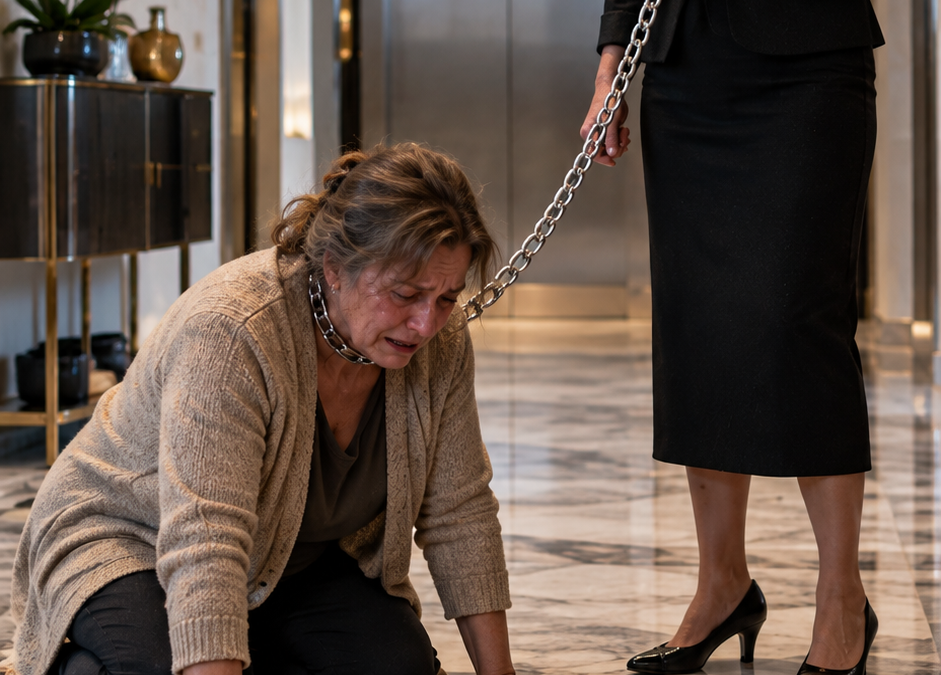
My mother was on her knees.
There was a dog chain around her neck.
For one second, I couldn’t breathe.
Donna Everett, the woman who had worked double shifts when I was a child so I could have school clothes, was kneeling on the marble floor of my apartment with broken eggs and spilled food around her.
Fresh cheese had rolled against the wall.
A container of mole had burst open.
Dark sauce streaked across the pale tile.
Handmade tortillas were scattered near the elevator.
And standing above my mother was my mother in law.
Hattie Coleman.
She was holding the end of the chain.
Laughing.
“Bark,” she repeated.
My mother’s face was red.
Not just from embarrassment.
From the pressure around her neck.
Something inside me broke.
“Hattie.”
She turned.
The smile disappeared from her face.
My mother looked at me.
“Penelope.”
The way she said my name nearly destroyed me.
Not because she sounded frightened.
Because she sounded ashamed.
As if she had done something wrong.
I walked toward them.
Hattie immediately lifted her chin.
“Your mother showed up uninvited.”
I stared at the chain.
“Take that off her.”
“She brought filthy food into the building.”
“Take it off.”
“She needs to learn some manners.”
I don’t remember deciding to move.
One second I was several feet away.
The next I was pulling the chain from Hattie’s hand.
She tried to hold on.
I yanked it away.
My mother gasped.
I dropped to my knees and loosened the metal from around her neck.
Red marks were already forming beneath her jaw.
My hands started shaking.
“Mom.”
“I’m okay.”
“No, you’re not.”
“It’s fine.”
Nothing was fine.
I helped her stand.
Then I turned toward Hattie.
She crossed her arms.
“What?”
I couldn’t believe her.
“What?”
“Yes. What?”
“You put a dog chain around my mother’s neck.”
“She was being dramatic.”
My mother whispered, “Penelope, please.”
Hattie rolled her eyes.
“See? Even she understands.”
That was the moment I slapped her.
The sound cracked through the hallway.
Hattie stumbled backward.
Her hand flew to her cheek.
For three years, I had listened to that woman insult me.
I had ignored every comment about where I came from.
Every joke about my clothes.
Every sneer when my mother called.
Every suggestion that because I had grown up in a small Montana town, I lacked class.
Every time Hattie acted as though I should be grateful Michael had chosen me.
I had swallowed it all.
Not anymore.
She stared at me.
“You hit me.”
“Yes.”
“You actually hit me.”
“You put a chain around my mother’s neck.”
“She needed to be taught a lesson.”
I grabbed the chain from the floor.
Hattie stepped backward.
“What are you doing?”
I looped it loosely around her neck.
I didn’t tighten it.
I didn’t pull.
I simply let the metal rest against her skin.
Then I looked directly into her eyes.
“Touch my mother again and you will finally meet the woman you have spent three years provoking.”
Her face changed.
For the first time since I had known her, Hattie looked afraid of me.
Good.
Unfortunately, that was the exact moment my husband arrived.
Michael stepped out of the elevator carrying his padel bag.
He saw his mother.
He saw the chain.
He saw me holding it.
But he didn’t look at the broken eggs.
He didn’t look at the food on the floor.
He didn’t look at my mother’s neck.
He didn’t ask what happened.
He dropped his bag.
“What the hell are you doing?”
Hattie’s entire personality changed instantly.
The arrogance disappeared.
Her face crumpled.
“Michael!”
She started crying.
“Your wife attacked me!”
I stared at her.
My mother tried to speak.
“She put—”
Michael didn’t let her finish.
He crossed the hallway.
Fast.
I saw his arm move.
Then his hand hit my face.
The impact snapped my head to the side.
For several seconds, I heard nothing.
Then a high ringing filled my ears.
I tasted blood.
My mother screamed.
“Michael!”
I slowly turned back toward my husband.
He had never hit me before.
Not once.
We had argued.
We had shouted.
There had been nights when we slept facing opposite walls.
But he had never raised a hand to me.
Until that day.
And the worst part wasn’t the pain.
It was his face.
There was no shock.
No regret.
No instant realization that he had crossed a line.
Only anger.
“You’ve lost your mind,” he shouted. “Get on your knees and apologize to my mother.”
I stared at him.
“You hit me.”
“She’s your elder.”
“You hit me.”
“You attacked my mother.”
“My mother was wearing a dog chain.”
He finally looked at Donna.
His eyes moved to the marks around her neck.
He saw them.
I know he did.
Then he looked away.
That was when my marriage ended.
Not when his palm hit my cheek.
When he saw what had been done to my mother and decided it didn’t matter.
Donna stepped forward.
“Michael, your mother put that chain around me.”
Hattie shouted immediately.
“She’s lying!”
My mother flinched.
I felt rage climb through my chest.
“You’re saying my mother put the chain around herself?”
“I’m saying she came here looking for trouble.”
Donna shook her head.
“I brought food for my daughter.”
“Garbage,” Hattie said.
Michael turned on my mother.
“That’s enough.”
I couldn’t believe what I was hearing.
“Don’t talk to her like that.”
He pointed at me.
“You need to calm down.”
“Your mother humiliated mine.”
“My mother says you attacked her.”
“There’s a camera.”
That stopped him.
Only for half a second.
But I saw it.
Hattie saw it too.
Their eyes met.
Interesting.
I filed that reaction away.
Michael recovered quickly.
“I don’t care.”
I almost laughed.
“You don’t care that the doorbell camera recorded everything?”
“I care that you put a chain around my mother’s neck.”
“She put it around mine first,” Donna said quietly.
Michael ignored her.
Then my mother did something I will never forget.
She started lowering herself.
At first I didn’t understand.
Then I realized she was trying to kneel.
“Mom.”
“If apologizing makes this stop—”
I grabbed her arms.
“No.”
“Penelope.”
“No.”
Her eyes filled with tears.
“I don’t want him to hurt you again.”
I pulled her upright.
Then I looked at Michael.
“Mom, you kneel only before God. Never before these people.”
Hattie made a disgusted sound.
“Listen to her. She thinks she’s royalty.”
That almost made me smile.
If Hattie had known what I actually owned, she might have chosen a different insult.
But she didn’t know.
Michael didn’t know either.
That had been intentional.
My name is Penelope Everett.
I was thirty one years old.
I worked as legal director for a real estate development company in Phoenix.
Most people who met me through Michael assumed I had a comfortable corporate job.
That was all I ever told his family.
What I never explained was that I had spent years investing aggressively.
Property.
Private funds.
Commercial partnerships.
Long term securities.
The apartment Michael and I lived in was mine.
Not ours.
Mine.
I had purchased it before our marriage through a structure Michael had never bothered to understand.
My investments could support me for decades.
I did not need Michael’s salary.
I had never needed it.
In fact, Michael contributed very little to our household.
He was an architect and design manager.
His salary was respectable.
But almost all of it went to his mother.
Groceries?
I paid.
Utilities?
Me.
Building fees?
Me.
Repairs?
Me.
Vacations?
Usually me.
Family dinners that Hattie ordered without looking at prices?
Also me.
Michael always had an explanation.
His mother had sacrificed for him.
She had debt.
She had medical bills.
Her house in Sedona needed repairs.
She had no one else.
And because I loved him, I tolerated it.
But I never told his family how much money I had.
Part of me was embarrassed to admit why.
I wanted to know whether they could love someone they believed came from less.
I grew up in Montana.
My mother had raised me modestly.
There were years when money was tight.
I knew what it meant to count groceries before reaching the register.
I knew what it meant to repair shoes instead of replacing them.
By the time I met Michael, my life was completely different.
But I never wanted wealth to become the reason someone stayed.
So I hid it.
I drove a nice but ordinary car.
I didn’t wear obvious luxury labels around Hattie.
I let Michael believe my salary and some investments paid our bills.
I wanted to know what his family thought of Penelope the woman, not Penelope the balance sheet.
Now I knew.
Six months before that morning, Hattie had moved into our apartment.
Supposedly because of health problems.
I objected.
Michael begged.
“She’ll only stay a few weeks.”
A few weeks became two months.
Two months became four.
At six months, she had redecorated the guest room and started calling the apartment “our place.”
She was healthier than either of us.
Every morning she walked several miles.
She spent afternoons shopping.
She went to social events.
Her greatest medical condition seemed to be an allergy to paying for anything herself.
Then she began asking strange questions.
“Whose name is on the deed?”
“What happens to the apartment if something happens to you?”
“Shouldn’t a married woman put property in her husband’s name?”
“What kind of wife keeps assets separate?”
I always smiled.
“An attorney.”
She hated that answer.
Once, she opened a drawer in my office.
I caught her.
“What are you doing?”
“I was looking for a pen.”
“In a locked file drawer?”
She immediately became offended.
“Are you accusing me of something?”
I had let it go.
That was my mistake.
Standing in that hallway with my cheek burning, I suddenly remembered every question.
Every drawer.
Every time Hattie had asked about ownership.
I looked at Michael.
Then at his mother.
Something larger was happening.
I just didn’t know what yet.
I walked into our bedroom.
Michael followed.
“Where are you going?”
I pulled a suitcase from the closet.
“What does it look like?”
“You’re being ridiculous.”
I opened the safe.
Documents.
Passport.
Laptop.
Backup drive.
A small folder containing financial information.
I packed them.
Michael stood in the doorway.
“If you walk out now, don’t come back.”
I stopped.
Then I turned.
He was standing in my bedroom.
Inside my apartment.
Threatening to ban me from property he didn’t own.
I almost laughed.
Instead, I zipped the suitcase.
“I’m not leaving my home, Michael.”
He frowned.
“I’m removing from my life what has already started to rot.”
His face hardened.
“What is that supposed to mean?”
“You’ll understand soon.”
Hattie appeared behind him.
She laughed.
“Oh please.”
I picked up my suitcase.
She smirked.
“Where are you going? Back to Montana?”
I walked past her.
My mother followed.
At the door, Michael shouted, “If you leave, we’re done.”
I looked back at him.
For three years, I had believed that man was my partner.
Now I saw him clearly.
“We were done the second you looked at the marks on my mother’s neck and decided your mother’s feelings mattered more.”
His jaw tightened.
“You’re dramatic.”
“No.”
I opened the door.
“I’ve just finally stopped being blind.”
Then I looked at Hattie.
She was smiling.
She thought she had won.
“Enjoy your last peaceful days.”
She laughed.
Michael laughed too.
Neither of them understood.
Before the elevator doors closed, I opened the building app on my phone.
I downloaded the complete doorbell video.
Then I sent a copy to my attorney.
The elevator descended.
Michael’s shouting disappeared.
My mother touched my cheek.
“Penelope.”
“I’m okay.”
“You shouldn’t have defended me like that.”
I stared at her.
“What?”
“He could have hurt you worse.”
“You were wearing a chain.”
Her eyes dropped.
That was Donna.
Even after being humiliated, she worried about everyone except herself.
The elevator opened into the lobby.
The concierge looked up.
His eyes moved to my suitcase.
Then my mother’s neck.
Then my cheek.
He looked away immediately.
That told me something.
People had seen.
People always saw.
They simply pretended they didn’t.
Outside, the Phoenix heat hit us like a wall.
My mother stopped near the curb.
“Where are we going?”
I looked up toward my apartment windows.
“Somewhere they can’t reach us.”
“Your apartment?”
“Not tonight.”
She looked confused.
“Why?”
Because I wanted Michael comfortable.
I wanted Hattie arrogant.
I wanted both of them to believe they had frightened me away.
People become careless when they think they have won.
I opened the car door.
“I’m waiting.”
“For what?”
“Their first mistake.”
It came faster than I expected.
One hour later, my mother and I were inside a hotel across the city.
I opened my laptop.
Donna sat on the edge of the bed.
I logged into the secure cloud system connected to my legal office.
Then I opened the video.
10:14:37 a.m.
Hattie appeared on screen.
My mother arrived carrying her basket.
Watching it from the beginning was somehow worse.
Donna looked excited.
She had traveled for hours.
She had made food for me.
Fresh eggs.
Cheese.
Nopales.
Tortillas.
Mole.
Things she knew reminded me of home.
Hattie opened the door.
Her expression changed immediately.
“You think you’re bringing those things into this house?”
Donna smiled uncertainly.
“I brought them for Penelope.”
“We don’t eat country trash here.”
My jaw tightened.
My mother watched beside me.
On screen, she tried to laugh.
“Everything is fresh.”
Hattie slapped the basket from her hands.
Eggs shattered.
The mole container burst.
Food scattered everywhere.
Donna bent down.
Then Hattie said, “Your daughter already lives off my son. Now you’ve come to beg too?”
I paused the video.
My hands were shaking.
My mother whispered, “Keep going.”
I didn’t want to.
But I did.
Hattie picked up the dog chain.
My mother sucked in a breath beside me.
Then the chain went around her neck.
“Turn it off.”
I paused immediately.
Donna covered her face.
“I don’t want to see it again.”
“You never have to.”
For several minutes, we sat silently.
Then my phone vibrated.
Michael.
Where are you?
Another message.
You embarrassed my mother.
Then:
Come home and apologize.
I stared at the screen.
Nothing about Donna.
Not one question.
Is she okay?
Did my mother hurt her?
How bad are the marks?
Nothing.
I typed a response.
Deleted it.
Typed another.
Deleted that too.
Finally, I turned the phone over.
“Let him wonder.”
My mother looked at me.
“You sound different.”
“I am different.”
That night I called my attorney, Elena Vargas.
Elena and I had worked together for years.
She knew about my property structure.
She knew about my investments.
And unlike Michael, she knew exactly how serious I was when I became quiet.
She answered on the second ring.
“You sent me the recording.”
“Yes.”
“I watched it.”
There was anger in her voice.
“What happened after the recording stopped?”
I told her.
Michael arriving.
The slap.
The demand that I kneel.
My mother attempting to apologize.
The suitcase.
Everything.
Elena went silent.
Then she said, “Do not go back to that apartment.”
“I wasn’t planning to.”
“Good.”
Her tone changed.
“Because this may not only be a domestic violence matter.”
I sat straighter.
“What do you mean?”
“You told me Hattie has been asking about the deed.”
“Yes.”
“Specifically whether you would transfer ownership to Michael?”
“Yes.”
“Has Michael ever seen your original purchase documents?”
“No.”
“Does he understand the ownership structure?”
“No.”
“Good.”
I frowned.
“Why is that good?”
“I checked something after watching the video.”
“What?”
“The property records.”
My stomach tightened.
“Elena.”
“Someone made an inquiry against your property six weeks ago.”
I stood.
“Who?”
“The request used Michael’s information.”
I stared at the window.
“Michael?”
“That’s how it appears.”
“He doesn’t know enough about my finances.”
“Are you sure?”
“Yes.”
“Then someone may have been investigating your assets without your knowledge.”
I barely slept.
At 4:17 a.m., my phone lit up.
Unknown number.
One message.
You should ask your husband why he visited the bank last month.
I stared at it.
Then a photograph appeared.
Michael stood outside a private banking building.
I recognized the gray jacket.
I had bought it for him.
Beside him stood Hattie.
And beside Hattie stood an older man.
I zoomed in.
My heart stopped.
Arthur Coleman.
Michael’s father.
A man who, according to every story I had heard for three years, had been dead for eleven years.
My mother woke.
“What is it?”
I locked the screen.
“Nothing.”
But everything had just changed.
At 7:30, Elena called.
“You received something?”
“Yes.”
“Send it.”
I forwarded the photograph.
She called again minutes later.
“I ran the man.”
“Arthur?”
“Yes.”
“He’s dead.”
“No.”
My skin went cold.
“What?”
“There is no death certificate that matches the story Michael’s family told you.”
I sat down.
“That’s impossible.”
“Three years ago, shortly before you married Michael, someone using the name Arthur Cole opened a company in Nevada.”
“Cole?”
“Close enough to Coleman to be interesting.”
“What did the company do?”
“It bought debt.”
“Whose?”
Elena paused.
“Hattie’s.”
Everything inside me went still.
“The Sedona house?”
“Among other things.”
“So Arthur is alive.”
“It appears so.”
“Why would his own family pretend he was dead?”
“I don’t know yet.”
Then Elena said, “There’s more.”
Of course there was.
“What?”
“That company also bought a controlling interest connected to Michael’s architectural firm.”
I closed my eyes.
Michael had spent years telling me the firm struggled.
Investors were difficult.
Projects fell through.
Money was tight.
His mother needed help.
He needed me to be patient.
I had paid more.
Contributed more.
Asked fewer questions.
My phone vibrated.
Michael.
You think leaving makes you safe?
A second message.
You have no idea what you married into.
Then a third.
Ask your mother what happened in Montana twenty five years ago.
I slowly looked toward Donna.
She stood near the window.
“Mom.”
She turned.
I showed her the phone.
The color disappeared from her face.
She didn’t ask what Michael meant.
That frightened me more than anything.
“What happened in Montana?”
She sat down slowly.
“I prayed you would never have to know.”
My heart began pounding.
“Know what?”
She started crying.
“Your father didn’t abandon us.”
I stared at her.
For my entire childhood, I had believed my father left.
Daniel Everett.
A man I knew mostly through photographs.
My mother rarely spoke about him.
When I asked, she always said he couldn’t stay.
I had translated that the way children do.
He didn’t want us.
“What are you saying?”
“He didn’t leave.”
“Then where is he?”
My mother covered her mouth.
“Your father was murdered.”
The room went silent.
I stood so quickly that the chair behind me fell.
“No.”
“I’m sorry.”
“You told me he left.”
“I was trying to protect you.”
“From what?”
She began shaking.
“There were people involved.”
“What people?”
“People connected to money. Property. Investments. Companies that existed on paper and disappeared when anyone asked questions.”
I stared at her.
“What did Dad do?”
“He discovered something.”
“What?”
“He realized money was being moved through construction businesses and property deals.”
My stomach turned.
Construction.
Architecture.
Property.
Michael’s world.
“What does Hattie have to do with this?”
My mother opened an old leather bag she had carried from Montana.
She removed a photograph.
My father stood in it.
Younger.
Smiling.
Beside him stood a woman.
Hattie.
And between them was a little boy.
Michael.
The photograph was twenty five years old.
I turned it over.
Four words were written on the back.
THE DEBT MUST BE PAID.
I stared at my mother.
“Why was Michael with my father?”
“Because Daniel knew the Coleman family.”
“What did they do to him?”
My mother looked away.
“They didn’t try to kill him because of money.”
“Then why?”
“Because he refused to give them something.”
“What?”
“The truth.”
Three knocks hit the hotel door.
Slow.
My mother froze.
Another knock.
Then:
“Penelope?”
Michael.
My blood went cold.
“How did he find us?”
Donna grabbed my arm.
“Don’t open it.”
“I won’t.”
The handle moved.
Once.
Twice.
Then stopped.
Michael spoke again.
“I know you’re inside.”
I stayed silent.
“You have something that belongs to my family.”
I looked at the photograph.
The recording.
My computer.
Documents.
It finally clicked.
He hadn’t come because he loved me.
He wasn’t there to apologize.
He wanted something.
Maybe the photograph.
Maybe information from my father.
Maybe my property.
Maybe all of it.
I called Elena.
“Michael is outside.”
“Don’t open the door.”
“I’m not.”
“I’m contacting hotel security and police.”
Then she said, “I found your father’s old case.”
My breathing stopped.
“What does it say?”
“He wasn’t officially confirmed murdered.”
I looked at Donna.
“What?”
“He disappeared after an attack.”
“And?”
“There was a witness.”
“Who?”
Elena hesitated.
“Hattie Coleman.”
The hallway suddenly became silent.
Then footsteps moved away.
Michael had left.
But he had already made another mistake.
Hotels have cameras.
Two hours later, police located Michael and Hattie at my apartment.
They weren’t packing clothes.
They were packing documents.
My documents.
Property records.
Bank statements.
Investment files.
Copies of financial correspondence.
And a folder containing samples of my signature.
When Elena showed me the folder, I felt physically sick.
“These are forged.”
Several documents appeared to transfer interests in property.
Others appeared designed to authorize transactions.
My signature was close.
Very close.
But not mine.
Michael’s face changed when police confronted him.
Hattie pointed at him.
“He did it!”
Michael stared at her.
“You told me to.”
“I did not!”
“You said she would never notice!”
Hattie screamed.
“You ungrateful idiot!”
I watched them from several feet away.
For three years they had acted like one united family.
Now it took less than thirty seconds for them to turn on each other.
I didn’t say anything.
I didn’t need to.
One officer opened another folder.
Inside was the original version of my father’s photograph.
Same image.
Same words.
THE DEBT MUST BE PAID.
But underneath was another sentence.
NOT BY PENELOPE.
My mother started crying.
I looked at her.
“Dad wrote this?”
“Yes.”
“He knew they might come after me?”
“Yes.”
“Why?”
“Because he believed the Colemans would eventually blame our family for what they lost.”
I turned toward Michael.
“For three years, you pretended to love me.”
His face dropped.
“I did love you.”
“No.”
“You don’t understand.”
“I understand more than you wanted me to.”
He took a step forward.
An officer stopped him.
Michael looked desperate.
“At first, I didn’t know how much you had.”
There it was.
I stared at him.
“At first?”
He realized his mistake.
Too late.
“What happened after you knew?”
He looked at the floor.
“My mother found things.”
“What things?”
“Statements.”
I laughed softly.
“Hattie wasn’t looking for a pen in my office.”
He said nothing.
“She was searching my financial records.”
“I didn’t know at first.”
“But later?”
Silence.
“Later, you helped her.”
His eyes filled.
“I thought your money could save us.”
I nodded.
Finally.
The truth.
“You married me for money.”
“No.”
“Then why did you forge my signature?”
“I didn’t forge all of them.”
Even the officer looked at him.
I almost smiled.
“What a defense.”
“Penelope.”
“No.”
I looked toward Hattie.
She was still shouting.
“She stole everything from us!”
I turned.
“No, Hattie.”
I held up my phone.
The doorbell video was ready.
“You tried to steal my dignity.”
Then I pointed to Donna.
“You put a chain around the woman who raised me.”
Finally, I looked at Michael.
“And when you had a choice, he chose you.”
His face collapsed.
I walked away.
The investigation lasted months.
What police found was worse than anything I had imagined.
Hattie had manipulated family finances for years.
Michael had secretly accessed information connected to my investments.
The forged papers were part of an attempt to establish control over assets that never belonged to him.
Arthur Coleman had not died eleven years earlier.
That story was a lie.
He had disappeared after cooperating with investigators.
Eventually, Arthur came forward.
For the first time, I saw him somewhere other than an old photograph.
He looked exhausted.
Older than his age.
Michael’s eyes.
Michael’s jaw.
But none of Hattie’s arrogance.
Arthur confirmed that decades earlier, Hattie’s family had been connected to a financial operation involving real estate projects, shell companies, questionable loans, and people who were pressured into silence.
My father discovered part of it.
He refused to participate.
Then he tried to expose it.
Someone attacked him.
Everyone assumed he died.
He didn’t.
My mother had been wrong about that part.
Daniel survived.
But he disappeared.
For twenty five years, my father lived under another identity.
When Elena told me, I sat silently for almost a full minute.
“My father is alive?”
“Yes.”
My mother started crying.
Neither of us knew what to do with that sentence.
Alive.
I had spent most of my life grieving a man I thought had abandoned me.
Then grieving a man I believed had been murdered.
Now I was being told he had been alive the entire time.
I was angry.
Relieved.
Confused.
And terrified to hope.
A few weeks later, a letter arrived for Donna.
No return address.
Three words on the envelope.
HE IS ALIVE.
We traveled to Montana together.
For most of the drive, my mother barely spoke.
As the mountains rose around us, she became quieter.
Every mile seemed to take years off her face.
By the time we reached the small town Elena had identified, Donna looked less like my mother and more like a frightened young woman going back to a life she had buried.
We stopped outside a modest house.
My mother couldn’t move.
“Mom.”
“What if it isn’t him?”
“What if it is?”
She looked at me.
“I don’t know which scares me more.”
We got out.
Before we reached the porch, the door opened.
An older man stood there.
Gray hair.
Thin face.
Tired eyes.
I knew him immediately.
Not because I remembered him.
Because I had spent my childhood staring at his photographs.
My mother whispered one word.
“Daniel.”
His face broke.
“Donna.”
Then he looked at me.
For a few seconds, nobody moved.
“Penelope.”
I started crying.
I hated that he knew my name.
I loved that he knew my name.
I crossed the distance between us.
I threw my arms around him.
Then I hit his chest.
“You left us.”
He held me tighter.
“I know.”
“You were alive.”
“I know.”
“You should have told me.”
“I wanted to.”
“Then why didn’t you?”
He closed his eyes.
“Because every time I thought about coming home, I remembered the men who had almost killed me.”
I pushed away.
“You let me believe you didn’t want me.”
His face twisted with pain.
“I know.”
“You let Mom raise me alone.”
“Yes.”
“You knew where we were?”
“Sometimes.”
“What does that mean?”
“I received information when it was safe.”
“So you watched my life from somewhere else?”
“Pieces of it.”
I laughed bitterly.
“Everybody has been watching my life except me.”
My mother cried.
Daniel looked at her.
“I’m sorry.”
She slapped him.
Hard.
He didn’t move.
Then she hugged him.
For the first time in twenty five years, my parents stood together.
It wasn’t a beautiful movie reunion.
It was messy.
My mother yelled.
My father cried.
I asked questions he couldn’t answer without hurting me.
Sometimes I left the room.
Sometimes he did.
But for the first time, our pain was based on truth.
That mattered.
Back in Phoenix, my marriage ended quickly.
Michael tried to contact me repeatedly.
At first he apologized.
Then he blamed his mother.
Then he blamed his father.
Then financial pressure.
Then me.
One message said:
You hid who you were too.
That one almost made me respond.
Almost.
Yes.
I had hidden my wealth.
But there was a difference between keeping a bank balance private and forging another person’s signature.
Michael knew that.
Eventually, Elena handled all communication.
Hattie was removed from my apartment.
The locks changed.
Her belongings were packed.
The dog chain remained in a kitchen drawer for several weeks.
I don’t know why.
Maybe part of me needed to see it.
A reminder.
Then one afternoon, my mother found me holding it.
“Throw it away.”
I looked at her.
“Are you sure?”
“Yes.”
I dropped it into the trash.
Metal hit the bottom of the bin.
That sound felt final.
A year later, I stood in the doorway of the same apartment.
It looked completely different.
Not because I had renovated much.
Because Michael was gone.
Hattie was gone.
Their voices were gone.
No criticism.
No doors opening without permission.
No questions about deeds.
No demands.
My mother stood beside me.
“You kept it.”
I looked around.
“No.”
She frowned.
I smiled.
“I reclaimed it.”
Donna squeezed my hand.
My father had moved closer to Phoenix.
Our relationship was still complicated.
There were mornings when I wanted to call him Dad.
There were others when I wanted to ask how he could have stayed away so long.
He never demanded forgiveness.
That helped.
One evening, I asked him the question that had bothered me most.
“If you could do it again, would you leave?”
He stared at his coffee for a long time.
“No.”
I was surprised.
“Why?”
“Because I confused keeping you alive with being your father.”
He looked at me.
“I protected your body and abandoned your childhood.”
That answer hurt.
But it was honest.
“What would you do instead?”
“I would have found another way.”
“Even if it was dangerous?”
“Yes.”
I nodded.
For the first time, I began to understand that admitting a choice was wrong didn’t erase why someone made it.
My mother also changed.
For years she had made herself small.
She apologized before anyone blamed her.
She worried about inconveniencing people who hurt her.
After what happened with Hattie, something inside her shifted.
One day we were grocery shopping and a woman cut in front of her.
Donna said, calmly, “Excuse me. There’s a line.”
I almost laughed.
She looked at me.
“What?”
“Nothing.”
“Why are you smiling?”
“I’m proud of you.”
She rolled her eyes.
But she smiled too.
As for Michael, I saw him one final time during a legal proceeding.
He looked thinner.
Older.
He waited until his attorney stepped away.
“Penelope.”
I stopped.
He looked at me.
“I really did love you.”
A year earlier, those words might have destroyed me.
Now they didn’t.
“I believe you thought you did.”
His face tightened.
“That’s cruel.”
“No.”
I shook my head.
“It’s the kindest version of the truth I can give you.”
He looked down.
“I made mistakes.”
“You hit me.”
“I know.”
“You watched your mother humiliate mine.”
“I know.”
“You helped search my finances.”
He said nothing.
“You participated in paperwork designed to take property that wasn’t yours.”
“I was scared.”
“So was I.”
He finally looked at me.
“My family was falling apart.”
“And you decided mine should pay for it.”
“I didn’t think it would go that far.”
“That’s the problem, Michael.”
“What?”
“You never thought about how far anything went as long as you weren’t the one being hurt.”
He closed his eyes.
I walked away.
He called after me.
“Do you hate me?”
I stopped.
For a moment, I considered the question.
Then I turned.
“No.”
He looked almost relieved.
I continued.
“Hating you would require giving you a place in my life you no longer have.”
Then I left.
That night, I returned home.
My mother was on the balcony.
Phoenix stretched beneath us.
The city lights appeared one by one.
She handed me a cup of tea.
“You’re smiling.”
“I finally feel free.”
She leaned against the railing.
“Do you regret marrying him?”
I thought about Michael.
The good years.
The laughter.
The lies.
Hattie.
The chain.
My father.
Everything.
Then I shook my head.
“No.”
My mother seemed surprised.
“Why?”
“Because if I hadn’t married Michael, I might never have learned who any of them really were.”
“And your father?”
“I might never have found him.”
Donna nodded.
“And now?”
I looked across the city.
“Now they don’t get another chance.”
The wind moved across the balcony.
For years, silence had made me nervous.
Silence meant someone was hiding something.
Someone was angry.
Someone was waiting.
That night, silence felt different.
Peaceful.
My name is Penelope.
I lost a husband.
I learned that my mother in law had despised me because she believed kindness meant weakness.
I discovered that the man I married had known far more about my money than he ever admitted.
I found documents carrying signatures that looked like mine but weren’t.
I learned that a dead man was alive.
Then I learned my own father was alive too.
And everything began because one woman believed she could put a chain around my mother’s neck and order her to bark without consequences.
Hattie thought she was humiliating a poor woman from Montana.
Michael thought he was defending his mother from an unstable wife.
They both thought I was the easiest person in the room to control.
They were wrong.
But the most important thing I learned wasn’t about money.
It wasn’t about revenge.
It wasn’t even about winning.
It was about the moment you finally stop explaining cruelty for the people who commit it.
For three years, I had excuses.
Hattie was lonely.
Michael was stressed.
His family had problems.
His mother came from another generation.
She didn’t understand boundaries.
Michael didn’t want conflict.
He was caught in the middle.
Every excuse kept me in the same place.
Then I saw my mother on her knees.
And all the excuses disappeared.
There are moments when your life becomes divided into before and after.
Before the chain, I still believed patience could fix my marriage.
After the chain, I understood that patience without boundaries was simply permission.
Before Michael hit me, I thought he would choose what was right if the situation ever became serious enough.
After he hit me, I knew exactly what he would choose.
His mother.
His comfort.
His version of the story.
Anything except accountability.
The mark on my cheek disappeared after a few days.
The lesson didn’t.
Neither did the image of my mother trying to kneel to protect me.
That image stayed.
Sometimes, late at night, I still remembered it.
My mother lowering herself.
Michael standing there.
Hattie watching.
And me catching Donna before her knees touched the floor.
“Mom, you kneel only before God.”
At the time, I thought I was protecting her dignity.
Months later, I realized I had also been speaking to myself.
I had spent three years kneeling emotionally.
Trying to earn respect from people who benefited from withholding it.
Trying to prove I was a good wife.
Trying to prove I wasn’t after Michael’s money when the truth was almost laughable.
I had more than he did.
Much more.
Yet I allowed myself to be treated like the dependent one.
Why?
Because sometimes smart people can still make terrible emotional bargains.
I thought if I remained humble, they would eventually see my character.
Instead, they saw opportunity.
Hattie believed my silence meant ignorance.
Michael believed my generosity meant dependence.
Neither understood that I had been paying attention.
The property questions.
The drawers.
The bank visit.
The fake signatures.
The strange history.
I had been watching pieces of the truth without understanding the full picture.
The chain simply forced me to stop looking away.
A few months after everything ended, I had lunch with Elena.
She placed a folder on the table.
“What’s this?”
“Final documentation on the apartment.”
I opened it.
Everything was clean.
Every attempted claim resolved.
Every questionable authorization flagged.
My property was secure.
I closed the folder.
“Thank you.”
Elena studied me.
“You know something?”
“What?”
“I thought the legal fight would be the hardest part for you.”
“It wasn’t.”
“What was?”
“Accepting that Michael knew what he was doing.”
She nodded.
“That usually is.”
“For months, I kept trying to find the moment when he became someone else.”
“Did you?”
“No.”
I looked out the restaurant window.
“I think the harder truth is that he was always capable of being that person. I just hadn’t seen the right situation yet.”
Elena didn’t disagree.
I continued.
“People keep asking when I knew my marriage was over.”
“What do you tell them?”
“Not when he hit me.”
She raised an eyebrow.
“No?”
“When he looked at my mother’s neck.”
I could still see it.
Michael’s eyes.
The red marks.
That tiny pause.
He saw.
He understood.
Then he chose his mother anyway.
“That was the moment.”
Elena nodded.
“Because hitting me was anger. Looking away was a decision.”
She sat quietly for a moment.
Then she said, “That’s probably the strongest piece of the entire case.”
I shook my head.
“No.”
“What is?”
“The video.”
She smiled slightly.
“Attorney answer.”
“I learned from the best.”
For the first time in months, we laughed.
Life became ordinary again.
That was the strangest part.
After so much drama, normal life felt almost suspicious.
I went to work.
Reviewed contracts.
Attended meetings.
Argued with developers over risk clauses.
Bought groceries.
Called my mother.
Had dinner with my father.
There were no mysterious messages.
No people searching drawers.
No one demanding access to my home.
Peace felt boring.
And I learned to love boring.
One Saturday morning, Donna arrived at the apartment again.
For one second, when the doorbell rang, my entire body tensed.
Then I opened the door.
She stood there holding a basket.
Exactly like before.
Eggs.
Cheese.
Tortillas.
A jar of mole.
I stared.
She smiled.
“What?”
“Mom.”
“What?”
“You really brought the basket again?”
“Yes.”
I started laughing.
She laughed too.
We carried it into the kitchen.
This time, nothing hit the floor.
No one insulted her.
No one called her food trash.
We cooked breakfast.
My father arrived later.
Daniel took one bite of Donna’s mole and closed his eyes.
“I thought about this for twenty five years.”
My mother stopped moving.
“So you remember.”
“How could I forget?”
She looked away, trying to hide tears.
I watched them.
There was still pain between them.
A lot.
But there was also history.
Real history.
Not the manufactured story I had grown up with.
I realized something then.
Finding the truth doesn’t restore the years people lost.
It simply gives them a chance to stop losing more.
That became my rule.
I couldn’t recover my marriage.
I couldn’t recover my childhood with my father.
I couldn’t erase what Hattie had done to my mother.
But I could stop giving those events more years.
I could decide what happened next.
That was what freedom actually looked like.
Not revenge.
Choice.
Months later, I received a letter from Michael.
I almost threw it away unopened.
Then curiosity won.
He wrote that he was sorry.
He said Hattie had controlled him most of his life.
He said he had been raised to believe family loyalty meant never questioning her.
He said when he discovered the extent of my assets, fear changed him.
His firm was in trouble.
Hattie’s debts were worse than he admitted.
He convinced himself that because we were married, using my resources without permission wasn’t really stealing.
That sentence stayed with me.
People can justify almost anything once they decide love gives them ownership.
Michael wrote that he regretted hitting me.
He regretted the documents.
He regretted what happened to Donna.
At the end, he wrote:
I know I chose my mother when I should have chosen my wife.
I folded the letter.
Then I put it away.
Not because I forgave him.
Not because I wanted him back.
Because those words answered the last question I had.
He knew.
Maybe not immediately.
Maybe not clearly enough at the time.
But eventually, he understood exactly what he had done.
I didn’t need anything else from him.
Hattie never apologized.
That didn’t surprise me.
According to the little information that reached me through lawyers, she still told people I had destroyed her family.
In her version, I had been manipulative.
Secretive.
Cold.
She claimed I had tricked Michael by hiding my money.
She called the doorbell recording “out of context.”
I laughed when Elena told me.
“Which context makes putting a chain around an elderly woman’s neck acceptable?”
“Apparently we haven’t discovered that legal doctrine yet.”
I smiled.
“Keep researching.”
We both knew it didn’t matter.
Hattie’s story belonged to Hattie.
The evidence belonged to reality.
For years, I had wasted energy trying to control how people saw me.
After everything happened, I stopped.
Some people believed Michael.
Some believed Hattie.
Most people who saw the recording understood immediately.
But eventually I realized none of that determined what happened next.
My life did not require a unanimous jury of strangers.
One evening, my mother and I sat on the balcony again.
She touched her neck absentmindedly.
The marks had disappeared long ago.
I noticed.
“Does it still bother you?”
She knew what I meant.
“Sometimes.”
“Why didn’t you fight her?”
Donna looked surprised.
“Hattie.”
She smiled sadly.
“I was embarrassed.”
“You had nothing to be embarrassed about.”
“I know that now.”
“But then?”
She looked toward the city.
“When someone treats you like you’re beneath them, sometimes the first feeling isn’t anger.”
“What is it?”
“Confusion.”
I understood.
“You think maybe you did something wrong.”
“Yes.”
She looked at me.
“That is how humiliation works.”
I reached for her hand.
“I’m sorry.”
“For what?”
“That you had to go through it.”
She squeezed my fingers.
“You came.”
“Of course I came.”
“No.”
Her eyes filled.
“You came.”
I finally understood.
She wasn’t talking about crossing the apartment hallway.
She meant I had stood beside her.
Publicly.
Immediately.
Without calculating whether defending her would make my marriage harder.
I leaned my head against her shoulder.
“I always will.”
She kissed my hair.
And just like that, for a few minutes, I wasn’t a lawyer.
I wasn’t a woman recovering from a failed marriage.
I wasn’t someone who had uncovered decades of family secrets.
I was simply Donna’s daughter.
That was enough.
A year after the incident, I changed one thing in the apartment.
The hallway floor.
There was nothing wrong with the marble.
No physical damage remained.
But every time I walked across it, I saw broken eggs.
Mole.
Tortillas.
My mother kneeling.
So I replaced it.
The contractor asked why.
“I’m tired of the color.”
That was true enough.
When the work finished, Donna came over.
She noticed immediately.
“You changed the floor.”
“Yes.”
“Because of that day?”
I hesitated.
“Yes.”
She looked down.
Then back at me.
“Good.”
I smiled.
“You approve?”
“I do.”
“Why?”
“Because sometimes reclaiming something means you change the parts that still remember.”
I laughed.
“When did you become philosophical?”
“After raising you.”
We stood there laughing in the same hallway where our lives had exploded.
The memory didn’t disappear.
But it lost some of its power.
And that was enough.
One afternoon, my father asked whether I hated Hattie.
“No.”
He looked surprised.
“You don’t?”
“I don’t want anything from her.”
“That isn’t the same question.”
I thought about it.
“No. I don’t hate her.”
“Why?”
“Because she already took enough.”
My father nodded slowly.
“I understand that.”
Of course he did.
He had given twenty five years to fear.
I refused to give Hattie the rest of mine.
That didn’t mean forgetting.
It meant remembering without obeying the memory.
There is a difference.
The final documents from my divorce arrived on a Wednesday.
No dramatic music.
No courtroom speech.
No confrontation.
Elena emailed them.
I signed.
She filed.
That was it.
Three years of marriage ended with a digital signature.
I stared at the confirmation screen.
Then I walked into the kitchen and made coffee.
A strange laugh escaped me.
Michael had once tried to use a forged version of my signature to take what belonged to me.
Now my real signature was the thing that finally removed him from my life.
There was poetry in that.
That evening, Donna called.
“It’s done?”
“Yes.”
“How do you feel?”
I considered lying.
Fine.
Relieved.
Happy.
Instead, I told the truth.
“Sad.”
She was quiet.
“Is that bad?”
“No.”
I looked around the apartment.
“I loved him.”
“I know.”
“Even after everything, part of me remembers who I thought he was.”
“That’s normal.”
“I hate that.”
“Why?”
“Because he doesn’t deserve good memories.”
My mother sighed softly.
“The memories belong to you, Penelope. Not him.”
I stopped.
“What?”
“If there were days when you were happy, you were happy. You don’t have to destroy those days to prove what he later did was wrong.”
That stayed with me.
Healing was full of ideas like that.
Things nobody tells you when the anger is fresh.
You can miss someone and still never want them back.
You can remember love without denying betrayal.
You can forgive parts of yourself without forgiving what happened.
You can move forward without pretending the past was meaningless.
Michael had been my husband.
I had loved him.
He hurt me.
Both could be true.
The truth didn’t need to be simple to be final.
Several months later, my company completed a major development project.
At the celebration, one of the executives raised a glass to me.
“To Penelope, the woman who catches what everyone else misses.”
People laughed.
I did too.
But privately, the words hit me.
I had built my career on noticing risk.
Reading documents.
Finding hidden liabilities.
Asking what wasn’t being said.
Yet inside my own marriage, I had ignored warning after warning.
For a while, I was ashamed of that.
Then I realized another truth.
Professional intelligence doesn’t make someone immune to emotional manipulation.
Sometimes it makes things worse.
You assume that because you are competent in one area, you’ll recognize danger everywhere.
You don’t.
Love creates blind spots no contract ever could.
I stopped blaming myself for having one.
Instead, I promised myself I would never again confuse discomfort with cruelty.
Discomfort can be worked through.
Cruelty must be confronted.
Hattie had been cruel long before the chain.
The chain was simply the first cruelty I refused to rename.
I should have recognized it earlier.
But I recognized it eventually.
That had to be enough.
On the anniversary of that morning, my mother came over.
She brought breakfast.
My father came too.
We ate on the balcony.
No one mentioned Hattie.
No one mentioned Michael.
Then Donna raised her coffee cup.
“To starting over.”
Daniel lifted his.
“To second chances.”
I lifted mine.
“To boundaries.”
My mother laughed.
“Of course the lawyer chooses boundaries.”
“Someone has to.”
We clinked cups.
The city was waking below us.
For once, everything felt ordinary.
Beautifully ordinary.
I thought about the woman I had been one year earlier.
She believed patience would eventually earn respect.
She believed love meant absorbing discomfort.
She believed keeping her financial independence quiet protected her from being used.
She believed marriage automatically created loyalty.
She believed Michael would choose her when it mattered.
That woman wasn’t stupid.
She simply didn’t have the information I had now.
I no longer hated her for that.
I thanked her.
She had survived long enough for me to become someone stronger.
People sometimes ask what I would say to Hattie if I saw her again.
Nothing.
That surprises them.
They expect some devastating speech.
Some perfect revenge line.
Some moment where I tell her I own the apartment, reveal my money, and watch her collapse.
But Hattie already knows what she lost.
She knows she was removed from a home she tried to claim.
She knows the woman she called a peasant walked out with her dignity.
She knows the daughter she underestimated had every piece of evidence needed to expose what was happening.
Most importantly, she knows I stopped caring whether she approved of me.
For someone like Hattie, that is worse than any insult.
As for Michael, I hope he eventually understands one thing.
The moment that destroyed our marriage wasn’t the moment I struck his mother.
It wasn’t even the moment he struck me.
It happened seconds earlier.
He arrived.
He saw his mother crying.
He saw me holding the chain.
And without asking one question, he decided who was guilty.
That was the truth of our marriage in a single moment.
His mother’s tears counted as evidence.
My words did not.
Her humiliation mattered.
My mother’s did not.
His family deserved protection.
Mine did not.
Once I understood that, there was nothing left to save.
The legal documents simply caught up later.
Sometimes I still think about the sentence I told him before leaving.
Enjoy your last peaceful days.
At the time, it sounded like a threat.
It wasn’t.
I never wanted revenge.
I wanted truth.
And the truth did exactly what threats couldn’t.
It exposed everything.
The property inquiries.
The bank visit.
Arthur.
The company.
The debt.
The forged signatures.
The connection to my father.
Daniel being alive.
All of it.
Michael and Hattie believed the danger came from what I might do to them.
They were wrong.
Their own actions destroyed them.
I simply stopped protecting them from consequences.
That is a very different thing.
My mother taught me one final lesson from that day.
Months after everything ended, I asked her why she had brought so much food.
She looked confused.
“What do you mean?”
“You drove for hours. Why bring eggs and cheese and tortillas and mole?”
She smiled.
“Because you told me you were tired.”
I had forgotten.
Weeks before, during a phone call, I had mentioned working late.
That was it.
One sentence.
My mother remembered.
She made food.
Packed it.
Drove hours.
And arrived at my door because she thought her daughter needed something homemade.
Hattie looked at that basket and saw poverty.
I looked at it now and saw love.
That was the difference between them.
Hattie measured people by what they could give her.
Donna gave because she loved.
For years, I had been trying to win approval from the wrong kind of person.
Never again.
My apartment still belongs to me.
My investments are secure.
My career is stronger than ever.
My mother visits whenever she wants.
My father is slowly becoming part of my life instead of a photograph inside it.
And somewhere in Phoenix, Michael is living with the consequences of decisions he once believed I would never discover.
I don’t know what Hattie tells people now.
I don’t care.
The woman she ordered to bark sits at my table.
The daughter she called a burden owns the home Hattie once tried to claim.
The husband who demanded I kneel no longer has a key.
And the woman who walked into that elevator with a swollen cheek never came back.
Someone else did.
Someone who finally understood that walking away isn’t always losing.
Sometimes walking away is the first time you stop negotiating with people who have already shown you what they think you are worth.
That morning, Michael told me that if I crossed the door, I should never return.
He thought he was throwing me out.
He never understood that the door was mine.
The apartment was mine.
The future was mine.
And after three years of letting his family decide how small I should become, my life was finally mine too.








