My Mother-in-Law Kicked My Son’s Cake Across the Patio—Then His Bloodwork Exposed Her Four-Year Secret
PART2
The spoon almost slipped from my hand.
I looked down at him.
My beautiful little boy.
Soft cheeks.
Big brown eyes.
A heart so open it terrified me.
A lump formed in my throat, but I smiled because mothers become very good at smiling over pain when their children still need a world that feels possible.
“Just be polite, sweetheart.”
That was my cowardice.
I know that now.
I should have said, “You do not have to earn love with cake.”
I should have said, “If someone refuses to love you, that is about what is broken in them, not what is missing in you.”
I should have said many things.
Instead, I handed him the prettiest bowl.
At noon, the patio filled with people. The air smelled of incense, coffee, warm earth, and baked sugar. Madeline appeared at the top of the steps wearing a dark purple dress, her gray-streaked hair pinned up, gold earrings catching the sun. She greeted everyone with the smile of a queen receiving tribute.
Then she saw Luke and me.
Her face hardened.
Brandon was inside taking a call in his study. He had been trying all morning to keep the peace, which, in his family, usually meant keeping his mother comfortable and hoping I would be patient enough to call it maturity.
I placed the bowl into Luke’s hands.
“Carry it carefully,” I told him. “Say, ‘Grandma, I brought you some cake.’”
He nodded solemnly.
“It’s cobbler, Mommy.”
“You’re right. Say cobbler.”
He looked very serious.
“Grandma, I brought you some cobbler.”
“That’s perfect.”
Luke walked through the crowd with both hands around the bowl. Some relatives smiled. Brandon’s older sister, Claire, watched from near the garden wall, her expression unreadable. I remember that now. At the time, I thought she looked sad.
Luke stopped in front of Madeline and lifted the bowl.
“Grandma,” he said carefully, “I brought you some cobbler. My mommy made it for you.”
For one brief second, I thought she would accept it.
Not because she had suddenly found kindness.
Because there were witnesses.
I did not need her to hug him. I did not need her to call him sweetheart. I did not need a miracle.
I only needed her not to hurt him.
Madeline looked down at him with icy calm.
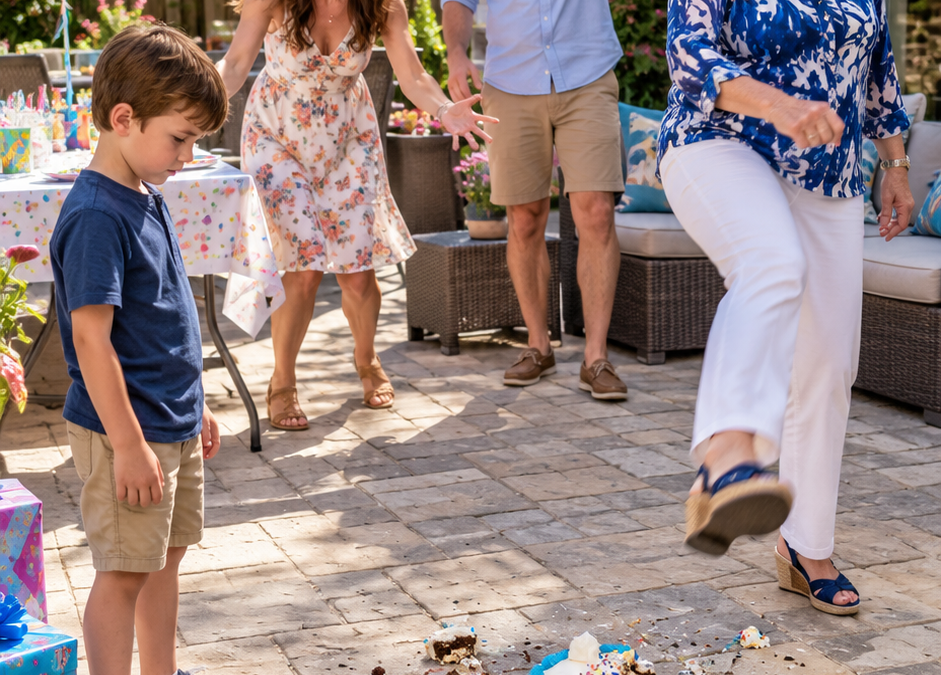
Then she lifted her foot and kicked the bowl.
The cobbler flew.
The plate shattered.
Cream splashed Luke’s legs.
Gasps rippled across the patio, then died under Madeline’s cold stare.
That was when she said it.
“Don’t ever call me Grandma again. You are not this family’s grandson.”
I heard the words.
I understood each one separately.
Together, they made no sense.
Not this family’s grandson.
Luke began sobbing then, great heaving sobs that seemed too big for his small body.
I wrapped him in my arms.
“Mommy, did I do something bad?”
“No, baby.”
“Why doesn’t Grandma want me?”
I held him tighter.
Before I could answer, Brandon came out of the house.
He stopped at the patio doorway.
His eyes moved from Luke’s tear-streaked face to the broken plate, the splattered cobbler, and finally to Madeline, who stood with folded arms and the faint satisfaction of a woman who had finally said aloud what she had been thinking for years.
“Mom,” Brandon said in a low, firm voice, “what did you just do to my son?”
Madeline’s face changed.
Not to guilt.
To calculation.
“Your son?” she asked. “Are you sure you can call him that?”
The entire patio fell silent.
Brandon turned pale.
I felt all the air leave my lungs.
The words struck me so hard I could not immediately speak.
Brandon stepped between us.
His voice was quiet.
Dangerously quiet.
“I’m asking you to leave my house. Right now.”
Everyone gasped.
Even Madeline.
But I did not see surprise in her eyes.
I saw something worse.
A strange calm.
As if the confrontation had not gone wrong at all.
As if this was only where she had meant for us to arrive.
Then Luke coughed.
Not a normal little cough.
A tight, frightened sound that seemed to catch in his chest.
His sobbing changed. He pressed one hand against his shirt.
“Mommy,” he whimpered. “My chest hurts.”
Everything else disappeared.
The broken bowl.
The relatives.
Madeline.
Her awful words.
I pulled back and looked at his face. His skin had gone pale beneath the flush of crying. His lips trembled. His breathing came too fast.
“Brandon,” I said.
He was already reaching for us.
“I’m taking him now.”
Madeline shifted as if she might speak again.
Brandon turned on her.
“One word,” he said, “and I swear to God, Mom, you will never step foot in this house again.”
For once, Madeline said nothing.
I carried Luke toward the car with Brandon beside me. As we hurried down the path, I glanced back at the patio.
Twenty relatives stood frozen.
Nobody followed.
Nobody spoke.
Nobody moved to help.
Except Claire.
She stood near the broken pieces of cobbler, looking down at them, then at Madeline.
When her eyes met mine, she mouthed two words.
“I’m sorry.”
I did not understand why.
Not yet.
The drive to the hospital felt endless.
Brandon drove with both hands gripping the steering wheel so tightly his knuckles turned white. I sat in the back seat with Luke lying across my lap, careful not to press too hard against him. His breathing had slowed but still felt uneven beneath my palm.
“Mommy?” he whispered.
“I’m here.”
“Am I in trouble?”
My heart cracked down the middle.
“No, sweetheart. You did nothing wrong.”
“Grandma is mad at me.”
“She should not have been.”
His eyes fluttered shut.
A few seconds later, he whispered, “Daddy?”
Brandon looked at him through the rearview mirror.
“Yes, buddy?”
“Why doesn’t Grandma like me?”
Brandon swallowed so hard I saw his throat move.
“I don’t know.”
It was the first time I had ever heard uncertainty in my husband’s voice about his mother.
Then Luke said something that made both of us go silent.
“Grandma said Daddy doesn’t know.”
Brandon’s eyes narrowed.
“What did she say, Luke?”
But Luke had already fallen asleep.
I looked at my husband.
“Brandon.”
He did not answer.
“Did your mother ever say anything like that before?”
“No.”
“Are you sure?”
He glanced at me.
“Yes.”
There was something in his face I could not read.
Guilt, maybe.
Or fear.
Then he asked, “Why didn’t you tell me she had been treating Luke like this?”
I stared at the back of his head.
“I did.”
“No,” he said. “You said she was distant.”
“I told you she wouldn’t hold him. I told you she wouldn’t let him call her Grandma. I told you she once told him to stay away from her chair because little boys make things dirty.”
His jaw tightened.
“I thought she was being difficult.”
“She told our four-year-old he wasn’t part of the family.”
“I know.”
“No,” I whispered. “I don’t think you do.”
For several seconds, neither of us spoke.
Then the hospital appeared ahead.
The emergency department moved quickly once we arrived.
Doctors examined Luke while nurses attached monitors to his tiny chest. He looked impossibly small on the hospital bed, his white shirt stained with blackberry syrup, his little shoes still sticky from the patio.
His heart rate was high.
Too high.
The doctor asked us questions.
Had he eaten anything unusual?
Had he fallen?
Had he complained of chest pain before?
Had he had a fever?
Any known allergies?
Any known heart conditions?
I answered no to everything.
Brandon stood beside the bed, one hand on Luke’s ankle, as if touching him lightly could anchor both of them to the world.
When the doctor asked about heart conditions, Brandon and I looked at each other.
“No,” I said. “None.”
The doctor frowned.
“We’re going to run some tests. EKG, bloodwork, electrolytes, inflammatory markers. We’ll keep him monitored.”
Luke looked frightened.
“Mommy, stay.”
“I won’t leave you.”
Brandon reached down and held Luke’s hand.
For the first time that day, I saw tears in his eyes.
“You’re my son,” he whispered.
Luke looked at him.
“I’m your son?”
“Always.”
Something inside me broke.
Because behind those words was a question neither of us wanted to ask.
Why had Madeline said otherwise?
Nearly an hour later, the doctor returned.
“There is no immediate sign of a heart attack or anything catastrophic,” he said.
My knees nearly gave out from relief.
“But,” he continued, “his heart rhythm was abnormal when he first arrived. We want to keep him for observation and run additional tests.”
“Do whatever you need to do,” Brandon said.
The doctor nodded and left.
Luke slept after that, exhausted from crying and fear.
I sat beside him, stroking his hair.
Brandon stood by the window, staring out at the parking lot.
His phone vibrated.
He looked down.
His face changed.
“What is it?” I asked.
He did not answer.
“Brandon?”
He turned the screen toward me.
A message from Claire.
You need to know the truth before Mom gets here.
I stared at it.
“What truth?”
Another message appeared.
I found the old file.
Brandon’s fingers tightened around the phone.
He typed back.
What file?
The reply came almost immediately.
Luke’s file.
My blood ran cold.
“Why would Claire have a file on Luke?”
Brandon did not answer.
Another message arrived.
The original birth records.
The room seemed to tilt.
I looked at my sleeping son.
Then at my husband.
“What does she mean by original birth records?”
“I don’t know.”
But something in his voice told me he was lying.
“Brandon.”
He closed his eyes.
“There are things about Luke’s birth that my mother always refused to discuss.”
“What things?”
He hesitated.
Then said, “She wanted a DNA test.”
My mouth went dry.
“What?”
“After Luke was born.”
“Why?”
“She said he didn’t look like me.”
I stared at him.
“And you never told me?”
“I thought she was being cruel.”
“You thought?”
“She asked for the test before we even left the hospital.”
“And what did you say?”
“I refused.”
“Why?”
“Because he was my son.”
The answer should have comforted me.
Instead, another question appeared.
“What did the test say?”
Brandon’s face went completely still.
“We never did one.”
Before I could respond, someone knocked on the hospital room door.
We both turned.
Claire stood there.
Her face was pale, her eyes red, and she was holding a thick brown envelope against her chest.
“Brandon,” she whispered.
He walked toward her.
“What is that?”
Claire looked at me.
Then at Luke.
Then back at Brandon.
“I found it in Mom’s locked cabinet.”
She held out the envelope.
“There are documents inside from the year Luke was born.”
Brandon took it. His hands were shaking.
“What kind of documents?”
Claire’s eyes filled with tears.
“Documents that prove Mom knew something about Luke before he was born.”
I stood.
“What do you mean?”
Claire looked at me.
“She knew you were pregnant before Brandon did.”
My heart stopped.
“That isn’t possible.”
“I know.”
“Brandon was the first person I told.”
“I know.”
“Then how could she have known?”
Claire’s lips trembled.
“Because someone told her.”
“Who?”
She looked toward the hallway.
Then lowered her voice.
“Your doctor.”
I could not breathe.
“My doctor?”
Claire nodded.
“And there’s something else.”
“What?”
She looked at Luke sleeping peacefully in the hospital bed.
“The file says his birth was not supposed to happen the way it did.”
A cold wave passed through me.
“What does that mean?”
Claire opened her mouth.
Before she could answer, a nurse rushed into the room.
“Mrs. Carter?”
“Yes?”
“You need to come with me.”
“Why?”
The nurse looked toward Luke’s monitor.
“We found something in his bloodwork that the doctor needs to discuss with you immediately.”
Brandon stepped forward.
“What did you find?”
The nurse hesitated.
“I can’t discuss all the results here.”
Then she looked at me.
“His blood type doesn’t match the one listed on his medical records.”
My heart began pounding.
“What?”
She repeated herself.
“Your son’s blood type does not match the birth records we have.”
Brandon looked at me.
I looked at him.
Neither of us spoke.
Then Claire slowly opened the brown envelope.
Inside was a single photograph.
She pulled it out.
It showed me.
Four years earlier.
Pregnant.
Standing outside a hospital.
I remembered that day.
The blue maternity dress. The swelling in my ankles. Brandon taking forever to bring the car around because he had stopped to buy me ginger candies from the gift shop.
But I had never seen this photograph.
And beside me stood Madeline.
Not angry.
Not distant.
Smiling.
Holding a newborn baby.
Claire turned the photograph over.
There was handwriting on the back.
Only six words.
This is the child we promised her.
My knees weakened.
“Who,” I whispered, “is her?”
Claire’s face crumpled.
“I don’t know.”
Brandon took the photograph from her.
He stared at it for several seconds.
Then all the color drained from his face.
“That’s not Luke.”
I looked at him.
“What?”
He pointed at the baby in Madeline’s arms.
“That baby has a birthmark.”
I looked closer.
There, just beneath the baby’s left ear, was a tiny dark mark.
Brandon whispered, “Luke doesn’t have one.”
The room went silent.
Then the hospital door opened.
Madeline stood in the doorway.
She had followed us.
And this time, she was not smiling.
She looked terrified.
Her eyes went straight to the photograph in Brandon’s hand.
“No,” she whispered.
Brandon turned toward her.
“Mom.”
Madeline shook her head.
“You weren’t supposed to find that.”
For the first time, I realized the truth was no longer hiding from us.
It was coming straight toward us.
And whatever had happened four years ago was far worse than a grandmother refusing to love her grandson.
Madeline stood in the doorway as if she had forgotten how to breathe.
For several seconds, nobody moved.
The hospital monitor beside Luke continued its steady rhythm.
Beep.
Beep.
Beep.
But all I could hear was Madeline’s voice.
You weren’t supposed to find that.
Brandon stepped toward her.
“What does that mean?”
She shook her head.
“Put the photograph down.”
“No.”
“Brandon, please.”
“I asked you a question.”
His voice was not angry anymore.
That frightened me.
It was quiet.
Controlled.
The voice of a man who had just discovered that his entire understanding of his family might be a lie.
“What happened four years ago?”
Madeline looked at me.
Her eyes filled with tears.
Then she looked at Luke.
Something changed in her expression.
For the first time, I saw genuine pain.
She whispered, “I never hated him.”
My throat tightened.
“You kicked his food across the patio.”
“I know.”
“You told him he wasn’t your grandson.”
“I know.”
“You watched him cry.”
Madeline closed her eyes.
“I know.”
“Then why?”
She did not answer.
Brandon stepped closer.
“Why did you do it?”
Madeline looked at him.
“Because if I called him my grandson, people would start asking questions.”
“What questions?”
“The same questions you are asking now.”
I held the photograph tighter.
“Who is that baby?”
Madeline looked at the image.
Then she whispered, “Your son.”
My heart stopped.
“No.”
She shook her head.
“Not the baby you are thinking of.”
Brandon stared at her.
“Mom, speak clearly.”
Madeline’s voice broke.
“There were two babies.”
The room disappeared around me.
I looked at Luke.
Then at the photograph.
“Two babies?”
She nodded.
“Two boys.”
Brandon took one step backward.
“Twins?”
“No.”
Her answer came immediately.
“Not twins.”
“Then what are you talking about?” he demanded.
Madeline looked at me.
“One baby belonged to you.”
She pointed at the photograph.
“And the other belonged to someone else.”
I felt sick.
“Where is the other baby?”
Madeline did not answer.
“Where is he?”
Her lips trembled.
“I don’t know.”
Brandon’s face hardened.
“You expect us to believe that?”
“I don’t expect you to believe anything.”
“Then tell us the truth.”
Madeline flinched.
A nurse appeared at the door.
“Please keep your voices down.”
Brandon stepped aside.
“I’m sorry.”
The nurse looked at Luke.
“He’s stable for now. The doctor wants to speak with both parents.”
She left.
Madeline remained in the doorway.
I stared at her.
“Why did you know about another baby?”
Madeline lowered her eyes.
“Because I was there.”
“Where?”
“At the hospital.”
“When?”
“The night Luke was born.”
My stomach twisted.
“You weren’t there.”
“I was.”
“I never saw you.”
“You weren’t supposed to.”
Brandon looked at her.
“What did you do?”
Madeline’s eyes filled with tears.
“I didn’t switch the babies.”
I froze.
She continued.
“But I knew someone who did.”
The doctor entered a few minutes later carrying a folder.
His expression was serious enough to make my skin go cold before he spoke.
“Mr. and Mrs. Carter?”
“Yes,” Brandon said.
“Your son’s bloodwork is unusual.”
My hand went immediately to Luke’s blanket.
“Is he in danger?”
“Not immediately. His rhythm has stabilized, and he is responding well to supportive care. But there is an inconsistency we need to investigate.”
“His blood type?” Brandon asked.
“Yes.”
The doctor opened the folder.
“The blood type recorded at birth is O positive.”
“And?” I asked.
“The sample we took today indicates A positive.”
I stared at him.
“Could today’s test be wrong?”
“It’s possible, which is why we repeated it.”
“And?”
“Same result.”
Brandon looked toward Luke.
“What does that mean?”
“It means either the original record is incorrect, or there is something we don’t yet understand about his medical history.”
I thought about the photograph.
The birthmark.
Madeline’s words.
Two babies.
Then I asked the question haunting me.
“Doctor, can a child have a blood type that does not match the one recorded at birth?”
“Yes, if the original record was wrong, mislabeled, or associated with another child. Rare medical explanations exist, but given the documents you’ve shown us, we need to verify identity and parentage through proper testing.”
Brandon’s jaw tightened.
“DNA test?”
“Yes.”
I nodded.
“Do it.”
The doctor closed the folder.
“We’ll arrange it. There is one more thing.”
“What?”
“The original birth records were requested from hospital archives this morning.”
My skin prickled.
“By whom?”
The doctor looked at the file.
“Someone using your husband’s family authorization.”
Brandon stood.
“I never authorized that.”
“I assumed it was your mother.”
Everyone looked at Madeline.
She shook her head.
“No.”
Brandon stared at her.
“You didn’t?”
“No.”
“Then who did?”
Madeline whispered, “I think I know.”
The doctor looked between us.
“Who?”
Madeline answered, “Dr. Nathaniel Reed.”
The name meant nothing to me.
But Brandon suddenly went pale.
“Mom…”
“What?” I asked.
He turned to me slowly.
“That’s the doctor who delivered Luke.”
Silence.
“You never told me his name,” I said.
“I didn’t remember.”
“You didn’t remember the doctor who delivered our son?”
“It was four years ago.”
“Brandon.”
He rubbed his forehead.
“I was exhausted. Everything happened so fast.”
Madeline whispered, “He was working with the clinic at the time.”
I looked at her.
“Working with them for what?”
She did not answer.
Brandon grabbed the brown envelope.
“I’m going to find him.”
Madeline reached for his arm.
“No.”
He pulled away.
“Why?”
“Because he isn’t the person you think he is.”
That night, Luke was moved to a private room.
The tests continued.
I stayed beside him, one hand on his leg, watching his little chest rise and fall. Brandon stepped into the hallway to make calls. Claire sat in the corner, pale and quiet, while Madeline remained alone outside the room with her hands clasped together like a woman praying to a God she had avoided for four years.
Eventually, I walked out to her.
She looked up.
“Are you here to hate me?”
“I don’t have time to hate you.”
She nodded.
“Good.”
“I want answers.”
“You deserve them.”
“Then tell me.”
Madeline looked down at her hands.
“Four years ago, I received a phone call.”
“From Dr. Reed?”
“Yes.”
“What did he say?”
“He told me your baby had been born.”
I frowned.
“You already knew I was in labor?”
“Yes.”
“How?”
Madeline’s eyes filled with tears.
“Because I had been paying him.”
My heart stopped.
“For what?”
“To watch you.”
The words entered me slowly.
To watch me.
Not to help me.
Not to protect me.
To watch me.
“Why?”
“Because I believed you were hiding something from Brandon.”
“What?”
“That Luke wasn’t his.”
I stared at her.
“Why would you think that?”
“Because of the timing.”
“What timing?”
Madeline hesitated.
Then she said, “Brandon had been away three months before Luke was born.”
“He was away for work.”
“I know.”
“He came home before Luke was conceived.”
“I know that now.”
“You know that now?” My voice shook. “What did you think then?”
“The night he came home, someone sent me photographs of you with another man.”
My mouth went dry.
“That never happened.”
“I believe you now.”
“Who was the man?”
“I don’t know.”
“Then why believe it?”
“Because the person who gave me the information showed me photographs.”
She reached into her purse and pulled out a small plastic envelope.
Inside were several photos.
The first showed me leaving a restaurant.
The second showed me standing beside a man.
The third showed us talking.
My hands trembled.
“I don’t know him.”
“I know.”
“What?”
“These photographs were manipulated.”
“How do you know?”
“Because I hired someone to verify them later.”
“Who?”
“Dr. Reed.”
I stared at her.
“You hired the same doctor who delivered my son to investigate me?”
“Yes.”
“Why?”
“Because he told me he could prove Luke wasn’t Brandon’s.”
Tears burned my eyes.
“And did he?”
Madeline shook her head.
“No.”
“Then what happened?”
“He told me something else.”
“What?”
She looked toward Luke’s room.
“He said your baby had been switched.”
My heart seemed to stop.
“Switched with whom?”
“I never knew.”
“Then why did you keep quiet?”
Madeline’s eyes filled with tears.
“Because he threatened me.”
“With what?”
She whispered, “Your son’s life.”
I froze.
“What?”
“He told me that if I went to the police, if I told Brandon, or if I tried to investigate the hospital, Luke would disappear.”
My hands began shaking.
“You believed him?”
“I had no choice.”
“You always have a choice.”
Madeline looked at me.
“Not when the person threatening you has already proven he can reach your family.”
“What did he do?”
She did not answer.
“Madeline.”
She finally whispered, “He made another child disappear.”
A chill ran through me.
“Who?”
She looked directly into my eyes.
“The baby in the photograph.”
Before I could ask another question, Brandon came running down the hallway.
“Where’s Mom?”
I turned.
“She told me—”
He held up his phone.
“I found Dr. Reed.”
My heart raced.
“Where?”
“He’s still practicing.”
“What?”
Brandon showed me the screen.
There was an address.
A private medical office only twenty minutes away.
“We’re going there,” he said.
The doctor stopped us before we could leave.
“Mr. Carter, your son needs observation.”
“I’ll be back.”
“Do not take unnecessary risks.”
Brandon looked at me.
“I need answers.”
I nodded.
“I’ll go with you.”
Madeline stood.
“So will I.”
Brandon stared at her.
“No.”
“You need me.”
“After everything you’ve done?”
“Yes.”
“Why?”
“Because I am the only person alive who knows what Dr. Reed did.”
That stopped him.
We left Luke with Claire in the private hospital room, after getting the doctor’s assurance that he was stable and that nurses would call us immediately if anything changed. I kissed his forehead before leaving.
“Mommy?” he murmured.
“I’ll be right back.”
“Don’t leave me.”
“I’m not leaving you. Aunt Claire is here. Nurses are right outside. Daddy and I are going to find out something important.”
His little fingers curled around mine.
“About Grandma?”
“About what happened when you were born.”
He blinked sleepily.
“Was I bad?”
“No, baby. Never.”
I kissed him again.
Then we left.
The private medical office stood behind a line of dark hedges on a quiet street outside Nashville. The building looked almost abandoned. No lit sign. No receptionist visible. No cars in the small parking lot except ours.
Brandon tried the front door.
Locked.
He knocked.
Nothing.
Madeline walked toward the side entrance.
“Here.”
Brandon turned.
“How do you know?”
“I’ve been here before.”
She pulled a key from her purse.
Brandon stared at it.
“You’ve been coming here?”
“For four years.”
She unlocked the door.
We entered.
The hallway smelled of dust and disinfectant. A single light flickered overhead. Old framed certificates hung crooked on the wall. The air felt stale, as if the building had been pretending not to exist.
We walked deeper.
Then we heard something.
A faint ringing.
A telephone.
Brandon followed the sound to an office at the end of the corridor. He opened the door.
An old desk stood inside.
A phone rang on it.
No one was there.
Brandon picked it up.
“Hello?”
Silence.
Then a man’s voice spoke.
“I wondered how long it would take you.”
Brandon froze.
“Who is this?”
“You already know.”
“Dr. Reed?”
The man laughed softly.
“You should have left the past alone.”
Brandon’s grip tightened around the phone.
“Where are you?”
“Close.”
“What did you do to my son?”
Silence.
Then the voice said, “Your son is exactly where he is supposed to be.”
I stepped forward.
“What does that mean?”
The voice changed.
Colder.
“Ask your mother.”
Madeline went white.
“Don’t.”
The caller continued.
“She knows what happened to the other child.”
The line went dead.
Brandon slowly lowered the phone.
Then we heard a noise behind us.
A door closing.
We turned.
At the end of the hallway stood a man in a dark coat.
He stared at us for one second.
Then ran.
Brandon chased him.
“Stop!”
I followed as far as the rear hallway, but the man disappeared through a back exit into the dark.
When Brandon returned, he was breathing heavily.
“Did you catch him?”
“No.”
Then he looked down.
Something was lying on the floor near the doorway.
A small hospital bracelet.
He picked it up.
There was a name written on it.
Not Luke.
Not Brandon.
Not mine.
A boy’s name.
Ethan Reed Carter.
I stared at it.
“Who is Ethan?”
Madeline covered her mouth.
Then whispered the words that changed everything.
“That was the name I was told to give the other baby.”
Brandon looked at her.
“Other baby?”
Madeline nodded.
“And if Ethan was real…”
She looked at me.
“…then someone has been hiding him for four years.”
My phone rang.
It was the hospital.
I answered so fast I nearly dropped it.
“Hello?”
The nurse’s voice trembled.
“Mrs. Carter, you need to come back immediately.”
“What happened?”
There was a pause.
“Your son woke up.”
I exhaled.
“Is he okay?”
“No.”
My blood ran cold.
“What happened?”
“He keeps asking for someone.”
“Who?”
The nurse hesitated.
Then whispered, “He keeps saying, ‘Where is my brother?’”
I looked at Brandon.
He had heard the words.
Neither of us moved.
Because until that moment, we had been searching for a missing child.
Now we had to face something even more terrifying.
Luke might already know exactly who that child was.
“Where is my brother?”
Luke’s tiny voice echoed through the hospital room when we returned.
He was awake, pale, and exhausted, with monitor stickers on his chest and Mr. Bear tucked under one arm.
I stood frozen beside his bed.
Brandon looked at me.
Madeline covered her mouth with both hands.
For four years, we had believed Luke was an only child.
Now our four-year-old was asking about a brother nobody had ever told him existed.
The nurse looked confused.
“He has been saying it repeatedly.”
I walked to the bed.
“Luke, sweetheart, what brother?”
He opened his eyes.
“The baby.”
My heart pounded.
“What baby?”
“The baby in Grandma’s picture.”
Brandon went still.
“What picture?”
Luke pointed weakly toward Madeline.
“She showed me.”
Madeline’s face crumbled.
“When?” I asked.
Luke frowned as if trying to remember.
“Before my birthday.”
Madeline whispered, “I never showed him that photograph.”
But Luke continued.
“He was crying.”
I sat beside him.
“Where did you see him?”
Luke pointed toward the window.
“In the house.”
“What house?”
“The little house.”
Brandon looked at Madeline.
She suddenly understood.
“The old guesthouse.”
“What guesthouse?” I asked.
“My mother’s old property,” she whispered.
“Where is it?”
“About forty minutes outside Nashville.”
Brandon was already reaching for his keys.
“We’re going.”
The doctor insisted Luke could not leave until his condition stabilized. Fortunately, his rhythm had returned to normal and the additional tests showed no immediate danger. Still, the blood type discrepancy remained. So did the DNA test.
We agreed to have samples taken immediately.
While we waited, Claire arrived with another envelope.
“I found something else,” she said.
She placed it on the bedside table.
Inside was a letter dated four years earlier.
The handwriting belonged to Dr. Reed.
I read it slowly.
The children are safe. No one will ever know what happened unless the records are opened.
I looked at Madeline.
“Children?”
She nodded.
“I never knew where they took the second baby.”
Brandon asked, “Then what did you do?”
Madeline looked at him through tears.
“I spent four years trying to find him.”
“Why didn’t you tell me?”
“Because every time I came close, Dr. Reed threatened to expose you.”
“Expose me for what?”
Madeline looked at me.
“For a crime you never committed.”
“What crime?” I asked.
“Child trafficking.”
The room went silent.
Madeline continued, voice barely holding together.
“Dr. Reed was involved with an illegal adoption network through the clinic. Babies from vulnerable families were being secretly reassigned to wealthy clients. Some birth records were altered. Some mothers were lied to. Some fathers never knew.”
I felt sick.
“Luke?”
Madeline shook her head.
“No. I believe Luke was never supposed to be part of it.”
“Then why was he involved?”
“Because someone discovered the scheme.”
“Who?”
Madeline looked at Brandon.
“Your father.”
Brandon stopped breathing.
“My father?”
“Before he died, he discovered what Reed was doing.”
“My father died before Luke was born.”
“I know.”
“What does that have to do with Luke?”
Madeline whispered, “He had evidence.”
Two hours later, the first DNA results came back.
The doctor asked us to sit down.
Brandon held my hand so tightly it hurt.
The doctor looked at us carefully.
“The test confirms that Brandon is Luke’s biological father.”
I closed my eyes.
A wave of relief passed through me so powerful it almost knocked me loose from my own body.
Luke was Brandon’s son.
Our son.
Our beautiful little boy.
The child Madeline had rejected for four years because of a lie.
The doctor continued.
“And there is no evidence that your son was switched.”
I looked at Madeline.
She started crying.
“Then the other baby…”
“We still don’t know,” the doctor said.
But I did.
Luke had mentioned the little house.
And we were going there.
We left once Luke was cleared for supervised transport and the doctor allowed him to come with us under strict instructions to return if symptoms appeared again. A nurse gave us printed instructions, and Brandon drove with the careful intensity of a man transporting glass.
The guesthouse stood behind a line of old oak trees on property that had belonged to Madeline’s mother.
It looked abandoned.
The windows were covered.
The garden had grown wild.
Ivy climbed the porch railing. Leaves covered the walkway. Wind moved through the branches with a sound like whispering.
Madeline stood outside the door, shaking.
“I haven’t been here in four years.”
Brandon unlocked the door with a key she gave him.
Inside, everything smelled old.
Dust covered the furniture. White sheets draped over chairs. The air felt stale, but not empty.
Then we heard something.
A child’s laughter.
I froze.
Brandon grabbed my hand.
“Did you hear that?”
“Yes.”
Luke, sleepy in Brandon’s arms, lifted his head.
“Brother,” he whispered.
We followed the sound down the hallway.
At the end was a small bedroom.
The door was slightly open.
Brandon pushed it.
Inside sat a little boy on the floor with a wooden train.
He could not have been more than four.
He looked up.
His eyes widened.
He stared at Brandon.
Then at me.
Then at Madeline.
Madeline dropped to her knees.
“Ethan.”
The little boy froze.
Nobody moved.
Then he whispered, “Grandma?”
Madeline began sobbing.
She opened her arms.
The boy ran toward her.
She held him as if she had been waiting four years for that single moment.
Brandon stood completely stunned.
I looked at the little boy.
There was a small birthmark beneath his left ear.
The same mark from the photograph.
“Oh my God,” I whispered.
Behind us, Claire started crying.
We had found him.
But there was one more surprise.
A man stepped into the doorway.
Dr. Reed.
Brandon immediately moved in front of me and Luke.
“What did you do to these children?”
Reed looked exhausted.
Older than he had in the photographs.
His coat hung loose. His face was gray with fear and sleeplessness.
“I didn’t hurt them.”
“You stole a child.”
“No.”
He looked at Ethan.
“I saved him.”
Brandon stared at him.
“Explain.”
Reed sighed.
“Your father discovered the adoption network. He confronted the people running it. They threatened to take Luke and Ethan.”
“Why Ethan?”
“Because Ethan’s mother died during childbirth. She was one of the women caught in the network. She had no family anyone could find quickly, and your father tried to protect her baby.”
I felt tears fill my eyes.
“And what happened?”
“She died.”
“Then why hide Ethan?”
“Because the people responsible were still looking for him.”
Madeline whispered, “Why didn’t you tell us?”
Reed looked at her.
“Because I was a coward.”
He lowered his eyes.
“I thought keeping the children hidden would protect them. But when I realized the network was still operating, I knew I couldn’t control it anymore.”
Brandon stepped closer.
“Why did you threaten my mother?”
“Because she found evidence.”
“Why tell her Luke wasn’t my son?”
“Because I needed her to stop looking.”
The room went silent.
I looked at Madeline.
“So you treated Luke cruelly to protect him?”
Madeline cried harder.
“I thought if I convinced everyone I didn’t love him, no one would suspect how desperately I was trying to protect him.”
My voice shook.
“You hurt a little boy who only wanted his grandmother.”
Madeline covered her face.
“I know.”
“That is not protection.”
“I know.”
“He asked me if cobbler would make you love him.”
She broke then.
Not neatly.
Not with dignity.
Madeline Carter, queen of the family patio, collapsed onto the old bedroom floor beside Ethan and sobbed like someone finally hearing the sound of the damage she had caused.
“I am sorry,” she whispered. “I am so sorry.”
Luke looked at her from Brandon’s arms.
His face was still pale.
“Grandma?”
Madeline looked up through tears.
“Yes, sweetheart?”
“Is he my brother?”
She looked at Ethan.
Then at Brandon.
Then at me.
The answer was not simple.
Not biological.
Not legal.
Not yet.
But some truths arrive before paperwork.
I walked to Ethan slowly and crouched in front of him.
“Hi,” I said gently. “My name is Olivia.”
He clutched Madeline’s sleeve.
“Are you Luke’s mommy?”
“Yes.”
“Luke said I was hiding.”
I looked at my son.
Luke’s eyes were half-closed, but he was watching Ethan with strange, solemn certainty.
“We found you,” Luke whispered.
Ethan smiled.
A small smile.
Then he held out his wooden train.
Luke reached for it.
That was when the police arrived.
Claire had called them before we entered the guesthouse.
Good.
Someone in the Carter family had finally learned that secrets should not be handled internally like holiday seating disputes.
The next several hours became a blur of uniforms, questions, child services, medical checks, and evidence bags. Dr. Reed did not run. He cooperated immediately, handing over keys, files, names, dates, payment records, and storage locations.
He had been hiding evidence for years.
Some of it implicated him.
Some implicated people far worse.
The illegal adoption network was not a rumor.
It had operated through private clinics, falsified birth records, vulnerable mothers, wealthy families desperate for children, and professionals willing to convert babies into transactions.
Brandon’s father, Thomas Carter, had discovered part of it before Luke was born. He had gathered evidence, confronted Reed, and planned to go to authorities. Then he died suddenly in what everyone believed was a heart attack.
Now investigators wanted to look at that too.
Madeline had suspected for years that Thomas’s death was connected. Reed had fed her just enough truth to terrify her and enough lies to control her. He told her Luke might be taken if she exposed anything. He told her Brandon could be framed as part of the scheme because the family name appeared in altered records. He told her the other child had been moved beyond reach.
Madeline believed him.
Not because she was innocent.
Because fear is most powerful when it attaches itself to something you already deserve guilt for.
She had distrusted me.
She had paid a doctor to watch me.
She had believed manipulated photos.
She had let suspicion poison her love before Reed ever threatened her.
That part was hers.
No conspiracy erased it.
Ethan was taken to the hospital for evaluation.
He was undernourished but not severely. Frightened but not physically harmed. Reed had arranged caretakers over the years, women paid cash to watch him, one after another, told a vague story about a complicated custody dispute. When attention increased, he moved Ethan to the guesthouse and checked on him himself.
It was monstrous.
It was also, in Reed’s mind, protection.
People do terrible things when they decide the law is too dangerous and their judgment is enough.
Child services placed Ethan in emergency protective care while investigators sorted everything out. But because he had no known living parent, and because the Carter family connection was deeply entangled, he was placed temporarily with us after urgent review, home inspection, and court approval.
I will never forget the first night Ethan came to our house.
He stood in the living room holding a small backpack and the wooden train.
Luke sat on the couch under a blanket, still tired from the hospital but alert.
For a moment, the two boys simply stared at each other.
Then Luke patted the cushion beside him.
“You can sit here.”
Ethan looked at me.
I nodded.
“You can.”
He climbed onto the couch.
Luke lifted the blanket.
Ethan slid underneath it.
They sat shoulder to shoulder watching cartoons, two little boys who had somehow known of each other in dreams, photographs, whispered stories, or whatever strange place children keep truths adults try to bury.
Brandon stood in the kitchen doorway, crying silently.
I took his hand.
“You okay?” I whispered.
“No.”
“Me neither.”
He looked at me.
“I should have protected Luke sooner.”
That sentence had been waiting between us.
I did not rush to comfort him.
Love does not require dishonest reassurance.
“Yes,” I said.
He flinched.
“I told you about Madeline,” I continued. “I told you she was hurting him.”
“I know.”
“You called it difficult.”
“I know.”
“He thought cobbler might earn her love.”
Brandon covered his face.
“I know.”
For a long moment, I let him feel it.
Then I said, “But today, when it mattered, you chose him.”
He looked at me.
“That doesn’t erase before.”
“No.”
“But it begins after.”
He nodded.
“I will never dismiss you again.”
“You don’t get to say that once. You get to prove it.”
“I will.”
I believed him.
Not because words fix damage.
Because when his mother challenged Luke’s place in the family, Brandon did not ask me to calm down. He did not ask Luke to forgive. He did not protect the patio. He protected our son.
Late is not ideal.
But late can still matter if it becomes consistent.
Madeline was not allowed to visit for weeks.
That was my rule.
Brandon agreed.
The court agreed.
Child services agreed.
Madeline did not fight it.
That was new.
She gave statements to police. Real statements. Full ones. She turned over Reed’s letters, payment records, old photos, secret notes, and recordings of threats. She admitted she had paid him to investigate me during my pregnancy. She admitted she had believed Luke might not be Brandon’s. She admitted she had treated Luke coldly and sometimes cruelly because Reed convinced her visible attachment would draw attention.
The investigator asked, “Do you understand that your behavior harmed the child?”
Madeline answered, “Yes.”
No excuses.
No speeches.
Just yes.
It was the first useful thing she had said in years.
Reed’s cooperation led to arrests.
Clinic administrators.
A private adoption broker.
A records clerk.
Two attorneys who had laundered illegal placements through sealed filings.
A former nurse who falsified birth charts.
Several wealthy couples who claimed they had “trusted the process” while paying six figures in cash through intermediaries.
The investigation spread beyond Nashville.
There were other children.
Other mothers.
Other families told lies by people wearing badges, white coats, or legal titles.
Thomas Carter’s death was reopened. In the end, investigators could not prove he had been murdered. There were suspicious circumstances, missing files, and threats, but not enough for charges. That uncertainty haunted Brandon.
“My father knew,” he said one night.
“He tried,” I replied.
“He died before he could finish.”
“Then we finish.”
And we did.
Not alone.
With detectives.
Prosecutors.
Social workers.
Attorneys.
Doctors.
Families who came forward after the news broke.
Ethan’s legal status took longer.
No child should have to wait for adults to decide who he belongs to while he is already sleeping in dinosaur pajamas in your guest room, but that is how systems work. Carefully. Slowly. Sometimes cruelly slowly.
We learned about his mother.
Her name was Rachel Monroe.
Twenty-two years old.
A waitress.
No family support.
Pregnant and frightened.
She had entered the clinic through a “charity maternal care program” that was actually a recruiting pipeline for illegal adoptions. She died from complications that proper medical care might have prevented. Her baby vanished into paperwork.
Ethan.
When I read Rachel’s file, I cried for a woman I never met.
Then I printed her photograph and placed it in a frame in Ethan’s room.
Brandon asked, “Are you sure?”
“Yes.”
“He’s little.”
“He deserves the truth in age-appropriate pieces. Not another mystery.”
So Ethan grew up knowing a simple version first.
Your first mommy was named Rachel.
She loved you before you were born.
Bad people made bad choices.
You were hidden.
We found you.
You are safe.
As he grew older, the story would grow with him.
But never again would adults protect themselves by starving a child of truth.
Luke adored Ethan immediately.
Not politely.
Aggressively.
He introduced him to everyone as “my brother Ethan who was hiding but now he’s not.” He shared toys, then took them back, then cried when Ethan cried, then argued over crayons, then insisted they sleep in the same room because “brothers need to know where each other is.”
Ethan followed Luke everywhere.
At first, he spoke little.
Then more.
Then constantly.
Within two months, our house sounded like a daycare had collided with a train station.
Wooden blocks.
Cartoons.
Snack negotiations.
Bath-time protests.
Tiny socks everywhere.
Brandon said one night, stepping on a plastic dinosaur at 11:30 p.m., “I used to think one child was exhausting.”
I looked over my book.
“And now?”
He held up the dinosaur.
“Now I know two children are a coordinated attack.”
I laughed so hard I woke both boys.
That was our new life.
Messy.
Exhausting.
Legally complicated.
Loud.
Real.
Madeline’s first visit happened three months after the patio.
Supervised.
Short.
At our house.
She stood on the porch holding a fresh blackberry cobbler.
The sight of it made my stomach twist.
Brandon stood beside me.
“You don’t have to do this,” he whispered.
“I know.”
Madeline looked smaller than she had before. Her dark purple dresses were gone. No gold earrings. No queenly posture. Just a woman holding dessert like a peace offering that might be rejected, as perhaps it should have been.
Luke ran into the hallway, saw her, and stopped.
Ethan hid behind him.
Madeline’s eyes filled.
“Hello, Luke.”
He looked at the dish.
“Did you bring cake?”
A tiny, broken laugh escaped her.
“Yes.”
“For me?”
“For you. And Ethan. And anyone else who wants some.”
Luke studied her.
“You won’t kick it?”
Madeline flinched.
“No, sweetheart. I will never kick your food again.”
He looked at me.
I nodded once.
He walked closer.
“Can I call you Grandma?”
Madeline’s face collapsed.
She lowered herself slowly to her knees.
“If you want to,” she whispered. “Only if you want to.”
Luke thought about it with the seriousness of a judge.
Then he said, “Grandma.”
Madeline began crying.
But she did not reach for him.
That mattered.
She waited.
Luke stepped forward and hugged her.
She held him carefully, as if touching something sacred she had once thrown away.
“I am so sorry,” she whispered.
Luke patted her shoulder.
“It’s okay.”
I almost interrupted.
Because it was not okay.
Not fully.
Not yet.
But Luke was four. His forgiveness was not a legal ruling. It was a child choosing relief.
Then he added, “But don’t kick cake anymore.”
Madeline laughed through tears.
“I promise.”
Ethan stepped out from behind Luke.
Madeline looked at him.
“Hello, Ethan.”
He held Luke’s sleeve.
“Are you my grandma too?”
Madeline covered her mouth.
Then looked at me.
I did not save her from the question.
She had spent years making children pay for adult fear. She could answer this one carefully.
“I would like to be,” she said softly. “If that feels okay to you someday.”
Ethan nodded.
“Okay.”
Children can be more generous than adults deserve.
That does not mean adults are entitled to it.
Madeline spent the next years proving herself.
Not with speeches.
With consistency.
Therapy.
Court cooperation.
Apologies without demands.
Visits where she followed rules.
Birthday cards that did not rewrite history.
No pressure for hugs.
No complaining that forgiveness was taking too long.
No blaming Reed for the parts that belonged to her.
At the first family dinner after Ethan’s placement became permanent, Madeline asked if she could say something.
Brandon looked at me.
I nodded.
Madeline stood at the table.
The same relatives who had watched Luke cry on the patio sat around us now. Quieter. Less certain. Shame makes people very interested in napkins.
Madeline’s voice trembled.
“I owe Luke an apology in front of every person who saw me hurt him.”
The room went still.
Luke looked up from his plate.
Ethan kept eating because Ethan believed serious conversations were best handled with bread.
Madeline continued.
“I told a little boy he did not belong. I did it because I was afraid, because I was proud, and because I had convinced myself cruelty could protect what honesty might endanger. I was wrong. Fear does not excuse what I did. Every adult here who stayed silent was wrong too.”
Several relatives looked down.
Good.
“Luke,” she said, turning to him, “you were always part of this family. You were always loved by your parents. You never had to earn your place with cobbler or good behavior or silence. I am sorry I made you feel otherwise.”
Luke blinked.
Then said, “Can I still have ice cream?”
The room burst into nervous laughter.
Madeline cried and laughed at once.
“Yes,” she said. “You can have ice cream.”
Brandon squeezed my hand under the table.
For the first time in years, dinner did not feel like a performance.
It felt like a beginning.
The adoption of Ethan became final eleven months after we found him.
The judge read through the findings, the investigations, the placement reports, the social worker recommendations, and the psychological evaluations. Rachel Monroe’s name was included in the record at my insistence.
When the judge said Ethan would legally become Ethan Monroe Carter, I cried.
Brandon cried.
Claire cried.
Madeline cried quietly in the back.
Luke whispered loudly, “Does this mean he can’t leave?”
The judge smiled.
“It means he is your brother legally now.”
Luke nodded.
“Good.”
Ethan looked at Brandon.
“Can I still use my train at home?”
Brandon laughed through tears.
“Yes, buddy. It’s your home.”
Ethan smiled.
“My home.”
That night, we ate blackberry cobbler at our kitchen table.
No patio.
No audience.
No broken plate.
Luke lifted his spoon.
“Ready?”
Ethan nodded.
“Ready.”
They took their first bite together.
Then Ethan grinned.
“It’s yummy.”
Luke looked proud, as if he had personally invented fruit.
“Told you.”
Madeline had made the cobbler.
I had allowed it after tasting one bite first, because trust may return, but I am still a mother with common sense.
She sat across from me.
“Thank you,” she said quietly.
“For what?”
“For letting me be here.”
I looked at Luke and Ethan, laughing over whipped cream.
“I didn’t do it for you.”
“I know.”
That answer mattered.
She finally knew not every act of grace belonged to her.
Years later, people would ask me how I forgave Madeline.
The truth is, I did not forgive her all at once.
I forgave her in pieces.
A supervised visit where she did not pressure Luke.
A court statement where she told the truth.
A birthday card where she wrote, “I hurt you,” instead of “Mistakes were made.”
A therapy session where she admitted suspicion had made her cruel before fear made her silent.
A family dinner where she apologized publicly.
A moment when Ethan fell asleep against her shoulder and she looked at me for permission before adjusting him.
Forgiveness was not forgetting the patio.
I still remembered every shard of that plate.
Forgiveness was deciding the patio would not be the only chapter of Luke’s story with his grandmother.
But forgiveness had boundaries.
Always.
Madeline never again got unsupervised authority over what truth children were allowed to hear. She never again got to define family alone. She never again entered my home as queen.
She entered as a grandmother who had nearly lost the right to that name and knew it.
Brandon changed too.
More quietly.
More painfully.
He had to face the fact that his desire to avoid conflict had cost our son years of small wounds. Madeline had not kicked the cobbler out of nowhere. She had built toward that moment, one cold refusal at a time, and Brandon had called each one “difficult.”
He went to therapy.
At first because I demanded it.
Later because he needed it.
He learned to say, “I should have listened.”
Not “I didn’t know.”
Not “Mom was complicated.”
Not “I thought you meant…”
I should have listened.
Those four words repaired more than any speech.
One night, after the boys fell asleep, he found me standing on the patio where it had happened. The stone had been cleaned long ago. No cream. No blackberries. No broken ceramic.
Still, I saw it.
Luke’s empty hands.
Madeline’s heel.
The relatives frozen in silence.
Brandon stood beside me.
“I hate this place sometimes,” he said.
“It’s your house.”
“It’s ours.”
I looked at him.
He corrected himself without prompting.
“It’s theirs too.”
The boys’ bedroom light glowed upstairs.
“I thought protecting family meant preventing explosions,” Brandon said.
I waited.
“I was wrong. Sometimes protecting family means letting the right things explode.”
I smiled faintly.
“That sounds like something my therapist would charge two hundred dollars for.”
“She probably did.”
I laughed.
Then he said, “I’m sorry I left you alone with her for so long.”
I looked at the patio.
“I know.”
“I’ll spend my life proving I heard you.”
I took his hand.
“Good.”
That was marriage after rupture.
Not perfect.
Not magically healed.
But honest.
The investigation into Dr. Reed and the adoption network continued for years. Some victims never found answers. Some children had already grown. Some records were missing forever. Some families fought the truth because they did not want their happiness examined under fluorescent legal light.
But many were found.
Many mothers learned what had happened.
Some reunions were joyful.
Some were devastating.
Most were both.
Reed went to prison after pleading guilty to multiple charges and testifying against others. In court, he said he had started by trying to help desperate people and ended by serving a system that turned children into inventory.
The judge told him good intentions do not launder crimes.
I liked that judge.
Madeline testified against him.
So did Claire.
So did Brandon.
I testified about Luke’s hospital visit, the bloodwork discrepancy, the photograph, the threats, the guesthouse, and the children.
When the prosecutor asked what began the chain of discovery, I answered honestly.
“My mother-in-law kicked my son’s dessert across a patio.”
A few people in the courtroom shifted.
It sounded absurd.
Small.
Almost domestic.
But cruelty often reveals what secrets work hard to hide.
If Madeline had accepted the cobbler, smiled stiffly, and survived the afternoon, maybe Luke’s chest pain would have passed unnoticed. Maybe his bloodwork would not have been checked. Maybe Claire would not have panicked and brought the envelope. Maybe the photograph would have remained in the locked cabinet. Maybe Ethan would have stayed hidden longer.
But Madeline’s cruelty made Luke cry so hard his heart rhythm faltered.
Her rejection sent us to the hospital.
The hospital found the mismatch.
The mismatch opened the records.
The records found Ethan.
The truth, apparently, had been waiting for someone to kick a plate too hard.
On the third anniversary of Ethan coming home, Luke asked if we could make blackberry cobbler “the right way.”
“What’s the right way?” I asked.
“With two bowls,” he said. “So nobody fights.”
Ethan nodded solemnly.
“And no kicking.”
“No kicking,” Brandon agreed.
Madeline was there that afternoon, helping peel apples because the boys had decided blackberry cobbler also needed apples, blueberries, and marshmallows, which made it less a cobbler and more a lawsuit against dessert.
Luke carried the first bowl to Madeline.
My breath caught.
Even after all those years, the image hit me.
A small boy.
A careful bowl.
A grandmother waiting.
This time, Madeline crouched before he reached her.
She held out both hands.
“Thank you, Luke.”
He watched her.
Then smiled.
“You’re welcome, Grandma.”
Ethan carried the second bowl.
Madeline accepted it with the same reverence.
“Thank you, Ethan.”
He leaned close.
“You can call me grandson too.”
Madeline began crying before she could answer.
“I know,” she whispered. “My grandson.”
The boys ran off to chase Claire’s dog around the yard.
I stood near the kitchen door, watching them.
Claire came beside me.
“I should have told you sooner,” she said.
I looked at her.
She had said it many times.
Maybe she needed to keep saying it.
Maybe I needed to hear it less each time.
“You were afraid of your mother.”
“Yes.”
“But you came to the hospital.”
“Late.”
“Still.”
She nodded.
“I found the file years before.”
That was new.
I turned.
“What?”
She looked down.
“Not all of it. Just enough to know Mom had something about Luke. I thought it was about her wanting a DNA test. I didn’t understand the rest.”
“Why didn’t you ask Brandon?”
“Because in this family, asking questions always punished somebody.”
That sentence was too accurate to argue with.
Claire wiped a tear.
“I’m trying to be different.”
“I know.”
She smiled sadly.
“The boys make it easier.”
Children often do.
Not because they owe adults redemption.
Because their needs clarify the room.
That evening, after everyone left, I found Luke and Ethan asleep on the same bed, heads at opposite ends, limbs everywhere, a wooden train clutched in Ethan’s hand and Mr. Bear under Luke’s arm.
Brandon stood behind me.
“They’re going to kick us out of our own room someday,” he whispered.
“They already own the house emotionally.”
He laughed quietly.
I leaned against him.
For once, the quiet felt full.
Not full of secrets.
Full of breathing.
Years after that terrible day, Luke asked me about the patio.
He was older then, old enough to remember some of it but not all.
“Did Grandma really say I wasn’t her grandson?”
I sat beside him on the porch.
“Yes.”
“Why?”
I took a breath.
“Because she was afraid, and because she made a very wrong choice with that fear.”
“Was she trying to protect Ethan?”
“She thought she was. But hurting you was still wrong.”
He nodded.
“Adults are complicated.”
“Yes.”
He thought about that.
“Kids are too.”
I smiled.
“Also yes.”
“Was Ethan always my brother?”
“In the ways that matter now, yes.”
He looked toward the yard where Ethan was trying to teach the dog to sit using a cracker.
“I think I knew.”
“Maybe you did.”
He leaned against my side.
“I’m glad we found him.”
“Me too.”
“Do you think his first mommy knows?”
I looked up at the sky.
Rachel Monroe had become part of our family language. Not a ghost hidden in a file. Not a sad footnote. A mother whose child lived.
“I hope so,” I said.
Luke nodded.
“Me too.”
The family home changed.
The patio remained, but we no longer treated it like sacred ground just because history had happened there. History is not always worthy of preservation. Sometimes it needs pressure washing and new chairs.
We replaced the cracked tile where the plate had shattered.
Not because we wanted to erase the memory.
Because children should not have to play around the outline of old harm.
Madeline asked if she could pay for it.
I said yes.
Then I made her choose the tile with Luke and Ethan.
They picked a warm terracotta color that looked cheerful in the sun.
The day the work was finished, Luke stood in the center of the patio with a bowl of cobbler in his hands and announced, “This floor is nicer because nobody was mean on it yet.”
Brandon nearly choked on his coffee.
Madeline closed her eyes.
I said, “Then let’s keep it that way.”
We did.
As much as any family can.
There were still hard conversations. Still therapy. Still court updates. Still news about the investigation. Still moments when Madeline’s old sharpness flashed and every adult in the room turned to look at her.
She learned to stop.
To breathe.
To apologize.
That may sound small.
It is not.
For some people, apology is the hardest muscle to build.
Ethan grew secure enough to become mischievous. Luke grew confident enough to stop asking whether he was bad whenever adults were upset. Brandon grew brave enough to confront his mother in real time instead of processing it three days later like a committee report. Claire became the aunt who brought art supplies and told the truth even when her voice shook.
And me?
I stopped trying to make myself acceptable to a family system that had mistaken silence for loyalty.
I loved them.
But love became clearer.
It had doors.
Conditions.
Light.
No child in my house would ever again be told to earn belonging through obedience, dessert, silence, or blood type.
One Sunday evening, we gathered for dinner.
The table was crowded.
Brandon at one end, me at the other, not because we believed in head seats but because someone had to be close to the kitchen and someone had to stop the boys from weaponizing dinner rolls.
Madeline sat beside Ethan.
Claire beside Luke.
The relatives who once stood frozen on the patio had learned, slowly and uncomfortably, that silence was not neutral. Some apologized. Some drifted away because accountability made them itchy. That was fine. Not every blood connection deserves a chair.
I brought out blackberry cobbler.
Luke looked at Madeline.
“Grandma?”
“Yes?”
“Do you remember when you kicked my cake?”
The table went silent.
Madeline lowered her head.
“Yes.”
Luke thought for a moment.
Then smiled.
“It’s okay.”
Madeline looked up.
“You forgive me?”
Luke nodded.
“But don’t kick cake anymore.”
Everyone laughed.
Not because it was funny exactly.
Because it was true.
Because children sometimes find the cleanest sentence in the room.
Madeline wiped her eyes.
“I promise.”
Ethan lifted his spoon.
“Can I kick broccoli?”
“No,” Brandon and I said together.
The boys groaned.
Claire laughed.
Madeline smiled through tears.
I looked around the table.
The same family that had once stood frozen while my son cried on a patio was now sitting together under the weight of truth. Not perfect. Not innocent. Not magically healed. But awake.
Sometimes truth does not arrive gently.
Sometimes it tears through everything you thought you knew.
It breaks open locked cabinets.
It exposes old lies.
It sends children to hospitals, adults to police stations, doctors to prison, and grandmothers to their knees.
But sometimes, after the darkness has passed, truth gives you something you never expected.
A second chance.
A family rebuilt honestly.
A little boy who finally knows he belongs.
A hidden child brought home.
Two brothers who never again have to wonder where the other one is.
That Sunday, Luke lifted his spoon and grinned at Ethan.
“Ready?”
Ethan nodded.
“Ready.”
They took their first bite of blackberry cobbler together.
No one kicked the plate away.
No one told anyone they did not belong.
No one protected a secret by hurting a child.
Everyone stayed.
Everyone smiled.
And my little boy finally had the family he had always deserved.








