My Mother-in-Law Called My Daughter a Guest on Christmas—Then a Red Box Made Her Scream
PART2
Then she touched Zia’s shoulder with two fingers and said, “And this is Zia, Travis’s little visitor.”
Visitor.
Zia looked down at her plate.
Travis went still.
I reached for my water glass because if my hands were busy, I might not throw the gravy boat.
After dinner, Travis pulled his mother into the hallway.
I did not hear all of it.
But I heard enough.
“She is not a visitor,” he said.
Lorraine answered, “Don’t start.”
“I’m serious, Mom.”
“So am I. You can play house however you like, but do not expect me to rewrite blood.”
There was a silence.
Then Travis said, “If blood is the only thing that makes someone family to you, that says more about you than it does about Zia.”
Lorraine laughed softly.
“That child already has a history, Travis. You would be wise not to confuse pity with fatherhood.”
I remember gripping the edge of the kitchen counter so hard my knuckles turned white.
That child.
That was how it started.
A label here.
A missing stocking there.
A family photo where Lorraine said, “Just the Whitmore grandchildren first,” then somehow never took the second picture.
A birthday card addressed to “Maya’s daughter.”
A Christmas ornament with every grandchild’s name painted in red except Zia’s.
Every time, Travis confronted her.
Every time, Lorraine denied intent.
“You’re too sensitive.”
“I simply forgot.”
“I didn’t mean it that way.”
“Must everything become a trauma?”
And every time, Zia became a little quieter around her.
By the Christmas everything broke open, Lorraine had spent three years teaching my child to expect less.
Less affection.
Less space.
Less recognition.
Less room at the table.
That year, Travis almost refused to go.
“We can stay home,” he told me on Christmas Eve, standing in our bedroom with Zia’s gold dress hanging carefully from the closet door.
I was folding tights on the bed.
“Do you want to?”
“No.”
“Then why say it?”
He looked toward the hallway, where Zia was singing softly while brushing her teeth.
“Because I don’t want to put her in front of Mom again.”
I sat down on the edge of the bed.
The house smelled like sugar cookies and pine candles. Downstairs, wrapped presents were stacked under our tree. Zia had left carrots for reindeer beside the fireplace even though she was old enough to suspect the truth and kind enough not to ruin it for us.
“She wants to go,” I said.
“I know.”
“She asked if Grandma might have her own stocking this year.”
Travis closed his eyes.
The pain that crossed his face told me he already knew the answer.
“Mom promised,” he said.
“When?”
“Last week. I called her. I told her this was the last Christmas I would let her treat Zia like a child we dragged in from the porch.”
“What did she say?”
“That I was being dramatic.”
“Of course she did.”
He sat beside me.
For a long moment, he said nothing.
Then he reached into the drawer of his nightstand and removed a small red velvet box.
It was no bigger than his palm.
Old.
Beautiful.
The kind of box that looked as though it belonged to jewelry or a family heirloom.
“What is that?” I asked.
His thumb brushed the lid.
“Something my father left.”
I knew very little about Travis’s father. Charles Whitmore had died when Travis was in his twenties, years before I met him. Lorraine spoke of him with the polished sadness of a widow who liked the social respect grief gave her, but Travis rarely mentioned him.
“What kind of something?” I asked.
Travis did not answer immediately.
That worried me.
He was not a secretive man by nature. He was direct, sometimes too direct. He believed silence was only useful if it protected someone vulnerable. If he kept something from me, it was because he believed telling me would change the ground beneath us.
“It’s a boundary,” he said finally.
“A boundary in a box?”
“A choice.”
I stared at him.
“For who?”
His eyes moved toward the hallway.
“For Zia.”
I did not like the sound of that.
“Travis.”
“I’m not using her,” he said immediately.
I believed him.
But I was still a mother before I was a wife.
“Then explain.”
He opened the box just enough for me to see a flash of brass inside.
A key.
Old, tarnished, with a number stamped on the head.
Beneath it was a folded white card.
“What does it open?” I asked.
“I’m not completely sure.”
“That is not comforting.”
“I know.”
“Then why would you give it to Zia?”
“Because Mom needs to understand that the next time she denies my daughter a place in this family, she loses hers in ours.”
His daughter.
Even after years of hearing it, those two words still touched something deep in me.
“What does the key have to do with Lorraine?”
His jaw tightened.
“Everything, I think.”
“You think?”
He closed the box.
“My father left instructions. Not clear ones. Just enough to make me start looking. There is a house. A number. An old family account. And a name Mom has spent my entire life trying to erase.”
“What name?”
Before Travis could answer, Zia appeared in the doorway wearing pink pajamas and holding Mr. Button by one ear.
“Dad?”
The conversation stopped.
Travis slid the box into his robe pocket.
“What’s up, sunshine?”
She stepped into the room.
“Do you think Grandma will like my gold dress?”
He smiled, but I saw the effort it took.
“She’d be foolish not to.”
Zia considered that.
“Grandma says gold is loud.”
“Then let it be loud,” Travis said. “Some people need help noticing beautiful things.”
Zia giggled.
The sound loosened the tightness in my chest.
That night, after she fell asleep, Travis steamed the gold dress twice. Once because it needed it. The second time because his hands needed something to do.
Before bed, I asked him again about the red box.
He sat beside me in the dark.
“If Mom behaves tomorrow, it stays in my pocket.”
“And if she doesn’t?”
He was silent for a long time.
“Then Zia decides whether to give it to her.”
“She is seven.”
“I know.”
“That is too much.”
“I’m not asking her to confront family history. I’m giving her a way to say, ‘You don’t get to make me invisible anymore.’”
I wanted to argue.
But then I thought of every time Lorraine had turned my daughter into an almost-person at family gatherings.
The forgotten chair.
The missing name.
The stocking that did not appear.
The phrase “Travis’s girl” spoken with a smile sharp enough to cut.
Maybe Travis was right.
Maybe Zia did deserve a choice.
Still, I said, “No secrets from me after tomorrow.”
Travis looked at me in the darkness.
“No secrets,” he promised.
I believed him.
That was before I understood that some secrets are not kept by one person.
Some secrets are rooms built by entire families, locked from the inside, with children taught never to ask why one door stays closed.
Lorraine’s dining room looked perfect on Christmas morning.
Perfect in the way a room can look perfect when everyone inside it is holding their breath.
Pine garland hung over the doorway. Cinnamon rolls cooled beneath foil on the sideboard. The chandelier flashed against silver napkin rings and polished crystal glasses. A small American flag tapped against the porch rail outside in the winter wind. Every chair had been positioned exactly. Every plate was white. Every ribbon matched.
Lorraine stood at the head of the table in an ivory sweater set and pearls, surveying her kingdom.
“Everyone sit,” she announced. “Food first, gifts after. Children with clean hands, please.”
Everyone obeyed.
That was how it worked in Lorraine’s house.
Smile.
Stay polite.
Never challenge her when she decided someone needed to remember their place.
Zia sat beside me in her gold dress. Travis had wiped a scuff from one black Mary Jane before we left the house and murmured, “She deserves one holiday where she feels chosen.”
Now she sat with both hands folded in her lap, trying very hard not to touch the silverware arranged like museum pieces.
Lorraine looked at her briefly.
Not unkindly, exactly.
Worse.
Administratively.
As though mentally checking whether Zia had been placed correctly.
The other grandchildren tore into cinnamon rolls and hot chocolate. Lorraine corrected elbows, praised outfits, commented on school awards, and smiled proudly when her oldest grandson mentioned being accepted into a robotics camp.
When Zia tried to tell Lorraine she had learned “Silent Night” on the piano, Lorraine interrupted to ask Carter whether his iPad had enough storage for his engineering app.
Zia stopped talking.
I felt Travis’s hand find mine under the table.
His fingers were tense.
“Not yet,” he murmured.
I understood what he meant.
Give her a chance.
Give Lorraine one last chance to be decent.
After breakfast, Lorraine clapped her hands.
“Gifts.”
The children rushed toward the sitting room.
Wrapped presents were arranged under a twelve-foot Christmas tree covered in white lights and gold ornaments. Lorraine liked to say she preferred a tasteful Christmas, which apparently meant a holiday with no handmade ornaments, no mismatched stockings, and no room for actual joy unless it photographed well.
One by one, she distributed the presents.
Carter received a new iPad.
Lily received one too.
Brennan got the same model, plus a gaming gift card.
The older kids opened envelopes thick with cash.
Lorraine smiled for every picture.
“Hold it up, sweetheart.”
“Turn toward the light.”
“Let Grandma see.”
Zia waited quietly near Travis’s knee.
She did not ask when her turn would come.
That hurt most.
Children who know they are included ask eagerly.
Children who are not sure learn to wait like guests.
Finally, Lorraine looked at her.
“Oh. Zia.”
The room shifted.
Lorraine reached behind a stack of gifts and pulled out a thin drugstore bag with a crooked bow stuck to the handle.
“This is for you, sweetheart,” she said. “I didn’t want you to feel totally left out.”
Totally left out.
The words were wrapped in sugar and dipped in poison.
Zia accepted the bag with both hands.
“Thank you.”
Her manners nearly broke my heart.
She carefully lifted the tissue paper.
Inside was a cheap vanilla candle.
There was nothing wrong with a candle.
That was what Lorraine would say if confronted.
It’s just a gift.
Must every little thing become a problem?
But the candle was not the wound.
The handwritten tag was.
To Travis’s Girl.
A fork stopped halfway to someone’s plate.
One cousin stared at the carpet.
The little dog under the table backed away from the chair legs as if even he knew something bad had entered the room.
Beside me, Travis crushed the side of his paper coffee cup without seeming to notice.
Lorraine kept smiling.
She had already begun pretending the insult was too small for decent people to mention.
I whispered, “Travis.”
He leaned toward me, eyes on Zia.
“I told her to give Mom the red box if this happened again.”
My head snapped toward him.
“What red box?”
“The one in her overnight bag.”
I stared at him.
“You planned this?”
“No,” he said. “I prepared for it.”
Across the room, Zia turned the candle in her hands.
She read the tag once.
Then again.
Her face did not crumple.
That was worse.
Pain in children is easier to bear when it comes out as tears.
When they swallow it, you know they have had practice.
Lorraine moved on as if nothing had happened.
“All right, who wants cocoa?”
The morning continued.
Or at least, everyone pretended it did.
Children played with their iPads. Adults praised Lorraine’s cooking. Someone discussed football. Someone else mentioned church attendance. The candle sat in Zia’s lap like a small, scented insult.
I wanted to leave.
Travis did too.
But Zia asked if we could stay until the cousins finished playing charades.
“She shouldn’t have to be the one who leaves,” Travis said quietly.
So we stayed.
All day, Lorraine behaved as though she had not humiliated a child in front of twenty people.
She laughed.
She poured coffee.
She asked Travis about work.
She did not look at the candle again.
Later that night, at 9:12 p.m., I found Zia sitting on the guest-room bed with the candle in her lap. Her gold dress was wrinkled now. Her curls had loosened around her face. The tag rested between her fingers, bent at one corner from how many times she had touched it.
I stood in the doorway.
“Baby?”
She did not look up.
“Mom?”
“Yeah?”
“Am I only Dad’s girl?”
I crossed the room so quickly I almost tripped over her overnight bag.
“No,” I said, kneeling in front of her. “You are my daughter. You are Dad’s daughter. You are Zia. You are not only anything.”
She stared at the tag.
“But Grandma wrote it.”
“Grandma was wrong.”
Her lower lip trembled.
“She gave everybody else names.”
Before I could answer, Travis appeared behind me.
I had not heard him come in.
His face looked wrecked.
He knelt beside me, bringing himself to Zia’s height.
“Zia,” he said.
She looked at him.
“You are my daughter.”
Her eyes filled with tears.
“No tag gets to decide that. No person gets to decide that for me. I chose you. I choose you every day. I will choose you tomorrow. I will choose you when you are seven, seventeen, thirty-seven, and one hundred if I’m still around and annoying everybody.”
A tiny laugh escaped her.
Then she wiped it away like she was embarrassed.
Travis reached into her overnight bag and pulled out the small red velvet box.
My chest tightened.
So he had already placed it there.
He set it carefully in her hands.
“This belongs to you for now.”
Zia turned the box over.
“It’s pretty.”
“It is.”
“What is it?”
“A choice.”
She frowned.
“Like a present?”
“Sort of.”
He opened it.
The brass key lay inside, old and tarnished, with the number 17 stamped into it. Beneath it was the folded white card.
Zia touched the key with one finger.
“Is it magic?”
Travis gave a sad smile.
“No. But it may tell the truth.”
“What truth?”
“That you belong more than Grandma has ever wanted to admit.”
I looked at him sharply.
“Travis.”
He nodded once, not taking his eyes from Zia.
“If Grandma ever makes you feel invisible again, you decide whether she gets this. Not me. Not Mom. You.”
Zia looked frightened.
“Will she be mad?”
“Probably.”
“Will you still be my dad?”
For half a second, Travis looked as though someone had put a hand through his chest.
“Always.”
She closed the box.
Then she held it against her heart.
I did not sleep much that night.
Travis lay awake beside me too.
I could feel it.
“Tell me,” I whispered.
He turned his head on the pillow.
“Tomorrow.”
“You promised no secrets.”
“I know.”
“Then tell me now.”
He was quiet for so long I thought he might refuse.
Then he said, “I had a brother.”
I went still.
“What?”
“Elias.”
The name sounded strange in the dark.
“My mother told everyone he died when I was little. Later she changed the story depending on who asked. Sometimes he ran away. Sometimes he got mixed up with dangerous people. Sometimes it was too painful to discuss.”
“You never told me.”
“I barely remember him. I was five when he disappeared from my life. For years, I thought he was dead. Then after Dad died, I found a photograph.”
“Of Elias?”
“And another child.”
“A child?”
“A little girl.”
The room seemed colder.
“What does that have to do with Zia?”
“I don’t know all of it.”
“Travis.”
“I mean it. I know Mom has lied about someone named Mara. I know Dad left that key. I know the number seventeen matters. I know Mom becomes terrified whenever I ask about Willow Lane.”
“Willow Lane?”
“A house the family supposedly sold years ago.”
“Supposedly?”
“It wasn’t sold.”
I pushed myself up on one elbow.
“How long have you known this?”
“Pieces? Years. Enough to act on? Only recently.”
“And you gave the key to our seven-year-old?”
“I gave her the power Mom keeps stealing from her.”
“That is not an answer.”
He sat up too, rubbing both hands over his face.
“I know. But listen to me. Mom can argue with me. She can dismiss you. She can turn every adult conversation into a trial where she plays the victim. But she cannot look at Zia holding that box and pretend this is about manners.”
“You think she knows something about Zia.”
“I think she knew from the moment she saw her.”
My breath caught.
“What does that mean?”
“I don’t know.”
But his voice told me he feared he did.
The next morning, Lorraine hosted brunch.
Of course she did.
In Lorraine’s world, even emotional violence required a second course.
The dining room had been reset with white dishes, silver napkin rings, and handwritten place cards. The chandelier glowed warmly above the table. Fresh garland hung over the doorway. Coffee steamed from a silver urn on the sideboard.
Everyone had a name.
Carter.
Lily.
Brennan.
Aunt Diane.
Uncle Rob.
Travis.
Maya.
Lorraine.
Except Zia.
Her card said:
Guest.
For a moment, I could not move.
The word was small.
Only five letters.
But it carried three years of exclusion inside it.
Zia saw it at the same time Travis and I did.
She did not cry.
She did not ask me to fix it.
She did not reach for Travis.
She simply looked at the place card for a long moment, then reached into the tiny gold purse Travis had given her that morning.
My pulse quickened.
Both her small hands closed around the red velvet box.
Then she stood.
The room seemed to sense something before it happened.
Conversations faded.
Someone set down a coffee cup.
Lorraine, standing near the head of the table, turned with her polished hostess smile.
Zia crossed the dining room.
Seven years old.
Gold dress.
Black Mary Janes.
Small shoulders straight.
Calm as a queen approaching a throne she had decided not to beg for.
She stopped in front of Lorraine.
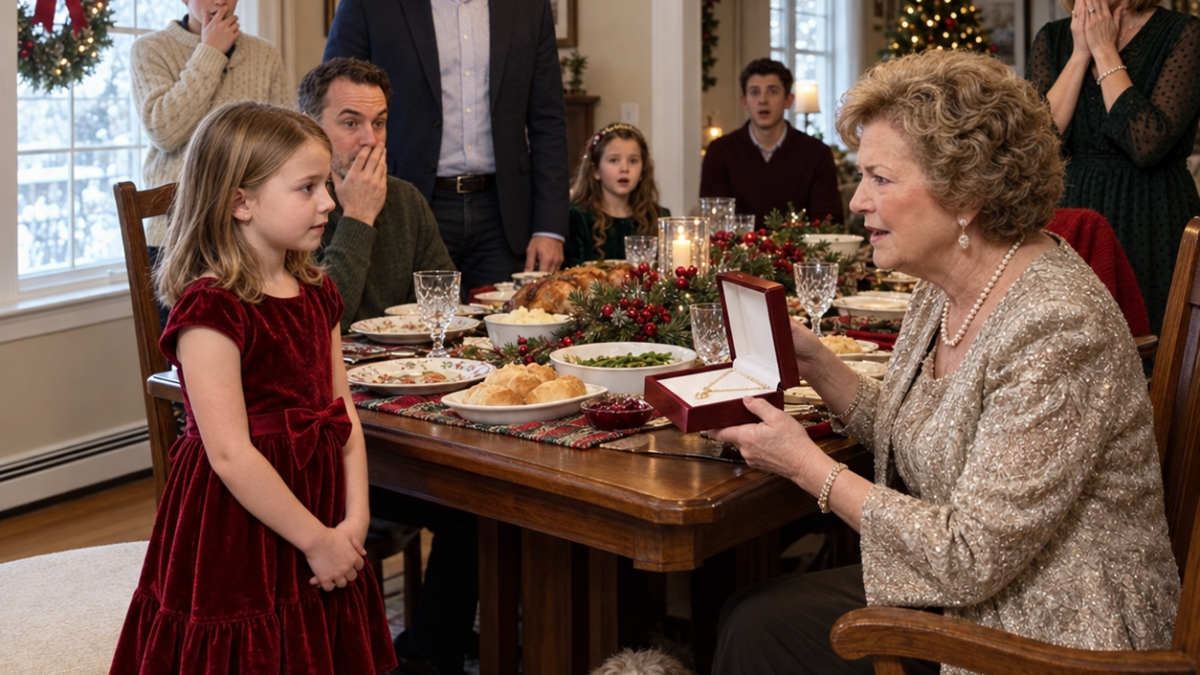
“Grandma,” she said, clear enough for the far end of the table to hear, “Dad told me to give this to you if you ever ignored me again.”
Lorraine’s smile tightened.
“Well,” she said, “isn’t that dramatic.”
Travis stood behind our daughter.
“Open it.”
His voice was quiet.
Lorraine’s eyes flicked to him.
Then to the box.
Then back to Zia.
For a second, something crossed her face.
Recognition.
Fear.
Then it vanished under contempt.
“I don’t know what little performance this is supposed to be.”
“Open it,” Travis repeated.
The room had gone completely silent.
Lorraine lifted the lid slowly, still wearing the smug expression of a woman already preparing a speech about sensitive children and modern parenting.
Then she saw the key.
The card.
The number.
She screamed.
Not a theatrical gasp.
Not a polite cry.
A real, sharp, animal sound that tore through the dining room and made the cousin by the window flinch.
Everyone leaned forward.
Zia stood in front of her, still wearing her gold dress, her small shoulders perfectly straight.
“Dad gave it to me,” she said.
Lorraine looked at Travis.
“You did this?”
Travis did not move.
“I didn’t do anything to you, Mom.”
“You—” Her voice cracked. “You gave that child this?”
“I gave my daughter a choice.”
My daughter.
The words hit the room harder than the scream.
Not your child.
Not Travis’s girl.
Not that visitor.
My daughter.
Lorraine unfolded the card.
Her eyes moved across the first few lines.
Then she stopped.
Her face went pale.
“Where is it?” she asked.
Travis’s expression hardened.
“Where is what?”
“You know exactly what I’m asking.”
“I don’t.”
“Don’t lie to me, Travis.”
A strange silence spread through the room.
Even the children had stopped eating.
Zia looked from Lorraine to Travis, confused but not frightened.
That was when I noticed the brass key clearly.
The number stamped into it.
“Travis,” I said.
He glanced at me.
“What does seventeen mean?”
Before he could answer, Lorraine slapped the card onto the table.
“Enough.”
She stood so quickly her chair scraped backward.
“You have no right.”
Travis stepped forward.
“No right to what?”
“To punish me.”
His voice remained quiet.
“This isn’t punishment.”
Lorraine laughed once, bitter and thin.
“Of course it is.”
“No. Punishment would mean I wanted you to hurt.”
He looked down at Zia.
“This is about what happens when someone keeps teaching a child that she doesn’t belong.”
Lorraine’s eyes flashed.
“She is not my responsibility.”
The room went still.
Zia’s expression changed only slightly.
But I saw it.
Her chin lowered.
Her fingers tightened around the edge of her dress.
Seven years old, and she already knew how to make herself smaller when adults said something cruel.
I wanted to gather her into my arms.
Instead, she surprised me.
She looked directly at Lorraine.
“That’s okay.”
Lorraine blinked.
“What?”
Zia’s voice was soft.
“You don’t have to be my grandma.”
I felt something inside me break.
Travis closed his eyes for one second.
Zia continued.
“But Dad said I shouldn’t let anyone decide whether I belong somewhere.”
Lorraine stared at her.
Then she looked at the key.
“Give me that.”
Zia did not move.
“Zia,” Lorraine said sharply. “Give me the key.”
Zia stepped backward.
“No.”
It was the first time I had ever heard her say no to Lorraine.
Not apologetically.
Not nervously.
Just no.
Travis moved beside her.
“That’s enough, Mom.”
Lorraine’s face twisted.
“You’ve poisoned her against me.”
“No,” Travis said. “You did that yourself.”
Someone at the far end of the table whispered, “Oh my God.”
Lorraine ignored them.
She looked at Travis with something I had never seen in her before.
Fear.
Not anger.
Fear.
“Where is the rest of it?” she asked.
Travis said nothing.
Her voice dropped.
“Where is the envelope?”
I looked at him.
“What envelope?”
Lorraine turned toward me.
“You really don’t know?”
“No.”
She stared at me for several seconds.
Then she laughed.
A quiet, humorless laugh.
“So he didn’t tell you.”
Travis’s jaw tightened.
“Don’t.”
“Don’t what?” Lorraine demanded. “Tell her the truth?”
“Not here.”
“Why not?”
“Because Zia is seven.”
Lorraine’s eyes flicked toward my daughter.
For the first time that morning, she seemed to remember that a child was standing in the room.
She lowered her voice.
“Then perhaps you should have thought about that before you opened old graves.”
My stomach tightened.
“Old graves?”
No one answered.
Zia looked at me.
“Mom?”
I crouched beside her.
“It’s okay.”
She nodded, but her eyes stayed on Travis.
“Dad?”
He knelt.
“Yeah?”
“Is Grandma in trouble?”
He swallowed.
“No, sweetheart.”
“Then why is she scared?”
Travis looked toward Lorraine.
“Because sometimes the truth scares people more than consequences do.”
Zia considered that.
Then she handed him the key.
“I’m done.”
He took it carefully.
“Done with what?”
“Being ignored.”
Lorraine’s face crumpled for half a second.
Only half a second.
Then the mask returned.
She walked out of the dining room, heels striking the hardwood floor with quick, angry clicks.
No one spoke until the kitchen door slammed.
Then Travis exhaled.
I stood.
“What is happening?”
He rubbed both hands over his face.
“I wanted to tell you after Christmas.”
“You have been saying some version of that for three years.”
“This is different.”
“It obviously is.”
I pointed toward the hallway.
“My daughter just handed your mother a box that made her scream, and your mother knows about an envelope you never told me about.”
“I know.”
“So tell me.”
He hesitated.
Then he reached into the inside pocket of his jacket and pulled out a photograph.
Old.
Yellowed at the edges.
He placed it on the table.
I picked it up.
It showed Lorraine standing outside a small brick house beside a teenage boy. He was thin, dark-haired, and smiling, with one hand shoved into his pocket as though embarrassed to be photographed.
Behind them stood a wooden sign.
17 WILLOW LANE.
I looked at Travis.
“Who is that?”
His answer came quietly.
“My brother.”
I stared at the photograph.
“You have a brother?”
“Had.”
The word hung between us.
“He died when he was nineteen.”
I looked back at the picture.
“Why have I never heard about him?”
“Because Mom doesn’t talk about him.”
“Why?”
Travis looked toward the hallway where Lorraine had disappeared.
“Because she told everyone he ran away first. Then later she told people he died. The story changes depending on what protects her best.”
“What does that have to do with Zia?”
His face darkened.
“Everything, I think.”
Before I could ask another question, the front door opened.
Lorraine came back into the room.
She was not alone.
A man followed her.
Late sixties, maybe early seventies.
Gray hair.
Dark wool coat.
A scar running from his left eyebrow toward his temple.
He stopped when he saw Travis.
Then he looked at the photograph on the table.
His face went white.
“No,” he whispered.
Travis stood.
“Mr. Hale?”
The man stared at him.
“You kept it.”
Lorraine slammed her hand against the table.
“Don’t.”
Mr. Hale did not look at her.
He looked at Zia.
Then at the brass key in Travis’s hand.
His eyes filled with tears.
“Oh,” he said.
I stepped between him and my daughter.
“Who are you?”
He looked at me.
“My name is Daniel Hale.”
Travis’s expression had become unreadable.
Daniel swallowed.
“I knew Travis’s brother.”
Lorraine whispered, “You promised.”
Daniel finally turned toward her.
“I promised your husband.”
Lorraine froze.
I looked at Travis.
“Your father?”
He nodded, eyes fixed on Daniel.
Daniel reached inside his coat and pulled out a sealed envelope.
It was old too, the paper yellowed and soft at the corners.
Across the front, in faded handwriting, were four words.
For the girl who comes next.
My skin prickled.
“What does that mean?”
Daniel looked at Zia.
“I think,” he said, voice rough, “it means Charles Whitmore knew this family would one day try to reject another innocent child.”
Lorraine stepped toward him.
“Give me that.”
Daniel moved away.
“No.”
Her voice became desperate.
“Daniel, please.”
That single word changed the room.
Please.
Lorraine did not say please.
Not to anyone.
Daniel shook his head.
“I should have given this to Travis years ago.”
“Why didn’t you?” Travis asked.
“Because your mother threatened me.”
Travis’s face went cold.
“What did she threaten you with?”
Daniel looked at him.
“Your brother.”
Silence.
Travis took one step forward.
“What about my brother?”
Daniel’s eyes lowered.
“Your brother didn’t run away.”
I felt Zia’s hand slip into mine.
Travis stopped breathing.
Lorraine whispered, “Daniel.”
But he continued.
“He didn’t leave town.”
Travis stared at him.
“Then where did he go?”
Daniel looked at the brass key.
“Number Seventeen.”
“Willow Lane?” I asked.
Daniel nodded.
“Your family owned that house.”
Travis frowned. “I know.”
“No,” Daniel said. “You don’t.”
He looked toward Lorraine.
“She told everyone it was sold.”
Lorraine said nothing.
“It wasn’t,” Daniel said.
Travis stared at the envelope.
“Then who owns it?”
Daniel’s answer was almost inaudible.
“Your brother.”
Travis shook his head.
“He’s dead.”
Daniel looked at him for a long moment.
“Are you sure?”
Nobody moved.
Then something shifted upstairs.
A floorboard groaned.
I looked toward the ceiling.
Lorraine’s face lost every trace of color.
“What was that?” one of the aunts whispered.
Another board creaked.
Slow.
Deliberate.
The dining room went still.
Zia moved closer to me.
Travis stepped in front of us.
Daniel backed toward the wall, gripping the envelope.
Lorraine whispered a name I had never heard before.
A name that made Travis’s face drain white.
“Elias.”
The footsteps stopped.
Then a man’s voice came from the hallway.
Older.
Rougher.
But unmistakably alive.
“Hello, Mother.”
Lorraine screamed again.
This time, nobody thought she was pretending.
The man stepped into the doorway.
He was tall and thin, with silver beginning to show through dark hair. A long black coat hung from his shoulders, damp from the winter rain. There was a faint scar along his jaw, and his left hand trembled slightly as he removed a pair of leather gloves.
He looked at Travis.
Travis looked at him.
Neither spoke.
The man smiled sadly.
“You’ve grown.”
Travis’s lips parted.
“Elias?”
The man nodded.
Lorraine made a strangled sound.
“No.”
Elias looked at her.
“Yes.”
She backed into the table.
“You’re dead.”
“I was supposed to be.”
Nobody moved.
I could hear the refrigerator humming in the kitchen.
A clock ticked somewhere upstairs.
Zia whispered behind me, “Mom…”
“Stay behind me.”
“But Dad knows him.”
“I know.”
“Is he Uncle Elias?”
I did not answer.
Because I did not know what to say.
Travis finally stepped forward.
“You’re my brother.”
Elias gave a small, bitter smile.
“You always were good with difficult questions.”
Travis’s eyes filled.
“You’re alive.”
“Apparently.”
“When did you come back?”
“Three days ago.”
“Why didn’t you call me?”
Elias looked at Lorraine.
“Because I wanted to see whether she would tell you the truth.”
Lorraine shook her head.
“Elias, please.”
He laughed softly.
“That is the third time I have heard you say please today. Christmas miracles do happen.”
He reached into his coat.
Lorraine immediately shouted, “Don’t!”
Elias stopped.
Then he slowly removed another photograph and placed it on the table.
Travis picked it up.
It showed two teenage boys standing beside the same brick house from Daniel’s photograph.
Travis, much younger.
And Elias.
But there was someone else in the picture.
A little girl, maybe four years old, stood between them in a blue dress, holding a book against her chest.
I frowned.
“Who is she?”
Elias looked at me.
“You really don’t know?”
I shook my head.
“No.”
He looked toward Lorraine.
“Tell her.”
Lorraine’s eyes filled with tears.
For the first time since I had known her, she looked old.
Not elegant.
Not powerful.
Just old.
“I can’t.”
Elias’s voice hardened.
“You have had twenty-eight years.”
Travis looked from the photograph to his mother.
“Who is that girl?”
Lorraine did not answer.
Elias did.
“Her name was Mara.”
The name seemed to alter the temperature of the room.
I waited.
“Who was Mara?”
Elias looked at Travis.
“Our sister.”
The photograph slipped from Travis’s hand and landed face down on the table.
“You told me I was an only child,” Travis said.
Lorraine began crying.
“I know.”
“You told me Elias ran away.”
“I know.”
“You told me there was no Mara.”
“I was trying to protect you.”
“From what?”
She looked at Zia.
Again.
That same strange recognition.
“From the truth.”
Travis slammed his palm against the table.
“Then tell me!”
Zia flinched.
Travis immediately looked at her, and the anger vanished from his face.
“I’m sorry, baby.”
Zia nodded, but she did not come closer.
She was watching Lorraine.
Seven years old.
Quiet.
Observing everything in the way children do when adults assume they are not listening.
Elias noticed her too.
His expression softened.
He crouched several feet away from her.
“What’s your name?”
Zia looked at Travis.
He nodded.
“Zia.”
Elias smiled.
“That’s beautiful.”
“Thank you.”
Elias glanced at the red velvet box.
“You opened it.”
Zia shook her head.
“Grandma did.”
His smile vanished.
“You gave her the key?”
Zia nodded.
“She said I didn’t belong.”
Something changed in Elias’s face.
He looked at Lorraine.
“You are still doing it.”
Lorraine closed her eyes.
“I made mistakes.”
“No,” Elias said quietly. “You made choices.”
He turned toward Travis.
“And she made you believe the wrong person was responsible for the consequences.”
Travis stared at him.
“What happened to you?”
Elias did not answer immediately.
Instead, he walked toward the window.
Rain streaked the glass.
“I was seventeen when I found out about Mara.”
Travis said nothing.
“Dad told me she died.”
Lorraine whispered, “She did.”
Elias turned.
“No. Not then.”
Daniel lowered his eyes.
Elias looked at him.
“You remember.”
Daniel nodded.
“I remember everything.”
I stepped closer.
“Someone needs to tell me what happened.”
Elias looked at me.
“Mara was not Lorraine’s daughter.”
The room went silent.
Travis frowned.
“What?”
“She was Dad’s daughter.”
“That doesn’t make sense.”
“It does when you know who her mother was.”
Elias took a breath.
“Her mother was a woman named Claire.”
Lorraine covered her face.
Travis stared at her.
“Who was Claire?”
Lorraine did not answer.
Elias did.
“Dad’s secretary.”
The air seemed to leave the room.
Travis looked confused, then sick.
“So Mara was…”
“Your half-sister.”
“But why hide her?”
“Because Dad was married to Mom,” Elias said bitterly. “He was afraid of scandal. Mom was afraid of losing everything.”
Lorraine whispered, “I was pregnant too.”
Elias stopped.
Travis looked at her.
“What?”
She looked at him.
“I was pregnant with you when I found out about Claire.”
Travis’s face changed.
“Mara was six months old by then,” Lorraine continued, her voice shaking. “Your father had set Claire up in the Willow Lane house. Number Seventeen. He paid for everything. He visited that child. He held her. He came home to me and lied.”
Her pain filled the room.
For one moment, I saw the wounded young wife beneath the cruel old matriarch.
Then I looked at Zia and remembered pain does not excuse what people do with it.
Elias stepped closer.
“And years later, when Mara was old enough to ask questions, you made sure every answer destroyed someone but you.”
Lorraine shook her head.
“I never wanted her dead.”
The word dead landed hard.
Zia’s hand tightened in mine.
Daniel finally spoke.
“Mara died because too many adults were trying to hide her.”
Everyone turned toward him.
His hands were shaking.
“I was twenty-four when Charles asked me to move Mara from Willow Lane. Claire had threatened to expose everything. Lorraine had threatened Claire. Charles panicked. He told me to take the child somewhere safe for one night.”
Lorraine screamed, “That is not what happened!”
Daniel turned to her.
“You told me if Claire went to the newspapers, you would make sure Mara disappeared.”
Lorraine’s face collapsed.
“I never meant…”
“You told me to scare her,” Daniel said. “You told me to make Claire understand that families like yours survive because women know when to stay silent.”
His voice broke.
“I was young. I was stupid. I thought I was helping contain a scandal. I took Mara from Willow Lane.”
Elias whispered, “And someone followed you.”
Daniel looked at Lorraine.
“Charles.”
Travis shook his head.
“No.”
“Yes.”
“My father wouldn’t…”
“He did.”
Daniel pulled another photograph from his coat.
This one was badly damaged.
He placed it beside the first.
It showed a car beside a dark road, one side crushed. A police vehicle was parked behind it. Near the car stood a little girl wrapped in a blanket.
Mara.
Travis stared.
“What happened?”
Daniel swallowed.
“There was an accident. Mara survived that night, but everything changed. Charles covered it up. Claire ran. Lorraine convinced the family Mara had died, because it was easier to bury a living scandal than admit what they had all done.”
Elias’s voice shook.
“And what happened to me?”
Lorraine stared at him.
“You ran away.”
“No.”
He stepped toward her.
“You told me Mara was dead.”
“She was gone.”
“You told me Dad was responsible.”
“He was.”
“And when I said I would go to the police, you locked me in the basement.”
Travis looked at his mother in horror.
“What?”
Elias nodded.
“For three days. I was nineteen. Daniel got me out. I left because if I stayed, either I would expose all of you or become one of you.”
Lorraine sobbed.
“I was afraid.”
“You were afraid I would tell the truth.”
“I was afraid I would lose you.”
“You lost me anyway.”
Silence.
Then Zia spoke.
“Uncle Elias?”
Everyone turned.
He looked at her.
“Why did Grandma give me the candle?”
Lorraine’s crying stopped.
Elias stared at my daughter.
Then he slowly looked at Travis.
“You haven’t told her.”
“Told her what?” Travis asked.
Elias walked toward the table and picked up the red velvet box.
“Why the key was meant for her.”
Travis frowned.
“It was?”
Elias nodded.
“The key does not open Number Seventeen.”
He turned it over.
“Look at the back.”
Travis took it.
On the back, almost invisible beneath the tarnish, were two tiny letters.
Z.R.
My stomach dropped.
“Zia Rose,” I whispered.
Everyone looked at my daughter.
Elias nodded.
“Your daughter was given the key because your mother knew exactly who she was.”
Travis went pale.
“What are you saying?”
Elias looked at Lorraine.
“You recognized her the first time you saw her.”
I froze.
Lorraine did not look at me.
Elias continued.
“Not because of Travis. Not because of Maya. Because of Mara.”
My heartbeat grew loud.
I stepped forward.
“Stop.”
Elias looked at me gently.
“You deserve to know.”
“No,” I said, though I did not know what I was refusing.
“You have been lied to too.”
“About what?”
He hesitated.
Then he said, “Your daughter’s adoption was never as simple as they told you.”
I could not speak.
I looked at Zia.
She was still holding the cheap vanilla candle.
The cruel little gift.
And suddenly I noticed something I had not noticed before.
The tag was not handwritten in Lorraine’s usual script.
It had been printed.
The words TO TRAVIS’S GIRL were only on the front.
But beneath them, half-hidden by a price sticker, was another line.
I peeled the sticker back.
My hands began shaking.
Four words were printed underneath.
SHE KNOWS WHO YOU ARE.
I looked up.
Lorraine was staring at me.
Elias was staring at Lorraine.
Travis was staring at Zia.
Then someone knocked three times on the front door.
Everyone froze.
Three slow knocks.
A pause.
Then three more.
Daniel whispered, “She found us.”
“Who?” Travis asked.
Daniel looked terrified.
Before he could answer, Lorraine whispered a name.
Not Elias.
Not Mara.
Not Travis’s father.
A name that made Elias immediately move toward the front hall.
“Don’t open it,” he said.
Another three knocks came.
Then a woman’s voice spoke from the other side.
“Lorraine.”
Lorraine’s entire body went rigid.
The voice continued.
“I know you’re in there.”
Elias looked at Travis.
“Whatever happens next, don’t let Zia leave your side.”
Travis pulled Zia toward him.
I stood beside them.
The doorknob slowly began to turn.
And Lorraine whispered, “Claire.”
The woman everyone had believed was gone.
The woman whose daughter had been hidden, erased, and renamed as a problem.
The door opened.
A woman with silver hair and a scar across her cheek stepped inside.
Rain clung to her dark coat.
Her face was lined with years of grief.
She looked directly at Zia.
Then she smiled.
“My granddaughter.”
The words stopped the entire house.
Zia looked at the woman in the doorway.
Then at me.
“Mom?”
I wrapped an arm around her.
“I’ve got you.”
The woman did not move closer.
She stood beneath the porch light, water dripping from her coat onto Lorraine’s polished floor.
She looked exhausted.
Not dangerous.
Not angry.
Heartbroken.
Her eyes remained fixed on Zia.
“I have imagined this moment for seven years,” she whispered.
Lorraine stepped forward.
“You have no right to come into my house.”
Claire looked at her.
“This was never your house alone.”
Lorraine flinched.
Claire’s gaze moved to Travis.
“And you must be Travis.”
He nodded slowly.
“You’re Claire.”
“Yes.”
“You’re alive.”
“So is your brother,” she said softly.
Elias looked away.
Travis’s voice shook.
“Why did everyone tell me you were dead?”
Claire looked at Lorraine.
“Because your mother needed me to be.”
Lorraine shook her head.
“I didn’t know where you went.”
“You knew enough.”
“I thought you left the country.”
“I did.”
“Why?”
Claire’s expression softened.
“Because I was trying to keep what was left of my family alive.”
Everyone went silent.
I looked at Zia.
Claire’s daughter, Mara, had been hidden.
Mara had grown up in shadows made by adult shame.
And somehow my little girl stood in the center of the room holding the key to all of it.
I turned toward Claire.
“You called Zia your granddaughter.”
Claire nodded.
“Yes.”
I looked at Travis.
He looked as confused and terrified as I felt.
“Then explain it,” I said.
Claire took a careful breath.
“Mara had a child.”
Nobody spoke.
My heartbeat became loud in my ears.
“Zia,” Claire said.
“No,” I whispered.
Not because I rejected it.
Because the world had tilted too fast.
Claire’s eyes filled.
“Mara gave birth seven years ago. She was frightened. She knew Lorraine’s family would try to take control if they knew. She knew Charles had left provisions for her and any child she had. She also knew blood had never protected anyone in this family.”
I gripped the back of a chair.
“How did she become mine?”
Claire looked at me with such gratitude that it hurt.
“Because Mara chose you.”
Memories rose slowly.
A young woman from my first years of adulthood.
A quiet friendship formed in hospital waiting rooms and volunteer shifts.
A woman named Mara who always seemed to be looking over her shoulder.
She had asked me once, in a voice too casual to be casual, whether I believed family was made or born.
I had said, “Both, if you’re lucky. Chosen, if you’re brave.”
Two months later, I was called to the hospital.
There was a baby.
There were papers.
There was a story about a young mother who had died unexpectedly and no relatives willing to take responsibility.
My first husband had wanted to look heroic.
I had wanted the baby the moment I held her.
Zia Rose.
My daughter.
“I was told there were no relatives,” I said.
Claire nodded, tears slipping down her face.
“Lorraine made sure of that. She blocked me. She hid Mara’s papers. She made certain the adoption moved through people who would not ask too many questions. I found out too late where Zia had gone.”
Lorraine whispered, “I thought she would be safer.”
Travis’s voice turned cold.
“You separated a baby from her family.”
“I thought I was protecting the family.”
Elias shook his head.
“No. You were protecting the family name.”
Lorraine did not deny it.
I looked at Claire.
“And Travis?”
Claire smiled sadly.
“Mara knew about him. She knew he was different from the others. She met him once at the hospital, years before Zia was born.”
Travis stared.
“I helped an injured woman one night.”
Claire nodded.
“That was Mara. You sat with her until I arrived. She said you were kind.”
Travis’s eyes filled.
“I don’t remember her face.”
“She remembered yours.”
The room seemed to fold in on itself.
The red box.
The key.
The candle.
The number.
The old photographs.
Lorraine’s cruelty.
All of it had been orbiting the same buried truth.
Zia had never been an outsider.
She was connected to the Whitmore family by blood through the very history Lorraine had tried to erase.
But more than that, she was connected by choice through Travis.
The man Lorraine had mocked for loving “someone else’s child” had been loving a child his own family had abandoned.
I looked at Lorraine.
“Why did you treat her like that?”
Lorraine lifted her head.
Her voice was barely audible.
“Because every time I looked at her, I saw Mara.”
Nobody answered.
“I saw Claire. I saw Charles. I saw the accident. I saw Elias leaving. I saw every sin I spent my life burying.”
Her eyes moved to Zia.
“And I blamed a child for all of it.”
Travis stepped toward her.
“You called my daughter a stray.”
Lorraine flinched.
“You gave her a candle while giving everyone else expensive gifts.”
“I know.”
“You left her name off the table.”
Her face crumpled.
“I know.”
“You told yourself she didn’t belong because admitting she did would mean admitting what you had done.”
Lorraine began sobbing.
“Yes.”
The room was silent except for her crying.
Travis looked at Zia.
Then back at his mother.
“You do not get to call yourself her grandmother anymore.”
Lorraine closed her eyes.
“I understand.”
He took Zia’s hand.
“We’re leaving.”
Lorraine looked up.
“Travis…”
He stopped.
She swallowed.
“Can I say goodbye?”
Travis looked at Zia.
It was her decision.
Not mine.
Not his.
Hers.
Zia thought about it.
Then she walked toward Lorraine.
She did not hug her.
She did not have to.
She simply said, “Grandma, I hope you become a better person.”
Lorraine began crying harder.
Zia continued, “But I don’t want you to hurt me anymore.”
Lorraine nodded through tears.
“I won’t.”
Zia looked down at the candle in her hands.
Then she placed it on the table.
“I don’t need this.”
And walked away.
We left Lorraine’s house before dessert.
No one tried to stop us.
Outside, the winter air felt sharp and clean. Zia held Travis’s hand on one side and mine on the other. Behind us, Claire stood on the porch with Elias and Daniel Hale, all three looking like people who had crossed a battlefield and did not yet know whether they had survived.
At the car, Zia turned back once.
“Mom?”
“Yes, baby?”
“Is Claire family?”
I looked at Claire.
Then at Travis.
Then at the house behind us, where Lorraine remained inside with her perfect table and shattered authority.
“She can be,” I said carefully. “If you want to know her.”
Zia considered that.
“Is Uncle Elias family?”
Travis gave a broken laugh.
“He is to me.”
Zia nodded as though filing that away.
Then she asked the question that nearly ended me.
“Am I still your daughter?”
I dropped to my knees right there beside the SUV.
“Zia Rose Reed-Whitmore, listen to me. Nothing we learned today changes that. Nothing. You were my daughter the first time I held you. You were my daughter before I knew any of these people. You will be my daughter if there are ten keys, twenty letters, and a hundred secrets. Do you understand?”
Her eyes filled.
“But Claire said granddaughter.”
“She can be your grandmother,” I said. “That does not make me less your mother.”
Travis knelt beside us.
“And it does not make me less your dad.”
Zia looked between us.
“Even if I belonged here before?”
Travis touched her cheek.
“You do not belong to places that hurt you. You belong with people who choose you safely.”
She threw herself into his arms.
He held her so tightly his shoulders shook.
I wrapped my arms around both of them.
For the first time all day, Zia cried.
Not quietly.
Not carefully.
She sobbed against Travis’s coat while I stroked her hair, and every tear felt like something poisonous leaving her small body.
Three months later, the house on Willow Lane was sold.
Not quickly.
Not cleanly.
Nothing involving the Whitmore family had ever been clean.
Lawyers became involved. Old documents surfaced. Charles Whitmore’s hidden arrangements were reviewed, challenged, verified, and finally enforced. Lorraine fought at first, then stopped when Elias produced records she could not deny and Claire produced letters Mara had written before her death.
The money from the old family trust was divided fairly among the people who had been denied it.
Claire received enough to start over without hiding.
Elias opened a small bookstore in Decatur, the kind with creaking floors, handwritten staff recommendations, and a children’s corner painted blue in Mara’s memory.
Daniel Hale retired for real this time, though he still called Travis every few weeks to say, “I remembered one more thing,” which usually meant another uncomfortable truth wrapped in legal caution.
And Lorraine did something none of us expected.
She entered therapy.
At first, Travis did not believe it.
“Therapy,” he said one evening, staring at his phone like it had insulted him.
I was washing dishes.
“Is that bad?”
“For my mother? It’s like hearing a statue joined a dance class.”
“People change.”
He gave me a look.
“People can change,” I corrected.
Lorraine wrote letters to Zia.
Not excuses.
Not explanations disguised as apologies.
Actual apologies.
The first letter was seven pages long.
Zia did not read it.
Not then.
Travis told her she did not have to.
So did I.
She kept the letters in a drawer beside the red velvet box.
“Maybe someday,” she said.
That was enough.
Claire became part of our lives slowly.
She never tried to replace anyone.
She did not call herself Zia’s mother.
She did not force affection or arrive with demands shaped like grief.
She simply became Claire.
The woman who came to school plays and sat three rows back.
The woman who brought strawberry ice cream because Mara had loved it.
The woman who told Zia stories only when Zia asked.
The woman who cried the first time Zia let her braid her hair.
Every year, on Mara’s birthday, we planted blue flowers.
Because Claire said Mara loved blue.
Elias came every year too.
So did Daniel, leaning on his cane and pretending not to cry.
Travis always stood beside Zia.
One spring afternoon, nearly a year after that Christmas, we sat in the backyard. Zia was doing homework at the patio table. Claire was reading in the shade. Travis was grilling burgers with the seriousness of a man performing surgery.
I watched Zia laugh at something he said.
Then she noticed me staring.
“What?”
I smiled.
“Nothing.”
She narrowed her eyes.
“You’re doing the mom face.”
“What mom face?”
“The one where you’re happy and sad at the same time.”
Everyone laughed.
She was right.
I walked over and kissed the top of her head.
She leaned into me automatically.
That small motion healed more than any court document.
“Mom?”
“Yeah?”
“Do you think Grandma is still mad at us?”
I paused.
“No.”
“How do you know?”
“Because I think she finally understands that losing someone is not the same as losing control.”
Zia thought about that.
Then she looked toward Travis.
“Can we invite her next Christmas?”
The backyard went quiet.
Travis looked surprised.
“Are you sure?”
Zia nodded slowly.
“But she has to promise something.”
“What?”
“She has to put my name on the table.”
Travis smiled, though his eyes were wet.
“I think that’s a fair rule.”
Christmas came again.
The same dining room looked completely different.
There were pine branches over the doorway. Cinnamon rolls beneath foil. Silver napkin rings. The same chandelier. The same winter wind tapping the little American flag against the porch rail.
But this time, the place cards were different.
There was one for everyone.
At the center of the table sat a small gold card.
ZIA.
No Guest.
No Travis’s Girl.
Just Zia.
Lorraine arrived quietly.
She looked older.
Softer.
She did not demand attention.
She did not make a speech.
She walked to Zia and stopped a respectful distance away.
“I brought you something,” she said.
Zia looked at the small package.
“What is it?”
“You can open it if you want.”
Zia did.
Inside was a gold locket.
Simple.
Beautiful.
On the back were three engraved words:
You Belong Here.
Zia looked at Lorraine.
“Thank you.”
Lorraine’s eyes filled with tears.
“May I hug you?”
Zia thought for a moment.
Then she nodded.
It was not a long hug.
But it was enough.
When they separated, Zia touched the locket.
“Grandma?”
“Yes?”
“I forgive you.”
Lorraine began to cry.
Zia lifted one small finger.
“But we are going to take it slow.”
Lorraine nodded.
“Slow is okay.”
Travis watched from across the room.
I slipped my hand into his.
He squeezed it.
Later that evening, after everyone had gone home, Zia fell asleep on the couch beneath the glow of the Christmas tree. Travis carried her upstairs. When he came back down, he found me standing by the dining room table.
The red velvet box sat in the center.
The brass key was inside.
But now there was something else beside it.
A photograph of Mara.
A photograph of Claire.
A photograph of Zia.
And one handwritten note.
Not from Lorraine.
Not from Travis.
From Zia.
It said:
Family isn’t always who finds you first.
Sometimes it’s who chooses you again and again.
I stood there for a long time, reading those words.
The house around us was quiet.
No secrets moved behind the walls.
No child sat at the table wondering whether she was allowed to belong.
No woman smiled over a cruel little gift and called it manners.
There were still scars.
There always would be.
But there was truth now.
And truth, even painful truth, gives people something lies never can.
A place to begin.
Travis wrapped his arms around me from behind.
“Remember what I told you that first Christmas?” he asked.
I smiled.
“She deserves one holiday where she feels chosen.”
He kissed my forehead.
“She does.”
I looked toward the stairs.
“She always will.”
The tree lights glowed softly behind us.
And upstairs, my daughter slept with her name on the table, her locket beside her bed, and the certainty no adult cruelty could ever take from her again.
She had never been a stray.
She had never been a guest.
She had never been merely Travis’s girl.
She was Zia.
She was loved.
She belonged.
And that Christmas morning, for the first time in her life, she woke up knowing there was a place at the table with her name on it.








