MY MILLIONAIRE HUSBAND BROUGHT A HOMELESS WOMAN HOME AND ORDERED ME TO BATHE HER MYSELF BUT THE CRESCENT MARK ON HER SHOULDER MADE ME DROP THE SPONGE AND WHISPER MOM
PART2
“Sometimes.”
He did not argue.
I almost wished he had.
Instead, he said,
“Okay.”
Lucas was most dangerous when he said okay.
Three days later, I came home from lunch with friends and found the woman in our living room.
I stopped inside the doorway.
My first thought was that Lucas had finally lost his mind.
“What is she doing here?”
The woman flinched.
Lucas answered.
“Her name is Hope.”
I looked at him.
“Is that actually her name?”
“No.”
“Then why are we calling her that?”
“She doesn’t remember her real one.”
I stared.
The woman finally spoke.
Her voice surprised me.
Soft.
Educated.
Careful.
“I’m sorry to cause trouble.”
I looked at Lucas.
“What is happening?”
He gestured toward the sofa.
“Sit.”
“I don’t want to sit.”
“Sabrina.”
“No. Explain why there is a homeless woman in our living room.”
The woman shrank slightly.
I noticed.
I wish I could tell you that recognition softened me.
It did not.
Not yet.
Lucas said,
“I met her at the kitchen.”
“And?”
“She needs help.”
“So give her money.”
“She needs identification.”
“Then contact social services.”
“She has no records she can access.”
“Then hire someone.”
“I did.”
I folded my arms.
“And she needs to live here while you do that?”
“Yes.”
That word landed like a slap.
“In our house?”
“Yes.”
“Why?”
“Because she has nowhere safe to go.”
I laughed.
“What’s next? Are you going to turn the guest wing into a shelter?”
The woman moved toward the front door.
“I can leave.”
Lucas stepped in front of her.
“No.”
She looked embarrassed.
“I don’t want to create problems between you and your wife.”
“You aren’t.”
I almost laughed again.
“Lucas.”
He looked at me.
“She remembers almost nothing from before approximately twenty years ago.”
I turned back toward her.
“What do you mean?”
Hope rubbed her hands together.
“I woke up near a construction site.”
“When?”
“Years ago.”
“How many?”
“I think twenty.”
“You think?”
“I don’t know.”
Her eyes filled with shame.
“I remember waking up near concrete ruins. There was blood on my shirt. I had no identification. I didn’t know my name.”
I felt uncomfortable.
“Were you injured?”
“I think so.”
“Police?”
“I was frightened.”
Lucas continued for her.
“She moved between shelters, stations, parks, abandoned buildings.”
“For twenty years?”
“Approximately.”
“And nobody identified her?”
“She avoided institutions.”
Hope whispered,
“I didn’t trust anyone.”
Lucas looked at me.
“I want to help her recover her documents. Maybe identify relatives.”
“That could take months.”
“Yes.”
“So she stays here for months?”
“If necessary.”
I felt anger rising.
Not because the house lacked room.
We had too much.
Six bedrooms.
A guest suite rarely used.
A pool house.
Staff.
Space everywhere.
But she was a stranger.
A stranger Lucas had brought into our private home without asking.
“What about security?”
“I handled it.”
“How?”
“She has been screened.”
“You screened a woman who does not know her own name?”
“I did what could be done.”
I laughed bitterly.
“Wonderful.”
Hope stepped backward.
“I really can leave.”
Lucas looked at me.
Then at her.
“You’re not leaving.”
He turned toward the stairs.
“I was about to run a bath.”
I blinked.
“What?”
Then he looked directly at me.
“Sabrina, help her.”
“Help her what?”
“Take a bath.”
I actually laughed.
“No.”
“Sabrina.”
“We have staff.”
“Exactly.”
“What does that mean?”
“If you really believe helping someone is good, start by treating her like a person instead of something you can assign to someone else.”
My face burned.
“That is unfair.”
“Is it?”
“You bring a stranger into our home without asking me and then lecture me?”
“I’m asking you to help her.”
“No. You’re ordering me.”
His jaw tightened.
Maybe he knew I was right.
He still did not back down.
“Please.”
That almost made it worse.
I looked at Hope.
Her clothes were filthy.
Her hair matted.
Her hands cracked.
I sighed dramatically.
“Fine.”
Hope whispered,
“I can bathe myself.”
I turned.
“I’d rather make sure you don’t damage anything.”
The second the words left my mouth, Lucas’s expression changed.
Disappointment.
I ignored it.
Now, years later, those words shame me more than almost anything else I said that day.
Not because I was cautious.
Because I made another human being feel like dirt before she had even washed it off.
I led Hope upstairs.
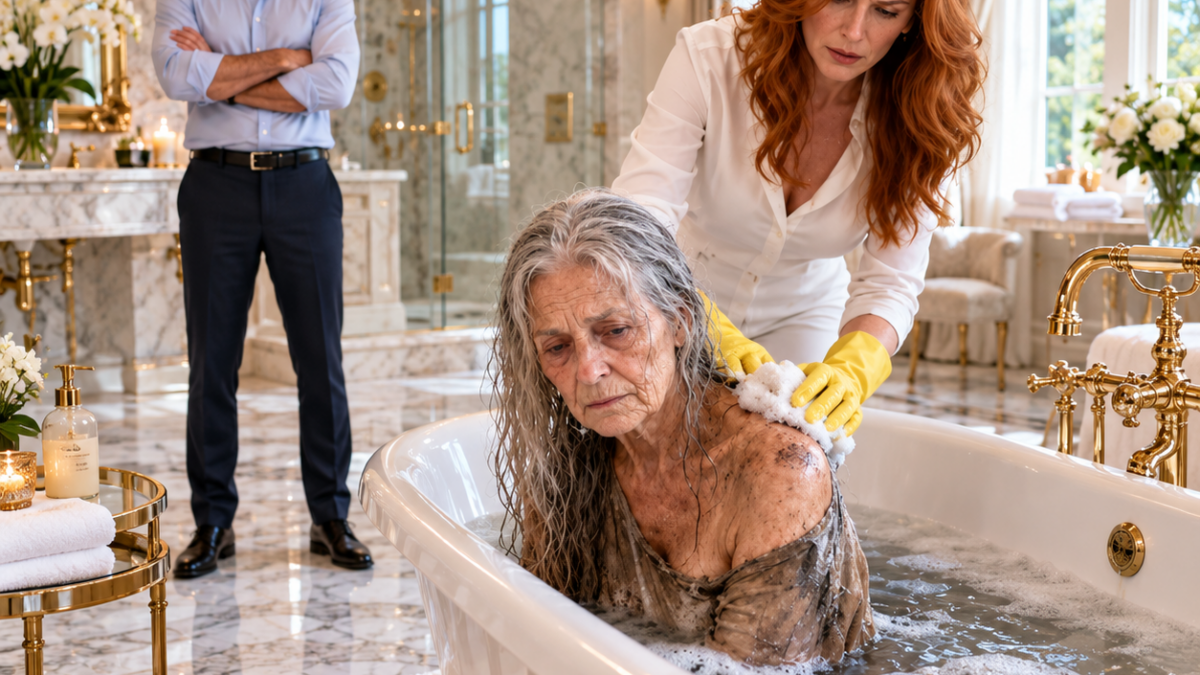
The bathroom attached to the guest suite was larger than the first apartment Lucas and I shared.
Marble tub.
Heated floor.
Brass fixtures.
Huge mirror.
I filled the tub.
Then put on rubber cleaning gloves.
Hope watched me.
She said nothing.
That somehow made me defensive.
“What?”
“Nothing.”
“You can say it.”
“I didn’t say anything.”
Exactly.
I pointed toward a large plastic bag.
“Take off those clothes. Put them there. We’re throwing them away.”
Hope touched the front of her jacket.
“I’ve had this a long time.”
“That’s obvious.”
Her face fell.
I looked away.
She removed it carefully.
Folded it.
Placed it beside the bag instead.
I almost corrected her.
Did not.
Under the jacket she wore two shirts.
Both badly worn.
Then she looked at me.
“I can bathe myself.”
“I know.”
“Then why are you still here?”
“Because Lucas asked me to help.”
“He asked you to make sure I don’t break anything.”
That stopped me.
I looked at her.
She was not angry.
Just tired.
I swallowed.
“Get in.”
She stepped into the tub.
The water immediately darkened around her feet.
I turned away slightly.
Disgust rose.
I hated that it did.
At the time, I blamed her.
Now I understand disgust often says more about distance than morality.
I had never been dirty because I had nowhere to wash.
Never worn clothes until they became part of my skin.
Never slept outdoors long enough that hygiene became a luxury.
I saw filth.
Not survival.
Hope sat down.
I handed her soap.
She started washing her arms.
Her movements were slow.
Weak.
I became impatient.
“Here.”
I picked up a sponge.
“I’ll help with your back.”
“You don’t have to.”
“I know.”
I rubbed soap across her right shoulder.
Dirt lifted.
Then something appeared beneath it.
A mark.
Small.
Dark.
Curved.
A perfect crescent.
The sponge fell from my hand.
It hit the tile.
Hope turned.
“What?”
I could not breathe.
The bathroom seemed to disappear.
There was only that mark.
That little moon.
My mother used to have one exactly like it.
On the same shoulder.
I had kissed it when I was a child.
Asked her why she had a moon on her skin.
She used to laugh.
“Because the moon wanted to know where to find me.”
I gripped the edge of the vanity.
“Turn around.”
Hope frowned.
“What?”
“Turn around.”
“Sabrina?”
“Please.”
Something in my voice frightened her.
She turned.
I took a washcloth.
Wet it.
Then began cleaning her face.
Not gently enough at first.
Desperately.
Years of dirt.
Sun damage.
Age.
Fine scars.
Hollow cheeks.
Gray hair.
But underneath—
Something familiar.
Not a face I could immediately identify.
Twenty years changes people.
Street life changes them more.
Yet the shape of her mouth.
Her eyes.
Something.
My hands began shaking.
“Stay here.”
I ran from the room.
Down the hall.
Into my bedroom.
Opened the bottom drawer of my dresser.
Then a small wooden box.
Inside lay a silver locket.
I had kept it for twenty years.
Through college.
Marriage.
Moves.
My father’s death.
Everything.
I ran back.
Hope was standing wrapped in a towel.
“What’s wrong?”
I opened the locket.
Inside was a faded photograph.
A young woman.
Twenty-seven.
Dark hair.
Bright smile.
Holding a ten-year-old girl with two missing front teeth.
Me.
I pointed at the woman.
“That was my mother.”
Hope stared.
Then looked at herself in the mirror.
I touched the crescent on her shoulder.
“She had exactly the same mark.”
Hope’s lips parted.
“No.”
“My mother disappeared twenty years ago.”
She stepped backward.
“I’m sorry.”
“No.”
My voice broke.
“Her name was Mary.”
Hope looked at the locket.
Then at me.
I said the word I had not said with hope in twenty years.
“Mom.”
Her face changed.
Not recognition.
Pain.
Confusion.
Fear.
“Mom, your name is Mary.”
She stared at me.
Then slowly reached for the locket.
“Where did you get this?”
“You gave it to me.”
Her eyes widened.
“No.”
“Yes.”
“You were wearing it the night you disappeared.”
She shook her head.
“I don’t remember.”
I opened it fully.
On the back of the tiny photograph were six handwritten words.
Always find your way back to me.
Hope touched them.
Her lips trembled.
“I know those words.”
My heart stopped.
“What?”
“I know them.”
“How?”
“I don’t know.”
“Mom, please.”
“Don’t call me that.”
The sentence hurt.
But she was terrified.
“I’m sorry.”
She closed her eyes.
“I remember a girl.”
My breath caught.
“What girl?”
“A little girl.”
Her forehead tightened.
“Crying.”
“Where?”
“I don’t know.”
“Was it me?”
She opened her eyes.
“Yes.”
I started crying.
“What else?”
“A car.”
“What kind?”
“Black.”
“Who was driving?”
She pressed her fingers against her temple.
“A man.”
“What man?”
“I don’t know.”
“Try.”
“I remember his hands.”
“Why?”
“A ring.”
“What ring?”
“Black stone.”
A cold feeling moved through me.
Hope suddenly stood so fast water splashed over the tub.
“Wait.”
She grabbed my wrist.
Her grip was startlingly strong.
“Don’t tell him.”
I froze.
“Tell who?”
Her eyes moved toward the bathroom door.
“Your husband.”
My body went cold.
“Lucas?”
She released me.
“Why are you afraid of Lucas?”
No answer.
“Mom.”
Her face twisted.
“He knows.”
“What?”
“He knows where I came from.”
I stared.
Before I could ask another question, the bathroom door opened.
Lucas.
“Everything all right?”
His voice was calm.
Too calm.
Hope immediately looked down.
I turned toward him.
For the first time in fifteen years, I did not see my husband.
I saw a man standing between me and a truth.
“Lucas.”
“Yes?”
“Where did you find her?”
“At the kitchen.”
“No.”
His eyes narrowed.
“I told you.”
“You didn’t tell me everything.”
His gaze moved toward Hope.
Then the locket.
For one fraction of a second, his expression changed.
Fear.
Real fear.
“What is that?”
I closed the locket.
“My mother’s.”
Lucas became completely still.
Hope looked at him.
Then whispered,
“David.”
Lucas went pale.
I turned toward her.
“Who is David?”
She shook her head.
“I don’t know.”
Lucas stepped into the room.
“Sabrina, we need to talk downstairs.”
“No.”
His jaw tightened.
“Not here.”
“Why did your face change when you saw this?”
“It didn’t.”
“It did.”
“Sabrina.”
“No.”
I stepped between him and Hope.
“Tell me the truth.”
He exhaled.
“I didn’t know who she was.”
“That is not what I asked.”
“I didn’t know she was your mother.”
My blood ran cold.
“You knew she was someone.”
He said nothing.
“Lucas.”
His shoulders dropped.
“I found a photograph.”
“Of what?”
“Your mother.”
My knees weakened.
“Where?”
He looked away.
“Someone gave it to me.”
“Who?”
No answer.
“Who gave you a photograph of my mother?”
He finally whispered,
“Your father.”
The room tilted.
“My father?”
“Yes.”
“My father died eleven years ago.”
“I know.”
“You met him?”
“Yes.”
I stared.
Lucas and I married fifteen years ago.
My father had been alive for four of those years.
They knew each other.
I had never known.
“Why?”
Lucas closed his eyes.
“Because he wanted to speak to me privately.”
“About what?”
He looked toward Hope.
“My mother.”
My father had told me one story for twenty years.
Mary had abandoned us.
Walked out one morning.
Never returned.
Police searched.
Nothing.
Eventually the case went cold.
My father said she must have chosen another life.
I believed him.
At first reluctantly.
Then angrily.
I spent birthdays waiting.
Graduations scanning crowds.
Every time the phone rang from an unknown number, some tiny part of me hoped.
Then hope became humiliation.
By eighteen, I told people my mother was dead.
It hurt less.
Now she was standing in my bathroom.
Alive.
And my husband had known something.
“Lucas.”
“I was going to tell you.”
“When?”
“I needed to be sure.”
“How long?”
He looked away.
“How long have you known she might be alive?”
Silence.
“Lucas.”
“Three months.”
I stepped backward.
Three months.
Ninety days.
We had eaten breakfast together.
Slept in the same bed.
Taken a weekend trip.
Celebrated our anniversary.
For three months, my husband suspected my missing mother was alive.
“You knew?”
“I suspected.”
“You knew enough to investigate.”
“Yes.”
“Why didn’t you tell me?”
“Because I was afraid of what it would do to you if I was wrong.”
I laughed bitterly.
“You decided for me.”
“I was trying to protect you.”
I hated that sentence instantly.
People often use protection as another word for control.
Hope whispered,
“He knows.”
Lucas looked at her.
“What do I know?”
She stared.
“David.”
His face tightened.
I looked between them.
“Who is David?”
Lucas did not answer.
Hope’s breathing changed.
Faster.
Then she said,
“Your father.”
I looked at her.
“What?”
She pressed both hands against her head.
“No. Not your father.”
She shook.
“His brother.”
Lucas closed his eyes.
I stared at him.
“My father had a brother?”
“Yes.”
“Named David?”
“Yes.”
“Why have I never heard about him?”
“Because your father made sure you didn’t.”
My stomach twisted.
“What did he do?”
Lucas spoke slowly.
“Twenty years ago, your father worked as an accountant for a developer called Redstone Development.”
I remembered that.
Barely.
My father hated discussing work.
“Redstone was laundering money through construction contracts.”
I stared.
“What?”
“Shell subcontractors. Inflated invoices. Fake labor. Real estate purchases.”
“My father discovered it?”
Lucas looked at Hope.
“No.”
I felt something inside me drop.
“What do you mean?”
“He was involved.”
“No.”
“Sabrina.”
“No.”
“My father was an accountant.”
“Yes.”
“He was boring.”
Lucas almost smiled sadly.
“That doesn’t make him innocent.”
I shook my head.
“You’re lying.”
“I wish I were.”
“Why would my mother disappear because of accounting fraud?”
Hope began crying.
I turned.
“Mom?”
She whispered,
“I found papers.”
“What papers?”
“Numbers.”
“Where?”
“At home.”
She closed her eyes.
“Your father brought documents home.”
Memory came in fragments.
She described a basement.
Arguments.
A black car.
A man with a black stone ring.
David.
My father’s brother.
Then Lucas said the sentence that changed my childhood forever.
“Your mother didn’t leave.”
I stared.
“She was taken.”
My knees almost gave out.
“By David?”
Lucas hesitated.
Then shook his head.
“Your father arranged it.”
I laughed.
No sound came out.
“My father kidnapped my mother.”
“He believed she had copied financial records.”
“Why would he threaten his own wife?”
“Because the network involved millions.”
I looked at Hope.
“Mom.”
She started crying harder.
“I remember now.”
I rushed toward her.
“What?”
“Your father said I would never see you again.”
My heart cracked.
“You knew I was alive?”
Her face twisted.
“I never forgot you.”
I started sobbing.
For twenty years, I had believed she left me.
For twenty years, I had hated her in order to survive missing her.
Now she was saying the opposite.
She had been trying to return.
“I looked for you,” she whispered.
“Why didn’t you come back?”
“I tried.”
“When?”
“Many times.”
“What stopped you?”
She looked toward Lucas.
“Someone from your father’s company.”
I turned.
“What does that mean?”
Lucas walked downstairs.
I followed.
“Do not walk away from me.”
“I’m not.”
He stopped near the fireplace.
He looked exhausted.
“Tell me everything.”
He reached inside his jacket.
An envelope.
My name.
Handwriting.
My mother’s.
I recognized it from old birthday cards.
My hands shook.
“How long have you had this?”
“Three days.”
“Three days?”
“I found it in a place connected to the old Redstone records.”
I opened it.
Sabrina,
If you are reading this, then someone finally found me.
My vision blurred.
I didn’t leave you.
I never abandoned you.
Your father told me if I tried to take you and run, he would make sure you disappeared too.
I stopped breathing.
I had to choose between staying near you and keeping you alive.
I pressed my hand against my mouth.
Then the final paragraph.
Lucas is not the man you think he is.
The letter fell from my hand.
I slowly looked at my husband.
He stared back.
“What does that mean?”
He swallowed.
“Sabrina.”
“What does that mean?”
Before he could answer, Hope screamed upstairs.
We ran.
She stood in the hallway.
In one hand, an old photograph.
She must have found it among clothes Lucas had prepared for her.
The picture showed my mother much younger.
Beside her stood a man.
Tall.
Dark hair.
Black stone ring.
Hope whispered,
“That is David.”
I stared.
“David who?”
“Your father’s brother.”
Lucas went pale.
Hope’s voice dropped.
“He is still alive.”
Then the doorbell rang.
Lucas froze.
A second later, we saw it through the glass near the foyer.
Black paint across our front door.
Four words.
SHE SHOULD HAVE STAYED LOST.
Hope trembled behind me.
Lucas stared at the message.
I turned.
“You knew this might happen.”
“No.”
“You’re lying.”
“I didn’t know he had found us.”
“David.”
“Yes.”
Hope whispered,
“He found me.”
I grabbed her hand.
“We call police.”
Lucas nodded.
Immediately.
He reached for his phone.
The lights went out.
Darkness.
Hope screamed.
Something crashed in the kitchen.
Glass.
Another sound.
Footsteps.
Someone inside.
Lucas grabbed my arm.
“Stay behind me.”
I pulled away.
“No.”
“Sabrina.”
“Do not make decisions for me again.”
I took Hope’s hand.
We moved toward the staircase.
Then a man’s voice came from the darkness.
“Mary.”
Hope stopped.
Her entire body shook.
“David.”
The lights came back on.
A man stood near the kitchen entrance.
Seventies.
Silver hair.
Long dark coat.
Calm eyes.
Black stone ring.
Exactly as Hope remembered.
Lucas stepped in front of us.
“David.”
David smiled.
“So you finally told her.”
I looked at Lucas.
“What is he talking about?”
David laughed softly.
“Lucas was always a coward.”
Lucas clenched his fists.
“You have no right to be here.”
David looked around.
“Your house?”
His smile widened.
“Everything you built started with people like me.”
I felt sick.
“What does that mean?”
David looked directly at me.
“Your husband never told you where his first investment came from?”
I turned.
“Lucas.”
He lowered his eyes.
“Tell me.”
“David helped finance my first company.”
“With what money?”
Silence.
David answered.
“Your father’s.”
I stared at Lucas.
“You knew?”
“Not at first.”
“When did you know?”
“Later.”
“How much later?”
His silence told me too much.
David smiled.
“He knew enough.”
My mother stepped forward.
“You killed him.”
David’s smile disappeared.
“No, Mary. You destroyed him.”
“You threatened Sabrina.”
“I never wanted the child.”
“Then why did you take me?”
“Because you had evidence.”
My mother’s face twisted.
“Evidence of what?”
I asked.
She answered.
“Your father and David were moving millions through construction projects.”
“My father too?”
“Yes.”
“Why did Dad let them take you?”
“He was afraid I would expose him.”
I felt sick.
The father who tucked me into bed.
The father who told me my mother abandoned us.
The man I mourned after his death.
He had been part of the reason she disappeared.
“Why keep her alive?” I asked David.
His eyes moved toward Hope.
“Because she hid copies.”
I looked at my mother.
“You did?”
She smiled faintly.
“Yes.”
“Where?”
She reached into the torn jacket she had refused to throw away.
From inside the lining, she pulled a tiny metal key.
“I kept this.”
Lucas stared.
“For twenty years?”
Hope nodded.
“What does it open?”
“A safe.”
“Where?”
“Your childhood home.”
A memory flashed.
Basement.
Dark.
A wooden cabinet.
My mother kneeling beside me.
Sabrina, never touch this box.
I had forgotten.
“I know where.”
Everyone turned.
“The basement.”
The old house had remained empty after my father died.
Legal disputes kept it from being sold.
Lucas took out his phone.
“We need police and we need to secure that house.”
David laughed.
“You still don’t understand.”
He reached into his coat.
Lucas moved.
David pulled out a photograph.
Not a weapon.
He threw it onto the floor.
I picked it up.
My mother.
Me.
And another woman.
I recognized her.
Lucas’s mother.
My blood went cold.
“Why is your mother with mine?”
Lucas closed his eyes.
“Because she helped Mary escape.”
“What?”
“My mother worked for David.”
I stared.
“She discovered what was happening.”
Hope nodded slowly.
“She helped me.”
Lucas continued.
“She helped your mother disappear before David could recover the copies.”
David’s expression hardened.
“She betrayed me.”
Lucas looked directly at him.
“And you killed her.”
I covered my mouth.
Lucas rarely discussed his mother.
He told me she died when he was young.
An accident.
Now he was saying—
“Murdered?”
Lucas nodded.
“Years ago.”
David said nothing.
That silence was enough.
Sirens sounded outside.
David’s face changed.
Lucas had called police earlier.
Quietly.
For once, I was glad he had acted without explaining.
David moved toward the back.
Officers entered seconds later.
Weapons drawn.
Commands.
He surrendered.
As they led him outside, he looked at Lucas.
“You think you’re innocent?”
Lucas said nothing.
Then David looked at me.
“Ask your husband what happened when he found Mary.”
I turned.
“What does he mean?”
Lucas’s face collapsed.
“I need to tell you something.”
“What?”
“I didn’t find your mother at the community kitchen.”
I stared.
“Then where?”
“The old bus station.”
“When?”
“Three months ago.”
I already knew part of this.
But hearing it spoken felt like betrayal all over again.
“You knew she was alive for three months.”
“I wasn’t sure.”
“You knew enough to hide her from me.”
“I was investigating.”
“You brought her home today.”
“Yes.”
“Why today?”
“Because I finally confirmed the locket connection.”
I stared.
“So the bath.”
His face twisted with shame.
“What?”
“You knew there was a mark.”
“No.”
“Then why did you insist I bathe her?”
He looked at me.
“I needed you to see her.”
My stomach dropped.
“You staged this.”
“No.”
“You forced an intimate situation because you thought I would discover something.”
“I thought if she was Mary, you might recognize something I couldn’t.”
“You could have told me.”
“Yes.”
“You humiliated her.”
His eyes filled.
“Yes.”
“And you humiliated me.”
“I know.”
“You made me into part of your test.”
“I know.”
I stepped away.
“You don’t get to decide what truth I deserve.”
“I know.”
Not apology.
Agreement.
That mattered slightly.
Not enough.
Lucas reached into his pocket.
Another photograph.
Mary years ago.
Outside a station.
Holding a newborn.
I stared.
“That isn’t me.”
“No.”
My mother began crying.
I turned.
“Who is the baby?”
She whispered,
“I didn’t escape alone.”
“What does that mean?”
“The night Lucas’s mother helped me run, there was another woman.”
“Who?”
“Someone David had been controlling.”
My heart pounded.
“She had a baby.”
Hope looked at the photograph.
“I took the child when the woman couldn’t.”
“Why?”
“She was dying.”
The room went silent.
“Whose child?”
My mother looked at David’s retreating police car.
“His.”
David’s daughter.
Saved by my mother.
Hidden somewhere.
Another life tangled into the same nightmare.
That mystery would take months.
But for that night, I could not carry another one.
I turned toward Hope.
Mary.
My mother.
“I spent twenty years thinking you abandoned me.”
She cried.
“I know.”
“I hated you.”
“I know.”
“I stopped saying your name.”
Her face crumpled.
“I never stopped saying yours.”
I moved toward her.
Then stopped.
For years I imagined reunion.
In every version, my mother looked like she had when I was ten.
Clean hair.
Perfume.
Warm arms.
Not this.
Older.
Thin.
Homeless.
Memory fractured.
Standing in borrowed clothes.
Life does not care about the version you rehearsed.
I crossed the room.
Wrapped my arms around her.
She held me.
For the first time in twenty years, I had my mother again.
I cried like I was ten.
She smelled of soap now.
Not the street.
Her hands trembled against my back.
“Why didn’t you come home?”
“I tried.”
“Why couldn’t you find me?”
“Your father moved you.”
“He told me you left.”
“I know.”
“How?”
“I saw things.”
“What?”
“School records.”
“From where?”
“People helped.”
“Why not contact police?”
“I did once.”
“And?”
“Someone told David.”
My blood chilled.
“So you ran again.”
“Yes.”
“For twenty years?”
“Not always.”
She closed her eyes.
“There were periods I remembered more. Then periods when everything disappeared.”
Doctors later called it trauma-related memory loss complicated by years of head injury, malnutrition, untreated illness, and psychological damage.
There was no magical restoration.
Memory returned in pieces.
Smells.
Faces.
Words.
The locket.
My voice.
David’s ring.
Lucas’s mother.
A black car.
Nothing came cleanly.
Real healing rarely does.
Police searched my childhood home.
The safe was still there.
Behind an old wooden cabinet in the basement.
The tiny key opened it.
Inside were ledgers.
Account records.
Construction contracts.
Photographs.
Names.
Transfers.
Enough evidence to reopen investigations that had been buried for decades.
Redstone Development had been a machine for moving dirty money through legitimate projects.
My father was not the innocent accountant I remembered.
He helped construct financial structures.
Then apparently tried to withdraw when the network became more violent.
By then, too late.
Mary discovered records.
My father chose the operation over protecting her.
David arranged her disappearance.
Lucas’s mother, Elena, worked inside David’s organization.
She helped Mary escape one holding location.
For that, Elena later died in what had been officially called a car accident.
Police reopened that too.
My father died eleven years before the truth surfaced.
There was no trial for him.
No confrontation.
That angered me more than I expected.
I wanted to ask him.
How could you?
How could you let your wife disappear?
How could you let your daughter believe she had been abandoned?
Why did you choose money?
Fear?
Your brother?
Anything over us?
Dead people do not answer.
That became another grief.
Lucas’s role was complicated.
Too complicated for simple forgiveness.
He had met my father years earlier.
My father gave him information about old accounts shortly before his death.
Some money eventually helped finance Lucas’s first company.
Lucas claimed he did not initially know where the capital originated.
Records suggested he learned enough later to suspect.
Instead of telling me, he investigated quietly.
He built businesses partly using money connected to people who had been harmed by Redstone.
He knew there were stains under his success.
He just convinced himself that turning dirty origins into legitimate companies made it different.
It did not.
The hardest conversation came two weeks after David’s arrest.
Lucas and I sat in our kitchen.
No staff.
No lawyers.
No investigators.
Just us.
He looked exhausted.
“So,” I said, “how much?”
“What?”
“How much of your first business came from my father’s money?”
“Three hundred thousand.”
I laughed bitterly.
“That isn’t a small seed investment.”
“No.”
“Did you know it was criminal money?”
“Not when I took it.”
“When did you learn?”
“Approximately three years later.”
“And you told me?”
“No.”
“Returned it?”
“No.”
“Reported it?”
“No.”
“What did you do?”
“I kept building.”
I stared.
“Why?”
“Because by then employees depended on me.”
“That is a convenient answer.”
“I know.”
“Did you think about telling me?”
“Yes.”
“How many times?”
“Hundreds.”
“But you didn’t.”
“No.”
“Why?”
“Because I was afraid you would look at me the way you are looking at me now.”
That was honest.
I hated it.
I looked away.
“Did you marry me because of my father?”
“No.”
“David says—”
“I met you before I knew the connection.”
I knew that timeline held.
We met in college.
His first serious business came years later.
“Did my father use you?”
“Yes.”
“For what?”
“To move money into legitimate ventures.”
“You knew eventually.”
“Yes.”
“Then you let him.”
“Yes.”
I closed my eyes.
The Lucas I thought I knew was not gone.
That would have been easier.
He was still there.
And also this.
A man who loved me.
A man who lied to me.
A man who built successful companies.
A man whose first capital came from criminal money.
A man who spent years trying to uncover my mother’s fate.
A man who kept the investigation from me.
Human beings are unbearable when they refuse to be simple.
“Why bring Mary home?”
“I wanted you to see her.”
“You used me.”
“Yes.”
“You could have said, Sabrina, I found a woman who may be your mother.”
“I was afraid.”
“Everyone in this story is afraid.”
He flinched.
Good.
“My father was afraid.”
“Yes.”
“Mary was afraid.”
“Yes.”
“Elena was afraid.”
“Yes.”
“You were afraid.”
“Yes.”
“And I spent twenty years living inside everybody else’s fear.”
He looked down.
“I’m sorry.”
“I need more than sorry.”
“What?”
“Truth.”
“You have it.”
“No.”
I leaned forward.
“I have pieces you decided I could handle.”
He looked at me.
“No more.”
“What?”
“No more deciding.”
He nodded.
“No more.”
I removed my wedding ring.
His face changed.
“Sabrina.”
“I’m not asking for a divorce.”
Hope flickered.
I hated that too.
“I’m telling you our marriage is not continuing as if this was a difficult week.”
He nodded.
“What do you want?”
“Separate rooms.”
“Okay.”
“Full financial disclosure.”
“Yes.”
“Every company.”
“Yes.”
“Every trust.”
“Yes.”
“Every account connected to Redstone.”
“Yes.”
“No destroying documents.”
“Never.”
“Independent forensic review.”
“Yes.”
“And therapy.”
His eyebrows lifted.
“For us?”
“For you first.”
He almost smiled.
“That sounds fair.”
“Nothing is funny.”
“I know.”
Our marriage survived.
Eventually.
But not because love conquered everything.
I hate stories like that.
Love without truth had helped create the problem.
Our marriage survived because Lucas stopped asking love to excuse secrecy.
He handed investigators everything.
Emails.
Ledgers.
Old bank records.
Notes from my father.
Documents from Elena.
He sold several businesses whose early funding could be traced directly to stolen Redstone money.
Some people told him he was insane.
Those companies were worth millions.
Lucas said,
“They were never entirely mine.”
Funds went into restitution programs and settlements for families harmed by the old construction network.
It did not make him a hero.
It made him accountable.
There is a difference.
I watched carefully.
Not his speeches.
His behavior.
When attorneys warned him disclosure could damage his reputation, he disclosed anyway.
When accountants suggested legal structures that might preserve more assets, he declined if victims had claims.
When journalists called, he did not pretend ignorance.
He said,
“I benefited from money I later learned was connected to criminal activity. I should have acted sooner.”
That mattered.
Not enough for instant trust.
Enough for a beginning.
My mother stayed with us briefly.
That did not work.
Not because I wanted her gone.
Because our house overwhelmed her.
Too large.
Too quiet.
Too clean.
She could not sleep in the guest room.
The bed was too soft.
She would curl on the floor beside it.
The first time I found her there, I cried.
“Mom.”
She woke terrified.
“What?”
“Why are you sleeping on the floor?”
She looked embarrassed.
“I’m used to it.”
“We have a bed.”
“I know.”
“Please use it.”
Her face tightened.
“Sabrina.”
I stopped.
I was doing it too.
Trying to force healing into the shape I wanted.
“Okay.”
I brought blankets.
Sat on the floor.
She laughed softly.
“You don’t have to sleep here.”
“I know.”
I stayed anyway.
Eventually, with doctors and social workers, we found a small house near mine.
Not luxurious.
That was important.
Mary chose it.
One bedroom.
Little kitchen.
Backyard.
Front porch.
She planted roses.
Red.
Yellow.
White.
At first, she killed half of them because she watered too much.
We laughed.
It was the first ordinary thing we did as mother and daughter.
Ordinary became precious.
I had spent years imagining one huge reunion that fixed everything.
Instead, we built a relationship through groceries.
Doctor appointments.
Photographs.
Recipes.
Arguments.
Silence.
Questions.
Sometimes she remembered me at ten more clearly than she understood me at thirty-six.
She would ask whether I finished homework.
Then realize.
Cry.
I learned not to correct her too quickly.
She learned my life slowly.
Lucas.
My career.
Friends.
My father’s death.
She grieved him.
That shocked me.
“How can you?”
She looked at me.
“What?”
“Miss him.”
“He did terrible things.”
“Yes.”
“He destroyed your life.”
“Yes.”
“Then why are you crying?”
She thought.
“Because before he became the man who hurt me, he was someone I loved.”
That answer stayed with me.
People want victims to simplify the people who hurt them.
Monster.
Nothing else.
Real history resists.
My father had loved her once.
Maybe deeply.
Then chose fear, money, and complicity.
Both could be true.
Mary never excused him.
But she did not erase every earlier memory either.
That helped me understand Lucas too.
Not forgive automatically.
Understand.
David went to trial.
The evidence from the safe transformed everything.
Kidnapping.
Fraud.
Money laundering.
Conspiracy.
Other crimes tied to Redstone.
Elena’s death reopened.
So did several unexplained disappearances.
David was convicted on multiple counts.
The day the verdict came, Mary sat beside me.
She did not smile.
I expected relief.
Instead, she whispered,
“Twenty years.”
I held her hand.
“You’re here.”
“I lost twenty years.”
“I know.”
“You grew up.”
My throat tightened.
“I know.”
“I missed everything.”
“No.”
She looked at me.
“You missed a lot.”
I smiled through tears.
“But not everything.”
We went home.
That night, I showed her boxes.
School certificates.
College photographs.
Wedding album.
Pictures my father had taken.
Some were painful.
Mary touched one from my high school graduation.
“You wore blue.”
“Yes.”
“You hated blue.”
“I still do.”
She laughed.
Then cried.
I sat with her.
No fixing.
Just staying.
That was something Lucas’s community kitchen taught me indirectly.
Helping is not always solving.
Sometimes it is preserving dignity while someone rebuilds what cannot be replaced.
The woman I initially treated like contamination taught me that faster than anyone.
I apologized to her months after we reunited.
Not for failing to recognize her.
For the bathtub.
“I wore gloves.”
Mary laughed.
“So?”
“I acted disgusted.”
“You were disgusted.”
“I was cruel.”
“You were frightened.”
“No.”
I looked at her.
“Do not excuse me because I’m your daughter.”
That silenced her.
I continued.
“I told you I didn’t want you breaking anything.”
Mary remembered.
Her face softened.
“That hurt.”
“I know.”
“I thought Lucas made a mistake bringing me.”
My eyes filled.
“I’m sorry.”
She reached for my hand.
“Good.”
I blinked.
“Good?”
“You should be.”
Then she smiled.
“You were terrible.”
I laughed through tears.
“Mom.”
“What?”
“I’m apologizing.”
“I accepted.”
“You’re supposed to say something kind.”
“I was homeless, not dishonest.”
That was Mary.
As more memory returned, so did her humor.
She had once been quick.
Sharp.
It came back.
Not perfectly.
But enough.
She told me stories about my childhood I had forgotten.
The time I cut my own hair.
The time I tried to run away because she made broccoli.
The way I used to pronounce spaghetti.
I gave her stories from the twenty years she lost.
We built a bridge from both sides.
Sometimes it held.
Sometimes grief washed parts away.
We rebuilt.
Lucas and I spent almost two years in therapy.
There were weeks I hated him.
Weeks I remembered why I loved him.
Weeks those feelings existed together.
The hardest question came from our therapist.
“What would rebuilding trust look like to you?”
I answered immediately.
“Knowing everything.”
The therapist asked,
“Is that possible?”
I stopped.
No.
You can never know everything inside another person.
That realization frightened me.
Then the therapist asked,
“What can you know?”
I looked at Lucas.
He answered.
“What I do now.”
Yes.
Trust stopped being about certainty.
It became pattern.
Does he tell difficult truths before being forced?
Does he ask before deciding for me?
Does he admit fear without calling it protection?
Does he tolerate my anger without demanding forgiveness?
Does he remain transparent when transparency costs money?
Over time, yes.
That is why we stayed married.
Not because the story required reconciliation.
Because after years of work, I chose it.
Choice.
That word mattered.
Lucas had spent three months denying me choices.
My father denied Mary hers.
David built his life around taking them from people.
I would never again stay anywhere I did not feel free to choose.
One year after finding Mary, I returned to the community kitchen.
Alone.
The director recognized me.
“You’re Lucas’s wife.”
“Sabrina.”
“Right.”
I volunteered.
Not for a photo.
No press.
I served soup.
A man complained it was too salty.
He was right.
A woman asked for two rolls.
I gave three.
An older woman came through the line.
Her hair was tangled.
For one terrible second, I saw Mary.
My hands stopped.
Then I looked at the woman’s face.
Not dirt.
A face.
“Would you like coffee?”
“Yes, honey.”
Cream?
“Please.”
Small things.
That was where my arrogance finally died.
Not all at once.
But enough.
I remembered saying some people prefer to live that way.
What did I know?
Mary had spent years outside because trauma, fear, missing identity, and danger had made ordinary life nearly impossible.
From a luxury home, her circumstances could look like choice.
From inside her history, they looked like survival.
I became careful with judgments after that.
Not because everyone on the street has a hidden daughter waiting in a mansion.
Most do not.
But every person has a story you cannot see from their clothes.
That is enough reason for dignity.
Years later, Mary told me something I never forgot.
We were sitting on her porch.
Roses everywhere.
The locket in her hand.
“Do you remember what you said in the bathroom?”
I groaned.
“Unfortunately.”
“Not that.”
“What?”
“You called me Mom.”
I looked at her.
“I barely knew why.”
“I did.”
“What?”
“Some part of me knew.”
My eyes filled.
“I thought you did not recognize me.”
“My mind didn’t.”
She touched her chest.
“But something did.”
I smiled.
She opened the locket.
Always find your way back to me.
“You kept this twenty years.”
“Yes.”
“Why?”
“I was afraid if I threw it away, I would be throwing you away.”
Mary cried.
I took her hand.
“I’m sorry you ever thought I left.”
“I’m sorry you spent twenty years trying to come back.”
She touched the crescent mark.
“My little moon.”
I laughed.
“You remember that.”
“Yes.”
“Why did you call it that?”
She smiled.
“My mother called it that.”
Another piece of family restored.
The baby in the train-station photograph was eventually found too.
That search took almost three years.
Her name was Elena Davidsson now.
Not David’s surname.
The family that adopted her had changed it.
She had no idea about her biological history.
Police contacted her carefully.
DNA confirmed it.
David was her biological father.
Her mother had died shortly after Mary and Lucas’s mother helped them escape.
Mary had carried Elena for days before placing her with people she believed were safe.
That was another part of Mary’s lost years.
She had not only been surviving.
She had been protecting others.
When Elena met Mary, she brought flowers.
Mary laughed.
“I kill those.”
Elena stared.
Then laughed too.
That was how some stories healed.
Not with music.
With bad gardening jokes.
Lucas’s companies changed.
He sold some.
Restructured others.
Created a foundation independent of his control focused on restitution, housing support, and document recovery for people experiencing homelessness.
I distrusted it at first.
“Is this guilt?”
“Yes.”
He answered immediately.
“And?”
“Responsibility.”
Better.
No hero campaign.
No giant portrait.
No building named after him.
Good.
He continued serving at the kitchen.
Sometimes I joined.
Sometimes Mary did.
The first time she walked in clean, wearing jeans and a red sweater, one volunteer recognized her.
“Hope?”
Mary smiled.
“My name is Mary.”
The volunteer hugged her.
I cried.
Of course.
Mary hated when I cried too much.
“You’re dramatic.”
“I lost you for twenty years.”
“That excuse expires eventually.”
“No.”
She rolled her eyes.
Our family became weird.
But real.
Christmas at Mary’s house.
Lucas washing dishes.
Elena visiting sometimes.
Old case files still arriving.
Therapy appointments.
No illusions.
My father’s portrait disappeared from my living room.
I did not burn it.
I placed it in storage.
Mary asked once why.
“I don’t know what to do with him.”
She nodded.
“Neither do I.”
That was permission enough.
You do not need immediate emotional conclusions about dead people who betrayed you.
Some histories remain unresolved.
The house where I grew up was eventually sold.
Before closing, I went once.
Mary came.
So did Lucas.
The basement safe had been removed.
The wall was open.
I stood in my childhood bedroom.
Tiny.
I remembered waiting at the window for my mother.
Every car.
Every birthday.
Mary stood in the doorway.
“I used to sit here?”
“Yes.”
“What color were the walls?”
“Yellow.”
She smiled.
“You begged for purple.”
“I did?”
“I said purple would make the room dark.”
“You were wrong.”
“Probably.”
We laughed.
Then she saw the window.
Her face changed.
“You waited.”
I swallowed.
“For years.”
She began crying.
I crossed the room.
“No.”
“What?”
“You do not get to apologize.”
“I left you.”
“You were taken.”
“I still wasn’t here.”
“That is not the same.”
She nodded.
Then whispered,
“Thank you.”
We walked out together.
I never returned.
The old house belonged to the past.
Not because truth erased it.
Because truth finally stopped it from owning us.
On the twentieth anniversary of my father’s death, I visited his grave.
First time in years.
I expected rage.
Instead, confusion.
I stood there.
“You told me she left.”
Wind.
Nothing else.
“You made me hate her.”
I stared at his name.
“You let me believe she didn’t want me.”
That was the unforgivable part.
Not money.
Not even crime.
He weaponized my mother’s absence.
I said,
“I loved you.”
That hurt.
“You were my dad.”
I cried.
“You should have been better.”
Then I left.
No forgiveness ceremony.
No dramatic release.
Just honesty.
Sometimes that is all a grave can give you.
Lucas waited in the car.
He did not ask what I said.
That was growth too.
Ten years after Mary came home, her memory was still imperfect.
Some things never returned.
But she remembered enough.
Me.
Her own name.
The locket.
The little moon.
Roses.
Lucas.
Elena.
David.
She built new memories.
That mattered more.
One afternoon, I found her sitting on the porch holding the locket.
“How are you feeling?”
“Old.”
“You are old.”
“Sabrina.”
“What?”
“Respect your mother.”
We laughed.
Then she looked at the crescent mark on her shoulder.
“Do you know what people misunderstand?”
“What?”
“They think losing memory means losing love.”
I sat beside her.
“Doesn’t it?”
“No.”
“How?”
She touched my hand.
“I forgot names.”
“Places.”
“Yes.”
“Years.”
“Yes.”
“But not you?”
She smiled.
“I forgot how to find you.”
My throat tightened.
“I never forgot that someone was missing.”
That sentence destroyed me.
She continued.
“I would wake in shelters sometimes with this pain.”
She touched her chest.
“I didn’t know why.”
“I thought I had lost something.”
“You had.”
“Yes.”
She looked at me.
“A mother can lose a house.”
She touched the crescent mark.
“She can lose her name.”
Then she placed her hand over mine.
“But she never loses her child.”
I cried.
Not because I was sad.
Because after decades of believing I had been discarded, I finally understood.
Mary had not abandoned me.
She survived for me.
The woman I had once looked at with disgust in my bathtub was not a stranger.
She was the missing piece of my life.
And there was one more lesson I carried from that day.
Lucas had told me to bathe her because he wanted me to see a person.
He was right about one thing.
I had become insulated.
Money had created distance.
Staff.
Drivers.
Private rooms.
People who handled unpleasant things.
I did not become cruel because I was rich.
But comfort made cruelty easier to ignore.
That day stripped something away.
I learned that dignity should never depend on whether someone is clean enough to make us comfortable.
I learned that a person can look lost and still belong somewhere.
I learned that homelessness can hide histories no stranger could imagine.
And I learned something about recognition.
Sometimes we recognize people through faces.
Sometimes voices.
Sometimes names.
Sometimes DNA.
And sometimes all it takes is one little crescent-shaped mark beneath years of dirt.
One moon.
One memory.
One locket kept for twenty years.
One word.
Mom.
People ask whether I believe fate brought Mary into Lucas’s community kitchen.
I do not know.
Maybe.
Maybe not.
What I know is this.
Lucas found her.
He brought her home.
He handled it badly.
Secretly.
Controlling.
He hurt me by deciding what I could know.
But he also opened a door twenty years of lies had kept shut.
Mary stepped through it.
So did I.
Our marriage changed.
My idea of my father changed.
My understanding of wealth changed.
My understanding of strangers changed.
Everything did.
The locket sits in a glass case now.
Not because it is valuable.
It is not.
Silver.
Scratched.
One hinge repaired twice.
But inside is a photograph of a young mother holding a little girl.
On the back:
Always find your way back to me.
She did.
Not quickly.
Not safely.
Not in the way either of us imagined.
But she did.
And years after the day I dropped that sponge, I finally understood why those six words mattered.
They were never an instruction for Mary alone.
They were for both of us.
Because I had been lost too.
Lost inside anger.
Privilege.
An old story about a mother who left.
A marriage filled with half-truths.
A father I had idealized.
Mary came home.
And in finding her, I found my way back too.








