My Husband Tried to Drag Me Out of My Hospital Bed—Then the Nurse Asked the Question That Destroyed Him
PART2
The words landed quietly.
That made them worse.
He said it like a correction.
Like I had exaggerated a weather report.
“You didn’t die,” he repeated. “You’re lying here while I’m handling everything. Emma. The house. Bills. Calls from the insurance company. My job. Your medical drama.”
“My medical drama?” I looked down at my legs. “Caleb, both of my legs are broken.”
“I can see the casts.”
“Then why are you talking like I’m on vacation?”
His jaw tightened.
There it was.
The warning sign.
A small movement. A hardening around the mouth. The slight lift of his chin. The expression that meant I had stepped too close to the edge of his patience, as though his patience were a holy thing and not a leash he tightened whenever I remembered I had a voice.
“Don’t start,” he said.
I almost stopped.
The habit rose in me automatically.
Apologize.
Soften.
Explain.
Tell him I was tired.
Tell him I did not mean it that way.
Tell him he was right, this must be so hard on him.
That had been my role for years. I translated his anger into stress. I translated his insults into worry. I translated his control into love with a complicated personality.
But something had shifted inside me during those three weeks alone.
Maybe pain had burned through my manners.
Maybe the accident had shaken loose the part of me that still believed obedience could purchase peace.
Maybe lying in a hospital bed with no husband beside me had shown me what my marriage looked like without my excuses standing in front of it.
“I’m not starting anything,” I said. “I’m recovering.”
He gave a short, humorless laugh.
“Recovering. Right.”
My hands curled around the blanket.
“Where’s Emma?”
“With my mother.”
My stomach tightened.
“Why?”
“Because someone has to take care of her.”
“I asked you to bring her yesterday.”
“She doesn’t need to see you like this.”
“She’s my daughter.”
“She’s scared enough already.”
“Then let me talk to her.”
“She doesn’t want to talk.”
That hurt more than I expected.
Not because I believed it.
Because I knew Caleb well enough to know he had probably made it true, at least for that moment.
“What did you tell her?” I asked.
“I told her Mommy needs rest.”
“How kind.”
“I also told her Mommy needs to stop making everything harder.”
My throat closed.
Emma had already lost three weeks with me. Three weeks of confusion. Three weeks of relying on Caleb to explain why her mother was gone. Three weeks under the influence of his version of events.
I stared at the drawing on the wall.
Come home soon, Mommy.
“She made that for me,” I said.
Caleb glanced at it as if noticing it for the first time.
“Cute.”
Cute.
The entire distance between us lived inside that word.
He stepped closer.
“The doctor said you can be discharged soon.”
“No. The doctor said maybe next week, if I tolerate therapy, and then I need inpatient rehab.”
“No.”
I looked at him.
“No?”
“We’re not doing rehab.”
“Caleb, I can’t walk.”
“You can recover at home.”
“I can’t even get to the bathroom without two nurses and a transfer belt.”
“You’ll figure it out.”
I stared at him, waiting for the joke to appear.
It did not.
“Our bedroom is upstairs.”
“I’ll put you on the couch.”
“The downstairs bathroom doesn’t have a shower.”
“You can sponge bathe.”
“I need medical care.”
“You need motivation.”
My chest tightened.
Pain moved through my ribs like wire.
“The physical therapist said—”
“I don’t care what the physical therapist said.”
“You should.”
“I’m done letting strangers drain our money because you like being taken care of.”
There it was.
The sentence beneath all the others.
I like being taken care of.
I almost smiled, because if I did not, I would scream.
For eleven years, I had taken care of everyone.
I had left my accounting job after Emma was born because Caleb insisted it made financial sense for one parent to stay home. At first, he called it practical. Then traditional. Then best for Emma. Then, gradually, it became another reason I owed him gratitude.
His career mattered because it brought in money.
My work at home did not count because no one issued a paycheck.
He would come home and ask what I had done all day while stepping over folded laundry, eating the dinner I cooked, wearing clean shirts I washed, walking through a house I maintained, kissing a child I had fed, bathed, dressed, taught, comforted, and loved through every fever and nightmare.
I had given up spreadsheets and clients for grocery lists and preschool forms.
I had told myself it was our decision.
But Caleb had a way of making “our decision” mean “my demand, delivered softly enough for you to call it agreement.”
“I gave up everything for this family,” I whispered.
He rolled his eyes.
That small movement killed something in me.
Not love.
Love had been dying in pieces for a long time.
It killed my last instinct to plead.
“You’re my husband,” I said. “You’re supposed to help me.”
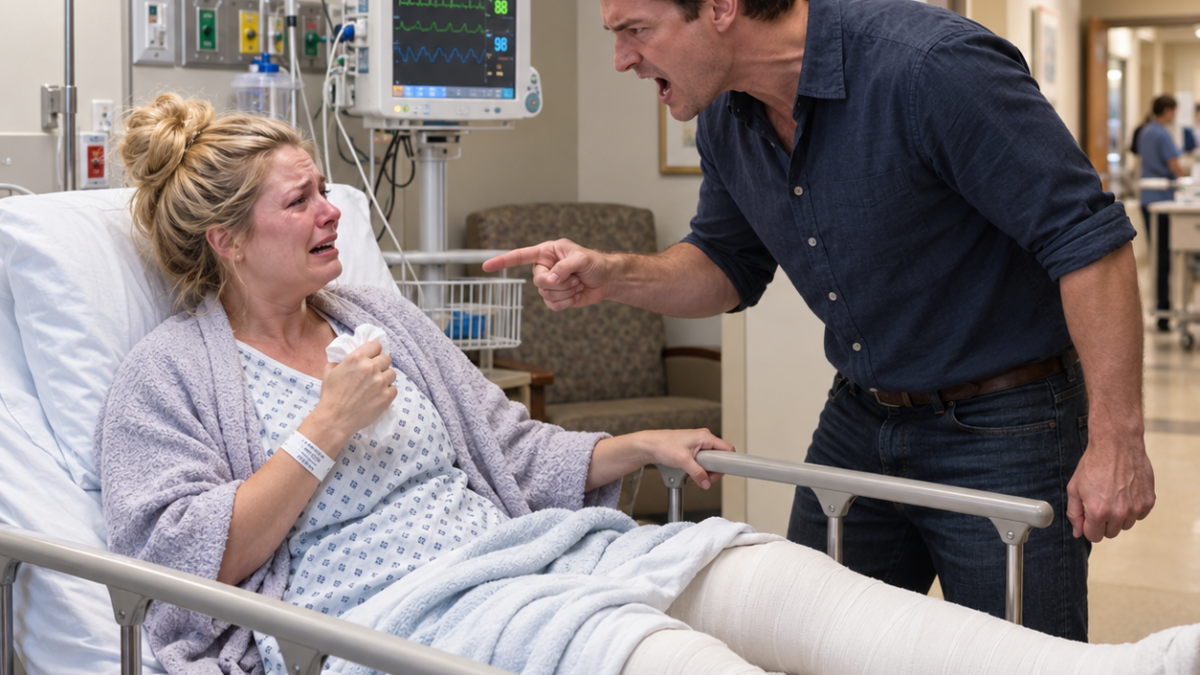
He leaned over the foot of the bed.
“You’re just making everything harder.”
The monitor continued.
Beep.
Beep.
Beep.
I breathed through my nose.
“My doctors decide when I leave.”
“I decide what I pay for.”
“Insurance is covering most of it.”
“Not enough.”
“Caleb—”
“Get up.”
For a second, I thought I had misheard him.
“What?”
“Get up. We’re leaving.”
“I can’t.”
“Don’t say that word to me.”
“My legs are broken.”
“Your legs are in casts. That doesn’t mean your entire body stopped working.”
I stared at him.
The absurdity would have been funny in another life. In a sitcom, maybe. A foolish husband saying something ridiculous before a laugh track corrected him.
But this was my room.
My body.
My pain.
My daughter waiting somewhere in his mother’s house.
And Caleb was not being foolish.
He was being Caleb.
He came around the side of the bed.
My pulse quickened.
“Don’t,” I said.
He pulled back the blanket.
The cold air hit my legs, and I flinched.
“Caleb, stop.”
“Sit up.”
“No.”
His eyes snapped to mine.
I had said no before in small ways.
No, I don’t want Italian tonight.
No, I can’t host your boss with two hours’ notice.
No, Emma can’t have candy before bed.
But this was different.
This no did not come with an apology attached.
It did not crouch.
It stood.
He froze, as if a chair had spoken.
“What did you say?”
“I said no.”
His hand closed around my upper arm.
Hard.
Pain shot through my shoulder and across my ribs as he pulled.
“Get up.”
I cried out.
The sound embarrassed me immediately, which tells you far too much about my marriage.
My body lurched sideways. The casts dragged against the sheets. My ribs screamed. My injured wrist slammed against the bedrail. The heart monitor began speeding up.
Beep-beep.
Beep-beep.
Beep-beep.
“Caleb, you’re hurting me!”
“Stop making a scene.”
“I can’t move!”
“You can if you want to.”
He pulled again.
This time my casted legs shifted, and a bolt of pain tore through me so violently that my vision went white. I gasped and grabbed at the bedrail. The monitor erupted into an urgent alarm.
I remember thinking, absurdly, that everyone in the hallway probably heard it.
Then I remember thinking, good.
Let them.
For years, Caleb’s anger had lived behind closed doors.
In kitchens after dinner.
In bedrooms after Emma fell asleep.
In the car with the radio turned up.
In the garage where neighbors could not see.
In text messages that vanished after he demanded to check my phone.
He had always understood walls.
He had always understood volume.
He had always known exactly how far he could go and still make me look unreasonable if I described it.
But hospitals do not belong to husbands.
They belong to records.
Visitor logs.
Medication schedules.
Monitors.
Nurses.
Charts.
Cameras.
Witnesses.
He pulled once more, and I screamed.
The door opened.
A nurse stood behind a supply cart, one hand still on the handle.
Her name was Angela Reed. I knew because she had been assigned to me twice before, and she had a voice like warm tea until she needed it to become steel.
Her eyes moved from Caleb’s hand on my arm to the twisted blanket, my trembling body, the monitor alarm, and the numbers flashing on the screen.
“Please step away from the patient,” she said.
Caleb dropped my arm.
Instantly.
The transformation was so fast it chilled me more than the pain.
His face rearranged itself. The anger smoothed. His shoulders lowered. His voice softened into the reasonable tone he used with bank managers, pastors, and police officers.
“She’s confused,” he said. “The medication has her disoriented. She was trying to get out of bed, and I was only helping.”
Angela looked at my casts.
Both of them.
Then at him.
“You were helping her get out of bed?”
He hesitated.
The monitor screamed again.
Two more staff members rushed in. One nurse came to my side and checked the leads. A male orderly stepped between Caleb and my bed without touching him.
Caleb pointed at me.
“Ask her. She’ll tell you nothing happened.”
There it was.
The old command, dressed as confidence.
She’ll tell you nothing happened.
Because I always had.
When Caleb punched the wall beside my head during Emma’s colic months, I said he was exhausted.
When he grabbed my wrist hard enough to bruise because I forgot to transfer money before the mortgage autopay, I said I bumped the counter.
When he shoved a dining chair so hard it cracked against the floor, I told Emma Daddy was frustrated.
When he called me useless, dramatic, lazy, ungrateful, unstable, and impossible, I translated each word into stress before it could reach anyone else.
When my sister Lauren asked why I never came to brunch anymore, I told her weekends were busy.
When my mother asked why I sounded tired, I told her motherhood was tiring.
When Emma once whispered, “Why does Daddy get big voice at you?” I held her too tightly and said, “He just had a hard day.”
For eleven years, I had been the janitor of Caleb’s image.
I swept up the glass.
I patched the drywall.
I wore long sleeves.
I smiled in Christmas photos.
And now he stood in my hospital room, certain that even broken, stitched, and trapped under the weight of two casts, I would still clean up after him.
Angela knelt beside my bed until her eyes were level with mine.
“Rebecca,” she said gently, “I need to hear your answer—not his.”
The room became very quiet.
Caleb stared at me.
Not pleading.
Warning.
My wedding ring pressed against the cold bedrail beneath my hand.
I looked at it.
A simple gold band.
Eleven years of meaning, polished by habit.
I remembered the day he slipped it onto my finger. Caleb had cried at the altar. His hands shook. He promised to honor me, protect me, cherish me, and build a life where I would never have to face anything alone.
People love wedding vows because they are beautiful.
They rarely ask what happens when vows become evidence of perjury.
I looked back at Angela.
“He hurt me,” I said.
The words were not loud.
They did not need to be.
The atmosphere changed instantly.
One nurse silenced the monitor but kept watching my vitals. The orderly took a wider stance between Caleb and the bed. Angela’s face remained calm, but her eyes sharpened.
Caleb laughed once.
It sounded wrong.
“Rebecca, don’t do this.”
I stared at him.
There were so many things inside that sentence.
Don’t embarrass me.
Don’t expose me.
Don’t make them see me.
Don’t stop protecting me now.
Angela stood.
“Sir, you need to step into the hallway.”
“No. This is my wife.”
“She is my patient.”
“I have medical power of attorney.”
Angela did not blink.
“Not while she is conscious and refusing your contact.”
“She’s drugged.”
“She is alert and oriented.”
“You don’t understand our marriage.”
“Sir,” the orderly said quietly, “step out.”
Caleb’s face flushed.
He pointed at me again.
“She’s unstable. She’s been unstable for years. Ask anyone. She exaggerates everything.”
Angela turned to the second nurse.
“Call security.”
That word landed like a slap.
Security.
Caleb heard it too.
His eyes widened.
“Are you serious?”
Angela’s voice stayed steady.
“Very.”
Footsteps came fast in the hallway.
Caleb looked at me one more time.
I knew that look.
It said: You will pay for this later.
But for the first time, he was the one surrounded by witnesses.
Before security reached the room, Angela leaned closer to me and asked one final question.
“Rebecca,” she said, “are any of the injuries we’re treating connected to anything involving your husband before today?”
My mouth went dry.
The obvious answer should have been no.
The accident had happened on a wet road three weeks earlier. A delivery truck had run a red light. My sedan had spun, hit the median, and folded around me like aluminum foil. Emergency workers cut me out. Strangers held my hand. Someone said, “Stay with us.” Someone else said, “She’s losing blood.”
That was the official story.
It was true.
But it was not the whole truth.
Three hours before the crash, Caleb and I had argued in the kitchen.
He had found an email on my laptop from a staffing agency.
A harmless email.
Accounting contract work.
Remote part-time.
Nothing signed.
Nothing decided.
Just one small attempt to imagine a life where I had my own income again.
Caleb did not see it that way.
He called it betrayal.
He said I was planning to abandon the family.
He said Emma would suffer because I wanted to “play businesswoman.”
I told him I wanted options.
He shoved the laptop closed so hard the corner cracked.
Then he grabbed my wrist.
The same wrist that still throbbed beneath the hospital bracelet.
He squeezed until I dropped the coffee mug in my other hand.
Emma came into the kitchen crying.
He released me.
Then he smiled at our daughter.
“Mommy dropped a cup,” he said. “She scared herself.”
Later, when I left to pick up Emma’s prescription from the pharmacy, my wrist hurt too much to grip the steering wheel properly. My ribs already ached from where he had pushed me against the counter two nights before. I was crying. Caleb called three times while I drove. I answered on speaker because if I did not, he would accuse me of ignoring him.
“You better not be going to your sister’s,” he snapped through the phone.
“I’m going to the pharmacy.”
“You lie so easily now.”
“Caleb, stop.”
“Come home after. Do you hear me? Come straight home.”
Then the truck ran the red light.
The crash was not Caleb’s hands on the steering wheel.
But his voice had been in the car.
His bruises had been on my body.
His fear had been in my bones.
Angela waited.
Caleb watched from near the door, two security officers now standing behind him.
My heart monitor ticked faster.
“Yes,” I said.
Caleb went completely still.
Angela’s expression did not change, but something in the room locked into place.
“Yes?” she asked.
“My wrist,” I whispered. “And my ribs. Some of the bruising. He hurt me before the accident.”
“That is a lie,” Caleb snapped.
Angela did not look at him.
“How did he hurt you?”
The words were simple.
The answer was not.
My whole marriage rose in my throat like smoke.
The wrist.
The counter.
The wall.
The chair.
The slammed doors.
The nights I slept stiffly beside him because moving might wake his anger.
The mornings I covered bruises with foundation and told Emma I was clumsy.
The way Caleb once took my car keys for two days because I “needed to remember who paid for the car.”
The time he stood in front of the bedroom door until I stopped asking to leave.
The time he told me no court would give custody to a woman with no job and “emotional episodes.”
The time he smiled at church while his hand rested too tightly on the back of my neck.
Angela did not ask me to tell all of it right then.
She just touched my hand and said, “You’re safe in this room.”
Caleb laughed again, louder this time.
“This is ridiculous. She’s been medicated for weeks.”
A security officer stepped closer.
“Sir, you need to leave now.”
“I’m not leaving my wife with people putting ideas in her head.”
The officer’s voice hardened.
“You are leaving.”
Caleb looked at me.
“Rebecca.”
For eleven years, my name in that tone had been enough.
I would fold.
I would soothe.
I would say, “It’s okay, he’s upset.”
This time, I turned my face toward the window.
Security escorted him out.
The door closed behind him.
And I broke.
Not beautifully.
Not quietly.
I sobbed so hard my ribs felt like they were splitting open again. Angela adjusted the bed, called for pain medication, and stayed beside me while another nurse checked the bruising on my arm where Caleb had grabbed me.
Finger marks were already forming.
Fresh ones.
On top of older shadows.
Within fifteen minutes, the hospital social worker arrived.
Her name was Marisol Vega, and she carried a tablet, a folder, and the unmistakable expression of a woman who had heard every version of “he didn’t mean it” and did not believe in any of them.
“Rebecca,” she said, pulling a chair close to my bed, “I know you’re in pain, and I know this is overwhelming. But because your husband physically assaulted you in the hospital and you’ve disclosed prior abuse, we need to talk about safety.”
Safety.
The word sounded foreign.
Not because I did not understand it.
Because I had stopped believing it applied to me.
“My daughter,” I said.
“How old is she?”
“Six. Emma.”
“Where is Emma now?”
“With Caleb’s mother, Diane.”
Marisol’s pen paused.
“Does Diane know about the abuse?”
I laughed once, bitterly.
“Diane calls it marriage.”
Angela, still near the medication pump, looked up.
Marisol’s voice remained calm.
“Has Caleb ever hurt Emma?”
“No,” I said automatically.
Too automatically.
Marisol waited.
I closed my eyes.
“He yells. He breaks things. He calls me names in front of her sometimes. He tells her I’m sick when I cry. He doesn’t hit her.”
“Has she ever tried to intervene?”
My throat tightened.
“Yes.”
“What happened?”
“She stood between us once. He told her to go to her room. She cried so hard she threw up.”
Marisol wrote that down.
“Has he threatened custody?”
“Yes.”
“How often?”
“All the time.”
“When did it begin?”
“After I mentioned going back to work.”
“And before that?”
I stared at the blanket.
Before that, I had not threatened his control.
Before that, I stayed in the house he paid for, drove the car in his name, spent grocery money from the account he monitored, and thanked him for the life he never stopped reminding me he provided.
“Before that, he didn’t need to,” I said.
Marisol nodded as if that answer told her more than a paragraph could.
A police officer came next.
Then another.
Then hospital security.
A domestic violence advocate.
A doctor who carefully documented the fresh bruising on my arm and compared it with older bruising in my chart.
That was when I learned my file had been speaking for me before I had the courage to do it myself.
The ER doctor from the night of the crash had noted bruises inconsistent with the collision pattern.
A nurse had documented that I became visibly anxious when asked whether my husband should be called.
A resident had written: Patient flinched when husband’s name mentioned.
I had not known that.
I had been busy surviving.
Apparently, other people had been noticing.
Marisol asked whether she could photograph the bruises.
I said yes.
A police officer asked whether I wanted to make a report.
I looked at Emma’s drawing.
Come home soon, Mommy.
“Yes,” I said.
Then I told the truth.
Not all of it perfectly.
Truth does not always come out in order.
It came in fragments.
The kitchen.
The wrist.
The cracked mug.
The counter.
The wall.
The time Caleb locked me out of our bedroom because I embarrassed him at dinner by disagreeing about Emma’s school.
The time he took my debit card.
The time he called me useless in front of his mother, and Diane said, “Well, Rebecca, you do make things harder on him.”
The officer wrote everything down.
At some point, he asked about the crash.
“Was your husband in the vehicle?”
“No.”
“Did he cause the collision?”
“The truck caused the collision.”
I stopped.
“My husband caused the condition I was in when it happened.”
The officer looked up.
I explained the calls. The threats. The injured wrist. The argument. The way I had been crying. The way I had answered because not answering Caleb felt more dangerous than driving distracted.
The officer did not promise charges for the accident.
He did not dramatize.
He just said, “We’ll request phone records and review the crash file.”
That was enough.
For years, I had lived in a marriage where every fact became negotiable if Caleb did not like it.
Now facts were being collected by people who did not need his permission.
Later that evening, the hospital restricted my visitor list.
Caleb was removed.
So was Diane.
A security alert was placed on my chart.
My room number was made private.
A nurse explained that if Caleb called, staff would not confirm whether I was there.
“He knows I’m here,” I said.
“Yes,” she replied. “But he does not get access just because he knows where you are.”
I turned that sentence over in my mind for hours.
Access is not a right just because someone knows where the door is.
At nine-thirty that night, Marisol came back.
“We need to talk about Emma.”
My body tensed.
“Is she okay?”
“We don’t know yet. Your sister Lauren is listed as an emergency contact in your file. Is she safe?”
“Yes. Completely.”
“Would you consent to us contacting her?”
I nodded.
“My phone is in the drawer.”
Marisol helped me call.
Lauren answered on the first ring.
“Becca?”
The moment I heard her voice, I almost fell apart again.
“Lauren.”
“What happened? I’ve been texting you. Caleb said you needed rest and didn’t want visitors.”
There it was.
Another lie wearing my clothes.
“I need help,” I said.
Lauren went silent.
Those four words had never passed between us like that before.
“What did he do?”
Not “What happened?”
Not “Are you sure?”
What did he do?
I cried then.
Marisol gently took over, explained the situation, and asked Lauren if she could go with police to Diane’s house to get Emma.
Lauren did not hesitate.
“I’m leaving now.”
Thirty-eight minutes later, Caleb called the hospital.
They did not put him through.
Then Diane called.
Then Caleb again.
Then a number I did not recognize.
Then Diane again.
At ten-forty, Lauren called from her car, voice shaking with rage.
“I have Emma.”
I nearly stopped breathing.
“Is she okay?”
“She’s scared. But she’s with me.”
“Did Caleb come?”
“He was there.”
My hand tightened around the phone.
“What happened?”
“Police met me at Diane’s. Caleb was in the driveway yelling that you were having a breakdown and trying to kidnap Emma through your sister.”
“Oh God.”
“Emma heard him. She ran to me, Becca. She ran barefoot across Diane’s porch.”
I covered my mouth.
Lauren’s voice broke.
“She thought you didn’t want to see her.”
I closed my eyes.
The pain in my legs disappeared under something worse.
“What?”
“Caleb told her you were too tired for her. That she made you nervous. That if she cried, you might not come home.”
A sound escaped me.
Not a sob.
Not a word.
Something between grief and rage.
Lauren said, “Listen to me. She is safe. I have her. Police told Caleb he cannot come near my house tonight. Marisol said there will be emergency filings tomorrow.”
“Can I talk to her?”
“She wants to talk to you, but she’s scared she’ll hurt you.”
“Put her on.”
Rustling.
Then a tiny voice.
“Mommy?”
My entire body leaned toward the sound.
“Emma.”
“Are you mad?”
“No, baby. No. Never.”
“Daddy said you needed quiet from me.”
“Daddy was wrong.”
“Did I make your heart beep too fast?”
I looked at the monitor.
“No, sweetheart. My heart beeps better when I hear you.”
She sniffled.
“Aunt Lauren gave me fuzzy socks.”
“That was good.”
“Can I see you?”
“Yes. As soon as the hospital says it’s okay.”
“Promise?”
“I promise.”
Her voice dropped to a whisper.
“Daddy got big voice at Grandma’s house.”
“I know.”
“He said you were telling stories.”
My eyes burned.
“I told the truth.”
“Is that bad?”
“No,” I said, more firmly than I had said anything in years. “Telling the truth is not bad.”
Emma breathed shakily.
“Okay.”
That night, I did not sleep.
Pain medication blurred the edges of the room, but my mind stayed awake, walking through eleven years with a flashlight.
How had I let it become this?
That question sounds like blame if you have never lived inside control.
People ask why women stay because they imagine leaving as a door.
They do not see the locks.
Money.
Children.
Shame.
Threats.
Family pressure.
Religious guilt.
Exhaustion.
The slow, deliberate erosion of confidence.
The way a man can hurt you on Tuesday and make pancakes on Wednesday.
The way apologies can sound like love when you are starving.
The way fear becomes normal so gradually that peace feels suspicious.
By morning, Caleb had been arrested for assaulting me in the hospital.
The charge was not the whole story.
But it was the first legal sentence with his name in the right place.
My attorney came at noon.
Not a divorce attorney at first.
A family attorney.
Her name was Nora Whitaker. She wore a charcoal suit, carried a leather folder, and had the kind of calm that made me feel she had walked through burning houses before and knew where the exits were.
“We are filing for an emergency protection order,” she said. “For you and Emma. We will request temporary sole decision-making, temporary physical custody, exclusive use of the home if appropriate, financial restraints, and no contact except through counsel or court-approved channels.”
I stared at her.
“I don’t have money.”
“You have marital assets.”
“He controls the accounts.”
“That ends now.”
I almost laughed.
Could a judge end a thing that had felt like weather?
Nora seemed to read my face.
“Rebecca, control feels permanent when it happens in private. In court, it has to explain itself.”
That sentence became another one I carried.
At the emergency hearing, I appeared by video from my hospital bed.
My hair was unwashed. My face was pale. The casts were visible beneath the blanket. A bruise shaped like Caleb’s fingers darkened my upper arm. I hated that strangers could see me like that.
Nora told me before the hearing, “Do not be ashamed of evidence.”
The judge listened.
Angela testified briefly about what she witnessed.
Hospital security testified about removing Caleb from the room.
The responding officer testified about my disclosure.
Marisol testified about safety concerns for Emma.
Lauren testified that Emma ran to her barefoot and stated she believed I did not want her.
Caleb’s attorney argued that the incident was a misunderstanding.
That word should be illegal in certain rooms.
A misunderstanding is ordering the wrong soup.
A misunderstanding is thinking a meeting starts at three when it starts at two.
A misunderstanding is not grabbing your wife’s injured body in a hospital bed while demanding she leave against medical advice.
Caleb appeared on video from his attorney’s office, not jail. His face looked tired and carefully wounded.
“Your Honor,” he said, “I was overwhelmed. I was trying to help my wife come home. She has been isolated in the hospital and heavily medicated. I never intended to hurt her.”
The judge asked, “Did you attempt to physically move Mrs. Mason from her hospital bed?”
Caleb hesitated.
“I tried to assist her.”
The judge looked down at the report.
“Against her stated refusal?”
“She was not thinking clearly.”
“Did medical staff ask you to step away?”
“Yes.”
“Did you step away?”
“I was concerned.”
“That is not an answer.”
Caleb’s jaw tightened.
There he was.
A glimpse of the man beneath the courtroom voice.
“No,” he said.
The judge granted the emergency protection order.
No contact with me.
No contact with Emma except through supervised arrangements pending further hearing.
Temporary custody to me, with Emma staying with Lauren until I could safely transition.
Caleb ordered out of the home.
Diane prohibited from contacting Emma.
Financial accounts frozen from unusual withdrawals.
My medical decisions protected from interference.
I listened from the hospital bed as the judge read terms that sounded impossible.
No contact.
Exclusive protection.
Temporary custody.
Financial restraints.
The law, for once, sounded like a door closing in the right direction.
After the hearing ended, I cried so hard Angela came in to check on me.
“Pain?” she asked.
“Yes,” I said.
She looked concerned.
“Where?”
I touched my chest.
“Here.”
She pulled a chair beside the bed and sat with me until I could breathe again.
Recovery changed after that.
Not physically at first. My legs were still broken. My ribs still punished laughter. My wrist still throbbed. I still needed help bathing, moving, sitting, standing, existing.
But the air around me changed.
Caleb was no longer allowed through the door.
Diane’s calls stopped.
Emma visited with Lauren two days later.
The nurses helped me sit up as much as I could. Angela fixed my hair because I started crying when I saw myself in the mirror. Another nurse found an extra blanket in Emma’s favorite color. Marisol arranged for a child-life specialist to explain the machines so Emma would not be scared.
When Emma entered, she stopped at the doorway.
She wore a yellow sweater and mismatched socks. Lauren stood behind her with one hand on her shoulder.
Emma looked at my casts.
Then my face.
Then the monitor.
“Hi, Mommy.”
I smiled through tears.
“Hi, my love.”
“Can I come close?”
“Yes.”
She walked slowly, as if I might crack from sound alone.
When she reached the bed, she looked at the casts again.
“Do they hurt?”
“Sometimes.”
“Can I touch your hand?”
“You can always touch my hand.”
She climbed onto the chair beside the bed and placed her small hand over mine.
Not on the bruised wrist.
The other one.
Carefully.
“I missed you,” she whispered.
“I missed you every minute.”
“Daddy said you were resting from being a mommy.”
I closed my eyes briefly.
Then opened them.
“No,” I said. “I was healing from the accident. I never needed rest from being your mommy.”
Her chin trembled.
“Even when I cry?”
“Especially when you cry.”
She leaned forward and laid her head gently against my side, careful of the ribs.
I rested my hand on her hair.
For the first time since the crash, I felt like part of me had returned to my body.
A week later, I was transferred to inpatient rehabilitation.
It was humbling in ways I had not expected.
Before the accident, I had measured hard days by overdue bills, Caleb’s moods, Emma’s school projects, and whether I could keep dinner from drying out. In rehab, victory looked like sitting upright for fifteen minutes without vomiting. Transferring to a wheelchair. Brushing my own teeth. Taking four steps between parallel bars while two therapists guarded me like I was made of glass and thunder.
The first time I stood, I cried.
Not from pain.
From rage.
Caleb had walked into my hospital room and told me to get up as if standing were a matter of attitude.
Now here I was, sweating through a hospital gown while my legs trembled under professional supervision, and the physical therapist said, “Good. That’s enough for today.”
Enough.
Such a kind word in the right mouth.
Caleb had used enough like a weapon.
I’ve had enough.
Enough drama.
Enough bills.
Enough excuses.
In rehab, enough meant my body had worked hard.
Enough meant rest.
Enough meant progress did not have to impress anyone to count.
Emma visited every other day with Lauren or my mother. She brought drawings, stickers, a stuffed fox, and dramatic updates about first grade.
One afternoon, she rolled beside me in a tiny visitor chair while I practiced moving my wheelchair down the hall.
“You’re like a race car,” she said.
“I am the slowest race car in Colorado.”
“Still counts.”
“Yes,” I said. “Still counts.”
She grew quieter near the end of the visit.
“What is it?” I asked.
She twisted the fox’s ear.
“Is Daddy in trouble?”
“Yes.”
“Because he hurt you?”
“Yes.”
“Is he mad at me?”
“No.”
“How do you know?”
The question stung.
Because I did not know.
Not really.
I knew Caleb loved control. I knew he loved looking like a father. I knew he loved Emma in the way some people love beautiful things that reflect well on them. But did he love her enough to stop using her?
I wanted to say yes.
Instead, I told a safer truth.
“Grown-up trouble is not your fault.”
She stared at the floor.
“Grandma Diane said families don’t call police.”
My jaw tightened.
“When did she say that?”
“At her house. Before Aunt Lauren came.”
“What else did she say?”
Emma’s voice got smaller.
“She said if I told people Daddy yelled, they would take him away and it would be because of me.”
I gripped the wheels of my chair.
Lauren, sitting nearby, looked ready to commit three felonies with a plastic cafeteria spoon.
I kept my voice calm for Emma.
“Listen to me, sweetheart. When adults make unsafe choices, adults are responsible. Not kids. Never kids.”
“But if I say it—”
“If you say the truth, the truth belongs to the person who did the thing.”
She absorbed that slowly.
Then nodded.
That night, I told Nora.
Diane was added to the protection order more firmly, and Emma began therapy with a child psychologist named Dr. Patel.
Caleb’s behavior after the order followed a pattern I should have predicted.
First came the apology.
Not directly, because he legally could not contact me, but through his attorney.
Mr. Mason deeply regrets the misunderstanding at the hospital and wishes to support his wife’s recovery.
Then came the image management.
He told neighbors I had suffered a medication-related breakdown. He told people at church that Lauren was poisoning me against him. He told his coworkers he was fighting for his daughter while his unstable wife weaponized the legal system.
Then came the money.
He tried to move funds from our joint savings account despite the court order. The bank flagged it. Nora filed immediately. The judge was not amused.
Then came the violation.
Caleb showed up outside Emma’s school two weeks after being ordered not to contact her.
He did not enter the building. He was not stupid enough for that. He stood across the street beside his car holding a stuffed bear and a sign that said:
DADDY LOVES YOU.
Emma saw him from the classroom window and had a panic attack so severe the school nurse called Lauren.
The principal called police.
Caleb claimed he had not technically approached her.
The judge later explained that technicalities do not become more impressive when aimed at a six-year-old child.
His supervised visitation request was suspended pending psychological evaluation.
That was when Caleb stopped looking sorry and started looking exposed.
The divorce filing came while I was still in rehab.
I signed the petition with a hand that trembled from injury and relief.
Irreconcilable differences sounded too polite.
Too mutual.
Too clean.
The marriage had not suffered from differences.
It had suffered from domination.
But legal forms are not poetry. They do not care if your life deserves a stronger verb.
So I signed.
Rebecca Mason v. Caleb Mason.
Dissolution of marriage.
Custody determination.
Protection order.
Financial disclosure.
Spousal support.
Child support.
Marital property.
The paperwork turned eleven years into categories.
House.
Accounts.
Retirement.
Vehicles.
Medical debt.
Personal property.
Parenting time.
Decision-making.
Safety provisions.
At first, it felt insulting.
Then it felt useful.
Caleb had spent years turning everything into emotion when facts threatened him.
Now the court turned everything back into facts.
He could rage about being misunderstood.
The bank statements still existed.
He could call me unstable.
The hospital video still existed.
He could say he was protecting Emma.
The school incident still existed.
He could say he never controlled money.
The account records still existed.
He could say he never isolated me.
My phone logs, blocked contacts, and messages to Lauren still existed.
Evidence became a language I trusted.
Months passed.
My body healed slowly.
Metal hardware held parts of my legs together. Physical therapy became my second job. I learned to walk again with a walker, then crutches, then one cane that Emma decorated with glitter stickers until it looked like a unicorn weapon.
I moved into Lauren’s guest room at first.
Then, after the court granted me temporary use of some marital funds, I rented a small two-bedroom apartment near Emma’s school.
It had thin walls, ugly carpet, and a balcony that overlooked a parking lot.
To me, it looked like freedom.
Emma chose the bedroom with morning light. We bought secondhand furniture and bright curtains. Lauren brought dishes. My mother mailed quilts. Angela, the nurse from the hospital, somehow found out through Marisol that we were moving and sent a card through proper channels.
It said:
Keep choosing your own breath.
I taped it inside my closet where I could see it every morning.
Caleb’s criminal case moved forward.
He eventually accepted a plea related to assault in the hospital and violation of the protection order. The prior abuse allegations became part of the divorce and custody proceedings, supported by medical records, photographs, witness testimony, financial documents, and Emma’s therapist’s careful reports.
Was it everything I wanted?
No.
People imagine justice as lightning.
Often, it is paperwork with staples.
But it was real.
The plea required probation, anger intervention, no unlawful contact, and compliance with family court orders. The judge in the criminal case looked at Caleb and said, “The fact that she was your wife did not give you authority over her injured body.”
I wrote that sentence down.
Later, when doubt crept in at night, I read it again.
The divorce trial took place almost a year after the accident.
By then, I could walk with a cane. My ribs had healed. My wrist still ached when it rained. My legs carried scars I did not enjoy looking at but no longer hated.
Caleb arrived in court wearing a gray suit and the face of a man prepared to be reasonable for an audience.
Diane sat behind him with a tissue in hand, though her eyes were dry.
Some performances run in families.
Nora sat beside me.
“Remember,” she whispered, “you are not here to convince him. You are here to tell the truth where it counts.”
The judge heard testimony for two days.
Angela testified about the hospital assault.
Marisol testified about my disclosure and safety planning.
Lauren testified about Emma running barefoot into her arms.
Emma’s therapist did not reveal private details unnecessarily, but she explained symptoms consistent with exposure to coercive control and fear in the home.
Financial experts discussed how Caleb had restricted access to money.
My former neighbor, Mrs. Alvarez, testified that she had heard Caleb yelling through the kitchen window more than once.
“I didn’t want to interfere,” she said, embarrassed.
I did not blame her.
Not fully.
Caleb had counted on everyone not wanting to interfere.
When I testified, Nora started gently.
She asked about the marriage.
About leaving work.
About Emma.
About the accident.
About the hospital.
Then she asked, “Why did you decide to tell Nurse Angela Reed that your husband hurt you?”
I looked at Caleb.
He stared back with controlled resentment.
“Because he expected me to lie,” I said. “And I realized if I kept lying for him, my daughter would learn to lie for unsafe people too.”
Nora let that sit.
“What do you want this court to understand?”
I took a breath.
“My husband did not become dangerous because I was injured. My injury made his danger visible. He tried to pull me from a hospital bed because he believed my pain mattered only if it served him. He had believed that for years. I just finally said it out loud.”
Caleb’s attorney tried to break me on cross-examination.
He suggested I exaggerated because I wanted custody.
He suggested my medication affected my memory.
He suggested my sister influenced me.
He suggested Caleb was stressed by medical bills.
He suggested marriages were complicated.
That one almost made me smile.
“Yes,” I said. “Marriage is complicated. Assault is not.”
He moved on quickly.
Caleb testified after me.
He apologized beautifully.
Caleb always apologized beautifully when someone important was watching.
He said the accident had traumatized him. He said he panicked. He said seeing me helpless made him feel powerless. He said he only wanted to bring me home. He said I had misunderstood his urgency. He said he never meant to hurt me. He said he loved Emma more than anything.
Then Nora stood.
Her cross-examination was not loud.
It did not need to be.
“Mr. Mason, when you entered your wife’s hospital room, did you ask how she was feeling?”
“I don’t remember.”
“Did you bring your daughter to see her?”
“No.”
“Did you bring clothes, toiletries, or anything she requested?”
“I was busy managing the household.”
“Did you tell her to get out of bed?”
“I encouraged her to come home.”
“Did you touch her after she said no?”
“I was trying to help.”
“Did she cry out in pain?”
He paused.
“Yes.”
“Did you release her immediately?”
“I was confused.”
“Did medical staff ask you to step away?”
“Yes.”
“Did you accuse her of being disoriented?”
“She was on medication.”
“Did the nurse document her as alert and oriented?”
“I suppose.”
Nora lifted a document.
“Did you tell your daughter that her mother needed rest from being a mommy?”
Caleb’s face tightened.
“I was trying to explain a difficult situation.”
“Did you tell her she made her mother nervous?”
“I don’t recall.”
“Did you stand across from her school holding a sign after a court order prohibited contact?”
“I did not approach her.”
“That was not my question.”
Caleb looked at the judge.
Then back at Nora.
“Yes.”
“Did your daughter have a panic attack?”
“I heard that.”
“Did you consider that your need to be seen as a loving father might be less important than her need to feel safe?”
His attorney objected.
The judge allowed a rephrased question.
Nora looked directly at Caleb.
“Whose comfort came first in that decision, yours or Emma’s?”
Caleb did not answer.
He did not need to.
The final order gave me primary custody and sole decision-making for medical, educational, and therapeutic care. Caleb received limited supervised visitation, contingent on continued counseling, completion of a certified intervention program, and strict compliance with the protective order. Diane was prohibited from contact with Emma unless approved by the court, which meant not at all.
I received spousal support for a defined period while rebuilding my career, child support, access to marital funds, and eventually my share of the house after it was sold.
The judge’s written order included one line that I read three times:
The court finds a pattern of coercive control, financial restriction, intimidation, and physical aggression.
Pattern.
Not misunderstanding.
Not stress.
Not marital conflict.
Pattern.
There are words that give shape to things you thought only you could feel.
That word gave me back years of my own memory.
After court, Caleb approached me in the hallway.
He was not supposed to come close, and Nora immediately stepped between us.
He stopped a few feet away.
“I lost everything,” he said.
I looked at him.
“No. You lost access to the people you harmed.”
His face twisted.
“I loved you.”
“Maybe.”
He flinched.
That was not the answer he expected.
But by then I understood something: love, by itself, was not proof of goodness. People could love you and still want to own you. People could love their children and still use them as mirrors. People could cry in court and still be dangerous in kitchens.
“You destroyed our family,” he said.
There he was.
The real Caleb, peeking through the suit.
“No,” I said. “I stopped letting you destroy us privately.”
Diane made a sound behind him.
“You’ll regret this when Emma grows up and learns what you did to her father.”
I turned to her.
“She will grow up knowing her father was given a path back into her life that required safety, accountability, and patience. What he does with that path is his choice.”
Diane’s lips thinned.
“And you?”
“I’m done explaining survival to people who preferred my silence.”
Nora touched my elbow, and we walked away.
Six months later, I returned to accounting part-time.
Remote contract work at first.
The first paycheck was small.
Almost embarrassingly small compared to the salary I once earned before marriage and motherhood swallowed my résumé whole.
I cried when it hit my bank account.
Not because of the amount.
Because my name was on it.
Because no one could ask what I bought at the grocery store and call it accountability.
Because no one could freeze my card to teach me a lesson.
Because I had forgotten how dignity could look like direct deposit.
Emma adjusted slowly.
She had nightmares for a while. She asked if police were “good scary or bad scary.” She worried that loving her dad would hurt my feelings. Dr. Patel helped us make space for complicated truths.
“You can love Dad and still know he made unsafe choices,” I told her one night while braiding her hair.
“Do you love him?”
The question stopped my fingers.
“No,” I said honestly. “Not the way I used to.”
“Are you mad?”
“Sometimes.”
“At me?”
“Never.”
“At him?”
“Yes.”
“Forever?”
I thought about that.
“Maybe not forever in the same way. But anger helped me protect us when sadness wanted me to be quiet.”
Emma considered this with the solemnity of a tiny judge.
“Anger can help?”
“Safe anger can.”
“What is safe anger?”
“Anger that tells the truth without hurting people.”
She nodded.
“Daddy had unsafe anger.”
“Yes.”
“Do I have unsafe anger?”
“No, baby. You have big feelings. We’re learning where to put them.”
She smiled a little.
“In the feelings notebook.”
“In the feelings notebook.”
She slept with that notebook beside her bed for months.
Sometimes she drew storms.
Sometimes houses.
Sometimes stick figures with speech bubbles.
One drawing showed me in a hospital bed with giant purple legs and a superhero cape.
I laughed when I saw it.
“Is this me?”
“Yes,” she said.
“I look very dramatic.”
“You are dramatic. But good dramatic.”
I taped it beside the first drawing.
COME HOME SOON, MOMMY.
Next to:
MOMMY CAME HOME.
Caleb’s visits began after four months of compliance.
Supervised at a center.
The first time, Emma hid behind my coat.
Caleb cried when he saw her.
The supervisor watched carefully.
To his credit, Caleb did not rush her.
He did not demand a hug.
He did not call her ungrateful.
He sat on the floor and asked if she wanted to draw.
She said no.
He said okay.
That was all.
Afterward, Emma asked, “Was that good?”
I said, “It was safe enough for today.”
That became our standard.
Not perfect.
Not fixed.
Safe enough for today.
Over time, Caleb learned to speak less and listen more, though I never trusted the change enough to remove the boundaries. His progress belonged to him. My protection belonged to Emma and me.
Diane tried to send birthday gifts.
They were returned.
She wrote letters accusing me of bitterness.
Unread.
She asked through relatives to “see her granddaughter before it was too late.”
No.
People who defend harm always become sentimental when boundaries work.
My mother once asked if I thought Diane understood what she had done.
“No,” I said. “I think she understands what she lost.”
There is a difference.
A year after the accident, I walked into the hospital again.
Not as a patient.
As a visitor.
Angela had agreed to meet me for coffee in the cafeteria after I sent a thank-you note through the hospital system. She looked almost the same—hair pulled back, badge clipped neatly, tired eyes, kind mouth.
I walked with a cane then, slowly but independently.
When she saw me, her face lit up.
“Rebecca.”
I hugged her carefully.
For a moment, neither of us said anything.
Then I said, “You asked me the right question.”
Her eyes softened.
“You answered it.”
“I almost didn’t.”
“I know.”
We sat with coffee that tasted exactly as terrible as hospital coffee should.
I told her about Emma, the apartment, the divorce, the job, the cane stickers, the court order.
Angela listened.
Then she said, “Do you know what I remember most from that day?”
“Caleb?”
She shook her head.
“You looking at your ring before you answered.”
I swallowed.
“I was saying goodbye.”
“I thought so.”
We sat quietly.
Then she added, “I’m glad you stayed alive long enough to tell the truth.”
That sentence followed me home.
Stayed alive long enough.
I had survived the accident, yes.
But there were other kinds of survival.
I had survived years of shrinking.
Years of explaining.
Years of teaching my daughter, without meaning to, that love required silence.
Now I was teaching her something else.
The second anniversary of the accident came on a rainy afternoon.
I expected to feel haunted all day.
Instead, Emma and I baked cupcakes.
Badly.
The frosting was too thin, the cake stuck to the wrappers, and Emma dropped sprinkles into the silverware drawer. We ate two cupcakes each for dinner because sometimes survival deserves poor nutrition.
Afterward, she brought me her old drawing from the hospital.
The first one.
COME HOME SOON, MOMMY.
The tape had yellowed at the corners.
“Can we put it in a frame?” she asked.
I looked at the stick-figure me with enormous purple casts.
“You want to keep it?”
“Yes.”
“Why?”
“Because I asked you to come home, and you did.”
My throat tightened.
“I tried very hard.”
“I know.”
We framed it.
It hangs now in the hallway of our apartment, near the door.
Some people might think that is strange, displaying a child’s drawing from the worst season of our lives. But to me, it is not a monument to pain.
It is a record of return.
I did come home.
Not to Caleb.
Not to the marriage.
Not to the woman I had been before.
I came home to myself.
I came home to Emma.
I came home to a life where the doors were not blocked, the money was not rationed, the truth was not punished, and love did not arrive with a hand around my arm.
My legs still ache when the weather changes.
My wrist still stiffens sometimes when I type too long.
There is a scar beneath my hair that Emma calls my “secret lightning.”
I still flinch at sudden shouting.
I still overexplain sometimes, then catch myself and stop.
Healing is not a straight line. It is a hallway with lights that flicker. Some days you walk through bravely. Some days you sit on the floor and wait.
But the door stays open now.
That is what matters.
Caleb once told me I made everything harder.
He was right, in the end.
I made it harder for him to hurt me.
I made it harder for him to lie.
I made it harder for his mother to poison my daughter against me.
I made it harder for a family built on silence to keep calling itself love.
And if that is what harder means, then I hope every woman lying in a hospital bed, kitchen, bedroom, or marriage where her pain has become someone else’s inconvenience learns to become impossible.
Impossible to drag.
Impossible to silence.
Impossible to convince that cruelty is stress.
Impossible to teach her daughter that fear is normal.
The night Caleb grabbed my arm, I thought I was at my weakest.
Both legs broken.
Ribs cracked.
Hair stitched.
Body trapped under blankets and casts.
But weakness was not the truth of that room.
The truth was this:
For the first time in eleven years, Caleb reached for me in front of someone who was not afraid of him.
For the first time in eleven years, someone asked for my answer and not his explanation.
For the first time in eleven years, I told the truth before he could bury it.
He walked into my hospital room intending to take me home.
Instead, he gave me witnesses.
He gave me documentation.
He gave me the moment my daughter would someday understand as the beginning of our freedom.
And when the nurse asked whether any of my injuries were connected to my husband before that day, I finally stopped protecting the man who had never protected me.
I said yes.
That one word did not heal my bones.
It did not erase the accident.
It did not undo eleven years.
But it opened the door.
And this time, when the door opened, I did not let Caleb pull me through it.
I rolled toward it myself.
Slowly.
Painfully.
Freely.
With my daughter’s drawing in my lap and my own name still printed on my wrist.








