My Husband Slapped Me at Seven Months Pregnant Then Blocked Me From Calling 911 Until I Said Four Words That Wiped the Smile Off His Face
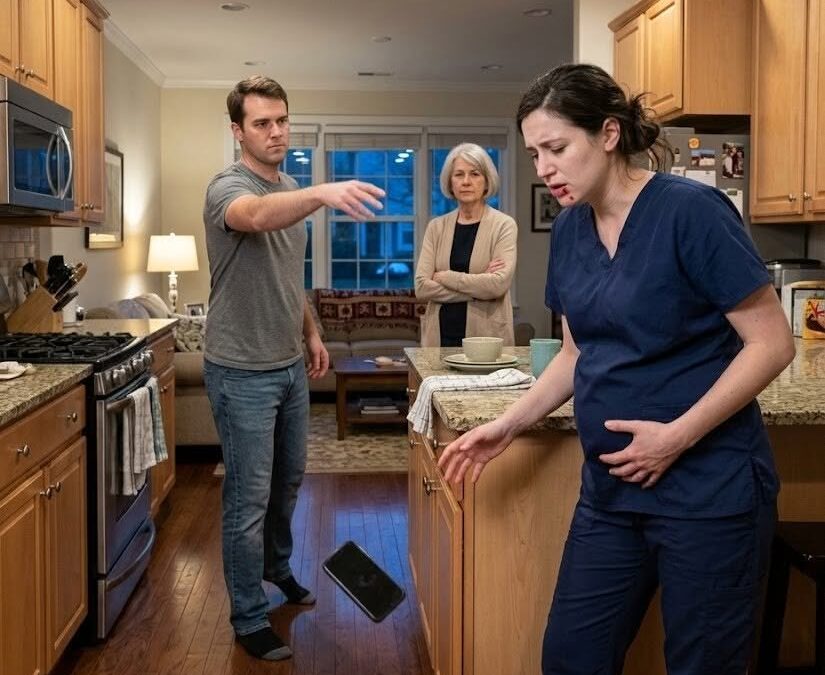
My Husband Slapped Me at Seven Months Pregnant Then Blocked Me From Calling 911 Until I Said Four Words That Wiped the Smile Off His Face
My husband slapped me before I could even close the front door.
I was seven months pregnant.
I had just finished a twelve hour shift.
My feet were swollen inside my work shoes, my lower back had been aching since noon, and sharp pains had been tightening across my stomach all day.
None of that mattered to Carter.
His hand came across my face so fast that I did not see it coming.
I only felt the impact.
Then the hallway wall slammed into my shoulder.
For one stunned second, I heard nothing except a dull ringing inside my head.
My lip split against my teeth.
I tasted blood.
And from the living room, my mother in law watched.
She did not stand.
She did not gasp.
She did not ask whether I was all right.
She smiled.
Not broadly.
Not dramatically.
Just a thin, satisfied smile from beneath the throw blanket covering her lap.
As though the sight of her pregnant daughter in law being hit was simply confirmation that discipline had finally been delivered where she believed it belonged.
“Do you have any idea what time it is, you useless bitch?” Carter shouted.
The digital clock on the wall behind him read 8:20 p.m.
I remember that number more clearly than almost anything else.
8:20.
Twenty minutes past eight.
A completely ordinary time on an ordinary weeknight.
But from that night forward, 8:20 became the exact minute my marriage stopped being something I could explain away.
I had been late before.
Traffic happened.
Shifts ran over.
People called out sick.
Emergencies happened at work.
None of that mattered.
Carter did not ask where I had been.
He did not ask why I was late.
He did not ask why I had one hand pressed against my stomach.
He already had his answer.
In his mind, I had failed him.
Again.
“Get in the kitchen and cook for my mother!”
His mother, Mrs. Eleanor, adjusted the blanket over her knees.
“What are you waiting for?” she asked.
Her tone was almost bored.
“A child requires discipline starting in the womb. A lazy mother raises a lazy child.”
My baby moved sharply inside me.
A hard, sudden movement beneath my ribs.
I put both hands over my stomach.
For a moment, that movement became the only thing I could feel clearly.
My son.
Still there.
Still moving.
Still depending on me.
I inhaled slowly.
The hallway tilted slightly.
Maybe because of the slap.
Maybe because I had not eaten properly since early afternoon.
Maybe because I had been feeling sick for hours.
Or maybe because I had finally reached a point where my body was refusing to keep absorbing what my mind had spent two years normalizing.
“I don’t feel well,” I said.
Carter laughed once.
Not because anything was funny.
Because laughter was one of the ways he made my pain feel ridiculous.
“You never feel well when there’s something to do.”
“That’s not true.”
The words slipped out automatically.
Too soft.
Too apologetic.
I hated how quickly I heard fear in my own voice.
Mrs. Eleanor clicked her tongue.
“There. That attitude.”
I looked at her.
“What attitude?”
“Talking back.”
“I said I don’t feel well.”
“You came home late.”
“I was working.”
“So?”
“So I’ve been on my feet for twelve hours.”
Her expression hardened.
“Women have been pregnant for thousands of years. You’re not special.”
I looked at Carter.
There had been a time when he would have noticed the blood on my mouth.
At least I told myself there had.
There had been a version of him who brought me coffee when I worked early.
A version who rubbed my shoulders while I studied.
A version who stood beside me in photographs with one hand resting at the small of my back.
A version who called me strong.
That version had become harder and harder to find.
By then, I was no longer sure whether he had changed or whether I had simply gotten close enough to see what had always been there.
He pointed toward the kitchen.
“Move.”
I should have left.
I know that now.
I should have turned around, walked through the still open front door and kept going.
But people who ask why abused women do not simply leave usually imagine abuse as a single clear moment.
A line.
A blow.
A threat.
They imagine a woman sees the line crossed and immediately understands that everything before it was false.
Real life can be slower.
Confusion becomes routine.
Fear mixes with hope.
Humiliation becomes normal enough that you start measuring days by how bad they were instead of asking why any of them were bad at all.
There were times Carter apologized.
There were times he cried.
There were times he blamed work.
Stress.
Money.
Me.
His mother.
My family.
The pressure of having a baby.
There were times he said he would change.
And because I wanted the life I had built to be real, I accepted each explanation long enough to remain inside it.
So that night, bleeding from my lip and seven months pregnant, I went into the kitchen.
I wish I could say I did it because I had a plan.
I did not.
I did it because obedience had become a survival habit.
The kitchen lights were too bright.
I remember that.
After the dim hallway, they seemed almost painful.
I put my bag down beside the refrigerator.
My stomach tightened again.
I braced one hand against the counter.
The pain started low.
Then spread across my abdomen until everything felt hard.
Rigid.
I closed my eyes.
Breathed.
Counted.
One.
Two.
Three.
Four.
The pressure eased.
Not completely.
Enough.
I opened my eyes.
Carter was already back in the living room.
Television noise filled the space between us.
His mother asked him something.
He answered.
Neither one lowered their voice.
Neither one acted as though anything unusual had happened at the front door.
That was one of the strangest things about living with Carter.
Violence could happen and then disappear from the atmosphere within seconds.
He could insult me.
Grab me.
Shove a door into me.
Punch a wall beside my head.
Then sit down and watch television.
It taught me to doubt my own sense of proportion.
If he could act normal immediately afterward, maybe I was the one making things dramatic.
That was the trap.
I opened the refrigerator.
Onions.
A container of beans.
Meat that needed to be cooked.
Mrs. Eleanor had apparently decided what she wanted for dinner before I got home.
Of course she had.
Her comfort had always arrived before mine.
I took out the ingredients.
My hands were trembling.
I told myself it was exhaustion.
I picked up a knife.
The onion blurred.
I blinked hard.
The sting in my split lip had become a steady throb.
I chopped.
Slowly.
The knife hitting the cutting board created a rhythm.
Tap.
Tap.
Tap.
I concentrated on the sound.
Not the pain.
Not Carter.
Not his mother.
Not the fact that I was cooking dinner for the two people who had watched me walk into the house holding my stomach and decided the appropriate response was violence and criticism.
The onions made my eyes water.
At first, I was grateful.
If they came into the kitchen, I could pretend that was why I was crying.
My baby shifted again.
“Hey,” I whispered.
The word was only for him.
“I know.”
I put a hand over my belly.
Another tightening started.
I waited.
The television audience laughed from the living room.
Some sitcom.
A bright artificial burst of applause.
The sound came through the doorway while I leaned over a cutting board trying not to panic about pain that had been happening since morning.
I had told myself throughout my shift that pregnancy was uncomfortable.
That women had cramps.
Back pain.
Pressure.
Braxton Hicks contractions.
I had read about all of it.
Every explanation had been available to me.
I had also known something felt different.
But I had kept working.
I had learned that lesson too well.
Keep going until your body gives you permission to stop by failing completely.
That was the standard in Carter’s house.
Not tired enough until you collapsed.
Not sick enough until you vomited.
Not hurt enough until there was blood.
And apparently even blood would not be enough.
I stirred the beans.
The spoon shook in my hand.
Grease popped from the pan and hit my knuckles.
I jerked back.
“Damn it.”
“What?” Carter shouted from the living room.
“Nothing.”
His mother said something I could not hear.
He laughed.
I stared at the stove.
Two years earlier, when I married Carter, I believed marriage would be the first truly independent decision of my life.
That mattered to me.
I came from a family where my father’s position followed us everywhere.
People recognized his name.
They behaved differently around him.
Doors opened before anyone touched them.
People returned calls quickly.
Strangers became polite when they realized who they were speaking to.
I hated it.
Not my father.
Never him.
I hated what happened around him.
I hated wondering whether someone liked me because of me or because they wanted proximity to him.
I hated having accomplishments treated as though they had been arranged.
I wanted my own work.
My own life.
My own marriage.
Something I built without borrowing influence from anyone.
Carter had seemed to understand that.
At first.
He called my independence one of the things he loved most about me.
“You don’t act entitled,” he once said.
I remember smiling.
“That’s romantic.”
“I mean it.”
“You’re telling me I’m attractive because I don’t act spoiled?”
“You know what I mean.”
I did.
At least I thought I did.
Later, the same independence became something he used against me.
If I asked for help, I was weak.
If I mentioned my family, I was threatening him.
If I defended myself, I was arrogant.
If I stayed quiet, I was admitting he was right.
There was no correct position.
Only his.
Mrs. Eleanor made that dynamic worse.
She had disliked me almost immediately.
Not openly at first.
She used questions.
“Oh, you’re keeping your maiden name professionally?”
“Your mother never taught you to iron shirts that way?”
“You’re really going back to work after the baby?”
“You don’t cook from scratch every night?”
Always questions.
Questions that were not questions.
Then came jokes about my family.
Country.
Simple.
Blue collar.
That one was especially ironic, but I never corrected her.
Neither did Carter.
He preferred the version of my family he had created.
It made him feel superior.
He believed my father was some quiet older man living far enough away to be irrelevant.
A man who might own a pickup truck.
A man who did not visit often.
A man with no power inside Carter’s carefully controlled world.
I let him believe it.
Partly because correcting him felt childish.
Partly because I wanted to know whether he respected me without knowing anything else.
I got my answer eventually.
By 8:20 that night, I had gotten it many times.
I finished the meat.
My stomach tightened again.
Longer this time.
I gripped the counter.
The kitchen seemed to narrow.
“Are you cooking or taking a nap in there?” Mrs. Eleanor called.
I closed my eyes.
“Almost done.”
“Then why are we waiting?”
Because I might be in labor.
Because I might be sick.
Because your son hit me hard enough to split my lip.
Because I have worked twelve hours.
Because I am carrying your grandson.
I said none of it.
“Coming.”
I put the food on plates.
My hands shook so badly that a fork slipped and hit the floor.
Carter appeared in the doorway immediately.
His reaction to the sound was faster than his reaction to my pain.
“What now?”
“I dropped a fork.”
“Jesus Christ.”
He bent down, picked it up and threw it into the sink.
“You can’t do one thing without making a mess.”
I stared at him.
He looked at my face.
At the swollen lip.
If he felt anything, he did not show it.
“You planning to stand there all night?”
I lifted the plates.
Carried them to the table.
Mrs. Eleanor sat first.
Carter took his seat.
I remained standing because my lower back hurt too much to bend comfortably.
Mrs. Eleanor took one bite.
She chewed.
Then spat the food directly onto the expensive china in front of her.
“This is absolutely disgusting.”
I stared.
The food looked normal.
Nothing burned.
Nothing raw.
I had cooked that meal dozens of times.
Carter glanced up from his phone.
“She screws everything up.”
Something inside me went very still.
Not angry.
Past angry.
Tired.
There is an exhaustion that comes from work.
Another from pregnancy.
Another from fear.
And then there is the exhaustion of being required to defend your own reality every day.
That was the one I felt.
“I’m late because I feel violently ill.”
My voice was quiet.
Flat.
Mrs. Eleanor pushed her chair backward.
“You feel sick?”
“Yes.”
“I’m sick of supporting a freeloading, clumsy daughter in law who happens to be pregnant.”
I looked at her.
“I work full time too.”
Three words.
That was all.
I work full time.
My uniform was still on me.
My shoes were swollen around my feet.
My work badge was clipped at my waist.
I had walked through the door less than an hour earlier after a twelve hour shift.
Facts should have mattered.
They never did in that house.
Mrs. Eleanor’s face tightened.
“You think having a little job makes you equal to my son?”
I stared at Carter.
He did not look up.
“Eleanor…”
I rarely called her by her first name.
That made her eyes flash.
“I’m not doing this tonight.”
“You’re not doing what?”
“Arguing.”
“Then stop arguing.”
“I’m not.”
“You just contradicted me.”
“I said I work.”
She stood.
“So now I’m a liar?”
“No.”
“You called me a liar.”
“I didn’t.”
She moved toward me.
I stepped backward.
I did not expect her to touch me.
That was another mistake.
Her hands hit my shoulder.
A shove.
Harder than I expected from a woman her age.
My heel caught.
I lost balance.
The kitchen spun.
Then the sharp corner of the granite countertop struck my lower back.
Pain exploded through my abdomen.
Not a cramp.
Not pressure.
Pain.
White.
Immediate.
Violent.
My knees folded.
I grabbed the edge of the counter.
The room vanished around the sensation.
For several seconds, I could not breathe properly.
“My…”
The word died.
Then I felt warmth.
Running down my legs.
I looked down.
Blood.
For one fraction of a second, my mind refused to understand it.
My uniform.
My legs.
The floor.
Red.
Too much red.
“My baby…”
Carter stood.
Hope rose in me automatically.
That instinct is hard to explain.
Even after everything, part of me expected his humanity to return when the danger became undeniable.
Surely this would be the line.
Surely seeing his pregnant wife bleeding would wake something in him.
Surely he would become the man I kept insisting still existed somewhere underneath the anger.
He looked at the blood.
Then at me.
“Don’t start with your dramatic bullshit.”
I stopped understanding him in that moment.
Not emotionally.
Fundamentally.
I had spent years trying to interpret his behavior through stress, pride, temper and insecurity.
That sentence erased those excuses.
I was seven months pregnant.
Bleeding.
His mother had just shoved me into a countertop.
And he called it drama.
I reached toward the kitchen island.
My phone was there.
Three feet away.
Maybe four.
“I need to call 911.”
Carter moved before I did.
His hand closed over my phone.
“Carter.”
He looked at me.
“Give it to me.”
“No.”
“I’m bleeding.”
“You’re fine.”
“Give me my phone.”
His jaw tightened.
“You are not turning this into some scene.”
“I need a hospital.”
Mrs. Eleanor folded her arms.
“Oh, for heaven’s sake.”
I looked at her.
There are faces you never forget.
I remember hers perfectly.
Not afraid.
Not ashamed.
Annoyed.
As though my blood was an inconvenience created specifically to ruin her dinner.
“Please,” I said.
The word was not for her.
It was for Carter.
“Give me the phone.”
He looked down at it.
Then threw it.
Across the kitchen.
The sound of glass breaking seemed louder than the slap had.
My phone struck the hardwood.
The screen shattered.
A spiderweb of cracks spread across the glass.
I stared.
“You aren’t calling a damn soul,” Carter said.
Something changed then.
Before that moment, the violence could still be framed as rage.
Cruelty.
Loss of control.
When he deliberately destroyed the device I was trying to use to call emergency services, there was control.
Decision.
He understood what I needed.
He chose to prevent it.
My fear became colder.
More precise.
Mrs. Eleanor looked at the blood beneath me.
“If she loses the baby, it’s because she doesn’t know how to take care of herself.”
The sentence barely sounded human.
“Don’t blame us later.”
Another contraction of pain hit.
I folded over the counter.
My fingers slipped.
My knees nearly gave out.
I could feel blood continuing down my legs.
I looked toward the broken phone.
If I could reach it, maybe the screen still worked.
Maybe emergency calling would still function.
I took one step.
Carter moved into my path.
“No.”
“Move.”
“Sit down.”
“I need help.”
“You need to stop.”
“Carter, move.”
He did not.
The kitchen suddenly felt tiny.
The island behind me.
Counter to my left.
Table to the right.
Carter in front.
The phone behind him.
My mother in law watching.
No exit that did not require me to get around one of them.
My baby moved weakly.
Or maybe I imagined it.
Panic rose so violently that the room blurred.
I pressed a hand against my abdomen.
“Please.”
Carter leaned closer.
Close enough that I could smell dinner on his breath.
“Listen carefully.”
His voice dropped.
That was always worse than shouting.
When Carter lowered his voice, he wanted me to remember something.
Usually that he believed he had more control than I did.
“My uncle is a senior prosecutor in the D.A.’s office.”
I stared.
“I’m a practicing attorney.”
His face was inches from mine.
“You’re not going to win a damn thing.”
Win.
That was the word he chose.
I was bleeding.
My baby might have been in danger.
And Carter thought we were in a contest.
He thought I was preparing a case against him.
He thought I was an opponent.
Not a wife.
Not the mother of his unborn child.
An opponent he needed to intimidate.
“My baby…”
“Stop using the baby.”
I stared at him.
“What?”
“You always do that.”
“I’m bleeding.”
“Because you fell.”
“Your mother shoved me.”
Mrs. Eleanor stepped forward.
“I did no such thing.”
I looked at her.
The lie came instantly.
No hesitation.
No confusion.
She had rewritten the last thirty seconds before they were even over.
“You pushed me.”
“You stumbled.”
“You put your hands on me.”
“I was trying to steady you.”
My mouth opened.
No words came.
There it was.
The future.
I could suddenly hear how they would tell it.
I came home late.
Emotional.
Sick.
Clumsy.
Argumentative.
I stumbled.
I fell.
Carter tried to calm me down.
His mother tried to help.
I became dramatic.
I threatened them.
I broke my own phone.
Maybe.
Why not?
If facts had never mattered in that kitchen, why would they start mattering once I left it?
Carter saw something change in my face.
He smiled.
That smile frightened me more than the slap.
“Now you’re thinking.”
I was.
But not the way he believed.
For two years, I had endured.
Not every day.
That was another misunderstanding people have about abusive homes.
It is not always terrible.
If it were, leaving might be simpler.
There were birthdays.
Trips.
Quiet mornings.
Shared jokes.
Plans for the nursery.
There were evenings Carter rested his hand on my stomach and smiled when the baby kicked.
Those moments existed.
So did the others.
The screaming.
The demands.
The humiliations.
His mother correcting me in my own home.
Carter telling me I should be grateful he had married someone from my background.
That one always confused me because he did not actually know my background.
Not really.
He knew only what I chose to show.
I had wanted my marriage to belong to me.
Not my father.
Not his name.
Not his position.
Mine.
I thought refusing to use family influence was integrity.
Maybe it was.
But somewhere along the way, integrity turned into silence.
Silence turned into isolation.
And isolation became exactly what Carter needed.
He believed nobody important would challenge him.
He believed I had nowhere meaningful to go.
He believed my father was a harmless old man somewhere far away.
A country bumpkin, as his mother called him.
I had never corrected them.
My father rarely visited because I had asked him not to interfere.
That truth tasted bitter now.
He had asked me more than once whether I was happy.
I always said yes.
Not because I wanted to protect Carter.
At first, because I wanted to protect my choice.
There is shame in admitting something you fought for has become dangerous.
I had defended the marriage.
Defended Carter.
Told friends he was stressed.
Told my mother that Eleanor was old fashioned.
Told my father everything was fine.
Fine.
That word had become one of the most expensive lies I ever told.
My father had once said something to me years before Carter entered my life.
We were standing beside his car after an event.
Someone had spent the entire evening name dropping.
Making sure everybody knew who he knew.
Which offices he could call.
Which doors he could open.
I had rolled my eyes afterward.
My father laughed.
Then he said, “You never flaunt real power, sweetheart.”
I remember asking, “Why?”
“Because if it’s real, you don’t need to.”
He looked at me.
“You use it only when there is no other way out.”
At the time, I thought he meant professional restraint.
Influence.
Reputation.
I did not realize those words would return to me in a kitchen years later while blood ran down my legs.
No other way out.
I looked at my shattered phone.
Carter.
Mrs. Eleanor.
The blood.
My stomach.
My son.
My pride became irrelevant.
I raised my head.
“Then call my father.”
Carter blinked.
“What?”
“If you’re so sure.”
Another cramp hit.
I gripped the counter.
“Call my father.”
For half a second, neither of them responded.
Then Carter laughed.
Mrs. Eleanor laughed too.
The sound filled the kitchen.
It might have humiliated me once.
Not anymore.
“Your father?” she said.
I said nothing.
“That pathetic country bumpkin who never visits?”
Carter shook his head.
“This is amazing.”
He bent down.
Picked up my cracked phone.
The screen still lit faintly beneath the shattered glass.
“Sure.”
He held it inches from my face.
“Let’s hear how the old man plans to drive his pickup truck down here and rescue his princess.”
His mother smiled.
I looked at the phone.
There were so many ways I could have responded.
I could have corrected their assumptions.
I could have explained who my father was.
I could have told Carter that the very reason he knew so little was because I had deliberately kept that part of my life outside our marriage.
I could have watched his expression change before the call.
But I did not want to impress him.
I wanted one person outside that house to hear my voice.
That was all.
Carter tapped the cracked screen.
Opened my contacts.
Scrolled.
Dad.
That was how I had saved it.
No title.
No full name.
No organization.
Just Dad.
His thumb hovered.
“Ready?”
I looked at him.
“Yes.”
He put the call on speaker.
Pressed the button.
The first ring sounded through the kitchen.
Long.
Clean.
Ordinary.
My stomach tightened.
I breathed through my mouth.
Second ring.
Carter glanced at his mother.
She rolled her eyes.
Third ring.
My knees shook.
My father did not always answer quickly.
He could be busy.
Driving.
In a meeting.
Sleeping.
Anything.
For the first time, fear took a different form.
What if he did not answer?
Carter’s smile widened as the third ring continued.
I could already imagine his reaction.
See?
Nobody is coming.
Nobody cares.
You are alone.
Then the ring stopped.
My father answered.
“Hello?”
One word.
Simple.
No authority.
No title.
No dramatic introduction.
Just my father’s voice.
For the first time that evening, Carter hesitated.
It was tiny.
A shift in expression.
Maybe something about the voice.
Maybe nothing more than the realization that a real person was now on the other end.
Whatever caused it, I saw it.
Then his grin returned.
“Go ahead, princess.”
He held the phone toward me.
“Tell Daddy how unfair your life is.”
I opened my mouth.
Another wave of pain hit.
I folded over the counter.
The sound that left me was barely more than air.
“Dad.”
Silence.
Then my father’s tone changed.
Immediately.
Not loudly.
That was what Carter did not understand about him.
My father rarely needed volume.
“Where are you?”
Before I could answer, Carter did.
“She’s at home.”
He laughed.
“She’s being dramatic because she came home late and got called out for it.”
My father ignored him.
Completely.
“Sweetheart.”
His voice was slower.
Focused.
“Are you hurt?”
I looked at Carter.
At the cracked phone in his hand.
At Mrs. Eleanor.
At my blood.
At the kitchen floor.
At the place where my life had narrowed into a handful of facts I could no longer soften.
“Yes.”
One word.
That was all I managed.
But it was the first honest word I had given my father about my marriage in a very long time.
Yes.
I am hurt.
Yes.
Something is wrong.
Yes.
I need you.
Mrs. Eleanor moved closer.
“She fell because she’s clumsy.”
My father said nothing.
“Don’t let her start lying to you.”
Still nothing.
“She’s always dramatic.”
My father waited until Eleanor stopped.
Then asked:
“Is Carter preventing you from calling for medical help?”
The question changed the room.
Because it ignored every distraction.
I came home late.
Irrelevant.
Dinner was bad.
Irrelevant.
Carter was angry.
Irrelevant.
His mother claimed I fell.
Irrelevant to the immediate question.
I was pregnant.
I was injured.
I was bleeding.
Was my husband preventing me from getting medical help?
Yes or no.
Carter’s expression tightened.
His thumb moved toward the red button.
I saw it.
He was going to hang up.
The same man who had mocked me for calling my father suddenly needed that call to end.
I forced the words out.
“He broke my phone.”
Carter’s hand closed harder around the device.
My father spoke before he could disconnect.
“Carter.”
One word.
Carter stopped.
“Put the phone down and listen to me.”
His thumb hovered.
Nothing else in the kitchen changed.
Blood was still beneath me.
My back still hurt.
My stomach still tightened.
The phone was still cracked.
Mrs. Eleanor still stood nearby with her arms crossed.
Carter was still physically between me and the easiest exit from the room.
Nothing was safe yet.
Nothing was solved.
But Carter was no longer laughing.
That mattered.
For most of the evening, I had heard certainty from him.
Certainty that I would cook.
Certainty that I would obey.
Certainty that I would not call anyone.
Certainty that his job protected him.
Certainty that his uncle’s position meant I could never challenge his version of events.
Certainty that my family was irrelevant.
Now, for the first time, there was hesitation.
His thumb remained above the screen.
My father continued.
His voice stayed controlled.
I stared at Carter.
I saw him listening.
Not because he had suddenly developed respect.
Because the dynamic had changed.
Someone outside the house knew.
That was the thing abusers fear more than arguments inside closed rooms.
Witnesses.
Information.
A fact escaping the environment they control.
Until that call, everything that happened had belonged entirely to Carter’s version.
He could slap me.
Then call it discipline.
His mother could shove me.
Then call it an accident.
I could bleed.
They could call it drama.
My phone could be broken.
Carter could say I had no reason to call anyone anyway.
The story remained inside the kitchen.
Inside the marriage.
Inside the family.
Now it had crossed the wall.
My father had heard my voice.
He had heard Carter speaking over me.
He had heard Mrs. Eleanor trying to explain away my injury.
He knew Carter had prevented me from making a medical call.
Even if the connection ended that second, the truth was no longer trapped entirely inside the house.
I realized that while Carter stood there with the phone.
And once I realized it, something inside me changed.
Fear remained.
Pain remained.
But the isolation broke.
That was enormous.
My father asked, “How far along are you?”
“Seven months.”
Carter’s eyes flicked toward me.
He had not expected the conversation to continue.
“Are you bleeding?”
I swallowed.
“Yes.”
My father exhaled.
Quiet.
Controlled.
Then he said, “Do not move more than you have to.”
Mrs. Eleanor scoffed.
“She’s perfectly capable of moving. She cooked an entire meal.”
I looked at her.
Even then.
Even while my father was trying to understand whether his pregnant daughter needed emergency care, Eleanor needed to defend herself.
My father ignored her again.
“Is the bleeding heavy?”
I looked down.
“I don’t know.”
“Is it continuing?”
“Yes.”
“Can you feel the baby moving?”
I pressed my palm against my belly.
For several terrifying seconds, I was not sure.
“I…”
Carter shifted.
“You’re feeding into this.”
My father’s voice sharpened.
“Carter, stop talking over her.”
Carter laughed.
But weakly.
“This is my house.”
“That is irrelevant.”
The sentence landed strangely.
Simple.
Flat.
Carter’s face changed.
He was used to people engaging with the frame he created.
My house.
My rules.
My profession.
My uncle.
My mother.
My wife.
My problem.
My father refused the frame.
The question was medical safety.
Everything else could wait.
I closed my eyes.
My baby moved.
Small.
But there.
“He moved.”
My voice cracked.
My father was silent for half a second.
“Good.”
One word.
Good.
I nearly cried.
Not because that meant we were safe.
It did not.
Because someone had reacted to my baby’s movement like it mattered.
Someone else remembered there were two of us.
Carter’s mother had talked about my son as a future object of discipline.
Carter had treated him as leverage whenever convenient.
My father heard that he moved and said good.
The simplicity of the concern broke something open inside me.
I started crying.
Not loudly.
I hated crying around Carter.
He used tears as evidence that I was unstable.
So even then, I tried to hide it.
My father heard anyway.
“Stay with me.”
That phrase nearly dropped me.
Stay with me.
I had spent two years staying with the wrong person.
Now my father was asking me to stay present long enough to survive whatever was happening.
Carter shifted the phone.
“This is ridiculous.”
My father said, “You said she came home late.”
“Yes.”
“You said she was being dramatic.”
“Yes.”
“Did you hit her?”
Silence.
Carter looked at me.
I did not speak.
My father repeated the question.
“Did you hit my daughter?”
Carter’s face hardened.
“She came in with an attitude.”
That was not an answer.
But it was.
Mrs. Eleanor immediately interrupted.
“He barely touched her.”
I stared at her.
Another version.
First I fell.
Now Carter barely touched me.
Facts were already shifting.
My father did not argue.
“Did either of you put your hands on her tonight?”
Eleanor said, “She’s twisting everything.”
“Did you?”
“She stumbled into the counter.”
“Before or after you touched her?”
Eleanor stopped.
Carter’s eyes narrowed.
“You trying to interrogate us?”
“No.”
My father’s answer came without hesitation.
“I’m trying to determine whether my pregnant daughter is being prevented from receiving medical assistance after being injured.”
Again.
The center.
The fact Carter could not talk around.
I watched him.
He looked at the blood.
Then at me.
Then the phone.
Something about his confidence had begun to crack.
Not disappear.
Carter was too proud for that.
But certainty had left.
“Give her the phone,” my father said.
“No.”
Carter answered too quickly.
My father went silent.
Carter seemed to hear his own mistake.
He corrected himself.
“The screen is broken.”
“Then put it on the counter and step away.”
“This is insane.”
“Put it down.”
“You don’t give orders in my house.”
My father paused.
When he spoke again, his voice was quieter.
“I am not discussing ownership of the house with you.”
I almost laughed.
Not because anything was funny.
Because I recognized my father.
He had always had that ability.
Someone would come at him with ego, accusation or performance, and he would remove everything except the actual question.
I had spent two years doing the opposite.
Following Carter into every argument.
Defending.
Explaining.
Proving.
Trying to show I was not lazy.
Not disrespectful.
Not dramatic.
Not ungrateful.
Not disloyal.
Every defense gave him another accusation to choose from.
My father gave him nothing.
“Your wife is seven months pregnant and bleeding.”
A pause.
“Put down the phone.”
Carter looked at me.
The cracked glass reflected the kitchen light.
I saw something in his face.
Calculation.
He was thinking now.
Not raging.
That was important.
Carter’s anger often hid how strategic he could be.
Once there were consequences outside the room, he adapted.
I watched it happen.
His shoulders lowered slightly.
His tone changed.
“Sir.”
Sir.
I had not heard him call my father anything before.
“This is a misunderstanding.”
There it was.
The transformation.
Less than a minute earlier, he had been telling me I would not win anything.
Now there was an external witness.
Suddenly, misunderstanding.
“She got home from work upset.”
I stared at him.
“I was not upset.”
He ignored me.
“She wasn’t feeling well. She got into it with my mother.”
I looked at Mrs. Eleanor.
Her mouth tightened.
“She lost her footing.”
“You hit me before that.”
Carter turned.
“Stop.”
My father heard.
“Do not tell her to stop.”
Carter closed his eyes for one second.
“Sir, respectfully, you’re getting one emotional version of what happened.”
Emotional.
Of course.
I was bleeding.
So I was emotional.
And because I was emotional, my memory could be treated as unreliable.
That pattern had worked before.
Not tonight.
My father asked, “Is she bleeding?”
Carter looked down.
“Yes.”
“Is she seven months pregnant?”
“Yes.”
“Did she ask to call 911?”
Carter did not answer immediately.
“Yes.”
“Did you give her the phone?”
Silence.
“I was trying to calm her down.”
“That was not the question.”
Carter’s jaw flexed.
“No.”
“Did you break the phone?”
Another pause.
“It slipped.”
I stared.
Even Mrs. Eleanor looked at him.
It slipped.
The phone had traveled across half the kitchen.
But already he was building a story.
My father did not call him a liar.
He did not need to.
“Put the phone down.”
Carter looked at me.
“What exactly are you planning to do?”
For the first time, he sounded less like an attorney and more like a frightened man trying to regain control.
My father said something that stayed with me.
“The question is not what I plan to do.”
Carter frowned.
“The question is what you are doing right now.”
Silence.
“Your wife has asked for medical help.”
A pause.
“Are you going to continue preventing her from getting it?”
The room felt completely still.
Carter’s mother spoke first.
“You have no idea what your daughter is like.”
I looked at her.
For two years, Eleanor had told me what kind of wife I was.
What kind of mother I would be.
What kind of employee I was.
What kind of family I came from.
Now she wanted to explain me to my own father.
“She manipulates everyone,” Eleanor continued.
My father said nothing.
“She comes home whenever she wants.”
Nothing.
“She doesn’t respect Carter.”
Nothing.
“She barely knows how to run a household.”
Nothing.
“I have done everything to help her.”
My father waited.
Then asked one question.
“Did you put your hands on my daughter tonight?”
Eleanor stopped.
I watched her throat move.
“She was being hysterical.”
Again.
Not an answer.
But it was.
I realized something important then.
My father was not saving me by announcing himself.
He was saving me by refusing to participate in their language.
Carter and Eleanor relied on judgments.
Lazy.
Dramatic.
Clumsy.
Disrespectful.
Emotional.
Freeloader.
Each word invited argument.
Was I lazy?
No, because I worked.
Then work became inadequate.
Was I disrespectful?
No, because I obeyed.
Then obedience became expected.
Was I dramatic?
No, because I was hurt.
Then hurt became exaggeration.
There was no end.
My father used behavior.
Who hit whom?
Who blocked the call?
Who broke the phone?
Who needed medical attention?
Behavior did not care about adjectives.
That understanding settled into me even while another wave of pain tightened through my abdomen.
I bent forward.
A sound escaped me.
My father heard.
“What’s happening?”
“Pain.”
“How bad?”
“I…”
I could not answer.
My legs shook.
Carter moved automatically, almost reaching toward me.
Then stopped.
I saw the hesitation.
Was he worried?
Or was he aware now that every action could be heard through the phone?
I did not know.
That uncertainty hurt in a new way.
I had spent years believing somewhere inside Carter was a good husband trapped beneath stress.
Now I wondered how many of his kind moments had simply occurred when kindness was easier.
Mrs. Eleanor grabbed my arm.
“Sit down before you fall.”
I jerked away.
“Don’t touch me.”
Her face hardened.
“There. You hear how she talks to me?”
My father said, “Take your hands off her.”
Eleanor looked at the phone.
For the first time, I saw something like offense mixed with caution.
She was used to being the oldest person in the room.
The matriarch.
The one everyone deferred to.
My father was not interested.
I leaned against the counter.
“Dad.”
“I’m here.”
“I’m scared.”
The words came out before I could stop them.
Carter looked at me.
I had never said that directly in front of him.
I had said angry.
Tired.
Upset.
Done.
Never scared.
Admitting fear felt like stripping away the final excuse.
My father’s voice softened.
“I know.”
“I don’t know if he’s okay.”
My hand moved across my stomach.
“I know.”
Another movement.
Small.
I closed my eyes.
“I need a hospital.”
“Yes.”
Carter opened his mouth.
My father cut him off.
“She needs medical attention.”
“She’s going to make accusations.”
There it was.
His priority.
Not the baby.
Accusations.
My father paused.
“Carter.”
“What?”
“If you are more worried about what she may say at a hospital than whether your pregnant wife is safe, you should think very carefully about why.”
Carter did not answer.
His mother did.
“This family will not be humiliated because she can’t handle pregnancy.”
I looked at her.
“How are you still saying this?”
My voice sounded strange.
Weak.
But clear.
“There is blood on the floor.”
Eleanor’s eyes flicked downward.
Then away.
“How are you still talking about humiliation?”
She opened her mouth.
Nothing came.
For the first time that night, I was not trying to convince her I was good.
I did not care what she believed anymore.
That freedom arrived strangely.
Not like strength.
Like exhaustion so complete that performance became impossible.
I had spent years trying to earn respect from two people committed to withholding it.
I was done auditioning.
Carter’s thumb finally moved away from the end call button.
He lowered the phone slightly.
Not onto the counter.
But away from the screen.
A small retreat.
My father said, “Give her the phone.”
Carter hesitated.
Then extended it toward me.
My hand reached out.
Before I could take it, another pain hit.
My knees folded.
This time Carter caught my elbow.
I screamed.
Not from his grip.
From my abdomen.
The phone nearly fell.
Mrs. Eleanor backed away.
“Look what she’s doing!”
“Stop talking,” Carter snapped.
The words stunned all of us.
Eleanor stared at her son.
He had never spoken to her that way in front of me.
Carter looked at the blood.
Really looked.
Maybe for the first time.
His face changed.
I wanted to believe fear finally reached him.
Maybe it did.
But even if it did, it came after too much.
He handed me the phone.
I pressed it against my ear.
“Dad.”
“I’m here.”
For the first time, his voice was not coming through the room.
It was against my ear.
Private enough to feel like a hand reaching across distance.
“I’m sorry.”
“Do not apologize.”
“I should have told you.”
“Not now.”
“I lied to you.”
“You told me you were fine.”
“I wasn’t.”
“I know that now.”
Tears blurred the cracked screen.
“I thought I could handle it.”
His answer came slowly.
“Handling something does not mean staying where you are being harmed.”
I closed my eyes.
Carter watched me.
I turned away from him.
“I didn’t want you to fix my life.”
“I know.”
“I wanted it to be mine.”
“I know.”
“I thought calling you meant I failed.”
My father was silent for a second.
Then said, “Calling for help is not failure.”
I started crying harder.
It was such a simple sentence.
But I had built an entire prison out of the opposite belief.
If I asked for help, Carter won.
If I admitted the marriage was bad, everyone who had warned me was right.
If my father intervened, I was no longer independent.
So I stayed.
And Carter benefited from every piece of pride I mistook for strength.
My father’s voice remained steady.
“Can you get to a door?”
I looked.
Carter stood nearby.
Mrs. Eleanor beside the table.
The front door was down the hallway.
“I think so.”
“Do not rush.”
Carter heard enough to understand.
“Where is she going?”
I lowered the phone.
“To get help.”
“You’re not going anywhere until we talk.”
I stared at him.
There it was again.
Control.
Even after the blood.
Even after the call.
Talk first.
Permission first.
His version first.
My father’s voice came faintly through the phone.
“What did he say?”
I raised it.
“He said I’m not leaving until we talk.”
Carter swore under his breath.
My father went silent.
When he spoke, his voice had changed again.
Not louder.
Harder.
“Carter.”
“What?”
“Move away from her.”
“You don’t understand what’s happening.”
“I understand that a seven month pregnant woman is bleeding and asking to leave for medical treatment.”
“She’s my wife.”
The sentence made my skin crawl.
My father answered immediately.
“She is not your property.”
Silence.
Carter looked at me.
For years, that had been the hidden assumption beneath everything.
My time.
My body.
My labor.
My paycheck.
My pregnancy.
My movement.
My phone.
His.
My father had named the flaw beneath it in five words.
She is not your property.
Carter’s face reddened.
“You think because you’re her father you get to tell me how my marriage works?”
“No.”
My father remained calm.
“I think she gets to decide whether she leaves a room.”
Another fact.
Another line Carter had no reasonable answer to.
I straightened as much as I could.
The phone pressed to my ear.
“I’m leaving.”
Carter stared.
“Don’t do this.”
“I’m leaving.”
“You’re making a huge mistake.”
Maybe.
But I had already made the larger mistake by staying too long.
He stepped sideways.
Not fully blocking me.
Enough.
I stopped.
My father heard my breathing change.
“What happened?”
“He moved.”
“Is he blocking you?”
Carter raised both hands.
“I’m not touching her.”
The wording mattered.
Not I’m letting her leave.
Not I’m helping her.
I’m not touching her.
Already thinking about liability.
Already choosing the sentence he could defend later.
I looked him in the eyes.
“Move.”
His mother scoffed.
“You are going to destroy this family over nothing.”
Nothing.
The blood on the floor.
Nothing.
The cracked phone.
Nothing.
My split lip.
Nothing.
My baby.
Nothing.
I looked at her.
“No.”
My voice steadied.
“I’m not the one who did this.”
It was the first time I said it.
Not I made him mad.
Not we fought.
Not things got out of hand.
Not she lost her temper.
They did this.
Behavior.
Facts.
Carter’s eyes changed.
He knew I had crossed a line emotionally.
Not against him.
Away from him.
I no longer needed him to agree with my reality.
That was more dangerous to his control than shouting ever would have been.
“You’re really going to call your father and run away because Mom bumped you?”
Bumped.
Another revision.
I almost smiled.
Not because it was funny.
Because I finally saw the mechanism clearly.
The story would keep shrinking until I doubted myself again.
Shove became bump.
Slap became frustration.
Broken phone became slipped phone.
Blocked emergency call became calming me down.
Blood became drama.
No.
Not anymore.
“You hit me.”
Carter stared.
“Don’t.”
“You hit me before I closed the door.”
“You came at me.”
“I had my work bag in one hand.”
“You were yelling.”
“I said I felt sick.”
“You always twist things.”
I looked down.
The blood existed.
The cracked phone existed.
My lip existed.
Reality did not require his signature.
“Move.”
Carter’s mother said, “You walk out that door and do not expect to come crawling back.”
I turned toward her.
Maybe once that threat would have worked.
Home had become something I tried desperately not to lose, even after it stopped being safe.
Now I understood a house is not a home simply because your belongings are inside it.
“I won’t.”
Eleanor looked surprised.
“What?”
“I won’t come crawling back.”
The words came quietly.
She heard them.
So did Carter.
So did my father.
Something in the kitchen ended right there.
Not the emergency.
Not the marriage legally.
Not the danger.
But the bargain I had been making with myself.
Endure today so tomorrow might improve.
That bargain was over.
Carter stepped aside.
Barely.
Enough.
I moved.
One hand against the wall.
One hand around the phone.
My legs shook.
I could feel wet fabric against my skin.
The hallway seemed ten times longer than usual.
“Stay with me,” my father said.
“I’m here.”
Three steps.
Four.
The wall kept me upright.
Carter followed.
Not touching.
Close.
Too close.
I stopped.
“Back up.”
“I’m making sure you don’t fall.”
“No.”
“For God’s sake.”
“No.”
My father said, “Carter, give her space.”
Carter glared at the phone.
Then stepped back.
I reached the front hallway.
The place where he had hit me.
My bag was still on the floor.
I looked at it.
For one irrational second, I wanted to pick it up.
Work badge.
Wallet.
Keys.
Everything normal.
I bent slightly.
Pain hit again.
“No,” my father said sharply through the phone.
I froze.
“Leave it.”
“But my keys.”
“Can you open the door?”
“Yes.”
“Open it.”
I reached for the handle.
Behind me, Mrs. Eleanor spoke.
“You step outside, the neighbors are going to see you like this.”
That sentence explained her better than anything else.
Not you need a doctor.
Not let me help you.
The neighbors will see.
Appearances.
That had always mattered.
The family image.
The professional image.
The respectable house.
The educated son.
The well dressed mother.
The pregnant wife who smiled at events.
Everything clean from the street.
I opened the door.
Cooler night air touched my face.
For the first time in what felt like hours, I breathed outside air.
My father said, “Are you outside?”
“One step.”
“Take it.”
I did.
Bare foot? No, still in work shoes. I felt the front step under them.
My legs trembled.
I crossed the threshold.
Behind me, Carter said my name.
Not an insult.
My name.
Softly.
The old tactic.
“Come back inside.”
I turned.
He stood in the doorway.
His mother behind him.
For a second, I saw the image we must have made.
Pregnant woman bleeding on the porch.
Split lip.
Cracked phone.
Husband standing inside a well kept Alexandria house asking calmly for her to come back.
If someone arrived only then, they might see uncertainty.
A private dispute.
A marriage problem.
But I knew what happened before the door opened.
So did my father.
That was enough.
“I need medical help.”
“I’ll drive you.”
“No.”
“Don’t be ridiculous.”
“No.”
“We can go together.”
I looked at him.
Less than twenty minutes earlier, he had thrown my phone rather than let me call 911.
Now that someone outside knew, he wanted to become the man who drove his pregnant wife to the hospital.
I understood why.
“Stay where you are.”
His face hardened.
“You’re embarrassing me.”
There it was.
Not hurting me.
Not frightening me.
Embarrassing him.
I almost felt relief.
The clarity was brutal, but clarity was better than confusion.
“You should be embarrassed.”
He flinched as though I had slapped him.
Then anger flashed.
My father heard the silence.
“Keep moving.”
I descended the front step.
The night air felt cool against sweat on my face.
A porch light flicked on across the street.
I saw movement behind a curtain.
Eleanor had been right.
Neighbors could see.
Good.
For the first time, I wanted witnesses.
Carter remained in the doorway.
Maybe because my father was still on the phone.
Maybe because the neighbors were watching.
Maybe because his legal training was finally reminding him that pulling a bleeding pregnant woman back into a house would be difficult to explain.
Whatever the reason, he stayed.
I reached the sidewalk.
My legs nearly gave out.
I lowered myself carefully onto the edge of the front walk.
“Dad.”
“I’m here.”
“I’m outside.”
“Good.”
I started sobbing.
Not quietly anymore.
The sound came from somewhere deeper than pain.
Years of pressure.
Shame.
Isolation.
The terrifying possibility that something was wrong with my baby.
My father let me cry.
He did not tell me to calm down.
I loved him for that.
After a moment, he said, “Listen to me.”
I wiped my mouth with the back of my hand.
More blood from my lip.
“I’m listening.”
“Whatever happens next, you tell the truth.”
I stared at the sidewalk.
“Okay.”
“Do not protect anyone.”
My eyes closed.
That was harder.
For two years, protecting Carter’s image had become automatic.
Do not tell Mom.
Do not worry Dad.
Do not embarrass the family.
Do not make work people suspicious.
Do not tell friends too much.
Do not say he hit the wall because then you have to explain why.
Do not say Eleanor called you worthless because people will ask why you keep visiting her.
Protect.
Protect.
Protect.
Everyone except myself.
“Okay.”
“Say it.”
“I’ll tell the truth.”
“All of it.”
My voice shook.
“All of it.”
Behind me, Carter said, “You’re really doing this?”
I did not turn.
My father heard him.
“Yes,” I said.
Not to my father.
To Carter.
“Yes.”
The word felt different this time.
Earlier it meant yes, I am hurt.
Now it meant yes, I am done hiding it.
The night had begun with Carter slapping me because I came home at 8:20.
He believed that first blow set the rules.
He was wrong.
The rule that mattered was the one I finally understood while sitting outside our house with his broken phone in my hand.
Pain does not become acceptable because someone powerful caused it.
Marriage does not erase the right to leave a room.
A law degree does not turn violence into misunderstanding.
A prosecutor in the family does not change blood on the floor.
And real power does not need to announce itself before protecting someone.
My father had told me that years earlier.
I finally understood.
The call was still connected.
Carter was still standing in the doorway.
Mrs. Eleanor was still behind him.
Nothing about the night had magically repaired itself.
I still needed medical care.
I still did not know whether my son was safe.
I still had no idea what the next morning would look like.
But something irreversible had happened.
The truth had left the kitchen.
Carter could no longer keep it behind his walls.
He could no longer destroy one phone and assume my voice disappeared with it.
He could no longer call me dramatic and expect that word to become reality.
And he could no longer rely on the version of my father he had invented.
The harmless old man.
The irrelevant country bumpkin.
The man who would never hear what was happening to his daughter.
Carter had made that call himself.
That was the irony I would remember.
He thought he was humiliating me.
He thought putting my father on speaker would prove how alone I was.
He thought he was giving himself one more opportunity to laugh.
Instead, he gave me a witness.
He gave me a voice outside the house.
He gave me the first opening I had taken in two years.
My father had not shouted.
He had not threatened.
He had not named his position.
He had not promised revenge.
He asked questions.
Are you hurt?
Are you bleeding?
Is Carter stopping you from calling for medical help?
Simple questions.
Questions built around facts.
And every one of them stripped another layer off the story Carter had constructed.
That was why Carter stopped laughing.
Not because he suddenly knew exactly who my father was.
Not because anyone had threatened him.
Because for the first time that night, he was speaking in front of someone he could not control.
Someone who did not care that Carter was an attorney.
Someone who did not care about his uncle.
Someone who did not care whether Mrs. Eleanor thought I was lazy.
Someone who cared only that I was pregnant, injured and asking for help.
That was enough.
I sat outside with one hand over my stomach.
My son moved again.
Small.
Faint.
Real.
I closed my eyes.
“Dad.”
“Yes.”
“He moved.”
My father exhaled.
“Good.”
I cried again.
Carter stood behind me without speaking.
For the first time since I walked through the front door, he had nothing useful to say.
His mother had stopped talking too.
Maybe they finally understood what I had spent too long refusing to understand.
The problem was no longer whether they believed me.
I believed myself.
That changed everything.
For two years, Carter had trained me to measure reality through his reactions.
If he laughed, maybe I was dramatic.
If he got angry, maybe I had gone too far.
If Eleanor agreed with him, maybe I really was the problem.
If he apologized afterward, maybe the situation was not serious.
If he bought flowers, maybe he meant it.
If he reminded me he loved me, maybe love explained away what fear could not.
That night broke the pattern.
Blood is not an opinion.
A broken phone is not a misunderstanding.
Blocking a bleeding pregnant woman from calling for medical help is not a communication problem.
Being slapped at the door is not a marital disagreement.
Those were facts.
My father’s questions forced me to see them that way.
And once I did, the old language stopped working.
Dramatic.
Lazy.
Ungrateful.
Difficult.
Emotional.
Words.
Only words.
None of them could clean the kitchen floor.
None could repair my phone.
None could unsplit my lip.
None could erase the terror that shot through me when I saw blood running down my legs.
None could turn Carter’s choices into mine.
That mattered more than any title my father might have carried.
I had spent years believing power meant influence.
Connections.
Names.
Offices.
People answering calls.
Carter believed that too.
That was why he mentioned his uncle.
Why he mentioned his profession.
Why he said I would never win.
But sitting outside my own house, I understood power differently.
Power was being able to say yes when my father asked if I was hurt.
Power was saying he broke my phone.
Power was refusing to walk back inside simply because Carter lowered his voice.
Power was allowing somebody else to know.
Power was the truth surviving the room where people had tried to rewrite it.
I looked up.
Carter still held the doorframe.
Our eyes met.
His expression had changed several times in less than half an hour.
Anger.
Contempt.
Mockery.
Confidence.
Calculation.
Now there was something else.
He knew I was no longer participating.
He could argue with me.
He could insult me.
He could invent a version of events.
But he could not make me help him build it anymore.
“You’re going to regret this,” he said.
My father heard.
I did too.
Once, those words would have frightened me back into obedience.
That night, they sounded like confirmation.
I lifted the cracked phone.
“Did you hear that?”
“Yes,” my father said.
Carter went silent.
Again.
That was the entire shift.
Before the call, Carter could say anything because he believed the words died inside the house.
After the call, every sentence had an audience.
Consequences begin with witnesses.
Sometimes the first witness is simply another human being hearing your voice.
I held the phone tighter.
The spiderweb of cracks cut across the lighted screen.
It looked ruined.
But it still worked.
That felt almost too perfect.
Carter had thrown it hard enough to break the glass.
He had not managed to silence it.
He had tried to reduce me to the same thing.
Damaged.
Afraid.
Unable to reach anyone.
But I was still speaking.
Still connected.
Still there.
My baby moved beneath my hand.
I looked away from Carter.
Toward the street.
Toward porch lights.
Toward the dark sky above Alexandria.
Anywhere except the house behind me.
For the first time in two years, I stopped thinking about how to make Carter less angry.
I stopped thinking about how to make Eleanor approve of me.
I stopped thinking about whether my father would be disappointed that the independent life I fought for had fallen apart.
I thought about one thing.
My son.
Then myself.
In that order.
Maybe someday I would learn to reverse them occasionally.
Maybe someday I would understand that protecting myself was also protecting him.
But that night, it was enough.
I had reached the moment my father once described.
No other way out.
So I used the only thing left.
The truth.
Carter had spent two years convincing me he held all the cards.
His house.
His career.
His mother.
His uncle.
His confidence.
My silence.
That last one had always been the most important.
And he lost it the moment he pressed call.
The first ring did not scare him.
The second did not.
The third did not.
Then my father answered.
“Hello?”
One ordinary word.
Carter laughed.
Then I said I was hurt.
I said he had broken my phone.
My father asked the right question.
And suddenly the man who had slapped me, blocked me, threatened me and mocked my family did something I had not seen him do all night.
He hesitated.
By the time I made it outside, I finally understood why.
People like Carter mistake control for power.
They are not the same thing.
Control works only while everyone cooperates with the story.
Power does not need the story.
It survives facts.
I looked one last time toward the doorway.
Carter’s face was pale beneath the porch light.
Mrs. Eleanor had pulled her blanket around herself even though she was standing.
Neither spoke.
The house behind them looked exactly as it had when I came home.
Same windows.
Same hallway.
Same furniture.
Same kitchen.
But it no longer felt like my prison.
It was simply the place where the truth had finally become too large to contain.
I put the phone back to my ear.
My father was still there.
“Sweetheart?”
“Yes.”
“Stay with me.”
I pressed my palm over my son.
“I will.”
And behind me, Carter did not laugh again.








