My husband dragged me into our backyard, tied my wrists to a wooden porch pillar, and punished my pregnant body for something I could never control.
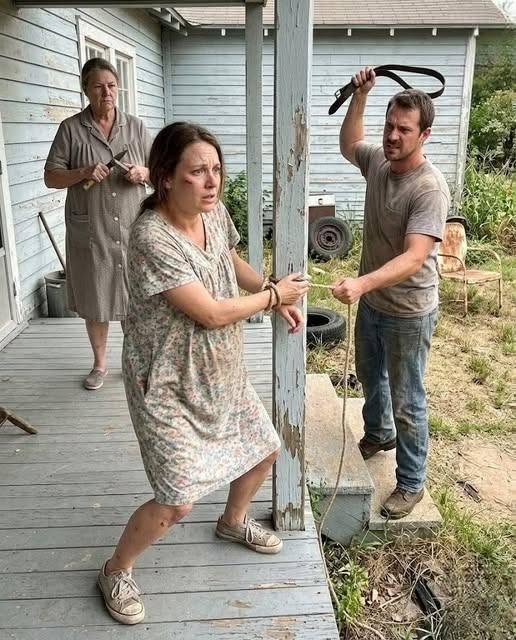
Every morning before the Texas sun came up, my husband dragged me into our backyard, tied my wrists to a wooden porch pillar, and punished my pregnant body for something I could never control.
Daughters.
That was my crime.
According to him, according to his mother, according to the rules they had created inside our rundown rental house, I had failed as a wife because I had given birth to girls.
And on the last morning they ever put their hands on me, my mother in law stood three feet away, calmly sharpening a metal tool while my husband tightened the rope around my wrists.
“All you make is worthless daughters,” he spat. “You’re a broken wife.”
The porch boards were cold beneath my bare feet.
I remember that because I needed something ordinary to think about.
The cold wood.
The loose nail beside the steps.
The dry patch of grass near the drainpipe.
Anything except the rope digging into my wrists.
Anything except my husband standing behind me.
Anything except the child moving inside my body.
His mother dragged the file across the metal again.
Scrape.
Scrape.
Scrape.
“In America, you still fail us,” she said.
She said it quietly.
That almost made it worse.
My husband yelled when he was angry. His mother rarely needed to. She spoke as if she were announcing facts nobody could challenge.
He looked at her.
She gave him a tiny nod.
Then he repeated what she had taught him.
“You hear her?”
I stared at the porch pillar.
“You hear what my mother is saying?”
I said nothing.
By then I had learned that begging only gave them more words to use against me.
The first few times, I had begged.
I had cried.
I had reminded him that I was pregnant.
I had reminded him that the girls were sleeping inside.
I had reminded him that I was his wife.
I had even looked at his mother and asked her how she could stand there while her son treated the mother of her grandchildren that way.
None of it mattered.
The more I pleaded, the angrier they became.
“You always make yourself the victim,” my husband would say.
His mother would shake her head.
“Look at her. Always dramatic.”
Eventually, I stopped giving them the performance they wanted.
I stopped asking for mercy.
But I never stopped listening.
That was the one thing they never understood.
They thought silence meant surrender.
They thought because I had stopped fighting openly, I had stopped fighting completely.
They were wrong.
Months earlier, I had found an old phone hidden in the back of a kitchen drawer.
It was beneath a stack of expired grocery coupons, takeout menus, dead batteries, and a packet of soy sauce so old the plastic had hardened.
The screen was cracked diagonally from the upper corner almost to the middle.
The battery barely lasted.
The phone had no active service.
But the voice recorder still worked.
I stood in the kitchen that afternoon staring at it while my husband was at work and his mother had gone shopping.
For several seconds, I simply held it.
My first thought was that he would kill me if he found it.
My second thought was that maybe someday I would need someone else to hear what happened inside that house.
That night, after everyone was asleep, I wrapped the phone inside a washcloth and pushed it deep into my pillow.
I turned on the recorder.
Then I whispered the date.
My own voice frightened me.
I barely recognized it.
It sounded small.
Careful.
Like I was asking permission to exist inside my own bedroom.
The next morning, before my husband came through the door, I pressed record again.
The phone captured everything.
His footsteps.
The bedroom door opening.
The blanket being pulled away.
His voice telling me to get up.
The back door.
My bare feet crossing the kitchen floor.
The rope.
His mother.
Her instructions.
His insults.
My breathing.
The first time I listened to the recording afterward, I almost deleted it.
Living through something and hearing it later are two different kinds of pain.
Memory changes things.
It softens edges.
It loses exact words.
It gives you tiny spaces where you can tell yourself maybe it was not as bad as you remember.
The recording gave me no such comfort.
His voice was clear.
“All you make is worthless daughters.”
Then his mother.
“Do not let the neighbors hear.”
Then him again.
“She never learns.”
I sat on the edge of the bathtub with one earbud hidden beneath my hair and listened to my own life as if it belonged to a stranger.
My crying was quieter than I remembered.
That frightened me more than the screaming.
I sounded like someone who had already learned that noise could make things worse.
I kept recording.
Not every file was useful.
Sometimes the battery died.
Sometimes the pillow muffled their voices.
Once my husband sat on the bed and nearly found the phone because he complained my pillow felt strange.
I stopped breathing while he squeezed it.
Then he threw it back onto the mattress.
“You need a new pillow,” he muttered.
I waited until he left before I allowed myself to breathe normally again.
I became careful.
Every night, I checked the battery.
Every morning, I positioned the microphone toward the bedroom door.
Whenever I could safely reach the phone, I renamed each recording with the date.
I did not know what I would do with them.
I did not have a lawyer.
I did not know where I could go.
I had children to think about.
I had almost no money that he did not control.
I had no car of my own.
I had spent so long being told that nobody would believe me that part of me still believed it.
But the recordings became something solid.
Something outside my head.
Something he could not rewrite after the fact.
Because rewriting reality was one of my husband’s favorite things.
He could hurt me in the morning and bring me a glass of water that afternoon.
Then he would act offended if I looked afraid.
“What?” he would say. “I’m trying to help you.”
His mother could stand beside the porch while I cried, then come home from the grocery store carrying cereal for the girls.
She would set the bags on the counter and say, “See? Everything I do for this family and nobody appreciates me.”
They could become ordinary again within minutes.
That was one of the things that kept me trapped.
If they had been monsters every second of every day, maybe leaving would have felt obvious.
But cruelty does not always look like cruelty all day long.
Sometimes it washes dishes.
Sometimes it pays the electric bill.
Sometimes it asks whether you want tea.
Sometimes it sits beside you at dinner and acts as though nothing happened before sunrise.
Then morning comes.
And the back door opens again.
My daughters knew more than I wanted to admit.
I told myself they were young enough not to understand.
I told myself I was protecting them by keeping the worst parts quiet.
But children notice patterns even when adults never explain them.
They noticed that I wore long sleeves when it was hot.
They noticed I moved slowly at breakfast.
They noticed I became tense whenever their grandmother entered the kitchen too early.
They noticed their father’s footsteps.
One morning, my oldest daughter looked at me while I was washing dishes and asked, “Mommy, why do you get scared when Daddy wakes up mad?”
The plate nearly slipped from my hands.
“I don’t get scared,” I said.
She stared at me.
Children know when adults lie badly.
“You do.”
I crouched down in front of her.
She reached out and touched my cheek.
“Does your tummy hurt?”
I swallowed.
“The baby makes me tired sometimes.”
“Is the baby a girl?”
My heart stopped for a second.
“Why do you ask that?”
She shrugged.
“Grandma said she hopes it isn’t.”
I did not know what to say.
Behind her, my younger daughter was coloring at the table.
A pink crayon rolled across the wood and fell onto the floor.
I picked it up.
I looked at those two girls.
Two human beings who laughed too loudly at cartoons, argued over cereal bowls, collected rocks from the yard, and wanted me to read the same bedtime stories over and over.
And inside our house, two adults had turned their existence into an accusation against me.
That night, I lay awake listening to my husband breathe.
The old phone was inside my pillow.
For the first time, I thought about what would happen if I did nothing.
Not to me.
To my daughters.
What would they learn from watching their mother disappear a little more every day?
Would they grow up believing daughters were worth less?
Would they believe love meant fear?
Would they marry men who spoke to them the way their father spoke to me because the sound felt familiar?
Would they become women who apologized for things they did not control?
Those questions frightened me more than leaving.
But fear does not disappear just because you understand it.
I still did not know how to get out.
So I recorded.
And waited.
And survived.
The morning that changed everything began with an argument the night before.
I had gone to a prenatal appointment.
My husband wanted to know whether the baby was a boy.
The doctor had not been able to tell with certainty.
When I came home, he was waiting in the kitchen.
His mother was sitting at the table drinking tea.
“Well?” he asked.
I set down my bag.
“They still couldn’t tell.”
His eyes narrowed.
“What do you mean?”
“I mean exactly that. They couldn’t tell.”
His mother made a sound of disgust.
“How convenient.”
I looked at her.
“What is that supposed to mean?”
She placed her cup down slowly.
“It means every time something matters, you suddenly have no answer.”
“I don’t control the ultrasound.”
My husband stepped closer.
“Don’t talk to my mother like that.”
“I’m not talking to her any way. I’m telling you what the doctor said.”
“You expect me to believe that?”
I stared at him.
“What exactly do you think I’m hiding?”
He did not answer immediately.
Then his mother did.
“She knows.”
I turned toward her.
“Knows what?”
“That it is another girl.”
The contempt in her voice was impossible to miss.
I felt my hand move instinctively over my stomach.
“You don’t know that.”
“I know your history.”
“My history?”
“You only make daughters.”
For a second, I almost laughed.
Not because anything was funny.
Because the statement was so ignorant and so cruel that my mind did not know how else to receive it.
“My body does not decide that.”
My husband slammed his hand against the counter.
“Enough.”
The girls were in the next room.
I immediately lowered my voice.
“Please.”
He stepped closer.
“What?”
“They can hear you.”
“Maybe they should.”
My stomach turned.
“No.”
“Maybe they should understand why their father is disappointed.”
I looked at him as if I had never seen him before.
“They are children.”
His mother leaned back in her chair.
“This is what happens when women are never corrected.”
I turned toward her.
“I am not something to correct.”
The room went silent.
I knew immediately that I had said the wrong thing.
Or maybe it was the right thing and that was why they hated it.
My husband’s expression changed.
His mother looked at him.
That tiny exchange between them was enough.
I knew the next morning would be bad.
I barely slept.
Before dawn, I woke before he did.
The room was dark.
I slid one hand inside the pillowcase.
The cracked phone was there.
Twenty eight percent battery.
Enough.
I pressed record.
Then I put it back.
A few minutes later, I heard the sound from outside.
Scrape.
Scrape.
Scrape.
His mother was already sharpening the tool.
I stared at the ceiling.
Beside me, my husband opened his eyes.
He did not say good morning.
He did not ask how I felt.
He threw back the blanket.
“Get up.”
I sat slowly.
My abdomen felt heavy.
“I don’t feel well.”
His jaw tightened.
“Do not start.”
“I’m serious.”
“So am I.”
He grabbed my arm.
The room tilted when I stood.
“Please, the baby.”
He laughed once.
“The baby. Always the baby.”
I tried to pull my arm free.
“You wanted this baby.”
“I wanted a son.”
That sentence went through me like cold water.
“You don’t even know what the baby is.”
“Exactly.”
He pulled me toward the door.
The girls were still asleep.
I looked toward their room as we passed.
For a second I imagined waking them.
Screaming.
Making enough noise that a neighbor might come outside.
But his mother was already standing in the backyard.
The sky was barely changing color.
She looked at me.
“What took so long?”
“She’s acting sick.”
“She always does when she knows she is wrong.”
I stopped walking.
“I haven’t done anything.”
My husband squeezed my arm.
“Move.”
The porch pillar waited where it always waited.
The rope was already there.
That detail made something inside me go cold.
They had prepared.
His mother had put the rope beside the pillar before I came outside.
My husband wrapped it around my wrists.
I looked down at my stomach.
The baby moved.
A small roll beneath my dress.
I closed my eyes.
Then I whispered, “You are wanted.”
My husband stopped.
“What did you say?”
I opened my eyes.
His mother lowered the metal tool.
“What is she mumbling?”
My husband pulled the rope tighter.
“Who are you talking to?”
“The baby.”
He stared at me.
I looked down again.
“You are wanted,” I repeated.
His expression hardened.
His mother stepped closer.
“She’s mocking you.”
“I’m talking to my child.”
“Our child,” he snapped.
“Then act like it.”
The words escaped before fear could stop them.
His face changed.
I knew that look.
His mother did too.
Instead of stopping him, she said, “She has no respect left.”
I looked at her.
“No. I’m just not pretending anymore.”
That was the moment the morning exploded.
My husband reached for the belt.
I turned my body as much as the rope allowed.
“Don’t.”
He raised it.
“Think about the baby.”
“You should have thought about that before disrespecting this family.”
His mother stood beside him.
“Not where a doctor can see.”
I stared at her.
For one second, even after everything, I could not believe she had said it.
Not stop.
Not she is pregnant.
Not this has gone too far.
Just hide the evidence.
My husband listened.
The first strike hit through the fabric of my dress.
I twisted toward the pillar.
“Stop!”
The baby moved again.
I cried out.
His mother looked toward the neighboring fence.
“Keep your voice down.”
I could barely breathe.
“What is wrong with you?”
She stared at me.
“You brought this into the house.”
“I brought what?”
“Shame.”
My husband raised his arm again.
I tried to protect my stomach with my shoulder and hip.
My wrists burned against the rope.
I begged him then.
Not for myself.
“For the baby. Please.”
His breathing was heavy.
His mother said, “She always knows what words to use.”
I looked at him.
“This is your child.”
For the first time, his hand hesitated.
I saw something in his face.
Fear.
Maybe doubt.
Maybe the smallest piece of conscience trying to wake up.
Then his mother spoke.
“If you stop now, she will control you forever.”
His face closed again.
That was who he was.
People would later ask how much influence his mother had over him.
I would think about that morning.
About the hesitation.
About the choice.
Because influence was not the same thing as innocence.
His mother gave him permission.
But his hand belonged to him.
My knees suddenly gave out.
I did not decide to fall.
My body simply stopped holding me.
The rope caught my weight.
Pain tore across my wrists.
My husband swore.
“Get up.”
I could not.
“I can’t.”
“Stand up.”
“I can’t.”
His mother rolled her eyes.
“She’s doing it again.”
I looked at them from near the porch floor.
Something inside my abdomen tightened.
Then came a pain unlike the others.
I gasped.
My husband froze.
I pressed one arm toward my stomach as much as the rope allowed.
“Something is wrong.”
His mother’s face changed for half a second.
Then she recovered.
“She wants attention.”
Another wave hit me.
I screamed.
My husband immediately looked toward the fence.
“Shut up.”
“I need a hospital.”
“No.”
“I need a hospital now.”
His mother stepped forward.
“Untie her.”
He looked at her.
“What?”
“Untie her before someone hears.”
That was the reason.
Not concern.
Not the baby.
Neighbors.
He loosened the knot.
The moment my hands were free, I folded forward.
My husband caught me beneath the arms.
Instead of helping me stand, he dragged me toward the back door.
My dress picked up dirt from the threshold.
My feet scraped against the floor.
His mother followed.
“She needs to stop making noise.”
I could barely understand her.
Pain came in waves.
They put me on the bed.
I curled onto my side.
“The baby.”
My husband paced.
“You’re fine.”
“No.”
“You’re always saying something is wrong.”
“This is different.”
His mother stood in the doorway.
“Maybe wait.”
I stared at her.
“Wait?”
She ignored me and looked at her son.
“If you take her in looking like this, they will ask questions.”
My husband stopped pacing.
For the first time that morning, real fear appeared on his face.
It was not fear that the baby might die.
It was not fear that I might die.
It was fear that someone outside our house might see what they had done.
I watched them realize that their private world might become public.
My husband rubbed both hands over his face.
“What do we say?”
His mother answered immediately.
“She fell.”
“Where?”
“Outside.”
“Doing what?”
She thought.
“Hanging laundry.”
Even through the pain, I heard the stupidity of it.
We did not own a clothesline.
My husband realized it too.
“There’s no clothesline.”
“Then say she slipped on the steps.”
“You said backyard.”
“Backyard steps.”
Another wave of pain hit me.
I cried out.
“Stop talking about the story and take me to the hospital!”
They both looked at me.
For one instant, the room became completely silent.
Then my husband pointed at me.
“You fell.”
I stared at him.
“What?”
“You fell in the backyard.”
I could not believe him.
His mother stepped closer.
“You understand?”
My hands curled around the sheet.
“I need help.”
“You will get help,” she said. “But you need to stop causing more trouble.”
Causing trouble.
I was lying on a bed after being tied to a pillar while pregnant, and in her mind I was still the problem.
My husband reached for his keys.
His mother followed him into the kitchen.
They began arguing again about what they would tell the hospital.
That was when I remembered the phone.
The pillow.
My hand shook as I reached inside the pillowcase.
For one horrible second, I could not find it.
Then my fingers touched cracked glass.
I pulled it out.
The recording timer was still moving.
It had captured everything.
The porch.
The screaming.
His mother telling him where not to leave marks.
The argument about the hospital.
The lie.
I stopped the recording.
Saved it.
Then slid the phone into the deep pocket of my loose dress.
I pressed my palm over it.
My husband came back.
“Can you walk?”
“No.”
He looked irritated.
Not frightened.
Irritated.
His mother sighed.
“For God’s sake.”
They helped me toward the car.
Every step hurt.
I remember the sky was fully bright by then.
People were driving to work.
Somewhere nearby, somebody started a lawn mower.
A truck passed our street.
Life was continuing within yards of me.
I remember thinking how strange that was.
You imagine that when your life breaks apart, the whole world should notice.
But traffic lights keep changing.
People buy coffee.
Dogs bark.
Radios play.
Nobody knows that the woman in the passenger seat beside them is holding a cracked phone in her pocket like it is the last solid object in the world.
My husband drove.
His mother sat in the back.
Before we reached the hospital, she leaned forward.
“Remember.”
I said nothing.
“You fell.”
I stared out the window.
“Did you hear me?”
“Yes.”
My husband glanced at me.
“Say it.”
“What?”
“Say what happened.”
I looked at him.
His hands were tight around the steering wheel.
“I fell.”
“Where?”
“In the backyard.”
His mother nodded.
“Good.”
I turned back toward the window.
Inside my pocket, the phone felt warm.
At the county hospital, a nurse saw me bent over and brought a wheelchair.
My husband immediately started talking.
“She fell outside.”
The nurse looked at me.
“Ma’am, can you tell me what happened?”
I opened my mouth.
My husband answered again.
“She slipped in the backyard.”
His mother stepped closer.
“She’s pregnant. She’s always clumsy now.”
The nurse did something neither of them expected.
She ignored them.
She crouched slightly so her eyes were level with mine.
“What happened?”
I looked at her.
Then at my husband.
Then at his mother.
The phone was in my pocket.
Months of recordings.
The truth was inches from my hand.
But fear is powerful.
“I fell,” I whispered.
My husband’s shoulders relaxed.
That tiny movement told me everything.
The lie gave him power.
The nurse studied my face.
Then she asked, “Would you like your husband to come into the examination room?”
My husband stepped forward.
“Of course I’m coming.”
She did not look at him.
She kept looking at me.
“Would you like him there?”
My mouth went dry.
I had not directly refused him in months.
“No.”
He stopped.
“What?”
The nurse stood.
“She asked for privacy.”
“I’m her husband.”
“And she asked for privacy.”
His mother moved forward.
“She is emotional.”
The nurse’s voice remained calm.
“She can still choose who is in the room.”
My husband looked at me.
There was a warning in his eyes.
I knew exactly what it meant.
You will pay for this later.
Normally, that threat would have been enough.
But something had changed.
Maybe it happened on the porch.
Maybe when my knees gave out.
Maybe when they argued over a lie instead of worrying about the baby.
Maybe it happened when I touched the phone.
I looked back at him.
“No,” I said again.
The nurse pushed my wheelchair through the doors.
They closed behind me.
For the first time in months, a locked door stood between my husband and me.
The examination happened quickly.
People entered.
Questions came from different directions.
How far along was I?
Where was the pain?
Had there been bleeding?
Had I experienced trauma?
That word.
Trauma.
I could not answer it.
The nurse touched my arm.
“Ma’am?”
I looked at her.
“Did someone hurt you?”
My throat tightened.
I thought about the phone.
I thought about the girls.
I thought about my husband waiting on the other side of the door.
Then the pain came again and the room moved faster.
A second clinician entered.
The monitor was adjusted.
Someone called for the doctor.
Voices became lower.
More serious.
I knew before anyone told me that something was terribly wrong.
I kept one hand over the pocket where the phone rested.
At some point, the doctor came to the side of the bed.
His face had changed.
Doctors learn how to deliver bad news.
I could see that training in the way he positioned himself.
The way he lowered his voice.
The way he made sure I was looking at him before he spoke.
“The baby was a boy,” he said.
For a moment, I heard only that.
A boy.
Then he continued.
“But the damage was too much.”
The room disappeared.
There are sentences that enter your life and divide everything into before and after.
That was mine.
The baby was a boy.
But the damage was too much.
I stared at the ceiling.
One tile had a tiny brown stain in the corner.
I focused on it because the alternative was to understand.
A boy.
The son they had demanded.
The son they had treated as proof that I might finally be useful.
The son they had decided mattered more than his sisters before he was even born.
Gone.
Not because I had given them another daughter.
Not because I had failed.
Gone because of violence.
Gone because my husband believed cruelty was discipline.
Gone because his mother believed she had the right to supervise my punishment.
Gone because they cared more about controlling me than protecting the child they claimed to want.
I made a sound.
I do not know what it sounded like.
The nurse took my hand.
I pulled it away.
Not because I was angry with her.
Because I did not want anyone touching me.
The doctor waited.
“I’m sorry,” he said.
I closed my eyes.
Inside my head, I heard my husband.
I wanted a son.
Then his mother.
The next baby needs to be a boy.
Then my own voice from that morning.
You are wanted.
I put both hands over my face.
I cried until there was nothing graceful left in me.
I cried for the baby.
I cried for my daughters.
I cried because I had spent months trying to survive long enough to protect them and still one of my children was gone.
At some point, the doctor asked a question.
“Do you feel safe going home?”
I lowered my hands.
“What?”
“Do you feel safe at home?”
My instincts answered before I could.
“Yes.”
The word came automatically.
Years of fear can train your mouth faster than truth.
The nurse looked at me.
I knew she did not believe it.
The doctor waited.
I looked toward the door.
My husband was somewhere in the hallway.
His mother too.
If I told the truth, what happened next?
Would they be arrested?
Would they come home?
Would they take the girls?
Would he find out about the recordings?
Would he destroy the phone?
Would anyone believe me?
Then I heard laughter.
Soft.
Muffled by the door.
My husband’s voice.
His mother’s.
I could not hear the words at first.
Then her voice became clearer.
“At least they believed the fall.”
A pause.
My husband said something.
She laughed again.
Not nervous laughter.
Relieved laughter.
They thought it was over.
They thought I had done exactly what they trained me to do.
Lie.
Protect them.
Carry the shame.
Go home.
Recover.
Wake up another morning.
Walk back toward the porch.
Something inside me changed.
Not into courage.
People like to describe moments like this as suddenly becoming fearless.
I was not fearless.
I was terrified.
My hands were shaking.
My heart was pounding.
I felt as if every part of my body wanted to hide.
But fear and action can exist at the same time.
I reached into my pocket.
The cracked phone came out.
The screen lit my palm.
The doctor looked at it.
The nurse looked at me.
I opened the recorder.
There they were.
Files.
Dates.
Times.
Morning after morning.
Proof.
For months, I had treated those recordings like something meant for someday.
Someday when I found a lawyer.
Someday when I found money.
Someday when I found somewhere to live.
Someday when I became brave enough.
There was no someday left.
My child was gone.
I opened the dialer.
The phone had no service plan, but emergency calling worked.
I called the police.
The dispatcher answered.
I nearly hung up.
Then she asked what my emergency was.
“My husband hurt me.”
Saying it aloud changed the air in the room.
The nurse went still.
The dispatcher asked where I was.
I gave the hospital name.
The floor.
The room number.
“Is your husband with you now?”
“He’s outside.”
“Is he armed?”
“I don’t know.”
“Is anyone else with him?”
“His mother.”
The dispatcher asked if she had participated.
I swallowed.
“Yes.”
The word almost broke.
“Yes.”
Then I said the sentence that finally made everything real.
“I have months of audio.”
The dispatcher paused.
“Audio recordings?”
“Yes.”
“Of the abuse?”
“Yes.”
“Keep that phone with you. Do not delete anything. Officers are coming.”
I looked toward the door.
The nurse quietly locked it.
The doctor stepped into the hall, then returned a moment later.
“They’re staying outside,” he said.
The dispatcher told me to remain on the line.
I put the phone beneath the blanket with the call connected.
Through the door, voices carried.
His mother.
“She’ll say anything now.”
My husband.
“Nobody will believe her.”
I closed my eyes.
The dispatcher heard them.
“Are those the people you described?”
“Yes.”
A few minutes later, heavy footsteps struck the hallway tile.
Fast.
Close.
My husband stopped speaking.
His mother stopped too.
The silence outside felt different this time.
Then I heard a man’s voice.
“Sir, step away from the door.”
My husband responded.
“This is my wife.”
“Step away from the door.”
“My wife is in there.”
Another voice.
“Keep your hands where I can see them.”
The handle moved.
My husband tried to step forward.
The officer reached the door first.
It opened.
One officer came into my room.
The second remained in the hallway.
The first officer looked at me.
“Are you the person who called?”
“Yes.”
He glanced at the nurse.
Then at the doctor.
“Is she safe in here?”
“Yes,” the nurse said.
The officer moved slightly so his body stood between my bed and the doorway.
Outside, my mother in law started immediately.
“She is confused.”
Nobody had asked her anything.
“She is grieving. She does not know what she is saying.”
My husband took a softer approach.
“She fell,” he said. “We brought her here because we were worried.”
The officer beside my bed looked at me.
“Do you have the recordings you mentioned?”
I held up the phone.
My hand shook so hard that the cracked screen flashed in the light.
“Yes.”
“May I see it?”
I unlocked it.
Then I hesitated.
That phone had been my secret for months.
Giving it away felt like surrendering the only thing that had belonged entirely to me.
But I handed it to him.
“The newest file,” I said.
He opened it.
My husband stepped toward the room.
“That’s private.”
The officer in the hallway blocked him.
“Stay where you are.”
My mother in law’s voice rose.
“She cannot record our family without permission.”
The officer ignored her.
He pressed play.
The back door creaked through the phone speaker.
Then footsteps.
The sound of rope.
My husband’s recorded voice filled the hospital room.
“All you make is worthless daughters. You’re a broken wife.”
Nobody moved.
The recording continued.
My mother in law’s tool scraping metal.
Then her voice.
“In America, you still fail us.”
The nurse who had brought me into the room stopped in the doorway.
My husband’s face changed.
He stared at the phone.
His mother pointed at it.
“Turn that off.”
The officer did not.
“That is private family business.”
He kept listening.
Then the recording reached the moment when I whispered to the baby.
“You are wanted.”
My husband’s recorded voice.
“Who are you talking to?”
“The baby.”
His mother.
“She’s mocking you.”
Then my voice.
“Then act like it.”
My husband looked down.
The sound of the belt came through the speaker.
My crying.
His mother’s warning.
“Not where a doctor can see.”
The officer’s expression hardened.
My mother in law tried to interrupt.
“You do not understand the context.”
He raised one hand.
“Ma’am, do not interrupt.”
“There was an argument.”
The recording continued.
My knees hitting the porch.
My husband cursing.
Me saying something was wrong.
His mother saying I wanted attention.
Then the voices inside the bedroom.
“She needs a hospital.”
“A hospital will ask questions.”
Then their conversation in the kitchen.
“What do we say?”
“She fell.”
“Hanging laundry?”
“There’s no clothesline.”
“Then the steps.”
When the recording ended, the room was completely silent.
Nobody had to explain it.
My husband opened his mouth.
Then closed it.
His mother tried first.
“That proves nothing.”
The officer looked at her.
“It proves quite a bit.”
“You do not know how she behaves.”
I stared at her.
Even then.
Even with her own voice captured.
Even in a hospital.
Even after the baby was gone.
She still believed the problem was my behavior.
The officer looked at me.
“You said you have more?”
“Months.”
My husband looked at his mother.
For the first time, I saw panic move between them.
Not control.
Not confidence.
Panic.
I took the phone back long enough to scroll.
“There.”
I pointed to a recording from three weeks earlier.
“That one.”
The officer played it.
My husband’s voice was quieter in that recording.
His mother’s was not.
“You’re leaving marks too high.”
Then him.
“What?”
“If she goes to a doctor, they’ll see.”
“She wears sleeves.”
“Not always.”
He muttered something.
Then she said it clearly.
“Make sure the next baby understands what happens when the mother refuses her duty.”
The officer paused.
My husband suddenly stepped away from his mother.
She looked at him.
He pointed at her.
“She told me to do it.”
I stared at him.
Months of obedience.
Months of standing beside her.
Months of using his own hands.
And the second consequences arrived, he moved away from her.
His mother’s face changed.
“What?”
“You told me.”
She looked at him with disbelief.
“I told you?”
“You said the next baby had to be a boy.”
Her expression twisted.
“I never made you touch her.”
My husband’s voice rose.
“You kept telling me she was disrespecting us.”
“And you are a grown man.”
“You said I had to control my wife.”
“I did not put the belt in your hand.”
For months, they had spoken like one person.
She gave instructions.
He carried them out.
He repeated her beliefs.
She defended him.
But the moment outsiders heard the truth, their partnership collapsed.
My husband pointed toward her.
“She put all this in my head.”
His mother laughed bitterly.
“You want to blame your mother now?”
“You told me she was ruining the family.”
“And did I force you?”
“You kept pushing me.”
“Pushing you?”
She turned toward the officer.
“My son has always had a temper.”
My husband stared at her.
I almost could not believe what I was hearing.
She continued.
“I tried to calm him many times.”
I found my voice.
“No, you didn’t.”
Everyone looked at me.
My mother in law narrowed her eyes.
“You were there.”
I looked directly at the officer.
“She told him where not to leave marks.”
The officer nodded.
“We heard it.”
“She brought the rope outside.”
My husband looked at her.
She snapped, “Do not start.”
I continued.
“She chose the mornings sometimes.”
“That is a lie.”
“It is on the recordings.”
Her face changed again.
For the first time, the phrase shut her up.
It is on the recordings.
Those five words became stronger than anything I had ever said inside that house.
Because she could no longer reshape the past faster than I could describe it.
The officer asked my husband to turn around.
He immediately protested.
“Wait. You don’t understand.”
“Turn around.”
“My baby just died.”
I felt the air leave my chest.
My baby.
He said it as if he were claiming grief as a defense.
The officer repeated the instruction.
My husband looked at me.
There was anger in his face.
Not remorse.
Anger.
“You did this?”
I stared at him.
He meant the police.
He meant the recordings.
He meant the consequences.
Not the porch.
Not the rope.
Not the baby.
“You did this,” I said.
He shook his head.
“My own wife.”
The officer placed restraints on him.
His mother began shouting.
“This is ridiculous.”
The second officer told her to turn around.
“I am an elderly woman.”
“Turn around.”
“I did not touch anybody.”
The first officer looked toward the phone.
“We have audio indicating your involvement.”
“Words are not a crime.”
The officer did not argue with her.
He simply repeated the instruction.
She looked at my husband.
For the first time since I had known her, he did not look back to her for permission.
He was staring at the floor.
She turned around.
The restraints closed around her wrists.
The sound was small.
A click.
Nothing dramatic.
But I remember it more clearly than almost any other sound from that day.
For months, the loudest sounds in my life had belonged to them.
Doors.
Threats.
The scrape of metal.
The rope tightening.
My husband yelling.
His mother giving instructions.
That click was quiet.
And yet it was the first sound that told me their control had limits.
They began walking them toward the elevator.
My husband twisted around.
“Tell them.”
I stared at him.
“Tell them what?”
“That this was not what it looks like.”
I almost laughed.
Not because anything was funny.
Because for months, he had told me nobody would believe what happened.
Now someone finally did, and he wanted me to lie again.
His mother shouted from farther down the hallway.
“She is not innocent.”
The officer guided her forward.
“She destroys families.”
The elevator doors opened.
She kept talking.
“She is doing this because she hates us.”
My husband looked at me one last time.
His expression was wounded.
That almost made me angry enough to stand up.
He looked betrayed.
As if marriage meant protecting him from the truth.
As if the greatest violation in our house was not what he had done to me, but the fact that I had recorded it.
The elevator doors closed.
Their voices disappeared.
The hallway became quiet.
I looked at the empty doorway.
Then something happened that I had not expected.
Nothing.
No explosion.
No punishment.
No hand reached through the door.
No one told me I had ruined everything.
The nurse walked back inside.
She adjusted the blanket.
The doctor returned.
Someone dimmed the lights.
The hospital continued functioning.
For months, I had believed exposing them would destroy the world.
Instead, the world stayed standing.
It was my old world that had ended.
And that was different.
The officer asked whether I could give a statement.
I said yes.
He brought a chair beside the bed.
Another officer handled the phone.
I watched him place it inside a clear evidence bag.
“Do you need the passcode?”
“We’ll document everything properly.”
He wrote information across the label.
Then he sealed it.
I stared at the phone through the plastic.
It looked smaller than I remembered.
Cheap.
Cracked.
Almost useless.
For months, it had slept inside my pillow inches from my face.
I had protected it like a secret heartbeat.
Now it sat beneath bright fluorescent light.
Visible.
Official.
Evidence.
Nobody could tell me I imagined anything.
The officer started with simple questions.
My name.
My address.
My husband’s name.
His mother’s name.
How long we had lived there.
Then harder ones.
“When did the abuse begin?”
I stared at my hands.
“I don’t know exactly.”
“Take your time.”
“The first time he dragged me outside?”
“Yes.”
I gave him my best estimate.
“What happened?”
I described the porch pillar.
The rope.
His mother.
The insults.
The belief that daughters made me defective.
The officer did not interrupt.
“Did this happen more than once?”
“Yes.”
“How many times?”
“I don’t know.”
He waited.
“Many.”
“Weekly?”
“Sometimes more.”
His pen stopped for half a second.
Then continued.
“Did your mother in law participate every time?”
“No.”
“Frequently?”
“Yes.”
“How?”
“Sometimes she watched. Sometimes she told him what to do. Sometimes she decided when.”
My voice began shaking.
The nurse brought water.
I took a sip.
Nobody said, Why didn’t you leave?
Nobody said, Why did you let this happen?
Nobody asked why a pregnant woman had failed to outsmart two people controlling her home, money, transportation, and fear.
The officer asked what happened that morning.
I described the appointment.
The argument.
The baby.
My whisper.
You are wanted.
When I reached the hospital, I stopped.
The officer waited.
I looked toward the doctor.
“The baby was a boy.”
My voice broke.
The officer lowered his pen.
“I’m sorry.”
I nodded.
I did not want sympathy.
I wanted accuracy.
So I continued.
“They kept saying they wanted a boy.”
I took another breath.
“And they killed the boy they wanted.”
The room went silent.
I hated the sentence the moment I said it.
Not because it was untrue.
Because it made the baby sound like the final twist in their story.
He was not.
He was my child.
He deserved more than becoming proof of their hypocrisy.
I put my hand over my stomach.
“I don’t want people to only talk about that.”
The officer looked at me.
“What do you mean?”
“My daughters.”
I swallowed.
“They called them worthless too.”
He nodded slowly.
I continued.
“They acted like having daughters was the reason I deserved everything.”
The nurse sat near the wall.
I looked at her.
“My girls heard things.”
She did not tell me it was okay.
She did not offer a false promise.
She simply said, “They’re going to need you safe.”
That sentence stayed with me.
Not perfect.
Not fearless.
Not healed overnight.
Safe.
The next few hours blurred.
People came and went.
More questions.
Medical forms.
A social worker.
Information about emergency shelter.
Questions about where my daughters were.
That terrified me.
They were not at the hospital.
A relative had been contacted to stay with them while my husband drove me in.
The social worker helped make arrangements so they would not be taken back to the house alone.
Every decision felt enormous.
Where would we sleep?
What would happen next?
What if he got released?
What if his mother convinced everyone I was lying?
What about money?
School?
Clothes?
Birth certificates?
Medication?
I had imagined escape as one dramatic moment.
A door opening.
A police officer arriving.
An arrest.
But escaping is also paperwork.
Phone calls.
Transportation.
Finding pajamas for children who do not understand why they cannot sleep in their own beds.
Trying to remember whether you left important documents inside a house you are afraid to enter.
Freedom can begin with chaos.
That night, after most of the activity settled, the doctor came back.
The room was darker.
Only one light remained on near the wall.
I had been staring at the curtain.
He asked if I needed anything.
I looked at him.
“Can you tell me again?”
He understood.
“The baby?”
I nodded.
“He was a boy.”
I closed my eyes.
A boy.
This time, the sentence did not belong to my husband.
It did not belong to his mother.
It belonged to me.
My son.
I cried quietly.
I imagined the life I had already begun constructing around him without realizing it.
The first time I would hold him.
The girls arguing over who got to sit closest to him.
Tiny clothes.
Sleepless nights.
His first laugh.
His first step.
All the ordinary things parents imagine because imagining them feels safe.
There would be none of them.
Grief did not disappear because the people responsible had been arrested.
Justice does not reverse time.
Evidence does not bring back a child.
A police report does not repair a body.
I understood that immediately.
What happened at the hospital was not a happy ending.
It was an ending to one kind of terror.
That mattered.
But grief came with me.
Near midnight, I thought about my daughters.
I remembered my oldest asking why I got scared when their father woke up angry.
I remembered lying to her.
I remembered my younger daughter’s pink crayon rolling off the table.
I remembered the way both girls became quiet whenever voices rose.
Children learn the rules of a house before anyone explains them.
Our house had taught them terrible rules.
Daddy’s anger matters more than Mommy’s pain.
Grandma is allowed to call girls worthless.
Silence keeps everyone safe.
Family secrets must stay inside the family.
Women absorb the damage.
Men define what counts as damage.
I could not erase what they had already learned.
But for the first time, I could teach them something different.
The next morning, sunlight reached the edge of the hospital curtain.
I had barely slept.
A nurse brought breakfast.
I looked at the tray for several minutes before touching it.
Toast.
Eggs.
Fruit.
Coffee.
Ordinary food.
No one inspected how much I ate.
No one told me I should be grateful.
No one turned breakfast into a debt.
I picked up the coffee.
My hands were still shaking.
But they were free.
A social worker came in later.
She explained the immediate plan.
There would be steps.
Safety arrangements.
Legal procedures.
People I could contact.
I listened carefully.
Then she asked a question I was not prepared for.
“What do you want your daughters to know right now?”
I stared at her.
“What?”
“If you could give them one message before all the adult explanations, what would it be?”
I thought of my husband’s voice.
Worthless daughters.
I thought of his mother.
You still fail us.
I thought of every morning when their beliefs had turned my children into weapons against me.
I knew the answer.
“I want them to know none of this happened because they are girls.”
The social worker nodded.
“And?”
I looked toward the window.
“I want them to know they were never the problem.”
Later, when I finally saw my daughters, my oldest ran toward me and stopped suddenly.
She saw the hospital band.
The exhaustion.
Something in my face.
Children know.
“Mommy?”
I opened my arms.
She came to me carefully.
My younger daughter climbed beside me.
For several minutes, none of us spoke.
Then my oldest asked the question I knew would come.
“Where’s Daddy?”
My throat tightened.
“He’s not coming home with us right now.”
“Why?”
I looked at both girls.
I had spent years trying to protect them from adult truth.
But there is a difference between protecting a child and teaching a child to doubt reality.
“Because Daddy hurt me.”
My oldest looked down.
My younger daughter whispered, “I knew.”
Those two words broke something inside me.
I knew.
Not I heard.
Not I wondered.
I knew.
I pulled her closer.
“You should never have had to know that.”
“Is Grandma mad?”
I closed my eyes for a second.
“She might be.”
“Is she mad at us?”
“No.”
The answer came immediately.
Then I corrected myself.
“Listen to me. Even if she says she is, even if anybody says something cruel, you did nothing wrong.”
My oldest looked at me.
“Because we’re girls?”
There it was.
The poison had reached them.
I held her face between my hands.
“Especially that. Being a girl is not wrong. You are not worth less. You never were.”
She started crying.
I did too.
My younger daughter leaned against my side.
“What about the baby?”
I had known that question would come too.
I looked at them.
“The baby died.”
My oldest covered her mouth.
The younger one asked, “Was it a girl?”
I felt my heart crack all over again.
“No.”
“What was it?”
“A boy.”
They were quiet.
My oldest looked confused.
“But Daddy wanted a boy.”
“Yes.”
“Then why?”
There are questions children ask that contain an entire moral universe.
Why?
Why would a man hurt the woman carrying the son he claimed to want?
Why would a grandmother encourage violence in the name of family?
Why would anyone believe a child’s sex could determine a mother’s value?
Why would people destroy what they claimed they were fighting for?
“I don’t know,” I told her.
That was the truth.
“I don’t think there is a good answer.”
She leaned against me.
I kissed her hair.
“But I know this.”
Both girls looked at me.
“What happened was not your fault.”
I took a breath.
“It was not the baby’s fault.”
Another breath.
“And it was not my fault.”
Saying the last sentence was harder than saying the first two.
Because somewhere deep inside, their voices still lived in me.
Broken wife.
Failure.
Drama.
Attention.
Disrespectful.
Ungrateful.
For years, every accusation had found a place to sit.
I knew removing them would take longer than one morning.
But I had begun.
The house still existed.
The porch pillar still stood.
The rope might have still been somewhere near the back door.
The bedroom pillow was empty.
The kitchen drawer still held expired coupons and takeout menus.
Our clothes were probably still hanging in the closet.
The cereal bowls were still in the cupboard.
Ordinary objects remained inside the place where extraordinary fear had become routine.
But the house no longer held the only version of the story.
That mattered.
My husband had believed that what happened behind a fence belonged to him.
His mother believed family privacy was a shield.
They were wrong.
The old phone had changed everything because it carried our private mornings into a room full of witnesses.
Not because technology rescued me.
It did not.
A phone cannot make a decision for you.
A recording cannot heal injuries.
Evidence cannot guarantee that fear disappears.
But that phone gave my truth a voice on the days when mine failed.
When my husband said I exaggerated, the recording remembered.
When his mother said she had tried to protect me, the recording remembered.
When they claimed I fell, the recording remembered.
When they turned against each other in the hospital hallway, the recording did not change.
It simply played.
That was what frightened them.
The truth no longer depended on whether I could say it perfectly.
For months, I had thought survival meant staying quiet enough to make it through the next day.
Then I learned survival could mean something else.
It could mean noticing.
Remembering.
Saving dates.
Holding on to one piece of reality when everyone around you insisted reality was different.
And finally, when the door opened, handing that reality to someone else.
People later asked me about the moment the police arrived.
They expected me to describe relief.
I did feel relief.
But that was not the strongest emotion.
The strongest was disbelief.
I had lived so long inside a system where my husband and his mother controlled every interpretation that I had forgotten what it felt like when other people heard the same facts and called them what they were.
My mother in law said I was unstable.
The officer kept listening.
My husband said I fell.
The recording kept playing.
She demanded the phone be turned off.
It stayed on.
He blamed her.
She blamed him.
The truth remained the same.
That was the moment I understood something I wish I had known years earlier.
Their confidence had never meant they were right.
It only meant nobody had challenged them successfully yet.
Inside the house, they had seemed enormous.
At the hospital, under fluorescent lights, with nurses watching and officers asking questions, they looked different.
Not harmless.
Never harmless.
But smaller.
Limited.
Human.
Capable of consequences.
My husband’s power had depended on my isolation.
His mother’s authority had depended on secrecy.
Once both were gone, they had almost nothing left except excuses.
And their excuses contradicted each other.
She made me do it.
I never made you do anything.
She fell.
The recordings lack context.
Nothing happened.
It was only an argument.
I was protecting the family.
He has always had a temper.
Every new explanation damaged the one before it.
I did not need to destroy their story.
They destroyed it themselves.
The saddest part was that even after everything, my husband never looked at me as though he understood what he had done.
Not then.
Maybe someday he would.
Maybe he never would.
But I stopped making my healing dependent on his understanding.
For years, I had waited for a version of him that might finally look at me and say, I was wrong.
A version of his mother who might look at her granddaughters and feel shame.
A version of our family where somebody apologized strongly enough to erase the mornings.
That version did not exist.
I could spend the rest of my life waiting for people who hurt me to become the people I needed.
Or I could build something without them.
My daughters needed that more than they needed an intact family photograph.
That was one of the hardest truths.
I had stayed partly because I believed keeping the family together was always better for children.
But together is not automatically safe.
Together is not automatically loving.
Together is not automatically a family worth preserving.
A house full of fear can teach children more damage than a separation ever will.
I learned that too late to protect them from everything.
But not too late to change what happened next.
I do not tell this story because I think hiding a recorder inside a pillow is some perfect solution.
It was the solution available to me in that house.
Another woman might leave without evidence.
Another might need a shelter.
Another might call a relative.
Another might tell a doctor.
Another might need years before she can speak.
There is no single brave way to survive fear.
I know that now.
At the time, I thought bravery meant confronting my husband face to face.
Standing in the kitchen.
Calling him a monster.
Walking out while he watched.
I could not do that.
For months, my bravery was smaller.
Press record.
Charge the phone.
Whisper the date.
Hide it again.
Make breakfast.
Hug the girls.
Stay alive until tomorrow.
Sometimes bravery is so quiet nobody recognizes it while it is happening.
Including you.
The morning they arrested my husband and mother in law, I did not feel brave.
I felt exhausted.
I felt devastated.
I felt empty.
But I had acted while afraid.
That was enough.
The baby I lost remained part of me.
His sex became the cruelest irony in the entire story because the people obsessed with having a boy were the ones who destroyed him.
But I refused to let that be the only meaning of his life.
To me, he was not punishment.
He was not proof.
He was not the son my husband deserved.
Children are not rewards adults earn for good behavior.
He was simply my child.
Wanted before I knew anything about him.
Loved before I ever saw his face.
When I whispered to him on the porch, “You are wanted,” I did not know whether I was carrying a son or a daughter.
That was the point.
I wish my husband had understood it.
I wish his mother had.
But their failure to understand did not make the statement less true.
You are wanted.
That is what every one of my children deserved to hear.
Not because of gender.
Not because of family expectations.
Not because they might grow into someone useful.
Simply because they existed.
My daughters heard that sentence many times afterward.
At first, they looked confused whenever I said it.
“You are wanted.”
Then embarrassed.
“Mom.”
Then annoyed, the way children eventually become when a mother repeats something too often.
That annoyance became one of the most beautiful sounds in my life.
It meant the sentence had become normal.
Love was becoming ordinary.
Not something earned.
Not something withdrawn as punishment.
Not something measured against whether they fulfilled another person’s expectations.
Just love.
There were hard days.
There were nights when I woke convinced I had heard the back door open.
Mornings when a scraping sound outside made my body freeze before my mind understood it was a neighbor moving a trash can.
Times when my daughters asked questions I did not know how to answer.
Times when money frightened me.
Times when paperwork overwhelmed me.
Times when I missed things about my old life that embarrassed me.
The kitchen window.
The way afternoon light reached the living room.
A grocery store nearby.
Routine.
Even terrible situations contain familiar pieces.
Missing familiarity does not mean you want the abuse back.
I had to learn that too.
Healing was not one straight line away from fear.
Some days I felt powerful.
Some days I cried because I could not find a sock.
Some days I wanted to hear every recording.
Other days the thought of that cracked phone made me sick.
Eventually, I understood that I did not need to listen anymore.
The evidence existed.
I did not need to keep proving the truth to myself.
My daughters slowly changed too.
At first, they still became quiet whenever an adult raised a voice nearby.
My oldest apologized constantly.
Sorry for spilling milk.
Sorry for asking a question.
Sorry for wanting another blanket.
Sorry for taking too long.
One evening, she knocked over a glass of water.
It shattered.
Her face went white.
She froze.
I recognized that expression because I had worn it myself.
“I’m sorry,” she whispered.
I looked at the glass.
Then at her.
“Are you hurt?”
She shook her head.
“That’s what matters.”
“But the glass.”
“We’ll clean it.”
She stared at me.
“You’re not mad?”
“It was an accident.”
She started crying.
Not because of the glass.
Because being allowed to make a mistake without fear was new.
I hugged her.
My younger daughter brought a towel.
We cleaned the floor together.
It was such a small moment.
But I remember thinking this is what changing a family looks like.
Not speeches.
Not perfect mornings.
A broken glass.
A child waiting for punishment.
A mother choosing something different.
The last sentence my husband had tried to give me was that I was broken.
For a long time, I believed him.
Then I started questioning what broken even meant.
I had scars.
Fear.
Grief.
Anger.
I had made choices I wished I had made sooner.
I had lied to nurses before I told the truth.
I had protected people who hurt me.
I had stayed.
I had survived.
None of those things made me worthless.
None made my daughters worthless.
The recording did not prove I was broken.
It proved something had been done to me.
There is a difference.
A huge one.
Something happened to me.
Something was done to me.
And I remained a person after it.
A mother.
A woman.
Someone who could make decisions.
Someone who could tell the truth.
Someone whose life did not have to remain defined by a porch pillar in Texas.
I still remember the sound of the metal file.
Scrape.
Scrape.
Scrape.
For months, that sound meant another morning was beginning.
Now when I remember it, another sound comes after.
The hospital hallway.
An officer saying, “Step away from the door.”
The click of restraints.
The evidence bag sealing around the phone.
My daughters breathing beside me.
And eventually, my own voice.
Clearer than it had been on that first recording.
They were never worthless.
The baby was never a punishment.
I was never broken because I gave birth to daughters.
I was never defective because I could not satisfy a family built around cruelty.
And I no longer measure the end of the story by whether the people who hurt me finally understood that.
The ending belongs to us.
To the girls who were told their existence made their mother a failure.
To the child I lost who was loved before anyone knew whether he was a son or daughter.
To the woman I was when I whispered dates into a cracked phone because speaking any louder felt dangerous.
And to the woman I became when I finally handed that phone to a police officer and said, “Play it.”
My husband once believed the recording would prove nothing.
His mother believed family secrets belonged behind closed doors.
They were both wrong.
The door opened.
Other people heard.
And once the truth had a voice outside that house, neither of them could force it back into silence.
Years from now, my daughters may remember pieces of that time differently than I do.
Maybe they will remember the closed doors.
Maybe my long sleeves.
Maybe the mornings when I told them everything was fine even though they knew it was not.
I cannot rewrite those memories.
What I can do is make sure the rest of their childhood teaches them something else.
That love should not require fear.
That being a daughter is not a disappointment.
That no partner has the right to punish them for failing an impossible expectation.
That family loyalty does not mean protecting abuse.
That telling the truth is not betrayal.
That surviving something does not make the survivor responsible for what happened.
And above everything else, that their worth was never decided by their father, their grandmother, or anyone who looked at two little girls and saw failure.
The last time I pictured that porch, I imagined it exactly as it was the morning everything ended.
Faded boards.
Loose nail.
Dry grass.
Old pillar.
Morning light spreading across the backyard.
For years, that image had made my chest tighten.
Then one day I imagined the pillar without me tied to it.
Just wood.
That was all.
The rope without my wrists inside it.
Just rope.
The house without our family trapped inside it.
Just a building.
Objects only hold the power people give them.
For a long time, that porch represented what they could do to me.
Now it represents the place where the evidence began.
The place where my husband said I was broken.
The place where his mother said I failed.
The place where a cracked phone hidden inside a pillow quietly disagreed with both of them.
And the truth eventually traveled farther than their voices ever could.
When my daughters ask me now why I kept that old phone, I tell them something simple.
“Because I needed someone to remember.”
They usually ask, “Someone?”
I smile.
“The phone remembered until I was ready.”
And when they ask what I finally learned from all of it, I do not talk about revenge.
I do not tell them their father’s arrest fixed everything.
It did not.
I do not tell them evil always gets punished quickly.
Life is not that simple.
I tell them what matters.
“No one gets to decide your value because you are a girl.”
Then I tell them the sentence I wish I had been strong enough to say the first morning my husband tied my hands to that porch.
“You were never worthless.”
I look at both of them.
Then I add the part that took me much longer to believe.
“Neither was I.”








