My Husband Cooked Dinner Then My Son and I Collapsed and I Heard Him Whisper, “It’s Done… Soon They’ll Both Be Gone”
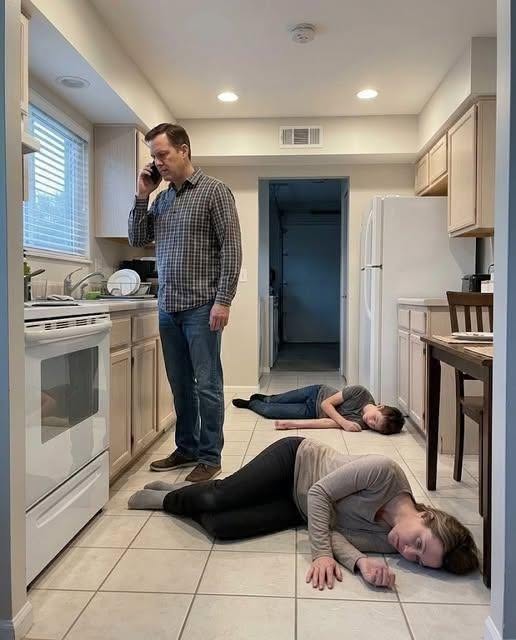
My Husband Cooked Dinner Then My Son and I Collapsed and I Heard Him Whisper, “It’s Done… Soon They’ll Both Be Gone”
My husband cooked dinner that night.
Less than an hour later, my son and I were lying motionless on the kitchen floor while I listened to the man I had married tell someone on the phone that soon we would both be gone.
I remember thinking one thing before everything else.
Do not move.
No matter what happens, do not let him know you can hear him.
My cheek was pressed against the cold kitchen tile.
The floor smelled faintly of lemon cleaner because I had mopped it that morning.
That ordinary smell almost made the situation worse.
Everything around me belonged to a completely normal evening.
The dishwasher hummed.
A glass of water sat half finished near my place at the table.
The overhead light cast the same soft yellow glow it always did.
A kitchen towel hung from the oven handle.
Nothing looked wrong.
But my body would not obey me.
My arms felt impossibly heavy.
My mouth was dry.
My thoughts moved faster than my muscles could follow.
A few feet away, my son Noah was lying beside his chair.
One arm was bent awkwardly beneath him.
His eyes were closed.
For several terrifying seconds, I did not know whether he was breathing.
I stared at his chest.
One rise.
Then another.
Then a third.
Only after I counted those three breaths did I allow myself to look toward the hallway.
Daniel had disappeared into the den.
I could hear him speaking.
His voice was low.
Too low for me to catch every word.
But some words came through clearly.
“It’s done.”
A pause.
Then another sentence.
“Soon they’ll both be gone.”
Every part of me wanted to scream.
Instead, I let my eyelids fall halfway closed.
My heart was beating so hard that I was convinced Daniel would hear it from the next room.
I tried to make each breath shallow.
Slow.
Weak.
Normal for someone who had collapsed.
I told myself not to think about what he meant.
Not yet.
Thinking would turn into panic.
Panic would become movement.
Movement could give us away.
I needed to survive the next minute before I could think about the next hour.
From the den, Daniel continued speaking.
I heard fragments.
A name I could not make out.
Something about timing.
Then, more clearly:
“They won’t be a problem after tonight.”
The sentence entered my mind slowly.
Not because I could not understand it.
Because I did.
I understood it too well.
A sound came from the hallway.
Footsteps.
Daniel was coming back.
I closed my eyes completely.
My body went loose against the floor.
I let my hand fall open beside my face.
The footsteps entered the kitchen.
Stopped.
For a second, nothing happened.
I could feel his presence without seeing him.
Then his shoes came into view through the narrow gap beneath my eyelashes.
He stood next to me.
I wanted to recoil.
Instead, I remained completely still.
Daniel crouched.
His fingers closed around my wrist.
He was checking my pulse.
The realization was so horrifying that I almost ruined everything.
He was not checking because he was worried.
Not after what I had just heard.
He wanted information.
He wanted to know what condition I was in.
I forced myself not to react when his thumb pressed against the inside of my wrist.
A few seconds later, he lowered my hand carefully back to the floor.
Carefully.
That detail stayed with me.
There was nothing frantic about him.
Nothing confused.
Nothing that sounded like a husband finding his wife and son unconscious after dinner.
He was calm.
He was deliberate.
Daniel stood and crossed toward Noah.
I could no longer see him.
Every instinct I had as a mother screamed at me to turn my head.
To open my eyes.
To get between them.
But I could not.
If Daniel believed Noah and I were unconscious, that belief was the only advantage we had.
I listened.
Daniel touched Noah’s shoulder.
Then he said something in the softest voice I had ever heard him use.
“This will be easier for everybody.”
That sentence nearly broke me.
He sounded kind.
That was the most frightening part.
Danger did not sound furious.
It did not sound wild.
It did not sound like the arguments people imagine when they think about something terrible happening inside a family.
Daniel sounded calm.
Gentle.
Almost comforting.
And somehow that made everything more terrifying.
I heard him straighten.
A chair scraped slightly.
Then there was the sound of something being picked up from the table.
I could not tell what.
A plate.
A glass.
His phone.
Something else.
His footsteps moved toward the hallway.
Then away.
Seconds later, the door to the garage opened.
Closed.
I waited.
I did not trust the silence.
Maybe he was standing behind the door.
Maybe he was waiting for us to move.
Maybe he had walked only far enough to make us think he was gone.
I counted slowly in my head.
One.
Two.
Three.
Four.
Five.
I reached twenty before I opened my eyes.
Noah opened his at exactly the same moment.
For one second, we just looked at each other.
His face was pale.
His eyes were wide.
I raised one finger to my lips.
Do not speak.
He nodded.
I pushed myself onto my elbows.
My arms shook so badly that I almost collapsed again.
Whatever was in my system had not disappeared just because fear had forced me awake.
My body still felt wrong.
Slow.
Disconnected.
Heavy.
Noah tried to sit up.
His chair shifted slightly.
I grabbed the sleeve of his shirt before the chair could knock against the cabinet.
He froze.
We both listened.
Nothing.
No footsteps.
No garage door.
No voice.
“Phones,” Noah whispered.
I checked my pocket.
Empty.
I looked at the counter.
Nothing.
Noah felt around his own clothes.
His phone was gone too.
That was not an accident.
Daniel had taken both of them.
The simplest, fastest way for us to call for help had been removed.
My mind started racing.
We had a laptop upstairs.
Too far.
Daniel could come back at any moment.
There was a tablet in Noah’s room.
Also upstairs.
No.
We needed something now.
Noah reached toward the table as though he might search around the place setting.
I caught his wrist.
My eyes had landed on my plate.
The blue one.
Daniel had served my dinner on it.
Several bites remained.
For a moment, I stared at those pieces of food.
Then I looked at Noah’s plate.
Mostly empty.
Then back at mine.
Same meal.
Same table.
Same sudden collapse.
My stomach turned.
I did not know exactly what had happened.
I did not know what was in the food.
I did not know whether the meal itself had caused it.
But I knew one thing with absolute certainty.
I was not going to let that plate disappear.
My mind began functioning in small, practical steps.
Save some.
Hide it.
Call for help.
Get Noah out.
Do not let Daniel know we are awake.
I opened the freezer drawer beneath the refrigerator.
Even that small movement felt painfully loud.
Plastic containers shifted.
A bag of frozen vegetables moved against the side.
My heel caught a grocery receipt lying on the floor.
For some reason, I picked it up.
Then shoved it beneath the cabinet.
The action was pointless.
Completely pointless.
But my hands needed something normal to do.
Something ordinary.
Something that reminded me I still had control over at least one movement.
I pulled out a clean freezer bag.
Noah held the drawer steady.
I scraped several untouched pieces of dinner from my plate into the bag.
I tried not to disturb the rest.
I did not want Daniel to look at the plate later and immediately realize something had changed.
The fork slipped against the ceramic.
The sound seemed enormous.
We froze.
Nothing happened.
I continued.
When I had enough, I sealed the bag.
Then pushed it behind a half empty package of frozen peas.
Far enough back that someone opening the drawer casually would not notice it.
I closed the freezer.
Then carefully returned my blue plate to almost exactly where it had been.
The chair.
The fork.
The napkin.
I tried to make the table look untouched.
Noah watched me.
His lips were trembling.
“Mom,” he whispered.
“I know.”
“What did he do?”
“I don’t know.”
I hated saying that.
But I would not lie to him.
Not then.
Not about that.
“Is he trying to…”
“No.”
The word came out too fast.
Not because I knew the answer.
Because I could not let him finish the sentence.
“Right now we don’t guess,” I whispered. “We get help.”
He nodded.
I looked toward the hallway.
Then remembered something.
The narrow cabinet beside the pantry.
Years earlier, we had kept a corded telephone there.
Daniel hated it.
He called it useless.
Outdated.
An ugly piece of plastic that belonged in a box at a yard sale.
More than once, he had said we should disconnect the line entirely.
I had never bothered.
Not because I had some dramatic instinct that one day it might save us.
I simply forgot.
There was always something else to do.
A bill.
A school activity.
Laundry.
Work.
Groceries.
The phone remained hidden behind a stack of old takeout menus because throwing it away was never important enough to reach the top of the list.
Now that stupid forgotten phone was all I could think about.
I crawled toward the cabinet.
Opened it.
Reached behind the menus.
My fingers found plastic.
I pulled the phone forward.
Noah stared at it as though I had pulled a lifeline out of the wall.
I lifted the receiver.
For half a second, there was silence.
Then I heard the dial tone.
I almost cried.
Instead, I dialed 911.
I gave the dispatcher our address first.
I had always heard that was what you should do.
Location first.
If the call disconnected, at least they would know where to come.
My voice sounded strange to me.
Weak.
Small.
But I forced the words out.
“My son and I collapsed after eating dinner.”
The dispatcher asked if we were conscious.
“Yes.”
“Are you having trouble breathing?”
“Not right now.”
“Do you know what happened?”
I looked toward Noah.
“No. But my husband was here. He thinks we’re unconscious.”
There was a pause.
Not long.
Just enough for me to hear my own breathing.
“What makes you say that?”
“I heard him talking on the phone.”
“What did he say?”
My throat tightened.
“He said, ‘It’s done.’ He said soon we’d both be gone.”
The dispatcher’s tone changed.
Not dramatically.
She stayed calm.
Professional.
But I could hear the seriousness underneath it.
“Where is your husband now?”
“I think he went outside. I heard the garage door. I don’t know if he left the property.”
“Are you able to get outside safely?”
“I don’t know.”
She told me to stay on the line.
Noah crawled toward the nearest window.
He raised one corner of the blind.
Barely an inch.
He looked outside.
Then back at me.
He shook his head.
Nothing visible.
No car where he expected it.
No Daniel.
That should have made me feel better.
It did not.
Because we did not know where he was.
I told the dispatcher we would move toward the back door if we could do it safely.
She told me help was coming.
The words were comforting.
But they did not change the fact that until help physically reached our kitchen, Noah and I were still alone.
I hung up only when the dispatcher told me to do so.
Noah immediately started toward the back door.
“Wait.”
“We need to go.”
“I know.”
“What if he comes back?”
“That’s why we have to think.”
I opened the freezer again.
My fingers found the sealed bag.
I pulled it out.
Then tucked it inside the waistband of my sweatpants beneath my shirt.
Cold pressed against my skin.
Noah stared at me.
“Why are you taking that?”
“Because if we get out, this comes with us.”
I did not explain more.
I did not want to say the word evidence.
Not to my son.
Not while we were still standing in the kitchen where his father had cooked dinner.
I checked the hallway.
Empty.
Then helped Noah stand.
His knees buckled almost immediately.
I grabbed him beneath the arms and pulled him against the refrigerator.
A magnet slid down the door and hit the floor.
We both froze again.
No sound from the hallway.
No sound from the garage.
No one coming.
Noah took a slow breath.
“I’m okay.”
“You don’t have to be okay.”
“I can walk.”
I nodded.
He put weight on both legs.
We crossed the kitchen slowly.
He gripped my wrist.
I kept one hand on the counter.
Each step felt like walking through deep water.
I reached the back door.
Turned the lock.
My hand wrapped around the handle.
Then headlights swept across the blinds.
Bright white lines moved across the kitchen wall.
Noah’s eyes widened.
I locked the deadbolt again.
Pulled him away from the glass.
“Floor.”
He understood immediately.
No argument.
No hesitation.
Noah dropped beside his chair.
I moved back toward the place where I had fallen earlier.
Every second mattered.
I lowered myself onto the tile.
I arranged Noah’s arm almost exactly the way it had been.
Then I moved my own hand.
Flattened my palm.
Turned my face.
My eyes landed on the blue plate.
Wrong.
It was slightly too far away.
I slid it about two inches toward my place setting.
That looked closer.
I lay down again.
A car door closed outside.
Keys scraped against the lock.
Noah’s breathing became faster.
I wanted to tell him to slow down.
Could not.
The back door opened.
Daniel stepped into the kitchen.
I shut my eyes.
For one terrifying second, I thought he might come directly to us.
He did not.
He went straight to the table.
No hesitation.
No “Are you okay?”
No checking our breathing.
No touching my shoulder.
He went directly to the blue plate.
I heard ceramic lift from the table.
Plastic opened.
A trash bag.
Daniel placed the plate inside.
My skin went cold.
That was why he had returned.
Not for us.
For the plate.
He had come back to remove something.
He moved around the kitchen.
A second object went into the bag.
Then another.
I kept my breathing slow.
Noah remained motionless beside me.
Daniel never opened the freezer.
That one mistake would become the difference between what he wanted people to believe and what could actually be tested.
At the time, all I knew was that the cold bag of food pressed against my waist beneath my shirt.
I wanted to put my hand over it.
I wanted to make sure it was still there.
I did not move.
Daniel tied the trash bag.
Then walked toward the garage.
As he moved away, I heard his phone.
A moment later, his voice.
“I cleaned everything up.”
My stomach twisted.
Everything.
The word echoed in my head.
He thought he had cleaned everything up.
I could not see Noah’s face.
I hoped he had not heard.
But I knew he probably had.
Then another sound entered the house.
Faint at first.
Far away.
Sirens.
Daniel stopped.
The silence that followed felt enormous.
For the first time that night, I imagined him afraid.
The sirens grew louder.
Closer.
Daniel moved back toward the kitchen.
I opened my eyes.
At the exact same moment, Noah sat up.
Daniel turned.
He saw us.
His face changed.
Only for half a second.
Shock.
Pure, unmistakable shock.
Then it disappeared.
“Thank God,” he said.
His entire voice transformed.
“I thought you both fainted.”
I stared at him.
Did not answer.
He stepped toward us.
“You’re awake. Oh my God. I was trying to figure out what happened.”
Noah moved closer to me.
Daniel stopped.
The sirens were directly outside now.
Red light flickered across the blinds.
Daniel looked toward the window.
Then back at us.
“You called someone?”
I still said nothing.
A knock hit the door.
Then another.
“Emergency services.”
Daniel’s eyes stayed on mine.
I had known that man for years.
I had watched him angry.
Tired.
Sick.
Excited.
Distracted.
Happy.
Frustrated.
I had watched him become Noah’s father.
I had slept beside him.
Shared meals with him.
Made plans with him.
And yet the face in front of me suddenly felt like the face of a stranger.
The paramedics entered first.
Police came in behind them.
Everything became noise and movement.
Questions.
Medical bags.
Gloves.
Blood pressure cuffs.
Someone asked who had collapsed first.
I said I did not know.
Someone asked what we had eaten.
I pointed toward the table.
Daniel jumped in immediately.
“She’s been exhausted lately.”
I looked at him.
He kept talking.
“She takes medication sometimes. I’ve told her she needs to be more careful.”
One of the paramedics looked toward me.
“What medication?”
Before I could answer, Daniel said, “I don’t know exactly. She handles all that.”
That was not true.
But I did not argue.
Not yet.
I had one sentence I needed them to hear.
“Same dinner. Same time. Test both of us.”
The paramedic looked at Noah.
Then me.
“What?”
“My son and I ate the same dinner. We both collapsed. Test both of us.”
Daniel laughed nervously.
Not a real laugh.
A short breath pretending to be one.
“They probably both got food poisoning. I was just saying she’s been under a lot of stress.”
I turned toward the paramedic.
“Please.”
That was enough.
The paramedic nodded.
From that point forward, Daniel no longer controlled the conversation completely.
Noah and I were taken to the hospital.
I remember very little about the ambulance ride in sequence.
Flashing lights.
A monitor.
Someone asking me to rate my nausea.
Someone checking Noah’s pupils.
The cold freezer bag still pressed beneath my shirt.
I did not tell anyone about it yet.
I do not know why.
Maybe because it had become the one thing Daniel did not know existed.
Maybe because I needed to reach somewhere safe before I let it out of my possession.
Maybe because after hearing him say he had cleaned everything up, I could not stand the idea of losing the only thing he had missed.
Daniel arrived at the hospital too.
Of course he did.
He had already shifted completely into another role.
Concerned husband.
Concerned father.
He spoke quickly.
Repeatedly.
He told nurses I had been tired.
Stressed.
Overwhelmed.
He suggested I might have taken the wrong medication.
He said Noah had probably reacted to something in the meal.
He said maybe there was a problem with an ingredient.
He spoke like a man trying desperately to help medical staff understand what had happened.
If I had not heard him on the phone, I might have believed him.
That realization terrified me almost as much as anything else.
He sounded reasonable.
That was his strength.
Nothing about him sounded like a villain in a movie.
He did not scream.
He did not threaten anyone.
He did not pace wildly through the hospital.
He stood near my bed and spoke with controlled concern.
He answered questions politely.
He touched his forehead as though overwhelmed.
He looked toward Noah’s room again and again.
Anyone walking past us might have thought he was terrified for his family.
Maybe that was exactly what he wanted them to think.
The first screening results changed the atmosphere.
A medical professional entered the room.
She asked Daniel to step back while she spoke to me.
There was a sedating substance in my system.
The same type of substance had been detected in Noah.
Neither of us had been prescribed it.
I stared at her.
Even though I had expected something.
Even though every part of that evening had already told me something had been done to us.
Hearing it confirmed felt different.
It made everything real in a new way.
This was not stress.
Not exhaustion.
Not a strange shared fainting episode.
Something was in both our bodies.
Something that did not belong there.
Daniel’s explanation suddenly had a problem.
A serious one.
He began speaking again.
Maybe something had been mixed accidentally.
Maybe there had been contamination.
Maybe I had handled medication near the food.
Maybe Noah had gotten into something.
One possibility after another.
I barely listened.
Because one of the doctors asked a question.
“What happened to the food?”
The room went quiet.
Daniel looked toward me.
I looked back at him.
For the first time since arriving at the hospital, I saw something in his eyes that resembled fear.
Not concern.
Fear.
I reached beneath my shirt.
Pulled out the freezer bag.
The plastic had warmed against my skin, but it was still sealed.
Inside were several pieces of the dinner Daniel had served me.
The dinner from the blue plate he thought he had removed.
I held it out.
The nurse put on gloves before taking it.
“This came from my plate,” I said.
Daniel did not speak.
“The plate he took after we collapsed.”
The police officer standing near the doorway shifted closer.
I continued.
“He never checked the freezer.”
That sentence was not dramatic.
I did not raise my voice.
I did not accuse Daniel of anything beyond what I had personally seen and heard.
But the room changed.
Until then, Daniel had been offering explanations.
Now there was something that could be tested.
Something outside his control.
The sealed bag became the one thing he had not accounted for.
Earlier that evening, everything had looked ordinary.
That was the thought I could not stop returning to.
Ordinary.
Daniel had cooked dinner many times before.
There was nothing unusual about seeing him at the stove.
Nothing unusual about hearing a pan scrape against the burner.
Nothing unusual about Noah talking at the table.
He had been telling us about a science project.
Something involving a model.
He complained that someone in his group was doing less work than everyone else.
I remember smiling.
Daniel had laughed once.
Actually laughed.
He had walked from the stove to the counter.
Back to the table.
He complained about the grocery store.
Too crowded.
Long lines.
Someone blocking an aisle with a shopping cart.
Ordinary complaints.
Ordinary conversation.
Ordinary family life.
That was what frightened me later.
We like to believe danger announces itself.
That something feels wrong before everything changes.
Sometimes it does.
Sometimes there is shouting.
A threat.
A slammed door.
An obvious moment when the atmosphere shifts.
But that night, danger looked like dinner.
It smelled like food.
It sounded like the dishwasher running behind us.
It looked like a man standing at the stove in his own house.
I remembered setting my fork down.
Not because the food tasted strange.
Because my hand suddenly felt weak.
I remember looking at Noah.
He had stopped talking.
His face looked confused.
“Mom?”
I tried to answer.
The room seemed to tilt.
That was all.
Then tile.
Cold against my cheek.
I kept replaying those seconds at the hospital.
Trying to identify something I should have seen earlier.
A look on Daniel’s face.
A pause.
A strange comment.
Something.
Anything.
But memory does not always give you what you want.
Sometimes the most terrifying answer is that everything looked normal until it did not.
Police separated us.
That helped.
Daniel was no longer standing near my bed.
I could finally breathe without feeling his attention on me.
An officer asked me to describe the evening from the beginning.
I did.
Slowly.
Dinner.
Weakness.
The fall.
Daniel leaving the kitchen.
The phone call.
“It’s done.”
The officer stopped writing for a second.
“Exact words?”
“As close as I can remember.”
“What else?”
“Soon they’ll both be gone.”
“And you believe he thought you were unconscious?”
“Yes.”
“Why?”
“Because when he came back, he checked my wrist. Then he checked Noah. He talked about us like we couldn’t hear.”
“What did he say to your son?”
My throat tightened.
“This will be easier for everybody.”
The officer wrote it down.
I hated seeing the sentence become ink on paper.
Hated that something so intimate and terrible could fit on one line of a notebook.
Then I told him about our missing phones.
The corded phone.
The call to 911.
The freezer bag.
The headlights.
Daniel returning.
The blue plate.
“I cleaned everything up.”
The officer looked at me.
“You heard him say that?”
“Yes.”
“To whom?”
“I don’t know.”
That mattered.
I wanted to give them answers.
Names.
Reasons.
A clear explanation.
I had none.
The truth was smaller and more frightening.
I knew only what I personally experienced.
My son and I ate.
We collapsed.
Our phones were gone.
Daniel spoke as though he expected us not to recover.
He removed my plate.
He told someone he had cleaned everything up.
The medical tests showed the same unprescribed sedating substance in both Noah and me.
The food remained available for testing because I had hidden some before he returned.
Everything else belonged to the investigation.
I would not invent pieces to fill the gaps.
That decision became important in the days afterward.
People wanted a simple story.
Police needed facts.
Medical staff needed timelines.
Friends wanted motives.
Relatives wanted to know how long I had suspected something.
The answer to that last question made people uncomfortable.
I had not.
Not like this.
There had been arguments in our marriage.
Of course there had.
There had been tense weeks.
Resentments.
Things unsaid.
Moments when Daniel became distant.
Moments when I became frustrated.
We were not some perfect television family.
But ordinary marital problems do not automatically explain what happened at that dinner table.
I refused to rewrite years of my life just because one terrible night had changed how everything looked.
That would come later.
Maybe.
At that moment, I needed facts.
So did Noah.
Especially Noah.
He was quieter in the hospital than I had ever seen him.
Every time someone entered his room, his eyes went to the door immediately.
He asked if Daniel was still in the building.
I told him I did not know.
Then I found out.
Then I told him only what he needed to know.
He asked if we were going home.
I could not answer.
Not right away.
The idea of returning to that kitchen made my chest tighten.
I pictured the table.
The chair.
The tile.
The freezer.
The blue plate.
The exact place where Noah had fallen.
A house can survive an event without physically changing.
That was something I had never understood before.
No fire.
No broken walls.
No shattered windows.
No visible destruction.
The refrigerator still worked.
The cabinets still closed.
The mail would still arrive.
The same photographs remained on the walls.
But the meaning of the house had changed completely.
It no longer felt like shelter.
It felt like a location where evidence had been collected.
That transition happened faster than I could emotionally understand.
Detectives returned to the house.
They documented the kitchen.
The table.
The cabinet containing the corded phone.
The freezer.
The places where everything had happened.
They examined the sequence of events.
What had been served.
What remained.
What Daniel removed.
What I preserved.
What we heard.
What he later said.
The blue plate became more than a plate.
It became part of a timeline.
Before that night, it had been one of several mismatched dishes in the cabinet.
I liked it because it was slightly deeper than the white ones.
I used it for pasta.
Rice.
Anything with sauce.
That night, it happened to be the plate Daniel served me.
Nothing more.
Until it became the object he came back to remove.
The old corded phone changed meaning too.
For years, it was clutter.
Daniel wanted it disconnected.
I had almost agreed more than once.
Who needed a corded phone anymore?
We had cell phones.
Internet.
Smart devices.
Every convenience modern life promised.
But when our cell phones disappeared, that old telephone line remained.
Technology everyone considered outdated became the only communication method Daniel had overlooked.
I thought about that often.
The things we dismiss as useless sometimes become important only when everything else fails.
The freezer became another strange symbol.
How many times had I opened that drawer without thinking?
Hundreds.
Maybe thousands.
Ice cream.
Frozen vegetables.
Leftovers.
Ice packs.
Nothing dramatic.
Then, in the middle of the worst night of my life, it became the safest hiding place I could think of.
Not because it was clever.
Because it was close.
Because Daniel had left the kitchen.
Because fear forces you to use whatever is available.
People later described what I did as smart.
I did not feel smart.
I felt terrified.
There is a difference.
I did not have a plan.
I was not thinking ten steps ahead.
I was thinking one step at a time.
Save food.
Call 911.
Get Noah up.
Try to leave.
Hide again.
Stay alive.
That was it.
Fear simplified everything.
There was no room for dramatic speeches.
No room for confrontation.
I did not want Daniel to confess.
I did not want to understand him.
I did not want to corner him and demand answers.
I wanted my son breathing.
I wanted help to arrive.
I wanted something from that dinner left behind for someone else to examine.
That was the entire world.
In the hospital, time moved strangely.
Minutes stretched.
Then hours disappeared.
People entered.
Asked questions.
Left.
Machines beeped.
Doors opened.
Shoes squeaked against polished floors.
Someone brought Noah juice.
He held the cup but barely drank.
At one point, he looked at me and asked the question I had been dreading.
“Did Dad want us to die?”
There was no good answer.
I reached for his hand.
“I don’t know exactly what he intended.”
“You heard him.”
“Yes.”
“He said we’d be gone.”
“Yes.”
“So what else does that mean?”
I looked at my son.
He deserved truth.
But truth included uncertainty.
And uncertainty mattered.
“It means what happened was serious,” I said. “It means the police have to find out exactly what he did and why. I’m not going to tell you something I don’t know for sure.”
Noah looked down.
“I heard him say it too.”
That sentence crushed something inside me.
Until then, some irrational part of me had hoped he had been too impaired to hear Daniel.
He had not.
He heard.
The sentence would belong to his memory too.
I squeezed his hand.
“I’m sorry.”
“For what?”
I almost said everything.
The dinner.
The marriage.
The house.
His father.
The fact that I had not known.
The fact that he had been lying on that floor while I pretended to be unconscious three feet away.
Instead, I said, “That you had to hear any of it.”
Noah did not answer.
He leaned against me.
That was the first time we really allowed ourselves to hold each other after the kitchen.
Until then, survival had made us practical.
At the house, we did not hug because hugging wasted movement.
In the ambulance, people were treating us.
At the hospital, questions began immediately.
Now, finally, Noah put his head against my shoulder.
I wrapped both arms around him.
He started crying.
Quietly at first.
Then hard.
I cried too.
Not because we had answers.
Because we had survived long enough to ask the questions.
That distinction mattered.
The medical findings continued to create problems for Daniel’s version of events.
He had suggested exhaustion.
Medication confusion.
A possible accidental reaction.
But Noah and I had the same unprescribed substance in our systems.
We had consumed the same meal.
We had become impaired within the same window.
The preserved food meant investigators did not have to depend entirely on memory or explanation.
There was something physical to examine.
Something collected before Daniel returned for the plate.
Something he had not handled after we woke up.
That bag became more important than I could have imagined while pushing it behind frozen peas.
I kept thinking about Daniel returning to the kitchen.
He walked past us.
Straight to the table.
That detail replayed constantly.
If he had believed we had simply fainted, why would his first priority have been the plate?
Why the trash bag?
Why tell someone he had cleaned everything up?
Those were questions investigators would have to pursue.
For me, they were also emotional facts.
I had watched the man I trusted prioritize an object over two people lying on the floor.
That image became impossible to forget.
The first days afterward were disorienting.
People used words around me that belonged to investigations and medical charts.
Evidence.
Samples.
Statements.
Timeline.
Testing.
Documentation.
I listened.
Answered what I could.
Corrected things when they were wrong.
Said “I don’t know” when I did not know.
Those three words became important.
I don’t know.
They protected the truth from turning into speculation.
Why did Daniel do it?
I don’t know.
Who was on the phone?
I don’t know.
How long had he been thinking about it?
I don’t know.
What exactly had he expected to happen?
I don’t know.
Had he done anything similar before?
Not that I knew.
People wanted a motive because motive makes terrifying behavior feel understandable.
If there is a reason, then perhaps there was a warning.
If there was a warning, maybe someone else can avoid it.
But at that stage, I could not offer any of that.
I had an event.
Not an explanation.
Noah and I did not go straight back home.
For several days, we stayed away.
I will not pretend those days were peaceful.
Safety and peace are not the same thing.
You can be physically safe and still feel like danger is standing behind every door.
The first night, I woke every hour.
Sometimes because I thought I heard Daniel’s footsteps.
Sometimes because I smelled imaginary food.
Once because I dreamed I was back on the kitchen floor and could not open my eyes.
I woke with my heart pounding.
I went to check Noah.
He was awake too.
“You okay?” I asked.
He nodded.
Then shook his head.
“No.”
“Me neither.”
There was relief in saying it.
We did not need to pretend.
Not with each other.
For the first few days, Noah barely ate.
Understandably.
Food had changed.
That is another thing people rarely think about.
When something frightening becomes connected to an ordinary necessity, you cannot simply avoid it.
We still had to eat.
Breakfast appeared.
Lunch appeared.
Dinner appeared.
Each plate carried a question.
Who made this?
Where did it come from?
Could I trust it?
Noah started watching everything.
He wanted sealed packages.
He wanted to open drinks himself.
If I cooked, he stayed in the kitchen.
At first, I wanted to tell him he did not need to do that.
Then I stopped myself.
Trust does not return because someone orders it to.
His nervous system had learned something terrible.
Home cooked food could be dangerous.
A parent could become dangerous.
Feeling afraid after that was not irrational.
It was a response.
So I let him watch.
I told him what ingredients I used.
I opened things in front of him.
Not forever.
Just then.
Whatever helped him get through the day.
I struggled with food too.
The first time someone placed a full dinner plate in front of me after the hospital, my hand would not move.
The plate was white.
Not blue.
The meal looked nothing like Daniel’s dinner.
Still, I stared at it.
My mind produced the same image.
Kitchen tile.
Noah on the floor.
Daniel’s voice from the den.
“It’s done.”
I pushed the plate away.
The person with me did not ask me to eat.
I appreciated that more than they probably understood.
Healing after something like that was not dramatic.
There was no morning when I woke up feeling strong and declared that the past no longer controlled me.
There were small victories.
A full glass of water.
Half a sandwich.
Sleeping four hours without waking.
Hearing a garage door without panicking.
Allowing Noah to be in another room without checking on him every five minutes.
The case continued in the background.
Evidence moved through systems I barely understood.
The preserved food was tested.
Medical results were reviewed.
Statements were compared.
The house was documented.
Daniel’s actions after the emergency call were examined.
His decision to remove the blue plate mattered because it was part of the sequence investigators were reconstructing.
So did his comments.
So did the missing phones.
So did the old corded phone that allowed me to reach emergency services anyway.
Every small detail became part of something much larger.
I found that strange.
Most of life is made of details no one records.
What time dinner begins.
Where a plate sits.
Which drawer someone opens.
Whether a phone is on the counter.
What a person says while walking through a room.
Usually those things disappear.
No one cares.
Then something terrible happens, and suddenly every ordinary detail becomes important.
A chair position.
A receipt.
A freezer bag.
A plate.
A sentence spoken on the phone.
I started understanding why investigators asked the same question more than once.
Memory changes under stress.
They needed consistency where it existed and honesty where it did not.
So I resisted the temptation to make the story cleaner.
Real events are messy.
There were minutes I could not account for.
Words I heard only partly.
I never saw who Daniel was speaking to.
I did not know exactly what he collected from the table before going to the garage the first time.
I could not say precisely how long he had been gone.
I could not tell anyone what he was thinking.
Only what he did.
That distinction became a kind of anchor.
Facts.
Stay with facts.
Whenever my mind spiraled, I came back to what I knew.
Noah survived.
I survived.
We heard Daniel speak.
We stayed still.
Our phones were missing.
The corded phone worked.
I called 911.
I saved food.
Daniel returned.
He removed the plate.
He said he cleaned everything up.
Sirens arrived.
Medical testing found the same unprescribed sedating substance in both of us.
The food had been preserved.
The investigation had something physical to work with.
Those facts were enough.
I did not need to solve the entire case alone.
I had already done the thing I needed to do.
Stay alive.
Months later, I returned to the house.
Walking through the front door was harder than I expected.
The place smelled closed up.
Stale air.
Dust.
That faint familiar scent every house has that the people who live there stop noticing.
I stood in the hallway for a long time.
Nothing attacked me.
Nothing moved.
Still, my body reacted as though danger were waiting.
My shoulders tightened.
My hands became cold.
I looked toward the kitchen.
For several seconds, I could not enter.
I could see part of the refrigerator.
Part of the counter.
The cabinet.
The floor.
That floor.
I told myself I did not have to go in.
Then I asked myself why I had come.
Not to prove bravery.
Not to reclaim some dramatic piece of my life.
I needed to see it.
I needed my memory of the kitchen to contain something besides that night.
So I walked forward.
One step.
Then another.
The room looked insultingly normal.
The counter was clean.
The table remained.
The light worked.
The freezer drawer opened exactly the same way.
The dishwasher door still had the tiny dent near one corner.
It felt impossible that a room could carry so much memory without showing any damage.
I stood near the place where I had fallen.
Then near Noah’s chair.
My chest tightened.
I put one hand on the counter.
Breathed.
I opened the narrow cabinet beside the pantry.
The old corded phone was still there.
Behind the takeout menus.
Exactly where I had reached for it.
I touched the receiver.
For a moment, I could hear the dial tone in my head.
I remembered holding that phone with shaking hands.
Remembered giving my address.
Remembered looking at Noah while the dispatcher asked where Daniel was.
Daniel had wanted that phone disconnected.
I had once agreed with him.
After that night, I never looked at it as clutter again.
I left it there.
Not because I needed to use it.
Because some objects become witnesses.
Not literally.
They cannot speak.
But they remind you what happened when your own mind starts trying to soften the edges.
The freezer was the same.
I opened it.
Cold air touched my face.
The frozen peas were gone by then.
Of course they were.
The food sample was long since out of my hands.
But I remembered exactly where I had pushed the bag.
Behind the package.
Deep enough that Daniel missed it.
I could still feel the cold plastic beneath my shirt.
I closed the drawer.
Then looked toward the table.
The blue plate was gone.
It had become part of the evidence connected to that night.
Its absence was strangely noticeable.
There were other plates.
White.
Gray.
A chipped bowl.
But I knew where the blue one used to sit in the cabinet.
I knew where it had been on the table.
I knew the sound it made when Daniel lifted it.
There was an empty place in my memory shaped exactly like that plate.
For a long time, I thought about why that object affected me so much.
Eventually, I understood.
The plate represented Daniel’s confidence.
He came back believing he could remove the thing that mattered.
He thought the plate was the story.
Take the plate.
Remove the food.
Clean the kitchen.
Control the explanation.
Tell people I had been exhausted.
Tell them medication might have confused me.
Tell them Noah and I reacted unexpectedly.
Create enough reasonable sounding possibilities and maybe no one would look harder.
But the truth was not sitting entirely on one plate.
Part of it was already in our bodies.
Part of it had already been heard by Noah and me.
Part of it was in the 911 call.
Part of it was in Daniel’s behavior.
And part of the dinner was sitting behind frozen peas.
He controlled many things that night.
The meal.
The phones.
His own movements.
The story he immediately began telling.
But he did not control everything.
That became the lesson I carried away.
People who try to control a situation often believe control is the same thing as certainty.
It is not.
Daniel could remove our phones.
He could not erase the corded phone he had forgotten.
He could carry away the plate.
He could not remove the food I had hidden.
He could tell medical staff I was confused.
He could not change what appeared in both our test results.
He could speak gently after the sirens arrived.
He could not unsay the words Noah and I had already heard.
He could present himself as concerned.
He could not rewrite the sequence of the night.
That did not make everything easy.
Nothing about what happened was easy.
The investigation did not instantly repair my family.
Evidence did not erase fear.
Medical confirmation did not answer every emotional question.
And surviving did not mean Noah and I walked away untouched.
There were consequences that never appeared in any official report.
The first time Noah heard someone say, “Dinner’s ready,” he froze.
The first time I smelled the same seasoning Daniel had used that night, I had to leave the room.
For months, Noah wanted to know exactly where my phone was.
Not his.
Mine.
“Do you have it?”
“Yes.”
“Charged?”
“Yes.”
“Can you show me?”
At first, I did.
Then gradually he asked less.
That was how progress looked.
Not forgetting.
Not pretending.
Simply needing fewer reassurances.
I changed too.
I became aware of exits.
Phones.
Keys.
Where people stood in a room.
What was on a table.
Whether I could reach a door.
For a while, I hated those changes.
They made me feel as though Daniel still controlled me.
Later, I understood that hyperawareness was not permanent identity.
It was my mind trying to protect me after failing to predict danger once.
I could work with it.
I did not have to become it.
Noah and I talked about that night carefully.
Never when he did not want to.
Never because I needed him to process it on my schedule.
Sometimes he asked factual questions.
“Did you really hear Dad say we wouldn’t be a problem?”
“Yes.”
“Did he know we were awake?”
“I don’t think so.”
“Why did you hide the food?”
“Because I thought someone might need to test it.”
“Were you scared?”
“Yes.”
That last answer surprised him.
“You looked calm.”
“I wasn’t.”
“You knew what to do.”
“No. I knew the next thing to do.”
He thought about that.
“What’s the difference?”
“A plan knows where everything is going. I didn’t. I just kept choosing the safest next step I could think of.”
That became something we both remembered.
You do not always need the whole plan.
Sometimes you need the next safe step.
Stay still.
Open your eyes.
Find a phone.
Call for help.
Save what matters.
Move toward the door.
Hide again.
Tell the truth.
One step.
Then another.
People later asked me how I stayed calm on the floor.
I did not.
My heart was racing.
My thoughts were chaotic.
I wanted to grab Noah and run.
I wanted to scream at Daniel.
I wanted to demand to know what he had done.
I wanted to wake up from the entire night.
Calmness was not what saved us.
Restraint did.
There is a difference.
I felt fear.
I just did not let every feeling become an action.
When Daniel checked my wrist, I wanted to pull away.
I did not.
When he touched Noah, I wanted to move.
I did not.
When the garage door closed, I wanted to run immediately.
I waited.
When headlights returned, I wanted to panic.
We went back to the floor.
Survival sometimes looks less like courage and more like resisting the strongest impulse in your body.
That was what happened.
I also thought often about Noah’s role.
He was not simply a child I rescued.
He helped.
He stayed still.
He watched the window.
He held the freezer drawer.
He listened.
He trusted me when I told him to get back on the floor.
That knowledge brought complicated feelings.
I was proud of him.
I also wished he had never needed to be brave.
Children should not have to prove how strong they are because an adult puts them in danger.
But Noah had done what he needed to do.
And I made sure he understood something.
None of it was his responsibility.
The fact that he helped did not mean he caused it.
The fact that he remembered details did not mean he had to carry the investigation.
The fact that he survived did not mean he needed to become fearless.
He was allowed to be a kid.
That mattered more than any story people might tell about bravery.
There were moments when anger became stronger than fear.
Especially late at night.
I would remember Daniel saying, “This will be easier for everybody.”
Easier for whom?
The question tormented me.
But I refused to answer it for him.
That was his sentence.
His meaning.
His responsibility.
I would not build a motive on his behalf.
Instead, I focused on what I could control.
Noah.
My own recovery.
Cooperating with investigators.
Making sure our account remained accurate.
Not allowing shock to become certainty about things I had not actually witnessed.
That last part was harder than it sounds.
When you experience betrayal, the past becomes suspicious.
You revisit every strange moment.
Every argument.
Every unexplained absence.
Every cold expression.
You wonder whether something had been building.
You wonder what else you missed.
Memory becomes a crime scene of its own.
I had to stop doing that constantly.
Not because the questions were invalid.
Because I could not live every day searching backwards for hidden meaning.
Some answers might come from the investigation.
Some might never come.
My life could not depend on solving every unanswered question.
The kitchen taught me that.
That night, I survived without understanding why.
Understanding was not required before action.
Sometimes you act because the danger is clear even when the motive is not.
Months passed.
The immediate shock softened around the edges.
Not disappeared.
Softened.
The story stopped being the first thing I thought about every morning.
Then one day I realized I had gone several hours without thinking about it.
That felt enormous.
Another day, Noah ate a meal someone else prepared without asking to see the package first.
Neither of us mentioned it.
I noticed.
He probably noticed too.
We let the moment remain ordinary.
Ordinary had become precious.
Before Daniel’s dinner, I had barely thought about ordinary evenings.
Now I understood what a gift they were.
A boring dinner.
A complaint about homework.
A sink full of dishes.
A phone ringing.
A freezer full of food no one needs to hide.
Those things once felt insignificant.
Afterward, they felt like proof that life could become simple again.
Not the same.
Simple.
There is a difference.
I never returned to the version of myself who believed familiarity automatically meant safety.
I could not.
But I also refused to become someone who believed danger was everywhere.
That would have given one night too much power.
Instead, I learned to live with what I knew.
Trust is not blindness.
Safety is not certainty.
And surviving betrayal does not require pretending you were foolish for trusting someone before they betrayed you.
I had married Daniel because I believed I knew him.
I had built a family with him.
That history was real.
So was what happened later.
One truth did not erase the other.
They existed beside each other in ways that were painful to understand.
That was part of the aftermath no one warned me about.
People want you to hate the person immediately.
Completely.
Cleanly.
But emotions are not court exhibits.
They do not arrive labeled.
There were memories of Daniel that still contained laughter.
Birthdays.
Trips.
Noah as a baby.
Ordinary mornings.
Then there was the kitchen.
The two realities collided.
I did not force myself to resolve them.
I simply stopped allowing good memories to excuse dangerous behavior.
That distinction became essential.
A person can have been good to you once and still do something that requires you to protect yourself now.
History does not erase present danger.
Love does not erase evidence.
Confusion does not erase what happened.
That night proved all three.
The investigation continued moving through its process.
I will not pretend I understood every stage.
There were waiting periods.
Updates.
More questions.
Documentation.
The preserved food became part of the larger evidentiary picture.
The medical findings remained important.
So did the sequence of Daniel’s actions.
The case was built from accumulated details rather than one dramatic revelation.
That surprised people.
They expected some single cinematic moment.
A confession.
A hidden message.
A shocking piece of evidence appearing from nowhere.
Real life was quieter.
The truth was assembled.
One fact beside another.
Dinner.
Collapse.
Statements.
Missing phones.
The corded phone.
The emergency call.
The blue plate.
The freezer bag.
Testing.
Daniel’s explanations.
His attempt to remove what remained.
Each piece mattered because it connected to the others.
That was how the story became harder to explain away.
Not because I shouted louder than Daniel.
Because facts stayed where explanations changed.
That realization helped me emotionally too.
Daniel had been good at sounding reasonable.
I knew that by then.
He could make a statement that seemed plausible for ten seconds.
Maybe I was tired.
Maybe I mixed medication.
Maybe something contaminated the food.
Maybe the collapse was accidental.
Each individual sentence created uncertainty.
But when those explanations were placed beside physical facts, they had to survive contact with them.
That was different.
I no longer needed to argue.
Evidence did not raise its voice.
It simply existed.
The freezer bag existed.
The medical tests existed.
The 911 call existed.
What Noah heard existed.
What I heard existed.
The timeline existed.
That changed how I thought about conflict in general.
For years, I believed winning an argument depended on finding the right words.
Explaining yourself clearly.
Persuading.
Defending.
That night taught me that sometimes the most powerful response is preservation.
Preserve facts.
Preserve distance.
Preserve your ability to act.
Do not waste time convincing someone who benefits from confusion.
That lesson came at a cost I would never choose.
But I kept it.
The first time I cooked dinner in a real kitchen again, I almost stopped halfway through.
The cutting board.
The pan.
The smell of onions.
Everything reminded me of Daniel moving between the stove and the counter.
Noah was nearby.
I saw him watching.
Not suspiciously.
Just carefully.
I wanted to prove something.
To finish.
To sit down.
To make dinner normal again.
Then I realized forcing normality was another kind of pressure.
So I turned off the stove.
“We’re ordering pizza.”
Noah looked surprised.
Then smiled.
“Really?”
“Really.”
“What happened to dinner?”
“Dinner can wait.”
We laughed.
It was a small laugh.
But it was real.
The next time, I finished cooking.
No dramatic breakthrough.
No tears.
Just food.
That was how we rebuilt.
Not by defeating the memory.
By creating other memories beside it.
Enough of them that eventually the kitchen floor became one memory instead of the definition of every kitchen.
I kept the old phone.
People found that strange.
“You’re really keeping that thing?”
“Yes.”
“Why?”
Because it worked.
That was the practical answer.
The emotional answer was harder.
The phone reminded me that survival sometimes depends on what someone else overlooks.
Daniel overlooked the phone.
He overlooked the freezer.
He overlooked the possibility that Noah and I could hear him.
He overlooked the fact that people do not always behave the way you expect when they are afraid.
He had planned around control.
But control requires perfect prediction.
Human beings are not perfectly predictable.
Neither is circumstance.
That mattered.
I did not keep the phone because I wanted to live in fear.
I kept it because it represented the opposite.
A route out.
A voice on the other end.
Someone hearing our address.
Help moving toward us while Daniel thought we were still helpless on the floor.
Sometimes I would touch the receiver and remember the dispatcher saying help was coming.
Those words had been a bridge between terror and survival.
The freezer bag became another memory I returned to.
Not because I wanted to celebrate being clever.
I did not feel clever.
I remembered how badly my hands shook.
How ordinary the frozen peas looked.
How absurd it felt to care about leftovers when my son and I might be in danger.
But those leftovers mattered.
That became another lesson.
During crisis, the important thing may not look important.
A forgotten phone.
A half eaten plate.
A plastic freezer bag.
A door lock.
A child’s steady breathing.
You do not need dramatic tools.
You need whatever works.
I thought too about the moment the headlights swept across the blinds.
We were inches from trying to leave.
If Daniel had returned thirty seconds later, maybe we would have been outside.
Maybe the story would have unfolded differently.
If he returned thirty seconds earlier, maybe I would still have been at the freezer.
The margins were that small.
That realization made me uncomfortable for a long time.
I wanted survival to feel like something earned entirely through good decisions.
It was not.
We made good decisions.
Luck mattered too.
Timing mattered.
Daniel’s assumptions mattered.
The forgotten phone mattered.
The fact that the dispatcher sent help quickly mattered.
Admitting that did not diminish what Noah and I did.
It made me more grateful.
Survival is sometimes a combination of courage, restraint, ordinary objects and circumstances aligning just enough.
I stopped asking why we deserved to survive.
That question leads nowhere.
We survived.
That was enough.
Noah recovered physically before I did emotionally.
Children are complicated that way.
He could laugh with friends and then have a panic reaction ten minutes later.
He could talk about school all afternoon and suddenly ask whether Daniel had known the police were coming.
Recovery was not linear for him either.
I learned not to interpret a good day as proof that everything was fixed.
And not to interpret a bad day as proof that nothing had improved.
Both could exist.
On one of those better days, he asked me something unexpected.
“Do you wish you had yelled at him?”
I knew exactly what he meant.
On the floor.
When Daniel touched him.
When he said it would be easier for everybody.
“No.”
“Never?”
“I wished I could.”
“That’s different.”
“Yes.”
“Why didn’t you?”
“Because I thought being quiet gave us a better chance.”
He nodded.
Then asked, “Were you scared he would hurt me if you moved?”
I looked at him.
“Yes.”
He was silent.
“So you just stayed there?”
“Yes.”
“That must have been hard.”
Hard.
Such a small word.
“Yes.”
He leaned against me.
“I’m glad you did.”
That sentence stayed with me.
There had been moments afterward when guilt tormented me.
Why had I not moved when Daniel touched Noah?
Why had I not protected him physically?
Why had I allowed my son to lie there while his father stood over him?
Rationally, I knew the answer.
Moving could have exposed us.
Emotionally, mothers do not always operate rationally when remembering danger around their children.
Noah’s words helped.
He understood.
Staying still had been protection.
It had not looked like protection.
But it was.
That changed something in me.
I stopped judging survival by what it looked like.
Not every brave action is visible.
Sometimes bravery is remaining motionless.
Sometimes it is whispering.
Sometimes it is pretending.
Sometimes it is waiting long enough to make one phone call.
The legal and investigative process eventually became its own world separate from our daily life.
I gave it the attention required.
Then tried to put it down when I could.
That boundary was difficult.
For a while, every update pulled me back into the kitchen.
Later, I learned to read information without living inside it.
The case mattered.
So did our future.
I did not want Daniel’s actions to become the only story Noah and I ever told.
So we began making plans unrelated to him.
Small things.
A weekend trip.
Changing something in Noah’s room.
Trying a restaurant.
Movies.
School events.
Life resumed its annoying, ordinary demands.
Bills still arrived.
Laundry accumulated.
Noah still forgot things.
I still lost my keys sometimes.
At first, those inconveniences felt offensive.
How could life expect me to worry about laundry after what happened?
Then they became comforting.
Normal problems meant normal life was returning.
I could be irritated about socks on the floor.
That was a privilege.
I could burn toast.
Miss an appointment.
Complain about traffic.
Those things no longer felt meaningless.
They felt human.
The first anniversary of that night was difficult.
I had not expected the date to matter.
My body remembered before I consciously did.
I woke uneasy.
Restless.
I could not understand why until I looked at the calendar.
Then I knew.
Noah remembered too.
Neither of us wanted to make it ceremonial.
We did not want candles.
A serious conversation.
Anything that made the date larger.
So we ordered dinner.
Not cooked.
Ordered.
We opened the containers together.
We ate in the living room.
Halfway through, Noah looked at me and said, “This is better than last year.”
I laughed despite myself.
“Very low standard.”
He smiled.
The moment was darkly funny.
And somehow healing.
The past could exist without controlling the room.
That was enough.
Years of ordinary family habits had taught me that home was where you relaxed your guard.
After Daniel, I had to redefine home.
Home could not mean a place where nothing bad could happen.
No place can guarantee that.
Home became the place where Noah and I could tell the truth.
Where neither of us had to pretend something felt safe when it did not.
Where questions were allowed.
Where fear could be acknowledged without being mocked.
Where food could become ordinary again on our own schedule.
Where trust was built through consistency rather than demanded through family roles.
That became more meaningful than any particular house.
I also stopped thinking of the blue plate as the thing that saved us.
It mattered.
Absolutely.
But objects do not save people by themselves.
The food mattered because I noticed it.
The phone mattered because I remembered it.
The freezer mattered because Noah and I used it.
The sirens mattered because someone answered the call.
Survival was a chain.
Break one link and maybe the outcome changes.
That thought could have terrified me forever.
Instead, I tried to see something else.
The chain held.
That night, the chain held.
My body did not completely fail me.
Noah remained conscious enough to understand.
Daniel left the room long enough.
The phone still had a dial tone.
The dispatcher believed me.
The food remained on the plate.
The freezer had a bag.
The sirens reached us.
We got to the hospital.
Testing provided information.
Evidence remained.
The truth had places to survive.
That became the sentence I carried with me.
The truth had places to survive.
Daniel apparently believed the truth existed only in what he controlled.
The phones.
The food.
The plate.
His explanation.
But truth is rarely stored in one place.
It was in two bodies.
Two memories.
A phone record.
A medical test.
A bag of food.
A sequence of actions.
That was why removing one object could not erase it.
For a while, I fantasized about asking Daniel one question.
Why?
Nothing more.
Just why.
Then I realized any answer would create more questions.
And an answer from him might never give me peace.
People who have hurt you do not automatically possess the words required to heal you.
Sometimes they do not understand themselves.
Sometimes they lie.
Sometimes they justify.
Sometimes the answer is simply not enough.
I stopped waiting for a single explanation to unlock my recovery.
That was freeing.
I could heal without understanding every part of him.
I could protect Noah without explaining Daniel.
I could accept what happened without constructing a neat motive.
Facts were enough to act.
The rest could remain unresolved.
That does not mean I stopped caring about accountability.
I cooperated.
I preserved what I knew.
I answered questions.
I wanted the evidence examined thoroughly.
I wanted the official process to deal with the facts.
But emotional recovery and legal resolution are different things.
I could not make my life wait for every procedural question to end.
Noah needed breakfast.
School.
Sleep.
Laughter.
A mother who existed in the present.
I needed that too.
Eventually, I returned to the kitchen alone one more time.
Not because investigators needed me.
Not because I had forgotten anything.
I simply wanted to stand there without fear deciding when I left.
The room had been cleaned out more by then.
Some things packed.
Some removed.
The cabinet door beside the pantry was open.
The old phone remained.
I picked up the receiver.
There was still a dial tone.
I smiled.
A tiny sound.
So ordinary.
Then I put it back.
I stood near the table and looked at the empty space where the blue plate once belonged.
I remembered Daniel walking in.
Not checking us.
Not asking whether we were alive.
Going directly to the plate.
Lifting it.
Putting it into the bag.
“I cleaned everything up.”
He believed that.
At least in that moment, he did.
He believed removing the plate meant removing the problem.
He was wrong.
The truth was already somewhere else.
In the freezer.
In my memory.
In Noah’s memory.
On the emergency line.
In our blood.
In every decision he made after believing we could no longer hear him.
I touched the edge of the table.
Then I walked out of the kitchen.
I did not look back.
For months, I had imagined that someday I would feel a dramatic sense of closure.
I never did.
Closure was quieter.
It was realizing I could leave the room without needing to conquer it.
I did not need the kitchen to become innocent again.
It had held something terrible.
That would always be true.
But it had also held the phone I used to call for help.
The freezer where I hid the food.
The floor where Noah opened his eyes and understood that we were still together.
The back door we almost reached.
The place where the sirens finally became louder than Daniel’s voice.
The room did not belong only to him.
Neither did the story.
That mattered.
For a long time, when people heard what happened, they focused on Daniel.
What kind of husband does that?
What was he thinking?
What was his motive?
How long had he planned it?
Those questions were understandable.
But eventually I stopped allowing him to be the center of the story.
For me, the story became about what happened after I opened my eyes.
My son opened his too.
We communicated without speaking.
We noticed our phones were gone.
We found another way.
We saved what we could.
We called for help.
We nearly escaped.
We adapted when Daniel returned.
We stayed still again.
We waited for sirens.
Then we told the truth.
Daniel made choices that night.
So did we.
His choices endangered us.
Ours kept the truth alive long enough to be found.
That is the part I remember now.
Not as a victory.
Nothing about what happened feels like victory.
A family was shattered.
A child learned something about danger he should never have had to learn.
Trust was destroyed.
Ordinary objects became reminders.
There was no winning.
There was surviving.
There was protecting.
There was preserving.
There was continuing.
Sometimes that is enough.
The blue plate never came back into my kitchen.
I never wanted it to.
For a while, its absence bothered me.
Later, I understood I did not need the object itself.
I remembered every detail.
Its color.
The food left on it.
The way it sat beneath the warm kitchen light.
The sound it made when Daniel lifted it from the table.
I remembered putting food into the freezer bag.
I remembered sliding the plate back.
I remembered his hand taking it away.
But the plate was never the most important thing.
The most important thing was the mistake behind it.
Daniel believed removing evidence meant controlling reality.
He believed if he cleaned the visible parts of the night, he could determine what people saw.
He forgot that Noah and I were still there.
Still listening.
Still remembering.
Still capable of moving once he walked away.
He forgot the old phone.
He forgot the freezer.
He forgot that truth does not need permission to survive.
Years later, I still think about the exact moment my cheek touched the kitchen tile.
There was a version of me before that second.
A woman thinking about dinner.
Her son’s school project.
Dirty dishes.
Tomorrow’s schedule.
Then there was the woman lying on the floor, hearing her husband say she and her son would soon be gone.
I used to think those two versions of me were completely different people.
They were not.
The woman before the collapse was the same woman who knew where the old phone was.
The same woman who noticed the food.
The same woman who protected Noah by staying still.
I did not suddenly become strong because something terrible happened.
I had always been capable of making those decisions.
I simply had never needed to know it.
Neither had Noah.
I wish we never had.
But once the night happened, wishing could not undo it.
We could only decide what came next.
What came next was messy.
Fear.
Questions.
Hospitals.
Police.
Evidence.
Sleepless nights.
Food we did not trust.
Rooms that did not feel safe.
Conversations we did not want.
Then, slowly, other things came next too.
School.
Movies.
Pizza.
Laughter.
Cooking again.
Sleeping better.
Days when we did not discuss Daniel.
Days when the story belonged to the past instead of the room we were standing in.
That was recovery.
Not erasure.
Distance.
The kitchen became a kitchen again.
Food became food again.
A phone became a phone.
A freezer became a freezer.
Not completely.
Never completely.
But enough.
Sometimes enough is a powerful word.
I once thought survival meant reaching some point where nothing hurt anymore.
Now I know survival can mean something simpler.
The memory hurts, but it does not decide what you do next.
The fear appears, but you still eat.
The question remains unanswered, but you still sleep.
The past exists, but it no longer owns every room.
That is where Noah and I eventually arrived.
Not untouched.
Not unchanged.
Alive.
Together.
And still capable of building ordinary evenings that ended exactly the way ordinary evenings should.
With dishes in the sink.
A light switched off.
A door locked.
A goodnight.
No sirens.
No whispered phone calls.
No pretending to be unconscious.
Just life.
I will never know what would have happened if I had moved too early.
If Noah had knocked the chair over.
If Daniel had opened the freezer.
If the old phone had already been disconnected.
If the dispatcher had not heard the fear in my voice.
If the sirens arrived five minutes later.
I do not let myself live inside those alternate endings anymore.
We had one ending.
This one.
We opened our eyes.
We stayed quiet.
We found help.
And Daniel missed one thing.
A small sealed bag hidden behind frozen peas.
That bag did not answer every question.
It did not repair my marriage.
It did not erase what Noah heard.
It did not make the kitchen safe again overnight.
But it meant the dinner did not disappear just because Daniel carried away the blue plate.
That was enough for the truth to have somewhere to begin.
And that is what Daniel never understood.
He thought the night belonged to the person who controlled the meal.
Then he thought it belonged to the person who controlled the phones.
Then to the person who removed the plate.
Then to the person who could tell the most reasonable story at the hospital.
But he was wrong every time.
Because truth does not belong to whoever speaks first.
It does not belong to whoever sounds calmest.
It does not disappear because someone throws away a plate.
Sometimes truth is hidden inside a freezer.
Sometimes it is carried beneath a frightened woman’s shirt.
Sometimes it is remembered by a child who pretended to be unconscious on a kitchen floor.
Sometimes it is found in two medical tests that match when someone insisted the problem belonged to only one person.
And sometimes the most important evidence in a terrifying story is not something dramatic at all.
It is leftovers.
That was the detail Daniel never accounted for.
And when I think about that night now, I no longer end the story with him standing in the kitchen.
I do not end it with his phone call.
I do not end it with the blue plate.
I end it with Noah.
My son opening his eyes beside me.
Looking directly at me.
Waiting for my signal.
Trusting me.
Then helping me do the next safe thing.
And the next.
And the next.
Until the sirens came.
Until the hospital lights replaced the kitchen light.
Until the sealed bag left my hand and entered someone else’s.
Until the story Daniel wanted people to believe stopped being the only story in the room.
That is where the ending belongs.
Not with what he tried to do.
With what he failed to erase.
The truth.
And the two people he believed would no longer be there to tell it.








