My Husband Burned My Hand on the Grill in Front of His Executives Then I Used One Phone Call to Show Him Who Really Controlled His Company
My Husband Burned My Hand on the Grill in Front of His Executives Then I Used One Phone Call to Show Him Who Really Controlled His Company
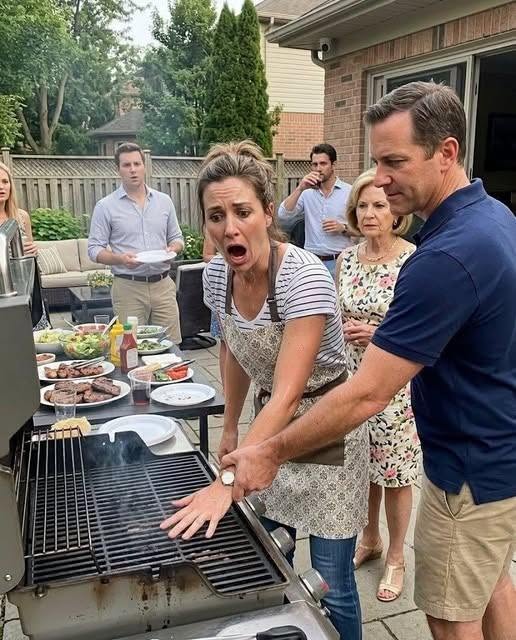
The second my palm hit the grill, every person in our backyard stopped laughing.
Not gradually.
Instantly.
One moment, I could hear patio chairs scraping over stone, ice knocking against expensive glasses, and the low comfortable laughter of people who had spent the entire afternoon pretending not to notice how my husband treated me.
The next moment, there was only my scream.
Pain ripped through my hand so violently that my knees nearly gave out.
I smelled smoke.
Burning meat.
Charcoal.
Then something sharper.
For one bright, sickening second, I saw Ivan’s face reflected in the polished steel along the front of the grill.
And what I saw there ended my marriage before either of us had said the word divorce.
He looked pleased.
Not startled.
Not horrified by what he had just done.
Not even drunk enough to seem confused.
Pleased.
His fingers were still locked around my wrist.
His mouth held that faint curve I knew too well, the one he wore whenever he believed he had successfully reminded me of my place.
He thought I would do what I had always done.
Pull my hand away.
Run inside.
Cry where no one could see me.
Put something cold over the burn.
Wrap it in a towel.
Fix my makeup if necessary.
Then come back outside before anyone needed another drink.
I would apologize for ruining the mood.
I would make some stupid joke about being clumsy.
I would reassure the guests.
I would clean the broken plate.
I would protect Ivan from the consequences of hurting me.
For ten years, that had been my role in our marriage.
He broke things.
I made sure nobody saw the damage.
That afternoon, he finally broke the part of me that had kept doing it.
I tore my hand free.
The serving table went sideways when my hip struck it.
Glasses crashed against the patio.
Someone shouted.
A large ceramic bowl filled with barbecue sauce flipped through the air and exploded against the front of my mother in law’s white summer dress.
Cynthia screamed.
Red sauce ran from her chest to her knees.
Two guests jumped backward as if they had been splashed with blood.
Someone dropped a plate.
It shattered near the pool.
Ivan stared at me.
“What the hell are you doing?”
My palm felt as though it were still pressed against the metal.
The pain came in waves.
Hot.
Then numb.
Then hot again.
I held the injured hand against my chest and looked at him.
He was waiting for fear.
Waiting for the familiar shift in me.
The lowered eyes.
The apology.
The calculation.
How angry is he?
How do I get through tonight?
What do I need to say so tomorrow will be easier?
Instead, I grabbed the metal spatula with my left hand.
Ivan’s face changed.
“What are you doing?”
I swung.
The spatula hit the control panel with a hard metallic crack.
One knob bent.
People gasped.
I hit it again.
Another knob snapped loose.
“Stop!”
Third strike.
The flames died.
Ivan stepped toward me.
A man named Raymond, one of our neighbors, moved between us.
At that point, I barely noticed.
I dropped the spatula.
Then I shoved both shoulders against the side of the grill cart.
The wheels caught on the patio stone.
I pushed again.
Everything in my body hurt.
My hand.
My shoulder.
My back.
But something had become stronger than pain.
The grill tipped.
It crashed onto the patio with a sound so enormous that someone near the pool screamed again.
Steaks slid through spilled ice.
Chicken hit the ground.
A metal tray spun twice before landing upside down.
Smoke curled around Ivan’s polished leather shoes.
His beer had fallen beside him and soaked the cuff of his pants.
He stared at the grill.
Then at me.
For the first time in years, Ivan looked at me as though I were not furniture.
Not staff.
Not the person who refilled his glass.
Not an extension of his image.
He looked at me as if I had become dangerous.
I stood in the wreckage.
My injured hand pressed against my chest.
And I smiled.
“You think this is funny?” he asked.
His voice dropped.
He always became quiet when he was truly furious.
“No.”
My voice surprised me.
It was steady.
“I think it’s finally useful.”
Ivan frowned.
He had no idea what I meant.
Neither did Cynthia.
Neither did the executives standing around the patio.
None of them knew that the ruined barbecue was not the beginning of my breakdown.
It was the first public move in a plan I had spent eighteen months quietly preparing.
Ivan thought I had finally lost control.
The truth was that I had finally decided to use the control he had forgotten I still possessed.
And that difference was about to cost him everything he believed belonged to him.
Eighteen Months Earlier
The first forged signature was almost perfect.
That was what bothered me.
If it had been sloppy, I might have assumed some junior accountant had made a mistake.
If my name had been typed instead of signed, I might have believed Ivan when he said the paperwork was routine.
But whoever signed the transfer authorization had taken time.
The angle of the R.
The slightly flattened loop in my last name.
Even the unnecessary pressure stroke I usually made when signing quickly.
Someone had practiced.
I sat at the desk in our home office and stared at the document.
One hundred eighty thousand dollars.
Transferred from an account connected to Vanguard Development into an entity I had never seen before.
The authorization line carried my name.
I had not signed it.
Ivan walked into the office while I was still staring.
“What are you doing?”
I minimized the screen.
“Bills.”
He loosened his tie.
“Again?”
“Again.”
He smiled.
“Good thing I married someone who likes spreadsheets.”
That sentence might sound harmless.
It was not.
Ivan had spent years reducing everything I had done for the company to administrative housekeeping.
Spreadsheets.
Paperwork.
Organization.
Little wife things.
When Vanguard Development first existed, we worked at a folding table in a rented office that smelled like old carpet.
There were no executives.
No company cars.
No polished headquarters.
No private golf memberships.
No magazine profiles about Ivan’s entrepreneurial vision.
There was one potential property.
One uncertain investor.
One old printer.
And money from a trust my grandmother had established for me long before I met Ivan.
That money funded the first deal.
Mine.
Not his.
Ours, I had believed at the time.
I did not hold that fact over him.
I loved him.
We were married.
What difference did it make whose money technically started the company if we were building it together?
That was how I thought at thirty.
At forty, I understood that trusting someone and giving up the ability to verify them were not the same thing.
The original operating structure gave my trust substantial voting control.
Fifty eight percent.
At the time, Ivan barely read the relevant provisions.
He cared about acquisitions.
Investors.
Negotiations.
Being the face of the company.
I cared about governance.
Liability.
Ownership protections.
The boring parts.
He used to tease me.
“One day we’ll have lawyers for this.”
“We have a lawyer.”
“A better one.”
“You hired him.”
“Exactly.”
I would laugh.
Back then, I did not mind that Ivan loved visibility.
I preferred working quietly.
He could pitch.
I could analyze.
He could charm investors.
I could identify which deals would actually survive.
We complemented each other.
At least, that was what I believed.
Then success changed the balance.
Or maybe success revealed it.
We moved out of the folding table office.
Vanguard purchased its first building.
Then another.
Then five.
Ivan appeared in business publications.
He was invited to panels.
Podcasts.
Charity events.
Golf tournaments.
His introductions became longer.
Founder.
President.
Visionary.
Industry leader.
My introductions became shorter.
His wife.
At first, I corrected people.
“Actually, I’m one of the founding owners.”
Then Ivan would laugh.
“She’s being modest. She’s the brains at home too.”
People would laugh.
The correction disappeared beneath the joke.
Eventually, I stopped correcting anyone.
That was easier.
Silence always starts as the easier option.
That is why it becomes dangerous.
The first time Ivan shouted at me in front of employees, we had been married four years.
I questioned an acquisition.
He slammed a folder onto the conference table.
“Do you ever stop second guessing me?”
The room went silent.
I answered carefully.
“I’m reviewing the debt exposure.”
“I know what you’re doing.”
“Then you know why I’m asking.”
He leaned toward me.
“You’re making me look weak.”
I stared at him.
I had thought we were discussing a building.
He thought we were discussing him.
That should have told me something.
Later, at home, he apologized.
Flowers arrived the next morning.
He said stress made him react badly.
I believed him.
Years passed.
The apologies got smaller.
The behavior got worse.
A hand gripping my arm in the garage.
A shove when I tried to leave an argument.
A threat whispered behind a closed door.
Never enough to produce the dramatic moment people imagine should immediately end a marriage.
Enough to teach me the rules.
Do not challenge Ivan in front of others.
Do not correct his stories.
Do not remind him whose money started Vanguard.
Do not question him while he is drinking.
Do not walk away when he is still talking.
Do not tell anyone.
I learned.
And every lesson made the next one easier for him to teach.
The forged signature changed something.
I did not confront him.
That was the most important decision I made.
The old version of me would have printed the transfer and walked directly into his office.
“What is this?”
Then Ivan would have answered.
He always had an answer.
Accounting error.
Routine restructuring.
Something I signed and forgot.
Something legal said was necessary.
Something I misunderstood.
He had become very good at explaining my own life back to me until I doubted what I had seen.
So I did something different.
I saved a copy.
Then another.
I began reviewing accounts Ivan believed I no longer monitored.
I pulled archived notices.
Copied emails.
Photographed documents before they disappeared.
Recorded dates.
Exact words.
Amounts.
Signatures.
Threats.
I built a private record.
At first, I thought I was collecting evidence only for myself.
I needed to know whether I was imagining the pattern.
I was not.
One suspicious transfer became four.
Then nine.
Corporate funds routed through entities with names that sounded legitimate but served purposes I could not identify.
Payments approved using my authority without my approval.
Documents containing my signature when I had never seen the pages.
Then came personal intimidation.
Ivan telling me:
“You have no idea how exposed you are if you challenge me.”
Another night:
“Nobody at Vanguard answers to you anymore.”
And my favorite:
“You gave up your place years ago.”
That sentence was the reason I reopened the trust documents.
He was wrong.
I had withdrawn from daily operations.
I had not surrendered ownership.
I still controlled fifty eight percent of the voting shares.
The structure had not changed because Ivan never believed I would use it.
Arrogance can be more useful than secrecy.
He had spent years building a kingdom on the assumption that the person with the largest legal voting interest was too embarrassed to remind anyone she existed.
For eighteen months, I let him keep believing it.
The Barbecue
Ivan announced the barbecue on Monday.
“I’m having people over Saturday.”
I looked up from my laptop.
“Having people over?”
“Company people.”
“How many?”
“Maybe twenty.”
“Twenty?”
“Could be thirty.”
I closed the laptop.
“You could have asked.”
He looked confused.
“Asked what?”
“Whether I wanted thirty people at the house.”
He smiled.
“It’s my house too.”
That sentence had become one of his favorites.
My house too.
Usually spoken immediately before making a decision that involved both of us and consulted only him.
“What’s the occasion?”
“Family celebration.”
“For what?”
He opened the refrigerator.
“Do we need an occasion?”
I knew that tone.
Conversation over.
By Friday, the guest list had grown.
Executives from Vanguard.
Raymond and his wife.
Ivan’s golf friends.
Two couples from the neighborhood.
A lender he wanted to impress.
Cynthia, of course.
Ivan selected steaks.
Wine.
Whiskey.
Imported beer.
He told me how he wanted the patio arranged.
“The white linens.”
“They’re going outside?”
“Yes.”
“They’ll get ruined.”
“They’re tablecloths.”
“They’re indoor linens.”
He looked at me.
“Why do you always make everything difficult?”
I stared.
A conversation about tablecloths had become a character flaw in under thirty seconds.
That was Ivan.
Saturday morning, he woke at nine.
I had already been awake for two hours.
I prepared salads.
Sauces.
Marinades.
Dessert.
Ice.
Drinks.
Chairs.
Tables.
At noon, the temperature was already close to ninety.
At twelve fifteen, Ivan walked outside wearing a clean shirt.
He looked around.
“Where are the extra umbrellas?”
“In the garage.”
“You didn’t put them out?”
“No.”
He sighed.
“I thought we talked about this.”
“We didn’t.”
“I definitely told you.”
He had not.
I knew that.
Eighteen months of writing everything down had changed the way I responded internally to his rewriting.
I no longer argued.
I simply knew.
“No problem,” I said.
He smiled.
“Thank you.”
That smile used to make me wonder whether I was being unfair.
Now it told me he believed he had won something.
Guests arrived.
The backyard filled.
Ivan became charming.
That transformation was always astonishing.
He could walk out of a room after calling me useless and greet another man with warmth five seconds later.
People loved him.
That was part of what made leaving difficult.
Public Ivan was funny.
Generous.
Confident.
He remembered birthdays.
He tipped excessively.
He donated to charities.
He made people feel important.
Private Ivan needed someone else to feel small so he could remain large.
That afternoon, I was the chosen person.
I moved between grill and tables.
Refilled drinks.
Carried plates.
Cleaned spills.
The heat became unbearable.
My shirt stuck to my back beneath the apron.
A grease splash hit my thumb.
A blister rose.
No one noticed.
At one point, I leaned against the counter because the backyard fence tilted slightly.
I had not eaten since breakfast.
Before I could take a bite of anything, Ivan held his empty glass toward me.
Not a word.
Just the glass.
I looked at it.
Then him.
He continued talking to a vice president about a property deal.
He did not even turn fully in my direction.
I took the glass.
Filled it.
Returned it.
That small moment humiliated me more than some of his shouting.
Not because serving someone you love is demeaning.
It is not.
Love is full of service.
Coffee.
Meals.
Small errands.
The problem was that Ivan had converted kindness into hierarchy.
He did not appreciate service.
He expected proof of obedience.
Cynthia arrived shortly after three.
White summer dress.
Pearls.
Large sunglasses.
She kissed Ivan.
Barely acknowledged me.
“You look exhausted.”
“I’ve been outside since noon.”
She glanced at the tables.
“Ivan works much harder than that every day.”
Of course.
She had been teaching him that kind of logic since birth.
A man’s work created status.
A woman’s work created obligation.
Twenty minutes later, she raised her voice.
“Do your duty as a wife.”
Several people heard.
Some laughed.
She continued.
“A successful man needs a woman who understands service.”
I looked at Ivan.
He smiled.
Lifted his glass.
The moment went through me like cold water.
Not because the words were new.
Because of the audience.
These people ran divisions of a company I helped create.
Some of them had once attended meetings where I spoke as an owner.
Now they laughed while my mother in law publicly described me as domestic staff.
And I had helped teach them that was acceptable by remaining silent.
Something inside me moved.
Not broke.
Moved.
The chicken was still undercooked when Ivan approached the grill.
“Give me one.”
“Five more minutes.”
He reached anyway.
Tore off a piece.
Chewed.
Spat it beside my shoe.
“You call this edible?”
“It isn’t finished.”
His eyes hardened.
“Always an excuse.”
I saw his hand.
Stepped back.
Too slow.
His fingers locked around my wrist.
There were people watching.
That should have protected me.
Instead, it made him crueler.
Perhaps he believed humiliating me publicly would reinforce everything he had taught them privately.
He dragged my hand toward the grill.
I resisted.
My shoes slid.
Tongs fell.
Then metal met skin.
Pain.
Scream.
Silence.
And the end of everything he thought he controlled.
After the Grill Fell
Raymond stood between us.
Ivan looked at him.
“You want to move?”
Raymond shook his head.
“No.”
“This is between me and my wife.”
Raymond looked at my hand.
“Not anymore.”
That sentence changed the backyard.
Until then, everyone had been Ivan’s guest.
Now they were witnesses.
A woman named Sheila, married to one of Vanguard’s executives, moved toward me.
“Let me see your hand.”
“I’m fine.”
“You’re not fine.”
She pulled a bottle of water from an ice bucket.
“Cold water. Not ice.”
My brain registered the practical instruction.
She must have known burns.
I let her pour water over my palm.
Pain flared.
I nearly cried out again.
Ivan watched.
Then said:
“She did this to herself.”
The entire patio seemed to turn toward him.
I looked up.
He continued.
“She jerked away. I was trying to move her.”
There it was.
Rewrite number one.
Less than two minutes after the event.
I had expected it.
That preparation mattered.
“They’re watching,” I said.
Ivan looked around.
Phones.
Faces.
Executives who had seen enough.
“You embarrassed yourself.”
I almost admired the consistency.
His violence.
My embarrassment.
His action.
My reaction.
Always the same structure.
He pointed toward the ruined patio.
“Look at this. You’ve lost control.”
I looked at the broken glasses.
The spilled food.
The grill on its side.
For the first time in ten years, I felt no urge to clean any of it.
Cynthia stood covered in barbecue sauce.
“You need to apologize.”
I turned.
“For what?”
Her mouth opened.
No immediate answer.
“For ruining the party.”
She sounded almost desperate.
A woman beside her said:
“He burned her hand.”
Cynthia’s face tightened.
“It was an accident.”
“No.”
I said it calmly.
Ivan hated calmness more than shouting.
He could dismiss shouting.
Call it hysteria.
Calmness gave him nothing.
He stepped sideways.
Raymond shifted with him.
Ivan stopped.
“You’re confused,” he told everyone. “She pulled away while I was trying to move her from the heat.”
A year earlier, I might have heard enough confidence in his voice to question myself.
Had he been moving me?
Was there some moment I misunderstood?
That is how deeply repeated manipulation can damage perception.
But eighteen months of documentation had rebuilt something.
Trust in my own memory.
I looked toward the camera above the back door.
Ivan followed my gaze.
His face changed.
The security camera had been my idea.
Months earlier, tools disappeared from the yard.
Ivan barely cared.
I installed three cameras.
Created the account.
Managed the cloud backups.
The center camera covered the entire patio.
Including the grill.
Ivan knew.
“Turn it off.”
No one spoke.
“Turn it off.”
I almost laughed.
He still thought evidence stopped existing when the camera stopped recording.
I reached into my apron.
My burned fingers closed around my phone.
Cynthia stared.
“What are you doing?”
Ivan watched my hand.
I pulled out the phone.
For a second, relief crossed his face.
He actually laughed.
A short laugh.
“Give me that.”
He expected a confrontation.
Maybe thought I had reached for something dangerous.
A phone looked harmless.
That was another mistake.
I unlocked it.
The security app opened.
Three camera feeds.
On the center screen, the backyard appeared from above.
I dragged backward.
Seconds.
Minutes.
There.
Ivan approaching.
Me at the grill.
His hand around my wrist.
My body pulling away.
Then my palm hitting the grate.
The timestamp glowed beneath the video.
One of the executives stepped closer.
“Is that live?”
“It’s already backed up.”
Ivan lunged.
Raymond raised one arm.
“Don’t touch her again.”
The patio went completely silent.
Ivan stared at him.
Raymond did not move.
Cynthia stepped forward.
“This is a private family matter.”
I looked at her.
“No.”
She blinked.
“He made it public when he invited the people whose money he manages.”
Ivan’s face tightened.
“You have no idea what you’re doing.”
That was the sentence I had been waiting for.
Because I did.
More than he knew.
I exited the camera feed.
Opened another file.
An emergency voting notice.
Prepared that morning.
Not after the burn.
Before.
Ivan saw the document.
His face changed slowly.
Confusion first.
Then recognition.
Then fear.
He read the authorization line.
Fifty eight percent controlling voting interest.
The trust.
My trust.
His voice dropped.
“You wouldn’t.”
I looked at him.
For ten years, Ivan had used those words as a prediction.
You wouldn’t leave.
You wouldn’t embarrass me.
You wouldn’t challenge me.
You wouldn’t tell anyone.
You wouldn’t use your shares.
He believed restraint was incapacity.
I tapped SEND.
Phones began vibrating.
One.
Then another.
Then six at once.
Executives looked down.
Ivan remained motionless.
A man named Gregory, Vanguard’s chief financial officer, opened the message.
His eyes moved quickly.
Then he looked at me.
“The meeting starts in ten minutes?”
“Yes.”
“Here?”
“Video conference.”
Ivan stared.
“You can’t call an emergency meeting from my backyard.”
Gregory looked at him.
Then the document.
“She can.”
Ivan turned toward him.
“Stay out of this.”
Gregory’s expression changed.
“This concerns Vanguard.”
“So?”
“So that makes it my job.”
The ruined barbecue suddenly felt irrelevant.
Ivan understood.
Finally.
The grill was not the disaster.
It was item one.
The physical violence.
Captured.
Witnessed.
Backed up.
Item two involved the transfers.
Item three the forged signatures.
Item four governance.
Item five control.
Ivan looked at me.
“What did you do?”
I smiled.
“Stopped cleaning up after you.”
His phone rang.
He glanced down.
And whatever name he saw on the screen wiped the remaining anger from his face.
He grabbed the back of a patio chair.
For one second, I thought he might actually fall.
Nobody moved.
The phone continued ringing.
Ivan stared at the screen.
Then at me.
“What did you do?”
This time his voice was barely audible.
I did not answer.
Not because I wanted theatrics.
Because the source of his fear belonged to the next part of the story, and I had already learned the value of letting a man reveal what scares him before giving him anything else.
The phone kept ringing.
Everyone could see his face.
Cynthia moved closer.
“Ivan?”
He ignored her.
Gregory looked at the screen from a distance but could not see the name.
“Are you going to answer that?”
Ivan swallowed.
The ringing stopped.
For two seconds, nothing happened.
Then it started again.
Same caller.
That frightened him more.
He looked toward the house.
Then toward the gate.
As though he had suddenly become aware of exits.
I knew that feeling.
For years, I had been the one calculating exits.
Rooms.
Doors.
Tone of voice.
Distance between Ivan and me.
Now he was doing it.
The reversal did not make me happy.
It made me clear.
There is a difference.
“Answer it,” I said.
Ivan looked at me.
“You planned this.”
“Yes.”
“How long?”
“Long enough.”
His face twisted.
“You psycho.”
Raymond shifted.
I raised my uninjured hand.
“No.”
I did not need defending from words anymore.
Ivan continued.
“You set me up.”
“No.”
“You waited until today.”
“Yes.”
“You made me do that?”
He pointed at my hand.
There it was.
Even now.
“You made yourself do that.”
“You knew people were watching.”
“So did you.”
That answer landed.
He had no place to put it.
Cynthia grabbed his arm.
“Come inside.”
“No.”
“Ivan.”
“No.”
The phone stopped ringing.
A text appeared.
I could not see it.
Ivan could.
Whatever he read drained the color from his face.
Gregory’s phone vibrated.
Then another executive’s.
Then mine.
Emergency meeting link active.
Nine minutes.
I turned toward Sheila.
“Can you help me wrap this?”
She nodded.
“Inside.”
“No.”
“You need proper treatment.”
“I know.”
“At least water.”
We moved toward an outdoor sink.
I kept the patio in view.
Ivan did not move.
He held his phone like it contained a threat.
Maybe it did.
The guests began separating into groups.
Whispers.
Executives opening documents.
Neighbors checking recordings.
The social structure of the barbecue had vanished.
Nobody cared about steaks.
Wine.
Ivan’s golf stories.
The company people were reading.
That was what I needed.
For years, Ivan had controlled information through presentation.
He spoke first.
Loudest.
Most confidently.
My strategy was the opposite.
Documents.
Dates.
Percentages.
Evidence.
Less dramatic.
More durable.
Gregory approached me.
“I need to ask you something.”
“Go ahead.”
“The transfer schedules attached to the notice.”
“What about them?”
“Are these complete?”
“No.”
His expression tightened.
“How incomplete?”
“Those are the transactions I could verify without alerting Ivan.”
Gregory looked toward him.
“Jesus.”
“I need you to remain objective.”
He stared.
“You think I’m protecting him?”
“I think everyone has been protecting him.”
Gregory looked embarrassed.
Fair.
He had heard Ivan demean me before.
Probably convinced himself marriage was complicated.
People use complexity as permission to avoid moral clarity.
“I didn’t know it was this bad.”
I looked at my hand.
“You didn’t want to know.”
That hurt him.
I could see it.
But I was finished making truths comfortable.
He nodded once.
“Fair.”
Seven minutes.
Ivan suddenly walked toward me.
Raymond blocked him again.
Ivan stopped.
“I need to speak to my wife.”
“You can speak from there,” Raymond said.
“This is ridiculous.”
“Then talk.”
Ivan looked at me.
“Privately.”
“No.”
His mouth tightened.
“Do not do this.”
I almost smiled at the phrasing.
Not don’t lie.
Not don’t falsely accuse me.
Don’t do this.
Meaning do not expose what already exists.
“You should have thought about that before today.”
“I mean the company.”
“So do I.”
“You’ll destroy Vanguard.”
That sentence struck deeper than he intended.
Because Vanguard mattered to me.
Maybe more than to him.
I remembered the first property.
The folding table.
The spreadsheets.
The nights we slept four hours because financing deadlines were approaching.
I remembered the first employee.
The first profitable quarter.
The day we signed for the headquarters.
Vanguard was part of my adult life.
Ivan knew.
He expected that love to make me protect him.
Again.
“I’m not destroying the company.”
I looked at the executives.
“I’m protecting it.”
Gregory lowered his eyes toward the transfer records.
Ivan laughed bitterly.
“From me?”
“Yes.”
The word went through him.
“You think you’re the company now?”
“No.”
“That fifty eight percent doesn’t make you capable of running it.”
“I didn’t say I was running it.”
“Then what?”
“I’m removing the person who thinks the company is his personal account.”
Silence.
Cynthia gasped.
“You ungrateful woman.”
I turned toward her.
“For what exactly should I be grateful?”
She stared.
“For everything my son gave you.”
I almost laughed.
“The company started with my trust.”
Her face changed.
She had known that.
But like Ivan, she had rewritten history until she preferred the version where her son created everything.
I continued.
“I helped write the operating structure. I built the early financial models. I negotiated the financing on the first two properties.”
People listened.
Cynthia shook her head.
“You were his wife.”
“Yes.”
“And?”
“That does not erase everything else I was.”
For the first time, those words felt completely true.
Five minutes.
Gregory looked at his phone.
“Board counsel is joining.”
Ivan froze.
There it was again.
That invisible architecture I had spent months activating.
Lawyers.
Voting rights.
Governance.
Audit authority.
He had thought power lived in his office because everyone there treated him like the most important person in the building.
Legal power lived in documents he had not read in years.
My burned palm throbbed.
I looked at it.
Blisters beginning.
Sheila said:
“You really need urgent care.”
“I will go.”
“When?”
“After the meeting.”
She frowned.
“This is serious.”
“So is this.”
I regretted the answer immediately.
My body mattered.
That had been another thing marriage taught me to postpone.
I corrected myself.
“Actually, call an ambulance.”
She nodded.
Ivan laughed once.
“There. Perfect. More drama.”
Several guests turned.
I looked at him.
“Thank you.”
He frowned.
“For what?”
“For saying that in front of everybody.”
His face tightened.
Every sentence was evidence now.
That was what he still did not understand.
When a person depends on private cruelty, publicity becomes a mirror.
Three minutes.
Sirens were not audible yet.
The emergency meeting link appeared on the screen.
I joined.
Several board members connected remotely.
Some from offices.
One from a golf club.
Another from what looked like an airport lounge.
Nobody smiled.
Gregory joined beside me.
Two executives moved chairs around one of the patio tables still standing.
Ivan stared.
“You’re doing this here?”
“Yes.”
“In front of guests?”
“You made them witnesses.”
He looked as though he wanted to break something.
The camera above the door remained visible.
He noticed it too.
That kept his hands at his sides.
The board chair appeared on screen.
“Can everyone hear me?”
“Yes.”
Ivan stepped closer.
“This meeting is unauthorized.”
Board counsel answered immediately.
“It is authorized under the voting provisions circulated with the notice.”
Ivan looked at me.
“Who gave you access to those?”
I stared.
“They’re mine.”
The board chair continued.
“We’ve received documentation alleging unauthorized transfers, misuse of signature authority, governance breaches, and conduct raising immediate risk concerns.”
Conduct.
The word felt sterile compared to what happened.
But sterile language has advantages.
It survives emotion.
Ivan interrupted.
“This is a domestic dispute.”
Board counsel said:
“Allegations involving corporate transfers are not a domestic dispute.”
Gregory added:
“I’ve reviewed the first schedule.”
Ivan turned.
“You work for me.”
Gregory’s face hardened.
“I work for Vanguard.”
That sentence might have been the first crack in Ivan’s corporate world.
He looked around.
Executive after executive avoided his eyes.
Not because they had all suddenly become brave.
Because the balance of power had changed.
People discover principles quickly when incentives change.
I knew that.
I was not romantic about what was happening.
Some of them had laughed fifteen minutes earlier.
Now they studied evidence.
I did not need them to become heroes.
I needed them to follow governance.
The board chair asked:
“Rebecca, can you describe why this meeting was called today rather than earlier?”
I looked toward Ivan.
He stared back.
I held my hand where the camera on the phone could see the burn.
“Because today my husband physically forced my hand onto a grill in front of company executives after eighteen months of escalating threats and financial irregularities.”
The board went silent.
Ivan shouted:
“She’s insane!”
Board counsel responded:
“Please do not interrupt.”
“You’re going to believe this?”
“There is video.”
Ivan looked at the security camera.
The board chair asked:
“Is the video preserved?”
“Yes.”
“Third party backup?”
“Yes.”
“Witnesses?”
I looked around.
Raymond raised his hand slightly.
Gregory spoke.
“Multiple.”
Ivan swore.
His mother started crying.
Not for me.
For him.
“Ivan has worked his whole life for this.”
I looked at her.
So had I.
She never saw it.
Or refused to.
The board chair continued.
“We will address personal conduct separately from the financial allegations.”
Ivan paced.
“You can’t remove me.”
Nobody answered immediately.
He looked at me.
“You hear me?”
I did.
I had heard variations for years.
You can’t.
You won’t.
You need me.
Nobody believes you.
I had spent eighteen months replacing each statement with documents.
I opened the trust instrument.
Shared the relevant page.
Fifty eight percent.
Voting rights.
Emergency authority.
Ivan stared at the screen.
“You did all this behind my back.”
“Yes.”
“While living in my house?”
“Our house.”
He laughed bitterly.
“Now you care about ownership?”
I looked at him.
“No. Now I care about accuracy.”
Sirens became audible in the distance.
Cynthia looked toward the street.
“What did you do?”
“I asked for medical help.”
“Police?”
“I didn’t say police.”
She looked frightened anyway.
Interesting.
The board meeting continued.
Questions about transfers.
One entity.
Then another.
Gregory confirmed he had not approved several.
An outside audit request.
Temporary suspension of certain executive authorities.
Preservation of records.
No destruction.
No deletion.
No removal of devices.
Ivan’s face changed at that one.
I saw it.
So did Gregory.
“Why did you react?” he asked.
Ivan snapped:
“I didn’t.”
“You did.”
“Don’t start.”
Gregory looked at me.
Then back.
“I want IT access controls implemented immediately.”
Board counsel agreed.
Ivan grabbed his phone.
I said:
“What are you doing?”
“None of your business.”
Board counsel spoke through the screen.
“Mr. Petrov, do not alter or delete company records.”
Ivan froze.
Everyone heard.
He looked around.
The backyard had become a courtroom without a judge.
Not legally.
Socially.
Every movement mattered.
The ambulance arrived.
Two paramedics entered through the side gate.
They saw the grill.
My hand.
The crowd.
One asked:
“Who is the patient?”
“I am.”
He approached.
“What happened?”
Ivan said:
“Accident.”
I answered:
“My husband forced my palm onto the grill.”
The paramedic looked at him.
Then at me.
“Do you feel safe remaining here?”
That question almost made me cry.
Simple.
Direct.
No need to prove the whole marriage.
Just:
Are you safe?
“No.”
Ivan stared.
The paramedic nodded.
“We can transport you.”
“I need two minutes.”
He looked at my hand.
“One.”
Fair.
I turned toward the board call.
“I authorize the temporary measures described in the notice.”
Ivan shouted:
“You walk away from this screen and I’ll challenge every vote.”
Board counsel said:
“You are entitled to challenge through proper procedure.”
Not threat.
Procedure.
Ivan hated procedure when he did not control it.
I looked at Gregory.
“Preserve everything.”
He nodded.
“Everything.”
The paramedic wrapped my hand carefully.
Pain shot up my arm.
I finally let myself react.
My knees weakened.
Sheila supported my elbow.
“You okay?”
“No.”
That answer felt good.
No performance.
No pretending.
No, I am not okay.
And I do not need to be.
As they led me toward the gate, Ivan called my name.
I turned.
For one second, I saw the man I had married.
Not the public executive.
Not the abuser.
Just Ivan.
Scared.
Confused.
Angry.
Maybe realizing that the person he relied on to absorb consequences had finally stopped.
“You’re really doing this?”
“Yes.”
“What happens to us?”
That question surprised me.
Us.
He had remembered the word.
Too late.
“I don’t know.”
“You planned the company part.”
“Yes.”
“The marriage?”
I looked at my injured hand.
“No.”
That was true.
I had prepared financially.
Legally.
Documented.
But some part of me still resisted naming the end.
Until the grill.
Then I knew.
“I do now.”
His face changed.
Cynthia began saying something.
I stopped listening.
The paramedics guided me through the gate.
Behind us, the emergency meeting continued.
For the first time since Vanguard became successful, Ivan was not the most powerful person in the conversation.
For the first time in my marriage, I did not stay to manage his reaction.
The ambulance doors closed.
And only then did I start shaking.
In the Ambulance
Adrenaline had hidden part of the pain.
Once I sat on the stretcher, it arrived fully.
My palm burned.
Every heartbeat seemed to land directly in the injury.
The paramedic asked:
“Any other injuries?”
“No.”
Then I thought.
Old bruises.
Old grips.
Old shoves.
He meant today.
“No.”
“Did he hit you anywhere else?”
“Not today.”
The paramedic looked up.
Not today.
Two words.
Enough.
“Has this happened before?”
I stared at the ceiling.
“Not like this.”
He nodded.
Did not force me.
“Would you like law enforcement contacted?”
I hesitated.
That hesitation embarrassed me.
After everything.
Still hesitation.
Years of conditioning do not disappear because you overturn one grill.
“Yes.”
The word came quietly.
“Yes, I would.”
He made the call.
I looked at my phone.
Messages everywhere.
Board members.
Executives.
Friends.
Neighbors.
Unknown numbers.
Ivan.
Cynthia.
Ivan again.
I turned the device face down.
Another vibration.
I ignored it.
For once, other people could wait.
At the hospital, they treated the burn.
The doctor explained depth.
Healing.
Pain management.
Follow up.
Possible scarring.
I stared at my palm.
Scarring.
For years, Ivan’s behavior had left marks no one could see.
This one might remain visible.
The idea did not upset me as much as I expected.
A police officer arrived.
She introduced herself.
Asked if I felt safe speaking.
“Yes.”
She asked me to describe what happened.
I did.
No embellishment.
No character analysis.
Chicken.
Argument.
Wrist.
Grill.
Pain.
Witnesses.
Camera.
She asked:
“Was the contact intentional?”
“Yes.”
“How do you know?”
“He held my wrist while I resisted and forced my palm down.”
“Any prior incidents?”
There it was.
The larger doorway.
I opened it.
“Yes.”
“How many?”
“I don’t know.”
She waited.
I continued.
“Grabbing. Shoving. Threats.”
“Medical treatment previously?”
“No.”
“Reports?”
“No.”
“Photographs?”
“Yes.”
Her eyes lifted.
“How many?”
“A lot.”
That was the moment I understood the value of those eighteen months beyond Vanguard.
I had documented the marriage too.
Not systematically at first.
But enough.
The officer asked if I wanted to provide copies.
“Yes.”
No hesitation this time.
While we spoke, the board meeting continued without me.
I received an update from counsel.
Temporary restrictions approved.
Independent forensic audit authorized.
Ivan’s access to certain systems suspended pending review.
Devices preservation notice.
Emergency governance session scheduled for Monday.
Not victory.
Process.
That distinction mattered.
I did not want revenge disguised as corporate governance.
I wanted the company protected.
If evidence cleared Ivan, procedures would show it.
I knew what I had seen.
I also knew institutions needed more than certainty in my own mind.
That was why I collected records.
Evidence lets truth survive outside the person telling it.
The security video did that for the grill.
The financial records would do it for Vanguard.
The Call at the Barbecue
Later that night, while I sat alone in a hospital room, I thought about the phone call that had made Ivan grab the patio chair.
I still did not know every detail behind his reaction.
The source of his fear had not yet fully revealed itself to me.
I knew only that the name on his screen had mattered.
Enough to drain his face.
Enough to make him stop shouting.
Enough to make a man who had spent the afternoon performing control suddenly look for somewhere to hold himself upright.
I could have asked.
Part of me wanted to.
But I had spent years rushing to understand Ivan.
What does he mean?
Why is he angry?
Who upset him?
How do I fix it?
That night I allowed myself something new.
Not knowing.
Whatever that call meant belonged to him.
The things I already knew belonged to me.
My injury.
The video.
The shares.
The transfers.
The signatures.
The meeting.
The rest could wait.
That was another kind of freedom.
The House Without Me
I did not go home.
That decision surprised Ivan more than the board vote.
He texted:
COME HOME SO WE CAN TALK.
Then:
YOU’RE MAKING THIS WORSE.
Then:
MY MOTHER IS HYSTERICAL.
Then:
AT LEAST TELL ME WHERE YOU ARE.
Then:
YOU CANNOT JUST DISAPPEAR.
I read them once.
Then handed my phone to my attorney.
Yes.
My attorney.
I had hired her four months earlier.
Her name was Naomi Chen.
Ivan knew her socially.
He did not know she represented me.
When she entered my hospital room, she looked at the dressing on my hand.
“I’m sorry.”
“Don’t be.”
“That is a serious injury.”
“I know.”
“You still want to proceed?”
“Yes.”
“With everything?”
I thought about our house.
Marriage.
Company.
Cynthia.
Ten years.
“Yes.”
Naomi opened her folder.
Then we began.
I had learned something from Ivan.
Timing matters.
He used timing to overwhelm.
I would use it to protect evidence.
The corporate steps were already active.
Now personal ones.
Protective measures.
Financial separation.
Document preservation.
Divorce preparation.
Access to the house handled safely.
I listened.
Signed.
Asked questions.
For once, legal documents did not feel like weapons aimed at me.
They felt like doors.
Naomi looked at me after the last signature.
“You realize there will be backlash.”
“I know.”
“He will say you planned to destroy him.”
“I planned to protect myself.”
“Keep saying exactly that.”
“I will.”
“And do not speak to him alone.”
That instruction hit harder than I expected.
My husband.
Do not speak to him alone.
A sentence I should have needed years earlier.
I nodded.
Cynthia’s Version
Cynthia called me the next morning.
I almost ignored it.
Then decided to answer with Naomi listening.
“Where are you?”
No hello.
“I’m safe.”
“You need to come home.”
“No.”
“Ivan is devastated.”
I looked at the bandages.
“He burned my hand.”
“It was an accident.”
“You watched it.”
“I watched you lose control and destroy his property.”
There it was.
Of course.
“Cynthia.”
“You humiliated him in front of the company.”
“He injured me in front of the company.”
“You always have to make yourself the victim.”
I closed my eyes.
Not from pain.
From recognition.
This was the system Ivan came from.
He had not invented all of it himself.
His mother had taught him that harm mattered less than reputation.
That women served.
That men were protected from consequences.
That the real offense was public exposure.
“Do not contact me again unless it concerns logistics through counsel.”
She went silent.
“Counsel?”
“Yes.”
“What have you done?”
Again.
Not what did Ivan do.
What have you done?
“I’m ending this.”
“Your marriage?”
“Yes.”
“You’ll regret it.”
Maybe.
People regret things.
Leaving can hurt even when necessary.
But regret is not the same as mistake.
“I’ll live with that.”
I ended the call.
My hand shook afterward.
Boundaries sound powerful in stories.
In real life, they can make your entire body tremble.
I still kept the boundary.
Monday at Vanguard
I attended the emergency board session remotely.
My hand remained wrapped.
Ivan appeared from a conference room.
He wore a dark suit.
Perfect tie.
Professional expression.
Public Ivan.
I almost admired the speed of the transformation.
He had probably slept two hours.
Yet there he was, polished.
Prepared.
His lawyer beside him.
Mine beside me.
Board counsel opened.
The forensic audit had begun.
Preliminary review confirmed irregularities serious enough to maintain restrictions.
Ivan denied wrongdoing.
He described the transfers as ordinary strategic movements.
He denied forging signatures.
He called the barbecue incident “a painful marital misunderstanding.”
I looked at the video window.
Painful marital misunderstanding.
My attorney touched my arm lightly.
Do not react.
I did not.
Evidence would speak.
Ivan continued.
He said I had been emotionally unstable.
Jealous of his success.
Resentful that he had become the public leader of Vanguard.
He suggested my emergency board action was retaliation following a domestic argument.
That one was clever.
Not convincing.
Clever.
He had always been better when prepared.
Then Gregory spoke.
“I need to clarify something.”
The board chair nodded.
Gregory said:
“Rebecca’s financial concerns were submitted with documentation predating Saturday by more than a year.”
Silence.
Ivan looked at him.
Gregory continued.
“The records cannot reasonably be characterized as a reaction to the barbecue.”
That was why dates mattered.
Documentation matters because manipulation often depends on making history flexible.
My timeline was not flexible.
Ivan’s attorney shifted.
The board chair asked:
“Does the majority voting interest remain valid?”
Counsel confirmed.
Yes.
Fifty eight percent.
Ivan looked at me through the screen.
For ten years, he had told himself I was irrelevant.
The percentage had never changed.
Only his awareness of it.
The board maintained his suspension of certain authority pending the audit.
He did not lose everything that day.
That would have been unrealistic.
Corporate structures are slower than revenge fantasies.
There were procedures.
Reviews.
Legal arguments.
But his absolute control ended.
That was enough.
The House
I returned to the house two weeks later.
Not alone.
Naomi arranged it.
A friend came.
So did someone authorized to ensure the interaction remained safe.
Ivan was not there.
Cynthia had moved temporarily.
The backyard looked strange.
The ruined grill had been removed.
Patio cleaned.
New tablecloth.
No trace of barbecue sauce.
If I had arrived without memory, nothing would have told me what happened there.
That disturbed me.
Violence can disappear from a place faster than from a body.
The security camera remained above the back door.
I looked at it.
Then at my bandaged hand.
The house was quiet.
I went upstairs.
Packed clothes.
Documents.
Personal items.
Photographs.
I stopped in our bedroom.
Our wedding photo sat on the dresser.
Ivan and me.
Younger.
Laughing.
I picked it up.
For a moment, grief hit.
Real grief.
Not because I wanted the present marriage back.
Because the people in that photograph once believed something.
At least I had.
Maybe Ivan did too.
People become uncomfortable with the idea that an abusive marriage can contain real love at some point.
It complicates the story.
But reality is complicated.
Ivan was not cruel every minute.
If he had been, I might have left sooner.
There were vacations.
Jokes.
Illnesses where he took care of me.
The night my father died, Ivan held me until morning.
Those memories existed.
So did the grill.
One did not erase the other.
The question was not whether Ivan had ever loved me.
The question was whether love made the present safe.
It did not.
I left the photograph.
Took the documents.
Walked downstairs.
In the kitchen, I saw a note.
Rebecca.
I almost did not open it.
Then I did.
Ivan had written:
I know you think I’m a monster right now. I’m not. I made one terrible mistake and you are using it to erase ten years. I love you. I built everything for us. Please stop before there’s nothing left to save.
I read it twice.
One terrible mistake.
Again.
Reduction.
A decade of threats became one mistake.
Forged signatures disappeared.
Transfers disappeared.
The video became a moment.
He built everything.
Us.
All the old language.
I folded the note.
Left it on the counter.
For the first time, I did not answer.
The Audit
The financial investigation took months.
That surprised people who expected one dramatic discovery.
Real financial misconduct is tedious.
Invoices.
Entities.
Authorizations.
Emails.
Metadata.
Bank records.
Passwords.
Approval chains.
Forensic accountants working through thousands of pages.
The truth accumulated.
Some transfers were explainable.
Others were not.
That mattered to me.
I did not need every suspicious thing to become criminal.
I needed accuracy.
The forged signatures were particularly serious.
Independent review confirmed multiple authorizations bearing my name had not been executed by me.
Ivan denied personal involvement.
The investigation followed the chain.
I will not pretend every answer arrived immediately.
Some never arrived cleanly.
But enough did.
The board gradually understood the problem was larger than a marriage.
Whatever happened legally after that belonged to lawyers, investigators, corporate governance and evidence.
My role was simpler.
Tell the truth.
Provide records.
Stop protecting Ivan.
That was harder than it sounds.
Old habits returned constantly.
When someone asked whether Ivan had threatened me before, my first instinct was:
He was stressed.
Then I corrected:
Yes.
When someone asked whether Cynthia had witnessed controlling behavior:
She didn’t understand.
Correction:
Yes.
When asked whether I felt afraid in my own home:
Not all the time.
Correction:
Yes.
Abuse teaches you to answer questions in ways that protect the person hurting you.
Recovery teaches you to answer accurately.
The Burn
My hand healed slowly.
The scar remained.
Not dramatic.
A pale irregular area across the palm and near the base of my thumb.
Physical therapy helped.
For weeks, gripping objects hurt.
Opening jars.
Holding a pen.
Turning a doorknob.
Every small limitation reminded me of Ivan.
I hated that.
Then one day my therapist said:
“You keep saying the scar belongs to him.”
I looked at her.
“He caused it.”
“Yes.”
“So?”
“So the injury came from him. The healing is yours.”
I almost rolled my eyes.
It sounded like something printed on a motivational card.
Then I went home.
Looked at my hand.
She was right.
Ivan caused the wound.
He did not own everything that followed.
The doctor’s care.
My exercises.
Skin healing.
Strength returning.
Those belonged to my body.
Not him.
Eventually, I stopped hiding the scar.
The Guests
Months after the barbecue, Sheila invited me to coffee.
I almost said no.
She had been there.
So had her husband.
She had watched Cynthia humiliate me before Ivan burned my hand.
Part of me resented everyone.
Fairly or not.
We met.
She looked nervous.
“I owe you an apology.”
I waited.
“I saw things.”
“What things?”
“Ivan speaking to you.”
“Everyone saw that.”
“I know.”
She looked down.
“I told myself it wasn’t my business.”
There it was.
The sentence that protects countless harmful situations.
Not my business.
“I laughed that afternoon.”
“At Cynthia.”
“Yes.”
“Why?”
“Because everyone else did.”
I said nothing.
She looked ashamed.
“I knew it wasn’t funny.”
That honesty mattered.
“I should have said something.”
“Yes.”
Her eyes filled.
I could have softened it.
Said you couldn’t have known.
Maybe she could not have known everything.
But she knew enough to be uncomfortable.
“Yes,” I repeated. “You should have.”
She nodded.
“Raymond told me the same thing.”
We sat quietly.
Then I said:
“You did help afterward.”
“That doesn’t erase before.”
“No.”
Another uncomfortable truth.
Humans want clean categories.
Good witness.
Bad witness.
Brave.
Coward.
Sometimes people fail first and act later.
The later action still matters.
So does the failure.
I did not need to choose only one.
Cynthia
Cynthia never really apologized.
Not in the way I wanted.
Months later, she sent a letter.
She wrote that she regretted “how everything unfolded.”
Not Ivan’s violence.
Everything.
She regretted “harsh words on all sides.”
All sides.
She hoped one day I would “remember the family we had been.”
I put the letter away.
No response.
Forgiveness, if it came, did not require reopening contact.
That was another lesson.
Some apologies are designed to restore access rather than acknowledge harm.
I no longer confused the two.
Ivan
The last meaningful conversation I had with Ivan happened nearly a year after the barbecue.
Lawyers had handled almost everything.
We met in a conference room.
Neutral location.
Counsel nearby.
He looked older.
Not dramatically.
Just tired.
For the first few minutes, we discussed practical matters.
Property.
Accounts.
Documents.
Then he said:
“Do you hate me?”
I was not prepared.
“No.”
He looked almost disappointed.
“Nothing?”
“I didn’t say nothing.”
“Then what?”
I thought.
“I believe you became someone who thought love meant I should absorb everything you did.”
His jaw tightened.
“I made mistakes.”
“Yes.”
“You made mistakes too.”
“Yes.”
He seemed surprised by that answer.
I continued.
“I stayed silent too long.”
“That isn’t what I meant.”
“I know.”
He looked away.
“You destroyed my career.”
There it was.
I shook my head.
“No.”
“You called that meeting.”
“Yes.”
“You released documents.”
“I provided records.”
“You got the board involved.”
“Yes.”
“You turned people against me.”
“No.”
He stared.
“You keep doing that.”
“What?”
“Acting like you had nothing to do with what happened.”
I looked at him.
“I had everything to do with exposing it.”
He leaned forward.
“Exactly.”
“But I didn’t create it.”
Silence.
“That’s the difference you still refuse to understand.”
He sat back.
For a few seconds, he looked like the younger Ivan.
The one from the folding table office.
“I thought we were partners.”
“So did I.”
That hurt us both.
He looked down.
“When did you stop loving me?”
I had asked myself the same question.
Maybe love did not switch off.
Maybe trust died first.
Then safety.
Then respect.
Love became irrelevant after that.
“I don’t know.”
He nodded.
No dramatic ending.
No confession.
No final revenge speech.
Just two people in a conference room who had built something together and then destroyed enough of each other that sitting across a table was the safest form their relationship could take.
When I left, I did not look back.
Vanguard
Vanguard survived.
That mattered to me.
I did not take pleasure in employees worrying about jobs.
I did not want good projects destroyed because Ivan and I had failed personally.
The governance structure changed.
Financial controls tightened.
Independent oversight increased.
No single executive held unchecked practical authority.
My role changed too.
I did not become Ivan in a different suit.
I had no interest in walking into headquarters and demanding everyone call me the real founder.
Visibility was never the goal.
Accountability was.
I participated where my ownership required.
Supported professional leadership.
Made sure the structure could survive personalities.
That was the lesson.
Companies should not depend on one charismatic person.
Neither should families.
The Barbecue Video
I watched the security video exactly twice.
The first time with police.
The second with my attorney.
Never again.
I did not need to.
What surprised me most was not the moment my hand hit the grill.
It was everything before.
Seeing myself move through the party.
Carrying trays.
Refilling Ivan’s drink.
Guests handing me plates.
Cynthia watching.
Ivan sitting.
I looked exhausted.
Smaller than I remembered.
Not physically.
In posture.
Shoulders slightly forward.
Head lowered.
Constant movement.
Then Cynthia’s comment.
Laughter.
Then Ivan.
Wrist.
Grill.
Scream.
After that, another woman appeared.
Me.
The one who picked up the spatula.
The one who shoved over the grill.
When I first saw the footage, I thought:
She looks crazy.
Then I corrected myself.
She looks done.
Important distinction.
People love judging the moment someone reacts.
The broken object.
The raised voice.
The overturned table.
They rarely watch the years before.
Context does not make every reaction wise.
It does make reactions understandable.
I would not advise someone to smash a grill.
I could have hurt myself worse.
Someone else could have been injured.
But I refuse to let Ivan use my reaction to erase his action.
That was his favorite trick.
It no longer worked.
A Year Later
One year after the barbecue, I hosted four people in my backyard.
Not thirty.
Four.
No executives.
No golf partners.
No corporate performance.
Sheila came.
Raymond and his wife.
Naomi.
I bought a new grill.
Smaller.
Nothing expensive.
Raymond looked at it.
“You sure?”
I laughed.
“Yes.”
“I’ll cook.”
“No.”
He raised both hands.
“Okay.”
I stood at the grill.
For a second, the heat against my palm triggered memory.
My body tightened.
I stepped back.
Breathed.
Naomi noticed.
Did not comment.
I returned.
Turned vegetables.
Then chicken.
Everyone served themselves.
Nobody held an empty glass toward me.
Nobody told me my duty.
Nobody spat food near my shoe.
The meal was imperfect.
One chicken breast slightly dry.
Nobody cared.
We sat.
Ate.
Talked.
At one point, I looked toward the security camera.
Still there.
Different account.
Same angle.
I smiled.
Not because I was afraid.
Because the camera had become ordinary again.
An object.
Not a witness waiting for disaster.
That felt like healing.
What Ivan Thought He Owned
The hardest thing for me to understand afterward was how ownership had shaped our marriage.
Ivan owned his clothes.
Car.
Shares.
Office.
That was normal.
But somewhere along the way, he began thinking in a broader way.
My labor belonged to the household.
My time belonged to him.
My silence belonged to the marriage.
My money had become “our beginning,” while his success became “his achievement.”
My ownership stake became an irrelevant technicality.
My pain became inconvenient.
My body became something he could physically reposition.
That is what happened at the grill.
The action was extreme.
The belief beneath it was old.
I said move.
Therefore you move.
I am angry.
Therefore your body becomes part of the lesson.
The moment I stopped participating in that belief system, everything collapsed quickly.
Not because one barbecue changed ten years.
Because ten years had already built the pressure.
The barbecue simply made concealment impossible.
Why I Smiled
People who saw the video sometimes asked why I smiled after knocking over the grill.
They assumed shock.
Maybe partly.
But I remember exactly what I felt.
Relief.
Not joy.
Relief.
The secret had become visible.
For years, I feared public exposure.
What would people think if they knew Ivan treated me badly?
Would they judge me for staying?
Would executives lose respect?
Would friends pity me?
Would Cynthia attack me?
That fear helped imprison me.
Then the worst thing happened in public.
And instead of dying from humiliation, I felt free.
Everyone knew.
No more performance.
The marriage was already broken on the patio.
The grill simply matched it.
That is why I smiled.
I did not have to hide anymore.
What I Destroyed Next
Ivan thought the grill was the first thing I destroyed.
It was not.
And despite what he later said, I did not spend the following months destroying his life.
What I destroyed was the structure that protected his behavior.
Silence.
Secrecy.
Automatic obedience.
Unchecked corporate control.
The assumption that being his wife meant I would place his reputation above my safety.
The belief that he could rewrite events faster than I could preserve them.
The belief that legal ownership did not matter because he was more visible.
The belief that witnesses would always choose comfort.
The belief that I would always clean up.
Those things disappeared.
Some quickly.
Some slowly.
That was what frightened him.
Not the grill.
Not even the fifty eight percent.
He lost the version of me that made his life easy.
Years Later
The scar is still visible if you know where to look.
A pale patch across my palm.
Sometimes people notice.
“What happened?”
I choose the answer depending on who asks.
“Burn.”
Enough.
Close friends know.
I do not tell the story constantly.
Trauma can become another identity if you let every introduction lead back to it.
I am more than the woman whose husband burned her hand.
I am also the woman who funded a company.
Built financial models.
Survived a marriage.
Reclaimed control.
Made mistakes.
Stayed too long.
Left.
Healed.
Sometimes I think about that phone call Ivan received.
The name that made him grab the chair.
People always want that part.
“Who called?”
“What did they say?”
“What happened next?”
I understand.
Cliffhangers are satisfying when resolved.
But the thing I remember is not the name.
It is his face.
For years, Ivan believed fear belonged to me.
That afternoon, for the first time, I watched uncertainty enter him.
Not because I threatened him.
Because consequences existed beyond his control.
The board.
The records.
The witnesses.
The security footage.
The legal documents.
The trust.
All things he had ignored because he thought charisma outranked structure.
That was the real caller.
Consequences.
The specific name on the screen mattered less than the world that had finally reached him.
The Lesson About Silence
Silence is complicated.
People told me afterward:
“You should have spoken sooner.”
Maybe.
They were not entirely wrong.
But I also refuse to treat the earlier version of myself with contempt.
She survived in the way she knew how.
She watched.
Learned.
Saved.
Prepared.
Her silence eventually became strategic.
That mattered.
There is a difference between surrender and waiting.
Ivan never learned it.
He assumed if I did not fight publicly, I had no fight in me.
He assumed if I served dinner, I accepted the hierarchy.
He assumed if I let him speak at meetings, I had forgotten governance.
He assumed if I stayed married, I would stay forever.
Every assumption made him careless.
Sometimes abusive people become most vulnerable when they believe the other person has completely surrendered.
That is not advice to remain in danger.
If you can leave safely, leave.
But my own reality was that I needed time.
Financial records.
Legal clarity.
Support.
Documentation.
A plan.
I used the time I had.
Then the moment arrived when hiding the truth became more dangerous than exposing it.
The grill decided the timing.
Not me.
Once he put my hand on it, there was no private marriage left to protect.
If I Could Speak to Cynthia
I sometimes imagine Cynthia still believes I ruined her son.
Maybe she does.
I no longer need to know.
If I could answer her one final time, I would return to the sentence she said before the barbecue exploded.
“Do your duty as a wife.”
I would tell her:
I did.
Just not the duty you meant.
A wife is not required to protect violence.
A wife is not obligated to disappear behind a husband’s success.
A wife does not owe silence in exchange for status.
A wife does not become household staff because a man earns money.
And marriage does not convert another person’s body into property.
My duty was not to Ivan’s ego.
My first duty was to remain a person.
I forgot that for years.
I remember now.
The Company Photograph
A few years after everything, Vanguard redesigned part of its headquarters.
Someone found an old photograph.
The first office.
Folding table.
Cheap chairs.
Ivan and me standing beside a model of the first property.
I was holding a calculator.
He had one arm around me.
Both of us looked exhausted.
Young.
Hopeful.
The communications team asked whether they could display it as part of company history.
I stared for a long time.
My first reaction was no.
Then I changed my mind.
“Yes.”
They asked whether I wanted Ivan cropped out.
I almost laughed.
“No.”
Why rewrite history?
He was there.
So was I.
That was the point.
The photograph belonged to the truth.
We built something together.
Then he began erasing me.
Later, I stopped allowing it.
The end does not require pretending the beginning never happened.
Complexity is allowed.
Final Night in the Old House
Before the house was eventually sold, I visited one final time.
Alone, but with people knowing exactly where I was.
That mattered.
The rooms were mostly empty.
My footsteps echoed.
I walked through the kitchen.
Dining room.
Office.
Then outside.
The patio stones had been cleaned long ago.
No stain.
No broken glass.
No sauce.
No grill.
I stood in the exact place where it happened.
My hand felt warm even though the day was cool.
Memory lives in the body.
I looked toward the camera.
Then toward the spot where Ivan had sat with a beer while I worked.
I thought I would feel anger.
Instead, I felt sadness.
Not for him exactly.
For time.
Ten years.
For the woman who spent so much of it making herself smaller.
I wanted to tell her:
You are allowed to take up space.
You are allowed to correct the story.
You are allowed to own what is yours.
You are allowed to stop serving people who confuse service with submission.
You are allowed to leave before they understand why.
Then I thought about the moment after the burn.
The spatula.
The grill falling.
My smile.
Maybe she already knew.
She just needed one final reason to stop protecting everyone else from the truth.
I left through the back gate.
Closed it.
Did not look back.
What I Know Now
I know success can hide cruelty.
I know charming people can still be dangerous in private.
I know witnesses often notice more than they admit.
I know money and visibility are not the same thing as ownership.
I know documentation matters.
I know fear distorts memory.
I know evidence can restore it.
I know a person can stay too long and still deserve safety when they finally leave.
I know breaking silence can look messy.
I know consequences are not revenge simply because the person facing them dislikes them.
I know love without respect becomes something else.
I know the person who performs the most powerfully in public is not always the person with the most actual power.
And I know that if someone forces your hand onto a hot grill and then complains about the scene you caused afterward, the real problem is not your reaction.
The Barbecue I Remember
Sometimes, when I cannot sleep, the memory returns in fragments.
Cynthia’s white dress.
Ivan’s empty glass.
The chicken.
The tongs falling.
His hand.
Heat.
My scream.
Sauce flying through the air.
The spatula.
Metal breaking.
The grill crashing.
Raymond stepping between us.
The security camera.
My phone.
The board notice.
SEND.
Phones vibrating.
Ivan’s face.
Then his phone ringing.
The name on the screen.
His hand gripping the chair.
People think that was the moment the balance changed.
It was not.
The balance had changed months earlier.
The moment I stopped confronting him and started documenting.
The moment I reopened the trust agreement.
The moment I realized fifty eight percent still meant fifty eight percent whether Ivan respected it or not.
The moment I hired Naomi.
The moment I stopped confusing preparation with betrayal.
The barbecue simply allowed everyone else to see what had already happened privately.
Ivan had lost control of me long before he knew.
That is why he was so shocked when I finally used it.
The Most Important Thing
The most important thing I destroyed after the grill was not Ivan’s career.
Not his reputation.
Not our marriage.
Those were outcomes of choices much larger than one afternoon.
The thing I destroyed was his certainty.
His certainty that I would always absorb the damage.
His certainty that witnesses would remain silent.
His certainty that the company belonged to whoever talked about it most.
His certainty that paperwork did not matter.
His certainty that my quietness meant weakness.
His certainty that being my husband gave him final authority over my decisions.
Once that certainty disappeared, the rest of the structure could finally be examined honestly.
Maybe that is why the moment still feels so clear.
I stood beside the overturned grill with a burned hand.
Ivan believed I had lost my mind.
Cynthia believed I had humiliated the family.
The executives believed they had walked into an awkward barbecue and suddenly found themselves inside a corporate emergency.
Everyone thought something had just begun.
For me, something had ended.
The ten years of explaining.
Covering.
Cleaning.
Serving.
Apologizing.
Waiting for Ivan to become the man I remembered.
That woman was finished.
I reached into my apron.
Pulled out my phone.
Opened the recording.
Opened the notice.
Pressed SEND.
And when Ivan’s phone rang and he looked at the name on the screen, he finally understood one thing.
I was no longer asking him for permission.
Not to speak.
Not to leave.
Not to vote.
Not to protect myself.
Not to tell the truth.
He looked at me as though I had become a stranger.
Maybe I had.
Or maybe I had finally become recognizable to myself again.
Either way, when his phone rang the second time and his face went pale, I did not rush toward him.
I did not ask whether he was okay.
I did not explain anything.
I stood there with my injured hand against my chest while the entire backyard watched him.
For ten years, I had been the person who cleaned up whatever Ivan broke.
That afternoon, I stopped.
And once I did, everyone could finally see how much damage had been there all along.








