My Father Told Me to Walk Myself Down the Aisle Because I Was Marrying a Nobody, Then 30 Veterans Entered and Exposed the Secret He Buried for 22 Years
PART2
Politicians.
Veterans.
Celebrities.
The local press called him “one of Charleston’s great civic philanthropists.”
Dad framed that article.
He hung it outside his office.
My mother polished the frame.
And none of us questioned anything.
Why would we?
The Valor Trust was the best part of him.
Or so I believed.
Julian questioned it.
Quietly.
Not at first.
For most of our relationship, he barely spoke about my father’s charity.
He knew Dad disliked him.
He refused to return the hatred.
“Your father worked hard,” he once said.
“That’s generous.”
“It’s true.”
“He called you a professional loser.”
Julian smiled.
“That one was creative.”
“He said public defenders are lawyers who couldn’t get hired anywhere else.”
“Less creative.”
“Doesn’t it bother you?”
“Yes.”
That surprised me.
Julian continued.
“But if I spend my life proving myself to people committed to misunderstanding me, I won’t have much life left.”
That sentence was one of the reasons I loved him.
Julian was not passive.
People confused his calmness with weakness.
My father did too.
Julian could stand in court for nine hours without raising his voice.
He could be insulted by prosecutors, threatened by defendants, dismissed by judges, and still walk out knowing exactly what he had accomplished.
He did not need applause.
That made Dad suspicious.
Men like my father understood ambition.
They understood competition.
They understood needing to win.
They did not understand people who could be powerful without needing anyone to call them powerful.
Six months before our wedding, Dad intensified his campaign against Julian.
“Marrying that man is a mistake.”
We were having dinner.
Mom stared at her plate.
My younger brother Caleb looked between us.
I put down my fork.
“We’re not discussing this.”
“We are if I’m paying for the wedding.”
“You’re not.”
Dad frowned.
“What?”
“Julian and I are paying.”
He actually laughed.
“With what?”
“My salary.”
“Your salary?”
“And his.”
Dad took a sip of wine.
“Nora, public defenders make less than my general manager.”
“Why do you care?”
“Because I know what marriage does when people are uneven.”
Julian looked at him.
“Uneven in what way?”
Dad smiled.
“Don’t embarrass yourself.”
I felt heat rise in my face.
“Dad.”
“No, let him hear it.”
Dad leaned back.
“My daughter grew up with a certain standard of living.”
“So?”
“So eventually love becomes mortgage payments.”
Julian nodded.
“Good thing we already discussed our finances.”
Dad looked almost disappointed.
“You think being prepared changes what you are?”
Julian’s voice stayed calm.
“What am I?”
“A nobody.”
There it was.
The word my father would repeat for six months.
Nobody.
Julian did not react.
I did.
“Stop.”
Dad looked at me.
“You’ll thank me eventually.”
“No.”
“When you’re forty and he’s still defending criminals for government money, you’ll understand.”
Julian finally leaned forward.
“I defend constitutional rights.”
Dad rolled his eyes.
“And there it is.”
“What?”
“Self importance.”
Julian smiled faintly.
“I’m marrying Nora. Not you.”
Caleb nearly laughed.
Mom covered it with a cough.
Dad did not.
From that night forward, war was declared.
Mostly by my father.
Julian refused to fight.
That made Dad angrier.
He investigated Julian’s finances.
Asked friends about his career.
Made comments about prenups.
Suggested Julian wanted access to the Montgomery name.
Then three months before the wedding, something changed.
Julian became distracted.
At first, I thought it was work.
He had a client who died unexpectedly.
Captain Marcus Hale.
Julian did not tell me much.
Attorney confidentiality.
But whatever happened stayed with him.
He began spending late nights at the office.
Taking calls outside.
Meeting people he never mentioned.
Once I woke at two in the morning and found him sitting at the kitchen table with documents spread around him.
“What are you doing?”
He covered them too quickly.
“Work.”
“What case?”
“Something old.”
“You okay?”
He looked at me for a long moment.
Then said, “I will be.”
I kissed his forehead.
I trusted him.
That matters.
Because trust was about to become the most painful word in my life.
The morning of our wedding, my father called.
I expected congratulations.
Instead:
“You still have time.”
I stood in the bridal suite wearing a robe while my hairdresser pinned my hair.
“For what?”
“To stop this.”
I closed my eyes.
“Dad.”
“Once you marry him, you tie the Montgomery name to someone with nothing.”
“He has a name.”
“You know what I mean.”
“Yes.”
I looked at my reflection.
“That’s the problem.”
Mom entered ten minutes later.
She carried a pearl necklace.
Hers.
The one she wore on her wedding day.
I smiled.
“You brought it.”
She nodded.
Then started crying.
I laughed softly.
“Mom.”
“I’m sorry.”
“What?”
“I’m emotional.”
She fastened the necklace behind my neck.
Her hands shook.
I noticed.
“You okay?”
“Yes.”
“You sure?”
She looked at me in the mirror.
For one second, something moved through her face.
Fear.
Then it vanished.
“You look beautiful.”
I turned.
“Mom.”
She hugged me.
Too tightly.
Then whispered against my ear:
“Whatever happens today, remember that I love you.”
I pulled back.
“What is that supposed to mean?”
She smiled.
“Nothing.”
“Mom.”
“Wedding nerves.”
She walked away.
I let her.
That was my mistake.
An hour later, I stood at the chapel doors.
My father approached.
Black tuxedo.
Silver cufflinks.
Perfect posture.
“Ready?” I asked.
He looked at me.
Not lovingly.
Appraisingly.
Like he was evaluating a deal one last time before refusing to sign.
“Nora.”
My stomach tightened.
“What?”
“I’m giving you one last chance.”
“No.”
“You haven’t even heard the question.”
“I know the question.”
“End this.”
I stared at him.
“No.”
His jaw tightened.
“You are humiliating this family.”
“I’m getting married.”
“To a nobody.”
Several bridesmaids nearby went silent.
I lowered my voice.
“Please don’t do this here.”
“You chose here.”
“What does that mean?”
“You chose him.”
“I did.”
“Then walk yourself.”
I froze.
“What?”
His mouth curved.
Not quite a smile.
A punishment disguised as one.
“Walk yourself down the aisle.”
My throat tightened.
“Dad.”
“That’s what happens when you marry a nobody.”
Then he laughed.
He walked past me.
Into the chapel.
All the way to the back.
Mom was already sitting there.
He sat beside her.
Caleb looked at him in disbelief.
My mother stared at her purse.
The wedding coordinator whispered, “Nora?”
I could barely breathe.
Beyond the open doors, Julian stood at the altar.
He had seen enough to understand.
His face was pale.
My eyes burned.
The pianist waited.
I almost ran.
For one second, I imagined leaving through the side door.
Driving anywhere.
Not because I doubted Julian.
Because I did not want forty people watching my father reject me.
Then Julian looked at me.
He did not gesture.
Did not rush forward.
Did not try to rescue me.
He simply stayed.
Available.
Steady.
Mine.
I adjusted my bouquet.
“Start the music.”
The coordinator looked uncertain.
“Are you sure?”
“No.”
Then I smiled through tears.
“But start it anyway.”
The piano began.
I stepped forward.
Alone.
First row.
Second.
Third.
Every step felt impossibly loud.
Guests looked uncomfortable.
Some looked angry.
My aunt was crying.
Caleb stared at Dad.
Dad looked straight ahead.
I kept walking.
Halfway down the aisle, Julian took one step toward me.
I shook my head.
Tiny.
Almost invisible.
Not because I did not want him.
Because I needed to finish.
If my father wanted me to walk alone as punishment, then I would walk alone as choice.
One more step.
Then another.
And then the chapel doors opened behind me.
The music stopped.
I turned.
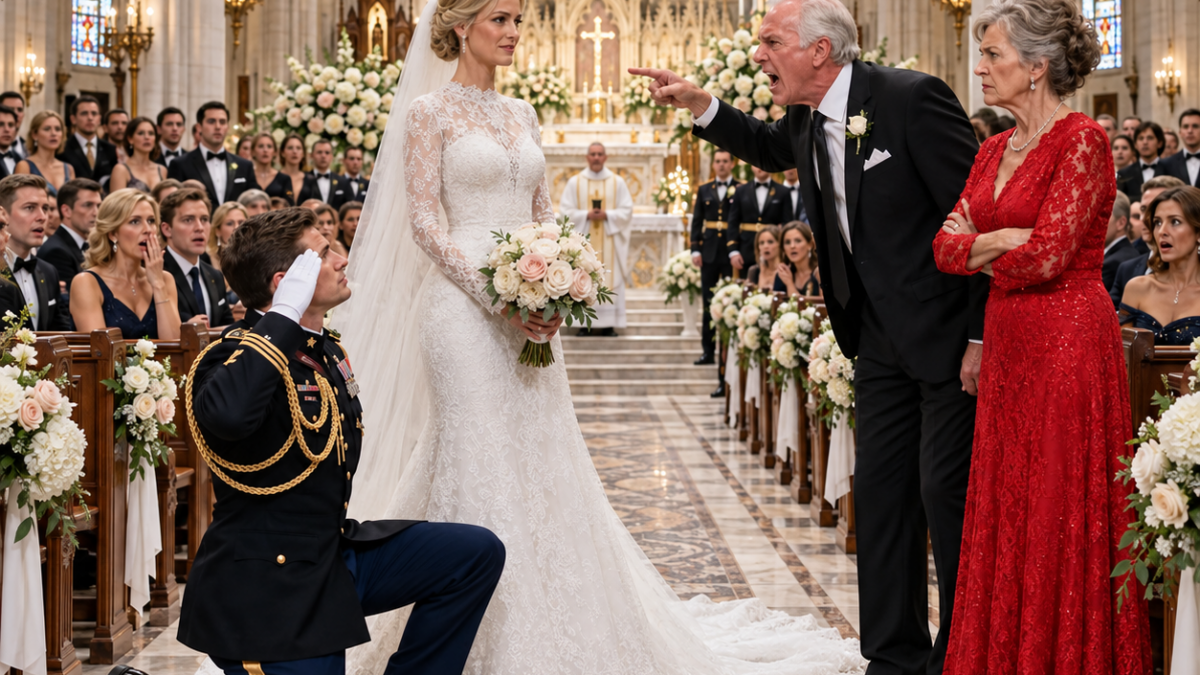
Thirty men and women entered.
Every one of them wore pristine military Dress Blues.
Marines.
Army.
Navy.
Air Force.
Some young.
Some old.
Some with medals covering half their chests.
One man walked with a cane.
A woman near the front had a scar running from her ear to her collar.
They moved with quiet precision.
No announcement.
No confusion.
They split into two lines along the aisle.
Then ceremonial swords came out.
Steel rose over my head.
A canopy.
A path.
My hands started shaking.
“What is happening?”
Nobody answered.
The last man entered.
Tall.
Black.
Early fifties.
Trimmed beard.
Marine Corps posture that seemed permanent even years after retirement.
He stopped near my father.
Dad stood.
Red faced.
“Who the hell are you people?”
The man remained still.
“My name is David Bell.”
His voice carried through the chapel.
“Master Sergeant, United States Marine Corps, retired.”
Dad’s face did not change.
Then David added:
“And lead investigator attached to a federal task force.”
The chapel went dead silent.
I looked at Julian.
He had gone pale.
“Julian?”
David turned toward me.
His expression softened.
“Nora, I’m sorry.”
“Sorry for what?”
“We tried to contact you privately this morning.”
“My phone was off.”
“We know.”
“What is this?”
David looked toward Julian.
Then at the veterans lining the aisle.
“Every person standing here came because of your fiancé.”
I stared.
“What?”
A woman in uniform wiped her cheek.
David continued.
“They are people he represented, protected, assisted, or helped bring into a federal investigation when powerful people tried to silence them.”
My father laughed bitterly.
“This is ridiculous.”
David looked directly at him.
“You called him a nobody.”
Dad said nothing.
David’s voice lowered.
“Half this chapel is standing because that nobody refused to leave veterans alone when men with money decided they were expendable.”
Julian closed his eyes.
My bouquet lowered.
“Julian.”
“I was going to tell you tonight.”
I stared at him.
“Tell me what?”
Before he answered, David removed a sealed envelope from inside his jacket.
Government crest.
Official markings.
Then he faced my father.
“Mr. Montgomery, before this ceremony continues, you should know Mr. Vance has spent six months investigating financial activity connected to the Valor Trust.”
The chapel changed.
Not physically.
Emotionally.
You can feel a room understand danger before anyone says the word.
My father’s face hardened.
“This is harassment.”
David continued.
“He found evidence you have spent years hiding activity inside the charity you built your reputation on.”
I turned toward Julian.
“You investigated my father?”
His eyes filled.
“Nora.”
“You investigated my family and said nothing?”
“I had to verify it.”
“How long?”
“Six months.”
I stepped backward.
“You knew?”
“I suspected.”
“That is not the same answer.”
“No.”
“Then answer me.”
The chapel doors opened again.
Nobody moved.
This time three people entered.
A silver haired woman in a charcoal suit.
A man in a dark federal windbreaker.
Another carrying a black case.
My father’s face changed.
Small.
Barely visible.
But I knew him.
His eyes tightened.
He glanced at Mom.
Then the exit.
The silver haired woman walked down the aisle.
Click.
Click.
Click.
She stopped beside David.
“Master Sergeant Bell.”
“Ma’am.”
Then she looked at me.
“Nora Montgomery?”
“Yes.”
“My name is Evelyn Shaw. Senior counsel, Department of Justice.”
The chapel erupted into whispers.
My father rose.
“This is absurd.”
Evelyn never even looked at him.
“Mr. Montgomery, sit down.”
“I don’t take orders from…”
“Sit down.”
My father sat.
That frightened me more than if he had screamed.
Evelyn opened the folder.
“Nora, you are not under investigation.”
I released a breath.
“But your father is.”
Mom gasped.
Caleb stood halfway.
Dad’s face reddened.
I looked at Julian.
He looked devastated.
Not victorious.
Not relieved.
Devastated.
I walked toward him.
“What did you know?”
“Nora.”
“What did you know?”
“I knew there were serious irregularities.”
“You brought federal investigators to our wedding because there were irregularities?”
“No.”
His answer was barely audible.
“Then tell me the truth.”
He looked at me.
“The Valor Trust is not what your father says it is.”
My stomach dropped.
Evelyn continued.
“Your fiancé became involved after the death of one of his former clients.”
“Who?”
“Captain Marcus Hale.”
Several veterans lowered their heads.
David’s jaw tightened.
“Marcus attempted to report evidence of fraudulent military contracting,” Evelyn said.
“Connected to whom?”
She did not answer.
She did not need to.
I looked at Dad.
“Your companies?”
He stared at the floor.
“Dad.”
“Nora, you don’t understand.”
“Are your companies involved?”
“It is complicated.”
I laughed.
Broken.
“Whenever people say complicated, what they usually mean is yes.”
Mom suddenly stood.
“Charles.”
Dad turned.
“Not now.”
She flinched.
I had watched that reaction my whole life.
My father spoke.
My mother became smaller.
He made cruel jokes.
She smiled nervously.
He insulted staff.
She changed the subject.
But this time she did not sit.
“I asked you about the transfers.”
My father went completely still.
“What?”
“I saw the accounts.”
“Margaret.”
“You were sending money overseas.”
“You don’t understand business.”
“I understood enough to know you were lying.”
Caleb stood.
“Mom?”
She looked at us.
“I found something six months ago.”
Dad moved toward her.
“Enough.”
Mom’s hands trembled.
Then she said something I had never heard her say to my father.
“No.”
The entire chapel seemed to inhale.
She opened her purse.
Pulled out a flash drive.
My father’s face went white.
“What is that?” I asked.
Mom cried.
“Everything I should have told you.”
Dad stepped toward her.
David immediately moved between them.
“Don’t.”
Dad stopped.
Thirty veterans surrounded us.
Nobody threatened him.
Nobody needed to.
Mom placed the flash drive in Evelyn’s hand.
“I copied the files before Charles realized I knew.”
Dad whispered her name.
“Margaret.”
She looked at him.
“I loved you.”
Tears ran down her face.
“I still don’t understand when you became this person.”
Dad looked away.
I turned toward Julian.
“You knew.”
“I knew something was wrong.”
“And you didn’t tell me.”
His eyes filled.
“I tried.”
“When?”
“Every day for months.”
“That is not trying.”
“No.”
“Then why?”
He took a breath.
“Because your father threatened you.”
Everything stopped.
“What?”
“He didn’t threaten me first.”
My father snapped, “He is lying.”
Julian ignored him.
“Six months ago, I confronted Charles privately.”
My chest tightened.
“You confronted my father?”
“Yes.”
“Why?”
“I had records showing Valor Trust funds being routed through shell companies connected to military contractors.”
Dad stood.
“You have no idea what those records mean.”
Julian finally turned.
“I know exactly what they mean.”
Then back to me.
“He threatened my career.”
“That sounds like Dad.”
“He threatened people I represented.”
My anger faltered.
“Then he threatened you.”
“How?”
Julian swallowed.
“He said he would destroy your life if I kept going.”
Dad laughed.
I looked at him.
He stopped.
“What exactly did he say?” I asked Julian.
Julian hesitated.
“Tell me.”
“He said, ‘Nora doesn’t know what she is.’”
A chill moved through me.
I looked at my father.
“What does that mean?”
Nothing.
“Dad.”
Nothing.
“What does that mean?”
Evelyn closed the folder.
“I think it’s time.”
The man with the black case opened it.
Laptop.
The first video appeared.
Security footage.
Parking garage.
My father walked toward a black sedan.
Another man approached.
Envelope exchanged.
Dad took it.
The screen changed.
Bank statements.
Companies.
Dates.
Transfers.
Millions.
I stopped understanding individual numbers.
Then one line appeared.
Recipient:
Nora Montgomery.
I stared.
“No.”
Another transfer.
My name.
Another.
My name.
Fourteen years earlier.
Then sixteen.
Some before I was eighteen.
“What is this?”
Nobody answered.
“Why is my name on these accounts?”
Dad looked older suddenly.
“Nora.”
“What did you do?”
“There are things about your childhood you don’t remember.”
Mom covered her mouth.
I turned.
“Mom?”
She cried harder.
Dad whispered:
“You were never supposed to find out.”
My blood turned cold.
Then a radio crackled.
David touched his ear.
“Bell.”
A voice:
“The courthouse file was accessed.”
“What file?” Julian asked.
David looked at me.
“The original adoption record.”
I forgot how to breathe.
“Adoption?”
My father closed his eyes.
The chapel lights went out.
A gunshot exploded.
Someone screamed.
Julian grabbed me.
“Down.”
We hit the floor behind a pew.
David shouted commands.
Veterans moved instantly.
Ceremonial swords dropped.
People were pushed behind cover.
Another sound outside.
Engine.
Tires.
Radio traffic.
“Rear entrance.”
“Suspect moving.”
“Secure the bride.”
Bride.
The word sounded ridiculous.
I was still wearing a wedding dress.
Five minutes earlier, my greatest problem had been my father refusing to walk me down an aisle.
Now someone was shooting near the chapel because of an adoption file.
Lights flickered.
Returned.
No one inside had been shot.
The bullet struck wood near the altar.
I looked at Dad.
He was standing.
Gray faced.
“You knew.”
He looked at the bullet hole.
“You knew this could happen.”
“I knew someone might come.”
“Who?”
“I don’t know.”
“Dad.”
“I don’t know.”
David walked toward him.
“This ends today.”
Dad laughed weakly.
“You think you know everything.”
“No.”
David stopped close enough that my father had to look at him.
“But I know enough.”
Evelyn lifted Mom’s flash drive.
“We have records. Witnesses. Copies.”
Dad looked at her.
“You don’t have the original.”
“The original what?”
His eyes moved to me.
“The record proving who Nora really is.”
My heart pounded.
“Where?”
He stayed silent.
Mom answered.
“At home.”
Dad turned.
“Margaret.”
“In the safe.”
“You don’t know the combination.”
She looked at him.
“You taught it to me.”
For the first time that day, I almost laughed.
Not because it was funny.
Because men like my father always underestimated quiet people.
David sent a team.
I looked at Dad.
“Am I adopted?”
He closed his eyes.
“Yes.”
One word.
Twenty two years of identity collapsed.
I sat.
My knees stopped working.
Julian crouched beside me.
He did not touch me.
He waited.
That mattered.
“Who were my parents?”
Dad looked at Mom.
Mom whispered:
“Your biological mother was Elena Vance.”
Julian’s head snapped up.
“What?”
I looked at him.
Dad nodded.
“Elena Vance.”
Julian stood.
“That was my mother.”
Silence.
My stomach twisted.
“What?”
Julian looked at me quickly.
Then Dad.
“No.”
His face drained.
“Elena raised me.”
Dad nodded.
“She wasn’t your biological mother.”
I stared between them.
Dad continued.
“Elena was your guardian after your birth mother died. She later became Nora’s biological mother.”
Julian looked dizzy.
“You’re saying…”
“You and Nora are not related by blood.”
The relief came too quickly.
Too shamefully.
Because that was not the question I should have been asking.
Julian whispered:
“I was told Elena died when I was nine.”
Dad shook his head.
“She disappeared.”
“You told people she was dead.”
“That was the cover story.”
Julian’s eyes filled with rage.
“Why?”
Dad sat.
For the first time, he looked defeated.
“Elena worked for one of my companies.”
My heart pounded.
“She discovered money intended for veterans was being diverted.”
Julian’s hands curled.
“By you?”
“At first, no.”
Evelyn spoke.
“Charles originally helped expose the network.”
I looked at her.
“What?”
Dad laughed without humor.
“The version of me you hate now wasn’t always the version that existed.”
I stared.
He continued.
“Elena found fraudulent contracting payments. Companies billing for services never delivered. Medical equipment. Veteran housing. Procurement contracts.”
“And?”
“She came to me.”
“Why?”
“Because one of the shell companies touched my dealership group.”
“Were you involved?”
“Not then.”
That last word chilled me.
Not then.
“What happened?”
Dad looked toward David.
“We began documenting.”
David nodded reluctantly.
“Charles did provide early intelligence.”
My mind reeled.
“So Valor Trust…”
Dad nodded.
“It was created partly to follow the money.”
I laughed through tears.
“You built a charity as bait?”
“As a way to identify which accounts were being targeted.”
“And veterans?”
“The grants were real.”
David said sharply:
“Some were.”
Dad flinched.
Evelyn continued.
“Over time Charles began redirecting money himself.”
I looked at him.
“You became the people you were investigating.”
He lowered his head.
“I told myself it was temporary.”
“Of course you did.”
“I thought if I controlled the network, I could expose the bigger players.”
“And did you?”
“No.”
“Instead you got rich.”
He did not answer.
I laughed.
“My entire childhood was funded by stolen money.”
“No.”
Dad looked at me quickly.
“The dealerships are legitimate.”
“Then why were accounts in my name?”
He looked away.
I stood.
“Why was money moved through me?”
“Nora.”
“ANSWER ME.”
My voice cracked through the chapel.
Dad swallowed.
“Because children attract less scrutiny.”
I felt sick.
“You used my name.”
“I protected the money.”
“You used me as cover.”
“Yes.”
That admission hurt more than the lie.
Mom sobbed.
“I didn’t know until recently.”
I turned toward her.
“How recently?”
“Six months.”
“The same time Julian started investigating.”
She nodded.
Everything converged.
Six months.
Julian.
Mom.
Dad.
Valor Trust.
Threats.
My name.
My wedding.
“Why hide my birth?”
Dad looked toward Evelyn.
Then David.
“Because Elena’s life was in danger.”
Julian stepped forward.
“What happened to her?”
Dad’s face changed.
Pain.
Maybe genuine.
“Elena obtained records linking senior contractors, accountants, and several government insiders.”
Evelyn added:
“Someone inside the original investigation leaked her location.”
Julian whispered:
“And she disappeared.”
Dad nodded.
“She was attacked.”
“Was she killed?”
“We believed so.”
Julian stared.
“You let me believe my mother was dead.”
“She raised you because your own mother had died years earlier.”
Julian wiped his face.
“She was the only mother I remembered.”
“I know.”
“You knew where I was.”
“Yes.”
“You watched me grow up.”
“From a distance.”
“Why?”
Dad looked at me.
“Because Elena left something behind.”
“What?”
“Her daughter.”
My chest tightened.
“Me.”
“Yes.”
“My biological father?”
“A Marine.”
David lowered his head.
“Thomas Mercer.”
The name moved through several veterans.
“He died overseas before you were born,” David said.
I stared at him.
“You knew him?”
“Only by reputation.”
Dad continued.
“Elena knew she was being watched. She knew if people discovered Nora existed, they could use her.”
“So you adopted me.”
Mom finally spoke.
“We were asked to hide you.”
“By who?”
She looked at Evelyn.
Evelyn answered carefully.
“A protective arrangement was made by people attached to the original investigation.”
I laughed.
“That is a very professional way to say my entire identity was manufactured.”
“Yes.”
At least she was honest.
I looked at Mom.
“Did you want me?”
Her face collapsed.
“Oh, Nora.”
“Did you?”
“Yes.”
The answer came without hesitation.
“You were three.”
She stepped closer.
“Terrified. You wouldn’t sleep unless someone held your hand.”
A memory moved through me.
Not complete.
A woman singing.
Dark hair.
A room I did not recognize.
“Was that Elena?”
Mom nodded.
“She brought you to us once.”
“You met her?”
“Yes.”
“How many times?”
“Three.”
Dad whispered:
“Four.”
Mom looked at him.
“You saw her again?”
Dad did not answer.
Julian caught it.
“When?”
Dad stood.
“I don’t remember.”
“You remember.”
Dad looked away.
Julian stepped toward him.
“Where is Elena?”
“I don’t know.”
“You saw her after Nora came to live with you.”
Dad’s silence answered.
Julian’s voice broke.
“Where?”
“She came to Charleston.”
“When?”
“Twenty years ago.”
“And then?”
“She disappeared again.”
“You never told me.”
“You were a child.”
“I grew up.”
No answer.
It was the recurring sin of every adult in the room.
Protection used as permission to control truth.
Julian looked at me.
“I’m sorry.”
I almost laughed.
“For what?”
“For hiding the investigation.”
“You did the same thing.”
“Yes.”
“At least you admit it.”
“I was afraid if I told you before I had proof, you would confront him.”
“I would have.”
“I know.”
“And?”
Julian’s eyes filled.
“He said he would hurt you.”
“So you decided for me.”
“Yes.”
My chest hurt.
“Do you understand why that matters right now?”
He nodded.
“More than I did an hour ago.”
That answer saved something.
Not everything.
Something.
Mom stepped forward.
“I know where Elena might be.”
Julian froze.
“What?”
Dad turned.
“Margaret.”
She reached into her purse.
Another photograph.
Old.
A woman.
Dark hair.
Sharp eyes.
Beside her stood a little girl.
Me.
I knew it before anyone said it.
Not because I remembered her face clearly.
Because my body did.
Some faces live below memory.
“Elena.”
Mom nodded.
On the back was an address.
David took it.
His expression changed.
“That was a safe house.”
“Was?”
“Twenty years ago.”
Julian grabbed the photograph.
Then read the line beneath the address.
If Nora ever learns the truth, take her to me.
A date followed.
Three days from now.
I stopped breathing.
“She’s alive.”
No one answered.
“She’s alive.”
Julian looked at me.
Hope and pain existed on his face at the same time.
David’s radio crackled.
“We located the property.”
“And?”
“Signs of recent occupation.”
My hands shook.
“Who?”
“Unknown.”
Then:
“There’s a letter.”
David listened.
His face changed.
“What does it say?” I asked.
He repeated:
“Nora, if you are reading this, Charles finally told you the truth. I am sorry it took twenty two years.”
My heart pounded.
“There’s more.”
“What?”
“You were never the only child I was protecting.”
Julian looked at me.
I looked at him.
Another mystery.
Another secret.
For the first time that day, I did not feel fear.
Only exhaustion.
And anger.
And something else.
Determination.
I turned toward Dad.
He sat in the back row.
The same place he had chosen when he refused to walk me down the aisle.
He looked smaller.
No dealership owner.
No philanthropist.
No family patriarch.
Just a man who had made choices.
Some loving.
Some cowardly.
Some corrupt.
I walked toward him.
“Nora.”
“Do not call me sweetheart.”
His mouth closed.
“Did you love me?”
His face broke.
“Yes.”
“Was any of it real?”
“All of it.”
“The money?”
“No.”
“The secrets?”
“They were real too.”
“That isn’t what I mean.”
He looked at me.
“You were my daughter.”
“Am.”
He blinked.
I corrected myself.
“Biology doesn’t change that.”
Hope moved across his face.
I killed it immediately.
“But being my father does not erase what you did.”
He lowered his eyes.
“You used my name.”
“Yes.”
“You lied about who I was.”
“Yes.”
“You threatened the man I love.”
“Yes.”
“You let me walk alone today because you thought his income made him worthless.”
Dad looked at Julian.
“I was wrong.”
I laughed.
“Today?”
“No.”
He swallowed.
“For years.”
I looked toward Mom.
She was crying.
Caleb sat near her.
My little brother looked stunned.
He had spent the entire day discovering our family was not what he believed either.
“Did Caleb know anything?”
“No,” Mom said.
Caleb looked at me.
“I swear.”
“I believe you.”
That almost broke him.
He came forward.
Hugged me.
“I’m sorry.”
“For what?”
“For not standing up when Dad wouldn’t walk you.”
I hugged him tighter.
“You were shocked.”
“I should have.”
“Maybe.”
I pulled back.
“But everybody in this room is done deciding who should have been braver five minutes ago.”
He laughed through tears.
“Okay.”
I turned toward Julian.
He waited near the altar.
Thirty veterans were still present.
Ceremonial swords lay against pews.
Federal investigators stood beside my mother.
A bullet hole marked the wood near where Julian and I were supposed to say our vows.
Ridiculous.
Absolutely ridiculous.
I walked toward him.
He did not move.
When I reached him, he whispered:
“I understand if you don’t want to do this.”
“Do what?”
“Marry me.”
I looked at him.
“You hid a federal investigation into my father.”
“Yes.”
“For six months.”
“Yes.”
“You brought thirty veterans to our wedding.”
“I didn’t arrange that part.”
David called from behind us:
“That was me.”
Several people laughed.
The first real laugh all afternoon.
I looked back at Julian.
“You should have told me.”
“I know.”
“Stop saying I know.”
He smiled sadly.
“Fair.”
“You should have trusted me.”
“Yes.”
“You should have let me decide what risk I was willing to take.”
“Yes.”
“You do it again, I leave.”
His face became serious.
“Understood.”
I looked at the altar.
Then the chapel.
“Do you still want to marry me?”
“More than I did this morning.”
“That’s a terrible answer.”
“Why?”
“I’m emotionally unstable.”
“So am I.”
I laughed.
Then cried.
He reached for my hand.
Stopped.
Waited.
I placed mine in his.
“Are you sure?” he asked.
“No.”
I smiled.
“But I’m sure I don’t want to walk alone anymore.”
We walked toward the altar.
That did not mean the ceremony immediately continued.
There were investigators in the chapel.
A shooter outside.
My father was about to be taken for questioning.
The venue was now an active crime scene.
Even Charleston weddings have limits.
The pastor stepped forward.
“I feel compelled to say this is the first time I have needed to ask federal law enforcement whether the ceremony can proceed.”
David almost smiled.
“It cannot.”
“Thought so.”
Guests laughed nervously.
I looked at Julian.
“Tomorrow?”
He shook his head.
“After you meet Elena.”
I stared.
“You would wait?”
“Nora.”
His voice softened.
“You just discovered your mother may be alive.”
I cried again.
“I hate how reasonable you are.”
“I get that a lot.”
My father was escorted out twenty minutes later.
Not handcuffed.
Not yet.
But surrounded.
As he reached the chapel doors, he stopped.
Turned toward me.
“Nora.”
I looked at him.
He struggled for words.
Finally:
“I’m sorry I didn’t walk you.”
Of everything.
That was what he chose.
I almost laughed.
Then realized he understood.
The aisle was the smallest betrayal.
But it was the one he could finally see.
“You didn’t deserve to.”
His face tightened.
I continued.
“Not because you’re a bad man.”
He waited.
“Because walking me would have meant you were giving me away.”
I looked at Julian.
“I’m not anybody’s possession.”
Dad nodded slowly.
Then left.
That evening, instead of a wedding reception, Julian and I sat in my apartment eating takeout.
Still dressed partly in wedding clothes.
My dress had grass stains from where I hit the chapel floor.
Julian’s tie was gone.
My pearl necklace sat on the table.
“So,” he said.
“Yes?”
“How was your wedding day?”
I stared at him.
He smiled.
I threw a napkin.
He caught it.
Then became serious.
“I’m sorry.”
“I know.”
“No.”
He moved closer.
“I need to say the entire thing.”
I waited.
“I’m sorry I decided keeping you ignorant was the same as keeping you safe.”
That mattered.
“I was afraid your father would hurt you.”
“He did anyway.”
“I know.”
“Different way.”
“Yes.”
“Were you afraid I would defend him?”
Julian hesitated.
“Yes.”
That hurt.
“Why?”
“Because you loved him.”
“I still do.”
“I know.”
“And I can love him and still believe he should be held accountable.”
“I understand that now.”
“Good.”
I looked at him.
“What else haven’t you told me?”
He exhaled.
“Marcus Hale.”
“Your client.”
“He was more than a client.”
I waited.
“He found financial records connected to fake rehabilitation contracts.”
“Valor Trust?”
“Yes.”
“He tried to report them.”
“What happened?”
“He was discharged under questionable circumstances years earlier. People used that to attack his credibility.”
“Did Dad?”
“Not directly.”
“Who?”
“Companies connected to the trust.”
“And Marcus died.”
“Yes.”
“How?”
“Officially suicide.”
My stomach tightened.
“You don’t believe that.”
“No.”
“Was he one of the reasons David came?”
“Yes.”
“And the veterans?”
“Marcus helped organize them.”
I looked at the ceiling.
“So my father may have been connected to money tied to the death of your client.”
“I don’t know that Charles ordered anything.”
“That is a lawyer answer.”
“Yes.”
“Keep it.”
He nodded.
For several minutes, we sat silently.
Then I asked:
“Who raised you before Elena?”
“My biological mother died when I was two.”
“And Elena?”
“She was my aunt’s friend.”
“Dad said guardian.”
“She became one legally.”
“What about your father?”
“Never knew him.”
“Did Elena ever talk about having a daughter?”
Julian thought.
“No.”
“But you were nine when she disappeared.”
“Yes.”
“So Nora could have been somewhere else already.”
He nodded.
“Apparently.”
I looked at him.
“This is insane.”
“Yes.”
“What if we discover something worse?”
“We will deal with it.”
“We?”
He smiled.
“If you still want me.”
I took his hand.
“That part hasn’t changed.”
Three days later, we drove to the address on the photograph.
Not alone.
David insisted.
Two unmarked federal vehicles followed us.
The safe house was outside Charleston.
Small.
White siding.
Pine trees.
Nothing about it looked like a place that had carried twenty years of secrets.
My hands shook.
Julian noticed.
He said nothing.
That was one of the things I loved most about him.
He knew silence could be support.
David walked ahead.
Checked the property.
Then returned.
“She’s here.”
My knees nearly gave out.
Julian caught my elbow.
“She?”
David nodded.
“One woman.”
I stopped.
“Alive?”
“Yes.”
I looked at Julian.
His face crumpled.
For him, Elena was the woman he remembered tucking him into bed.
For me, she was a ghost I could not remember clearly enough to mourn.
We approached the door.
Before David knocked, it opened.
A woman stood there.
Late sixties.
Maybe early seventies.
Dark hair mostly gray.
Thin.
Sharp eyes.
She looked at Julian first.
Her hand covered her mouth.
“Oh God.”
Julian stopped breathing.
“Elena?”
She cried.
“My boy.”
He crossed the porch.
She hugged him.
Hard.
Julian made a sound I had never heard from him.
Something between a sob and a gasp.
I stood back.
This was his moment.
He had spent decades believing she was dead.
Elena touched his face.
“You grew up.”
He laughed through tears.
“That happens.”
“I am so sorry.”
“Why did you leave me?”
Her face broke.
“I thought staying would kill you.”
Julian stepped back.
“You could have found me later.”
“I tried.”
“When?”
“Letters.”
“I never got them.”
She closed her eyes.
“Then they intercepted them.”
David looked at one of the agents.
Notes were made.
Then Elena looked at me.
Everything changed.
She stopped breathing.
“Nora.”
My name in her voice felt familiar.
Not consciously.
Somewhere deeper.
I stepped forward.
“You know me.”
Tears ran down her face.
“I know every birthday I missed.”
My throat closed.
“Are you my mother?”
“Yes.”
One word.
Not dramatic.
No music.
Just truth.
I moved toward her.
Then stopped.
Anger arrived before affection.
“Why did you leave me?”
She nodded as though she had rehearsed accepting that question for twenty years.
“Because men were watching you.”
“Everybody says that.”
“I know.”
“My entire life has been people saying they lied to protect me.”
“I know.”
“You could have come back.”
“I tried twice.”
“What happened?”
“The first time, Charles stopped me.”
My blood turned cold.
“What?”
Julian looked at her.
“Elena.”
She continued.
“He believed contact would expose you.”
“Did he threaten you?”
“No.”
She looked toward the floor.
“Not then.”
“Later?”
“Yes.”
I closed my eyes.
Of course.
“What did he say?”
“That he had built a life for you.”
I laughed bitterly.
“He told you to stay away from your own daughter?”
“Yes.”
“And you listened?”
“At first.”
“Why?”
“Because there were people looking.”
“Real people?”
“Yes.”
She looked at David.
He nodded.
“The threat was genuine.”
I shook my head.
“That does not make every choice good.”
“No.”
Elena’s answer came immediately.
“I made mistakes.”
That helped more than excuses would have.
She invited us inside.
The living room was sparse.
Files.
Photographs.
A few books.
No television.
On the wall hung one photograph.
Me.
At graduation.
I walked closer.
“You were there?”
“No.”
“How did you get this?”
“Someone sent it.”
“Who?”
“Margaret.”
Mom.
I stared.
“She knew you were alive?”
“Not always.”
“When?”
“About seven years ago.”
My chest tightened.
“She lied too.”
“Yes.”
I sat.
Julian lowered himself into a chair.
“How many people knew?”
Elena sighed.
“Too many.”
“Yet Nora didn’t.”
“No.”
I laughed.
“Excellent system.”
Elena almost smiled.
“You sound like your father.”
I went cold.
“My biological father?”
“Yes.”
“Thomas Mercer?”
She nodded.
“Tell me.”
“He was a Marine intelligence specialist.”
David sat straighter.
“He discovered some of the early contracting problems.”
“Did he know Charles?”
“Yes.”
“Was Charles involved then?”
“No.”
“Everyone keeps saying then.”
Elena looked sad.
“Because Charles changed.”
“How?”
“At first he was angry about the fraud.”
“And later?”
“He discovered how profitable access to the network could become.”
“So he used the same system.”
“Yes.”
“And Valor Trust?”
“Started clean.”
That surprised me.
“Really?”
“Yes.”
“Then what happened?”
“Donations increased.”
“Power increased.”
“Yes.”
“And Dad liked it.”
“Yes.”
That sounded like him.
Julian asked:
“Who tried to kill you?”
Elena’s face changed.
“We still do not know every name.”
“Was Charles involved?”
“No.”
“You’re sure?”
“Yes.”
Relief moved through me.
Small.
But real.
My father was corrupt.
Arrogant.
Controlling.
He had not tried to murder my mother.
I hated how grateful I felt.
Elena continued.
“Charles actually helped me disappear after the attack.”
I stared.
“So he saved you.”
“Yes.”
“And then kept you from me.”
“Yes.”
There it was again.
People are rarely one thing.
My father could be the man who saved Elena.
The man who gave me a home.
The man who used my name for financial transfers.
The man who called Julian a nobody.
The man who threatened him.
All true.
Human beings are inconvenient that way.
“What did the letter mean?” I asked.
Elena looked confused.
“What letter?”
“You wrote that I wasn’t the only child you were protecting.”
She looked at Julian.
He froze.
“You meant him.”
“Yes.”
Julian’s eyes filled.
“You were protecting both of us.”
“Yes.”
“Why?”
“Because your biological mother had also discovered part of the network.”
Julian stared.
“My mother?”
“She worked in accounting for a contractor.”
“Did she die naturally?”
Elena looked at David.
He answered carefully.
“We are reopening that question.”
Julian stood.
“No.”
I reached for him.
He stepped away.
“I spent my whole life thinking one mother died and another disappeared.”
Elena started crying.
“I’m sorry.”
“Stop saying that.”
I understood exactly how he felt.
He walked outside.
I followed.
He stood under the pine trees.
Hands on his head.
“Julian.”
“I’m fine.”
“No, you’re not.”
“Everyone lied.”
“Yes.”
“Everybody.”
“Yes.”
He turned.
“And I lied to you too.”
That stopped me.
“I became them.”
“No.”
“I hid the investigation.”
“Yes.”
“I justified it as protection.”
“Yes.”
“That is exactly what they did.”
I stepped closer.
“Then learn faster.”
He stared.
“What?”
“We cannot undo what everybody did before.”
I took his hand.
“But we can stop repeating it.”
He looked at me.
“No secrets.”
“No secrets.”
“Even if the truth is dangerous.”
“We decide together.”
He nodded.
That became the first real vow of our marriage.
Not in a chapel.
Under pine trees.
No guests.
No officiant.
Just two people promising not to protect each other through ignorance.
The federal investigation unfolded over the next year.
My father was indicted on financial crimes.
Fraud.
Conspiracy.
Misuse of charitable funds.
Additional charges tied to false contracts.
Not murder.
Not attempted murder.
That distinction mattered to me.
He cooperated eventually.
Partly.
Dad was not transformed overnight.
Men who build identities around control do not surrender it gracefully.
At first, he blamed accountants.
Partners.
Consultants.
Then Mom’s flash drive made denial difficult.
Then Julian’s evidence.
Then Marcus Hale’s records.
Then testimony from veterans.
Eventually Dad admitted he had redirected funds.
At sentencing, he looked older than I had ever seen him.
I attended.
Not because I supported him.
Because he was my father.
That was still true.
He looked toward me before the hearing.
“I don’t expect forgiveness.”
“Good.”
He almost smiled.
“You sound like your mother.”
“Which one?”
That hurt him.
I did not apologize.
He nodded.
“Fair.”
He looked toward Julian.
“I was wrong about him.”
“Yes.”
“I thought money made people important.”
“Yes.”
“He had something I didn’t.”
“What?”
Dad looked toward the veterans seated behind us.
“People who would stand beside him when there was nothing to gain.”
That was the closest my father ever came to understanding.
The Valor Trust was restructured.
Recovered funds were returned.
New independent management took control.
Dad’s name was removed.
Some veterans wanted the charity dissolved.
Others argued the mission mattered more than the man who corrupted it.
Ultimately, the trust survived under a different name.
Marcus Hale’s name.
That mattered to Julian.
My mother left Dad.
Not immediately.
She struggled.
Thirty four years of marriage does not disappear because a flash drive changes hands.
She loved him.
Hated what he had done.
Blamed herself.
Then learned not to.
One evening she came to my apartment.
“I should have spoken sooner.”
“Yes.”
She flinched.
I continued.
“But I understand why you didn’t.”
“That does not excuse it.”
“No.”
She smiled sadly.
“You really are Elena’s daughter.”
“And yours.”
She started crying.
I held her.
Biology complicated my idea of motherhood.
It did not erase Margaret.
She raised me.
Packed lunches.
Sat beside my bed when I was sick.
Taught me to drive.
Argued about prom dresses.
Helped me study.
Made mistakes.
Kept secrets.
Loved me.
Elena gave me life.
Margaret gave me a childhood.
I refused to reduce either woman to one title.
Julian did the same.
Elena had raised him for seven years.
She remained his mother in the ways memory understands.
No DNA test changed that.
And yes, we did the tests.
Immediately.
Julian insisted.
So did I.
We were not biologically related.
Not cousins.
Not siblings.
Nothing.
I remember staring at the report.
Julian leaned over.
“Well.”
“What?”
“Good news.”
I hit him with the envelope.
He laughed.
I did too.
Some humor is survival.
We eventually married six weeks after the first ceremony.
Same chapel.
Smaller crowd.
No federal agents.
No gunshots.
A strict invitation policy.
David Bell came.
So did several veterans.
Not thirty.
He said the others had jobs.
Mom sat in the front row.
Caleb stood beside Julian.
Elena attended quietly.
My father did not.
He was under legal restrictions by then.
But he sent a letter.
I almost did not read it.
Then I did.
Nora,
The first time you stood at the end of that aisle, I thought walking beside you meant approving of your choice.
I was wrong.
It should have meant loving you while you made your own.
I made you walk alone because I wanted you to feel punished.
Instead, you showed me you never needed me to carry you.
I am sorry.
Julian is not a nobody.
Neither were the men and women I used when I forgot why Valor Trust existed.
Neither were you.
Dad.
I folded it.
No instant forgiveness.
But I kept it.
When the chapel doors opened, Mom stood.
Then Elena.
Both women looked at me.
“Who is walking with you?” the coordinator whispered.
I smiled.
“No one.”
She looked confused.
I stepped forward.
Alone.
Not abandoned.
Not rejected.
Alone by choice.
Halfway down the aisle, Julian stepped forward.
This time I did not shake my head.
He met me.
We walked the remaining distance together.
That felt right.
The pastor smiled.
“Welcome back.”
Everybody laughed.
He added:
“I have confirmed there are no federal agents waiting outside.”
David raised his hand.
“Technically…”
The entire chapel groaned.
I laughed so hard I almost ruined my makeup.
Then Julian took my hands.
His vows were simple.
“Nora, I will never confuse loving you with choosing for you.”
My throat closed.
“I will tell you the truth even when I’m afraid of what it costs.”
Tears filled my eyes.
“And if you ever have to walk alone, I’ll walk close enough that you can reach me.”
I barely got through mine.
“I promise not to confuse independence with isolation.”
Julian smiled.
“I promise not to make you prove your worth to people who have already decided not to see it.”
I looked toward the front row.
Mom cried.
Elena cried.
Caleb pretended he wasn’t.
David absolutely was.
“And I promise,” I continued, “that whatever comes through those chapel doors today, we deal with it together.”
The chapel laughed.
Then we were married.
No explosion.
No arrest.
No revelation.
Just vows.
Later, at the reception, David approached me.
He carried no government envelope.
I checked.
“You’re safe,” he said.
“I’m traumatized by stationery now.”
He laughed.
Then became serious.
“Your father was wrong about one thing.”
“Only one?”
“He called Julian nobody.”
I looked across the room.
Julian was speaking with veterans.
Not performing.
Listening.
David continued.
“People misunderstand what service looks like.”
“What do you mean?”
“Sometimes it’s a uniform.”
He looked toward Julian.
“Sometimes it’s standing beside someone in court when nobody else cares whether they disappear.”
I smiled.
“That sounds like him.”
David nodded.
“Marcus trusted him.”
That still hurt.
“Did Marcus know this investigation might kill him?”
“Yes.”
“Why keep going?”
David looked at me.
“Because he thought if everyone waits for safety, powerful people win by default.”
I carried that sentence for years.
My relationship with Dad became complicated.
Prison changed him.
Not magically.
Not completely.
But enough that our conversations became honest.
The first time I visited, he looked at the glass between us.
“I deserved what happened.”
I said nothing.
“I keep thinking about the aisle.”
“Why?”
“Because that was the purest version of who I had become.”
I stared.
“Explain.”
“I thought money made me qualified to decide who deserved respect.”
My throat tightened.
“You humiliated me.”
“I know.”
“You humiliated Julian.”
“Yes.”
“You were willing to destroy my wedding.”
“Yes.”
“And that was before anybody exposed Valor Trust.”
“Yes.”
He looked down.
“That’s why it bothers me.”
I understood.
The fraud required greed.
Fear.
Compromise.
Self justification.
The aisle required only arrogance.
No conspiracy.
No pressure.
He had hurt me because he believed he was entitled to.
“I forgive the aisle,” I said.
He looked up.
“Not everything.”
Hope disappeared.
“That is fair.”
“I don’t know if I ever will.”
“I know.”
“But I forgive that part.”
He cried.
So did I.
Forgiveness became specific.
Not a blanket.
Not amnesia.
Individual decisions.
Individual injuries.
Some healed.
Some did not.
Elena eventually told me everything about my biological father.
Thomas Mercer.
Marine.
Quiet.
Funny.
Terrible singer.
Loved old motorcycles.
He knew Elena was pregnant before deployment.
He never met me.
That hurt in a strange way.
How do you miss someone you never knew?
Apparently easily.
Elena gave me letters.
One was written before his final deployment.
For our daughter.
If she has your stubbornness, God help whoever tries to control her.
I laughed until I cried.
Then Elena showed me another line.
Tell her courage isn’t being unafraid. It’s knowing what matters more than fear.
I framed that one.
Not because Thomas was a hero.
I never knew enough to make him perfect.
But because I liked the thought.
Years later, I learned my father had spent his life trying to control fear.
Money.
Reputation.
Family.
Narrative.
Everything needed to stay where he placed it.
Julian lived differently.
He accepted uncertainty.
Maybe that was why Dad hated him.
Julian represented a kind of strength my father could not buy.
The veterans knew that.
I learned it slowly.
My brother Caleb changed too.
Dad had groomed him for the dealerships.
After the scandal, Caleb walked away.
“Do you hate cars now?” I asked.
“No.”
“Then why leave?”
“I don’t want to inherit Dad’s life just because he planned it.”
That sounded familiar.
“What will you do?”
“Teach.”
I laughed.
“Dad is going to have a stroke.”
“Already told him.”
“What happened?”
“He asked how much teachers make.”
“Of course.”
“I told him enough.”
We laughed.
Caleb became a history teacher.
Dad eventually admitted he was good at it.
Mom started traveling.
At sixty one, she discovered she liked making decisions without asking anyone.
Her first trip alone was to Spain.
She sent me twenty seven photographs of breakfast.
Every morning.
I never complained.
She had spent decades shrinking herself.
If freedom looked like photographing toast in Barcelona, I supported it.
Elena stayed in Charleston.
Not in my house.
Not immediately.
We needed boundaries.
Love cannot be built by pretending missing decades do not matter.
We met for coffee.
Walked.
Talked.
Sometimes argued.
She wanted to explain everything.
Sometimes I did not want explanations.
One day she said:
“I thought saving your life was the same as being a mother.”
I stared.
“What did you learn?”
“That surviving is only the first part of living.”
I nodded.
“That’s good.”
“It took me twenty years.”
“Slow learner.”
She laughed.
We became something.
Mother and daughter.
Not the version either of us lost.
A new one.
That mattered more than trying to recreate a childhood that never happened.
Julian and I stayed married.
Not perfectly.
That is important.
People hear dramatic wedding stories and assume the marriage afterward becomes some reward.
It did not.
We argued.
Mostly about secrecy.
The first year, whenever Julian said “I didn’t want to worry you,” I nearly lost my mind.
Eventually he learned.
I learned too.
I had my own habit of withholding.
I did not call it secrecy.
I called it “handling things.”
Same disease.
Different language.
So we created a rule.
Bad news within twenty four hours.
No exceptions unless legally prohibited.
When Julian had a case involving threats, he told me.
When I learned Dad might face additional charges, I told him.
When Elena’s health became uncertain, we faced it together.
Truth became a practice.
Not a personality trait.
Years after our wedding, Julian left the public defender’s office.
Dad would have felt vindicated.
Except Julian did not join a corporate firm.
He created a nonprofit legal organization for veterans and low income defendants caught in contracting or benefits disputes.
David joined the advisory board.
Several veterans from our wedding helped fund it.
They named it Hale Legal Project.
Marcus again.
I asked Julian once:
“Do you ever wish Dad had liked you?”
“Yes.”
That surprised me.
“Really?”
“Of course.”
“Why?”
“Because you loved him.”
Simple.
“And now?”
Julian thought.
“I don’t need him to approve of me.”
“Different question.”
He smiled.
“I would still like him to.”
That honesty was Julian.
Dad eventually did.
He never said it directly.
Instead, during one prison visit, he asked:
“How is Julian’s organization?”
“Good.”
“How much are they raising?”
“Dad.”
“What?”
“You can care without calculating revenue.”
He frowned.
“Fine.”
Two minutes later:
“Are they solvent?”
I laughed.
“Yes.”
He nodded.
“Good.”
Then:
“He’s doing useful work.”
From Charles Montgomery, that was practically a love letter.
The biggest lesson from that first wedding day was not that my father was corrupt.
Not that Julian was secretly more important than Dad believed.
Not even that my biological mother was alive.
It was this:
People reveal themselves most clearly when they believe they have the right to define someone else.
Dad defined Julian by salary.
Nobody.
He defined Mom by obedience.
Wife.
He defined me by ownership.
Daughter.
He defined veterans by usefulness.
Charity.
He defined himself by wealth.
Important.
Then one afternoon, every label collapsed.
Thirty veterans walked through the doors.
A public defender turned out to have more loyalty in one room than my father had built in thirty years.
My quiet mother carried the evidence that broke his defense.
The daughter he believed should obey turned out not to be biologically his and yet remained his daughter anyway.
And the charity he used to build prestige became the evidence of his fall.
Years later, somebody asked why thirty veterans came in Dress Blues.
I asked David.
“Honestly?”
“Yes.”
“Julian didn’t want them there.”
I laughed.
“I knew it.”
“Marcus had planned to attend your wedding.”
My smile disappeared.
David continued.
“After he died, several of the group decided someone should stand where he couldn’t.”
My eyes filled.
“The swords?”
“Someone got theatrical.”
“Who?”
David smiled.
“Not telling.”
I looked across the room at Julian.
That was the thing my father never understood.
Status is often loud.
Character usually is not.
Julian did not tell me about veterans he helped because he did not believe helping them made him special.
My father put his name on buildings.
Julian put other people’s names on case files and fought to keep them from disappearing.
Dad called him nobody.
But nobody is sometimes what powerful people call anyone whose value cannot be measured in the currency they respect.
A teacher.
A public defender.
A nurse.
A soldier nobody remembers after deployment.
A quiet wife.
An adopted daughter.
A whistleblower.
A man in a courtroom who refuses to let someone be erased.
Dad eventually understood.
Late.
But late is not nothing.
On the tenth anniversary of our wedding, Julian and I returned to the chapel.
Same doors.
Same aisle.
No audience.
The pastor let us inside.
I stood where I had stood that first day.
Julian stood at the altar.
“You look ridiculous,” I said.
“Why?”
“You’re reenacting trauma.”
“It’s romantic.”
“No.”
“Walk.”
I laughed.
Then started down the aisle.
Halfway, I stopped.
Looked toward the back row.
I could still see Dad there in memory.
Laughing.
Mom beside him.
Caleb staring at the floor.
Then the doors opening.
Uniforms.
Swords.
Truth.
Julian walked toward me.
“You okay?”
“Yes.”
“You sure?”
“No.”
He smiled.
“Good answer.”
We stood together.
I said:
“You know what I used to think?”
“What?”
“That Dad ruined my wedding.”
Julian waited.
“He didn’t.”
“No.”
“He ruined his place in it.”
Julian nodded.
“And you?”
“I walked.”
He smiled.
“You did.”
I looked toward the doors.
“Then everybody else came.”
We stood there for a long time.
No music.
No federal investigation.
No secrets.
Just us.
I thought about my father’s words.
Walk yourself.
He meant them as humiliation.
They became prophecy.
I did walk myself.
Through the aisle.
Through the truth.
Through anger.
Through adoption records.
Through two mothers.
Through learning who my biological father was.
Through loving a man who made mistakes without reducing him to those mistakes.
Through forgiving parts of my father without erasing what he did.
Through becoming somebody no one else got to define.
That was the real story of my wedding.
Not thirty veterans.
Not the federal envelope.
Not the bullet.
Not the charity scandal.
A woman was told she was making the wrong choice because the man she loved had no status.
Her father refused to walk beside her.
So she walked anyway.
And when the truth arrived behind her, loud enough to shake the chapel, she did not turn around and run.
She kept going.
My father called Julian a nobody.
He was wrong.
But not because Julian secretly had powerful connections.
Not because veterans respected him.
Not because federal investigators trusted him.
Not because he exposed fraud.
My father was wrong before any of that.
Julian deserved respect when Dad thought he was only a public defender.
He deserved dignity when no one knew what he had done for veterans.
He deserved to marry me if I chose him and he chose me.
That should have been enough.
The same lesson applied to me.
I did not become worthy after learning Elena was my mother.
I did not become important because Thomas Mercer had been a Marine.
I was not made stronger by the adoption secret.
I was already Nora.
The woman at the chapel doors.
The one holding a bouquet with crushed stems.
The one whose father sat down.
The one who walked.
Years later, when Dad was released, Julian and I met him for dinner.
He looked older.
More fragile.
For the first time, he drove an ordinary sedan.
I tried not to enjoy that.
Failed.
He sat across from Julian.
Awkward silence.
Then Dad said:
“I owe you an apology.”
Julian looked at him.
“For which part?”
I nearly choked on water.
Dad almost laughed.
“All of it.”
Julian nodded.
“Start with Nora.”
Dad looked at me.
I waited.
“I am sorry I made your wedding about my pride.”
That was accurate.
“I am sorry I used money to measure your choices.”
Better.
“I am sorry I used your name in accounts you knew nothing about.”
Harder.
“I am sorry I hid Elena.”
Harder still.
“And I am sorry I thought providing for you gave me ownership over you.”
The restaurant disappeared for a moment.
That was the sentence.
The real one.
I nodded.
“Thank you.”
He looked at Julian.
“And I’m sorry I called you nobody.”
Julian smiled faintly.
“I’ve been called worse.”
“I know.”
“You were responsible for some of it.”
Dad actually laughed.
Then became serious.
“You protected people when I used them.”
Julian said nothing.
“I can’t fix that.”
“No.”
“I can try to make restitution.”
“Yes.”
Dad nodded.
That was enough for dinner.
No dramatic embrace.
No complete restoration.
Reconciliation is often boring when done correctly.
Small conversations.
Boundaries.
Evidence.
Time.
When Dad died years later, I was with him.
So was Caleb.
Mom came.
Elena did not.
That was her boundary.
Julian waited outside until I asked him to come in.
Dad looked at him.
“You took care of her.”
Julian shook his head.
“She takes care of herself.”
Dad smiled weakly.
“Right answer.”
Then he looked at me.
“You walked.”
My eyes filled.
“Yes.”
“I should have walked with you.”
I took his hand.
“You were not ready.”
“No.”
“But eventually you caught up.”
He laughed softly.
“Barely.”
Those were some of his last words.
After the funeral, I found the original Valor Trust plaque in storage.
CHARLES MONTGOMERY
FOUNDER
SERVICE BEFORE SELF
The irony was almost unbearable.
Caleb asked what we should do with it.
“Throw it away?”
I stared at it.
“No.”
“Keep it?”
“No.”
“Then?”
We donated the metal to be melted down.
It became part of a memorial at the Hale Legal Project.
No Charles Montgomery name.
No family name.
Just one sentence:
SERVICE IS WHAT YOU DO WHEN NOBODY IS APPLAUDING.
Julian cried when he saw it.
So did I.
Because that was Marcus.
David.
The veterans.
Mom.
Elena.
And eventually, in small ways, Dad too.
The man who once called Julian nobody left behind one accidental lesson.
Being known does not make a person worthy.
Being wealthy does not make them important.
Being applauded does not make them good.
Sometimes the most valuable person in the room is the one nobody notices until everything falls apart.
The one who stays.
The one who tells the truth.
The one who holds the line.
The one who does the work without needing their name above the door.
My father learned that too late.
I learned it walking down an aisle.
And every anniversary, when Julian asks what I remember most from our first wedding day, I never say the gunshot.
I never say the veterans.
I never say the federal agents.
I say:
“The first step.”
Because that was the hardest.
The moment after my father sat down.
Before anybody came through the doors.
Before I knew Julian’s secrets.
Before I knew mine.
Before I knew my mother was alive.
Before the entire world changed.
I could have stayed still.
Instead, I walked.
One step.
Then another.
And another.
Sometimes that is how a life changes.
Not when someone rescues you.
Not when the truth arrives.
Not when powerful people finally admit they were wrong.
It changes the first time you move forward without permission.
My father told me to walk myself down the aisle because I was marrying a nobody.
So I did.
And by the time I reached the altar, I understood something he had spent his entire life missing.
Nobody becomes somebody because rich people approve of them.
Nobody becomes important because a uniform enters the room.
Nobody becomes worthy because a government envelope proves their value.
Julian had always been somebody.
So had my mother.
So had the veterans.
So had I.
And once I understood that, no one ever got to define my worth for me again.








