My Father Called My Fiancé a Nobody at Our Wedding—Then Thirty Strangers Walked In and Destroyed His Empire
PART2
I should have believed him.
That was the thing about my father. He rarely made threats in a raised voice. He preferred promises delivered calmly.
And three weeks later, there he was, fulfilling one in the back row of St. James Chapel.
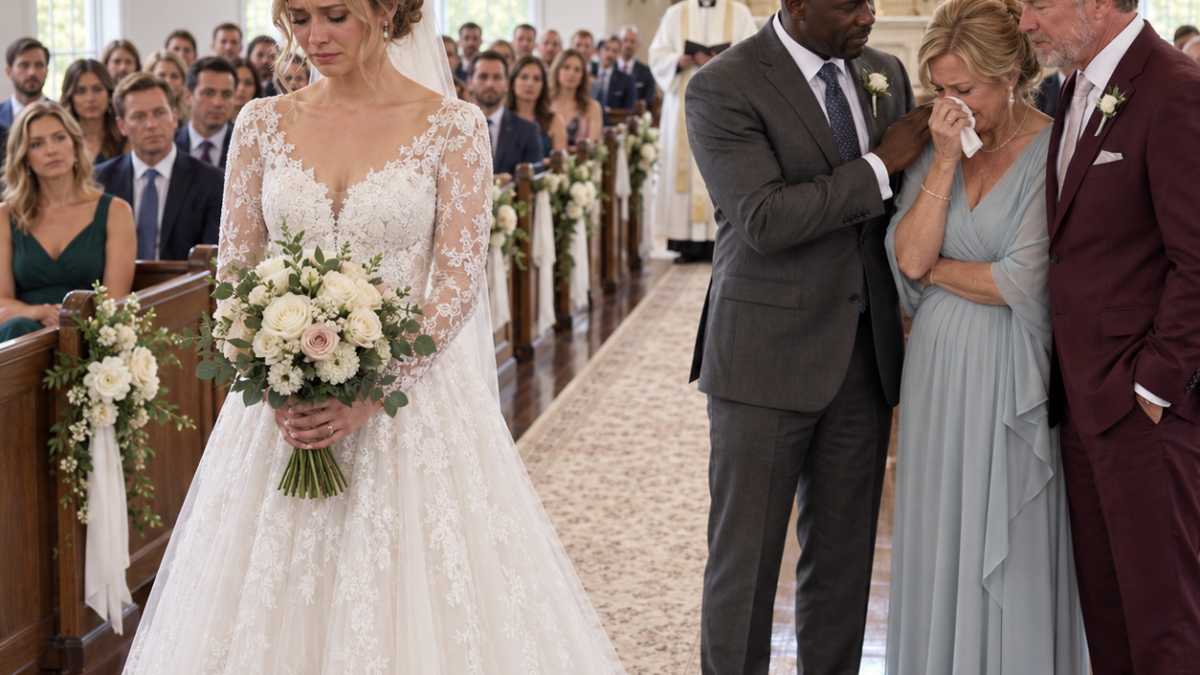
My bouquet trembled in my hands. White roses. Blue hydrangeas. A ribbon with a tiny charm from my grandmother wrapped around the stems. My grandmother had died when I was sixteen. She was my father’s mother, but nothing like him. She used to tell me, “Money is a tool, Maya. Don’t let fools turn it into a throne.”
I thought of her when Dad laughed.
I thought of all the times she had looked at him with quiet disappointment and said, “Richard, don’t confuse being loud with being right.”
He never listened.
My mother sat beside him in the back row. She did not reach for me. She did not stand. She did not even look at me for longer than half a second. Her eyes fell to her purse, where her fingers worried the clasp.
My younger brother Caleb sat on Dad’s other side, jaw tight, gaze fixed on the floor. Caleb was twenty-two, still trying to become a man without angering the man who had paid for every road he walked on. He loved me. I knew he did. But love inside my father’s orbit often came out looking like silence.
The guests shifted uncomfortably.
Someone coughed.
A cousin whispered, “Oh my God.”
The wedding coordinator stood frozen near the aisle, headset visible beneath her hair, eyes wide with horror.
I could have run.
For one second, I wanted to.
I wanted to gather my dress in both hands, turn around, and disappear into the humid Charleston night. I wanted to avoid the humiliation. I wanted to spare Ethan. I wanted to stop feeling every eye in the chapel moving between me, my father, and the man waiting at the altar.
Then Ethan took one step forward.
Not dramatic.
Not possessive.
Just one step.
His eyes asked a question.
Do you want me to come to you?
I shook my head slightly.
Not because I did not want him.
Because I did.
Because I had spent my life being escorted through rooms by my father’s money, my father’s temper, my father’s reputation, and my father’s permission.
If he wanted me to walk myself down the aisle as an insult, fine.
I would do it as a declaration.
So I lifted my chin and walked.
Every step sounded enormous.
My dress brushed against the old wooden floor. The chapel smelled of candles and flowers. Sunlight from the stained glass painted the aisle in blues and reds and golds, colors trembling through my tears.
I heard my father mutter something.
I did not turn.
I kept walking toward Ethan.
His face broke when I got close enough to see him clearly. Not from weakness. From restraint. He looked like every protective instinct in his body was fighting the promise he had made me months earlier when I told him, “Do not get into a public fight with my father at our wedding, no matter what he says.”
At the time, Ethan had looked pained.
“Maya, if he hurts you—”
“He will try.”
“Then let me stand up for you.”
“I need to stand up for me.”
Now here we were.
Halfway down the aisle.
Me walking alone.
Ethan waiting.
My father satisfied behind me.
And then the chapel doors opened.
The hinges groaned softly.
The music stopped.
A gust of warm air slipped into the chapel, carrying street noise, salt, and something else—movement.
I turned.
Thirty strangers walked inside.
Not loudly.
Not chaotically.
With quiet precision.
Men and women. Young and old. Black, white, Latino, Asian. Some wore simple gray suits. Some wore gray dresses beneath matching jackets. A few had silver hair. One young man leaned slightly on a cane. A woman in her sixties pressed a folded handkerchief to her mouth as soon as she saw Ethan.
Each person wore a small pin shaped like a silver shield.
They lined both sides of the aisle.
No one explained.
No one asked permission.
They simply took their places, forming a human border between the pews and the path to the altar.
The chapel held its breath.
One man stepped forward.
He was tall, Black, probably in his fifties, with a trimmed beard, wire-rimmed glasses, and the kind of posture that made you think he had learned patience from pain rather than politeness. He stopped near my father’s row.
He looked directly at Dad.
“Sir—”
My father shot to his feet.
“Who the hell are you people?”
The man removed his glasses slowly.
“My name is Marcus Bell. I’m an investigator with the South Carolina Bar’s Innocence Review Network.”
Ethan went completely still.
I turned toward him.
He looked stunned.
Not guilty.
Stunned.
“Marcus?” he whispered.
Marcus looked at me, and his expression softened.
“Maya, we apologize for arriving like this. We tried to reach you privately this morning, but your phone was off.”
I touched the side of my dress, where my phone was not. It was in the bridal suite, silenced, because I had wanted one hour free from my father’s messages.
“What is this?” I asked.
Marcus looked from me to Ethan, then back again.
“Your fiancé saved my son from serving twenty-five years for a crime he did not commit.”
A sound moved through the chapel.
Not quite a gasp.
More like the room inhaled at once.
Marcus continued, voice steady.
“Every person standing here is connected to someone Ethan Cole defended when no one else would listen. Some were acquitted. Some were released. Some had charges dismissed. Some were given a second chance instead of a buried life. We are here because your father called him a nobody, and that word does not belong to him.”
My bouquet slipped lower in my hands.
Ethan’s eyes shone.
“Marcus,” he said quietly, “you didn’t have to—”
“Yes,” Marcus said, turning toward him. “We did.”
A woman near the front stepped forward just enough for me to see her. She was in her forties, with tear-streaked makeup and a gray blazer.
“My brother is home because of him,” she said.
Another man raised his hand slightly.
“My daughter kept her scholarship because he fought the expulsion charge.”
The young man with the cane swallowed hard.
“I got out after six years. Mr. Cole found the witness they ignored.”
A white-haired woman pressed her hand to her chest.
“He helped my grandson when we had no money and no one answering our calls.”
I looked at Ethan.
This man I loved.
This man my father had dismissed because his shoes were not handmade and his car did not impress valets.
Ethan never talked about his victories. Not like this. He told me stories carefully, stripped of names and details, not to brag but because some days the weight of other people’s suffering came home with him in his shoulders.
He would sit at our kitchen table with a cold cup of coffee and say, “I got someone home today.”
That was all.
I had understood it mattered.
I had not understood thirty people might one day walk into my wedding wearing gray to prove it.
Marcus faced my father again.
“You called him a nobody,” he said. “Sir, half this aisle exists because that nobody gave our families their names back.”
Dad’s mouth opened.
Nothing came out.
For the first time in my life, my father looked smaller than the room.
Then Marcus reached into his jacket and removed a sealed envelope.
“And there is one more thing.”
Ethan’s head snapped toward him.
“Marcus.”
Marcus did not look away from my father.
“Mr. Whitmore, before this ceremony continues, you should know Mr. Cole also uncovered evidence tied to your company’s charitable foundation. The state attorney general’s office is outside.”
My body went cold.
The Whitmore Hope Fund.
My mother’s project.
At least, that was what I had always believed.
Every December, my family posed for photographs with oversized checks and smiling teenagers in borrowed suits. Foster youth scholarships. Technical school support. Emergency grants for young adults aging out of care. Dad loved those events. He loved standing in the center of every picture, one hand on my shoulder, one hand extended toward some grateful recipient, smiling like generosity had been invented by him and priced accordingly.
“What?” I whispered.
Ethan stepped toward me.
“Maya—”
“What evidence?”
His face tightened with pain.
“I was going to tell you tonight.”
A laugh burst from my father.
Not his public laugh.
Not the booming dealership laugh that made customers feel like they were already friends.
This laugh was sharp, ugly, and scared.
“This is ridiculous,” Dad said. “Maya, tell your little courthouse husband to stop embarrassing himself.”
Little courthouse husband.
Even then.
Even with thirty people standing between him and his arrogance.
Even with the attorney general outside.
He could not resist reaching for the smallest insult available.
Ethan’s jaw tightened, but he said nothing.
That restraint made me angrier than if he had shouted.
I turned to him.
“Ethan. Tell me.”
He looked at my dress, my bouquet, my shaking hands.
“I didn’t want this here,” he said. “I swear to you. I found irregularities after your father called my office and threatened to ruin me. He mentioned the foundation. He said I didn’t understand what real public service looked like. Something about the annual scholarship list didn’t sound right, so I checked publicly available records. Then Marcus helped connect the pattern.”
Marcus nodded.
“Several listed scholarship recipients do not exist. Their addresses trace to vacant lots, closed businesses, or properties connected to Whitmore employees. Payments moved through vendors associated with your father’s dealerships.”
The chapel erupted in whispers.
My mother lifted her head.
Her face had gone gray.
“Richard,” she whispered.
Dad pointed at Marcus.
“You don’t know what you’re talking about.”
A woman in a gray suit stepped through the open chapel doors.
She was tall, composed, and carried the kind of authority my father usually tried to purchase through donations and golf outings.
She held up a badge.
“Assistant Attorney General Denise Walker. Mr. Whitmore, we have a warrant.”
My bouquet nearly slipped from my hands.
The chapel doors opened wider behind her.
Two officers stepped inside.
Nobody moved.
Then my father did what my father always did when reality stopped obeying him.
He attacked the nearest person he believed he owned.
“Maya,” he barked. “Come here.”
I stared at him.
His face reddened.
“I said come here.”
Ethan stepped off the altar.
“Do not speak to her like that.”
Dad sneered.
“You think wearing a rented suit makes you a man?”
Before Ethan could answer, Marcus said quietly, “Mr. Whitmore, I would be careful. There are cameras in this chapel.”
Dad’s face twitched.
That was when I realized something important.
My father was not afraid of hurting people.
He was afraid of being recorded.
Denise Walker moved forward with two officers behind her.
“Richard Whitmore,” she said, “you are not under arrest at this moment, but you are being served with a search and seizure warrant concerning suspected wire fraud, charitable fraud, false filings, and obstruction.”
Dad stared at the papers like they were written in a language spoken only by consequences.
Caleb stood from the back row.
“Dad?”
“Shut up,” Dad snapped.
The word cracked across the chapel.
Caleb sat down again, humiliated, shoulders folding inward.
And suddenly my little brother was eight years old again, standing in our kitchen while Dad screamed because he spilled orange juice on a contract.
I looked at my mother.
She had risen halfway from the pew.
“Richard,” she said, voice trembling. “Tell me this isn’t true.”
“Sit down, Helen.”
The entire chapel heard it.
The command.
The contempt.
The way he did not even look at her fully because he expected obedience to arrive before eye contact.
My mother flinched.
But she did not sit.
It was such a small rebellion.
A woman remaining on her feet.
Yet in our family, it sounded like thunder.
Dad noticed too.
His eyes narrowed at her.
“Helen.”
She gripped the pew in front of her.
“No,” she whispered.
Dad’s face changed.
For the first time in my life, I saw my father lose control in public.
Not polished frustration.
Not stern disappointment.
Real panic.
He turned back to me.
“Maya, this is what happens when you let outsiders into family business.”
Outsiders.
My almost-husband, who had stood beside me through every insult.
Marcus, whose son was free because Ethan had fought for him.
The families in gray, whose grief had been answered by a man my father called worthless.
The attorney general, holding a warrant.
Anyone who refused to kneel became an outsider.
My chest felt tight beneath the boning of my dress.
“What did you do?” I asked.
Dad smiled then.
A terrible, condescending smile.
“You don’t understand business.”
There it was.
The sentence he had used my entire life.
When I asked why dealership employees were afraid of him.
You don’t understand business.
When Mom asked why charity expenses seemed strangely high.
You don’t understand business.
When Caleb asked why Dad fired a service manager two weeks before his pension vested.
You don’t understand business.
When I asked why he wanted me to sign documents I had not read.
You don’t understand business.
I lifted my chin.
“You’re right,” I said. “I didn’t understand. But I’m listening now.”
Denise Walker looked at me.
“Ms. Whitmore, we may need to speak with you later. You are not accused of wrongdoing.”
Dad exploded.
“Of course she isn’t! She doesn’t know anything. She never knew anything.”
That hurt.
I hated that it hurt.
Because my father meant it as protection in the legal sense, maybe.
But he delivered it as an insult.
My daughter is too decorative to be guilty.
Too sheltered to be useful.
Too obedient to be informed.
Too foolish to matter.
I looked at Ethan.
His eyes were full of apology.
“I’m sorry,” he whispered.
And I believed him.
Because my father had humiliated me before anyone in gray entered the chapel. My father had turned my wedding into a punishment long before the warrant arrived.
The ceremony did not continue immediately.
How could it?
Two officers served papers on my father in the aisle where I was supposed to walk toward vows. Denise Walker spoke in low tones with Marcus and Ethan near the chapel doors. Guests whispered as if volume might determine legal exposure. My bridesmaids formed a protective cluster around me, though none of them seemed to know whether to adjust my veil or call a crisis manager.
My mother still stood in the back row.
Dad was arguing now.
Not loudly enough to be arrested, but loudly enough to let everyone know he remained the kind of man who believed volume was a legal strategy.
“This is a publicity stunt,” he said. “You people have no idea who you’re dealing with.”
Denise Walker’s face did not move.
“That is why we obtained a warrant.”
“You’ll hear from my attorneys.”
“We expect to.”
“I have donated more to this state than—”
“Charitable donations are part of the inquiry, Mr. Whitmore.”
That shut him up for half a second.
A photographer near the side wall slowly lowered her camera, looking horrified by the possibility that she had captured evidence instead of memories.
Ethan came to me.
He did not touch me until I nodded.
Then he took my hand carefully, as if I were something precious but not fragile.
“Maya,” he said, voice low, “I am so sorry.”
“Did you know they were coming?”
“I knew the warrant might be served today. I didn’t know they would come here. I tried to ask them not to. They couldn’t reach your father at the house or office. Marcus said they tried your phone this morning because they knew the timing could affect you.”
“My phone was off.”
“I know.”
“You were going to tell me tonight?”
“Yes.”
“After the wedding?”
“Yes.”
“Why?”
His eyes filled with guilt.
“Because I didn’t want your father’s crimes standing at the altar with us.”
I looked past him at Dad.
Too late, I thought.
They had been standing there my entire life.
“What did he say to you?” I asked.
Ethan hesitated.
“When?”
“When he called your office.”
His jaw tightened.
“He said if I went through with the wedding, he would make sure I never practiced law comfortably in this state again.”
My stomach turned.
“He threatened your career?”
“Yes.”
“And you didn’t tell me?”
“I didn’t want to make you choose between your family and me on the week of our wedding.”
I almost laughed.
Not because it was funny.
Because the tragedy was so perfectly Ethan.
He had been trying to protect me from a choice my father had already forced on us.
“I chose you months ago,” I said.
His face softened.
“I know.”
“No. I mean it. Not because you’re perfect. Not because you rescued people. Not because thirty strangers walked in wearing coordinated justice suits.”
He gave a startled, breathless laugh.
I squeezed his hand.
“I chose you because when you see someone being crushed, you move toward them. My father sees someone being crushed and asks whether the photograph will look charitable.”
Ethan closed his eyes for a moment.
Around us, the chapel murmured, restless and stunned.
Our officiant, Reverend Paulson, approached gently.
“Maya,” he said, “Ethan. We can pause. We can reschedule. No one would blame you.”
I looked down at my dress.
The bouquet.
The bent stems.
My father had wanted me to walk alone to shame me. The state had walked in to expose him. Ethan’s former clients had come to defend his name. My mother had stood up. My brother had looked like a boy trapped inside a man’s suit.
Nothing about this day was what I planned.
But maybe that did not mean it was ruined.
Maybe it meant the wrong foundation had cracked before I built a new life on top of it.
I looked toward the aisle.
The thirty people in gray still stood there.
Marcus Bell caught my eye.
His expression asked nothing.
It offered steadiness.
I turned to Ethan.
“Do you still want to marry me today?”
He looked almost offended by the question.
“Maya, I would marry you in this chapel, in a courthouse hallway, in a parking lot, or in the lobby of the attorney general’s office if you asked.”
Despite everything, I smiled.
“The lobby might be too much.”
“Agreed. Bad lighting.”
I took a breath.
“Then we continue.”
The wedding coordinator made a tiny sound that might have been terror or admiration.
My father heard me.
“No,” he said.
Everyone turned.
He stood in the aisle, papers in hand, face red.
“You will not turn this family into a circus.”
I looked at the officers.
Then Denise Walker.
Then the thirty strangers.
Then my mother.
Finally, I looked at my father.
“You already did.”
His mouth tightened.
“I will not bless this marriage.”
“You refused to bless it before you knew anyone was watching.”
He took a step toward me.
An officer shifted immediately.
Dad stopped.
I continued, surprised by the steadiness in my own voice.
“You don’t have to walk me down the aisle. You don’t have to approve of Ethan. You don’t have to respect me. But you are not stopping this ceremony.”
Dad’s eyes were hard enough to cut glass.
“You will regret humiliating me.”
That was when my mother spoke.
“No, Richard.”
The chapel went silent again.
Dad turned slowly.
Mom’s hands shook, but she remained standing.
“She won’t,” Mom said.
Dad stared at her as if the pew had started talking.
“What did you say?”
Mom lifted her chin.
“I said she won’t regret it.”
He laughed once.
“You have no idea what is happening here.”
“I think I finally do.”
For thirty-one years, my mother had spoken softly enough to disappear beneath him.
Now her voice trembled, but it did not vanish.
Dad pointed at her.
“Sit down.”
“No.”
One word.
Not loud.
Not dramatic.
But I saw Caleb look up.
I saw something pass across his face.
Hope, maybe.
Or disbelief.
Dad stepped toward Mom.
Marcus moved first.
He did not touch my father. He simply placed himself in the aisle between Dad and Mom, calm as a locked door.
“Sir,” Marcus said, “you heard her answer.”
My father looked like he might choke on his own outrage.
Then Denise Walker spoke.
“Mr. Whitmore, interfering with a witness or attempting to intimidate involved parties would not help your position.”
That finally did what decency never could.
It made consequences visible.
Dad stepped back.
The officers asked him to move outside for further service instructions. He resisted in words, but not in action. His friends watched him go. The mayor’s wife looked down at her lap. A dealership manager who had laughed at Dad’s jokes for years suddenly examined his cufflinks like they contained scripture.
When the doors closed behind him, the chapel released a breath.
My mother remained standing.
Our eyes met across the room.
For once, she did not look away.
I turned toward the aisle again.
The path to the altar was still there.
But it was not empty anymore.
Thirty strangers stood on both sides, people Ethan had helped when no one rich, powerful, or polished cared enough to listen. They had come to restore his name, and somehow, without meaning to, they had restored something in me too.
Marcus stepped toward me.
“Maya,” he said gently, “I know I’m not the man you expected beside you.”
My throat tightened.
“No,” I said. “You’re not.”
“If you want to walk alone, we will honor that.”
I looked at Ethan.
Then at my mother.
Then at the aisle lined with living proof that worth could not be measured by my father’s bank accounts.
“I started alone,” I said. “I don’t think I am anymore.”
Marcus offered his arm.
Not like he was giving me away.
Like he was walking beside me because my father had mistaken abandonment for power.
I took it.
The pianist, bless her brave and probably underpaid soul, began again.
The music sounded different this time.
Less delicate.
More defiant.
As Marcus walked me down the aisle, people in gray lowered their heads slightly as I passed. Some smiled through tears. Some pressed hands to their hearts. One elderly man whispered, “God bless you both.”
Halfway down, I glanced back.
My mother had stepped into the aisle.
For a second, I thought she was leaving.
Instead, she walked toward us.
“May I?” she whispered.
Marcus stepped aside without hesitation.
Mom took my other arm.
Her hand shook against mine.
“I’m sorry,” she whispered.
I could not answer.
Not then.
But I did not pull away.
Together, we walked the rest of the aisle.
My father had told me to walk myself.
Instead, I arrived at the altar with a mother learning how to stand and a stranger whose family had been saved by the man I loved.
Ethan was crying when I reached him.
He did not try to hide it.
My father would have hated that.
Good.
The ceremony continued.
Reverend Paulson’s voice shook at first, then steadied. The vows I had written the night before suddenly felt too small and too perfect, like they belonged to a gentler day. When it was my turn, I unfolded the paper anyway.
“Ethan,” I began, then stopped.
The paper trembled.
I looked at him.
Then I put the paper away.
“I wrote something about partnership,” I said, and a few people laughed softly through tears. “About coffee and late nights and the way you leave legal pads everywhere. But I think everyone here has had enough paperwork for one day.”
Even Denise Walker smiled from the back.
I took Ethan’s hands.
“My whole life, I was taught that a person’s value was something other people assigned. By a father. By a family name. By a bank account. By a room full of people who either approve or don’t. But you taught me that worth is what we protect when no one is clapping. It is what we do when someone powerless is being crushed. It is what remains when status leaves the room and only character is still standing.”
Ethan’s hands tightened around mine.
“I choose you,” I said. “Not because my family approves. Not because this day is easy. I choose you because you are the man who walks toward people everyone else calls nobody. And today, when I was humiliated in front of everyone I know, I found out I was marrying someone who had already spent his life proving my father wrong.”
Ethan wiped his face with one hand.
Then he gave his vows.
“Maya,” he said, voice rough, “I wanted to protect you from today. I failed at that.”
I shook my head, but he continued.
“But I promise this. I will never ask you to shrink so my life feels easier. I will never make you choose between truth and love. I will never call control protection. I will never use silence as the price of peace. And when the world makes you walk alone, I will meet you wherever you are and walk the rest with you.”
By the time Reverend Paulson pronounced us husband and wife, half the chapel was crying.
The other half was probably reconsidering their charitable deductions.
Ethan kissed me softly.
Not triumphantly.
Not like a man claiming anything.
Like someone making a promise with his whole body.
For one brief second, the chapel became quiet again.
Not shocked.
Sacred.
Then applause rose.
It began with the people in gray.
Then my friends.
Then cousins.
Then Caleb, who stood and clapped so hard his face crumpled.
My mother stood beside him.
She clapped too.
My father was not there.
For the first time in my life, a room felt fuller without him.
The reception did not go as planned.
That is a polite way of saying half the guests spent cocktail hour whispering about search warrants while the other half googled “Whitmore Hope Fund investigation” behind floral centerpieces.
Denise Walker and her team left shortly after the ceremony. Marcus and the group in gray stayed long enough to congratulate us but refused to turn the evening into a press conference. They had not come for spectacle. They had come because Ethan mattered.
Marcus pulled me aside before he left.
“I am sorry this happened on your wedding day,” he said.
I looked across the reception hall at Ethan speaking quietly with the young man who had leaned on a cane.
“I’m not,” I said.
Marcus studied me.
“I don’t mean I’m happy,” I added. “But my father wanted me to remember this day as humiliation. Instead, I’ll remember who showed up.”
Marcus nodded.
“My son used to say Mr. Cole was the first person in a suit who looked at him like he was still human.”
My eyes burned.
“That sounds like Ethan.”
“It is Ethan.”
He handed me a small envelope.
“Letters,” he said. “From some families who couldn’t come.”
I held it carefully.
“Thank you.”
“No. Thank you for seeing him.”
I watched Marcus leave, thinking about how strange it was that a man I had never met understood my husband more clearly than my father ever would.
My mother stayed at the reception.
At first, she hovered near the edges like a ghost unsure whether it was welcome among the living. Dad had not returned. His attorneys had apparently advised him that storming back into his daughter’s wedding after being served with a charitable fraud warrant might not project innocence.
For once, he listened to someone.
Caleb approached me first.
He looked miserable.
“Maya,” he said, “I’m sorry.”
I touched his arm.
“You didn’t say it.”
“I didn’t stop it.”
“You’re twenty-two.”
“I’m not eight.”
“No,” I said softly. “But sometimes around Dad, we all become younger than we are.”
His eyes filled.
“I hate him.”
“You might.”
“I do.”
“You might also love him. That’s harder.”
Caleb looked away.
“He told me if I supported your marriage, he’d stop paying tuition.”
Of course he did.
My father could turn love into a loan agreement before breakfast.
“What did you say?”
“I said nothing.” Caleb’s voice cracked. “Like always.”
I pulled him into a hug.
He stiffened first, then collapsed against me.
“I’m sorry,” he whispered again.
“Then start speaking,” I said.
He nodded into my shoulder.
Later, my mother came to me near the cake table.
She looked exhausted.
Older than she had that morning.
“Maya,” she said.
I waited.
There were too many years between us for an easy embrace.
She knew it.
Her hands folded in front of her.
“I failed you today.”
“Yes,” I said.
She closed her eyes.
I could have softened it.
The old Maya would have.
The old Maya would have rescued her from guilt because guilt made my mother tremble and trembling made me feel cruel.
But I had stood alone at the chapel doors while she looked down at her purse.
So I let the truth remain standing.
“I also failed you before today,” she said.
That I had not expected.
My throat tightened.
Mom looked toward the windows, where the Charleston evening glowed amber behind white curtains.
“When your father told me he would not walk you down the aisle, I begged him not to embarrass you.”
“You knew?”
She nodded.
“He told me this morning.”
I stepped back slightly.
“You knew this morning?”
Her face crumpled.
“I thought he was bluffing.”
“You always think he’s bluffing.”
“I know.”
“No, Mom. You hope he’s bluffing because then you don’t have to choose.”
She flinched.
The words were sharp.
They were also overdue.
“I’m sorry,” she whispered.
“What did you think would happen? That he would humiliate me gently?”
“I thought if I stayed calm, he might not make it worse.”
“That has been your strategy my entire life.”
Tears spilled down her cheeks.
“I know.”
I looked at my mother, this woman who had taught me how to tie ribbons, write thank-you notes, and lower my voice when men raised theirs. She had loved me. I knew that. But her love had often arrived wrapped in fear, which made it too weak to shield anyone.
“I don’t need you to be sorry only because it got ugly in public,” I said. “I need you to understand it was ugly before people saw.”
She nodded.
“I do.”
“Do you?”
Her mouth trembled.
“I want to.”
It was the most honest answer she had given me in years.
So I took it.
Not as forgiveness.
As a beginning.
The investigation consumed the next year.
My father’s empire did not collapse all at once. Men like Richard Whitmore build their lives with lawyers in mind. There were companies inside companies, signatures hidden behind assistants, invoices buried under vendor contracts, payments described as consulting, scholarships routed through administrative accounts, and enough plausible deniability to make a lesser prosecutor develop a migraine and retire to raise goats.
But Denise Walker was not lesser.
Neither was Ethan.
He was not part of the prosecution, of course. Once the case formally opened, he stepped back and handed everything he had found to the appropriate authorities. He followed every ethical rule with the irritating precision of a man who considered professional responsibility sexy.
I told him that once.
He said, “It is.”
I said, “That may be the most public defender thing you’ve ever said.”
But privately, he struggled.
Not because he regretted exposing my father.
Because the case became tied to our marriage in ways neither of us could fully escape.
Reporters camped outside the dealership. Headlines called the wedding “The Charity Fraud Ceremony,” which made me want to throw my phone into the Cooper River. People treated our vows like a dramatic subplot in my father’s scandal. Old family friends called to ask what I knew, which was often a disguised way of asking whether their names might appear in documents.
Dad called me once before the no-contact advice became formal.
I let it go to voicemail.
His message was short.
“You have no idea what you’ve done.”
Not: I’m sorry.
Not: Are you okay?
Not: I ruined your wedding.
Just accusation.
I saved the voicemail.
Evidence, I had learned, was sometimes just a person speaking naturally when they thought consequences were not listening.
My mother moved out two months after the wedding.
That shocked everyone more than the warrant.
She rented a small townhouse with blue shutters and no room for my father’s opinions. Caleb helped her move. Ethan and I came too. Mom had packed quietly for weeks, separating thirty-one years into boxes labeled kitchen, books, linens, personal.
Dad sent flowers to the townhouse.
Mom threw them away.
Then he sent a necklace.
She returned it.
Then he sent a letter through his attorney reminding her of marital property rights.
She got her own attorney.
That was the day I knew something real had changed.
At her townhouse, Mom began painting again.
At first, small things.
A lemon on a plate.
A blue door.
A marsh at sunset.
Then one afternoon, I found her working on a canvas of the chapel aisle. No faces. Just thirty gray figures lining both sides, light spilling through stained glass.
“You painted the witnesses,” I said.
She nodded.
“I think about them a lot.”
“Why?”
“Because I spent years believing one person’s anger could fill a room.” She touched the wet paint with the tip of her brush. “Then they walked in, and suddenly his anger looked very small.”
I sat beside her.
“I was angry at you.”
“I know.”
“I still am, sometimes.”
“You should be.”
That answer did more for us than any apology.
My brother changed too, though in less graceful ways.
Caleb dropped out of the business program Dad had chosen for him and switched to social work. Dad left him a voicemail calling him weak, foolish, and infected by Ethan’s “poverty religion.”
Caleb played it for us at dinner one night.
Then he deleted it.
“Wow,” Ethan said carefully. “Poverty religion.”
Caleb smirked.
“Do we tithe in ramen noodles?”
Ethan lifted his glass.
“Only the good kind.”
Humor became our family’s first healthy coping mechanism.
Not denial.
Not smoothing over.
Just the kind of laughter that lets people breathe after truth cracks the walls.
The Whitmore Hope Fund investigation revealed more than I wanted to know.
The foundation had raised millions over eight years. Some money did reach real foster youth programs and scholarship recipients. That almost made the theft worse. My father had hidden fraud behind actual good, using real children as camouflage for fake ones.
Investigators found ghost recipients.
Fabricated scholarship files.
Payments to shell vendors.
Kickbacks through dealership marketing accounts.
Donor money used for personal travel.
A consulting contract connected to one of Dad’s college friends.
Forged board approvals.
And, eventually, obstruction.
After the warrant, Dad ordered an employee to delete records.
The employee did not.
Her name was Janice Moore, and she had worked in accounts payable for Whitmore Auto Group for nineteen years. She walked into the attorney general’s office with a flash drive, a folder of printed invoices, and the calm rage of a woman who had been underpaid long enough to become dangerous.
At trial, Janice became my hero.
Dad’s defense tried to make her sound bitter.
She replied, “I am bitter. I am also correct.”
The courtroom laughed until the judge told everyone to settle down.
By then, nobody in our family was laughing.
The trial began eighteen months after my wedding.
Dad arrived every day in expensive suits, flanked by attorneys, looking offended that the justice system had failed to recognize him as a donor-level citizen. He did not look at Ethan. He rarely looked at me. When he did, his expression carried the same message as the voicemail.
You did this.
I sat with Mom and Caleb behind the prosecution.
That, more than anything, enraged him.
He expected betrayal from Ethan. Ethan was an outsider. A nobody. A man whose value Dad never recognized.
But us?
His wife.
His daughter.
His son.
We were supposed to orbit.
Instead, we sat still while other people described the gravity of his lies.
Marcus testified about how concerns first surfaced through scholarship inconsistencies. Denise Walker presented financial trails. Janice explained internal records. Former employees described pressure to classify questionable expenses. A foster youth program director testified that her organization had been used in promotional materials for funds it never received.
Then came the testimony that shattered my mother.
A young woman named Alina Brooks took the stand.
She had been listed as a scholarship recipient in three annual reports.
She was real.
But she had never received the full amount claimed.
“I got two thousand dollars,” she said. “The report said I received twenty-five thousand.”
The prosecutor asked, “What would the remaining money have meant to you?”
Alina’s face tightened.
“I was sleeping in my car during my second semester. I dropped out for a year.”
My mother covered her mouth.
Dad looked straight ahead.
Not ashamed.
Annoyed.
As if Alina had committed a social error by being harmed where people could see it.
That was when my grief for my father changed into something colder.
I had spent years wondering whether he loved us badly or loved power more.
In court, I got my answer.
Power was the language.
We were just words he used inside it.
Ethan testified only about his initial discovery and the handoff to investigators. Dad’s attorney tried to paint him as vengeful.
“You disliked Mr. Whitmore, correct?”
Ethan sat calmly.
“I disliked the way he treated Maya.”
“You felt insulted by him.”
“Yes.”
“So you had personal motivation to damage his reputation.”
Ethan looked at my father.
“Mr. Whitmore damaged his reputation by stealing from a charity.”
The courtroom went very still.
The attorney tried again.
“You expect this jury to believe your actions were purely noble?”
“No,” Ethan said. “I expect the jury to look at the bank records.”
I loved him so much in that moment it physically hurt.
Not because he was dramatic.
Because he refused to be dragged into Dad’s theater.
Facts, not ego.
Records, not performance.
Truth, not volume.
When I testified, Dad finally looked at me.
The prosecutor asked about family involvement in the foundation, public events, my understanding of the scholarship program, and documents Dad once asked me to sign.
I told the truth.
I had attended fundraisers.
I had posed for photos.
I had believed the foundation was legitimate.
I had never had operational control.
I had once refused to sign a donor letter because the numbers seemed inconsistent, and Dad told me I was embarrassing myself by asking questions.
The prosecutor asked, “Did your father often discourage questions about his business or charitable activities?”
“Yes.”
“How?”
I felt Dad’s stare.
“He would say we didn’t understand business. He would imply that asking questions proved disloyalty or stupidity.”
“Did that affect whether family members challenged him?”
“Yes.”
“In what way?”
I looked at my mother.
Then Caleb.
Then Ethan.
“It taught us silence before it taught us facts.”
Dad’s attorney objected.
The judge allowed the answer.
The defense tried to make me look bitter about the wedding.
That was not hard.
I was bitter about the wedding.
I was also telling the truth.
“Ms. Whitmore,” Dad’s attorney said, “your father refused to walk you down the aisle because he disapproved of your marriage, correct?”
“Yes.”
“That hurt you.”
“Yes.”
“You were angry.”
“Yes.”
“You wanted him punished.”
I leaned toward the microphone.
“I wanted him absent. The punishment came from the evidence.”
The jury watched closely.
The attorney shifted.
“Isn’t it true that your husband, Ethan Cole, used your wedding day to humiliate your father?”
“No.”
“No?”
“My father used my wedding day to humiliate me. My husband used the legal system to report suspected fraud.”
The attorney’s mouth tightened.
“No further questions.”
The trial lasted three weeks.
The jury deliberated for two days.
Guilty.
Wire fraud.
Charitable fraud.
False statements.
Obstruction.
Conspiracy related to certain financial transfers.
Not guilty on two lesser counts.
Dad showed no emotion when the verdict was read.
My mother cried silently.
Caleb stared at the floor.
I held Ethan’s hand.
There was no joy in the courtroom.
Justice, I discovered, does not always feel like victory. Sometimes it feels like watching a collapsed building and knowing the people inside had been warned for years about the cracks.
At sentencing, victims spoke.
Not me at first.
Program directors.
Donors.
Scholarship applicants.
Alina Brooks, who had returned to school after the investigation created an emergency restitution fund.
Marcus spoke too, not as a victim of the fraud directly, but as someone who had watched my father call Ethan a nobody in a room full of families who knew better.
“Character,” Marcus said, “is not what a man donates when cameras are present. Character is what he refuses to steal when no one is looking.”
Dad looked bored.
Then my mother stood.
That got his attention.
Helen Whitmore walked to the front of the courtroom in a pale blue dress she had chosen herself, without asking whether Richard liked the color. Her hands shook slightly as she unfolded her statement.
“I was married to Richard for thirty-one years,” she began. “For many of those years, I mistook comfort for safety and silence for loyalty. I attended foundation events. I smiled in photographs. I believed what I was told because believing was easier than confronting the man who benefited from my quiet.”
Dad’s face hardened.
Mom continued.
“I am ashamed that my name helped decorate something corrupt. But shame cannot be the end of truth. I support restitution. I support accountability. And I support my daughter, whose wedding day exposed not only financial crimes, but the emotional cost of building a family around one man’s control.”
Dad leaned toward his attorney, whispering angrily.
Mom did not look at him.
Then it was my turn.
I had written twelve drafts.
The first was too angry.
The second too polite.
The third sounded like I was still trying to make Dad understand.
By the final version, I knew better.
I stood at the podium and looked at the judge.
“My name is Maya Cole,” I said.
Dad’s jaw tightened at my married name.
Good.
“I am Richard Whitmore’s daughter. For most of my life, I believed my father was harsh, demanding, and proud, but ultimately generous. That was the story our family told because the alternative was too painful. The investigation showed that his generosity was often a stage prop. But what happened hurt beyond money.”
I looked briefly at him.
“He used charity to buy admiration. He used family to protect his image. He used wealth to decide who mattered. On my wedding day, he called my husband a nobody because Ethan did not have money. But Ethan had spent years helping people my father would have ignored unless they were useful in a photograph.”
My voice shook, but I kept going.
“My father did not lose his reputation because strangers walked into a chapel. He lost it because the truth did. And for the first time, he could not buy the door closed.”
Dad stared at me with pure hatred.
It should have hurt.
It did not.
That was how I knew I was free.
The judge sentenced him to prison, ordered restitution, fines, forfeiture proceedings, and barred him from managing charitable organizations in the future. The dealerships survived under court-monitored restructuring for a while, then parts were sold. The foundation was dissolved. A new scholarship fund was later created by former donors under independent oversight, with no Whitmore name attached.
Dad appealed.
Of course he did.
Men like my father experience accountability as an administrative error.
The conviction held.
Life afterward was quieter.
Not simple.
Quiet.
Ethan and I rented a small house near a live oak tree whose branches stretched over the driveway like a blessing. Our kitchen table was always covered in legal pads, coffee mugs, and my half-finished attempts to learn how to cook things that did not come from expensive family recipes with emotional baggage.
Ethan still worked as a public defender.
My father’s friends found that hilarious.
Or tragic.
Or wasteful.
I found it beautiful.
Some nights Ethan came home exhausted, eyes heavy, tie loosened, carrying other people’s disasters in his briefcase. Some nights he won. Some nights he did not. Some nights the system was too slow, too crowded, too underfunded, too indifferent.
But he kept showing up.
That was the thing about Ethan.
He did not need applause to continue.
A year after our wedding, we returned to St. James Chapel.
Not for a grand anniversary ceremony.
Just us.
The chapel was empty except for sunlight and dust motes floating through stained glass.
I stood at the double doors again.
For a moment, I was back there.
Bouquet shaking.
Dad laughing.
Mom looking down.
Ethan waiting.
Then the doors opening.
Thirty strangers in gray.
Truth entering like weather.
Ethan stood beside me.
“Are you okay?” he asked.
“Yes.”
“You sure?”
I smiled.
“Public defender. Always cross-examining.”
“Occupational hazard.”
We walked down the aisle together.
Slowly.
No music.
No audience.
No warrant.
At the altar, I turned and looked back at the doors.
“I used to think that was the worst moment of my life,” I said.
“When he refused?”
“Yes.”
“And now?”
“Now I think it was the moment the room stopped lying.”
Ethan took my hand.
“My father thought he abandoned me at the aisle,” I said. “But really, he removed the last illusion that he belonged beside me.”
Ethan kissed my knuckles.
Outside, Charleston moved on. Carriages rolled over old streets. Tourists took pictures. Church bells rang somewhere in the distance. The world had not stopped for my family’s collapse, which felt offensive at first, then merciful.
My mother rebuilt herself slowly.
She finalized the divorce two years after my wedding. She kept painting. She opened a small studio gallery near King Street, not grand, not flashy, but hers. On opening night, she displayed the chapel painting.
Thirty gray figures.
A bride.
Light on the aisle.
No father in the frame.
The title was Witnesses.
Caleb graduated with his social work degree. Ethan cried at the ceremony and denied it badly. Mom cried openly. I cried because my brother walked across the stage with a confidence that did not ask our father’s permission.
Dad sent no card.
That was fine.
Absence had become one of his kinder choices.
One evening, years later, Ethan and I received a letter from Alina Brooks. She had finished her degree. She included a photo of herself in a graduation gown, grinning fiercely at the camera.
The note said:
I don’t know if your wedding was ruined or rescued, but I’m grateful for what came out of it. I got to finish what was stolen from me. Thank you for not looking away.
I read it twice.
Then I handed it to Ethan.
He sat down at the kitchen table and covered his face.
I rested my hand on his shoulder.
“You okay?”
He nodded.
“No,” he said.
I smiled softly.
“That also works.”
Our wedding photograph hangs in our hallway now.
Not the formal portrait with perfect flowers.
Not the family photo we never took.
My favorite picture was captured by accident.
The photographer took it from near the front of the chapel after Marcus and my mother joined me. In the photo, I am walking down the aisle with both of them beside me. Ethan is waiting ahead, crying openly. The people in gray line the pews. Light spills across the floor. In the back, my father is gone.
For a long time, I thought the empty space where he should have been would hurt forever.
It does not.
Now it looks like honesty.
My father called Ethan a nobody because he believed worth came from power, money, and fear.
He was wrong.
Worth was Marcus Bell walking into a chapel to defend the man who saved his son.
Worth was my mother standing after thirty-one years of sitting down.
Worth was my brother learning that silence is not peace.
Worth was Ethan refusing to trade integrity for approval.
Worth was me finishing the aisle after my father tried to turn it into a punishment.
And family?
Family was not the man who shared my name while using it as leverage.
Family was the people who stood when standing cost them something.
The day began with my father laughing at me from the back row.
It ended with his empire under warrant, his lies exposed, and my hand in the hand of the man he called nobody.
So yes, I walked myself down the aisle.
At first.
Then the truth walked in behind me.
And by the time I reached the altar, I was not alone at all.








