My Ex Saw His Gray Eyes On My Twin Sons At The Mall And His Mother’s Two Million Dollar Lie Finally Destroyed The Family That Buried Me
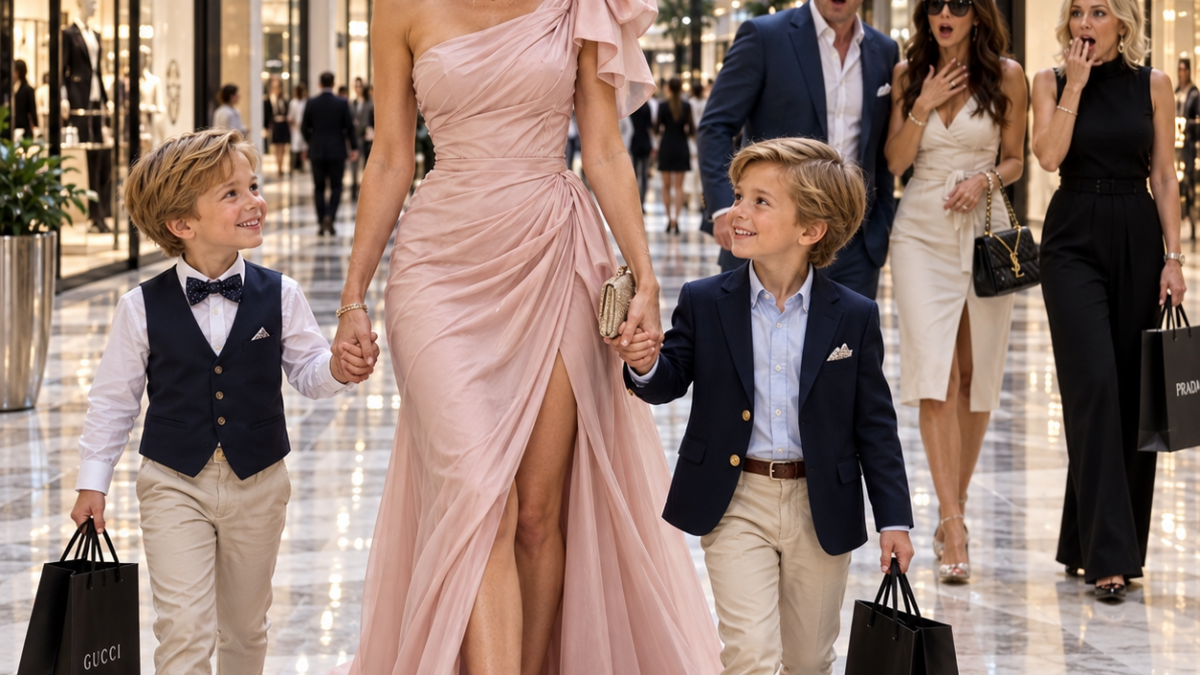
PART2
Preston flinched.
Someone I used to know.
It was cruel.
It was also true.
Before he could say anything else, a woman stepped out of the store behind him.
Not his girlfriend.
Not his wife.
Worse.
His mother.
Victoria Callahan.
The woman who had smiled at me for three years like I was an unfortunate stain on her son’s future. The woman who could freeze a room without lifting her voice. The woman who believed money was not only power, but proof of moral superiority.
She wore cream wool, pearls, and the same expression I remembered from the last time she looked at me.
Controlled disgust.
Then she saw the boys.
Her eyes moved from Liam to Lucas.
Then to Preston.
Then back to my sons.
For the first time since I had known her, Victoria Callahan looked afraid.
Not surprised.
Afraid.
That was when I knew the past was worse than even I understood.
“Preston,” she said sharply. “We’re leaving.”
He did not move.
His eyes stayed fixed on the boys.
“How old are they?” he asked.
I did not answer.
Victoria stepped closer, her smile snapping into place like armor.
“What a coincidence,” she said. “Caroline Whitmore. After all these years.”
I looked at her.
“Victoria.”
Her gaze lowered to my sons again.
Two little boys.
Same height.
Same gray eyes.
Same dark lashes.
Same slight crease between their brows when confused.
She swallowed.
It was subtle.
But I saw it.
Preston did too.
“How old?” he repeated, voice lower now.
Liam answered before I could stop him.
“We’re five.”
Lucas added proudly, “And a half.”
Preston closed his eyes for one second.
When he opened them, there was devastation in them.
Real devastation.
I hated him for it.
Not because it was fake.
Because it was late.
Victoria stepped between us.
“Children, why don’t you go look at the toys?” she said with a sweetness that made my skin crawl.
I pulled both boys closer.
“No.”
Her smile tightened.
“I was only being kind.”
“You’ve never only been kind in your life.”
Her eyes flashed.
Preston looked at me.
“Are they mine?”
The mall noise seemed to disappear.
Shoppers moved around us.
A child cried near the escalator.
A teenager laughed too loudly behind me.
Somewhere, a store played cheerful music.
But all I heard was Preston’s question.
Are they mine?
Five years too late.
I looked at Liam and Lucas.
Their faces were turned up toward me, confused and quiet now.
That was the only thing that kept me from breaking.
“They’re my sons,” I said.
Preston’s jaw tightened.
“That wasn’t what I asked.”
“I know.”
Victoria touched his arm.
“Preston. Not here.”
He pulled away from her.
That tiny movement made her face tighten again.
Good.
“Caroline,” he said, “answer me.”
I laughed once.
It came out colder than I meant.
“No.”
His expression shifted.
“No?”
“You don’t get to demand truth from me in front of my children after buying your way out of it five years ago.”
His face changed so sharply that for a second, I thought I had struck him.
“I bought my way out?”
I stared at him.
“Don’t do that.”
“Do what?”
“Act surprised.”
Victoria stepped in quickly.
“This is inappropriate.”
I looked at her.
“You should be very careful what you call inappropriate.”
Her lips pressed into a thin line.
Lucas tugged my hand.
“Mom, can we go?”
That snapped me back.
“Yes.”
I bent slightly, keeping my voice calm for the boys.
“We’re going to leave now.”
Preston stepped forward.
I looked at him, and he stopped.
Not because I had power over him.
Because my sons were watching.
Maybe some part of him understood that mattered.
“Caroline,” he said, voice rough. “Please.”
That word almost hurt.
Please.
He had not said please five years ago.
He had not begged me to stay.
He had not followed me out of the conference room.
He had let me walk away with two unborn children under my heart and an envelope full of money on the table between us.
I guided Liam and Lucas around him.
Victoria whispered something I almost missed.
“You should have stayed gone.”
I stopped.
Slowly, I turned my head.
Preston heard it too.
His eyes snapped toward his mother.
“What did you say?”
Victoria’s face smoothed instantly.
“Nothing.”
I looked directly at her.
“Don’t worry, Victoria,” I said. “I kept every document.”
Her face went pale.
There it was.
The fear again.
I walked away before either of them could say another word.
In the parking lot, I buckled the boys into their car seats with hands that would not stop shaking.
Liam watched me carefully.
“Mommy, who was that man?”
I pulled the strap across his chest.
“Someone from before you were born.”
Lucas frowned.
“He had our eyes.”
My throat closed.
“Yes,” I whispered. “He did.”
“Is he family?” Liam asked.
I pressed my lips together.
Children have a way of stepping directly onto the truth before adults are ready to admit where it lives.
I kissed his forehead.
“We’ll talk about it later.”
“But is he?” Lucas insisted.
I looked between my sons.
Five years old.
Too young for betrayal.
Too old for lies that would not hold.
“He is part of the story,” I said carefully. “But you are safe. And I am here. That’s what matters right now.”
They accepted that because children trust the voice that tucks them in at night.
I got into the driver’s seat, locked the doors, and gripped the steering wheel until my knuckles went white.
Only then did I let myself shake.
Five years earlier, I had believed love could survive almost anything.
I was twenty eight years old and working as an architectural designer in Chicago. Preston and I had been together for almost three years.
He was not just rich.
Rich was too small a word for the Callahans.
The Callahan family owned hotels, development companies, commercial real estate, private equity holdings, and half the skyline if you believed gossip. Their name opened doors before they knocked. Their donations sat on hospital wings, university buildings, museum plaques, and political campaign reports.
Preston was the oldest son.
The heir.
The careful one.
The one groomed since childhood to protect the family name from scandal, weakness, and unsuitable attachments.
I was unsuitable.
I knew that from the beginning.
I was the daughter of a school librarian and a machinist. I had student loans, a secondhand car, and a tiny apartment with radiator heat that clanked at night. I worked long hours designing spaces other people could afford to live in.
Preston met me at a charity planning meeting for a community housing project.
He asked better questions than the other donors.
That was what got me first.
Not his suit.
Not his name.
Not his smile.
The questions.
He wanted to know where the windows would face in winter. How wide the hallways were for wheelchairs. Whether the playground could be seen from the laundry room so parents could watch children while doing chores.
I thought he cared.
Maybe he did.
Maybe that was the tragedy.
People can care and still choose cowardice when the bill comes due.
For almost three years, Preston was everything I thought I wanted.
He brought coffee to my office when I worked late.
He learned my favorite cheap Thai place even though his mother called it “suspiciously casual.”
He took me to architectural tours in cities where his hotels stood like monuments.
He kissed me in elevators and whispered that one day we would design our own house.
Then I got pregnant.
Twins.
I found out on a Tuesday morning after three weeks of exhaustion I had blamed on work. The ultrasound tech smiled and turned the monitor toward me.
“There are two heartbeats.”
Two.
I laughed and cried at the same time.
On the train to Preston’s office, I kept one hand over my stomach. I imagined his shock. His smile. Maybe fear. Maybe joy. I pictured us calling the babies “the Callahan chaos” and arguing about names.
I arrived at his office with tears of happiness in my eyes and the ultrasound tucked safely in my bag.
His assistant looked uncomfortable when she saw me.
That should have warned me.
“Mr. Callahan is in conference room three,” she said.
Not his office.
Conference room three.
I found him standing by the window overlooking the city.
His back was to me.
On the table was a large white envelope.
He did not kiss me.
He did not touch my stomach.
He did not ask to see the ultrasound.
“Caroline,” he said quietly.
Something inside me began to go cold.
“I have news,” I said, trying to save the moment with my own hope. “Preston, I’m pregnant.”
He closed his eyes.
Not with joy.
With dread.
I felt the room tilt.
“It’s twins,” I whispered.
He turned then.
His face was pale.
For a second, pain moved through his eyes.
Then he buried it.
Callahan training.
Feel nothing where witnesses might see.
He gestured toward the chair.
“Sit down.”
“I don’t want to sit.”
“Please.”
That please was not like the one in the mall.
This one was tired.
Defeated before the fight began.
I sat.
He pushed the envelope toward me.
At first, I did not understand.
Inside was money.
A cashier’s check.
Clinic information.
A legal card.
And a typed document labeled Confidential Resolution Agreement.
My entire body went cold.
“What is this?”
Preston lowered his eyes.
“Caroline, things are complicated right now.”
“Complicated?”
“You know how important my family’s company is. My mother would never accept this situation.”
“This situation?” I repeated.
“Our timing. Your position. The press. The board. My engagement obligations.”
“Your what?”
His jaw tightened.
“My mother has been discussing a merger arrangement with the Langford family. Nothing is final.”
I stared at him.
A merger arrangement.
That was how the Callahans spoke about marriage when love was inconvenient.
“You’re asking me to give up our children,” I said.
He looked like the words hurt him.
But not enough.
“I’m asking you to think carefully about what comes next.”
I pulled the agreement from the envelope with numb fingers.
The language blurred at first.
Confidentiality.
Relocation support.
Medical privacy.
No future claims.
No contact.
No public statements.
Two million dollars.
My breath stopped.
Two million dollars to erase three years of love and two heartbeats.
I pushed the envelope back across the table.
“No, Preston. You’re asking me to disappear.”
He said nothing.
That silence told me everything.
I stood slowly.
For one terrible second, I wanted him to stop me.
I wanted him to knock the envelope off the table, take my hands, say he had panicked, say his mother pressured him, say we would figure it out, say anything that sounded like us.
He did not.
So I looked at him one last time.
“One day,” I said, “you’ll understand exactly what you chose to lose.”
Then I walked out.
I never called him again.
What I did not know then was that the envelope on the table was only half the betrayal.
The other half belonged to Victoria.
I found that out slowly.
Painfully.
In pieces that did not fit until the mall forced them together.
Two days after I left Preston’s office, I received a letter from Callahan counsel.
It said I had refused the proposed resolution and that further attempts to contact Preston would be considered harassment. It said the Callahan family expected discretion. It said any false claims regarding paternity would be vigorously challenged.
False claims.
I was carrying two of his children.
Three days later, my landlord informed me my lease would not be renewed.
My employer suddenly lost a major contract connected to a Callahan development.
A clinic I had visited called to say there had been a “records request error” and I needed to confirm my privacy settings.
Then I noticed a black SUV outside my apartment twice in one week.
I left Chicago before the month ended.
Not dramatically.
No suitcase in the rain.
No final letter.
I packed what fit into my car, gave away furniture, closed accounts, changed my number, and drove to Ohio because my college roommate Elise lived outside Columbus and said, “Come here. We’ll figure it out.”
Elise saved my life.
Not in a movie way.
In a real way.
She met me with soup, prenatal vitamins, a spare room, and no questions I could not answer.
When I finally told her everything, she did not say, Are you sure?
She did not say, Maybe he was scared.
She did not say, Rich families are complicated.
She said, “We need a lawyer.”
That was Elise.
Practical kindness.
She introduced me to Maya Desai, a family attorney who had once represented Elise’s sister during a custody nightmare. Maya read the Callahan letter, the proposed agreement I had photographed before leaving, and every message Preston had ever sent me.
Then she looked at me.
“Do you want money from him?”
“No.”
“Do you want contact?”
“No.”
“Do you want legal protection if he comes later?”
I put both hands over my stomach.
“Yes.”
Maya helped me prepare.
Not to sue.
To survive.
She documented everything.
My pregnancy.
My move.
The threatening legal letter.
The fact that I had refused the money.
The fact that Preston had been informed before the birth.
She told me to keep records because wealthy families rewrite stories for sport.
She was right.
Liam and Lucas were born five weeks early during a snowstorm.
They were tiny.
Furious.
Perfect.
Lucas came first, screaming like he objected to the lighting.
Liam followed two minutes later, quieter at first, then louder once he realized his brother was getting attention.
I named them without asking anyone.
Liam Henry Whitmore.
Lucas James Whitmore.
Not Callahan.
Never Callahan.
When the nurse placed them in my arms, both boys opened their eyes briefly.
Gray.
Both of them.
Preston’s eyes looking at me from two impossibly small faces.
I cried so hard the nurse thought something was wrong.
Everything was wrong.
Everything was beautiful.
Both things can be true.
The first year was brutal.
Premature twins do not care about heartbreak.
They care about feeding schedules, reflux, sleep, diapers, doctor visits, and crying in stereo at 2:00 a.m. I freelanced from Elise’s kitchen table while the boys slept in bassinets beside me. I took contract design work no one else wanted because it paid quickly. I learned to shower in four minutes and eat standing up.
Some nights, I resented Preston so deeply I scared myself.
Not because I wanted him back.
Because I wanted to know what it felt like to be the kind of person who could sleep after walking away.
Then I would look at the boys.
Their curled fists.
Their tiny mouths.
Their matching gray eyes.
And I would remember that I had not walked away from nothing.
I had walked away carrying everything.
By the time they were five, I had built a life.
Not an easy one.
A real one.
We had a small townhouse with a blue front door. A backyard barely large enough for a plastic slide. A kitchen wall covered in preschool art. A savings account that grew slowly. A design studio I co-owned with Elise, focusing on accessible residential renovations and small community projects.
No private jets.
No Callahan money.
No envelopes.
Just work.
Love.
And peace.
Then Cedar Point Mall happened.
That night, after the boys fell asleep, I sat at my kitchen table staring at my phone.
Preston had not called.
I had no idea if he had my number.
But at 9:17 p.m., Maya called me.
“Caroline,” she said, “did something happen today?”
My stomach tightened.
“Why?”
“I received an email from Callahan corporate counsel requesting confirmation of whether I still represent you.”
The room went cold.
“How did they know you represented me?”
“They shouldn’t.”
“Victoria,” I whispered.
“What happened?”
I told her about the mall.
The silence on the line grew sharp.
Then Maya said, “Do not speak to Preston without me.”
“I wasn’t planning to.”
“Good. Also, Caroline?”
“Yes?”
“I pulled the file after receiving the email. There is something I want to review with you tomorrow.”
“What?”
“The resolution agreement.”
I closed my eyes.
“I never signed it.”
“I know,” Maya said. “That’s why this is strange.”
The next morning, I dropped the boys at Elise’s house and drove to Maya’s office.
Maya had printed documents across the conference table.
The old proposed agreement.
The Callahan letter.
Emails from five years ago.
A certified mail receipt.
And one new document I had never seen.
My name was at the top.
Caroline Whitmore.
Below it was a signature.
My signature.
Except it was not mine.
I felt the floor disappear beneath me.
“What is that?”
“A settlement acknowledgment,” Maya said carefully. “It appears to state that you accepted two million dollars in exchange for confidentiality and waiver of future claims related to Preston Callahan.”
I gripped the chair.
“I never signed that.”
“I know.”
“I never took money.”
“I know.”
My voice rose.
“Maya, I never took one cent.”
She stood and placed both hands on the table.
“Caroline. I believe you. Sit down.”
I sat because my legs had started shaking.
Maya continued, “This document was not in the packet you gave me five years ago. But Callahan counsel referenced a resolved matter in their email last night. So I pushed back. This was sent to me at 7:42 this morning.”
I stared at the fake signature.
Someone had forged my name.
Someone had made Preston believe I had taken two million dollars to disappear.
My mouth went dry.
“Did Preston know?”
Maya’s eyes sharpened.
“That is the question.”
By noon, we had more answers.
Maya contacted the bank listed in the settlement record. A wire had been initiated five years ago from a Callahan family account.
Two million dollars.
Recipient: a trust entity called C.W. Resolution Holdings.
Authorized by Victoria Callahan.
Controlled by a law firm connected to Victoria personally, not Callahan corporate.
The money had never reached me.
The account was closed eight months later.
Funds transferred.
Not to me.
Not to my children.
To a private Callahan foundation account used for “reputation management expenses.”
Victoria had created a fake settlement, forged my signature, moved two million dollars through a shell trust, and apparently told everyone I had taken the money.
Including Preston.
I sat in Maya’s office while the truth crawled over my skin.
“She stole from him,” I said slowly.
“Yes.”
“And used me to hide it.”
“Yes.”
“And made him think I sold the babies.”
Maya’s face softened.
“Possibly.”
I stared at the documents.
The room blurred.
For five years, I had carried Preston’s abandonment like a scar.
But now there was another wound underneath it.
Had he believed I had accepted the money?
Had he thought I walked away willingly?
Had Victoria told him the twins were gone?
No.
I stopped that thought before it could become mercy.
Preston had still pushed the envelope toward me.
He had still chosen silence.
He had still let me leave.
Victoria may have built the lie afterward, but Preston laid the first stone.
My phone rang while I was still in Maya’s office.
Unknown number.
Maya looked at me.
“Let it go.”
I did.
A voicemail appeared seconds later.
Maya nodded for me to play it on speaker.
Preston’s voice filled the room.
“Caroline. It’s Preston. I don’t know if this is still your number. I got it from old records. I know I have no right to call, but I need to speak with you. Please. I need to know if those boys are mine.”
His voice cracked slightly.
“And I need to understand why my mother is lying.”
I looked at Maya.
She rewound the voicemail.
Played the last sentence again.
Why my mother is lying.
So he knew something.
Or at least, he had finally started asking the right question.
Maya said, “Do you want me to respond?”
“Yes.”
“What do you want to say?”
I looked at the forged signature.
Then the wire record.
Then the old envelope copy.
“Tell him if he wants answers, he can come to your office tomorrow at ten. Alone. No mother. No corporate counsel. No threats.”
Maya nodded.
“And the boys?”
“He does not see them.”
“Until?”
“Until I know exactly what he knew and exactly what he plans to do with the truth.”
Preston arrived at 9:48 the next morning.
Twelve minutes early.
He wore a dark suit but no tie. His face looked like he had not slept. Maya brought him into the conference room, where I sat with a folder in front of me and a wall of five years between us.
For a moment, neither of us spoke.
He looked at me the way he had in the mall.
Like grief had finally found an address.
“Caroline,” he said.
“Sit down.”
He did.
Maya stayed beside me.
Preston noticed.
“Are we doing this through attorneys?”
“Yes.”
He nodded slowly.
“I deserve that.”
“You deserve worse.”
His jaw tightened, but he accepted it.
Good.
That was new.
I opened the folder and took out a photo of Liam and Lucas at their fifth birthday party.
Matching superhero shirts.
Chocolate frosting on Lucas’s cheek.
Liam holding up five fingers with intense concentration.
I slid the photo across the table.
Preston stared at it.
His face broke.
Not completely.
Callahan men probably trained in mirrors until they could bleed politely.
But enough.
He touched the edge of the photo with one finger.
“What are their names?”
“Liam and Lucas.”
He closed his eyes.
“Twins.”
“Yes.”
“Boys.”
“Yes.”
A tear slipped down his face.
He wiped it quickly, as if embarrassed.
I hated that the tear moved me.
I hated that grief in him still knew how to reach grief in me.
Maya spoke before I had to.
“Mr. Callahan, Caroline agreed to this meeting to clarify facts. You will not request contact with the children today. You will not make legal threats. You will answer questions directly.”
Preston looked at her.
“Understood.”
I leaned forward.
“What did your mother tell you?”
He looked back at the photo.
Then at me.
“That you took the money.”
The words hit even though I expected them.
“What money?”
“Two million dollars.”
My laugh came out sharp.
“Of course.”
His eyes lifted.
“She said you signed an agreement. That you wanted no contact. That you had decided not to continue the pregnancy.”
My whole body went cold.
Not continue the pregnancy.
Maya’s pen stopped moving.
Preston’s voice roughened.
“She showed me paperwork.”
“Forged paperwork.”
“I know that now.”
“Do you?”
His eyes held mine.
“I saw the boys.”
I could not breathe for a second.
He continued.
“At the mall, I knew. I knew before Liam said they were five. I knew when I saw their eyes. Then I looked at my mother, and she looked afraid. Not surprised. Afraid.”
His mouth tightened.
“I went to her house that night. I asked her directly. She said you had lied. That you had always been after money. That if the children existed, you must have hidden them to trap me later.”
My hands curled into fists.
“Convenient.”
“Yes.”
“What did you do?”
“I asked to see the settlement documents. She stalled. I called corporate counsel. They found references to a resolved matter but not the original transfer records. Then I contacted your attorney.”
He looked at Maya.
“I wanted to know whether the agreement was real.”
Maya placed a copy of the forged document in front of him.
“Did you sign this?”
Preston looked at it.
“No.”
My head snapped up.
“What?”
“I signed an authorization to establish a support fund,” he said.
My chest tightened.
“A support fund?”
His face filled with shame.
“The envelope I gave you had options. Money. An attorney. Clinic information.”
“Clinic information,” I repeated.
He flinched.
“I did not choose that clinic. My mother’s attorney included it. I should have removed it. I should have burned the whole envelope. I know.”
“You pushed it toward me.”
“Yes.”
“You called our children a complication.”
His eyes closed.
“I did.”
“You let me walk out.”
“Yes.”
“You don’t get to rewrite that as support.”
“I’m not trying to.”
His voice was low now.
“I was a coward, Caroline. My mother told me the board would remove me. She said the Langford merger would collapse. She said you would be destroyed by press, investors, and my family if I tried to bring you in. I told myself giving you money and distance was protection.”
“Protection?”
My voice cracked.
“I was pregnant, Preston.”
“I know.”
“No. You don’t. I was alone. I moved states. I gave birth early in a snowstorm. I fed two babies every two hours while trying to work from a borrowed kitchen table.”
He looked destroyed.
Good.
“I counted diapers,” I said. “I stretched groceries. I cried in the shower because it was the only place the boys couldn’t hear me. I watched them open their eyes and saw yours every single day.”
My breath shook.
“And you were grieving a lie your mother wrote with my name on it.”
He looked down.
“Yes.”
The room went silent.
Then I asked the question that mattered most.
“When she told you I had ended the pregnancy, did you try to find me?”
He did not answer quickly.
That was answer enough.
Finally, he said, “No.”
I leaned back.
Pain moved through me.
Old.
New.
Worse because I had almost hoped.
“Why?”
His voice was barely above a whisper.
“Because I believed I had no right.”
“No. Try again.”
He looked at me.
I saw the truth before he spoke.
“Because if I found you and it was true, I would have to face what I had done.”
There it was.
Not Victoria.
Not forged documents.
Not family pressure.
Preston.
A coward honest enough, finally, to name himself.
I nodded slowly.
“That is the first thing you’ve said today that I believe completely.”
He swallowed.
Maya slid the wire records across the table.
“Your mother authorized two million dollars into a shell entity. Caroline never received it. The signature is forged. The funds appear to have been redirected.”
Preston read.
His face hardened in a way I had never seen before.
Not at me.
At the paper.
At his mother.
At the empire that raised him to value reputation over blood.
“She stole it,” he said.
“She used me to steal it,” I corrected. “And used my unborn children as the cover.”
His hand tightened around the document.
“I will make this right.”
I laughed, and the sound was ugly.
“You cannot make five years right.”
He looked at me.
“I know.”
“No, Preston. Listen to me. You can repay stolen money. You can expose your mother. You can take a DNA test. You can sign checks until your wrist hurts. But you cannot give Liam and Lucas their first steps back. Their first words. The NICU. The fevers. The preschool mornings. The nights they asked why other kids had dads and I said families come in different shapes because I refused to make them feel abandoned.”
His eyes filled.
I kept going.
“You cannot buy back the version of me who walked into your office happy.”
He whispered, “I know.”
“Good.”
Maya folded her hands.
“Mr. Callahan, before any discussion of paternity, custody, visitation, or support, we will need complete financial disclosure related to the settlement entity, all communications between you, your mother, and counsel, and written agreement that you will not approach the children without Caroline’s consent.”
He nodded.
“Done.”
“That is not a casual answer,” Maya said.
“It wasn’t casual.”
I studied him.
“Do you want custody?”
His eyes returned to the photo.
“I want to know them.”
“That is not what I asked.”
He looked at me.
“I don’t know what I have the right to want.”
I hated that answer because it was almost decent.
“I will not let you walk into their lives like a Callahan heir collecting property.”
“I won’t.”
“If you fight me in court, I will bury you in every document I kept.”
“I believe you.”
“If your mother comes near them, I will get a protective order.”
His face changed.
“She won’t.”
“You don’t control her as well as you think.”
“No,” he said quietly. “Clearly I never did.”
When Preston left, he took nothing but a copy of the forged agreement and a photograph Maya allowed him to keep after I nodded.
I watched through the window as he stood outside the building, looking down at the picture of our sons.
He did not get into his car for a long time.
That night, Victoria Callahan called me.
I do not know how she got my number.
Of course she did.
People like Victoria always know how to find a door they were not invited to open.
I let it go to voicemail.
Her voice was smooth.
“Caroline. This is Victoria Callahan. I think it would be best for everyone if we spoke privately before Preston makes a mess of old misunderstandings.”
Old misunderstandings.
I nearly threw the phone.
She continued.
“Children are fragile, and sudden disruption can be harmful. I’m sure you understand that whatever happened years ago, you have built your life. There is no need to involve lawyers in something that can be settled discreetly.”
Settled discreetly.
Again.
Always money first.
Then silence.
Then burial.
Maya listened to the voicemail the next morning and smiled the way attorneys smile when someone has handed them a gift wrapped in arrogance.
“Good,” she said.
“Good?”
“She contacted you directly. She referenced settlement. She confirmed knowledge of the children indirectly. She sounds worried.”
“I don’t want her worried. I want her away from my sons.”
“That comes next.”
Victoria did not stay away.
Two days later, she showed up at the preschool.
That was her second mistake.
Liam and Lucas attended a small private preschool ten minutes from our townhouse. I chose it because the teachers were kind, the playground was fenced, and nobody cared that my boys sometimes arrived with mismatched socks because they had strong opinions about independence.
At 11:30 a.m., I received a call from the director, Mrs. Alvarez.
“Caroline,” she said carefully, “there is a woman here asking to see Liam and Lucas.”
My blood went cold.
“What woman?”
“She says she is their grandmother.”
I stood so quickly my chair rolled backward.
“I’m on my way. Do not let her near them.”
“We haven’t. The boys are in class. She is in the lobby.”
“Call the police if she refuses to leave.”
There was a pause.
“She is being very insistent.”
“I’m five minutes away.”
I called Maya from the car.
Then Preston.
He answered immediately.
“Caroline?”
“Your mother is at my sons’ preschool.”
Silence.
Then his voice changed.
“I’m handling it.”
“No. I am handling it. You are going to tell me right now whether you sent her.”
“I didn’t.”
“Do you know she went?”
“No.”
“If you are lying—”
“I’m not.”
I could hear movement on his end. A door. Voices. His tone when he spoke again was lethal.
“Do not let her leave before I get there.”
I hung up because his orders were not my plan.
When I arrived, Victoria stood in the preschool lobby wearing navy silk and pearls, holding a gift bag from an expensive toy store.
Mrs. Alvarez stood behind the desk with the expression of a woman who had physically placed politeness between children and danger.
Victoria turned when I entered.
“Caroline,” she said warmly. “There you are.”
I ignored her warmth.
“You need to leave.”
Her smile tightened.
“I only wanted to meet my grandsons.”
“You do not have grandsons.”
Her eyes flashed.
“Let’s not be cruel.”
I stepped closer.
“Cruel was forging my signature on a two million dollar agreement and telling your son I took money to disappear.”
Mrs. Alvarez’s eyes widened.
Victoria’s face went still.
“Lower your voice.”
“No.”
She looked toward the hallway.
“I know you are emotional.”
“And I know you are trespassing in my children’s school.”
Her gaze sharpened.
“Do you really want to make an enemy of me?”
I laughed.
Not loudly.
But enough.
“Victoria, you made an enemy of me when you used my unborn children to steal from your own family.”
Her hand tightened around the gift bag.
“You have no idea what you’re talking about.”
“I have wire records.”
Her face paled.
“I have the forged settlement.”
Her jaw tightened.
“I have the lawyer who received your voicemail.”
For the first time, fear fully replaced her mask.
Then the front doors opened.
Preston walked in.
He was not alone.
A man in a gray suit followed him, and though I did not know his name then, I later learned he was a private investigator Preston had hired that morning.
Victoria turned sharply.
“Preston.”
He looked at her.
Not like a son.
Like a man seeing a stranger wearing his childhood.
“Why are you here?”
She lifted the gift bag slightly.
“To see my grandchildren.”
His voice was cold.
“You do not know them.”
“I am your mother.”
“And apparently a forger.”
Her face hardened.
Mrs. Alvarez whispered, “I’m going to call security.”
“Please do,” I said.
Victoria lowered her voice.
“Preston, do not do this in public.”
“Why?” he asked. “You did everything else in secret.”
That hit her.
Her mouth trembled for half a second before she recovered.
“You were falling apart. You were about to throw away your future for a woman who would never fit our life.”
I stared at her.
There it was.
Not regret.
Not denial.
Just justification.
Preston’s voice dropped.
“So you forged her signature?”
Victoria looked at me.
“Caroline refused what was best for everyone.”
“What was best for everyone?” I repeated.
“She would have been destroyed by our world.”
“I was destroyed by you.”
Her nostrils flared.
Preston took one step forward.
“Did you tell me she ended the pregnancy?”
Victoria said nothing.
“Mother.”
Her eyes filled suddenly.
Real tears.
Weaponized or not, I could not tell.
“I protected you.”
Preston’s face twisted.
“No. You robbed me.”
“I saved you from scandal.”
“You took my sons.”
The lobby went silent.
Even Victoria seemed shaken by the words.
My sons.
He had said it like a truth and a wound.
I hated him for being right.
I hated myself for noticing.
Victoria whispered, “You were not ready.”
Preston’s voice broke.
“That was not your decision.”
“And you would have made the wrong one,” she snapped. “Look at you now. One glimpse of two little faces and you’re ready to burn down everything your grandfather built.”
Preston looked at me.
Then back at his mother.
“Maybe it should have burned years ago.”
Security arrived before she could answer.
Victoria left with her head high, but her hand shook as she clutched the toy store bag.
Mrs. Alvarez documented everything.
Maya filed for an emergency order preventing Victoria from approaching the school, my home, or the boys.
Preston signed a sworn statement confirming he had not authorized her visit.
That statement changed the direction of everything.
For the first time, Preston was not standing opposite me.
He was standing against his mother.
I did not trust it.
But I used it.
The DNA test happened two weeks later.
Not because anyone needed it emotionally.
Because court needed paper.
Preston requested it through Maya, not directly.
He did everything correctly now.
That annoyed me too.
It is hard to stay cleanly furious when someone starts behaving exactly as they should have from the beginning.
The results came back on a rainy Thursday morning.
Probability of paternity: 99.9999%.
I stared at the page.
Liam and Lucas Callahan by blood.
Whitmore by name.
Mine by every night, every fever, every grocery trip, every school form, every lullaby, every impossible morning.
Preston called Maya after receiving his copy.
Not me.
Good.
He asked if he could write the boys a letter.
I almost said no.
Then Maya said, “You do not have to give it to them. But it may be useful to know what he says when he cannot perform in person.”
So I allowed it.
The letter arrived three days later.
Two pages.
Handwritten.
Liam and Lucas,
My name is Preston Callahan. You do not know me yet, and that is my fault, not yours.
I knew your mother before you were born. I loved her, but I did not protect that love when I should have. I made choices that hurt her, and because of those choices, I missed the first five years of your lives.
That is something I will regret forever.
I am not writing to ask you for anything. I am not writing to tell you what to feel. Your mother has taken care of you every day, and she is the reason you are safe, loved, and strong.
If someday she decides it is right for you to know me, I will be grateful. If that day takes a long time, I will wait. If you are angry when you learn the truth, you have the right to be.
I hope you like robots. I saw that at the mall.
I also hope you know your mother is braver than anyone I have ever met.
Preston
I read it twice.
Then cried.
I hated that too.
Not because I forgave him.
Because the letter did not ask for anything.
It did not accuse.
It did not excuse.
It did not mention money.
It did not say his mother lied, even though she had.
It said my fault.
That mattered.
I put the letter in a folder labeled Later.
Not now.
Later.
The civil case against Victoria unfolded like a mansion collapsing from termites no one wanted to admit were there.
Maya brought in a financial crimes attorney named Jonah Fields. Preston hired independent counsel separate from Callahan corporate. That alone caused gossip. When the Callahan heir hires counsel against his own mother, rich people whisper louder than poor people shout.
The two million dollar transfer became the center.
Victoria claimed the money had been used for crisis management after I made “potentially damaging threats.”
There was one problem.
I had made no threats.
There was another problem.
Her own attorney had kept notes.
Apparently, Victoria’s personal counsel at the time, a man named Gerald Pike, had retired and developed either a conscience or fear of prison. When subpoenaed, he produced internal memos showing Victoria directed the creation of the shell entity.
One note read:
V.C. insists C.W. signature can be obtained through alternate documentation if subject refuses direct execution.
Alternate documentation.
A pretty phrase for forgery.
Another note read:
P.C. to be informed matter resolved. No additional contact recommended.
P.C.
Preston Callahan.
Victoria had not only forged my signature.
She had managed her son’s grief like a public relations issue.
Preston found out in a conference room surrounded by lawyers.
I was not there, but Maya later told me his face went white when the memo was read.
He had believed he was abandoned because he deserved it.
In part, he did.
But he had also been lied to by the woman who raised him.
That kind of betrayal is its own inheritance.
The first supervised meeting between Preston and the boys happened four months after the mall.
Four months of attorneys.
Therapists.
Child specialists.
Questions.
Preparation.
I told Liam and Lucas the truth in pieces.
Age appropriate pieces.
Their father had not known they were alive.
Their grandmother had made very bad choices.
Their mother had kept them safe.
Their father wanted to meet them.
Liam asked, “Is he the gray eyes man?”
“Yes.”
Lucas asked, “Did he lose us?”
I almost broke.
“In a way,” I said.
Liam frowned.
“Like at the mall?”
“Bigger than that.”
Lucas thought about this.
“Did he look?”
I closed my eyes.
“No. Not the way he should have.”
Children understand more than adults hope and less than adults fear.
The meeting took place at a family counseling center with a therapist present. Preston arrived early with no gifts because the therapist had advised against trying to buy affection.
He looked terrified.
That gave me satisfaction I am not proud of.
The boys stood beside me, both unusually quiet.
Preston crouched to their level but did not move closer.
“Hi,” he said. “I’m Preston.”
Liam studied him.
“You have our eyes.”
Preston swallowed.
“Yes.”
Lucas looked at me.
“Mom said you lost us.”
Preston’s face crumpled.
He did not look at me for help.
Good.
He answered them.
“I did. And I should have looked harder.”
Liam frowned.
“Why didn’t you?”
The therapist shifted slightly but did not interrupt.
Preston took a slow breath.
“Because I believed something that was not true. And because I was scared to find out the truth.”
Lucas said, “Mom finds things when we lose them.”
Preston’s eyes filled.
“She does.”
Liam asked, “Do you like robots?”
That saved him.
For twenty minutes, Preston learned more about toy robots than any adult man needed to know. Lucas explained dinosaur rankings. Liam asked if Preston had a car. Preston said yes. Liam asked if it was faster than Mom’s. Preston looked at me and wisely said, “No.”
The boys laughed.
I nearly cried.
Not because it was beautiful.
Because it was normal.
And normal, after five years of fear, can feel like a knife.
Afterward, Preston walked us to the parking lot but stopped several feet from the car.
Boundaries.
He was learning.
“Thank you,” he said.
I buckled Lucas in first.
“For them. Not for you.”
“I know.”
I looked at him over the car roof.
“Do you?”
His mouth tightened.
“I’m trying to.”
That was the only answer I could accept.
Victoria was indicted six months after the mall encounter.
Forgery.
Wire fraud.
Financial misconduct connected to the settlement fund.
Obstruction.
The Callahan family tried to keep it quiet.
They failed.
The headline was brutal.
CALLAHAN MATRIARCH ACCUSED OF FORGING SETTLEMENT IN HEIR PATERNITY COVER UP.
My name did not appear in the first article.
Then it did.
Caroline Whitmore, architectural designer and mother of twin sons fathered by Preston Callahan.
I hated every word.
Not because it was false.
Because once your private pain becomes public fact, strangers believe they own a vote.
People online called me a gold digger.
A saint.
A liar.
A victim.
A strategist.
A woman who “played the long game.”
I wanted to scream.
The long game was diapers, debt, and daycare.
The long game was two premature babies with reflux.
The long game was working until midnight because preschool tuition did not care about heartbreak.
Preston issued one public statement.
Ms. Whitmore did not seek publicity, payment, or advantage. She refused money five years ago and has raised our sons with integrity, privacy, and courage. Any suggestion otherwise is false.
Our sons.
I stared at that phrase.
Our.
It still felt dangerous.
But less like theft than before.
Victoria’s trial lasted eight days.
I testified on day three.
Walking into that courtroom felt like walking back into the conference room where Preston had pushed the envelope toward me.
Only this time, I was not alone.
Maya sat beside me.
Elise sat behind me.
Preston sat on the opposite side of the courtroom, not with his mother.
That mattered.
Victoria wore gray.
Not cream.
Not pearls.
Gray, like she wanted to look modest after a lifetime of treating modesty as something for employees.
Her eyes found mine when I took the stand.
She looked at me with the same contempt as always.
But beneath it was fear.
The prosecutor asked me about Preston.
Our relationship.
The pregnancy.
The meeting in his office.
The envelope.
My refusal.
My move.
The boys.
Then he showed me the forged agreement.
“Is this your signature?”
“No.”
“Did you receive two million dollars?”
“No.”
“Did you authorize anyone to create C.W. Resolution Holdings?”
“No.”
“Did you agree to waive future claims regarding your children?”
“No.”
“Did you terminate the pregnancy?”
My voice caught.
The courtroom went very still.
“No,” I said. “My sons are alive.”
Preston closed his eyes.
Victoria looked away.
Then her attorney cross examined me.
Of course he tried to make me look calculating.
“You never contacted Mr. Callahan after leaving Chicago?”
“No.”
“You never asked him for support?”
“No.”
“You never told him the children were born?”
“No.”
“Yet you kept records of the proposed settlement?”
“Yes.”
“Why?”
“Because his family had already threatened me legally.”
“You were preparing to sue?”
“No.”
“You simply kept documents for five years?”
“Yes.”
He smiled faintly.
“That seems unusual.”
I looked at him.
“I was a pregnant woman threatened by billionaires. Keeping paper did not feel unusual. It felt like breathing.”
The smile disappeared.
He tried another direction.
“Isn’t it true you were angry when Mr. Callahan did not choose you?”
“Yes.”
A ripple moved through the room.
He looked pleased.
I continued before he could weaponize it.
“I was heartbroken. I was pregnant. I was afraid. I was angry that the man I loved put an envelope on a table where his joy should have been. But anger is not forgery. Heartbreak is not wire fraud. And raising my children alone is not evidence that I invented what his mother did.”
The prosecutor did not need to redirect much after that.
Preston testified next.
I watched him take the stand.
For years, I had imagined him being forced to tell the truth.
I thought it would feel like justice.
Instead, it felt like surgery.
Necessary.
Bloody.
Too late to prevent damage.
He admitted he had offered the envelope.
He admitted he had failed me.
He admitted he let his mother control the response.
Then the prosecutor showed him the forged agreement.
“Did you believe Caroline Whitmore signed this?”
“Yes.”
“Who told you that?”
“My mother.”
“Did you believe Ms. Whitmore accepted two million dollars?”
“Yes.”
“Did you believe she ended the pregnancy?”
Preston’s jaw worked.
“Yes.”
“And when you learned that was not true?”
He looked toward me.
Then at the jury.
“I realized my mother had stolen five years from my sons. And I had helped her by being too ashamed to look for the truth.”
Victoria’s face remained still.
But her hands trembled.
On the final day, the prosecutor played a recording from Victoria’s former attorney.
Gerald Pike had secretly recorded a call when he began fearing liability.
Victoria’s voice filled the courtroom.
“Preston cannot know the details. He will mourn and move on. Caroline is nobody. If she resurfaces, we’ll say she took the money and regretted it.”
The prosecutor paused the audio.
Caroline is nobody.
I looked at Victoria.
All those years, that was what she had believed.
Not unsuitable.
Not inconvenient.
Nobody.
Then the prosecutor resumed.
Gerald Pike asked, “And if there are children?”
Victoria laughed.
“There won’t be. Women like that always choose survival.”
Women like that.
She meant women without family money.
Women without board seats.
Women without lawyers on retainer.
Women who could be frightened, isolated, erased.
She had misunderstood one thing.
I did choose survival.
I just did not choose her version.
Victoria was convicted.
Not on every count.
Enough.
The sentence was not as long as people expected, because wealth still knows how to cushion falls. But she did not walk away untouched.
Prison time.
Financial penalties.
Restitution.
Removal from the Callahan Foundation board.
Civil liability.
Public disgrace.
The Callahan family name survived, because names like that are built to survive almost anything.
But Victoria’s control did not.
That mattered more.
After sentencing, Preston found me outside the courthouse.
He did not approach too closely.
He had learned that distance could be respect when earned slowly.
“Caroline,” he said.
I turned.
He looked tired.
Older than thirty seven.
“She wants to appeal,” he said.
“I assumed.”
“I won’t support it.”
“Good.”
He looked down.
“The restitution account. I want it placed entirely for the boys. Not to you unless you want it. Education, health care, anything they need.”
“I can provide for them.”
“I know,” he said quickly. “You have. Better than I deserved.”
“Then why?”
“Because the money existed because of them. Because it was stolen in their name. Because even if you never needed it, it should never return to the people who used them.”
That was fair.
I hated that it was fair.
“I’ll discuss it with Maya.”
He nodded.
Then he said, “I’m sorry.”
I had heard those words before.
From him.
From others.
From people who wanted absolution cheap.
But this one sounded different.
Not bigger.
Not dramatic.
Specific.
“I am sorry I put the envelope on that table. I am sorry I let you walk out. I am sorry I believed paperwork because it hurt less than finding you. I am sorry I missed their first five years. I am sorry you carried fear that belonged to me.”
My throat tightened.
“I don’t know what to do with that.”
“You don’t have to do anything.”
I looked at him.
He gave a sad half smile.
“I’m learning that apologies are not invoices.”
That almost broke me.
Because that sounded like something he had learned in therapy.
Maybe he had.
Good.
“Preston.”
“Yes?”
“You can keep seeing them. Slowly. Supervised until Maya and the therapist say otherwise.”
His face changed.
Hope.
Careful, frightened hope.
“But if you ever use money, lawyers, or your name to push faster than they are ready for, I will stop it.”
“I know.”
“If you ever let your family near them without my consent, I will stop it.”
“I know.”
“If you ever make them feel like they are Callahan heirs before they are children, I will stop it.”
His eyes softened.
“I want them to be children.”
“For how long?”
“As long as they can.”
That was the best answer he had given me.
The boys got to know Preston slowly.
Not as Father.
Not at first.
As Preston.
The gray eyes man.
The robot guy.
The man who wore suits but sat on the floor when Lucas insisted dinosaurs could defeat all vehicles, including helicopters.
At first, visits were awkward.
Liam was cautious.
Lucas was curious.
Preston was terrified of doing the wrong thing and therefore did the wrong thing often in small, harmless ways.
He brought books too advanced for them.
Liam told him, “We are five, not forty.”
He bought sneakers without asking their size.
Lucas said, “My feet are not guesses.”
He once wore a suit to a playground.
Both boys stared at him until he removed his jacket and rolled up his sleeves.
But he kept showing up.
On time.
Without gifts unless approved.
Without press.
Without his mother.
Without demands.
The first time Liam called him Dad was accidental.
We were at the zoo, six months after the trial.
Preston had joined us for a Saturday visit. Lucas dropped his stuffed tiger near the penguin exhibit, and Preston bent to pick it up.
Liam said, “Dad, wait, Lucas dropped Stripe.”
The world stopped.
Preston froze with the tiger in his hand.
Liam froze too, realizing what he had said.
I held my breath.
Preston crouched and handed the tiger to Lucas.
Then he looked at Liam.
“You can call me Preston if that feels better,” he said softly.
Liam stared at him.
“What do you want?”
Preston’s eyes filled.
“I want you to choose.”
Liam considered this seriously.
Then said, “Okay, Dad.”
Lucas immediately said, “If he says Dad, I say Dad too.”
Preston laughed and cried at the same time.
I turned toward the penguins because I did not want them to see me cry too.
That night, after I put the boys to bed, I sat on the porch with a cup of tea and let the grief move through me.
Not grief that Preston was becoming their father.
Grief that he had not been there sooner.
Grief that forgiveness, if it came at all, would not restore what was missing.
Grief that my sons were happy and I still hurt.
Maya once told me that children can receive a repaired relationship while mothers still carry the cost of the years before repair.
She was right.
Preston did not ask me to move.
He did not ask me to change the boys’ names.
He did not ask me to be with him again.
He rented a modest house ten minutes away from ours when he came to Ohio. Not a mansion. Not a hotel suite. A house with a backyard and ugly carpet the boys loved because they could slide on it in socks.
He spent half his time in Columbus and half in Chicago as Callahan Holdings went through its own reckoning.
Victoria’s conviction triggered audits.
Audits triggered resignations.
Resignations triggered headlines.
Preston stepped down from several family boards and created an independent structure for his own work. He sold assets tied to his mother’s foundation. He testified in civil proceedings even when it embarrassed the family.
It cost him.
Good.
Some lessons should.
One evening, almost a year after the mall, he came to my studio after a visit with the boys.
Elise had gone home.
The office smelled like trace paper, coffee, and sawdust from a model we were building.
Preston stood near the doorway.
“I brought back Lucas’s jacket. He left it in my car.”
“Thanks.”
He placed it on the chair.
Then he looked at the model on the table.
“What is this?”
“Affordable senior housing redesign. Better light, wider kitchen paths, shared garden.”
He smiled faintly.
“You still design places like answers.”
I looked up.
“What does that mean?”
“When I first met you, you said every building answers a question about what people deserve.”
I remembered saying that.
I did not remember him remembering.
“That was a long time ago.”
“Yes.”
He slid his hands into his coat pockets.
“I was an idiot then.”
“You were a coward.”
He nodded.
“That too.”
The honesty still surprised me.
He looked around the studio.
“I loved you, Caroline.”
My chest tightened.
“Preston.”
“I’m not saying it to ask for anything.”
“Then why say it?”
“Because I spent years letting my mother define what happened. Then I spent months letting guilt define it. Neither is the whole truth.”
I looked down at my plans.
He continued.
“I loved you. I failed you. Both are true. I don’t expect love to matter more than failure. I just need to stop pretending the failure means the love was fake.”
My throat hurt.
For years, I had survived by making him into a villain.
It helped.
It gave shape to the pain.
But the truth was harder.
Preston had loved me.
And still failed.
He had been manipulated.
And still responsible.
He had lost his sons because of Victoria.
And because of himself.
Both.
Always both.
“I loved you too,” I said quietly.
He closed his eyes.
I continued.
“That doesn’t mean I trust you.”
“I know.”
“It doesn’t mean I want our old life back.”
“I know.”
“It doesn’t mean I forgive you.”
His eyes opened.
“I know.”
I looked at him.
“But it means I don’t want to lie about what it was.”
His face softened.
“That is more than I deserve.”
“Yes,” I said. “It is.”
He laughed softly.
So did I.
That was the first easy sound between us in six years.
Preston earned more time with the boys.
Then unsupervised afternoons.
Then overnights when the therapist approved it and the boys asked.
The first overnight nearly killed me.
I packed their bags like they were leaving for college instead of sleeping ten minutes away.
Pajamas.
Toothbrushes.
Favorite stuffed animals.
Allergy medicine.
Extra socks.
Emergency numbers.
A note reminding Preston that Lucas needed the dinosaur night light facing the closet because shadows were “suspicious.”
When Preston arrived to pick them up, he read the list solemnly.
“I can handle this.”
I gave him a look.
He corrected himself.
“I will follow the list exactly.”
“Better.”
The boys ran to his car with backpacks bouncing.
Liam turned back at the last second.
“Mom! We’ll come back tomorrow!”
“I know!”
Lucas shouted, “If Dad burns pancakes, can we call you?”
“Yes!”
Preston looked offended.
“I can make pancakes.”
Lucas whispered loudly, “He cannot.”
They drove away.
I stood in the driveway until the car disappeared.
Then I went inside and cried into a dish towel for ten minutes.
Elise came over with wine and Thai food.
“Congratulations,” she said. “You allowed healthy attachment and hated every second.”
“I hate growth.”
“Everyone does. That’s why people avoid it.”
The boys came home the next morning sticky, tired, and thrilled.
Preston had not burned pancakes.
He had ordered them.
That counted.
Years do not heal evenly.
Sometimes I watched Preston with the boys and felt gratitude.
Sometimes rage.
Sometimes longing for a life we never got to live.
Sometimes nothing at all.
The nothing was peaceful.
On the boys’ seventh birthday, we had a backyard party at my house.
Dinosaurs and robots.
A theme selected through democratic chaos.
Preston came early to set up tables. Elise supervised him like a contractor who might install balloons incorrectly. Maya came with cupcakes. Mrs. Alvarez from preschool came because the boys insisted she was “school family.”
No Callahans came.
That was my rule.
Preston respected it.
Halfway through the party, Liam climbed onto Preston’s back and declared him a robot dinosaur mountain. Lucas joined. Preston collapsed dramatically onto the grass while seven children attacked him with foam swords.
I stood on the porch watching.
Elise came beside me.
“You okay?”
“Yes.”
“You sure?”
I looked at Preston laughing under a pile of children.
“I think so.”
“That sounds dangerous.”
“It is.”
She handed me lemonade.
“Do you love him again?”
I did not answer quickly.
Did I?
Or had I never fully stopped?
Some love does not survive as romance.
It becomes scar tissue.
Weather.
A room in your house you do not enter often but never demolish.
“I don’t know,” I said.
Elise nodded.
“Good answer.”
When the boys turned eight, Victoria was released.
Preston told me before the media did.
We sat at my kitchen table while the boys played upstairs.
“She wants contact,” he said.
“No.”
“I already told her no.”
“Good.”
“She wrote letters to the boys.”
“No.”
“I didn’t bring them.”
“Good.”
He looked tired.
“She says prison changed her.”
“Did it?”
His mouth tightened.
“She says it did.”
“That is not what I asked.”
He looked down.
“I don’t know.”
I softened despite myself.
Not toward Victoria.
Toward him.
Because she was still his mother.
Monsters do not stop being mothers to the people they raised. That is part of the damage.
“You can have whatever relationship with her you need,” I said. “But not through my children.”
He nodded.
“I know.”
“And not near me.”
“I know.”
“And if she shows up at school again…”
“She won’t.”
“Preston.”
He looked at me.
“If she does, I will stand with you against her.”
That mattered.
Not because I needed him to protect me.
Because once, he had failed to choose.
Now he was choosing out loud.
Victoria tried anyway.
Not in person.
She sent a birthday gift through a third party.
Two silver watches.
For eight year old boys.
With Callahan engraved on the back.
The package came to Preston’s house during an overnight visit. He opened it after the boys were asleep. Then he called me.
His voice was grim.
“I’m bringing something over.”
He arrived at 10:30 p.m. with the box.
I opened it at the kitchen table.
The watches gleamed under the light.
Callahan.
Not Whitmore.
Not Hayes.
Not even their first names.
Callahan.
My stomach twisted.
“She still thinks names are ownership,” I said.
Preston nodded.
“What do you want to do?”
I looked at him.
“You’re asking me?”
“They are our sons. But you are their mother, and she is my problem.”
Our sons.
This time, the phrase did not cut.
It settled.
I closed the box.
“Return them.”
“I will.”
“With a letter from your attorney saying any further attempt at contact violates the order.”
“Already drafted.”
I almost smiled.
“Good.”
He hesitated.
“I’m sorry.”
“For her?”
“For the fact that she still exists in their story.”
I looked toward the stairs.
“She exists in the story. She does not get to write it.”
The watches were returned.
Victoria did not send another package.
When the boys were nine, Preston asked me to dinner.
Not family dinner.
Not a birthday.
Not a school event.
Dinner.
I stared at him so long he actually looked nervous.
“You can say no,” he said.
“I know.”
“I mean it.”
“I know.”
“I’m asking because I want to spend time with you. Not because of the boys. Not because of guilt. Not because I think enough years have passed and I’m owed something.”
I folded my arms.
“You practiced that.”
“Yes.”
“With whom?”
“My therapist.”
I laughed before I could stop myself.
His face warmed slightly.
“Worth it.”
I said no the first time.
Then yes three months later.
Dinner was awkward.
Then not.
We talked about work.
The boys.
Elise’s engagement.
His restructuring of the Callahan company.
My studio’s new project.
We did not talk about Victoria until dessert.
“She wrote me again,” he said.
I set down my fork.
“What does she want?”
“To meet them before she dies.”
I looked at him sharply.
“Is she dying?”
“No.”
I picked up my fork again.
“Then she’s dramatic.”
He laughed.
That laugh nearly undid me.
Not because it was charming.
Because I remembered it from before.
From kitchens and sidewalks and hotel balconies where we once planned a future we were too weak to protect.
“Do you miss who we were?” he asked quietly.
I looked at him.
“Yes.”
His eyes softened.
“So do I.”
“But I don’t want to be her again.”
“I don’t want you to be.”
“Good. Because she was too willing to mistake your silence for depth.”
He winced.
“Deserved.”
“She was also too impressed by your suits.”
He looked down at himself.
“This is a nice suit.”
“It is.”
“You hate that.”
“I do.”
We laughed again.
Something opened.
Not forgiveness exactly.
Possibility.
That was more frightening.
Possibility requires trust, and trust is expensive after betrayal.
We moved slowly.
Painfully slowly.
The boys knew we were spending time together because I refused secrets. They were delighted and also grossed out, as children should be.
Lucas asked if we were going to kiss.
I told him to eat his carrots.
Liam asked if Dad would move in.
I said no.
Preston said, “Not unless your mom invites me someday.”
Lucas said, “She doesn’t even let us wear shoes on the couch, so good luck.”
Fair.
When the boys were ten, Preston and I took them to Cedar Point Mall.
The same mall.
I suggested it.
He looked at me like I had suggested walking into traffic.
“Are you sure?”
“Yes.”
We walked between the same toy stores where the past had found us.
The boys were taller now.
Still loud.
Still obsessed with robots, though dinosaurs had been replaced by space engineering and soccer.
Preston held a shopping bag in one hand.
I held coffee.
We stopped near the place where he had first seen them.
For a moment, all four of us were quiet.
Liam looked around.
“This is where Dad found us?”
I nodded.
Preston’s face tightened.
“Yes.”
Lucas said, “Technically Mom had us. You found out.”
Preston laughed softly.
“Correct.”
Liam looked at me.
“Were you scared?”
I answered honestly.
“Yes.”
Lucas looked at Preston.
“Were you scared?”
Preston knelt slightly, though they were almost too old for that now.
“More than I had ever been.”
“Because of Grandma Victoria?”
“And because I realized I had missed five years I could never get back.”
Liam nodded.
“You did miss a lot.”
“I know.”
“But you came to my science fair.”
“Yes.”
“And Lucas’s soccer game when it snowed.”
“Yes.”
“And you know I hate peas.”
“I do.”
Lucas said, “That’s important.”
Preston smiled.
“It is.”
Then Liam said, “I’m glad you found out.”
I looked away quickly.
So did Preston.
The mall moved around us, bright and ordinary.
No confrontation.
No Victoria.
No forged documents.
No envelopes.
Just a family standing in the place where truth once split the world open.
A year later, Preston asked me to marry him.
Not with a giant ring.
Not in public.
Not with Callahan diamonds.
He asked in the backyard after the boys went inside to argue about video games.
He held out a small box.
I stared at it.
“No.”
He blinked.
“I haven’t asked.”
“I know what boxes mean.”
He smiled.
“This one means options.”
I opened it.
Inside was a simple ring.
Beautiful.
Quiet.
Mine if I wanted it.
Beside it was a folded document.
I looked at him.
“What is that?”
“Prenup.”
I laughed so hard I had to sit down.
Preston looked alarmed.
“That was not the reaction I expected.”
“You proposed with a prenup?”
“You trust documents.”
I kept laughing.
He sat beside me.
“I’m serious, Caroline. Everything you built remains yours. Your studio. Your house. Your savings. The boys’ Whitmore name stays unless they choose otherwise. No Callahan family claim. No control. No expectation that you enter any board, foundation, obligation, or public role you don’t choose.”
I stopped laughing.
He continued.
“I should have protected you from my world before. I didn’t. If you ever step near it again, it will be because every door is open and every exit belongs to you.”
My eyes burned.
“That is very romantic for a legal threat.”
He smiled.
“I’ve learned your language.”
I looked at the ring.
The document.
The man.
The father.
The coward he had been.
The person he had worked to become.
“I’m not saying yes today,” I said.
He nodded.
“I know.”
“I might say yes someday.”
His eyes softened.
“I know.”
“I love you,” I whispered.
His breath caught.
It was the first time I had said it since Chicago.
“I love you too,” he said.
“But if you ever put an envelope between us again, I will make your lawyers cry.”
He smiled through tears.
“They already fear you.”
“Good.”
I said yes six months later.
The wedding was small.
No Callahan spectacle.
No society pages.
No Victoria.
Elise stood beside me.
Maya attended as a guest and still looked like she was mentally reviewing every contract in the room.
Liam and Lucas walked me down the aisle because they said I needed “double security.”
Preston cried before I reached him.
Lucas whispered, “Dad is leaking.”
Liam whispered back, “It’s emotions.”
I nearly ruined my own entrance laughing.
When Preston and I exchanged vows, he did not promise to protect me.
That would have been the wrong word.
Instead, he said, “I promise never again to decide your life without you.”
That was the vow that mattered.
Years later, people still ask why I took him back.
They expect a simple answer.
Love.
Children.
Money.
Closure.
None of those are simple.
The truth is this.
I did not take back the man who put an envelope on the table.
That man is gone, and if he were not, I would still be gone too.
I chose the man who looked at his sons and finally stopped hiding from the truth.
The man who testified against his mother.
The man who waited.
The man who accepted no.
The man who learned that fatherhood was not blood, money, or name.
It was showing up.
Again.
Again.
Again.
Even when the first five years were already lost.
As for Victoria, she never met Liam and Lucas.
Not once.
Preston visited her alone twice before she died.
He came home quiet both times.
The second time, he sat at our kitchen table for a long while before saying, “She asked if they had the Callahan eyes.”
I looked at him.
“What did you say?”
“I said they have Caroline’s courage.”
I cried then.
Not for Victoria.
Never for Victoria.
For the woman I had been in that conference room, pushing the envelope back across the table with shaking hands.
She deserved to know that one day, the children she chose would be known not as a scandal, not as leverage, not as heirs, not as a secret worth two million dollars.
But as boys.
Loved boys.
Safe boys.
Boys with gray eyes and their mother’s last name and a father who had to earn every ordinary Saturday.
Sometimes, when Liam and Lucas ask about the past, I tell them the truth in pieces they are old enough to carry.
They know their grandmother lied.
They know their father failed.
They know I was alone.
They know we found our way to something better, not because pain disappeared, but because people finally stopped pretending it had never happened.
And they know this most of all.
No amount of money can erase a child.
No forged signature can bury a heartbeat.
No powerful family can rewrite the truth forever.
Five years ago, Preston Callahan offered me an envelope and watched me walk away pregnant, heartbroken, and alone.
He thought that was the end of us.
His mother thought two million dollars and a forged name could keep the truth buried.
They were both wrong.
Because one Saturday afternoon in a crowded mall outside Columbus, Ohio, two little boys turned their steel gray eyes toward the man who had lost them.
And in that single moment, every lie Victoria Callahan built finally collapsed under the weight of what she could never forge.
Blood.
Truth.
And the mother who refused to disappear.








