My Ex Bragged About His Baby With My Best Friend—Then a Stranger Walked In and Said the Child Was Mine
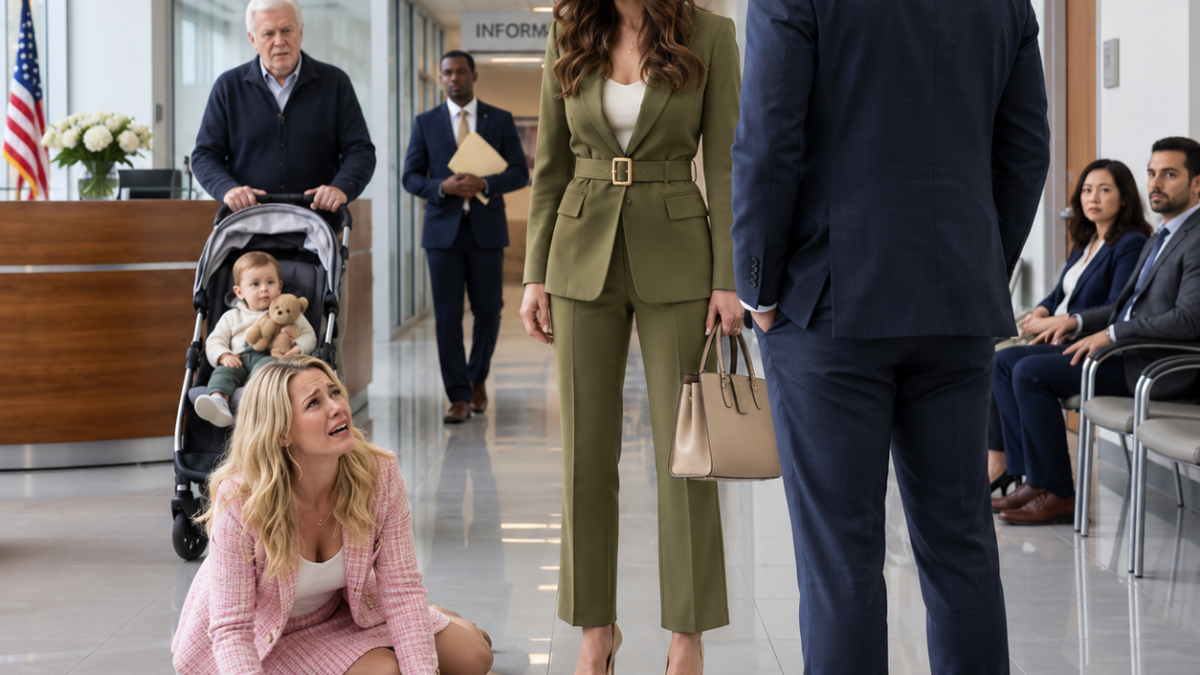
PART2
The hallway changed.
People felt it.
Hospital waiting areas have a strange awareness. They can be full of crying babies, coughing children, vending machine hums, overhead announcements, squeaking shoes, and exhausted parents, but humiliation has a sound all its own. When it enters wearing expensive cologne, the room knows.
Connor shifted closer to the stroller.
He wanted me to see everything.
The baby.
The blanket.
The diaper bag.
Melinda beside him.
The family portrait he believed would cut me open in public.
Then he delivered the line he had probably rehearsed for months.
“Leaving you was the best decision I ever made.”
Melinda whispered, “Connor.”
But he was already performing.
He looked around just enough to confirm the audience had grown.
Then he said it.
“A woman who can’t have children shouldn’t act surprised when a man finally builds a real family.”
The nurse behind the desk went still.
The man near the vending machine lowered his coffee cup.
Melinda’s face went pale.
There it was.
The old wound.
The one Connor had pressed for years until I stopped knowing whether the pain was grief or marriage.
Seven years of fertility appointments.
Seven years of blood tests.
Seven years of ultrasounds.
Seven years of hormone injections, surgical procedures, embryo reports, phone calls, clinic chairs, silent drives home, and the uniquely cruel vocabulary of reproductive medicine.
Unexplained.
Poor response.
Abnormal development.
Nonviable.
Failed transfer.
Unlikely.
Complicated.
And finally, impossible.
Connor had held my hand through the first two years.
By the third, he held his phone instead.
By the fifth, he stopped coming to appointments unless I begged.
By the seventh, he told me, “Maybe some women just aren’t meant to be mothers.”
He apologized later.
Of course he did.
Men like Connor often apologize for the sentence while keeping the belief.
Back then, I thought grief had made him cruel.
Now I knew cruelty had simply been living in the house with me and waiting for an excuse.
Connor nodded toward the stroller.
“I’m lucky,” he said. “I have a one-year-old son with your best friend.”
Melinda’s mouth parted.
No words came out.
The baby bottle trembled in her hand.
I looked at the child first.
Because none of this was his fault.
Then I looked at Melinda.
She still would not meet my eyes.
That was the first thing that felt wrong.
Not guilt.
Not pride.
Fear.
Finally, I looked back at Connor.
He was waiting.
He wanted the scene.
He wanted my face to crack.
He wanted tears. Anger. One sharp word. One visible wound he could use later to tell people, “See? This is what I lived with.”
So I smiled.
Small.
Controlled.
Almost polite.
“Really?”
Connor’s expression changed before he could stop it.
Just a flicker.
But I saw it.
Doctors are trained to notice small changes.
A shallow breath.
A tightening jaw.
A pulse jumping under the skin.
Connor blinked.
“What does that mean?”
“Nothing.”
My phone buzzed inside my lab coat pocket.
I ignored it.
Connor stepped closer.
“No, say it. You always had something to say when we were married.”
“I remember you talking more than I did.”
A few people in the hallway pretended very hard not to hear that.
Connor’s smile thinned.
Melinda shifted her weight.
The baby dropped the giraffe and made a soft sound of protest.
I bent instinctively to pick it up.
Melinda pulled the stroller back so quickly the wheels squeaked.
I stopped.
That movement told me more than words.
“Melinda,” I said quietly, “why are you afraid of me touching him?”
Her face drained.
Connor laughed.
“She’s not afraid. Don’t make this weird.”
“Connor, you brought infertility into a pediatric hallway. We passed weird four exits ago.”
The nurse behind the desk suddenly became very interested in her computer screen.
My phone buzzed again.
Unknown number.
I ignored it again.
Connor looked at the screen through the pocket outline.
“Still popular?”
“Still employed.”
His jaw tightened.
That one landed.
Connor had been brilliant once, or at least brilliant at convincing rooms he was. Finance. Strategy. Venture capital. Boardrooms. Panels. Wine receptions where people said things like “market disruption” while eating appetizers too small to respect hunger.
But after the divorce, after his affair with Melinda became public enough that mutual friends stopped pretending dates overlapped innocently, his firm quietly pushed him toward a “consulting role.” Connor called it strategic independence.
Everyone else called it unemployment with better stationery.
Melinda adjusted the bottle.
Her hand shook harder now.
“Kirsten,” she said, finally looking at me, “this isn’t the place.”
That almost made me laugh.
Not the place.
Hospitals were precisely the place where bodies told the truth whether people wanted them to or not.
Before I could answer, the elevator chimed.
The doors opened.
A man stepped out.
Tall.
Dark-haired.
Late forties, perhaps.
He wore a charcoal suit without a tie, and there was nothing flashy about him. No watch begging to be noticed. No arrogant smile. No performance.
Just quiet confidence.
The kind that makes people move aside without being asked.
He held a thin black folder under one arm.
He took three steps.
Then stopped.
His eyes landed on Melinda.
The bottle slipped from her hand.
It hit the floor.
Plastic cracked against polished tile.
The baby started crying.
Nobody moved.
Not Connor.
Not Melinda.
Not even me.
The man’s face changed.
It was not surprise.
It was recognition.
And something dangerously close to grief.
He looked at the baby.
Then at Melinda.
Then at Connor.
Finally, his eyes settled on me.
For one strange second, I had the unsettling feeling that he had been looking for me.
He said my name.
“Kirsten Sinclair?”
I straightened.
“Yes?”
His expression softened.
“I need to speak with you.”
Connor stepped between us.
“You need to speak with my ex-wife?”
The stranger looked at him.
“Yes.”
Connor laughed.
It was an ugly sound.
“And who exactly are you?”
The man ignored him.
His eyes remained on me.
“I’m Daniel Hayes.”
The name meant nothing to me.
But Melinda reacted as though someone had struck her.
Her face went white.
Connor turned toward her.
“You know him?”
She did not answer.
“Melinda?”
Still nothing.
Daniel looked down at the baby.
His voice dropped.
“I knew I would find him eventually.”
My heart gave a strange, painful beat.
“Find who?” I asked.
Daniel looked at me.
“The child.”
Connor’s face hardened.
“What the hell is that supposed to mean?”
Daniel finally turned toward him.
“It means the boy in that stroller may not be your son.”
Absolute silence.
The baby’s crying seemed impossibly loud in the hallway.
Melinda grabbed the stroller handle.
“No.”
It was the first word she had said with force.
Daniel’s expression did not change.
“You knew this day would come.”
“I don’t know what you’re talking about.”
“Yes, you do.”
Connor stared at her.
Then at the baby.
Then back at Daniel.
His confidence was gone.
“What are you saying?” he asked.
Daniel opened the black folder.
“I’m saying there was a mistake.”
Connor’s voice became dangerously quiet.
“What mistake?”
Daniel looked at me.
“The fertility clinic.”
My breath caught.
For seven years, that place had been the center of my life.
Pacific Reproductive Medicine.
A glass-walled clinic overlooking a courtyard with olive trees and a fountain that ran constantly, as if the building wanted women to believe softness lived there. I had spent hundreds of hours inside those rooms. Blood draws at sunrise. Consultations under warm lighting. Financial counseling that used cheerful language for debt. Procedure rooms cold enough to feel more like punishment than hope.
Dr. Marcus Vale had been my specialist.
Kind.
Brilliant.
Careful.
Or so I had believed.
He had looked me in the eyes one year before my divorce and said, “I’m sorry, Dr. Sinclair. There is nothing more we can do.”
After that, Connor stopped pretending hope still lived with us.
Then Daniel said something that made the entire hallway tilt beneath my feet.
“Dr. Sinclair, your medical records were altered.”
I could not speak.
Connor stared at me.
Melinda closed her eyes.
And suddenly I understood why she had looked afraid when she saw me.
Not guilty.
Afraid.
Because she knew.
Or at least, she knew something.
My voice came out quieter than I expected.
“What records?”
Daniel hesitated.
“The records from your final fertility treatment.”
My fingers tightened around my tablet.
“What about them?”
“They say the procedure failed.”
“I know.”
“No,” he said gently. “You were told it failed.”
A cold sensation traveled down my spine.
I looked at Melinda.
She was crying now.
Silent tears.
Connor turned toward her.
“What does he mean?”
She shook her head.
“Connor…”
“What does he mean?”
“I didn’t know it would happen like this.”
He took one step back.
“What did you do?”
Melinda covered her mouth.
Daniel closed the folder.
“I think we need somewhere private.”
“No.”
My answer surprised even me.
I looked at Daniel.
“If my medical records were altered, I want to know why.”
His eyes held mine.
“Because someone didn’t want you to know the truth.”
“Who?”
He glanced at Connor.
Then Melinda.
Then finally back at me.
“I don’t know.”
That answer frightened me more than anything else.
Because Daniel was not guessing.
He was genuinely afraid.
A nurse hurried over and picked up the broken bottle.
“Is everyone all right?”
Nobody answered.
The baby had stopped crying.
He was staring at me.
His blue eyes followed my face.
Something about that look made my chest ache.
I had never held him.
Never fed him.
Never heard him laugh.
Never wiped his mouth or kissed his forehead or learned which lullaby made him sleepy.
Yet when he reached one small hand toward me, something inside me broke open.
I stepped closer.
Melinda immediately pulled the stroller back.
I stopped.
“Why are you afraid of me touching him?”
She could not answer.
Connor looked at her.
Then at me.
Then at the child.
For the first time since our divorce, I saw genuine fear in my ex-husband’s eyes.
Not fear of losing an argument.
Fear of losing everything.
My phone buzzed again.
The same unknown number.
This time, I answered.
“Hello?”
Silence.
Then a woman’s voice whispered, “Kirsten, don’t trust Daniel Hayes.”
I froze.
“Who is this?”
The woman breathed shakily.
“You need to leave the hospital.”
“Why?”
“Because Connor isn’t the only person who lied to you.”
My heart began pounding.
“What does that mean?”
The woman whispered four words.
“Your baby is alive.”
The call ended.
I stared at the phone.
Connor was watching me.
Melinda was crying.
Daniel had gone completely still.
And somewhere behind us, the elevator doors opened again.
This time, I recognized the man who stepped out.
Dr. Marcus Vale.
My former fertility specialist.
The doctor who had once sat across from me with folded hands and a polished grief expression and told me my last chance had failed.
He was older now.
Thinner.
His hair was more silver at the temples.
He carried a manila envelope in one hand and a photograph in the other.
When he saw me, he did not look surprised.
He looked terrified.
He walked straight toward me.
“Kirsten,” he whispered.
I could not move.
He held out the photograph.
“I’m sorry.”
I looked down.
The photograph was old, slightly yellowed at the edges.
A hospital bracelet lay beside a tiny newborn hand.
Then I saw the date printed along the bottom.
Eight years ago.
My treatment date.
The date I had been told there was nothing to transfer.
Nothing to freeze.
Nothing to hope for.
My entire body went cold.
“What is this?”
Dr. Vale swallowed.
“Proof.”
“Proof of what?”
He looked as if the word might kill him.
“That there was a live birth connected to your embryos.”
For a moment, the hospital hallway disappeared.
All I could see was the photograph.
The tiny hand.
The bracelet.
The date.
The evidence of a life that had existed while I sat at home grieving the death of an imaginary future.
Connor whispered something behind me.
I turned.
He was staring at the photograph.
And I watched the blood drain from his face.
Because Connor knew exactly what he was looking at.
That was the moment I understood something worse.
He had known about the child.
Maybe not everything.
Maybe not the whole mechanism.
But he had known enough.
“Connor,” I whispered.
He did not answer.
“Look at me.”
His eyes lifted.
For the first time in our entire marriage, he looked like a man who had run out of lies.
“You knew.”
He swallowed.
“Kirsten—”
“You knew.”
“I didn’t know everything.”
A bitter laugh escaped me.
“That is not an answer.”
Melinda began crying harder.
“Please.”
I turned toward her.
“Please what?”
She shook her head.
“I never wanted this.”
“You never wanted what?”
Her lips trembled.
“The truth.”
The hallway seemed to shrink around us.
Nurses were pretending not to listen.
Parents were pretending not to stare.
A toddler in dinosaur pajamas was openly staring because children have not yet learned the useless adult tradition of fake privacy.
But none of that mattered.
My entire past had cracked open.
I held up the photograph.
“Dr. Vale says there was a birth connected to my embryos.”
Melinda closed her eyes.
I watched her face.
Then I asked the question burning through me.
“Where is that child?”
She did not answer.
Connor did.
“I don’t know.”
I stared at him.
“You don’t know?”
“No.”
“You just said you didn’t know everything.”
“I didn’t.”
“So you know something.”
His jaw tightened.
I stepped closer.
“You know something.”
Connor looked at Melinda.
That single glance was enough.
There were secrets between them.
Secrets I had never imagined.
Dr. Vale finally spoke.
“The first embryo was transferred to another patient.”
My knees nearly failed.
Daniel caught my elbow.
I barely felt his hand.
“What?”
Dr. Vale’s face was gray.
“It was an illegal transfer. The clinic was under internal investigation. Records were altered. Embryo counts were falsified. Patients were told material was nonviable or destroyed when it was not.”
Every word arrived like a medical instrument laid cold against skin.
Precise.
Terrible.
Unavoidable.
“I was told we had three embryos,” I whispered.
Daniel opened his folder.
“You and Connor were told three. The actual count was seven.”
I shook my head.
“No.”
“I’m sorry.”
“No.”
My voice sharpened.
“There were three. Dr. Vale told me there were three.”
Dr. Vale looked down.
“That was what the file said when I reviewed it. The final pages were missing.”
I turned on him.
“You were my doctor.”
“I know.”
“You told me there was nothing more to do.”
“Yes.”
“You looked at me and let me believe my body had failed.”
His face collapsed.
“I believed the file.”
“You were supposed to verify it.”
He flinched.
Good.
Some guilt deserves direct delivery.
Daniel said, “Five embryos were later destroyed during the cover-up. Two survived.”
I looked at the stroller.
The baby stared back at me, one fist curled around the blanket.
“One is him,” I said.
Daniel did not answer.
Melinda did.
“Yes.”
My vision blurred.
Connor took a step toward me.
“Kirsten—”
I lifted one hand.
“Do not.”
He stopped.
I looked at Melinda.
“You carried my child?”
She shook her head frantically.
“I didn’t know it was yours.”
“You didn’t know?”
“I was told it was an anonymous donor embryo. I was told Connor had arranged everything legally. I was told—”
“By Connor?”
She looked at him.
That was all I needed.
I turned toward my ex-husband.
“You used one of my embryos to have a baby with my best friend.”
Connor shook his head.
“No. I didn’t know it was yours.”
“Do not insult me with badly structured lies. You are not that stupid.”
His eyes filled with something almost like shame.
“We were desperate.”
I laughed.
It was not a happy sound.
“We?”
He swallowed.
“You wanted a family.”
“I wanted a family with my husband.”
“And I wanted one too.”
“No,” I said. “You wanted an heir.”
He flinched.
That landed.
Because it was true.
Connor’s family had money, legacy, expectations, engraved silver baby cups, and an ancestral obsession with bloodline that belonged in a Gothic novel or a tax shelter. His mother, Evelyn Fleming, had once told me at Thanksgiving, “Men like Connor need continuity.”
I replied, “Most humans do.”
She did not laugh.
Connor had always acted like fatherhood was less about raising a child and more about producing evidence that he mattered beyond himself.
“You wanted someone to carry your name,” I said.
“I loved you.”
“No.”
My voice broke for the first time.
“You loved what I could give you.”
Melinda covered her face.
I looked at her.
“And you?”
She lowered her hands.
“I loved you too.”
I stared at her.
“You slept with my husband.”
“I know.”
“You helped him destroy our marriage.”
“I know.”
“You are holding my child.”
Tears streamed down her cheeks.
“I didn’t know at first.”
“At first,” I repeated.
Her face crumpled.
The words mattered.
At first.
Not never.
“When did you know?”
She did not answer.
“When?”
“After he was born,” she whispered.
The world tilted again.
“You knew for a year?”
“Connor told me it would destroy you.”
I laughed once.
“Thoughtful.”
“He said you were unstable after the divorce. He said if you found out, you would take him.”
“The child?”
“Yes.”
“You mean my biological son.”
She began sobbing.
The elevator chimed again.
Everyone turned.
A woman stepped out.
Older.
Sixties.
Gray-blond hair set in an elegant twist.
Black coat.
Pearl earrings.
Leather handbag hanging from one arm.
Evelyn Fleming.
Connor’s mother.
She looked directly at me.
Then at Dr. Vale.
“You shouldn’t have brought her here,” she said.
Dr. Vale went pale.
“Mrs. Fleming—”
I stared at her.
“You know about this.”
She did not deny it.
“I know enough.”
Connor stepped forward.
“Mother.”
She raised one hand.
“Not another word.”
He stopped.
Even now.
Even in ruin.
Connor still obeyed the woman who had taught him entitlement with a silver spoon.
Evelyn looked at me.
Then at the baby in the stroller.
For the first time, I saw fear.
She walked slowly toward him.
Melinda did not move.
Evelyn bent down.
She studied his face.
His eyes.
The soft blond hair.
The tiny birthmark beneath his left ear.
Then she whispered, “Oh God.”
I stepped closer.
“What?”
She stood.
Her eyes remained fixed on the baby.
“That child is not Connor’s biological son.”
Connor went rigid.
“What?”
Evelyn turned toward him.
“You idiot.”
The hallway went silent.
She pointed at the child.
“He has the Sinclair eyes.”
I looked at the baby.
Blue eyes.
Soft blond hair.
A tiny birthmark just below his left ear.
My breath caught.
I had seen that birthmark before.
Not in life.
In a photograph.
On the newborn in Dr. Vale’s hand.
I reached toward the stroller slowly.
Melinda did not pull away this time.
The baby wrapped his fingers around mine.
Something inside me recognized him before my mind could.
My son.
Not Connor’s trophy.
Not Melinda’s public redemption.
Not a weapon in a hallway.
Mine.
A child created from my body, hidden by lies, carried inside a betrayal, born into a story written without my consent.
I began to cry.
Not loudly.
Not dramatically.
One tear.
Then another.
Connor whispered behind me, “Kirsten.”
I did not turn.
He said my name again.
This time, his voice was breaking.
“I can explain.”
I looked at my son.
Then at the man who had once been my husband.
“No,” I said. “You can confess.”
Connor said nothing.
“I’m done listening to explanations.”
Evelyn opened her handbag.
“There is one thing you do not know.”
I stared at her.
She pulled out a sealed envelope and held it toward me.
“The boy is not the first child they took from you.”
The hallway seemed to disappear beneath my feet.
“What did you say?”
Evelyn’s face, usually sharp enough to cut ribbon, softened into something almost human.
“Your first embryo was transferred eight years ago. Not to Melinda. To a woman named Claire Donnelly, who believed she was receiving an anonymous donor embryo through a secondary clinic.”
Dr. Vale closed his eyes.
Daniel looked down.
Melinda whispered, “Kirsten…”
I took the envelope from Evelyn.
My fingers could barely close around it.
“What happened to that child?”
Evelyn looked toward the elevator.
“She is here.”
The elevator doors opened.
A little girl stood there holding the hand of a hospital social worker.
Not sixteen.
Not grown.
Eight years old.
Small for her age, with dark hair pulled into a ponytail, blue eyes too serious for a child, and the exact same tiny birthmark below her left ear.
The social worker crouched and whispered something to her.
The girl looked at me.
Then at the baby.
Then back at me.
Her voice was small.
“Are you Dr. Sinclair?”
I could not breathe.
“Yes.”
She swallowed.
“My name is Emily.”
My heart broke.
And then, impossibly, it began again.
Emily.
A name I had once written in a notebook during my second year of fertility treatment, back when hope still came easily enough to have favorite names. Emily for a girl. Noah for a boy. Connor had smiled then and said, “One of each would be efficient.”
I thought he was joking.
Now my daughter stood in a hospital hallway beside a social worker, carrying eight years of stolen time in her eyes.
“How did you find me?” I whispered.
Emily reached into the pocket of her cardigan and pulled out a creased envelope.
“My mom gave me this before she died.”
Her mom.
The woman who raised her.
Claire Donnelly.
My chest tightened.
“She died?”
Emily nodded.
“Three months ago.”
“I’m sorry.”
“She told me I wasn’t born from her body,” Emily said carefully, as if repeating something an adult had explained many times. “She said my biological mother was a doctor named Kirsten Sinclair. She said if anything happened to her, I should find you.”
I covered my mouth.
The social worker stepped forward.
“I’m Lena Ortiz. I work with child services. Claire Donnelly named you in a letter and included genetic testing records. We contacted Mr. Hayes because of the clinic investigation. We were arranging a private meeting, but events moved faster than expected.”
Events.
A polite word for my ex-husband bragging about my stolen son in a pediatric hallway while my stolen daughter arrived by elevator.
Emily looked at the stroller.
“Is that the baby?”
My voice shook.
“Yes.”
“Is he my brother?”
I looked at Daniel.
He nodded.
Pending final legal testing, maybe he should have said.
But some truths arrive before court orders.
“Yes,” I whispered. “He is.”
Emily smiled.
A real smile.
The first one I had seen on her face.
“He’s cute.”
“He is.”
She stepped closer to the stroller.
The baby reached for her finger.
She let him hold it.
Then she laughed.
That small laugh broke something inside me all over again.
Not from pain this time.
From joy so sharp it hurt.
Two children.
Both mine.
Both alive.
Both within reach.
Years of grief rose inside me so violently I almost staggered.
The miscarriages I thought I had.
The embryos I mourned.
The nursery catalogs I stopped opening.
The Mother’s Day brunches Melinda attended with me while squeezing my hand and lying through her teeth.
The nights Connor turned away in bed.
The final appointment.
Dr. Vale’s face.
“I’m sorry, Dr. Sinclair. There is nothing more we can do.”
Nothing more.
There had been a whole life.
Two of them.
I looked at Connor.
He was pale.
Shaken.
Still handsome, unfortunately, because justice does not always ruin bone structure on schedule.
“I want the truth,” I said.
He lowered his eyes.
Evelyn snapped, “Connor.”
His jaw tightened.
Then he spoke.
“I knew there were embryos remaining.”
A sound moved through the hallway.
Melinda began crying again.
“I didn’t know about Emily until later.”
“Later when?”
“After the divorce.”
Daniel stepped forward.
“That’s not true.”
Connor’s eyes flashed.
“You don’t know everything.”
“No,” Daniel said. “But I know enough to recognize when you’re editing.”
I turned to Daniel.
“Who are you really?”
He exhaled.
“I worked for Pacific Reproductive’s legal department eight years ago. When irregularities surfaced, I was assigned to internal review. I found missing embryo records, altered consent forms, and transfers to partner clinics. I tried to notify affected patients.”
“You tried?”
“Yes.”
“I never heard from you.”
Connor looked away.
Daniel opened his folder and removed an old letter.
“I sent this to the address listed in your file.”
I stared at the address.
It was not mine.
Not even close.
A luxury apartment Connor had rented for six months during our separation and told me was “temporary corporate housing.”
I looked at him.
“You changed my address.”
He said nothing.
“You intercepted my mail.”
His silence answered.
Daniel continued.
“I also sent notice to Connor as your spouse of record at the time. He responded through counsel claiming the matter was emotionally harmful and that you did not wish to be contacted directly.”
My hands went cold.
“You believed him?”
Daniel’s face tightened.
“I was young. The clinic’s outside counsel told me the spouse response satisfied notification protocol. I pushed back. Then I was removed from the review.”
“Removed?”
“Fired.”
Evelyn spoke then.
“Because Connor’s father intervened.”
Connor’s head snapped toward her.
“Mother.”
“No,” Evelyn said. “Enough.”
She looked at me.
“My late husband was on the board of a foundation tied to Pacific Reproductive. He believed scandal would damage the family. Connor told us the embryos were no longer legally yours because the clinic documents were ‘unclear.’ He said you were unstable, grief-stricken, and refusing further contact.”
I laughed, but no humor came with it.
“Convenient.”
Evelyn looked ashamed.
“I believed what suited us.”
That sentence was the first honest thing she had ever said to me.
Dr. Vale spoke.
“I did not know the full extent then. I suspected records were wrong, but by the time I had proof, the internal investigation had been buried and patient files were incomplete.”
I turned on him.
“You were the physician.”
“Yes.”
“You owed me the truth before you had proof comfortable enough to protect yourself.”
He flinched.
“I know.”
“Do you?”
His eyes filled.
“I have lived with this for years.”
“Good,” I said. “Make room. I am just arriving.”
Emily’s hand slipped into mine.
She did it carefully.
Not like she knew me.
Like she wanted to.
I looked down at her.
This child had lost the only mother she had known three months earlier. Now she stood inside a hospital hallway learning that the woman in a white coat was not a stranger exactly, but not yet mother either. Biology can open a door. It does not furnish the room.
I squeezed her hand gently.
“Are you okay?” I asked.
She shook her head.
Honest child.
Good.
“Me neither.”
That made her smile faintly.
Melinda knelt beside the stroller, sobbing now.
“Kirsten, please. I didn’t know when I got pregnant. I swear. Connor told me it was an anonymous embryo from a donor bank. I was desperate. I wanted a child. He said the clinic had arranged everything. I didn’t know it was yours until after Noah was born.”
Noah.
The name hit me.
My old notebook.
Emily for a girl.
Noah for a boy.
I looked at Connor.
His face told me the truth before he did.
“You named him Noah,” I whispered.
He closed his eyes.
“Connor.”
“I remembered,” he said.
“You remembered the name I chose for our child, and you gave it to the baby you had with my best friend using my embryo.”
He had no answer.
Some crimes are too specific for defense.
Melinda reached toward me.
I stepped back.
“No.”
Her hand fell.
“I wanted to tell you.”
“But?”
“I was afraid you would take him.”
“He was mine.”
“I raised him.”
Her voice broke on that.
And there it was.
The cruelty no courtroom could make simple.
Melinda had betrayed me.
Melinda had lied.
Melinda had carried and raised my biological son for one year while knowing enough to fear me.
But she had also fed him at 2 a.m., rocked him through fevers, learned his cries, watched him laugh, loved him.
Hate wanted a clean room.
Reality dragged mud across the floor.
I looked at Noah in the stroller.
He yawned.
Tiny.
Innocent.
Loved by the wrong people and still deserving all the love.
I turned to Lena Ortiz.
“What happens now?”
She answered carefully.
“We need immediate legal and child welfare coordination. Genetic testing will be confirmed through court-approved process. Existing custody orders, birth records, and consent documents will need review. No one should make sudden unilateral changes today unless there is an immediate safety concern.”
Safety.
I looked at Connor.
Then Melinda.
Then Evelyn.
Then Dr. Vale.
Immediate safety concern was a tempting phrase.
But I was still a physician.
Still trained to separate what I felt from what a child needed.
Noah did not need to be ripped from the only hands he knew in a hallway because adults had committed sins before he could speak.
Emily did not need another abrupt loss dressed up as justice.
I took a breath.
“Then we do this correctly.”
Connor looked relieved.
I pointed at him.
“Do not mistake correctly for gently.”
His relief vanished.
“Every document goes to my attorney. Every clinic record. Every transfer form. Every consent file. Every email. Every payment. Every altered address. Every communication between you, Melinda, your family, the clinic, and anyone connected to this.”
Connor swallowed.
“Kirsten—”
“No. You stood in this hallway and used a baby to humiliate me. Now that baby gets protected from you the way I should have been.”
Evelyn lowered her head.
Melinda whispered, “What about me?”
I looked at her.
“You get a lawyer.”
She cried harder.
“I don’t want to lose him.”
“Neither did I.”
The words landed.
She covered her mouth.
Daniel said quietly, “I have already preserved copies of what I could access. There are federal investigators who reopened related complaints last month after Claire Donnelly’s letter surfaced.”
“Claire knew?” I asked.
Lena nodded.
“Near the end of her illness, she ordered genetic testing. She suspected Emily’s birth story had irregularities. She left sworn statements.”
“What did she say?”
Lena’s face softened.
“That she loved Emily completely. That she had no idea at the time that the embryo had been transferred illegally. That when she learned the truth, she wanted Emily to know where she came from, but not to feel discarded by either mother.”
I knelt in front of Emily.
Carefully.
So we were eye level.
“Claire sounds like she loved you very much.”
Emily nodded, tears spilling over.
“She did.”
“I’m glad.”
“You’re not mad?”
“At her? No.”
“At me?”
“Oh, sweetheart.” The word slipped out before I could stop it.
Emily’s face changed.
Not frightened.
Hopeful.
I kept my voice steady.
“None of this is your fault.”
She nodded like she wanted to believe me and did not yet know how.
Noah made an impatient sound.
I reached into the stroller and touched his little hand again.
He grabbed my finger.
Connor watched me.
For once, he looked like the outsider.
The next several hours passed in conference rooms, not hallways.
Hospitals are good at finding rooms when a situation becomes legally radioactive.
My staff meeting was canceled. My chief of medicine arrived, then legal, then security, then child services, then a detective from the county unit already assisting the fertility clinic investigation.
The hospital where we stood had not caused the original crime, but the revelation had happened on its property, and institutions, like people, become very attentive when liability walks in carrying a black folder.
My attorney, Diana Reeves, arrived within forty minutes.
She was five feet tall, wore red glasses, and could make grown men regret speaking in paragraphs.
The first thing she did was take my phone.
“Have you texted Connor?”
“No.”
“Good.”
“Melinda?”
“No.”
“Excellent.”
“Should I be doing something?”
“Yes. Breathing. Hydrating. Not confessing feelings into discoverable channels.”
I almost laughed.
Diana turned to Daniel.
“You. Folder. Table. Now.”
He obeyed.
I liked her immediately.
The documents were worse when organized.
Seven embryos created during my final cycle.
Not three.
Consent forms altered.
Disposition records incomplete.
Storage logs edited.
Two transfers to outside facilities under anonymized donor IDs.
Five embryos destroyed after the clinic investigation began.
Patient notification attempts redirected.
My address changed.
Connor’s signature appearing where mine should have been required.
Payments from a Fleming family-controlled entity to a clinic administrator later convicted in a related fertility-material scheme.
Melinda’s transfer paperwork listing anonymous donor material.
Emily’s birth records connected to Claire Donnelly through a secondary clinic that had since closed.
Noah’s records showing Melinda as gestational carrier and legal mother, Connor listed as father, donor material anonymous.
Anonymous.
That word appeared again and again like a curtain someone had pulled over a kidnapping.
Diana read silently for fifteen minutes.
Then removed her glasses.
“This is catastrophic.”
“For whom?”
She looked at me.
“For everyone who is not you or the children.”
That was the first comforting sentence of the day.
Connor’s attorney arrived after two hours.
He looked expensive and tired, which suggested he had either worked with Connor before or understood the case immediately.
Melinda’s attorney arrived next and looked like she wished she had chosen real estate law.
Evelyn remained present because, as Diana whispered, “old money never misses a chance to supervise disaster.”
Dr. Vale gave a formal statement. Daniel gave his. Lena handled Emily’s immediate welfare plan. Noah stayed with Melinda temporarily under an emergency agreement that included strict non-removal terms, supervised contact conditions involving Connor, preservation of records, and no travel.
Emily came home with me that night.
Not permanently decided.
Not legally final.
But under a temporary placement arrangement because Claire’s letter named me, genetic evidence was strong, and Emily asked if she could stay with “the doctor who might be my mother.”
That sentence almost killed me.
My house was not ready for a child.
Certainly not one who arrived by legal earthquake.
There was no bedroom decorated for her. No clothes. No favorite cereal. No stuffed animals, except one ridiculous plush kidney a nurse had given me as a joke after a renal conference. Emily loved it immediately, which I took as genetic proof before the DNA test returned.
We stopped at Target on the way home with Diana following behind us because she refused to let me make decisions while emotionally concussed.
Emily chose pajamas with moons on them, a toothbrush, socks, a blue hoodie, and a notebook.
At checkout, she looked up at me.
“Is this too much?”
I nearly broke.
“No.”
“Claire said not to ask for too much.”
“Claire was probably trying to help you feel safe.”
Emily nodded.
“But in this house, you’re allowed to need things.”
Her eyes filled.
I looked away because crying in checkout aisles makes cashiers nervous.
That night, Emily stood in my guest room doorway holding the plush kidney.
“Do I call you Kirsten?”
I sat on the edge of the bed.
“You can call me whatever feels comfortable.”
“Claire said you were my first mother.”
My throat tightened.
“She sounds very generous.”
“She was.”
“I wish I could thank her.”
Emily looked down.
“She said you would say that.”
We sat quietly.
Then she asked, “Did you want me?”
That question opened a canyon inside me.
“Yes,” I said, immediately, clearly, with no room for doubt. “Before I knew you existed, I wanted you. When I thought I could not have children, I still wanted you. When I saw you today, I wanted to know you. None of this happened because I gave you away.”
Her face crumpled.
“I was scared.”
“Me too.”
“Adults keep saying that.”
“Because this is a very scary adult mess.”
She hugged the plush kidney.
“Will I have to leave?”
“I don’t know what the court will decide yet. But I know this: I will not disappear from your life.”
“Promise?”
“Yes.”
She studied me like children do when they have learned promises are not always built correctly.
Then she nodded.
“Okay.”
After she fell asleep, I sat at my kitchen table with Diana, who had refused to leave until she saw me consume food. She slid a container of soup toward me.
“Eat.”
“I’m not hungry.”
“You are about to sue several people, petition for custody-related relief, cooperate with a federal investigation, and mother two children who arrived through a crime scene. Eat soup.”
“I see why people hire you.”
“I’m expensive because I’m correct.”
I ate.
Then I cried.
Diana let me.
She did not say it would be okay.
Good lawyers know better.
The next weeks were brutal.
DNA confirmed what my body had already known.
Emily was my biological daughter.
Noah was my biological son.
Connor was not Noah’s biological father.
That result detonated the last fantasy Connor had been holding.
He had believed he had engineered fatherhood.
Instead, he had helped expose that the child he paraded as proof of his masculinity carried none of his genetics and all of my stolen history.
I did not enjoy his pain.
That is a lie.
Part of me did.
A small, petty, exhausted part of me enjoyed the symmetry.
He had mocked me for being childless while standing beside two children created from my body and hidden from me by his choices.
If the universe occasionally writes with a flaming pen, who am I to edit?
But the larger part of me was too busy.
Motherhood arrived not as a baby shower but as litigation.
Emergency hearings.
Genetic reports.
Birth record challenges.
Clinic subpoenas.
Custody evaluations.
Federal interviews.
Media inquiries.
Professional leave.
Therapy appointments.
Pediatric visits.
Emily’s school records.
Noah’s medical records.
Melinda’s petitions.
Connor’s objections.
Evelyn’s sudden desire to “make things right,” which Diana translated as “control the settlement before someone names the family foundation in a headline.”
The hardest part was Noah.
Melinda had raised him for a year. She was legally listed as his mother. She loved him. I could see that, and I hated that I could see it because it complicated my rage.
The court moved carefully.
Too carefully for my heart.
Emergency orders prevented Connor from unsupervised contact with either child due to evidence of fraud, concealment, and emotional manipulation. Melinda retained temporary physical care of Noah while genetic and legal claims proceeded, with structured visitation for me under supervision at first, then expanded as professionals observed Noah’s comfort.
The first time I held him, he cried.
Not because he knew me.
Because he did not.
That was the cruelest truth.
Biology had recognized him in my chest.
But he was one year old, and I was a stranger in a white coat trying not to sob into his hair.
Melinda stood across the room with both hands pressed to her mouth.
The visitation supervisor said gently, “Give him time.”
Time.
The thing everyone had stolen and now advised me to respect.
I respected it anyway.
Because Noah deserved better than adults ripping him between truths.
So I showed up.
Every visit.
On time.
Calm.
With the same soft blanket.
The same little giraffe.
The same song I once imagined singing to a baby who never came.
At first, he tolerated me.
Then he studied me.
Then he let me feed him.
Then one afternoon, he fell asleep against my chest.
I sat completely still for forty-three minutes because if the building had caught fire, I would have negotiated with it.
Emily adjusted faster in some ways and harder in others.
She wanted closeness, then feared it.
She asked questions at impossible times.
While brushing teeth: “Did Connor steal me?”
During breakfast: “Was Claire wrong to keep me?”
In the car: “Is Noah sad because everyone lied before he was born?”
Children do not schedule existential devastation politely.
I answered as honestly as I could.
“Connor helped hide the truth.”
“Claire did not know at first, and when she learned, she tried to help you find me.”
“Noah is too little to understand the lies, but our job is to make sure he grows up with truth.”
Emily nodded solemnly.
Then asked for waffles.
Life is strange that way.
One day you explain embryo theft to an eight-year-old.
The next minute you are negotiating syrup.
Connor unraveled publicly.
His carefully curated image did not survive the filings. The story became news after federal prosecutors expanded the fertility fraud investigation and several affected families came forward. Pacific Reproductive Medicine, already weakened by prior scandals, collapsed under lawsuits. Dr. Vale cooperated and surrendered his license pending review. Daniel Hayes became a key witness. Evelyn Fleming’s family foundation entered settlement negotiations faster than I thought possible, proving that old money can move quickly when headlines smell blood.
Connor tried to claim he had been misled by the clinic.
Then Daniel produced emails.
Connor tried to say he changed my address because we were separating and mail needed organization.
Then Diana produced evidence he intercepted patient notifications.
Connor tried to say Melinda believed everything was anonymous.
Melinda’s attorney conceded that was true initially but admitted she later learned enough to fear disclosure.
Connor tried to say he loved Noah regardless of biology.
That might also have been true.
But love does not erase fraud.
At one hearing, Connor looked across the courtroom at me and mouthed, “Please.”
I looked away.
There had been years when I would have crawled across broken glass for that man’s softness.
Now I knew softness from Connor usually meant he had found a new surface to press.
Melinda and I had our first real conversation three months after the hospital.
It happened in a supervised visitation center after Noah fell asleep in a portable crib between us.
She looked thinner. Older. Less polished. Betrayal does not age people the same way guilt does.
“I don’t know how to apologize,” she said.
“You probably can’t.”
She nodded.
“I deserved that.”
“No,” I said. “You deserved worse. I’m being efficient.”
A weak laugh escaped her.
Then she cried.
“I was jealous of you,” she whispered.
That surprised me.
“Of me?”
“You were always so sure. So respected. Doctors listened when you spoke. Connor listened when you spoke, even when he resented it. I was always the friend. The soft one. The fun one. The one people called when they wanted comfort, not advice.”
“And that led naturally to sleeping with my husband?”
She flinched.
“No. Nothing leads naturally to that. I chose it.”
Good.
Continue.
“At first, he made me feel chosen,” she said. “Then he made me feel necessary. Then he told me you were cold, that the marriage was over in every way but paperwork, that you didn’t love him anymore.”
“I was in fertility treatment and working hospital shifts.”
“I know.”
“You sat with me after appointments.”
“I know.”
“You brought soup.”
“I know.”
“You knew I was grieving.”
Her tears fell silently.
“I know.”
For a while, neither of us spoke.
Then she said, “When Connor suggested the embryo transfer, he said it was legal. Anonymous donor. Private clinic. He said I could have the baby I wanted, and he could finally be a father. I didn’t ask enough questions because I wanted the answer too badly.”
“When did you learn?”
“After Noah was born. Evelyn came to see him. She saw the birthmark and said something strange. Connor panicked. I pushed. He told me there had been a mix-up, that one of your embryos might have been used, but that telling you would destroy everyone.”
“It had already destroyed me.”
“I know that now.”
“No. You knew that then.”
She closed her eyes.
“Yes.”
That was the first time I believed she understood even one corner of what she had done.
“I love him,” she said, looking at Noah.
“I know.”
“I’m terrified you’ll take him away forever.”
“I know.”
“Will you?”
I looked at Noah sleeping between us.
I wanted to say yes.
The honest, ugly part of me wanted to take both children, close every door, and let everyone else taste absence.
But motherhood, real motherhood, was not ownership.
I had learned that by losing before I ever held.
“I will fight for my place in his life,” I said. “I will fight for truth on his birth records. I will fight for legal recognition. I will fight to make sure Connor cannot use him. But I will not punish Noah for loving the woman who fed him when he cried.”
Melinda covered her mouth.
“That is more mercy than I deserve.”
“Yes.”
I let that sit.
Mercy should not always be made comfortable.
The final legal resolution took nearly two years.
Emily’s guardianship moved first. Claire Donnelly’s letter, genetic proof, and lack of other suitable family led to me becoming her legal parent through a structured court process that honored Claire’s role as her mother. Emily chose to keep Donnelly as a middle name.
Emily Claire Sinclair.
The day the order was signed, she hugged me in the courthouse hallway and whispered, “Can I call you Mom now?”
I held her so tightly Diana said, “Gentle. She needs ribs.”
Noah’s case was more complex.
Melinda had legal parental status from birth. I had genetic parentage through fraud. Connor had been listed as father but was not biological and had participated in concealment. The court, guided by child welfare experts, genetic evidence, and settlement agreements, eventually recognized me as Noah’s legal mother while allowing Melinda a defined parental role because she had been his primary caregiver and because cutting her off would have harmed him.
It was imperfect.
It was painful.
It was also child-centered.
Noah’s legal name became Noah Sinclair Travis.
Not Fleming.
Connor fought that and lost.
He received no custody.
Limited supervised contact was possible only after therapy, disclosures, and strict compliance. He rarely used it. Men who want heirs do not always know what to do with children who need snacks, patience, and accountability.
Melinda and I learned a strange, careful form of cooperation.
Not friendship.
Never again.
But something built around Noah’s well-being.
Shared calendars.
Therapy recommendations.
Birthday plans.
Medical appointments.
No secrets.
That was the rule.
No secrets.
Emily struggled with that arrangement at first.
“She lied,” Emily said one night while helping me fold baby pajamas.
“Yes.”
“Then why does she get to stay?”
“Because Noah loves her, and she loves him.”
“Is love enough?”
“No.”
Emily looked relieved by the honesty.
“Then why?”
“Because love plus accountability plus boundaries can sometimes become safe enough for a child.”
She thought about that.
“Do you love Connor?”
“No.”
“Did you?”
“Yes.”
“Did love plus boundaries make him safe?”
“No.”
“Why not?”
“Because he did not accept accountability.”
Emily nodded slowly.
“So Melinda has homework.”
Despite everything, I laughed.
“Yes. Very serious homework.”
The criminal cases ended in pieces.
Clinic administrators were convicted or pled guilty in fertility-material trafficking and records falsification schemes. Civil settlements followed. Dr. Vale lost his license and avoided prison through cooperation, though his reputation became a cautionary tale in medical ethics lectures. Daniel testified, then started a nonprofit assisting patients affected by reproductive fraud.
Connor pled guilty to charges related to obstruction, falsified medical communications, and conspiracy tied to concealment of records. His sentence included prison time, fines, and probationary restrictions. Evelyn’s family foundation paid into a victim compensation fund, though Evelyn herself avoided criminal conviction by cooperating and providing documents that Connor thought had been destroyed.
The day Connor was sentenced, I gave a victim impact statement.
I stood in court with Emily sitting behind me between Diana and Lena, and Melinda farther back holding Noah.
Connor looked at me as if I were the only person in the room.
Maybe he expected anger.
I had anger.
But I also had something stronger now.
Precision.
“For years,” I began, “I believed infertility was the central grief of my life. I believed my body had failed. I believed my marriage collapsed under grief. I believed my former best friend betrayed me in an ordinary, ugly way. I was wrong. What happened was not ordinary betrayal. It was organized deprivation.”
The courtroom was silent.
“My medical records were altered. My address was changed. My consent was bypassed. My embryos were used, destroyed, transferred, concealed, and converted into other people’s family plans while I was told there was nothing left to hope for.”
Connor lowered his head.
“I lost first words. First steps. First fevers. First birthdays. I lost the chance to hold my daughter when she cried as a newborn. I lost the chance to hear my son’s first laugh from the beginning. Time was stolen from me in a form no restitution can return.”
My voice shook.
I let it.
“But I am not here only to speak about what was taken. I am here because two children deserve a record that tells the truth. They were not mistakes. They were not donor material. They were not Connor Fleming’s private solution to shame. They are Emily and Noah. They are loved. They are mine. And they should never have to wonder whether adults were too polite to name the crime that shaped their lives.”
I looked at Connor.
“You mocked me in a hospital hallway for not having a family while standing beside my son. That was not your worst act, but it was the clearest expression of who you had become. You wanted victory more than truth. You wanted legacy more than love. You wanted control more than fatherhood.”
I turned back to the judge.
“I ask the court to impose accountability that reflects not only falsified records and intercepted notices, but stolen years.”
Connor cried when he spoke.
Maybe because he was sorry.
Maybe because he had finally lost the audience.
He said he had been afraid.
That he had wanted a family.
That the clinic had made it easy to believe lines were blurry.
That he had loved me.
That he had loved Noah.
That he did not know how to undo what he had done.
The judge listened.
Then imposed sentence.
Not enough to give back eight years.
Nothing could.
But enough to mark the truth.
Afterward, Connor tried to speak to me in the hallway.
Diana stepped forward.
I raised one hand.
“Let him say one sentence.”
Connor looked ruined.
“Kirsten,” he said, “I know I don’t deserve forgiveness.”
“No,” I said. “You don’t.”
He swallowed.
“I’m sorry.”
I waited.
This time, he did not add excuses.
That mattered.
Not enough.
But it mattered.
“I forgive you,” I said.
His eyes widened.
Diana looked at me like she might need medical attention.
I continued.
“Not because you deserve it. Because I refuse to spend the rest of my life carrying you. Forgiveness is not access. It is not absolution. It is not a door. It is me putting down what belongs to you.”
Connor cried harder.
I felt nothing warm toward him.
Only lightness.
That was enough.
Three years after the hospital hallway, my house looked nothing like it had before.
There were toys in the living room.
Baby gates in places no adult could navigate with dignity.
Emily’s backpack near the stairs.
Noah’s blocks under the couch.
A refrigerator covered in drawings, school notices, pediatric appointment reminders, and one photograph of a plush kidney wearing a party hat.
Emily hated having her picture taken unless she was controlling the angle.
Noah believed every camera existed to document his genius.
On Saturday mornings, Emily and I made pancakes.
She always burned the first batch.
I always pretended not to notice.
Noah sat in his booster seat shouting, “Again!” whenever she flipped one badly enough to qualify as indoor weather.
Sometimes I stood in the kitchen and simply watched them.
My daughter.
My son.
Alive.
Loud.
Messy.
Real.
There were hard days.
Of course there were.
Emily grieved Claire. Some nights she cried because loving me felt like betraying the woman who raised her. I told her love was not a bank account. Depositing more in one place did not empty the other.
Noah had transitions between my house and Melinda’s. Sometimes he clung to her. Sometimes to me. Sometimes he threw applesauce at both of us because toddlers are morally complex.
Melinda and I attended co-parenting therapy, which was exactly as enjoyable as dental work performed during a tax audit, but useful.
Once, during a session, she said, “I miss being your friend.”
I looked at her.
“I miss who I thought you were.”
She nodded.
“That’s fair.”
“It’s not meant to be.”
“I know.”
Progress, sometimes, is someone accepting the sentence without asking you to soften it.
Emily eventually asked the question I feared most.
She was sitting on my bedroom floor, painting her nails blue and getting more polish on her skin than nail.
“Do you wish you found me sooner?”
Every day.
Every hour.
In every version of my life where I allowed myself to imagine the impossible.
“Yes,” I said. “Every day.”
She looked down.
“I’m sorry.”
I moved to the floor beside her.
“Do not apologize for something adults stole from both of us.”
“Can we make up the time?”
“No.”
Her face fell.
I took her hand.
“We can’t make up the past.”
Then I squeezed gently.
“But we can fill the future.”
She leaned against my shoulder.
Her nail polish stained my sleeve.
I did not move.
A year after Connor’s sentencing, I returned to the pediatric wing where everything had unraveled.
Not for drama.
For Noah’s checkup.
Emily came with us because she had decided she was “medically responsible” for her brother, which meant correcting nurses on his snack preferences.
The hallway looked the same.
Same polished floors.
Same nurses’ station.
Same vending machine.
Same elevator.
For a moment, I saw Connor standing there again.
Smirking.
Melinda holding the bottle.
The stroller.
The audience.
The sentence meant to destroy me.
A woman who can’t have children shouldn’t act surprised when a man finally builds a real family.
I looked down.
Noah held my hand.
Emily stood on my other side.
“Mom?” she asked.
“Yes?”
“You okay?”
I smiled.
“Yes.”
Noah tugged my fingers.
“Giraffe.”
He had dropped his toy.
I bent and picked it up.
This time, nobody pulled the stroller away.
This time, no one stood between me and my child.
This time, the hallway held no secrets large enough to swallow my life.
As we waited near the elevator, Dr. Greene from pediatrics passed by and waved. A nurse smiled at Noah. Emily asked if the cafeteria still had terrible muffins.
Life continued.
Not restored.
Not exactly.
Restoration suggests you get back what was taken in the same condition.
I did not.
I never got Emily’s first eight years.
I never got Noah’s first year.
I never got the marriage I thought I had.
I never got my friendship with Melinda back.
I never got the version of myself who believed medical records were sacred enough that no one would dare turn them into fiction.
But I got truth.
I got my children.
I got a life built without Connor’s shadow across the doorway.
And I got to become a mother not because a man finally gave me permission, not because his family approved, not because a clinic admitted guilt in time, but because the truth fought its way through every locked room and found me.
That night, after the appointment, we went home.
Emily sat on the floor with Noah, helping him stack wooden blocks. He knocked them down. She gasped theatrically, as if civilization had fallen. He laughed so hard he hiccupped.
I stood in the doorway and watched.
Emily looked up.
“Mom?”
“Yes?”
“Come play.”
I smiled.
“I thought you’d never ask.”
I sat beside them.
Noah climbed into my lap.
Emily leaned against my shoulder.
For a moment, I closed my eyes.
Years earlier, I had left a fertility clinic believing my family had disappeared before it could begin. One year after my divorce, I walked into a hospital hallway and found that my family had been living on the other side of lies, waiting for one person to drop a bottle, one man to open a folder, one photograph to surface, one child to reach for my hand.
Connor thought he was showing me his victory.
Instead, he showed me the door back to everything he had stolen.
My ex-husband had smirked and bragged that he had built a real family.
He was wrong.
He had built a fraud.
The real family was the daughter who asked whether she could call me Mom.
The son who fell asleep against my chest after learning my heartbeat.
The future we could not recover but could still fill.
And me?
I was not the barren ex-wife in Connor’s hallway performance.
I was not the cold doctor.
Not the failed patient.
Not the betrayed friend.
Not the woman who could not have children.
I was Kirsten Sinclair.
A doctor.
A mother.
A witness.
A woman who smiled when a cruel man tried to humiliate her, because somewhere inside me, before I knew the facts, my body had already recognized the truth.
The baby in that stroller was mine.
And the life Connor thought he had stolen forever had finally found its way home.








