My Daughter Said Fish Were Biting Her Stomach—Then My Husband Accused Me While the Real Monster Stood Beside Him
PART2
The nurse asked about vomiting, diarrhea, medications, allergies, foods, falls, recent illness, household chemicals, small toys, batteries, coins.
I answered every question I could.
No vomiting.
No fever.
No known ingestion.
No batteries.
No coins.
No choking episode.
No, I had not left medication out.
No, I did not know if she swallowed anything.
No, we did not keep small magnets in the house.
Not that I knew of.
The emergency physician came in, a calm-looking man with tired eyes and a voice that tried to make bad possibilities sound manageable.
“I’m Dr. Hayes. We’re going to get imaging right away.”
Lily whimpered when they touched her abdomen.
I stood beside her bed and stroked her hair, whispering, “I’m here, baby. I’m right here.”
“Mommy, don’t let the fish bite holes.”
My hand froze.
The doctor looked at me.
“What did she say?”
“She keeps saying fish are moving inside her.”
His expression did not change, but his eyes sharpened.
He ordered an ultrasound first.
The technician who came in smiled at Lily, warmed the gel, and told her the wand was like a little camera looking for answers. Lily tried to be brave. She really did. She bit her lip and clutched my fingers with both hands.
The technician moved the probe over her abdomen.
Once.
Twice.
Then more slowly.
Her smile faded.
The room seemed to shrink.
She tilted the screen away from me.
That was the moment my fear turned into something heavier.
A mother knows when someone is hiding panic.
The technician excused herself and left.
“Is everything okay?” I asked.
She did not answer.
She just said, “The doctor will be right back.”
Minutes later, Dr. Hayes returned, not alone this time. Another physician came with him, then a radiology tech, then a nurse who avoided my eyes.
They ordered an X-ray.
I stood behind the protective barrier with Lily crying on the table.
“Hold still, sweetheart,” the tech said gently.
“I want Mommy.”
“I’m right here,” I called.
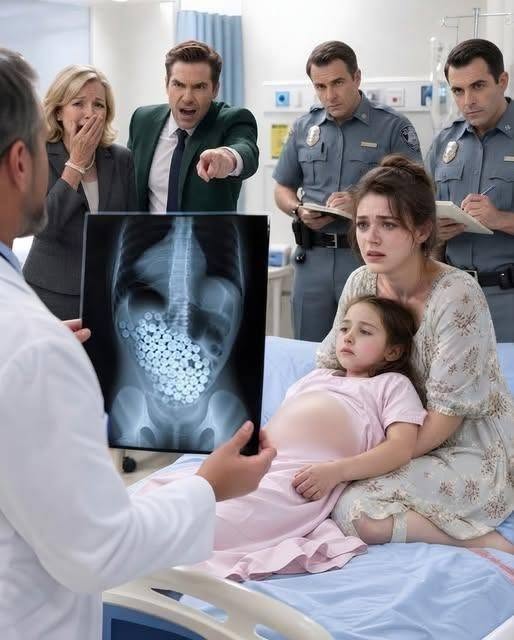
The X-ray appeared on the screen.
I did not understand what I was seeing at first.
There were bright dots inside my child.
Dozens of them.
Clustered.
Strung.
Grouped like tiny beads in places no bead should ever be.
The doctor’s face went pale.
He looked at the image for several seconds, then walked out.
No explanation.
No reassurance.
Nothing.
I followed him into the hallway.
“Doctor, what is that? What’s inside my daughter?”
He picked up the phone at the nurses’ station.
His voice dropped, but not enough.
“I need to report a suspected child abuse case involving a minor. Multiple foreign objects in the abdomen. Possible intentional ingestion.”
The hallway tilted.
For a second, I thought I might pass out.
“Child abuse?” I said. “No. No, what are you talking about?”
A nurse stepped between us with practiced gentleness.
“Ma’am, please come back into the room.”
“No. Tell me what’s happening.”
Dr. Hayes turned toward me, his face tight.
“Mrs. Carter, we need to act quickly. Your daughter has ingested a significant number of high-powered magnets.”
Magnets.
The word made no sense.
“Magnets?” I repeated. “What magnets?”
“They appear to be small, strong magnetic balls. Multiple pieces.”
“How many?”
He hesitated.
“How many?” I demanded.
“At least thirty-six.”
I gripped the wall.
Thirty-six.
My five-year-old daughter had thirty-six magnets inside her body.
I thought of her tiny mouth, her little hands, the way she hated bitter medicine, the way she gagged if a blueberry was too soft.
“That’s impossible,” I said. “She wouldn’t swallow thirty-six magnets. She wouldn’t even swallow one.”
“That’s one of our concerns.”
“What does that mean?”
Dr. Hayes glanced toward Lily’s room. “When multiple magnets are swallowed, they can attract each other through separate loops of intestine. They can trap tissue between them, cut off blood flow, cause necrosis, perforations, sepsis. We’re calling pediatric surgery.”
My legs weakened.
“She’s going to need surgery?”
“She may already have intestinal damage.”
“Can I see her?”
“In a moment.”
“In a moment?” I almost laughed because the phrase was too small for what was happening. “That’s my daughter.”
“And right now,” he said carefully, “we have to keep her alive.”
That shut me up.
For about thirty seconds.
Then two police officers walked into the emergency department.
Officer James Miller was tall, square-jawed, and expressionless in the way police officers get when they are trying not to accuse you too early. His partner, Officer Brian Collins, had a notepad already in his hand.
“Mrs. Emily Carter?” Officer Miller asked.
“Yes.”
“We need to ask you a few questions.”
“My daughter is going into surgery.”
“We understand.”
No, they did not.
Nobody understood.
They led me into a small consultation room with beige walls, two chairs, and a box of tissues placed in the center of the table like someone had decorated for human collapse.
Officer Collins placed a copy of the X-ray in front of me.
I stared at the bright dots in Lily’s body.
“They’re high-powered magnets,” he said. “Thirty-six confirmed.”
I could not breathe around the number.
“Where did she get them?” Officer Miller asked.
“I don’t know.”
“Are there toys in the house that contain magnets?”
“No.”
“Magnetic building sets?”
“No.”
“Desk toys?”
“No.”
“Craft supplies?”
“No.”
“Does your husband own anything like this?”
“I don’t think so.”
“You’re her primary caregiver?”
“Yes.”
“You stay home with her?”
“Yes.”
“Do you work outside the home?”
“No.”
“Who was with Lily yesterday?”
I closed my eyes and tried to reconstruct the day.
Me.
Lily.
Patricia.
Patricia.
My mother-in-law had come over in the afternoon without asking, the way she always did, using the spare key Daniel had given her after I specifically told him I did not want anyone entering our home uninvited.
She had swept in with a tote bag, perfume, and judgment.
“Oh, Emily,” she had said, looking at the breakfast dishes in the sink. “Rough morning?”
I had been doing laundry, helping Lily with a preschool workbook, and trying to finish an online class module for my early childhood education certificate. So yes, the bowls had not yet been rinsed. Apparently that qualified as a domestic emergency in Patricia Carter’s private kingdom of polished surfaces and emotional sabotage.
“She came by around four,” I told the officers.
“Who?”
“My mother-in-law. Patricia Carter.”
“Was she alone with Lily?”
I opened my mouth.
Then stopped.
For a few minutes.
Maybe ten.
I had carried laundry upstairs. Patricia had been sitting at the dining table with Lily.
But I did not say that yet.
Not because I wanted to protect Patricia.
Because the accusation was too monstrous to let into the room without proof.
“She was in the house,” I said.
Officer Collins wrote something down.
“Did you see her give anything to your daughter?”
“No.”
“Did your daughter mention anything?”
I remembered the car.
Grandma said not to tell.
My stomach turned.
“She said something on the way here,” I whispered.
Both officers looked up.
“What did she say?”
“She said, ‘Grandma said not to tell.’ But she was in pain. She might not have known what she was saying.”
Officer Miller’s expression hardened, but not toward Patricia.
Toward me.
“Mrs. Carter, we need you to be very clear. Did you give Lily anything yesterday?”
“No.”
“Did you leave anything out?”
“No.”
“Were you distracted?”
The word landed exactly where Patricia had spent years trying to place it.
Distracted.
That was her favorite word for me.
Not neglectful, because that sounded too ugly in public.
Not incompetent, because Daniel still needed to pretend he had married well.
Distracted.
Emily is distracted with her classes.
Emily is distracted by her phone.
Emily is distracted by trying to prove she’s more than a mother.
Emily is distracted, so maybe Lily needs Grandma a little more.
“I was not distracted,” I said.
Officer Collins glanced at the X-ray.
“Thirty-six magnets don’t enter a child by accident easily.”
“I know that.”
“Then help us understand.”
“I can’t,” I said, and hated how weak it sounded. “I don’t know how they got inside her.”
That was the truth.
And the truth, in that room, sounded useless.
While I sat under fluorescent lights answering questions like a criminal, my daughter was being prepped for emergency surgery.
I signed forms with a shaking hand.
Bowel perforation.
Possible resection.
Anesthesia risks.
Infection.
Complications.
Consent.
Consent.
Consent.
It is strange what terror does to language. Words that should shatter you become boxes to initial.
The surgeon, Dr. Elena Ruiz, spoke to me before they took Lily back.
“We’re going to do everything we can,” she said. “You brought her in quickly after severe symptoms began. That matters.”
“Will she live?”
Dr. Ruiz did not give me the easy lie.
“She is very sick. But she is strong, and we are moving fast.”
I kissed Lily’s forehead.
She was groggy from medication, eyes half open.
“Mommy?”
“I’m here.”
“Are you mad?”
My heart split.
“No. Never.”
“Grandma said if I told, you’d be mad.”
I bent closer.
“Told me what, baby?”
But then the anesthesiologist adjusted something, and Lily drifted.
They wheeled her away.
The doors closed.
And I stood there with empty arms.
Daniel arrived an hour later.
By then, I had called him eleven times. He came running through the hospital doors in a wrinkled dress shirt, hair messy, face flushed.
For one stupid second, I thought, finally.
Finally, I would not have to stand alone inside the worst night of my life.
Finally, my husband would hold me up.
Finally, whatever cracks had been spreading through our marriage would be forced shut by the only thing that truly mattered: our daughter.
Then I saw Patricia behind him.
She was wearing a cream cardigan, pearl earrings, and a face already arranged into grief.
Her grief was always beautifully dressed.
“Where is she?” Daniel demanded.
“In surgery,” I said, stepping toward him. “Daniel, they found magnets. Thirty-six magnets. She—”
“What did you do?” he asked.
The sentence stopped me cold.
“What?”
“What did you do to her, Emily?”
I stared at him.
The hallway noise disappeared.
Nurses moved.
Machines beeped.
A family somewhere cried softly.
But all I heard was my husband’s voice accusing me of harming our child while our child was cut open on an operating table.
“I didn’t do anything,” I said.
Patricia made a wounded sound behind him.
“Oh, Daniel.”
I looked at her.
She had one hand over her mouth, but her eyes were dry.
Not red.
Not swollen.
Dry.
“I told you,” she whispered. “I told you Emily was overwhelmed.”
Daniel turned on me fully.
“How does a five-year-old swallow thirty-six magnets with you in the house?”
“I don’t know.”
“You don’t know?”
“No, Daniel, I don’t know. I brought her here. I called you. I’m the one who—”
“You’re always doing classes,” he snapped. “Always on the laptop. Always saying you need something for yourself.”
That one almost made me laugh.
Something for myself.
My “something” was an online certificate I studied for between laundry loads, preschool pickup, cooking dinner, cleaning bathrooms, scheduling pediatric appointments, and managing the household Daniel treated like a hotel that also produced clean socks.
Patricia stepped closer to him.
“I didn’t want to say this here,” she said, with the exact tone of a woman thrilled to say it here, “but last week when I came over, Lily was watching videos alone while Emily was upstairs. Anything could happen in that house.”
“That is not true,” I said.
Officer Miller and Officer Collins had returned to the hallway.
Of course they had.
Patricia noticed them too.
Her performance grew ribs and wings.
“My poor granddaughter,” she cried. “She is such a sweet child. She trusts everyone. She needs someone watching her every second.”
“Stop,” I said.
Daniel pointed at me.
“Don’t tell my mother to stop. She’s been worried for months.”
“Your mother has been interfering for months.”
“She has been helping.”
“She has been criticizing.”
“She loves Lily.”
“She wants control.”
Patricia gasped as if I had slapped her with a Bible.
Daniel’s face hardened.
“Our daughter might die, and you’re attacking my mother?”
“Our daughter might die, and your mother is making this about me.”
The officers watched every word.
I realized then what Patricia had done long before that night.
She had prepared the room.
Not this hospital room.
Every room.
Every conversation.
Every family dinner where she sighed because I let Lily eat macaroni shaped like dinosaurs.
Every Sunday lunch where she asked Daniel whether I was “still doing that little online school thing.”
Every phone call where she told relatives she worried I was “too modern” and “too independent” and “not naturally maternal.”
She had spent years sprinkling gasoline around my life.
Now my daughter was in surgery, and Patricia had lit the match.
Three hours later, Dr. Ruiz came through the double doors.
I stood so quickly my knees nearly buckled.
Daniel stood too.
Patricia clutched his sleeve.
“She survived,” the surgeon said.
The sound that came out of me was not a sob exactly. It was relief breaking through fear with no dignity left.
“But,” Dr. Ruiz continued, “we had to remove a damaged section of intestine. Several magnets had attached through separate loops of bowel. There were areas of pressure necrosis and early perforation. We repaired what we could. She’ll need close monitoring, antibiotics, and a long recovery.”
“Can we see her?” Daniel asked.
“Soon.”
I forced myself to ask the question that had been burning inside me.
“Doctor, could Lily have swallowed thirty-six magnets by herself?”
Dr. Ruiz looked at me carefully.
“It is extremely unlikely.”
Patricia stopped moving.
Daniel glanced at his mother, then back at the doctor.
“Why?”
“Because of the number,” Dr. Ruiz said. “Because of the taste and texture. Because swallowing that many would be unpleasant. A child might swallow one or two out of curiosity, maybe more in unusual circumstances, but thirty-six suggests repeated encouragement or deception.”
“Deception?” I asked.
“Someone may have told her they were candy. Or medicine. Or something harmless.”
I thought of Lily’s whisper.
Grandma said not to tell.
The memory rose again, clearer this time.
Patricia at the dining table.
Lily coloring.
Me carrying laundry.
Patricia smiling in that syrupy grandmother voice she used when she wanted people to see how adored she was.
I gripped the side of a chair.
Daniel noticed.
“What?” he asked.
I did not answer him.
I turned to the officers.
“There’s a camera in our dining room.”
Patricia’s head snapped toward me.
It was small.
Almost nothing.
But I saw it.
Fear.
Not sadness.
Not shock.
Fear.
Officer Miller straightened.
“What kind of camera?”
“A home security camera. We bought it after a package theft last year. It faces the dining room and part of the living room. It records motion.”
Patricia gave a wet little laugh.
“That old thing? Emily, don’t be absurd. It hasn’t worked in ages.”
I looked at her.
“How would you know?”
Color drained from her face.
Daniel frowned. “What are you implying?”
“I’m going home,” I said.
“No, you’re not,” he snapped.
The way he said it made every hair on my arms rise.
Officer Collins looked between us.
“Why not, Mr. Carter?”
Daniel opened his mouth, closed it, then said, “Because she could hide evidence.”
Something inside me went still.
Not calm.
Still.
There is a difference.
Calm is peace.
Stillness is the moment your soul steps away from panic and sharpens itself into a blade.
I looked at my husband, the man I had married eight years earlier, the man who had cried when Lily was born, the man who knew I checked the locks twice every night and cut grapes into quarters long past the age most parents stopped worrying.
“You think I would destroy evidence while our daughter is fighting for her life?”
“I don’t know what to think.”
“Yes, you do,” I said quietly. “Your mother thought for you.”
Patricia clung to him.
“Daniel, don’t let her twist this. She’s panicking. She’ll do anything to protect herself.”
There it was.
The script.
I pulled out my phone and called Officer Miller’s number from the card he had given me earlier.
He was standing five feet away, but I wanted it on record.
“Officer,” I said, looking straight at Daniel, “I believe there may be video evidence in my dining room showing what happened to my daughter. My husband and mother-in-law are trying to stop me from retrieving it.”
Daniel reached for the phone.
I stepped back.
“He is now trying to take my phone,” I added.
Officer Miller moved immediately.
“Mr. Carter, step back.”
Daniel froze.
Patricia whispered, “This is insane.”
“No,” I said. “What’s insane is that I had to call the police to stop my husband from keeping me away from the truth.”
Fifteen minutes later, the officers arranged for us to go to the house together.
Lily was stable in recovery. My friend Megan, who had arrived after my frantic call, stayed at the hospital with permission from the nurses until my mother could get there. Megan hugged me before I left and whispered, “Do not let them corner you.”
That was the first time that night someone spoke to me like I was a mother instead of a suspect.
The drive home felt unreal.
Daniel sat in the front passenger seat of the police cruiser ahead of me. Patricia rode with him, her face turned toward the window. I followed in my car with Officer Collins beside me.
“You okay to drive?” he asked.
“No.”
He waited.
“But I’m going to.”
When we pulled into our neighborhood, the sun had not fully risen yet. The houses looked peaceful in that smug suburban way, lawns trimmed, porch lights glowing, sprinklers ticking like nothing evil could possibly live behind matching shutters.
Our house stood at the end of a quiet cul-de-sac.
The home Daniel and I had chosen when Lily was still a baby.
The home where I had painted her nursery pale yellow because we did not want to know the gender until birth.
The home where Patricia had said, “Yellow is cheerful, I suppose, if you don’t mind it looking like a daycare.”
The officers told us not to touch anything.
We entered through the front door.
My eyes went first to Lily’s shoes beside the sofa. Little white sneakers with glittery stars on the sides. One was tipped over, tongue sticking out like she had kicked them off in a hurry.
Her coloring book still lay open on the dining table.
The page showed a smiling mermaid and a school of fish.
A blue crayon had rolled onto the floor.
My throat closed.
Officer Miller glanced around.
“Where’s the camera?”
I pointed to the bookshelf in the corner.
Small black device.
Dust on top.
Still plugged in.
Patricia muttered, “I told you, it doesn’t work.”
Officer Collins looked at her.
“You seem very certain.”
She shut up.
I opened my laptop with hands that did not feel like mine.
The security app took longer than usual to load because, naturally, the universe had decided suspense needed buffering.
Daniel stood behind me.
Patricia stood near the wall.
Officer Miller stood close enough to see the screen.
The footage folder appeared.
Motion detected.
4:27 p.m.
4:31 p.m.
4:38 p.m.
4:52 p.m.
My pulse pounded so hard I could feel it in my teeth.
“Yesterday afternoon?” Officer Miller asked.
“Yes.”
I clicked 4:27.
The dining room appeared on the screen.
Lily sat at the table, coloring.
I appeared in the background carrying a laundry basket.
That ordinary image almost broke me.
I wanted to reach through the screen and shake yesterday’s version of myself. Don’t go upstairs. Don’t leave her there. Don’t trust the woman smiling beside your child.
On the video, I said something to Lily about folding towels.
Lily nodded.
Patricia entered the frame two minutes later.
She waited until my footsteps faded.
Then she moved.
Not like a confused grandmother.
Not like someone who accidentally left something dangerous within reach.
She sat beside Lily and placed her purse on her lap.
Officer Collins leaned closer.
Patricia’s breathing changed.
On the screen, Lily looked up.
“What are those, Grandma?”
Patricia pulled out a small clear plastic bottle.
Inside it were shiny little magnetic balls.
My stomach dropped.
“Mermaid eggs,” Patricia said sweetly. “They’re magic.”
Daniel whispered, “Mom…”
No one answered him.
Lily leaned back slightly.
“Are they candy?”
“Better than candy,” Patricia said. “If you swallow them, tiny magic fish swim in your tummy.”
Lily’s face brightened for half a second, then clouded.
“Will Mommy say it’s okay?”
Patricia smiled.
That smile should have been submitted to the court as a weapon.
“Mommy doesn’t understand special things,” she said. “This can be our secret.”
Officer Miller’s jaw tightened.
On the screen, Patricia placed one magnet on Lily’s tongue.
Lily made a face.
“It tastes bad.”
“That means the magic is starting,” Patricia said. “Be brave.”
Another magnet.
Then another.
Then another.
Each one entered my daughter’s mouth under the voice of someone she trusted.
I stopped breathing.
By the tenth, Lily looked uncomfortable.
By the fifteenth, she asked for water.
By the twentieth, she said, “My tummy feels funny.”
Patricia laughed softly.
“That’s the fish waking up.”
I made a sound.
Megan was not there to hold me this time, so I gripped the edge of the table so hard my nails bent.
Daniel stepped backward until his shoulders hit the wall.
On the video, Lily whispered, “I don’t want more.”
“Just a few,” Patricia coaxed. “Grandma needs you to be a good girl.”
That sentence filled me with a rage so pure it frightened me.
Patricia did not force Lily physically.
She did something worse.
She used love.
She used obedience.
She used the tender trust children give adults before they know adults can be monsters.
When the bottle was empty, Patricia put it back in her purse and wiped the table with a napkin.
Not the motion of someone innocent.
The motion of someone cleaning up.
Then she bent toward Lily.
“If you tell Mommy, she’ll be angry with you.”
Lily nodded, frightened.
“Promise?”
“Promise.”
Officer Miller paused the video.
No one spoke.
The house made small normal sounds around us: refrigerator hum, air conditioner click, distant dog bark.
Normal life continuing around the wreckage of mine.
Officer Miller turned to Patricia.
“How many magnets did you give her?”
Patricia’s mouth opened and closed.
“I didn’t know there were thirty-six.”
The silence after that was the loudest thing I had ever heard.
Because no one in that house had said the number aloud.
Not since leaving the hospital.
Officer Collins stepped toward her.
“Patricia Carter, turn around.”
“No,” she said.
“Turn around.”
Daniel pushed away from the wall. “Wait.”
Officer Miller looked at him.
Daniel stopped.
For one flicker of a second, I thought he might defend his mother again.
I think Patricia thought so too.
She lunged toward him.
“Daniel, tell them! Tell them I would never hurt Lily!”
He looked at her like he had never seen her before.
“You fed her magnets.”
“I didn’t know they were dangerous!”
“You told her not to tell Emily.”
“I was trying to help you!”
The handcuffs clicked around her wrists.
That sound did something to me.
It did not heal anything.
But it gave reality a spine.
Officer Collins searched her purse right there on the dining room floor after obtaining her consent in the frantic, babbling way guilty people sometimes give consent because they think talking will make them look innocent.
Inside, he found the empty plastic bottle.
A folded receipt.
Her phone.
And a napkin with tiny metallic dust marks pressed into the fibers.
Patricia cried harder.
Not for Lily.
For herself.
“I did it for you,” she sobbed at Daniel. “That woman was taking your daughter away from you.”
I stared at her.
My daughter was in a hospital bed with part of her intestine removed, and Patricia still could not say her name without turning her into property.
“That woman,” Daniel repeated, voice hollow.
“She was controlling everything,” Patricia said. “She kept Lily from me. She made you ask permission to see your own child.”
“I live with my child.”
“She was turning her against us!”
“She is five.”
“She would have gotten a stomachache,” Patricia pleaded. “That’s all. Then the doctors would see Emily wasn’t watching her, and you could file for custody. You could bring Lily home where she belongs.”
“Home?” I said.
Patricia finally looked at me.
Her face twisted.
“With family.”
I walked toward her slowly.
Officer Miller shifted, probably worried I would hit her.
I did not.
I wanted to.
God help me, I wanted to.
But I did not give Patricia the gift of becoming what she accused me of being.
“My daughter was already home,” I said. “You came into it and poisoned the safest place she had.”
Patricia screamed as they took her outside.
“You ruined this family!”
I watched from the doorway while the officers guided her toward the cruiser.
“No,” I said, though she probably could not hear me. “I finally saw it clearly.”
Later, Officer Collins told us they had seen a notification on Patricia’s locked phone during processing. A message preview from her sister.
Tomorrow Daniel will finally have a reason to take the little girl away. Emily will look completely irresponsible.
That was the first crack.
The phone became the earthquake.
Investigators obtained access after a warrant. What they found did not look like a terrible mistake. It looked like a campaign.
For months, Patricia had been writing about me to relatives, church friends, old neighbors, and even Daniel.
Emily is unstable.
Emily spends too much time on her computer.
Emily gets angry when I offer advice.
Emily thinks giving birth makes her the queen.
Emily is isolating Lily.
Emily needs to be watched.
My favorite, in the category of horrifying irony, was one she sent to Daniel six weeks before the magnets.
Your wife is not evil, sweetheart. She is careless. That may be worse.
Careless.
This from a woman who fed thirty-six magnets to a child and called them mermaid eggs.
Investigators found search history.
What happens if a child swallows magnets?
Delayed symptoms after swallowing magnetic balls.
Can doctors tell when magnets were swallowed?
Signs of negligent parenting child injury.
Custody emergency petition mother unsafe.
They found photographs of my dining room.
Notes about my routine.
Emily takes laundry upstairs around 4:30.
Camera angle? Bookshelf? Maybe not active.
Lily trusts “magic” stories.
Reward after swallowing?
Do not let Lily tell Emily.
One note, saved in her calendar, read:
Tuesday—Daniel out of town. Emily laundry. Lily table.
I read those words sitting in a hospital room while my daughter slept beside me with tubes in her arms.
I did not cry when the detective showed them to me.
I had cried too much already.
There comes a point where grief dries into something harder.
Lily woke just before dawn the next morning.
Her lips were cracked. Her face looked almost translucent beneath the hospital lights. She blinked at the ceiling, then turned her head toward me slowly.
“Mommy?”
“I’m here.”
“Are the fish gone?”
I held her hand with both of mine.
“Yes, baby. They’re gone.”
“All of them?”
“All of them.”
Her eyes filled with tears.
“I didn’t want to eat more.”
My mouth trembled.
“I know.”
“Grandma said I had to be brave.”
“You were brave,” I whispered. “But what Grandma did was wrong.”
Lily looked frightened.
“Will she be mad?”
“No.”
“Will Daddy be mad?”
The question hit Daniel like a physical blow.
He stood in the doorway holding a coffee cup he had not drunk from. He had been standing there for several minutes, watching us, afraid to enter.
Lily saw him and pulled back into the pillow.
It was not dramatic.
She did not scream.
She did not cry.
She simply moved away from her father.
That tiny motion broke him more thoroughly than any accusation I could have thrown.
“Lily,” he whispered.
She turned her face into my arm.
I looked at him.
“Not now.”
He nodded and stepped back.
It was the first time in years Daniel did what I asked without checking his mother’s shadow first.
But obedience after catastrophe is not the same as loyalty before it.
That is something people do not understand until they have lived through betrayal inside a marriage.
Everyone wants to know if the guilty person apologizes.
They want the dramatic scene.
The tears.
The confession.
The promise.
I am sorry.
I was wrong.
I should have believed you.
But apologies after evidence are cheap compared to trust before evidence.
Daniel apologized once Patricia was in handcuffs.
Daniel apologized after the video.
Daniel apologized after the search history.
Daniel apologized after the surgeon said Lily could have died.
What Daniel never gave me was the thing I needed when the truth was uncertain.
Faith.
Before the camera, he chose his mother.
Before the proof, he made me the monster.
Before the officers knew my name properly, he helped them build a cage around me.
And then he seemed surprised that an apology could not unlock it.
Two days after the surgery, Officer Miller and Officer Collins returned to the hospital.
This time, they did not ask me questions like I was hiding blood under my fingernails.
Officer Miller removed his hat when he entered.
“Mrs. Carter,” he said, “you are officially cleared as a suspect. The evidence recovered from the home and the surveillance recording directly implicate Patricia Carter.”
I nodded.
I should have felt relief.
I should have felt vindicated.
Instead, I looked at my daughter sleeping under a thin hospital blanket and felt nothing but exhaustion.
Because being proven innocent does not erase the hours when everyone treated you as guilty.
It does not put the removed intestine back into your child.
It does not unmake the moment your husband’s face changed when he looked at you.
It does not clean the poison out of the word family.
“You did the right thing asking us to preserve that video,” Officer Collins said.
“I did it because no one else was going to protect us,” I answered.
The officers looked uncomfortable.
Good.
Some truths should make people uncomfortable.
My mother arrived from Santa Fe that afternoon.
She walked into Lily’s room carrying a small duffel bag and wearing the same denim jacket she had worn my whole childhood. She had aged ten years during the flight. When she saw Lily, her face crumpled, but she held herself together until she hugged me in the hallway.
Then she broke.
“What happened to my grandbaby?”
I told her.
All of it.
Patricia.
The magnets.
The camera.
Daniel.
The accusation.
My mother listened without interrupting, one hand pressed over her mouth.
When I finished, she said, “Where is Daniel?”
“Downstairs.”
“Good.”
“Mom.”
“No,” she said. “I am sixty-two years old, I have arthritis in both knees, and I did not fly from New Mexico to be polite to a man who needed a security camera to remember his wife was not a child abuser.”
That was the first time I laughed.
It came out cracked and ugly, but it was real.
Megan stayed too.
She brought soup I could not eat, coffee I could barely taste, clean clothes, phone chargers, a stuffed unicorn, children’s books, and a folder full of printed legal contacts because Megan had always expressed love through terrifying levels of organization.
“You need a family-law attorney,” she said.
“My daughter just had surgery.”
“Yes. And the woman who did it was trying to help your husband take custody. So we are not waiting for everyone to calm down and rewrite history.”
She was right.
I hated that she was right.
Before Lily was discharged, I met with a family-law attorney named Rebecca Sloan.
She had silver hair, red glasses, and the calm, lethal energy of someone who had watched too many women apologize for surviving.
She listened to the facts.
Then she said, “We file immediately.”
“For divorce?”
“For protection first. Then custody. Then divorce, if that is what you choose. But right now, your daughter’s safety is the priority.”
“She’s safe from Patricia. Patricia is in jail.”
Rebecca tilted her head.
“Patricia had access because your husband gave her access. Patricia built her plan partly because your husband believed her narrative. Patricia attempted to frame you so your husband could take custody. Your husband then tried to stop you from retrieving evidence. That matters.”
I looked down at my hands.
The nails were still torn from gripping the dining table.
“I know.”
“Do you?”
I met her eyes.
“I’m starting to.”
We filed for an emergency protection order against Patricia, temporary sole custody, full medical decision-making authority, exclusive use of the marital home, and supervised visitation for Daniel pending evaluation and therapy.
When Daniel was served, he called me crying.
I almost did not answer.
But Lily was asleep, and some part of me still needed to hear what kind of man remained after his mother’s mask fell off.
“Emily,” he said, voice breaking, “please don’t do this.”
“Do what?”
“Take my daughter from me.”
I closed my eyes.
There it was.
My daughter.
Not our wounded child.
Not Lily, who flinched when he walked into the room.
My daughter, as if custody were a chair and I had pulled it away from him at dinner.
“I am protecting Lily,” I said.
“I’m her father.”
“Then act like one.”
“I didn’t know what Mom had done.”
“You didn’t need to know what she had done to know what I hadn’t.”
Silence.
“I was scared,” he said.
“So was I.”
“I thought—”
“No, Daniel. You didn’t think. You reacted exactly the way your mother trained you to react. You saw me standing there terrified, and instead of asking how to help, you asked what I did.”
He started crying harder.
“I’m sorry.”
“I believe that.”
“Then please—”
“I believe you’re sorry now,” I said. “I do not believe you would have been sorry if the camera hadn’t existed.”
That silence was different.
That one had truth in it.
Lily spent two weeks in the hospital.
The first days were brutal.
She woke disoriented, frightened, and hurting. She cried during dressing changes. She refused broth. She begged me not to let anyone put “more fish” inside her. Nurses came in with gentle voices and careful hands, but she watched every adult like trust had become a language she no longer spoke.
At night, when the hospital quieted, she would wake screaming.
“They’re biting!”
I would gather her as gently as I could around the tubes and monitors.
“They’re gone. They’re gone. I promise.”
“Grandma said they were magic.”
“I know.”
“She lied?”
“Yes.”
“Grown-ups can lie?”
The question nearly finished me.
I wanted to tell her no.
I wanted to preserve one shining corner of childhood where adults remained safe and grandmothers baked cookies and secrets were about birthday presents, not internal bleeding.
But Patricia had already stolen that.
So I gave Lily the truth wrapped in the softest voice I had.
“Some grown-ups lie. That’s why you can always tell me when something feels wrong.”
“What if they say not to?”
“Especially then.”
Daniel visited under supervision.
The first visit was awful.
He arrived with an enormous stuffed bear, balloons, a doll, and a backpack full of toys, as if guilt could be wrapped in tissue paper and handed to a traumatized child.
Lily saw him and turned away.
His face crumpled.
“Hey, princess.”
I stood immediately.
“Don’t.”
He looked startled.
“What?”
“Don’t call her that right now. Don’t push closeness. Don’t make her comfort you.”
He swallowed.
“I just wanted—”
“I know what you wanted. Ask what she needs.”
Daniel looked at Lily.
She stared at the wall.
He set the gifts in the corner.
“Lily,” he said, voice shaking, “would it be okay if I sat over here and read quietly?”
She did not answer.
I said, “That means you may sit. It does not mean you may touch her.”
He sat on the floor near the window.
For the first time since the hospital nightmare began, Daniel looked smaller than his mother’s expectations.
He opened a book.
His voice trembled so badly he had to start the first page twice.
Lily eventually turned her head slightly.
She listened.
She did not smile.
But she listened.
That was the first correct thing Daniel did.
Not enough.
But correct.
Meanwhile, Patricia began her transformation from predator to victim.
Her attorney released statements suggesting she was a loving grandmother under emotional distress. She claimed she never understood the magnets were dangerous. She claimed she believed they were harmless toy beads. She claimed my “coldness” and “restrictive parenting” had pushed her into a desperate attempt to prove I was not providing enough supervision.
That part amazed me.
Not because she lied.
Because even after nearly killing Lily, Patricia’s story still required everyone to focus on my tone.
Her supporters called.
At first, I ignored them.
Then Daniel’s Aunt Carol left a voicemail that changed my mind.
“Emily, honey, what Patricia did was wrong, nobody denies that, but prison will destroy her. She is an older woman. She made one terrible mistake. Families have to find forgiveness somewhere.”
I called her back.
She sounded surprised.
“Emily?”
“You said prison will destroy Patricia.”
“Well, yes, I only meant—”
“Lily’s intestines were destroyed first.”
Silence.
“She is five years old, Carol. Patricia did not forget a car seat. She did not misunderstand an allergy label. She fed thirty-six high-powered magnets to a child, one at a time, while calling them magic. Then she told her not to tell me.”
“I know, but—”
“No. There is no but after that sentence.”
“I’m just saying Patricia loved Lily.”
“Love does not require a surgeon.”
Carol began to cry.
I felt nothing.
That frightened me for a moment, how empty I felt listening to another adult cry. Then I realized my sympathy had become very specific. It belonged to the child in the hospital bed, not the adults upset that consequences had finally learned their address.
“No one is to call me asking for mercy again,” I said. “The next person who does will hear exactly what Patricia did in detail, and then I will send the voicemail to the prosecutor.”
Carol never called again.
The case reached the local news within a week.
Grandmother Accused of Feeding Magnets to Child in Custody Plot.
The headline was terrible.
Accurate, but terrible.
Neighbors who had once praised Patricia’s lemon bars stopped waving at her house. Her church removed her from the children’s ministry committee, which should have happened several decades earlier if God accepted anonymous tips. Women who had nodded sympathetically while Patricia complained about me suddenly discovered they had always “felt something was off.”
That is another thing betrayal teaches you.
People love to claim they suspected the truth once the truth becomes safe to repeat.
But when Patricia was building her lies, plenty of them helped carry bricks.
Daniel unraveled slowly.
At first, he tried to separate himself from his mother’s actions.
“I didn’t know.”
That was his shield.
He held it up in every conversation.
With me.
With police.
With attorneys.
With himself.
I did not let him keep it polished.
“You didn’t know she fed Lily magnets,” I told him during one supervised hospital meeting. “Fine. But you knew she hated me.”
“She didn’t hate you.”
“Daniel.”
He looked away.
I waited.
He rubbed both hands over his face.
“She was hard on you.”
“She accused me of being a bad mother for years.”
“She worried.”
“She undermined me.”
“She thought you pushed her out.”
“She was not entitled to be inside every part of our marriage.”
“She’s my mother.”
“And I was your wife.”
He flinched.
Good.
“She got in your ear,” he said.
“She got in your spine,” I corrected. “You stood because she told you where to stand. You spoke because she handed you the sentence.”
He whispered, “I hate myself for that.”
“Then do something useful with the hate.”
“What does that mean?”
“Become a father Lily can feel safe with. Stop trying to become my husband again.”
His face changed.
There it was.
The part he kept circling.
Not Lily.
Not surgery.
Not trauma.
Marriage.
He wanted the family back.
Men like Daniel often want the family back after they helped break it because they mistake regret for repair. They think pain gives them depth. They think crying proves growth. They think losing access to what they failed to protect is punishment enough.
It is not.
“You’re really leaving me,” he said.
“Yes.”
“Because of one night?”
I stared at him.
“One night?”
His face reddened.
“That’s not what I meant.”
“No, it is exactly what you meant. You think the night began when Lily got sick. It didn’t. It began years ago, when your mother learned she could insult me and you would call it concern. It began when she walked into our house uninvited and you said she meant well. It began when I told you she was turning the family against me and you told me not to be dramatic.”
He said nothing.
“That night was not an accident,” I continued. “It was the harvest.”
Daniel cried quietly.
I did not comfort him.
Lily came home after fourteen days.
Our house felt different.
The dining room was no longer a dining room. It was a crime scene that had been cleaned too well.
The chair where Patricia sat was gone. I dragged it to the curb myself, then stood there watching it like it might crawl back inside.
Megan helped me rearrange the furniture.
My mother washed every plate, every cup, every spoon. Not because they were dirty. Because she needed to do something with her hands that did not involve finding Patricia and committing a felony.
We changed the locks.
We changed the alarm code.
We removed Daniel’s mother from every pickup list, medical contact, school form, emergency sheet, and family app.
I deleted her photos from the digital frame in the hallway.
That one made me sit on the floor and cry.
Not because I missed her.
Because there had been pictures of Lily on Patricia’s lap at Christmas, Lily asleep against her shoulder, Lily holding up a paper crown while Patricia smiled down at her.
The monster had not always looked like a monster.
That is why monsters get close.
Lily’s recovery was slow.
She could not eat normally for months. Some foods caused cramping. She tired easily. She hated taking medicine. She hated doctor visits more. She developed a habit of asking what every pill was, what every drink was, what every snack contained.
At first, I answered with pain in my throat.
Later, I understood her questions were not defiance.
They were survival.
“What is this?” she would ask, pointing to applesauce.
“Applesauce. I opened it myself.”
“What is this?”
“Medicine from Dr. Ruiz. It helps your tummy heal.”
“What is this?”
“Soup Grandma Linda made.”
She froze at the word Grandma.
My mother heard it from across the kitchen and closed her eyes.
After that, Lily called my mother Nana.
No one asked why.
At night, Lily slept in my room on a small mattress beside my bed. Every few hours, I woke to check her breathing. Sometimes I found her awake, staring at the ceiling.
“What are you thinking about?” I asked once.
“Secrets.”
I turned on the lamp.
“What about secrets?”
“Can bad secrets come back if somebody opens the door?”
I got out of bed and knelt beside her.
“Bad secrets lose power when we tell safe people.”
“How do you know who safe people are?”
The question deserved more than a simple answer.
So I gave her rules.
Safe people do not ask you to hide pain.
Safe people do not tell you Mommy will be mad if you tell the truth.
Safe people do not make your body feel scared.
Safe people do not need secrets to love you.
She listened seriously, clutching her rabbit.
“What if Daddy says a secret?”
“Then you tell me.”
“What if you say a secret?”
I swallowed.
“If I ever ask you to keep a secret that makes you feel scared, you tell Nana, Dr. Ruiz, Megan, your teacher, or Officer Miller.”
She blinked.
“You can be wrong too?”
“Yes.”
That answer hurt.
It was also necessary.
I wanted Lily to trust me.
But more than that, I wanted her to trust herself.
The trial began eight months later.
By then, Lily’s scars had healed into thin pale lines, but the deeper wounds still showed in small ways. She no longer accepted candy from adults. She checked my face before answering questions. She did not like mermaid books anymore. She loved drawing fish but only if they were outside bodies—in oceans, bowls, ponds, or on paper.
I did not bring her to court.
Patricia’s attorney had suggested, through proper channels and improper relatives, that Lily’s absence proved I was “controlling the narrative.”
I nearly admired the audacity.
Apparently, protecting a traumatized child from seeing the grandmother who nearly killed her was manipulation now. Patricia could have set fire to our kitchen and someone in her family would still say I was being divisive for installing smoke detectors.
The courtroom was packed the first day.
Reporters sat in the back.
Patricia wore navy blue and a silver cross necklace large enough to qualify as a closing argument. She looked thinner. Older. Smaller. But when she turned and saw me, the hatred in her eyes was perfectly healthy.
Daniel sat two rows behind me.
We were already separated.
Temporary custody orders were in place.
His visits remained supervised.
He had started therapy. He had also started saying things like “enmeshment” and “family systems,” which sounded impressive until I remembered a vocabulary upgrade is not the same as moral courage.
The prosecution played the dining room video.
I had seen it before.
The detectives had seen it.
The attorneys had seen it.
But nothing prepared me for watching a courtroom full of strangers go silent as Patricia called the magnets mermaid eggs and placed them on my daughter’s tongue.
One.
Another.
Another.
Another.
The prosecutor did not rush it.
She let the room sit inside every second.
Lily’s small voice came through the speakers.
“They taste bad, Grandma.”
Patricia’s recorded voice answered sweetly.
“That means the magic is beginning.”
A woman in the gallery covered her mouth.
Daniel bent forward with his elbows on his knees, both hands over his face.
I did not look away.
Not once.
Some people think strength means not breaking.
They are wrong.
Strength is staying present while breaking, because someone has to bear witness to what happened.
Dr. Ruiz testified.
She explained the surgery in clear, clinical detail. Magnets in separate loops of intestine. Pressure injuries. Tissue damage. Resection. Infection risk. Long-term digestive complications.
The prosecutor asked, “Based on your examination, was Lily Carter’s condition life-threatening?”
“Yes.”
“Would immediate medical care have been necessary?”
“Absolutely.”
“Did Lily’s mother delay seeking treatment?”
“No. The history provided and the medical timeline indicate that Mrs. Carter brought Lily in promptly once severe symptoms appeared.”
The prosecutor paused.
“Did you observe anything consistent with indifference or neglect by Mrs. Carter?”
Dr. Ruiz looked toward the jury.
“No. I observed a terrified mother trying to save her child.”
For the first time since that night, I felt my lungs fully expand.
Officer Miller testified next.
He explained the initial suspicion, the hospital interview, my statement about the camera, Daniel’s attempt to prevent me from leaving, and Patricia’s reaction.
The prosecutor asked, “Did Mrs. Carter cooperate?”
“Yes.”
“Did she attempt to conceal evidence?”
“No. She directed us to evidence.”
“Did anyone attempt to discourage access to that evidence?”
Officer Miller glanced briefly at Daniel.
“Yes.”
Daniel closed his eyes.
Then the prosecutor called him.
Watching Daniel walk to the witness stand hurt in a way I had not expected.
This was the man whose hand I held during Lily’s first steps. The man who once slept sitting up in a rocking chair because she had an ear infection and would only rest against his chest. The man who cried when she called him Dada.
He had loved her.
That was the complicated cruelty of it.
Love does not always protect.
Sometimes love is weak.
Sometimes it bends toward the loudest person in the room.
Sometimes it needs proof before it does the decent thing, and by then the damage is already done.
The prosecutor’s questions were precise.
“Mr. Carter, when you arrived at the hospital, what did you say to your wife?”
He swallowed.
“I asked what she had done.”
“To Lily?”
“Yes.”
“Did you have evidence that your wife had harmed your daughter?”
“No.”
“Why did you assume she had?”
“My mother had been telling me for a long time that Emily was careless. Distracted. Unstable.”
“Did you believe your mother?”
“Yes.”
“While your daughter was in emergency surgery, who did you choose to protect first?”
Daniel’s eyes filled.
“My mother.”
The courtroom stayed silent.
No one gasped.
No one needed to.
Sometimes the truth is dramatic enough without sound effects.
Patricia took the stand against her attorney’s advice.
Of course she did.
Patricia had never met a room she did not believe she could manage.
She cried before the first question ended.
“I loved Lily,” she said. “I loved her more than anything. Emily pushed me away. She made me feel like a stranger in my own family.”
The prosecutor let her talk.
That was smart.
People like Patricia are most dangerous when edited.
Given enough room, they usually reveal the machinery.
“I just wanted Daniel to see,” Patricia said. “He was losing his daughter. Emily controlled everything. What Lily ate, where she went, who saw her, what she wore. A grandmother has rights too.”
The prosecutor stepped closer.
“Rights to feed a child thirty-six magnets?”
Patricia flinched.
“I did not know they were that dangerous.”
“You searched the dangers of magnet ingestion before the incident.”
“I search many things. I’m curious.”
“You searched whether doctors could tell when magnets were swallowed.”
“I don’t remember that.”
“You searched emergency custody after child injury.”
“I was worried about Lily.”
“You wrote, ‘We need some kind of accident that proves how distracted she is.’”
Patricia pressed a handkerchief to her mouth.
“I was emotional.”
The prosecutor’s voice hardened.
“You created the accident.”
“No.”
“You purchased the magnets.”
“I thought they were toys.”
“You waited until Daniel was out of town.”
“I visited my granddaughter.”
“You waited until Emily went upstairs.”
“I don’t remember.”
“You told Lily not to tell her mother.”
Patricia said nothing.
The prosecutor looked toward the judge, then back at her.
“If you believed the magnets were harmless, why did you instruct a five-year-old child to keep them secret from her mother?”
Patricia opened her mouth.
No words came out.
Her silence was clearer than any confession.
The verdict came after less than four hours of deliberation.
Guilty.
Aggravated child abuse.
Child endangerment.
Tampering-related charges.
Contributing to the delinquency and corruption of a minor.
Domestic violence connected to harm within a family relationship.
Additional counts tied to planning and concealment.
The judge’s statement was cold and exact.
He said Patricia had exploited a child’s trust, weaponized family access, endangered Lily’s life, and attempted to frame an innocent mother.
Patricia sobbed.
Her attorney placed a hand on her shoulder.
Daniel stared at the floor.
I sat still.
The sentence was several years in prison, followed by strict supervision, and a permanent no-contact order protecting Lily.
When officers approached to take Patricia into custody, she twisted toward Daniel.
“Tell them!” she screamed. “Tell them I love her! Tell them I love my granddaughter!”
Daniel stood slowly.
For one terrible second, I wondered if he would go to her.
Old habits are ghosts with muscle.
But he did not move.
Patricia’s face changed.
“Daniel!”
He whispered, “You almost killed my child.”
“I did it for you!”
“No,” he said. “You did it for yourself.”
She turned on me then, eyes wild.
“You poisoned my son against me!”
I held the protection order in my lap.
“No, Patricia,” I said. “You fed poison to my daughter and called it magic. I just lived long enough for everyone else to see it.”
They took her away screaming.
The divorce finalized four months later.
People always ask whether that part was hard.
It was.
But not in the way they expect.
Leaving Daniel was not a sudden explosion.
It was not one dramatic suitcase, one slammed door, one rain-soaked goodbye.
It was paperwork.
Financial disclosures.
Custody calendars.
Mediation rooms.
Parenting plans.
Therapy requirements.
Medical expense divisions.
Who keeps the house.
Who pays the insurance.
Who receives school emails.
How many supervised hours.
What conditions must be met before expansion.
Marriage ends in documents long after it ends in the body.
Mine ended in the hospital hallway when Daniel looked at me and saw a suspect.
The judge granted me primary custody.
Daniel received supervised visitation, with the possibility of gradual expansion if he complied with therapy, parenting education, and every safety condition. He was forbidden from allowing Patricia any contact with Lily, direct or indirect.
Outside the courthouse, Daniel caught up with me.
“Emily.”
I stopped but did not turn right away.
The courthouse steps were bright in the afternoon sun. People moved around us carrying folders, coffee cups, ordinary problems.
“I still love you,” he said.
I turned.
He looked tired. Older. Realer, maybe. Grief had removed some of the polish his mother kept on him.
“I believe you,” I said.
Hope flickered across his face.
Then I finished.
“But your love failed where it mattered most.”
He winced.
“I can change.”
“You can.”
“Then maybe someday—”
“No.”
He swallowed.
“You don’t know what I was going to say.”
“Yes, I do.”
His eyes filled.
“I miss our family.”
“Our family was not safe.”
“I miss you.”
“You miss who I was before I knew what you would do under pressure.”
He looked down.
“I’ll spend the rest of my life making it up to Lily.”
“I hope you do.”
“And you?”
I shook my head.
“No. You can become a better father. You cannot become my husband again.”
He nodded slowly.
For the first time, he did not argue.
That mattered.
Not enough to change my decision.
But enough to give me hope that maybe Lily could someday have a father who earned his place honestly.
Patricia sent letters from prison.
The first came addressed to Lily in careful cursive.
My hands shook when I saw it.
Grandma made a mistake. Grandma wants to explain.
I did not open it.
I placed it in a plastic evidence sleeve my attorney had given me and sent it to the prosecutor for violation review.
Daniel asked about it during a custody exchange.
“Would you ever let Lily read one when she’s older?”
“No.”
“What if she asks?”
“Then I’ll tell her the truth in age-appropriate words.”
“What if she wants closure?”
I looked at him across the supervised visitation center lobby.
“My daughter does not owe an audience to the woman who used her trust as a weapon.”
He lowered his eyes.
“You’re right.”
Those words once would have shocked me.
Now they simply passed through.
A year after the surgery, Lily and I moved to Tucson.
I needed distance from the house, the dining room, the cul-de-sac, the neighbors who knew too much and said too little. I needed sunlight that did not fall across the chair where Patricia sat. I needed windows that had never reflected police lights.
The new house was small.
Two bedrooms.
Yellow curtains.
A backyard with a crooked lemon tree and a patch of dirt where Lily immediately decided to plant basil, marigolds, and one mystery seed she found in her jacket pocket.
“It might be a watermelon,” she said.
“It might be a weed,” I said.
She frowned at me.
“Mommy, plants have feelings.”
“Then we’ll give it a chance.”
The mystery seed became nothing at all, but she watered that empty patch of dirt for six weeks with the dedication of a tiny farmer who believed in resurrection.
Lily still had medical appointments.
Some foods still hurt her stomach.
She had good days and hard days.
But slowly, laughter came back into the house.
At first, it startled me.
Then I began to trust it.
She laughed at cartoons.
She laughed when Nana tried to use video filters and turned herself into a potato.
She laughed when Megan tripped over a garden hose and bowed like she meant to do it.
She laughed in her sleep once, and I lay awake afterward crying quietly because joy had returned without asking permission.
Daniel improved.
I will give him that truth because it belongs to Lily, not to my anger.
He attended therapy.
He learned her medication schedule.
He stopped arriving with guilt gifts.
He stopped asking for hugs.
That was important.
At one visit, Lily sat on the floor building a wooden train track while Daniel watched.
“Can I help?” he asked.
She considered.
“You can make the bridge.”
He smiled carefully.
“Okay.”
He built the bridge wrong.
She sighed dramatically.
“No, Daddy, trains can’t climb a mountain wall.”
“Right. Engineering note received.”
I watched from the doorway.
Lily laughed.
Daniel looked like the sound almost knocked him over.
He did not reach for her.
He did not make the moment about forgiveness.
He simply rebuilt the bridge.
Later, Lily hugged him goodbye.
It was quick.
Half a second.
Then she ran back to me.
Daniel cried in his car afterward.
I saw him through the window.
I did not go outside.
His tears were his to carry.
Mine had carried enough.
I did not hate him.
Hatred is another kind of chain, and I had spent too long trapped in other people’s houses.
But I never confused remorse with repair.
There were things Daniel could rebuild with Lily.
There were things he destroyed forever with me.
Both truths could live in the same room.
One afternoon, almost eighteen months after the surgery, I was making tea while Lily colored at the kitchen table.
She had started kindergarten by then. She wore her hair in two uneven braids because she insisted on helping. Her backpack hung by the door, covered in keychains: a unicorn, a sun, a tiny plastic taco Megan bought because “every child needs emotional support Mexican food.”
I heard her humming.
That sound had become one of my favorite things in the world.
“What are you drawing?” I asked.
“Fish.”
The kettle slipped in my hand.
Hot water splashed onto the counter.
For a moment, I was back in the hospital.
The X-ray.
The metallic dots.
The surgical consent forms.
Patricia’s voice through the camera.
Mermaid eggs.
Magic fish.
Be brave.
Lily looked up.
“Mommy?”
I turned off the stove.
“I’m okay.”
She held up the paper.
The fish were blue, pink, green, purple, and yellow. Some had eyelashes. One wore a crown. Another had what appeared to be roller skates.
“These are good fish,” she said.
I sat beside her.
“They’re beautiful.”
“They don’t bite anymore.”
My throat tightened.
“No?”
“No. Now they live on paper.”
I pulled her gently into my arms.
She came willingly.
She smelled like crayons, shampoo, and sunshine.
That is the smell of survival, in case no one has told you.
Not courtroom wood.
Not hospital antiseptic.
Not printed verdicts.
Survival smells like a child leaning against you without fear.
Patricia had tried to use my daughter’s body to prove I was unfit.
Daniel had trusted his mother before he trusted his wife.
The police had first seen a possible suspect.
The doctors had seen a medical emergency.
The court had seen a crime.
But Lily had told the truth from the beginning.
She called them little fish because she was too young to know the word betrayal.
I knew that word.
I had learned it in marriage.
In family dinners.
In hospital hallways.
In the pause between asking for comfort and receiving accusation.
But I learned other words too.
Evidence.
Protection.
Custody.
Boundaries.
Freedom.
Freedom did not feel like revenge.
It did not feel like victory music or dramatic speeches.
Freedom felt like changing the locks.
Freedom felt like saying no without explaining until my throat hurt.
Freedom felt like watching my daughter ask what was in her medicine and answering her with respect instead of impatience.
Freedom felt like a judge signing papers that told the world what my body already knew: a family without safety is not a family.
That evening, Lily taped her fish drawing to the refrigerator.
It hung crooked.
She insisted crooked was “more artistic.”
I stood in the kitchen after she ran outside to check on her basil, staring at those bright paper fish.
For the first time, they did not terrify me.
They were outside her body.
Outside the secret.
Outside Patricia’s reach.
Visible.
Named.
Harmless.
Exactly where they belonged.
Daniel came by later for a scheduled visit. He stopped in front of the refrigerator.
Lily pointed proudly.
“I made fish.”
His face changed, pain moving through it.
“They’re really good,” he said.
“They don’t bite.”
His eyes flicked toward me, then back to her.
“I’m glad.”
She studied him with the seriousness only children can manage.
“Daddy?”
“Yes?”
“Safe people don’t make bad secrets.”
He swallowed.
“You’re right.”
“And safe people believe kids.”
“Yes.”
“And mommies.”
His eyes filled.
I did not rescue him from that sentence.
He knelt down, leaving space between them.
“I should have believed your mommy,” he said. “I was wrong.”
Lily looked at me.
I nodded once, not to forgive him for her, but to let her know the words were safe to hear.
She turned back to Daniel.
“You can look at my basil.”
He wiped his eyes.
“I’d like that.”
They went outside.
I watched through the kitchen window as Lily showed him the small green leaves pushing up from the soil. Daniel crouched beside her, listening carefully, hands to himself, face open and devastated and grateful.
Maybe he would become a better father.
Maybe Lily would let him.
Maybe one day the word Daddy would stop carrying a shadow.
I hoped so.
For her.
Not for him.
As for Patricia, she remained exactly where the court put her: far away from my child, behind walls she could not manipulate with tears. People sometimes ask whether I ever forgave her.
The answer depends on what they mean.
If forgiveness means I stopped waking up every morning imagining her hand placing magnets on my daughter’s tongue, then no, not completely.
If forgiveness means I wanted her dead, then also no.
If forgiveness means I released the fantasy that she would someday understand the full horror of what she did and become a different woman, then yes.
I forgave reality for being real.
Patricia was not a misunderstood grandmother.
She was not lonely love gone wrong.
She was not a victim of my boundaries.
She was a woman who decided that if she could not control a family, she would injure a child and blame the mother.
That truth no longer needed my rage to remain true.
Years from now, Lily may ask more questions.
I will answer them.
Carefully.
Honestly.
With love strong enough not to lie.
I will tell her that she was brave, but she should never have been asked to be.
I will tell her that her body belonged to her, even when adults forgot.
I will tell her that the truth saved us, but she saved us first by speaking through pain in the only words she had.
Little fish.
Swimming.
Biting.
A child’s language for betrayal.
And I will tell her the ending too.
Not the courtroom ending.
Not the prison ending.
Not the divorce ending.
The real ending.
The one where she planted basil in paper cups.
The one where she drew fish with crowns and roller skates.
The one where she learned that secrets can be opened, monsters can be named, and doors can be closed forever—even on people who share your blood, your last name, or your memories.
That night, after Daniel left and Lily fell asleep, I stood by her bedroom door for a long time.
Her night-light glowed softly.
Her rabbit was tucked under one arm.
Her breathing was even.
Peaceful.
I touched the doorframe and thought about the woman I had been before that 2 a.m. cry.
She had wanted to be believed.
She had wanted her husband to choose her.
She had wanted Patricia to stop.
She had wanted the family to become gentle if she just explained herself clearly enough.
That woman was gone.
I did not mourn her.
She had done her best with the lies she had been handed.
But the woman standing in the doorway now understood something better.
A mother does not need permission to protect her child.
A wife does not need proof of innocence to deserve loyalty.
A family title does not make someone safe.
And when someone crosses the line between love and harm, you do not negotiate with the ashes.
You close the door.
You lock it.
You build a new home beyond it.
Then one day, if you are lucky, your child tapes a picture to the refrigerator, laughs in the next room, and reminds you that justice cannot return everything that was taken.
But sometimes, justice gives you one priceless thing back.
The certainty that no one will ever again walk through a doorway you have chosen to close.








