My daughter came home on a rainy Thursday morning without a suitcase, without her wedding ring, and with a smile that frightened me more than tears would have.
PART2
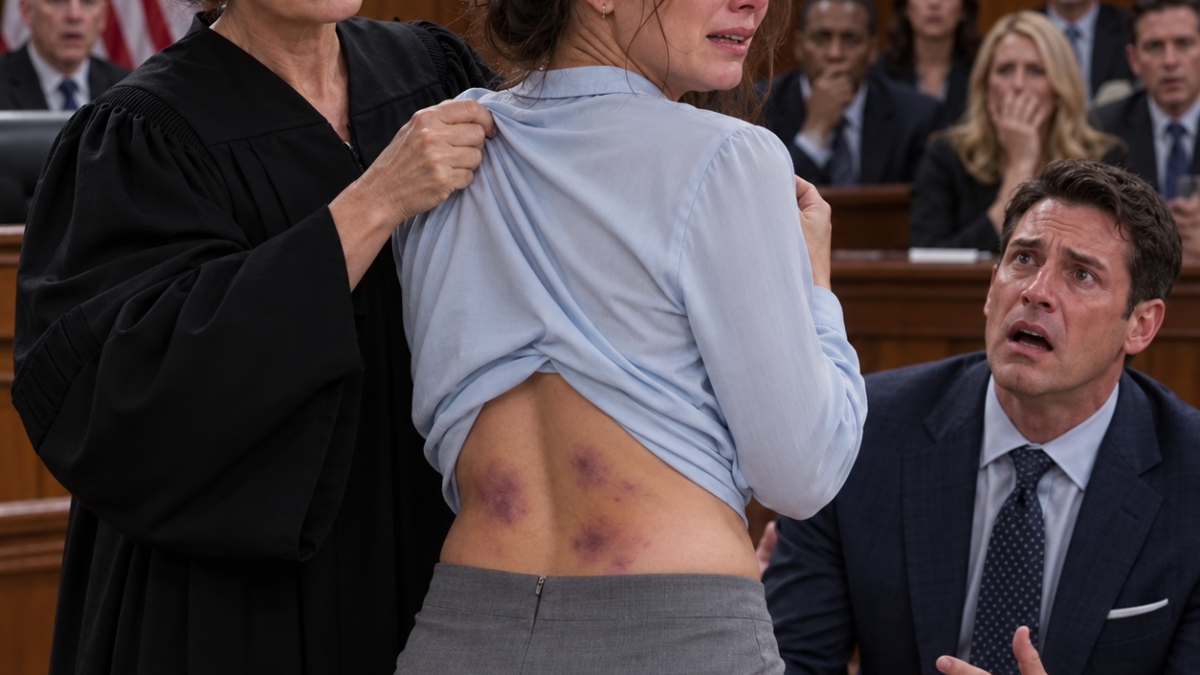
I saw the marks before she saw me.
For several seconds, I could not understand what I was looking at.
Dark bruises spread across her ribs.
Some purple.
Some fading into yellow.
A narrow healing cut ran near her spine.
There were older marks beneath the new ones.
Layer upon layer.
Different ages.
Different injuries.
Not one fall.
Not one accident.
A history.
The air left my lungs.
“Oh, sweetheart.”
Clara spun around.
Her face changed instantly.
She grabbed the blouse from the bed.
“What happened to you?”
“Nothing.”
She pulled the fabric over one shoulder.
“Clara.”
“I fell.”
“Where?”
“Mom, please.”
“Where did you fall?”
She turned away.
“On the stairs.”
I looked at the bruises.
Then at her.
“No.”
Her shoulders stiffened.
“Please don’t.”
“What happened?”
“I told you.”
“You told me something that is not true.”
Her lips began trembling.
That was when I saw it.
Fear.
Not embarrassment.
Not irritation.
Fear.
“Clara.”
She sat on the edge of the bed.
For a long time she stared at the carpet.
Then she whispered, “Daniel gets angry.”
Every instinct in my body went still.
“What does that mean?”
“He gets angry.”
“I heard you.”
She pressed both hands together.
“Then he apologizes.”
My chest tightened.
“He says he doesn’t know what comes over him.”
“How long?”
She did not answer.
“How long, Clara?”
A tear rolled down her cheek.
“Three years.”
I sat beside her.
Three years.
Three years of Christmas dinners.
Three years of birthdays.
Three years of phone calls in which she said everything was fine.
Three years during which I had seen my daughter dozens of times and had never understood.
“Has he hit you?”
Her mouth opened.
Closed.
Then she nodded.
“More than once?”
Another nod.
“What else has he done?”
She began crying.
Not loudly.
That almost destroyed me.
“He pushes me.”
I took her hand.
“He throws things.”
Her fingers were cold.
“He’s grabbed my neck before.”
I closed my eyes for one second.
Only one.
“What else?”
“He controls the accounts.”
I looked at her.
“He checks what I spend. He asks for receipts. He says I’m bad with money.”
“You worked before Sophie was born.”
“He made me quit.”
“Made you?”
“He said Sophie needed me.”
“What did you want?”
“I wanted to go back part-time.”
She wiped her face.
“He said mothers who cared about their children didn’t hand them to strangers all day.”
My anger grew colder.
“He doesn’t like my friends.”
“I’ve noticed you stopped seeing some of them.”
“He said they were bad for our marriage.”
“What about your phone?”
“He checks it.”
“Your email?”
“Yes.”
“Your car?”
Her hesitation gave me the answer.
“There’s a tracker.”
I felt my hands tighten.
“Does he know you are here?”
“Yes.”
“Does he know you are planning to leave?”
“I don’t know.”
“Clara.”
“I don’t know, Mom.”
She suddenly stood.
“You don’t understand.”
I stood with her.
“Then help me understand.”
“He’s a lawyer.”
“I know.”
“A very good one.”
“I know that too.”
“He knows police officers.”
I said nothing.
“He knows judges.”
I watched her face.
“He knows exactly what to say.”
Her voice dropped.
“He tells me no one will believe a nervous wife over a partner at Mercer, Vale and Knox.”
There it was.
Not only violence.
Strategy.
Daniel had not simply hurt my daughter.
He had built a legal argument around her fear.
“He says I provoke him.”
I kept my voice controlled.
“Do you believe that?”
“I don’t know anymore.”
“Clara.”
She looked at me.
“You do not cause another adult to assault you.”
Her eyes filled.
“He says I exaggerate.”
“That does not make the injuries disappear.”
“He says sometimes I get emotional.”
“Being emotional does not make bruises appear.”
“He says if I ever tell anyone, he’ll prove I’m unstable.”
I felt the judge in me begin cataloging the language.
Isolation.
Coercive control.
Intimidation.
Threats involving credibility.
Possible custody manipulation.
Evidence destruction risk.
But I forced myself to remain Clara’s mother.
“What exactly did he threaten?”
She wrapped her arms around herself.
“If I leave, he says he’ll take Sophie.”
My stomach turned.
“He says you can’t just take a child away from her father because your marriage is difficult.”
“Did he use those words?”
“Yes.”
“Anything else?”
“He already drafted custody papers.”
That changed everything.
“When?”
“I saw them two weeks ago.”
“What did they say?”
“That I was unstable.”
She swallowed.
“That I had anxiety.”
“You were treated for anxiety after Sophie’s birth.”
“I know.”
“Did he mention that?”
“Yes.”
Of course he did.
A medical condition.
Something ordinary.
Something treatable.
Something millions of people experienced.
Weaponized.
“He said he would use my therapy records.”
“Does he have access to them?”
“I don’t know.”
“Did you ever authorize him?”
“No.”
“Did you give him your passwords?”
“He knows most of them.”
I felt something inside me harden.
Not rage.
Rage is hot.
This was colder.
More useful.
“Where is Sophie right now?”
“Preschool.”
“Who is picking her up?”
“Daniel.”
“What time?”
“Three.”
I looked at the clock.
1:47.
Clara saw my expression.
“Mom, please don’t call him.”
“I’m not calling him.”
“Don’t go there.”
“I’m not going to confront him.”
“He’ll make it worse.”
“I know.”
She stared at me.
I took her cold hands in mine.
“We are going to the hospital.”
Her face changed.
“No.”
“Yes.”
“Mom.”
“You have injuries. They need to be documented and treated.”
“He’ll say I planned it.”
“That is why a professional will document them.”
“He’ll say you influenced me.”
“I will not speak for you.”
“He’ll say I kidnapped Sophie.”
“We are not going to kidnap anyone.”
Her breathing became faster.
“What if he already picked her up?”
“We will find out through the proper channels.”
She looked at me helplessly.
I squeezed her hands.
“We will document everything.”
I paused.
“We will follow the law.”
Another pause.
“And we will leave him no easy opportunity to rewrite what happened.”
For the first time since I entered the bedroom, Clara looked directly into my eyes.
“You really think someone will believe me?”
“Yes.”
“How can you be sure?”
“I can’t guarantee what every person will do.”
Her face fell slightly.
“But I can guarantee that we will stop helping Daniel hide the truth.”
She nodded.
Barely.
Then she whispered, “Okay.”
I helped her put on her coat.
As we left the bedroom, she looked toward the old photograph on her dresser.
She was sixteen in that picture.
Laughing.
Careless.
Safe.
I wondered when Daniel had taught her to stop being that person.
Then I decided I did not care when.
I cared that he would never get to do it again.
At the hospital, I did exactly what I promised.
I did not introduce myself as a judge.
I did not call anyone I knew.
I did not ask for favors.
Clara gave her own name.
She answered her own questions.
A forensic nurse examined her.
The process was slow.
Careful.
Clinical.
And devastating.
One injury after another was photographed.
Measured.
Recorded.
The nurse asked Clara whether she felt safe returning home.
“No.”
“Has your husband ever strangled or choked you?”
Clara looked at me.
I did not react.
I wanted her answer to be hers.
“Yes.”
The nurse’s expression remained professional.
“How many times?”
“Twice.”
“Did you lose consciousness?”
“Once, maybe for a few seconds.”
My fingernails dug into my palm.
“Has he threatened to kill you?”
Clara hesitated.
“He said sometimes everyone would be happier if I disappeared.”
The nurse paused.
“Did you understand that as a threat?”
“Yes.”
“Has he threatened your child?”
“Not physically.”
“What has he said?”
“That he’ll take her away.”
“Has he used weapons?”
“No.”
“Does he own firearms?”
“Yes.”
My heart dropped.
“How many?”
“I think two.”
“Where are they stored?”
“At home.”
The nurse documented it.
A victim advocate joined us.
Then local police were contacted.
Clara gave a statement.
It took more than an hour.
Three years compressed into dates and incidents.
A broken plate thrown near her head.
A wrist twisted because she tried to leave during an argument.
Her keys hidden.
Credit cards canceled.
A bedroom door kicked open.
A hand around her throat.
Apologies.
Flowers.
Promises.
Then repetition.
The cycle was so familiar professionally.
Hearing it from my daughter nearly broke me.
At one point, Clara said, “I should have left sooner.”
I finally interrupted.
“No.”
Everyone looked at me.
I softened my voice.
“You left when you were able to leave.”
Clara began crying.
The advocate nodded gently.
“Yes.”
That was all.
No judgment.
No question about why she stayed.
No humiliation.
Just evidence.
By late afternoon, the victim advocate helped Clara seek an emergency protective order.
The process moved quickly because of the injuries, threats, and concern involving Sophie.
Police coordinated the child’s transfer.
Daniel had already arrived at the preschool.
He objected.
He argued.
He reportedly insisted that Clara was “having an episode.”
But there was an order.
There were officers.
And this time, Daniel could not control the room simply by speaking more confidently than everyone else.
At 5:26 p.m., Sophie ran into Clara’s arms.
I had never seen my daughter collapse like that.
She dropped to her knees and held the little girl so tightly Sophie started laughing.
“Mommy, you’re squishing me.”
Clara laughed through tears.
“I missed you.”
“You saw me this morning.”
“I know.”
Sophie noticed the hospital bracelet.
“Are you sick?”
“No.”
“Did you get a shot?”
“No.”
“Good.”
Then she saw me.
“Grandma!”
She launched herself at me.
I held her.
Her hair smelled like crayons and strawberry shampoo.
Four years old.
Completely unaware of how close her life had come to becoming a weapon in her father’s hands.
We returned to my house before sunset.
Police advised us on immediate safety measures.
Locks.
Communication.
Documentation.
No direct contact unless required and legally appropriate.
Preserve messages.
Preserve voicemails.
Do not engage.
Clara nodded through all of it.
Then, at 8:13 p.m., her phone rang.
Daniel.
She went pale.
“You don’t have to answer,” I said.
“What if it’s about Sophie?”
I looked at the screen.
“Put it on speaker.”
She answered.
“Hello?”
Daniel’s voice was calm.
Too calm.
“You took my daughter.”
Clara closed her eyes.
“She is safe.”
“You had no right.”
“There’s an order.”
“You had no right.”
His voice sharpened.
“Bring her back.”
Clara’s hand started shaking.
“Daniel.”
“Bring her back tonight, or I will destroy you.”
I looked at Clara.
She looked at me.
Then I spoke.
“Counselor, choose your next words carefully.”
Silence.
Then Daniel laughed.
“And who are you supposed to be?”
I glanced at the recording indicator glowing red.
“The person who just heard you attempt to intimidate someone protected by an emergency order.”
Another pause.
Then his voice changed.
“I don’t think you understand what you’ve done.”
I said nothing.
“You’ve interfered in a family matter.”
“No.”
“You’ve taken my child without my permission.”
“You were informed that Clara and Sophie are protected under an emergency order.”
He laughed softly.
“You really should stop pretending to be a lawyer.”
Clara looked at me sharply.
I stayed silent.
Daniel continued.
“I know people in the courthouse.”
His confidence returned.
“I know people in the police department.”
I felt Clara’s hand grip mine.
“I know exactly how these things work.”
He almost sounded amused.
“By tomorrow morning, Clara will be explaining to a judge why she lied.”
“Is that a threat?”
“No.”
His voice became colder.
“It’s a prediction.”
Then the call ended.
For several seconds, no one moved.
Rain tapped against the windows.
Sophie was upstairs asleep.
Clara stared at the phone.
Then at me.
“Mom?”
“Yes?”
“Why did he say you were pretending to be a lawyer?”
I looked at her.
“Because I never told him I was one.”
She swallowed.
“You never told him anything.”
“No.”
“Then how did he know?”
That was the first moment the case changed beneath my feet.
Until then, I believed I was dealing with a violent husband who had become frightened because his wife finally escaped.
Now I wondered whether Daniel had been frightened long before Clara ever left him.
And if so, what exactly had he been afraid of?
I woke before dawn.
Years on the bench had trained my body to operate on little sleep, but that morning I did not even try.
I sat in my study at 5:10 with a cup of coffee growing cold beside me.
On the wall were photographs of my life before the bench.
Clara at eight.
Clara at sixteen.
Clara at college graduation.
Sophie smiling with two missing front teeth.
I stared at my granddaughter’s photograph.
Then opened a secure notebook.
I wrote:
MERCER, VALE & KNOX.
Underneath:
VERIFY EVERYTHING.
Power itself had never frightened me as much as secrecy.
Power can be challenged.
Secrecy convinces people they cannot even begin.
At 6:17, my private phone rang.
My clerk.
“Judge Hart?”
“Yes.”
“We have a problem.”
I sat straighter.
“What kind?”
“There was an overnight filing in county court involving Clara Cross.”
My fingers tightened around the coffee cup.
“Who filed it?”
“Daniel Mercer.”
Mercer.
I looked at the firm name on my notebook.
“Send it.”
“I already did.”
I opened the secure message.
Emergency petition for temporary custody.
I read carefully.
Not as a mother.
As a judge.
Daniel alleged that Clara had experienced an emotional breakdown.
He described her as paranoid.
Unstable.
Irrational.
He claimed she had fabricated injuries after a marital disagreement.
He claimed she had improperly removed Sophie.
He referenced Clara’s postpartum anxiety.
Selective facts.
Loaded language.
Calculated framing.
Then I reached the final page.
And stopped.
There was a paragraph about me.
Not Judge Evelyn Hart.
Evelyn Cross.
Clara’s mother.
Daniel wrote that Clara’s mother was “a highly influential federal judicial officer who may attempt to improperly interfere with the proceedings.”
I stared at the screen.
He knew.
Not only that I was a lawyer.
He knew exactly who I was.
For twenty-two years, I had watched attorneys make one catastrophic mistake over and over.
They mistook anger for weakness.
They wanted the judge angry.
A furious judge could be accused of bias.
A reactive judge could create appeal issues.
A personally offended judge could become the story.
Daniel wanted that.
Perhaps he expected me to call someone.
Pressure someone.
Demand something.
So I did the opposite.
I stopped reading.
I contacted the appropriate judicial ethics office.
I disclosed everything.
My daughter.
The protective order.
Daniel’s filing.
His reference to my position.
Then, through proper channels, I made sure the judge handling the family proceedings understood I would have no involvement beyond my lawful role as Clara’s mother and potential witness.
I would not preside over anything involving Daniel.
I would not influence anyone who did.
I would not call prosecutors demanding action.
I would not convert a mother’s fear into judicial misconduct.
Daniel wanted me to blur that line.
I intended to make the line impossible to question.
At 8:05, Clara walked into the kitchen carrying Sophie.
My granddaughter still wore pajamas.
“Grandma?”
“Yes, sweetheart?”
“Are we staying here?”
I crouched.
“For a little while.”
“Is Daddy coming?”
Clara froze.
I looked at Sophie.
“Your mommy and daddy are having some grown-up problems.”
“Did Daddy do something bad?”
Clara’s eyes filled.
I answered carefully.
“Sometimes adults make choices that aren’t safe.”
Sophie thought about that.
Then said, “Daddy was yelling again.”
The word struck like a hammer.
Again.
Not once.
Again.
I looked at Clara.
“How often has she heard him yell?”
“I don’t know.”
That answer frightened me more than Daniel’s threats.
At 9:40, the victim advocate called.
“There’s something you need to know.”
“What?”
“Clara’s hospital records have already been requested.”
“By whom?”
“A law firm.”
I already knew.
“Mercer, Vale and Knox?”
“Yes.”
Clara stared at me.
The advocate continued.
“They claim the records are relevant to the custody matter.”
“Were any released?”
“No.”
I exhaled.
“The protective order triggered additional review.”
“Good.”
After the call ended, Clara wrapped both arms around herself.
“He’s trying to get everything.”
“He’s trying to control the story.”
“He’ll say I’m lying.”
“He already is.”
“What if people believe him?”
I walked toward her.
“Then we give them facts.”
“I don’t know if I can do this.”
“Yes, you can.”
“I’m scared.”
“I know.”
“You sound so certain.”
I looked at her.
“I’ve spent my entire career listening to frightened people tell the truth.”
“And?”
“Fear does not make someone a liar.”
She looked down.
Neither of us knew yet how much more frightening the truth was about to become.
The envelope arrived that afternoon.
No return address.
Hand delivered.
Inside were two photographs.
The first showed Daniel’s office.
Specifically, a locked filing cabinet.
Across the cabinet was a handwritten label.
CROSS CONFIDENTIAL.
I stared.
Clara had never worked at Mercer, Vale and Knox.
Neither had I.
Why was our family name on a cabinet in Daniel’s office?
The second photograph showed part of a document.
At the bottom was a signature.
Evelyn Hart.
My signature.
Or an excellent imitation.
On the back of the photograph, someone had written three words.
ASK WHO PAID.
Clara watched my expression.
“What?”
I handed her the picture.
She stared.
“Mom.”
“I know.”
“No.”
She pointed toward the first photograph.
“That label.”
“What about it?”
“I’ve seen it.”
My stomach tightened.
“Where?”
“In Daniel’s study.”
“When?”
“Six months ago.”
“Did you open it?”
“No.”
“Did you ask him?”
“He said it involved one of his clients.”
“Did anyone else access it?”
Clara hesitated.
“Yes.”
“Who?”
She looked terrified.
“Michael.”
My heart stopped.
“Michael who?”
“You know him.”
There was only one Michael I immediately associated with Daniel’s firm.
“Michael Reeves?”
She nodded.
Michael Reeves had worked in my chambers for seven years.
Brilliant.
Careful.
Ambitious.
Trusted.
He left three years earlier for private practice.
Six months after leaving chambers, he joined Mercer, Vale and Knox.
At the time, I had congratulated him.
Now my former clerk had apparently been accessing a confidential file bearing my family name.
At 7:12 that evening, another call came.
Unknown number.
I answered.
No one spoke.
Then a male voice said, “Judge Hart.”
My body went still.
“Who is this?”
“You shouldn’t have opened that envelope.”
The line disconnected.
I immediately notified security and the detective assigned to Clara’s case.
Officers searched the property.
Nothing.
No forced entry.
No footprints.
No damage.
Then one officer stopped near the end of my driveway.
A small red rain boot sat in the grass.
Clara went white.
“That’s Sophie’s.”
The officer photographed it.
“Are you sure?”
“I put both by the door last night.”
No one spoke.
Then Sophie came running into the hallway.
“Grandma!”
She was holding a small silver key.
“Look what I found in Mommy’s bag.”
Clara frowned.
“That isn’t mine.”
I took it.
A number was stamped into the metal.
My fingers closed around it.
I knew that number.
I had not seen it in years.
Room 317.
The old federal courthouse archive.
A sealed storage room connected to a case from the early years of my judicial career.
Evidence had gone missing.
Records had been disputed.
The archive was later closed.
One attorney involved in the original matter had been the father of Michael Reeves.
Clara watched my face.
“What does it open?”
“I don’t know.”
That was technically true.
I knew what door I suspected.
I did not yet know what waited behind it.
That night, after Clara and Sophie went upstairs, I opened old judicial records.
UNITED STATES v. ROTHMAN.
Twenty years old.
Sealed exhibits.
I opened the attorney list.
One name stopped me.
David Mercer.
Daniel’s father.
I sat back.
Mercer.
Reeves.
Room 317.
The forged signature.
Clara’s injuries.
I looked again at the photograph from the envelope.
A case number was visible.
I enlarged it.
It was not Rothman.
It was a financial crimes case from three years earlier.
A case over which I had presided.
Millions had been seized from a network of shell companies.
One corporate defendant had been represented by Mercer, Vale and Knox.
My private phone rang.
Michael Reeves.
I answered.
He did not say hello.
“If you want your daughter alive and your granddaughter safe, stop digging.”
My heart slammed once.
“Michael.”
“You were never supposed to see that cabinet.”
“What is inside?”
Silence.
“Michael.”
“Proof.”
“Of what?”
Another pause.
“Of why Daniel married Clara.”
Every part of me went cold.
“What does that mean?”
He exhaled.
Then said something even worse.
“Don’t trust the police officer assigned to your daughter’s case.”
The line went dead.
I stood motionless.
For the first time in my career, I was not thinking like a judge.
I was thinking only as a mother.
My daughter was upstairs.
My granddaughter was beside her.
And somewhere outside my home, people had been watching us long before Clara ever found the courage to leave Daniel.
A floorboard creaked.
I turned.
Clara stood at the top of the stairs.
“Mom?”
“Yes?”
“I heard you.”
“How much?”
“Michael’s voice.”
I walked toward her.
“What did you hear?”
She descended one step.
Then another.
“He called Daniel something else once.”
I stopped.
“What?”
“I heard them arguing.”
“When?”
“Months ago.”
“What did he call him?”
Clara opened her mouth.
Then every light in the house went out.
Sophie screamed.
For three seconds, everything was black.
Then emergency lighting flickered to life.
Clara ran upstairs.
I followed.
Sophie stood in the hallway crying.
Clara lifted her.
“It’s okay.”
I looked toward the windows.
Rain.
Darkness.
No visible movement.
The security panel downstairs was dead.
Not malfunctioning.
Disabled.
My phone had no signal.
Then it vibrated.
UNKNOWN NUMBER.
You should have listened.
A second message.
Room 317. Midnight. Come alone.
Clara read it over my shoulder.
“What does that mean?”
“I’m not sure.”
“You’re lying.”
I looked at her.
“I’m trying not to frighten you.”
“Mom, I’m already frightened.”
I could not argue.
“So am I.”
Power returned forty minutes later.
Security determined the cameras had been disabled for exactly eleven minutes.
Nothing was stolen.
Nothing obviously damaged.
Except the front door lock had been opened from the inside.
“Inside?” I asked.
The officer nodded.
“That’s what the system shows.”
“Then either someone entered without forcing the door.”
“Yes.”
“Or someone already had access.”
He shifted.
“Judge Hart, I recommend you stay somewhere secure tonight.”
Something about his response bothered me.
He had not asked about Room 317.
Had not asked about Michael.
Had not asked who sent the message.
He simply wanted us gone.
Michael’s warning returned.
Do not trust the officer assigned to your daughter’s case.
At 11:32, I made a decision.
I was going to the courthouse.
Not alone.
Not recklessly.
And not secretly in the sense Daniel hoped.
I documented where I was going and preserved the messages.
When I told Clara I needed to retrieve something, she immediately shook her head.
“No.”
“Clara.”
“No.”
“I am not leaving you here.”
“And I’m not letting you disappear into some courthouse in the middle of the night.”
“This may connect directly to Daniel.”
“Exactly.”
She stepped closer.
“You’re my mother.”
“And you’re my daughter.”
“Then stop becoming Judge Hart every time things get terrifying.”
The words hurt because they were partly true.
“I’m trying to protect you.”
“So am I.”
Her voice broke.
“I spent three years believing nobody would help me.”
I looked at her.
“And now you’re the first person who has.”
Tears gathered.
“Do not disappear on me now.”
I pulled her into my arms.
“I won’t.”
At 11:57, we entered the old courthouse through a secured entrance after appropriate arrangements had been made.
The building felt different at night.
During the day, marble hallways carried voices.
Attorneys.
Jurors.
Clerks.
Families.
Arguments.
At midnight, every sound echoed.
Room 317 sat at the end of an old archive corridor.
I inserted the silver key.
It turned.
Clara grabbed my arm.
“Mom.”
“I know.”
The door opened.
Dust.
Shelves.
Old evidence boxes.
Sealed records.
But in the center stood something that did not belong.
A new metal cabinet.
Across it, a white label.
CROSS FAMILY.
Clara covered her mouth.
I opened it.
Medical records.
Bank statements.
Property documents.
Photographs.
Court filings.
Pictures of me leaving the courthouse.
Pictures of Clara in college.
Pictures of Sophie outside preschool.
Pictures of my home.
Someone had been watching us for years.
Clara found a folder.
PROJECT HART.
Inside was Daniel’s photograph.
Below it was a different name.
Nathaniel David Mercer.
“Mom.”
I read further.
Daniel had legally changed his name seven years earlier.
Before then, he was Nathaniel David Mercer.
Then another name appeared.
Margaret Cross.
My sister.
My dead sister.
I could not breathe.
Margaret had died twenty-six years earlier.
A traffic accident.
That was what we had been told.
That was what I had believed.
But the file said she had an “undisclosed financial relationship” to the Mercer network.
A handwritten note appeared beneath.
Evelyn never knew.
Clara touched my arm.
“What is this?”
“I don’t know.”
Then she found another document.
Her face changed.
“This says Daniel met me before I met him.”
I took it.
A timeline.
Clara at twenty-one.
Three months before the restaurant where Daniel later claimed they first crossed paths.
He had been watching her.
Studying her.
Her school.
Relationships.
Friends.
Family.
Finances.
At the bottom:
Marriage recommended.
Clara stepped backward.
“No.”
I caught her shoulders.
“No.”
Her face collapsed.
“He didn’t marry me because he loved me.”
Before I could answer, the archive lights suddenly brightened.
A man stood in the doorway.
Michael Reeves.
He looked exhausted.
Rain soaked his suit.
He closed the door behind him.
“Because your mother was the one person they couldn’t control.”
I stared.
“Explain.”
Michael looked at the cabinet.
“Daniel’s family wanted leverage.”
“Against me?”
“Yes.”
“Why?”
“Because your sister discovered what they were doing twenty-six years ago.”
My heart stopped.
“What did Margaret discover?”
“Money.”
“What money?”
“Federal money.”
He swallowed.
“Mercer, Vale and Knox was built on more than legal fees.”
He listed shell companies.
Charities.
Construction companies.
Political donors.
Money routed until ownership became difficult to trace.
“And Margaret?”
“She found records.”
“What happened?”
“She copied them.”
“Where are they?”
“She gave them to you.”
“No.”
“Yes.”
“I would remember.”
Michael shook his head.
“You did receive them. You just didn’t know what they were.”
He pointed into the cabinet.
I opened another file.
A photograph of Margaret and me.
Young.
Smiling.
Standing outside our childhood home.
On the back:
For Evelyn, when she remembers.
Below:
The accident was not an accident.
The room disappeared around me.
Twenty-six years.
Twenty-six years of grief.
Twenty-six years believing an ordinary tragedy had taken my sister.
Michael stepped closer.
“I’m sorry.”
“You knew?”
“Yes.”
“How long?”
“Three years.”
Anger surged.
“Three years?”
“I was trying to protect Clara.”
“You joined Daniel’s firm.”
“To find evidence.”
“You could have come to me.”
“I couldn’t.”
“Why?”
His eyes shifted toward Clara.
“Because someone inside the courthouse was helping them.”
I stared.
“Who?”
“I never learned the name.”
Footsteps sounded outside.
Michael froze.
The door handle moved.
Slowly.
Clara stepped behind me.
“Michael?”
“Do not open it.”
The handle stopped.
Then a man’s voice came through.
Calm.
Familiar.
Daniel.
“You should have listened to me, Evelyn.”
Clara turned white.
Daniel continued.
“You were always very good at judging everyone else.”
A pause.
“But you never learned how to judge the people closest to you.”
I looked at Michael.
His eyes dropped.
Daniel spoke again.
“Ask him what happened the night your sister died.”
I faced Michael.
“What happened?”
He whispered, “I wasn’t supposed to be there.”
“What happened?”
“I was seventeen.”
“You were there?”
He nodded.
“I saw the car.”
My chest tightened.
“What car?”
“The one that hit Margaret.”
“Who was driving?”
Michael looked directly at me.
“Daniel’s father.”
Silence.
Then Daniel laughed from the other side of the door.
“No, Judge.”
His voice became almost gentle.
“That’s only half the truth.”
The lights went out.
Clara screamed my name.
Thirty seconds later, they returned.
Daniel was gone.
Michael was gone.
And the folder concerning Margaret’s death had disappeared.
One sheet remained on the floor.
A handwritten sentence.
ASK CLARA WHAT SHE SAW THE NIGHT SHE LEFT DANIEL.
I turned.
Clara was crying.
“What did you see?”
She shook her head.
“Clara.”
“I saw him talking to someone.”
“Daniel?”
“I thought so.”
“What do you mean?”
She pointed toward the photograph labeled Nathaniel David Mercer.
“There were two.”
“What?”
“The night before I left, I looked through the garage window.”
Her hands began trembling.
“Daniel was outside.”
“And?”
“Another man came out of the house.”
She looked at me.
“He looked exactly like Daniel.”
For a moment I could not process it.
“A twin?”
“I don’t know.”
“What did they say?”
“I heard one sentence.”
“What?”
Clara closed her eyes.
“She remembers too much.”
Every hair on my arms rose.
“Who said it?”
“I don’t know.”
Sophie tugged her sleeve.
“Mommy?”
Clara immediately knelt.
“Yes, baby?”
“Can we go home?”
Clara looked at me.
And in that moment I understood something I should have known from the beginning.
Home was no longer a place.
Not my house.
Not Clara’s marital home.
Not the courthouse.
Home was wherever my daughter and granddaughter could stop being afraid.
“Yes,” I said.
“We are going home.”
The next morning, I contacted federal investigators through proper channels.
Not friends.
Not favors.
Not informal influence.
I disclosed my conflict.
I recused myself from any matter that could touch my family.
Then I handed over evidence.
That was all.
Evidence did the rest.
Investigators traced bank accounts.
Companies.
Political donations.
Old case files.
Missing exhibits.
The cabinet in Room 317.
The surveillance files.
The forged signature.
Records connected to Margaret.
Daniel’s history.
Then came the first major correction.
Daniel did not have a twin.
Not technically.
The man Clara saw was his identical half-brother.
Nathan Mercer.
Born under a different surname.
Kept out of the public side of the family.
Almost absent from normal records.
Daniel and Nathan had worked together for years.
Two nearly identical men.
One useful public identity.
One useful shadow.
If Daniel needed an alibi, Nathan could appear.
If a threat needed to be delivered, Nathan could appear.
If surveillance footage became inconvenient, identity became uncertain.
Witnesses questioned themselves.
Clara had questioned herself.
That was part of the design.
Three days later, Nathan was arrested while attempting to leave the country under a false identity.
Daniel was arrested that afternoon.
The initial charges went far beyond domestic violence.
Conspiracy.
Fraud.
Obstruction.
Witness intimidation.
Financial crimes.
Then evidence connected the brothers and their family network to Margaret’s death.
For twenty-six years, I had believed my sister died because of an accident.
The truth was crueler.
Margaret had discovered financial records linked to the Mercer organization.
She copied them.
She hid evidence.
She tried to create a trail that could survive her.
When the wrong people learned what she knew, they silenced her.
Or thought they had.
They failed.
Because Margaret had already left pieces behind.
Some in old files.
Some in photographs.
Some inside records no one thought I would ever connect.
She simply needed someone to survive long enough to see the pattern.
That someone turned out to be me.
Daniel fought everything.
Of course he did.
He challenged Clara’s credibility.
He attacked the hospital documentation.
He characterized her injuries as “ambiguous.”
He claimed her recollection had been influenced by me.
He claimed the protective order had been obtained through panic.
He claimed I had used my status.
Every allegation was examined.
That was important.
I wanted it examined.
Because facts that survive scrutiny become much harder to bury.
Clara’s medical evidence stood.
The photographs stood.
Her contemporaneous messages stood.
Witness accounts stood.
The recorded threat stood.
Financial records stood.
The files from Room 317 stood.
Digital evidence stood.
Eventually, Daniel’s version of reality became too complicated to maintain.
A lie often survives by forcing everyone else to explain.
Daniel had spent years forcing Clara to explain herself.
Why she was upset.
Why she spent money.
Why she wanted to see friends.
Why she disliked being grabbed.
Why she was frightened.
Why she wanted to leave.
Once investigators made Daniel explain the evidence instead, his confidence began to crack.
Why had his firm sought Clara’s protected medical records so quickly?
Why did his office maintain files on the Cross family?
Why were there photographs of Sophie outside preschool?
Why did documents contain my forged signature?
Why did Daniel’s family have access to sealed material?
Why did Nathan move under false identities?
Why did financial transfers connect companies from cases I had presided over?
Why had Margaret Cross been monitored before her death?
Why had Daniel studied Clara before supposedly meeting her by chance?
Question after question.
The man who once told my daughter that no one would believe her discovered something he should have understood as an attorney.
Courtrooms do not require victims to be perfect.
Evidence does not become false because the frightened person presenting it cries.
And confidence is not proof.
Six months later, Clara testified.
The courtroom was packed.
Daniel sat at the defense table.
Without the expensive suit he favored, without the controlled smile, without his office and his reputation surrounding him, he looked smaller.
Ordinary.
That was perhaps the strangest thing.
Powerful men often seem enormous only while everyone around them agrees to act small.
Clara took the stand.
I watched from behind her.
She was pale.
Her hands shook.
But her voice was clear.
She described the first time Daniel shoved her.
They had been married less than a year.
He apologized immediately.
Cried.
Bought flowers.
Said stress had changed him.
She believed him.
The second incident was worse.
Then months passed.
Then another.
Then intimidation became routine.
He never had to hit her every day.
He only had to make her remember that he could.
She described money.
Access to accounts.
Passwords.
Tracking.
Friends disappearing from her life.
She described Daniel standing in the doorway during arguments so she could not leave.
She described sleeping with Sophie behind a locked bedroom door.
At one point, the prosecutor asked, “Why didn’t you report the violence sooner?”
Daniel looked at her.
I saw Clara notice.
For years, that look had controlled her.
Then she answered.
“Because he made me believe the consequences of telling the truth would be worse than the consequences of staying.”
Silence filled the room.
“What changed?”
Clara swallowed.
“My mother saw my back.”
My eyes filled.
“She asked what happened.”
“And what did you say?”
“I lied.”
“Why?”
“Because that had become automatic.”
“What happened next?”
“She asked again.”
“And?”
“I told her enough of the truth to start.”
“Did she pressure you to make allegations?”
“No.”
“Did she promise to use her position to punish your husband?”
“No.”
“What did she tell you?”
Clara looked toward me.
“She said we would document everything and follow the law.”
The prosecutor nodded.
“At the time, did your husband know your mother was Judge Evelyn Hart?”
“I didn’t think he did.”
“Did you?”
“Yes.”
“Why had that information been kept private?”
“Because my mother never wanted her position to become power I could borrow.”
Daniel’s attorney objected.
The court handled it.
Clara continued.
She never shouted.
Never dramatized.
She did not need to.
She told the truth.
Bruises.
Threats.
Control.
Fear.
The night she saw Nathan.
The custody papers.
The threat to destroy her.
Then the defense began.
They tried to make her sound inconsistent.
Trauma does not always organize itself chronologically.
Dates shifted slightly.
Certain details were uncertain.
Daniel’s lawyer emphasized every hesitation.
“Mrs. Mercer, you said you were afraid of your husband.”
“Yes.”
“Yet you remained married to him.”
“Yes.”
“You traveled with him.”
“Yes.”
“You attended social events.”
“Yes.”
“You posted photographs online smiling beside him.”
“Yes.”
“So there were periods when your marriage appeared happy.”
Clara looked at him.
“Appeared.”
He paused.
“You expect this court to believe you were terrified while posting anniversary photographs?”
Clara breathed slowly.
Then said, “I expect the court to understand that a photograph takes less than a second.”
The courtroom went completely still.
She continued.
“You did not photograph what happened afterward.”
Daniel lowered his eyes.
That was the moment I realized something.
My daughter was still afraid.
But fear no longer controlled where she looked.
Near the end of testimony, Daniel stared at her.
Clara met his eyes.
Then looked away.
Not because she was intimidated.
Because he no longer deserved her attention.
That was when I knew she was becoming free.
The investigation widened for months.
Mercer, Vale and Knox collapsed.
Some partners cooperated.
Others were charged.
Financial records resurfaced.
Missing exhibits were recovered.
Former employees talked.
People who had stayed silent for years suddenly discovered the value of honesty once secrecy stopped protecting them.
Michael Reeves surrendered himself and cooperated.
For a long time, I did not know what I felt toward him.
Anger.
Gratitude.
Betrayal.
Pity.
He had known too much and said too little.
But he had also spent years trying to uncover the same network that had destroyed Margaret.
One afternoon, we sat across from each other in a conference room.
No robes.
No courtroom.
No clerk and judge.
Just two people whose lives had been damaged by the same history.
“Why didn’t you tell me?” I asked.
Michael looked tired.
“I thought they were watching you.”
“They were.”
“I thought if I came to you, I’d expose what I had.”
“You should have trusted me.”
“Yes.”
No excuse.
No argument.
That answer softened me more than justification would have.
“Did your father know?”
Michael nodded.
“He represented people involved in Rothman. He realized evidence was being moved. By the time he understood the scale, he was afraid.”
“Of the Mercers?”
“Of everyone connected.”
“And Margaret?”
“She knew part of it.”
“Did your father know she was in danger?”
Michael looked down.
“I think he suspected.”
The answer hurt.
For twenty-six years, I had imagined that Margaret’s final day had been ordinary.
Now every unknown choice looked different.
Had she been afraid?
Had she tried to call me?
Had she wondered whether I would understand?
There are questions no investigation can answer.
That is one of the hardest lessons a judge learns.
Justice can establish facts.
It cannot recreate the dead.
Eventually, Margaret’s name was publicly connected to the evidence she tried to preserve.
A memorial plaque was placed in the courthouse honoring victims and whistleblowers whose courage helped expose the scheme.
I attended with Clara and Sophie.
When the cloth was removed, Clara squeezed my hand.
“I wish Aunt Margaret could see this.”
“So do I.”
Sophie looked up.
She was older now.
“Was she brave?”
I smiled.
“Very.”
“Like Mommy?”
I looked at Clara.
“Yes.”
“Like you?”
Clara answered before I could.
“Especially like Grandma.”
I laughed softly.
For most of my life, I thought strength meant appearing unafraid.
The bench rewards composure.
Lawyers mistake emotion for weakness.
Judges are trained to control their faces, voices, reactions.
But Clara had taught me something better.
Courage was not the absence of fear.
Sometimes courage was simply telling the truth while your voice shook.
One year after Clara left Daniel, she moved into a small house fifteen minutes from mine.
Blue front door.
Tiny garden.
A swing in the backyard for Sophie.
Nothing luxurious.
Nothing designed to impress anyone.
The first time I visited, I noticed Clara had left her bedroom door open.
Such a small thing.
But I understood.
No one could trap her in a room.
No one controlled which doors opened.
There were no hidden cameras.
No tracking devices.
No passwords Daniel demanded.
No footsteps in the hallway making her body tense.
Ordinary life returned slowly.
One Saturday morning, I arrived to smell burnt pancakes.
Sophie ran toward me.
“Grandma!”
She wrapped her arms around my waist.
“Mommy burned breakfast.”
Clara shouted from the kitchen.
“I did not!”
“You did!”
I laughed.
Clara appeared carrying a plate.
“Your granddaughter has become extremely dramatic.”
“She inherited it.”
“From you?”
“Obviously.”
Sophie giggled.
The kitchen filled with noise.
Music.
Plates.
Arguments about syrup.
A child laughing.
For years, I had presided over cases involving families who would have given anything for an ordinary morning like that.
We rarely understand peace while we have it.
We recognize it after fear teaches us the difference.
That evening, Clara and I sat on the porch.
The sun dropped behind the trees.
“Mom?”
“Yes?”
“Do you ever wish we never found out?”
“About what?”
“All of it.”
She looked down.
“Aunt Margaret. Daniel. Why he married me.”
I thought carefully.
“No.”
“Really?”
“Yes.”
“Even Margaret?”
“Especially Margaret.”
Clara looked confused.
“Why?”
“Because secrets don’t disappear when we refuse to look at them.”
I watched Sophie playing in the yard.
“Your aunt spent her last days trying to make sure the truth survived her.”
Clara rested her head on my shoulder.
“I almost didn’t survive mine.”
The words nearly stopped my heart.
I turned.
“But you did.”
“I was so scared.”
“I know.”
“I thought no one would believe me.”
I touched her chin gently.
“Look at me.”
She did.
“I believed you.”
“From the beginning?”
“From the moment I saw your back.”
Her eyes filled.
Then she cried.
Not the frightened crying from that first day.
Not the silent tears of someone afraid even grief might provoke punishment.
These tears came from safety.
I put my arm around her.
“You came home.”
She smiled.
“Yes.”
“That mattered more than you knew.”
Years passed.
Sophie gradually learned the story in pieces.
Never all at once.
Children should not carry adult horror before they have language strong enough to hold it.
When she was little, we told her only that her father had made unsafe choices.
Later, she learned about abuse.
Control.
Threats.
Law.
Evidence.
She learned that love should never require silence.
That power does not make a person right.
That fear is not consent.
That asking for help is not failure.
That a polished reputation does not cancel private cruelty.
Most importantly, she learned that none of what happened to Clara had been caused by Clara.
As Sophie grew, I occasionally wondered whether the story would define her.
It did not.
That was another victory.
Trauma existed in her family history.
It was not her identity.
Clara eventually returned to work.
At first part-time.
Then full-time.
She became involved with organizations supporting survivors of domestic violence.
The woman who once believed her own fear made her unbelievable became one of the clearest voices I had ever heard explaining coercive control.
Years later, she was invited to testify before Congress about legal protections for survivors facing financial abuse, custody intimidation, and professional retaliation.
I sat in the audience.
She walked to the microphone.
Calm.
Prepared.
Her hands did not shake until she opened her folder.
I knew because I was watching closely.
Then she began.
She did not tell Daniel’s story.
She told hers.
She spoke about how abusers weaponize credibility.
How professional status can become part of coercion.
How survivors can appear functional while living in terror.
How custody threats can trap parents.
How financial surveillance can become a cage.
How quickly institutions can fail people when confidence is mistaken for truth.
She did not ask anyone to pity her.
She asked them to understand the system clearly enough to improve it.
When she finished, people stood.
Clara looked overwhelmed.
Afterward, she came toward me quickly.
“Mom.”
I hugged her.
“You were wonderful.”
“I was terrified.”
“So was I.”
She laughed.
“You?”
“Always.”
“You never look scared.”
I smiled.
“That is because you usually see me when I am busy.”
She pulled back.
“What does that mean?”
“It means courage often looks less impressive from the inside.”
She hugged me again.
As I held her, I realized something I had missed during my entire career.
A judge protects the law.
A mother protects the person she loves.
The dangerous temptation is believing those roles are the same.
They are not.
What saved Clara was not that I could command a courtroom.
It was that I refused to misuse that power.
I believed her.
I helped her document the truth.
I made sure professionals did their jobs.
I stepped away when my position could create a conflict.
Then I stood beside my daughter while the evidence spoke.
That distinction mattered.
It always would.
That night, I returned home alone.
My study was quiet.
Margaret’s photograph still sat on the shelf.
Beside it was a newer photograph of Clara and Sophie laughing in the garden.
I moved the frames closer together.
Past and present.
Loss and survival.
A sister I could not save.
A daughter I almost lost.
A granddaughter who would grow up knowing that fear should never be confused with love.
I looked at Margaret.
“It’s over.”
The room was silent.
But the silence no longer felt empty.
For twenty-six years, I had treated silence like the final proof of death.
No answers.
No explanation.
No chance to ask one more question.
Now silence felt different.
Peaceful.
Outside, rain began tapping against the windows.
The same sound I remembered from the morning Clara came home without her wedding ring.
I could still see her standing in my kitchen.
Forced smile.
Long sleeves.
Cold hands.
I remembered the moment I stepped into her bedroom.
The bruises.
The cut.
The older yellow marks beneath the newer ones.
I remembered whispering, “What happened to you?”
I remembered her answer.
I fell.
Three years of abuse hidden inside two words.
Then I remembered what came after.
The hospital.
The order.
Daniel’s phone call.
His calm threat.
His belief that no one would believe her.
He had been wrong about almost everything that mattered.
He thought being a lawyer made him untouchable.
He thought knowing police officers meant the law belonged to him.
He thought knowing judges meant he understood justice.
He thought my daughter’s fear guaranteed her silence.
He thought my position would either intimidate me or tempt me into doing something improper.
He thought power meant controlling people.
What he never understood was that real power often looks boring.
A documented injury.
A preserved voicemail.
A properly issued order.
A witness who decides to speak.
A bank record.
A file someone forgot to destroy.
A frightened woman saying, “Yes, he did this to me.”
Truth rarely enters the room dramatically.
Sometimes it arrives trembling.
Sometimes it needs help standing.
But once enough pieces survive, even powerful people can no longer order reality to change.
My phone buzzed.
A photograph from Clara.
Sophie had fallen asleep on the sofa with a book across her face.
Underneath, Clara had written:
She swore she wasn’t tired.
I laughed.
Then another message arrived.
Thank you for believing me when I couldn’t believe myself.
I stared at the words for a long time.
I typed several replies.
Deleted them.
Finally, I wrote:
You told the truth. I just stayed beside you while you did it.
Then I turned off the lamp.
Before leaving the study, I looked at Margaret one more time.
My sister had tried to expose powerful people.
Clara had survived one.
Sophie would grow up knowing both stories.
Not as warnings that the world was hopeless.
As proof that silence could end.
Upstairs, I could hear Clara’s voice through the speakerphone as Sophie laughed about something I could not understand.
Life had continued.
The darkness had not won.
For decades, I thought justice meant the guilty being held accountable.
I still believed that mattered.
I had devoted most of my adult life to it.
But age had taught me something the bench never could.
Sometimes the greatest victory is not watching a powerful man lose his freedom.
It is watching the people he frightened recover theirs.
It is your daughter sleeping without listening for footsteps.
It is your granddaughter laughing without lowering her voice.
It is a blue front door no one controls but the woman who lives behind it.
It is pancakes burning on a Saturday morning.
It is ordinary life returning.
I closed the study door.
And as I walked upstairs, I thought again about the sentence Daniel had once spoken with absolute confidence.
No one will believe you.
He had built an entire life around that assumption.
In the end, one person believed Clara immediately.
Then a nurse documented her injuries.
An advocate helped her.
Police enforced an order.
Investigators followed evidence.
Witnesses spoke.
Records surfaced.
A courtroom listened.
And eventually the world Daniel had manipulated became too full of facts for his version of the truth to survive.
He had once threatened to destroy my daughter.
Instead, Clara rebuilt herself.
He had once threatened to take Sophie.
Instead, Sophie grew up safe.
He had once treated my family as leverage.
Instead, his surveillance exposed the conspiracy his own family had spent decades hiding.
He had once believed he understood judges.
But the greatest mistake he made was never understanding a mother.
Not because I broke the law for my daughter.
Because I refused to.
I gave Daniel no misconduct to hide behind.
No improper order.
No secret phone call.
No favor.
Nothing except what frightened men like him fear most.
A woman who had stopped being silent.
Evidence.
And time.
I reached the top of the stairs and stopped near the window.
Rain ran slowly down the glass.
For a second, I saw Clara as a child again.
Eight years old.
Running through this hallway after a nightmare.
Calling for me.
Back then, protecting her had been simple.
I turned on the light.
Checked under the bed.
Held her until she slept.
Adults are harder to protect.
You cannot inspect every shadow.
You cannot choose their partners.
You cannot force them to leave before they are ready.
You cannot promise that telling the truth will be painless.
All you can do is make sure they know where home is when they finally run.
Clara had remembered.
She came home.
And that changed everything.
Years later, when people asked what moment began Daniel Mercer’s downfall, they often expected me to name Room 317.
The secret files.
The financial records.
The surveillance.
Nathan Mercer.
Margaret’s evidence.
They expected something dramatic.
I always thought of something much smaller.
A bedroom.
Rain against the window.
My daughter pulling a blouse over bruised shoulders.
Her whispering, “Please, Mom. Don’t make this worse.”
And me realizing that the worst thing I could possibly do was allow her to return to silence.
That was where it began.
Not in court.
Not with an arrest.
Not with a federal investigation.
With a mother asking her daughter one more time:
“What happened?”
And a frightened woman finally deciding to answer.
The truth did not save us all at once.
It came home piece by piece.
But it came home.
And once it did, none of us ever had to live inside Daniel’s version of reality again.








