My CEO Husband Took His Mistress to the Gala—Then My Billionaire Father Walked In and Asked About His Company
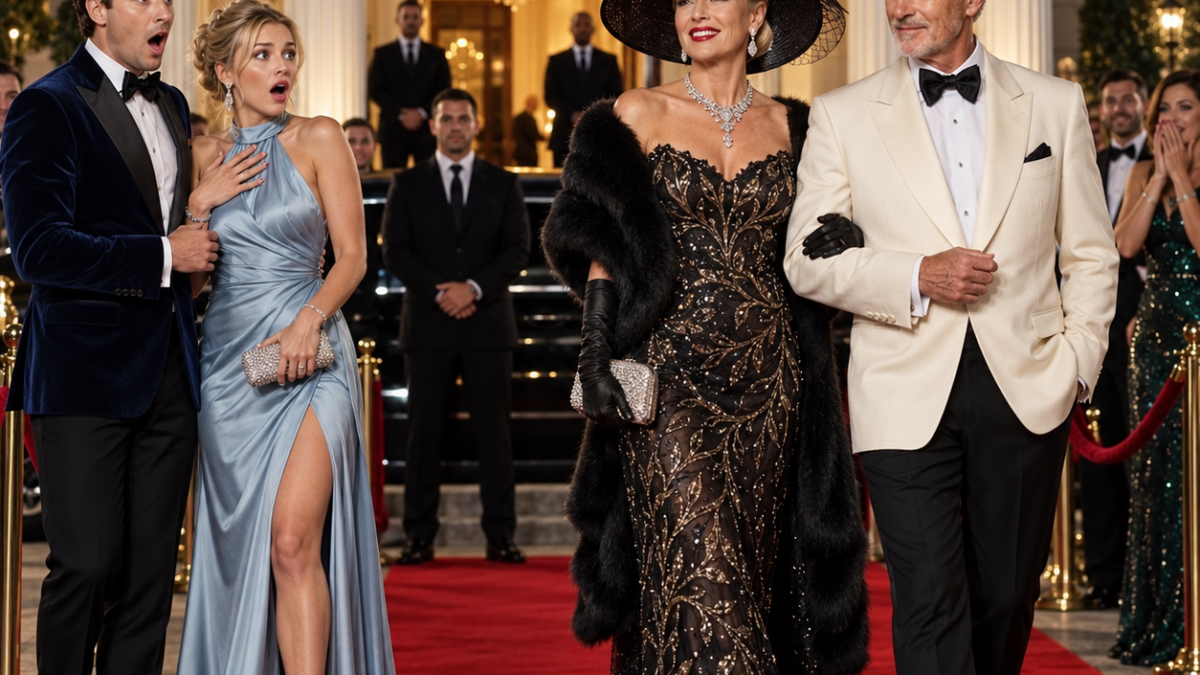
PART2
I do not know what made me move. Pride, maybe. Or the final flicker of a self I had almost forgotten. I turned from the window, walked out of my bedroom, and descended the stairs one careful step at a time.
Mrs. Gladys saw me first.
Her face changed.
She had been with our household since the first year of my marriage, though “our household” was a generous phrase. The mansion belonged to Spencer on paper because he wanted it that way, but it had never felt like mine. Mrs. Gladys knew more than she said. She saw the untouched dinners, the closed doors, the birthdays Spencer forgot, the nights I sat alone in the kitchen because the silence in the master bedroom was too large.
She looked at me now with something between concern and warning.
Spencer turned.
The moment he saw me, his expression tightened as if I had stepped onto a stage where I had not been cast.
“What are you doing?” he asked.
“I thought we were going together,” I said.
My voice sounded calm.
Too calm.
Paisley’s gaze traveled slowly from my hair to my shoes, lingering on the sleeves of my dress. Her mouth curved.
“Oh,” she said, placing a hand lightly over her lips. “So you’re the wife.”
The wife.
Not Spencer’s wife.
Not Mrs. Conway.
Not Phoebe.
The wife.
As though I were a legal inconvenience instead of a person.
She laughed softly. “Now I understand why he never takes you anywhere.”
I looked at Spencer.
Waited.
One word.
That was all I wanted.
One correction.
One boundary.
One sign that the man I had married still existed somewhere behind the expensive suit and empty eyes.
He said nothing.
His silence hurt more than if he had shouted.
Paisley tilted her head. “The Apex Group annual gala is far too important tonight. There will be CEOs, investors, politicians, international partners, actual people with influence.” She smiled at me as if she were giving advice to a child. “You should stay home, Phoebe. Looking like that, you’d only ruin Spencer’s evening.”
“Paisley,” I said quietly.
Her eyebrows lifted.
“That necklace,” I continued. “Did Spencer buy it?”
She touched the diamonds with a little smile. “He has excellent taste.”
I looked at him again.
“Did you?”
His jaw tightened. “This isn’t the time.”
“No,” I said. “I suppose it never is.”
He sighed, impatient now, because humiliation was acceptable only as long as I received it quietly.
“Phoebe, don’t make a scene.”
The words struck something deep in me.
Not because they were cruel.
Because they were familiar.
Do not make a scene.
Do not ask questions.
Do not embarrass me.
Do not cry where people can see.
Do not expect loyalty just because you gave me yours.
Paisley slipped her arm through his. “We’re running late.”
Spencer did not look at me again.
He escorted her out.
The front doors closed behind them with a hollow sound that seemed to travel through the whole house.
I stood there until the SUV engine started, until its headlights swept across the windows, until the sound faded down the long driveway and disappeared into the night.
Mrs. Gladys approached carefully.
“Ma’am,” she said, her voice soft, “would you like me to make you something to eat?”
I almost laughed.
Food.
Such a small human kindness.
A sandwich, soup, tea.
Something warm placed in front of a woman whose marriage had just been stripped bare in her own foyer.
“I’m not hungry,” I said.
Her eyes were wet. “Mrs. Conway…”
“Please don’t call me that tonight.”
She stopped.
I had not meant to say it.
The words simply came out.
For three years, I had worn Spencer’s name like a test I kept failing.
I turned and went upstairs.
The bedroom felt colder when I entered it again. I closed the door, walked to the mirror, and looked at the woman in the navy dress. She had not screamed. She had not collapsed. She had not begged her husband to stay.
But she was not strong.
Not yet.
She was empty in the way a house becomes empty after the people inside it finally admit they have been living with ghosts.
My phone buzzed on the vanity.
For one foolish second, I thought it was Spencer.
It was not.
Unknown number.
The message contained a photo.
Paisley was sitting in the back seat of Spencer’s SUV, holding up two fingers in a playful victory sign. Spencer’s profile was reflected in the window beside her. His hand rested near her knee.
Beneath the image, she had written:
Tonight he’ll be completely mine. Enjoy waiting for him.
I stared at the words.
I had expected pain.
Instead, something quiet moved through me.
Something colder than anger.
Something cleaner.
I placed the phone on the vanity, opened the bottom drawer, and pushed aside a stack of silk scarves I had not worn in years.
At the back was a red velvet box.
I had hidden it there three years earlier, the day I married Spencer Conway.
My father had given it to me before the ceremony.
Not at the church.
Not in front of guests.
Not while cameras flashed and everyone praised the handsome CEO who had captured Raymond Harrell’s mysterious daughter.
No.
Dad had found me alone in the bridal suite before anyone else arrived. He had looked older than usual that day, though he was still powerful, still broad-shouldered, still the kind of man who seemed to occupy more space than other people.
He had held out the red box.
“Keep this,” he said.
“What is it?”
“Something you may need.”
I laughed then because I was happy, naive, and wearing white.
“Dad, I’m getting married, not going to war.”
He had not smiled.
That should have frightened me.
Instead, I kissed his cheek and told him I wanted a simple life. I told him Spencer loved me because I had hidden who I was. I told him I wanted to know what it felt like to be chosen without the Harrell name standing behind me like a fortress.
My father looked at me with such sadness that I almost changed my mind before the wedding even began.
Then he said, “There may come a day when love and blindness feel the same. If that day comes, use what’s inside.”
I promised him I would.
Then I locked the box away and did not open it again.
Until tonight.
My fingers trembled as I lifted the lid.
Inside lay a black card, smooth and heavy, with no bank logo, no account number on the front, no visible name.
Only a silver emblem.
A small crown surrounded by three circles.
Beneath it, printed in fine letters, were the words:
HARRELL PRIVATE TRUST — AUTHORIZED BENEFICIARY.
Beside the card was a small SIM card sealed in a plastic sleeve.
I had forgotten about that part.
My heart began beating harder.
I removed the SIM and inserted it into my phone.
For a moment, nothing happened.
Then the screen refreshed.
There was only one contact saved.
Dad.
I sat on the edge of the vanity stool.
Three years.
Three years of not calling him.
Three years of sending polite holiday messages, brief birthday texts, and carefully edited photos that made my life look quiet but not sad. Three years of refusing invitations home because I could not bear to let him look at me and know I had been wrong.
I had thought silence was dignity.
It was not.
It was isolation dressed up as pride.
My thumb hovered over the call button.
Then I pressed it.
The phone rang once.
Twice.
Three times.
A deep voice answered, rough with disbelief.
“Phoebe?”
My chest tightened so sharply I had to close my eyes.
“Dad…”
For a moment, I was not twenty-nine years old.
I was twelve again, standing in a funeral dress too stiff at the collar, staring at a closed casket while my father held my hand so hard it almost hurt.
I swallowed.
“I want to come home.”
The silence that followed was not empty.
It was full of everything we had not said.
Then Raymond Harrell, one of the most powerful businessmen in the state, spoke in a voice that broke on the first word.
“My little girl,” he said. “I’m coming for you.”
I pressed my hand over my mouth.
I did not want to cry.
Not yet.
“Dad,” I whispered.
“Yes?”
“Don’t be angry.”
He exhaled slowly.
“Does your husband hurt you?”
My throat closed.
Images flashed through my mind.
Spencer gripping my wrist too hard at a charity dinner because I spoke to a journalist without asking him first.
Spencer throwing a glass against the kitchen wall two inches from my shoulder because a board member had declined his proposal.
Spencer standing over me while I sat on the bed, telling me no one else would tolerate my moods.
I answered the only way I knew how.
“No.”
My father was quiet.
Then he asked a different question.
“Does he humiliate you?”
I closed my eyes.
This time, there was no way to lie.
“Yes.”
“Does he have another woman?”
I looked at Paisley’s message still glowing on the vanity.
“Yes.”
Dad did not speak.
Somehow, that silence frightened me more than anger.
“Dad…”
“I want you to listen carefully,” he said. “You have spent three years protecting a man who never protected you.”
I lowered my head.
“I thought I could make it work.”
“I know.”
“I thought if I didn’t tell him about our family, he would love me for me.”
“I know.”
“I thought…”
My voice broke.
The tears came then, hot and humiliating.
Dad interrupted gently.
“You never needed to prove you were worth loving.”
I wiped my face with the heel of my hand.
“I don’t want revenge.”
“I didn’t say anything about revenge.”
His voice had changed.
It was no longer only my father speaking.
It was Raymond Harrell.
The man CEOs answered to.
The man politicians invited to private dinners.
The man Spencer had spent two years desperately trying to impress without knowing he had been sleeping beside his daughter every night.
“Dad,” I said carefully. “Please don’t destroy him.”
There was a pause.
“I won’t.”
Relief loosened something in my chest.
Then he added, “Unless he has already destroyed himself.”
My fingers went cold around the phone.
“What does that mean?”
He did not answer.
Instead, he asked, “Do you still have the card?”
I looked down at the black card in the velvet box.
“Yes.”
“Good.”
“Why?”
“Because that card was never meant to call me.”
I stared at it.
“What?”
“It was meant to protect you if you ever needed to leave him.”
A chill moved through me.
“I don’t understand.”
“You will.”
“Dad—”
“Phoebe,” he said, softer now, “stay inside. Keep the card hidden. Do not tell Spencer you have it. Do not let anyone near you unless they identify themselves as Harrell security. I am sending Ethan.”
“Ethan Miller?”
“Yes.”
My father’s legal adviser.
I had met him years ago, before my wedding. Calm, quiet, observant, with dark hair, serious eyes, and the kind of manners that made silence feel intentional rather than awkward.
“Why would I need a lawyer tonight?”
“Because sometimes,” Dad said, “the end of a marriage is not the most dangerous part.”
The line went dead.
I sat motionless.
Outside, the night pressed against the windows.
The room seemed different now. The red velvet box looked heavier, less like a family keepsake and more like evidence.
A knock sounded at my door.
I quickly closed the box.
“Come in.”
Mrs. Gladys entered, pale and nervous.
“Ma’am…”
“Yes?”
“There are two black cars outside.”
My heart skipped.
“Dad?”
She shook her head.
“No, ma’am. There are men standing beside them.”
I walked to the window.
Two black sedans sat at the foot of the driveway. No headlights. No visible markings. A man in a dark suit stood beside the first vehicle, looking directly toward my bedroom window.
Then he lifted his phone.
My phone buzzed.
Unknown number.
One message appeared.
Do not trust your husband.
Before I could breathe, a second message followed.
And whatever you do, don’t let Spencer see the card.
I turned toward the velvet box.
Mrs. Gladys saw my expression and stepped closer.
“Ma’am?”
I closed my hand around the phone.
“Lock the front door.”
Her face drained. “Why?”
“Just do it.”
She hurried downstairs.
I remained at the window, watching the men by the sedans.
My phone rang again.
Spencer.
For the first time that night, I felt no fear when I saw his name.
I answered.
“Phoebe.”
His voice sounded irritated.
Not guilty.
Not apologetic.
I could hear music and laughter behind him.
“You left me at home,” I said.
“I know.”
“You took Paisley.”
A pause.
“It’s not what you think.”
I almost smiled.
That sentence should be retired from every cheating husband’s vocabulary.
“Then what is it?”
“She’s helping me with something.”
“What?”
“I can’t discuss business over the phone.”
I looked toward the black cars outside.
“Of course you can’t.”
“Phoebe, don’t start this tonight.”
“I didn’t start anything, Spencer.”
“You’re being emotional.”
There it was.
The word.
The lid he tried to place over every question.
For years, that word had worked on me. It made me stop, apologize, retreat, examine my tone instead of his betrayal. It made me wonder if I had imagined disrespect because I wanted too much.
But tonight, it sounded pathetic.
Small.
Predictable.
I took a breath.
“Are you coming home tonight?”
“I don’t know.”
“With Paisley?”
Silence.
Then Paisley’s voice floated through the phone.
“Spencer, they’re waiting for you!”
His tone sharpened. “I’ll call you later.”
The line went dead.
I stared at the screen.
Then something strange happened.
I smiled.
Not because I was happy.
Because for the first time in three years, I was not waiting for Spencer anymore.
I was waiting for the truth.
Downstairs, the doorbell rang.
Mrs. Gladys called up from the foyer, her voice thin with anxiety. “Mrs. Con—Phoebe?”
I picked up the velvet box, tucked it inside a small black clutch, and walked downstairs.
Through the frosted glass beside the front door, I saw a man standing on the porch.
Not a stranger.
Ethan Miller.
When Mrs. Gladys opened the door, he stepped inside with two security officers behind him. He wore a black suit and overcoat, and his face was serious but not alarmed.
“Phoebe,” he said.
For some reason, hearing my first name from someone who had known me before Spencer nearly broke me.
“Ethan.”
He looked at the dress, the clutch in my hand, the red marks on my palm from gripping the curtain.
His jaw tightened almost imperceptibly.
“Your father is waiting downtown,” he said.
“At the gala?”
“Yes.”
My stomach turned.
“I don’t want a spectacle.”
“That choice was taken from you when Spencer walked in with Paisley Daley and your absence became part of his presentation.”
The words were blunt.
I needed blunt.
Mrs. Gladys put a hand to her chest. “Is she safe?”
Ethan looked at her with respect. “She is now.”
Then he turned back to me.
“Do you have the card?”
I hesitated.
His eyes softened.
“Your father told you not to trust anyone. That was good advice. So I’ll tell you what only someone from Harrell’s inner counsel would know. The day he gave you that box, he asked me to draft a protective separation protocol and hated every word because he believed needing it would mean he had failed you.”
My throat tightened.
I opened my clutch just enough to show the edge of the card.
Ethan nodded once.
“Keep it with you. Do not hand it to anyone unless your father asks you directly.”
“What is it?”
“A key.”
“To what?”
“To everything Spencer has been trying to reach without knowing the door had your name on it.”
The air left my lungs.
“What has he done?”
Ethan’s expression was controlled.
But his eyes were not.
“We are still confirming that.”
“Tell me what you know.”
He glanced toward Mrs. Gladys.
She lifted her chin. “I can step away.”
“No,” I said. “Stay.”
Spencer had humiliated me in front of her. I would not hide the truth from the only person in that house who had treated me like a human being.
Ethan nodded.
“Apex Group has been courting several investors for the last eighteen months. Officially, tonight’s gala is about expansion and international partnership. Unofficially, Spencer needs capital. More than the public numbers suggest.”
“How much?”
“Enough that without a major injection, Apex may not survive another year.”
I gripped the banister.
Spencer had told me business was excellent.
He had told everyone.
Magazine profiles. Charity speeches. Panels on leadership. Photographs beside politicians. Smiling interviews about growth, innovation, and disciplined risk.
All theater.
“Where do I fit into this?” I asked.
Ethan’s gaze dropped to the clutch.
“Your marriage certificate connected Spencer to you legally. Your concealed identity protected you socially, but it may have made you vulnerable on paper. Someone inside Apex began searching for Harrell-linked trusts approximately six months after your wedding.”
“That doesn’t make sense. Spencer didn’t know I was Raymond Harrell’s daughter.”
Ethan said nothing.
A terrible thought opened inside me.
“Did he?”
“We don’t know what he knew,” Ethan said. “We know what he tried to access.”
My mouth went dry.
Mrs. Gladys whispered, “Oh, dear God.”
Ethan stepped aside and gestured toward the door.
“Your father asked me to bring you to the Grand Meridian before Raymond takes the stage.”
I looked down at my old navy dress.
Suddenly, Paisley’s diamond necklace and champagne gown seemed ridiculous.
I did not need to look like her.
I did not need to outshine her.
I only needed to stop hiding.
Still, my voice was quiet when I said, “I look terrible.”
Ethan’s expression shifted.
Not pity.
Anger.
“Phoebe,” he said, “the people in that ballroom are about to learn that the woman Spencer Conway left at home owns more power in one forgotten card than he has managed to borrow in his entire career. Let them see the dress.”
Mrs. Gladys nodded fiercely, wiping her eyes.
“Yes, ma’am. Let them.”
I breathed in.
Then I picked up my coat and walked out of Spencer Conway’s mansion for the last time as the woman he thought he controlled.
The Grand Meridian Hotel rose above Euclid Avenue like a tower of glass and gold. By the time we arrived, luxury cars lined the front entrance, cameras flashed beneath the awning, and guests in tuxedos and gowns drifted through the lobby holding champagne flutes as though the rest of the world existed only to admire them.
Inside the elevator, I stood between Ethan and one of the security officers, gripping my clutch.
“Are you afraid?” Ethan asked.
I looked at my reflection in the mirrored doors.
“Yes.”
“Good.”
That surprised me.
He continued, “Fear means you understand the stakes. Just don’t let it make decisions for you.”
The elevator rose.
Forty-two floors.
My ears popped.
My heart pounded.
Somewhere above us, Spencer was smiling beside Paisley, believing I was at home crying into my old dress.
The doors opened.
Music spilled into the corridor.
Violins.
Laughter.
Crystal clinking.
The top floor of the Grand Meridian had been transformed into a ballroom suspended over the city. Glass walls showed Cleveland glittering below. Chandeliers cast warm light over hundreds of guests. Floral arrangements lined the stage. A giant Apex Group emblem gleamed behind the podium.
The evening was in full swing.
Across the room, Spencer Conway raised a champagne glass.
He looked completely at ease.
That was what people never understood about cruel men.
They are not always raging.
Sometimes they are charming.
Sometimes they look polished, generous, visionary.
Sometimes they donate to hospitals, sit on nonprofit boards, kiss babies at charity events, and go home to tell their wives they are nothing.
Paisley stood beside him with her hand resting possessively on his arm.
I watched from the corridor as she leaned closer and whispered something.
Spencer smiled.
Then the lights dimmed.
A hush moved through the ballroom.
The master of ceremonies stepped onto the stage.
“Ladies and gentlemen,” he said, “tonight is a very special evening for the Apex Group.”
Applause erupted.
Spencer straightened.
This was his moment.
I knew that look on his face. I had seen it before investor calls, before interviews, before dinners where he rehearsed humility in the mirror and practiced laughing like powerful men were all old friends. He believed tonight would prove he belonged among them. He believed the city would finally recognize his brilliance.
The host continued.
“Our next guest has made an extraordinary contribution to the financial community and has agreed to attend tonight’s event privately.”
Spencer’s smile faded.
Something about the wording unsettled him.
I saw it happen.
A flicker.
A crack.
“Please welcome,” the host said, “Mr. Raymond Harrell.”
The ballroom erupted.
Spencer froze.
His champagne glass nearly slipped from his hand.
Raymond Harrell walked onto the stage in a black tuxedo, silver hair neat, posture straight, his presence so quiet and immense that the room seemed to rearrange itself around him. He shook hands with the host, nodded to the chairman of the hotel, and looked out over the crowd.
Then his eyes found Spencer.
Just for a second.
That was enough.
Spencer’s face changed.
He had wanted Raymond Harrell’s attention for years.
Now he had it.
And he looked terrified.
Paisley leaned toward him. I could read her lips.
Who is that?
Spencer answered without looking at her.
Raymond Harrell.
Her eyes widened.
The Raymond Harrell?
Before Spencer could respond, the ballroom doors opened.
Ethan stepped forward first.
Then the two security officers.
Then me.
Every conversation near the entrance stopped.
I walked into the ballroom wearing my old navy dress beneath a simple black coat. No diamonds. No designer gown. No dramatic makeup. My hair was pinned back the way I had done it myself in the bedroom while my hands were shaking.
I could feel people looking.
Some recognized me as Spencer’s wife.
Some did not recognize me at all.
A few glanced at my dress with polite confusion, as though I had wandered into the wrong event.
Then Spencer saw me.
His face drained of color.
“Phoebe?” he said.
Paisley’s smile disappeared.
“What is she doing here?”
I did not look at her.
I walked straight toward the stage.
My father stepped down before I reached it.
For a second, the ballroom blurred.
He looked older up close. More tired. But his eyes were the same eyes that had watched me take my first steps, taught me to ride a bike, sat beside me through the long silent months after my mother died.
I had spent three years avoiding those eyes because I feared disappointment.
There was none.
Only love.
He held out his hand.
I took it.
In front of hundreds of people, Raymond Harrell squeezed my fingers and said, “I’m sorry I’m late, sweetheart.”
The ballroom went silent.
Not quiet.
Silent.
Paisley whispered, “Sweetheart?”
Spencer looked as though someone had struck him.
Dad turned toward the crowd.
“Ladies and gentlemen,” he said calmly, “there seems to be a misunderstanding.”
His hand remained around mine.
“This is not my guest.”
A murmur moved through the room.
He paused.
“This is my daughter.”
The room erupted in whispers.
I did not look at Spencer yet.
I could feel his stare, hot and panicked, but I kept my eyes forward.
My father continued.
“Phoebe Harrell-Conway is the rightful authorized beneficiary of the Harrell Private Trust.”
The words landed like glass breaking.
Spencer’s wife.
The woman in the old dress.
The woman left at home.
The woman Paisley had mocked.
Harrell.
Daughter.
Beneficiary.
Power shifted in the ballroom so visibly that I almost heard it.
People stepped back from Spencer by inches. Investors turned toward one another. Board members stiffened. Journalists near the stage lifted their phones higher.
Paisley’s fingers tightened around Spencer’s arm.
“Spencer,” she whispered.
He did not answer.
Dad finally looked at him.
Then he smiled.
Not warmly.
Not kindly.
It was the smile of a man who had found the door to a room where someone had been hiding.
“Mr. Conway,” he said, “let’s discuss your company.”
Spencer swallowed.
“Mr. Harrell, I think there has been a misunderstanding.”
“I agree.”
Relief flashed across Spencer’s face.
Then Dad continued.
“The misunderstanding appears to be your belief that my daughter was alone.”
A ripple moved through the room.
Spencer stepped forward, lowering his voice. “May I speak with you privately?”
“No.”
The answer was immediate.
Spencer blinked.
Dad’s expression did not change. “Anything you have to say to me can be said here.”
I saw the moment Spencer realized the room was not his anymore.
He glanced around.
Executives were watching.
Investors were watching.
Politicians were watching.
Journalists were recording.
His board was standing near the front with faces that had gone rigid with calculation.
This was not a marital disagreement.
This was exposure.
“Phoebe,” Spencer said quietly, “can we please go home?”
I looked at him then.
For the first time that night, I saw him clearly.
Not as the man I had loved.
Not as the man I had tried to save.
As a person who had mistaken my patience for weakness.
“Home?” I asked.
“Yes.”
“You mean the house you told me I shouldn’t leave tonight?”
His jaw tightened. “That isn’t what I meant.”
“It is exactly what you meant.”
Paisley tugged his sleeve. “Spencer, we should leave.”
I looked at her.
She was pale now beneath her makeup.
“I think you should stay,” I said.
Her eyes narrowed. “Why?”
“Because this concerns you too.”
Before she could respond, the ballroom doors opened again.
Two men in dark suits entered carrying thick folders.
One approached my father and whispered into his ear.
Dad’s expression hardened.
“Are you certain?”
“Yes, sir.”
He took one folder and handed it to me.
My fingers tightened around the cover.
Printed across the front were the words:
APEX GROUP — CONFIDENTIAL ACQUISITION REVIEW.
I looked at Dad.
“What is this?”
“The truth about your marriage,” he said.
Spencer’s voice cut through the air.
“That’s enough.”
Dad turned his head.
“No,” he said quietly. “It isn’t.”
I opened the folder.
The first pages contained company names, financial projections, debt schedules, investment memorandums, and internal Apex documents I only half understood at first. Then I saw wire transfers. Private account identifiers. Shell entities. Consulting invoices. Notes marked confidential.
Then I saw my name.
PHOEBE HARRELL-CONWAY.
Underneath, in typed language that made my stomach twist:
Primary beneficiary. Identity undisclosed. Transfer authorization pending marital asset review.
My hands shook.
“Dad.”
“I know.”
“What does this mean?”
“It means someone at Apex knew enough about you to look for assets connected to your married name.”
I looked at Spencer.
He had gone white.
“No,” he said. “Those documents are being misrepresented.”
I turned a page.
There were signatures.
Some were Spencer’s.
Some were Paisley’s.
And then, near the bottom of a transfer authorization, I saw my own name written in blue ink.
Phoebe Harrell-Conway.
My body went cold.
“I never signed this.”
Spencer took a step toward me.
“Phoebe, I can explain.”
I looked up.
“Explain why my signature is on a document I have never seen.”
He opened his mouth.
Nothing came out.
The silence was answer enough.
Paisley stepped back from him.
I noticed.
So did my father.
“Paisley,” I said.
She flinched at the sound of her name.
“You told me tonight he would be completely yours.”
Her lips parted.
Spencer turned sharply toward her.
“You texted her?”
Paisley’s face went red. “I—”
“Incredible,” I said.
My voice did not rise.
That made people listen harder.
“You were proud enough to send me a photograph from my husband’s car, but now you’re shy?”
A few people murmured.
Paisley’s eyes glistened, but I did not mistake her tears for innocence.
Not yet.
“Did you know about these transfers?” I asked.
“No.”
“Did you sign these documents?”
“I signed documents Spencer gave me. I didn’t know what they were.”
Dad’s eyes sharpened.
Spencer hissed, “Paisley.”
She looked at him, fear replacing performance.
“You told me she was nobody,” Paisley whispered.
The room went still.
She swallowed.
“You said Phoebe had no family. You said her father was dead.”
I stared at Spencer.
My father stood beside me, utterly motionless.
Spencer did not know Raymond Harrell was my father.
But he had told Paisley my father was dead.
Why?
Because a woman with no family is easier to erase.
Paisley’s voice broke. “You said she was just some woman you married before you became important. You said the marriage was practically over. You said—”
“Stop talking,” Spencer snapped.
The sharpness in his tone cut through the room.
Paisley recoiled.
I knew that tone.
I had lived with it.
Dad looked at her. “Ms. Daley, do you have copies of what Mr. Conway asked you to sign?”
Spencer’s face changed.
“Raymond,” he said quickly, forgetting formality now, “this is not appropriate.”
Dad ignored him.
Paisley looked from Spencer to me.
Then she opened her small gold clutch with shaking hands and removed a flash drive.
Spencer lunged.
Security moved faster.
Two guards stepped between them before he reached her.
Paisley started crying.
“I kept copies,” she said. “I thought I was protecting myself in case he left me with nothing.”
She looked at me then, and for the first time, I saw not triumph but humiliation.
“I hated you,” she said. “Because I thought you had what I wanted.”
My chest tightened, but I said nothing.
She wiped her cheeks with trembling fingers. “I thought he loved me. But he never loved anyone. He only loved what people could give him.”
She handed the flash drive to Ethan.
He took it with a nod.
Spencer’s mask cracked.
“You stupid little—”
“Careful,” Dad said.
One word.
Spencer stopped.
I had heard powerful men threaten one another before. They rarely shouted when they meant it.
Dad turned toward the crowd.
“I apologize for interrupting your evening,” he said. “But certain matters cannot remain hidden once they endanger fiduciary partners, shareholders, and my daughter’s legal interests.”
Marcus Bell, one of Apex’s largest shareholders, stepped forward from the front row.
“What exactly are you accusing Spencer of?”
“I am accusing no one,” Dad said. “I am presenting documents that require immediate review by independent counsel.”
Marcus looked at Spencer.
Spencer straightened, recovering just enough of his public voice to sound insulted.
“This is a domestic matter being weaponized to undermine Apex at a critical moment.”
My father’s smile vanished.
“My daughter is not a domestic matter.”
The sentence landed with such force that even Spencer looked away.
I clutched the folder.
There had been a time when I would have begged Dad to stop. I would have worried about Spencer’s reputation, his investors, his career, the headlines, the humiliation. I would have been ashamed that my private pain was being seen.
But standing there in that room, I realized shame had always been Spencer’s favorite prison for me.
He made me ashamed of wanting kindness.
Ashamed of asking questions.
Ashamed of my family.
Ashamed of being lonely.
Ashamed of wearing an old dress while his mistress wore diamonds.
Now the shame was looking for its rightful owner.
And it was not me.
Dad’s phone rang.
He glanced at the screen, and his expression shifted in a way I did not understand.
“Excuse me.”
He stepped aside, answered, and listened.
The color drained slightly from his face.
“What?” he said.
A pause.
“Send it immediately.”
He ended the call.
“Dad?” I asked.
He looked at me.
For the first time that night, I saw fear in my father’s eyes.
Not business concern.
Fear.
“We found something.”
“What?”
“The origin record on the trust.”
“You created it.”
He shook his head slowly.
“No.”
I stared at him.
“Then who did?”
He reached into his jacket and removed an old envelope, yellowed around the edges, sealed carefully in a protective sleeve.
My heart stopped.
I knew that handwriting.
I had not seen it since I was twelve years old, but my body recognized it before my mind could deny it.
My mother’s handwriting.
“Dad,” I whispered. “Where did you get that?”
“Your mother gave it to me twenty years ago.”
The ballroom seemed to fade.
“My mother died eighteen years ago.”
“I know what you were told.”
“What does that mean?”
His eyes shone.
“It means I have failed you in ways I cannot repair tonight.”
A roaring filled my ears.
He handed me the envelope.
My hands trembled as I opened it.
Inside was one sheet of paper.
The first line made the room disappear.
Raymond, if Phoebe ever marries a man named Spencer Conway, you must immediately activate the Harrell Trust.
My knees weakened.
Ethan stepped closer, but I steadied myself.
I looked at my father.
“Mom knew his name?”
Dad nodded.
“She knew exactly who Spencer was.”
Across the ballroom, Spencer stared at the envelope as if it had risen from a grave.
“What did she know?” I whispered.
Dad took the letter gently and scanned the lower paragraph.
His face became grim.
“Your mother believed Spencer Conway would one day be used as a path to reach the Harrell empire.”
Spencer stepped forward.
“That is insane.”
Dad looked at him.
“Is it?”
He held up another document.
“This authorization was created three years ago, shortly after your marriage to my daughter.”
Ethan displayed a copy on the large screen beside the stage.
Gasps moved through the ballroom.
My signature appeared beside Spencer’s.
I shook my head.
“I never signed that.”
“No,” Ethan said. “You didn’t.”
His voice was calm, but his eyes were hard.
“We had a forensic document examiner review preliminary scans before tonight. The signature is a forgery.”
Spencer looked at the screen as though he could will it blank.
“This is a setup.”
Dad turned to him.
“By whom? My dead wife?”
The words chilled the room.
Paisley covered her mouth.
I stared at the letter.
There was more.
I forced myself to read.
If I am gone when this happens, do not assume coincidence. Men who want empires often begin by studying daughters. Phoebe will believe love should cost her something because grief will make her tender. Protect her, Raymond. Even if she hates you for it.
Tears blurred the ink.
Grief will make her tender.
My mother had known me.
Even across eighteen years.
Even from behind a death I was no longer certain had happened.
A sound cut through the ballroom.
Not music.
Not applause.
A scream from the back.
The lights went out.
Darkness swallowed the room.
Glass shattered.
People shouted.
Someone grabbed my wrist.
I tried to pull away.
“Let go of me!”
A voice whispered close to my ear.
“Your mother was right.”
My blood turned to ice.
The grip tightened, not hurting me, but anchoring me.
“Your husband isn’t the man you should be afraid of.”
Then the hand released me.
The lights snapped back on.
The envelope was gone.
I spun around.
“Dad!”
Raymond was already moving toward me, security closing in around us.
“Phoebe?”
“The letter,” I gasped. “Someone took it.”
Ethan’s gaze swept the ballroom. “Lock the exits.”
But the next second, every person near the entrance fell silent.
I turned.
A woman stood in the doorway.
She wore a dark coat.
Her hair was streaked with silver.
Fine lines framed her eyes.
But there are faces grief does not erase.
There are eyes a daughter knows even after eighteen years of mourning.
My heart stopped.
“Mom?”
The woman’s face crumpled.
“Phoebe.”
The single word shattered every wall I had built around that old wound.
I ran.
I did not care about cameras.
I did not care about Spencer, Paisley, Apex, the trust, the investors, or the city watching through phone screens.
I ran straight into my mother’s arms.
For eighteen years, those arms had existed only in dreams.
Now they were real.
Warm.
Shaking.
Holding me so tightly I felt twelve years old again.
“I thought you were dead,” I sobbed.
“I know.”
“You were dead.”
“I know, sweetheart.”
“Why?”
My mother, Evelyn Harrell, held my face between trembling hands.
“Because I had to disappear to keep you alive.”
I stared at her through tears.
“What are you talking about?”
Before she could answer, my father approached.
For the first time in my life, Raymond Harrell looked completely broken.
He stopped a few feet away from her.
“Evelyn.”
She looked at him.
“Raymond.”
They stared at each other across eighteen years of grief, secrets, rage, and love.
Then he pulled her into his arms.
The ballroom watched in stunned silence.
I watched my parents hold each other and realized the greatest mystery of my life had not been Spencer’s betrayal.
It had been my family’s silence.
My mother was alive.
My father had known more than he told me.
The trust had been created to protect me.
But from whom?
Evelyn released my father and turned toward Spencer.
The warmth disappeared from her face.
“From men like him.”
Spencer took a step back.
“Mrs. Harrell…”
“Do not call me that,” she said.
Her voice was cold enough to stop him.
“You know exactly who I am.”
Spencer swallowed. “I never meant to hurt Phoebe.”
My mother laughed.
Not loudly.
Not hysterically.
Bitterly.
“You married her for access.”
The room inhaled.
I looked at him.
“What?”
Spencer shook his head. “No. Phoebe, no. I loved you.”
My mother’s eyes did not leave him.
“Then why did you spend three years trying to obtain access to assets connected to her married name?”
“I didn’t know about the trust.”
“You knew enough to look.”
His face tightened.
Dad stepped beside her.
“Apex was failing,” he said. “Your public valuation depended on confidence you no longer deserved. You needed a capital rescue, and my daughter’s name became useful once you realized there were doors connected to it.”
“I didn’t know she was your daughter,” Spencer snapped.
“No,” Dad said. “I believe that may be true.”
For a second, Spencer looked relieved.
Then Dad added, “Which makes your conduct worse, not better. You exploited her without even knowing the full value of what you were trying to steal.”
The words hit me harder than I expected.
Because that was the center of it.
Spencer had not needed to know I was rich to mistreat me.
He had not needed to know my father’s name to lie, humiliate, cheat, manipulate, and forge.
He had done those things believing I had nothing.
That was who he was.
Paisley stood near the security guards, crying quietly.
Evelyn looked at her.
“You helped him.”
Paisley nodded.
“I signed what he told me to sign. I arranged meetings. I carried documents. I sent messages.” She looked at me. “And I mocked you because it made me feel chosen.”
I said nothing.
She deserved consequences.
But in that moment, I saw the trap clearly.
Spencer had made both of us smaller in different ways.
He made me small by calling me his burden.
He made Paisley small by calling her special only when she served his ambition.
Neither of us had been loved.
We had been used.
Spencer recovered enough to sneer. “This is ridiculous. You’re all acting like Phoebe is some helpless victim. She chose to hide her family. She chose to live in my house. She chose to be my wife.”
My mother’s expression hardened.
“She chose love,” Evelyn said. “You chose strategy.”
He laughed once, sharp and ugly.
“You disappeared for eighteen years. You don’t get to lecture anyone about love.”
My father moved, but my mother lifted a hand.
“No, Raymond.”
She stepped toward Spencer herself.
The room seemed to hold its breath.
“You are right,” she said. “I do not get to pretend my choices caused no pain. My daughter suffered because I stayed gone. My husband suffered because I made him bury a woman who was not dead. I have lived with that every day.”
Her voice trembled, but did not break.
“But I disappeared because people inside our world were willing to use Phoebe as leverage. I had evidence. I had names. I had threats in writing. And I knew that if I stayed visible, my daughter would grow up with a target on her back.”
Spencer scoffed, but quietly now.
Evelyn continued, “You are not powerful enough to have planned all of it. That is the truth. But you were vain enough to be recruited by people who understood exactly what you wanted.”
My skin prickled.
“Recruited?” I whispered.
Ethan stepped forward. “Apex’s attempted access appears to trace through a consulting entity connected to former Harrell associates.”
Dad’s face was stone.
“My former associates,” he said.
The room shifted again.
This was larger than Spencer.
But Spencer had opened the door.
Evelyn looked at me.
“I tried to warn your father that if you ever married into a family or company connected to those people, the trust needed to lock itself around you before anyone could reach you. I named Spencer because his father had business ties to them years ago. I never imagined you would meet him by chance.”
I stared at her.
“Was it chance?”
No one answered quickly enough.
My stomach turned.
Spencer looked away.
Paisley covered her face.
Ethan’s jaw tightened.
I understood before anyone said it.
“No,” I whispered.
Spencer finally spoke.
“I didn’t arrange the meeting.”
My voice came out hollow.
“What?”
“At the charity auction,” he said. “Where we met. I didn’t know who you were. I swear I didn’t. They told me you were connected to old money. They said you were lonely. They said if I got close to you, certain doors might open.”
The room blurred.
Our first meeting.
The way he had spilled wine near my chair, laughed, apologized, asked if I hated events like that too.
The way he had seemed different from men who chased my father’s shadow.
The way he had said, “I don’t care who your family is. I just like talking to you.”
A lie so perfect it had become the foundation of my marriage.
“You knew from the beginning,” I said.
“No. Not everything.”
I stared at him.
That was his defense.
Not everything.
He had not known the full amount he might gain.
He had only known I was useful.
I almost collapsed under the weight of it.
My mother reached for me, but I stepped back.
Not from hatred.
From overwhelm.
“So none of it was real?”
Spencer’s face changed.
For the first time that night, I saw something like panic that was not about investors or cameras.
“Phoebe,” he said. “Some of it was.”
I hated that answer most of all.
Because maybe it was true.
Maybe there had been moments when he liked me.
Moments when he enjoyed my gentleness, my patience, my admiration.
Maybe he had convinced himself that using me and loving me were not mutually exclusive.
That is the cruelty of selfish people.
They call their fondness love while bleeding you dry.
I looked at him for a long time.
Then I said, “That makes it worse.”
He flinched.
“You knew I was a person.”
Silence.
“You knew I had feelings. You knew I trusted you. You knew I gave up my family to prove I loved you. And you still let me disappear inside your life because it benefited you.”
His eyes filled with tears.
I had wanted those tears for years.
Now they meant nothing.
“I can fix this,” he said.
“No.”
“Phoebe—”
“No.”
The word came out soft.
Final.
“You do not get to fix what you broke only because everyone can see the pieces now.”
My father touched my shoulder.
“Enough for tonight.”
But I shook my head.
“Not yet.”
I turned toward Paisley.
She straightened as if awaiting sentencing.
“I am not going to pretend you didn’t hurt me,” I said. “You humiliated me in my own home. You wore jewelry my husband bought while I mended my own dress. You sent that message because you wanted me to feel replaced.”
She cried harder.
“I know.”
“You will give Ethan everything you have. Every message, every recording, every document, every account Spencer used you to open.”
She nodded quickly.
“I will.”
“And then you will stop performing innocence where there was cruelty.”
Her face crumpled.
“Yes.”
I turned back to Spencer.
“As for you, I want three things.”
He looked desperate enough to agree before hearing them.
“Anything.”
“First, you will not return to the house tonight.”
His mouth opened.
I continued.
“Second, you will direct all communication through attorneys.”
“Phoebe—”
“Third,” I said, “you will never again use the word emotional to describe a woman reacting appropriately to your betrayal.”
A few people in the ballroom murmured.
Spencer stared at me, humiliated.
Good.
Not because I wanted revenge.
Because truth often feels like humiliation to people who built their lives on lies.
My father turned to Ethan.
“Begin the review.”
Ethan nodded.
Security moved toward Spencer.
He looked around, as if expecting allies to step forward.
No one did.
Marcus Bell had already backed away.
The board chairman whispered urgently into his phone.
Investors avoided Spencer’s eyes.
Apex’s perfect night had become a crime scene with chandeliers.
As security escorted Spencer toward a side room, he twisted back to look at me.
“You’ll regret this,” he said.
The old me might have trembled.
The new me smiled sadly.
“No, Spencer. I already regret you.”
He was led away.
The ballroom remained frozen for several seconds after he disappeared.
Then noise returned all at once.
Questions.
Whispers.
Phones.
Reporters.
Security.
My father put an arm around me, but I looked at my mother.
There were a thousand things I wanted to ask.
Why did you leave me?
Who threatened us?
How could you let me mourn you?
Did you watch me grow up from a distance?
Did you know I cried for you every birthday?
But the first words that came out were smaller.
“Did you ever come back?”
Her eyes filled.
“Yes.”
My heart clenched.
“When?”
“School plays. Graduations. Once, when you had pneumonia in college, I sat in a car outside the hospital for six hours because Raymond told me you were sleeping and safe.”
I stared at Dad.
He looked away.
Anger rose in me so quickly I almost choked on it.
“You both let me believe she was dead.”
Dad’s face crumpled.
“Yes.”
My mother whispered, “Phoebe—”
“No.” I stepped back. “Not tonight. I cannot lose my husband and get my mother back and forgive my father in the same room.”
The sentence hurt them.
It hurt me too.
But it was true.
For once, I did not soften the truth to make other people comfortable.
My mother nodded slowly, tears slipping down her face.
“You’re right.”
Dad looked at me with grief.
“You owe us nothing tonight.”
That almost broke me more than any excuse would have.
Ethan approached quietly.
“Phoebe, we need to move you to a secure area. Reporters are gathering near the elevators.”
I looked around the ballroom.
People stared at me differently now.
Not with pity.
Not with mockery.
With curiosity.
Calculation.
Admiration.
Fear.
All the things attached to the Harrell name.
For three years, I had hidden from that kind of gaze.
Tonight, I was too tired to care.
I walked out between my parents without looking back.
In a private suite two floors below, I finally removed my coat and sat in the old navy dress Spencer had said would embarrass him.
My mother sat across from me.
My father stood by the window, silent.
Ethan and two security officers waited outside the door.
For several minutes, none of us spoke.
Then I laughed.
It came out broken and strange.
Dad turned. “Phoebe?”
“I spent twenty minutes wondering if this dress made me look poor.”
My mother covered her mouth.
I looked down at the worn sleeves.
“And all this time, my marriage was apparently a corporate infiltration event.”
The laugh became a sob.
Then I was crying so hard I could not breathe.
My mother crossed the room but stopped before touching me.
“May I?”
That question undid me.
Spencer had taken affection as a right.
My mother, who had given birth to me, asked permission.
I nodded.
She wrapped her arms around me.
I cried into her shoulder for my marriage, my childhood, my dead mother who was not dead, my father’s silence, the three years I had wasted trying to earn love from a man who had appraised me like an asset.
Dad knelt in front of me.
I had never seen Raymond Harrell kneel for anyone.
But he knelt for me.
“I am sorry,” he said.
Not polished.
Not strategic.
Not legal.
Just broken.
“I thought keeping distance honored your choice. Then I thought keeping the truth protected you. I was wrong both times.”
I wiped my face.
“Why didn’t you tell me about Mom?”
His eyes closed.
“Because the threats were real. Because Evelyn had evidence that certain people wanted leverage over our family. Because after she disappeared, the threats stopped. Because every year that passed made the lie harder to undo.”
“That’s not an answer.”
“No,” he said. “It’s an explanation. Not an excuse.”
My mother held my hand.
“I wanted to come back when you turned eighteen. Raymond and I fought about it.”
Dad nodded.
“She did.”
“But by then you were in college,” Mom said. “You were finally laughing again. I convinced myself that returning would destroy you all over again.”
“It would have,” I said.
She flinched.
Then I added, “But so did staying dead.”
Her tears fell silently.
“I know.”
For the first time that night, I saw my parents not as legends from my childhood, not as billionaire and ghost, but as flawed human beings who had made impossible choices and then hid behind the fact that the choices were impossible.
I was not ready to forgive them.
But I was ready to hear the truth.
“Tell me everything,” I said.
So they did.
Not all at once.
No one can compress eighteen years of secrets into one conversation without breaking something.
But they told me enough.
Years earlier, my mother had discovered that a small circle of businessmen connected to Harrell investments had been moving money through private entities, using family access, marriages, and inheritance structures as leverage. When she began documenting it, threats followed. Not loud threats. Sophisticated ones. A staged accident. A security breach at my school. A message left in my mother’s car with my name written on it.
She made a choice.
Disappear publicly.
Protect me privately.
Create a trust that would lock down certain assets if anyone tried to access them through me.
She named Spencer Conway because his family had once been tied to one of those entities.
“Did Spencer know that?” I asked.
“No,” Dad said. “Not at first. We believe he was approached after meeting you.”
My mother’s face tightened.
“Ambition made him easy to guide.”
I looked at the door.
“What happens now?”
Ethan entered with a laptop and the flash drive Paisley had given him.
“Now,” he said, “Apex gets audited. Spencer’s board suspends him before sunrise if they’re smart. Regulators get notified. Your divorce counsel files immediately. And you sleep somewhere he cannot enter.”
“I want to go home,” I said.
Dad brightened for one painful second.
Then I clarified.
“Not the mansion. Home.”
His eyes softened.
“The Harrell estate?”
I nodded.
“If I’m allowed.”
He looked as if I had stabbed him.
“Phoebe, it has always been yours.”
I thought of the bedroom I had left at twenty-six, convinced I was choosing love over privilege. I thought of the gardens my mother had designed before she vanished. I thought of the kitchen where Dad burned pancakes every Sunday because he insisted a Harrell should know how to fail at breakfast with confidence.
For the first time that night, I wanted to go back.
Not as a defeated wife.
As a daughter.
We left the hotel through a private exit after midnight.
Outside, the cold air hit my face.
Cameras flashed from the street, but security held the reporters back.
Questions flew.
“Phoebe, did Spencer Conway commit fraud?”
“Mr. Harrell, is Apex under investigation?”
“Mrs. Harrell, where have you been?”
My mother stiffened beside me.
I took her hand.
She looked startled.
So did I.
I was angry.
I was wounded.
But I was not twelve anymore.
I understood what terror could do to love.
I did not forgive her in that moment.
I simply did not let go.
At the curb, I turned once and looked up at the glowing top floor of the Grand Meridian.
Somewhere inside, Spencer’s world was collapsing under the weight of documents, signatures, lies, and the woman he had mistaken for powerless.
I felt no triumph.
Only exhaustion.
And beneath it, a thin, unfamiliar thread of freedom.
The Harrell estate sat beyond iron gates and old oak trees west of the city, set back from the road on land my father had refused to sell even when developers offered absurd amounts. The house was not as large as Spencer’s mansion, but it breathed differently. It had warmth in the walls. History. Scratches on the banister from when I slid down it as a child. A sunroom where my mother had once painted watercolors. A library where Dad kept business books beside my old fairy tales because he said a proper education required both strategy and dragons.
When we entered, the staff did not stare at my dress.
They cried.
Maria, who had cooked for us since I was little, pressed both hands to her mouth when she saw my mother.
“Mrs. Harrell?”
My mother began crying too.
The reunion that followed was quiet and devastating. People who had mourned Evelyn touched her hands as if verifying a miracle. My father stood back, watching, his face carved with regret.
I went upstairs alone.
My old bedroom was exactly the same and completely different.
The pale green walls.
The white curtains.
The shelf of horse figurines I had collected until I was fifteen.
The framed photograph of my parents and me at Lake Erie when I was eight.
My mother had been in that picture all along, smiling in the sunlight, while downstairs she stood alive.
I sat on the bed and finally removed the navy dress.
For a moment, I held it in my lap.
Then I folded it carefully.
Not because it was beautiful.
Because it had survived the night with me.
In the morning, the city exploded.
By nine, every financial outlet in Cleveland was reporting that Spencer Conway had been escorted from the Apex gala after Raymond Harrell publicly identified Phoebe Harrell-Conway as his daughter and trust beneficiary.
By ten, Apex Group’s board announced an emergency internal review.
By noon, Spencer was suspended pending investigation.
By evening, three investors withdrew from the planned partnership.
The headlines were brutal.
APEX CEO FACES QUESTIONS AFTER GALA SCANDAL.
HARRELL TRUST LINKED TO APEX TRANSFER REVIEW.
RAYMOND HARRELL’S DAUGHTER REVEALED AS WIFE OF EMBATTLED CEO.
The worst articles included photographs.
Spencer with Paisley on his arm.
Me in my old navy dress beside my father.
My mother in the doorway, looking like a ghost who had walked into a ballroom and changed the living.
Spencer tried to call me forty-seven times.
I did not answer.
He texted.
Phoebe, please.
You don’t understand.
Your father is manipulating you.
Paisley is lying.
I made mistakes, but I love you.
That last message made me stare at the phone for a long time.
I made mistakes.
Men like Spencer loved that word.
Mistakes.
As though betrayal were a spilled drink.
As though forged signatures were typos.
As though humiliation were accidental weather.
I blocked his number.
Then I met with the divorce attorney my father recommended but did not choose for me. That mattered. He gave me three names, three profiles, and said, “You decide.”
I chose Maren Cole, a woman in her fifties with silver glasses, calm eyes, and no patience for theatrical men.
She listened without interrupting while I explained the marriage.
Not the gala.
The marriage.
The slow erosion.
The financial control disguised as generosity.
The way Spencer insisted I did not need my own accounts because “we were a team.”
The way he criticized my clothes but never offered money for replacements unless he picked them.
The way he told me my father’s world had made me unrealistic, spoiled, dramatic.
The way he asked about my past in fragments but never enough to learn the truth.
Maren took notes.
When I finished, she looked at me and said, “Emotional abuse thrives in ambiguity. Divorce prefers documentation.”
For the first time in days, I smiled.
“I have three years of ambiguity.”
“Then we will turn it into documentation.”
The divorce filing went out three weeks later.
By then, Apex was bleeding.
Paisley cooperated.
Not nobly.
Necessarily.
Her flash drive contained emails, calendar invitations, internal memos, recordings of Spencer instructing her to route payments through consulting accounts, and messages where he described me as “manageable,” “legally useful,” and once, in a line that made me physically ill, “too desperate for affection to ask hard questions.”
That one stayed with me.
Not because it was surprising.
Because it was accurate enough to hurt.
I had been desperate for affection.
That did not make him less cruel.
It made him more guilty.
Spencer’s board abandoned him publicly within a month.
Privately, they scrambled to distance themselves from every document bearing his name. Apex’s valuation collapsed. Investors demanded answers. Regulatory agencies opened inquiries. The press camped outside his office until he stopped going there.
And then, one gray afternoon, he came to the Harrell estate.
He arrived in a car I did not recognize because the black SUV had been repossessed as part of a lender dispute.
Security called from the gate.
“Mrs. Harrell-Conway, Spencer Conway is requesting to speak with you.”
I stood in the sunroom where my mother used to paint.
My father was across the room reading a report.
He looked up.
“You do not have to.”
“I know.”
That was new.
Knowing I did not have to.
For three years, obligation had been the leash around my throat.
I smoothed my sweater.
“I’ll speak to him outside.”
Dad stood.
“I’ll come with you.”
“No.”
He stopped.
“I need to do this myself.”
My mother appeared in the doorway. She had moved back into the estate two weeks after the gala, though “moved back” was too simple a phrase for resurrecting a life. Some days, I wanted to sit with her for hours. Other days, I could barely look at her. She accepted both with a patience that made forgiveness possible, if not immediate.
“Do you want us nearby?” she asked.
“Yes,” I said. “But not beside me.”
Spencer waited near the front steps.
He looked smaller.
That was my first thought.
Not older, though he did.
Not ruined, though he was.
Smaller.
The arrogance that once filled rooms had drained from him, leaving a man in a wrinkled coat with tired eyes and hands shoved into his pockets.
“Phoebe,” he said.
I stopped several feet away.
“Spencer.”
His eyes moved over my face, searching for the wife who used to make his pain more important than her own.
He did not find her.
“I made a mistake,” he said.
“You made thousands.”
He flinched.
“I deserve that.”
“You deserve worse.”
He lowered his head.
For a moment, we stood in silence.
Wind moved through the bare trees.
“I did love you,” he said.
I almost wished he had lied.
It would have been easier.
“No,” I said. “You loved being loved by me.”
His eyes reddened.
“That’s not fair.”
“Fair?” I repeated.
Something sharp rose in me.
“You left me at home in an old dress and took your mistress to a gala where you planned to save a company built on lies. You let her mock me in my own foyer. You forged my name. You used my loneliness as a business strategy. Do not come to my father’s house and ask me for fair.”
He swallowed hard.
“I can change.”
“I hope you do.”
His face lifted quickly, mistaking compassion for invitation.
I corrected him.
“But not with me.”
“Phoebe—”
“No.”
The word no felt different now.
Not defensive.
Not angry.
Sacred.
He rubbed a hand over his face.
“Is there nothing I can do?”
“There is.”
Hope flickered.
“Leave me alone.”
The hope died.
“I loved the man I thought you were,” I said. “But that man never existed. And even if pieces of him did, they were never enough to outweigh what you chose to become.”
Tears slipped down his face.
Once, that would have undone me.
Now I simply felt sad for the woman I used to be, the woman who would have crossed the distance and comforted the person who broke her.
Spencer nodded.
Then he turned and walked back down the drive.
I watched until the gate closed behind him.
When I returned to the house, my father was standing in the foyer.
My mother stood beside him.
Neither spoke.
I walked between them and into the library.
Then I sat down in my father’s old leather chair and began to cry.
Not because I wanted Spencer back.
Because ending something toxic does not erase the love you wasted inside it.
My mother sat on the floor beside me.
My father sat on the other side.
No one gave advice.
No one said I was better off.
No one told me to be strong.
They simply stayed.
That was the beginning of my healing.
Not the gala.
Not the headlines.
Not Spencer’s downfall.
That quiet afternoon in the library, surrounded by the two people I had lost in different ways, finally allowed to fall apart without someone calling it weakness.
Six months later, the Harrell estate looked different.
Not because of renovations.
Not because of security upgrades or the cars that came and went through the gates.
Because laughter returned.
My mother started cooking breakfast badly, which delighted my father because he was no longer the only Harrell capable of burning toast. Maria pretended to be offended and then secretly made backup pancakes. My father began leaving work early on Thursdays because my mother insisted the three of us should have dinner without phones. I pretended to complain and then arrived first every week.
Forgiveness did not happen like a curtain rising.
It happened like winter loosening its grip.
A little thaw.
Then another.
Some days, I was angry again.
At Dad for honoring my independence so completely that he left me isolated.
At Mom for deciding my safety mattered more than my right to know she was alive.
At myself for confusing endurance with devotion.
We talked through it.
Sometimes badly.
Sometimes with slammed doors.
Sometimes with tears.
But always with return.
That was the difference.
Spencer had punished conflict with distance.
My family learned to survive it.
I refused to become a woman who only lived from her father’s fortune. For years, I had rejected the Harrell name out of fear that it would make love false. Now I saw the opposite danger. Rejecting my resources had not made me more authentic. It had made me easier to control.
Power was not the enemy.
Shame was.
So I used the trust.
Not for gowns.
Not for revenge.
Not to buy a louder version of the life Spencer had wanted.
I created the Harrell Women’s Independence Foundation, dedicated to helping women trapped in marriages shaped by financial control, emotional abandonment, coercive dependence, or social humiliation. We started with emergency legal grants, housing support, counseling, and scholarships for women rebuilding careers after years of being told they were nothing without their husbands.
My mother helped organize the first advisory board.
My father funded the opening endowment.
But I ran it myself.
That mattered to me.
The first woman we helped was named Claire.
She was thirty-four, with two children, a husband who monitored her debit card, and a mother who kept telling her divorce would shame the family. When she sat across from me in the foundation office, she twisted a tissue until it tore apart in her hands.
“I don’t know why I stayed so long,” she whispered.
I thought of my navy dress.
I thought of Spencer’s voice in the foyer.
I thought of how easy it is to judge a locked door from the outside.
So I said the words I had needed someone to say to me.
“Because leaving takes resources. And because people who control you work very hard to make sure you don’t have any.”
She cried.
I did too after she left.
Not from sadness.
From recognition.
A year after the gala, I stood on the balcony of my new office overlooking the city. My company was not as large as Apex had been. It did not need to be. It was structured around ethical investment in women-led businesses, survivor housing projects, and community legal networks. My father reviewed the first portfolio and only criticized six things, which he claimed showed tremendous restraint.
“You’re becoming impossible,” I told him.
“I was born impossible,” he replied.
My mother framed our first press clipping and hung it crookedly in the office hallway. When I tried to straighten it, she slapped my hand away.
“Perfect things make people nervous,” she said.
“You faked your death for eighteen years and now you’re giving decorating advice?”
She smiled. “I contain multitudes.”
We were not a normal family.
But we were becoming an honest one.
One afternoon, Dad came to my office carrying a folder.
I groaned when I saw it.
“No more trusts.”
He looked offended. “This is a very small trust.”
“Dad.”
“All right. Medium.”
“Dad.”
He laughed and handed me the folder.
Inside was a letter.
Not from my mother this time.
From him.
My daughter,
I spent years protecting you by keeping you away from the world I built. I realize now that protection without trust can become another kind of cage.
The Harrell empire is not your inheritance because you were born into it.
It is yours because you have earned the right to decide what happens to it.
You can take control.
You can reshape it.
Or you can walk away.
Whatever you choose, I will be proud of you.
By the time I finished reading, my eyes were wet.
I looked at him.
“I don’t want the empire.”
His smile was gentle.
“I know.”
“I want to build something of my own.”
“I know.”
“But I may want to use some of the family resources.”
He laughed. “That is what they are there for.”
I hugged him.
For a long moment, he simply held me.
Then he kissed the top of my head and whispered, “Thank you for coming home.”
I closed my eyes.
“Thank you for leaving the light on.”
That evening, I received a message from an unfamiliar number.
I know you probably don’t remember me, but I met you at the gala. I would like to speak with you when you have time.
I frowned.
Before I could respond, a familiar voice came from behind me.
“Bad news?”
I turned.
Ethan Miller stood in the doorway, holding two coffees and wearing the expression of a man trying very hard to look casual and failing.
I raised an eyebrow.
“Do you always appear when mysterious messages arrive?”
“It’s part of my charm.”
“You have charm?”
“I have been informed by several reliable sources.”
“Your mother does not count.”
He smiled.
Over the past year, Ethan had become a steady presence in my life. At first, he was simply my father’s legal adviser, the man who coordinated documents, security, filings, and the careful dismantling of Spencer’s lies. Then he became the person who checked on me without making me feel watched. He sent short messages before difficult hearings. He stood beside me during foundation launch meetings. He never pushed into my grief, never tried to become the hero of my recovery, never treated my vulnerability as an invitation.
That made him dangerous in an entirely different way.
Kindness, after cruelty, feels suspicious at first.
Then it feels impossible.
Then, slowly, if it is patient enough, it feels safe.
“Your father asked me to make sure you got home safely,” Ethan said.
“You’ve been doing that for a year.”
“I know.”
“And?”
He set one coffee on my desk.
“And I was hoping you might let me take you to dinner.”
I narrowed my eyes.
“Is this a business dinner?”
“No.”
“A family dinner?”
“No.”
“A legal dinner?”
“That sounds horrifying.”
“Then what?”
He met my eyes.
“A real date.”
For years, I had believed love required proof.
I had believed I had to shrink my name, soften my needs, lower my voice, and hide my shine so someone else could feel comfortable choosing me.
Now I understood something different.
Real love does not ask you to become smaller.
It does not punish you for having a past.
It does not make humiliation feel like loyalty.
It does not require you to abandon yourself at the door.
I looked at Ethan’s outstretched hand.
Then at the city beyond the balcony.
The same city where Spencer had once paraded another woman through a ballroom and expected me to stay home waiting.
The same city where my father had taken my hand and said, This is my daughter.
The same city where my mother had returned from the dead, where my marriage had ended, where my real life had finally begun.
I smiled.
“I’d like that.”
Ethan’s smile warmed slowly.
Not victorious.
Not possessive.
Just happy.
That night, the entire Harrell family gathered for dinner.
My father raised his glass.
“To new beginnings.”
My mother lifted hers.
“To coming home.”
I looked around the table.
At Raymond Harrell, who had learned that protecting someone meant trusting her with the truth.
At Evelyn Harrell, who had come back from a life of shadows and accepted that love required accountability.
At Ethan, who watched me with quiet respect rather than hunger.
At the empty space where shame used to sit.
For so long, I thought my life had been ruined the night Spencer left me behind.
I had been wrong.
That night had not ended my story.
It had introduced me to myself.
I lost a husband.
But I found my parents.
I lost a marriage.
But I found my voice.
I lost the life I thought I wanted.
And gained one I never knew was waiting for me.
I lifted my glass.
“To never making yourself smaller for someone else’s comfort.”
Everyone smiled.
Glasses touched.
Outside the windows, the city lights shimmered beneath the evening sky.
For the first time in my life, I was not hiding my name.
I was not hiding my family.
I was not hiding my dreams.
I was not waiting for a man to decide whether I was worthy of standing beside him.
I already knew.
I was Phoebe Harrell.
Daughter.
Founder.
Survivor.
And finally, completely, free.








