My Boss Let Me Die On The Conference Room Floor For Nine Minutes Until A Paramedic Walked In And Exposed The CPR Secret That Destroyed Him Forever
PART2
Even dying, I heard that.
The company could be liable.
Not Claire could die.
Not she needs help.
Not get the AED.
The company could be liable.
Nathan shoved him away.
“Move!”
Then his hands came down on my chest.
The first compression felt like being struck from inside my own bones. My body jerked against the carpet. If I could have screamed, I would have. But some distant part of me understood. He was trying to keep me alive.
Jenna was crying into the phone.
“Yes, she collapsed. She’s not breathing. We’re on the seventh floor. Meridian Logistics, downtown office, conference room B. Please hurry.”
Martin was still talking.
“Do you even know what you’re doing? You could injure her. Stop touching her.”
Nathan did not stop.
He counted under his breath at first, then louder, maybe to drown Martin out.
“One, two, three, four, five…”
My body rose and fell beneath his hands. My ribs screamed. The room disappeared and returned in violent flashes.
Carpet.
Ceiling light.
Nathan’s voice.
Jenna sobbing.
Martin saying, “This is insane.”
Then the sirens.
They sounded far away at first. Then closer. Then right outside the building, slicing through the glass and steel like judgment.
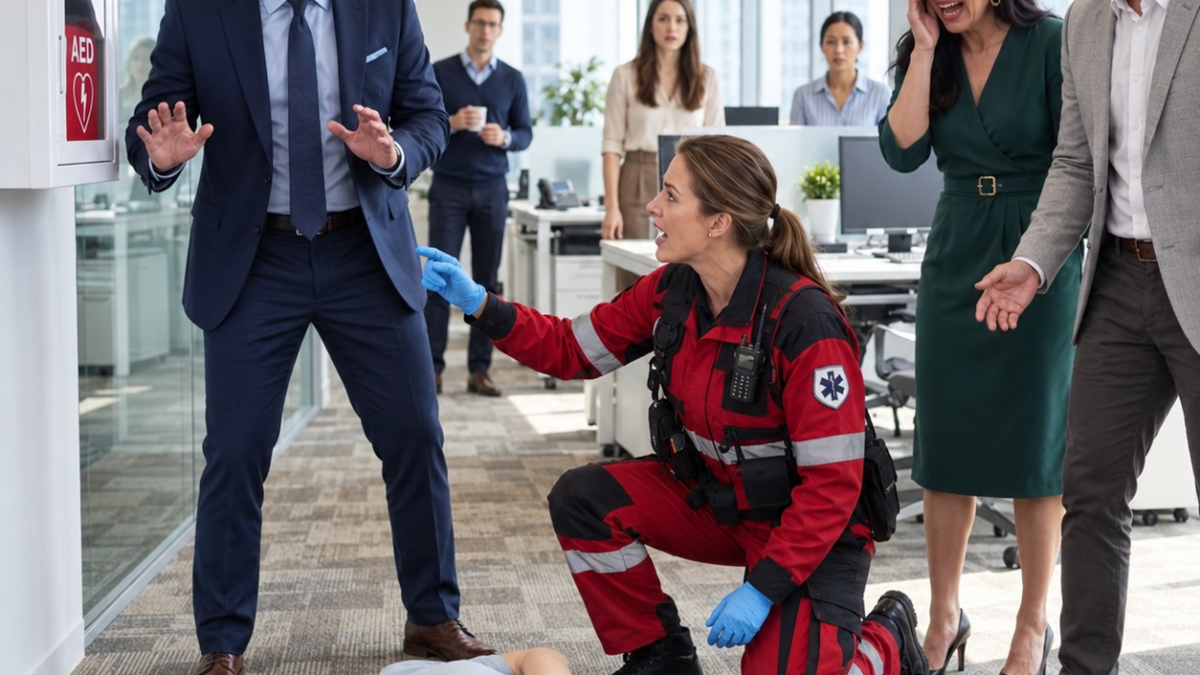
The conference room doors burst open.
Two paramedics rushed in carrying a red medical bag and a cardiac monitor. One was a broad shouldered man with dark hair, steady hands, and a voice that took command before anyone could argue.
“What happened?”
Nathan gasped, “She collapsed. She stopped breathing. I started CPR.”
The paramedic dropped beside me and checked my neck.
“No pulse.”
The room changed.
I could not see it, but I felt it. Panic became real. Not office panic. Not reputational panic. Human panic.
He cut open my blouse, placed cold adhesive pads against my chest, and ordered everyone back.
“Clear.”
The shock lifted my body from the floor.
Nothing.
Nathan started compressions again. Another paramedic forced air into my lungs. The monitor made sounds that meant nothing to me then and everything to them.
“Clear.”
Another shock.
Nothing.
“Resume compressions.”
My body was no longer mine. It belonged to the hands fighting for it. Nathan pressing down hard enough to break ribs. The second paramedic breathing for me. The first watching the monitor like he could drag my heart back through sheer will.
“Clear.”
The third shock hit.
This time, the monitor answered.
A fragile rhythm appeared.
The broad shouldered paramedic stared at the screen, then looked around the conference room.
“How long was she down?”
No one answered.
Jenna wiped her face with both hands. “Maybe nine minutes. I don’t know. We didn’t know what to do.”
His expression changed.
Slowly, he raised his eyes toward Martin.
Then recognition sharpened his face.
“You,” he said.
Martin took a step backward.
The paramedic stood, one bloodstained glove still hovering above my chest.
“I trained your management team in CPR six weeks ago.”
Nobody breathed.
“You passed the certification test,” he continued.
Martin’s mouth opened.
No words came out.
The paramedic pointed toward the glass cabinet beside the conference room exit.
“And that is an AED.”
Everyone turned.
The cabinet was right there.
Less than fifteen feet away from me.
Red letters. Clear instructions. Unlocked glass door.
The device that could have shocked my heart minutes earlier had been sitting on the wall the whole time.
Martin’s face lost its color.
The paramedic’s voice dropped.
“You knew exactly what to do,” he said. “So why did you leave her on the floor?”
That was the last thing I remembered before the world went black.
When I woke up, I did not wake all at once.
I surfaced through pain.
First came the sound of machines. Soft beeps. Air moving through tubes. Shoes squeaking somewhere outside. A quiet voice at the nurses’ station.
Then came the weight in my throat.
I panicked before I understood where I was.
My eyes opened, and the room exploded into white light. I tried to move, but something tugged at my mouth. My hands twitched against blankets. Pain tore through my chest.
A nurse appeared beside me.
“Claire, you’re in the ICU. You’re safe. Don’t try to talk.”
Safe.
That word did not belong anywhere near the last thing I remembered.
My sister Rebecca was asleep in a plastic chair beside the bed, her arms crossed tightly over her chest, her head bent at an impossible angle. Her hair was pulled into the messy bun she only wore when she had stopped caring what the world thought. Her eyes looked swollen even in sleep.
The nurse touched her shoulder.
Rebecca woke so fast she almost fell out of the chair.
“Claire?”
I tried to say her name.
The tube stopped me.
Her face crumpled.
“Oh my God,” she whispered, grabbing my hand. “You’re awake.”
A doctor came in minutes later. Then another nurse. They explained the breathing tube would be removed. They told me to stay calm, to cough when instructed, to breathe through the pain.
Nothing about it felt calm.
When the tube came out, fire scraped up my throat. I coughed, gasped, and cried without meaning to.
Rebecca held my hand the entire time.
Every breath afterward felt like broken glass moving inside my chest.
The doctor introduced herself as Dr. Melissa Grant, cardiologist. She had kind eyes, but her voice did not soften the facts.
“You suffered a massive pulmonary embolism,” she said. “A blood clot formed in your left leg and traveled to your lungs. It blocked blood flow and caused your heart to go into cardiac arrest.”
I stared at her, trying to absorb words that sounded like they belonged to someone else.
Blood clot.
Lungs.
Cardiac arrest.
She continued, “We removed most of the clot through an emergency catheter procedure. You are on anticoagulants now. We’ll monitor you closely.”
I tried to speak. My voice came out as a torn whisper.
“Why?”
Dr. Grant glanced at Rebecca.
“There are several possible contributing factors. But your chart notes prolonged immobility, long workdays, and recent leg swelling.”
My eyes closed.
The leg swelling.
Three months earlier, my left calf had started aching after a week of twelve hour days. At first, I blamed heels. Then stress. Then the fact that Martin had our entire department working through lunch because the inventory numbers “needed cleaning up.”
The swelling came and went.
Then it came back worse.
I had emailed Martin asking to work from home for two days so I could attend a medical appointment without losing an entire day in the office.
He denied it.
His exact words were still burned into my mind.
Claire, this department cannot accommodate another attention seeking absence.
HR had been copied.
No one responded.
Now I was in the ICU with broken ribs and a blood thinner running into my veins.
Dr. Grant must have seen the realization on my face.
“Your coworker saved your life,” she said gently. “The CPR kept blood moving to your brain. Another few minutes without circulation, and this conversation probably would not be happening.”
I swallowed through pain.
“Nathan.”
Rebecca nodded. “Nathan started compressions. Jenna called 911.”
My throat tightened.
“Martin?”
Rebecca’s face changed.
All the tenderness left it.
“He hasn’t called.”
I already knew, but hearing it still hurt.
Not because I wanted concern from him. I wanted proof that even a man as cruel as Martin Hale had some bottom. Some line. Some moment where a human life mattered more than control.
Apparently not.
“HR did,” Rebecca said.
I looked at her.
She pulled out her phone.
“Elise Warren left four voicemails. She wanted to speak with you before you contacted an attorney, the police, the media, or outside agencies.”
My mouth went dry.
“She said that?”
Rebecca’s smile was cold.
“Not in one sentence. She’s smarter than that. But yes.”
She played the messages.
Elise’s voice filled the room, polished and careful.
“Claire, this is Elise Warren from Human Resources. First, we are all deeply concerned and hoping for your full recovery. When you are able, we would appreciate the opportunity to speak with you directly regarding what occurred today so we can support you appropriately.”
The second message came two hours later.
“Claire, it’s Elise again. I know this is a stressful time, and we want to make sure there is no confusion about the incident. There are certain details being shared that may not be accurate. Please contact me or have Rebecca contact me before making any formal statements.”
The third.
“Claire, I want to emphasize that Meridian Logistics is prepared to offer paid medical leave while we review internal procedures. We can send a representative to the hospital with paperwork if that is easier.”
The fourth was the worst.
“Claire, matters like this can become complicated when outside parties are involved. I would hate for misinformation to create unnecessary consequences for people who care about you.”
Rebecca stopped the recording.
My chest monitor beeped faster.
A nurse glanced through the glass wall.
Rebecca squeezed my hand.
“I forwarded everything to a lawyer.”
I looked at her.
She shrugged.
“You were unconscious. Someone had to be the mean sister.”
I tried to laugh, but the pain in my ribs punished me immediately.
Rebecca leaned closer.
“Don’t laugh. Don’t move. Don’t die. Those are your three jobs right now.”
That sounded like Rebecca.
She was three years older than me, an elementary school principal, and the only person I knew who could comfort a crying child, intimidate a contractor, and rewrite a budget in the same afternoon. When our mother died eight years earlier, Rebecca became the person I called when the world stopped making sense.
Now she was sitting beside my hospital bed with mascara under her eyes and murder in her heart.
“I remember him,” I whispered.
Her face softened.
“Martin?”
I nodded.
“What do you remember?”
I closed my eyes.
The floor.
The carpet.
His voice.
“She wants attention.”
Rebecca went perfectly still.
“He said that while you were down?”
I nodded again.
Her hand tightened around mine.
“What else?”
I whispered as much as I could before exhaustion dragged me under again.
When I woke the next afternoon, Detective Aaron Blake was standing near the foot of my bed.
Daniel Ruiz stood near the door.
The paramedic.
The man whose voice had cut through the conference room like a blade.
He looked different outside the chaos. Still broad shouldered, still calm, but there was something haunted around his eyes. He held his hat in both hands and did not interrupt when Detective Blake introduced himself.
Rebecca sat beside me with a notebook.
My lawyer sat in the corner.
Simone Carter.
I had never met her before that morning, but Rebecca had chosen well. Simone looked like the kind of woman who ironed her blazers because she enjoyed preparing for war. She had silver streaks in her black hair, sharp glasses, and a yellow legal pad covered in notes.
Detective Blake pulled a chair closer.
“Claire, I know this is difficult. We can stop at any time.”
I nodded.
He asked what I remembered.
I told him about the presentation. The pressure in my chest. The fall. Martin saying I wanted attention. Jenna saying my lips were blue. Nathan trying to help. Martin ordering him not to touch me.
The more I spoke, the more Daniel’s jaw tightened.
Detective Blake exchanged a look with him.
“The conference room has a camera,” he said.
I closed my eyes.
Of course it did.
Martin had fought for those cameras after a vendor accused him of verbally abusing her during a contract dispute. He claimed cameras would protect employees from false allegations.
That was the thing about men like Martin.
They always built the evidence they believed would save them.
Then one day, it told the truth instead.
“Your employer initially claimed the camera wasn’t recording,” Detective Blake continued. “One of your coworkers gave us a copy.”
“Who?” Rebecca asked.
“Jenna Morris.”
My eyes burned.
Jenna.
Quiet, careful Jenna, who avoided conflict so aggressively she apologized to automatic doors.
Detective Blake continued, “She used her phone to record the security monitor before the company’s technology department could erase or restrict access to the file.”
Simone’s pen stopped moving.
“Erase?”
Detective Blake glanced at her.
“We are investigating that.”
Daniel stepped forward slightly.
“I need you to understand something,” he said to me. “You were in cardiac arrest when we arrived. Nathan had started compressions. He was doing them correctly enough to give you a chance. Without that, you likely would not have survived.”
I whispered, “Thank you.”
His expression tightened.
“I’m glad we got there.”
There was more in his voice. Anger. Guilt, maybe. The kind that belongs to rescuers who know they arrived after someone else wasted time.
Detective Blake opened a folder.
“The footage shows you collapsing at 10:14 a.m. Martin Hale stands near you but does not check for breathing or pulse. He instructs others not to approach. At 10:16, Jenna Morris says your lips are turning blue. Hale tells her to sit down. At 10:18, Nathan Porter approaches, but Hale physically stops him. At 10:19, Porter shoves Hale away and begins CPR. Emergency responders enter at 10:23.”
Nine minutes.
Nine minutes and eleven seconds, the detective later told me.
A lifetime measured in carpet fibers and cowardice.
Detective Blake looked at me.
“The audio captured several statements clearly.”
I knew what was coming.
Still, hearing him repeat them made my body go cold.
“She wants attention.”
“Don’t reward this.”
“Don’t touch her.”
Rebecca covered her mouth.
Simone wrote each phrase down slowly.
Daniel’s voice was controlled but hard. “Martin Hale was in the CPR and AED training I conducted six weeks ago. I remember him because he argued through half of it. He said emergency response was mostly common sense and liability awareness.”
“Did he pass?” Simone asked.
“Yes,” Daniel said. “He demonstrated compressions. He demonstrated AED use. He signed the completion document.”
“And the AED?”
“In the room,” Daniel said. “Visible. Accessible. Functional.”
Detective Blake added, “The footage shows him standing beside the AED cabinet while Claire is down.”
Rebecca whispered, “He watched her die.”
Nobody corrected her.
Because that was exactly what he had done.
The company placed Martin on administrative leave that afternoon.
That was what Elise called it in a carefully worded email sent to the whole department.
We are aware of a medical emergency involving one of our valued employees. Out of respect for privacy, we ask that everyone refrain from speculation. Meridian Logistics is reviewing the matter internally.
Valued employee.
Privacy.
Speculation.
Words companies use when they hope nobody says cover up.
That evening, Jenna called Rebecca from an unknown number.
Rebecca put the call on speaker because I was too weak to hold the phone.
Jenna was whispering.
“Rebecca?”
“Yes. Jenna?”
“I’m sorry. I’m so sorry. I should have helped sooner. I should have ignored him.”
My eyes filled with tears.
Rebecca looked at me, then said, “Jenna, Claire can hear you.”
Jenna sobbed once.
“Claire, I’m sorry.”
I forced out a whisper.
“You called.”
“I waited too long.”
“You called.”
That was all I could give her, but it was enough to make her cry harder.
Then her voice dropped.
“Martin is still in the building.”
Rebecca straightened.
“What?”
“He’s meeting with executives. They told us he was on leave, but he’s upstairs with Elise and the CEO. They’re saying you had a panic attack. They’re saying Nathan injured you by doing CPR wrong.”
The monitor beside my bed started beeping faster again.
Rebecca reached for my arm.
Jenna continued, words tumbling out.
“They’re pressuring Nathan. They told him he violated workplace safety procedures because only designated responders are allowed to use the AED.”
Simone, who had been quietly reviewing documents in the corner, stood.
“Ask her if Martin was a designated responder.”
Rebecca repeated the question.
“Yes,” Jenna said. “Martin was. Elise too. Three managers. They all took the training.”
Daniel had said that.
But hearing Jenna confirm it made the room feel smaller.
Jenna inhaled shakily.
“There’s more.”
Rebecca looked at Simone.
“What more?”
“I found an old email. Claire sent it to Martin three months ago. About leg swelling. She asked to work from home so she could go to the doctor. Martin denied it. HR was copied.”
I closed my eyes.
The email.
I had almost forgotten the exact date.
Jenna sent a screenshot seconds later.
There it was.
My own words.
Martin,
My left calf has been swollen and painful for several days. I have a medical appointment available Thursday afternoon, but given the schedule this week, I am requesting to work from home Thursday and Friday so I can attend the appointment and make up time as needed.
Thank you,
Claire
Martin’s response.
Claire,
This department cannot accommodate another attention seeking absence. We are in the middle of quarterly reconciliation. I need you in office and focused. Please do not make this into something bigger than it is.
Martin
Elise had been copied.
She had never responded.
I remembered sitting at my desk after receiving that email, embarrassed and angry and tired. I remembered touching my swollen calf beneath the desk, telling myself I would go to urgent care Saturday. Then Saturday became the warehouse audit. Sunday became the emergency report. Monday became the executive prep meeting.
Tuesday became the floor.
Simone took Rebecca’s phone, read the email, and looked up.
“This is no longer only about a cruel remark,” she said. “They ignored a medical accommodation request, discouraged emergency assistance, attempted to hide evidence, and are now retaliating against witnesses.”
She placed a document on my hospital table the next morning.
A preservation notice.
It ordered Meridian Logistics not to delete emails, security recordings, training records, internal chats, HR files, access logs, phone records, or documents connected to my collapse.
My hand trembled as I signed it.
Not from fear.
From weakness.
I hated that. I hated how much effort it took to hold a pen. I hated that my ribs screamed when I shifted. I hated that Martin was walking around in a suit while I needed help sitting up.
My phone vibrated.
Rebecca picked it up, glanced at the screen, and her face hardened.
“It’s Martin.”
Simone held out her hand.
“Give it to me.”
She read the message aloud.
You’re destroying people’s careers over a misunderstanding. Fix this before it goes too far.
The room went silent.
Simone photographed the message.
Then another appeared.
Remember who approved your promotion.
Dr. Grant, who had walked in to check my chart, paused at the foot of the bed.
Rebecca’s lips parted in fury.
Simone looked toward the hallway, where Detective Blake was speaking with Daniel.
“Do not answer him,” she said.
A third message appeared.
Everyone in that room knows what really happened.
That was when Jenna called again.
This time, she was crying so hard Rebecca could barely understand her.
“He knows,” Jenna sobbed. “He knows I copied the video.”
Rebecca stood.
“Where are you?”
“My apartment. I left work early. He kept staring at me through the glass wall of Elise’s office. Then I got a message from an unknown number saying evidence thieves get sued.”
Simone motioned to Detective Blake through the glass.
Rebecca kept her voice steady.
“Jenna, lock your door.”
“I did.”
“Is anyone with you?”
“No.”
“Can you see outside?”
Jenna inhaled sharply.
“He’s here.”
My blood turned cold.
Rebecca’s face went white.
“What do you mean?”
“He’s in the parking lot. He’s getting out of his car.”
Detective Blake stepped inside.
“Put her on speaker.”
Rebecca did.
Jenna whispered, “He’s coming toward the building.”
Detective Blake’s voice became sharp and calm.
“Jenna, this is Detective Blake. Do not open the door. Do you understand me?”
“Yes.”
“Call 911 from another phone if you can. Stay on this line.”
“I only have this phone.”
“That’s fine. Stay with me. What floor are you on?”
“Second.”
“Apartment number?”
“2B.”
“Is there another exit?”
“Balcony, but it faces the parking lot.”
A pounding sound came through the phone.
Jenna screamed.
My heart monitor spiked so violently that Dr. Grant stepped beside me.
“Claire, breathe slowly.”
I could not.
I was back on the floor.
Unable to move.
Listening to Martin control the room.
The pounding came again.
Then Martin’s voice, muffled but unmistakable.
“Jenna, open the door.”
She sobbed.
Detective Blake said, “Jenna, do not speak to him.”
Martin pounded again.
“I know you’re in there. We need to talk like adults.”
Sirens sounded faintly through Jenna’s phone.
Detective Blake kept talking, steady as stone.
“Police are coming. Stay away from the door.”
Martin’s voice changed.
“You think Claire is going to save you? She’s lying in a hospital bed because she finally pushed too far.”
Rebecca looked at me.
Her face was full of a rage I had never seen before.
Martin continued, louder now.
“You stole company property. Do you understand that? That video belongs to Meridian. You want to lose your job? You want charges?”
Jenna was breathing too fast.
“I can’t,” she whispered. “I can’t do this.”
“Yes, you can,” Rebecca said suddenly.
Everyone looked at her.
She leaned toward the phone.
“Jenna, listen to me. Claire is alive because Nathan disobeyed him. The truth is alive because you disobeyed him. You do not open that door.”
Jenna cried harder.
The pounding stopped.
For one second, there was silence.
Then glass shattered.
Jenna screamed.
Detective Blake shouted, “Move away from the door!”
There was chaos through the phone. Feet running. A crash. Martin shouting something we could not understand. Jenna sobbing, “He broke the hallway window. He’s inside the building.”
Then another voice.
“Police! Step away from the door!”
Martin yelled, “This is a workplace matter!”
The reply came instantly.
“Hands where I can see them!”
A struggle.
A thud.
Then Martin screaming, “Do you know who I am?”
Rebecca whispered, “Yes. We do now.”
Jenna stayed on the line until an officer entered her apartment. She was physically unharmed, but the sound of her crying stayed with me long after the call ended.
Martin was arrested outside her door.
That changed everything.
Administrative leave became termination.
Internal review became criminal investigation.
Privacy became public record.
By morning, Meridian Logistics no longer sounded polished. It sounded scared.
Elise Warren called Simone, not me.
Simone put the call on speaker in my hospital room.
Elise’s voice was tight.
“Simone, we want to resolve this constructively.”
Simone smiled without warmth.
“Then preserve the evidence and stop harassing witnesses.”
“Elise,” Simone said, “your company told police a conference room camera was not recording. A witness preserved footage before your technology department could remove access. Your HR department was copied on a medical request related to symptoms that became a near fatal emergency. Your director discouraged CPR, blocked an employee from assisting, stood beside an AED, then threatened my client and went to a witness’s home. I recommend you choose your next sentence carefully.”
There was a long pause.
Elise said, “We will cooperate fully.”
Simone leaned back.
“I would start now.”
The days that followed blurred together.
Blood draws.
Scans.
Physical therapy.
Pain medication.
Doctors explaining clotting risks and recovery timelines.
Rebecca reading legal updates from Simone.
Daniel visiting once, awkwardly, carrying a small bouquet from his station.
I was embarrassed when he walked in.
He had seen me at my most helpless. Shirt cut open. Body shocked. No pulse. Dead, or close enough that the difference depended on other people refusing to give up.
He placed the flowers on the counter.
“The crew wanted to send something.”
“Thank you,” I whispered.
He nodded.
For a moment, neither of us spoke.
Then he said, “Nathan keeps asking how you are.”
My eyes burned.
“He saved me.”
“Yes.”
“Can you tell him that?”
“I think he needs to hear it from you when you’re ready.”
I nodded.
Daniel looked toward the window.
“I keep thinking about that training session.”
“What happened?”
He exhaled slowly.
“Martin joked about lawsuits. Asked whether it was safer to wait for professionals. I told him if someone is in cardiac arrest, waiting can be fatal. He repeated that in the test answer.”
“He knew.”
Daniel’s jaw tightened.
“Yes.”
There it was again.
The part I could not escape.
Martin had not misunderstood.
He had not frozen.
He had not lacked training.
He had chosen control over my pulse.
“Why?” I whispered.
Daniel looked at me, and for a second, he did not answer like a paramedic. He answered like a man who had seen too much.
“Some people would rather be in charge of a tragedy than useful in an emergency.”
That sentence stayed with me.
Because that was Martin.
He had built his career on rooms where people waited for permission. Permission to speak. Permission to question numbers. Permission to leave early for a doctor. Permission to help a woman dying on the floor.
Nathan had broken that spell with both hands on my chest.
Jenna had broken it with a phone camera.
Rebecca had broken it by calling a lawyer before HR could wrap my near death in company language.
And I was about to break it with every breath I had left.
The first time Nathan visited, he stood in the doorway like he was afraid he might hurt me by entering.
He wore a wrinkled button down, and his eyes were red.
“Hey,” he said.
I smiled weakly.
“Hey.”
Rebecca stood.
“I’ll get coffee.”
When she left, Nathan stayed near the door.
“You can come in,” I said.
He walked to the chair but did not sit until I nodded.
“I’m sorry,” he said immediately.
My throat tightened.
“For what?”
“I waited. I heard him say not to touch you, and I hesitated. I knew something was wrong, but I still hesitated.”
“Nathan.”
“I keep thinking, if I had moved sooner…”
“Nathan.”
He looked at me.
“You saved my life.”
His face crumpled.
“I broke your ribs.”
“That means you did it right.”
He laughed once, but it turned into a sob.
“I thought you were dead.”
“So did I.”
He covered his face with one hand.
“I was so scared.”
“I know.”
“He told me to stop. Even while I was doing compressions, he kept saying I was making it worse. I almost listened.”
My blood chilled.
“But you didn’t.”
He shook his head.
“Jenna shouted that the dispatcher said keep going. So I kept going.”
“Thank you.”
He looked ashamed of being thanked.
“I don’t feel like a hero.”
“Good,” I whispered. “Heroes in movies are too calm. You were scared and did it anyway. That counts more.”
He cried then.
Quietly.
I let him.
Some people cry because they are weak.
Some cry because their body is finally putting down something too heavy to carry standing up.
Nathan returned to work before I did. I hated that he had to.
Meridian tried to suspend him anyway.
The official reason was “failure to follow designated emergency response protocol.” Simone responded with a letter so sharp Rebecca read it three times for pleasure. Within twenty four hours, Nathan’s suspension disappeared. The company publicly thanked him for “quick action during a medical emergency.”
Nathan sent me a screenshot.
They’re pretending they always supported me.
I replied with shaking fingers.
Let them pretend in writing.
That became Simone’s motto for the case.
Let them pretend in writing.
Because every lie came with metadata.
Every cover up came with a timestamp.
Every attempt to shift blame created a new document.
And Martin, for all his cruelty, could not stop texting.
After his arrest at Jenna’s apartment, he was ordered not to contact me, Jenna, Nathan, or anyone involved in the investigation. So he used other people.
His brother sent Rebecca a Facebook message.
Martin made mistakes, but Claire is taking this too far. He has anxiety too.
Simone archived it.
A former supervisor texted Nathan.
You have to think about your future. Being known as difficult follows people.
Archived.
Elise sent a department wide memo reminding employees that “unauthorized disclosure of company recordings may violate policy.”
Archived.
Then came the worst one.
An anonymous email to my personal address.
Claire,
You know what will happen if this becomes public. People will ask why you ignored leg pain for months. They will ask if you exaggerated symptoms to create a lawsuit. They will ask whether Nathan hurt you more than the clot did. They will ask why you, a senior analyst, failed to manage your own health.
You are not the victim you think you are.
No signature.
But attached to it was a screenshot from my confidential HR file.
Only HR had access.
Rebecca read it beside my bed and went very quiet.
That was always dangerous.
Rebecca loud was angry.
Rebecca quiet was strategic.
She handed the phone to Simone.
Simone read it once.
Then she said, “That was a mistake.”
The email moved the case into new territory.
Confidential medical information.
Retaliation.
Possible obstruction.
Witness intimidation.
The state labor agency opened an investigation. OSHA requested records. The district attorney’s office began reviewing Martin’s actions. The company’s board hired outside counsel, which was corporate language for “someone is about to be sacrificed.”
Elise was the first.
She resigned three weeks after my collapse.
The company announced it as a personal decision.
Jenna sent me the internal rumor version.
Elise tried to blame IT, IT produced emails showing Elise asked about deleting camera access logs, and then nobody invited Elise to meetings anymore.
I read that message twice.
Then I slept for four hours, the best sleep I had since waking up in the ICU.
Recovery was humiliating.
No one warns you about that part.
Survival sounds dramatic from the outside. Strong. Inspiring. Clean.
Inside it, survival is asking your sister to help you shower because lifting your arms hurts. It is needing a pillow pressed to your chest every time you cough. It is walking ten steps in a hospital hallway and feeling like you climbed a mountain. It is waking up convinced you are back on the carpet because a machine beeped in the wrong rhythm.
It is fear disguised as fatigue.
The day I was discharged, Rebecca drove me home.
My apartment looked exactly the same and completely different.
My work bag sat by the door where I had dropped it Monday night.
A mug sat in the sink.
A pair of black heels waited under the console table.
On the counter was a sticky note I had written to myself before everything happened.
Ask Martin about warehouse variance before Thursday call.
I stared at it for a long time.
Rebecca gently peeled it from the counter, crumpled it, and threw it away.
“You are not asking Martin anything ever again.”
I wanted to laugh.
Instead, I cried.
She hugged me carefully, avoiding my ribs.
For the first week, she stayed with me.
She cooked.
She organized medications.
She walked with me around the block, slowly, patiently, while I became furious at my own lungs.
I had always been independent. Not because I hated help, but because needing too much felt risky. Our mother got sick when I was twenty four. My father had left when we were children. Rebecca and I learned early that the person who handled things suffered less than the person waiting to be rescued.
Then my body betrayed me in a conference room, and I had to learn that accepting help was not the same as losing control.
One night, I woke up gasping.
Not from pain.
From the dream.
The room tilting.
Martin’s voice.
Don’t reward this.
I sat upright too fast and cried out when my ribs protested.
Rebecca appeared in the doorway instantly.
“Claire?”
“I’m okay.”
She turned on the lamp.
“No, you’re not.”
I pressed a hand to my chest.
“I keep hearing him.”
She sat on the edge of the bed.
“What does he say?”
I looked at her.
“She wants attention.”
Rebecca’s face broke.
Then hardened.
“Good.”
I stared at her.
“Good?”
“Remember it.”
“Rebecca.”
“No. Remember exactly what he said. Not because he deserves space in your head, but because someday someone will try to soften this. They’ll say he panicked. They’ll say he was confused. They’ll say nobody knew. And you will remember the truth.”
I hated that she was right.
Because it had already started.
A former coworker sent me a careful text.
I’m so sorry this happened. I also hope everyone can heal. Martin was under a lot of pressure.
A vendor emailed.
I heard there was a medical episode. Hope you’re better. Martin always spoke highly of you.
An old mentor called and said, “I know Martin can be difficult, but career damage is serious.”
Career damage.
I had died on the carpet.
Martin’s career was not the body in the ICU.
Rebecca watched me delete that voicemail.
“You okay?”
“No.”
“Good. That was a stupid question anyway.”
She sat beside me on the couch.
For a while, we said nothing.
Then I whispered, “What if they make it look like my fault?”
Rebecca looked at me like I had insulted her entire bloodline.
“They won’t.”
“You don’t know that.”
“I know you. I know Simone. I know there is video. I know Nathan. I know Jenna. I know Daniel trained that arrogant piece of garbage himself. And I know your boss was stupid enough to text you after almost letting you die.”
I breathed slowly.
She continued, softer now.
“And even if some people believe him, that does not change what happened.”
That became another lesson.
Truth and belief are not the same thing.
People can believe lies loudly.
It does not make them true.
The first legal deposition happened six weeks after my collapse.
I was still on medical leave. Still bruised inside and out. Still sleeping badly. But Simone said it was time.
Meridian’s attorneys wanted to question me.
They came with laptops, binders, bottled water, and faces arranged into professional concern. Martin’s attorney came too. Martin was not allowed in the room for my testimony, which seemed to offend him through his lawyer’s posture.
We sat in a conference room nothing like the one where I collapsed, but my body did not know the difference.
Polished table.
Rolling chairs.
Projector screen.
Water pitcher.
My chest tightened before anyone asked a question.
Simone noticed.
“Do you need a break?”
The opposing attorney looked annoyed.
“We haven’t started.”
Simone did not look at him.
“I was speaking to my client.”
I took one slow breath.
Then another.
“No. I’m ready.”
They began gently.
My job title.
My responsibilities.
My work hours.
My relationship with Martin.
Then they moved where I knew they would.
“Ms. Avery, had you complained about stress before the incident?”
“Yes.”
“Had you ever experienced anxiety at work?”
“Yes. Most people working under Martin did.”
Simone’s mouth twitched.
The attorney frowned.
“Please answer only for yourself.”
“I just did.”
He tried again.
“Is it possible you misinterpreted Mr. Hale’s comments while experiencing a medical emergency?”
“No.”
“You were in distress.”
“Yes.”
“Your hearing may have been affected.”
“I heard him clearly.”
“But you were losing consciousness.”
“I was conscious enough to hear him tell people not to help me.”
The attorney shifted.
“Isn’t it true that Mr. Hale believed touching you could expose the company to liability?”
I stared at him.
“That is what he cared about while I was not breathing.”
A silence.
Simone leaned back.
The attorney looked down at his notes.
“Were you aware there was an AED in the room?”
“No. Martin was.”
“Objection,” Martin’s attorney said.
Simone smiled. “You can object at trial. This is a deposition. She can answer.”
They asked about my leg pain.
Why I had not gone to the doctor sooner.
Why I did not take sick leave.
Why I continued working long hours.
Why I did not follow up with HR.
Question after question, all pointed toward one ugly implication.
Why did you let yourself almost die?
Finally, I asked, “Can I answer fully?”
Simone nodded.
The court reporter looked up.
I folded my hands carefully so they would not shake.
“I told my manager I had leg swelling and pain. I requested a work arrangement that would allow me to see a doctor. He denied it and called it attention seeking. HR was copied and did not intervene. I continued working because that was the culture Martin created. If you left early, you were weak. If you asked for help, you were dramatic. If you questioned him, you were disloyal. So yes, I should have gone anyway. But the company should not have made medical care feel like misconduct.”
The room went very still.
The attorney stopped that line of questioning soon after.
Nathan’s deposition was worse.
Not because he failed.
Because he blamed himself so much that every question reopened the wound.
They asked why he touched me if Martin told him not to.
Nathan answered, “Because she wasn’t breathing.”
They asked if he was certified.
“No.”
They asked if he feared hurting me.
“Yes.”
They asked why he continued.
“Because the dispatcher told us to keep going and because stopping seemed worse.”
They asked if he broke my ribs.
He started crying.
Simone called a break.
When we came back, she asked him one question on the record.
“Mr. Porter, did Claire Avery personally thank you for saving her life?”
Nathan wiped his face.
“Yes.”
“And did her treating physician tell you the rib fractures were a known risk of effective CPR?”
“Yes.”
“And would you make the same decision again?”
Nathan looked up.
This time, his voice was steady.
“Yes. Faster.”
Jenna testified too.
She shook through half of it, but she did not break.
She described Martin’s voice. Elise’s silence. The fear in the room. The moment she realized the security footage might disappear. She described going to the monitor room on the excuse of needing water, recording the playback with her phone, and sending it to her personal email before IT locked her out.
Then she described Martin coming to her apartment.
His attorney tried to suggest he only wanted to “clarify facts.”
Jenna looked at him and said, “He broke the hallway window outside my apartment.”
That ended the clarification theory.
Daniel testified last in the civil case.
He brought records.
Training attendance.
Certification results.
AED demonstration sheets.
Martin Hale’s signature.
Elise Warren’s signature.
The company safety director’s signature.
Daniel explained cardiac arrest in plain, brutal terms. Every minute without CPR decreases survival. AEDs are designed for layperson use. A trained responder in the room should act immediately. Liability fears do not justify doing nothing when a person is pulseless.
Then Simone played Daniel’s body camera audio from the response.
I had not heard it before.
My own body was on the floor, hidden from the deposition room screen by agreement, but the audio was clear.
Daniel asking, “How long was she down?”
Jenna crying.
Daniel saying, “You.”
Then his voice turning lethal.
“I trained your management team in CPR six weeks ago.”
The opposing attorneys stopped taking notes.
Maybe because there was nothing left to write.
Martin’s criminal case moved separately.
Reckless endangerment.
Witness intimidation.
Obstruction related charges under review.
The district attorney did not charge him with attempted murder, though Rebecca wanted that more than oxygen. Simone explained intent would be difficult to prove. Martin could claim panic, confusion, liability concern, workplace chaos.
I hated that.
Not because I wanted revenge.
Because the law often needs a clean story, and cruelty is messy. Men like Martin do not always say, “I want her dead.” Sometimes they say, “Don’t reward this,” and let the floor do the rest.
The first time I saw Martin after the collapse was at a preliminary hearing.
He wore a gray suit.
He had lost weight.
He looked tired.
Good.
His wife sat behind him.
That startled me.
I knew he was married, but I had rarely seen her. Her name was Caroline. She had come to one holiday party two years earlier, a quiet woman with nervous hands and a beautiful silk scarf. Martin had spent most of that party correcting her stories.
“No, Caroline, that was in June.”
“Caroline always exaggerates.”
“She means well.”
At the time, I thought he was rude.
Now I wondered what he said at home when no one was listening.
Caroline looked at me across the courtroom.
For a second, our eyes met.
Then she looked down.
Martin did not look at me at all.
His attorney argued he had been overwhelmed by an unexpected medical emergency. He had believed, mistakenly but sincerely, that moving me might create harm. He had deferred to trained medical professionals.
The prosecutor stood.
“Except the trained medical professionals were not there yet. The defendant was trained. An AED was present. A witness attempted to intervene, and the defendant physically stopped him. The defendant did not merely fail to act. He actively prevented action.”
Then they played the clip.
Not the whole nine minutes.
Enough.
“She wants attention.”
“Don’t reward this.”
“Don’t touch her.”
Caroline flinched.
Martin stared at the table.
I watched him, waiting for remorse.
It never came.
Only anger.
I could see it in the set of his jaw. He was not devastated that I had almost died. He was furious that my almost death had become inconvenient.
At the end of the hearing, as officers led him out, Caroline stood too quickly and dropped her purse. Its contents spilled across the floor. Lip balm. Keys. A folded tissue. A small prescription bottle.
I bent to help without thinking, then stopped because my ribs still pulled when I leaned.
Rebecca picked up the keys and handed them to Caroline.
Caroline whispered, “Thank you.”
Rebecca nodded.
Then Caroline looked at me.
“I’m sorry,” she said.
Martin turned his head so fast the officer beside him grabbed his arm.
“Caroline.”
She shrank immediately.
I saw it.
Rebecca saw it.
Simone saw it.
Caroline gripped her purse and followed him out without another word.
That moment haunted me more than I expected.
Because Martin had not started with me.
People like him rarely start at work.
They practice where no one files HR complaints.
Two weeks later, Simone called.
“Claire, I need to warn you. Martin’s wife contacted the prosecutor.”
I sat down slowly.
“Why?”
“She wants to give a statement. She also asked for resources.”
I closed my eyes.
Rebecca, sitting beside me, whispered, “Oh.”
Simone continued, “I can’t share details, but this may affect the criminal case.”
It did.
Caroline’s statement revealed a pattern.
Martin controlling finances.
Martin restricting her car use.
Martin calling her unstable when she disagreed.
Martin refusing to take her to urgent care after she fainted during a heat wave because he said she was “performing.”
When the prosecutor told Simone that, Rebecca walked into my kitchen, opened a cabinet, and screamed into a dish towel.
I understood.
Some rage has nowhere civilized to go.
The civil case settled before trial.
Meridian Logistics offered money first.
Simone rejected it.
They offered more.
She rejected it again.
Then she told them settlement required more than a check.
Public acknowledgement of emergency response failures.
Full medical leave and disability protections.
No retaliation against Nathan, Jenna, or any employee who cooperated.
Independent audit of HR practices.
Mandatory emergency training conducted by an outside agency.
AED access policy rewritten to clarify that any willing responder could use it.
Written apology from the company.
Meridian fought the apology hardest.
Not the money.
The words.
Companies hate words that cannot be hidden in accounting columns.
Eventually, they agreed.
The statement was stiff, legal, and bloodless, but it existed.
Meridian Logistics acknowledges failures in emergency response and internal reporting during the medical emergency involving Claire Avery on April 9. We recognize that immediate aid should not have been delayed and that employees who attempted to assist acted appropriately. We regret the harm caused.
Regret.
Not enough.
But in writing.
Nathan kept his job for six more months, then left for a better one.
Jenna transferred departments, then later left too.
Elise disappeared into consulting, which seemed unfair until Simone reminded me that women who protect powerful men often land softly, but not always cleanly.
Martin did not land softly.
He pleaded guilty to witness intimidation after the Jenna incident. The reckless endangerment charge resulted in probation, community service, mandatory counseling, and a permanent mark on his record. Rebecca thought it was too light. So did I.
But then came the professional consequences.
His certification record became part of the public proceedings.
His name circulated in industry circles.
The board terminated him for cause.
His attempt to sue Meridian for wrongful termination failed after the company produced messages showing he had demanded IT “make sure no one can access that room footage before Legal reviews it.”
He had written it from his company email.
Even Rebecca laughed at that.
“Evil and bad at Outlook,” she said. “Pick a struggle.”
Six months after my collapse, I returned to the Meridian building for the last time.
Not to work.
To clean out my office.
Simone did not love the idea, but I needed to do it. Rebecca came with me. So did Nathan and Jenna, because apparently almost dying on carpet creates bonds stronger than corporate onboarding.
The building lobby looked the same. Marble floor. Security desk. Fake plants. The Meridian logo glowing on the wall like nothing had happened.
But people stared.
Some with pity.
Some with guilt.
Some with that hungry look people get around scandal.
I kept walking.
My desk was exactly as I had left it, except someone had placed a small plant beside my monitor. A note from Jenna sat next to it.
For the office you choose next.
I touched the leaves and nearly cried.
My office shelves held four years of notebooks, reports, coffee mugs, and framed photos. One photo of Rebecca and me at the beach. One of my mother from before she got sick. One of my old dog, Max, who had hated everyone except delivery drivers.
I packed slowly.
Nathan hovered near the doorway.
“You okay?”
“No.”
He nodded.
“Want us to make awkward small talk?”
“Yes.”
Jenna immediately said, “The new inventory director wears bow ties unironically.”
Nathan added, “He also says synergy without blinking.”
I laughed, then grabbed my ribs out of habit, though they had mostly healed.
When the boxes were packed, I asked to see conference room B.
Rebecca’s face tightened.
“You don’t have to.”
“I know.”
But I did.
The room was empty.
The carpet had been cleaned.
The table polished.
The projection screen rolled up.
The AED cabinet still hung beside the door.
For a moment, I stood in the threshold and could not enter.
My body remembered before my mind did.
The tilt.
The impact.
The inability to breathe.
Martin’s voice.
Jenna touched my arm lightly.
“We can leave.”
I shook my head.
Then Nathan walked past me into the room.
He stood where he had done compressions.
Jenna stood near the phone.
Rebecca stood beside me.
None of us spoke.
After a while, I walked to the AED cabinet and opened it.
The alarm chirped.
The device sat inside, bright and simple and ready.
I closed the cabinet gently.
Then I turned to the room.
“I’m done here.”
And I was.
Not healed.
Not untouched.
Done.
A year after the collapse, Daniel invited me to speak at a community CPR event.
At first, I said no.
Then Rebecca said, “You don’t have to turn trauma into a TED Talk.”
I agreed.
Then I thought about Nathan.
About Jenna.
About the cabinet on the wall.
About Martin standing beside it.
So I called Daniel back and said yes.
The event was held in a high school gym. Folding chairs. Fluorescent lights. Practice mannequins lined up on blue mats. A table full of pamphlets about cardiac arrest, stroke symptoms, and emergency response.
I stood behind a podium with my notes shaking in my hands.
Daniel introduced me simply.
“This is Claire Avery. She survived cardiac arrest because someone in the room chose to act.”
I walked to the microphone.
For a second, the gym blurred into the conference room.
Then I saw Rebecca in the front row.
Nathan beside her.
Jenna beside him.
Dr. Grant in the back.
And Caroline Hale near the exit.
I almost lost my breath.
She looked different. Hair shorter. Shoulders straighter. No silk scarf. She held a pamphlet in one hand and stood beside a woman I did not know, maybe an advocate, maybe a friend.
Our eyes met.
This time, she did not look down.
So I began.
“I do not remember everything from the day I collapsed,” I said. “But I remember enough.”
The room quieted.
“I remember trying to breathe and not being able to. I remember falling. I remember hearing people around me. And I remember one person in authority telling them not to help.”
I paused.
“That person was wrong.”
My voice strengthened.
“If someone is not breathing, if someone has no pulse, if there is an AED nearby, hesitation can be deadly. Waiting for permission can be deadly. Fear of doing the wrong thing can become the wrong thing.”
Nathan looked at the floor.
I looked directly at him.
“A coworker who was scared and uncertified started compressions anyway. He broke my ribs. He also saved my brain, my body, and my life. Another coworker called 911 and preserved the truth when powerful people tried to rewrite it.”
Jenna wiped her eyes.
I continued.
“I used to think emergencies revealed heroes. Now I think they reveal systems. They reveal who has been trained to act and who has been trained to obey. They reveal whether leaders create courage or fear.”
Daniel stood near the wall, arms crossed, listening.
“And sometimes,” I said, “they reveal that the most dangerous person in the room is not the one collapsing. It is the one convincing everyone else to stay seated.”
No one moved.
Then applause began.
Soft at first.
Then louder.
I did not enjoy it, exactly.
But I accepted it.
Afterward, Caroline approached me.
Rebecca stiffened, but I touched her arm.
Caroline stopped a few feet away.
“Claire,” she said.
“Caroline.”
Her hands trembled around the pamphlet.
“I left him.”
The words moved through me slowly.
I nodded.
“I’m glad.”
“He told me you ruined him.”
I almost smiled.
“He helped.”
For the first time, Caroline laughed. It was small, startled, and sad.
Then her eyes filled with tears.
“I believed him at first. About you. He said you were manipulative. That you had always wanted his job. That you staged things.”
“I was dead on the floor, Caroline.”
“I know.”
She looked ashamed.
“I think part of me knew before I knew. I’m sorry.”
I believed her.
Maybe not completely.
But enough.
“You don’t owe me an apology for surviving him too,” I said.
She cried then.
Rebecca pretended not to, which was her version of generosity.
Caroline wiped her face.
“He always hated being embarrassed. More than he hated doing wrong.”
“Yes,” I said. “I know.”
She looked toward the CPR mannequins.
“I signed up for the class.”
“Good.”
“I froze once,” she whispered. “Years ago. Not with you. With myself. I fainted at home, and when I woke up, he was angry about the broken lamp.”
My throat tightened.
“I’m sorry.”
She nodded.
“I don’t want to freeze anymore.”
I looked at the mats, the AED trainer, the people practicing compressions with awkward determination.
“Then don’t.”
She smiled through tears.
“I’ll try.”
“That counts.”
After that day, I did not think of the conference room as often.
I still dreamed about it sometimes.
Trauma is rude that way. It returns without asking, opens doors you locked, sits at the foot of your bed, and reminds you it knows the old routes through your body.
But it came less.
My lungs strengthened.
My ribs healed.
The scar from the catheter procedure faded to a pale mark.
I took a new job at a smaller company with a boss who once canceled a meeting because an analyst said she had a migraine. The first time he did that, I went to the restroom and cried.
Not because he was extraordinary.
Because he was normal.
Because normal had started to feel miraculous.
On my first day, he pointed out the emergency exits, first aid kit, and AED.
“We review this with all new employees,” he said.
I looked at the cabinet on the wall.
“Good.”
He smiled uncertainly.
“Sorry, that probably sounds boring.”
“No,” I said. “It sounds safe.”
Two years after the collapse, I received a letter from Martin.
It arrived at Simone’s office because he was still barred from contacting me directly. She called first.
“You don’t have to read it.”
“Is it an apology?”
“No.”
I laughed.
Not because it was funny.
Because of course it was not.
“Send it.”
The letter came scanned by email.
Claire,
I have had a lot of time to think about what happened. I am not the monster people made me out to be. I made mistakes under pressure, but you know the workplace environment was intense for all of us. I wish you had spoken to me privately before allowing this to become a legal circus.
You were always one of my strongest employees. That is why I pushed you. I regret that you misunderstood my leadership style.
I hope someday you can let go of your anger.
Martin
I read it twice.
Then I closed my laptop.
Rebecca called ten minutes later because Simone had copied her too.
“Well?” she asked.
“He regrets being misunderstood.”
Rebecca made a sound that was almost a laugh and almost a threat.
“What are you going to do?”
“Nothing.”
“Really?”
“Yes.”
I looked out my apartment window. It was raining softly, just like the day of the presentation.
But I was not on the floor.
I was standing.
Breathing.
Free from that room.
“He wants a response,” I said. “He wants proof he can still make me explain myself.”
Rebecca was quiet for a moment.
Then she said, “Mom would be proud of you.”
My eyes stung.
“Yeah?”
“Yes. She would say silence is classy, and then she would call him a bastard in the kitchen.”
That made me laugh so hard I had to sit down.
This time, my ribs did not hurt.
That felt like a miracle.
On the anniversary of the day I collapsed, I met Nathan, Jenna, Rebecca, Daniel, and Dr. Grant for lunch.
Not at a fancy place.
A loud diner with sticky menus, bottomless coffee, and a waitress who called everyone honey.
Nathan had recently been promoted at his new company. Jenna was taking classes in emergency management. Daniel had been promoted to training supervisor. Dr. Grant arrived late, still in scrubs, apologizing as if the rest of us had not literally rearranged our schedules around the fact that she saved hearts for a living.
Rebecca ordered pancakes at noon because she believed time was a suggestion.
At one point, Nathan raised his coffee mug.
“To Claire.”
I shook my head.
“No.”
He blinked.
“No?”
I lifted my water glass.
“To the people who moved.”
Jenna’s eyes filled.
Daniel nodded.
Rebecca smiled.
Dr. Grant lifted her coffee.
Nathan swallowed hard and raised his mug again.
“To moving.”
We all drank.
For a moment, the diner noise faded, and I saw them as they had been that day.
Nathan’s hands on my chest.
Jenna’s shaking fingers dialing 911.
Daniel rushing through the door.
Rebecca sleeping in a plastic chair.
Dr. Grant standing at my bedside, explaining how close I had come.
None of them had been perfect.
None of them had known exactly what to do every second.
But each of them, at the moment that mattered, moved toward life instead of fear.
That is what saved me.
Not one hero.
A chain.
A chain Martin tried to break.
He failed.
After lunch, Rebecca and I walked slowly to the parking lot.
The air was warm, but not suffocating. Cars flashed in the sun. Somewhere nearby, sirens passed, then faded.
Rebecca looked at me.
“Do you still hear him?”
I knew what she meant.
I thought about lying.
Then I shook my head.
“Sometimes.”
“What does he say now?”
I looked across the street at a woman helping an elderly man step carefully off a curb.
“She wants attention.”
Rebecca’s jaw tightened.
“But it sounds different now.”
“How?”
I smiled a little.
“Smaller.”
Because that was the truth.
Martin’s voice used to fill the room.
Now it was just an echo.
An ugly one, yes.
But an echo.
And echoes only survive when there is empty space to carry them.
My life was not empty anymore.
It was full of doctor appointments I kept.
Work boundaries I enforced.
Friends who checked on me.
A sister who still threatened to fight anyone who said “panic attack” within ten feet of her.
A new workplace where late nights were exceptions, not proof of loyalty.
A CPR certification card in my wallet.
A copy of the Meridian apology in a folder I rarely opened.
And one security camera clip I had watched only once but would never delete.
Not because I wanted to relive it.
Because some truths deserve witnesses.
The final time I entered a Meridian building was not downtown. It was a regional safety conference held in a hotel ballroom, where Meridian’s new leadership was required to present on emergency response reform as part of the settlement.
Simone asked if I wanted to attend.
At first, I said no.
Then I changed my mind.
I sat in the back beside Rebecca while a new executive stood at a podium and explained policy changes in careful corporate language.
All employees may render emergency aid in good faith.
AED access will not be restricted by role.
Managers are required to call emergency services immediately when life threatening symptoms are observed.
Retaliation against employees who seek medical care or report safety concerns is prohibited.
It sounded basic.
It sounded like things human beings should not need written down.
But there it was.
Written down because I had almost died.
Written down because Nathan had pressed his hands into my chest.
Written down because Jenna had copied a video.
Written down because Martin had believed power meant permission to do nothing.
At the end, the executive asked if I wanted to say anything.
Simone looked at me.
Rebecca whispered, “Only if you want to.”
I stood.
The room turned.
Some people knew who I was. Some did not. That was fine.
I walked to the microphone.
“I only have one thing to say,” I said.
My voice did not shake.
“When someone collapses, you do not ask whether helping them protects the company. You help them. When someone says they need medical care, you do not call them dramatic. You listen. When someone tells you a leader is dangerous, you do not wait for a body on the floor before believing them.”
No one moved.
I continued.
“I survived. That does not make what happened less serious. It makes the second chance more expensive.”
I stepped away from the microphone.
Rebecca was crying.
Simone nodded once.
That night, I went home and sat by my window with a cup of tea.
Rain moved gently over the glass.
For the first time in a long time, rain did not take me back to the conference room.
It just sounded like rain.
I thought about the woman I had been that morning, standing beside a projection screen, trying to make numbers make sense. I thought about how tired she was. How swollen her leg felt under the table. How carefully she had learned to ignore her own body because the office punished inconvenience.
I wished I could tell her what I know now.
Your pain is not a performance.
Your body is not a disruption.
Your emergency does not need permission.
And the people who call your suffering attention seeking are often terrified of what will happen when everyone finally pays attention.
Martin thought ignoring me would keep him powerful.
Instead, his silence became evidence.
His orders became audio.
His training records became proof.
His threats became charges.
His company’s cover up became policy reform.
And my collapse became the moment everyone saw him clearly.
Not as a hard boss.
Not as a misunderstood leader.
Not as a man under pressure.
As the person who stood beside an AED while a woman under his authority lay dying on the floor and told everyone not to reward her.
That is the part I remember now.
Not just that I fell.
Not just that I stopped breathing.
Not just that he failed me.
I remember that he did not get the final word.
Nathan’s hands did.
Jenna’s call did.
Daniel’s shock did.
Rebecca’s fury did.
Simone’s evidence did.
My own voice did.
I used to think survival meant waking up.
Now I know better.
Survival is what comes after.
It is telling the truth while people beg you to make it smaller.
It is letting the record show exactly who stepped forward and who stepped back.
It is refusing to apologize because your emergency became inconvenient for the people who ignored it.
It is walking into another conference room one day, feeling your chest tighten, breathing through it, and staying upright anyway.
It is knowing that the floor did not keep you.
The room did not keep you.
The man who wanted you silent did not keep you.
I am still here.
And every time someone tells me I am lucky, I think of those nine minutes.
I think of the shoes that shifted but did not come closer.
I think of the cabinet on the wall.
I think of Martin’s voice.
Then I think of Nathan moving anyway.
Jenna calling anyway.
Daniel exposing the truth anyway.
Rebecca fighting anyway.
And I correct them silently.
Luck did not save me alone.
People did.
The ones who refused to obey cruelty.
The ones who understood that when a body hits the floor and the room freezes, someone has to be brave enough to move.








