I Walked Into My Ex-Husband’s Family Funeral With Five Children—Then He Saw His Own Face in Every One of Them
PART2
I kept that card folded inside my Bible.
I never replied.
I told myself silence was safer.
But when I read that William had asked for me to be told about his funeral, I knew I had to go.
Not for Grant.
Not for the Whitmores.
For William.
And for my children.
They deserved to stand beside the grave of the grandfather who never knew them.
At least, that was what I believed then.
By Saturday morning, the sky over Georgia was gray and low, heavy with rain that had not yet decided whether to fall. My black SUV rolled through the open iron gates of the Whitmore property just as the church bells began to ring.
The sound moved through the trees like a warning.
I sat in the passenger seat for a moment after the driver stopped near the cemetery road.
My hands were steady.
That surprised me.
I had expected them to shake.
I looked down at my blue military dress uniform. Every button was polished. Every ribbon sat exactly where it belonged. My hair was pinned tight at the nape of my neck. My shoes were black and spotless.
I had debated whether to come in uniform.
Part of me thought it would look theatrical.
Another part knew exactly why I needed it.
The last time the Whitmore family saw me, I was a trembling young wife in a wrinkled blouse, pleading with people who had already found me guilty.
This time, I wanted them to see what became of the woman they threw away.
I stepped out first.
Cold air touched my face.
Then the back doors opened.
One by one, my children climbed out.
Ethan, ten years old, serious and tall for his age, with Grant’s dark eyes and my guarded mouth.
Noah, also ten, born minutes after Ethan but somehow always brighter, restless, watching everything with his father’s crooked half-smile.
Luke, eight, narrow-shouldered and sharp-eyed, with a tiny scar above his left eyebrow in the exact place Grant had one from falling off a pony as a boy.
Rose, seven, solemn in her black dress, William Whitmore’s gray eyes looking out of a child’s face like an accusation from the past.
Emma, six, small hand clutching Rose’s, wearing black shoes she hated and carrying a folded drawing she had made for a grandfather she had never met.
I lined them up beside me.
“Remember what we talked about,” I said quietly.
Ethan nodded. “Stay together.”
Noah added, “Don’t answer rude questions.”
Luke muttered, “Even if they deserve rude answers.”
I gave him a look.
He looked down. “Especially then.”
Rose squeezed Emma’s hand.
Emma looked toward the cemetery beyond the oaks. “Is Dad here?”
The word caught me in the ribs.
Dad.
They knew Grant existed.
I had never lied about that.
I told them their father and I had been separated before they were born. I told them adults sometimes made painful mistakes. I told them I would answer more when they were older.
But children know when a story has missing pages.
“Yes,” I said. “He’ll be here.”
Emma’s eyes widened. “Will he know us?”
I looked toward the hill where mourners in black gathered around the Whitmore family plot.
“No,” I said softly. “Not yet.”
We started walking.
The whispers began before we reached the first row of parked cars.
At first, they were only murmurs.
Then names.
Then gasps.
“Is that Savannah?”
“Savannah Cole?”
“She has children?”
“Five?”
“Look at the boys.”
“No. Look at the little one.”
I kept walking.
The gravel crunched beneath my shoes.
My children stayed close.
Every step took me deeper into a past I had spent ten years outrunning.
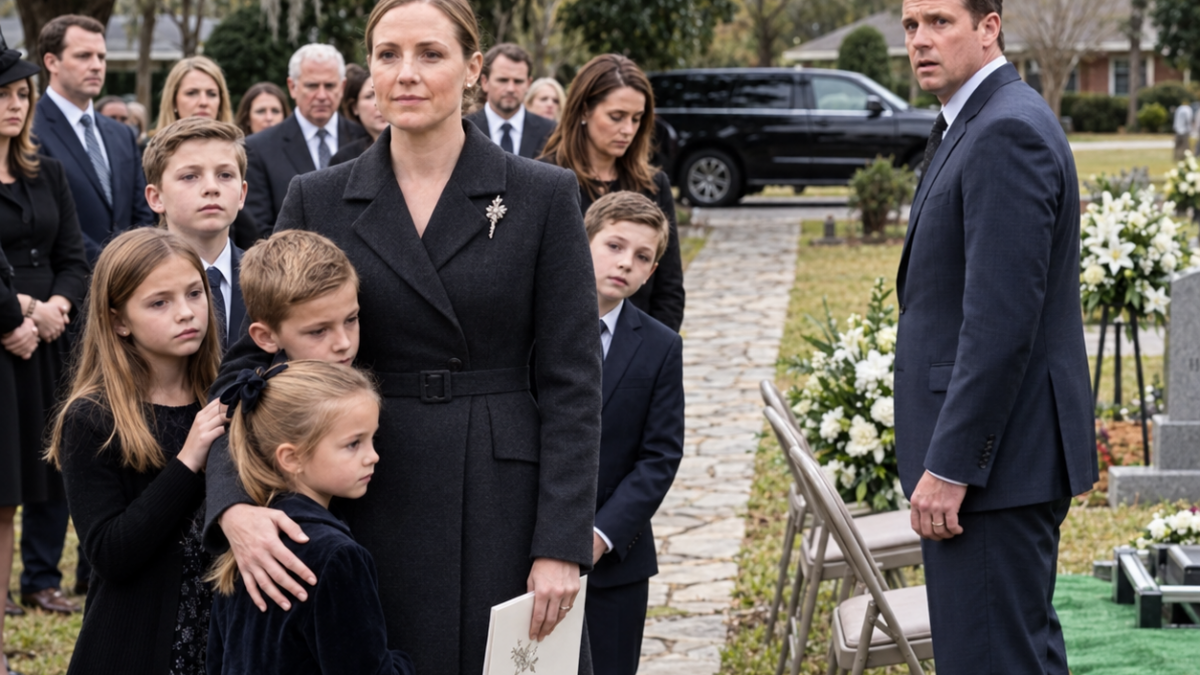
The Whitmore cemetery sat behind the family chapel, beneath ancient live oaks hung with Spanish moss. Rows of white chairs faced the open grave. William’s coffin rested under a canopy, dark polished wood covered with white lilies. The Whitmore relatives stood in clusters, their wealth visible even in mourning—black coats, pearl earrings, polished shoes, expensive umbrellas held by hired hands.
Then I saw Grant.
He stood near the coffin with his back half turned, taller than I remembered, broader through the shoulders, his dark hair touched faintly with gray at the temples. Grief had stripped some of the polish from him. His face was drawn. His hands were clasped in front of him, but he kept flexing his fingers as if he wanted to reach for something and did not know what.
For one second, the old love rose up so suddenly it almost knocked me off balance.
I hated that.
I hated that ten years of silence had not erased the memory of being twenty-three and laughing with him under those same oak trees. I hated that I remembered how his hand felt at my back. I hated that my body recognized him before my heart could defend itself.
Then Vanessa Hale stepped into view.
The old love died.
She wore black, of course, but somehow made mourning look like performance. Her dress was fitted, her veil delicate, her hair smooth under a small hat. She stood too close to Grant, not touching him but close enough to remind everyone she had claimed the space I once occupied.
Ten years had been kind to her face and cruel to her eyes.
She saw me before Grant did.
For a brief second, pure shock flashed across her expression.
Then she smiled.
It was the same smile she had worn in the sitting room ten years ago while holding a tissue to dry eyes that were not wet.
She stepped away from the mourners and blocked our path.
“Well,” Vanessa said loudly enough for nearby relatives to hear, “I suppose the military doesn’t teach shame.”
Ethan’s hand tightened around mine.
I felt it.
That tiny flinch of a child hearing an adult insult his mother.
Something inside me went very still.
Not calm.
Still.
There is a difference.
Calm means nothing inside you is moving.
Still means everything inside you has stood at attention.
I looked at Vanessa.
“Move.”
Her eyes flicked over my uniform, then my children.
“Do you really expect people to believe this little parade happened by accident?”
“They came to say goodbye.”
“To a man who was not their family.”
The words sliced through the air.
Before I could answer, Rose stepped forward.
My quiet, gray-eyed daughter looked past Vanessa toward William’s coffin.
“He was our grandfather,” she said.
She did not shout.
She did not tremble.
But every person within twenty feet heard her.
The cemetery changed.
That is the only way I can describe it.
A breeze moved through the moss. The whispers stopped. Someone dropped a program, and the soft slap of paper hitting wet grass sounded impossibly loud.
Grant turned from the coffin.
At first, he looked annoyed by the disturbance.
Then he saw me.
His face went blank.
“Savannah?”
I had imagined this moment a thousand times.
In some versions, I slapped him.
In others, I cried.
In the worst ones, I still wanted him to choose me.
But standing there with five children beside me and William’s coffin behind him, I felt none of those things.
I felt the weight of ten years.
That was all.
Grant’s eyes moved from me to Ethan.
Then Noah.
Then Luke.
Then Rose.
Then Emma.
I watched recognition arrive in pieces.
Confusion first.
Then disbelief.
Then something deeper.
Something that drained the color from his face.
Ethan had his eyes.
Noah had his smile.
Luke had the scar.
Rose had the Whitmore gray.
And Emma—
Emma had Grant’s whole face.
Not a resemblance anyone could politely dismiss.
Not a coincidence.
A verdict.
Vanessa saw it too.
The woman who thought she had buried the past watched it walk into the cemetery holding my children’s hands.
She reached toward Rose.
I caught her wrist before her fingers touched my daughter.
“Do not put your hands on my child.”
The silence was no longer polite.
It was afraid.
Vanessa stared at my hand around her wrist.
For ten years, she had remembered me as the young woman who cried, pleaded, and left.
She did not know what the Army had taught me.
She did not know what motherhood had built in me.
She did not know that fear becomes a very small thing when you have already survived the loss of everything you thought you needed.
I released her.
She stepped back, shaken.
Grant moved toward us slowly.
His eyes never left the children.
“Savannah,” he said, voice rough, “what is this?”
I reached into the inside pocket of my uniform jacket and touched the sealed envelope I had carried from the SUV.
Inside were the things I had not been allowed to show him ten years ago.
A paternity report.
A copy of the old hotel folio.
A notarized statement Vanessa thought had disappeared forever.
And William’s Christmas card, folded thin from years of being read and re-read.
I looked at the grave.
Then at Grant.
“This,” I said, lifting the envelope, “is what you left behind ten years ago.”
Vanessa whispered, “Savannah, don’t.”
Grant heard her.
He turned.
For one perfect, terrible second, he looked from her face to mine and realized she was not surprised.
His grief shifted into suspicion.
“What question?” I asked softly, because I knew he had one.
Grant swallowed.
His voice was barely steady when he said, “Are they mine?”
The words were simple.
They should have been asked ten years earlier.
Before lawyers.
Before accusations.
Before I delivered children alone.
Before my sons learned to stop asking why other kids had fathers at school events.
Before Rose drew family pictures with a blank space where a man should be.
Before Emma asked if her dad would recognize her face.
I looked at Grant Whitmore, the man I once loved enough to build a life with, and I answered the question he had been too proud, too angry, or too manipulated to ask.
“Yes.”
The word moved through the cemetery like thunder.
Grant closed his eyes.
When he opened them, they were wet.
Vanessa stepped forward quickly. “Grant, she’s trying to manipulate you.”
“No,” I said.
My voice was quiet.
“I am done letting you speak for me.”
I opened the envelope.
The first document I pulled out was the paternity report.
Grant reached for it with a hand that trembled.
I let him take it.
His eyes scanned the first line.
Then the second.
Then the final conclusion.
I watched his breathing change.
“No,” he whispered.
Ethan looked up at me. “Mom?”
I placed a hand on his shoulder.
“It’s okay.”
It was not okay.
But children need something solid when adults begin collapsing around them.
Grant stared at Ethan again.
The resemblance was no longer something he could deny.
His gaze moved to Noah.
Then Luke.
Then Rose.
Then Emma.
He stared at Emma the longest.
My youngest child shifted behind Rose, uncomfortable under the intensity of his grief.
Grant looked back at me.
“How?”
I almost laughed.
Not because anything was funny.
Because after ten years of raising five children without him, after nights in military housing with one sick child on my chest and another crying in the next room, after deployments arranged around childcare and court documents kept in a fireproof box, after birthdays where I smiled through exhaustion so my children would not feel what was missing, he had managed to ask the smallest possible question.
How?
I swallowed.
“That is what I want to know.”
I pulled out the second document.
“The hotel folio.”
Grant’s eyes widened.
For ten years, I had imagined this moment.
I had imagined screaming.
I had imagined throwing the papers at him.
I had imagined watching Vanessa crumble.
But beside William’s grave, I felt strangely calm.
Because truth does not always need volume.
Sometimes it only needs to be seen.
Grant took the folio.
His eyes moved across the printed dates.
“June seventeenth,” he murmured.
I nodded.
“The night before you accused me.”
He looked up.
“You told me you were at the hospital.”
“I was.”
“You said you never left.”
“I didn’t.”
His face hardened.
“Then why is Vanessa’s name on this?”
Every head in the cemetery turned toward her.
Vanessa shook her head.
“That is not what you think.”
Grant took one step toward her.
“Then tell me what it is.”
She opened her mouth.
Nothing came out.
For years, I had thought Vanessa’s power came from confidence.
Now I saw something else beneath it.
Fear.
Not guilt.
Fear.
As if she was not afraid of being exposed.
She was afraid of someone else being exposed with her.
I reached into the envelope one more time.
“The notarized statement.”
Vanessa grabbed my arm.
“Don’t.”
The word came out as a whisper.
I looked down at her hand.
Then at her face.
“Let go.”
She did.
Slowly.
Grant stared at her.
“What statement?”
I handed it to him.
He unfolded the page.
The cemetery became completely silent.
His eyes moved down the document.
First confusion.
Then shock.
Then horror.
He looked at Vanessa.
“Who is Daniel?”
Vanessa’s lips parted.
No one answered.
So I did.
“Your father’s attorney.”
Grant looked at me. “Daniel Mercer?”
I nodded.
“Ten years ago, Daniel witnessed Vanessa meeting your father at the Whitmore hotel.”
Grant’s eyes narrowed.
“My father?”
“Yes.”
He looked back at the statement.
“Why?”
That was the question that had haunted me too.
Why had Vanessa been at the Whitmore hotel the same night someone photographed me entering a hospital and claimed I was meeting another man?
Why had Grant received images that looked incriminating only because no one allowed me to explain them?
Why had William’s attorney signed a statement saying he saw Vanessa exchange an envelope with William in a private dining room?
Why had that statement been mailed anonymously to me three months after the divorce, after I had already left Georgia, after I was already too broken and pregnant to fight?
“I don’t know,” I said.
Vanessa whispered, “You do not understand what you are doing.”
“Neither do you,” I said.
She looked at William’s coffin.
Her face changed.
“You think William was innocent?”
The wind moved through the trees.
Grant went still.
“What did you just say?”
Vanessa’s eyes filled with tears.
Real ones this time.
“I said you do not know everything.”
Grant’s voice dropped.
“Then tell us.”
She shook her head. “I can’t.”
“You’ve been talking for ten years,” he said, grief sharpening every word. “You accused my wife of cheating. You convinced me her child wasn’t mine. You stood beside my family while they erased her. And now you can’t talk?”
Vanessa looked smaller suddenly.
“I was protecting you.”
“From what?”
She looked again at William’s coffin.
“From your father.”
The words struck the cemetery like lightning.
My breath caught.
William.
The one man in the Whitmore family who had shown me kindness.
The one man who sent the Christmas card.
The one man whose funeral had brought me back.
Grant looked as if she had slapped him.
“My father?”
Vanessa nodded, crying harder now. “He knew.”
“Knew what?”
She looked at my children.
Then at me.
Then back at Grant.
“He knew about them.”
The world seemed to tilt.
“No,” I said.
My voice sounded far away.
“That’s impossible.”
Vanessa shook her head.
“He knew before they were born.”
I remembered the Christmas card in my envelope.
Some truths take time to find their way home.
At the time, I thought it was an old man’s attempt at kindness.
Now I was not so sure.
Grant turned toward me.
“Savannah…”
I could not answer.
Because suddenly I remembered something small.
Something I had buried so deeply that even I had not realized it was still there.
Three days before Grant filed for divorce, William had called me.
I had been too angry to answer.
Too humiliated.
Too betrayed.
He left a voicemail.
I never listened to it.
Not then.
Not when the divorce became final.
Not when I left Georgia.
Not when Ethan and Noah were born.
Years later, I played it by accident while transferring old files from one phone to another. The recording was damaged. Most of it was static.
But one sentence was clear.
Savannah, if Grant asks you about the night at the hotel, don’t tell him anything until you know who gave him the photographs.
I had thought it was part of the chaos.
Now I understood.
William knew someone was setting me up.
I looked at Grant.
“Your father tried to warn me.”
Grant’s eyes filled.
“And I never knew.”
“No.”
I shook my head.
“You never knew because someone made sure you didn’t.”
His face turned toward Vanessa.
She looked away.
Grant’s voice became dangerously quiet.
“Who gave me the photographs?”
Vanessa said nothing.
“Who?”
Still nothing.
Then a voice came from behind the mourners.
“I did.”
Everyone turned.
An elderly man stood near the cemetery gate.
Gray hair.
Thin frame.
Wooden cane.
Dark coat dampened by mist.
I recognized him immediately.
Daniel Mercer.
William Whitmore’s attorney.
The man whose name was written on the notarized statement.
Grant stared as if he were seeing a ghost.
“You’re alive.”
Daniel gave a tired smile.
“Unfortunately, your father is not.”
Grant looked toward the coffin, pain crossing his face.
“What happened?”
Daniel walked slowly toward us. Every step seemed difficult, but his eyes were clear. He looked at my children first, and something soft passed over his face.
Then he looked at me.
“I’m sorry, Savannah.”
My throat tightened.
“For what?”
“For taking ten years to come forward.”
Grant stepped toward him.
“You know what happened?”
Daniel nodded.
“I know what your father discovered.”
“And?”
Daniel looked around the cemetery, then lowered his voice.
“William Whitmore did not die believing his son hated Savannah.”
He paused.
“He died believing his son had been lied to.”
Grant’s face went pale.
“By Vanessa?”
Daniel looked at her.
“No.”
Vanessa closed her eyes.
Daniel continued.
“By someone much closer to this family.”
A murmur moved through the mourners.
Grant scanned the faces around us.
His relatives stood rigid beneath black umbrellas.
Old friends looked away.
Former employees watched the ground.
“Who?” Grant demanded.
Daniel reached inside his coat and pulled out a small black notebook.
“I promised William I would only open this if Savannah ever returned.”
He handed it to me.
My fingers trembled when I took it.
The leather cover was worn smooth at the corners. Rain dotted the surface. I opened it carefully, afraid of what might fall out.
On the first page was William’s handwriting.
Three words.
Protect Savannah Cole.
My eyes burned.
I turned the page.
There were names.
Dates.
Payments.
Phone numbers.
Short notes written in a tight, hurried hand.
At the bottom of one page was a name I never expected to see.
Grant leaned over my shoulder.
His face drained of color.
“That’s not possible.”
I looked at him.
“Who is it?”
Grant did not answer.
Daniel did.
“His mother.”
The cemetery erupted in whispers.
Grant stepped backward as if someone had struck him.
“My mother died six years ago.”
Daniel nodded.
“I know.”
“Then how could she have—”
“Because William discovered the truth six years before her death.”
Grant looked at the notebook.
Then at Vanessa.
Then at me.
And finally at his father’s coffin.
“What truth?”
Daniel’s expression hardened.
“The truth about why Savannah was framed.”
For ten years, I believed my marriage had been destroyed because another woman wanted my husband.
Standing there in the rain, I realized Vanessa had never been the beginning.
She had only been the visible piece.
The part I could hate.
The part I could name.
But somewhere inside that little black notebook was the answer to the question that had haunted me for a decade.
Why had someone wanted Grant to believe I betrayed him?
And why had William risked everything to make sure the truth survived him?
I turned another page.
There was a date.
The date my first doctor confirmed I was pregnant.
Beside it, William had written:
Grant’s children were never the secret.
The secret was who knew they existed before Grant did.
I read the sentence three times.
The words blurred.
Grant’s children were never the secret.
The secret was who knew they existed before Grant did.
For a moment, I could hear nothing.
Not the wind.
Not the rain beginning to tap against the canopy.
Not the mourners shifting in the grass.
Only my own heartbeat.
I slowly turned the page.
October 14 — Savannah visited the doctor alone. Pregnancy confirmed.
My fingers went cold.
“How did William know?” I whispered.
Daniel answered before Grant could.
“Because William paid the doctor.”
I looked up sharply.
“What?”
“Your doctor was receiving threats,” Daniel said.
My stomach tightened. “What kind of threats?”
“The kind that made a man afraid to tell the truth.”
Grant moved closer.
“About the pregnancy?”
Daniel shook his head.
“About everything.”
A folded photograph slipped from between the notebook pages and landed at my feet.
I bent down and picked it up.
My breath caught.
It was a photograph of me.
Pregnant.
Standing outside a clinic.
I remembered that day.
I had been seven months along, exhausted, swollen, wearing a gray sweater stretched tight across my stomach. I had gone alone because Grant and I were already divorced. I had walked out of the clinic pretending not to be terrified because the doctor had warned me that one of the babies was measuring small and another had an irregular heartbeat.
Someone had been watching me.
Someone had been close enough to take that photograph.
On the back was a handwritten date.
Beneath it:
She still doesn’t know.
Grant took the photo from my hand.
His face twisted.
“Who took this?”
Daniel’s eyes moved toward Vanessa.
She shook her head. “Not me.”
Grant rounded on her.
“Then who?”
She did not answer.
I stared at her.
“You know.”
Vanessa looked at me for several long seconds.
Then she whispered, “Yes.”
The confession was so quiet I almost missed it.
Grant did not.
“Who?”
“I never knew his name.”
“You’re lying.”
“I’m not.”
“Then what do you know?”
She swallowed.
“I was told to keep Savannah away from the family.”
My whole body went cold.
“You were told?”
Vanessa nodded.
“I was hired.”
Grant stared at her.
“What?”
Her voice shook now.
“I didn’t meet you by accident.”
Grant’s eyes darkened.
“The restaurant?”
“Yes.”
“The charity weekend?”
“Yes.”
“The hotel?”
“Yes.”
“The photographs?”
Her mouth trembled.
“Yes.”
Grant looked as if the ground had opened beneath him.
“You planned all of it.”
“I was paid to make you believe Savannah was cheating.”
The rain grew heavier.
No one moved.
I looked at my children, five frightened faces standing close together, trying to understand how adults could stand beside a grave and reveal that their entire lives had been shaped by lies older than they were.
“But why?” I asked.
Vanessa looked at me.
“Because someone didn’t want you to have children.”
The air left my lungs.
My children.
Five lives.
Five hearts.
Five small hands that had held mine through every lonely year.
Grant’s voice broke.
“Why?”
Vanessa shook her head. “I don’t know.”
“Who paid you?”
“I never saw their face.”
“How?”
“An account.”
She looked down.
“Money was transferred to me every month.”
Daniel stepped forward.
“How much?”
Vanessa hesitated.
“Ten thousand.”
A murmur passed through the crowd.
Grant stared in disbelief.
“For ten years?”
She nodded.
“Until last month.”
That sentence frightened me more than anything else she had said.
“Last month?” I asked.
Vanessa nodded.
“The payments stopped.”
“Why?”
She looked toward William’s coffin.
“Because your father died.”
Grant’s expression hardened.
“My father was paying you?”
“No.”
Vanessa’s voice trembled.
“Your father was the reason the payments stopped.”
Daniel slowly closed the notebook.
“William found the account.”
Grant looked at him.
“And then?”
“He froze it.”
“How?”
“Evidence.”
“What evidence?”
Daniel looked at me.
“That is what I came here to give you.”
He reached inside his coat again and pulled out a small silver key.
It was old, nearly black with age.
I stared at it.
“What is that?”
“William left a safe deposit box.”
Grant frowned.
“My father didn’t have one.”
“He did.”
“Where?”
Daniel looked directly at me.
“Not in Georgia.”
The rain thickened into a steady sheet.
My children moved closer.
I could feel Ethan watching Grant.
Noah had one arm around Luke.
Rose held Emma’s hand.
They were frightened.
Not of the cemetery.
Not of the rain.
Of us.
Of all the adults standing in a circle, tearing open the sealed parts of their lives.
I knelt in front of them.
“Listen to me.”
All five looked at me.
“Whatever happens next, you stay together. You do not go anywhere unless I tell you. You do not leave each other.”
Ethan nodded.
“Mom, are we going home?”
Home.
For ten years, home had meant anywhere Grant could not reach us.
Now the past had found us anyway.
“I don’t know yet,” I said.
Grant heard me.
He stepped closer.
“You’re not taking them away from me again.”
I stood slowly.
The look I gave him stopped him before he could say another word.
“I did not take them away from you.”
His face fell.
“You never told me.”
“You did not want to hear the truth.”
“I was manipulated.”
“So was I.”
He looked down.
“I was wrong.”
Those three words.
I had imagined hearing them for years.
In my imagination, they healed something.
In real life, they only made the wound visible.
“You were wrong,” I said.
Grant nodded.
“I know.”
“You believed her.”
“I know.”
“You signed the papers.”
“I know.”
“You let your family call me a liar.”
His eyes reddened.
“I know.”
My voice trembled.
“And you never came looking.”
He closed his eyes.
“I was ashamed.”
I shook my head.
“No.”
He opened his eyes.
“You were comfortable.”
That hurt him.
I could see it.
But I did not take it back.
Because shame might have stopped him for a month.
Comfort stopped him for ten years.
Daniel interrupted gently.
“We don’t have much time.”
Grant turned. “What do you mean?”
“William knew someone would come for the notebook.”
My stomach dropped.
“What?”
Daniel looked toward the cemetery road.
“There is a reason I waited until the funeral.”
“Why?”
“Because William told me not to trust anyone inside the Whitmore family.”
A car engine sounded beyond the trees.
Everyone turned.
A black sedan had stopped near the cemetery entrance. Tinted windows. Engine running. No one stepped out at first.
Daniel’s expression changed.
“That’s them.”
Grant moved in front of the children instinctively.
“Who?”
Daniel did not answer.
The sedan door opened.
A man stepped out.
Tall.
Late fifties.
Gray suit.
Black umbrella.
I had never seen him before.
But Vanessa had.
She stepped backward immediately.
“No.”
The man walked toward us slowly, shoes sinking slightly into the wet grass.
Vanessa whispered his name.
“Richard.”
Grant looked at her.
“Who is Richard?”
She did not answer.
The stranger stopped several yards away.
His eyes moved to Daniel.
Then to the notebook in my hand.
Then to me.
Finally, his gaze settled on the children.
His expression changed.
Not surprise.
Recognition.
That was when I understood.
He had seen them before.
I moved my children behind me.
“Who are you?” I asked.
The man smiled faintly.
“Someone who has been waiting ten years to meet them.”
Grant stepped between us.
“You stay away from my children.”
The man looked amused.
“Your children?”
His quiet laugh made my skin crawl.
“You still do not understand.”
Grant’s face hardened.
“Understand what?”
Richard reached into his jacket.
I grabbed Ethan and pulled all five children back.
But instead of a weapon, Richard removed a photograph.
He held it up.
It showed Grant ten years younger, standing outside a hospital.
Beside him was Vanessa.
In the background stood William Whitmore.
And beside William was a nurse holding a newborn baby.
My baby.
One of my sons.
A sound broke from my throat before I could stop it.
“No.”
Grant stared at the photo.
His face turned white.
“That is impossible.”
Richard smiled.
“That is what William said.”
Daniel closed his eyes.
I looked at him.
“You knew?”
He did not deny it.
“William discovered the truth after the first birth.”
“What truth?”
Richard answered.
“Your children were not supposed to survive.”
The words struck me like a physical blow.
I pulled Emma against my side.
Grant stared at Richard.
“What did you say?”
Richard lowered the photograph.
“Someone had been trying to make sure Savannah’s pregnancies ended before anyone discovered who the father was.”
My vision blurred red around the edges.
I looked at my children.
Five beautiful, frightened faces.
Five lives someone had decided were threats before they had names.
“Who?” I whispered.
Richard’s smile faded.
“That is what William spent his final years trying to uncover.”
Daniel opened the notebook again.
“There is one final page.”
He turned it toward me.
At the bottom, in William’s handwriting, were six words:
The person is already at this funeral.
I looked up.
Dozens of faces stared back at me.
Whitmore relatives.
Family friends.
Former employees.
Vanessa.
Daniel.
Grant.
Richard.
Then I saw her.
A woman stood near the back of the crowd, beneath a black veil.
She was crying.
At least, she had been.
When our eyes met, she stopped.
Her face was familiar.
Too familiar.
I had seen her before.
Not at the funeral.
Not in family photographs.
Years ago.
At the hospital.
The night Emma was born.
She had been standing outside my room.
Watching.
Waiting.
I whispered the name that rose from memory.
“Margaret…”
Grant turned so fast he nearly stumbled.
His mother had been dead for six years.
But the woman at the edge of the crowd looked exactly like her.
The woman slowly lifted her gloved hands and removed the black veil.
It was not Margaret.
It was Margaret’s sister.
Grant’s aunt.
Evelyn Whitmore.
The woman everyone had told me left Georgia after Margaret’s death.
She smiled at me.
And said the words that made my blood run cold.
“You should have stayed gone, Savannah.”
The rain seemed to pause around that sentence.
Grant stepped forward.
“Aunt Evelyn.”
She looked at him almost fondly.
“You always were a slow one, Grant.”
His voice shook.
“Did you do this?”
Her smile disappeared.
“Not everything.”
Daniel stepped beside me.
“Enough, Evelyn.”
She looked at him with contempt.
“You betrayed Margaret.”
“No,” Daniel said. “I betrayed a lie.”
Grant’s face twisted.
“Why?”
Evelyn looked at him for a long moment.
Then at my children.
“Because your mother believed this family belonged to her.”
Grant frowned.
“What does that have to do with Savannah?”
“Everything.”
Evelyn’s voice sharpened.
“Your father changed his will.”
The cemetery stilled again.
“He planned to leave the majority of the Whitmore estate to William’s grandchildren.”
Grant looked at my children.
“But he didn’t know they existed.”
“He did.”
My heart stopped.
Evelyn continued.
“William discovered Savannah was pregnant before the divorce was final. He knew the child was yours. Then he discovered there was more than one. He intended to protect them.”
Her mouth twisted.
“And Margaret could not allow that.”
Grant looked as if he might be sick.
“My mother…”
“Your mother was terrified,” Evelyn said, “that if you had children with Savannah, she would lose control of the family line, the estate, the voting shares, everything she had spent decades positioning herself to control through you.”
I felt tears burning behind my eyes.
“So she destroyed our marriage.”
“She tried.”
Evelyn looked at Vanessa.
“Vanessa did the dirty work.”
Vanessa lowered her head.
“And you?” I asked.
Evelyn’s eyes met mine.
“I cleaned up the mistakes.”
My voice went cold.
“You tried to hurt my children.”
She looked away.
“I never wanted them dead.”
I stepped forward.
“Do not dress that up. Richard just said they were not supposed to survive.”
“That was Margaret.”
Grant flinched.
Evelyn’s mouth tightened.
“My sister went further than I agreed to.”
“Oh,” I said, rage settling into me like steel. “So you only wanted me framed, divorced, isolated, and erased. But you draw the line at murder?”
No one spoke.
Evelyn’s eyes flashed.
“You think you understand families like ours? You don’t. You were a threat from the moment Grant married you. Not because of your money. Not because of your name. Because he loved you enough to become someone we could not manage.”
Grant looked at me.
I refused to look back.
Evelyn continued, “Margaret believed love made him weak. William believed it made him human. That was their war long before you entered this family.”
Daniel’s grip tightened around his cane.
“And Savannah paid for it.”
Evelyn looked at him.
“We all paid.”
“No,” I said.
She turned back to me.
The rain ran down my face, but I did not wipe it away.
“We did not all pay. I paid. My children paid. Grant paid. William paid. You collected.”
For the first time, Evelyn had no answer.
Richard shifted uncomfortably.
Grant turned on him.
“And you? What were you?”
Richard looked at the notebook.
“A fixer.”
The word was ugly in its simplicity.
“For my mother?”
“For Margaret,” he said. “At first.”
“And after she died?”
His gaze moved to Evelyn.
She said nothing.
Richard sighed.
“After Margaret died, Evelyn continued the payments to Vanessa. She wanted Savannah watched.”
Grant’s face hardened.
“Watched?”
Richard nodded toward the children.
“Birthdays. Schools. Addresses. Medical records when possible. Anything that proved the children existed and remained outside the Whitmore family.”
My stomach turned.
I thought of every time I had felt uneasy in a parking lot.
Every strange car outside base housing.
Every anonymous call that ended when I answered.
Every time I told myself motherhood had made me paranoid.
I looked at Evelyn.
“You watched my children grow up?”
She did not deny it.
“I made sure they were safe.”
Something inside me snapped.
I moved before anyone could stop me.
Grant caught my arm, not restraining me harshly, just stopping me from stepping too close.
I turned on him.
“Let go.”
He released me instantly.
Good.
He was learning.
I pointed at Evelyn.
“You do not get to call surveillance safety. You do not get to poison my marriage, steal my children’s father, track them like threats, and then pretend you were protecting anyone.”
Evelyn’s lips trembled.
For the first time, she looked old.
“You have no idea what Margaret would have done if William hadn’t intervened.”
Daniel nodded slowly.
“That much is true.”
I looked at him.
He continued, “William found out after the first birth. He realized Margaret had arranged the photographs, paid Vanessa, and influenced Grant through staged evidence. He confronted her. She threatened to expose financial irregularities within the estate if he went public. He needed time to gather proof.”
Grant’s voice broke.
“So he knew my children existed and never told me?”
Daniel looked at him with sorrow.
“He tried.”
“No.”
“He did. More than once. Letters disappeared. Calls were blocked. Your mother controlled the house, your staff, your schedule, and after the divorce, your grief. You were easier to isolate than you want to admit.”
Grant looked away.
That was the most honest pain I had seen on his face all day.
Daniel added, “William was not innocent. He waited too long. He feared scandal more than he should have. But in the end, he preserved everything he could. The notebook. The bank records. The witness statements. The safe deposit key. The letter for Savannah.”
I stiffened.
“What letter?”
Daniel’s eyes softened.
“He left one for you at the grave.”
I turned toward William’s coffin.
Under the lilies, tucked partly beneath a white ribbon, was a small envelope I had not noticed before.
My name was written across it.
Savannah.
My legs felt weak as I walked to the coffin.
No one stopped me.
Even the minister, who had been standing silently beneath the canopy, stepped aside.
I picked up the envelope.
The paper was thick and dry despite the rain, protected under the flowers.
My hands shook as I opened it.
Inside was a letter written in William’s careful hand.
Savannah,
If you are reading this, then you came back braver than any of us deserved.
I knew before I died that you had been wronged. I knew Grant had been lied to. I knew my wife, Margaret, played a role in destroying your marriage, and I knew my silence helped her succeed.
There is no apology large enough for that.
I told myself I was protecting the family by investigating quietly. I told myself I needed proof before I came to you. I told myself Grant was too angry to hear the truth.
Those may be explanations, but they are not excuses.
Your children are Whitmores by blood, but they are yours by courage. You raised them when we failed them. No document, estate, or name can ever outweigh that.
If Grant is standing near you when you read this, I ask him only one thing: do not demand forgiveness from the woman you abandoned. Earn trust from the children you never knew.
And if you cannot forgive me, Savannah, I accept that.
Just do not let what they did convince you that you were unworthy of love.
You were never the problem.
You were the family they were afraid of losing.
By the time I reached the final line, the words blurred.
I pressed the letter against my chest.
For ten years, I had carried the belief that my marriage ending meant I had failed.
That I had not been enough.
Pretty enough.
Calm enough.
Convincing enough.
Respectable enough.
But standing beside William’s grave, with rain soaking my uniform and my children watching me, I finally understood.
I had not failed.
I had survived.
Grant stood several feet away.
For once, he did not approach.
He waited.
That mattered.
Not enough to heal ten years.
But enough for one breath.
Behind us, Daniel handed the notebook and records to two county investigators who had been standing near the cemetery gate in plain clothes. I had not noticed them before. Maybe no one had.
Evelyn saw them and turned sharply.
“You planned this.”
Daniel’s face was tired.
“William planned it.”
The investigators moved toward her.
Richard did not resist when another officer approached him.
Vanessa sank into a chair, crying into both hands.
I watched all three of them—Vanessa, Richard, Evelyn—and felt something I had not expected.
Not satisfaction.
Not victory.
Pity, maybe.
Or disgust so exhausted it had no teeth left.
They had spent ten years maintaining a lie.
And in the end, five children standing in the rain had undone them.
Grant walked slowly toward me.
He stopped at a respectful distance.
“I’m sorry,” he said.
I looked at him.
“You already said that.”
“I know.”
He swallowed.
“But this time, I’m not asking you to forgive me.”
That surprised me.
“I’m asking you to let me make things right.”
I looked at my children.
Ethan stepped forward first.
“Mom.”
I turned.
His eyes were on Grant.
“Is he really our dad?”
My heart broke in a new place.
I knelt in front of him.
“Yes.”
Ethan’s throat moved as he swallowed.
He looked at Grant for a long moment.
Then he asked, “Why didn’t he come?”
Grant’s eyes filled.
I stayed quiet.
That answer belonged to him.
He crouched slowly, bringing himself to Ethan’s height.
“Because I was wrong,” he said. “Because I believed a lie. Because I was hurt and proud and weak, and instead of fighting for the truth, I hid behind anger.”
Ethan studied him.
He did not forgive him.
Not immediately.
And I was grateful.
Children should not have to pretend pain disappears because adults finally tell the truth.
Grant looked at all five children.
“I cannot give back the years I missed.”
His voice cracked.
“But if you let me, I will spend the rest of my life making sure you never wonder whether you matter to me again.”
Noah looked at Ethan.
Luke looked at Rose.
Emma stayed pressed against my side.
Then Rose asked quietly, “Did Grandpa know us?”
Grant looked at Daniel.
Daniel nodded.
“He loved them before he ever met them.”
That was when something inside me finally broke open.
Not all of it.
But enough.
I walked back to William’s grave and placed my hand against the cold wood of the coffin.
“You kept your promise,” I whispered.
The minister cleared his throat softly.
The funeral had been waiting for our family’s ghosts to finish speaking.
I stepped back.
Grant stood beside the children, not touching them, not claiming them, only present.
The service began.
The minister spoke of William’s generosity, his leadership, his complicated legacy. I wondered how often funerals hid more than they revealed. I wondered how many families buried truth under flowers because it was easier to praise the dead than examine the living.
When the prayers ended, each mourner placed a flower on the coffin.
My children went last.
Ethan placed a white rose.
Noah placed a folded paper airplane he had made in the car because he did not know what else to bring.
Luke placed a small toy soldier from his pocket.
Rose placed a pressed leaf she had collected near the cemetery path.
Emma placed her drawing.
It showed five children standing under a tree beside an old man with gray eyes.
She had drawn him from imagination.
Somehow, she had drawn him smiling.
Grant turned away, covering his mouth.
I let him have his grief.
I had carried mine alone for long enough to know grief does not become smaller because someone deserves it.
After the funeral, we did not go to the mansion.
Grant asked once.
“Can we talk somewhere private?”
I looked at the house beyond the trees.
The old white columns.
The windows that had watched me leave broken.
“No,” I said. “Not there.”
He nodded.
“Where?”
“There’s a diner off Route 19.”
He blinked, surprised.
“The one with the red roof?”
“It was the only place I could afford coffee the week after I left you.”
Pain crossed his face.
“Savannah…”
“Do not apologize again unless you know which wound you’re apologizing for.”
He closed his mouth.
We drove separately.
My children rode with me.
No one spoke for the first ten minutes.
Then Luke said, “That was the weirdest funeral ever.”
Noah snorted.
Ethan whispered, “Not funny.”
But then Rose giggled.
Emma followed.
And somehow, in the middle of the strangest, most painful day of their lives, all five of my children started laughing in the back seat.
I did too.
Not because anything was light.
Because sometimes the body chooses laughter when grief has filled every other room.
At the diner, Grant arrived alone.
No Vanessa.
No relatives.
No lawyers.
Just Grant in a black suit damp from rain, looking like a man who had aged ten years in one morning.
We sat in a corner booth.
The children ordered pancakes, fries, grilled cheese, chocolate milk, and one slice of lemon pie Emma insisted was “for Grandpa.”
Grant tried to pay.
I stopped him.
His eyes flickered.
“You don’t have to prove independence every second,” he said carefully.
“No,” I answered. “But you don’t get to perform fatherhood with a debit card on the first day either.”
He accepted that.
Good.
We talked for three hours.
Not about everything.
That would take years.
But about enough.
The children asked questions.
Small ones first.
“What’s your favorite color?”
“Did you really have a horse?”
“Are you allergic to cats?”
“Do you know how to fix bikes?”
Then harder ones.
“Did you love Mom?”
Grant looked at Noah.
“Yes.”
“Then why didn’t you believe her?”
He took a long breath.
“Because I believed the wrong people more than I trusted the woman I loved.”
Ethan asked, “Will you leave again?”
Grant looked at me before answering.
“I will not leave. But your mom decides how and when I get to be part of your lives.”
All five children turned to me.
That was the moment I realized the next part of our lives would not be decided by DNA.
It would be decided by boundaries.
Mine.
I set down my coffee.
“We will move slowly. No overnight visits. No sudden changes. No promises you cannot keep. You will meet with a family counselor. You will answer their questions honestly. You will not blame me for the years you missed. And you will never use them to get close to me.”
Grant nodded.
“Yes.”
“I mean that.”
“I know.”
“Do you?”
He looked down at his hands.
Then back at me.
“I lost the right to ask you for anything the day I refused to listen. Whatever you allow me now is more than I deserve.”
I wanted to hate him in that moment.
It would have been cleaner.
But hate requires certainty, and the truth had complicated everything.
Grant had failed me.
He had also been manipulated.
He had abandoned me.
He had also been lied to by his own mother.
Both things were true.
Pain often is.
Three months passed before I let him visit our home.
By then, the investigation had widened.
Vanessa cooperated almost immediately. Her pride collapsed under the weight of bank records and recorded instructions. She admitted Margaret Whitmore had first approached her through Richard, offering money to create suspicion between Grant and me. Vanessa had been younger then, ambitious, flattered by proximity to wealth, and foolish enough to believe she was entering a love story instead of a scheme.
I did not absolve her.
But I understood the machinery better.
Richard gave a full statement in exchange for consideration. He described years of payments, staged photographs, intercepted messages, and surveillance. Evelyn fought longer. She denied everything until Daniel opened William’s safe deposit box in Alabama.
Inside were copies of canceled checks, photographs, letters, medical notes, and a recorded confession William had made two weeks before his death.
In that recording, William’s voice was weak but clear.
He said Margaret had believed Grant’s marriage to me would weaken her control over the Whitmore estate. She had viewed me as unsuitable, not because I lacked character, but because I had too much of it. Grant listened to me. Grant laughed with me. Grant made decisions without consulting his mother when I was beside him.
Margaret could not tolerate a daughter-in-law who made her son independent.
So she built a lie.
She used Vanessa as temptation.
Richard as fixer.
Evelyn as watcher.
And Grant’s pride as the final weapon.
That last part mattered.
No one could have destroyed our marriage if Grant had trusted me.
The scheme worked because he allowed it to.
That was the truth he had to live with.
And I refused to carry it for him.
The first time Grant came to see the children at our house, he arrived with no gifts.
I noticed.
So did Ethan.
Grant stood on the porch holding only a notebook.
“What’s that?” Noah asked suspiciously.
Grant looked nervous.
“A list.”
Luke frowned. “Of what?”
“Things I don’t know about you yet.”
Emma tilted her head. “Like what?”
Grant opened the notebook.
“Favorite foods. Best subjects. Worst subjects. Birthdays, though I know those now. Allergies. Fears. Favorite bedtime stories. Sports. Books. Whether Luke’s scar has a story.”
Luke touched his eyebrow.
“I fell off the monkey bars.”
Grant smiled faintly.
“I fell off a pony.”
Luke tried not to smile.
He failed.
That was the beginning.
Not forgiveness.
Not family.
A beginning.
Grant showed up every Saturday at first.
Then Wednesdays after school.
Then school events, doctor appointments, parent-teacher meetings.
He learned that Ethan became silent when overwhelmed.
That Noah talked too much when nervous.
That Luke pretended not to care when he cared the most.
That Rose collected old books and pressed flowers between their pages.
That Emma could not sleep without a stuffed rabbit named Captain Bun.
He learned slowly.
Honestly.
Imperfectly.
There were difficult days.
The first time Emma called him Dad by accident, everyone froze. She cried because she thought she had betrayed me. Grant cried because he had waited months to hear it. I held both truths in my hands and realized motherhood is often standing between other people’s pain and refusing to let either side become a weapon.
There were angry days too.
Ethan once shouted, “You don’t get to tell me what to do! You weren’t there!”
Grant went pale.
Then he said, “You’re right. I wasn’t. But I’m here now, and being angry at me doesn’t make me leave.”
Ethan slammed his bedroom door.
Grant sat outside it for forty minutes.
Not knocking.
Not demanding.
Just sitting.
Eventually, Ethan opened the door and sat beside him without speaking.
That was another beginning.
As for me and Grant, we were harder.
Children can sometimes accept love in pieces.
Adults remember the knife.
Grant never asked me to remarry him.
Not at first.
He did not ask to come home.
He did not speak of love as if it entitled him to access.
He apologized in specifics.
“I’m sorry I let my mother call you unstable.”
“I’m sorry I signed the papers before hearing you.”
“I’m sorry I did not go to the hospital records myself.”
“I’m sorry you gave birth without me.”
“I’m sorry you had to become strong in places where I should have stood beside you.”
Those apologies mattered.
Not because they erased anything.
Because they named what happened.
A year after the funeral, I returned to the Whitmore cemetery.
This time, I did not wear my military uniform.
I wore jeans, boots, and a dark green sweater Rose said made me look “like a serious tree,” which I decided to take as a compliment.
The children ran ahead with flowers.
Grant walked beside me.
We had become something neither of us could define easily.
Not husband and wife.
Not strangers.
Not simply co-parents.
Something cautious.
Something scarred.
Something alive.
At William’s grave, the children placed their flowers.
Emma placed another drawing.
This one showed an old man under a tree with five children, their mother, and a man standing a little apart but smiling.
Grant looked at it for a long time.
Then he said quietly, “She drew me outside the circle.”
“She drew you closer than last time,” I said.
He nodded.
“I’ll take it.”
We stood there after the children wandered toward the oak trees.
Grant looked at the headstone.
“I used to think I lost ten years because of a lie.”
I looked at him.
“What do you think now?”
He watched our children laughing beneath the moss.
“I think I gave ten years to a lie because facing the truth would have required me to question the people I trusted and the anger I wanted to keep.”
That answer settled between us.
It was better than an apology.
It was ownership.
I looked toward the trees.
“What will you do with the rest of your life?”
He answered without looking away from the children.
“Tell the truth.”
I smiled faintly.
“That’s a start.”
He turned to me.
“Savannah?”
“Yes?”
“I loved you then.”
I said nothing.
“I was just too weak to protect what I loved.”
The old wound ached.
Not sharply.
Deeply.
I looked at the five children running between the graves, laughing in a place that had once held only grief.
“Then don’t make the same mistake twice.”
“I won’t.”
When he reached for my hand, I let him hold it.
Not because the past had disappeared.
Not because forgiveness had become simple.
Not because a happy ending means returning to the exact life people stole from you.
Sometimes a happy ending is not getting your old life back.
Sometimes it is watching the people who tried to destroy your future become nothing more than a chapter in your past.
Sometimes it is standing beside a man who failed you and realizing his regret no longer controls your worth.
Sometimes it is looking at your children and knowing they will never have to wonder whether they were secrets.
Months later, I took William’s Christmas card from my Bible and placed it in a small wooden box.
Beside it, I placed his final letter.
Then I closed the lid.
My children were no longer hidden.
Grant was no longer a stranger.
And I was no longer the woman who left the Whitmore property believing she had lost everything.
I had five beautiful children.
A future built on truth.
A family that did not need to be perfect to be real.
And, finally, peace.
Outside, Emma shouted, “Mom!”
I opened the front door.
All five children ran toward me across the yard.
Ethan reached me first.
Then Noah.
Luke crashed into my side.
Rose wrapped her arms around my waist.
Emma jumped so hard I had to catch her.
Grant stood near the old porch steps, watching us with eyes full of everything he had missed and everything he still hoped to earn.
For the first time in ten years, when I looked down the road behind us, I did not wonder who was coming to hurt us.
I wondered where we would go next.
That was when I understood the truth William had tried to give me all those years ago.
The past had finally stopped chasing us.
Because we had stopped running from it.








