I Found My Daughter Locked Inside a Freezer—Then She Whispered the Name That Destroyed My Divorce Story
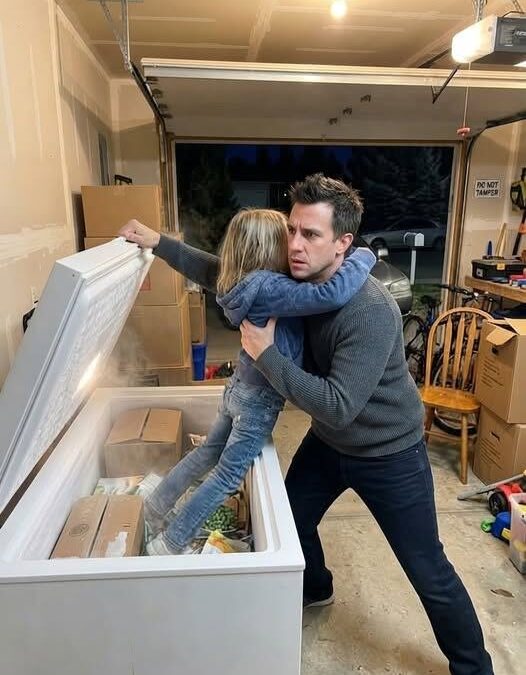
PART2
“Emergency services.”
Her face changed again.
This time, she tried sadness.
“Oh, for heaven’s sake. Don’t be dramatic. She must have climbed in there playing. Lily does this sometimes. She hides when she’s upset.”
Lily made a soft choking sound against my neck.
I felt her whole body tremble.
The dispatcher was still on the line.
“Sir, stay where you are. Police and paramedics are on the way.”
Evelyn took one step toward us.
“Give her to me.”
I stepped back.
“Do not come near her.”
Her eyebrows rose.
The Evelyn I knew would have gasped, placed a hand on her chest, and acted wounded. This Evelyn did not. This Evelyn’s eyes hardened like ice over black water.
“You have no right to speak to me that way in my daughter’s home.”
“My daughter was locked in a freezer.”
“She got in by herself.”
“She told me you put her there.”
Evelyn’s mouth barely moved.
“She’s five.”
“She knows who put her inside a freezer.”
“She lies when she’s afraid of consequences.”
That sentence hit me so hard I almost missed what it proved.
Not “children imagine things.”
Not “she must be confused.”
She lies when she’s afraid of consequences.
As if this had happened before.
As if Lily had been punished for telling the truth.
I tightened my hold on her.
The dispatcher said, “Sir, move outside if it’s safe.”
I backed toward the driveway.
Evelyn followed.
“Ethan, stop. You are making this worse.”
“For who?”
“For Lily,” she snapped. “Do you think police cars and ambulances will help her? She’s already anxious because of the divorce. She needs calm.”
“She needs a hospital.”
“She needs structure. She needs boundaries. That is what Taylor and I have been trying to give her while you spoil her and teach her to manipulate adults.”
I almost laughed.
It came out as a breath instead.
There I was, holding my half-frozen child, and Evelyn was still trying to run the courtroom of her own ego.
Then sirens cut through the October night.
Red and blue lights washed across the driveway.
Lily flinched.
“It’s okay,” I whispered. “They’re here to help.”
Paramedics reached us first. A woman named Angela knelt in front of me with a trauma bag.
“Hi, sweetheart,” she said gently to Lily. “My name is Angela. I’m going to help warm you up.”
Lily did not let go of my shirt.
“That’s okay,” Angela said. “Daddy can hold you while we check.”
A police cruiser pulled in behind the ambulance. Two officers stepped out.
Evelyn instantly transformed.
Her shoulders collapsed. Her voice went thin. Her hands fluttered near her throat.
“Officers, thank goodness. My granddaughter frightened us half to death. She must have climbed into the freezer while playing hide-and-seek.”
Officer Grant, a tall man with a close-cropped beard, looked past her at me.
“Are you the father?”
“Yes. Ethan Reed.”
“Did you find the child?”
“Yes.”
“Where?”
“In that chest freezer.”
Evelyn interrupted. “He doesn’t live here anymore. He arrived unexpectedly. We’re divorced, and he’s been very emotional about custody.”
Officer Grant did not look impressed.
“Ma’am, step back.”
Her mouth tightened.
“I’m only trying to explain the family situation.”
“I said step back.”
For the first time since I had known her, Evelyn obeyed someone without adding a sermon.
The paramedics checked Lily’s temperature, pulse, and responsiveness. She kept drifting toward sleep, then jerking awake.
“Stay with me, bug,” I said, using the nickname I had given her when she was a baby and crawled backward before she learned forward.
Her eyes fluttered.
“Daddy?”
“I’m here.”
“Don’t let Grandma close it.”
“I won’t.”
Angela looked at me.
Then at the freezer.
Then at Officer Grant.
Her expression told me she had heard enough.
“We’re transporting,” she said. “Possible hypothermia. We need pediatric evaluation.”
“I’m going with her,” I said.
Evelyn stepped forward. “No, Taylor should be called first. She has primary custody.”
Officer Grant looked at her. “Where is Taylor Reed?”
“At a work dinner,” Evelyn said too quickly.
“At ten o’clock at night?”
“She’s a pharmaceutical sales director. Her schedule is demanding.”
“Call her.”
Evelyn hesitated.
That hesitation was small, but not small enough.
Officer Grant noticed.
“Now.”
Evelyn pulled out her phone.
I rode in the ambulance with Lily.
As they loaded her in, I saw Officer Grant standing in the garage doorway, looking at the freezer. His partner was photographing the workbench, Evelyn’s purse, her keys, the open lid, the clutter around it.
Evelyn stood on the driveway, arms wrapped around herself, no longer crying.
Just watching.
At the hospital, Lily was wrapped in warm blankets and connected to monitors. The staff moved quickly, checking her core temperature, oxygen levels, fingers, toes, mental status. Her hoodie and pants were removed and sealed in a bag. A nurse found red marks on her upper arms.
Finger marks.
Small, ugly half-moons where someone had gripped her hard enough to bruise.
I stared at them while something hot and violent rose behind my eyes.
“Mr. Reed?” the nurse said softly.
I looked up.
“We have to document everything.”
“Do it.”
Lily whimpered when they touched the bruises.
“I’m sorry, baby,” the nurse said. “You’re doing so well.”
“Was I bad?” Lily whispered.
Everyone in the room went still.
I sat beside her bed.
“No,” I said firmly. “You were not bad.”
“Grandma said cold girls remember rules.”
The nurse’s jaw tightened.
“What rules?” I asked, though part of me did not want to know.
Lily looked down at the blanket.
“Don’t cry when Mommy is busy. Don’t ask for Daddy. Don’t tell secrets. Don’t make Grandma repeat herself.”
The room blurred.
I put my head down against Lily’s hand.
I had spent months believing the divorce had made my daughter quiet.
I had told myself children changed during family transitions. I had told myself her stomachaches before custody exchanges were anxiety. I had told myself the way she clung to me on Sundays was because she missed me.
All of that was partly true.
And not enough.
Taylor arrived at the hospital forty minutes later.
Her hair was pinned up. Her coat was unbuttoned. Her face looked pale, but not in the way I expected. Not frantic. Not shattered.
Frightened.
But frightened of what?
She rushed toward Lily’s room, saw me, and stopped.
“What happened?”
I stood.
“You tell me.”
Her eyes darted behind me toward the bed. “Where’s Lily?”
“Being treated because she was locked inside the freezer in your garage.”
Taylor pressed one hand to her mouth.
“Oh my God.”
I watched her carefully.
“What did you know?”
Her eyes snapped to mine.
“What?”
“What did you know?”
“How dare you ask me that?”
“Our daughter told me Evelyn puts her in there when she’s bad.”
Taylor’s face changed.
It was tiny.
A flinch.
A fracture.
Gone almost instantly.
But I saw it.
I had once known every expression on that face. I knew when Taylor was truly confused. I knew when she was angry. I knew when she was hiding something.
This was hiding.
“She’s confused,” Taylor said.
“She is hypothermic, bruised, and terrified of your mother.”
“My mother would never—”
“Do not finish that sentence.”
Taylor’s mouth trembled.
“You don’t understand what things have been like.”
“No, I don’t. So explain.”
Before she could answer, Officer Grant entered the hallway with another officer and a woman in a navy blazer who introduced herself as Mara Fields from child protective services.
Taylor immediately stiffened.
“CPS? Why is CPS here?”
Mara’s face was calm.
“Because your child was found inside a freezer.”
Taylor looked at me as if I had personally ordered the alphabet against her.
“This is exactly what I was afraid of.”
That sentence stayed with me.
Not, “My daughter could have died.”
Not, “How did this happen?”
Exactly what I was afraid of.
As if exposure was the real emergency.
Mara asked to interview Lily when medically appropriate. The doctor allowed a brief conversation with me present but silent.
Lily answered in a tiny voice.
Yes, Grandma put her in the freezer.
No, this was not the first time.
Sometimes it was “just for counting.”
Sometimes “until I stopped crying.”
Sometimes “until Mommy came back downstairs.”
How many times?
Lily held up four fingers.
Then after a long pause, she whispered, “Maybe more.”
Mara asked if Mommy knew.
Lily looked at Taylor through the glass wall of the room.
Taylor’s face went gray.
Lily whispered, “Mommy says don’t make Grandma upset.”
Taylor turned away.
And that was the moment I understood my marriage had not ended three weeks earlier in court.
It had ended every time Taylor chose silence because silence was easier than protecting our child.
The next hours came in fragments.
Hospital lights.
Police questions.
Taylor crying in the hallway.
Evelyn arriving with a lawyer faster than most people arrive with pajamas.
Mara requesting an emergency safety plan.
A doctor explaining mild to moderate hypothermia, bruising, emotional trauma, and the need for observation.
Officer Grant asking whether there were cameras in the garage.
Taylor saying no.
Me remembering the old motion camera I had installed two years earlier after raccoons kept tearing into the trash bins.
A cheap camera.
Battery-powered.
Mounted high on a shelf near the garage ceiling.
Mostly forgotten.
I told Officer Grant.
Taylor’s head snapped toward me.
“What camera?”
“The one I installed after the raccoons.”
“You said that thing died.”
“I thought it did.”
Evelyn, sitting between her lawyer and Taylor, went perfectly still.
The officers obtained consent from Taylor to access the garage, then later a warrant when Evelyn’s attorney started objecting to everything except gravity. They found the camera still mounted. The battery was low, but not dead. The memory card was inside.
The footage did not capture everything.
It captured enough.
The first video showed Evelyn leading Lily into the garage three days before I found her. Lily was crying and rubbing her eyes.
Evelyn opened the freezer.
Lily backed away.
There was no audio, but the body language was clear.
Evelyn pointed sharply.
Lily shook her head.
Evelyn grabbed her arm.
I had to leave the room when they played that part.
I made it to the hallway trash can before I threw up.
When I came back, the detective was watching me with something like sympathy, which felt useless but human.
The second video was worse.
The night I found her.
Evelyn carried Lily into the garage at 9:14 p.m. Lily was struggling. Evelyn set her down, spoke close to her face, then lifted the freezer lid.
Lily tried to run.
Evelyn caught her by the hood.
I heard Taylor make a sound behind me when she saw it.
Not grief.
Recognition.
Evelyn put my daughter into the freezer and closed the lid.
Then she stood there for nearly ten seconds with one hand resting on top.
Ten seconds.
Do you know how long ten seconds is when you are watching someone decide whether your child deserves air?
Then Evelyn walked back into the house.
The camera recorded nothing but the closed freezer for forty-three minutes.
Forty-three minutes.
I had arrived at 9:58 p.m.
If Taylor had not sent that cold message telling me to pick up my boxes, if I had waited until Friday, if traffic had been worse, if I had decided to avoid conflict one more time, my daughter might not have survived the night.
When the footage ended, Taylor slid down the wall and sobbed.
I could not look at her.
Officer Grant asked Evelyn if she had anything to say.
Her lawyer said, “My client will not be making a statement.”
But Evelyn could never resist correcting a room.
“She was never in danger,” she said coldly. “I checked on her.”
That was when Taylor stopped crying.
She looked up at her mother.
“What?”
Evelyn turned toward her.
“She had a blanket.”
“She was inside a freezer,” Taylor whispered.
“Unplugged most of the time.”
Officer Grant looked sharply toward the detective.
“It was plugged in when I found her,” I said.
Evelyn’s mouth tightened.
“She needed discipline. You both let her become hysterical and disobedient. Crying for her father every night, refusing to eat, throwing tantrums, embarrassing Taylor—”
“She missed me,” I said.
Evelyn’s eyes cut to me.
“She needed to forget you.”
The room went silent.
There it was.
Not discipline.
Not structure.
Not concern.
Erasure.
My daughter had been punished for loving me.
Taylor stared at her mother like someone watching a house burn and realizing she had been smelling smoke for years.
“Mom,” she whispered, “what did you do?”
Evelyn lifted her chin.
“What you were too weak to do.”
Taylor recoiled as if slapped.
Police arrested Evelyn that night.
Child abuse.
Reckless endangerment.
False imprisonment.
Assault.
Charges that would later grow sharper as investigators dug deeper.
As officers led her away, Evelyn did not cry.
She looked at Taylor.
“You will regret letting him do this.”
Him.
Not the police.
Not the evidence.
Me.
Even in handcuffs, Evelyn needed a villain, and naturally she chose the father who opened the freezer.
The emergency custody hearing happened the next morning.
I had not slept.
My shirt still smelled faintly of freezer frost and Lily’s hospital shampoo. I sat beside my attorney, a man named Paul Herrera, who had represented me during the divorce and looked angrier than I had ever seen him.
“We are asking for immediate temporary sole custody,” he told the judge. “The child was found locked inside a freezer in the mother’s garage. The maternal grandmother has been arrested. The child has disclosed repeated incidents. Video evidence supports at least two.”
Taylor sat across the courtroom with her attorney. Her face was swollen from crying. She looked smaller than she had during the divorce. Back then she had seemed armored by certainty and Evelyn’s constant whispering presence.
Now Evelyn was in jail.
Taylor looked like a woman who had forgotten how to stand without someone behind her.
Her attorney argued that Taylor had not personally put Lily in the freezer.
The judge’s face did not move.
“Did the child indicate the mother was aware of the grandmother’s discipline methods?”
Mara Fields from CPS testified.
“She indicated that her mother told her not to upset the grandmother. The child appears fearful of both the grandmother and the mother’s response.”
Taylor began crying again.
I felt nothing.
That scared me for a second.
Then I looked down at my hands and remembered them pulling Lily out of that freezer, her body stiff with cold.
My sympathy had limits now.
They were shaped like my daughter.
The judge granted me emergency temporary custody, suspended Taylor’s unsupervised parenting time, ordered no contact between Lily and Evelyn, required Taylor to undergo psychological evaluation and parenting therapy, and gave CPS continuing oversight.
When the ruling was read, Taylor covered her mouth.
I closed my eyes.
Not in victory.
There was no victory in this.
There was only survival dressed up as procedure.
Lily was released from the hospital two days later into my care.
I brought her to my apartment, a two-bedroom place I had rented after the divorce because it was the only thing I could afford near her school district. I had been embarrassed by it at first. The carpet was old. The kitchen cabinets stuck. The balcony overlooked a parking lot and one heroic pine tree trying its best beside the dumpsters.
But when I carried Lily inside, she looked around and whispered, “No freezer?”
I nearly broke.
“No freezer.”
“Promise?”
“I promise.”
She studied my face.
“Grandma can’t come here?”
“No.”
“Mommy?”
I paused.
“Not unless a judge and doctors say it’s safe.”
She nodded slowly, as if safety had become a math problem she was trying to learn.
That first night, she slept in my bed while I sat in a chair beside her and watched her breathe. Around 3 a.m., she woke screaming, kicking at blankets.
“Open it! Open it!”
I gathered her carefully.
“You’re out. You’re out, bug. You’re safe.”
“I was knocking.”
“I know.”
“Nobody came.”
“I came.”
She clung to me.
“You came because of boxes.”
The sentence destroyed me.
I pressed my cheek to her hair.
“No,” I whispered. “I came because something told me I needed to.”
For months, I would wonder about that.
Why did I go Thursday instead of Friday?
Why did uneasiness sit in my chest until I grabbed my keys?
Maybe it was instinct.
Maybe it was luck.
Maybe some part of me had heard my daughter calling long before my ears did.
I do not know.
I only know I stopped dismissing the quiet alarms inside myself.
Because for years I had ignored them.
I ignored them when Evelyn corrected Lily for being “clingy” at two years old.
I ignored them when Taylor began repeating her mother’s phrases.
“She needs firmer boundaries.”
“She’s too attached to you.”
“You make goodbyes harder.”
“She cries because you indulge it.”
I ignored them when Lily stopped telling me what happened at her mother’s house.
I ignored them when she asked if freezers could open from the inside.
That one came back to me two days after she moved in.
We had been grocery shopping a month before the divorce finalized. Lily had stood near the frozen waffles section, staring at the glass doors.
“Daddy,” she had asked, “can kids open cold boxes?”
I thought she meant supermarket freezers.
I said, “These? Yes, but we don’t climb in them.”
She had gone quiet.
I remembered it later and had to sit on the bathroom floor until the nausea passed.
The investigation widened.
Evelyn’s phone told a story she did not want told.
Messages to Taylor.
That child runs you.
She cries because Ethan rewards weakness.
If you keep letting her ask for him, you’ll never have peace.
A little cold teaches control.
Taylor’s replies were not as monstrous.
That almost made them worse.
Mom, don’t be extreme.
She’s only five.
Just don’t leave marks.
Please stop calling it punishment in texts.
I read those lines in my attorney’s office while Lily colored in the waiting room with Paul’s assistant.
Just don’t leave marks.
There are betrayals that explode.
Then there are betrayals that sit quietly on a screen and show you exactly how low the floor had been beneath your life.
Taylor had known enough to tell her mother not to leave marks.
She had known enough to avoid certain words in writing.
She had known enough to be afraid of documentation.
But apparently not enough to stop it.
When police interviewed her again, Taylor admitted Evelyn had used “cold time-outs.”
That was what she called them.
Cold time-outs.
As if adding the word time-out could turn torture into parenting.
Taylor claimed she believed Evelyn was putting Lily in the garage with the door open, not inside the freezer.
Then detectives showed her the footage from three days earlier.
Taylor asked for a lawyer.
I do not blame people for asking for lawyers.
I blame them for needing lawyers because they failed children.
Evelyn remained in custody.
Her attorney argued she had intended only discipline, not injury. He painted her as an old-fashioned grandmother overwhelmed by a difficult child and a bitter divorce. He suggested I had coached Lily. He suggested the freezer incident had been misinterpreted. He suggested the video lacked context.
Context.
That word became comedy to me in the darkest possible way.
What context makes sense of locking a five-year-old inside a freezer?
Was there a missing footnote?
A cultural tradition?
A parenting book titled Hypothermia for Beginners?
The prosecutor did not laugh.
She built the case brick by brick.
Medical records.
Body camera footage.
Garage camera video.
Lily’s forensic interview.
Text messages.
Prior bruising photos from pediatric visits Taylor had explained as playground accidents.
A neighbor’s statement about hearing Lily cry in the garage on two earlier evenings.
A school aide’s note that Lily once hid inside a classroom cubby and cried when someone closed the door.
Every piece made the same shape.
My daughter had been living in fear while adults around her called it adjustment.
Taylor was not arrested at first.
That made me furious.
Paul explained the difference between moral guilt and criminal proof. I told him I did not care. He said courts cared very much, and if I wanted to protect Lily, I needed to care strategically even when I hated it.
So I learned.
I learned the language of custody modification.
Trauma-informed therapy.
Supervised visitation.
Protective orders.
Mandated reporting.
Forensic interviews.
Guardian ad litem.
Parenting capacity evaluation.
I learned that rage is not enough in court. You need documents. Dates. Photos. Certified copies. Witnesses. Printed messages. Timelines.
So I made timelines.
Every stomachache.
Every Sunday meltdown.
Every strange question.
Every bruise I had noticed and let Taylor explain away.
Every text where Taylor denied me extra time because Lily “needed to detach.”
Every email from Evelyn pretending to be helpful.
By December, my apartment looked like a war room with a child’s art table in the corner.
Lily started therapy with Dr. Anika Shah, a child psychologist with silver bracelets and the patient voice of someone who knew children reveal truth sideways.
For the first few sessions, Lily barely spoke.
She drew boxes.
Houses.
Doors.
A big gray rectangle with a tiny stick figure inside.
Dr. Shah never pushed.
She let Lily decide when the drawings needed words.
One night after therapy, Lily asked me if bad people always look scary.
We were sitting on the floor eating noodles from paper bowls because I had burned dinner and decided humility tasted like takeout.
“No,” I said. “Sometimes they look normal.”
“Like Grandma?”
I set my bowl down.
“Yes.”
“Was she bad all the time?”
The question was harder than I expected.
“No. People can do nice things and still do something very bad.”
“She made cookies.”
“I know.”
“She bought my purple boots.”
“I know.”
“She put me in the cold box.”
My throat tightened.
“Yes.”
Lily stared into her noodles.
“I don’t like purple boots now.”
“We can get different boots.”
“Can they be yellow?”
“They can be dinosaur boots if you want.”
She considered.
“Yellow dinosaurs.”
“Powerful choice.”
She smiled a little.
It was tiny, but I collected it like evidence of another kind.
Taylor’s first supervised visit happened six weeks after Lily moved in with me.
It took place at a family visitation center with beige walls, plastic toys, and staff trained to smile without promising anything.
Lily wore her new yellow dinosaur boots.
She held my hand so tightly my fingers tingled.
Taylor was already inside the room when we arrived.
She looked thinner. Her hair was pulled back. She wore no makeup. When she saw Lily, she began to cry.
Lily stepped behind me.
“Hi, baby,” Taylor said.
Lily did not answer.
Taylor looked at the supervisor, then at me, then back at Lily.
“I missed you so much.”
Dr. Shah had warned us about this.
Adults in guilt often ask children to carry the emotional load.
I crouched beside Lily.
“You can say hi, or you can wave, or you can sit quietly. You don’t have to hug anyone.”
Taylor flinched at that.
Good.
Lily lifted one hand halfway.
Taylor pressed both hands to her mouth as if that tiny wave were a royal pardon.
The visit lasted forty-five minutes.
Taylor brought a stuffed animal.
Lily accepted it but set it beside her instead of holding it.
Taylor tried to talk about school.
Lily answered with one-word replies.
Then Taylor said, “I’m sorry Grandma scared you.”
Lily looked up.
Not hurt.
Not confused.
Angry.
“Grandma didn’t scare me,” she said. “Grandma put me in the freezer.”
Taylor’s face collapsed.
“I know.”
“You didn’t open it.”
Taylor covered her mouth.
The supervisor wrote something down.
Lily looked at me through the observation window.
I pressed my palm to the glass.
She pressed hers back.
That night, Taylor sent me a text.
I deserve that. I failed her.
I stared at it for a long time.
Three months earlier, I would have rushed to soften the blow.
You were manipulated.
Your mother controlled you.
We all made mistakes.
But I had retired from making betrayal comfortable.
So I wrote back:
Yes. You did.
She did not reply.
Evelyn’s preliminary hearing happened in January.
The courtroom was smaller than I expected. Evelyn wore a gray suit and a neck brace she had not needed in any police footage. She looked like she had dressed for the role of fragile grandmother persecuted by modern parenting.
The prosecutor played part of the garage video.
Evelyn’s face remained still until the moment Lily tried to run.
Then she looked away.
Not from guilt.
From irritation.
As if Lily’s resistance still annoyed her.
The paramedic testified about Lily’s condition.
The ER doctor testified about hypothermia risks.
Mara Fields testified about Lily’s disclosure.
Then I testified.
Evelyn watched me the entire time.
The prosecutor asked me to describe what I heard when I entered the garage.
“My daughter screaming for help.”
“What did you do?”
“I opened the freezer.”
“What did you see?”
I gripped the edge of the witness stand.
“My five-year-old daughter curled between frozen food packages. Her lips were blue. Her clothes were stiff with frost. She was shaking so hard she could barely speak.”
“Did she say anything after you removed her?”
“Yes.”
“What did she say?”
I looked at Evelyn.
“She said, ‘Grandma put me in.’”
Evelyn’s attorney stood.
“Objection, hearsay.”
The judge overruled under the applicable exception for the emergency context, though my brain barely registered the legal reasoning.
The defense attorney approached for cross-examination with the smooth smile of a man about to insult me professionally.
“Mr. Reed, you were unhappy with the custody arrangement after your divorce, correct?”
“Yes.”
“You wanted more time with Lily.”
“Yes.”
“You had reason to resent my client because she supported her daughter during the divorce.”
“I resented your client because she locked my daughter in a freezer.”
A few people in the gallery shifted.
The attorney’s smile thinned.
“Please answer only the question asked.”
“Ask a better question.”
The judge warned me.
I apologized to the judge, not to the attorney.
He tried to imply I had arrived unexpectedly, that my presence was suspicious, that Lily could have climbed into the freezer and later blamed Evelyn because children say strange things under stress.
When he finished, the prosecutor stood again.
“Mr. Reed, did the video show Lily climbing into the freezer by herself?”
“No.”
“Did the video show Evelyn Hart placing Lily inside?”
“Yes.”
“Did the video show Lily attempting to get away?”
“Yes.”
“Did the video show you entering the garage before or after Lily had already been trapped?”
“After.”
“Did you call 911?”
“Yes.”
“Did you seek medical care?”
“Yes.”
“No further questions.”
That was the thing about truth.
Once it had footage, it did not need a dramatic personality.
The judge found enough evidence to proceed.
Evelyn remained under strict conditions. Eventually, after additional charges were added, she was denied further attempts to contact Lily or Taylor outside legal channels.
Taylor’s situation became more complicated.
CPS substantiated failure to protect.
The custody court ordered continued supervised visits. Taylor had to complete therapy, parenting classes, domestic abuse education, and demonstrate separation from Evelyn—not just physically, but financially and emotionally.
That last part was the hardest for her.
Evelyn had not merely been Taylor’s mother.
She had been her interpreter of reality.
Without Evelyn, Taylor had to face herself.
Some days, she did.
Some days, she tried to bargain.
In March, Taylor asked to speak with me after a supervised exchange. The visitation center allowed it in a conference room with a staff member nearby.
She sat across from me, twisting a tissue between her fingers.
“I’m selling the house,” she said.
“Good.”
She looked wounded by the lack of nostalgia in my voice.
“It was our first home.”
“It was where my daughter was tortured.”
She nodded, tears rising.
“I know.”
I waited.
“I found things,” she said.
“What things?”
“In Mom’s storage unit. Notes. Old journals. She used to punish me too.”
The room went quiet.
I had suspected there was history.
Cruelty like Evelyn’s rarely begins in old age. It usually has roots.
Taylor pulled a folded paper from her purse.
“When I was little, she would lock me in the pantry. Sometimes the basement closet. She called it quiet discipline. I thought…” She swallowed hard. “I thought I turned out fine.”
I looked at her.
“Did you?”
The question was not cruel.
It was exact.
Taylor’s face crumpled.
“No.”
For the first time, I saw not the ex-wife who failed me, not the mother who failed Lily, but the child Evelyn had trained to accept fear as order.
It made me sad.
It did not make me forget.
“Taylor,” I said, “I am sorry she did that to you.”
She cried silently.
“But you let it reach Lily.”
“I know.”
“No, I need you to hear me. Your trauma explains why you froze. It does not excuse it.”
She nodded again.
“I’m not asking for custody back right now.”
That surprised me.
“What are you asking for?”
“A chance to keep showing up. However the court allows. However Lily allows.”
I studied her face.
There was no Evelyn in the hallway.
No sharp text from her mother waiting to direct the next sentence.
Just Taylor, ruined and trying not to run from the ruins.
“I won’t fight safe progress,” I said. “But I will fight anything that risks her.”
“I know.”
“And Taylor?”
She looked up.
“If you ever minimize what happened again, if you ever call it a misunderstanding or discipline or stress, I will bury you in court with every document I have.”
For the first time in years, she did not accuse me of being harsh.
She said, “I would deserve it.”
Evelyn’s trial began eleven months after the freezer.
By then, Lily was six.
She had lost one front tooth.
She had started calling my apartment “our pine tree house” because of the sad little pine outside the balcony. The tree had somehow survived snow, wind, bad soil, and apartment maintenance. Lily said it was brave.
I understood why she liked it.
She did not attend the trial.
Her forensic interview was used instead, sparing her from the courtroom. I watched the jurors see the video of Lily in a child-friendly interview room, holding a stuffed turtle, explaining in her small voice that Grandma used the cold box when she cried too much.
One juror cried openly.
Evelyn stared straight ahead.
Her defense argued she had no intent to seriously harm Lily.
The prosecutor argued intent did not require a confession wrapped in a bow. It lived in actions. It lived in the repeated pattern. It lived in the texts, the bruises, the threats, the closed lid.
The garage footage played again.
I had seen it so many times by then that certain seconds had burned permanent marks in me.
Lily backing away.
Evelyn grabbing her hood.
The lid closing.
Evelyn’s hand resting on top.
Forty-three minutes of closed silence.
The prosecutor let the video run.
Not the whole time, but long enough.
Long enough for everyone to feel the weight of waiting.
Long enough for the jury to understand that my daughter was not disciplined.
She was imprisoned.
Taylor testified for the prosecution.
That shocked Evelyn more than anything.
When Taylor walked to the stand, Evelyn leaned forward slightly, eyes narrowed. I recognized the look. It was the silent command Taylor had obeyed for most of her life.
Not this time.
Taylor told the truth.
Her voice shook, but she did not stop.
She admitted she had ignored warning signs. She admitted Evelyn had used cold punishments on her as a child. She admitted she had minimized Lily’s fear because accepting it would have forced her to confront her mother.
The prosecutor asked, “Did Ethan Reed know these punishments were occurring?”
“No.”
“Did he ever approve of them?”
“No.”
“Who found Lily in the freezer?”
“Ethan.”
“Who called 911?”
“Ethan.”
“Who protected Lily when you did not?”
Taylor closed her eyes.
“Ethan did.”
Evelyn’s face hardened into something almost inhuman.
When the defense cross-examined Taylor, they tried to paint her as unstable, guilty, desperate to save herself by blaming her mother.
Taylor listened, then said quietly, “I am guilty of failing my daughter. That is why I am telling the truth now.”
The attorney paused.
He had expected denial.
He did not know what to do with confession.
Evelyn chose to testify.
Of course she did.
Like Patricia in another life, like every controlling person who mistakes silence for defeat, Evelyn could not resist the chance to reclaim the room.
She spoke beautifully.
That was the dangerous thing.
She talked about tradition, discipline, modern children, broken homes, disrespect, and the pain of watching her daughter suffer through divorce. She said Lily had become “emotionally dysregulated” after spending time with me. She said I encouraged dependency. She said Taylor was overwhelmed.
Then the prosecutor stood.
“Mrs. Hart, did you place Lily Reed inside a chest freezer?”
“I placed her in a controlled cooling environment for less time than has been exaggerated.”
Several jurors stared.
The prosecutor blinked once.
“A controlled cooling environment?”
“The freezer was not full.”
“It was plugged in.”
“I believed she was safe.”
“Then why did you close the lid?”
“To reduce stimulation.”
“Why did she scream for help?”
“Children scream when corrected.”
“Why did you tell her the cold would help her think?”
“Because she needed to think.”
“She was five.”
“She was old enough to learn consequences.”
The prosecutor walked to the evidence screen.
“Did you write this message to Taylor? ‘If she keeps asking for Ethan, put her in the cold long enough to reset her.’”
Evelyn’s jaw tightened.
“I was speaking figuratively.”
The prosecutor played the video of Evelyn putting Lily into the freezer.
The courtroom watched.
The prosecutor turned back.
“Was that figurative?”
Evelyn did not answer.
The verdict came the next day.
Guilty.
Child abuse.
False imprisonment.
Reckless endangerment.
Assault on a child.
Multiple related counts.
At sentencing, the judge said Evelyn had abused trust across generations, repeated on her granddaughter what had been done to her daughter, and shown no genuine remorse.
Evelyn received a significant prison sentence and a permanent criminal no-contact order.
When the bailiff moved toward her, Evelyn turned—not to Lily, who was not there, not to me, not to the court.
To Taylor.
“You weak little girl,” she hissed. “You let him take everything.”
Taylor stood behind the prosecutor’s table, shaking.
Then she said, clearly enough for the whole room to hear, “No, Mom. He gave Lily back her life.”
Evelyn’s face twisted.
For once, she had no room left to control.
After the trial, life did not become magically simple.
That is not how recovery works.
There was no single morning where Lily woke up healed. No judge could sentence away nightmares. No verdict could make cold air innocent again.
Winter was hard.
The first snow sent Lily into a panic because the world outside looked too much like the inside of the freezer felt. She refused popsicles. She hated the frozen food aisle. She cried once because a cartoon penguin lived in an igloo.
So we took recovery in small, stubborn steps.
We bought yellow dinosaur boots.
We kept extra blankets in every room.
We practiced opening and closing safe doors.
We made a rule that no one in our home was ever locked anywhere as punishment.
We put words to fear.
Dr. Shah taught Lily to say, “My body remembers.”
I taught her to say, “I need the door open.”
Megan, my sister, taught her to say, “No thank you, that is not for me,” in a tone so firm it could stop traffic.
My apartment became messy, warm, loud, and safe.
There were drawings on the fridge. Pillows on the floor. Stuffed animals in legally questionable quantities. A night-light in the hallway shaped like a moon. A basket by the door for shoes, including the yellow dinosaur boots that became Lily’s armor.
Taylor continued supervised visits.
Slowly, painfully, honestly, she improved.
She never regained primary custody.
Not while Lily was young.
The court eventually allowed longer supervised visits, then therapeutic visits, then short unsupervised daytime visits after nearly two years of compliance. But overnights did not come for a long time.
Taylor did not fight the pace.
That mattered.
At one therapy session, Lily asked Taylor, “Why didn’t you open the freezer?”
Taylor cried.
Dr. Shah glanced at her, not rescuing her.
Taylor said, “Because I was scared of Grandma, and I listened to my fear instead of protecting you.”
Lily looked down at her shoes.
“That was wrong.”
“Yes,” Taylor said. “It was very wrong.”
“Daddy opened it.”
“Yes.”
Lily thought about that.
“Daddy heard me.”
Taylor looked at me.
I was sitting in the corner, silent, hands clasped so tightly my knuckles ached.
“Yes,” Taylor said. “Daddy heard you.”
That night, Lily asked if Mommy was bad.
I sat beside her bed.
“Mommy did something wrong by not protecting you.”
“Like Grandma?”
“No. Grandma hurt you on purpose. Mommy failed to stop her. Those are different kinds of wrong.”
“Can Mommy get better?”
“She is trying.”
“Can Grandma?”
I took a slow breath.
“Grandma is not safe for us.”
“Ever?”
“Ever.”
Lily nodded, relieved.
Children do not always want endless forgiveness.
Sometimes they want adults brave enough to close a door and mean it.
Two years after I found Lily in the freezer, we moved into a small house.
Not fancy.
Not large.
But ours.
It had a red front door, a fenced backyard, and no chest freezer. The refrigerator freezer was on top, and for the first week Lily checked it every morning, making sure it was too small for people.
Fair enough.
We planted a pine tree in the backyard because Lily said the apartment tree needed a cousin.
Taylor came to the housewarming for one hour.
She brought no gifts except a book about brave animals and a written safety promise Lily had requested in therapy.
It said:
I will never let anyone hurt you to keep peace.
I will listen when your body says no.
I will believe you the first time.
Lily kept it in a drawer, not on the wall.
Trust, she had learned, was not decoration.
It was evidence gathered slowly.
One cold October evening, exactly three years after the night in the garage, Lily and I sat on the back porch under a blanket. She was eight by then, taller, sharper, funny in a dry little way that made adults blink. The pine tree had survived its first two winters and grown almost a foot.
“Daddy?” she said.
“Yeah, bug?”
“Do you still have the boxes?”
“What boxes?”
“The ones you came to get.”
I smiled sadly.
“Yes. In the basement.”
“What was in them?”
“Books. Some old photo albums. A broken lamp I kept meaning to fix for reasons I can no longer defend.”
She leaned against me.
“If you didn’t come for the boxes, would you still have come?”
I looked out at the yard.
This was the question beneath so many of her questions.
Would you have found me?
Would you have heard me?
Was I saved by love or accident?
I could have lied.
I could have said of course, absolutely, I would have known. But children who survive betrayal deserve better than comforting lies.
“I don’t know exactly how,” I said. “But I believe something in me knew I needed to come. And after that night, I promised myself I would never ignore that feeling again.”
She was quiet.
Then she said, “I screamed really loud.”
“I know.”
“My throat hurt.”
“I’m so sorry.”
“You came.”
I kissed the top of her head.
“I came.”
“And you opened it.”
“Yes.”
She nodded, as if confirming the official record of the universe.
Then she looked toward the pine tree.
“I think the tree likes us.”
“I think so too.”
“It stayed.”
I looked at her.
“Yes,” I said. “It stayed.”
That night, after Lily went to bed, I stood in the kitchen of our small house and looked at the refrigerator.
There were drawings on it.
A school calendar.
A spelling test with a gold star.
A photo of Lily in yellow dinosaur boots holding a watering can beside the pine tree.
And there, near the bottom, held by a magnet shaped like a sun, was a picture Lily had drawn in therapy.
A freezer.
Open.
Empty.
A little girl standing outside it.
A man beside her.
A red door in the distance.
When she first showed it to me, I had asked, “What’s the red door?”
She said, “Home.”
Not Taylor’s house.
Not my apartment.
Not any building, really.
Home meant the place where no one closed the lid.
Evelyn had tried to teach my daughter that love was obedience, that fear was discipline, and that cold silence was what happened when children asked for too much.
Taylor had taught her, for a while, that weakness could look like motherhood if it cried afterward.
The court taught her that adults could name harm correctly.
Therapy taught her that her body was allowed to remember.
I taught her that when she called, I would come.
And Lily taught me that fatherhood is not a custody schedule, not a weekend, not a line on a court order, not the right to be called Dad.
Fatherhood is the moment you hear a muffled cry through layers of cold and run toward it with everything you have.
It is believing your child before the evidence is convenient.
It is changing the locks, learning the legal language, sitting through nightmares, warming soup, documenting bruises, refusing false peace, and standing between your child and anyone who believes love gives them permission to harm.
Three weeks after my divorce, I thought I was returning to collect the leftovers of a failed marriage.
Instead, I found the truth inside a freezer.
I found out my daughter had been punished for loving me.
I found out silence can be inherited like a disease.
I found out some families do not break in courtrooms; they break in garages, under yellow lights, beside open freezers, when a child finally whispers the name everyone else was afraid to say.
But I found something else too.
I found the part of myself that would never again be talked out of what I knew.
The divorce had taken my house.
Evelyn had nearly taken my daughter.
Taylor had taken years of trust and buried them under fear.
But Lily survived.
She grew.
She laughed again.
She planted a pine tree.
And every winter after that, when the Colorado air sharpened and frost silvered the windows, I no longer thought only of the cold box in the garage.
I thought of my daughter wrapped in a blanket on our porch, warm against my side, watching her brave little tree stand through another season.
The freezer was empty.
The door was open.
The child was out.
And no one in this world would ever close a lid over her voice again.
REVIEW
I Found My Daughter Locked Inside a Freezer—Then She Whispered the Name That Destroyed My Divorce Story
Three weeks after my divorce, I walked back into the house I had lost to pick up two boxes of old books, and I found my five-year-old daughter locked inside a freezer in the garage.
Her lips were blue, her hoodie was stiff with frost, and when I pulled her into my arms, she clung to me like she had been waiting for someone to remember she existed.
Then she whispered five words against my chest, and every lie I had believed about my marriage, my ex-wife, and the family I once trusted cracked open in the cold garage light.
“Grandma put me in.”
For a second, I honestly thought my mind had broken.
There are sentences a person’s brain refuses to accept, not because they are complicated, but because accepting them would rearrange the entire world. My daughter was five years old. Five. She still slept with her stuffed rabbit under her chin. She still asked me to cut the crusts off her sandwiches because “bread skin is too chewy.” She still believed the moon followed our car because it liked us.
And now she was shaking in my arms, her skin frighteningly cold, her breath coming in tiny broken puffs, telling me that her grandmother had put her inside a chest freezer.
Not accidentally.
Not during a game.
Not because Lily had climbed in and gotten stuck.
“She puts me in there when I’m bad,” Lily whispered. “She says the cold helps me think.”
The garage seemed to tilt around me.
The freezer stood open behind us, spilling white vapor into the yellow light. Bags of frozen peas and packages of meat were scattered where I had thrown them aside. A thin crust of frost clung to the inside walls. One of Lily’s sneakers lay near the freezer hinge. The other was still on her foot.
I pulled my jacket tighter around her and pressed her face against my chest.
“You’re safe,” I said, even though my own voice sounded like it belonged to someone else. “Daddy’s got you. Nobody is putting you back in there.”
She made a tiny sound. Not a sob exactly. More like her body had been holding one breath for too long and finally remembered how to let go.
Three weeks earlier, a judge had signed papers dissolving my marriage to Taylor Reed, the woman I once thought I would grow old beside. Three weeks earlier, I had stood in a courthouse hallway while Taylor refused to look at me and her mother, Evelyn Hart, dabbed at dry eyes with a tissue, performing grief as if the divorce were a funeral and she had bought front-row seats.
Our divorce had been ugly, but not dramatic in the cinematic sense. No screaming affair confession. No one throwing wedding photos into a fireplace. Just years of slow corrosion. Taylor became distant after Lily was born. Evelyn became more present. I became, according to both of them, too critical, too emotional, too suspicious, too unwilling to “let women handle the home.”
That was Evelyn’s favorite phrase.
Let women handle the home.
Which sounded harmless until you realized it meant: You are the father, but you are not the authority.
I had fought for more custody. I lost more than I won. Taylor received primary residential custody. I received alternating weekends, Wednesday dinners, shared legal decision-making, and a lecture from the mediator about “trusting the co-parenting process.”
The co-parenting process, as it turned out, had a chest freezer.
I reached for my phone with one hand while holding Lily with the other.
Before I could dial, she grabbed my wrist.
Her fingers were so cold they barely felt real.
“Daddy,” she whispered.
“I’m calling for help.”
“No.”
The fear in that one word cut through me.
“It’s okay. I’m calling doctors. Not Grandma.”
Her eyes moved past my shoulder, toward the door connecting the garage to the kitchen.
I followed her gaze.
That was when I saw Evelyn’s purse on the workbench.
Her keys beside it.
Taylor’s car was gone from the driveway, but Evelyn’s wasn’t. She had not left. She was somewhere inside the house.
A soft mechanical hum came from the freezer behind me.
Lily began whispering again.
“No. No. No.”
I dialed 911.
“What is your emergency?”
“My daughter was locked inside a chest freezer,” I said. “She’s five. She’s dangerously cold. She’s conscious but shaking. Her lips are blue.”
The dispatcher’s voice sharpened.
“Sir, where are you?”
I gave the address on Aspen Ridge Lane.
“Is she breathing normally?”
“She’s breathing, but it’s shallow. She’s freezing. I wrapped her in my jacket.”
“Keep her warm. Do not apply direct heat. Keep her awake if you can. Is the freezer still closed?”
“It’s open now.”
“Is the person who placed her there still nearby?”
I looked at Evelyn’s purse.
“Yes.”
Lily heard the answer and buried her face deeper into my shirt.
“Who is it?” the dispatcher asked.
“My former mother-in-law. Evelyn Hart.”
The kitchen door clicked.
Lily went completely rigid.
I turned slowly, keeping my body between my daughter and the doorway.
Evelyn stepped into the garage wearing a lavender sweater, black slacks, and the calm face of a woman who had spent her whole life convincing people that cruelty was just discipline with better posture.
She looked first at the open freezer.
Then at Lily in my arms.
Then at the phone in my hand.
For one tiny second, her mask slipped.
Not much.
Just enough.
Her eyes widened, and her mouth tightened.
Then the mask snapped back into place.
“Ethan,” she said, breathless, “thank God you’re here. I was just looking for her.”
“You were looking for her in the kitchen?”
Her eyes flicked to the phone.
“Who are you talking to?”
“Emergency services.”
Her face changed again.
This time, she tried sadness.
“Oh, for heaven’s sake. Don’t be dramatic. She must have climbed in there playing. Lily does this sometimes. She hides when she’s upset.”
Lily made a soft choking sound against my neck.
I felt her whole body tremble.
The dispatcher was still on the line.
“Sir, stay where you are. Police and paramedics are on the way.”
Evelyn took one step toward us.
“Give her to me.”
I stepped back.
“Do not come near her.”
Her eyebrows rose.
The Evelyn I knew would have gasped, placed a hand on her chest, and acted wounded. This Evelyn did not. This Evelyn’s eyes hardened like ice over black water.
“You have no right to speak to me that way in my daughter’s home.”
“My daughter was locked in a freezer.”
“She got in by herself.”
“She told me you put her there.”
Evelyn’s mouth barely moved.
“She’s five.”
“She knows who put her inside a freezer.”
“She lies when she’s afraid of consequences.”
That sentence hit me so hard I almost missed what it proved.
Not “children imagine things.”
Not “she must be confused.”
She lies when she’s afraid of consequences.
As if this had happened before.
As if Lily had been punished for telling the truth.
I tightened my hold on her.
The dispatcher said, “Sir, move outside if it’s safe.”
I backed toward the driveway.
Evelyn followed.
“Ethan, stop. You are making this worse.”
“For who?”
“For Lily,” she snapped. “Do you think police cars and ambulances will help her? She’s already anxious because of the divorce. She needs calm.”
“She needs a hospital.”
“She needs structure. She needs boundaries. That is what Taylor and I have been trying to give her while you spoil her and teach her to manipulate adults.”
I almost laughed.
It came out as a breath instead.
There I was, holding my half-frozen child, and Evelyn was still trying to run the courtroom of her own ego.
Then sirens cut through the October night.
Red and blue lights washed across the driveway.
Lily flinched.
“It’s okay,” I whispered. “They’re here to help.”
Paramedics reached us first. A woman named Angela knelt in front of me with a trauma bag.
“Hi, sweetheart,” she said gently to Lily. “My name is Angela. I’m going to help warm you up.”
Lily did not let go of my shirt.
“That’s okay,” Angela said. “Daddy can hold you while we check.”
A police cruiser pulled in behind the ambulance. Two officers stepped out.
Evelyn instantly transformed.
Her shoulders collapsed. Her voice went thin. Her hands fluttered near her throat.
“Officers, thank goodness. My granddaughter frightened us half to death. She must have climbed into the freezer while playing hide-and-seek.”
Officer Grant, a tall man with a close-cropped beard, looked past her at me.
“Are you the father?”
“Yes. Ethan Reed.”
“Did you find the child?”
“Yes.”
“Where?”
“In that chest freezer.”
Evelyn interrupted. “He doesn’t live here anymore. He arrived unexpectedly. We’re divorced, and he’s been very emotional about custody.”
Officer Grant did not look impressed.
“Ma’am, step back.”
Her mouth tightened.
“I’m only trying to explain the family situation.”
“I said step back.”
For the first time since I had known her, Evelyn obeyed someone without adding a sermon.
The paramedics checked Lily’s temperature, pulse, and responsiveness. She kept drifting toward sleep, then jerking awake.
“Stay with me, bug,” I said, using the nickname I had given her when she was a baby and crawled backward before she learned forward.
Her eyes fluttered.
“Daddy?”
“I’m here.”
“Don’t let Grandma close it.”
“I won’t.”
Angela looked at me.
Then at the freezer.
Then at Officer Grant.
Her expression told me she had heard enough.
“We’re transporting,” she said. “Possible hypothermia. We need pediatric evaluation.”
“I’m going with her,” I said.
Evelyn stepped forward. “No, Taylor should be called first. She has primary custody.”
Officer Grant looked at her. “Where is Taylor Reed?”
“At a work dinner,” Evelyn said too quickly.
“At ten o’clock at night?”
“She’s a pharmaceutical sales director. Her schedule is demanding.”
“Call her.”
Evelyn hesitated.
That hesitation was small, but not small enough.
Officer Grant noticed.
“Now.”
Evelyn pulled out her phone.
I rode in the ambulance with Lily.
As they loaded her in, I saw Officer Grant standing in the garage doorway, looking at the freezer. His partner was photographing the workbench, Evelyn’s purse, her keys, the open lid, the clutter around it.
Evelyn stood on the driveway, arms wrapped around herself, no longer crying.
Just watching.
At the hospital, Lily was wrapped in warm blankets and connected to monitors. The staff moved quickly, checking her core temperature, oxygen levels, fingers, toes, mental status. Her hoodie and pants were removed and sealed in a bag. A nurse found red marks on her upper arms.
Finger marks.
Small, ugly half-moons where someone had gripped her hard enough to bruise.
I stared at them while something hot and violent rose behind my eyes.
“Mr. Reed?” the nurse said softly.
I looked up.
“We have to document everything.”
“Do it.”
Lily whimpered when they touched the bruises.
“I’m sorry, baby,” the nurse said. “You’re doing so well.”
“Was I bad?” Lily whispered.
Everyone in the room went still.
I sat beside her bed.
“No,” I said firmly. “You were not bad.”
“Grandma said cold girls remember rules.”
The nurse’s jaw tightened.
“What rules?” I asked, though part of me did not want to know.
Lily looked down at the blanket.
“Don’t cry when Mommy is busy. Don’t ask for Daddy. Don’t tell secrets. Don’t make Grandma repeat herself.”
The room blurred.
I put my head down against Lily’s hand.
I had spent months believing the divorce had made my daughter quiet.
I had told myself children changed during family transitions. I had told myself her stomachaches before custody exchanges were anxiety. I had told myself the way she clung to me on Sundays was because she missed me.
All of that was partly true.
And not enough.
Taylor arrived at the hospital forty minutes later.
Her hair was pinned up. Her coat was unbuttoned. Her face looked pale, but not in the way I expected. Not frantic. Not shattered.
Frightened.
But frightened of what?
She rushed toward Lily’s room, saw me, and stopped.
“What happened?”
I stood.
“You tell me.”
Her eyes darted behind me toward the bed. “Where’s Lily?”
“Being treated because she was locked inside the freezer in your garage.”
Taylor pressed one hand to her mouth.
“Oh my God.”
I watched her carefully.
“What did you know?”
Her eyes snapped to mine.
“What?”
“What did you know?”
“How dare you ask me that?”
“Our daughter told me Evelyn puts her in there when she’s bad.”
Taylor’s face changed.
It was tiny.
A flinch.
A fracture.
Gone almost instantly.
But I saw it.
I had once known every expression on that face. I knew when Taylor was truly confused. I knew when she was angry. I knew when she was hiding something.
This was hiding.
“She’s confused,” Taylor said.
“She is hypothermic, bruised, and terrified of your mother.”
“My mother would never—”
“Do not finish that sentence.”
Taylor’s mouth trembled.
“You don’t understand what things have been like.”
“No, I don’t. So explain.”
Before she could answer, Officer Grant entered the hallway with another officer and a woman in a navy blazer who introduced herself as Mara Fields from child protective services.
Taylor immediately stiffened.
“CPS? Why is CPS here?”
Mara’s face was calm.
“Because your child was found inside a freezer.”
Taylor looked at me as if I had personally ordered the alphabet against her.
“This is exactly what I was afraid of.”
That sentence stayed with me.
Not, “My daughter could have died.”
Not, “How did this happen?”
Exactly what I was afraid of.
As if exposure was the real emergency.
Mara asked to interview Lily when medically appropriate. The doctor allowed a brief conversation with me present but silent.
Lily answered in a tiny voice.
Yes, Grandma put her in the freezer.
No, this was not the first time.
Sometimes it was “just for counting.”
Sometimes “until I stopped crying.”
Sometimes “until Mommy came back downstairs.”
How many times?
Lily held up four fingers.
Then after a long pause, she whispered, “Maybe more.”
Mara asked if Mommy knew.
Lily looked at Taylor through the glass wall of the room.
Taylor’s face went gray.
Lily whispered, “Mommy says don’t make Grandma upset.”
Taylor turned away.
And that was the moment I understood my marriage had not ended three weeks earlier in court.
It had ended every time Taylor chose silence because silence was easier than protecting our child.
The next hours came in fragments.
Hospital lights.
Police questions.
Taylor crying in the hallway.
Evelyn arriving with a lawyer faster than most people arrive with pajamas.
Mara requesting an emergency safety plan.
A doctor explaining mild to moderate hypothermia, bruising, emotional trauma, and the need for observation.
Officer Grant asking whether there were cameras in the garage.
Taylor saying no.
Me remembering the old motion camera I had installed two years earlier after raccoons kept tearing into the trash bins.
A cheap camera.
Battery-powered.
Mounted high on a shelf near the garage ceiling.
Mostly forgotten.
I told Officer Grant.
Taylor’s head snapped toward me.
“What camera?”
“The one I installed after the raccoons.”
“You said that thing died.”
“I thought it did.”
Evelyn, sitting between her lawyer and Taylor, went perfectly still.
The officers obtained consent from Taylor to access the garage, then later a warrant when Evelyn’s attorney started objecting to everything except gravity. They found the camera still mounted. The battery was low, but not dead. The memory card was inside.
The footage did not capture everything.
It captured enough.
The first video showed Evelyn leading Lily into the garage three days before I found her. Lily was crying and rubbing her eyes.
Evelyn opened the freezer.
Lily backed away.
There was no audio, but the body language was clear.
Evelyn pointed sharply.
Lily shook her head.
Evelyn grabbed her arm.
I had to leave the room when they played that part.
I made it to the hallway trash can before I threw up.
When I came back, the detective was watching me with something like sympathy, which felt useless but human.
The second video was worse.
The night I found her.
Evelyn carried Lily into the garage at 9:14 p.m. Lily was struggling. Evelyn set her down, spoke close to her face, then lifted the freezer lid.
Lily tried to run.
Evelyn caught her by the hood.
I heard Taylor make a sound behind me when she saw it.
Not grief.
Recognition.
Evelyn put my daughter into the freezer and closed the lid.
Then she stood there for nearly ten seconds with one hand resting on top.
Ten seconds.
Do you know how long ten seconds is when you are watching someone decide whether your child deserves air?
Then Evelyn walked back into the house.
The camera recorded nothing but the closed freezer for forty-three minutes.
Forty-three minutes.
I had arrived at 9:58 p.m.
If Taylor had not sent that cold message telling me to pick up my boxes, if I had waited until Friday, if traffic had been worse, if I had decided to avoid conflict one more time, my daughter might not have survived the night.
When the footage ended, Taylor slid down the wall and sobbed.
I could not look at her.
Officer Grant asked Evelyn if she had anything to say.
Her lawyer said, “My client will not be making a statement.”
But Evelyn could never resist correcting a room.
“She was never in danger,” she said coldly. “I checked on her.”
That was when Taylor stopped crying.
She looked up at her mother.
“What?”
Evelyn turned toward her.
“She had a blanket.”
“She was inside a freezer,” Taylor whispered.
“Unplugged most of the time.”
Officer Grant looked sharply toward the detective.
“It was plugged in when I found her,” I said.
Evelyn’s mouth tightened.
“She needed discipline. You both let her become hysterical and disobedient. Crying for her father every night, refusing to eat, throwing tantrums, embarrassing Taylor—”
“She missed me,” I said.
Evelyn’s eyes cut to me.
“She needed to forget you.”
The room went silent.
There it was.
Not discipline.
Not structure.
Not concern.
Erasure.
My daughter had been punished for loving me.
Taylor stared at her mother like someone watching a house burn and realizing she had been smelling smoke for years.
“Mom,” she whispered, “what did you do?”
Evelyn lifted her chin.
“What you were too weak to do.”
Taylor recoiled as if slapped.
Police arrested Evelyn that night.
Child abuse.
Reckless endangerment.
False imprisonment.
Assault.
Charges that would later grow sharper as investigators dug deeper.
As officers led her away, Evelyn did not cry.
She looked at Taylor.
“You will regret letting him do this.”
Him.
Not the police.
Not the evidence.
Me.
Even in handcuffs, Evelyn needed a villain, and naturally she chose the father who opened the freezer.
The emergency custody hearing happened the next morning.
I had not slept.
My shirt still smelled faintly of freezer frost and Lily’s hospital shampoo. I sat beside my attorney, a man named Paul Herrera, who had represented me during the divorce and looked angrier than I had ever seen him.
“We are asking for immediate temporary sole custody,” he told the judge. “The child was found locked inside a freezer in the mother’s garage. The maternal grandmother has been arrested. The child has disclosed repeated incidents. Video evidence supports at least two.”
Taylor sat across the courtroom with her attorney. Her face was swollen from crying. She looked smaller than she had during the divorce. Back then she had seemed armored by certainty and Evelyn’s constant whispering presence.
Now Evelyn was in jail.
Taylor looked like a woman who had forgotten how to stand without someone behind her.
Her attorney argued that Taylor had not personally put Lily in the freezer.
The judge’s face did not move.
“Did the child indicate the mother was aware of the grandmother’s discipline methods?”
Mara Fields from CPS testified.
“She indicated that her mother told her not to upset the grandmother. The child appears fearful of both the grandmother and the mother’s response.”
Taylor began crying again.
I felt nothing.
That scared me for a second.
Then I looked down at my hands and remembered them pulling Lily out of that freezer, her body stiff with cold.
My sympathy had limits now.
They were shaped like my daughter.
The judge granted me emergency temporary custody, suspended Taylor’s unsupervised parenting time, ordered no contact between Lily and Evelyn, required Taylor to undergo psychological evaluation and parenting therapy, and gave CPS continuing oversight.
When the ruling was read, Taylor covered her mouth.
I closed my eyes.
Not in victory.
There was no victory in this.
There was only survival dressed up as procedure.
Lily was released from the hospital two days later into my care.
I brought her to my apartment, a two-bedroom place I had rented after the divorce because it was the only thing I could afford near her school district. I had been embarrassed by it at first. The carpet was old. The kitchen cabinets stuck. The balcony overlooked a parking lot and one heroic pine tree trying its best beside the dumpsters.
But when I carried Lily inside, she looked around and whispered, “No freezer?”
I nearly broke.
“No freezer.”
“Promise?”
“I promise.”
She studied my face.
“Grandma can’t come here?”
“No.”
“Mommy?”
I paused.
“Not unless a judge and doctors say it’s safe.”
She nodded slowly, as if safety had become a math problem she was trying to learn.
That first night, she slept in my bed while I sat in a chair beside her and watched her breathe. Around 3 a.m., she woke screaming, kicking at blankets.
“Open it! Open it!”
I gathered her carefully.
“You’re out. You’re out, bug. You’re safe.”
“I was knocking.”
“I know.”
“Nobody came.”
“I came.”
She clung to me.
“You came because of boxes.”
The sentence destroyed me.
I pressed my cheek to her hair.
“No,” I whispered. “I came because something told me I needed to.”
For months, I would wonder about that.
Why did I go Thursday instead of Friday?
Why did uneasiness sit in my chest until I grabbed my keys?
Maybe it was instinct.
Maybe it was luck.
Maybe some part of me had heard my daughter calling long before my ears did.
I do not know.
I only know I stopped dismissing the quiet alarms inside myself.
Because for years I had ignored them.
I ignored them when Evelyn corrected Lily for being “clingy” at two years old.
I ignored them when Taylor began repeating her mother’s phrases.
“She needs firmer boundaries.”
“She’s too attached to you.”
“You make goodbyes harder.”
“She cries because you indulge it.”
I ignored them when Lily stopped telling me what happened at her mother’s house.
I ignored them when she asked if freezers could open from the inside.
That one came back to me two days after she moved in.
We had been grocery shopping a month before the divorce finalized. Lily had stood near the frozen waffles section, staring at the glass doors.
“Daddy,” she had asked, “can kids open cold boxes?”
I thought she meant supermarket freezers.
I said, “These? Yes, but we don’t climb in them.”
She had gone quiet.
I remembered it later and had to sit on the bathroom floor until the nausea passed.
The investigation widened.
Evelyn’s phone told a story she did not want told.
Messages to Taylor.
That child runs you.
She cries because Ethan rewards weakness.
If you keep letting her ask for him, you’ll never have peace.
A little cold teaches control.
Taylor’s replies were not as monstrous.
That almost made them worse.
Mom, don’t be extreme.
She’s only five.
Just don’t leave marks.
Please stop calling it punishment in texts.
I read those lines in my attorney’s office while Lily colored in the waiting room with Paul’s assistant.
Just don’t leave marks.
There are betrayals that explode.
Then there are betrayals that sit quietly on a screen and show you exactly how low the floor had been beneath your life.
Taylor had known enough to tell her mother not to leave marks.
She had known enough to avoid certain words in writing.
She had known enough to be afraid of documentation.
But apparently not enough to stop it.
When police interviewed her again, Taylor admitted Evelyn had used “cold time-outs.”
That was what she called them.
Cold time-outs.
As if adding the word time-out could turn torture into parenting.
Taylor claimed she believed Evelyn was putting Lily in the garage with the door open, not inside the freezer.
Then detectives showed her the footage from three days earlier.
Taylor asked for a lawyer.
I do not blame people for asking for lawyers.
I blame them for needing lawyers because they failed children.
Evelyn remained in custody.
Her attorney argued she had intended only discipline, not injury. He painted her as an old-fashioned grandmother overwhelmed by a difficult child and a bitter divorce. He suggested I had coached Lily. He suggested the freezer incident had been misinterpreted. He suggested the video lacked context.
Context.
That word became comedy to me in the darkest possible way.
What context makes sense of locking a five-year-old inside a freezer?
Was there a missing footnote?
A cultural tradition?
A parenting book titled Hypothermia for Beginners?
The prosecutor did not laugh.
She built the case brick by brick.
Medical records.
Body camera footage.
Garage camera video.
Lily’s forensic interview.
Text messages.
Prior bruising photos from pediatric visits Taylor had explained as playground accidents.
A neighbor’s statement about hearing Lily cry in the garage on two earlier evenings.
A school aide’s note that Lily once hid inside a classroom cubby and cried when someone closed the door.
Every piece made the same shape.
My daughter had been living in fear while adults around her called it adjustment.
Taylor was not arrested at first.
That made me furious.
Paul explained the difference between moral guilt and criminal proof. I told him I did not care. He said courts cared very much, and if I wanted to protect Lily, I needed to care strategically even when I hated it.
So I learned.
I learned the language of custody modification.
Trauma-informed therapy.
Supervised visitation.
Protective orders.
Mandated reporting.
Forensic interviews.
Guardian ad litem.
Parenting capacity evaluation.
I learned that rage is not enough in court. You need documents. Dates. Photos. Certified copies. Witnesses. Printed messages. Timelines.
So I made timelines.
Every stomachache.
Every Sunday meltdown.
Every strange question.
Every bruise I had noticed and let Taylor explain away.
Every text where Taylor denied me extra time because Lily “needed to detach.”
Every email from Evelyn pretending to be helpful.
By December, my apartment looked like a war room with a child’s art table in the corner.
Lily started therapy with Dr. Anika Shah, a child psychologist with silver bracelets and the patient voice of someone who knew children reveal truth sideways.
For the first few sessions, Lily barely spoke.
She drew boxes.
Houses.
Doors.
A big gray rectangle with a tiny stick figure inside.
Dr. Shah never pushed.
She let Lily decide when the drawings needed words.
One night after therapy, Lily asked me if bad people always look scary.
We were sitting on the floor eating noodles from paper bowls because I had burned dinner and decided humility tasted like takeout.
“No,” I said. “Sometimes they look normal.”
“Like Grandma?”
I set my bowl down.
“Yes.”
“Was she bad all the time?”
The question was harder than I expected.
“No. People can do nice things and still do something very bad.”
“She made cookies.”
“I know.”
“She bought my purple boots.”
“I know.”
“She put me in the cold box.”
My throat tightened.
“Yes.”
Lily stared into her noodles.
“I don’t like purple boots now.”
“We can get different boots.”
“Can they be yellow?”
“They can be dinosaur boots if you want.”
She considered.
“Yellow dinosaurs.”
“Powerful choice.”
She smiled a little.
It was tiny, but I collected it like evidence of another kind.
Taylor’s first supervised visit happened six weeks after Lily moved in with me.
It took place at a family visitation center with beige walls, plastic toys, and staff trained to smile without promising anything.
Lily wore her new yellow dinosaur boots.
She held my hand so tightly my fingers tingled.
Taylor was already inside the room when we arrived.
She looked thinner. Her hair was pulled back. She wore no makeup. When she saw Lily, she began to cry.
Lily stepped behind me.
“Hi, baby,” Taylor said.
Lily did not answer.
Taylor looked at the supervisor, then at me, then back at Lily.
“I missed you so much.”
Dr. Shah had warned us about this.
Adults in guilt often ask children to carry the emotional load.
I crouched beside Lily.
“You can say hi, or you can wave, or you can sit quietly. You don’t have to hug anyone.”
Taylor flinched at that.
Good.
Lily lifted one hand halfway.
Taylor pressed both hands to her mouth as if that tiny wave were a royal pardon.
The visit lasted forty-five minutes.
Taylor brought a stuffed animal.
Lily accepted it but set it beside her instead of holding it.
Taylor tried to talk about school.
Lily answered with one-word replies.
Then Taylor said, “I’m sorry Grandma scared you.”
Lily looked up.
Not hurt.
Not confused.
Angry.
“Grandma didn’t scare me,” she said. “Grandma put me in the freezer.”
Taylor’s face collapsed.
“I know.”
“You didn’t open it.”
Taylor covered her mouth.
The supervisor wrote something down.
Lily looked at me through the observation window.
I pressed my palm to the glass.
She pressed hers back.
That night, Taylor sent me a text.
I deserve that. I failed her.
I stared at it for a long time.
Three months earlier, I would have rushed to soften the blow.
You were manipulated.
Your mother controlled you.
We all made mistakes.
But I had retired from making betrayal comfortable.
So I wrote back:
Yes. You did.
She did not reply.
Evelyn’s preliminary hearing happened in January.
The courtroom was smaller than I expected. Evelyn wore a gray suit and a neck brace she had not needed in any police footage. She looked like she had dressed for the role of fragile grandmother persecuted by modern parenting.
The prosecutor played part of the garage video.
Evelyn’s face remained still until the moment Lily tried to run.
Then she looked away.
Not from guilt.
From irritation.
As if Lily’s resistance still annoyed her.
The paramedic testified about Lily’s condition.
The ER doctor testified about hypothermia risks.
Mara Fields testified about Lily’s disclosure.
Then I testified.
Evelyn watched me the entire time.
The prosecutor asked me to describe what I heard when I entered the garage.
“My daughter screaming for help.”
“What did you do?”
“I opened the freezer.”
“What did you see?”
I gripped the edge of the witness stand.
“My five-year-old daughter curled between frozen food packages. Her lips were blue. Her clothes were stiff with frost. She was shaking so hard she could barely speak.”
“Did she say anything after you removed her?”
“Yes.”
“What did she say?”
I looked at Evelyn.
“She said, ‘Grandma put me in.’”
Evelyn’s attorney stood.
“Objection, hearsay.”
The judge overruled under the applicable exception for the emergency context, though my brain barely registered the legal reasoning.
The defense attorney approached for cross-examination with the smooth smile of a man about to insult me professionally.
“Mr. Reed, you were unhappy with the custody arrangement after your divorce, correct?”
“Yes.”
“You wanted more time with Lily.”
“Yes.”
“You had reason to resent my client because she supported her daughter during the divorce.”
“I resented your client because she locked my daughter in a freezer.”
A few people in the gallery shifted.
The attorney’s smile thinned.
“Please answer only the question asked.”
“Ask a better question.”
The judge warned me.
I apologized to the judge, not to the attorney.
He tried to imply I had arrived unexpectedly, that my presence was suspicious, that Lily could have climbed into the freezer and later blamed Evelyn because children say strange things under stress.
When he finished, the prosecutor stood again.
“Mr. Reed, did the video show Lily climbing into the freezer by herself?”
“No.”
“Did the video show Evelyn Hart placing Lily inside?”
“Yes.”
“Did the video show Lily attempting to get away?”
“Yes.”
“Did the video show you entering the garage before or after Lily had already been trapped?”
“After.”
“Did you call 911?”
“Yes.”
“Did you seek medical care?”
“Yes.”
“No further questions.”
That was the thing about truth.
Once it had footage, it did not need a dramatic personality.
The judge found enough evidence to proceed.
Evelyn remained under strict conditions. Eventually, after additional charges were added, she was denied further attempts to contact Lily or Taylor outside legal channels.
Taylor’s situation became more complicated.
CPS substantiated failure to protect.
The custody court ordered continued supervised visits. Taylor had to complete therapy, parenting classes, domestic abuse education, and demonstrate separation from Evelyn—not just physically, but financially and emotionally.
That last part was the hardest for her.
Evelyn had not merely been Taylor’s mother.
She had been her interpreter of reality.
Without Evelyn, Taylor had to face herself.
Some days, she did.
Some days, she tried to bargain.
In March, Taylor asked to speak with me after a supervised exchange. The visitation center allowed it in a conference room with a staff member nearby.
She sat across from me, twisting a tissue between her fingers.
“I’m selling the house,” she said.
“Good.”
She looked wounded by the lack of nostalgia in my voice.
“It was our first home.”
“It was where my daughter was tortured.”
She nodded, tears rising.
“I know.”
I waited.
“I found things,” she said.
“What things?”
“In Mom’s storage unit. Notes. Old journals. She used to punish me too.”
The room went quiet.
I had suspected there was history.
Cruelty like Evelyn’s rarely begins in old age. It usually has roots.
Taylor pulled a folded paper from her purse.
“When I was little, she would lock me in the pantry. Sometimes the basement closet. She called it quiet discipline. I thought…” She swallowed hard. “I thought I turned out fine.”
I looked at her.
“Did you?”
The question was not cruel.
It was exact.
Taylor’s face crumpled.
“No.”
For the first time, I saw not the ex-wife who failed me, not the mother who failed Lily, but the child Evelyn had trained to accept fear as order.
It made me sad.
It did not make me forget.
“Taylor,” I said, “I am sorry she did that to you.”
She cried silently.
“But you let it reach Lily.”
“I know.”
“No, I need you to hear me. Your trauma explains why you froze. It does not excuse it.”
She nodded again.
“I’m not asking for custody back right now.”
That surprised me.
“What are you asking for?”
“A chance to keep showing up. However the court allows. However Lily allows.”
I studied her face.
There was no Evelyn in the hallway.
No sharp text from her mother waiting to direct the next sentence.
Just Taylor, ruined and trying not to run from the ruins.
“I won’t fight safe progress,” I said. “But I will fight anything that risks her.”
“I know.”
“And Taylor?”
She looked up.
“If you ever minimize what happened again, if you ever call it a misunderstanding or discipline or stress, I will bury you in court with every document I have.”
For the first time in years, she did not accuse me of being harsh.
She said, “I would deserve it.”
Evelyn’s trial began eleven months after the freezer.
By then, Lily was six.
She had lost one front tooth.
She had started calling my apartment “our pine tree house” because of the sad little pine outside the balcony. The tree had somehow survived snow, wind, bad soil, and apartment maintenance. Lily said it was brave.
I understood why she liked it.
She did not attend the trial.
Her forensic interview was used instead, sparing her from the courtroom. I watched the jurors see the video of Lily in a child-friendly interview room, holding a stuffed turtle, explaining in her small voice that Grandma used the cold box when she cried too much.
One juror cried openly.
Evelyn stared straight ahead.
Her defense argued she had no intent to seriously harm Lily.
The prosecutor argued intent did not require a confession wrapped in a bow. It lived in actions. It lived in the repeated pattern. It lived in the texts, the bruises, the threats, the closed lid.
The garage footage played again.
I had seen it so many times by then that certain seconds had burned permanent marks in me.
Lily backing away.
Evelyn grabbing her hood.
The lid closing.
Evelyn’s hand resting on top.
Forty-three minutes of closed silence.
The prosecutor let the video run.
Not the whole time, but long enough.
Long enough for everyone to feel the weight of waiting.
Long enough for the jury to understand that my daughter was not disciplined.
She was imprisoned.
Taylor testified for the prosecution.
That shocked Evelyn more than anything.
When Taylor walked to the stand, Evelyn leaned forward slightly, eyes narrowed. I recognized the look. It was the silent command Taylor had obeyed for most of her life.
Not this time.
Taylor told the truth.
Her voice shook, but she did not stop.
She admitted she had ignored warning signs. She admitted Evelyn had used cold punishments on her as a child. She admitted she had minimized Lily’s fear because accepting it would have forced her to confront her mother.
The prosecutor asked, “Did Ethan Reed know these punishments were occurring?”
“No.”
“Did he ever approve of them?”
“No.”
“Who found Lily in the freezer?”
“Ethan.”
“Who called 911?”
“Ethan.”
“Who protected Lily when you did not?”
Taylor closed her eyes.
“Ethan did.”
Evelyn’s face hardened into something almost inhuman.
When the defense cross-examined Taylor, they tried to paint her as unstable, guilty, desperate to save herself by blaming her mother.
Taylor listened, then said quietly, “I am guilty of failing my daughter. That is why I am telling the truth now.”
The attorney paused.
He had expected denial.
He did not know what to do with confession.
Evelyn chose to testify.
Of course she did.
Like Patricia in another life, like every controlling person who mistakes silence for defeat, Evelyn could not resist the chance to reclaim the room.
She spoke beautifully.
That was the dangerous thing.
She talked about tradition, discipline, modern children, broken homes, disrespect, and the pain of watching her daughter suffer through divorce. She said Lily had become “emotionally dysregulated” after spending time with me. She said I encouraged dependency. She said Taylor was overwhelmed.
Then the prosecutor stood.
“Mrs. Hart, did you place Lily Reed inside a chest freezer?”
“I placed her in a controlled cooling environment for less time than has been exaggerated.”
Several jurors stared.
The prosecutor blinked once.
“A controlled cooling environment?”
“The freezer was not full.”
“It was plugged in.”
“I believed she was safe.”
“Then why did you close the lid?”
“To reduce stimulation.”
“Why did she scream for help?”
“Children scream when corrected.”
“Why did you tell her the cold would help her think?”
“Because she needed to think.”
“She was five.”
“She was old enough to learn consequences.”
The prosecutor walked to the evidence screen.
“Did you write this message to Taylor? ‘If she keeps asking for Ethan, put her in the cold long enough to reset her.’”
Evelyn’s jaw tightened.
“I was speaking figuratively.”
The prosecutor played the video of Evelyn putting Lily into the freezer.
The courtroom watched.
The prosecutor turned back.
“Was that figurative?”
Evelyn did not answer.
The verdict came the next day.
Guilty.
Child abuse.
False imprisonment.
Reckless endangerment.
Assault on a child.
Multiple related counts.
At sentencing, the judge said Evelyn had abused trust across generations, repeated on her granddaughter what had been done to her daughter, and shown no genuine remorse.
Evelyn received a significant prison sentence and a permanent criminal no-contact order.
When the bailiff moved toward her, Evelyn turned—not to Lily, who was not there, not to me, not to the court.
To Taylor.
“You weak little girl,” she hissed. “You let him take everything.”
Taylor stood behind the prosecutor’s table, shaking.
Then she said, clearly enough for the whole room to hear, “No, Mom. He gave Lily back her life.”
Evelyn’s face twisted.
For once, she had no room left to control.
After the trial, life did not become magically simple.
That is not how recovery works.
There was no single morning where Lily woke up healed. No judge could sentence away nightmares. No verdict could make cold air innocent again.
Winter was hard.
The first snow sent Lily into a panic because the world outside looked too much like the inside of the freezer felt. She refused popsicles. She hated the frozen food aisle. She cried once because a cartoon penguin lived in an igloo.
So we took recovery in small, stubborn steps.
We bought yellow dinosaur boots.
We kept extra blankets in every room.
We practiced opening and closing safe doors.
We made a rule that no one in our home was ever locked anywhere as punishment.
We put words to fear.
Dr. Shah taught Lily to say, “My body remembers.”
I taught her to say, “I need the door open.”
Megan, my sister, taught her to say, “No thank you, that is not for me,” in a tone so firm it could stop traffic.
My apartment became messy, warm, loud, and safe.
There were drawings on the fridge. Pillows on the floor. Stuffed animals in legally questionable quantities. A night-light in the hallway shaped like a moon. A basket by the door for shoes, including the yellow dinosaur boots that became Lily’s armor.
Taylor continued supervised visits.
Slowly, painfully, honestly, she improved.
She never regained primary custody.
Not while Lily was young.
The court eventually allowed longer supervised visits, then therapeutic visits, then short unsupervised daytime visits after nearly two years of compliance. But overnights did not come for a long time.
Taylor did not fight the pace.
That mattered.
At one therapy session, Lily asked Taylor, “Why didn’t you open the freezer?”
Taylor cried.
Dr. Shah glanced at her, not rescuing her.
Taylor said, “Because I was scared of Grandma, and I listened to my fear instead of protecting you.”
Lily looked down at her shoes.
“That was wrong.”
“Yes,” Taylor said. “It was very wrong.”
“Daddy opened it.”
“Yes.”
Lily thought about that.
“Daddy heard me.”
Taylor looked at me.
I was sitting in the corner, silent, hands clasped so tightly my knuckles ached.
“Yes,” Taylor said. “Daddy heard you.”
That night, Lily asked if Mommy was bad.
I sat beside her bed.
“Mommy did something wrong by not protecting you.”
“Like Grandma?”
“No. Grandma hurt you on purpose. Mommy failed to stop her. Those are different kinds of wrong.”
“Can Mommy get better?”
“She is trying.”
“Can Grandma?”
I took a slow breath.
“Grandma is not safe for us.”
“Ever?”
“Ever.”
Lily nodded, relieved.
Children do not always want endless forgiveness.
Sometimes they want adults brave enough to close a door and mean it.
Two years after I found Lily in the freezer, we moved into a small house.
Not fancy.
Not large.
But ours.
It had a red front door, a fenced backyard, and no chest freezer. The refrigerator freezer was on top, and for the first week Lily checked it every morning, making sure it was too small for people.
Fair enough.
We planted a pine tree in the backyard because Lily said the apartment tree needed a cousin.
Taylor came to the housewarming for one hour.
She brought no gifts except a book about brave animals and a written safety promise Lily had requested in therapy.
It said:
I will never let anyone hurt you to keep peace.
I will listen when your body says no.
I will believe you the first time.
Lily kept it in a drawer, not on the wall.
Trust, she had learned, was not decoration.
It was evidence gathered slowly.
One cold October evening, exactly three years after the night in the garage, Lily and I sat on the back porch under a blanket. She was eight by then, taller, sharper, funny in a dry little way that made adults blink. The pine tree had survived its first two winters and grown almost a foot.
“Daddy?” she said.
“Yeah, bug?”
“Do you still have the boxes?”
“What boxes?”
“The ones you came to get.”
I smiled sadly.
“Yes. In the basement.”
“What was in them?”
“Books. Some old photo albums. A broken lamp I kept meaning to fix for reasons I can no longer defend.”
She leaned against me.
“If you didn’t come for the boxes, would you still have come?”
I looked out at the yard.
This was the question beneath so many of her questions.
Would you have found me?
Would you have heard me?
Was I saved by love or accident?
I could have lied.
I could have said of course, absolutely, I would have known. But children who survive betrayal deserve better than comforting lies.
“I don’t know exactly how,” I said. “But I believe something in me knew I needed to come. And after that night, I promised myself I would never ignore that feeling again.”
She was quiet.
Then she said, “I screamed really loud.”
“I know.”
“My throat hurt.”
“I’m so sorry.”
“You came.”
I kissed the top of her head.
“I came.”
“And you opened it.”
“Yes.”
She nodded, as if confirming the official record of the universe.
Then she looked toward the pine tree.
“I think the tree likes us.”
“I think so too.”
“It stayed.”
I looked at her.
“Yes,” I said. “It stayed.”
That night, after Lily went to bed, I stood in the kitchen of our small house and looked at the refrigerator.
There were drawings on it.
A school calendar.
A spelling test with a gold star.
A photo of Lily in yellow dinosaur boots holding a watering can beside the pine tree.
And there, near the bottom, held by a magnet shaped like a sun, was a picture Lily had drawn in therapy.
A freezer.
Open.
Empty.
A little girl standing outside it.
A man beside her.
A red door in the distance.
When she first showed it to me, I had asked, “What’s the red door?”
She said, “Home.”
Not Taylor’s house.
Not my apartment.
Not any building, really.
Home meant the place where no one closed the lid.
Evelyn had tried to teach my daughter that love was obedience, that fear was discipline, and that cold silence was what happened when children asked for too much.
Taylor had taught her, for a while, that weakness could look like motherhood if it cried afterward.
The court taught her that adults could name harm correctly.
Therapy taught her that her body was allowed to remember.
I taught her that when she called, I would come.
And Lily taught me that fatherhood is not a custody schedule, not a weekend, not a line on a court order, not the right to be called Dad.
Fatherhood is the moment you hear a muffled cry through layers of cold and run toward it with everything you have.
It is believing your child before the evidence is convenient.
It is changing the locks, learning the legal language, sitting through nightmares, warming soup, documenting bruises, refusing false peace, and standing between your child and anyone who believes love gives them permission to harm.
Three weeks after my divorce, I thought I was returning to collect the leftovers of a failed marriage.
Instead, I found the truth inside a freezer.
I found out my daughter had been punished for loving me.
I found out silence can be inherited like a disease.
I found out some families do not break in courtrooms; they break in garages, under yellow lights, beside open freezers, when a child finally whispers the name everyone else was afraid to say.
But I found something else too.
I found the part of myself that would never again be talked out of what I knew.
The divorce had taken my house.
Evelyn had nearly taken my daughter.
Taylor had taken years of trust and buried them under fear.
But Lily survived.
She grew.
She laughed again.
She planted a pine tree.
And every winter after that, when the Colorado air sharpened and frost silvered the windows, I no longer thought only of the cold box in the garage.
I thought of my daughter wrapped in a blanket on our porch, warm against my side, watching her brave little tree stand through another season.
The freezer was empty.
The door was open.
The child was out.
And no one in this world would ever close a lid over her voice again.








