I Found My 10 Year Old Daughter Locked in a Dog Cage Behind Her Mother’s House Then She Pointed at the Pool and Whispered Six Words That Froze My Blood
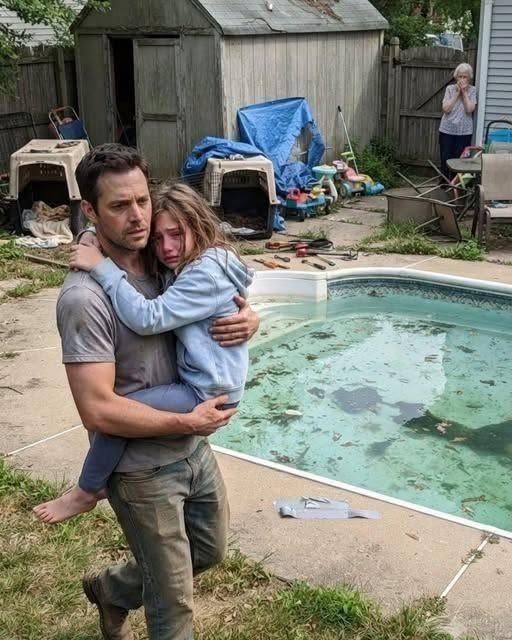
I Found My 10 Year Old Daughter Locked in a Dog Cage Behind Her Mother’s House Then She Pointed at the Pool and Whispered Six Words That Froze My Blood
The first thing I noticed was the smell.
Rust.
Sour chlorine.
Wet leaves baking beneath a hard Sunday sun.
The second thing I noticed was how quiet the house was.
Not peaceful.
Quiet.
There is a difference.
Peace has warmth in it.
Peace feels lived in.
This silence felt like something had gone wrong and the entire neighborhood had decided not to look directly at it.
Beyond the fence, somebody’s lawn mower coughed, stopped, then started again.
A sprinkler clicked somewhere two houses away.
Cars passed at the end of the street.
The world was continuing normally.
That almost made what I was looking at harder to understand.
My ex wife’s backyard gate had been chained shut.
I wrapped one hand around the chain.
It was hot from the sun.
When I pulled it, metal scraped against the gatepost with a sharp sound that went straight through my teeth.
And right then, standing outside a house I had once called home, every excuse I had made for months finally died.
My name is Michael Carter.
I am Emily’s father.
She was ten years old that summer.
Ten.
Old enough to know when adults were lying.
Old enough to know when a room was unsafe.
Old enough to learn how to hide fear.
But nowhere near old enough to be responsible for protecting herself from adults who should have protected her.
After my divorce from her mother, Sarah, we split Emily’s time between us.
On paper, it looked simple.
Clean.
Organized.
Predictable.
Emily stayed with me on certain days.
She stayed with Sarah on the others.
Every Sunday evening, I was supposed to drive over, pull into the driveway and find Emily waiting for me with her backpack, a library book and some breathless story she had been saving up all day.
That was how it used to happen.
I would barely have the engine in park before she came running.
Sometimes she would open the passenger door before I had even turned off the ignition.
“Dad, guess what.”
Those were usually the first three words.
Not hello.
Not how are you.
“Dad, guess what.”
Then I would have to listen while she told me about a teacher, some ridiculous joke from recess, a science project, a disagreement between friends or something our dog had supposedly done even though we did not have a dog at my house.
Emily could make a five minute story take twenty.
I used to tease her about it.
“Breathe, Em.”
“I am breathing.”
“You haven’t stopped talking for six minutes.”
“That’s not true.”
“It absolutely is.”
Then she would laugh.
That laugh disappeared gradually enough that I did not understand what I was losing until it was almost gone.
The Sunday handoffs changed first.
Instead of running toward Sarah’s house after I dropped her off, Emily started staying in my SUV.
At first it was thirty seconds.
Then a minute.
Then several.
I would turn off the engine and reach for my seat belt.
Emily would not move.
Her fingers would stay wrapped around the shoulder strap.
She would rub her thumb across the fabric over and over until the skin beside her thumbnail turned red.
“You okay?”
“Yeah.”
“You sure?”
“Yeah.”
“What’s wrong?”
“Nothing.”
I wanted nothing to be true.
That was my first mistake.
One Sunday she asked, “Can we just sit here for a little bit?”
I looked toward Sarah’s house.
The porch light was already on.
“It’s getting late.”
“I know.”
“Your mom’s expecting you.”
“I know.”
She kept looking through the windshield.
Not at anything specific.
Just forward.
“Five minutes?” she asked.
I should have heard what she was really asking.
Instead, I looked at the clock.
“Okay. Five.”
So we sat.
No music.
No conversation.
She held the seat belt.
I watched the minutes pass.
Then, when five minutes were over, I did exactly what the custody schedule expected me to do.
I walked my daughter back toward a house she was clearly afraid to enter.
That memory became unbearable later.
At the time, I told myself I was respecting boundaries.
Respecting Sarah.
Respecting the arrangement.
Not letting a child manipulate divorced parents against each other.
Those were responsible sounding explanations.
That was why they were dangerous.
Emily started asking to stay for dinner even when she had already eaten.
“Can I just eat with you?”
“Your mom said you already had dinner.”
“I can eat again.”
“You’re going to explode.”
“I won’t.”
“Emily.”
“Please?”
Sometimes I let her.
Sometimes I told her it was too late.
Every one of those moments came back afterward.
Every please.
Every hesitation.
Every time she went quiet.
Especially when Jason’s name came up.
Jason was Sarah’s new husband.
When I first met him, he seemed friendly enough.
He was one of those men who squeezed too hard when shaking your hand.
Not enough to start a confrontation.
Enough to make sure you noticed.
He smiled a lot.
But his smiles always felt competitive.
Like a conversation was something he could win.
He called himself strict.
Sarah called him dependable.
Emily rarely called him anything.
If Sarah said, “Tell Jason what happened at school,” Emily would say, “He already knows.”
If somebody asked, “How are things with Jason?” she would shrug.
If I used his name in the car, her expression changed.
Not dramatically.
That was what I missed.
Children do not always announce fear by screaming.
Sometimes they become careful.
Emily became careful.
She thought before answering simple questions.
She watched adults’ faces.
She learned how to say as little as possible.
No ten year old should know how to disappear while sitting directly in front of you.
But Emily did.
I asked Sarah about it twice.
The first time, she laughed.
Actually laughed.
“Michael, she’s playing us.”
“What?”
“She knows we’re divorced. Kids figure out leverage.”
“She doesn’t act normal when Jason comes up.”
“She’s adjusting.”
“She looks scared.”
“She looks ten.”
“That isn’t an answer.”
Sarah sighed.
I could hear irritation building.
“Jason has rules. You don’t.”
“I have rules.”
“You try to be the fun parent.”
“That’s not what this is about.”
“It’s exactly what this is about.”
Then she said something that worked on me because it touched the exact insecurity divorce had already planted.
“She knows if she complains about my house, you’ll rescue her from having consequences.”
Rescue.
That word bothered me.
But not enough.
I did not want to become the father who used his daughter against his ex wife.
I did not want every disagreement to turn into accusations.
I did not want Emily standing between two adults who hated each other.
So I backed off.
The second conversation went worse.
I told Sarah directly that Emily’s behavior around drop offs worried me.
She accused me of poisoning Emily against Jason.
“He’s strict,” she said. “He isn’t cruel.”
“I didn’t say cruel.”
“You’re implying it.”
“I’m telling you she’s uncomfortable.”
“You’re jealous.”
I almost laughed.
Instead I said, “Of Jason?”
“Of everything.”
“What does that even mean?”
“The house. Me moving on. Someone else living here.”
I remember looking around the place while she said it.
That house had once been mine too.
The chipped stone beside the front step.
The hallway I had painted twice because Sarah hated the first color.
The kitchen where Emily learned to spell her name with magnetic letters on the refrigerator.
There were memories there.
But jealousy was not why I had called.
Still, Sarah had found the accusation that made me question myself.
Maybe I was interpreting things emotionally.
Maybe I wanted something to be wrong because Jason made me uncomfortable.
Maybe Emily was adjusting.
Maybe Sarah was right.
Maybe I was being unfair.
That word became another excuse.
Maybe.
Maybe.
Maybe.
For longer than I want to admit, I let uncertainty protect me from action.
Because action would have required me to consider something much worse.
That I might be driving my daughter back to a house where she was learning how to survive.
I told myself Emily would tell me if something serious happened.
That sounds reasonable until you remember what frightened children actually do.
They protect adults.
They protect themselves.
They worry about consequences adults never imagine.
I told myself her teachers would notice.
I told myself neighbors would notice.
I told myself Sarah was her mother.
Sarah would never allow anybody to truly hurt her.
Each explanation gave me another day of comfort.
Emily was the one paying for every day I bought.
The morning everything changed began with a school notification.
Friday.
8:12 a.m.
I was standing beside my SUV with a paper coffee cup in my hand when my phone buzzed.
I expected an email.
Instead, I saw the school system.
Emily Carter absent.
I stared at it.
Emily was almost never absent.
Not because she loved school every day.
She complained about Mondays like every other kid.
But Sarah was organized about attendance.
If Emily had an appointment, I usually knew.
If she was sick, I normally got a message.
That morning I had received nothing.
I texted Sarah immediately.
Is Emily sick?
I watched the screen.
No response.
I took a sip of coffee.
It had already gone lukewarm.
Ten minutes passed.
I called.
Ring.
Ring.
Ring.
Voicemail.
I hung up.
Called again.
Same thing.
Then I called Emily.
Her phone rang twice.
Then disconnected.
I told myself she was sleeping.
Maybe Sarah had taken her phone.
Maybe they were at a doctor’s office.
Maybe the school system had made a mistake.
There was that word again.
Maybe.
By lunchtime, I had sent four messages.
Is everything okay?
Call me.
I need to hear from Emily.
Sarah please answer.
Nothing.
The silence stopped being annoying.
It became frightening.
At 6:47 that evening, I called Emily again.
Straight to voicemail.
I remember the exact time because I stared at it afterward as if the numbers themselves could explain something.
6:47.
Three digits separated by a colon.
Normal information.
But that was the moment my fear stopped behaving like fear and turned into action.
I requested a welfare check.
The person I spoke to took the address.
I gave it once.
Then again.
I explained the custody schedule.
The missed school day.
The unanswered calls.
Emily’s recent behavior.
Jason.
The silence.
I was given an incident number.
I wrote it on the back of a gas station receipt because my hands were shaking so badly I did not trust myself to type it correctly.
I sat in my SUV afterward.
The coffee cup was still in the holder.
I stared at the number until the ink blurred.
I expected relief.
I had done something.
Someone else knew.
Someone would check.
But fear does not disappear just because you pass information to another person.
I drove home.
Checked my phone constantly.
Nothing.
Saturday morning arrived.
No call.
No text.
No photograph.
No irritated message from Sarah telling me I had overreacted.
By then, I would have welcomed anger.
I wanted Sarah to call and insult me.
I wanted her to say Emily was fine.
I wanted her to accuse me of being dramatic.
Anything.
Silence was worse.
I drove down Sarah’s street Saturday morning.
I did not stop.
Her car was in the driveway.
Jason’s truck was gone.
The curtains were closed.
I drove past slowly.
Nothing moved.
That evening, I drove by again.
Same curtains.
Same car.
Same dead windows.
I considered walking to the front door.
My hand actually moved toward the door handle.
Then I stopped.
This is the part people judged later.
Why didn’t you go in then?
Why didn’t you break the door?
Why didn’t you demand to see her?
Those are easy questions when you already know how the story turns out.
At the time, I knew only that I was the ex husband Sarah had already accused of causing trouble.
I knew there had supposedly been a welfare check.
I knew a custody dispute could become ugly if one parent appeared at another parent’s house demanding entry.
And I was afraid that if Emily was inside and already frightened, an explosive confrontation with Jason might make things worse.
So I drove home.
I told myself authorities were handling it.
I told myself Sarah would call.
I told myself not to become exactly the angry ex husband she had described to everybody else.
Another night passed.
By Sunday afternoon, three full days had passed since I had heard my daughter’s voice.
Three days.
Once I said the number out loud, something changed.
Three days was no longer confusion.
Three days was no longer a missed text.
Three days was no longer me trying to respect boundaries.
Three days was my daughter being gone from my life while every instinct in my body told me something was wrong.
At that point, looking unreasonable no longer mattered.
I drove to Sarah’s house.
The sky was almost white from the heat.
The kind of summer afternoon when the sun seems too close.
I parked.
The front yard looked neglected.
The cracked step seemed worse than I remembered.
The flower beds were dry despite a garden hose lying across the grass.
Every curtain was closed.
Then I saw the backyard gate.
The chain.
Heavy.
Wrapped deliberately around the post.
Locked.
It was not something someone had casually put there to stop a dog from pushing through.
It was meant to prevent entry.
I rang the doorbell.
Once.
Twice.
Again.
I kept my thumb on it until it hurt.
Nothing.
I knocked.
Hard.
“Sarah!”
My knuckles stung.
No answer.
“Emily!”
Nothing.
I hit the door again.
“Emily!”
Silence.
Then I heard someone behind me.
“Michael.”
I turned.
Mrs. Harris from next door was hurrying toward me.
She wore house slippers and a light cardigan despite the heat.
A rosary was wrapped around one hand.
She was gripping it so hard her knuckles had gone white.
“Michael,” she whispered again. “Thank God you’re here.”
Whatever remained of my hope collapsed.
People do not say thank God you’re here when everything is fine.
“Where’s Emily?”
Mrs. Harris looked at Sarah’s windows.
Not at me.
At the windows.
As if she was afraid the house itself could hear her.
“Where is she?” I asked again.
“I don’t know.”
“What happened?”
Her mouth opened.
Closed.
“What happened?”
“I’ve heard things.”
“What things?”
“Michael…”
“What things?”
“Screaming.”
The word seemed to hang between us.
“How long?”
She looked down.
“Weeks.”
I stopped breathing for a second.
“Weeks?”
“Not every day.”
“That doesn’t matter.”
“I know.”
“What did you hear?”
“Arguments. Crying. Things hitting walls.”
“Emily?”
“I couldn’t always tell.”
I stepped closer.
“Did you call anyone?”
“I went over twice.”
“That’s not what I asked.”
“I called to check. Sarah answered.”
“What did she say?”
“That everything was fine.”
“Did you see Emily?”
Mrs. Harris hesitated.
“No.”
The answer made something inside me turn cold.
“Not once?”
“She only opened the door a little.”
“And you never saw Emily?”
“No.”
“Why didn’t you call me?”
The question came out sharper than I intended.
I watched guilt pass across her face.
Then I immediately hated myself because I recognized the expression.
I had the same guilt.
“Sarah told me things,” Mrs. Harris said.
“What things?”
“That the divorce was bad. That you were looking for excuses to interfere.”
I closed my eyes.
Of course.
“She said you wanted to cause problems.”
“Did you believe her?”
“I didn’t know what to believe.”
I looked at her.
And there it was.
The exact trap I had fallen into.
Uncertainty.
Fear of making the wrong choice.
Fear of escalating a situation.
Mrs. Harris had waited because she worried action would make things worse.
So had I.
We had both chosen hesitation because hesitation felt responsible.
Emily had paid the price.
“I’m sorry,” Mrs. Harris said.
I shook my head.
Not because I forgave everything.
Because standing there assigning blame would not find my daughter.
“Tell me everything.”
Mrs. Harris looked toward the backyard.
Then she said, “Last night I saw Jason.”
My pulse jumped.
“Where?”
“Out back.”
“With Emily?”
“No.”
“With Sarah?”
“No.”
“What was he doing?”
She twisted the rosary tighter.
“He had bags.”
“What bags?”
“Black contractor bags.”
I stared.
“He carried them into the yard.”
“How many?”
“Several.”
“What was in them?”
“I don’t know.”
“What did he do?”
Mrs. Harris swallowed.
“He put them in the pool.”
For a moment, all I could hear was the lawn mower somewhere beyond the block.
Then my own breathing.
“He what?”
“He carried them across the patio. One at a time.”
“Were they heavy?”
“Yes.”
“How heavy?”
“I don’t know, Michael.”
“Did you see what was inside?”
“No.”
“What happened after?”
“He stood beside the pool.”
“Doing what?”
“Watching it.”
I looked toward the chained gate.
Every terrible possibility entered my head at once.
I refused to let any of them become real before I saw something.
Mrs. Harris opened her side gate.
“The fence,” she said.
I followed her.
The fence dividing the yards was old.
Rust streaked the metal.
High enough to be inconvenient.
Not high enough to stop me.
I climbed.
A jagged piece caught my palm.
Skin tore.
I barely noticed.
I dropped into Sarah’s backyard.
That was when the smell hit me.
Rust.
Chlorine gone sour.
Wet leaves.
Something stagnant.
The pool water slapped faintly against concrete.
I looked around.
The yard felt abandoned even though signs of recent activity were everywhere.
Plastic toys had been stacked against the wall.
Two patio chairs were upside down.
A single child’s sandal sat near the back step.
Faded from the sun.
My stomach tightened.
“Emily?”
No response.
I took another step.
“Emily!”
Nothing.
Then I looked at the pool.
The water had gone green.
Not slightly cloudy.
Green.
Thick.
Almost still.
Beneath the surface, where the pool became deeper, were dark shapes.
Black contractor bags.
Tied shut.
Several of them.
For one second, my body refused to move.
Everything Mrs. Harris had said became visible.
Jason carrying them.
One by one.
Dropping them into the water.
Standing there afterward.
Watching.
I wanted to go toward the pool.
I was terrified to go toward the pool.
Before I could decide, wind moved across the backyard.
Something behind the shed lifted.
Blue plastic.
A tarp.
One corner rose.
Dropped.
I turned.
The tarp had been weighted down.
A brick on one side.
A plastic bucket on the other.
Wind caught it again.
And underneath, for less than a second, I saw metal bars.
I ran.
One of the overturned patio chairs scraped my leg as I passed.
I did not feel it.
I kicked the bucket aside.
Threw the brick.
Grabbed the tarp with both hands.
Pulled.
The plastic slid away.
There was a dog cage beneath it.
A large one.
And inside was my daughter.
For several seconds, my brain rejected what my eyes were seeing.
That happens when reality moves too far beyond what your mind expects.
You see something.
You understand the shapes.
But meaning arrives late.
Metal.
Blanket.
Child.
Emily.
My daughter was curled inside a dog cage.
Her knees were pulled against her chest.
A filthy blanket was underneath her.
She wore the pale blue hoodie she had left my house in the week before.
I remembered that hoodie.
I had told her it was too hot outside.
She had rolled her eyes.
“Dad, it gets cold at night.”
Now the sleeves were dirty.
One cuff was stretched over her hand.
Her hair was tangled across her face.
Her lower lip was split.
But it was her eyes that broke me.
They were dry.
Too dry.
Not because she was not afraid.
Because she looked like she had already cried everything she had.
“Emily.”
The word barely came out.
She did not move.
Children are supposed to react when their parents rescue them.
That is how we imagine these moments.
They cry.
They throw themselves into your arms.
They scream your name.
Emily stared at me.
Just stared.
And I realized she was trying to decide whether I was real.
That realization did more damage to me than almost anything else.
My daughter had reached a point where seeing her father appear in front of her did not automatically mean safety.
Maybe she thought she was hallucinating.
Maybe she thought it was another trick.
I dropped beside the cage.
“Emily.”
Her eyes moved slowly over my face.
Then my shirt.
Then my bleeding palm.
Her lips parted.
“Daddy?”
One word.
That was all.
It nearly destroyed me.
“I’m here.”
Her face changed.
Only slightly.
“I’m here, Em.”
She moved toward the door.
Then stopped.
The cage was locked.
A padlock held it shut.
I grabbed it.
Pulled.
Useless.
I pulled harder.
The cage rattled.
Emily flinched violently.
I froze.
“I’m sorry.”
She pushed herself backward.
“I’m sorry. I’m not leaving.”
Her eyes stayed on my hands.
I forced myself to slow down.
My daughter did not need panic.
She needed me to solve the problem.
I looked around.
Concrete.
Flowerpot.
Old gardening things.
Then I saw a pair of pliers near a cracked pot.
I grabbed them.
The handles were faded.
Rough.
I clamped the jaws around the lock.
Squeezed.
Pain shot through the cut in my palm.
The lock held.
Emily whispered, “Daddy.”
“I’m right here.”
I adjusted the angle.
Pulled.
Nothing.
For one second, my mind pictured Jason coming through the back door.
I saw it so clearly that I actually looked toward the house.
I imagined him seeing me beside the cage.
I imagined standing up.
Crossing that yard.
Putting every ounce of rage in my body into him.
The thought was immediate.
Primitive.
And then I looked at Emily.
She was watching me.
And I understood something.
My daughter did not need another angry man in that backyard.
She did not need shouting.
She did not need violence.
She needed the cage open.
I looked back at the lock.
That was my job.
Not revenge.
Not explanations.
Open the cage.
I put the pliers around the metal again.
Braced my knee.
Pulled.
The lock groaned.
My injured hand slipped.
Blood smeared the handle.
I changed grip.
Tried again.
Emily whispered my name.
“I’m here.”
“Daddy.”
“I’m not leaving.”
The lock snapped.
I later learned the time was 3:26 p.m.
I remember that because afterward, times became important.
When did you arrive?
When did you enter the yard?
When did you find Emily?
When did the lock break?
But in that moment, time did not exist.
The broken padlock hit the concrete.
I pulled the cage door open.
Emily launched forward.
Her shoulder hit the frame.
Then she hit my chest.
Both fists.
Arms around my neck.
She held me with so much force it hurt.
I wanted it to hurt.
I wrapped my arms around her.
She felt frighteningly light.
Too light.
There seemed to be almost nothing to her except sharp elbows, trembling legs and shallow breaths against my neck.
“I have you.”
Her fingers twisted into my shirt.
“I have you.”
I kept saying it.
“You’re safe.”
I did not know whether that was completely true yet.
But I needed her to hear it.
“I have you.”
I picked her up.
One arm beneath her knees.
One around her back.
She buried her face against my shoulder.
“I’m sorry.”
She did not answer.
“I’m sorry, Emily.”
Nothing.
“I should have listened.”
Her fingers tightened.
“I should have understood.”
I could hear my own voice breaking.
“You will never have to convince me again. Do you hear me? Never.”
Still no answer.
I started toward the fence.
There was no plan beyond movement.
Get to Mrs. Harris.
Get to my SUV.
Call for help.
Get Emily away.
Every step felt too slow.
I kept looking at the back door.
Closed.
The upstairs curtains.
Still.
I crossed half the yard.
Then Emily’s entire body stiffened.
Not gradually.
Instantly.
Her arms locked around my neck.
I stopped.
“What?”
She did not answer.
“Emily?”
Her face was no longer pressed against me.
She was looking past my shoulder.
At first I thought she had seen somebody at the house.
I turned slightly.
“No.”
Her fingers pulled hard at the back of my shirt.
“What is it?”
She was staring at the pool.
The green surface sat almost perfectly still.
Black contractor bags rested beneath it.
Their tied tops shifted with weak ripples.
Near the shallow end, a strip of silver duct tape floated.
Emily’s breathing changed.
Short.
Sharp.
“Em?”
She pulled at my shirt again.
Trying to turn me away.
Then she whispered six words.
“Daddy, please don’t look at the pool.”
My blood went cold.
There are things children say because they are frightened.
There are things they say because they imagine monsters where none exist.
And there are things they say because they know something an adult does not.
Emily’s voice belonged to the third category.
She was not guessing.
She was warning me.
She knew something about those bags.
I could feel it.
I looked at her face.
Her jaw was clenched.
Her eyes fixed on the water.
I wanted to ask.
What is in there?
What did you see?
What did Jason do?
Where is your mother?
Every question rushed toward my mouth.
I stopped them.
We were still in that yard.
My daughter had just been released from a cage.
Whatever truth she was carrying could wait until I had her somewhere safe.
I tightened my hold.
“Okay.”
Her eyes moved to mine.
“I’m not looking.”
She nodded once.
I turned toward the fence.
That should have been the moment we left.
It should have been the moment I climbed back into Mrs. Harris’s yard with my daughter in my arms and never looked at Sarah’s house again.
But before I took another step, something moved upstairs.
Behind the curtains.
A shadow.
Small.
Fast.
Then gone.
I froze.
Emily felt it.
Her body tightened again.
“Who’s upstairs?”
She shook her head immediately.
Too fast.
“Emily.”
“No.”
“Is it Jason?”
She buried her face against my shoulder.
That was enough.
I stopped asking.
The instinct to know everything had to come second to getting her out.
I moved toward the fence again.
Behind me, somewhere inside the house, I heard a faint sound.
Not loud enough to identify.
A floorboard.
A door.
Something shifting.
I moved faster.
“Mrs. Harris!”
My voice ripped across the yards.
“Call 911!”
Mrs. Harris appeared on the other side of the fence.
The moment she saw Emily, both hands flew toward her mouth.
“Oh my God.”
“Call now!”
She moved.
I reached the fence.
Climbing in had been easy because I had nothing except fear driving me forward.
Climbing out while holding my daughter was different.
“I need you to hold onto me.”
Emily’s grip tightened.
“I won’t drop you.”
“No.”
“What?”
“Don’t put me down.”
“I won’t.”
“Promise.”
“I promise.”
I shifted her carefully against my chest.
Mrs. Harris returned holding her phone.
“They’re coming.”
“Police and ambulance?”
“Yes.”
“Tell them there may be someone inside.”
Her eyes flicked toward the house.
“What about Sarah?”
“I don’t know.”
I hated saying those words.
I don’t know.
I did not know where Sarah was.
I did not know where Jason was.
I did not know what was in the pool.
I did not know how long Emily had been in the cage.
I did not know what had happened in that house after Thursday.
I knew only the weight of my daughter in my arms.
And how desperately she wanted me not to look at the water.
That was enough.
Mrs. Harris steadied the fence while I climbed.
My cut palm reopened against the metal.
This time I felt it.
A sharp burning line.
I ignored it.
Emily whimpered when my footing slipped.
“I’ve got you.”
“I know.”
Those two words hit me harder than I expected.
I know.
After everything, she still trusted me enough to say that.
I got one leg over.
Then the other.
Mrs. Harris reached up.
I refused to transfer Emily entirely.
Not because I distrusted her.
Because Emily was clinging too tightly.
Finally, I dropped into the neighboring yard.
My knees almost gave out.
Mrs. Harris grabbed my arm.
“Easy.”
I straightened.
“Where’s your car?”
“Driveway.”
“Let’s go inside first.”
“No.”
I looked around.
“No house. We stay where people can see us.”
I did not want Emily behind another closed door.
Not yet.
Mrs. Harris nodded.
We moved toward the front.
Emily never released my neck.
Mrs. Harris kept talking to the 911 dispatcher.
Her voice shook.
“Yes, she’s conscious.”
A pause.
“She’s ten.”
Another pause.
“I don’t know how long.”
Emily flinched at that.
I said quietly, “Don’t answer questions about what happened yet.”
Mrs. Harris nodded.
The dispatcher asked something else.
“There is a man who may be inside.”
I looked back.
From the side yard, I could see part of Sarah’s second floor.
The curtain had returned to stillness.
No face.
No movement.
Nothing.
But I knew what I saw.
I had not imagined it.
Something had moved.
That uncertainty crawled under my skin.
Jason’s truck had been gone Saturday.
I had not checked for it before entering the yard Sunday.
Sarah’s car was still there.
Where was Sarah?
The thought had been sitting beneath everything else.
Now it pushed forward.
“Emily.”
She lifted her head slightly.
“Is Mom inside?”
Her expression changed.
I immediately wished I had not asked.
“Forget it.”
She stared at me.
“You do not have to answer anything right now.”
She looked back toward the house.
Then toward the pool.
Her mouth closed.
I felt her tremble.
“Okay,” I whispered. “No questions.”
We reached the front sidewalk.
Neighbors were beginning to notice.
A man across the street stood in his driveway.
Another curtain shifted.
Somebody slowed a car.
I wanted to tell all of them to stop looking at my daughter.
At the same time, I wanted as many witnesses as possible.
That contradiction stayed with me.
I wanted privacy.
I wanted the world watching.
I wanted Emily protected from attention.
I wanted nobody able to pretend they had not seen what was happening.
Sirens sounded in the distance.
Emily jerked.
“It’s okay.”
“Are they coming here?”
“Yes.”
“Police?”
“Yes.”
She started shaking harder.
That frightened me.
“Emily, look at me.”
She would not.
“Em.”
Finally, her eyes came up.
“You’re not in trouble.”
Her expression broke.
“I didn’t…”
“I know.”
“I didn’t do anything.”
“I know.”
“I tried…”
“I know.”
I did not know what she had tried.
I said it anyway because the thing she needed to hear was not that I understood every detail.
She needed to hear that I believed her.
“You are not in trouble.”
Her lips started trembling.
For the first time since I found her, tears appeared.
Not dramatic sobbing.
One tear.
Then another.
She pressed her face back into my shoulder.
I held her.
“Whatever happened, you’re not in trouble.”
The sirens grew louder.
Mrs. Harris stood beside us crying silently.
I looked at her.
“Did you see anyone leave today?”
She shook her head.
“Jason?”
“No.”
“Sarah?”
“No.”
“What about last night?”
“No. Just Jason in the yard.”
“With the bags.”
“Yes.”
I did not ask anything else.
I did not want Emily listening.
An ambulance turned onto the street.
A police cruiser followed.
Another came from the opposite direction.
The ordinary neighborhood changed instantly.
Doors opened.
People came outside.
Lights flashed across parked cars and house fronts.
For three days I had wanted somebody else to understand that something was wrong.
Now everyone could see it.
And somehow I hated that too.
Paramedics reached us first.
One woman crouched in front of Emily.
“Hi, sweetheart. My name is Rachel.”
Emily buried her face.
The paramedic looked at me.
“Can you put her down?”
“No,” Emily said immediately.
Her voice was clearer than it had been.
The paramedic nodded.
“That’s okay.”
She did not argue.
“Dad can hold you.”
I mouthed thank you.
She checked Emily without forcing her away from me.
Pulse.
Eyes.
Breathing.
Questions asked gently.
“Do you hurt anywhere?”
Emily shrugged.
“Can you tell me your name?”
“Emily.”
“How old are you?”
“Ten.”
“Do you know what day it is?”
Emily looked at me.
I had to think too.
“Sunday,” I said.
The paramedic nodded.
“Do you know where you are?”
Emily whispered Sarah’s street name.
“Good.”
Another paramedic examined my hand.
“It’s nothing.”
“It’s bleeding.”
“My daughter.”
“She’s being evaluated.”
“I stay with her.”
“No one said otherwise.”
The police approached.
One officer looked toward Sarah’s house.
Another toward me.
“Are you Michael Carter?”
“Yes.”
“You made the welfare request Friday?”
“Yes.”
“I need you to tell me what happened.”
I looked at Emily.
“Not in front of her.”
He understood immediately.
“Can she stay with the paramedics?”
Emily tightened her grip.
“No.”
I looked at the officer.
“She stays with me.”
“Okay.”
He changed his question.
“Is there anyone inside the house?”
“I don’t know.”
“Any weapons you know about?”
“I don’t know.”
“Where is her mother?”
“I don’t know.”
“What about the stepfather?”
“I don’t know.”
I hated how useless I sounded.
“I found Emily in the backyard.”
“Where?”
“In a cage.”
He stared.
“A dog cage.”
The officer’s expression changed.
“Locked?”
“Yes.”
“Who opened it?”
“I did.”
“With what?”
“Pliers.”
“Where is the cage?”
“Behind the shed.”
The officer spoke into his radio.
Then asked, “Anything else we need to know before officers enter?”
I looked at Emily.
She had gone still.
The pool.
I lowered my voice.
“There are black contractor bags in the swimming pool.”
His face stayed controlled.
“How many?”
“I don’t know.”
“Do you know what’s inside?”
“No.”
Emily’s fingers dug into my shoulder.
I stopped.
The officer noticed.
He looked at her.
Then back at me.
“We’ll handle it.”
I nodded.
That sentence mattered.
We’ll handle it.
For three days I had been trying to handle things without enough information.
Now trained people were moving toward the house.
I did not follow.
Every instinct wanted to.
I wanted to know what was behind the upstairs curtain.
I wanted to know where Sarah was.
I wanted to know what was in those bags.
I wanted Jason standing in front of me answering questions.
But I looked down at Emily.
My job had changed.
My job was not investigation.
My job was her.
The paramedic asked if we could move into the ambulance.
Emily resisted.
“No doors.”
The woman paused.
“Okay.”
No doors.
Two words.
I felt sick.
What had happened to make a ten year old afraid of enclosed spaces after I found her in a locked cage?
The answer was obvious enough that I did not need to ask.
“We can leave the ambulance doors open,” the paramedic said.
Emily looked at me.
“It’s okay.”
“You’re coming?”
“Everywhere.”
That finally got her to loosen her grip enough for us to move.
I sat inside the ambulance with her still against me.
The back doors remained open.
Outside, police spread around Sarah’s house.
Two officers went toward the front.
Others disappeared down the side.
Radios crackled.
Neighbors stared.
Everything moved quickly.
I felt strangely still.
Emily’s breathing began slowing.
The paramedic gave her water.
She took one tiny sip.
Then another.
“Good.”
Emily looked suspiciously at the bottle before drinking again.
I noticed that.
The paramedic noticed too.
Neither of us commented.
“Emily,” the paramedic said, “I want to look at your lip.”
Emily leaned back slightly.
The split looked worse up close.
My hands curled.
I forced them open.
Anger was useless here.
My daughter did not need me furious.
She needed me present.
That thought returned over and over.
I had imagined, during the divorce, that being a good father meant protecting her from chaos.
Keeping routines stable.
Not insulting her mother.
Not turning custody exchanges into arguments.
Not making Emily choose sides.
Those principles were not wrong.
But I had treated avoiding conflict as if it were the same thing as protecting my child.
It was not.
Sometimes protection requires conflict.
Sometimes the polite choice is the cowardly choice.
Sometimes a child is asking for help without ever saying the words help me.
Emily had asked to sit in my driveway.
She had asked to stay for dinner.
She had gone silent at Jason’s name.
I had noticed everything.
That was the part I could not forgive easily.
I noticed.
I just interpreted every sign in the least frightening possible way.
Because that version allowed my life to remain manageable.
Now she was sitting in an ambulance wearing the same hoodie from the previous week.
I touched the back of her head.
“I’m sorry.”
She did not look up.
“Dad?”
“Yes.”
“Are they going in?”
I followed her gaze.
Police were near the front door.
“Yes.”
Her body tightened.
I immediately said, “You don’t have to watch.”
“Are they going to the pool?”
The question was barely audible.
“They know it’s there.”
“Don’t let them.”
I stared.
“Why?”
She looked at me.
Fear.
Not concern.
Not confusion.
Fear.
I wanted answers so badly it physically hurt.
Instead, I said, “You don’t have to tell me.”
Her eyes dropped.
“You can tell the police when you’re ready.”
“No.”
“Okay.”
“I don’t want anyone to look.”
“Okay.”
I had no right to promise that.
Police were already there.
The pool would be examined.
But I could promise something else.
“You don’t have to look.”
Emily’s breathing caught.
“You never have to look at it again.”
That seemed to reach her.
She nodded.
A police officer approached the ambulance.
“Mr. Carter.”
I looked up.
“We’re securing the property.”
“Did you find anyone?”
“I can’t discuss details yet.”
That meant something.
I did not know what.
“Is Sarah alive?”
The officer paused.
Not long.
But long enough.
“I can’t discuss details yet.”
My stomach turned.
Emily looked at me.
I forced my face not to change.
The officer noticed.
“Right now I need you and your daughter to go with EMS.”
“I’m not leaving until I know she’s safe.”
“She is safe with you and medical personnel.”
“No. I mean safe from whoever is in that house.”
“Officers are securing it.”
“Jason?”
“We are working on identifying everyone connected to the property.”
That was all he would say.
I wanted to argue.
Then I looked at Emily.
Again, the same decision.
Her first.
Everything else later.
“We’ll go.”
The ambulance doors remained open until we were ready to move.
Then the paramedic explained each step to Emily.
“We have to close these while we drive.”
Emily looked at me.
“I’m staying.”
“Promise?”
“I promise.”
The doors closed.
Her grip returned around my arm.
The moment the outside disappeared, she started breathing faster.
“Look at me.”
She did.
“Not the door. Me.”
She focused on my face.
“We’re leaving.”
A shaky breath.
“We’re leaving that house.”
Another.
“You’re not going back.”
She stared at me.
“Ever?”
The question cut through everything.
I should have said something measured.
I should have considered legal procedures.
Custody orders.
Investigations.
The fact that parents cannot always make absolute promises about complicated systems.
I did not care.
“Not while I have any ability to stop it.”
She looked at me.
Then leaned into my side.
That was the most honest promise I could make.
The ambulance moved.
For the first time since entering Sarah’s backyard, I let myself think about what I had seen.
The cage.
The padlock.
The blanket.
The blue hoodie.
The split lip.
The black bags.
The duct tape.
The upstairs curtain.
The absence of Sarah.
Every detail tried to arrange itself into an explanation.
I refused.
Not because I lacked imagination.
Because imagination was dangerous now.
There were facts.
There were questions.
I had spent months filling uncertainty with reassuring explanations.
I would not make the opposite mistake and fill uncertainty with the worst possible answer.
The truth would be terrible enough without me inventing more.
Emily’s forehead rested against my arm.
I asked, “Can I ask one thing?”
She went tense.
“You can say no.”
She waited.
“How long were you outside?”
Her fingers moved against my sleeve.
“I don’t know.”
“Okay.”
That was the end of the question.
I did not ask who put her there.
I did not ask whether Sarah knew.
I did not ask whether Jason hurt her.
I did not ask what was in the pool.
I wanted information.
But Emily had spent days, maybe longer, in a world where adults demanded things from her.
I was not going to turn safety into another interrogation.
At the hospital, the questions continued.
Medical staff.
A police officer.
Someone trained to work with children.
Everybody wanted different information.
I stayed nearby whenever I was allowed.
When I was asked to leave for certain examinations, Emily resisted.
The staff slowed down.
Explained.
Asked permission.
Gave her choices.
Small choices.
Which chair?
Water or juice?
Door open or closed?
Light brighter or dimmer?
Those questions seemed trivial.
They were not.
After being locked inside a cage, control over small things mattered.
I watched her choose the door open every time.
That broke me quietly.
No dramatic moment.
No collapse.
Just a father sitting in a hospital chair realizing his daughter was now afraid of closed doors.
A doctor examined the cut on my palm.
I barely paid attention.
“Keep this clean.”
“Fine.”
“You may need…”
“Is Emily okay?”
“We’re taking care of her.”
That phrase frustrated me.
I wanted numbers.
Certainty.
A declaration that she would be completely fine forever.
No responsible doctor could give me that.
Physically, she needed care.
Emotionally, no one could measure the damage in one afternoon.
The police asked me for a detailed timeline.
This time Emily was in another room with a specialist.
I sat across from an officer and told him everything.
The Sunday drop offs.
Her requests to stay.
Her reaction to Jason.
My conversations with Sarah.
The Friday school absence.
The unanswered messages.
The welfare check.
Driving past the house.
Mrs. Harris.
The screaming.
The contractor bags.
The fence.
The cage.
The pool.
The curtain.
When I finished, the officer said nothing for several seconds.
I hated that silence.
“Did I miss something?”
“We’re comparing your information with what we’re gathering.”
“Was the welfare check done?”
He looked down at his notes.
“I’m not the person handling that portion.”
“That’s not an answer.”
“I understand.”
“Friday night I called because I couldn’t reach my daughter.”
“Yes.”
“I was told someone would check.”
“I understand.”
“And Sunday I found her in a locked cage.”
His face remained professional.
“I understand why you have questions.”
Questions.
I had too many.
“Where is Sarah?”
He did not answer.
“Is she in the house?”
“I can’t release details yet.”
“Was Jason there?”
“Mr. Carter.”
“That’s my daughter.”
“I know.”
“Do you?”
The words came out harsher than I intended.
The officer did not react.
He let me sit with my anger.
Then he said, “Right now the most useful thing you can do is keep giving us accurate information and stay available for Emily.”
I hated him for being right.
I sat back.
“Okay.”
He asked about Jason.
I told him what I knew.
Not much.
New husband.
Called himself strict.
Tense relationship with Emily.
Sarah defending him.
No specific allegation from Emily.
I made myself say that clearly.
“No specific allegation.”
The officer looked up.
“You suspected something?”
“I suspected she was afraid.”
“Did she ever tell you why?”
“No.”
“Did she ever say he hit her?”
“No.”
“Locked her anywhere?”
“No.”
“Threatened her?”
“No.”
Each no felt like evidence against myself.
Why had I not known?
Then I remembered.
Children do not owe adults perfect disclosures before adults take their fear seriously.
That became one of the hardest lessons.
I had been waiting for Emily to present evidence like a lawyer.
Tell me exactly what happened.
Who did it.
When.
Where.
How many times.
Instead, she had given me the language children often use.
Can we stay here five more minutes?
Can I eat dinner with you?
Do I have to go?
Silence.
Tension.
Fear.
I had heard the words without understanding the message.
I could not change that.
But I could change what happened next.
When I finally saw Emily again, she was sitting on the hospital bed under a thin blanket.
She looked impossibly small.
I sat beside her.
“Hey.”
“Hey.”
“You hungry?”
She shook her head.
“Thirsty?”
Another shake.
“Want me to stop asking questions?”
A tiny nod.
That almost made me smile.
“Okay.”
We sat in silence.
After several minutes, she said, “Dad?”
“Yeah.”
“You were supposed to come Friday?”
“No. Sunday was my scheduled day.”
“Oh.”
The disappointment in that one syllable was brutal.
“But I started looking Friday when the school said you were absent.”
She looked at me.
“I called. I asked police to check. I drove past the house.”
“Why didn’t you come in?”
There was no accusation in her voice.
That somehow made it worse.
I looked down.
“Because I made a mistake.”
She stared.
“I thought I was being careful.”
“What does that mean?”
“I thought if I showed up angry, I could make things worse.”
She considered that.
“Did Mom tell you that?”
I looked at her.
“What?”
“That you make things worse.”
I felt my chest tighten.
“Did she tell you that?”
Emily looked away.
I did not push.
“Your mom and I have disagreed about a lot of things.”
Silence.
“But none of that changes this. If you are afraid, I want to know.”
She pulled the blanket higher.
“I was afraid.”
“I know.”
“You didn’t before.”
There it was.
No dramatic accusation.
Just truth.
I swallowed.
“No. Not enough.”
She looked at me again.
“I’m sorry.”
She did not rescue me from my guilt.
She did not say it was okay.
And she should not have had to.
After a while, she moved closer.
That was enough.
I put my arm around her.
We sat like that until she fell asleep.
I did not.
Every time I closed my eyes, I saw the cage.
Then the pool.
Then the curtain.
I kept hearing her whisper.
Please don’t look at the pool.
Six words.
I had heard Emily say thousands of sentences in her life.
Funny ones.
Annoying ones.
Half asleep ones.
Angry ones.
Those six changed something inside me permanently.
Because they contained knowledge.
Whatever was in that pool, she associated it with terror.
That much was undeniable.
But I would not force the answer out of her.
The police would investigate.
Specialists would speak to her when appropriate.
My job was to stop making my curiosity more important than her sense of safety.
That sounds obvious.
It was not.
When your child has been hurt, you want every answer immediately.
Who?
What?
Why?
How long?
You believe answers will give you control.
But sometimes demanding answers simply gives a frightened child another adult to manage.
I would not do that.
The next morning, Emily woke before me.
I had fallen asleep in the chair.
She was watching me.
“You stayed.”
“Of course.”
“All night?”
“Yes.”
“Why?”
The question hurt.
“Where else would I go?”
She shrugged.
I leaned forward.
“Emily.”
She looked at me.
“If I say I’m staying, I’m staying.”
She nodded.
That became a phrase between us.
For the next several days, if I had to leave the room, I told her exactly why.
Bathroom.
Talk to a nurse.
Get food.
Five minutes.
Ten minutes.
I always came back when I said I would.
It felt almost painfully small.
But trust had to be rebuilt in small units.
Minutes.
Doors.
Promises.
She needed evidence too.
Not evidence for police.
Evidence that adults could say something and then do it.
The investigation continued outside our hospital room.
I was given very little information at first.
That was frustrating.
I wanted updates every five minutes.
I wanted someone to explain the pool.
Sarah.
Jason.
The upstairs movement.
Everything.
Instead, I learned that investigations do not organize themselves around a parent’s panic.
Things had to be secured.
Documented.
Examined.
People located.
Statements collected.
Emily protected.
I forced myself not to fill the silence.
That was new for me.
Before this, uncertainty made me invent reassuring stories.
Now I learned to let uncertainty remain uncertainty.
I knew what I had personally seen.
A locked dog cage.
Emily inside.
Black bags beneath green pool water.
A strip of duct tape.
Movement upstairs.
Everything beyond that belonged to investigators until facts emerged.
I also learned something else.
Anger can feel like action when it is really only noise.
I was furious.
At Jason.
At Sarah.
At myself.
At the welfare system.
At Mrs. Harris.
At every person who might have heard something.
At the neighbors who kept mowing lawns while my child was behind a shed.
But anger did not help Emily sleep.
It did not make her eat.
It did not make her trust closed doors.
So I learned to put rage somewhere else.
When she was awake, I was Dad.
Not investigator.
Not avenger.
Dad.
If she wanted cartoons, we watched cartoons.
If she wanted silence, we sat silently.
If she asked whether I would be there when she woke up, I said yes.
Then I made sure the answer was true.
One afternoon she finally ate part of a sandwich.
I almost cried.
Not because the sandwich mattered.
Because ordinary things had started feeling extraordinary.
A bite of food.
A laugh.
A complaint about a hospital blanket.
Each one felt like evidence that the girl inside the cage had not disappeared.
She was still Emily.
Damaged was not the same thing as gone.
That distinction became important.
People sometimes talk about trauma as though it creates a completely new person.
I refused to think of her that way.
Something terrible had happened.
That did not mean Jason, Sarah or anyone else got to define the rest of her life.
Emily still hated tomatoes.
Still thought I drove too slowly.
Still corrected me when I used slang wrong.
Those details mattered more than I can explain.
They were pieces of her no cage could take.
Days later, when a therapist asked Emily what made her feel safest, she pointed at me.
I had to look away.
Because all I could think was that I should have been safer sooner.
Later, the therapist told me something simple.
“You cannot repair the days you missed by punishing yourself every day afterward.”
I did not like that sentence.
It sounded too forgiving.
She continued.
“Guilt is useful only if it changes behavior.”
That part I understood.
So I changed behavior.
No more explaining away fear because adults offered plausible reasons.
No more assuming a child would provide perfect language for danger.
No more treating custody schedules as more sacred than safety.
No more worrying about looking unreasonable when my daughter’s behavior told me something was wrong.
That was not revenge.
That was learning.
The house remained part of the investigation.
I did not return immediately.
I did not want to.
The idea of standing near that pool made my skin go cold.
But sometimes at night, I mentally walked through the yard.
Fence.
Chair.
Sandal.
Pool.
Tarp.
Cage.
Lock.
Emily.
Then the whisper.
Please don’t look at the pool.
I always stopped there.
Because the source of that fear was not mine to invent.
What mattered was that Emily knew something had happened there.
Something bad enough that, even after being freed from a locked cage, the pool frightened her more than the house.
That fact stayed with me.
So did the movement behind the curtain.
For weeks, I wondered whether I had seen a person.
Maybe only fabric.
Maybe reflection.
Maybe someone inside.
The uncertainty used to make me furious.
Eventually, I learned to let investigators establish what they could.
My role had already been clear.
Get Emily out.
Stay.
Listen.
Believe.
Months later, one ordinary Sunday, Emily sat in my driveway after we came home from lunch.
For a second my body reacted before my mind did.
The old memory returned.
Her gripping the seat belt.
Asking for five more minutes.
Not wanting to go inside.
But this time she unbuckled.
Opened the passenger door.
Then stopped.
“Dad?”
“Yeah?”
“Can we sit for a minute?”
My heart tightened.
“Of course.”
She leaned back.
Sunlight crossed the dashboard.
Neither of us spoke.
After a minute, she said, “I used to ask that because I didn’t want to go back.”
“I know.”
“You know now.”
“Yes.”
She picked at a loose thread on her jeans.
“I thought you knew then.”
That hurt more than an accusation would have.
“I didn’t understand.”
“I thought adults always knew.”
I shook my head.
“No.”
“That’s dumb.”
“It is.”
She looked at me.
“You’re supposed to know.”
“We’re supposed to pay attention.”
“You didn’t.”
“No.”
I did not defend myself.
That was important.
There are apologies that secretly ask the injured person to make you feel better.
I would not do that to her.
“I’m sorry.”
She stared through the windshield.
After a while, she said, “I know.”
Not it’s okay.
Not I forgive you.
I know.
That was enough.
We stayed in the SUV for another ten minutes.
This time there was nowhere she had to go afterward.
No Sarah.
No Jason.
No house with closed curtains.
When she finally got out, she ran toward my front door.
Just like she used to.
Not exactly the same.
Nothing would ever be exactly the same.
But close enough that I had to sit in the driver’s seat for another minute before following her.
I thought about every Sunday when she had delayed getting out.
Every signal.
Every excuse I had accepted.
I could not go backward.
No parent can.
You can only become different after you understand what you missed.
That is the cruel limitation of hindsight.
It gives clarity after the moment when clarity would have been most useful.
I stopped wishing for a time machine eventually.
Wishing did nothing for Emily.
Presence did.
Listening did.
Believing her did.
Showing up did.
So that became the work.
There were still nights when she woke frightened.
Still moments when dogs barking behind fences made her freeze.
Still times when the smell of chlorine changed her expression.
I never asked her to “get over” those things.
I learned that recovery is not a performance adults should demand from children.
She did not owe me normality.
She owed nobody a fast recovery.
What I owed her was patience.
The pool remained one subject she rarely spoke about.
I accepted that.
Her six words were enough.
Please don’t look at the pool.
People often think the most terrifying part of that Sunday was finding my daughter inside a cage.
It was terrible.
No language makes it less terrible.
But the moment that lives deepest inside me happened after the lock broke.
After I believed the worst part was over.
I had her in my arms.
We were moving toward the fence.
I thought rescue had already happened.
Then her body went rigid.
She looked past me.
Not at the house.
At the water.
And the little girl who had endured enough to be locked behind metal bars became terrified of what I might see.
That changed the meaning of the entire backyard.
The cage was no longer the only secret.
The yard itself felt like a place where truth had been hidden.
Some beneath a tarp.
Some beneath green water.
Some behind closed curtains.
Some inside a ten year old child who had learned that speaking could be dangerous.
I wanted all of it exposed.
At the same time, I wanted Emily to never have to describe another second.
That contradiction never completely disappeared.
Justice asks questions.
Healing sometimes needs silence.
Adults have to learn how to respect both.
What I know for certain is this.
Emily did not need me to become violent that afternoon.
She needed me to choose her over my rage.
She did not need me to interrogate her beside the pool.
She needed me to carry her away.
She did not need me to promise I understood everything.
She needed me to admit when I did not.
And she did not need me to tell her she should have spoken sooner.
She had been speaking.
I was the one who had failed to understand the language.
The driveway.
The seat belt.
The extra dinner.
The silence around Jason.
Those were words too.
I hear them clearly now.
There is one memory I return to more than any other.
Not the cage.
Not the chain.
Not the blood on my palm.
The second before Emily recognized me.
She looked at my face like she was trying to determine whether I was real.
That expression taught me what fear can do to a child.
It can make rescue look suspicious.
It can teach them to distrust hope.
I never wanted her to look at me that way again.
So after that day, I stopped treating trust as something I automatically deserved because I was her father.
I treated it as something I had to protect.
Every promise mattered.
Every time I said I would come back, I came back.
Every time she said she did not want to talk, I stopped asking.
Every time she said something felt wrong, I listened before explaining.
Those things sound small.
They were not.
Children build safety from repetition.
So do adults.
One reliable moment.
Then another.
Then another.
That was how we moved forward.
I still think about Sarah.
Of course I do.
She was Emily’s mother.
Whatever exactly happened inside that house and whatever investigators ultimately established, one fact could never be erased.
Emily had been afraid in her mother’s home.
I had told Sarah.
Sarah had told me Jason was strict.
Not cruel.
Those words came back constantly.
Strict.
Not cruel.
There is a dangerous distance between how an adult describes discipline and how a child experiences fear.
I wish I had respected that distance sooner.
Labels are easy.
Strict.
Difficult.
Sensitive.
Manipulative.
Jealous.
Bitter.
Those words had kept the adults arguing about each other.
Meanwhile, Emily’s actual behavior was giving us information.
She did not care what label we used.
Her body knew she was afraid.
Children often tell the truth physically before they can tell it verbally.
I learned that too late to prevent the backyard.
But not too late to change what kind of father I became afterward.
Mrs. Harris carried guilt too.
She apologized repeatedly.
Eventually, I told her what I had learned to tell myself.
“You hesitated because you were afraid of making things worse.”
She nodded.
“So did I.”
That did not make the hesitation harmless.
But blame alone would not teach us anything.
What mattered was what we did with the lesson.
When something feels wrong around a child, discomfort is not a reason to ignore it.
Being embarrassed is survivable.
Being accused of overreacting is survivable.
An awkward conversation is survivable.
Waiting can have consequences that are not.
I wish someone had said that to me earlier.
Maybe I would have listened.
Maybe not.
That word again.
Maybe.
I stopped building my life around it.
The past could not be rewritten with hypothetical courage.
I had only the present.
Emily.
My responsibility.
That became enough.
On some nights, long after she fell asleep, I would stand in the hallway outside her room.
Door open.
Always open if she wanted it.
A small night light glowing.
I would listen to her breathe.
Not because I feared she would disappear.
At least not always.
Sometimes because the sound reminded me that the story had continued beyond that backyard.
That was important.
Traumatic stories often get frozen at the worst image.
A cage.
A pool.
A whisper.
But people keep living afterward.
Emily kept living.
She returned to school.
She complained about homework.
She laughed.
She got angry with me.
She forgot chores.
She borrowed things without asking.
She grew.
Those normal frustrations became precious.
Every time she rolled her eyes at me, some part of me thought, good.
Be ten.
Be difficult.
Be safe enough to be annoying.
Children trapped in fear become careful.
I never wanted careful Emily again.
I wanted loud Emily.
Opinionated Emily.
Emily who complained.
Emily who told me when I was wrong.
Especially when I was wrong.
One evening, long after that Sunday, she left a glass on the coffee table after I told her twice to take it to the kitchen.
I called after her.
“Emily.”
“What?”
“The glass.”
“I’ll get it later.”
“Now.”
She sighed dramatically.
“Fine.”
She came back.
Picked it up.
Then muttered, “You’re so strict.”
The word hit both of us.
We froze.
For half a second, I saw fear cross her face.
Then I said, “Apparently.”
She stared.
I raised an eyebrow.
She started laughing.
I did too.
It was the first time that word became ordinary again.
Strict.
Just a parent asking a kid to move a glass.
Nothing more.
That moment mattered.
Recovery sometimes hides inside jokes no one else would understand.
There are still questions I refuse to answer by guessing.
People want the black bags to become a dramatic reveal.
They want to know exactly what Emily saw.
They want to know what moved upstairs.
I understand the curiosity.
I felt it more strongly than anyone.
But I learned a difficult principle after that afternoon.
When facts stop, the story should stop too.
Fear can make imagination cruel.
I will not turn my daughter’s terror into details she never gave me.
I know what I saw.
Black bags beneath green water.
Silver tape near the shallow end.
Emily looking at them.
Emily pulling at my shirt.
Emily saying, “Daddy, please don’t look at the pool.”
That is enough to understand why my blood ran cold.
Anything beyond that belongs to evidence and to Emily’s own voice if she chooses to use it.
For me, the emotional truth was already devastating.
I had arrived expecting a custody dispute.
I found a locked gate.
A frightened neighbor.
A backyard full of warning signs.
And my ten year old daughter behind metal bars.
Then, when I believed I had found the worst thing hidden on that property, Emily looked toward the pool.
That was the moment I understood how little I knew.
And how dangerous it had been to believe uncertainty meant safety.
I do not make that mistake anymore.
When Emily tells me something feels wrong, I do not begin by explaining why it might actually be fine.
I begin with a question.
“Tell me.”
Sometimes she does.
Sometimes she says, “I don’t know.”
That answer is allowed.
Fear does not always arrive with a complete explanation.
Sometimes the feeling comes first.
The words arrive later.
Sometimes they never arrive.
Listening still matters.
I wish I had known that before the driveway.
Before Friday.
Before the welfare check.
Before the fence.
Before the cage.
I know it now.
And if there is one thing I carry from that afternoon more strongly than guilt, it is this:
A child should not have to become convincing before an adult becomes concerned.
Emily had already told me.
Not in the language I expected.
But she told me.
Every extra minute in the SUV was a sentence.
Every request for dinner was a sentence.
Every silence at Jason’s name was a sentence.
Every time she rubbed her thumb against that seat belt was a sentence.
I simply did not know how to read them.
Now I do.
The last image from that afternoon will always be the same.
Emily in my arms.
Her fingers twisted into the back of my shirt.
The pool behind us.
Green water.
Black shapes beneath the surface.
A closed house.
A curtain upstairs moving when no window should have been open.
And my daughter whispering into my shoulder.
“Daddy, please don’t look at the pool.”
I did not.
I turned toward the fence.
Because whatever waited inside that water could be handled by people whose job was to investigate it.
My job was carrying my daughter out.
For once, I understood exactly what she needed from me.
So I held her tighter.
I stopped asking questions.
And I walked away from the pool.








