I Came Home to Find My Wife and 6-Year-Old Daughter Poisoned on the Floor—Then My Mother Tried to Take My Child
PART2
I wish I could tell you I understood the weight of those words then.
I didn’t.
I convinced her.
That was the truth.
Evelyn moved into our guest bedroom the next afternoon.
Two days later, Daniel started visiting.
My younger brother and I had never been close.
He was thirty-six and had spent most of his adult life searching for shortcuts.
Shortcuts to money.
Shortcuts to status.
Shortcuts to responsibility.
He could charm strangers within minutes, but every person who knew him for more than a year eventually ended up loaning him something.
Money.
A car.
A spare room.
A business contact.
An excuse.
My mother had always protected him.
When Daniel failed college, the professors were unfair.
When his first business collapsed, his partner had cheated him.
When his marriage ended, his wife had been selfish.
When he borrowed eleven thousand dollars from me and repaid less than two, Evelyn told me family did not keep score.
I stopped lending him money after that.
He stopped calling except when he needed something.
So when he began dropping by our house almost daily while Evelyn was staying with us, I noticed.
I just did not notice enough.
The night before I left for my trip, Clara stood in our bedroom packing shirts into my suitcase.
“Your brother has been in your office twice.”
I looked up.
“What?”
“I caught him coming out yesterday.”
“Did he say why?”
“He said he needed a charger.”
“There are chargers everywhere.”
“I know.”
I zipped a side compartment.
“Did you ask him?”
“Yes.”
“And?”
“He smiled at me.”
That sounded like Daniel.
Clara sat on the edge of the bed.
“I don’t like this, Michael.”
“Then I’ll talk to him.”
“And your mother?”
“What about her?”
“She has started counting food.”
I laughed once, because the sentence sounded so bizarre.
Clara didn’t.
“She told Lily she had already had one banana yesterday and couldn’t have another.”
My hands stopped moving.
“She what?”
“She says groceries are expensive and we waste too much.”
“It’s our food.”
“I know that.”
“I’ll handle it.”
“You always say that.”
I looked at her.
The hurt on her face made me defensive.
That is another thing I had to admit later.
Sometimes guilt disguises itself as irritation.
“What do you want me to do, Clara? Throw my mother out tonight?”
“I want you to believe me before something terrible has to happen.”
I wish I could erase that sentence from my memory.
Instead, I hear it more clearly than almost anything else from that week.
I walked over and kissed her forehead.
“I believe you.”
But belief without action is often just another kind of neglect.
The next morning, I left.
Three days.
Chicago.
Quarterly meetings.
Presentations.
Client dinners.
I called home the first night.
Lily answered.
“Daddy!”
There was noise behind her.
Cabinets closing.
My mother’s voice.
“Where’s Mom?” I asked.
“Grandma says she’s resting.”
“Is she sick?”
“I don’t know.”
Then Evelyn took the phone.
“Clara has one of her headaches.”
Clara did get migraines occasionally.
Not often.
Maybe three or four times a year.
“Can I talk to her?”
“She’s asleep.”
“I’ll call later.”
“No need. Focus on work.”
Something about that bothered me.
But not enough.
The second night I called at seven.
No answer.
I called Clara directly.
No answer.
I texted.
Everything okay?
No reply.
At 8:14, Evelyn messaged.
Clara still under the weather. Lily asleep. Stop worrying.
I called anyway.
Daniel answered Clara’s phone.
That should have sent me home.
Instead, I asked, “Why do you have my wife’s phone?”
“She left it downstairs.”
“Where’s Clara?”
“Sleeping.”
“Daniel, why are you at my house?”
“Mom needed help with something.”
“What?”
“Relax, Mike.”
I hated when he called me Mike.
He knew it.
“I’m asking you a question.”
“And I answered.”
“No, you didn’t.”
In the background I heard something hit the floor.
Then Clara’s voice.
Faint.
“Give me that.”
The call ended.
I called back five times.
No answer.
I booked the first flight home the next morning.
I told myself I was overreacting.
I wanted desperately to be overreacting.
By the time I pulled into my driveway, I had almost talked myself into embarrassment.
Then I opened the front door.
The silence hit first.
Our house was never silent at four in the afternoon.
Lily sang.
Clara played music while cooking.
The dishwasher hummed.
The television talked to empty rooms.
But that day there was nothing.
“Clara?”
No answer.
“Lily?”
I walked farther in.
My suitcase rolled behind me.
Then I smelled it.
Soup.
Bleach.
And something bitter I could not identify.
I reached the kitchen doorway.
Everything in me stopped.
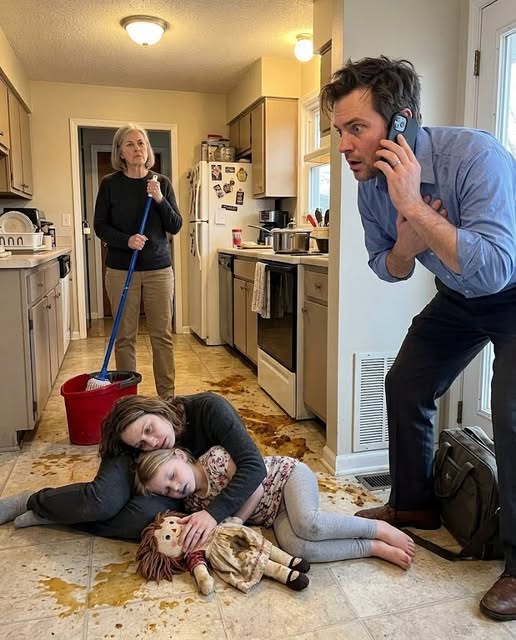
Clara was on the floor.
Lily was tucked against her.
My mother stood beside them.
For half a second my brain refused to interpret what my eyes were seeing.
Then instinct took over.
I dropped my suitcase.
Called 911.
Put the phone on speaker.
“My wife and daughter are unconscious. They’re breathing, but barely.”
The dispatcher asked for the address.
I gave it.
“Do not give them food or drink. Do you know what happened?”
“No.”
Evelyn sighed loudly.
“Michael, this is completely unnecessary.”
I turned toward her.
She was holding a mop.
Cloudy water filled the bucket near her feet.
“What happened?”
“Clara fainted.”
“And Lily?”
“She worked the child into hysterics.”
Lily wasn’t hysterical.
She was barely moving.
I knelt.
“Lily?”
No response.
“Clara?”
Her eyelids twitched.
I saw bruising around the fingers of her left hand.
Scrapes on the knuckles.
Her nails looked broken.
There was dried blood near one cuticle.
Then I noticed the pantry.
We had a walk-in pantry beside the refrigerator.
A silver padlock hung through a metal latch someone had screwed into the doorframe.
I stared at it.
“Where did that come from?”
Evelyn followed my eyes.
“Oh, for heaven’s sake.”
“Where is the key?”
“Michael—”
“Where is the key?”
“I locked the pantry.”
The dispatcher could hear us.
“Sir, emergency units are approximately three minutes away.”
I kept my eyes on my mother.
“Why?”
“Because Clara wastes food.”
I looked at Lily.
Her pajama shirt had ridden up.
Her stomach looked hollow.
Her ribs were visible.
A cold sensation moved through me.
“How long?”
“What?”
“How long has that pantry been locked?”
“Don’t interrogate me in my own son’s house.”
“This is not your house.”
Her expression changed.
Just slightly.
I had corrected her before.
But I had never said it like that.
“Answer me.”
“She had meals.”
“Where?”
“I cooked.”
“For them?”
“I am not going to stand here while you accuse me because your wife is incapable of managing a household.”
A faint sound came from the floor.
“Michael.”
I bent down.
Clara’s eyes opened a fraction.
“I’m here.”
“The doll.”
“What?”
Her fingers twitched against Miss Button.
“The doll.”
Then her body went slack.
“Clara?”
The dispatcher told me to check breathing.
She was breathing.
Shallow.
I did not move anything.
I had no law enforcement training.
But something in that kitchen felt wrong in a way deeper than an accident.
The shattered bowl.
The padlock.
The bruises.
The stained doll.
The mop.
My mother trying to clean.
I pulled out my phone.
I photographed everything.
Evelyn stared at me.
“What are you doing?”
“Documenting.”
“That’s ridiculous.”
Click.
Pantry.
Click.
Soup.
Click.
Clara’s hand.
Click.
Mop bucket.
Click.
Broken glass.
Then Daniel appeared in the hallway.
I hadn’t known he was there.
He wore dark jeans, a fitted jacket, and a silver watch that caught the light when he folded his arms.
I recognized watches.
That one cost at least eight thousand dollars.
Daniel had complained two weeks earlier that he could barely make rent.
“Mother called me,” he said.
“When?”
“This afternoon.”
I glanced toward Clara.
“She said Clara had another fit.”
“Another?”
Daniel shrugged.
“You know how she is.”
“No. Tell me how she is.”
His eyes narrowed.
“Fragile.”
“Careful.”
He smiled.
“You married fragile goods. Don’t take it out on us.”
The sirens reached the street.
I remember looking at my brother then and feeling something fundamental shift.
It was not rage.
Rage came later.
This was recognition.
Daniel was not shocked to see my wife and daughter on the floor.
He was annoyed.
Paramedics entered seconds later.
Everything moved quickly.
Oxygen.
Vitals.
Questions.
A stretcher.
Then another.
One paramedic, a woman named Harris, looked at Lily and said quietly, “How long has she been eating poorly?”
Evelyn answered.
“She is a picky child.”
I said, “She wasn’t underweight three days ago.”
Harris looked at me.
Then at the pantry.
“Is that food storage?”
“Yes.”
She pointed.
“Why is it locked?”
My mother stepped forward.
“There is more than enough food in the refrigerator.”
I opened the fridge.
Three water bottles.
Mustard.
Half a carton of eggs.
Two containers labeled EVELYN.
A bottle of wine.
Nothing else.
I photographed that too.
My mother’s face hardened.
“Are you seriously doing this?”
“Yes.”
The second paramedic lifted Miss Button.
Evelyn moved so quickly I almost missed it.
“That disgusting thing can stay here.”
He paused.
I looked at her.
Her reaction was wrong.
Too fast.
Too specific.
I grabbed a box of freezer bags from a drawer.
“Put it in this.”
“Michael.”
“The doll goes with Lily.”
“It’s covered in whatever she spilled.”
“Exactly.”
Her face changed.
Only for a second.
But I saw fear.
The ambulance took Clara and Lily.
I rode with Lily.
My mother insisted she would drive herself.
Daniel drove her.
At the hospital, doctors separated Clara and Lily into treatment rooms.
I stood in the hallway wearing the same clothes I had worn on the plane, my suitcase still abandoned near my front door, and watched strangers fight to stabilize the two people I loved most.
A nurse asked if Lily had allergies.
“No.”
“Medications?”
“No.”
“Any known exposure to chemicals?”
I thought of the smell.
“I don’t know.”
“Pesticides? Cleaning solutions? Gardening products?”
“My mother has been staying with us.”
The nurse looked up.
“That wasn’t my question.”
I swallowed.
“No known exposure.”
Clara’s blood pressure was dangerously low.
Lily was dehydrated.
Both had abnormal neurological symptoms.
Vomiting.
Weakness.
Respiratory distress.
At first, the doctors considered food poisoning.
Then carbon monoxide.
Then household chemicals.
While they worked, Evelyn sat in the waiting room talking.
She always talked when silence might give someone else room to think.
“Clara has never been healthy,” she told a nurse.
That was false.
“She gets emotional.”
Misleading.
“She sometimes refuses meals when upset.”
Completely false.
“And Lily has always been delicate.”
Another lie.
I sat across from her.
Daniel sat beside her.
Tap.
Tap.
Tap.
His thumb kept waking the screen of his watch.
“Stop,” I said.
He looked up.
“What?”
“That.”
He smirked.
“Sorry my watch bothers you.”
“Where did you get it?”
His expression changed.
“Bought it.”
“With what?”
“None of your business.”
My phone vibrated.
Bank alert.
I almost ignored it.
Then I read the message.
Unusual activity detected.
I opened the account.
Our emergency savings balance had dropped by eighty-four thousand dollars.
Three transfers.
Twenty-eight thousand each.
All during my trip.
My pulse slowed.
That surprised me.
Sometimes the worst discoveries do not create panic.
They create clarity.
I opened transaction details.
Backup card authorization.
The card was stored in a locked drawer inside my home office.
The office key was hidden behind a removable panel beneath my desk.
Only Clara and my mother knew.
Clara knew because it was our money.
My mother knew because years earlier, during a medical emergency, I had shown her where I kept important documents in case something happened to me.
Daniel did not know.
At least, I had never told him.
I turned the phone facedown.
Daniel leaned toward me.
“You should think carefully about what happens next.”
“What does that mean?”
He lowered his voice.
“Mother already talked to a lawyer.”
I stared at him.
“What lawyer?”
“A family attorney.”
“For what?”
He smiled without humor.
“Clara clearly isn’t stable.”
I stood.
He leaned back.
“What?”
“Say that again.”
“Don’t make this ugly.”
“My wife is unconscious.”
“And that’s unfortunate.”
“My daughter is in a treatment room.”
“Exactly. You need to protect Lily.”
“From whom?”
“From a mother who can’t care for her.”
I looked at Evelyn.
She wouldn’t meet my eyes.
“When did you contact the lawyer?”
Daniel shrugged.
“We were planning ahead.”
“Before today?”
No answer.
“Before the ambulance?”
Still nothing.
I took out my phone.
Not to call the police.
Not yet.
I texted my attorney, Rachel Bennett.
Emergency. Freeze every nonessential account immediately. Preserve login records, card access, IP logs, transfer destinations. Do not contact anyone except me.
She replied less than a minute later.
On it. Are you safe?
I looked at my mother.
At my brother.
For the first time in my life, I did not know.
I typed:
Yes. Wife and daughter hospitalized. Possible criminal conduct. Preserve everything.
Ten minutes later Dr. Reyes entered the hallway.
He was holding Miss Button in a clear evidence bag.
He had been calm when he first introduced himself.
Now he was not.
“Mr. Ward?”
I stood.
“Yes.”
“Can we speak privately?”
Evelyn stood too.
“I’m his mother.”
Dr. Reyes looked at her.
“I asked for Mr. Ward.”
Her mouth tightened.
I followed him several steps away.
He held up the bag.
“Where did Lily get this?”
“The doll?”
“Yes.”
“I made it for her.”
“You made it?”
“My wife sewed most of it. I added a voice recorder inside years ago.”
He glanced at the doll.
“A recorder?”
“Yes.”
“How long does it record?”
“Twelve hours. Maybe a little more depending on the battery.”
He looked back toward Evelyn.
“What?”
Dr. Reyes lowered his voice.
“We detected a chemical residue on both Clara’s clothing and Lily’s pajama sleeve.”
My chest tightened.
“What chemical?”
“We’re waiting for confirmation, but the preliminary screening suggests organophosphate pesticide exposure.”
I stared at him.
“Pesticide?”
“Concentrated.”
“How?”
“We don’t know.”
Behind us, my mother laughed.
Sharp.
Forced.
“A child’s toy poisoned them? That’s absurd.”
Dr. Reyes turned.
“I did not say the toy poisoned anyone.”
Evelyn froze.
The doctor continued.
“I said residue was present.”
Daniel stood.
“You cannot accuse anyone without proof.”
“I haven’t accused anyone.”
He nodded toward the security desk.
“That is why hospital administration contacted law enforcement.”
My brother glanced toward the exit.
A security officer shifted into his path.
“Sir, we’re asking everyone involved to remain available.”
Daniel laughed.
“I’m not involved.”
“No one said you were.”
That was the first moment Daniel truly looked afraid.
A detective named Serena Holt arrived twenty minutes later.
She was compact, quiet, maybe mid-forties, with the kind of expression that made people uncomfortable because it revealed nothing.
She spoke to me first.
I told her everything.
The phone calls.
The locked pantry.
Daniel in the house.
The money.
The custody lawyer.
Clara whispering about the doll.
I showed her the photographs.
She asked if Evelyn had permission to lock food away.
“No.”
“Did she have authority over your daughter?”
“She was a temporary guest.”
“Did she ever discipline Lily?”
“She was told not to.”
“Did she?”
I thought of Clara’s warnings.
“I don’t know.”
Holt looked at me for a moment.
“You may find out things tonight that are difficult to hear.”
“I already have.”
“No,” she said. “You have suspicions.”
She glanced toward the treatment rooms.
“Facts hurt differently.”
Police took custody of Miss Button.
An evidence technician photographed the doll and carefully opened the seam along its back.
The little recorder was still inside.
Battery active.
Dr. Reyes looked at me.
“Did it record automatically?”
“No. Lily had to press the button in the doll’s palm.”
“Would she?”
“She presses it all the time when I travel.”
Detective Holt asked, “Does she know how to erase recordings?”
“No.”
The recorder stored files by date.
There were eight.
The oldest from the morning I left.
The newest from that afternoon.
Holt did not play them in the hallway.
She took them.
“Can I hear them?”
“When they’re copied and preserved.”
“That’s my daughter’s voice.”
“I know.”
“My wife may be on there.”
“I know.”
“My mother too.”
“Yes.”
I understood.
Chain of custody.
Evidence.
Procedure.
Rules that felt unbearably slow when my family was behind hospital doors.
At 9:20 that night, Dr. Reyes came to me.
“Your daughter is stable.”
My knees nearly gave out.
I sat down hard.
“Can I see her?”
“In a few minutes.”
“And Clara?”
“She’s responding to treatment.”
“Will she be okay?”
He hesitated.
“We are cautiously optimistic.”
I covered my face.
For the first time since I entered the kitchen, I cried.
Not loudly.
I simply bent forward and broke.
I felt a hand touch my shoulder.
For one irrational second, I thought it might be my mother.
It was a nurse.
Evelyn sat twenty feet away.
Watching.
No tears.
No question about Lily.
No question about Clara.
Only calculation.
When I finally entered Lily’s room, she looked impossibly small.
An oxygen cannula ran beneath her nose.
Her skin had more color.
Her eyes opened when I touched her hand.
“Daddy?”
“I’m here.”
Her fingers tightened weakly.
“You came back.”
Three words.
They destroyed me.
“Of course I came back.”
“Grandma said you were too busy.”
I closed my eyes.
“No. Never.”
“She said Mommy was making you tired.”
“Grandma was wrong.”
Lily looked frightened.
“Is Mommy dead?”
“No.”
I said it immediately.
“Mommy is alive. Doctors are helping her.”
Her eyes filled.
“She tried to give me soup.”
I forced myself to remain calm.
“What happened?”
Lily looked toward the door.
“Is Grandma here?”
“Not in this room.”
“She gets mad.”
“She cannot come in.”
Lily’s breathing changed.
I squeezed her hand.
“You are safe.”
“Promise?”
“I promise.”
“Daddy?”
“Yes?”
“Grandma made Mommy say sorry.”
“For what?”
Lily whispered.
“For being hungry.”
I felt something inside me tear.
Before I could ask more, Detective Holt stepped into the room with a child advocacy specialist.
She did not question Lily immediately.
She told me not to either.
“Let trained interviewers handle detailed recall,” she said quietly. “You don’t want to influence her memory.”
Every instinct in me wanted answers.
I obeyed.
That was one of the hardest things I have ever done.
At midnight, Clara woke.
She asked for Lily before she asked what had happened to herself.
“She’s stable,” I said.
Clara started crying.
I sat beside her.
“I’m sorry.”
Her eyes moved to mine.
“For what?”
“For leaving.”
“You went to work.”
“I left you with her.”
Clara turned her face away.
“She took my phone.”
I went still.
“What?”
“The first night.”
“Why?”
“She said I was poisoning you against her.”
I stared at her.
“Clara—”
“She locked the pantry after you left.”
“Why didn’t you call someone?”
“She took my keys too.”
My stomach tightened.
“She said I was disrespecting her.”
“Did Daniel help?”
Clara closed her eyes.
“Yes.”
That answer was somehow worse than anything I expected.
“He came the first night.”
“Why?”
“I heard them arguing about money.”
“What money?”
“I don’t know.”
She swallowed.
“I went to your office because I heard a drawer close.”
“Daniel was in there?”
“He came out with an envelope.”
“What envelope?”
“I couldn’t see.”
“Did you confront him?”
“Yes.”
Her eyes opened.
“He laughed.”
I knew that laugh.
“What happened next?”
“Your mother told me I was hysterical.”
Clara’s voice shook.
“She said you had warned her about my moods.”
“I never did.”
“I know that now.”
“Clara, I swear—”
“She was trying to make me doubt myself.”
I took her hand carefully.
The bruises around her fingers were darkening.
“What happened to your hands?”
“I tried to break the pantry lock.”
My throat tightened.
“Why?”
“Lily hadn’t eaten since breakfast.”
I looked down.
Clara continued.
“Your mother cooked for herself and Daniel.”
“What did she give you?”
“Crackers.”
“How long?”
“Almost two days.”
I stood abruptly.
The chair scraped backward.
“Michael.”
I pressed both hands to my head.
“I let her into this house.”
“Michael.”
“I told you she would help.”
“She fooled you too.”
“No.”
I looked at Clara.
“I taught her she could ignore your boundaries because I kept asking you to forgive her.”
Clara said nothing.
That silence was worse than an argument because she knew I was right.
“What about the pesticide?”
Her face changed.
“I don’t know.”
“You whispered about the doll.”
“I remembered Lily recording.”
“What did she record?”
“I don’t know all of it.”
“Clara.”
She closed her eyes.
“Your mother hit me.”
Everything in me went cold.
“When?”
“The second day.”
“Where?”
“In the kitchen.”
“Why?”
“I took food from her bag.”
I couldn’t speak.
“She bought groceries,” Clara said, “but she kept them in the trunk of her car and brought them inside when Daniel came.”
“For herself?”
“And him.”
“What did you take?”
“A sandwich.”
The absurdity of it almost made me laugh.
My wife had been struck in her own kitchen for taking a sandwich purchased while she was being denied access to her own food.
“What happened?”
“She grabbed my hand.”
Clara lifted her bruised fingers slightly.
“I pushed her away.”
“Did she fall?”
“No.”
“What did Daniel do?”
“He held my wrists.”
I closed my eyes.
“Did he hurt you?”
“Yes.”
“How badly?”
“Mostly bruising.”
“Mostly?”
“Michael, Lily was watching.”
I understood.
She had minimized everything to keep Lily calm.
“Then what?”
“They said they were documenting my behavior.”
“For custody.”
Her eyes opened.
“You know?”
“Daniel told me.”
Clara began trembling.
“They wanted me to look unstable.”
I sat down again.
“Why?”
“I don’t know.”
“I do.”
I told her about the money.
Eighty-four thousand dollars.
Her face went white.
“No.”
“Yes.”
“I didn’t authorize anything.”
“I know.”
“How did they—”
“My backup card.”
She stared at me.
“Evelyn knew where the key was.”
“Yes.”
“And Daniel?”
“Probably knows now.”
Clara began crying silently.
“They were going to say I took it.”
The thought had already occurred to me.
She saw it on my face.
“Oh my God.”
I leaned closer.
“Listen to me. They are not getting away with this.”
She shook her head.
“You don’t understand your mother.”
“I think I finally do.”
“No. Michael, she planned this.”
Her voice dropped.
“She kept saying you were going to realize I was the problem.”
I said nothing.
“She told Lily that after I was gone, Grandma would take care of her.”
The room seemed to shrink.
“After you were gone?”
Clara nodded.
“She said it twice.”
Detective Holt was told immediately.
At 2:10 a.m., she returned.
“We reviewed the first audio files.”
I stood.
“What’s on them?”
She looked at Clara.
Then at me.
“Enough to obtain warrants.”
My heart started pounding.
“For what?”
“Your home. Evelyn Ward’s vehicle. Daniel Ward’s apartment.”
“Can I hear them?”
“Some.”
We went to a consultation room.
Holt placed a laptop on the table.
Rachel, my attorney, joined by phone.
The first file began with Lily’s voice.
“Daddy, this is me. Grandma says Mommy is bad at cleaning.”
Then Clara in the background.
“Lily, come eat.”
Evelyn’s voice.
“She already ate.”
“She had half a piece of toast.”
“That is plenty.”
“Evelyn, unlock the pantry.”
“No.”
“This is our home.”
“My son pays for this home.”
“So do I.”
A pause.
Then my mother said, very clearly:
“Not for much longer.”
The recording ended.
I stared at the screen.
Holt played another.
Daniel’s voice.
“Did you find the card?”
Evelyn:
“Yes.”
“PIN?”
“Same one he always uses.”
“Don’t transfer too much at once.”
“I know how banks work, Daniel.”
Then Clara.
“What are you doing?”
Movement.
A chair scraped.
Daniel said, “Why are you creeping around?”
Clara:
“Give me Michael’s card.”
Evelyn:
“You need to calm down.”
Clara:
“I’m calling him.”
Daniel:
“No, you’re not.”
Clara:
“Give me my phone!”
There was a struggle.
Lily started crying.
The recording cut off.
I felt sick.
The third file was worse.
My mother’s voice was close to the microphone.
“Tell your father Mommy scares you.”
Lily:
“No.”
“Say it.”
“No.”
“Say Mommy screams.”
“She doesn’t.”
“Lily.”
“I want Daddy.”
Then a slap.
Not loud.
But unmistakable.
I stood so quickly the table shook.
Holt paused the audio.
“Sit down, Michael.”
“She hit my daughter.”
“I know.”
“She hit my six-year-old daughter.”
“I know.”
Rachel’s voice came through the speaker.
“Michael, do not leave that hospital.”
I was shaking.
“Why?”
“Because if you confront either of them, they gain an argument they currently do not have.”
I sat.
It took every ounce of control I possessed.
Holt played the next section.
Clara’s voice.
“Do not touch her again.”
Evelyn:
“Or what?”
Clara:
“I’m calling police.”
Daniel:
“With what phone?”
Clara:
“Move.”
Sounds of struggle.
Then Daniel:
“Stop acting crazy.”
Clara:
“Get off me!”
Lily screaming.
Then Evelyn said something that silenced the room.
“We only need three days.”
Daniel replied, “And if she won’t cooperate?”
My mother answered:
“Then we make sure Michael comes home to exactly what he needs to see.”
The file ended.
No one spoke.
Detective Holt closed the laptop.
“We are treating this as coordinated criminal conduct.”
I stared at her.
“Did they poison them intentionally?”
“We don’t know yet.”
But we all knew what the question had become.
Police searched my house before dawn.
The pesticide concentrate was found in the garage.
I owned it.
That mattered.
I had bought it months earlier for wasp nests near the back fence.
A legal product.
Dangerous if misused.
The bottle was usually stored on a high shelf inside a locked utility cabinet.
The cabinet was open.
My fingerprints were naturally on the container.
So were Clara’s.
That did not surprise me.
We both maintained the house.
But forensic technicians also found fresh prints belonging to Evelyn and Daniel.
Police found disposable gloves in the kitchen trash.
A measuring cup with chemical residue.
And a second container in Daniel’s car.
That changed everything.
The most important evidence came from the final audio recording.
Lily had activated Miss Button sometime before lunch.
The doll recorded nearly two hours.
Evelyn’s voice came first.
“You are going to eat.”
Clara:
“Not until Lily eats.”
“She had cereal.”
“That was yesterday.”
“Stop exaggerating.”
“I’m done with this. Unlock the pantry.”
“No.”
“Then I’m breaking it.”
Movement.
Metal rattling.
Clara grunting.
Evelyn:
“You ungrateful little—”
A sharp impact.
Then Lily crying.
Daniel entered several minutes later.
“What happened?”
Evelyn:
“She tried to break the lock.”
Daniel:
“Why?”
“Because she thinks she runs this house.”
Clara:
“I do run this house. I live here. You don’t.”
Daniel laughed.
“Not for long.”
Then something quieter.
Evelyn asked, “Did you bring it?”
Daniel:
“In the car.”
“What about the lawyer?”
“She says if Clara is hospitalized and we show neglect, emotional instability, financial theft—”
Clara shouted, “What financial theft?”
Silence.
Then Daniel said, “You really should mind your business.”
“My husband’s money is my business.”
Evelyn:
“Michael’s money.”
“Our money.”
“That attitude is exactly why he needs protection.”
The recording continued.
Daniel:
“Mom, don’t overdo it.”
Evelyn:
“I know what I’m doing.”
Then liquid poured.
Clara:
“What are you putting in that?”
Evelyn:
“Cleaner.”
“Why are you holding my soup?”
“I’m not.”
“You just poured something into it.”
Daniel:
“Clara, stop.”
“Move away from the stove.”
“Mom.”
“Daniel, take Lily upstairs.”
Lily screamed, “No!”
The next few minutes were chaotic.
Clara tried to take the bowl.
Evelyn accused her of becoming violent.
Daniel grabbed Clara.
Lily ran toward them.
Then a crash.
Clara shouted, “Lily, don’t touch that!”
After that came coughing.
Heavy breathing.
Daniel said, “What did you use?”
My mother answered, “Not that much.”
Daniel:
“Jesus Christ.”
Evelyn:
“She wasn’t supposed to spill it.”
Clara:
“Call an ambulance.”
Daniel:
“No.”
Clara:
“Call an ambulance!”
Evelyn:
“She’ll recover.”
Clara:
“Lily can’t breathe!”
Daniel:
“We have to leave.”
Evelyn:
“No. Michael will be home soon.”
Daniel:
“What?”
“If we call now, everything is ruined.”
Clara’s voice became weak.
“You’re insane.”
Then my mother said the sentence that ended any illusion I had left about her.
“I am fixing my son’s life.”
The audio continued.
Clara crawled toward Lily.
We could hear it.
Her breath.
Her hands dragging across tile.
Lily crying.
“Mommy.”
“I’m here, baby.”
“Mommy, I’m sleepy.”
“No. Stay awake.”
“Mommy—”
“Look at me.”
Then Clara screamed toward my mother.
“Please!”
Evelyn said nothing.
Daniel’s voice came from farther away.
“We should go.”
“No.”
“What if Michael sees us?”
“He’ll believe me.”
“How do you know?”
“Because he always has.”
That sentence hurt more than I expected.
Because it was true.
Not the way she meant it.
I had never believed my mother over evidence.
But for years I had believed her comfort mattered more than Clara’s discomfort.
I had believed keeping peace was more important than setting boundaries.
I had believed irritation was harmless if everyone eventually moved on.
Evelyn had built her plan on a pattern I helped create.
The recording ended with Clara whispering to Lily.
“Press the button again.”
Lily said, “Why?”
“So Daddy can hear us.”
That was why Clara said the doll.
Not because it was stained.
Because she knew.
She knew Miss Button had captured the truth.
Police arrested Evelyn at the hospital.
Daniel had already left.
Security had allowed him to step outside earlier because he was not technically detained.
By the time officers reached his apartment, he was gone.
They found clothes missing.
Passport gone.
Laptop gone.
But he did not get far.
Rachel’s account freeze had stopped the remaining transferred funds.
Police traced the first twenty-eight thousand dollars to a brokerage account.
The second had paid debts.
The third had been moved into an account under a company Daniel created four days earlier.
He tried to withdraw cash from a branch forty miles away the next morning.
The bank flagged the account.
Police arrested him in the parking lot.
I did not see my mother again until the preliminary hearing.
By then, Clara and Lily had come home.
The pantry lock had been removed.
I replaced the entire door anyway.
Clara asked why.
“I don’t want Lily seeing the holes.”
She understood.
We threw away the dishes Evelyn had used.
The mop.
The bucket.
The kitchen rug.
Anything that smelled remotely chemical.
Lily kept Miss Button only after the police returned her months later.
The stained dress could not be saved.
Clara sewed a new one.
Blue this time.
Lily asked if the doll had been brave.
“Yes,” Clara told her.
“Very brave.”
Lily shook her head.
“No. You were.”
Clara left the room crying.
Recovery was not dramatic.
That surprised me.
I think movies teach us that surviving something terrible creates a clear dividing line.
Before.
After.
But real recovery was made of small things.
Lily refusing soup.
Clara waking at 2 a.m. because she thought she heard the pantry lock.
Me checking the doors three times before bed.
Lily hiding crackers in her room.
The first time I found them, I almost cried.
Six packs beneath her pillow.
Two granola bars in a toy chest.
An apple wrapped in a napkin behind books.
I sat beside her.
“You don’t have to hide food.”
She looked terrified.
“I was saving it.”
“For when?”
“If Grandma comes back.”
I pulled her into my arms.
“Grandma is not coming back.”
“What if she does?”
“She cannot enter this house.”
“What if you’re away?”
“I’m not leaving for a while.”
“What if Mommy gets sick?”
“Then we call for help.”
“What if Grandma says no?”
I held her tighter.
“Grandma does not get to say no anymore.”
Therapy began the next week.
For Lily.
For Clara.
For me.
At first I thought I was attending to support them.
Then our therapist, Dr. Marsh, asked me a question.
“Why did your mother know she could stay in your home after your wife said no?”
I looked at him.
“She needed help.”
“That isn’t what I asked.”
Clara sat beside me.
Silent.
I stared at the floor.
“Because I let her.”
“Why?”
“Because she’s my mother.”
“Why did that outrank your wife’s refusal?”
I had no good answer.
That was the beginning of my real reckoning.
I loved Clara.
I had never hit her.
Never cheated.
Never screamed at her.
Never intentionally humiliated her.
I had thought those facts made me a good husband.
But goodness is not only measured by the harm you personally refuse to inflict.
Sometimes it is measured by the harm you refuse to permit from others.
I had failed there.
Repeatedly.
Clara never used that failure as a weapon.
That made it harder.
One night, weeks later, she sat at the edge of our bed.
“I almost left you last year.”
I stared at her.
“What?”
“When your mother ruined Lily’s birthday.”
I remembered.
Evelyn had invited twelve relatives after Clara explicitly limited the party to children and parents from Lily’s class.
Then she complained about the cake.
Then she gave Lily a tablet after we had both agreed she was too young.
Clara and Evelyn argued.
I told Clara, later, “That’s just Mom.”
Clara looked at me now.
“When you said that, I realized you might expect me to live like this forever.”
I sat beside her.
“Why didn’t you tell me?”
“I did.”
I looked at her.
“You didn’t say you were leaving.”
“No. I said I couldn’t keep doing this.”
That was true.
Many times.
“I heard complaint,” I said.
“You should have heard pain.”
“I know.”
She studied my face.
“Do you?”
“Yes.”
I meant it.
“Clara, if you decide you can’t forgive me—”
“Stop.”
She held up one hand.
“This is not about punishment.”
“Then what is it about?”
“Change.”
“I’m changing.”
“I know.”
“But?”
“But you’re doing it because something horrific happened.”
I said nothing.
“I need to know that six months from now, when things are quieter, you won’t start remembering the mother you wish Evelyn was.”
That sentence stayed with me.
Because grief does that.
It edits.
It removes ugly details.
It turns history into nostalgia.
“I probably will,” I admitted.
Clara looked surprised.
“I’ll probably miss parts of her.”
Her eyes filled.
“She’s still my mother. I remember her making pancakes when I was eight. Sitting beside me in the emergency room when I broke my arm. Sewing my Halloween costume. I remember good things.”
Clara waited.
“But good memories don’t cancel what she did.”
“No.”
“And missing someone does not mean giving them access.”
Clara’s shoulders relaxed slightly.
“That’s what I needed to hear.”
The criminal case moved slowly.
Prosecutors charged Evelyn with attempted murder, aggravated child abuse, unlawful imprisonment, poisoning, conspiracy, financial fraud, and several related offenses.
Daniel faced conspiracy charges, aggravated child abuse, theft, financial crimes, evidence tampering, and accessory liability related to the poisoning.
His attorney argued Daniel had not known Evelyn intended to use pesticide.
The audio created a problem for that defense.
“Don’t overdo it,” he had said before she poured anything.
“What did you use?” he asked afterward.
And most damaging:
“If we call now, everything is ruined.”
He knew enough.
Maybe not every detail.
Enough.
My mother’s attorney chose a different strategy.
Clara was unstable.
The recordings were incomplete.
The pesticide spill had been accidental.
Evelyn had merely tried to manage a chaotic household.
The money transfers were unrelated.
Her plan to seek temporary custody came from genuine concern.
Then came the preliminary hearing.
I sat behind the prosecutor.
Clara sat beside me.
Evelyn entered wearing a navy dress I recognized.
She had worn it to our wedding rehearsal dinner.
That felt deliberate.
She looked smaller than I remembered.
Older.
For one dangerous second, I felt pity.
Then I remembered Lily asking if she needed to hide food before Grandma returned.
Pity remained.
But it changed nothing.
Evelyn looked at me.
“Michael.”
The bailiff told her not to speak.
Her attorney leaned toward her.
She looked away.
Clara’s hand found mine.
The prosecutor played excerpts from Miss Button.
My mother’s own voice filled the courtroom.
“Tell your father Mommy scares you.”
Then Lily saying:
“No.”
Then the slap.
Evelyn stared at the table.
Another clip.
“We only need three days.”
Another.
“Michael will believe me.”
Another.
“I am fixing my son’s life.”
No one in the courtroom moved.
Then came the final section.
Clara begging her to call an ambulance.
Lily struggling to breathe.
My mother refusing.
I had heard it before.
It was worse in court.
Perhaps because this time I watched strangers react.
The judge removed his glasses.
The clerk looked down.
One juror candidate waiting for another case covered her mouth.
Evelyn’s attorney requested a recess.
Denied.
The detective testified next.
Then Dr. Reyes.
Then the forensic toxicologist.
The chemical concentration found on the bowl, Clara’s sleeve, Lily’s pajamas, and the doll was consistent with the pesticide from my garage.
My mother’s prints were on the measuring cup.
Daniel’s prints were on the bottle.
The prosecution introduced the banking evidence.
Daniel’s new watch had been purchased the afternoon before I returned home.
Price:
$9,460.
Paid from one of the transferred accounts.
I almost laughed when I heard that.
Not because it was funny.
Because Daniel’s vanity had made his guilt visible on his wrist while my wife was fighting for her life.
Then the prosecutor called me.
I took the stand.
My mother looked directly at me.
For the first time, she looked scared.
The prosecutor asked about the pantry.
The trip.
The card.
The doll.
My mother’s stay.
Then:
“Mr. Ward, did you give Evelyn Ward permission to discipline your child by withholding food?”
“No.”
“Did you authorize her to secure your pantry?”
“No.”
“Did you authorize her to remove your wife’s phone?”
“No.”
“Did you authorize financial transfers?”
“No.”
“Did you ever tell your mother Clara was unstable?”
“No.”
“Did you seek custody advice concerning your wife before this incident?”
“No.”
“Did you believe Clara was an unfit mother?”
“Never.”
My mother’s attorney stood for cross-examination.
He was polished.
Soft-spoken.
Dangerous.
“Mr. Ward, you love your wife?”
“Yes.”
“You love your daughter?”
“Yes.”
“And you loved your mother?”
I paused.
“Yes.”
“Loved?”
The prosecutor objected.
Sustained.
He changed direction.
“Mrs. Ward had previously helped your family, correct?”
“Sometimes.”
“She babysat?”
“Yes.”
“Bought gifts?”
“Yes.”
“Stayed with your daughter?”
“Briefly.”
“Without incident?”
I looked at him.
“Without poisoning her.”
The judge warned me to answer only the question.
My mother’s attorney continued.
“You trusted Evelyn enough to let her stay in your home.”
“Yes.”
“You trusted her with knowledge concerning your emergency financial documents.”
“Yes.”
“So prior to this event, you considered her trustworthy.”
I knew what he was doing.
Building reasonableness.
A loving mother.
A misunderstanding.
A terrible accident.
“Yes,” I said.
He smiled.
“Thank you.”
“But my trust does not alter the recording.”
The smile vanished.
The judge looked at me.
“Mr. Ward.”
“Sorry, Your Honor.”
The defense attorney approached.
“You were away during most of the events in question.”
“Yes.”
“So you did not personally witness my client poison anyone.”
“No.”
“You did not personally witness her strike your daughter.”
“No.”
“You did not personally witness her deny food.”
“No.”
His expression softened.
“You are relying upon recordings, your wife, and a traumatized child.”
I looked at my mother.
Then back at him.
“No.”
He paused.
“What are you relying on?”
“Your client.”
Silence.
I nodded toward the evidence monitor.
“Her voice.”
The hearing ended with the judge ordering both defendants held for trial.
Daniel accepted a plea deal four months later.
He agreed to testify fully against Evelyn in exchange for a reduced sentence.
I was not surprised.
Daniel had always chosen himself when pressure became real.
But his testimony gave us the part of the story we did not know.
The plan had begun with money.
Daniel owed more than one hundred thousand dollars to lenders and former business partners.
He had convinced Evelyn that I was sitting on “family money” while refusing to help him.
My emergency account contained around two hundred thousand dollars.
Not inheritance.
Not family money.
Clara and I had built it over fifteen years.
But Evelyn believed my success belonged, in some vague moral way, to everyone related to me.
Daniel told her I would never willingly give him enough.
So they decided to manufacture a crisis.
At first, the plan was simply to access the account.
Then Clara caught them.
That changed everything.
According to Daniel, Evelyn panicked.
She said Clara would turn me against them permanently.
Daniel suggested telling me Clara had stolen the money.
Evelyn went further.
If Clara appeared unstable, neglectful, and dangerous, I might believe she had taken the money during some kind of breakdown.
If custody of Lily became an issue, Evelyn could position herself as the responsible grandmother.
Daniel testified that the food restriction started as “pressure.”
The phone removal was meant to isolate Clara.
The pantry lock was intended to make Clara angry enough to create recordings or photographs that looked chaotic.
“Mother wanted her to lose control,” Daniel said.
The prosecutor asked, “Why?”
“So Mike would come home and see a mess.”
“Did your mother intend to kill Clara?”
Daniel looked toward Evelyn.
“No.”
Evelyn’s attorney visibly relaxed.
Then Daniel continued.
“Not originally.”
The courtroom went silent.
“What changed?”
“Clara found out about the transfers.”
“And?”
“Mom said she couldn’t be allowed to talk to Michael first.”
“What did that mean?”
“She wanted Clara sick.”
“How sick?”
Daniel swallowed.
“Sick enough that Mike would think she had some breakdown.”
“Did you agree?”
“I told Mom not to use much.”
My stomach turned.
The prosecutor showed him the pesticide.
“Did you retrieve this product?”
“Yes.”
“From Michael Ward’s garage?”
“Yes.”
“Did you bring it into the kitchen?”
“Yes.”
“Did you know your mother intended to put it in Clara’s food?”
Daniel hesitated.
“Yes.”
“Did you know Lily was present?”
“Yes.”
“Did you call emergency services after the exposure?”
“No.”
“Why?”
Daniel stared at the floor.
“We were scared.”
The prosecutor’s voice hardened.
“Who were you scared for?”
Daniel did not answer.
“Clara?”
“No.”
“Lily?”
“No.”
“Then who?”
“Myself.”
That may have been the first completely truthful thing my brother said in years.
Evelyn did not take a plea.
She went to trial.
By then, eleven months had passed.
Lily was seven.
She had gained back the weight she lost.
She still hated soup.
Clara had returned to work part-time.
Our marriage was different.
Stronger in some ways.
More honest in others.
But not magically healed.
Trust, I learned, has layers.
Clara trusted that I loved her.
She did not yet fully trust that I would always recognize danger from my own family.
I accepted that.
Trust is not something the person who damaged it gets to schedule.
The trial lasted three weeks.
The defense attacked Daniel.
Called him a liar.
A thief.
A coward who blamed his mother for his own crimes.
All true.
That was the difficulty.
But evidence does not require a witness to be admirable.
It requires corroboration.
And Daniel’s testimony matched bank records.
Phone data.
Security camera footage.
Chemical evidence.
And Miss Button.
The doll became the center of the trial.
The defense tried to exclude the recordings.
Failed.
Tried to argue Lily had accidentally edited files.
Failed.
Tried to suggest Clara coached her.
Impossible, because timestamps proved several recordings had been created while Clara was being restrained or unconscious.
The jury heard everything.
My mother’s contempt.
Her planning.
Her attempts to manipulate Lily.
Clara begging.
Daniel panicking.
And finally my mother refusing to call an ambulance.
The prosecutor saved one recording for closing arguments.
Not the poisoning.
Not the money.
The first one.
Lily’s small voice:
“Daddy, this is me. Grandma says Mommy is bad at cleaning.”
Then Evelyn:
“She already ate.”
Clara:
“She had half a piece of toast.”
Evelyn:
“That is plenty.”
The prosecutor let the silence sit.
Then she faced the jury.
“This case did not begin when pesticide entered a bowl. It began when control became entitlement, when entitlement became punishment, and when punishment became a plan to remove a wife and mother from her own family.”
Evelyn stared straight ahead.
The verdict came after nine hours of deliberation.
Guilty.
Attempted murder.
Guilty.
Aggravated child abuse.
Guilty.
Poisoning.
Guilty.
Conspiracy.
Guilty.
Unlawful restraint.
Guilty.
Financial fraud.
One charge related to intentional attempted murder of Lily resulted in a lesser included conviction because prosecutors could not prove Evelyn specifically intended for Lily to ingest or contact the pesticide.
It did not matter much for sentencing.
The judge called Evelyn’s conduct “a sustained campaign of coercive control culminating in an act that could easily have killed two people.”
Before sentencing, she was allowed to speak.
She stood slowly.
For the first time in nearly a year, I heard my mother speak directly to me without a recording or lawyer between us.
“Michael.”
I stared at her.
“I know you hate me.”
I said nothing.
She looked at Clara.
Then back at me.
“I never hated your wife.”
Clara’s expression did not change.
“I wanted to protect you.”
The prosecutor shook her head slightly.
Evelyn continued.
“Daniel was in trouble.”
My brother was not there.
He had already begun serving his sentence.
“He needed help,” she said. “You had more than enough.”
There it was.
Even now.
“My whole life was my sons.”
The judge interrupted.
“Mrs. Ward, this is your opportunity to address the court, not rationalize financial theft.”
She nodded.
Then looked at me again.
“When Clara came into your life, you changed.”
I almost spoke.
I didn’t.
“You stopped listening to me. You stopped helping Daniel. You acted like she and Lily were your only family.”
I finally understood something.
My mother had never accepted that marriage changes loyalty.
She believed becoming my wife made Clara a competitor.
Becoming Lily’s mother made her a gatekeeper.
My independence felt like betrayal.
“You were my boy,” Evelyn said.
Past tense.
The words should have hurt.
Instead, they clarified everything.
I stood when the victim statement portion began.
The prosecutor had asked if I wanted to speak.
At first, I said no.
Then Lily asked me a question the night before sentencing.
“Does Grandma know what she did?”
I told her yes.
Lily asked, “Then why did she do it?”
I had no answer.
So I decided to say what I did know.
I faced the judge.
Then Evelyn.
“My mother keeps saying she wanted to protect me.”
Evelyn started crying.
I continued.
“She did not protect me.”
My voice remained steady.
“She stole from my wife and me. She starved my daughter. She hit her. She restrained my wife. She helped create a plan to make Clara appear mentally unstable so they could steal money and interfere with custody.”
Evelyn wiped her eyes.
“She poisoned food in my kitchen.”
I paused.
“But what I need the court to understand is that the damage did not end when Clara and Lily left the hospital.”
I described the hidden crackers.
Lily’s fear of locked doors.
Clara’s panic around chemical smells.
The nightmares.
The therapy.
My own guilt.
Then I said something I had spent months understanding.
“For years, I mistook keeping peace with my mother for being a good son. I made excuses. I minimized. I asked my wife to absorb discomfort because confronting my mother felt harder.”
Clara looked at me.
“That was my failure.”
My mother shook her head.
“No, Michael.”
I did not look away.
“But my failure to set boundaries does not excuse her decision to cross them.”
The courtroom became completely still.
“I can regret what I enabled without accepting responsibility for what she chose.”
That sentence had taken months of therapy to learn.
“I loved my mother.”
My voice broke slightly.
“Some part of me probably always will.”
Evelyn covered her mouth.
“But love without safety is not access.”
The judge watched me closely.
“She will never again be alone with my daughter.”
Evelyn whispered my name.
“She will never enter our home.”
Her crying grew louder.
“She will never receive money from me.”
“Michael, please.”
“And when Lily is old enough to decide what relationship, if any, she wants with her grandmother, that choice will belong to Lily—not to guilt, not to tradition, and not to anyone telling her family must be forgiven because it is family.”
I sat down.
Evelyn was sentenced to decades in prison.
Daniel received a significantly shorter term because of his cooperation, though long enough that his new watch, his fake company, and the money he thought would save him became meaningless almost immediately.
We recovered most of the stolen funds.
Not all.
Some had already been spent.
I didn’t care as much as I expected.
Money could be rebuilt.
What mattered was that Clara and Lily were alive.
One year after the sentencing, I had to travel again for work.
I nearly canceled.
My company would have understood.
Clara knew that.
“You should go,” she said.
We were standing in the bedroom.
My suitcase was open on the bed.
The sight of it made my stomach twist.
“I can attend remotely.”
“You can.”
“I don’t need to go.”
“I know.”
She folded one of my shirts.
“Then why are you telling me to?”
“Because I don’t want what she did to decide the shape of our life forever.”
I looked at her.
“You’re sure?”
“Yes.”
“Lily?”
“She knows.”
As if summoned, Lily ran into the room.
She was holding Miss Button.
The doll wore the new blue dress.
“Daddy.”
“Yeah?”
“You forgot something.”
She held up the doll.
I smiled.
“Miss Button stays with you.”
“No.”
She pressed the doll’s palm.
My own voice played.
A message recorded years earlier.
Good night, Lily Bean. Daddy loves you all the way past the moon and back again.
She grinned.
“You have to make a new one.”
“For the trip?”
“Yes.”
I took the doll.
“What should I say?”
“Something not embarrassing.”
“You’re seven. Everything I say is embarrassing.”
She rolled her eyes.
Clara laughed from the bed.
I pressed record.
“Hi, Lily Bean. I’ll be gone for two nights, and I’ll call before bedtime. Mom is in charge, which means you have to listen to everything she says unless she says vegetables are delicious, because we both know that is propaganda.”
“Michael.”
Lily giggled.
I continued.
“I love you. I love Mom. And I’ll always come home.”
I released the button.
Lily listened.
Then hugged me.
Later that evening, after she had gone to bed, Clara and I sat on the back porch.
The same porch where, years earlier, my mother had criticized the patio furniture.
The same yard where Daniel once borrowed my truck without asking.
The same house I once thought belonged to everyone I loved simply because I loved them.
I understand it differently now.
A home is not defined by who shares your blood.
It is defined by who is safe inside it.
Clara rested her head against my shoulder.
“Do you ever think about her?”
I knew who she meant.
“Yes.”
“Do you miss her?”
“Sometimes.”
Clara nodded.
No jealousy.
No anger.
Just understanding.
“I miss who I thought she was,” I said.
“That’s different.”
“Yeah.”
For a while we listened to the night insects.
Then Clara said, “I used to think if I could just explain myself better, she’d understand.”
“I know.”
“I thought she hated me.”
“She did.”
Clara looked at me.
I shook my head.
“Maybe not you personally. She hated what you represented.”
“What was that?”
“The fact that I grew up.”
Clara was quiet.
“She wanted to be necessary.”
“Yes.”
“And when she wasn’t?”
“She decided someone had stolen me.”
Clara exhaled.
“That’s sad.”
“It is.”
“And still unforgivable.”
“Yes.”
Both things could be true.
That was another lesson.
Understanding someone’s damage does not require volunteering to become its victim.
Two nights later, I flew home.
When I opened the front door, I heard footsteps pounding toward me.
Lily appeared around the corner.
“Daddy!”
She launched herself into my arms.
I lifted her.
Clara walked out of the kitchen.
Healthy.
Smiling.
Alive.
For one second, the memory came back anyway.
Gray skin.
Blue lips.
Soup on tile.
A mop bucket.
My mother telling me not to make a scene.
I held Lily tighter.
“You okay?” Clara asked.
“Yeah.”
And I was.
Not because I had forgotten.
Because I hadn’t.
For years, I believed family problems became dangerous only when someone screamed, hit, threatened, or openly declared hatred.
I know better now.
Sometimes danger arrives disguised as help.
Sometimes control sounds like concern.
Sometimes cruelty hides behind the phrase, “I’m only doing what’s best for you.”
And sometimes the person standing closest to you has spent years teaching you to ignore warning signs because acknowledging them would require you to admit that love and harm can come from the same place.
My mother believed blood gave her permanent authority over me.
Daniel believed being my brother entitled him to the life I had built.
They both believed Clara was removable.
A wife who could be discredited.
A mother who could be labeled unstable.
A barrier between them and what they thought belonged to them.
They were wrong.
Clara was not the outsider in my family.
She was my family.
Lily was my family.
And I finally understood that protecting them required more than loving them privately.
It required choosing them openly.
Every time.
Even when the person standing on the other side of that choice shared my name.
Especially then.
Six months after my last therapy session, Lily brought home a school assignment.
The page was titled:
MY SAFE PLACE.
The children were supposed to draw somewhere they felt protected.
Some drew bedrooms.
Some drew grandparents’ houses.
One drew a castle.
Lily drew our kitchen.
At first, I couldn’t breathe.
Clara saw it too.
She crouched beside Lily.
“This is your safe place?”
Lily nodded.
The drawing showed the table.
The refrigerator.
The pantry.
She had colored the pantry door bright yellow.
There was no lock.
Three stick figures stood in the middle of the room.
Lily.
Clara.
Me.
Miss Button sat on the counter.
Clara touched the page.
“Why the kitchen?”
Lily shrugged.
“Because Daddy fixed it.”
I had replaced cabinets.
Painted walls.
Changed flooring.
But I knew she wasn’t talking about renovations.
Clara knew too.
Lily pointed at the pantry.
“Anyone can eat now.”
Clara looked away before Lily could see her cry.
I knelt.
“Always.”
Lily smiled.
Then she added, very seriously:
“Except before dinner.”
Clara laughed.
I laughed.
Lily laughed because we did.
And in that moment, in the same room where my family had nearly been destroyed, I realized something I had not understood while standing in court, listening to verdicts, freezing accounts, or watching police carry evidence from my home.
Winning was not the conviction.
Winning was not recovering the money.
Winning was not hearing a judge tell my mother she was wrong.
Winning was my daughter opening the pantry without fear.
It was Clara cooking without checking the doorway.
It was leaving for two nights and coming home to laughter instead of silence.
It was knowing that the people inside my house never had to earn food, safety, love, or the right to be heard.
My mother spent years teaching me that family meant obligation.
Clara and Lily taught me something better.
Family means responsibility.
Not the responsibility to excuse harm.
The responsibility to stop it.
Not the obligation to preserve appearances.
The obligation to protect trust.
Not loyalty to whoever knew you first.
Loyalty to the people whose lives are joined to yours now.
I still have the photograph I took that afternoon.
The locked pantry.
I kept only one.
Detective Holt once asked why.
I told her I needed to remember.
She said, “You won’t forget.”
She was right.
But memory changes over time.
Details blur.
Emotion softens.
And people who survive controlling families sometimes begin rewriting history without realizing it.
Maybe she was having a bad day.
Maybe I misunderstood.
Maybe it wasn’t always terrible.
Maybe I was too harsh.
So I kept the photograph.
Not because I wanted to live in anger.
Because I never again wanted nostalgia to become permission.
The lock hangs crooked in the picture.
A cheap silver padlock.
Nothing dramatic.
Nothing that looked capable of changing a family.
But that was the point.
The most dangerous things do not always announce themselves.
Sometimes they appear one small boundary at a time.
A criticism you ignore.
A key someone should not have.
A guest who refuses to leave.
A relative who says your spouse is too sensitive.
A mother who decides she knows what your child needs better than you do.
A brother who believes your money belongs to him.
A pantry lock.
A missing phone.
A lie.
Another lie.
Until one day you walk into your own kitchen and realize all the things you dismissed have become a cage around the people you love.
I cannot change the fact that I missed the warning signs.
I cannot change that Clara told me she felt unsafe and I answered with compromise.
I cannot change that Lily learned, even briefly, what it felt like to be hungry inside her own home.
But I can decide what happens next.
I can believe my wife the first time.
I can teach my daughter that “no” remains a complete sentence even when spoken to family.
I can refuse to confuse guilt with love.
And I can make sure nobody ever again stands inside my home, harms the people I love, and expects me to explain it away because we share blood.
That part of my life is over.
Miss Button still sits on Lily’s bed.
The recording device no longer works.
Police technicians damaged part of it while recovering the files, and I never repaired it.
Lily once asked me why.
“Because she already said the most important thing she’ll ever say,” I told her.
“What?”
I looked at the little blue dress Clara had sewn.
“The truth.”
Lily thought about that.
Then hugged the doll.
At bedtime that night, she handed Miss Button to me.
“Daddy?”
“Yes?”
“Do you think she saved us?”
I sat on the edge of her bed.
“No.”
Lily frowned.
“No?”
“The doll helped.”
“Then who saved us?”
I brushed her hair away from her forehead.
“Your mom.”
She smiled.
“And you.”
I shook my head.
“I came home.”
“That counts.”
I looked toward the doorway.
Clara was standing there.
Watching us.
Alive.
Safe.
Home.
Maybe Lily was right.
Maybe coming home counted.
But I knew now that coming home was not enough.
You had to see what was happening inside it.
You had to listen when the people you loved said something was wrong.
And once you finally saw the truth, you had to be willing to choose it—even when it cost you the family you came from.
I lost a mother and a brother because of what happened in that kitchen.
For a long time, I thought of it that way.
Loss.
Now I see it differently.
I stopped losing myself to them.
I stopped asking Clara to pay for peace I was too afraid to disturb.
And Lily stopped learning that adults could hurt her simply because they were relatives.
The family that remained was smaller.
But it was real.
And every night when I walk past that unlocked pantry, hear Clara moving around the kitchen, or see Lily carrying Miss Button by one cloth arm, I remember the afternoon I came home and found them on the floor.
I remember my mother telling me Clara was lazy.
I remember Daniel’s expensive watch.
I remember the oily stain on the doll.
And I remember the moment my mother realized the one witness she had dismissed as a dirty child’s toy had been listening to everything.
She thought she had three days to rewrite my family.
She thought she could steal our money, starve my wife into submission, frighten my daughter, and make me believe the woman I married was the problem.
She was wrong.
Because Clara had spent the last of her strength protecting Lily.
Lily had pressed one small button.
And Miss Button had remembered every word.








