I Came Home for Dad’s 78th Birthday—When I Removed His Coat, I Saw What My Brother Had Been Hiding
I Came Home for Dad’s 78th Birthday—When I Removed His Coat, I Saw What My Brother Had Been Hiding
The first thing my seventy-eight-year-old father did when I reached for the buttons of the heavy wool coat he was wearing inside an overheated house was scream so sharply that the drinking glass in his hand slipped onto the bathroom tile, and before I could understand why a man who had once lifted me onto his shoulders, rebuilt an engine in a snowstorm, and spent my entire childhood telling me never to let fear control my decisions was suddenly shrinking against the wall like a terrified child, he grabbed both sides of the coat, pulled them closed over his chest, and begged, “Please, Elena, don’t take it off—please don’t let Julian know you saw,” while downstairs my brother and his wife laughed over wine in the kitchen and continued telling anyone who would listen that Dad’s “confusion” had become so severe they deserved sympathy for sacrificing their lives to care for him.
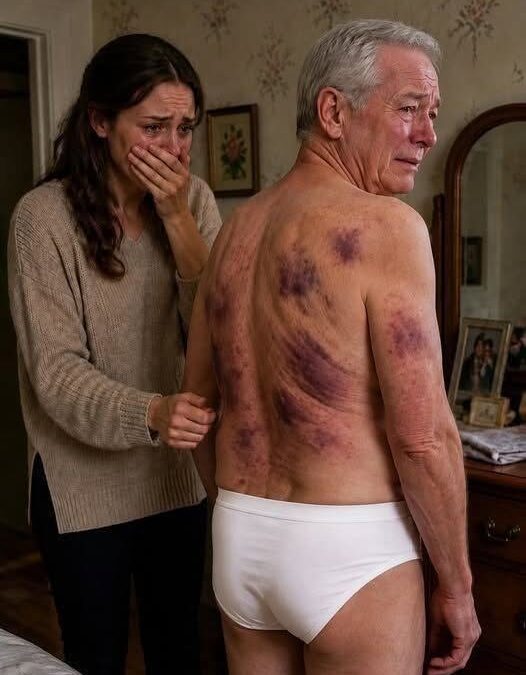
I had driven six hours to surprise Dad for his seventy-eighth birthday believing my greatest regret would be that work had kept me away too often, but within an hour of arriving I had noticed every curtain drawn against the afternoon sun, no telephone where Dad had always kept one, an expensive bracelet on my sister-in-law Chloe’s wrist despite Julian complaining about money for years, legal documents giving my brother sweeping control over Dad’s finances, and a father who had lost so much weight in three months that his trousers hung from his hips, yet even those details did not prepare me for what I saw after I locked the bathroom door, turned on the shower to hide our voices, and slowly eased that coat from his shoulders: dark bruises along his ribs, old yellow marks beneath newer purple ones across his back, raw pressure wounds on his upper arms, and deep red bands circling both wrists so clearly that I did not need a doctor to tell me somebody had been tying an elderly man down.
I wanted to storm downstairs, grab Julian by the collar, and demand to know how my own brother had turned our father’s house into a prison, but Dad was shaking too hard for rage to help him, so I swallowed every scream in my throat, wrapped him in a towel, photographed each injury with timestamps, recorded him telling me how Julian restrained him whenever he questioned missing money and how Chloe struck him until he signed documents he could barely read, listened as he revealed that they had sold his lake cabin, emptied investment accounts, rewritten his will, destroyed his phone, and threatened to have him declared incompetent if he contacted me, and then I picked up my own phone and made one quiet call that neither Julian nor Chloe would understand until strangers began walking through the front door and asking questions they had spent months making sure my father was too frightened to answer.
My name is Elena Vance.
For most of my life, my father was the person I called when something broke.
That included more than appliances.
When my first car died two hours from home, Dad came with jumper cables and a thermos of coffee.
When I ended my engagement at thirty-one and spent two weeks pretending I was relieved instead of devastated, he drove to my apartment with groceries and never once said he had warned me about the man.
When I changed careers at thirty-eight and everyone else asked whether I was throwing away stability, Dad asked only one question.
“Will you respect yourself more when you wake up?”
“Yes.”
“Then do it.”
That was him.
Practical.
Steady.
Not sentimental in the obvious ways.
He rarely said, “I’m proud of you.”
Instead, he changed the oil in my car before long trips.
He checked weather reports before flights.
He mailed newspaper clippings about industries I worked in even after newspapers became something almost nobody clipped anymore.
He was a man who loved through preparation.
Which was why seeing fear in him felt fundamentally wrong.
Dad did not scare easily.
My brother Julian had inherited that trait physically without inheriting much else.
Julian was four years younger than I was, charming from the moment he learned charm could become a form of currency.
As children, I followed rules because I worried about consequences.
Julian learned to avoid consequences by smiling at the right person.
When we were teenagers, he could wreck Dad’s truck, come home three hours late, and somehow end the argument with Dad helping him replace the headlight.
I used to envy him.
Later, I understood how dangerous a person could become when he spent his entire life learning that persuasion mattered more than accountability.
That sounds harsh.
For years I would never have said it aloud.
We were siblings.
We loved each other in the complicated way adults sometimes love people they would never voluntarily befriend if blood had not introduced them first.
Julian could be generous.
He once flew across the country when I had surgery.
He remembered birthdays.
He could make Dad laugh harder than I ever could.
But he always needed more.
More money.
More admiration.
More credit.
More proof that someone else’s success should somehow include him.
When Dad retired at sixty-eight after forty-six years as a civil engineer, Julian immediately became interested in his finances.
Not openly.
Never crudely.
He asked questions disguised as concern.
“Dad, do you have enough diversification?”
“Who’s managing the brokerage account?”
“You’re not leaving cash sitting around, are you?”
Dad tolerated it at first.
He even liked having a son who seemed interested.
Then Julian married Chloe.
If Julian was charming, Chloe was strategic.
She never entered a room without identifying who mattered most in it.
She dressed beautifully, remembered names, sent thank-you cards, and could insult you while making you wonder whether you had misunderstood the sentence.
She and I disliked one another almost immediately.
Neither of us pretended otherwise.
The first Christmas after their wedding, Chloe watched me clear dishes and said, “It’s admirable how committed you are to your career, Elena. I don’t know how women tolerate reaching forty without building a family.”
I smiled.
“I suppose we all build one differently.”
She smiled back.
“Of course.”
Julian told me later that I was too sensitive.
That became his favorite explanation for any conflict involving his wife.
Dad did not like Chloe much either.
But he loved Julian.
And fathers can forgive things in their children that they would never tolerate in strangers.
Two years before that birthday visit, Dad fell from a ladder while cleaning gutters.
Nothing catastrophic.
A broken wrist.
Two cracked ribs.
But the accident changed his confidence.
For the first time, he accepted that living alone might eventually become difficult.
I lived six hours away.
Julian and Chloe lived twenty minutes from him.
So they began helping.
Groceries.
Doctor visits.
House repairs.
Medication pickups.
At first, I was grateful.
I called every Sunday.
Dad always sounded fine.
“Your brother fixed the gutter.”
“Chloe brought dinner.”
“Julian drove me to cardiology.”
I sent Julian money twice when he said some of Dad’s home repairs were more expensive than expected.
He accepted it without hesitation.
Then, gradually, my calls with Dad changed.
He became harder to reach.
Sometimes Julian answered Dad’s phone.
“He’s sleeping.”
“He’s at an appointment.”
“He’s having a confused day.”
The first time Julian used that phrase, I laughed.
“A confused day?”
“You know Dad.”
“No, actually, I don’t know him as confused.”
“He’s getting older, Elena.”
Dad occasionally forgot names.
He misplaced his glasses.
Once he repeated a story twice in one phone call.
That did not seem extraordinary for a man in his late seventies.
Julian made it sound like the beginning of dementia.
“His doctor worried?”
“He doesn’t tell doctors everything.”
“Then I’ll come down.”
“No need.”
That should have bothered me more.
It did bother me.
But I was in the middle of leading a major project at work.
Deadlines.
Travel.
Fourteen-hour days.
The kinds of responsibilities that seem urgently important because they arrive with calendars and salaries.
Family concerns are easier to postpone because nobody sends meeting invitations titled CHECK WHETHER YOUR FATHER IS SAFE.
So I postponed.
Three months before Dad’s birthday, I visited for one weekend.
He was thinner.
Not dramatically.
I noticed and asked.
“I’m old,” he said.
Julian answered for him.
“He forgets meals.”
Dad rolled his eyes.
“I do not.”
Chloe put a plate in front of him.
“You forgot lunch yesterday.”
“I wasn’t hungry.”
She looked at me as if to say See?
The house was clean.
Dad had no visible injuries.
His hair was cut.
His medications sat organized in labeled boxes.
Julian showed me an app he used to track appointments.
I left thinking perhaps I had been unfair.
That guilt became useful to them later.
Three months passed.
For Dad’s seventy-eighth birthday, I decided not to call first.
I took two days off work, packed an overnight bag, bought him the old-fashioned mechanical watch he had admired in a shop window the previous year, and drove six hours.
The weather was beautiful.
Bright October sun.
Clear sky.
Dad’s birthday had always been cool enough for a sweater and warm enough to sit outside.
When I reached his house, every curtain was closed.
That was my first warning.
Dad hated closed curtains.
“Why own windows if you don’t use them?” he used to say.
I parked.
Julian’s SUV was in the driveway.
So was Chloe’s Mercedes.
I rang the bell.
Chloe opened the door.
Her expression lasted less than half a second before transforming.
Surprise.
Annoyance.
Then warmth.
“Elena.”
She hugged me.
Her body remained stiff.
“You should have called.”
“Then it wouldn’t be a surprise.”
She stepped aside reluctantly.
“Your father doesn’t do well with surprises anymore.”
There it was.
Confusion.
Fragility.
Decline.
The story they had prepared.
I walked inside.
The house smelled wrong.
Too much lemon cleaner.
Dad’s house usually smelled faintly like coffee, cedar, and whatever he had cooked.
Now it smelled institutional.
“Where is he?”
“Resting.”
“At two in the afternoon?”
“He gets tired.”
I noticed Chloe’s bracelet as she touched her hair.
Gold.
Diamonds.
I did not know jewelry well enough to price it accurately, but it was not cheap.
Julian appeared from the kitchen.
“Elena?”
He sounded genuinely startled.
Then he hugged me.
“What are you doing here?”
“Visiting Dad on his birthday.”
“You drove six hours without calling?”
“I’ve done stranger things.”
He smiled.
Something behind it stayed tense.
“We had plans.”
“With Dad?”
“Yes.”
“Great. I’ll join.”
Julian glanced at Chloe.
Tiny gesture.
Most people would have missed it.
I did not.
“Where’s Dad?”
Julian rubbed his jaw.
“Upstairs.”
Chloe corrected him.
“He was upstairs.”
They looked at each other.
Then I heard slow footsteps.
Dad appeared in the hallway.
I almost did not recognize him.
He had always been lean.
Now he looked reduced.
His cheeks had hollowed.
His shoulders curved inward.
And he wore a thick gray wool coat buttoned to his throat.
Inside.
The thermostat read seventy-four degrees.
“Dad?”
His head lifted.
The expression on his face almost stopped me.
His eyes filled immediately.
“Elena.”
He moved toward me.
I opened my arms.
He stopped.
Looked toward Chloe.
Then Julian.
Only when Chloe turned toward the kitchen did Dad step close enough for me to hug him.
He felt frighteningly light.
“Happy birthday.”
His mouth touched my shoulder.
“You came.”
“Of course.”
He held me tighter.
Then Julian spoke behind us.
“Careful, Dad.”
Dad released me immediately.
Too immediately.
“He bruises easily now,” Julian said.
I looked at him.
“That so?”
“Blood thinners.”
Dad was not taking blood thinners the last time I checked.
“What medication?”
Julian waved one hand.
“Doctor changed some things.”
“Which doctor?”
“Elena.”
He laughed.
“You’ve been here five minutes.”
Exactly.
Five minutes.
And already he wanted me to stop asking.
Dad sat in his recliner.
The coat remained buttoned.
I gave him the watch.
For a moment, I saw my father again.
His face brightened.
“You remembered.”
“You only pointed it out six times.”
“It was three.”
“Six.”
He turned it over carefully.
Chloe appeared with a cake.
No candles.
Dad liked candles.
I noticed stupid details because the larger truth had not yet become visible.
There were no photographs on the side table.
Dad’s landline telephone was gone.
His old tablet was not beside his chair.
Mail had disappeared from the desk.
“Where’s your phone?” I asked.
Dad looked down.
Julian answered.
“He broke it.”
Dad’s head snapped toward him.
Julian smiled.
“Dropped it.”
“I can buy another.”
“No need. He was calling people at strange hours.”
Dad looked at me.
That look stayed with me.
He wanted to say something.
He was afraid.
At dinner, Julian performed caregiving.
That is the only word I have for it.
He displayed receipts.
“Groceries are ridiculous now.”
Medication lists.
“You wouldn’t believe what insurance won’t cover.”
A folder of legal paperwork.
“I had to get power of attorney because he can’t handle everything.”
I stopped eating.
“Power of attorney?”
Dad’s fork paused.
Julian opened the folder.
“Financial and medical.”
“When?”
“Two months ago.”
“Dad?”
Julian answered.
“He agreed.”
I looked at Dad.
“Did you?”
His eyes moved to Julian.
“Yes.”
The answer was barely audible.
Chloe poured wine.
“He’s lucky Julian is willing to do it.”
I looked at her.
“Why?”
She laughed.
“Because caregiving destroys your life.”
Dad flinched.
“Chloe,” Julian said gently.
“What? It does.”
She looked directly at me.
“You get to have your career. Travel. Nice hotels. Adult conversations.”
I almost smiled at the absurdity.
“You disappeared into work, Elena. We’re the ones here when he wakes up angry or refuses medication or accuses us of stealing things.”
Dad’s hand tightened around his fork.
I saw it.
“What does he accuse you of stealing?”
Silence.
Julian set down his glass.
“See?”
“See what?”
“This.”
He gestured at me.
“You arrive and interrogate everyone.”
“I asked one question.”
“Dad gets paranoid.”
“Dad?”
Again, he did not answer.
Chloe shook her head.
“He thought money was missing from an account.”
“Was it?”
“Elena.”
Julian’s voice sharpened.
I smiled.
“You’re right.”
That surprised them.
I leaned back.
“I haven’t been here enough.”
Chloe’s face relaxed slightly.
“I should help.”
Dad looked at me.
Something changed behind his eyes.
Hope.
That evening, Chloe announced Dad needed a shower.
Dad went completely rigid.
“I had one.”
“You haven’t had one since Tuesday.”
“I’m clean.”
Chloe stood.
“Come on.”
Dad’s hand gripped the armrest.
“I can help,” I said.
All three turned toward me.
Chloe recovered first.
“You wouldn’t know his routine.”
“I have successfully operated a shower before.”
She smiled without amusement.
“He gets difficult.”
“He’s my father.”
Julian watched me carefully.
Then shrugged.
“Fine.”
Dad did not move.
I crouched.
“Come on, Dad.”
His eyes searched mine.
I gave him nothing to react to.
No suspicion.
No anger.
Just daughter helping father.
He stood.
Upstairs, I carried clean clothes into the bathroom.
Dad followed.
When I closed the door, he whispered:
“Don’t lock it.”
“Why?”
He looked toward the hallway.
I locked it.
His face changed.
“Elena.”
“It’s okay.”
“No.”
His breathing quickened.
“Dad.”
“Open it.”
“Why?”
“He checks.”
“Julian?”
My father’s eyes filled.
He said nothing.
I turned on the shower.
Water struck tile.
Noise filled the room.
Then I reached for his coat.
He screamed.
Not loudly.
Not at first.
A sharp sound torn from his throat.
Then he backed into the wall.
“Please.”
I froze.
“Dad?”
“Don’t take it off.”
“Why?”
“Please.”
His hands were shaking.
“Don’t let Julian know.”
The world narrowed.
“Know what?”
He closed his eyes.
“Please.”
I stepped closer.
“I’m not going to hurt you.”
“I know.”
“I need to see.”
His chin trembled.
Slowly, he released the coat.
I undid the first button.
Then the second.
His breathing became ragged.
“Look at me.”
He did.
“Not the door.”
I slipped the coat from one shoulder.
Purple bruising appeared.
My stomach turned.
I pulled it lower.
More.
Across his ribs.
His back.
His upper arms.
Then his wrists.
The marks circled them.
Raw red lines over older discoloration.
Rope.
Cord.
Restraints.
I stopped breathing.
“Dad.”
He started crying.
My father did not cry at my mother’s funeral until everyone had gone home.
Now tears ran down his face while he stood half-dressed in his bathroom.
“Who did this?”
He looked toward the locked door.
“Dad.”
“Julian.”
I felt rage so violent it became strangely quiet.
“What did he do?”
“Don’t confront him.”
“Tell me.”
“He ties me.”
The shower continued running.
“When?”
“When I ask questions.”
“What questions?”
“My money.”
He swallowed.
“Sometimes when I won’t sign.”
“Sign what?”
“Things Chloe brings.”
My hands shook.
I forced them still.
“Does Chloe hurt you?”
Dad covered his face.
“She hits me.”
I closed my eyes.
“With what?”
“Her hand. Sometimes a belt.”
I tasted metal.
“When?”
“When I refuse.”
I wrapped him in a towel.
“Sit down.”
He obeyed.
“Dad, I need you to tell me everything.”
“They’ll say I’m confused.”
“I won’t.”
“They have papers.”
“I don’t care.”
“They said you won’t believe me.”
My chest tightened.
“What?”
“Julian said you were too busy.”
I knelt.
“He said you were tired of me.”
“No.”
“I tried calling.”
“I never got—”
“He broke the phone.”
My hands curled into fists.
“He said you didn’t want an old man bothering you.”
“Dad, look at me.”
He did.
“He lied.”
My voice cracked.
“He lied to you.”
Dad started sobbing.
I held him.
For several seconds, I forgot evidence.
Police.
Money.
Everything.
I was just a daughter holding the man who had once carried me through a flooded street because I was afraid my shoes would be ruined.
Then survival took over.
I needed facts.
“Can I photograph the injuries?”
Fear returned.
“Why?”
“So nobody gets to say they aren’t there.”
He nodded.
I photographed everything.
Wide angle.
Close-up.
Wrists.
Back.
Ribs.
Arms.
A healing cut near his shoulder blade.
I turned on location and timestamps.
Then I opened the voice recorder.
“Dad, I’m going to ask clear questions.”
His hands shook.
“Okay.”
“What is your full name?”
He answered.
“Date of birth?”
Answered.
“Do you know today’s date?”
He was off by one day.
“Do you know where you are?”
“My house.”
“Who lives here with you?”
“Julian and Chloe.”
“Permanently?”
“They said temporary.”
“How long?”
“Seven months.”
I had been told three.
“Did you give Julian permission to restrain you?”
“No.”
“Did you give Chloe permission to hit you?”
“No.”
“Did you freely sign all financial documents they presented?”
“No.”
“What happens if you refuse?”
“Julian ties my wrists to the bed.”
My throat closed.
“For how long?”
“Sometimes an hour.”
“Sometimes?”
“Once all night.”
I stopped recording for three seconds because I thought I might be sick.
Then continued.
“What happened to the lake cabin?”
Dad looked at me.
“They sold it.”
“Who?”
“Julian.”
“Did you authorize the sale?”
“He made me sign.”
“How?”
“Chloe slapped me.”
Dad touched his cheek unconsciously.
“Julian said if I didn’t sign, he’d tell a judge I had dementia and put me somewhere no one could find me.”
The lake cabin had belonged to our family for forty-three years.
Dad had taught us to fish there.
Mom’s ashes had been scattered from its dock.
“How much?”
“Four hundred and eighty thousand.”
“Where did the money go?”
“I don’t know.”
I kept recording.
“Investment accounts?”
“Two are almost empty.”
“How much was there?”
“About six hundred thousand.”
I stared at him.
“Dad.”
“I know.”
“Your will?”
His eyes dropped.
“They changed it.”
“How?”
“Everything to Julian.”
“And me?”
“Nothing.”
I almost laughed.
Not because I cared about inheritance.
Because the greed was so complete.
“Did you want that?”
“No.”
“Do you want Julian controlling your finances?”
“No.”
“Your medical decisions?”
“No.”
“Do you believe you need a guardian?”
“No.”
“Have you been diagnosed with dementia?”
“No.”
“Any cognitive disorder?”
“My doctor said mild age-related memory changes.”
Exactly what I suspected.
“Who is your doctor?”
He told me.
“Has Julian attended appointments?”
“Every one lately.”
“Does he answer questions for you?”
Dad nodded.
“Does he ever give you medication you don’t recognize?”
His expression changed.
“Yes.”
Cold moved through me.
“What happens?”
“I sleep.”
“How long?”
“Sometimes most of the day.”
I photographed medication bottles.
Three prescriptions were unfamiliar.
One did not have Dad’s name on it.
Chloe’s name.
A sedative.
My hands went cold.
Downstairs, Julian laughed.
The sound traveled through the floor.
I wanted to kill him.
That is not a figure of speech.
For perhaps five seconds, I genuinely imagined walking downstairs and hurting my brother.
Then Dad whispered:
“Don’t.”
I looked at him.
“He’ll hurt you too.”
That brought me back.
Anger was not protection.
Evidence was.
Distance was.
Police.
Adult Protective Services.
Emergency medical care.
A court order if necessary.
I picked up my phone.
The first call I made was to 911.
Not Julian.
Not a family lawyer.
Not a cousin who might warn him.
I stepped into the far corner of the bathroom and spoke barely above the shower.
“My seventy-eight-year-old father is being physically abused and unlawfully restrained in his home by my brother and sister-in-law.”
The dispatcher’s voice changed immediately.
“Are the suspects currently in the residence?”
“Yes.”
“Are there weapons?”
“Possibly. My brother owns firearms.”
Dad looked at me in alarm.
I raised one hand.
“Are you in immediate danger?”
“We’re locked in an upstairs bathroom.”
“Do they know you have called?”
“No.”
“Stay where you are if it is safe. Officers and medical responders are being dispatched.”
I gave the address.
Then the dispatcher asked:
“Is your father able to speak for himself?”
“Yes.”
“Is he conscious and oriented?”
“Yes.”
“Any active bleeding?”
“No. Extensive bruising and restraint marks.”
“Do not confront the suspects.”
“I won’t.”
That promise required more discipline than almost anything I had ever done.
After the call, I contacted the county’s elder-abuse emergency line.
One call became two because I was not going to leave a single procedural gap for Julian to exploit.
I texted my attorney, Rebecca Shaw, who had handled my business contracts for years and knew an elder-law specialist.
Emergency. Father being abused and financially exploited. Police en route. Need elder-law counsel tonight.
She replied almost instantly.
Preserve documents. Do not let alleged abusers remove him. I’m calling Martin Hale now.
I looked at Dad.
“Help is coming.”
His face drained.
“No.”
“Yes.”
His eyes widened.
“Julian?”
I nodded.
Dad looked at the door.
“You don’t understand.”
“What?”
“He’ll kill me.”
The words landed harder than any scream.
My father had taught me to ride a bicycle.
Change a tire.
Stand up straight.
Say what I meant.
Now he was afraid of his own son.
I crouched.
“Dad, listen to me.”
His breathing shook.
“I came here for you.”
“You weren’t supposed to know.”
“I know now.”
“I tried calling.”
“I know.”
“He said you hated me.”
“I don’t.”
“He said you were ashamed.”
“No.”
Dad’s face crumpled.
I took both of his hands.
“You did nothing to deserve this.”
Footsteps sounded below.
“Dad?”
Julian.
My father’s entire body stiffened.
I put one finger to my lips.
“Dad?” Julian called again.
I raised my voice.
“Everything’s fine.”
Silence.
Then Chloe laughed downstairs.
“Maybe he finally decided to take a bath.”
Footsteps moved toward the staircase.
Dad grabbed my wrist.
“Don’t let him in.”
“I won’t.”
The steps stopped outside the hallway.
“Elena?”
“Yes?”
“You’ve been up there a while.”
“I’m helping Dad.”
“He doesn’t need help.”
“He’s seventy-eight.”
“He gets confused.”
I looked at the rope marks.
“I’ll be down in a minute.”
Another silence.
Then footsteps moved away.
Julian was worried.
Good.
But not worried enough.
Not yet.
Dad whispered:
“We should leave.”
“Can you walk?”
“Yes.”
“The back stairs?”
“Door downstairs is locked.”
“With what?”
“Key.”
I looked at him.
“Julian keeps it.”
That fact made the situation worse legally and emotionally.
Dad had been locked inside his own home.
My phone vibrated.
A text from the dispatcher.
OFFICERS APPROACHING. REMAIN SECURE.
Then another message came from my attorney.
Elder-abuse investigator notified. Do not sign anything. Keep father with you.
I dressed Dad in clean clothes.
He reached for the coat.
I stopped him.
“You don’t need it.”
He looked ashamed.
“I don’t want them to see.”
“The people coming need to see.”
His hands trembled.
I gave him a loose cardigan instead.
We heard vehicles outside.
No sirens.
Smart.
Then the doorbell.
Julian answered.
I could not hear every word.
Then:
“Is there a problem?”
Officer’s voice.
“We received a welfare report.”
“From who?”
“We need to speak with Harold Vance.”
“My father is sleeping.”
Dad looked at me.
I opened the bathroom door.
“Dad?” the officer called.
I stepped into the hallway.
“He’s awake.”
Julian appeared at the bottom of the stairs.
Our eyes met.
His expression transformed.
“Elena.”
No smile now.
“What did you do?”
I said nothing.
Two officers entered behind him.
Chloe appeared from the kitchen.
“This is ridiculous.”
Dad stood behind me.
One officer looked up.
“Mr. Vance?”
Dad stepped into view.
The cardigan did not cover the bruising near his neck.
The officer’s face changed.
“Sir, can you come downstairs?”
Dad froze.
I whispered:
“I’m with you.”
We descended slowly.
Julian started talking before Dad reached the last step.
“He falls.”
The officer raised one hand.
“I didn’t ask.”
“He bruises easily.”
“Sir.”
“He has memory problems.”
“Stop talking.”
For perhaps the first time in his adult life, Julian did.
A female paramedic approached Dad.
“Mr. Vance, I’d like to examine you privately.”
Chloe stepped forward.
“I manage his medication.”
The paramedic looked at her.
“You’re not coming.”
Chloe blinked.
“I’m his caregiver.”
“Not for this examination.”
Dad squeezed my hand.
“Can Elena come?”
“Yes.”
We moved into the den.
The paramedic documented everything.
She asked whether Dad felt safe.
“No.”
“Do you want to remain in this home tonight?”
“No.”
“Are you afraid of anyone here?”
Dad looked through the doorway.
“Julian.”
My brother heard.
His face turned red.
“This is insane.”
An officer moved between him and the den.
“Sir, stay where you are.”
Chloe began crying.
Instantly.
Not slowly.
She flipped emotion on like a switch.
“We have done everything for him.”
I watched her.
“Everything,” she repeated. “He wakes us at night. He accuses us. He refuses medicine. We gave up our apartment.”
That was news.
I looked at Julian.
“You told me you were still leasing your apartment.”
He glared.
Chloe realized her mistake.
“We still pay some costs there.”
An investigator from Adult Protective Services arrived thirty minutes later.
Her name was Marissa Cole.
She did not look dramatic.
No uniform.
No weapon.
A canvas bag, notebook, practical shoes.
Yet Julian reacted to her more nervously than to the police.
Maybe because law enforcement could be framed as a misunderstanding.
A specialist in elder abuse meant somebody knew the pattern.
Marissa interviewed Dad alone.
Then me.
Then Julian.
Then Chloe.
I gave her the photographs.
The recording.
The medication bottle with Chloe’s name.
The financial information Dad remembered.
The altered will, if it could be found.
Julian laughed when she asked about restraints.
“My father wanders.”
Dad had never wandered.
“Medical authorization?”
“What?”
“Documentation that restraints were medically ordered.”
Julian’s expression hardened.
“I’m his power of attorney.”
“That is not authorization to tie him to a bed.”
Chloe interrupted.
“He gets violent.”
“Police reports?”
“No.”
“Medical records?”
“No.”
“Injury reports?”
“No.”
She looked at Julian.
“Then we will document what we actually have.”
That sentence changed the room.
For months Julian and Chloe had controlled the story.
Now someone else was writing it.
Police searched the bedroom after Dad gave consent.
They found nylon restraints beneath the bed.
Not rope.
Worse.
Purpose-built straps.
Velcro cuffs.
The sight of them made Dad shake.
“Those.”
One officer photographed them.
Julian exploded.
“They’re safety restraints!”
“Prescribed by whom?”
Silence.
In a locked drawer, officers found Dad’s old phone.
Screen smashed.
Beside it were copies of bank statements.
Transfer confirmations.
A notary stamp.
And a black notebook.
Dad saw it.
“My book.”
I picked it up only after the officer photographed the drawer.
Inside, Dad had documented months.
Dates.
Amounts.
Incidents.
June 14 — Julian angry about brokerage account. Took checkbook.
June 19 — Chloe made me sign. Hit left shoulder.
July 2 — Asked Elena’s number. Julian said she doesn’t want calls.
July 11 — $75,000 missing.
July 22 — tied to bed until morning.
August 3 — lake cabin papers.
August 17 — new will.
September 5 — medication made me sleep 14 hours.
September 18 — tried to call Elena. Phone broken.
October 2 — Julian said he will put me away.
The entries became shakier over time.
The last page contained one sentence.
If Elena comes, tell her I tried.
I turned away.
Dad was watching me.
“I tried.”
I went to him.
“I know.”
“No, I need you to know.”
“I know.”
“I didn’t forget you.”
My throat closed.
“I know, Dad.”
Julian was arrested that night.
Not because of the financial allegations.
Those required more investigation.
He was arrested after Dad stated clearly that Julian had restrained him against his will, physical evidence supported the statement, and the restraints were found.
Chloe was not arrested immediately.
That infuriated me.
She stood in the foyer with arms crossed while police took Julian outside.
“This is your fault,” she whispered.
I looked at her.
“No.”
“You come here after months and destroy everything.”
“No.”
“He will never forgive you.”
I almost laughed.
“You still think this is about whether Julian forgives me?”
Her mouth tightened.
“You have no idea what caring for him was like.”
“Then you should have left.”
“He needed us.”
“He needed caregivers.”
My voice stayed low.
“Not captors.”
She stepped closer.
“You think he’s going to live with you?”
“If he wants.”
“You have a career.”
“So?”
“You’re never home.”
The old guilt.
The weapon she knew.
“You don’t know what it takes.”
“You’re right.”
That surprised her.
“I don’t know everything it takes.”
I looked toward Dad.
“But I know tying him to a bed is not part of it.”
A police officer asked Chloe to leave the residence for the night because Dad did not want her there.
“This is our home too.”
Dad spoke from behind me.
“No.”
We turned.
His voice trembled.
But he repeated it.
“This is my house.”
Chloe stared at him.
“Harold—”
“My house.”
“You’re confused.”
“No.”
It was quiet.
Simple.
One syllable.
But it was the first boundary I had heard Dad set since arriving.
Chloe grabbed her handbag.
“You’ll regret this.”
Dad flinched.
The officer stepped closer.
“Ma’am.”
She left.
At the hospital, doctors examined Dad.
Three healing rib fractures.
Multiple soft-tissue injuries.
Wrist abrasions.
Malnutrition.
Dehydration.
Medication over-sedation.
The sedative found upstairs appeared in his blood despite never being prescribed to him.
That changed Chloe’s legal situation.
The emergency department contacted law enforcement again.
By two in the morning, I sat beside Dad while he slept.
He looked smaller under hospital blankets.
But different.
Without the coat.
Without the house.
Without Julian’s footsteps.
For the first time all day, his face relaxed.
I did not.
I opened my laptop.
The investigator had advised me not to access Dad’s accounts without authorization, so I did nothing myself.
Instead, Dad signed a limited consent allowing the hospital social worker and his own independent attorney to contact financial institutions.
By morning, Martin Hale, the elder-law attorney my lawyer recommended, was sitting across from us.
He was seventy himself.
White hair.
Calm voice.
He spoke to Dad, not me.
That mattered.
“Mr. Vance, who do you want involved in this conversation?”
“Elena.”
“Anyone else?”
“No.”
“Do you want Julian involved in your financial decisions?”
“No.”
“Medical decisions?”
“No.”
“Do you want to revoke existing powers of attorney if legally possible?”
“Yes.”
“Do you understand what that means?”
“Yes.”
Martin asked Dad questions for nearly forty minutes.
Dates.
Family.
Assets.
Consequences.
Dad occasionally paused.
Once he forgot the exact name of a mutual fund.
Martin did not treat that as incompetence.
At the end, he closed the folder.
“In my opinion, you understand the decisions we’re discussing.”
Dad looked at me.
Julian had spent months telling him no one would believe that.
Martin continued.
“We move quickly.”
Emergency revocation notices went to banks.
Brokerage firms.
Medical providers.
Title companies.
The law firm holding the new will.
Martin requested the cabin sale documents.
He also petitioned for an emergency protective order barring Julian and Chloe from contacting Dad or entering the property.
A judge granted temporary restrictions that afternoon.
Then the numbers began arriving.
They were worse than Dad remembered.
Two investment accounts had lost $612,400 through transfers and liquidations.
The lake cabin sold for $485,000.
Dad had received only $62,000 into an account still bearing his name.
The rest had moved through accounts connected to Julian.
There were credit cards opened jointly.
A home-equity line Dad did not remember requesting.
Large purchases.
Jewelry.
Travel.
A vehicle down payment.
Julian and Chloe had not sacrificed their lives to care for Dad.
They had financed their lives with his.
When investigators showed me the preliminary totals, I had to sit down.
More than one million dollars potentially diverted or exposed.
But Dad’s reaction surprised me.
He did not ask about the money first.
He asked:
“Can I keep the house?”
Martin answered carefully.
“We’re working on that.”
Dad nodded.
“What about the lake cabin?”
Silence.
The sale had closed.
A third-party couple had purchased it.
There was no immediate evidence they knew anything was wrong.
Dad looked toward the hospital window.
“Your mother loved that place.”
I took his hand.
“I know.”
He closed his eyes.
“That hurts more than the money.”
The next blow came two days later.
The new will.
It left nearly everything to Julian.
Not just more.
Everything.
I received a token bequest of one thousand dollars with language claiming Dad had already provided generously for me during life.
He had not.
Again, the inheritance itself did not matter.
The sentence did.
It manufactured a story.
Elena had been given her share.
Julian was the devoted son.
Dad had made a considered decision.
Chloe had been named alternate executor.
Martin studied the signature.
“Did you sign this?”
Dad looked at it.
“Yes.”
“Voluntarily?”
“No.”
“What happened?”
Dad swallowed.
“Julian tied one wrist.”
I stopped breathing.
“Chloe held my other hand.”
Martin’s jaw tightened.
“They told me if I didn’t sign, they would tell Elena I hated her.”
Dad looked at me.
“I thought maybe you already believed that.”
I left the room.
Not because I blamed him.
Because I could not let him watch me cry again.
In the hallway, I pressed both palms against the wall.
Guilt came in waves.
I should have visited.
I should have questioned Julian.
I should have called Dad’s doctor.
I should have noticed the missed calls.
I should have ignored work.
I should have known.
A hospital social worker named Priya found me.
“You’re Elena?”
“Yes.”
“Your father asked where you went.”
“I needed a minute.”
She nodded.
“You’re blaming yourself.”
I laughed without humor.
“Is it that obvious?”
“It usually is.”
“I was six hours away.”
“You were not the person abusing him.”
“I was the person not seeing it.”
“Those are different responsibilities.”
“I should have—”
She interrupted gently.
“Abusers isolate deliberately.”
I looked at her.
“They did not merely hurt your father. They controlled information.”
I said nothing.
“They answered phones.”
“Yes.”
“They interfered with communication.”
“Yes.”
“They undermined his credibility.”
“Yes.”
“They told you he was confused.”
“Yes.”
“They told him you did not care.”
I closed my eyes.
“That wasn’t accidental.”
“No.”
Her voice remained calm.
“That was part of the abuse.”
Understanding that did not remove my guilt.
But it gave the guilt proper boundaries.
Julian and Chloe had not simply benefited from my absence.
They had widened it.
They needed Dad and me separated because together we might compare stories.
So from that day forward, I stopped asking myself only:
Why didn’t I see?
I started asking:
What did they do to make sure I couldn’t?
The answer helped investigators.
Phone records showed Julian had blocked my number on Dad’s device for periods of time.
Messages I sent never reached him.
Two voicemails Dad tried to leave me had been deleted before sending completely.
Julian had changed Dad’s email password.
Mail from brokerage firms had been redirected.
Medical portals listed Julian as primary contact.
At doctor appointments, Julian described memory symptoms Dad denied having.
One physician had recommended formal cognitive testing.
Julian never scheduled it.
That detail mattered enormously.
He wanted Dad called incompetent.
He did not want anyone testing whether he actually was.
The criminal investigation expanded.
Financial exploitation.
Identity theft.
Forgery.
Coercion.
Elder abuse.
Unlawful restraint.
Potential medication misuse.
Chloe was arrested six days after Dad’s hospital admission after pharmacy records, toxicology, and Dad’s statement established probable cause that she had given him medication not prescribed to him.
I did not attend the arrest.
I did not need to.
I was helping Dad learn how to walk around his own house again without fear.
He refused to return at first.
I understood.
We stayed in a small accessible rental for three weeks while police finished evidence collection and friends helped me change locks, install cameras, replace his phone, and remove every object associated with the abuse.
Dad insisted on throwing out the bed.
“You don’t have to.”
“I do.”
So we did.
The restraints were evidence.
The frame was not.
Ryan—my closest friend since college—drove down with a truck and helped remove it.
He had never met Julian.
After hearing what happened, he said only:
“Tell me what needs lifting.”
Sometimes that is the best thing someone can say.
We bought Dad a new bed.
New sheets.
Nothing fancy.
He chose dark blue.
The first night back home, he stood at the bedroom door.
I stayed several feet behind him.
“You okay?”
“No.”
Honest.
“Want to leave?”
He shook his head.
“No.”
He walked inside.
Sat on the bed.
Then looked at his wrists.
“Can you leave the door open?”
“Of course.”
I slept in the room across the hall.
At 2:13 a.m., I heard him call my name.
I was there in seconds.
He was sitting upright.
“Bad dream?”
“Thought he was downstairs.”
“He isn’t.”
“I know.”
“Want me to stay?”
Dad nodded.
I sat in the chair beside the bed until sunrise.
That became our routine for a while.
Not every night.
Enough.
My work allowed me to take family leave.
Chloe had mocked my career as proof I did not care.
Ironically, that same career had given me enough security to stop working temporarily when Dad actually needed me.
During the day, we rebuilt systems.
Dad met with a geriatrician without Julian present.
The assessment confirmed what we suspected.
No dementia.
Mild cognitive impairment within a range common for his age, but full capacity to understand his finances, medical choices, and legal decisions.
When the doctor told him, Dad cried.
“Say it again.”
The doctor looked confused.
“You retain decision-making capacity.”
Dad looked at me.
“I told you.”
“I know.”
“No.”
He smiled through tears.
“I need to hear myself say it.”
He turned back to the doctor.
“I’m old.”
“Yes.”
“I forget things.”
“Sometimes.”
“But I’m not crazy.”
“No, Mr. Vance.”
Dad nodded.
“That’s enough.”
The civil case moved faster than the criminal case.
Martin filed to void the new will on grounds of undue influence and coercion.
Dad executed a new estate plan.
He insisted I not know the details.
At first, that surprised me.
Then I understood.
This was about restoring autonomy.
Not transferring control from Julian to me.
“Good,” I told him.
He frowned.
“You’re not offended?”
“No.”
“You don’t want to know?”
“No.”
He smiled.
“Your mother would have asked.”
“That is because Mom was nosy.”
“She was.”
For the first time since my arrival, Dad laughed freely.
The sound nearly broke me.
The lake cabin became complicated.
The buyers had purchased it through a standard transaction.
Julian held power-of-attorney documents broad enough to appear valid.
Dad’s signature was on the closing paperwork.
Challenging the sale would take time and might unfairly harm innocent buyers.
Dad surprised all of us.
“Leave them alone.”
Martin looked at him.
“You understand we can investigate rescission.”
“I understand.”
“You may have legal grounds.”
“Did they know?”
“No evidence suggests they did.”
“Then they bought a cabin honestly.”
Dad exhaled.
“Julian stole it from me.”
“Yes.”
“The buyers didn’t.”
Martin nodded slowly.
Dad looked at me.
“I don’t want to take somebody else’s home because my son took mine.”
That was my father.
Even after everything.
We pursued the money instead.
Asset freezes revealed Julian and Chloe had not spent all of it.
Approximately $420,000 remained in accounts, investments, and traceable assets.
Their luxury SUV was seized in connection with alleged proceeds.
Jewelry was catalogued.
The bracelet Chloe wore when I arrived was valued at $31,000.
I stared at the appraisal.
Thirty-one thousand dollars.
Dad had been eating canned soup some nights because Chloe told him groceries were expensive.
I remembered her wrist moving as she poured wine.
The rage returned.
But Dad was learning something about anger before I was.
“Don’t let their ugliness live in your head rent-free.”
He said it one afternoon while we sorted old photographs.
“You’re giving me mental-health advice?”
“I’m seventy-eight.”
“Exactly.”
“That means I have more experience being miserable.”
I laughed.
Then his expression turned serious.
“Elena.”
“Yes?”
“You’re angry because you love me.”
“Yes.”
“But if every day becomes about Julian, he still controls this house.”
I looked around.
The curtains were open.
Sunlight covered the floor.
Dad had insisted on opening every one.
He was right.
The criminal preliminary hearing came four months after my surprise visit.
I had not seen Julian since the arrest.
He entered wearing a dark suit.
For one second, he looked like my little brother again.
The boy who followed me to school.
The teenager who asked me to lie about where he had been.
The man who stood beside me at Mom’s funeral.
Then he saw Dad.
His face hardened.
Chloe sat separately under terms of the protective order.
Her attorney had advised distance.
Dad wanted to testify.
The prosecutor tried to prepare him.
“You may be challenged about memory.”
“I know.”
“They may suggest Elena influenced you.”
Dad looked at me.
“She told me not to testify unless I wanted.”
The prosecutor smiled.
“Good answer.”
On the stand, Dad looked small.
But he did not look weak.
Julian’s attorney started carefully.
“Mr. Vance, do you sometimes forget dates?”
“Yes.”
“Appointments?”
“Yes.”
“Names?”
“Sometimes.”
“Have you ever misplaced money?”
“Probably.”
“Have you ever accused someone of taking something you later discovered you misplaced?”
Dad thought.
“My glasses.”
A few people smiled.
The attorney continued.
“So your memory is imperfect.”
“I’m seventy-eight.”
“Exactly.”
Dad leaned toward the microphone.
“Yours perfect?”
The judge hid a smile.
The attorney changed approach.
“Your son Julian cared for you for months.”
“Yes.”
“Drove you to appointments.”
“Yes.”
“Purchased groceries.”
“With my money.”
“Helped manage medication.”
“He gave me Chloe’s.”
The attorney stiffened.
“Let’s stay with—”
“You asked.”
I looked down to hide my smile.
Then came the restraints.
“Is it possible your son restrained you because you were at risk of falling?”
“No.”
“How can you be certain?”
“Because he said, ‘Maybe this will teach you to stop asking about the bank.’”
Silence.
“Did you ever become physically aggressive with Julian?”
“No.”
“Never?”
“I pushed him once.”
“When?”
“When he tried to take my wallet.”
“Ah.”
The attorney seized it.
“So you did use physical force.”
Dad nodded.
“Yes.”
“Could Julian have restrained you in response to your aggression?”
“No.”
“Why not?”
“Because he tied me to the bed two hours later.”
The attorney paused.
Dad continued.
“And left me there until morning.”
He lifted his sleeves.
The marks had faded.
Photographs appeared on the screen.
They did not need explanation.
Then the recording I made in the bathroom was admitted.
Dad’s own voice.
Clear.
Oriented.
Terrified.
Julian looked at me.
He knew immediately who had recorded it.
His eyes filled with hatred.
I felt nothing.
That surprised me.
I had imagined facing him would produce fury.
Instead, I felt distance.
The brother I loved existed in memories.
The man in court had made choices those memories could not excuse.
Chloe’s attorney pursued a different strategy.
Caregiver stress.
Burnout.
Overwhelming responsibility.
It is real.
Caregiver burnout can be devastating.
It deserves compassion.
But not as camouflage.
The prosecutor asked Chloe:
“Did caregiver burnout cause you to purchase a thirty-one-thousand-dollar bracelet with funds traced to Mr. Vance?”
Objection.
Overruled.
Chloe’s face reddened.
“Julian handled finances.”
“Did caregiver stress cause you to administer your prescription sedative to Mr. Vance?”
“I was trying to calm him.”
“Without medical authorization?”
“He was agitated.”
“Did you strike him?”
“No.”
Photos of bruising.
Dad’s statement.
A handwritten note in the black notebook.
Chloe hit me after cabin papers.
She denied everything.
Then investigators introduced a recording we had not known existed.
Dad’s house had an old security camera in the garage.
Julian had disconnected the visible camera months earlier.
But the system still retained short audio clips associated with motion events on a storage module.
One clip captured Julian and Chloe arguing in the garage.
Chloe’s voice:
“He keeps asking about Elena.”
Julian:
“Then stop letting him near the phone.”
Chloe:
“He’s going to tell her.”
Julian:
“She barely visits.”
Chloe:
“What if she comes?”
A pause.
Then my brother said:
“She won’t.”
My stomach turned.
He had counted on me.
Not my loyalty.
My absence.
That realization hurt more than almost anything.
Julian had built part of his plan around the assumption that I would remain too busy.
He was almost right.
The court bound both cases over for trial.
Then plea negotiations began.
Chloe took a deal first.
She pleaded guilty to financial exploitation, elder abuse, and unlawful administration of medication in exchange for dismissal of several lesser charges and an agreed sentencing range.
She also agreed to restitution.
I expected Dad to be angry.
He was relieved.
“One less trial.”
Julian refused.
He insisted he had been acting under his power of attorney.
He insisted Dad was incompetent.
He claimed Chloe had been the violent one.
Then he claimed I had manipulated Dad because I wanted an inheritance.
That accusation finally made me laugh.
When Martin told us, I asked Dad:
“Can we fix this permanently?”
“How?”
“Leave everything to a cat shelter.”
Dad smiled.
“I don’t like cats.”
“Perfect. Makes me look innocent.”
He laughed for nearly a minute.
Humor returned before trust did.
Healing was strange that way.
Some things came back quickly.
Others took months.
Dad still flinched when someone touched his wrists unexpectedly.
He hated closed bedroom doors.
He refused to wear the gray coat again.
I offered to donate it.
He said no.
A year after I discovered the bruises, he burned it.
Not dramatically.
No speech.
We used the old fire pit.
Dad dropped the coat in.
Watched flames take the sleeves.
Then said:
“Your mother hated that coat anyway.”
I laughed.
“She bought it for you.”
“She had bad taste.”
“Now you’re insulting a dead woman.”
“She can take it.”
We sat outside until only ash remained.
Julian’s trial began fourteen months after my visit.
Dad was seventy-nine.
Stronger.
He had gained twelve pounds.
He walked with a cane now, but mostly because his physical therapist convinced him pride was not a balance strategy.
The prosecution’s case was simple in structure and devastating in detail.
Control.
Isolation.
Financial exploitation.
Coercion.
Physical restraint.
Threats.
They showed the jury the blocked calls.
The redirected mail.
The altered account permissions.
The cabin documents.
The new will.
The restraints.
The bruises.
The smashed phone.
The medication.
The notebook.
Then they called me.
Julian watched as I took the stand.
The prosecutor asked why I came home.
“Dad’s birthday.”
“Had anyone asked you to investigate his care?”
“No.”
“Did you expect to find abuse?”
“No.”
“What made you suspicious?”
I described the curtains.
The coat.
The way Dad waited until Chloe left before hugging me.
Julian’s attorney objected that I was interpreting behavior.
Sustained.
I kept to facts.
Then the bathroom.
“What happened when you attempted to help your father remove his coat?”
“He screamed.”
“What did he say?”
“Please don’t take off my coat.”
“Then?”
“He begged me not to tell Julian.”
The prosecutor showed photographs.
I forced myself to look.
“Who took these?”
“I did.”
“When?”
“That evening.”
“Were they altered?”
“No.”
“Why photograph rather than confront your brother?”
I looked toward Dad.
“Because my father needed protection more than I needed an argument.”
That sentence mattered to me.
A year earlier, I would not have understood it.
“Did you record Mr. Vance?”
“Yes.”
“With his permission?”
“Yes.”
“Why?”
“Because I knew exactly what Julian and Chloe would say.”
“What?”
“That Dad was confused.”
The prosecutor played part of the recording.
My voice asking:
Do you know where you are?
Dad:
My house.
Do you know who lives here?
Julian and Chloe.
Do you want Julian controlling your finances?
No.
The jury listened.
Then Dad described being tied to the bed.
Julian stared at the table.
Cross-examination began.
His attorney attacked my absence.
“You lived six hours away.”
“Yes.”
“You sometimes went weeks without visiting.”
“Months.”
“You were busy with your career.”
“Yes.”
“You left caregiving to Julian.”
“I trusted him to help.”
“You benefited from that arrangement.”
“In the sense that I believed my father was safe.”
“You sent money to Julian.”
“Yes.”
“So you knew care was expensive.”
“Yes.”
“Yet you did not personally provide it.”
“No.”
He paused.
I knew what he wanted.
Guilt.
An emotional daughter.
A defensive reaction.
“Would you agree,” he asked, “that perhaps your guilt over abandoning your father influenced the way you interpreted what you found?”
The word hit exactly where he intended.
Abandoning.
I looked at Dad.
Then back at the attorney.
“I feel guilty.”
He seemed surprised.
“You do?”
“Yes.”
“For being absent?”
“Yes.”
“So—”
“But guilt did not create bruises.”
He stopped.
“It did not purchase restraints.”
The prosecutor remained silent.
“It did not transfer money.”
The attorney tried to interrupt.
“It did not put Chloe’s medication in my father’s blood.”
“Ms. Vance—”
“And it did not force Julian to tell Dad that I hated him.”
The judge told me to answer only questions.
I apologized.
Julian’s attorney waited.
Then:
“You dislike your brother now.”
“Yes.”
“You want him punished.”
“I want the truth recognized.”
“That wasn’t my question.”
“Yes.”
“You want him punished.”
“If the law says what he did deserves punishment, yes.”
“Wouldn’t that give you control of your father’s estate?”
“No.”
“How not?”
“My father controls his estate.”
“Assuming competence.”
“Which his doctors have confirmed.”
The attorney moved on.
Dad testified the next day.
This time Julian had to sit twenty feet away while his father described him.
Not as a monster.
That would have been easier.
Dad described the son he had loved.
Teaching Julian baseball.
Paying for college.
Helping after his first failed business.
Giving him thirty thousand dollars for a house down payment.
The jury listened.
Then the prosecutor asked:
“When did your relationship change?”
Dad thought.
“I don’t know.”
“What do you mean?”
“People think bad things happen all at once.”
He looked at Julian.
“They don’t always.”
The courtroom was silent.
“First he wanted to help with bills.”
Dad paused.
“Then he wanted passwords.”
Another pause.
“Then he said I shouldn’t drive.”
“Then he said I shouldn’t handle checks.”
“Then I couldn’t talk to doctors alone.”
“Then my phone disappeared.”
“Then the curtains stayed closed because Chloe said neighbors were nosy.”
I felt cold.
“Then he took my keys.”
Dad’s voice became weaker.
“Then one day I realized I needed permission to leave my own bedroom.”
Nobody moved.
The prosecutor asked:
“Why didn’t you call police?”
Dad laughed sadly.
“With what phone?”
“Why didn’t you tell a doctor?”
“Julian was there.”
“Why didn’t you tell Elena during earlier visits?”
Dad looked at me.
“I was ashamed.”
My eyes filled.
“Of what?”
“Being weak enough to let my son do it.”
The prosecutor stepped closer.
“Mr. Vance, who was responsible for what happened to you?”
Dad looked at Julian.
“My son.”
Julian’s face tightened.
“And Chloe.”
Dad took a breath.
“Not Elena.”
I looked down.
The prosecutor waited.
Dad continued without being asked.
“Not me either.”
That was the moment he reclaimed something larger than money.
For months he had been ashamed.
Now he named responsibility correctly.
Julian’s attorney spent nearly two hours challenging Dad’s memory.
Dates.
Amounts.
Sequence.
Dad made mistakes.
He confused July 11 with July 12.
Misremembered whether one transfer was seventy-five or seventy-eight thousand.
At one point, Julian’s attorney smiled.
“So your memory is unreliable.”
Dad looked irritated.
“My memory is old.”
A few jurors smiled.
“You just misstated the amount.”
“Yes.”
“If you can be wrong about that—”
Dad interrupted.
“I may forget whether my son stole seventy-five thousand or seventy-eight thousand.”
The attorney frowned.
Dad lifted his wrist.
“I did not forget being tied to my bed.”
Silence.
The jury deliberated for two days.
Guilty.
Multiple counts.
Elder abuse.
Unlawful restraint.
Financial exploitation.
Theft-related offenses.
Coercion.
Other charges varied by statute and evidence, but the result was the same.
Julian was convicted.
He did not look at Dad when the verdicts were read.
He looked at me.
As if I had done this to him.
That used to matter.
It no longer did.
Sentencing occurred six weeks later.
Dad chose to speak.
I did not know what he planned to say.
He refused to show me.
Again:
Autonomy.
The courtroom was full.
Dad walked to the lectern with his cane.
Julian sat beside his attorney.
Chloe had already been sentenced under her agreement and was not present.
Dad adjusted the microphone.
“My name is Harold Vance.”
His voice was stronger than it had been in the bathroom.
“I am seventy-nine years old.”
He looked at the judge.
“I have spent a lot of this year being asked what my son took from me.”
He paused.
“People expect me to say money.”
The judge listened.
“He took money.”
Dad nodded.
“A lot.”
A faint ripple moved through the room.
“He sold a cabin.”
Dad’s jaw tightened.
“He changed my will.”
Pause.
“But money is not the worst thing he took.”
Julian finally looked up.
Dad turned toward him.
“You took my certainty.”
My brother’s face changed.
“I used to trust my own thoughts.”
Dad gripped the lectern.
“Then every time I remembered something you didn’t like, you said I was confused.”
Silence.
“If I asked about money, you said I was paranoid.”
“If I asked for my daughter, you said she did not want me.”
“If I resisted, you said I was violent.”
His voice trembled.
“You made me believe being old meant I no longer had the right to know what was happening to me.”
Julian looked down.
Dad continued.
“For a while, I believed you.”
I was crying now.
“So when people ask what you stole, that is my answer.”
He touched his chest.
“You stole trust in myself.”
The judge waited.
Dad took a breath.
“But Elena gave it back.”
I covered my mouth.
He looked at me.
“Not by making decisions for me.”
That mattered.
“By believing I could still make them.”
He faced the judge.
“I do not ask you to hate my son.”
Julian’s shoulders moved.
“I don’t even know if I hate him.”
Dad’s voice broke.
“I wish I could go back to loving him without remembering what he did.”
He swallowed.
“But I cannot.”
Then he turned toward Julian.
“You were my son before you were my abuser.”
Julian’s face crumpled.
“And that is why it hurt so much.”
Dad returned to his seat.
I took his hand.
Julian received a substantial prison sentence.
Not life.
Not forever.
Enough years that none of us could pretend consequences were symbolic.
Restitution orders followed.
Civil recovery continued.
We eventually recovered more than half the money.
Insurance, seized assets, and negotiated settlements increased that amount.
Not everything returned.
The lake cabin never did.
Dad accepted that long before I did.
A year after sentencing, the couple who bought the cabin contacted him.
They had learned part of its history through litigation.
They invited Dad to visit.
I expected him to refuse.
He said yes.
We drove there in May.
The road had not changed.
Pines.
The old mailbox.
The turn toward the lake.
Dad was quiet the entire way.
When we arrived, the new owners—a retired teacher named Susan and her husband Mark—met us outside.
“We didn’t know,” Susan said immediately.
Dad hugged her.
She looked shocked.
“I know.”
They showed him the cabin.
They had renovated the kitchen.
Repaired the dock.
Painted one bedroom.
Dad smiled at everything.
Then he asked to walk to the lake.
I followed.
He stood at the end of the dock.
Mom’s ashes had been scattered there twelve years earlier.
Dad stared across the water.
“Thought I’d be angry.”
“Are you?”
“No.”
“Sad?”
“Yes.”
He sat.
I sat beside him.
After a while, he said:
“Things aren’t people.”
I looked at him.
“I know.”
“No, you don’t.”
He smiled.
“You inherited that from your mother.”
“What?”
“Attaching memories to objects.”
I laughed.
“She did.”
Dad looked toward the cabin.
“The memories came with me.”
That sentence freed both of us.
A few months later, he bought a much smaller cottage near my city.
Not because I forced him.
Because he chose it.
We argued about that distinction repeatedly.
“You could stay with me.”
“I like you in limited doses.”
“I’m your daughter.”
“Exactly.”
His cottage was twelve minutes from my house.
He remained independent.
A caregiver visited three mornings a week because Dad had developed arthritis and needed help with some tasks.
He chose her himself.
Interviewed her.
Checked references.
Controlled the schedule.
The first time she helped him bathe, he panicked.
He called me afterward.
“I almost fired her.”
“Why?”
“She touched my coat.”
I went silent.
He chuckled.
“Kidding.”
“Dad.”
“Sorry.”
“You’re terrible.”
“I know.”
But the joke meant something.
The coat no longer owned the memory entirely.
Dad turned eighty.
Then eighty-one.
His health declined in ordinary ways.
Blood pressure.
Knees.
Hearing.
Nothing like the artificial decline Julian and Chloe had manufactured.
One Sunday, he asked me to help organize papers.
Among them was the black notebook.
I held it.
“Want this?”
“No.”
“Destroy it?”
He thought.
“No.”
“What then?”
“Keep it.”
“Why?”
Dad looked out the window.
“Because someday you’ll start remembering Julian as a boy.”
I went still.
He knew me.
“You’ll remember him following you around.”
“Yes.”
“You’ll remember Christmas.”
“Yes.”
“You’ll remember the funny things.”
“Yes.”
Dad nodded.
“That’s fine.”
He touched the notebook.
“But don’t let good memories rewrite bad facts.”
The sentence landed deeply.
I kept the notebook.
Not on display.
In a drawer.
Years later, I still occasionally open it.
Not because I need anger.
Because memory softens edges.
That can be beautiful.
It can also be dangerous.
People ask whether I ever speak to Julian.
For years, no.
Then, four years after sentencing, I received a letter.
I almost returned it unopened.
Dad said:
“Read it if you want.”
“You don’t?”
“No.”
“Why?”
“I already know what happened.”
The envelope sat on my desk for two weeks.
Eventually, I opened it.
Julian wrote six pages.
The first page apologized.
The second explained.
The third blamed Chloe.
The fourth blamed debt.
The fifth blamed pressure.
The sixth apologized again.
I read it twice.
Then I showed Dad.
He read the first paragraph.
Stopped.
Handed it back.
“That isn’t an apology.”
“What is it?”
“A negotiation.”
I looked at him.
“Meaning?”
“He wants something.”
Dad was right.
At the bottom Julian asked whether I could support an early-release petition someday.
I laughed.
Then cried.
Then tore nothing up.
I put the letter with the notebook.
Julian had spent his life believing relationships were leverage.
Even regret became a transaction.
I never responded.
Dad did.
One sentence.
Elena mailed it for him.
I love the son you were, but I will not pretend that loving you removes the consequences of the man you became.
That was all.
Julian sent no more letters for two years.
Then one arrived with no request.
I am sorry.
Nothing else.
Dad kept that one.
He did not answer.
“Forgive him?” I asked once.
Dad looked annoyed.
“Why does everybody ask that?”
“Because people like endings.”
“Life isn’t a movie.”
“So no?”
He sighed.
“I stopped wishing him harm.”
“That’s forgiveness?”
“Maybe.”
“Do you want him back in your life?”
“No.”
I nodded.
Dad smiled.
“See? People confuse forgiveness with access.”
That became one of the most important things he ever taught me.
You can release hatred without reopening the door.
You can grieve someone who is alive.
You can love who a person once was and protect yourself from who they became.
You can forgive yourself for not seeing abuse sooner without pretending the missed warning signs never mattered.
I had work to do too.
After Dad recovered, I became almost obsessive.
I called constantly.
Checked bank statements with him even when he did not ask.
Asked where he was going.
Who was visiting.
Whether medications changed.
One afternoon he finally said:
“Elena.”
“What?”
“You’re doing it.”
“Doing what?”
“Watching me.”
“I’m helping.”
His eyebrows rose.
The same eyebrows I had inherited.
“Really?”
I stopped.
He continued.
“Julian controlled me because he said I was too old to make decisions.”
“I am not Julian.”
“No.”
His voice softened.
“But fear can still make good people controlling.”
That hurt.
Because it was true.
I sat across from him.
“I’m scared.”
“I know.”
“What if I miss something again?”
“You might.”
“That’s not comforting.”
“I’m old. I’m allowed to be unhelpful.”
I laughed.
Then Dad became serious.
“Elena, the answer to what Julian did cannot be for you to take my life over correctly.”
I stared at him.
He reached across the table.
“I need a daughter.”
Not a supervisor.
I understood.
That was perhaps the hardest lesson of everything that happened.
Protecting someone vulnerable does not mean removing their agency.
Dad had been abused partly through the language of protection.
We had to rebuild safety without recreating control.
So I asked.
Not told.
Do you want me at the appointment?
Do you want me to review this?
Do you want help?
Sometimes he said yes.
Sometimes no.
I learned to survive no.
Two years after Julian’s conviction, Dad and I attended a community seminar on elder financial abuse.
He had been invited to speak.
I thought he would decline.
He accepted.
There were maybe sixty people.
Older adults.
Adult children.
Caregivers.
Social workers.
Dad sat behind a table with a microphone.
The moderator asked:
“What warning sign do you wish your family had recognized first?”
I expected him to mention bruises.
Missing money.
The phone.
Instead he said:
“Someone else always speaking for me.”
The room became quiet.
He explained.
“My son answered questions doctors asked me.”
“His wife told people what I ate.”
“They told my daughter what I thought.”
“They told me what my daughter thought.”
Dad nodded slowly.
“When one person becomes the translator for everybody, be careful.”
I watched people write that down.
Then he added:
“And check the curtains.”
Laughter.
Dad smiled.
“I always liked mine open.”
I cried quietly in the second row.
Afterward, an elderly woman approached him.
Her daughter stood nearby.
The woman whispered something.
Dad listened.
Then she showed him her wrist.
My heart stopped.
Dad looked at me.
I understood immediately.
We helped her speak to the social worker running the event.
I never learned every detail.
I did not need to.
On the drive home, Dad stared out the window.
“You okay?”
He nodded.
“Wish someone had held a seminar sooner.”
I smiled.
“Maybe you’re that someone for her.”
He was quiet.
Then:
“That would make the whole mess worth it.”
“No.”
He looked at me.
“No?”
“What happened to you never needed to happen in order for something good to happen later.”
He considered that.
“You sound like your therapist.”
“She’s expensive. I reuse material.”
Dad laughed.
“Fair.”
He lived another six years.
He died at eighty-five.
Peacefully.
In his own bed.
No restraints.
No locked door.
No coat.
I was there.
The night before, he was mostly asleep.
At around three in the morning, he opened his eyes.
“Elena?”
“I’m here.”
“You stayed.”
“Of course.”
He smiled faintly.
“You came home.”
The words brought me back to that bathroom.
His bruised wrists.
The shower running.
My phone in my hand.
All those years disappeared.
“I did.”
Dad closed his eyes.
“Knew you would.”
He died the next afternoon.
After the funeral, Martin Hale called me.
Dad had left instructions for his estate.
I laughed when I heard that.
Even dead, he was still organizing paperwork.
The will divided what remained among me, several charities, and a fund for elder-abuse legal services.
Julian received one dollar.
Dad had insisted.
Not because one dollar had legal magic.
Martin told him repeatedly it did not.
Dad said:
“I know.”
“Then why?”
“So he knows I remembered him.”
That was Dad.
Sharp until the end.
There was also a letter for me.
I waited three weeks to open it.
Elena,
If you are reading this, then apparently even engineers eventually stop functioning.
I laughed so hard I cried.
The letter continued.
I know you still blame yourself for not coming sooner.
Stop.
You were my daughter, not my guard.
Julian was responsible for his choices.
Chloe was responsible for hers.
I was responsible for some of mine too, including hiding things because I was ashamed.
You cannot make a family safe by assigning one person the job of noticing every danger.
You make it safe by telling the truth when something feels wrong and believing the people you love when they finally find the courage to speak.
You did that.
You came home.
That was enough.
I had to stop reading.
I walked outside.
Dad’s small cottage faced west.
Sunlight was filling the yard.
Every curtain was open.
I left them that way while I packed his things.
I found the mechanical watch I had given him on his seventy-eighth birthday.
The day everything changed.
He had worn it often.
On the back, sometime after the trial, he had engraved four words.
I DIDN’T FORGET YOU.
I sat on the edge of his bed holding it.
For years I had thought the worst part of what Julian and Chloe did was physical.
The restraints.
The bruises.
The medication.
Then I thought the money was the worst part.
The accounts.
The cabin.
The will.
Eventually I understood Dad had already identified the deepest wound.
They separated him from his own reality.
They made him question whether his memories were reliable.
Whether his daughter loved him.
Whether being old had canceled his authority over his body.
Whether the person looking back at him in the mirror deserved to be believed.
Money can sometimes be recovered.
Bruises fade.
Property can be replaced.
But making another human being doubt his own right to speak is a form of theft that leaves no simple accounting record.
That was why the first thing I did in that bathroom mattered so much.
I believed him.
Before the bank statements.
Before the medical reports.
Before police found the restraints.
Before toxicology.
Before the notebook.
Before a judge.
My father said:
“My son is hurting me.”
And I believed him.
Not because old people are always accurate.
They are not.
Neither are young people.
Not because every accusation is automatically true.
It is not.
I believed him enough to investigate rather than dismiss.
Enough to photograph.
Enough to record.
Enough to call for help.
Enough to let people trained to determine facts do their jobs.
That distinction matters.
Julian and Chloe had built their entire protection around the opposite assumption.
They thought “he forgets things” meant “nothing he says counts.”
They thought age had made him invisible.
They thought I would arrive, see a clean house, hear a polished explanation, accept a folder of receipts, feel guilty, and leave.
They were almost right.
If I had stayed only one afternoon, perhaps I would have.
If Dad had not screamed when I touched the coat, perhaps I would have gone back to my hotel that night believing Julian was difficult but devoted.
If Chloe had been slightly kinder.
If Julian had hidden his irritation more carefully.
If Dad had been too frightened to speak.
A family can remain trapped behind a surprisingly thin wall of believable lies.
That is what still frightens me.
Not that Julian became capable of cruelty.
That happens.
What frightens me is how ordinary everything looked from the outside.
Clean lawn.
Paid bills.
Organized medication.
A son telling everyone he was exhausted from caregiving.
A daughter-in-law carrying groceries.
An elderly father becoming “forgetful.”
Curtains closed.
A phone misplaced.
Documents signed.
Every individual fact had an explanation.
Only when I stood still long enough did they form a pattern.
Dad flinched.
Dad waited for Chloe to leave before hugging me.
Dad wore a wool coat in a warm house.
Dad had no phone.
Julian answered for him.
Chloe insulted him as if he were a burden.
The finances were suddenly private.
Every road led to control.
People later asked me about “the call.”
The one that changed everything.
They wanted drama.
Who did you call?
What did you say?
Did Julian know immediately?
The truth is less cinematic.
I called emergency services.
I told them exactly what I saw.
I did not threaten Julian.
I did not tell him I was going to ruin his life.
I did not announce that I had photographs.
I did not wave Dad’s recorded statement in his face.
I kept my voice low because the strongest thing I could do in that moment was refuse to turn my father’s rescue into a confrontation about my anger.
That call did not destroy Julian’s life.
Julian did that himself.
The call merely brought witnesses.
That distinction saved me from years of wondering whether I had been too harsh.
I did not fabricate the restraints.
I did not move the money.
I did not administer Chloe’s medication.
I did not force Dad’s signature.
I opened a door.
What stood behind it belonged to them.
Sometimes I still dream about that first night.
In the dream, I arrive late.
The house is empty.
Curtains closed.
Dad’s coat sits on the chair.
I call his name.
Nothing.
Then I wake up.
For years after, I would walk through my own house and open every curtain.
Habit.
Reminder.
Light.
Dad would have mocked the symbolism.
“Curtains are not moral objects, Elena.”
I can hear him saying it.
He would be right.
But I leave mine open anyway.
On the sixth anniversary of his death, I drove past his old house.
A young family lived there.
Two bicycles in the driveway.
Chalk drawings on the sidewalk.
Every curtain open.
I did not stop.
I did not need to.
At the next light, I looked down at the watch on my wrist.
Dad’s watch.
The one I gave him when I came home expecting cake and candles and instead found a man afraid to remove his coat.
The engraving pressed against my skin.
I DIDN’T FORGET YOU.
Neither did I.
I remember the father who raised me.
I remember the frightened man in that bathroom.
I remember the survivor who testified against his own son.
I remember the eighty-year-old who learned to laugh again.
I remember the stubborn old man who told me protecting him did not entitle me to control him.
I remember every curtain thrown open.
And when I remember Julian, I remember the truth too.
He was my brother.
He had good moments.
He had once held my hand at our mother’s funeral.
He also abused our father.
Both facts can exist.
Love does not erase accountability.
Memory does not require reconciliation.
And family is not a license to harm someone while demanding silence as proof of loyalty.
That was the lesson Julian never understood.
Dad did.
So did I.
The day I came home, Julian expected guilt to keep me quiet.
Chloe expected a clean house and legal paperwork to overpower whatever Dad might say.
They believed age had made him unbelievable and distance had made me irrelevant.
They were wrong about both of us.
Because beneath that coat was evidence.
Inside that frightened man was still my father.
And beneath all the fear they had spent months creating was one thing they had not managed to take from him completely.
The ability to tell the truth when somebody finally stopped long enough to listen.
I listened.
Then I made the call.








