I Came Home Early And Found My Sick Mother Bruised In My Kitchen Then My Husband Learned The Mansion Across The Street Was Mine
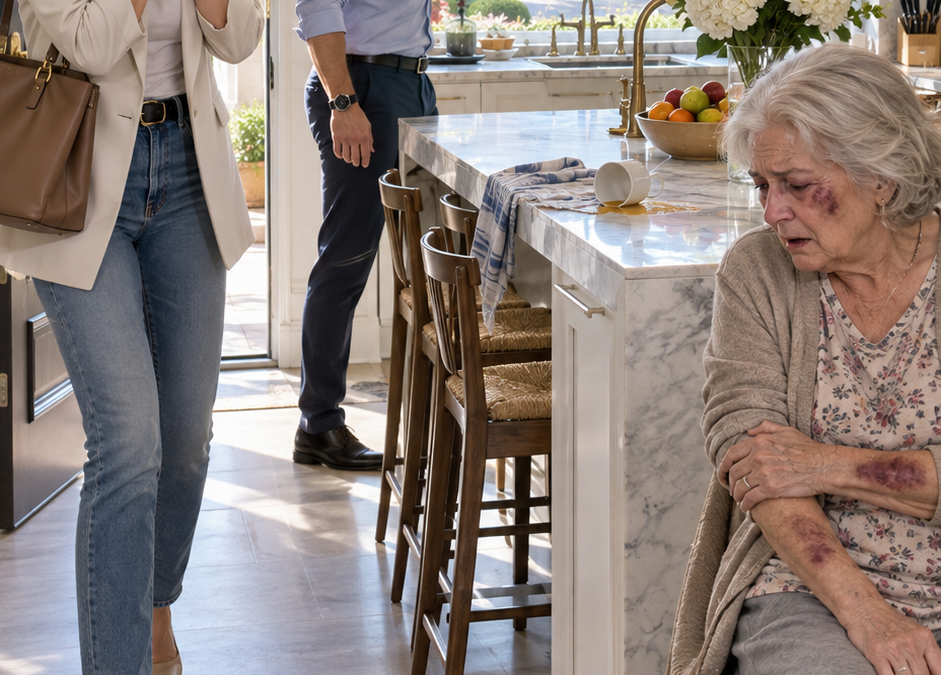
PART2
Rose pulled her sleeve down.
“I fell.”
Too fast.
Too quiet.
Too practiced.
My mother had never been able to lie to me.
Not when our electricity was shut off when I was eight and she told me we were having a candlelight adventure.
Not when she claimed she was not hungry so I could eat the last piece of chicken.
Not when she smiled at my college graduation while hiding the fact that she had sold part of her farmland to pay my final tuition bill.
And not now.
Noah clung tighter to her leg.
From the living room, Eleanor shouted, “Tell her not to burn the meat again!”
Then Mark laughed.
“And she still hasn’t finished my laundry.”
Something inside me broke so cleanly that I almost heard it.
For seven years, I had paid the mortgage.
I bought both cars.
I covered Eleanor’s medical treatments when she said her insurance was not enough.
I financed every vacation she bragged about to her church friends.
I paid for Mark’s failed business idea, then his second failed business idea, then his “transition period” after he decided corporate work was bad for his mental health.
He walked around like a wealthy man because my income made it possible.
And while I was hundreds of miles away working twelve hour days, he and his mother had turned my sick mother into their servant.
The woman who had raised me with cracked hands and impossible courage was standing in my kitchen, bruised, trembling, and too frightened to tell me the truth.
I turned off the stove.
The click sounded louder than the television.
Eleanor appeared in the hallway.
“What do you think you’re doing?” she demanded.
I did not look at her.
“Mom,” I said, “pack what you need. We’re leaving.”
Rose’s eyes widened.
“No, honey, I can finish this. It’s almost done.”
The words came out of habit.
That made them worse.
I shifted Lily against my hip and reached down for Noah. He came to me immediately, hiding his face in my shoulder.
“No,” I said. “You are done.”
Eleanor stepped into the kitchen, her face tightening.
“Where does she think she’s going?”
“With me.”
“She isn’t finished.”
I finally looked at her.
Eleanor was wearing one of the cashmere cardigans I had bought her for Christmas. She had diamond studs in her ears, red polish on her nails, and not one trace of shame on her face.
“Finished?” I repeated.
She lifted her chin.
“Dinner is for seven. Mark invited people. Your mother agreed to help.”
Rose whispered, “Amelia…”
I turned to my husband.
Mark had followed his mother now, standing behind her with the expression of a man trying to decide whether to act innocent or offended.
He chose offended.
“You’re overreacting,” he said.
“Move.”
He blinked.
“What?”
“Move away from the door.”
He stepped in front of the hallway.
“No. Stop acting crazy. She needs to apologize to Mom and get back in that kitchen.”
For one second, I stared at the man I had married.
Mark Reed.
Tall, handsome, charming Mark, who used to send flowers to my office and tell everyone he was proud of his hardworking wife. Mark, who called my mother “sweet Rose” in public. Mark, who kissed my forehead before I left for New York and promised to make sure she rested.
That man was gone.
Or maybe he had never existed.
Maybe he had only been what my money allowed him to pretend to be.
I took my phone from my coat pocket.
Mark frowned.
“What are you doing?”
I opened the home control app.
One tap.
Electricity disabled.
The television went black.
The sudden silence in the house was glorious.
Eleanor gasped from the living room.
Another tap.
Water supply locked.
Another.
Garage access revoked.
Another.
Every authorized card connected to my personal accounts frozen.
Every household spending card disabled.
Mark’s phone buzzed.
Then buzzed again.
His face changed as he looked at the screen.
“My card’s been canceled,” he said. “What did you do?”
I looked him straight in the eye.
“I gave you back the life you can afford.”
For once, he had no answer.
I turned to Rose.
“Mom. Purse. Medication. Coat. Now.”
She moved slowly, still shaking. I wanted to help her, but I had both children in my arms. Lily’s face was wet from crying. Noah’s little fingers were curled into my blouse.
Eleanor stormed forward.
“This is my son’s house.”
I laughed once.
Cold.
Wrong.
“This house is in my name.”
Mark’s jaw tightened.
“Our marital home.”
“That I pay for.”
“You think money makes you God?”
“No,” I said. “But it does make the mortgage company listen to me.”
Rose came back with a small overnight bag and her purse. Her hands were shaking so badly she could barely hold them.
Eleanor looked at the bag and sneered.
“Don’t forget the mop. It knows her better than luggage.”
Rose flinched.
I stepped toward Eleanor before I could stop myself.
Mark moved between us.
“Don’t you dare threaten my mother.”
I smiled.
It did not feel like my face.
“Funny. You were perfectly fine letting yours threaten mine.”
He lowered his voice.
“Amelia, think carefully. You don’t want to make this ugly.”
“It became ugly before I walked in.”
He looked at Noah and Lily.
“You’re scaring the kids.”
That almost made me laugh again.
He had sat on the sofa while Lily screamed and Noah clung to my injured mother’s leg. But now that I was moving, now that I was no longer funding his comfort, he suddenly remembered we had children.
I adjusted Noah higher on my shoulder.
“Mom, walk.”
Rose followed me through the hallway.
Eleanor shouted behind us, “You are not taking those children anywhere!”
I stopped at the front door and turned.
“They are my children.”
“They are Mark’s too.”
“Then he should have acted like a father before I came home early.”
Mark reached for my arm.
I looked down at his hand.
He stopped.
Good.
Somewhere in his survival instincts, he still had one working nerve.
I opened the front door.
Cold evening air rushed in.
The neighborhood was quiet. Perfect lawns. Decorative lights. Expensive cars in driveways. The kind of suburban street where people preferred problems to stay behind curtains.
I carried Noah while Rose held Lily.
Together, we walked out of the house and across the street.
Not down the block.
Not to the car.
Across the street.
Toward the largest mansion in the neighborhood.
The one Mark had admired for years.
The one he had called “obscene” whenever someone else parked in the circular driveway.
The one he had once pointed to during a walk and said, “Can you imagine living like that?”
I had smiled then.
I could imagine it very well.
Because I had bought it three years earlier.
Mark followed us outside barefoot, still holding his phone.
“Amelia!” he shouted. “Where the hell are you going?”
I did not answer.
Eleanor came onto the porch.
“Mark, stop her!”
I reached the enormous iron gate, shifted Noah carefully, and pressed my thumb to the scanner.
A soft beep sounded.
The gates opened.
Mark stopped in the middle of the street.
His face went pale.
“How do you have access to that house?”
I turned back.
“Because I bought it three years ago.”
The gates began closing between us.
“It’s fully paid off,” I said. “And your name isn’t on a single document.”
Mark rushed toward the scanner and pressed his thumb against it.
A red light flashed.
Access denied.
For one second, he looked stunned.
Then his eyes moved past me toward the towering windows, the circular driveway, the stone entryway, the massive front doors.
The shock disappeared.
What replaced it was greed.
That was the second time my marriage ended.
The first was my mother’s bruised wrist.
The second was watching my husband forget those bruises the moment he realized I owned something bigger.
He was no longer thinking about Rose.
Or Noah.
Or Lily.
Or what I had walked in on.
He was calculating.
What the house was worth.
How long I had owned it.
How he could claim it.
How he could get inside.
I carried my children through the mansion’s front door with my mother behind me.
The cupcake box was crushed against my side, frosting leaking from one corner onto Rose’s trembling hand.
Inside, the house smelled like fresh linen and cedar.
Quiet.
Clean.
Untouched by Eleanor.
I had bought it through an LLC before Mark’s spending became completely out of control. At first, I told myself it was an investment. Then, slowly, it became something else.
A backup plan.
A place with no joint accounts.
No shared passwords.
No in law access.
No Mark.
I had never planned to move in like this.
With crying toddlers, a bruised mother, and the sound of my husband shouting outside the gate.
But sometimes the life raft you build in secret becomes the only reason you survive the wreck.
I set Noah and Lily on the couch in the family room. They clung to each other, still sniffling. I opened the crushed bakery box and placed two cupcakes on napkins.
Lily stared at hers.
“Grandma sad?” she whispered.
Rose looked like the question had stabbed her.
I knelt in front of my mother.
“You didn’t fall in the bathroom, did you?”
Rose stared down at the frosting on her fingers.
For a long moment, she said nothing.
Then she whispered, “No.”
Outside, Mark had stopped yelling.
Through the window, I could see him standing on the sidewalk, typing rapidly on his phone.
Already planning his next move.
I locked the door.
Then I turned back to Rose.
“Tell me everything.”
Her swollen hands tightened together.
“What they made me do wasn’t the worst part,” she said.
My stomach went cold.
“I kept proof,” she continued. “I hid it before you came home because I knew they would destroy it if they found it.”
I sat beside her slowly.
“What proof?”
Rose looked toward the twins.
Noah had fallen asleep against a pillow, one hand still wrapped around Lily’s sleeve. Lily was licking frosting off her finger, eyes red and heavy.
My mother’s voice dropped.
“The first thing they did was take my phone.”
I closed my eyes.
“When?”
“The day after you left for New York.”
Six days.
I had been gone six days.
Rose continued, “Mark said the battery looked swollen and dangerous. He said he would take it to get checked. I told him I needed it because you called every night. Eleanor said I was being dramatic and that if you needed anything, you could call Mark.”
My hands curled into fists.
“I called you every night.”
“I know.”
“He told me you were sleeping.”
She nodded.
“He told me you were too busy to talk.”
My throat tightened.
Rose swallowed.
“Then Eleanor said if I really wanted to help, I should stop acting like a guest.”
I forced myself to breathe.
“What else?”
“They moved my medication.”
The room seemed to drop ten degrees.
“Your arthritis meds?”
“And my pain cream. And my anti inflammatory pills.”
I stood up.
“Where?”
“She kept them in the upstairs linen closet. She said I could have them after chores, because they made me lazy.”
For a moment, I could not see.
Rage blurred the room.
My mother, who had spent her whole life working through pain, had been denied medication in my own house because Eleanor Reed decided suffering made her more useful.
Rose reached for my hand.
“Amelia, please.”
I sat again because she needed calm, not my fury.
“How did you get the bruises?”
She looked away.
“Mom.”
Her mouth trembled.
“The first one happened when I reached for the closet.”
“Who grabbed you?”
She did not answer.
“Mom.”
“Mark.”
The sound that came out of me did not feel human.
Rose started crying.
“He didn’t hit me. Not like that. He grabbed my wrist. He said if I took extra pills, I’d sleep all day and leave him with the children. I tried to pull away, and he squeezed harder.”
I covered my mouth.
“The bruise under your eye?”
“Eleanor.”
My body went still.
“She said I was embarrassing her because Lily was crying during her video call. I was holding Noah and trying to reach Lily. Eleanor took Lily from the high chair too fast, and I told her not to yank her like that. She turned and slapped me.”
I stood again.
This time, Rose did not stop me.
“She slapped you?”
Rose nodded, tears running down her face.
“Then she said if I told you, she would say I came at her first. She said nobody would believe an old woman who already looked sick.”
I walked to the window.
Mark was gone from the sidewalk now.
Probably back inside our old house.
Probably with Eleanor.
Probably calling lawyers, bankers, police, anyone who could help him turn this into something where he was the victim.
I looked back at Rose.
“You said you kept proof.”
She nodded.
“I knew they would say I was confused. Eleanor kept saying it in front of neighbors. ‘Rose forgets things.’ ‘Rose gets dramatic.’ ‘Rose needs structure.’ I knew what she was doing.”
That was Eleanor.
She never lied by accident.
She planted narratives.
“I had my old tablet,” Rose said. “The cracked one you gave me years ago. Mark didn’t know it still worked. I kept it in the lining of my overnight bag. I recorded when I could.”
“Where is it?”
“In my bag.”
I brought it to her.
The tablet was old, the case peeling, the screen cracked at one corner. Rose’s hands shook as she opened a hidden folder.
Videos.
Audio files.
Photos.
Dozens of them.
The first audio clip started with Eleanor’s voice.
“I do not care if your hands hurt. Dinner does not cook itself.”
Then Mark.
“Mom, don’t argue with her. She likes feeling helpless.”
Rose’s voice, soft and exhausted.
“I just need ten minutes.”
Eleanor snapped, “You can sit when the laundry is done.”
In another clip, Lily cried in the background while Mark said, “If Amelia asks, you’re happy to help. Don’t make me look bad.”
Rose whispered, “I want to talk to my daughter.”
Mark replied, “My wife is working because someone has to pay for all this. Don’t bother her with old lady complaints.”
I had to stop the recording.
My hands were shaking.
Rose touched my arm.
“There is more.”
“I know.”
“No,” she said, voice breaking. “Worse.”
She opened a video.
The angle was low, probably from the tablet hidden inside a laundry basket. The laundry room appeared in grainy light.
Rose was sitting on the floor, rubbing her wrists.
Eleanor stood over her.
“You are lucky we let you stay here,” Eleanor said. “Do you know how many daughters dump their sick mothers in homes and never look back?”
Rose said, “Amelia would never do that.”
Eleanor laughed.
“Amelia has no idea what to do with sick people. She throws money at everything. That is all she knows.”
Mark entered the frame.
“Did she finish the shirts?”
“No,” Eleanor said. “She’s resting again.”
Mark’s face hardened.
“Rose, I told you I need those for tomorrow.”
“My hands are swollen.”
He crouched in front of her.
Then he said the sentence that turned my blood to ice.
“If you make Amelia choose between her mother and her marriage, you will lose.”
Rose’s sob broke through the present and the recording at the same time.
I paused the video.
For a long moment, neither of us moved.
Then I said, “He threatened you with me.”
She nodded.
“He told me you were already stressed. He said if I caused problems, you would resent me. He said you needed a husband more than a burden.”
I bent forward, pressing both hands over my face.
Every night in New York, I had called Mark after failing to reach my mother.
Every night, he said, “She’s fine. She’s sleeping. She overdid it playing with the kids, but she’s happy.”
Every night, I believed him because I wanted to believe the people in my home loved each other enough to be safe.
Rose opened another folder.
Screenshots.
Messages from Eleanor.
The upstairs bathroom still needs scrubbing.
Do not use the good towels.
The children’s sheets must be changed before Mark gets home.
If your hands are too sore to cook, take less time sitting.
One message from Mark made my skin crawl.
Remember, Amelia is under pressure. Do not call her crying unless you want her to think bringing you here was a mistake.
Another.
Mom says you were rude today. Apologize before dinner.
Another.
You are not the guest here. You are here because this family is doing you a favor.
I looked at Rose.
“Why didn’t you tell me when I called the house phone?”
She swallowed.
“Because Eleanor stood beside me.”
The floor seemed to shift under me.
“What?”
“She listened. Sometimes Mark listened too. Once I tried to say I wanted to come home. Eleanor took the receiver and told you the connection dropped.”
I remembered that call.
I had been in a hotel room in Manhattan, exhausted after a board presentation. The line had gone dead, and when I called back, Mark answered.
“Your mom hit the wrong button,” he said, laughing. “You know how she is with phones.”
I had laughed too.
God forgive me.
I had laughed.
A knock sounded at the front door.
Rose flinched violently.
Noah woke with a cry.
I checked the security screen.
Two police officers stood outside the gate.
Behind them, on the sidewalk, stood Mark and Eleanor.
Mark was wearing shoes now, but no coat. Eleanor had one hand pressed to her chest like a woman in a stage play.
Of course.
I opened the intercom.
“Yes?”
One officer leaned toward the camera.
“Ma’am, we received a call about a domestic dispute and possible unlawful removal of children from the residence.”
Mark stepped forward behind him.
“Amelia, just open the gate. Let’s talk like adults.”
His voice was smooth now.
Careful.
The voice he used with bankers.
I looked at the officers through the screen.
“I am the children’s mother. They are safe with me. My elderly mother has visible injuries and evidence of abuse. I will open the gate for the officers only.”
Mark’s face changed.
“Abuse?” he shouted. “She’s lying!”
Eleanor gasped loudly.
“Officer, that woman is unstable. She turned off utilities in a house with my son inside.”
I pressed the gate control.
The gates opened just wide enough for the officers.
Mark tried to follow.
I tapped the screen.
The gate stopped.
Then closed in his face.
The red denial light reflected across his cheek.
The officers came to the door.
I let them in.
The older officer, Sergeant Hayes, took one look at Rose’s face and his expression shifted. The younger one, Officer Miller, looked toward the twins, then back at me.
“What happened here?”
I answered calmly because rage would only help Mark.
“I came home early from a work trip. I found my mother cooking, cleaning, and caring for my children while visibly injured. My husband and his mother had taken her phone, restricted her medication, forced her to perform household labor despite severe rheumatoid arthritis, and threatened her not to tell me. She has recordings, messages, and photos.”
Rose began crying softly.
Sergeant Hayes crouched a little, not too close.
“Ma’am, is that true?”
Rose looked at me.
I nodded.
She whispered, “Yes.”
Outside, Mark shouted, “She’s confused!”
The sergeant turned toward the window.
“So he says.”
I showed them the bruises.
The medication story.
The messages.
The video where Mark said my mother would lose me if she made me choose.
Officer Miller’s jaw tightened when she saw the chore list Rose had photographed on the refrigerator.
Monday
Strip beds
Bleach bathrooms
Iron Mark’s shirts
Prepare roast
Clean baseboards
No sitting before dinner
No sitting before dinner.
In my house.
For my mother.
Sergeant Hayes asked, “Do you want medical attention?”
Rose shook her head.
I said, “Yes.”
My mother looked at me.
“Amelia…”
“Yes,” I repeated.
The sergeant nodded.
“We can call EMS for evaluation or you can take her to urgent care.”
“I’ll take her. But I want a report filed.”
Mark began pounding on the gate.
“Amelia!”
Sergeant Hayes stepped outside.
I watched through the window as he spoke to Mark.
I could not hear every word, but I saw Mark’s performance change.
First anger.
Then wounded husband.
Then concerned father.
Then offended homeowner.
Eleanor dabbed at dry eyes.
Sergeant Hayes listened with the expression of a man who had heard every version of this before.
Then he pointed toward the mansion.
Mark’s mouth moved fast.
Eleanor’s face twisted.
Finally, Mark shouted loud enough for me to hear through the glass.
“That house is marital property!”
I smiled.
Not happily.
Just enough.
No, Mark.
It was not.
I had bought the mansion three years earlier through Rose Harbor Holdings, an LLC created before Mark and I hit the financial cliff I had seen coming. The funds came from the sale of stock options I earned before our marriage and an inheritance from my grandfather that had never touched our joint accounts.
My attorney had insisted on clean documentation.
At the time, I thought she was being overly cautious.
Now I wanted to send her flowers.
Sergeant Hayes returned.
“He says he lives across the street.”
“He does.”
“He says you shut off utilities.”
“I disabled smart controls and froze my own cards. The house still has basic safety power and water access through manual override. I did not endanger him.”
The officer nodded.
“He also says this property belongs to both of you.”
“It does not.”
I opened my email and showed him the deed, LLC documents, and property tax statements.
He read quietly.
Then he handed the phone back.
“Seems clear.”
Outside, Mark’s face darkened as he realized the officers were not dragging me back across the street.
That was when Eleanor made her mistake.
She shouted, “That old woman is making things up because she hates me!”
Rose heard it.
For the first time since I had found her in the kitchen, my mother stood.
She walked slowly to the front window. Her hands were bandaged only by thin kitchen wraps, her face still bruised, her body still trembling.
But her voice, when she spoke, was steady.
“I do not hate you, Eleanor,” she said through the closed glass.
Everyone outside turned.
Rose continued.
“I was afraid of you. There is a difference.”
Eleanor’s mouth opened.
Rose looked at Mark.
“And you,” she said, voice breaking. “You told me my daughter would choose you if I became inconvenient.”
Mark’s face went pale.
Rose lifted her chin.
“You were wrong.”
Lily toddled to my leg and wrapped her arms around my knee.
Noah followed.
I looked at my mother, my children, the officers, then the man outside who had mistaken my love for blindness.
“Yes,” I said. “He was.”
The officers instructed Mark and Eleanor to remain away from the mansion for the night. They said we would need civil attorneys for property issues, but any harassment, threats, or attempted entry would be handled as a police matter.
Mark stared at me through the gate.
“This isn’t over.”
I opened the intercom.
“No,” I said. “It’s finally starting.”
Then I closed the blinds.
That night, Rose slept in the main guest suite of the mansion.
Not the smallest room.
Not near the laundry.
Not where anyone could call her help.
The main guest suite, with heated floors, a private bathroom, a wide bed, and a view of the garden.
I bathed the twins, changed them into pajamas I had kept stored there for emergencies, and tucked them into the room beside mine.
Lily would not let go of my hand.
Noah kept asking, “Grandma okay?”
“She’s okay now,” I whispered.
But I knew okay was a lie.
Safe was the word.
Safe came before okay.
After they finally slept, I sat with Rose in the guest room while she soaked her hands in warm water.
“I should have told you,” she said.
I shook my head.
“Do not do that.”
Her eyes filled.
“I raised you better than to let anyone hurt me.”
“You raised me to survive. That’s what we’re doing.”
“I was ashamed.”
“Of what?”
“That my own daughter’s husband saw me as a servant. That I let it happen. That I was so afraid of being a burden I became one anyway.”
I took the towel and gently dried her fingers one by one.
“You are not a burden.”
She cried then.
Quietly.
Old pain, new pain, all of it coming out through the same exhausted body.
“I kept thinking about when you were little,” she whispered. “I worked in the fields with my hands swollen, but I could still do it then. I could still protect you. Then I was in that kitchen, and I couldn’t even open my own medicine bottle because they had hidden it.”
My throat burned.
“I should have come home sooner.”
“No,” she said sharply.
I looked up.
Her eyes were fierce now.
“Do not take his sin and wear it.”
That was Rose.
Bruised, exhausted, betrayed, and still protecting me from blame.
I laughed through tears.
“You’re telling me not to blame myself while blaming yourself.”
She managed a weak smile.
“Mothers are hypocrites sometimes.”
The next morning, my attorney arrived at seven.
Naomi Price was small, precise, and dressed like she had never lost an argument in her life. She had handled the LLC purchase of the mansion, my separate asset planning, and several business contracts. She had also warned me twice to stop letting Mark use my accounts casually.
I had ignored her.
She did not say I told you so.
That was how I knew she was excellent.
She listened to everything while sitting at the dining table with coffee she did not drink.
Rose showed her the tablet.
I showed her the bank alerts, frozen cards, utility logs, property records, mortgage payments, nanny contract, and flight details.
Naomi’s expression grew colder with every document.
Finally, she closed her notebook.
“This is abuse, financial exploitation, coercive control, and potentially elder abuse. The children witnessed distress. Your husband called police under false pretenses. His mother appears to have assaulted your mother. We need protective orders, medical documentation, account lockdown, divorce strategy, and evidence preservation immediately.”
Rose whispered, “Will this hurt Amelia?”
Naomi looked at her directly.
“It will hurt the people who caused it.”
I liked her even more.
We spent the morning moving fast.
Urgent care documented Rose’s bruises, chemical irritation, arthritis flare, elevated blood pressure, dehydration, and anxiety response.
The doctor asked if she felt safe at home.
Rose looked at me.
Then she said, “I do now.”
Naomi filed for an emergency protective order for Rose against Eleanor and Mark. She filed temporary custody and exclusive use motions for me regarding the twins and the marital home. She sent Mark’s attorney a preservation notice within two hours.
Then she did something I had not expected.
She contacted the nanny agency.
The nanny I had hired had supposedly quit after two days.
That was what Mark told me.
“She said the twins were too much,” he had said over the phone. “Your mom actually offered to help instead.”
I had felt guilty but relieved.
Now Naomi called the agency on speaker.
A manager confirmed the nanny had not quit.
She had been sent away.
By Eleanor.
The agency notes were clear.
Client’s mother in law refused entry. Stated family did not need outside help and did not want strangers in the house. Husband later confirmed cancellation.
I sat back slowly.
Mark had lied before my mother ever became trapped.
He and Eleanor had removed paid help so Rose would become the help.
Naomi requested the records.
Then she looked at me.
“This was not improvised.”
No.
It was planned.
That realization made me colder than anger ever could.
At eleven, Mark started texting.
At first, the messages came as wounded husband.
Amelia, this has gone too far. We need to talk for the kids.
Then offended homeowner.
You had no right to shut me out of my own finances.
Then victim.
Your mother manipulated you. She has hated me from the beginning.
Then threat.
If you try to take my children, I will make sure everyone knows you abandoned them for work.
I stared at that one for a long time.
Abandoned them for work.
The work that paid for his beer, his house, his cars, his mother’s doctors, and his life.
Naomi photographed every message.
“Do not respond emotionally,” she said.
I typed:
Communicate through counsel.
Then I blocked him everywhere except one court monitored parenting app Naomi set up.
Eleanor left voicemails from three numbers.
The first was furious.
“You spoiled little witch. You think money means you can destroy a family?”
The second was dramatic.
“I am an old woman, and you have left me without water in a house I helped maintain.”
She had never maintained anything except her opinion of herself.
The third was the most honest.
“You were never good enough for Mark. We tolerated you because you were useful.”
Naomi smiled when she heard that one.
“Useful,” she said. “Helpful word.”
By noon, the story had spread.
Not publicly.
Worse.
Family.
Mark’s sister, Denise, texted first.
Mom is crying. Whatever happened, you need to calm down. She said your mother attacked her.
I sent one photo.
Rose’s bruised wrist.
Denise did not reply for twenty minutes.
Then she wrote:
I didn’t know.
I stared at those words.
Nobody ever knows when knowing would require action.
My cousin Maribel called from Florida.
I answered because she was one of the few relatives who had never treated my success like a family ATM.
She said, “Tell me what happened before I call your husband a name I can’t take back.”
I told her enough.
She went silent.
Then she said, “Do you need me?”
That simple question almost broke me.
Need.
Not explain.
Not defend.
Not calm down.
Need.
“I don’t know yet.”
“I’m flying in.”
“You don’t have to.”
“I know. That’s why it means something.”
She arrived that evening with two suitcases, three casseroles, and the expression of a woman who had already chosen violence spiritually but would settle for legal support.
The twins adored her immediately because she let them put stickers on her laptop.
Rose cried when she saw her.
Maribel held her gently and said, “Auntie, who do I have to bury emotionally?”
For the first time in two days, Rose laughed.
That laugh sounded like medicine.
The emergency hearing happened forty eight hours after I came home.
Mark arrived in court wearing a navy suit I had bought him.
That detail bothered me more than it should have.
He looked polished because I had paid for polish.
Eleanor sat behind him in pearls, her face arranged into wounded innocence.
Her attorney tried to paint the situation as a family misunderstanding caused by stress, miscommunication, and my “intense work schedule.”
I almost laughed out loud.
Naomi did not.
She stood and dismantled him piece by piece.
She presented Rose’s medical report.
The photos.
The audio.
The videos.
The nanny agency record.
The text messages.
The police report.
The voicemails.
The record of Mark attempting to claim the mansion.
The financial records showing how much of my income had gone into accounts he controlled for household use while he contributed almost nothing.
Mark’s attorney tried to object to the recordings.
Naomi had already prepared the legal argument.
One party consent.
Emergency context.
Pattern of abuse.
Preservation of evidence.
The judge allowed enough to understand the danger.
Then Naomi played Eleanor’s voicemail.
You were never good enough for Mark. We tolerated you because you were useful.
The courtroom went silent.
Eleanor’s face turned red.
Mark looked at the table.
The judge asked Rose if she wanted to speak.
My mother stood slowly.
Her hands were wrapped. Her eye was still bruised. Her voice shook, but she did not hide.
“I came to help my daughter,” she said. “I thought I was helping with my grandchildren. I love those babies. But after Amelia left for work, they took my phone and moved my medication. They told me I was selfish if I rested. They said Amelia would be angry if I complained.”
She looked at Mark.
“He told me my daughter would choose him if I became inconvenient.”
Mark’s jaw tightened.
Rose continued.
“I believed him for a while because I was ashamed. But my daughter came home and picked me up from the kitchen floor. So I know now he lied.”
I covered my mouth.
Naomi touched my arm under the table.
The judge granted temporary protective orders.
Eleanor was barred from contact with Rose and the children.
Mark was barred from entering the mansion or contacting Rose.
I was granted temporary exclusive physical custody of Noah and Lily pending further evaluation, with Mark allowed supervised visitation only after a hearing.
The marital home was frozen from transfer or new debt.
Mark was ordered to maintain utilities manually and could not access my separate accounts.
The judge also ordered a guardian ad litem for the children because of the exposure to conflict and allegations involving their care.
When the judge said “elder abuse investigation,” Eleanor gasped as if the word had attacked her.
Outside the courtroom, Mark tried to approach me.
Naomi stepped between us.
“Through counsel.”
He looked past her.
“Amelia, please. You know me.”
I stared at him.
That was the problem.
I did now.
He softened his voice.
“I made mistakes. Mom got carried away. Your mother exaggerates when she’s emotional. But this is our family. You don’t throw away a marriage over one bad week.”
“One bad week?” I repeated.
His face tightened.
“You know what I mean.”
“Yes,” I said. “I do. You mean the week I caught you.”
He looked wounded.
“Don’t do that.”
“Do what?”
“Act like I’m a monster.”
I took one step closer.
Naomi did not stop me.
“You watched my mother cook with injured hands while our daughter cried.”
He swallowed.
“I didn’t know it was that bad.”
“You laughed about laundry.”
His eyes flicked away.
“You froze my cards without warning.”
There it was.
Not my mother.
Not our children.
The cards.
I smiled.
It felt like the final cut.
“Thank you for reminding me what you miss most.”
I walked away.
Eleanor shouted after me.
“You’ll come crawling back when you realize money can’t raise children!”
I stopped and turned.
“No,” I said. “But it paid for the nanny you fired.”
People in the hallway turned.
Eleanor’s face went pale.
Mark closed his eyes.
Good.
The next few weeks became a war of paperwork.
Mark wanted access to the mansion.
Denied.
Mark wanted the children brought to the marital home.
Denied.
Mark wanted emergency spousal support, claiming I had financially abused him by freezing cards.
Naomi’s response was so sharp Maribel read it twice for entertainment.
The court found no emergency need because Mark had a house, a vehicle, and access to his own bank account. The fact that he had become accustomed to spending my income was not an emergency.
I printed that sentence.
Not because I needed it.
Because sometimes justice looks beautiful in Times New Roman.
Eleanor tried to claim Rose had attacked her first.
Then Naomi produced the recording.
Eleanor: “If you tell Amelia, I’ll say you came at me first.”
That ended that.
Denise, Mark’s sister, called me after the first week.
I almost did not answer, but something in me wanted to know which version she had chosen.
Her voice was quiet.
“I listened to Mom’s voicemail.”
“Okay.”
“She told me you edited it.”
“Do you believe that?”
A long pause.
“No.”
That surprised me.
Denise exhaled shakily.
“When we were kids, she made me clean before guests came. Not like this. I mean, I wasn’t hurt. But she would inspect baseboards. She’d call me lazy. Mark never had to do it because he was her prince.”
I leaned against the kitchen counter in the mansion.
“He still is.”
“I know.”
Another pause.
“I’m sorry about Rose.”
“Thank you.”
“I’m also sorry I texted you before asking what happened.”
That was rare in Mark’s family.
A clean apology.
No if.
No but.
No request.
I accepted it carefully.
Denise later gave a statement about Eleanor’s history of controlling behavior. It did not erase what happened, but it helped establish the pattern.
The guardian ad litem visited both houses.
In the mansion, Noah and Lily showed her their room, their toys, the reading nook Rose had slowly started using as her safe place. Lily pointed to Rose’s chair and said, “Grandma sits now.”
The guardian wrote that down.
At the old house, Mark apparently tried to present himself as a devoted father overwhelmed by my career and his mother’s mistakes.
Then Lily saw Eleanor’s cardigan draped over a chair and began screaming.
That went into the report too.
Children remember more than adults hope.
Rose began therapy in February.
At first, she resisted.
“I’m too old to sit on a couch and talk about feelings,” she said.
Maribel replied, “Auntie, you survived Eleanor. A therapist is just someone with better lighting.”
Rose went.
Then she kept going.
Some days she came back quiet.
Some days angry.
Some days she wanted to cook for everyone, then caught herself halfway through asking what we wanted for dinner.
“You don’t have to,” I would say.
“I know,” she would answer.
But knowing and believing are different rooms, and she was still walking between them.
Her hands healed slowly.
The bruises faded.
The fear took longer.
For weeks, if a pot boiled over, she apologized.
If the twins cried, she tried to stand too fast.
If I came home from work with a tired face, she asked if she had done something wrong.
Every time, I hated Mark all over again.
Not because of one slap.
Not because of one bruise.
Because he had taught my mother to treat her own existence like a problem.
The divorce filing became official in March.
Mark was furious.
He had apparently believed I was punishing him, not leaving him.
That is how entitled men think.
They confuse consequences with negotiations.
His first settlement demand was absurd.
Half the mansion.
Continued lifestyle support.
Joint custody with alternating weeks.
My payment of his legal fees.
Naomi laughed.
Actually laughed.
Then she sent a counteroffer that amounted to reality.
He could keep his personal belongings, his own retirement account, one vehicle if he refinanced it in his name, and supervised visitation subject to child welfare recommendations.
He called me from an unknown number that night.
I answered by mistake.
“Amelia,” he said.
I froze.
Then I pressed record and put him on speaker. Maribel, sitting across the room, immediately sat up.
“You need to stop letting that lawyer poison you,” Mark said.
“Use the parenting app.”
“I am your husband.”
“Not for long.”
He inhaled sharply.
“Do you hear yourself? You sound like a cold corporate bitch.”
Maribel mouthed, wow.
I said nothing.
Mark continued.
“You think that mansion makes you better than me. You hid it for years. What kind of wife does that?”
“The kind who needed somewhere safe.”
“You never needed safety from me.”
I almost laughed.
“My mother did.”
“That was between her and Mom.”
“No, Mark. That was in my house, with my children watching, while you sat on my sofa.”
He snapped, “Your money, your house, your sofa. God, do you know how exhausting it was being married to someone who always had more?”
There it was.
The real wound.
Not love.
Not family.
Not pressure.
His ego.
“You were angry that I provided for you?”
“I was angry that you made me feel small.”
“I didn’t make you feel small. I stopped making myself smaller so you could feel big.”
Silence.
Then his voice changed.
“You’ll regret this. Judges don’t like women who keep fathers from their children.”
“I’m recording this.”
He hung up.
Naomi used the call.
Mark’s supervised visitation remained restricted.
His financial claims weakened further after discovery began.
That was when we found the credit cards.
Three accounts opened in my name.
Not by me.
One had funded a golf trip.
One had paid for Eleanor’s dental work.
One had been used for electronics, restaurant bills, and hotel stays Mark claimed were “business development meetings.”
Naomi brought in a forensic accountant.
Then another truth emerged.
Mark had been telling people he co owned my consulting firm.
He did not.
He had used my company profile to approach investors for another business idea. He had suggested my “family office” might back private deals.
I did not have a family office.
I had a business I built from years of work and stress and airport coffee.
But Mark had seen my labor as a resource he could attach his name to.
The more we uncovered, the clearer it became.
What happened to Rose was not separate from what happened to me.
It was the same belief wearing different clothes.
Mark believed women existed to support his comfort.
His mother taught him that.
I financed him.
Rose served him.
Eleanor praised him.
The twins were supposed to admire him.
And when any of us became inconvenient, we became unstable, dramatic, ungrateful, or cruel.
In April, the elder abuse investigation resulted in charges against Eleanor for assault and coercive conduct related to Rose. Mark was not charged with the assault under the eye because Rose’s recording did not capture it clearly, and Eleanor denied it. But he was named in the financial and coercive evidence connected to medication restriction and intimidation.
He blamed Eleanor.
Of course.
In his written statement, he said he had “trusted his mother’s judgment” and “did not fully understand Rose’s medical limitations.”
Rose read that line in Naomi’s office.
Then she looked up and said, “He saw me drop a pot because my fingers locked.”
Naomi nodded.
Rose continued.
“He told me to clean the floor before Lily slipped.”
No one spoke.
Rose folded the paper and set it down.
“I hope he says that to a judge.”
Eventually, he did.
The custody hearing became the ugliest day of my life after the day I came home early.
Mark’s attorney tried to paint me as an absent mother.
He brought up my business trips.
My late meetings.
The nanny.
The fact that I owned a second house without telling my husband.
He argued I had “weaponized finances” and created instability by abruptly leaving the marital home.
Naomi let him talk.
Then she stood.
She played the footage from the mansion gate, where Mark’s first real reaction to discovering the house was to attempt entry and demand ownership.
She presented the nanny agency records showing I had arranged childcare.
She presented Mark’s cancellation.
She presented videos showing Rose caring for the twins under duress.
She presented the police report.
The guardian ad litem testified that the children associated Eleanor with fear and Rose with comfort. She also testified that Mark minimized the abuse and focused heavily on property and money during interviews.
Then the judge asked Mark one question.
“Why did you cancel the nanny your wife hired?”
Mark shifted.
“My mother believed family care was better.”
The judge waited.
Mark added, “And Rose wanted to help.”
Naomi asked, “If Rose wanted to help, why did she need permission to access her phone?”
Mark flushed.
“She didn’t.”
Naomi played the audio.
Rose: “I want to call Amelia.”
Mark: “No. Not while you’re crying like this.”
The courtroom went silent.
Then Naomi asked, “Why did she need permission to access her medication?”
Mark’s attorney objected.
The judge allowed the question.
Mark’s voice hardened.
“I was worried she was overusing it.”
Naomi looked at him.
“Are you a physician?”
“No.”
“Did you call her physician?”
“No.”
“Did you inform your wife you had restricted her mother’s medication?”
“No.”
“Did you tell your wife her mother was sleeping?”
He hesitated.
“Yes.”
“Was that always true?”
Silence.
“No.”
Naomi stepped back.
“No further questions.”
The judge granted me primary custody.
Mark received supervised visitation that could be expanded only after completing parenting classes, counseling, and demonstrating insight into the harm caused. Eleanor was barred from contact with the twins indefinitely.
Mark looked stunned.
Not sorry.
Stunned.
As if the court had misunderstood his importance.
Outside, he cornered me near the elevators before security noticed.
“This is your fault,” he said.
I held Lily’s backpack in one hand and Noah’s stuffed dinosaur in the other.
“Still?”
He leaned closer.
“You destroyed my relationship with my kids.”
“No,” I said. “You let them watch you destroy their grandmother.”
His face twitched.
“They’re two. They’ll forget.”
That sentence told me everything I needed to know.
I stepped back.
“I won’t.”
Security came between us.
He did not try again.
The mansion slowly became home.
Not immediately.
At first, it felt like an emergency shelter with expensive countertops.
The twins woke at night.
Rose apologized too much.
I worked from the dining room because I was afraid to leave for more than two hours.
Maribel stayed for three weeks, then flew home after making me promise not to become “one of those rich tragic women who refuses help while owning seven guest rooms.”
I promised.
The first normal thing happened in May.
Lily spilled juice on the kitchen floor.
The moment the cup hit the tile, Rose jumped up.
“I’ll get it.”
I reached her before she could reach the towels.
“Mom.”
She froze.
Lily’s eyes filled with tears.
Noah whispered, “Bad?”
I knelt beside them.
“No. Accidents happen.”
I handed Lily a small towel.
“We clean together.”
So we did.
Lily wiped one tiny corner.
Noah mostly smeared juice farther across the floor.
Rose stood watching, one hand pressed to her mouth.
“What?” I asked softly.
She shook her head.
“Nothing.”
But later, after the twins went down for nap, she said, “Eleanor would have made me redo the whole floor.”
I took her hand.
“Eleanor isn’t here.”
Rose looked around the kitchen.
“No,” she said. “She isn’t.”
That was healing.
Not dramatic.
Not cinematic.
A child spilling juice and nobody being afraid.
In June, the old house sold.
That surprised people.
Mark fought it at first, claiming he had emotional attachment to the marital home. Naomi produced records showing he had missed two utility payments the moment my accounts were removed and had asked his attorney whether the house could be rented for income.
Emotional attachment apparently had a price point.
The sale paid off the mortgage and covered legal costs. My share went into accounts for the twins and a trust for Rose’s care.
Mark received less than he expected.
More than I wanted.
Law is rarely poetic.
But he did not get the mansion.
He did not get my company.
He did not get access to my mother.
And he did not get to keep pretending he had built the life he merely inhabited.
Eleanor pleaded no contest to a reduced assault charge and received probation, mandatory anger management, and a protective order. It felt too light. Rose said it was enough because the order mattered more than the sentence.
“I don’t need her ruined,” my mother told me. “I need her away.”
That was Rose.
Still more merciful than anyone deserved.
Mark’s financial fraud issues dragged on longer. Some were settled civilly. Some debts became his. Some accounts were closed. My credit was repaired after months of letters, affidavits, and fury.
The divorce finalized in October.
I wore a black suit.
Not because it was a funeral.
Because it fit.
Mark signed with a face like stone. He looked older, thinner, less polished. He had moved into an apartment near his job, a job he took only after the court made clear lifestyle support was not going to save him.
After the signing, he looked at me and said, “I did love you.”
I studied him.
Maybe he believed that.
Maybe he loved what I did.
What I paid.
What I forgave.
What I made possible.
Maybe to Mark, love and access had always been the same thing.
“No,” I said. “You loved the life I gave you.”
His eyes hardened.
There he was.
I walked away.
On Thanksgiving, we hosted dinner at the mansion.
Small.
Rose.
Maribel.
Denise, surprisingly, after Rose said she was comfortable with it.
The twins.
A few friends.
The table was too big for our group, so we all sat clustered at one end with too many dishes and not enough matching serving spoons.
Rose made sweet potatoes because she wanted to.
Not because anyone ordered her.
She sat while they baked.
That mattered.
When I brought the roast to the table, Lily clapped.
“Grandma sit!”
Everyone froze for half a second.
Then Rose laughed.
“Yes,” she said. “Grandma sits.”
Noah patted the chair beside him.
“Here.”
Rose sat.
The whole room seemed to exhale.
After dinner, Denise helped me clear plates.
She held one for a long moment, then said, “I keep thinking about Mom.”
I did not answer.
“She made me believe serving men was love,” Denise continued. “But she never called it that. She called it being raised right.”
I looked at her.
“Do you believe that now?”
“No.”
She looked toward the dining room, where Rose was helping Noah fit puzzle pieces together, her movements slow but peaceful.
“I think being raised right would have made Mark get up from the sofa.”
I nodded.
That was the cleanest truth anyone from that family had ever spoken.
In December, I took Rose and the twins to see Christmas lights.
The mansion’s neighborhood went completely overboard. Giant reindeer. Inflatable snow globes. Music synced to lights. Noah screamed with joy every time something blinked. Lily insisted every Santa was “the real one.”
Rose walked slowly beside me, bundled in a red coat, her gloved hand tucked through my arm.
At one house, a mechanical train circled the lawn.
Noah ran ahead.
Lily followed.
Rose watched them with tears in her eyes.
“What is it?” I asked.
She smiled.
“I thought I had ruined everything.”
“You didn’t ruin anything.”
“I know that in my head.”
“And your heart?”
She looked at the twins.
“My heart is slower.”
I leaned my head against hers for a second.
“That’s okay.”
She squeezed my arm.
“I used to think being useful was how I earned staying loved.”
The sentence hit me hard.
Because I had believed that too.
Different kitchen.
Different currency.
Same cage.
Rose continued, “Then Eleanor made me useful until I disappeared.”
I swallowed.
“And now?”
She smiled a little.
“Now Lily tells me to sit.”
We both laughed.
Christmas came quietly.
Mark had supervised visitation on December 23. He brought the twins gifts that were too expensive for his current budget and spent most of the visit trying to make them say they missed his house.
According to the supervisor’s report, Noah said, “Mommy house has cupcakes.”
Lily said, “Grandma sits there.”
The report also noted that Mark became visibly frustrated when the children did not engage with questions about where they “wanted to live.”
His visits stayed supervised.
On Christmas morning, Rose gave me a small wrapped box.
Inside was her old cracked tablet.
I looked up.
“Mom?”
“I copied everything Naomi needs. The originals are stored safely. But I want you to keep this.”
My throat tightened.
“I don’t want you to feel like you have to carry proof forever.”
She touched the tablet gently.
“It isn’t just proof.”
I waited.
“It is the thing that reminded me I wasn’t crazy,” she said. “When they told me I was dramatic, confused, lazy, ungrateful, I would listen back when they slept. Not often. Just enough to remember what was real.”
I held the tablet carefully.
Evidence.
Memory.
Anchor.
“I hate that you needed it,” I whispered.
“So do I.”
She smiled softly.
“But I am glad I had it.”
I put it in the safe that afternoon.
Next to the mansion deed.
Next to my company documents.
Next to the divorce decree.
Next to the new trust documents for Noah, Lily, and Rose.
Not because I wanted to live in fear.
Because women in my family had spent too long surviving without paper trails.
That ended with me.
One year after I came home early, I flew to New York again.
It was my first overnight work trip since everything happened.
I almost canceled three times.
Rose noticed.
“You’re pacing,” she said.
“I’m thinking.”
“You’re pacing in heels.”
“I can think in heels.”
She sat at the kitchen island, hands wrapped around tea.
“Go.”
I looked at her.
“What?”
“Go do your work.”
“I don’t want you to feel abandoned.”
Her face softened.
“Sweetheart, you leaving for work did not hurt me. People who lied to us hurt me.”
My eyes burned.
“The nanny will be here. Maribel is on call. Denise said she can come if needed. The cameras are working. The gate list is updated.”
Rose smiled.
“And I have my phone.”
That made us both laugh.
Then she held it up.
“And my medication.”
“Mom.”
“And my chair.”
I walked around the island and hugged her.
She held me carefully because I was the one shaking.
“I’m scared,” I admitted.
“I know.”
“What if something happens?”
“Then I call you. Or Maribel. Or the police. Or all three because I am dramatic now.”
I laughed into her shoulder.
“Good.”
When I returned from New York two days later, I came home to a different scene.
The house smelled like tomato soup.
The television was low.
No one was crying.
Rose was sitting at the kitchen table while the twins drew circles on paper and argued about whether purple could be a dinosaur color.
The nanny was loading the dishwasher.
My suitcase rolled behind me.
Noah looked up first.
“Mommy!”
Lily followed, nearly tripping over her own feet.
I dropped to my knees and caught them both.
Rose smiled from the table.
Not pale.
Not frightened.
Sitting.
The relief was so powerful I almost cried into my children’s hair.
That night, after the twins slept, Rose and I sat in the family room with tea.
The mansion windows reflected us back.
My mother in a soft cardigan.
Me barefoot, exhausted, home.
“I used to hate this house,” she said suddenly.
I turned.
“Why?”
“At first, it felt like proof of what Mark wanted. Big. Cold. Expensive.”
“And now?”
She looked around.
“Now it feels like a place that refused to let him in.”
I smiled.
“That is exactly what it is.”
She looked at me for a long moment.
“You bought this before you knew.”
“I think part of me knew enough.”
“About Mark?”
“About needing something that was mine.”
Rose nodded slowly.
“Good.”
That one word felt like absolution.
The final confrontation with Mark happened eighteen months after the divorce.
Not dramatic.
Not at the mansion gate.
Not in court.
At a supervised family therapy session he had requested as part of his attempt to expand visitation.
I did not want to go.
Naomi said it might be useful.
The therapist, Dr. Lang, asked Mark what he wanted the children to understand when they were older.
Mark leaned forward.
“I want them to understand families are complicated. I want them to know their mother made choices too. She was gone a lot. She kept secrets. She hid a whole house from me.”
I sat very still.
Dr. Lang asked, “What do you want them to understand about Rose?”
Mark’s jaw tightened.
“I want them to understand my mother and Rose had conflict.”
I laughed.
I did not mean to.
It just came out.
Dr. Lang looked at me.
“Amelia?”
I looked at Mark.
“You still can’t say it.”
He frowned.
“Say what?”
“That you hurt her.”
He rolled his eyes.
“I never hit Rose.”
“You grabbed her. You scared her. You took her phone. You kept her medicine from her. You helped your mother turn her into labor.”
His face flushed.
“I was overwhelmed.”
“With what? A nanny I paid for and you canceled?”
“I felt judged in my own home.”
“There it is again,” I said. “Your feelings standing in front of someone else’s bruises.”
Dr. Lang wrote something down.
Mark’s mouth tightened.
“I have done the counseling. I have followed the rules. At some point, you need to stop punishing me.”
“I am not punishing you.”
“Then what is this?”
I thought about that.
Then I answered honestly.
“This is what life looks like when I stop protecting you from your own choices.”
The room went quiet.
For once, Mark had nothing clever to say.
His visitation expanded slightly months later, but slowly and with monitoring. Eleanor remained barred. Mark never got unsupervised overnights during the years when the twins were too young to explain discomfort clearly. By the time they were older, they knew boundaries the way other children knew bedtime stories.
Noah once asked me, at six years old, “Why doesn’t Daddy’s mommy come here?”
I sat beside him on the floor, where he was building a tower from wooden blocks.
“Because she hurt Grandma Rose.”
He nodded solemnly.
“Is she in timeout?”
I thought about Eleanor’s probation, protective order, loneliness, and permanent exile from my home.
“Yes,” I said. “A very long one.”
Lily looked up from her coloring book.
“Good.”
Rose laughed from her chair.
A real laugh.
Years passed.
The bruises became memories.
The scars on Rose’s hands faded but never disappeared completely. Her arthritis worsened some seasons and improved in others. She had good days and bad days. On bad days, she rested without apologizing, though sometimes I saw the old shame move across her face before she pushed it away.
Noah and Lily grew.
They forgot pieces of the old house.
Not all of it.
Children do not always remember events, but their bodies remember safety and fear.
Noah hated yelling.
Lily refused to eat roast beef until she was seven.
Both of them were fiercely protective of Rose’s chair at the table.
Nobody else sat there.
Not guests.
Not Maribel.
Not me.
“That’s Grandma’s sitting place,” Lily would say.
And nobody argued.
Mark remarried eventually.
A woman named Tessa.
Younger.
Kind, from what I could tell.
Or maybe just quiet.
I heard from Denise that Eleanor disliked her immediately.
That worried me, but Tessa was not my responsibility. I did send one message through Denise.
If she ever needs documentation of past behavior, Naomi has records.
Tessa never asked.
I hope that means she never needed them.
But hope is not evidence.
Rose lived with us until she died peacefully twelve years later.
Not in a kitchen.
Not on a floor.
Not with bleach burning her hands.
In the main guest suite that had become hers entirely, with sunlight through the curtains and both twins beside her bed.
Noah was fourteen by then, tall and serious.
Lily held Rose’s hand and whispered, “Grandma, you can rest.”
Rose smiled faintly.
“I know, baby.”
Those were her last words.
I know.
After the funeral, we came back to the mansion.
The house was full of flowers and casseroles and people speaking softly.
I walked into the kitchen and found Noah wiping the counter.
For one awful second, memory flashed.
Rose.
Kitchen.
Bleach.
Fear.
Then Noah looked up and said, “I just wanted to help.”
I breathed.
“That’s okay.”
He frowned.
“Mom?”
I shook my head.
“Nothing.”
Lily came in holding Rose’s favorite cardigan.
“Can we keep this?”
“Yes.”
“Can we put it on her chair?”
I looked at Rose’s chair at the table.
Empty.
Waiting.
“Yes,” I whispered.
So we folded the cardigan over the back of the chair.
For months, it stayed there.
Not as a shrine.
As a reminder.
Rose sits.
Rose rests.
Rose belongs.
The mansion across the street became the center of our family story, but not because it was large or expensive.
Because it was the first place my children saw me choose protection over performance.
It was the place my mother learned she did not have to earn love through labor.
It was the place I stopped financing my own disrespect.
People sometimes ask why I bought that house in secret.
They expect a dramatic answer.
The truth is quieter.
I bought it because some part of me knew I needed one door no one else could unlock.
At the time, I thought it was about money.
It was not.
It was about permission.
Permission to leave.
Permission to say no.
Permission to protect the people who had protected me.
Permission to stop explaining to a man who heard my mother crying and asked about laundry.
Mark thought the worst thing I did that day was cancel his cards.
He never understood.
The worst thing I did, in his mind, was reveal the truth about what he could afford without me.
Not just financially.
Morally.
Emotionally.
As a husband.
As a father.
As a son in law.
He could afford none of it.
He had been living on credit long before the banks noticed.
Credit from my patience.
Credit from Rose’s silence.
Credit from Eleanor’s excuses.
Credit from children too young to know better.
That credit ran out the moment I walked in early.
I still remember the cupcakes.
The crushed box.
The frosting leaking onto Rose’s wounded hand.
For years, I could not buy rainbow frosting without feeling sick.
Then, on Lily and Noah’s tenth birthday, they asked for the same cupcakes.
I went to the bakery myself.
The woman behind the counter placed them carefully in a pink box.
“Special occasion?” she asked.
I smiled.
“Yes.”
At home, we lit candles.
Noah made a wish and refused to tell us.
Lily got frosting on her nose.
Rose’s chair sat at the table with her cardigan still folded over it.
Maribel raised a glass and said, “To the early flight that changed everything.”
I looked at my children.
At the home.
At the chair.
At the life that had come after the nightmare.
Then I lifted my glass.
“No,” I said softly. “To the women who kept proof.”
Because that was the real reason we survived.
Rose kept proof when they tried to make her doubt her own pain.
I kept property separate when I could no longer ignore my own fear.
Naomi kept records.
Maribel kept showing up.
Denise kept telling the truth even when it cost her family comfort.
And my children kept reminding all of us what love should look like.
Simple.
Safe.
A chair at the table.
A locked gate when needed.
A door that opens only for the people who know how to enter without turning someone else into a servant.
I came home early that day thinking I was surprising my children.
Instead, I surprised my husband.
I surprised my mother in law.
Maybe I even surprised myself.
I learned that a woman can spend years paying for a house and still not feel at home until she finally refuses to let cruelty live there.
I learned that family can be an excuse or a shelter, depending on who is holding the keys.
I learned that love without boundaries becomes labor.
And labor without respect becomes a prison.
My mother in law thought my mother had come to work.
My husband thought I had come home to obey.
They both learned the truth at the same time.
Rose had not come to work.
She had come to be loved.
And I had not come home to save my marriage.
I had come home to save my family from it.








