I Came Home After Four Years Overseas and Found My Wife Bald and Starving Behind the House Then I Learned Who Had Been Living on My Money
I Came Home After Four Years Overseas and Found My Wife Bald and Starving Behind the House Then I Learned Who Had Been Living on My Money
For four years, every time somebody asked me what kept me going overseas, I gave the same answer.
“My wife.”
Not money.
Not medals.
Not pride.
Not the promise that eventually the deployment would end.
Gwen.
I thought about her on nights when sleep came in twenty minute pieces.
I thought about her when the heat seemed to rise directly out of the ground.
I thought about her when the silence after a difficult day felt heavier than noise.
I carried one photograph of her in my wallet until the edges became soft and the colors faded.
Gwen standing beside me outside our old rental house.
Her hair falling over one shoulder.
Her smile slightly crooked because she hated posing for pictures.
I looked at that photograph so often I could close my eyes and see every detail.
For four years, home meant her.
That was why I did not tell anyone I was coming back.
I wanted one good surprise.
After years of bad news, changed schedules, cancelled leave, delayed flights, dropped calls and conversations that ended because of bad connections, I wanted one moment nobody had planned.
I wanted to walk through the gate.
Call her name.
Watch Gwen turn.
I imagined her running toward me.
I imagined dropping my bag.
I imagined holding her so tightly she would laugh and tell me she could not breathe.
That was the homecoming I carried in my head.
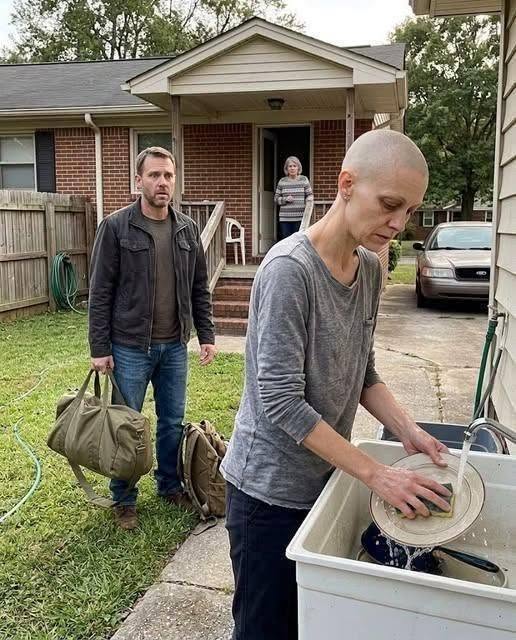
Instead, I found my wife kneeling in the dirt behind a house I had paid for.
Bald.
Painfully thin.
Picking broken pieces of a plate out of the ground with bare hands.
And the people I had spent four years trusting stood inside wearing my money.
I had been serving overseas with the U.S. Army.
I had sent almost one hundred thousand dollars home during those four years.
Sometimes more when extra compensation came through.
Sometimes less when schedules changed.
But every month, I transferred something.
I never thought of it as sacrifice.
That money was for home.
For Gwen.
For my mother, Margaret, if she needed help.
For my younger sister, Paige, while she got herself established.
For repairs.
Food.
Medical needs.
Anything that kept the people I loved secure until I came back.
I was not rich.
Not even close.
One hundred thousand dollars spread across four years is not some enormous fortune when an entire household is involved.
But it represented hours.
Risk.
Distance.
Things I did not buy for myself.
Meals skipped because I did not need anything fancy.
A new laptop I kept postponing.
A watch I wanted and never ordered.
Every time I decided not to spend, I imagined the money doing something useful at home.
A roof repaired.
A medical bill handled.
Gwen getting whatever she needed.
That belief made distance easier.
When emergency leave finally came through after our last deployment, I decided to keep my return secret.
Only the necessary people knew.
No family.
No Gwen.
Nobody.
My flight landed in the afternoon.
I remember walking through the airport feeling almost light.
Exhausted.
But light.
The bag on my shoulder seemed easier to carry with every step.
I rented a car because I wanted to arrive without anyone expecting military transport or a family pickup.
The closer I got to our neighborhood, the more nervous I became.
Good nervous.
I checked myself in the rearview mirror.
Too tired.
Too thin.
Hair shorter than Gwen liked.
I laughed at myself.
She was not going to care.
Then I turned onto our street.
And almost missed the house.
It looked completely different.
Two floors.
Fresh exterior.
Tall metal gate.
Landscaping.
A new truck parked out front.
Expensive looking windows.
A wide balcony that had never existed before.
I slowed.
Checked the number.
Correct.
For one brief second, pride filled my chest.
They had done something with the money.
Built something.
Improved everything.
Maybe Margaret had managed the renovations while Gwen handled the rest.
Maybe the sacrifices had been worth it.
I parked down the road because I still wanted the surprise.
Grabbed my bag.
Walked toward the house.
The gate was unlocked.
I stepped inside.
Nobody saw me.
Music played somewhere indoors.
Voices.
Laughter.
For some reason, instead of immediately using the front door, I walked around the side.
Maybe instinct.
Maybe I heard something.
I still do not know.
I reached the backyard.
And saw Gwen.
She was kneeling beside an old washing basin.
Not a modern sink.
Not the laundry room I had paid to renovate.
A plastic basin near the back wall.
Her clothes hung loose from her body.
Not fashionably loose.
Wrong.
As if they belonged to someone twenty pounds heavier.
Maybe more.
She wore a knitted cap despite the warm afternoon.
A broken plate lay scattered in the dirt.
Gwen was picking up pieces one at a time.
Slowly.
Her fingers shook.
At first, my brain refused to recognize her.
The body was wrong.
The posture was wrong.
The woman in my photograph had been healthy.
Soft cheeks.
Strong legs.
Thick hair.
This woman looked fragile enough that a strong wind might knock her sideways.
Then somebody shouted from inside.
Paige.
My sister.
“That bald woman shouldn’t even be showing her face when we have guests!”
Gwen froze.
So did I.
Bald woman.
For half a second I thought Paige meant someone else.
Then Gwen turned.
She saw me.
The world stopped.
I had imagined this moment thousands of times.
Her smile.
Her running.
Maybe crying.
Instead, Gwen stepped backward.
Not toward me.
Away.
Her hands flew to her head.
She grabbed the knitted cap with both hands as if she was afraid I might take it.
That reaction frightened me more than her appearance.
“Gwen?”
My voice sounded wrong.
She stared.
Her mouth opened.
Nothing came out.
I dropped my bag.
Moved closer.
She backed up again.
“Hey.”
I held both hands where she could see them.
“It’s me.”
Her eyes filled.
“I know.”
The words were barely audible.
“Why are you…”
I stopped.
Too many questions.
Why are you outside?
Why are you washing dishes?
Why are you so thin?
Why are you wearing that cap?
Why did Paige call you bald?
Why are you afraid of me?
I took another step.
Gwen shook her head.
“No.”
“Gwen.”
“Please.”
That word cut through me.
Please.
Like I was someone she needed protection from.
I lowered my voice.
“I’m not going to hurt you.”
Her eyes shut.
My chest tightened.
Why would she need to hear that?
I reached slowly toward her cap.
“Can I?”
She did not say yes.
But she stopped resisting.
I removed it.
My wife’s head was completely shaved.
Not salon shaved.
Uneven.
Raw in places.
Tiny cuts across the scalp.
Faint healing marks.
I stopped breathing.
“What happened?”
Gwen immediately grabbed the cap from me.
Pulled it back on.
The movement exposed her wrist.
Thin.
Too thin.
I saw what looked like medical tape residue near one arm.
Then the back door opened.
My mother stepped outside.
Margaret.
Silk blouse.
Gold earrings.
Gold bracelet.
Hair freshly styled.
For one instant she looked shocked to see me.
Then joy exploded across her face.
“My son!”
She rushed forward.
I stepped sideways.
Her arms paused.
Not enough to look rude.
Enough.
Paige appeared behind her.
New phone.
Designer purse.
Perfect nails.
She stared at me.
“You’re home?”
“Apparently.”
Margaret recovered.
“We thought you were coming next month.”
“Plans changed.”
“Oh, darling.”
She smiled.
Then noticed where I was looking.
Gwen.
Something defensive entered her face.
“She did this to herself.”
I looked at my mother.
“What?”
“The hair.”
Margaret sighed as if Gwen had embarrassed us all.
“She ruined it with cheap chemicals. I told her not to experiment.”
Gwen stared at the ground.
Paige laughed.
“And then she got obsessed with losing weight.”
I looked at Paige.
“Obsessed?”
“She barely eats.”
Margaret shook her head.
“We tried.”
That word.
Tried.
As if they were victims of Gwen’s choices.
I turned to my wife.
“Is that true?”
She did not answer.
Margaret spoke for her.
“She has become very strange since you left.”
I looked at the basin.
Broken plate.
Her bare hands.
“Why is she washing dishes out here?”
Margaret’s smile tightened.
“Because she broke one.”
“That did not answer me.”
“Don’t come home after four years and immediately start judging the household.”
Paige crossed her arms.
“You have no idea what we’ve dealt with.”
I almost laughed.
No idea.
They were right.
I had no idea.
Gwen bent to pick up another piece of porcelain.
Her sleeve slipped.
Hospital bandage.
Fading IV mark.
My body went cold.
“What is that?”
She yanked the sleeve down.
“Nothing.”
“Gwen.”
Margaret interrupted.
“She gets little treatments for weakness.”
“What treatments?”
“Nothing serious.”
Gwen looked toward my mother.
Fear.
There it was again.
Not annoyance.
Not embarrassment.
Fear.
I wanted to explode.
I wanted to drag every person into the living room and demand answers.
Four years in uniform taught me something else.
When you suspect somebody is lying, anger is information you do not give them yet.
People prepare when they know you are suspicious.
They coordinate stories.
Destroy evidence.
Move money.
I forced my face to change.
Relax.
Smile.
Not much.
Enough.
“I actually came home with good news.”
Margaret’s expression shifted instantly.
Paige looked interested.
Gwen looked confused.
“What news?” Margaret asked.
“Deployment compensation finally cleared.”
“How much?”
Too fast.
She did not ask how I was.
Not really.
She asked how much.
I pretended not to notice.
“Benefits too.”
Paige stepped closer.
“Okay?”
I smiled.
“Almost four hundred thousand.”
Silence.
Then Margaret’s entire face lit up.
“Oh, thank God.”
Not thank God you are safe.
Thank God.
Money.
Paige laughed.
“I knew there had to be something good after all this.”
Margaret touched my arm.
“We can finally finish the upstairs.”
I stared.
“Finish?”
“The balcony side.”
Paige added:
“And we need another truck.”
Margaret said:
“The kitchen could be redone.”
Not one question about Gwen.
Not one.
My wife stood less than ten feet away looking like she might collapse.
They were already spending money that did not exist.
Because there was no four hundred thousand dollar payment sitting in an accessible account.
I had exaggerated.
Deliberately.
I needed to know who they were.
The answer arrived instantly.
I smiled.
“Maybe.”
Margaret hugged me.
This time I let her.
Over her shoulder, I looked at Gwen.
She was not smiling.
She looked terrified.
That night, I found out why.
The Storage Room
Dinner felt like theater.
Margaret cooked.
Or claimed she did.
Paige talked about how difficult everything had been while I was gone.
George was not part of our household in this version of the story. It was just my mother, sister, Gwen and me.
I noticed that immediately because four years overseas can blur family routines, but it cannot invent people.
Gwen barely touched her plate.
Margaret kept watching her.
Once, Gwen reached for meat.
Paige said:
“You said your stomach hurt.”
Her hand stopped.
“Right.”
She put it back.
My jaw tightened.
I said nothing.
After dinner, Margaret showed me renovations.
New furniture.
Imported curtains.
Large television.
Granite.
Additional bedroom.
Bathroom fixtures.
Every item translated automatically into dollars in my head.
Money I had sent.
“How much did all this cost?”
Margaret waved her hand.
“Over four years?”
“Yes.”
“We’d have to calculate.”
Paige laughed.
“Don’t start doing Army math.”
Army math.
I smiled.
Inside, something colder grew.
When it was time for bed, I expected Gwen to go upstairs.
She did not.
I watched from the hallway as Margaret turned off lights.
Paige went to her room.
Gwen picked up folded laundry.
Then walked toward the back of the house.
I followed quietly.
She opened a narrow door.
Storage room.
Damp walls.
Old cleaning supplies.
Boxes.
Thin mattress on the floor.
One blanket.
I stood in the doorway.
Gwen froze.
“What is this?”
She put the laundry down.
“You should sleep upstairs.”
“Where do you sleep?”
Silence.
“Gwen.”
She pointed at the mattress.
For a second I could not process it.
“My wife sleeps here?”
“Please keep your voice down.”
I stepped inside.
Closed the door.
“Why?”
“They’ll hear you.”
I stared.
“They?”
She realized what she had said.
Looked away.
My anger nearly broke through.
I lowered my voice.
“Sit.”
She sat.
I sat beside her.
The floor was cold.
Moisture had darkened one corner of the wall.
There was no proper ventilation.
“This is where you sleep.”
“Yes.”
“How long?”
She did not answer.
“Gwen.”
Tears rose.
“I don’t want trouble.”
“You are my wife.”
“That’s why.”
“What does that mean?”
She shook her head.
“I can’t.”
I reached carefully for her hand.
She flinched.
Then let me hold it.
Bones beneath skin.
“What happened?”
Her mouth trembled.
I waited.
She slowly began unbuttoning her blouse.
My first thought was confusion.
Then I saw the scar.
Near her breast and upper chest.
Biopsy.
I knew enough to recognize something medical had happened.
“What is that?”
Gwen looked at me.
“I have cancer.”
Everything inside me stopped.
“What?”
“They found a tumor five months ago.”
I could not breathe correctly.
“What kind?”
She told me what doctors suspected.
More testing.
Specialist.
Treatment plan not completed.
My mind refused the sequence.
Five months.
I had spoken to her during those months.
Short calls.
She had said tired.
Fine.
Busy.
Nothing.
“Why didn’t you tell me?”
“I tried.”
“No.”
My voice broke.
“I would remember.”
“I tried.”
“Gwen.”
Tears slipped down her cheeks.
“I begged Margaret for three hundred dollars to see the specialist.”
My vision narrowed.
“What?”
“She said no.”
“Why?”
“She said I was pretending.”
My fingers tightened.
“She said I wanted your military pay.”
I almost stood.
Gwen grabbed my wrist.
“No.”
“She refused you medical treatment?”
“She said there was no proof anything was wrong.”
“You had a biopsy.”
“I didn’t yet.”
“How did you get the biopsy?”
Gwen touched her cap.
I already knew.
Did not want to know.
She removed it.
Her scalp under the dim light.
Small cuts.
“I sold my hair.”
My throat closed.
“How much?”
“One hundred fifty.”
I looked at her.
“You sold your hair for one hundred fifty dollars.”
“Yes.”
“To pay for transport and testing.”
“Yes.”
My entire body began shaking.
Not fear.
Rage.
She whispered:
“I cut it myself first.”
I could not speak.
“Then somebody helped clean it up.”
I covered my mouth.
Four years.
Almost one hundred thousand dollars.
And my wife sold her hair for one hundred fifty dollars because she could not get three hundred dollars from the people I trusted with my money.
Upstairs, my mother slept under expensive sheets.
My sister’s new phone probably cost ten times that amount.
Truck outside.
Gold jewelry.
Renovations.
Furniture.
My wife sold her hair.
I wrapped both arms around Gwen.
She remained stiff at first.
Then collapsed against me.
Not crying loudly.
Her body barely had strength.
I whispered into her scalp:
“Hold on a little longer.”
She shook.
“I’m sorry.”
I pulled back.
“For what?”
“For looking like this.”
That sentence destroyed me.
“You never apologize for being sick.”
She cried harder.
“I thought you’d be ashamed.”
“Of you?”
“Paige said…”
I stopped her.
“No.”
She stared.
“Listen to me.”
I held her face carefully.
“I came home for you.”
Her eyes closed.
“I should have known.”
“How?”
“I should have seen it in the calls.”
“You couldn’t.”
“I should have.”
“You were overseas.”
“That doesn’t excuse—”
“It does not make you responsible for what they did.”
I stopped.
They.
Gwen had said it without thinking.
“What did they do?”
She looked toward the door.
Fear again.
I lowered my voice.
“Not tonight.”
She nodded.
I lay beside her on the thin mattress.
She protested.
“You shouldn’t sleep here.”
“Neither should you.”
“They’ll hear you.”
“Let them.”
Her hand closed around my wrist.
“No.”
Real fear.
That stopped me.
I stayed quiet.
Held her until she slept.
Then stared at the ceiling until morning.
Above us were rooms paid for by money I earned overseas.
Furniture.
Clothes.
Jewelry.
A truck.
Below them, my wife slept beside cleaning supplies.
Before sunrise, I made one decision.
I was going to find out where every dollar went.
But I would not confront Margaret.
Not yet.
Not Paige.
Not until I understood everything.
The Letters
At 5:30, Gwen woke.
She immediately tried to sit.
“You shouldn’t be sleeping here.”
“Neither should you.”
She looked toward the ceiling.
Fear again.
“They’ll hear.”
I lowered my voice.
“How long?”
“What?”
“This.”
She looked away.
“How long have they treated you like this?”
Her lips trembled.
“Almost three years.”
Three.
I stared.
I had been gone four.
Almost the entire deployment.
“Why didn’t you tell me?”
“I tried.”
Something inside me dropped.
“What does that mean?”
Gwen reached beneath the thin mattress.
Pulled out a plastic bag.
Letters.
Receipts.
Medical papers.
Photographs.
Dozens.
She placed them in my hands.
“I wrote you more than thirty times.”
I picked up the first.
My name.
Her handwriting.
Envelope never sent.
“Why didn’t I get them?”
“Margaret said she mailed them.”
I opened one.
I don’t want to worry you. I’m having some health problems, but I’m trying to stay strong.
Another:
Please call when you can. I need to hear your voice.
Another:
I think something is seriously wrong.
My eyes blurred.
“You tried calling.”
“Yes.”
“How many times?”
“Too many.”
“I never saw the calls.”
“Paige changed my number.”
My head lifted.
“What?”
“She said the phone was broken.”
“Was it?”
“I don’t know.”
“She gave you another?”
“Yes.”
“Controlled by her?”
Gwen nodded.
“She said you were under stress.”
My stomach turned.
“She said if I kept calling, I would distract you from the mission.”
I stared.
There had been calls.
Short.
Awkward.
Gwen pausing.
Her voice low.
I blamed distance.
Poor connection.
Exhaustion.
“Sometimes Paige stood beside me.”
My fingers froze on the letter.
“What?”
“While we talked.”
I remembered.
Silences.
Answers that sounded rehearsed.
Everything okay?
Yes.
You sure?
Yes.
Need anything?
No.
Always no.
Because my sister was standing beside her.
Monitoring.
Four years overseas taught me to watch people.
Somehow I had not realized my own wife was asking for help without words.
I hated myself for that.
Gwen saw my face.
“Don’t.”
“What?”
“Don’t blame yourself.”
“How can I not?”
“They made sure you didn’t know.”
Hospital papers.
Date five months ago.
Biopsy.
Specialist recommended.
I looked at her.
“Why didn’t you continue?”
“I couldn’t afford it.”
“You had my money.”
Painful smile.
“No.”
“I sent money every month.”
“I know.”
“Then where did it go?”
“I don’t know.”
I hated the answer.
“You stopped asking?”
“Yes.”
“Why?”
“Because every time I asked, Margaret said household expenses.”
I looked around the storage room.
“What expenses?”
She laughed without humor.
“Jewelry.”
My mother’s bracelet flashed in memory.
“Furniture.”
Living room.
“Paige’s phone.”
New device.
“The truck.”
Of course.
“Clothes. Renovations. Gate.”
Every thing I admired when I arrived transformed.
Not home.
Evidence.
I stood.
“Where are the bank records?”
Gwen grabbed my hand.
“Please.”
“What?”
“Don’t tell them.”
“Why?”
“There’s something else.”
I sat.
“What?”
She hesitated.
“I don’t think Margaret was making all the decisions.”
A chill moved through me.
“Then who?”
Gwen reached beneath the mattress again.
Another envelope.
No bank logo.
No hospital stamp.
My name in black ink.
Inside:
Photograph.
Margaret standing beside a bank employee.
Financial institution behind them.
Date two years earlier.
Folder in my mother’s hand.
My transfer folder.
On the back:
Ask your mother who really owns the account.
I stared.
“Who gave you this?”
“I don’t know.”
“Where?”
“Outside the storage room.”
“When?”
“Months ago.”
“Why didn’t you show anyone?”
“Who?”
The question hurt because it had no answer.
Who could she trust?
Not Margaret.
Not Paige.
I was thousands of miles away.
“Somebody wanted you to know.”
“I think so.”
“Why?”
“I don’t know.”
Footsteps above.
Gwen snatched the photograph.
“Hide it.”
I placed it in my pocket.
Margaret’s voice echoed.
“Is everyone awake?”
Gwen stiffened.
I had seen people react to danger.
That was the reaction.
My mother came downstairs wearing silk.
Stopped when she saw me.
Then transformed.
Warm smile.
“Oh, darling.”
She rushed forward.
“My son.”
I did not move.
She hugged me.
Gold bracelet caught morning light.
“Nice bracelet.”
She touched it.
“Oh, this?”
“Yeah.”
“Paige bought it.”
Paige appeared.
“Mom deserves something nice.”
I smiled.
“Of course.”
Margaret studied me.
“You mentioned good news.”
“The compensation?”
Her eyes lit.
“Yes.”
“How much?”
“Almost four hundred thousand.”
Paige stepped closer.
“What are you going to do with it?”
“I haven’t decided.”
Margaret touched my arm.
“Invest in the house.”
“Maybe.”
“Another property,” Paige said.
“Maybe.”
“Build another floor,” Margaret added.
“Maybe.”
Then:
“By the way, Mom, what bank do you use?”
Her smile vanished for half a second.
“Why?”
“I need advice.”
I named the bank in the photograph.
Margaret became still.
Paige looked at her.
One glance.
Enough.
They were communicating.
I smiled.
“Never mind. We’ll talk later.”
The rest of breakfast, I pretended.
Laughed.
Ate.
Listened.
Inside, I counted contradictions.
At noon, Paige left.
I followed.
The Financial Office
Paige drove into the city.
I kept enough distance that she never looked back twice.
Twenty minutes.
Small gray office building.
No obvious corporate branding.
She parked.
Entered.
I waited.
Ten minutes.
Twenty.
A man came outside carrying a folder.
Paige joined him.
Looked around.
Took it.
They shook hands.
I photographed everything.
Then the man turned.
I knew him.
He had visited our home two years earlier.
During one of the rare periods I was able to video call while Margaret had guests.
She introduced him as someone helping with family finances.
I remembered the watch.
Military style.
A model common among some personnel I had worked around overseas.
Coincidence.
Maybe.
But coincidence had become expensive.
After Paige left, I entered.
Receptionist.
“Can I help?”
I gave the man’s name.
Her face changed.
“Not available.”
“Employee?”
“Not exactly.”
Before she answered, an older man came down the hallway.
He saw me.
Stopped.
“You’re Margaret’s son.”
My body went cold.
“How do you know?”
He looked at the receptionist.
“Close the door.”
She did.
Then:
“You shouldn’t have come here.”
“Why?”
“If you start asking questions, they’ll know you found out.”
“Who?”
His eyes narrowed.
“Your mother isn’t the only person using your money.”
I stepped closer.
“What does that mean?”
He lowered his voice.
“Your wife wasn’t the only person they were keeping sick.”
I stared.
“What?”
He glanced at the door.
“There’s another account.”
“Whose?”
“Yours.”
He handed me sealed envelope.
My name.
“This was opened four years ago.”
“I didn’t open an account.”
“I know.”
“Who did?”
“That is what you need to prove.”
I opened it.
Bank statement.
Transfer.
Twenty five thousand dollars.
Recipient.
A name I knew.
Connected to my years overseas.
My hands went numb.
Someone trusted.
Someone with access to deployment information.
I looked up.
“What the hell is this?”
The older man shook his head.
“Not here.”
“You brought me this far.”
“I did not bring you anywhere. You followed your sister.”
“Then explain.”
“Someone has been preparing for the day you came home.”
My phone rang.
Gwen.
I answered instantly.
“Where are you?”
Her voice shook.
“City.”
“You need to come home.”
“Why?”
Silence.
“Paige knows you found the account.”
My stomach dropped.
“How?”
“I don’t know.”
“Where are you?”
“House.”
“Lock the door.”
“I did.”
“Gwen…”
Crash.
Her scream.
Call dead.
Everything else disappeared.
I ran.
The Gate
I do not remember most of the drive.
Only Gwen’s scream.
Again.
Again.
Again.
I called.
No answer.
Again.
Nothing.
I pushed harder.
When I reached the house, the gate stood open.
That gate had impressed me one day earlier.
Now it looked like a warning.
I ran inside.
“GWEN!”
Living room empty.
Television on.
Glass broken on floor.
“GWEN!”
Crying.
Backyard.
I ran.
She sat beside the washing basin.
Blood on one sleeve.
Alive.
I dropped beside her.
“Who?”
“Paige.”
My body went cold.
“Where is she?”
“Gone.”
“What happened?”
“She wanted the envelope.”
“What envelope?”
“The things under my mattress.”
We went to the storage room.
Destroyed.
Mattress thrown.
Letters gone.
Hospital documents gone.
Photograph gone.
Medical evidence.
Everything.
Gwen reached into a different hiding place.
Small notebook.
“I kept this somewhere else.”
Inside:
Dates.
Amounts.
Names.
Transfers.
Notes.
My money divided.
Margaret.
Paige.
Then a company I had never heard of.
Same name from the bank statement.
Monthly transfers for nearly four years.
Almost same months I sent money.
Same pattern.
This was not random theft.
System.
I called the financial officer.
He answered.
“Did you find her?”
“Find who?”
Silence.
“The person who opened the account.”
“Tell me everything.”
He sighed.
“Four years ago, someone used your identification documents.”
“To open the account.”
“Yes.”
“Who?”
“I don’t know with absolute certainty.”
“You have authorization records.”
“Yes.”
“Name.”
Pause.
“Your mother signed the authorization.”
I closed my eyes.
Margaret.
“Was my signature forged?”
“Yes.”
“And the money?”
“Moved through multiple accounts before reaching the investment company.”
Same one.
“Why?”
“You need to ask Margaret.”
Call ended.
When we returned inside, my mother stood in the hallway.
Paige behind her.
So much for gone.
Maybe she had returned.
Maybe she never left the property.
Her eyes red.
Margaret no longer smiled.
No performance.
“How long?”
“Please listen.”
“How long?”
“Four years.”
I laughed.
Four years.
Exactly.
“You stole my money.”
“We invested it.”
“You stole it.”
“I protected the family.”
I pointed at Gwen.
“From her?”
Silence.
“She was dying in a storage room.”
“We did not know how serious—”
Gwen spoke.
“I told you.”
Margaret looked away.
“You begged for money.”
“Yes.”
“Three hundred dollars.”
“Yes.”
“And you refused.”
“I thought…”
“You called her a liar.”
Gwen’s voice broke.
“You told me I wanted attention.”
Margaret cried.
I felt nothing.
Then Paige said:
“We thought you’d never come back.”
Room silent.
I turned.
“What?”
She covered her face.
“We thought you would stay overseas.”
“Why?”
“Everything got complicated.”
“Complicated?”
“Mom said if you came back, you would ask questions.”
I stared.
“Then why keep the house?”
“Because money was invested.”
“How much?”
Silence.
“How much?”
Margaret whispered:
“Almost three hundred thousand.”
My knees nearly gave out.
“I sent under one hundred.”
“It grew.”
Investments.
Transfers.
Leverage.
Whatever operation they built had multiplied the stolen funds.
“How much now?”
Silence.
“There is money.”
Paige nodded.
“Yes.”
“Where?”
“Overseas.”
That was when I understood their reaction to my fake four hundred thousand.
They were not excited I returned.
They were excited another pool of money had arrived.
I looked at my mother.
“Do not be afraid of me.”
She stepped backward anyway.
“I’m not angry.”
I looked at Gwen.
“I’m heartbroken.”
That broke something in Margaret’s face.
Good.
Anger could become a story about my temper.
Heartbreak left nowhere to hide.
The Hospital
The next morning, I took Gwen to the hospital.
No storage room.
No permission.
No asking Margaret for three hundred dollars.
I sat beside my wife through intake.
Bloodwork.
Imaging.
Consultation.
Every time someone asked for insurance information, I handled it.
Every time Gwen tried to apologize, I stopped her.
When the doctor finally entered, Gwen gripped my hand so tightly her fingers turned white.
“The tumor is treatable.”
Gwen started crying.
I closed my eyes.
For four years, I had trained myself not to react too quickly.
That morning, I let myself cry.
Hope can hurt after fear.
Treatment would not be easy.
Surgeries.
Months.
Follow up.
Medication.
Potential complications.
But there was a path.
That was everything.
Gwen looked at me.
“I thought…”
She could not finish.
I knew.
She thought she would die in a storage room while my family called her dramatic.
I kissed her forehead.
“You’re not doing this alone.”
What I Had Missed
During treatment, Gwen finally told me the entire story.
Not at once.
Trauma does not arrive as a clean narrative.
Pieces.
One night, she explained the first year.
Margaret took control of household money because I was away.
At first, Gwen agreed.
My mother was older.
Experienced.
The transfers arrived.
Bills were paid.
Then Margaret began deciding what Gwen could spend.
Groceries.
Clothes.
Medicine.
Everything.
If Gwen questioned it, Margaret said:
“My son earned this. I will make sure it isn’t wasted.”
Paige reinforced it.
“She used to say you didn’t trust me.”
My stomach twisted.
“What?”
“That was why your mother controlled the account.”
“I never said that.”
“I know now.”
Second year.
Paige replaced Gwen’s phone.
Controlled access.
Blocked certain calls.
Read messages.
Sometimes stood beside her during our conversations.
Letters Gwen wrote disappeared.
When she asked, Margaret said international military mail was unreliable.
Gwen believed some of it.
What choice?
Third year.
Treatment worsened.
No money.
No independence.
Storage room after Margaret claimed Gwen’s bedroom needed renovation.
Renovation somehow never ended.
“Why didn’t you leave?”
I asked once.
Immediately regretted it.
Gwen looked at me.
“With what money?”
I closed my eyes.
Of course.
No phone.
No money.
Ill.
Isolated.
The house itself became a trap.
Fourth year.
Cancer symptoms.
Begging.
Hair.
Biopsy.
That was when somebody began leaving information.
Photograph.
Hints.
Maybe whistleblower.
Maybe someone connected to the financial operation.
The message on the photo.
Ask your mother who really owns the account.
Gwen kept everything because she hoped one day I would come home.
The sentence destroyed me.
One day.
She had waited.
Not passively.
Surviving.
The Investigation
I reported the forged documents.
Accounts froze.
Financial investigators became involved.
The investment company drew scrutiny.
Some money was recoverable.
Some was not.
Margaret and Paige had to answer questions they could no longer dismiss with family language.
This was the moment I learned something important.
Families often use words like help, sacrifice and protection to hide behavior that would sound completely different if strangers did it.
If a stranger forged your signature, that is fraud.
If a stranger takes your money, that is theft.
If a stranger controls your spouse’s phone and prevents her from contacting you, that is coercive.
Calling the person Mom does not change behavior.
I loved Margaret.
That made the truth worse.
Not less true.
The beautiful house went up for sale.
Truck sold.
Jewelry sold.
Furniture.
Anything tied to misused funds became part of the financial unraveling.
I did not want the house.
People assumed I would.
After all, my money paid for much of it.
No.
Too many memories.
The backyard basin.
Storage room.
Gate.
Gold bracelet.
Everything.
I rented a small apartment near Gwen’s treatment center.
One bedroom.
Then upgraded to two when we could.
Nothing impressive.
No gate.
No balcony.
No expensive curtains.
But Gwen slept in a real bed.
Beside me.
That apartment felt richer than the house ever had.
Margaret
My mother asked to see me during the investigation.
I almost refused.
Then agreed.
Public place.
Gwen did not come.
Margaret looked smaller.
No silk.
No jewelry.
She folded her hands.
“I know you hate me.”
“No.”
She seemed confused.
“Hating you would be easier.”
Her eyes filled.
“I thought I was helping.”
“How?”
She took a breath.
“When you left, everything felt uncertain.”
“So you forged my signature.”
“I was told—”
“By who?”
She stopped.
There.
The missing layer.
“Who told you?”
“I can’t…”
“Mom.”
Her eyes dropped.
“Someone said the money could grow.”
“Who?”
“A financial adviser.”
“Name.”
She gave the same name tied to someone from my overseas network.
My stomach tightened.
“How did you meet him?”
“He contacted me.”
“When?”
“After your deployment.”
“How did he know I was deployed?”
She went silent.
That was the question.
The mysterious person.
Someone knew my schedule.
My income.
My family.
Gwen’s condition.
“What did he tell you?”
“That military families lose money because spouses waste it.”
I laughed bitterly.
“And you believed Gwen would waste it.”
“I…”
“Say it.”
“Yes.”
“Why?”
“She wasn’t family.”
I stared.
“She was my wife.”
Margaret cried.
“I know.”
“No. She was family before Paige’s phone. Before your bracelet. Before that truck.”
“I know.”
“Then why?”
Fear.
Control.
Greed.
Jealousy.
All mixed.
My mother did not have one clean motive.
People rarely do.
The adviser convinced her to create structures.
Promised returns.
Paige helped manage transfers.
They spent some.
Invested some.
Then the money grew.
Greed made stopping harder.
They needed me away.
Gwen became threat because she asked questions.
Then Gwen got sick.
By then admitting truth would expose everything.
So they called her a liar.
That was perhaps the ugliest part.
They protected theft by turning illness into a character flaw.
I stood.
Margaret grabbed my hand.
“Please.”
I looked down.
“Do not ask me to forgive you while Gwen is still in treatment.”
She released me.
I left.
Paige
Paige was harder.
She remained defensive longer.
She said Margaret controlled her.
Said the adviser manipulated them.
Said she never meant Gwen real harm.
I asked:
“Did you stand beside her while she called me?”
Silence.
“Yes.”
“Did you change her phone?”
“Yes.”
“Did you hear her ask for help?”
“She was always complaining.”
My jaw tightened.
“Did you call her bald woman?”
Paige looked away.
“Yes.”
“Did you know why she had no hair?”
“She said she cut it.”
“Did you ask why?”
“No.”
“Because you didn’t care.”
“That’s not fair.”
“Fair?”
I laughed.
“Gwen sold her hair to pay for a biopsy while you carried a purse bought with my money.”
Paige cried.
For once, I did not comfort her.
Some guilt should be felt.
Not forever.
But long enough to become change.
Gwen’s Hair
Months later, Gwen’s hair began growing back.
Tiny.
Soft.
Uneven.
I noticed before she did.
She caught me staring.
“What?”
“Nothing.”
“You’re staring.”
I touched her scalp gently.
“Hair.”
She reached up.
Felt it.
Then laughed.
A real laugh.
I had not heard that sound since returning.
“You look like I almost lost you,” I said.
She became quiet.
“You came home.”
“I should have come sooner.”
She shook her head.
“You came when you needed to.”
I did not agree.
But I stopped arguing.
Guilt can become selfish if you make the harmed person spend energy comforting you.
I learned to carry mine without placing it on Gwen.
The Money Could Not Buy Time
Eventually, some of the money was recovered.
Not all.
Enough to help.
People asked whether I regretted sending it.
No.
I regretted trusting the wrong people with control.
The intention had been right.
Support family.
The system had been wrong.
One person should not have controlled access.
One family member should not have managed communication.
I thought money itself protected people.
It does not.
Money needs transparency.
Relationships do too.
I had sent almost one hundred thousand dollars home believing every transfer meant safety.
Instead, some paid for gold.
Phones.
Truck.
House.
Investments.
Meanwhile Gwen needed three hundred dollars.
That ratio haunted me.
Three hundred.
Less than many single transfers I sent.
A tiny amount compared with the total.
She could not access it.
The problem was never absence of resources.
It was control.
The Unknown Message
One evening, Gwen and I sat outside our apartment.
Her hair growing.
Still tired.
Treatment ongoing.
But hopeful.
She touched the short strands.
“I look terrible.”
“You look alive.”
She smiled.
“I’ll take that.”
My phone buzzed.
Unknown number.
I opened.
One sentence.
You recovered the money, but you still don’t know who started it.
My heart accelerated.
Gwen saw my face.
“What?”
I locked the screen.
“Nothing.”
She frowned.
For a second, I considered telling her.
Then stopped.
Not because she could not handle truth.
Because that evening was the first peaceful one we had experienced in weeks.
The financial officer had warned me.
Margaret forged documents.
Paige moved money.
But someone else created the structure.
Someone knew my deployment date.
Compensation.
Transfers.
Family weaknesses.
Someone connected to my years overseas.
The name on the first statement.
The military style watch.
The adviser.
There was another layer.
I deleted the visible message.
Not the evidence.
I had already saved it securely.
That distinction mattered.
I was not ignoring the threat.
I was refusing to let it steal the evening.
Gwen leaned against me.
I looked at her hair.
Her face.
Alive.
This time I knew priority.
Her.
Therapy
Both of us went.
I resisted at first.
Soldiers become practiced at compartmentalizing.
Put one thing away.
Do job.
Move.
That strategy works in certain environments.
Not marriage.
My therapist asked:
“What hurts most?”
“Everything.”
“Choose.”
I hated that.
Then:
“The letters.”
“Why?”
“Because they existed.”
Thirty plus.
Gwen reached.
I did not receive.
“If I had gotten one…”
“You might have come home.”
“Yes.”
“Could you?”
I paused.
Maybe.
Maybe not immediately.
Deployment realities are real.
But I could have acted.
Called command.
Arranged medical help.
Protected funds.
Something.
“The letters mean there were chances.”
“Yes.”
“That is grief.”
I nodded.
Not guilt alone.
Grief for possible interventions.
Then therapist said:
“You cannot live inside the alternate timeline.”
I knew.
Still visited it often.
Gwen’s Version of Home
One night, I asked Gwen:
“What did you think home was while I was gone?”
She stared at the ceiling.
“You.”
Not house.
Not family.
Me.
My chest tightened.
“That is a lot to put on someone.”
“I know.”
“What happens now?”
She thought.
“Maybe home needs to be more than one person.”
That answer showed how much she had changed.
We built routines.
Friends.
Medical team.
Community.
Gwen reconnected with people Margaret and Paige had pushed away.
A cousin.
Old coworker.
Neighbor.
Isolation had made abuse possible.
Connection became protection.
I learned not to be her only source of safety.
That was important too.
Love should expand a person’s world.
Not become the whole border around it.
The House Sale
The old house sold.
I attended nothing.
Agent handled it.
When final papers arrived, I stared at photograph in listing.
Beautiful.
Two floors.
Gate.
Truck gone.
Fresh paint.
Someone else might see dream home.
I saw backyard.
Storage room.
Washing basin.
Broken plate.
Gwen’s cap.
I closed listing.
Signed.
Done.
Money from sale entered legal process.
Some recovered funds restored.
Some directed to obligations.
I did not care about maximizing every dollar.
I cared about ending connection.
Margaret’s Bracelet
The gold bracelet appeared in inventory when assets were reviewed.
My mother had claimed Paige bought it.
Records showed funds traced to accounts containing my transfers.
I was asked what I wanted done.
Sell.
No sentiment.
The proceeds could help repay.
Margaret later said losing that bracelet hurt.
Not because gold.
Because it represented what she had become.
I did not respond.
Sometimes consequences teach lessons family speeches cannot.
Gwen’s First Real Meal
Treatment affected appetite.
For months, food remained difficult.
Then one evening, Gwen asked for grilled chicken.
Simple.
I cooked.
Badly.
She took a bite.
Made face.
“What?”
“Dry.”
I stared.
Then we both laughed.
I had not realized how much I missed ordinary criticism.
She ate half.
More than usual.
That night felt bigger than any recovered account.
Progress changes scale after illness.
A meal.
A walk.
Hair.
Sleep.
Things money cannot manufacture.
Paige’s Apology
A year later, Paige wrote.
Not called.
Letter.
Maybe because letters had become symbolic.
She wrote:
I stood beside Gwen when she called you. I watched her choose every word because she was afraid of what I would say afterward. I told myself I was helping Mom protect the family. The truth is I liked the life your money gave us and I didn’t want Gwen to threaten it.
That sentence mattered.
Not excuses.
Truth.
She continued.
I don’t expect forgiveness. I just need you to know I understand now that what I did was cruel.
I showed Gwen.
She read.
Then handed it back.
“What do you think?”
“I think she’s sorry.”
“Do you forgive?”
Gwen thought.
“Not yet.”
Fair.
The Adviser
The investigation into the larger financial structure continued.
The adviser connected to my overseas network became central.
I will not invent a perfect criminal mastermind resolution because life did not hand me one quickly.
Records showed contact.
Knowledge he should not have had.
Financial accounts set up under my identity.
Transfers timed around deployments.
Margaret’s authorization.
Paige’s participation.
Investment company.
But the unknown message suggested someone above or beside him.
You still don’t know who started it.
Maybe intimidation.
Maybe truth.
Investigators followed it.
I learned to tolerate uncertainty.
That was difficult.
After years of being deceived, you want every answer.
But chasing every shadow can become another kind of captivity.
I cooperated.
Protected us.
Then went home to Gwen.
The Four Hundred Thousand Lie
Eventually Margaret learned the compensation amount had been a trap.
There was no immediate four hundred thousand windfall ready for them.
She asked:
“Why would you lie?”
I almost smiled.
“Because I needed to know what mattered to you.”
Her eyes lowered.
“The money.”
“Yes.”
“I was happy you were home.”
“I believe part of you was.”
That was the most accurate answer.
People are complicated.
My mother could love me and still exploit me.
Those truths can coexist.
That complexity does not excuse harm.
It explains why leaving hurt.
Coming Home
For years, I thought coming home was a physical event.
Plane lands.
Bag.
Gate.
House.
Wife.
I was wrong.
Coming home took months.
Maybe years.
I had to return emotionally.
Learn Gwen again.
She had changed.
So had I.
Her fear.
My hypervigilance.
Her medical trauma.
My military habits.
We could not simply resume the marriage paused four years earlier.
That marriage no longer existed.
We had to build a new one.
Sometimes that felt unfair.
After everything, should not love automatically repair itself?
No.
Love helps.
Work repairs.
Conversation.
Patience.
Boundaries.
Medical care.
Therapy.
Time.
The Night Gwen Told Me Everything
About eighteen months after my return, Gwen woke me.
“Can we talk?”
“Always.”
She sat up.
“I hated you.”
I stayed still.
“When?”
“While you were gone.”
That hurt.
But I listened.
“Sometimes.”
She continued.
“I knew it wasn’t your fault. Then I would think you forgot me.”
Tears came.
“I thought maybe Margaret was right. Maybe you sent money to her because you trusted her more.”
“No.”
“I know now.”
“I need you to say everything.”
She breathed.
“I hated hearing your voice sometimes.”
My chest tightened.
“Because Paige stood there?”
“Yes.”
“And because you sounded okay.”
I understood.
My normal voice became evidence I was safe while she suffered.
“I’m sorry.”
“I know.”
“I should have…”
She stopped me.
“No.”
Her hand found mine.
“I’m not telling you so you punish yourself.”
“Then why?”
“Because if we’re going to be okay, I can’t protect you from my feelings.”
That sentence changed our marriage.
Truth without protection.
No performance.
I nodded.
“Then hate me if you need.”
She smiled sadly.
“I don’t now.”
“Good.”
“I’m still mad sometimes.”
“Fair.”
We laughed quietly.
Healing.
What I Learned About Loyalty
I had once believed loyalty meant defending family.
After returning, definition changed.
Loyalty without truth becomes complicity.
Margaret expected Paige to be loyal.
Paige helped.
They called it family.
Gwen needed someone to be loyal to her wellbeing instead.
Nobody was.
I began teaching myself:
If someone I love is wrong, telling the truth is not betrayal.
If family steals, reporting theft is not betrayal.
If family controls a sick person, stopping it is not betrayal.
Sometimes loyalty means refusing to help someone continue becoming worse.
The Army Photograph
The photograph of Gwen I carried overseas still exists.
Faded.
I framed it next to a new one.
New picture:
Gwen with short regrown hair.
A little fuller in the face.
Standing beside me outside our small apartment.
Not glamorous.
She is laughing.
In the old photograph, I believed I knew what home looked like.
In the new one, I understand home is something people continually create.
Not guaranteed by blood.
Not by property.
Not money.
By safety.
Truth.
Choice.
Two Years After
Two years after my return, Gwen’s doctors gave us news we had prayed for.
Treatment had worked well.
Ongoing monitoring.
No guarantees.
But strong progress.
We sat in the car afterward.
Neither spoke.
Then Gwen whispered:
“I might live.”
I turned.
“Don’t say might like that.”
She laughed through tears.
“You know what I mean.”
I did.
We cried.
Then bought cheap ice cream.
Sat in parking lot.
Ate from paper cups.
Best celebration of my life.
Margaret Again
Eventually, I saw my mother again.
Older.
No jewelry.
She looked at Gwen.
Gwen stayed near me but not behind me.
Margaret said:
“I am sorry.”
Gwen answered:
“I know.”
Same words I had once used.
Margaret cried.
Gwen did not comfort her.
That was not cruelty.
Boundary.
My mother asked:
“Can I ever make it right?”
Gwen said:
“No.”
Margaret flinched.
Then Gwen continued:
“You can live differently.”
That was better than forgiveness.
Maybe.
Paige’s Phone
During legal review, the phone Paige had used to monitor Gwen became evidence.
Messages.
Call logs.
Control settings.
Blocked numbers.
I saw one text from Margaret:
Don’t let her worry him. He needs focus.
That sentence haunted me.
They framed isolation as protection.
Protect me.
At Gwen’s expense.
I realized something about abuse.
It often dresses itself as concern.
We’re helping.
We know better.
You’re too sick.
He’s too busy.
This is for family.
Words can make control look respectable.
Behavior tells truth.
The Mysterious Photograph
The photograph of Margaret at the bank remained important.
Who left it?
We never established conclusively.
Possibilities existed.
Employee.
Someone from the investment company.
Person with conscience.
Someone trying to manipulate later events.
I wanted answer.
Did not get one.
At first, unresolved details felt intolerable.
Then life taught me:
Closure is not total knowledge.
Closure can be knowing enough to choose.
I knew my family stole.
Gwen was isolated.
Accounts forged.
Cancer neglected.
That was enough to act.
The Name on the Statement
The name connected to my overseas years remained the most disturbing clue.
I will not invent its identity beyond what the source gives.
I knew the name.
Trusted it.
It connected my life overseas to the scheme at home.
That meant the operation was not simply household greed that grew accidentally.
Someone had information.
Deployment timing.
Compensation.
Possibly identity documents.
That person became part of the broader investigation.
I changed passwords.
Bank procedures.
Contacts.
Nobody had unilateral access anymore.
Gwen and I reviewed finances together.
Not because marriage requires surveillance.
Because transparency had been absent too long.
The First Vacation
Three years after return, Gwen and I took a short trip.
Nothing expensive.
Cabin.
Two nights.
Before leaving, she packed medication three times.
Checked the bag repeatedly.
I wanted to say relax.
Stopped.
Her anxiety had reasons.
Instead:
“What would make this easier?”
She looked at me.
“Can I hold the medicine?”
“Of course.”
That small question reminded me:
Control over small things matters after someone has been controlled.
We had a good trip.
Not perfect.
Gwen tired quickly.
I woke from a deployment nightmare.
Still good.
Real life.
Almost One Hundred Thousand Dollars
Sometimes people focused on the number.
“You sent almost one hundred thousand?”
Yes.
But the number is not what devastates me.
Three hundred dollars does.
Gwen needed three hundred.
Imagine having enough money in the system.
Not being able to access three hundred to learn whether you have cancer.
That is the story.
Resource versus power.
Money exists.
Person cannot use it.
Someone else controls gate.
That dynamic appears everywhere, not only bank accounts.
Information.
Phones.
Transportation.
Medical care.
A person can live in a wealthy house and still be deprived.
Gwen proved that.
The Storage Room Mattress
When the house sold, I asked for one thing.
The thin mattress.
Everyone thought I was strange.
I took it.
Not to keep forever.
I brought it outside.
Gwen stood beside me.
We looked.
Then I cut it open.
Inside were dust.
Old paper fragments.
Nothing symbolic enough.
We disposed of it.
No fire.
No dramatic destruction.
Just trash.
That felt right.
It was not sacred.
It was something she should never have slept on.
Gwen’s Hair Became Long Again
Years passed.
Her hair grew.
First short.
Then chin.
Then shoulder.
One morning, she complained:
“It takes forever to dry.”
I smiled.
“What?”
“Nothing.”
“You’re doing that thing.”
“What thing?”
“Looking like you’re about to cry.”
“I’m not.”
“You are.”
I touched a strand.
“You sold this once.”
Her expression softened.
“I know.”
“For one fifty.”
“Terrible deal.”
I laughed.
“Worst financial transaction in family history.”
She laughed too.
Then serious:
“It bought me the biopsy.”
“Yes.”
“It bought me time.”
We stopped joking.
I kissed her forehead.
The hair did not matter aesthetically.
It became evidence of survival.
The Unknown Person
The broader case never became something I let dominate our lives.
That was intentional.
Investigators continued.
Occasional updates.
The message:
You recovered the money, but you still don’t know who started it.
I saved a copy.
Did not obsess.
Whoever sent it wanted attention.
Maybe warning.
Maybe fear.
I refused to give them Gwen’s recovery time.
That was the final victory.
Not solving every mystery.
Refusing to let mystery become master.
Four Years Since Coming Home
On the fourth anniversary of my return, Gwen did something funny.
She placed a broken plate on the kitchen counter.
I stared.
“What is that?”
She smiled.
“I bought it broken.”
“Why?”
“Art.”
I looked at her.
“You paid money for broken dishes?”
“Very little.”
She had arranged the pieces in a frame.
Not the original plate.
Just symbolic.
At bottom:
HOME IS WHERE NOBODY MAKES YOU PICK UP THE PIECES ALONE.
I stared.
Then laughed and cried at same time.
“Too sentimental?”
“Yes.”
“You hate it?”
“No.”
We hung it.
What Home Means Now
I came home expecting reunion.
I found investigation.
Illness.
Betrayal.
Fraud.
Fear.
Maybe that sounds like the opposite of home.
At first, yes.
But home is not what waits.
It is what you decide to build after seeing what was really there.
Gwen and I built smaller.
Slower.
More honest.
No impressive gate.
No expensive furniture.
No rooms purchased to show success.
Our home contained ordinary things.
Medication organizer.
Photographs.
Plants Gwen kept forgetting to water.
My boots near the door.
Too many mugs.
Bills we both understood.
Phones nobody monitored.
That was wealth.
If I Could Speak to Myself Overseas
I would not tell him to stop sending money.
I would tell him:
Do not let one person control it.
Call your wife privately.
Ask specific questions.
Do not accept “fine” forever if her voice sounds wrong.
Send resources directly where needed.
Build redundancy.
Trust family.
But verify systems.
Most importantly:
Do not confuse providing money with providing safety.
I thought sending money was enough.
It was useful.
But safety also requires access.
Voice.
Connection.
Choice.
I know now.
Gwen Forgave Me Before I Did
One evening, I said:
“I’m sorry.”
She looked up.
“For what?”
“For not knowing.”
“We’ve done this.”
“I know.”
“You want me to forgive you again?”
Maybe.
That was uncomfortable.
She touched my hand.
“I don’t blame you.”
“I do.”
“That’s your problem then.”
I almost laughed.
She smiled.
“I mean it.”
“You’re harsh.”
“You married me.”
Fair.
She became serious.
“You were lied to too.”
I nodded.
“Stop competing with me over who suffered worse.”
That sentence ended much of my guilt loop.
Pain does not need ranking.
We both lost four years differently.
Then found each other again.
The Biggest Lie
Margaret and Paige lied about money.
Phone.
Letters.
Cancer.
But the biggest lie was:
Gwen did this to herself.
That sentence at my homecoming.
“She did this to herself.”
Her hair.
Weight.
Isolation.
Health.
They blamed the victim for visible consequences of what they had done.
That pattern appears everywhere.
Why didn’t she leave?
Why didn’t she call?
Why is she sick?
Why did she sell her hair?
Why did she become thin?
Because options were systematically removed.
Once I understood that, anger changed.
I stopped asking Gwen questions that sounded like accusations.
Instead:
What prevented you?
Who controlled access?
What did you need?
Different questions produce different truth.
The Last Time Margaret Mentioned Money
Years later, Margaret said:
“I wish I could return every dollar.”
I answered:
“I don’t.”
She looked confused.
“I wish you had given Gwen three hundred.”
Silence.
That was it.
The whole tragedy condensed.
She cried.
I left.
The Person I Was Supposed to Save
At the end of the source story, I thought:
Sometimes coming home does not mean finding the life you expected.
Sometimes it means finding the person you were supposed to save.
I would revise that now.
I did not save Gwen alone.
She saved herself repeatedly before I arrived.
She wrote letters.
Tried calls.
Hid records.
Sold her hair.
Reached medical care.
Survived the storage room.
Kept evidence.
She was not waiting passively for rescue.
She was surviving with almost nothing.
When I came home, I finally became available to stand beside her.
That is more accurate.
Partners do not save each other like helpless objects.
They create conditions where each can keep fighting.
Gwen had already fought.
I finally joined.
The Last Scar
Her biopsy scar remains.
She used to hide it.
Now she does not.
One night I touched it gently.
“Does it hurt?”
“No.”
“Emotionally?”
She thought.
“Less.”
I nodded.
She touched my chest.
“You have scars too.”
Different kind.
Some visible.
Some not.
Maybe marriage after trauma is learning not to demand unscarred versions of each other.
We stopped trying to return to before.
There was no before available.
Only next.
The Message I Never Answered
The unknown sender never received a response from me.
That was intentional.
You recovered the money, but you still don’t know who started it.
Maybe true.
Maybe bait.
Investigators had it.
I would not engage.
Whoever wrote it knew enough to be dangerous.
Maybe believed uncertainty would make me chase.
I had spent enough years away from Gwen.
I was not volunteering more.
Truth matters.
So does proportion.
The unresolved mastermind could not become another deployment.
I was home.
What They Lost
Margaret and Paige lost the house.
Truck.
Jewelry.
Access.
Reputation.
Money.
People called that punishment.
Maybe.
But the thing they lost that mattered most was trust.
Money can return.
Trust, sometimes not.
I still spoke to them occasionally as years passed.
Boundaries.
Never financial access.
Never control of Gwen’s care.
Never private decisions on my behalf.
Consequences remained even after anger cooled.
Forgiveness without changed structure is just another opportunity for repetition.
The Day Gwen Entered the Old Neighborhood
Years later, we happened to drive past.
House had new owners.
Different gate color.
Flowers.
Children’s bicycles outside.
Gwen watched.
I asked:
“You okay?”
She nodded.
Then:
“It looks smaller.”
Trauma makes places enormous.
Healing returns scale.
We kept driving.
No stop.
No need.
The Final Meaning of the Money
Nearly one hundred thousand dollars.
For a long time, the number represented betrayal.
Then I reframed.
Some money was stolen.
Some spent.
Some recovered.
But I was still capable of earning again.
Money replenishes.
Time does not.
That is why I stopped obsessing over exact recovery percentage.
I wanted Gwen’s time.
Medical care.
Peace.
Whatever money returned supported that.
The rest became tuition for the worst lesson of my life.
Expensive.
But learned.
The Morning After Good News
After one especially positive oncology appointment, we woke early.
Gwen made coffee.
I watched sunlight through apartment blinds.
No mansion.
No gold.
No gate.
She put mug in front of me.
“Why are you smiling?”
“You’re here.”
“That’s creepy.”
“I mean alive.”
“Still creepy.”
I laughed.
She sat.
For several minutes, nothing happened.
Perfect.
Ordinary.
That is what I wanted overseas.
I just did not know the shape.
If My Mother Could Go Back
Margaret once said:
“If I could go back…”
I stopped her.
“You can’t.”
She nodded.
“I know.”
“Then what will you do now?”
That became the only useful question.
Past explanation has limits.
Present behavior matters.
She started therapy.
Stopped making excuses.
Accepted financial restrictions.
Whether that earned full forgiveness is another story.
Change mattered anyway.
Paige Built Her Own Life
Paige eventually got a job completely disconnected from family money.
At first, I thought:
Good.
Then realized I was still measuring her life.
Not my responsibility.
She sent updates rarely.
No asking for money.
No demands.
Maybe consequences taught adulthood.
Maybe shame.
I hoped for growth.
From distance.
Gwen’s Birthday
The first birthday after she was stable, I asked what she wanted.
“Nothing.”
I gave her a look.
“Seriously.”
“Not acceptable.”
She thought.
“Dinner.”
“Where?”
“At home.”
“What?”
“Your dry chicken.”
I laughed.
“You insulted it.”
“I’m nostalgic.”
We cooked together.
She had hair.
Strength.
Appetite.
At one point, a plate slipped from my hand and shattered.
Both of us froze.
Backyard.
Broken plate.
Memory.
Then Gwen started laughing.
I did too.
We picked pieces together.
Together.
That word mattered.
The Story People Tell
People who hear a short version focus on shock.
Sold hair.
Storage room.
Stolen money.
Cancer.
Mother.
Sister.
Hidden account.
But the deepest part is not the twist.
It is trust architecture.
I sent money through one path.
Communication through people who could intercept.
No independent checks.
Everyone depended on relationships remaining healthy.
When relationships became exploitative, there were no safeguards.
That lesson changed everything.
Love does not eliminate need for systems.
Clear accounts.
Direct access.
Medical autonomy.
Private communication.
Those are not signs of mistrust.
They protect trust from abuse.
The Last Conversation About Coming Home
One night Gwen asked:
“Would you still surprise me if you had another deployment?”
I laughed.
“No.”
“Why?”
“I’d announce myself six months early.”
She smiled.
“Good.”
Then:
“Did you really imagine I’d run into your arms?”
“Yes.”
“I probably would have.”
That hurt.
“In another timeline.”
She squeezed my hand.
“This one is okay.”
I looked at her.
“Okay?”
“More than okay.”
That was enough.
What I Know Now
I know money sent home is not the same as money reaching the person it is meant to help.
I know family members can weaponize duty.
I know illness becomes more dangerous when someone controls access to care.
I know a person can appear silent because somebody else controls the phone.
I know letters can become lifelines even if they never arrive.
I know expensive houses can contain poverty.
I know gold jewelry can coexist with medical neglect.
I know people who steal sometimes call it investment.
I know people who isolate someone sometimes call it protection.
I know a victim may look like she “did this to herself” because the real story has been hidden.
I know guilt can become another way to avoid being present.
I know unresolved mysteries do not have to consume the life you still have.
And I know coming home is not a location.
It is an action.
Again and again.
The Photograph in My Wallet
I still have the old photograph.
Gwen before.
Long hair.
Crooked smile.
Rental house.
But beside it, I keep a newer one.
Short regrown hair.
Treatment center garden.
She is thinner than before the deployment but stronger than the woman I found.
I keep both.
Not before and after as if one is better.
Both are her.
The woman I loved.
The woman who survived.
The woman I had to learn again.
The Last Unknown
Investigators continued looking at the adviser and network.
I cannot give a neat final villain because the source itself does not.
Someone knew too much.
That remains.
But the existence of an unresolved actor no longer changes what is certain.
Margaret signed forged authorization.
Paige helped control communications and transfers.
My money moved.
Gwen was denied care.
A company received repeated funds.
Someone connected to my overseas years appeared in records.
The investigation continues where evidence leads.
That is enough.
I no longer invent answers to make endings feel complete.
Truth deserves patience.
The House They Built
When I first arrived, I thought the house represented success.
By the second day, evidence.
Later, I understood it represented a different thing.
Misplaced trust made visible.
Every new floor.
Every expensive curtain.
Every piece of furniture.
A dollar trail I had mistaken for love.
That does not mean nice houses are wrong.
It means objects do not prove wellbeing.
I had looked at the gate and thought:
My family is safe.
Five minutes later, I found Gwen behind the house.
Never again would I confuse appearance with safety.
Gwen’s Voice
The most important change is simple.
Gwen speaks.
Not that she was mute before.
She had been conditioned to minimize.
Now if she is angry:
“I’m angry.”
If afraid:
“I’m afraid.”
If she needs money:
“I need this.”
If my behavior triggers something:
“That scared me.”
Direct.
Sometimes uncomfortable.
Beautiful.
I do the same.
That is marriage now.
Not peace through silence.
Safety through truth.
The Ending I Actually Wanted
I used to want an ending where every dollar returned.
Every guilty person confessed.
Every hidden mastermind exposed.
Every medical problem resolved permanently.
Life rarely gives that.
The ending I got was quieter.
Gwen alive.
Treatment working.
Hair growing.
Apartment.
Bed.
Food.
Phone nobody monitors.
Money she can access.
Me home.
Investigation continuing.
Family boundaries.
A future.
That is enough.
More than enough.
One Final Morning
Years after I returned, I woke before Gwen.
Sunlight.
She slept beside me.
Hair spread across pillow.
For a moment, I watched her breathe.
Not because I feared she would stop.
Old habit.
Then she opened one eye.
“You’re staring.”
“Yes.”
“Why?”
“I came home.”
She smiled sleepily.
“Took you long enough.”
I laughed.
Then she rolled toward me.
I held her.
That was the homecoming I had imagined.
It arrived years late.
No airport.
No dramatic reunion.
No running across the yard.
Just morning.
Two people.
Alive.
And suddenly I understood something.
The surprise homecoming had not failed.
It had simply revealed the truth before the lie could continue another day.
If I had called ahead, maybe the house would have been cleaned differently.
Maybe Gwen would have been dressed.
Maybe the storage room hidden.
Maybe Margaret would have prepared a story.
Maybe Paige would have controlled Gwen’s words.
Maybe the evidence would have moved.
Instead, I arrived unannounced.
And saw everything exactly as it was.
A beautiful gate.
A truck.
Gold.
Furniture.
A bald woman washing dishes behind the house.
The truth was not subtle.
I had simply needed to see it without preparation.
My mother said:
“She did this to herself.”
She was wrong.
Gwen had done one thing to herself.
She survived.
She cut off her hair because nobody would give her three hundred dollars.
She sold it.
Reached a doctor.
Hid documents.
Wrote letters.
Held on.
Everything else had been done around her.
To her.
Against her.
I came home believing I was returning as protector.
That idea became humbling.
Gwen had protected her own life with almost nothing.
My job was finally to stop standing far away believing money alone could do what presence, access and truth required.
So when people ask what I learned after four years overseas, I do not tell them the lesson came from war.
It came from home.
I learned that the most dangerous betrayal does not always come from strangers.
Sometimes it wears your mother’s jewelry.
Sometimes it carries your sister’s new phone.
Sometimes it lives upstairs while your wife sleeps beside cleaning supplies.
Sometimes it tells you everything is fine.
And sometimes the person everyone calls weak is the strongest one in the house.
Gwen was.
She still is.
Margaret and Paige thought I would never come home.
Someone else had planned around my absence.
Accounts were opened.
Money moved.
Letters intercepted.
A sick woman was isolated.
Then I walked through the gate without warning.
Their first mistake was believing distance meant blindness.
Their second was believing Gwen would not survive long enough to tell me.
Their third was believing I would care more about recovering money than protecting my wife.
They were wrong about all three.
I came home for Gwen.
Years later, after the house was sold, after treatment, after investigations, after apologies and boundaries and therapy, that remained the simplest truth in the entire story.
I went overseas thinking I was earning money for my family.
I came back and learned who my family actually was.
Not the people wearing what I paid for.
Not the people sitting upstairs planning how to spend another four hundred thousand dollars.
Not the people who called illness laziness.
Family was the woman sleeping beside me.
The woman who had written thirty letters.
The woman who sold her hair for one hundred fifty dollars.
The woman who still tried to protect me from feeling guilty when I discovered what had happened.
The woman whose first instinct when I returned was not to run into my arms.
It was to cover her shaved head.
That image will never completely leave me.
Neither will the next one.
Gwen years later.
Hair growing.
Head on my shoulder.
Quiet evening.
My phone buzzing with a message from someone who wanted me to keep chasing darkness.
I saved the evidence.
Locked the screen.
Looked at my wife.
And chose her.
Because answers matter.
Money matters.
Justice matters.
But the people we love are not supposed to spend their lives waiting while we chase everything else.
I had already lost four years.
I refused to lose another night.
Gwen leaned against me.
For once, silence felt peaceful.
And after everything my family had taken, that peace was the one thing nobody was ever going to steal from us again.








