Hours After I Gave Birth To Triplets My Father Tried To Hand My Newborn Son To My Brother But The Forged Signature Exposed A Plan Made Before He Was Born
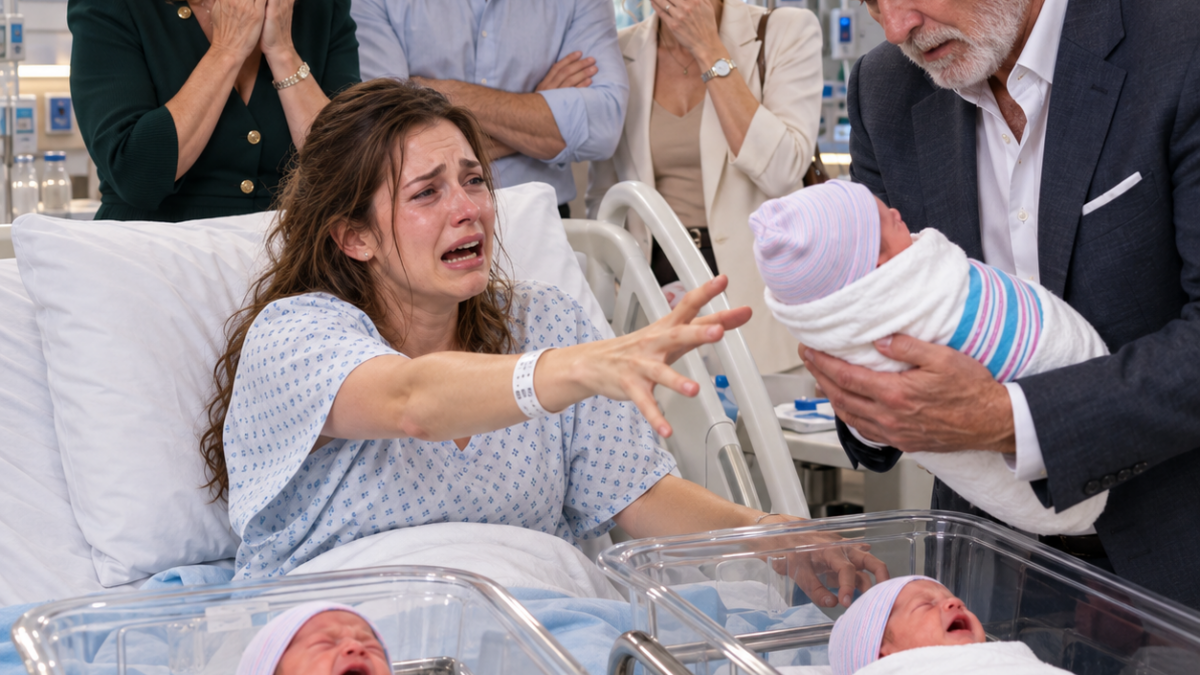
PART2
My voice was not loud.
It did not need to be.
My mother immediately moved toward the bed.
“Brynn, sweetheart, please don’t get upset. Nobody is trying to make this difficult. We only thought the family should have a calm conversation about what could be best for everyone.”
I stared at her.
“Best for everyone?”
She hesitated.
My eyes moved back to my father.
Hudson was still in his arms.
My son had been alive for less than half a day, and somehow the people standing around me were discussing him as if his future were a family vote.
“There is no conversation,” I said. “Hudson is my son. Put him back beside me.”
Marlowe’s shoulders shook once.
Reid shifted near the window.
For one foolish second, I thought he might speak up.
He did not.
My father remained composed.
That was the most terrifying part.
He was not babbling from emotion. He was not blurting out some ugly thought born from exhaustion and grief. He had not made a wild suggestion and immediately regretted it.
He believed there was logic behind what he was saying.
Warren Keaton always believed there was logic behind what he wanted.
He glanced toward the other two bassinets.
Elsie and June were sleeping peacefully, wrapped in pink and lavender blankets, unaware that their brother had become the subject of something monstrous.
Then he turned back to me.
“Brynn, look at this practically. You have two daughters and a son. Reid and Marlowe don’t have any children. Families make sacrifices for each other.”
The words entered the room and ruined something that could never be repaired.
“Having three babies doesn’t make one of them extra,” I said.
Silence.
I looked directly at Reid.
“Do you agree with this?”
My brother finally raised his eyes.
He looked sick.
“Brynn, I didn’t want it handled like this.”
My stomach tightened.
Not I don’t want this.
Not Dad is wrong.
Not put her baby back.
I didn’t want it handled like this.
That difference lodged in me like glass.
“Handled like what, Reid?”
He opened his mouth.
Marlowe touched his arm.
He stopped.
My mother tried again.
“Everyone is emotional right now. You’ve just been through an exhausting experience. Maybe we should talk after you’ve rested.”
I shook my head.
“There will be nothing to discuss later either.”
Then I pointed toward the bassinet.
“Dad. Put my son back.”
For the first time, my father’s confidence weakened.
Only slightly.
He looked around the room as if he expected someone else to help convince me. My mother cried silently. Reid stared at the floor. Marlowe covered her mouth.
Nobody spoke.
Finally, my father stepped forward and carefully returned Hudson to the bassinet.
The second Hudson was down, I reached for him.
Pain tore through my body, but I did not care.
My fingers touched the edge of his blanket. He was warm. Sleeping. Safe for the moment.
Only then did I breathe.
At that point, I still thought I understood what had happened.
I thought my family had spent too many years grieving Reid and Marlowe’s infertility. I thought my father had taken a private sadness and twisted it into something unforgivable. I thought they had convinced themselves that because I had three babies and my brother had none, one of mine could be “shared.”
It was horrifying.
It was inappropriate.
It was cruel.
But I thought it was an idea.
I thought my answer had ended it.
Hudson was my son.
Elsie and June were my daughters.
Callum was their father.
That was the beginning and end of the matter.
Or so I believed.
Because less than an hour later, a hospital employee entered my room carrying a folder.
She looked uncomfortable before she even spoke.
“Mrs. Keaton,” she said carefully, “we need to verify something with you.”
My parents exchanged a glance.
It lasted barely a second.
But I saw it.
The woman placed a document on the table beside my bed.
My full name appeared near the bottom.
Brynn Keaton.
Underneath it was a signature.
For a moment, I simply stared.
It looked like mine.
The shape of the B.
The angle of my last name.
Even the small upward stroke I usually made at the end.
Someone had studied my signature carefully.
There was only one problem.
I had never signed that document.
My mouth went dry.
“Where did you get this?”
No one in my family answered.
And that was when I understood that the conversation I had awakened to was not the beginning of anything.
It was only the first part I had been allowed to see.
Whatever had been happening around my newborn son had started long before that morning.
The hospital employee, whose badge read Lydia Torres, glanced toward my family, then back at me.
“Mrs. Keaton, did you sign anything concerning the temporary placement, transfer, or guardianship of any of your children?”
My heart seemed to stop.
“No.”
She looked down at the paper.
“Are you certain?”
“I gave birth yesterday,” I said. “I signed standard admission paperwork. Consent forms. Insurance documents. Things like that. But nothing about giving my child to someone else.”
Lydia swallowed.
“All right.”
I looked at my family.
My father was staring at the floor.
My mother had gone pale.
Reid had turned completely away from me.
And Marlowe was crying.
Silent tears ran down her cheeks.
That was when something inside me hardened.
I looked at her.
“What is this?”
She did not answer.
“Marlowe.”
She covered her mouth with one hand.
My father stepped forward.
“Brynn, this isn’t the time.”
I laughed once.
It was not a happy sound.
“Apparently it was the time when you took my newborn son out of his bassinet.”
My father stiffened.
Lydia looked between us.
“Mr. Keaton, I’m going to ask you to let your daughter answer the questions.”
He stared at her.
For the first time since I had awakened, I saw uncertainty in his eyes.
Lydia picked up the document.
“This was found in a file associated with Hudson’s newborn records.”
My stomach turned.
“What kind of file?”
She hesitated.
“A supplemental file.”
“What does that mean?”
“It means there are documents attached to his record that aren’t part of the ordinary discharge paperwork.”
I reached for the paper.
She handed it to me.
The heading read:
Temporary Family Placement Authorization.
Below that was Hudson’s full name.
Hudson Callum Mercer.
My name appeared as the parent.
Underneath was the signature.
My signature.
Or something close enough to fool someone who did not know me.
I stared at it until the letters blurred.
“I didn’t sign this.”
Lydia nodded.
“That is what we need to investigate.”
My father immediately said, “There must have been a misunderstanding.”
I turned toward him.
“A misunderstanding doesn’t create a signature.”
Nobody spoke.
Then I noticed another line.
There was a date.
I read it twice.
My hands began to tremble.
The date was from six months earlier.
I had been pregnant then.
I had not even known Hudson was a boy at that point.
In fact, I had not known there were three babies yet.
The room suddenly felt much smaller.
“Why,” I whispered, “is there a document from six months ago concerning my son?”
My mother began crying harder.
That frightened me more than anything else.
Because she was not looking at the document.
She was looking at my father.
Whatever passed between them told me they both knew exactly what it meant.
I pushed the blanket away and tried to sit upright.
Pain shot through my abdomen.
Lydia immediately reached out.
“Please don’t strain yourself.”
“I need answers.”
“You will get them.”
“No.” I looked at my father. “I need answers from my family.”
My father’s jaw tightened.
“Brynn, you aren’t thinking clearly.”
“I am thinking more clearly than I have all morning.”
“You’ve just given birth.”
“And someone forged my signature.”
Silence.
That sentence changed the atmosphere completely.
Lydia looked toward the door.
“I’m going to contact the patient advocate and medical records supervisor.”
My father stepped forward.
“There is no need to escalate this.”
She looked directly at him.
“Sir, if a patient’s signature has potentially been falsified, it is already escalated.”
My father stopped.
Lydia left.
The door clicked shut behind her.
For a moment, nobody moved.
Then Reid whispered, “Dad.”
My father turned toward him.
“What?”
“You said this wouldn’t happen.”
My blood ran cold.
I looked at my brother.
“What wouldn’t happen?”
Reid’s face went white.
Marlowe grabbed his arm.
“Reid, stop.”
I stared at them.
“What wouldn’t happen?”
My father spoke sharply.
“Enough.”
“No.” I pointed toward the door. “Someone has a document with my forged signature. That document concerns my son. And now my brother just said you promised something wouldn’t happen.”
I looked at Reid.
“What did he promise you?”
Reid’s eyes filled with tears.
“I never wanted Hudson.”
I froze.
Marlowe closed her eyes.
My father said, “Reid.”
But my brother continued.
“I never wanted to take your baby.”
A strange wave of relief moved through me.
Then he added, “But Dad said it had already been arranged.”
The relief disappeared.
“What had been arranged?”
Reid looked at me.
“The guardianship.”
The word landed like a hand around my throat.
Guardianship.
Not a conversation.
Not a possibility.
An arrangement.
“Whose idea was it?”
He did not answer.
I already knew.
My father had always been the center of every major decision in our family.
Where we lived.
Which schools we attended.
Which problems were discussed.
Which problems were buried.
When my grandmother had dementia, he decided which relatives were allowed to visit.
When Reid dropped out of law school, Dad decided what explanation the family would use.
When my mother found a lump in her breast, Dad decided who would know before the biopsy came back.
Control was the language Warren Keaton called love.
But this was different.
This involved my child.
“Dad?”
He looked at me.
For the first time in my life, I did not recognize the man standing across from me.
He looked older.
Tired.
Frightened.
But he still did not deny it.
“You weren’t supposed to find that document,” he said.
The room went silent.
I stared at him.
“What did you just say?”
He seemed to realize his mistake.
“I meant—”
“No.”
My voice shook.
“You said I wasn’t supposed to find it.”
My mother sobbed.
I looked at her.
“Mom, how long?”
She wiped her face.
“How long what?”
“How long have you known?”
She could not answer.
That was answer enough.
I closed my eyes.
For months, I had thought my pregnancy had simply been complicated.
The strange phone calls.
My mother’s insistence that she attend every doctor’s appointment.
My father’s sudden interest in my medical bills.
The questions about whether Callum had enough life insurance.
The repeated comments about how difficult raising three children would be.
The way my mother asked if I was scared.
The way my father said three babies would be more than any new mother could handle.
The way Marlowe cried when I told the family I was pregnant, then apologized and said she was happy for me.
At the time, I thought they were worried.
Now every memory rearranged itself.
Every conversation acquired a second meaning.
Every innocent question became suspicious.
Then I remembered the night of my baby shower.
My father had asked whether Callum and I had prepared legal documents in case something happened to us.
I had laughed.
He had not.
He had looked at me strangely and said, “You never know what life has planned.”
I had forgotten that.
Until now.
I looked at him.
“You started this before the babies were born.”
He said nothing.
“You started planning this while I was pregnant.”
Still nothing.
“Why?”
My father’s face changed.
Not guilt.
Something more complicated.
Fear.
Then Marlowe suddenly spoke.
“Because Reid can’t have children.”
My eyes moved toward her.
She was crying openly now.
“I know,” she whispered. “I know how it sounds.”
I stared at her.
“How long have you known?”
She looked at Reid.
“Seven years.”
Reid lowered his head.
I remembered.
Seven years ago, Reid and Marlowe had married in my parents’ backyard beneath white string lights. They had been happy then. Hopeful. Loud about their future. They wanted four children, maybe five, and they joked about needing a house with mudrooms, bunk beds, and a giant dining table.
Then years passed.
No pregnancy.
Then doctors.
Then procedures.
Then silent holidays where everyone avoided asking.
I had known they were struggling.
I sent flowers after Marlowe’s first failed treatment.
I brought soup after her second.
I attended appointments when she asked because Reid could not always leave work.
I listened to her cry in my car outside a fertility clinic.
I had never imagined that their grief had become connected to my child.
Marlowe wiped her cheeks.
“When your father found out you were pregnant, he said it was a blessing.”
I felt sick.
“What did he mean?”
“He said sometimes God gives abundance where there has been emptiness.”
I looked at my father.
“That is disgusting.”
His face tightened.
“I was trying to help.”
“You forged my signature.”
“I didn’t forge anything.”
The room became silent again.
I looked at the document.
“Then who did?”
My father did not answer.
My mother whispered, “Warren.”
He turned sharply.
“Don’t.”
“You told me it was taken care of,” she said.
I felt the blood drain from my face.
“Who took care of it?”
My mother covered her mouth.
My father looked toward the door.
Then back at me.
“There was an attorney.”
“What attorney?”
He hesitated.
“Someone who handles family matters.”
“What attorney?”
He finally gave me a name.
Evelyn Hart.
I had never heard it in a legal context.
But I had heard it once before.
At my parents’ house.
Months earlier, I had walked into my father’s study to ask whether he wanted coffee. He had been reading a letter. When he saw me, he slid it under a folder too quickly.
I asked who Evelyn Hart was.
He said, “Just an old business associate.”
Now the name filled my hospital room like smoke.
Before I could ask anything else, Lydia returned.
This time, she was not alone.
A woman in a gray suit entered behind her and introduced herself as Nora Bell, the patient advocate. Behind Nora was a man from medical records named Daniel Mercer, no relation to Callum, though under different circumstances I might have found that funny.
He carried another folder.
“Mrs. Keaton,” Daniel said, “we found additional documents.”
My stomach dropped.
“How many?”
He looked at the folder.
“Several.”
“Concerning Hudson?”
“Yes.”
“From when?”
He exchanged a glance with Nora.
“The earliest one is dated eight months ago.”
Eight months.
I had been pregnant for only a few weeks.
I stared at him.
“What does it say?”
He opened the folder.
“It appears to be correspondence between an outside legal office and someone connected to your family.”
My father’s face went completely still.
“Connected to my family how?” I asked.
“We’re still determining that.”
Daniel removed another page.
“This letter discusses anticipated birth arrangements, family placement, and a child referred to as ‘the male infant.’”
My hands went cold.
“The male infant?”
He nodded.
“That is what it says.”
I looked at Hudson.
My tiny son slept peacefully in his bassinet. His fingers were curled into little fists. He had no idea adults had been discussing his future before he could breathe.
I began to cry.
Not loudly.
Not dramatically.
Silently.
Because suddenly the whole thing felt much bigger than Reid wanting a child.
Bigger than my father making a terrible decision.
Someone had known.
Someone had planned.
Someone had created paperwork.
Someone had expected me to sign something I had never seen.
And the most terrifying question remained unanswered.
If they had been planning for Hudson for months, why had they needed my signature?
Nora seemed to read the question on my face.
“Mrs. Keaton, there’s something else you should know.”
I looked at her.
She lowered her voice.
“The document isn’t simply a guardianship agreement.”
“What is it?”
She placed another paper in front of me.
“This authorizes a transfer of parental responsibility under certain circumstances.”
I read the sentence.
Then read it again.
My hands began shaking.
“What circumstances?”
She pointed to a section.
Medical incapacity.
Financial hardship.
Inability to provide adequate care.
And one final category.
Maternal consent.
My heart stopped.
“I never consented.”
“We know.”
“Then why is it here?”
“We don’t know yet.”
I looked at my father.
He would not meet my eyes.
Then I looked at Reid.
He was crying.
“Marlowe?”
She whispered, “I thought you had agreed.”
I stared at her.
“Agreed to what?”
“To let Hudson live with us.”
I could not breathe.
“When?”
She looked confused.
“Your father told us you had already made the decision.”
I turned toward him.
“You told them I agreed?”
He remained silent.
“You told them I agreed before I even gave birth.”
Nothing.
My voice broke.
“You told them I was giving away my son.”
My father finally looked at me.
What he said next was so quiet that I almost did not hear it.
“I believed you would eventually understand.”
That was the moment I stopped seeing a father who had made a mistake.
I saw a man who had already decided that my consent was only a delay.
My mother reached for the bed rail.
“Brynn, your father thought—”
I cut her off.
“No.”
“But Reid and Marlowe—”
“No.”
“They have suffered for so long.”
“And you thought that meant I should suffer too?”
She began crying harder.
Marlowe whispered, “I didn’t know you hadn’t agreed.”
I looked at her.
“But when you thought I had, you never called me?”
Her face crumpled.
“I was afraid you’d change your mind.”
There it was.
Not innocence.
Not completely.
Desperation.
Desperation had made her willing to accept the version that gave her what she wanted.
I looked toward Reid.
“And you?”
He could barely look at me.
“Dad said you didn’t want to discuss it until after delivery because you were scared Callum would overreact.”
A sound escaped me that was almost a laugh.
“Callum would overreact to someone taking his son?”
Reid closed his eyes.
“I’m sorry.”
“Not enough.”
Nora stepped forward.
“Mrs. Keaton, for your safety and privacy, I recommend we clear the room.”
My father immediately straightened.
“I am her father.”
Nora did not blink.
“She is the patient.”
“She has just given birth. She is not in a position to make—”
“I said everyone out.”
The words came from me.
Low.
Clear.
Every face turned.
I pointed toward the door.
“Out.”
My mother whispered my name.
“Out.”
One by one, they left.
My mother crying.
Marlowe holding Reid’s hand.
Reid looking back once with a grief I was too furious to care about.
My father was last.
Before he stepped through the door, he turned back.
His face was pale.
Then he said something I will never forget.
“Ask the doctor why Hudson’s records were flagged before he was born.”
The door closed.
The room was finally quiet.
Too quiet.
I looked at Nora.
“What does that mean?”
She exchanged a glance with Daniel.
Daniel opened his folder again.
“Mrs. Keaton, Hudson’s prenatal file was accessed repeatedly.”
“By whom?”
“We don’t know everyone yet.”
“How many times?”
He looked at the page.
“Twenty-three.”
My heart sank.
“Twenty-three times?”
He nodded.
“By people who weren’t assigned to your care.”
I reached for Hudson’s hand.
His tiny fingers wrapped around mine.
“How could someone access his records before he was even born?”
“They accessed your prenatal records,” Daniel said. “Your ultrasound images, lab results, genetic screening, provider notes.”
“My provider notes?”
“Yes.”
“Who?”
He hesitated.
“Some were hospital staff. Others were not directly involved in your care. One account remained open for almost seventeen minutes.”
“Whose account?”
“Dr. Samuel Vance.”
The name meant nothing to me.
“I don’t know him.”
“He wasn’t your obstetrician.”
“Then why did he access my file?”
“That is what we are investigating.”
I stared at the paper.
Then another thought occurred to me.
“Could my father have asked him to?”
Nora’s expression remained careful.
“We cannot answer that yet.”
I looked toward the closed door.
My father knew people everywhere.
He had spent his career building connections, favors, and quiet conversations. Warren Keaton did not always ask for things directly. He simply found the person who could make the obstacle disappear.
Daniel turned another page.
“The first access occurred eight months ago.”
“My pregnancy had barely begun.”
“Yes.”
“And I did not know there were triplets.”
“No.”
He scrolled.
“The second was three weeks later. Then there were several after your anatomy scan.”
I frowned.
“Why would anyone care about a baby’s records that early?”
Nora said quietly, “That is what makes this unusual.”
Daniel continued.
“The records weren’t the only thing accessed. Your ultrasound images were opened multiple times.”
My breath caught.
“Why?”
“We don’t know.”
“Was Hudson identified as a boy at that point?”
“No. Not initially. But after your later screening, sex markers became visible in the lab results.”
I looked at Hudson.
“Then they were looking for him after they knew.”
Nora said nothing.
She did not have to.
I suddenly remembered the day I learned I was having triplets.
I had been alone because Callum was traveling. The doctor turned the screen toward me and said, “There are three heartbeats.”
I had laughed, then cried, then called Callum in the parking lot.
After Callum, I called my mother.
Then my father called me less than two hours later.
Not to congratulate me.
Not to ask if I was okay.
He asked, “Did the doctor find anything unexpected?”
At the time, I thought he meant medical complications.
Now I understood.
He already knew something.
“Can you print the access history?” I asked.
“We can request it,” Daniel said.
“I want it.”
Nora nodded.
“We’ll make sure you receive a copy. I also recommend speaking with hospital security.”
“Why?”
Daniel opened another file.
“There is a visitor entry that may concern you.”
“What visitor entry?”
“Someone visited the maternity building several times during your pregnancy.”
“Who?”
He turned the page toward me.
The name read:
Evelyn Hart.
I stared at it.
The room tilted.
“I think I’ve met her.”
Nora leaned in.
“Where?”
“At my doctor’s office. Months ago. In the waiting room.”
I could see it clearly now.
A woman with silver hair and a dark coat sat beside me while I waited for an appointment. She was elegant in a way Nashville women often are when money is old enough to stop announcing itself.
She smiled at me and asked if I was excited to become a mother.
I said yes.
Then she said something strange.
“Three is a beautiful number.”
At the time, I assumed she knew I was having triplets because maybe she had overheard me at the desk.
But I had not told the desk that day.
Not out loud.
Not in the waiting room.
I looked at Nora.
“She knew.”
Daniel’s expression darkened.
“I’m going to contact security.”
An hour later, a hospital security officer named Daniel Mercer returned with a thicker folder and another officer standing outside my door.
“Mrs. Keaton,” he said, “we reviewed the visitor logs. Evelyn Hart entered the maternity building six times during your pregnancy.”
“Six?”
“Yes.”
“Was she visiting me?”
“No.”
“Then who?”
He opened the folder.
“That’s where it becomes complicated.”
He showed me a security photograph.
It was slightly blurry, taken from a camera near the parking garage elevators.
But I recognized the woman immediately.
Silver hair.
Dark coat.
Calm expression.
Evelyn Hart.
“When was this?” I asked.
“Three days before your anatomy scan.”
I remembered that day.
I remembered the woman sitting beside me.
I remembered her asking whether I had considered what would happen if the pregnancy became difficult.
I had thought it was intrusive.
Now it sounded like a warning.
“Did she meet my father?”
The officer turned a page.
“Yes.”
My mouth went dry.
“How many times?”
“Five of the six visits.”
I closed my eyes.
Everything connected and still did not make sense.
My father.
The forged document.
Reid and Marlowe.
Evelyn Hart.
Dr. Samuel Vance.
Unauthorized records.
My son.
Then Daniel said, “There is one more thing.”
He pulled out another photograph.
This one showed my father standing in the hospital parking garage.
Beside him was Evelyn Hart.
And beside her was Dr. Samuel Vance.
The same doctor who had accessed Hudson’s records.
“When was this taken?” I asked.
“Eight months ago.”
The beginning of my pregnancy.
My hands began shaking.
“That’s impossible.”
“What is?”
“I didn’t know I was pregnant yet.”
Daniel looked at me carefully.
“That’s why we think you may have been the last person to know.”
“What does that mean?”
He opened the final page.
“We found a billing record from a private medical practice.”
“What kind of practice?”
He hesitated.
“Genetic counseling.”
“I never went to genetic counseling.”
“We know. That is the problem.”
The appointment was scheduled six days before my first prenatal visit.
My name was on the record.
My date of birth was correct.
My address was correct.
Even my insurance information was correct.
But I had never been there.
The notes were brief.
Patient informed of potential hereditary risk.
Patient advised regarding reproductive options.
Patient declined further testing.
At the bottom was another signature.
Mine.
Again.
Almost perfect.
Almost.
But not mine.
I looked at the first fake signature, then the second.
They were not identical.
The first looked like an imitation.
The second was nearly indistinguishable from my real signature.
Someone had been practicing.
“They’ve been doing this for months,” I whispered.
Nora’s face was tight.
“It appears so.”
“Why?”
Nobody answered.
Then my phone vibrated.
Callum.
I answered immediately.
“Callum?”
His voice came through breathless.
“Brynn, I’m at the airport. My flight boards in fifteen minutes. How are you? How are the babies?”
“Callum, something is wrong.”
His voice changed instantly.
“What happened?”
I looked at Hudson.
“My family tried to take him.”
Silence.
Then, very quietly, he said, “What?”
I told him everything.
My father holding Hudson.
The conversation.
The forged document.
The records.
Evelyn Hart.
Dr. Vance.
The fake genetic counseling appointment.
When I finished, he did not speak for several seconds.
Then he said, “Brynn, I need you to listen to me.”
“What?”
“Do not let anyone take Hudson anywhere.”
“I won’t.”
“No. I mean anyone. Not your parents. Not Reid. Not Marlowe. Not a nurse unless you personally know why. Nobody.”
“I know.”
“There is something I haven’t told you.”
My stomach tightened.
“What?”
“I found something at the house.”
“What did you find?”
“A folder.”
I sat completely still.
“What kind of folder?”
“I thought it belonged to your father. He was at the house last week helping your mother bring baby gifts, remember?”
“Yes.”
“I found it behind the nursery dresser this morning before I left for the airport. It must have slipped out of one of the boxes. It has your name on it.”
My heart began pounding.
“What else?”
He hesitated.
“Hudson.”
I closed my eyes.
“What’s inside?”
“I haven’t opened it.”
“Then open it.”
I heard movement. Then a pause.
Callum’s breathing changed.
“Brynn.”
“What?”
“There are photographs.”
“Of what?”
“Of you.”
I felt cold all over.
“From when?”
“Your pregnancy.”
“Who took them?”
“I don’t know.”
Then Callum said something that made my blood run cold.
“There are photographs of Hudson too.”
I looked down at my newborn son.
“But Hudson wasn’t born.”
“I know.”
My voice barely worked.
“How could there be photographs of him?”
“Ultrasound images,” he said. “Printed copies. Marked with notes.”
Paper moved on his end.
“The first photograph is dated the day of your first ultrasound.”
My heart pounded.
“And the last one?”
Callum was silent.
“Callum?”
“The last one was taken yesterday.”
I stopped breathing.
Yesterday.
The day Hudson was born.
Someone had photographed my son inside the hospital.
Before I knew anyone was watching.
“There is a note attached,” Callum said.
“What does it say?”
His voice dropped.
“It says, ‘Proceed when the boy is born.’”
I looked toward the door.
The hallway outside my room was quiet.
Too quiet.
Then footsteps approached.
Slow.
Measured.
The handle began to turn.
Nora stood immediately.
The security officer moved toward the entrance.
I reached for Hudson.
The door opened.
And Callum walked in.
For one second, I could not move.
Then I burst into tears.
He crossed the room in three steps and wrapped his arms around me.
“I’m here,” he whispered. “I’m here.”
I held onto him as tightly as my exhausted body allowed.
Behind him, two security officers entered.
One of them closed the door.
Callum pulled back just enough to look at my face.
“Are you hurt?”
“No.”
“Are the babies safe?”
I nodded.
“All three.”
His eyes immediately went to the bassinets.
He walked over slowly.
He looked at Elsie first.
Then June.
Then Hudson.
When he reached our son, he placed one trembling hand against the edge of the bassinet.
“Hey, little guy.”
His voice broke.
“I’m sorry I wasn’t here.”
Hudson stirred.
Callum wiped his face with the back of his hand.
For the first time since waking up, I felt something other than fear.
I felt safe.
Not because the danger was gone.
Because I was no longer facing it alone.
Callum opened the folder he had brought from home.
Inside were photographs.
Dozens of them.
Pictures of me leaving doctor’s appointments.
Pictures of my parents visiting our house.
Pictures of Reid and Marlowe.
Pictures of ultrasound images with handwritten markings.
The final photographs showed the hospital.
My hospital room.
My father entering.
Marlowe standing near Hudson’s bassinet.
And one photograph taken only minutes before my father picked Hudson up.
I stared at it.
“How did someone get these?”
Callum shook his head.
“We’re going to find out.”
Nora examined the folder.
Then she noticed something I had not.
A small embossed symbol appeared on several pages.
She frowned.
“I know this organization.”
“What organization?”
“It’s a private family services foundation.”
She turned the page.
“Hart Family Foundation.”
Evelyn Hart.
The woman from the visitor logs.
The woman from the waiting room.
My father’s old business associate.
The person who had apparently been moving around my pregnancy like a shadow.
Within an hour, the story began to unravel.
Not fully.
Not cleanly.
But enough to show us the shape of the nightmare.
Evelyn Hart was not simply an attorney.
She was a family-law consultant who had built her reputation helping wealthy families handle “sensitive domestic transitions.”
Private adoptions.
Guardianships.
Custody settlements.
Inheritance disputes.
Pregnancies that needed to be “managed.”
She was charming. Connected. Discreet.
The kind of person rich families called when they wanted something done without fingerprints.
My father had contacted her shortly after learning I was pregnant.
But according to the early notes, he had not originally planned to take Hudson specifically.
At first, his concern, or what he called concern, was broad.
Triplets would overwhelm me.
Callum’s work schedule would make things harder.
Reid and Marlowe had an empty nursery and years of grief.
The family had “resources.”
A temporary placement could “relieve maternal burden.”
Every phrase was clean enough to sound reasonable to someone who did not understand what it meant.
Then the records changed.
After unauthorized access to my prenatal screening, the language shifted.
One child became male infant.
Potential placement became proposed family transfer.
Support became guardianship.
My father had believed that because I was carrying triplets, I would become overwhelmed. He expected Callum to be absent. He believed Reid and Marlowe could provide a stable home for one child.
And once he learned one of the babies was a boy, something uglier came into focus.
The Keaton name.
The Keaton line.
The grandson Reid could not have.
Hudson became more than a baby in my father’s mind.
He became a solution.
That was how men like Warren Keaton made evil sound practical.
They called it family planning.
They called it sacrifice.
They called it mercy.
But mercy does not require forged signatures.
Later that afternoon, hospital security stopped Evelyn Hart outside the maternity ward.
She arrived wearing a dark green coat, carrying a leather portfolio, and introduced herself as “family counsel.”
Family counsel.
Not my counsel.
Not Callum’s counsel.
Family counsel.
As if my children belonged to a committee.
When she was denied access, she asked to speak to Warren Keaton.
When security told her Mr. Keaton was not permitted on the floor without patient approval, she smiled.
“Mrs. Keaton may not be in a position to make sound decisions at the moment.”
That sentence, captured on security audio, became one of the first pieces of evidence our lawyer used against her.
Callum called an attorney before sunset.
Her name was Simone Adler, and she arrived at the hospital with flat shoes, a sharp blazer, and the expression of a woman who considered sleep optional when children were involved.
She listened to everything.
The forged signatures.
The unauthorized records.
The fake counseling appointment.
The visitor logs.
The folder.
The family conversation.
Then she looked at me.
“Do you want your family barred from this floor?”
“Yes.”
She turned to Callum.
“You?”
“Yes.”
By seven that evening, my parents, Reid, and Marlowe were removed from the visitor list.
By eight, the hospital legal department was involved.
By nine, Simone had sent preservation notices to the hospital, Evelyn Hart’s office, Dr. Vance, my father, and every entity connected to the fake documents.
By ten, the police had taken an initial report.
I spent that night awake.
Not because the babies let me sleep.
They did not.
Triplets have no respect for trauma.
But even in the moments when they were quiet, I could not close my eyes without seeing my father holding Hudson like he had already decided where my son belonged.
Callum stayed in the chair beside my bed all night.
Every time a nurse entered, he sat up.
Not aggressively.
Alert.
Once, around three in the morning, I whispered, “You can sleep.”
He looked at me.
“So can you.”
Neither of us did.
The next morning, Reid asked to see me.
At first, I said no.
Then I remembered the look on his face when Dad held Hudson.
The discomfort.
The fear.
The tears.
Reid had not stopped it, and I did not forgive him for that.
But I needed to know what he knew.
So I agreed.
Only Reid.
No Marlowe.
No parents.
Callum stayed beside me.
Simone stood near the door.
Reid entered looking like he had aged ten years overnight.
His eyes were swollen. His shirt was wrinkled. He stood just inside the doorway, as if unsure whether he still had the right to enter a room where his nephew slept.
He did not.
But I had allowed it.
That mattered.
He sat in the chair near the window.
For a while, neither of us spoke.
Finally, he said, “I never asked Dad to take Hudson.”
“I know.”
“I wanted a child.”
“I know.”
“But I didn’t want your child.”
I looked at him.
He wiped his eyes.
“I should have stopped him sooner.”
“Yes.”
He nodded.
“You’re right.”
He took a long breath.
“I was so desperate to become a father that when Dad told me he had found a way for Marlowe and me to raise one of your children, I didn’t ask enough questions.”
“You should have asked me.”
“I know.”
“You should have come to me.”
“I know.”
“And when Dad told you I agreed?”
Reid looked down.
“I believed him.”
That hurt more than I expected.
Because Reid had known me my entire life.
He had been the little boy who slept on my floor during thunderstorms. The teenager who called me from parties when he was too drunk to drive. The brother who cried in my apartment when the doctor told him biological children would likely never happen.
He should have known I would never give away one of my babies like an extra chair.
“I wanted to believe him,” he whispered.
There it was.
The truth.
Ugly.
Human.
Not enough.
“When Marlowe found out you were having triplets, Dad told us you were considering letting us raise one.”
“I never considered that.”
“I know that now.”
“You knew me,” I said. “You knew Callum. You knew we were preparing three cribs. Three names. Three car seats.”
His face crumpled.
“I know.”
“You let yourself imagine taking my son because imagining it felt better than asking whether it was real.”
He covered his face.
“I’m sorry.”
I looked at him.
For the first time, I could see the difference between someone who wanted my child and someone who had been manipulated by grief.
That did not excuse what happened.
But it explained it.
“Did Marlowe know about the documents?”
“No,” he said quickly. “Not the forged signature. Not the hospital files. She thought there would be legal papers after birth. She thought Dad had spoken to you and you wanted time before making it public.”
“Convenient.”
He flinched.
“Yes.”
I looked toward Hudson.
He slept between his sisters now because I had insisted all three bassinets be moved to my side of the room.
“Can I see him?” Reid asked softly.
Callum’s jaw tightened.
I looked back at my brother.
“Not yet.”
He nodded immediately.
“I understand.”
“I don’t know when yet.”
“I understand.”
“And if you ever let Dad convince you that my children are solutions to your pain again, you will never see any of them.”
Tears slipped down his face.
“I know.”
That was the first step toward healing.
Not forgiveness.
Not yet.
Just honesty.
Marlowe came later that afternoon.
She asked through Simone, which was wise.
I almost refused her too.
But Marlowe’s silence haunted me differently.
Reid was my brother.
Marlowe was the woman who had cried in my passenger seat outside fertility clinics. She knew what it meant to ache for a child. That was exactly why her involvement hurt.
She entered alone.
No makeup.
Hair pulled back.
Face pale.
She did not sit until I nodded.
“I thought you agreed,” she said first.
Her voice broke.
“I know that doesn’t fix anything. But I need you to know I thought you had agreed.”
“Because my father told you?”
“Yes.”
“And you never thought to ask me?”
She closed her eyes.
“I was afraid.”
“Of me saying no?”
“Yes.”
The honesty was brutal.
“I wanted him so badly before he was even born,” she whispered. “Not Hudson specifically at first. Just the idea. A baby in our house. A child to love. A way for the nursery not to stay empty forever.”
I said nothing.
She continued.
“When Warren said you were overwhelmed and had privately asked about family placement, I should have known. I should have said, ‘Let me hear it from Brynn.’ But I was so tired of grief. I wanted one thing to be easy.”
“And my son was easy?”
“No.”
She looked horrified.
“No. God, no. That’s not what I mean.”
“But it is what happened.”
She cried silently.
“Yes.”
For a long moment, the only sounds were June’s soft hiccups and the monitor beside my bed.
Then Marlowe said, “I bought him a blanket.”
My body stiffened.
She immediately shook her head.
“I threw it away last night. I realized I had bought something for a child whose mother never gave him to me. I couldn’t look at it.”
That hurt too.
But not as much as it might have, because she understood at least one piece of what she had done.
“I can’t comfort you,” I said.
“I know.”
“I can’t make you feel better.”
“I know.”
“And you cannot ask me when you can hold him.”
Her face crumpled.
“I won’t.”
I studied her.
“When this investigation is over, you and Reid need help. Real help. Not Dad’s solutions. Not secret lawyers. Grief counseling.”
She nodded.
“We started this morning.”
That surprised me.
“Good.”
She stood to leave.
At the door, she turned back.
“Brynn?”
I looked at her.
“I am sorry I let wanting a child make me forget you were his mother.”
That was the first apology that did not ask me for anything.
I kept it.
Not as forgiveness.
As evidence that maybe one person in the family understood the crime.
My father was harder.
He did not ask to see me immediately.
He spent the first two days insisting, through my mother and then through his attorney, that his intentions had been misunderstood.
Misunderstood.
That word became a kind of poison.
A forged signature was not misunderstood.
A fake medical appointment was not misunderstood.
Twenty-three unauthorized record accesses were not misunderstood.
A note saying proceed when the boy is born was not misunderstood.
By the third day, Simone had enough evidence to make his attorney start using careful language.
My father had contacted Evelyn Hart.
He had provided her with my basic information.
He had given her copies of old family documents bearing my signature, supposedly so she could “prepare possible paperwork.”
He had discussed Reid and Marlowe as prospective caregivers.
He had asked Dr. Vance, an old acquaintance from a charity board, whether triplet pregnancies often created “temporary maternal incapacity.”
He had authorized payment to Hart Family Foundation for “placement consulting.”
He denied ordering anyone to forge my name.
He denied authorizing hospital record access.
He denied knowing anyone had photographed Hudson.
But he could not deny that he opened the door.
And when you open a door for someone like Evelyn Hart, you do not get to act shocked that she walks through carrying a knife.
On the fourth day, after I was discharged into a private recovery suite arranged by the hospital while security investigated, my father finally came to see me.
Callum did not want him near us.
I did not either.
But I needed to look at him.
Simone agreed only under strict conditions.
Hospital security outside.
Callum in the room.
No contact with the babies.
No private conversation.
My father entered looking smaller than I had ever seen him.
Warren Keaton had always been a large man to me, even when I outgrew childhood. Not just physically. Emotionally. He filled rooms with certainty. He decided. Others adjusted.
Now he stood by the door, shoulders slumped, eyes red.
He looked at the bassinets.
Hudson was sleeping between Elsie and June.
Together.
Where he belonged.
My father’s mouth trembled.
“Brynn,” he said.
I waited.
“I thought I was fixing something.”
“You broke something.”
His eyes filled.
“I know.”
“No, Dad. You don’t.”
I looked at him, and the anger I had held back for days finally found words.
“You decided that because I had three children, one of them could belong to someone else.”
He lowered his head.
“I was wrong.”
“You didn’t make a mistake.”
Silence.
“You made a decision.”
He nodded slowly.
“I did.”
“You made it without me.”
“Yes.”
“You made it without Callum.”
He glanced at my husband.
Callum’s face was stone.
“Yes.”
“You made it without caring what separating Hudson from Elsie and June would do to them.”
His eyes closed.
“Yes.”
“You made it because Reid was hurting, and it was easier to take from me than accept that you couldn’t fix him.”
My father covered his mouth.
For the first time, I saw the truth land.
Not the legal truth.
The human one.
“You taught us family meant sacrifice,” I said. “But somehow sacrifice always meant someone else giving up what you decided they could live without.”
My mother, who had come with him but stayed near the door, began crying.
I looked at her.
“And you knew.”
She nodded through tears.
“I knew some.”
“Enough?”
She could not answer.
“Enough,” I said for her.
She pressed both hands to her face.
“I told him it was wrong.”
“But you did not tell me.”
“No.”
“Why?”
She cried harder.
“Because I was afraid of losing him. Of losing Reid. Of breaking the family.”
I almost laughed.
“You protected the idea of family from the people in it.”
She whispered, “I am sorry.”
I turned back to my father.
“What did you mean when you said Hudson wasn’t like the others?”
He looked toward my son.
For several seconds, he said nothing.
Then he whispered, “He was the boy.”
The room went still.
Callum took one step forward.
My father continued quickly.
“I know how that sounds.”
“No,” I said. “I don’t think you do.”
“The Keaton name—”
“Stop.”
He stopped.
“Do not finish that sentence in front of my daughters.”
His face crumpled.
Elsie and June slept on, unaware that their grandfather had just admitted the world had valued their brother differently before any of them could open their eyes.
I felt a new kind of rage.
Not only for Hudson.
For them too.
For every daughter reduced to less by men who called tradition love.
“My daughters are not consolation prizes,” I said.
My father nodded.
“I know.”
“No. You are learning.”
He lowered his eyes.
“You’re right.”
I waited.
Then, finally, he said the words I needed to hear.
“I am sorry, Brynn.”
Not because someone forced him.
Not because the hospital was investigating.
Not because his plan failed.
Because, for one second at least, he understood what he had done.
I did not hug him.
I was not ready.
Maybe I would never be ready.
But I told him the truth.
“If you want to be part of my children’s lives someday, you will have to earn that privilege. You will not assume it. You will not demand it. You will not use the word family like a key.”
He nodded.
“I will do whatever you ask.”
“No,” Callum said for the first time.
My father looked at him.
Callum’s voice was calm, but I had never heard him sound so dangerous.
“You will do what the court orders, what the hospital investigation requires, and what Brynn allows. Those are three different things. Do not confuse them.”
My father swallowed.
“Yes.”
He left a few minutes later.
My mother touched the doorframe before leaving, as if she wanted to say something else.
I did not ask her to stay.
For weeks after we brought the babies home, I barely slept.
Not because of the triplets.
Though they did their part.
I did not sleep because every sound near the front door made my body tense. Every unknown number on my phone made my stomach twist. Every form from the pediatrician turned into a threat until Callum read it with me.
Motherhood is already terrifying.
Newborns are impossibly fragile. Their heads wobble. Their cries change by the hour. Their little fingers grip yours like they trust you with a world you are not sure you know how to hold.
But I had the extra terror of knowing that someone had tried to make a legal path for my son to disappear.
Callum changed the locks.
Then the security system.
Then the cameras.
Then he changed them again because he said the first company irritated him.
He took family leave and turned our house into a command center of diapers, bottles, court documents, and color coded feeding charts.
For the record, color coding triplets at 3:00 a.m. is optimistic.
Elsie refused every schedule.
June drank slowly just to prove she could.
Hudson slept through alarms and woke when everyone else finally closed their eyes.
They were not symbols.
Not heirs.
Not solutions.
They were babies.
Messy, loud, perfect babies.
And every time I saw the three of them together, I thought of the document that had tried to split them apart before they knew each other’s names.
The investigation moved faster than I expected.
The hospital had too much to lose, which meant they suddenly became very interested in truth.
Dr. Samuel Vance was suspended within ten days.
At first, he claimed he had accessed my records by mistake.
Then IT produced the audit trail.
Twenty-three accesses.
Searches filtered by my name.
Ultrasound images opened and downloaded.
Lab results viewed.
A newborn record accessed minutes after Hudson’s birth.
There was no mistake large enough to cover that.
Then came the emails.
Evelyn Hart had written to Dr. Vance using language so polished it was almost worse than bluntness.
Need confirmation when sex markers are available.
Need anticipated delivery window.
Need notification if maternal exhaustion or complications create documentation opportunity.
Documentation opportunity.
That phrase made Callum leave the room.
He later told me he went outside and screamed into a towel in the garage because he did not want the babies to hear him.
I understood.
I had wanted to scream since the moment my father said I had three babies.
Evelyn Hart’s office was searched after one of her assistants turned over documents.
That assistant, a woman named Priya Noll, became the first true whistleblower.
She told investigators that Hart Family Foundation often worked in “gray spaces” between private adoption, guardianship, and family wealth management. Most of their cases involved families who wanted quiet transfers of custody, elder control, inheritance restructuring, or children placed with relatives without public fights.
But my case had unsettled her.
Because I had never attended a meeting.
Never spoken to Evelyn Hart.
Never consented.
Priya had been instructed to scan signature samples from documents my father provided.
Old birthday cards.
A medical power of attorney from years ago.
A check I had written to reimburse my parents for vacation lodging.
My signature had been practiced like handwriting homework.
When I heard that, I cried harder than I expected.
Not because of the forgery alone.
Because my father had given her the samples.
Pieces of family life turned into tools against me.
The first signature had been rough.
The second nearly perfect.
By the time Hudson was born, someone had become very good at writing my name.
The legal consequences came in waves.
Evelyn Hart lost her license first.
Then came charges connected to forged documents, identity misuse, unauthorized medical record access, and conspiracy to interfere with custodial rights.
Dr. Vance faced charges and civil claims. He surrendered his hospital privileges before they could be formally revoked, as if that made him noble.
It did not.
My father faced charges too.
Not the worst ones Evelyn did.
But enough.
Conspiracy.
Fraudulent documents.
Unauthorized disclosure of private information.
Attempted interference with custody.
He cooperated after Evelyn tried to blame him for everything.
That was when he finally understood something I had known from the beginning.
People who forge signatures do not stop at one victim.
Evelyn had planned to leave my father holding the scandal while she called herself a consultant.
Reid and Marlowe were not charged after the investigation confirmed they had not known about the forged signatures, the fake medical appointment, or the record access.
But innocence is not the same as harmlessness.
They entered counseling.
Real counseling.
Grief counseling.
Marriage counseling.
And later, when they could say it without breaking, infertility counseling.
For months, I did not allow them near the babies.
Reid accepted that.
Marlowe did too.
That acceptance was the only reason I eventually believed their apologies might become something more than regret over being caught in the blast.
The first time Reid saw the triplets again, they were four months old.
He came alone.
Callum sat beside me.
Reid stood in our living room holding a small gift bag and looking like a man approaching a church after committing a sin he could not name.
“What’s in the bag?” I asked.
“Books,” he said quickly. “For all three. Same value. Same size. No blue. No pink.”
I almost smiled despite myself.
He had learned something.
He did not ask to hold Hudson.
He did not ask to hold anyone.
He sat on the floor while Elsie stared at him with deep suspicion, June chewed her fist, and Hudson slept through the entire emotional event like a man who had no meetings scheduled.
Reid cried.
Quietly.
He looked at all three babies and said, “I’m sorry I let anyone treat you like you were divisible.”
That mattered.
Not enough to erase.
But enough to begin.
Marlowe came two weeks later.
She brought nothing.
“I wanted to bring gifts,” she said at the door. “But my therapist said I might be using presents to manage guilt.”
I stared at her.
“I like your therapist.”
“She scares me.”
“Good.”
Marlowe sat in the chair farthest from the bassinets.
She did not ask to move closer.
After twenty minutes, June started crying.
Marlowe’s hands twitched.
Then she folded them tightly in her lap.
I watched her fight every instinct to reach for a baby she wanted and had no right to touch.
That restraint became her apology before words did.
Eventually, I picked up June and sat across from her.
“You can say hello,” I said.
Marlowe’s face crumpled.
“Hello, June,” she whispered.
Not Hudson.
June.
My daughter.
A person in her own right.
That mattered too.
Six months after the birth, the hospital investigation officially concluded.
Every false document was removed from our children’s records but preserved for evidence.
The unauthorized access trail was sealed and copied to us.
New security protocols were implemented for maternity records.
A quiet settlement offer arrived from the hospital system.
Callum wanted to reject it out of rage.
Simone advised us to consider what we wanted most.
I wanted protocols.
I wanted written acknowledgment.
I wanted the nurses retrained.
I wanted no other mother to wake up and learn a stranger had been inside her baby’s file before the baby was born.
So we settled with conditions.
Money went into trusts for the triplets.
Not because money repaired anything.
Because children deserve something built from the wreckage adults create.
Evelyn Hart pleaded guilty before trial.
Her downfall was not dramatic.
That disappointed me at first.
I had imagined a courtroom confession, a sharp cross examination, her perfect silver hair under harsh lights as everyone finally saw what she had done.
Instead, she sat in a conference room with lawyers and accepted a deal because the evidence was too clear and her foundation’s records implicated too many wealthy clients.
That was the part that still haunts me.
We were not her only case.
We were simply the one where the mother woke up too soon.
At sentencing, I gave a statement.
I held a printed page in both hands, but I barely looked at it.
Evelyn sat at the defense table in a navy suit.
She looked smaller than I remembered from the waiting room.
Not weaker.
Just less mythic.
“Before my son was born,” I said, “you turned him into an objective.”
The courtroom was silent.
“You looked at my pregnancy and saw opportunity. You looked at my brother’s grief and saw leverage. You looked at my father’s control issues and saw a client. You looked at my signature and saw a technical problem to solve.”
Evelyn did not look at me.
I continued.
“My son was not a placement. My daughters were not surplus. My body was not your timeline. My exhaustion was not your documentation opportunity.”
My voice shook.
I let it.
“You built paperwork around a baby who had never taken a breath. You tried to make theft look like family. You tried to make my consent appear where it never existed.”
Then I looked directly at her.
“But I woke up.”
For the first time, her eyes lifted.
I held her gaze.
“And because I woke up, so will every record connected to you.”
She looked away first.
Good.
My father’s sentencing was harder.
No one prepares you for watching a parent stand before a judge because he tried to arrange the future of your newborn child behind your back.
He pleaded guilty to reduced charges after cooperating against Evelyn and Dr. Vance.
People told me I should be grateful he cooperated.
I was not.
Cooperation after discovery is not morality.
It is damage control with better timing.
Still, his statement mattered.
He stood in court and said, “I believed my grief for one child gave me authority over another. I believed my son’s pain mattered more than my daughter’s consent. I believed my grandson could repair what I could not accept was broken.”
His voice shook.
“I was wrong. My daughter did not misunderstand me. I betrayed her.”
I cried then.
Not because I forgave him.
Because he finally said it in a room where everyone heard.
That is the strange thing about accountability.
Sometimes it arrives too late to save the relationship it names.
But it still matters.
My father received probation, fines, mandatory counseling, and a no contact order that could only be modified at my request.
My mother was not charged, though part of me wished consequences had more room for silence.
She moved out of my parents’ house for a while.
Not permanently at first.
Then longer.
Then, after a year, she rented a small apartment near my aunt and started therapy on her own.
She wrote me letters.
The first few were full of explanations.
I did not answer those.
Then one arrived that began differently.
Brynn,
I keep trying to explain because explaining lets me stand one step away from admitting that I failed you.
I knew enough.
Not all of it, but enough.
I knew your father was speaking with Evelyn Hart. I knew he believed Reid and Marlowe should raise one of your babies. I knew you had not told me that. I let myself believe there was some conversation I was not part of because believing that was easier than confronting him.
I protected peace in our family by sacrificing your trust.
I am sorry.
I do not expect forgiveness.
Mom
I read that one three times.
Then I put it in a drawer.
Not thrown away.
Not answered.
Kept.
Some apologies need time to become anything.
The triplets turned one on a rainy Sunday.
We had planned a small party.
Then, because triplets attract chaos, it became a house full of people, frosting, balloons, and at least one mysterious stain no adult admitted creating.
Elsie had frosting on both cheeks.
June tried to grab a balloon and screamed when it floated away from her like betrayal.
Hudson sat in Callum’s lap, laughing at absolutely nothing.
Reid and Marlowe came with permission.
They brought three identical wrapped books.
My mother came alone.
She cried when she saw the babies, but she did not reach for them until I nodded.
My father arrived last.
He stood at the open front door holding a small gift bag.
He did not step inside.
He waited.
That small gesture meant more than any apology.
For once, Warren Keaton did not assume entry.
He asked with his body before his mouth could ruin it.
I looked at Callum.
Callum looked at me.
The choice was mine.
Finally, I nodded.
My father entered.
He did not pick Hudson up.
He did not reach for him.
He did not even move toward his bassinet.
He placed the gift bag on the table with the others and sat on the floor several feet away, where Elsie was banging a spoon against a plastic bowl.
She looked at him.
He looked at her.
Then he said softly, “Hello, Elsie.”
Not Hudson first.
Elsie.
My daughter.
A person he had once treated as less relevant to his plan.
She offered him the spoon.
He accepted it solemnly.
I had to look away.
Not because everything was fixed.
Because healing sometimes begins in gestures so small you resent how much they matter.
Later that evening, after everyone left and the house looked like a party supply store had exploded, I stood beside the three cribs.
Hudson slept between his sisters.
Callum came up behind me and wrapped his arms around my waist.
“You okay?” he asked.
I nodded.
Then shook my head.
Then laughed softly.
“I don’t know.”
“That seems fair.”
I looked at the three tiny faces.
“Do you ever think about how different everything could have been?”
“All the time.”
“If Lydia hadn’t noticed the supplemental file…”
“She did.”
“If I hadn’t woken up…”
“You did.”
“If Dad had walked out with him…”
Callum tightened his arms around me.
“But he didn’t.”
I closed my eyes.
For months, people had told me to focus on the fact that Hudson was safe.
They meant well.
But safety after almost is complicated.
Almost leaves fingerprints.
Almost makes you check locks twice.
Almost makes you read every form like a threat.
Almost wakes you in the night with the sound of a bassinet wheel that never moved.
But almost is also not the ending.
Hudson was there.
Elsie was there.
June was there.
Together.
Breathing.
Growing.
Ruining sleep.
Saving me.
I reached into Hudson’s crib and touched his tiny hand.
His fingers curled around mine.
I thought about the forged signature.
The one that had frightened me so badly.
The one someone created because they believed a piece of paper could decide where my child belonged.
They had been wrong.
Motherhood had never been a signature.
It had never been a legal document.
It had never been something another person could arrange in secret.
Motherhood was the thousands of moments after.
The sleepless nights.
The first smiles.
The bottles washed at midnight.
The fevers.
The laughter.
The fear.
The love.
The choice to stand beside your child every single day, even when you are exhausted, terrified, furious, and unsure.
Someone tried to make a decision about my son before he was even born.
But the mystery did not take my family from me.
It revealed what family had become.
And then it forced us to decide what family was supposed to mean.
Not possession.
Not obligation.
Not sacrifice forced from someone else’s body.
Choice.
Trust.
Protection.
Love that asks before it reaches.
Two years later, Reid and Marlowe adopted a little girl through a licensed agency after eighteen months of counseling, home studies, and brutally honest preparation.
They named her Clara.
The first time I met her, Marlowe placed her in my arms and whispered, “We did this the right way.”
I looked at the baby.
Then at Marlowe.
“Yes,” I said. “You did.”
Reid cried when Hudson toddled over and dropped a block into Clara’s blanket.
“Gift,” Hudson said solemnly.
Clara slept through the ceremony.
Children are humbling that way.
My father remained on the edge of our lives for a long time.
Not outside.
Not inside.
At the edge.
He attended birthdays when invited.
He sent cards addressed to all three children equally.
He never used the phrase Keaton line again.
The first time he slipped and called Hudson “my boy,” I looked at him.
He corrected himself immediately.
“My grandson.”
Then he looked at Elsie and June.
“My grandchildren.”
It was awkward.
It was small.
It mattered.
My mother rebuilt more quickly, maybe because she had spent so many years being afraid of my father’s certainty that once it cracked, she finally saw daylight.
She became the grandmother who asked.
“Can I pick up June?”
“Is Elsie ready for a nap?”
“Would Hudson like me to read?”
Permission became her love language because she understood what silence had cost.
Callum forgave no one easily.
That was one of the reasons I loved him.
He did not pressure me to reconcile.
He did not tell me blood mattered.
He did not say my father had meant well.
He did not say Reid’s grief excused him.
He simply stood beside me while I decided, person by person, boundary by boundary, what access looked like.
One night, when the triplets were almost three, I found him in the hallway outside their room.
All three children had finally fallen asleep after demanding water, songs, different blankets, and a discussion about whether raccoons wear shoes.
Callum stood outside their door, looking in.
“What are you doing?” I whispered.
He smiled faintly.
“Counting.”
I leaned beside him.
“One, two, three.”
“One, two, three,” he repeated.
Then his voice lowered.
“I still do it every night.”
My throat tightened.
“So do I.”
We stood there together, watching our children sleep.
Three babies.
Three heartbeats.
Three futures.
No extras.
No solutions.
No one else’s sacrifice.
When Hudson was old enough to ask why Grandpa Warren always waited at the door, I told him the truth in the only way a child could carry.
“Because grown-ups have to learn rules too.”
Hudson thought about that very seriously.
“Did he break a rule?”
“Yes.”
“A big one?”
“The biggest.”
“Did he say sorry?”
“Yes.”
“Does sorry fix it?”
I looked at my son.
My beautiful boy, whose life had been discussed before he was born by people who forgot he would one day ask questions.
“No,” I said. “Sorry starts the fixing. It doesn’t finish it.”
Hudson nodded.
Then he ran off because Elsie had stolen his dinosaur.
That was childhood.
Not courtrooms.
Not forged documents.
Not family schemes.
Dinosaur theft.
Sticky hands.
Bedtime rebellion.
Ordinary chaos.
The life they almost interrupted before it began.
Years later, I still keep copies of everything.
The forged authorization.
The fake genetic counseling form.
The access logs.
The photographs.
The note.
Proceed when the boy is born.
People sometimes tell me I should destroy them.
Move on.
Let the past die.
They do not understand that evidence is not always a chain.
Sometimes it is a fence.
A reminder of where the boundary stands.
A record for my children if they ever need to know why their mother became so careful with permission, signatures, doctors, and doors.
I do not live in fear anymore.
But I respect what fear taught me.
Read everything.
Ask questions.
Trust discomfort.
Do not let anyone use family to rush your consent.
And never assume the person holding the baby has the right to carry him away.
The morning everything changed, my father lifted my newborn son from his bassinet and said, “You have three babies. Your brother has none.”
He thought I would be too exhausted to fight.
He thought postpartum pain would make me pliable.
He thought my love for Reid would make me generous in the way he needed.
He thought a forged signature could make theft look legal.
He thought family meant he could decide where my child belonged.
He was wrong.
Because having three babies did not make one of them extra.
Because my son was not a gift for my brother’s grief.
Because my daughters were not evidence that I had enough children to spare.
Because my husband came home.
Because a hospital employee asked the right question.
Because a folder slipped behind a nursery dresser.
Because signatures can be forged, but a mother’s refusal cannot.
And because when I finally understood that someone had been making plans around Hudson months before he was born, I made a plan of my own.
Not secret.
Not forged.
Not hidden behind family meetings and legal language.
A simple one.
Protect all three.
Together.
Always.
That is what I did.
That is what Callum did.
And that is why, every night, before I turn off the hallway light, I still look into their room and count.
Elsie.
June.
Hudson.
One.
Two.
Three.
All mine.
All ours.
All home.








