For my thirty first birthday, my mother in law handed me divorce papers in front of my entire unit at the Army Ball.
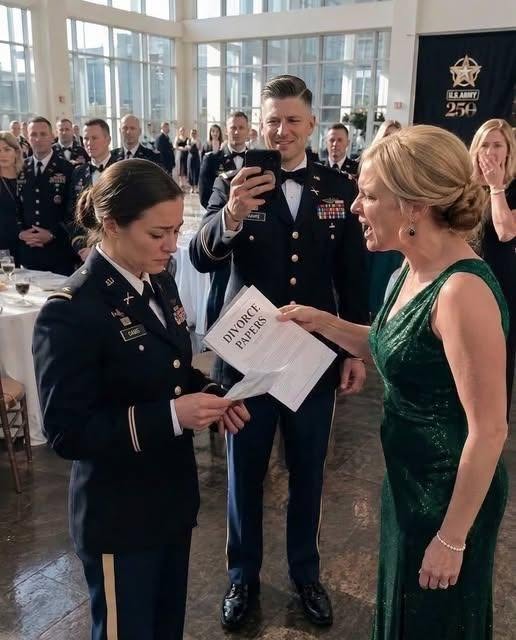
For my thirty first birthday, my mother in law handed me divorce papers in front of my entire unit at the Army Ball.
She smiled when she did it.
That is the part I remember most clearly.
Not the envelope.
Not Grant holding up his phone.
Not the eighty seven people who suddenly went quiet.
Her smile.
Diane Keller crossed the ballroom in a navy sequined gown, placed a cream envelope beside my plate, and leaned toward me as though she were presenting a birthday card.
“Happy birthday, Natalie.”
Then she added:
“Grant thought it was time you stopped pretending this marriage was still alive.”
My husband stood ten feet away.
Phone raised.
Recording.
Several officers at my table stopped eating.
My battalion commander looked at Diane.
Then Grant.
Then me.
The band had just finished one song and had not yet started the next, which meant there was no music to soften the moment.
I could hear silverware touching china three tables away.
Grant grinned.
“Come on.”
He gestured with his phone.
“Open it.”
I did.
Petition for dissolution of marriage.
Temporary possession of the house.
Division of accounts.
A request that I reimburse Grant for improvements allegedly made to property “held jointly by the parties.”
That last part almost made me smile.
Almost.
Because the house Grant wanted had never belonged to him.
It belonged to me.
More precisely, it had belonged to my grandfather.
He left it to me six years earlier.
Before I married Grant.
Before I became Natalie Keller.
Before Diane ever started referring to the Raleigh property as “our family house.”
And three weeks before the Army Ball, I learned that my husband and his mother had already tried to take it.
I knew about the forged deed.
I knew about the revoked power of attorney.
I knew about the $186,000 home equity transfer.
I knew exactly where $94,000 of that money went.
Diane’s bank account.
But Diane did not know I knew.
Neither did Grant.
So I took the pen from the envelope.
Grant zoomed in with his phone.
Diane folded her hands in front of her.
I signed.
Her smile widened.
“See?”
She said it loudly enough for the tables around us to hear.
“That wasn’t so hard.”
Then she looked toward Grant.
“Now the house can finally stay in the Keller family.”
My battalion commander’s expression changed.
I placed the pen down.
Straightened the papers.
And stood.
“Thank you.”
Grant lowered his phone slightly.
“For what?”
I looked directly at him.
“For serving these in front of eighty seven witnesses.”
His smile weakened.
“And thank you for recording your mother explaining what you planned to do with my house.”
The color vanished from Diane’s face.
Grant stared at me.
Then the ballroom doors opened.
A woman in a gray suit walked inside beside two uniformed sheriff’s deputies.
She looked directly at Grant.
“Mr. Keller.”
The ballroom went completely still.
“Please keep that phone exactly where it is.”
Grant froze.
Diane turned sharply.
“Excuse me.”
The woman walked closer and held up a badge.
“Detective Mara Ellison. Wake County Sheriff’s Office.”
A low murmur moved across the ballroom.
Grant lowered his phone.
The detective’s eyes hardened.
“I said exactly where it is.”
Slowly, he raised it again.
My heart was pounding hard enough that I could feel it in my throat.
But somehow I remained calm.
I had spent three weeks imagining some version of this moment.
Not because I wanted revenge.
Because I needed proof.
And Grant had just spent the last ten minutes creating it himself.
Detective Ellison approached our table.
One deputy carried a document envelope.
The other held a small evidence bag.
Diane stepped forward.
“You can’t simply walk into a military function and interrupt a private family matter.”
“This is not a military investigation.”
Detective Ellison did not raise her voice.
“We are here regarding an active county investigation involving financial fraud, forgery, and the unlawful transfer of real property.”
Nobody moved.
Grant looked at me.
Then Diane.
Then me again.
“What is this?”
I stared.
“You know what this is.”
“No, I don’t.”
“You will.”
His jaw tightened.
“You told me you hadn’t done anything.”
“I told you I wasn’t discussing it.”
“You knew?”
“Yes.”
Something changed in his face.
Not guilt.
Fear.
Real fear.
Diane grabbed his arm.
“Grant, don’t say anything.”
Detective Ellison looked at her.
“That is excellent advice.”
Diane immediately released him.
The detective placed a folder on the table.
“Natalie, I need you to confirm something.”
She opened it.
Copies.
The deed.
The home equity loan documents.
The old power of attorney.
Bank transfers.
She pointed to the signature on the deed.
“Is this your signature?”
I looked down.
My name.
Beautifully copied.
Every loop and angle almost perfect.
“Yes.”
Grant’s shoulders relaxed slightly.
The detective asked:
“Did you sign it?”
“No.”
The relaxation vanished.
“Did you authorize Grant Keller to sign on your behalf?”
“No.”
Grant laughed.
A thin, brittle sound.
“That’s ridiculous.”
He looked at the detective.
“Natalie gave me power of attorney.”
“She did.”
His shoulders relaxed again.
Detective Ellison waited.
Then:
“And she revoked it on April 11, 2024.”
Grant stopped breathing.
Diane turned toward him.
“You said it was still valid.”
He did not answer.
“Grant?”
“I thought it was.”
Detective Ellison closed the folder.
“No.”
Her voice sharpened.
“You did not think it was valid.”
Grant stared.
“You submitted a revoked power of attorney to the county recorder’s office.”
No answer.
“You used it to transfer an interest in property you did not own.”
Silence.
“Then a home equity loan was obtained against that property.”
Diane stepped backward.
“And $94,000 of the proceeds were transferred into an account belonging to Diane Keller.”
Every face in the ballroom seemed to turn toward her.
Diane’s mouth opened.
“That was a gift.”
“No.”
I spoke quietly.
She looked at me.
“It wasn’t.”
“You don’t understand.”
“I understand perfectly.”
I reached into my handbag.
Pulled out my own folder.
“I understand that the transfer arrived nine days after the loan closed.”
Diane stared.
“I understand $38,000 went toward your mortgage balance.”
Her face changed.
“Another $21,500 paid off a credit card in your name.”
Grant whispered:
“Mom.”
“And the remaining money was divided between two accounts.”
I looked at him.
“One of them belongs to you.”
The whispering around us exploded.
My commander stood.
Colonel Matthew Ross had not said a word since Diane arrived at the table.
He approached slowly.
“Natalie.”
“Yes, sir.”
“Are you all right?”
For one second I almost laughed.
Not because anything was funny.
Because that was the question everybody should have asked me three weeks earlier.
When the bank called.
When I discovered my signature.
When I realized the man sleeping beside me might have tried to steal my grandfather’s house.
“Yes, sir.”
He looked at Grant.
Then Diane.
Then the detective.
“I think we should let Detective Ellison finish.”
She nodded.
“Thank you, Colonel.”
Then she faced Grant.
“I need your phone.”
Grant tightened his grip.
“Why?”
“You have been recording.”
“So?”
“So your recording may contain evidence relevant to an active investigation.”
He looked at me.
“You set me up.”
I shook my head.
“No.”
I picked up the divorce papers.
“You set yourself up.”
He stared.
“You knew about the money.”
“Yes.”
“The deed?”
“Yes.”
“Mom?”
“Yes.”
His voice dropped.
“Then why didn’t you confront me?”
I looked around.
My unit.
Their spouses.
Senior officers.
People who had watched my marriage become entertainment because Grant and Diane had chosen humiliation as strategy.
Then I looked back at him.
“Because if I confronted you privately, you would have lied.”
He said nothing.
“And if I confronted Diane, she would have lied.”
Diane’s eyes filled with anger.
“So you humiliated us instead?”
“No.”
I placed the petition back on the table.
“You did that yourselves.”
One deputy stepped forward.
“Mr. Keller, you are not being arrested at this moment.”
Grant exhaled.
“But you are being served with a preservation notice and formal demand for records.”
His relief disappeared.
“And my wife?”
The deputy glanced at me.
“She appears to be standing right there.”
Grant’s face tightened.
For the first time all night, I saw something behind his anger.
Regret.
But it came three weeks too late.
He stepped toward me.
“Natalie.”
I did not move.
“Please.”
The word sounded strange from him.
“Please what?”
“I can explain.”
“No.”
“Give me five minutes.”
“You had three weeks.”
“I was going to fix it.”
“You were going to take my house.”
“No.”
He shook his head.
“I was trying to…”
“To what?”
He stopped.
Because every possible answer was worse than silence.
The bandleader took one hesitant step toward the microphone.
Colonel Ross raised one hand.
The bandleader stepped away.
Nobody wanted background music for this.
I looked down at the divorce papers.
Then lifted them.
“I signed the acknowledgment of service.”
Grant nodded quickly.
“Right.”
“I did not sign your settlement.”
His expression fell.
“I did not agree to give you my house.”
Diane whispered:
“That house was supposed to stay in the family.”
I turned.
“My grandfather left it to me.”
She stared.
“And your son tried to steal it.”
Detective Ellison stepped beside me.
“Natalie.”
I looked at her.
“There is one more thing.”
My stomach tightened.
She opened the evidence envelope.
“We found a document in the county filing system you have not seen yet.”
“What?”
She handed me a photograph of a scanned document.
At the bottom was a signature.
Not mine.
Not Grant’s.
Someone else’s.
I looked closer.
Everything inside me went cold.
My grandfather’s name.
Arthur Hale.
His signature.
Except my grandfather had been dead for six years.
“What is this?”
Detective Ellison’s expression changed.
“It suggests the property fraud may have begun long before Grant filed for divorce.”
I could barely speak.
“And Natalie…”
“Yes?”
“The person who submitted this document was not Grant.”
Her eyes moved across the ballroom.
Toward Diane.
Diane went white.
Then Detective Ellison said:
“Your mother in law was not the mastermind.”
I stared.
“Then who was?”
The detective looked toward the ballroom entrance.
A man in a black suit stood there.
Still.
Watching.
Waiting.
He smiled when our eyes met.
I knew him.
Thomas Reeves.
My grandfather’s attorney.
The man who had handled his estate.
The man who sat across from me six years earlier and handed me the keys to the Raleigh house.
The man who told me:
“Your grandfather wanted you to have one place in this world no one could take from you.”
Thomas walked toward us.
Grant stepped back.
Diane whispered:
“Thomas.”
He did not look at her.
His eyes stayed on me.
“Natalie.”
“What is happening?”
His face looked older than I remembered.
“I am sorry.”
“For what?”
“That you had to learn this way.”
I gripped the document.
“What did my grandfather know?”
Thomas stopped.
“Everything.”
One word.
It hit harder than I expected.
He opened his briefcase.
Removed a sealed envelope.
“My instructions were to deliver this only if someone attempted to interfere with your ownership.”
My eyes filled.
I recognized my grandfather’s handwriting.
Thomas handed it to me.
The envelope felt heavier than paper should.
I opened it.
Natalie,
If you are reading this, somebody has attempted to take the house.
Do not trust anyone who tells you that keeping it is selfish.
The house is yours.
I made certain of it.
But there is something you need to understand.
The Keller family has been trying to obtain that property for years.
I stopped.
Looked at Diane.
She turned away.
My marriage was three years old.
My grandfather died six years earlier.
The Keller family had wanted my property before Grant and I were even married.
Thomas continued.
“Your grandfather discovered that Diane’s father had repeatedly tried to purchase the land.”
“Why?”
“Because the property was worth more than the house.”
I stared.
“What does that mean?”
“Mineral rights.”
For a second, the words made no sense.
Then he explained.
Years before, geological surveys identified potentially valuable mineral deposits beneath several parcels in the area.
Most neighboring owners sold.
My grandfather refused.
Again.
Again.
Again.
“He never told me.”
“He did not want your relationship to the property shaped by its speculative value.”
“That sounds like him.”
“He also suspected some potential buyers were using aggressive methods to consolidate adjoining rights.”
Diane interrupted.
“That is not what happened.”
Thomas finally looked at her.
“No?”
“My father made legitimate offers.”
“He also attempted to cloud title.”
Her mouth closed.
Grant turned.
“Mom?”
Diane ignored him.
Thomas continued.
“Your grandfather took protective measures.”
“Like what?”
“Separate title structures.”
“Estate provisions.”
“And the letter.”
“Yes.”
I held it tighter.
“Why would Diane care now?”
Thomas looked at her.
“That is a question she should answer.”
I turned.
Diane stared at me.
“Was Grant supposed to marry me because of the house?”
Her eyes widened.
“No.”
“Answer carefully.”
“That is not what happened.”
“Then what happened?”
She began crying.
Real tears.
Not the satisfied smile from ten minutes earlier.
“My husband left me with almost nothing.”
“That does not answer the question.”
“I had debts.”
“The $94,000.”
“Yes.”
“Why did you think my house should solve them?”
She looked at Grant.
Grant looked at the floor.
Something in me understood before either spoke.
I turned to my husband.
“How long?”
No answer.
“Grant.”
Nothing.
“How long have you known your family wanted the house?”
His voice was barely audible.
“Before we married.”
The ballroom disappeared.
Our wedding replaced it.
Grant holding my hands.
My grandfather’s empty chair because he had already died.
Diane crying in the front row.
Our vows.
Our first night in the Raleigh house after we returned from the honeymoon.
Grant walking from room to room saying:
“This place is incredible.”
Me laughing.
“You hate old houses.”
“Not this one.”
Now I knew why.
“You knew.”
Grant’s eyes filled.
“I knew Mom’s family had tried to buy it.”
“And the mineral rights?”
“Some.”
“Before you proposed?”
He said nothing.
That was an answer.
My chest tightened.
“Did you marry me for the property?”
“No.”
Too fast.
“Grant.”
“I loved you.”
“Past tense.”
His face broke.
“I love you.”
“Did you want the house?”
He looked at the floor.
“Yes.”
The honesty came too late to save him.
Maybe that was why it hurt so much.
“I loved you.”
He said it again.
I believed him.
That was the worst part.
Because betrayal would have been easier if our entire marriage were fake.
But people can love you and still decide they are entitled to what belongs to you.
Love does not prevent greed.
Sometimes it makes greed easier to justify.
“I thought eventually it would become ours.”
“It never was.”
“I know.”
“No.”
My voice rose for the first time.
“You knew it belonged to me. That is different.”
Diane stepped forward.
“This did not begin with Grant.”
I turned.
“Then tell me where it began.”
She looked at Thomas.
He said nothing.
Diane wiped her face.
“My father believed Arthur stole the land from him.”
Thomas responded immediately.
“That is false.”
“According to you.”
“According to recorded title history.”
“My father said they had an agreement.”
“What agreement?”
Diane looked at me.
“A handshake.”
I almost laughed.
“So your father believed a handshake entitled your family to land my grandfather legally owned.”
“He believed Arthur cheated him.”
“And because of that, you thought my husband should forge my signature sixty years later?”
“No.”
“You took $94,000.”
“That money was supposed to stabilize things.”
“What things?”
“My house.”
“Your credit card.”
“Grant’s account.”
“You used equity from my house to solve your problems.”
Diane’s voice sharpened.
“You have no idea what I sacrificed.”
There it was.
The entitlement.
Not denial.
Justification.
I looked at her.
“My grandfather worked forty years for what he left me.”
“So did my father.”
“Then your father should have left you something.”
Her face hardened.
That was cruel.
I knew it.
I did not regret saying it.
Detective Ellison stepped between us before the argument expanded.
“This conversation is done.”
She looked at Grant and Diane.
“You both need counsel.”
Diane asked:
“Are we being arrested?”
“Not tonight.”
Relief flickered.
“Do not mistake that answer for the end of the investigation.”
Grant looked at me.
“I’m sorry.”
I believed him.
I hated that I believed him.
Sorry does not restore a forged signature.
Sorry does not put stolen equity back.
Sorry does not erase the fact that three weeks earlier, my husband had watched me drink coffee across the kitchen table while knowing I was secretly investigating him.
But I believed he was sorry.
Because consequences have a way of producing feelings people should have found earlier.
I looked at the divorce petition.
Then at the ballroom.
Eighty seven witnesses.
People who had expected dinner.
Dancing.
Speeches.
Instead they were watching the end of my marriage.
Grant and Diane had wanted public humiliation.
They had chosen the audience.
I picked up the papers.
Walked toward the center of the ballroom.
Everyone watched.
“My name is Natalie Keller.”
My voice shook slightly.
I corrected myself.
“Natalie Hale.”
That got Grant’s attention.
“I turned thirty one tonight.”
Nobody moved.
“This was supposed to be an Army Ball.”
A few nervous smiles.
“Instead, apparently, it became a property law seminar.”
Some people laughed softly.
Good.
The tension broke.
I looked toward my commander.
Then my unit.
“I’m sorry for the interruption.”
Colonel Ross shook his head.
“You did not interrupt anything.”
I looked at Grant.
He could not meet my eyes.
“My marriage ended tonight.”
I paused.
“No.”
I corrected myself again.
“It ended three weeks ago when I learned someone had forged my name.”
Grant closed his eyes.
“Tonight I simply stopped pretending it could be saved.”
Silence.
“And for my thirty first birthday…”
I took a breath.
“I think clarity is probably the best gift I could have received.”
Colonel Ross lifted his glass.
“To Natalie.”
One by one, people raised theirs.
“To Natalie.”
My eyes filled.
This time, I let the tears come.
Not humiliation.
Relief.
I walked out of the ballroom twenty minutes later.
Cold night air hit my face.
My phone buzzed.
Thomas.
There’s another page.
I stopped.
Opened the letter again.
A second sheet had folded against the first.
At the bottom, beneath my grandfather’s handwriting:
Never let them make you leave.
I pressed the page against my chest.
The ballroom doors opened behind me.
Colonel Ross stepped outside.
“You all right?”
“For the first time in a while.”
He stood beside me.
Did not ask questions.
That was one of the reasons I respected him.
After a moment:
“What’s next?”
I folded the letter.
Put it inside my jacket.
“Tomorrow.”
“Yes?”
“I go home.”
He nodded.
The house in Raleigh was ninety minutes away.
I did not drive that night.
Too much emotion.
Too little sleep.
The next morning, I went with Detective Ellison’s approval and my attorney’s advice.
Not alone.
A locksmith met me there.
So did Thomas.
The house looked exactly as it had three weeks earlier.
Red brick.
White columns.
Large oak near the driveway.
The porch light still burned.
Grant’s car was gone.
I stood on the front steps.
For several seconds, I could not move.
Thomas waited.
“Your grandfather used to sit right there.”
He pointed toward the porch.
“I know.”
“He hated air conditioning.”
“I know.”
“Even in August.”
“He said people had survived North Carolina summers before electricity.”
Thomas smiled.
“He complained constantly while saying it.”
That was Grandpa.
Principles accompanied by whining.
I laughed.
Then cried.
Thomas gave me space.
The locksmith changed every exterior lock.
Back door.
Side entrance.
Garage.
Gate code.
Alarm code.
Grant’s access disappeared piece by piece.
Not vindictively.
Practically.
When the last lock clicked, I understood what my grandfather’s sentence meant.
Never let them make you leave.
The property mattered.
But not because of minerals.
Not because of speculative value.
Because this was the one place my grandfather built where I never had to earn belonging.
I called my attorney from the kitchen.
“I’m ready.”
“For the divorce?”
“For everything.”
The divorce became uglier before it became cleaner.
Grant’s attorney initially claimed the home equity transfer had been a misunderstanding.
Then a bookkeeping error.
Then an authorized marital investment.
The theories changed as evidence arrived.
Mine did not.
I did not sign.
The power of attorney was revoked.
The house was separate inherited property.
The loan proceeds were distributed to Grant and Diane.
Simple facts are dangerous to complicated lies.
The video from the Army Ball became useful evidence.
Grant had recorded Diane saying:
“Now the house can finally stay in the Keller family.”
His attorney hated that sentence.
So did Diane’s.
When Detective Ellison later returned his phone after lawful forensic procedures, Grant asked whether I had intentionally provoked Diane.
“No.”
“Really?”
“I did not know she would say that.”
“You knew something would happen.”
“I knew the two of you wanted a performance.”
He looked ashamed.
“We thought you’d cry.”
That sentence hurt more than most of the financial evidence.
“You thought humiliating your wife in front of her unit would be entertaining.”
He looked down.
“Mom said…”
“Stop.”
He froze.
“You are thirty four years old.”
Silence.
“Do not finish another sentence about our marriage with ‘Mom said.’”
His face went red.
“I know.”
“Do you?”
“Yes.”
“Then tell me whose idea the Army Ball was.”
His eyes closed.
“Mine.”
That surprised me.
“What?”
“I knew your birthday was the same week.”
“You planned it.”
“Yes.”
“To serve me there.”
“Yes.”
“Why?”
He looked miserable.
“I was angry.”
“At what?”
“You’d been distant.”
I almost laughed.
“I had discovered fraud.”
“You hadn’t told me.”
“Exactly.”
“I thought you were preparing to leave.”
“So you decided to humiliate me first.”
“Yes.”
He wiped his face.
“I’m not proud of it.”
“Good.”
“Diane wanted to come.”
“Of course.”
“She thought if we embarrassed you, you’d sign quickly.”
There.
Strategy.
Not spontaneous cruelty.
They believed shame could create consent.
That was what scared me most.
Had the bank not called three weeks earlier, I might have opened those papers unprepared.
Grant might have pushed me outside.
Diane might have cried.
They might have told me signing was inevitable.
They might have convinced me the house was marital.
I was educated.
An Army officer.
Financially competent.
And even I might have hesitated when two people I had trusted insisted they understood my own property better than I did.
That thought changed me.
Abuse does not always rely on ignorance.
Sometimes it relies on exhaustion.
Timing.
Social pressure.
The confidence of people willing to lie repeatedly.
The Army Ball was supposed to be leverage.
Instead, it became evidence.
The bank fraud investigation continued.
The home equity lender rescinded portions of the transaction after confirming unauthorized documents.
Civil claims followed.
Criminal review followed too.
The exact legal outcomes took time.
Months.
Not one dramatic arrest.
There were interviews.
Subpoenas.
Document examination.
Digital records.
Notary logs.
County filings.
Bank surveillance.
Email recovery.
The boring machinery that makes truth durable.
That was where Diane’s role became clearer.
She had not forged my grandfather’s signature.
The earlier document had been submitted years before by someone connected to a property acquisition firm.
A firm tied to Diane’s father’s old efforts to obtain adjoining mineral rights.
Thomas had discovered irregularities while settling my grandfather’s estate.
He preserved copies.
Why had he not told me everything?
I asked him.
We sat in Grandpa’s study.
Same leather chair.
Same shelves.
“You were twenty five.”
“That is not an answer.”
He nodded.
“You were grieving.”
“Still not an answer.”
“Arthur instructed me not to burden you with an unresolved dispute unless somebody acted.”
I stared.
“So everybody decided I should know less about my own property.”
Thomas flinched.
“That is fair.”
“Was Grandpa trying to protect me?”
“Yes.”
“Do you think he was right?”
Thomas thought.
“No.”
That surprised me.
“No?”
“You should have known.”
“Then why follow his instruction?”
“I was his lawyer.”
“Convenient.”
“Yes.”
He sighed.
“I am sorry.”
I believed him too.
My life had become a parade of men apologizing for decisions they made on my behalf.
Grandfather.
Thomas.
Grant.
Different motives.
Same habit.
Protection without consent.
The mineral rights issue turned out to be less cinematic than Diane had imagined.
No hidden gold mine.
No overnight billion dollar fortune.
Potential value.
Strategic value.
Leasing rights.
Future development possibilities.
Enough money to motivate people.
Not enough to justify mythology.
That mattered.
I refused to let the house become a treasure chest.
The property was valuable before anyone drilled beneath it.
It held my grandfather’s books.
The porch where he taught me to shell peas.
The kitchen table where I studied for commissioning exams.
The small crack in the upstairs window from the baseball I threw at twelve.
Grant had never understood that.
Neither had Diane.
They saw asset.
I saw home.
The divorce hearing came six months after the Army Ball.
Grant sat beside his attorney.
No Diane.
That was progress.
I wore my uniform because I had come directly from duty.
Not for drama.
Still, Grant stared at the insignia longer than necessary.
Our attorneys resolved most issues before the hearing.
The house remained mine.
The fraudulent debt attached to it was being unwound separately.
Grant abandoned his claim to “improvements.”
He could not provide credible evidence that any substantial work had been funded solely by him.
Joint accounts were divided according to documented contributions and applicable law.
No fantasy.
No dramatic judge speech.
Paper.
Numbers.
Signatures.
The divorce decree was entered.
When we stepped outside, Grant followed me.
“Natalie.”
I stopped.
He looked thinner.
Older.
“I need to ask you something.”
“What?”
“Was there ever a chance?”
“After what?”
“The bank called.”
“No.”
That hurt him.
“Even if I had admitted everything?”
I thought.
Maybe this was the first time I answered honestly rather than strategically.
“I don’t know.”
He looked up.
“But you didn’t.”
“No.”
“You served me at the Ball instead.”
“Yes.”
“You filmed it.”
“Yes.”
“You let your mother talk about keeping my house in your family.”
He closed his eyes.
“I know.”
“The marriage did not end because you wanted property.”
He looked confused.
“It ended because when you realized you might lose control, your instinct was humiliation.”
He swallowed.
“I’m sorry.”
“I know.”
“Do you forgive me?”
That question surprised me.
“No.”
His face fell.
“Maybe someday.”
I softened.
“But forgiveness is not part of the divorce settlement.”
He almost smiled.
“Fair.”
I walked away.
Diane’s financial problems were harder.
The $94,000 transfer remained central.
She initially insisted it had been a gift from Grant.
Grant later contradicted that.
Records showed she knew the funds were connected to the home equity loan.
Whether she understood every fraudulent filing became a legal question for investigators.
Morally, I already had my answer.
She knew the money came from my property.
She used it.
Then she stood at my birthday dinner and announced the house should “stay in the Keller family.”
Whatever she did not know, she knew enough.
She called me once.
I answered against my attorney’s preference because the call came after her counsel had cleared limited personal communication regarding belongings.
“Natalie.”
“Diane.”
“I want my jewelry.”
“It was returned through Grant.”
Silence.
Then:
“I didn’t call about jewelry.”
“Then this conversation ends.”
“Please.”
That word again.
The Kellers had discovered it late.
“What?”
“I lost my house.”
I remained silent.
She had refinanced.
Penalties.
Legal fees.
Debts.
The details were not mine to manage.
“I’m sorry.”
“You don’t sound sorry.”
“I am sorry you’re struggling.”
“But?”
“I will not pay for it.”
She cried.
“You have so much.”
There it was.
“You have the Raleigh property.”
“Yes.”
“Your Army career.”
“Yes.”
“Your grandfather left you investments.”
“Some.”
“And I have nothing.”
I closed my eyes.
“That is not a debt I owe you.”
“You could help.”
“I already did.”
“What?”
“Ninety four thousand dollars of my equity passed through your account without my permission.”
She stopped crying.
“That’s cruel.”
“No.”
My voice remained calm.
“That is arithmetic.”
Silence.
Then:
“I loved you.”
I believed that too.
Strangely.
Diane and I had once been close.
She helped choose flowers for our wedding.
Sat with me through Grant’s surgery.
Sent care packages during training.
Human beings do not become imaginary because they betray you.
Those good memories existed.
So did fraud.
“I loved you too.”
She cried harder.
“Then why are you doing this?”
“I am not doing this to you.”
I looked out the study window.
“You made choices.”
“So did I.”
“We are living inside them now.”
She hung up.
I never spoke to her privately again.
The Army Ball video circulated less than I feared.
My commander shut down gossip inside the unit quickly.
“An officer’s domestic legal matter is not entertainment.”
That sentence helped.
A few people asked whether I wanted the Ball photographs.
At first I said no.
Later, I changed my mind.
There was one photograph taken before Diane crossed the floor.
I was laughing with Captain Alvarez.
Grant appears blurred in the background.
Phone in hand.
I kept that picture.
Not because of Grant.
Because I looked happy.
I refused to let the rest of the night steal the minutes before it.
That became another lesson.
Betrayal has a way of contaminating memory.
You start wondering:
Was any anniversary real?
Was every kiss strategic?
Did he love me?
Did he love the house?
Did Diane ever care about me?
The answer I eventually accepted was complicated.
Yes.
And yes.
Grant could love me and want the property.
Diane could care about me and feel entitled to my inheritance.
Contradictory truths are still truths.
What mattered was not proving every happy memory false.
It was refusing to let those memories excuse what came later.
The criminal investigation eventually resulted in formal charges connected to forged documents and fraudulent financial activity.
I will not dramatize courtroom details I did not personally control.
Grant’s attorney negotiated.
Diane had separate counsel.
The old estate related filing involving my grandfather opened another branch of the investigation, involving people beyond the Keller family.
Thomas cooperated fully.
Some records went back decades.
Not every wrong became a charge.
Statutes.
Proof.
Dead witnesses.
Lost files.
Reality is messier than stories.
But the title to my home was clarified.
The fraudulent transfer was voided.
My ownership remained intact.
The equity problem was corrected through litigation and settlement processes.
I did not become richer.
I regained what had already been mine.
That distinction mattered.
People around me kept calling it a victory.
I hated that word.
Victory implies you wanted the fight.
I wanted my marriage.
My home.
My signature.
My life.
I would have preferred never needing to defend any of them.
But eventually I learned to accept another word.
Survival.
Not dramatic survival.
Legal.
Emotional.
Financial.
The kind where you wake up six months later and realize nobody else has access to your accounts.
Nobody is asking where you spent your money.
Nobody is calling inherited property “ours” while excluding you from decisions.
Nobody is recording you for humiliation.
Peace feels strange after conflict.
At first, silence sounds suspicious.
The Raleigh house became mine again in ways paperwork could not measure.
I painted the study.
Grant hated the dark green walls.
I chose dark green.
I replaced the dining table.
Diane had selected the old one.
I donated it.
I kept the porch chairs my grandfather bought.
They were ugly.
Uncomfortable.
Perfect.
One afternoon Thomas visited.
He brought another folder.
I groaned.
“No.”
He laughed.
“This one is harmless.”
“Those are famous last words.”
Inside were photographs.
My grandfather.
The house.
Survey maps.
Old letters.
One photograph showed Grandpa standing beside Diane’s father decades earlier.
Both young.
Both smiling.
I stared.
“They knew each other.”
“Well.”
Thomas hesitated.
“They were friends once.”
That changed something.
“What happened?”
“Money.”
“Of course.”
“The mineral rights speculation became serious.”
“Diane’s father wanted to sell.”
“Arthur did not.”
“So they fought.”
“Yes.”
“And decades later their grandchildren married.”
Thomas smiled sadly.
“Life has a sense of humor.”
I looked at the photograph.
Two men.
Friends.
Before resentment hardened into family mythology.
“Did Grandpa hate them?”
“No.”
“Diane acted like our families had been enemies forever.”
“People simplify history when they need loyalty.”
That sentence stayed with me.
Diane inherited a story.
Her father was cheated.
Arthur stole opportunity.
The Raleigh land should have been theirs.
Grant inherited Diane’s version.
Then he married the woman who owned the disputed property.
Maybe he loved me.
Maybe some part of him also felt he was correcting family history.
Either way, he never told me.
Secrets transform motives.
That was the problem.
I told Thomas:
“I’m leasing none of the mineral rights.”
He laughed.
“You haven’t even reviewed current valuation.”
“I don’t care.”
“Arthur would approve.”
“That makes me want to reconsider.”
Thomas laughed harder.
Eventually I did review the rights.
Not because of family mythology.
Because responsible ownership meant understanding them.
I hired independent counsel.
Independent geologists.
Independent financial advisers.
Nobody connected to Thomas.
Nobody connected to the Kellers.
I wanted facts.
The deposits existed.
Commercial potential uncertain.
Environmental consequences significant.
I ultimately declined development offers.
Not because Grandpa had.
Because after reviewing everything, I made the same decision myself.
That distinction mattered.
Inherited property.
Independent choice.
One Sunday morning I sat on the porch with coffee.
The sun came through the oak tree.
I opened Grandpa’s letter again.
Natalie,
If you’re reading this, someone has tried to take the house from you.
I used to think the most important line was:
Never let them make you leave.
Years later, I realized another sentence mattered more.
Do not trust anyone who tells you that keeping it is selfish.
Grant had done exactly that.
Not directly.
Slowly.
“You don’t use the Raleigh place enough.”
“It’s expensive to maintain.”
“My mother loves it.”
“Why keep assets separate if we’re married?”
“We should think like a family.”
Every sentence reasonable alone.
Together, a campaign.
I had mistaken pressure for partnership.
That was not because I was weak.
Marriage trains people to merge.
Schedules.
Homes.
Accounts.
Plans.
The line between intimacy and entitlement can blur if somebody benefits from the blur.
I learned to sharpen it.
My next relationship came years later.
His name was Aaron.
Civil engineer.
Divorced.
One teenage daughter.
The first time he visited Raleigh, I watched him carefully.
He walked through the house.
Looked at the old windows.
The porch.
The oak.
Then said:
“Beautiful place.”
“That’s it?”
He looked confused.
“What else?”
“No investment speech?”
“No.”
“Mineral rights?”
“What mineral rights?”
I laughed.
That was when I knew I had finally stopped living inside the previous marriage.
Not because Aaron was perfect.
Because I was no longer waiting for every man to become Grant.
The first time we discussed finances, I said:
“This property remains mine.”
Aaron answered:
“Of course.”
No offense.
No debate.
No speech about trust.
I nearly cried.
Healthy responses can feel anticlimactic when you are accustomed to manipulation.
Aaron later asked:
“Why are you smiling?”
“I’m not.”
“You are.”
“Long story.”
I told him eventually.
Not immediately.
Trust does not require instant disclosure either.
When I finally explained the Army Ball, he stared.
“Your husband served you divorce papers at your birthday?”
“At the Army Ball.”
“In front of your unit?”
“Yes.”
“And filmed it?”
“Yes.”
He shook his head.
“I would have thrown the phone.”
“I had witnesses.”
“You’re more disciplined than me.”
“I was in uniform emotionally.”
He laughed.
Then:
“Were you scared?”
That question took me back.
Most people asked:
Were you angry?
Did you know?
What happened to Grant?
Nobody asked scared.
“Yes.”
I answered honestly.
“Terrified.”
“Of what?”
“That I had missed something obvious.”
There.
The real wound.
Not the money.
Not the house.
My judgment.
I had trusted Grant.
Loved him.
Given him power of attorney before deployment because spouses do things like that.
Revoked it later for practical reasons.
Never imagined an old copy could become a weapon.
For months after the investigation, I questioned every decision.
Aaron said:
“You know trusting someone is not the same as authorizing fraud.”
I smiled.
“That sounds like something my lawyer would say.”
“Your lawyer sounds smart.”
“She charges more.”
Years later, I was promoted.
At the ceremony, Colonel Ross had already retired but attended.
He found me afterward.
“Still living in Raleigh?”
“Yes, sir.”
“Still fighting Kellers?”
“No.”
“Good.”
He smiled.
“Best birthday party I ever attended.”
I stared.
“Sir.”
“What?”
“You raised a glass while sheriff’s deputies seized my husband’s phone.”
“Memorable.”
I laughed.
Then thanked him.
“For what?”
“For not turning it into gossip.”
His expression became serious.
“You were one of my officers.”
“That didn’t automatically make you responsible for my personal life.”
“No.”
“But it made me responsible for the climate around you.”
That was leadership.
Not rescuing me.
Not ordering Grant out.
Simply ensuring humiliation did not become entertainment.
I remembered that when I later took command.
People carry private wars into workplaces.
Sometimes the most useful thing a leader can do is refuse to let spectators turn pain into spectacle.
Grant and I did not become friends.
We exchanged occasional emails related to old tax documents.
Eventually those stopped too.
Years after the divorce, he wrote one longer message.
Natalie,
I have spent a lot of time trying to understand why I thought I was entitled to the house.
Mom raised me with the story that Arthur cheated our family.
I believed marrying you somehow made things fair.
That is ugly to admit.
I did love you.
I also used that love to justify things that had nothing to do with love.
I am sorry.
I do not expect a response.
Grant.
I read it twice.
Then put it away.
Aaron asked:
“Are you going to answer?”
“No.”
“You okay?”
“Yes.”
“Really?”
“Yes.”
And I was.
Forgiveness had happened without communication.
Not because Grant earned it.
Because I no longer needed anger to guard the house.
Locks did that.
Title records did that.
Lawyers did that.
Boundaries did that.
Anger had finished its shift.
I could let it go.
Diane died several years later.
I learned through Grant’s cousin.
My first feeling was sadness.
Then confusion.
Then nothing.
Grief does not follow moral categories.
She had once been family.
She had also stood over my birthday table smiling while handing me papers designed to strip away my marriage and property.
Both memories existed.
I sent flowers.
No note.
That was enough.
Thomas retired not long afterward.
Before closing his practice, he returned one final original document.
Grandpa’s handwritten property instructions.
At the bottom:
Natalie gets the house because she understands home better than money.
I laughed.
Thomas smiled.
“He was right.”
“I’m not sure.”
“Why?”
“I spent years defending it because of money.”
“No.”
He shook his head.
“You spent years defending title because people used money to attack home.”
Different.
Maybe true.
I framed that page.
Not the mineral survey.
Not the deed.
The sentence.
Years later, on my fortieth birthday, I held a dinner at the Raleigh house.
Small.
Friends.
Army people.
Aaron.
His daughter.
Thomas.
Even Colonel Ross.
No Diane.
No Grant.
No legal envelopes.
At one point someone brought out a cake.
Nine candles.
Because forty candles would apparently trigger the smoke alarm.
Everybody sang badly.
I laughed.
Then Ross raised his glass.
“Oh no.”
He smiled.
“To Natalie.”
I groaned.
He continued.
“May all future birthday surprises involve significantly fewer deputies.”
Everyone laughed.
I raised mine.
“I’ll drink to that.”
Later, after people left, I stood alone in the kitchen.
Same house.
Same woman.
Different life.
I thought about thirty one.
Navy sequins.
Cream envelope.
Grant’s phone.
The forged signature.
Detective Ellison walking through the doors.
At the time, I thought everything had collapsed in one evening.
Actually, it clarified.
The marriage had already collapsed.
The Ball only turned the lights on.
That distinction matters.
People sometimes believe exposure causes destruction.
It does not.
Exposure reveals what was already unstable.
The forged deed existed before the detective arrived.
The $94,000 transfer happened before Diane smiled.
Grant knew about the property before he filmed me.
The truth did not ruin my marriage.
It described it accurately.
That was why, eventually, I stopped wishing the Army Ball had gone differently.
Would I have preferred dignity?
Privacy?
Absolutely.
But Diane and Grant chose an audience because they thought witnesses would pressure me.
Instead, witnesses protected me.
They heard Diane’s words.
Saw Grant record.
Watched my response.
Nobody could later say:
Natalie became hysterical.
Natalie misunderstood.
Natalie agreed.
Natalie signed away the house.
No.
Eighty seven people saw me sign acknowledgment of service.
Not settlement.
That difference became symbolic.
I acknowledged reality.
I did not surrender to it.
There is a difference.
The house remained.
I remained.
The marriage did not.
That was not failure.
Some structures should end when they require you to disappear to keep them standing.
I learned that at thirty one.
Not from a motivational speech.
From divorce papers beside birthday cake.
From a detective telling my husband not to lower his phone.
From my mother in law saying too much because she believed she had already won.
People reveal themselves when victory feels certain.
Diane believed the house was finally entering the Keller family.
Grant believed embarrassment would make me compliant.
Neither realized the bank had already called.
Neither realized the old POA had been flagged.
Neither realized Detective Ellison knew about the transfer.
Neither realized my silence was not ignorance.
That lesson stayed with me too.
Silence does not always mean weakness.
Sometimes it means someone is gathering documents.
I never became vindictive.
That surprised even me.
I did not call Grant’s employer.
Did not send the video around.
Did not expose Diane socially.
Did not make posts.
The legal case had enough oxygen.
Revenge would have kept me tied to them.
I wanted separation.
Real separation.
Accounts.
Property.
Name.
Future.
By thirty two, I used Hale again everywhere.
By thirty three, the house no longer felt like a crime scene.
By thirty four, I could drive past places Grant and I loved without feeling sick.
By thirty five, I stopped checking county property records every month.
By forty, I could tell the Army Ball story and laugh at Ross’s toast.
Healing was not one moment.
It was administrative.
Slow.
Almost boring.
Exactly what I needed.
One evening Aaron asked whether I would ever sell the Raleigh house.
I looked around.
Maybe.
The answer surprised me.
“Really?”
“Yes.”
“I thought your grandfather said never leave.”
“No.”
I smiled.
“He said never let them make me leave.”
Aaron understood immediately.
That was the whole point.
Staying because you choose is freedom.
Leaving because you choose is also freedom.
Being forced is the problem.
My grandfather did not leave me a prison.
He left me leverage.
A place where nobody could dictate the terms of my survival.
I kept it because I loved it.
Not because of fear.
Maybe someday I will sell.
Maybe a child will inherit it.
Maybe the minerals remain untouched forever.
None of that defines what Grandpa gave me.
He gave me one place in the world where ownership and belonging were aligned.
Then Grant tried to separate them.
He failed.
Not because I was cleverer.
Because paperwork matters.
Dates matter.
Revocation matters.
Signatures matter.
Bank calls matter.
Evidence matters.
And sometimes, so does a mother in law who cannot resist bragging in front of eighty seven witnesses.
That still makes me smile.
If I could speak to Natalie at thirty one, sitting at that table with divorce papers beside her plate, I would tell her:
Do not look at Grant’s phone.
Do not look at Diane’s smile.
Look around.
Your commander is watching.
Your officers are watching.
The detective is already outside.
Your lawyer has copies.
The bank has flagged the loan.
You are not trapped.
Then I would tell her the most important thing.
Signing acknowledgment is not surrender.
Divorce is not defeat.
Keeping what belongs to you is not selfish.
And loving somebody does not require allowing them to rewrite your name on a document.
My signature belonged to me.
My home belonged to me.
My future belonged to me.
Eventually, my life did too.
For my thirty first birthday, Diane Keller thought she was giving me humiliation.
Grant thought he was recording my collapse.
Instead, they gave me witnesses.
Evidence.
Clarity.
And the cleanest ending my marriage could possibly have had.
That night, I signed one page.
The page confirming I had received the divorce petition.
Then I stood.
Thanked them.
And watched the entire performance turn against the people who had planned it.
The next morning, I changed the locks.
Then I called my attorney.
“I’m ready.”
“For the divorce?”
I looked through the window at the house my grandfather left me.
“For everything.”
And this time, when I signed my name, I knew exactly what I was signing away.
Not my home.
Not my inheritance.
Not my career.
Not my future.
Only the life I had finally learned I deserved to leave behind.
REVIEW
For my thirty first birthday, my mother in law handed me divorce papers in front of my entire unit at the Army Ball.
She smiled when she did it.
That is the part I remember most clearly.
Not the envelope.
Not Grant holding up his phone.
Not the eighty seven people who suddenly went quiet.
Her smile.
Diane Keller crossed the ballroom in a navy sequined gown, placed a cream envelope beside my plate, and leaned toward me as though she were presenting a birthday card.
“Happy birthday, Natalie.”
Then she added:
“Grant thought it was time you stopped pretending this marriage was still alive.”
My husband stood ten feet away.
Phone raised.
Recording.
Several officers at my table stopped eating.
My battalion commander looked at Diane.
Then Grant.
Then me.
The band had just finished one song and had not yet started the next, which meant there was no music to soften the moment.
I could hear silverware touching china three tables away.
Grant grinned.
“Come on.”
He gestured with his phone.
“Open it.”
I did.
Petition for dissolution of marriage.
Temporary possession of the house.
Division of accounts.
A request that I reimburse Grant for improvements allegedly made to property “held jointly by the parties.”
That last part almost made me smile.
Almost.
Because the house Grant wanted had never belonged to him.
It belonged to me.
More precisely, it had belonged to my grandfather.
He left it to me six years earlier.
Before I married Grant.
Before I became Natalie Keller.
Before Diane ever started referring to the Raleigh property as “our family house.”
And three weeks before the Army Ball, I learned that my husband and his mother had already tried to take it.
I knew about the forged deed.
I knew about the revoked power of attorney.
I knew about the $186,000 home equity transfer.
I knew exactly where $94,000 of that money went.
Diane’s bank account.
But Diane did not know I knew.
Neither did Grant.
So I took the pen from the envelope.
Grant zoomed in with his phone.
Diane folded her hands in front of her.
I signed.
Her smile widened.
“See?”
She said it loudly enough for the tables around us to hear.
“That wasn’t so hard.”
Then she looked toward Grant.
“Now the house can finally stay in the Keller family.”
My battalion commander’s expression changed.
I placed the pen down.
Straightened the papers.
And stood.
“Thank you.”
Grant lowered his phone slightly.
“For what?”
I looked directly at him.
“For serving these in front of eighty seven witnesses.”
His smile weakened.
“And thank you for recording your mother explaining what you planned to do with my house.”
The color vanished from Diane’s face.
Grant stared at me.
Then the ballroom doors opened.
A woman in a gray suit walked inside beside two uniformed sheriff’s deputies.
She looked directly at Grant.
“Mr. Keller.”
The ballroom went completely still.
“Please keep that phone exactly where it is.”
Grant froze.
Diane turned sharply.
“Excuse me.”
The woman walked closer and held up a badge.
“Detective Mara Ellison. Wake County Sheriff’s Office.”
A low murmur moved across the ballroom.
Grant lowered his phone.
The detective’s eyes hardened.
“I said exactly where it is.”
Slowly, he raised it again.
My heart was pounding hard enough that I could feel it in my throat.
But somehow I remained calm.
I had spent three weeks imagining some version of this moment.
Not because I wanted revenge.
Because I needed proof.
And Grant had just spent the last ten minutes creating it himself.
Detective Ellison approached our table.
One deputy carried a document envelope.
The other held a small evidence bag.
Diane stepped forward.
“You can’t simply walk into a military function and interrupt a private family matter.”
“This is not a military investigation.”
Detective Ellison did not raise her voice.
“We are here regarding an active county investigation involving financial fraud, forgery, and the unlawful transfer of real property.”
Nobody moved.
Grant looked at me.
Then Diane.
Then me again.
“What is this?”
I stared.
“You know what this is.”
“No, I don’t.”
“You will.”
His jaw tightened.
“You told me you hadn’t done anything.”
“I told you I wasn’t discussing it.”
“You knew?”
“Yes.”
Something changed in his face.
Not guilt.
Fear.
Real fear.
Diane grabbed his arm.
“Grant, don’t say anything.”
Detective Ellison looked at her.
“That is excellent advice.”
Diane immediately released him.
The detective placed a folder on the table.
“Natalie, I need you to confirm something.”
She opened it.
Copies.
The deed.
The home equity loan documents.
The old power of attorney.
Bank transfers.
She pointed to the signature on the deed.
“Is this your signature?”
I looked down.
My name.
Beautifully copied.
Every loop and angle almost perfect.
“Yes.”
Grant’s shoulders relaxed slightly.
The detective asked:
“Did you sign it?”
“No.”
The relaxation vanished.
“Did you authorize Grant Keller to sign on your behalf?”
“No.”
Grant laughed.
A thin, brittle sound.
“That’s ridiculous.”
He looked at the detective.
“Natalie gave me power of attorney.”
“She did.”
His shoulders relaxed again.
Detective Ellison waited.
Then:
“And she revoked it on April 11, 2024.”
Grant stopped breathing.
Diane turned toward him.
“You said it was still valid.”
He did not answer.
“Grant?”
“I thought it was.”
Detective Ellison closed the folder.
“No.”
Her voice sharpened.
“You did not think it was valid.”
Grant stared.
“You submitted a revoked power of attorney to the county recorder’s office.”
No answer.
“You used it to transfer an interest in property you did not own.”
Silence.
“Then a home equity loan was obtained against that property.”
Diane stepped backward.
“And $94,000 of the proceeds were transferred into an account belonging to Diane Keller.”
Every face in the ballroom seemed to turn toward her.
Diane’s mouth opened.
“That was a gift.”
“No.”
I spoke quietly.
She looked at me.
“It wasn’t.”
“You don’t understand.”
“I understand perfectly.”
I reached into my handbag.
Pulled out my own folder.
“I understand that the transfer arrived nine days after the loan closed.”
Diane stared.
“I understand $38,000 went toward your mortgage balance.”
Her face changed.
“Another $21,500 paid off a credit card in your name.”
Grant whispered:
“Mom.”
“And the remaining money was divided between two accounts.”
I looked at him.
“One of them belongs to you.”
The whispering around us exploded.
My commander stood.
Colonel Matthew Ross had not said a word since Diane arrived at the table.
He approached slowly.
“Natalie.”
“Yes, sir.”
“Are you all right?”
For one second I almost laughed.
Not because anything was funny.
Because that was the question everybody should have asked me three weeks earlier.
When the bank called.
When I discovered my signature.
When I realized the man sleeping beside me might have tried to steal my grandfather’s house.
“Yes, sir.”
He looked at Grant.
Then Diane.
Then the detective.
“I think we should let Detective Ellison finish.”
She nodded.
“Thank you, Colonel.”
Then she faced Grant.
“I need your phone.”
Grant tightened his grip.
“Why?”
“You have been recording.”
“So?”
“So your recording may contain evidence relevant to an active investigation.”
He looked at me.
“You set me up.”
I shook my head.
“No.”
I picked up the divorce papers.
“You set yourself up.”
He stared.
“You knew about the money.”
“Yes.”
“The deed?”
“Yes.”
“Mom?”
“Yes.”
His voice dropped.
“Then why didn’t you confront me?”
I looked around.
My unit.
Their spouses.
Senior officers.
People who had watched my marriage become entertainment because Grant and Diane had chosen humiliation as strategy.
Then I looked back at him.
“Because if I confronted you privately, you would have lied.”
He said nothing.
“And if I confronted Diane, she would have lied.”
Diane’s eyes filled with anger.
“So you humiliated us instead?”
“No.”
I placed the petition back on the table.
“You did that yourselves.”
One deputy stepped forward.
“Mr. Keller, you are not being arrested at this moment.”
Grant exhaled.
“But you are being served with a preservation notice and formal demand for records.”
His relief disappeared.
“And my wife?”
The deputy glanced at me.
“She appears to be standing right there.”
Grant’s face tightened.
For the first time all night, I saw something behind his anger.
Regret.
But it came three weeks too late.
He stepped toward me.
“Natalie.”
I did not move.
“Please.”
The word sounded strange from him.
“Please what?”
“I can explain.”
“No.”
“Give me five minutes.”
“You had three weeks.”
“I was going to fix it.”
“You were going to take my house.”
“No.”
He shook his head.
“I was trying to…”
“To what?”
He stopped.
Because every possible answer was worse than silence.
The bandleader took one hesitant step toward the microphone.
Colonel Ross raised one hand.
The bandleader stepped away.
Nobody wanted background music for this.
I looked down at the divorce papers.
Then lifted them.
“I signed the acknowledgment of service.”
Grant nodded quickly.
“Right.”
“I did not sign your settlement.”
His expression fell.
“I did not agree to give you my house.”
Diane whispered:
“That house was supposed to stay in the family.”
I turned.
“My grandfather left it to me.”
She stared.
“And your son tried to steal it.”
Detective Ellison stepped beside me.
“Natalie.”
I looked at her.
“There is one more thing.”
My stomach tightened.
She opened the evidence envelope.
“We found a document in the county filing system you have not seen yet.”
“What?”
She handed me a photograph of a scanned document.
At the bottom was a signature.
Not mine.
Not Grant’s.
Someone else’s.
I looked closer.
Everything inside me went cold.
My grandfather’s name.
Arthur Hale.
His signature.
Except my grandfather had been dead for six years.
“What is this?”
Detective Ellison’s expression changed.
“It suggests the property fraud may have begun long before Grant filed for divorce.”
I could barely speak.
“And Natalie…”
“Yes?”
“The person who submitted this document was not Grant.”
Her eyes moved across the ballroom.
Toward Diane.
Diane went white.
Then Detective Ellison said:
“Your mother in law was not the mastermind.”
I stared.
“Then who was?”
The detective looked toward the ballroom entrance.
A man in a black suit stood there.
Still.
Watching.
Waiting.
He smiled when our eyes met.
I knew him.
Thomas Reeves.
My grandfather’s attorney.
The man who had handled his estate.
The man who sat across from me six years earlier and handed me the keys to the Raleigh house.
The man who told me:
“Your grandfather wanted you to have one place in this world no one could take from you.”
Thomas walked toward us.
Grant stepped back.
Diane whispered:
“Thomas.”
He did not look at her.
His eyes stayed on me.
“Natalie.”
“What is happening?”
His face looked older than I remembered.
“I am sorry.”
“For what?”
“That you had to learn this way.”
I gripped the document.
“What did my grandfather know?”
Thomas stopped.
“Everything.”
One word.
It hit harder than I expected.
He opened his briefcase.
Removed a sealed envelope.
“My instructions were to deliver this only if someone attempted to interfere with your ownership.”
My eyes filled.
I recognized my grandfather’s handwriting.
Thomas handed it to me.
The envelope felt heavier than paper should.
I opened it.
Natalie,
If you are reading this, somebody has attempted to take the house.
Do not trust anyone who tells you that keeping it is selfish.
The house is yours.
I made certain of it.
But there is something you need to understand.
The Keller family has been trying to obtain that property for years.
I stopped.
Looked at Diane.
She turned away.
My marriage was three years old.
My grandfather died six years earlier.
The Keller family had wanted my property before Grant and I were even married.
Thomas continued.
“Your grandfather discovered that Diane’s father had repeatedly tried to purchase the land.”
“Why?”
“Because the property was worth more than the house.”
I stared.
“What does that mean?”
“Mineral rights.”
For a second, the words made no sense.
Then he explained.
Years before, geological surveys identified potentially valuable mineral deposits beneath several parcels in the area.
Most neighboring owners sold.
My grandfather refused.
Again.
Again.
Again.
“He never told me.”
“He did not want your relationship to the property shaped by its speculative value.”
“That sounds like him.”
“He also suspected some potential buyers were using aggressive methods to consolidate adjoining rights.”
Diane interrupted.
“That is not what happened.”
Thomas finally looked at her.
“No?”
“My father made legitimate offers.”
“He also attempted to cloud title.”
Her mouth closed.
Grant turned.
“Mom?”
Diane ignored him.
Thomas continued.
“Your grandfather took protective measures.”
“Like what?”
“Separate title structures.”
“Estate provisions.”
“And the letter.”
“Yes.”
I held it tighter.
“Why would Diane care now?”
Thomas looked at her.
“That is a question she should answer.”
I turned.
Diane stared at me.
“Was Grant supposed to marry me because of the house?”
Her eyes widened.
“No.”
“Answer carefully.”
“That is not what happened.”
“Then what happened?”
She began crying.
Real tears.
Not the satisfied smile from ten minutes earlier.
“My husband left me with almost nothing.”
“That does not answer the question.”
“I had debts.”
“The $94,000.”
“Yes.”
“Why did you think my house should solve them?”
She looked at Grant.
Grant looked at the floor.
Something in me understood before either spoke.
I turned to my husband.
“How long?”
No answer.
“Grant.”
Nothing.
“How long have you known your family wanted the house?”
His voice was barely audible.
“Before we married.”
The ballroom disappeared.
Our wedding replaced it.
Grant holding my hands.
My grandfather’s empty chair because he had already died.
Diane crying in the front row.
Our vows.
Our first night in the Raleigh house after we returned from the honeymoon.
Grant walking from room to room saying:
“This place is incredible.”
Me laughing.
“You hate old houses.”
“Not this one.”
Now I knew why.
“You knew.”
Grant’s eyes filled.
“I knew Mom’s family had tried to buy it.”
“And the mineral rights?”
“Some.”
“Before you proposed?”
He said nothing.
That was an answer.
My chest tightened.
“Did you marry me for the property?”
“No.”
Too fast.
“Grant.”
“I loved you.”
“Past tense.”
His face broke.
“I love you.”
“Did you want the house?”
He looked at the floor.
“Yes.”
The honesty came too late to save him.
Maybe that was why it hurt so much.
“I loved you.”
He said it again.
I believed him.
That was the worst part.
Because betrayal would have been easier if our entire marriage were fake.
But people can love you and still decide they are entitled to what belongs to you.
Love does not prevent greed.
Sometimes it makes greed easier to justify.
“I thought eventually it would become ours.”
“It never was.”
“I know.”
“No.”
My voice rose for the first time.
“You knew it belonged to me. That is different.”
Diane stepped forward.
“This did not begin with Grant.”
I turned.
“Then tell me where it began.”
She looked at Thomas.
He said nothing.
Diane wiped her face.
“My father believed Arthur stole the land from him.”
Thomas responded immediately.
“That is false.”
“According to you.”
“According to recorded title history.”
“My father said they had an agreement.”
“What agreement?”
Diane looked at me.
“A handshake.”
I almost laughed.
“So your father believed a handshake entitled your family to land my grandfather legally owned.”
“He believed Arthur cheated him.”
“And because of that, you thought my husband should forge my signature sixty years later?”
“No.”
“You took $94,000.”
“That money was supposed to stabilize things.”
“What things?”
“My house.”
“Your credit card.”
“Grant’s account.”
“You used equity from my house to solve your problems.”
Diane’s voice sharpened.
“You have no idea what I sacrificed.”
There it was.
The entitlement.
Not denial.
Justification.
I looked at her.
“My grandfather worked forty years for what he left me.”
“So did my father.”
“Then your father should have left you something.”
Her face hardened.
That was cruel.
I knew it.
I did not regret saying it.
Detective Ellison stepped between us before the argument expanded.
“This conversation is done.”
She looked at Grant and Diane.
“You both need counsel.”
Diane asked:
“Are we being arrested?”
“Not tonight.”
Relief flickered.
“Do not mistake that answer for the end of the investigation.”
Grant looked at me.
“I’m sorry.”
I believed him.
I hated that I believed him.
Sorry does not restore a forged signature.
Sorry does not put stolen equity back.
Sorry does not erase the fact that three weeks earlier, my husband had watched me drink coffee across the kitchen table while knowing I was secretly investigating him.
But I believed he was sorry.
Because consequences have a way of producing feelings people should have found earlier.
I looked at the divorce petition.
Then at the ballroom.
Eighty seven witnesses.
People who had expected dinner.
Dancing.
Speeches.
Instead they were watching the end of my marriage.
Grant and Diane had wanted public humiliation.
They had chosen the audience.
I picked up the papers.
Walked toward the center of the ballroom.
Everyone watched.
“My name is Natalie Keller.”
My voice shook slightly.
I corrected myself.
“Natalie Hale.”
That got Grant’s attention.
“I turned thirty one tonight.”
Nobody moved.
“This was supposed to be an Army Ball.”
A few nervous smiles.
“Instead, apparently, it became a property law seminar.”
Some people laughed softly.
Good.
The tension broke.
I looked toward my commander.
Then my unit.
“I’m sorry for the interruption.”
Colonel Ross shook his head.
“You did not interrupt anything.”
I looked at Grant.
He could not meet my eyes.
“My marriage ended tonight.”
I paused.
“No.”
I corrected myself again.
“It ended three weeks ago when I learned someone had forged my name.”
Grant closed his eyes.
“Tonight I simply stopped pretending it could be saved.”
Silence.
“And for my thirty first birthday…”
I took a breath.
“I think clarity is probably the best gift I could have received.”
Colonel Ross lifted his glass.
“To Natalie.”
One by one, people raised theirs.
“To Natalie.”
My eyes filled.
This time, I let the tears come.
Not humiliation.
Relief.
I walked out of the ballroom twenty minutes later.
Cold night air hit my face.
My phone buzzed.
Thomas.
There’s another page.
I stopped.
Opened the letter again.
A second sheet had folded against the first.
At the bottom, beneath my grandfather’s handwriting:
Never let them make you leave.
I pressed the page against my chest.
The ballroom doors opened behind me.
Colonel Ross stepped outside.
“You all right?”
“For the first time in a while.”
He stood beside me.
Did not ask questions.
That was one of the reasons I respected him.
After a moment:
“What’s next?”
I folded the letter.
Put it inside my jacket.
“Tomorrow.”
“Yes?”
“I go home.”
He nodded.
The house in Raleigh was ninety minutes away.
I did not drive that night.
Too much emotion.
Too little sleep.
The next morning, I went with Detective Ellison’s approval and my attorney’s advice.
Not alone.
A locksmith met me there.
So did Thomas.
The house looked exactly as it had three weeks earlier.
Red brick.
White columns.
Large oak near the driveway.
The porch light still burned.
Grant’s car was gone.
I stood on the front steps.
For several seconds, I could not move.
Thomas waited.
“Your grandfather used to sit right there.”
He pointed toward the porch.
“I know.”
“He hated air conditioning.”
“I know.”
“Even in August.”
“He said people had survived North Carolina summers before electricity.”
Thomas smiled.
“He complained constantly while saying it.”
That was Grandpa.
Principles accompanied by whining.
I laughed.
Then cried.
Thomas gave me space.
The locksmith changed every exterior lock.
Back door.
Side entrance.
Garage.
Gate code.
Alarm code.
Grant’s access disappeared piece by piece.
Not vindictively.
Practically.
When the last lock clicked, I understood what my grandfather’s sentence meant.
Never let them make you leave.
The property mattered.
But not because of minerals.
Not because of speculative value.
Because this was the one place my grandfather built where I never had to earn belonging.
I called my attorney from the kitchen.
“I’m ready.”
“For the divorce?”
“For everything.”
The divorce became uglier before it became cleaner.
Grant’s attorney initially claimed the home equity transfer had been a misunderstanding.
Then a bookkeeping error.
Then an authorized marital investment.
The theories changed as evidence arrived.
Mine did not.
I did not sign.
The power of attorney was revoked.
The house was separate inherited property.
The loan proceeds were distributed to Grant and Diane.
Simple facts are dangerous to complicated lies.
The video from the Army Ball became useful evidence.
Grant had recorded Diane saying:
“Now the house can finally stay in the Keller family.”
His attorney hated that sentence.
So did Diane’s.
When Detective Ellison later returned his phone after lawful forensic procedures, Grant asked whether I had intentionally provoked Diane.
“No.”
“Really?”
“I did not know she would say that.”
“You knew something would happen.”
“I knew the two of you wanted a performance.”
He looked ashamed.
“We thought you’d cry.”
That sentence hurt more than most of the financial evidence.
“You thought humiliating your wife in front of her unit would be entertaining.”
He looked down.
“Mom said…”
“Stop.”
He froze.
“You are thirty four years old.”
Silence.
“Do not finish another sentence about our marriage with ‘Mom said.’”
His face went red.
“I know.”
“Do you?”
“Yes.”
“Then tell me whose idea the Army Ball was.”
His eyes closed.
“Mine.”
That surprised me.
“What?”
“I knew your birthday was the same week.”
“You planned it.”
“Yes.”
“To serve me there.”
“Yes.”
“Why?”
He looked miserable.
“I was angry.”
“At what?”
“You’d been distant.”
I almost laughed.
“I had discovered fraud.”
“You hadn’t told me.”
“Exactly.”
“I thought you were preparing to leave.”
“So you decided to humiliate me first.”
“Yes.”
He wiped his face.
“I’m not proud of it.”
“Good.”
“Diane wanted to come.”
“Of course.”
“She thought if we embarrassed you, you’d sign quickly.”
There.
Strategy.
Not spontaneous cruelty.
They believed shame could create consent.
That was what scared me most.
Had the bank not called three weeks earlier, I might have opened those papers unprepared.
Grant might have pushed me outside.
Diane might have cried.
They might have told me signing was inevitable.
They might have convinced me the house was marital.
I was educated.
An Army officer.
Financially competent.
And even I might have hesitated when two people I had trusted insisted they understood my own property better than I did.
That thought changed me.
Abuse does not always rely on ignorance.
Sometimes it relies on exhaustion.
Timing.
Social pressure.
The confidence of people willing to lie repeatedly.
The Army Ball was supposed to be leverage.
Instead, it became evidence.
The bank fraud investigation continued.
The home equity lender rescinded portions of the transaction after confirming unauthorized documents.
Civil claims followed.
Criminal review followed too.
The exact legal outcomes took time.
Months.
Not one dramatic arrest.
There were interviews.
Subpoenas.
Document examination.
Digital records.
Notary logs.
County filings.
Bank surveillance.
Email recovery.
The boring machinery that makes truth durable.
That was where Diane’s role became clearer.
She had not forged my grandfather’s signature.
The earlier document had been submitted years before by someone connected to a property acquisition firm.
A firm tied to Diane’s father’s old efforts to obtain adjoining mineral rights.
Thomas had discovered irregularities while settling my grandfather’s estate.
He preserved copies.
Why had he not told me everything?
I asked him.
We sat in Grandpa’s study.
Same leather chair.
Same shelves.
“You were twenty five.”
“That is not an answer.”
He nodded.
“You were grieving.”
“Still not an answer.”
“Arthur instructed me not to burden you with an unresolved dispute unless somebody acted.”
I stared.
“So everybody decided I should know less about my own property.”
Thomas flinched.
“That is fair.”
“Was Grandpa trying to protect me?”
“Yes.”
“Do you think he was right?”
Thomas thought.
“No.”
That surprised me.
“No?”
“You should have known.”
“Then why follow his instruction?”
“I was his lawyer.”
“Convenient.”
“Yes.”
He sighed.
“I am sorry.”
I believed him too.
My life had become a parade of men apologizing for decisions they made on my behalf.
Grandfather.
Thomas.
Grant.
Different motives.
Same habit.
Protection without consent.
The mineral rights issue turned out to be less cinematic than Diane had imagined.
No hidden gold mine.
No overnight billion dollar fortune.
Potential value.
Strategic value.
Leasing rights.
Future development possibilities.
Enough money to motivate people.
Not enough to justify mythology.
That mattered.
I refused to let the house become a treasure chest.
The property was valuable before anyone drilled beneath it.
It held my grandfather’s books.
The porch where he taught me to shell peas.
The kitchen table where I studied for commissioning exams.
The small crack in the upstairs window from the baseball I threw at twelve.
Grant had never understood that.
Neither had Diane.
They saw asset.
I saw home.
The divorce hearing came six months after the Army Ball.
Grant sat beside his attorney.
No Diane.
That was progress.
I wore my uniform because I had come directly from duty.
Not for drama.
Still, Grant stared at the insignia longer than necessary.
Our attorneys resolved most issues before the hearing.
The house remained mine.
The fraudulent debt attached to it was being unwound separately.
Grant abandoned his claim to “improvements.”
He could not provide credible evidence that any substantial work had been funded solely by him.
Joint accounts were divided according to documented contributions and applicable law.
No fantasy.
No dramatic judge speech.
Paper.
Numbers.
Signatures.
The divorce decree was entered.
When we stepped outside, Grant followed me.
“Natalie.”
I stopped.
He looked thinner.
Older.
“I need to ask you something.”
“What?”
“Was there ever a chance?”
“After what?”
“The bank called.”
“No.”
That hurt him.
“Even if I had admitted everything?”
I thought.
Maybe this was the first time I answered honestly rather than strategically.
“I don’t know.”
He looked up.
“But you didn’t.”
“No.”
“You served me at the Ball instead.”
“Yes.”
“You filmed it.”
“Yes.”
“You let your mother talk about keeping my house in your family.”
He closed his eyes.
“I know.”
“The marriage did not end because you wanted property.”
He looked confused.
“It ended because when you realized you might lose control, your instinct was humiliation.”
He swallowed.
“I’m sorry.”
“I know.”
“Do you forgive me?”
That question surprised me.
“No.”
His face fell.
“Maybe someday.”
I softened.
“But forgiveness is not part of the divorce settlement.”
He almost smiled.
“Fair.”
I walked away.
Diane’s financial problems were harder.
The $94,000 transfer remained central.
She initially insisted it had been a gift from Grant.
Grant later contradicted that.
Records showed she knew the funds were connected to the home equity loan.
Whether she understood every fraudulent filing became a legal question for investigators.
Morally, I already had my answer.
She knew the money came from my property.
She used it.
Then she stood at my birthday dinner and announced the house should “stay in the Keller family.”
Whatever she did not know, she knew enough.
She called me once.
I answered against my attorney’s preference because the call came after her counsel had cleared limited personal communication regarding belongings.
“Natalie.”
“Diane.”
“I want my jewelry.”
“It was returned through Grant.”
Silence.
Then:
“I didn’t call about jewelry.”
“Then this conversation ends.”
“Please.”
That word again.
The Kellers had discovered it late.
“What?”
“I lost my house.”
I remained silent.
She had refinanced.
Penalties.
Legal fees.
Debts.
The details were not mine to manage.
“I’m sorry.”
“You don’t sound sorry.”
“I am sorry you’re struggling.”
“But?”
“I will not pay for it.”
She cried.
“You have so much.”
There it was.
“You have the Raleigh property.”
“Yes.”
“Your Army career.”
“Yes.”
“Your grandfather left you investments.”
“Some.”
“And I have nothing.”
I closed my eyes.
“That is not a debt I owe you.”
“You could help.”
“I already did.”
“What?”
“Ninety four thousand dollars of my equity passed through your account without my permission.”
She stopped crying.
“That’s cruel.”
“No.”
My voice remained calm.
“That is arithmetic.”
Silence.
Then:
“I loved you.”
I believed that too.
Strangely.
Diane and I had once been close.
She helped choose flowers for our wedding.
Sat with me through Grant’s surgery.
Sent care packages during training.
Human beings do not become imaginary because they betray you.
Those good memories existed.
So did fraud.
“I loved you too.”
She cried harder.
“Then why are you doing this?”
“I am not doing this to you.”
I looked out the study window.
“You made choices.”
“So did I.”
“We are living inside them now.”
She hung up.
I never spoke to her privately again.
The Army Ball video circulated less than I feared.
My commander shut down gossip inside the unit quickly.
“An officer’s domestic legal matter is not entertainment.”
That sentence helped.
A few people asked whether I wanted the Ball photographs.
At first I said no.
Later, I changed my mind.
There was one photograph taken before Diane crossed the floor.
I was laughing with Captain Alvarez.
Grant appears blurred in the background.
Phone in hand.
I kept that picture.
Not because of Grant.
Because I looked happy.
I refused to let the rest of the night steal the minutes before it.
That became another lesson.
Betrayal has a way of contaminating memory.
You start wondering:
Was any anniversary real?
Was every kiss strategic?
Did he love me?
Did he love the house?
Did Diane ever care about me?
The answer I eventually accepted was complicated.
Yes.
And yes.
Grant could love me and want the property.
Diane could care about me and feel entitled to my inheritance.
Contradictory truths are still truths.
What mattered was not proving every happy memory false.
It was refusing to let those memories excuse what came later.
The criminal investigation eventually resulted in formal charges connected to forged documents and fraudulent financial activity.
I will not dramatize courtroom details I did not personally control.
Grant’s attorney negotiated.
Diane had separate counsel.
The old estate related filing involving my grandfather opened another branch of the investigation, involving people beyond the Keller family.
Thomas cooperated fully.
Some records went back decades.
Not every wrong became a charge.
Statutes.
Proof.
Dead witnesses.
Lost files.
Reality is messier than stories.
But the title to my home was clarified.
The fraudulent transfer was voided.
My ownership remained intact.
The equity problem was corrected through litigation and settlement processes.
I did not become richer.
I regained what had already been mine.
That distinction mattered.
People around me kept calling it a victory.
I hated that word.
Victory implies you wanted the fight.
I wanted my marriage.
My home.
My signature.
My life.
I would have preferred never needing to defend any of them.
But eventually I learned to accept another word.
Survival.
Not dramatic survival.
Legal.
Emotional.
Financial.
The kind where you wake up six months later and realize nobody else has access to your accounts.
Nobody is asking where you spent your money.
Nobody is calling inherited property “ours” while excluding you from decisions.
Nobody is recording you for humiliation.
Peace feels strange after conflict.
At first, silence sounds suspicious.
The Raleigh house became mine again in ways paperwork could not measure.
I painted the study.
Grant hated the dark green walls.
I chose dark green.
I replaced the dining table.
Diane had selected the old one.
I donated it.
I kept the porch chairs my grandfather bought.
They were ugly.
Uncomfortable.
Perfect.
One afternoon Thomas visited.
He brought another folder.
I groaned.
“No.”
He laughed.
“This one is harmless.”
“Those are famous last words.”
Inside were photographs.
My grandfather.
The house.
Survey maps.
Old letters.
One photograph showed Grandpa standing beside Diane’s father decades earlier.
Both young.
Both smiling.
I stared.
“They knew each other.”
“Well.”
Thomas hesitated.
“They were friends once.”
That changed something.
“What happened?”
“Money.”
“Of course.”
“The mineral rights speculation became serious.”
“Diane’s father wanted to sell.”
“Arthur did not.”
“So they fought.”
“Yes.”
“And decades later their grandchildren married.”
Thomas smiled sadly.
“Life has a sense of humor.”
I looked at the photograph.
Two men.
Friends.
Before resentment hardened into family mythology.
“Did Grandpa hate them?”
“No.”
“Diane acted like our families had been enemies forever.”
“People simplify history when they need loyalty.”
That sentence stayed with me.
Diane inherited a story.
Her father was cheated.
Arthur stole opportunity.
The Raleigh land should have been theirs.
Grant inherited Diane’s version.
Then he married the woman who owned the disputed property.
Maybe he loved me.
Maybe some part of him also felt he was correcting family history.
Either way, he never told me.
Secrets transform motives.
That was the problem.
I told Thomas:
“I’m leasing none of the mineral rights.”
He laughed.
“You haven’t even reviewed current valuation.”
“I don’t care.”
“Arthur would approve.”
“That makes me want to reconsider.”
Thomas laughed harder.
Eventually I did review the rights.
Not because of family mythology.
Because responsible ownership meant understanding them.
I hired independent counsel.
Independent geologists.
Independent financial advisers.
Nobody connected to Thomas.
Nobody connected to the Kellers.
I wanted facts.
The deposits existed.
Commercial potential uncertain.
Environmental consequences significant.
I ultimately declined development offers.
Not because Grandpa had.
Because after reviewing everything, I made the same decision myself.
That distinction mattered.
Inherited property.
Independent choice.
One Sunday morning I sat on the porch with coffee.
The sun came through the oak tree.
I opened Grandpa’s letter again.
Natalie,
If you’re reading this, someone has tried to take the house from you.
I used to think the most important line was:
Never let them make you leave.
Years later, I realized another sentence mattered more.
Do not trust anyone who tells you that keeping it is selfish.
Grant had done exactly that.
Not directly.
Slowly.
“You don’t use the Raleigh place enough.”
“It’s expensive to maintain.”
“My mother loves it.”
“Why keep assets separate if we’re married?”
“We should think like a family.”
Every sentence reasonable alone.
Together, a campaign.
I had mistaken pressure for partnership.
That was not because I was weak.
Marriage trains people to merge.
Schedules.
Homes.
Accounts.
Plans.
The line between intimacy and entitlement can blur if somebody benefits from the blur.
I learned to sharpen it.
My next relationship came years later.
His name was Aaron.
Civil engineer.
Divorced.
One teenage daughter.
The first time he visited Raleigh, I watched him carefully.
He walked through the house.
Looked at the old windows.
The porch.
The oak.
Then said:
“Beautiful place.”
“That’s it?”
He looked confused.
“What else?”
“No investment speech?”
“No.”
“Mineral rights?”
“What mineral rights?”
I laughed.
That was when I knew I had finally stopped living inside the previous marriage.
Not because Aaron was perfect.
Because I was no longer waiting for every man to become Grant.
The first time we discussed finances, I said:
“This property remains mine.”
Aaron answered:
“Of course.”
No offense.
No debate.
No speech about trust.
I nearly cried.
Healthy responses can feel anticlimactic when you are accustomed to manipulation.
Aaron later asked:
“Why are you smiling?”
“I’m not.”
“You are.”
“Long story.”
I told him eventually.
Not immediately.
Trust does not require instant disclosure either.
When I finally explained the Army Ball, he stared.
“Your husband served you divorce papers at your birthday?”
“At the Army Ball.”
“In front of your unit?”
“Yes.”
“And filmed it?”
“Yes.”
He shook his head.
“I would have thrown the phone.”
“I had witnesses.”
“You’re more disciplined than me.”
“I was in uniform emotionally.”
He laughed.
Then:
“Were you scared?”
That question took me back.
Most people asked:
Were you angry?
Did you know?
What happened to Grant?
Nobody asked scared.
“Yes.”
I answered honestly.
“Terrified.”
“Of what?”
“That I had missed something obvious.”
There.
The real wound.
Not the money.
Not the house.
My judgment.
I had trusted Grant.
Loved him.
Given him power of attorney before deployment because spouses do things like that.
Revoked it later for practical reasons.
Never imagined an old copy could become a weapon.
For months after the investigation, I questioned every decision.
Aaron said:
“You know trusting someone is not the same as authorizing fraud.”
I smiled.
“That sounds like something my lawyer would say.”
“Your lawyer sounds smart.”
“She charges more.”
Years later, I was promoted.
At the ceremony, Colonel Ross had already retired but attended.
He found me afterward.
“Still living in Raleigh?”
“Yes, sir.”
“Still fighting Kellers?”
“No.”
“Good.”
He smiled.
“Best birthday party I ever attended.”
I stared.
“Sir.”
“What?”
“You raised a glass while sheriff’s deputies seized my husband’s phone.”
“Memorable.”
I laughed.
Then thanked him.
“For what?”
“For not turning it into gossip.”
His expression became serious.
“You were one of my officers.”
“That didn’t automatically make you responsible for my personal life.”
“No.”
“But it made me responsible for the climate around you.”
That was leadership.
Not rescuing me.
Not ordering Grant out.
Simply ensuring humiliation did not become entertainment.
I remembered that when I later took command.
People carry private wars into workplaces.
Sometimes the most useful thing a leader can do is refuse to let spectators turn pain into spectacle.
Grant and I did not become friends.
We exchanged occasional emails related to old tax documents.
Eventually those stopped too.
Years after the divorce, he wrote one longer message.
Natalie,
I have spent a lot of time trying to understand why I thought I was entitled to the house.
Mom raised me with the story that Arthur cheated our family.
I believed marrying you somehow made things fair.
That is ugly to admit.
I did love you.
I also used that love to justify things that had nothing to do with love.
I am sorry.
I do not expect a response.
Grant.
I read it twice.
Then put it away.
Aaron asked:
“Are you going to answer?”
“No.”
“You okay?”
“Yes.”
“Really?”
“Yes.”
And I was.
Forgiveness had happened without communication.
Not because Grant earned it.
Because I no longer needed anger to guard the house.
Locks did that.
Title records did that.
Lawyers did that.
Boundaries did that.
Anger had finished its shift.
I could let it go.
Diane died several years later.
I learned through Grant’s cousin.
My first feeling was sadness.
Then confusion.
Then nothing.
Grief does not follow moral categories.
She had once been family.
She had also stood over my birthday table smiling while handing me papers designed to strip away my marriage and property.
Both memories existed.
I sent flowers.
No note.
That was enough.
Thomas retired not long afterward.
Before closing his practice, he returned one final original document.
Grandpa’s handwritten property instructions.
At the bottom:
Natalie gets the house because she understands home better than money.
I laughed.
Thomas smiled.
“He was right.”
“I’m not sure.”
“Why?”
“I spent years defending it because of money.”
“No.”
He shook his head.
“You spent years defending title because people used money to attack home.”
Different.
Maybe true.
I framed that page.
Not the mineral survey.
Not the deed.
The sentence.
Years later, on my fortieth birthday, I held a dinner at the Raleigh house.
Small.
Friends.
Army people.
Aaron.
His daughter.
Thomas.
Even Colonel Ross.
No Diane.
No Grant.
No legal envelopes.
At one point someone brought out a cake.
Nine candles.
Because forty candles would apparently trigger the smoke alarm.
Everybody sang badly.
I laughed.
Then Ross raised his glass.
“Oh no.”
He smiled.
“To Natalie.”
I groaned.
He continued.
“May all future birthday surprises involve significantly fewer deputies.”
Everyone laughed.
I raised mine.
“I’ll drink to that.”
Later, after people left, I stood alone in the kitchen.
Same house.
Same woman.
Different life.
I thought about thirty one.
Navy sequins.
Cream envelope.
Grant’s phone.
The forged signature.
Detective Ellison walking through the doors.
At the time, I thought everything had collapsed in one evening.
Actually, it clarified.
The marriage had already collapsed.
The Ball only turned the lights on.
That distinction matters.
People sometimes believe exposure causes destruction.
It does not.
Exposure reveals what was already unstable.
The forged deed existed before the detective arrived.
The $94,000 transfer happened before Diane smiled.
Grant knew about the property before he filmed me.
The truth did not ruin my marriage.
It described it accurately.
That was why, eventually, I stopped wishing the Army Ball had gone differently.
Would I have preferred dignity?
Privacy?
Absolutely.
But Diane and Grant chose an audience because they thought witnesses would pressure me.
Instead, witnesses protected me.
They heard Diane’s words.
Saw Grant record.
Watched my response.
Nobody could later say:
Natalie became hysterical.
Natalie misunderstood.
Natalie agreed.
Natalie signed away the house.
No.
Eighty seven people saw me sign acknowledgment of service.
Not settlement.
That difference became symbolic.
I acknowledged reality.
I did not surrender to it.
There is a difference.
The house remained.
I remained.
The marriage did not.
That was not failure.
Some structures should end when they require you to disappear to keep them standing.
I learned that at thirty one.
Not from a motivational speech.
From divorce papers beside birthday cake.
From a detective telling my husband not to lower his phone.
From my mother in law saying too much because she believed she had already won.
People reveal themselves when victory feels certain.
Diane believed the house was finally entering the Keller family.
Grant believed embarrassment would make me compliant.
Neither realized the bank had already called.
Neither realized the old POA had been flagged.
Neither realized Detective Ellison knew about the transfer.
Neither realized my silence was not ignorance.
That lesson stayed with me too.
Silence does not always mean weakness.
Sometimes it means someone is gathering documents.
I never became vindictive.
That surprised even me.
I did not call Grant’s employer.
Did not send the video around.
Did not expose Diane socially.
Did not make posts.
The legal case had enough oxygen.
Revenge would have kept me tied to them.
I wanted separation.
Real separation.
Accounts.
Property.
Name.
Future.
By thirty two, I used Hale again everywhere.
By thirty three, the house no longer felt like a crime scene.
By thirty four, I could drive past places Grant and I loved without feeling sick.
By thirty five, I stopped checking county property records every month.
By forty, I could tell the Army Ball story and laugh at Ross’s toast.
Healing was not one moment.
It was administrative.
Slow.
Almost boring.
Exactly what I needed.
One evening Aaron asked whether I would ever sell the Raleigh house.
I looked around.
Maybe.
The answer surprised me.
“Really?”
“Yes.”
“I thought your grandfather said never leave.”
“No.”
I smiled.
“He said never let them make me leave.”
Aaron understood immediately.
That was the whole point.
Staying because you choose is freedom.
Leaving because you choose is also freedom.
Being forced is the problem.
My grandfather did not leave me a prison.
He left me leverage.
A place where nobody could dictate the terms of my survival.
I kept it because I loved it.
Not because of fear.
Maybe someday I will sell.
Maybe a child will inherit it.
Maybe the minerals remain untouched forever.
None of that defines what Grandpa gave me.
He gave me one place in the world where ownership and belonging were aligned.
Then Grant tried to separate them.
He failed.
Not because I was cleverer.
Because paperwork matters.
Dates matter.
Revocation matters.
Signatures matter.
Bank calls matter.
Evidence matters.
And sometimes, so does a mother in law who cannot resist bragging in front of eighty seven witnesses.
That still makes me smile.
If I could speak to Natalie at thirty one, sitting at that table with divorce papers beside her plate, I would tell her:
Do not look at Grant’s phone.
Do not look at Diane’s smile.
Look around.
Your commander is watching.
Your officers are watching.
The detective is already outside.
Your lawyer has copies.
The bank has flagged the loan.
You are not trapped.
Then I would tell her the most important thing.
Signing acknowledgment is not surrender.
Divorce is not defeat.
Keeping what belongs to you is not selfish.
And loving somebody does not require allowing them to rewrite your name on a document.
My signature belonged to me.
My home belonged to me.
My future belonged to me.
Eventually, my life did too.
For my thirty first birthday, Diane Keller thought she was giving me humiliation.
Grant thought he was recording my collapse.
Instead, they gave me witnesses.
Evidence.
Clarity.
And the cleanest ending my marriage could possibly have had.
That night, I signed one page.
The page confirming I had received the divorce petition.
Then I stood.
Thanked them.
And watched the entire performance turn against the people who had planned it.
The next morning, I changed the locks.
Then I called my attorney.
“I’m ready.”
“For the divorce?”
I looked through the window at the house my grandfather left me.
“For everything.”
And this time, when I signed my name, I knew exactly what I was signing away.
Not my home.
Not my inheritance.
Not my career.
Not my future.
Only the life I had finally learned I deserved to leave behind.








