A Stranger Refused to Leave My Paid Seat and Blamed My Baby Then My 10 Year Old Daughter Held Up One Tiny Object and the Plane Went Silent
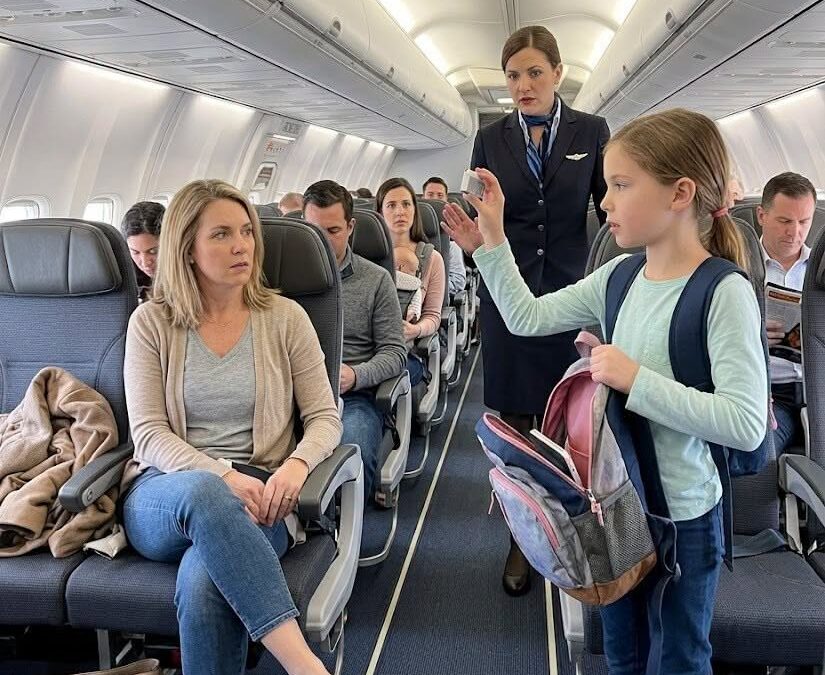
A Stranger Refused to Leave My Paid Seat and Blamed My Baby Then My 10 Year Old Daughter Held Up One Tiny Object and the Plane Went Silent
I thought the hardest part of that flight would be traveling alone with two children.
One of them was only six weeks old.
I was wrong.
The real trouble started before I had even managed to sit down.
And less than twenty minutes later, my ten year old daughter would stand in the aisle of a crowded airplane holding a tiny object in her hand while the woman who had spent the entire boarding process humiliating us suddenly stopped talking.
Not lowered her voice.
Not softened her attitude.
Stopped talking.
Completely.
The same woman who had blamed my children for delaying everyone.
The same woman who had pointed at my sleeping newborn as if he were some kind of problem I had deliberately brought onto the aircraft.
The same woman who had refused to give up the seat beside my daughter even after I showed her the boarding passes proving that I had paid extra so my children and I could stay together.
By the time my daughter stood up, almost everyone near our row was watching.
The irritation was gone.
The sighs were gone.
Nobody was complaining about the delay anymore.
Because suddenly the seat was not the most important thing happening on that plane.
It all started with something my daughter noticed trapped beneath that woman’s leg.
Something she had tried to warn her about quietly.
Something the woman had angrily told her to stop mentioning.
I wish I could say I knew from the beginning that the situation was going to become that tense.
I didn’t.
When I arrived at the airport that morning, I was worried about ordinary things.
Diapers.
Bottles.
Security.
Boarding.
Whether Oliver would cry during takeoff.
Whether Emma would get bored.
Whether I had packed enough wipes.
Whether I had forgotten some tiny but important baby item that I would suddenly desperately need thirty thousand feet in the air.
Oliver was six weeks old.
Six weeks.
Anyone who has cared for a newborn knows that six weeks is not an age when life feels organized.
Your entire day can revolve around feeding schedules, naps that disappear without warning, crying you cannot immediately explain, and the constant feeling that you are carrying one more thing than your arms were designed to hold.
I was already tired before the trip even began.
Not ordinary tired.
Newborn tired.
The kind of exhaustion that sits behind your eyes and makes you check the same bag three times because you no longer trust yourself to remember whether you packed something thirty seconds ago.
And I was traveling alone.
Not just with Oliver.
With Emma too.
Emma was ten.
She was old enough to understand what was happening around her, old enough to help when I needed an extra pair of hands, but still young enough that I wanted her right beside me.
That was exactly why I had planned everything before the flight.
I did not want to rely on luck.
I did not want to board the plane and discover that Emma had been placed several rows away while I tried to manage a newborn by myself.
So when I bought our tickets, I paid extra.
Two seats together.
Extra legroom.
Nothing extravagant.
Nothing unreasonable.
One seat for Emma.
One seat for me.
Oliver would remain secured against my chest in his baby carrier.
I had looked at that seating arrangement and felt relieved.
It gave me one less thing to worry about.
Emma would be beside me.
If she needed anything, I could help her.
If Oliver woke up and became restless, I would have enough room to adjust him without struggling against a stranger’s elbow.
If I needed something from the diaper bag, Emma could help.
If she became nervous during takeoff, I would be right there.
That was the whole point.
I was not paying extra because I expected special treatment for being a mother.
I was paying extra specifically so I would not need special treatment.
I wanted to solve the problem before it existed.
For days before the flight, I kept reminding myself of that.
You planned this.
You paid for the seats.
The kids will be together.
You will sit down.
Oliver will settle.
Everything will be fine.
By the time boarding started, I was exhausted but cautiously optimistic.
Emma stayed close to me as we moved through the jet bridge.
She had her backpack on both shoulders and that very serious expression she gets when she knows I am overwhelmed and has silently decided she is going to be as helpful as possible.
She did not complain.
She did not run ahead.
She did not ask me a dozen questions.
She just stayed beside me.
Oliver was asleep against my chest, warm and surprisingly peaceful inside the carrier.
Every few steps, I instinctively touched the back of his head.
Still sleeping.
Good.
For one brief moment, I actually felt proud of myself.
Maybe I had overthought everything.
Maybe this was going to be easier than I feared.
Maybe all the careful planning had worked.
Then we reached row eleven.
And I stopped.
There was already a woman sitting in one of our seats.
At first, I honestly assumed it was a mistake.
Airplanes are confusing.
People read the wrong row.
Someone sees eleven instead of twelve.
Someone mistakes A for F.
It happens.
I had no reason to assume anything worse.
But then I looked more closely.
She did not look confused.
She looked settled.
Very settled.
Her coat was spread across the seat beside her as though she had been there long enough to claim the space.
An oversized handbag was sticking partly into the aisle.
Passengers behind me immediately had to stop because there was no way to move around me while I was carrying Oliver and trying to figure out why someone was sitting where Emma was supposed to sit.
The woman had even taken off her shoes.
One bare foot was tucked underneath her near the window.
That detail bothered me immediately, although I could not fully explain why.
Maybe because it made the whole thing feel less accidental.
She had not simply sat down for a second while checking her boarding pass.
She had made herself comfortable.
Still, I told myself not to assume the worst.
I had a six week old baby sleeping on my chest.
My ten year old daughter was standing beside me.
There was a line of passengers behind us.
The last thing I wanted was an argument.
So I kept my voice calm.
“Excuse me,” I said. “I believe you’re sitting in one of our seats.”
She looked up at me.
For a second, her eyes went directly to Oliver.
I remember that clearly.
She looked at him first.
Then she looked at me.
And then, instead of checking her ticket, instead of asking what seat I had, instead of even pretending there might be a misunderstanding, she put her headphones back on.
“I’m already settled,” she said.
I actually froze for a moment.
Not because I did not understand the words.
Because I did.
Too well.
“I’m already settled.”
That was her explanation.
Apparently sitting down first had transformed the seat into her property.
I looked at Emma.
Emma looked at me.
Then I pulled out our boarding passes.
I was still trying to keep everything polite.
Maybe she had misunderstood.
Maybe once she saw the seat numbers, she would realize this was not some mother demanding that another passenger switch places.
I held the passes where she could see them.
“I paid extra to reserve both of these seats,” I said.
That was when her expression changed.
She removed one side of her headphones and stared at me as though I had accused her of something outrageous.
There was irritation in her face.
Not confusion.
Not embarrassment.
Irritation.
And then she raised her voice.
“Women traveling with babies always expect everyone else to change their plans,” she said. “You chose to bring two children onto this flight. That isn’t my problem.”
Several people turned their heads.
I felt heat rise into my face.
There are few things more uncomfortable than suddenly becoming the center of attention in a confined public space.
I had not raised my voice.
I had not demanded anything unusual.
I had not asked her to rearrange her plans because I was traveling with children.
I was standing beside the seats printed on boarding passes I had purchased.
But now strangers were looking at us.
And because she had spoken so loudly, all anyone had initially heard was her version.
Mother.
Baby.
Children.
Problem.
Delay.
Emma gripped both straps of her backpack.
She was silent.
But I could see her watching the woman.
Then watching me.
Then looking down at Oliver.
I hated that.
I hated that she was being pulled into an adult confrontation when all she had done was follow me onto an airplane and try to sit in the seat we had reserved for her.
Oliver moved slightly against my chest.
I put one hand on his back automatically.
Please stay asleep.
Please stay asleep.
The aisle behind us was filling rapidly.
Passengers could no longer move forward.
Some people were craning their necks trying to understand what was happening.
Others just looked irritated that boarding had stopped.
And I understood their frustration.
Nobody wants to stand in a crowded airplane aisle longer than necessary.
But understanding their frustration did not make the situation disappear.
I could not simply put Emma anywhere.
I had specifically paid so I would not have to do that.
Then I saw a flight attendant coming toward us.
The moment I saw her, I felt relief.
Actual relief.
Because in my mind, the problem was about to end.
I would show her the boarding passes.
She would check the seats.
The woman would move.
Emma and I would sit down.
Boarding would continue.
Simple.
I handed the flight attendant our passes.
She looked at them carefully.
Then she checked the other woman’s ticket.
I watched her face.
And that was the first moment I realized something else was wrong.
Her expression changed.
She checked again.
Then looked back at me.
Somehow, Emma’s seat appeared to have been assigned twice.
For a moment, I did not know what to say.
I had expected the woman to be in the wrong seat.
Technically, she was sitting where Emma was supposed to sit.
But according to what the flight attendant was seeing, the problem was more complicated than someone simply ignoring the number on her boarding pass.
The seat had apparently been duplicated.
I could feel the passengers behind us shifting.
The flight attendant looked past me at the crowded aisle.
Then she leaned closer.
“There’s another empty seat three rows behind,” she said quietly. “Would you be willing to sit there so we can finish boarding?”
I stared at her.
For a second, I genuinely wondered whether I had misunderstood.
I looked at Emma.
Then back at the attendant.
“You want me to leave my ten year old daughter beside a complete stranger?” I asked.
I tried to keep my voice controlled.
But now I was angry.
Not screaming.
Not making a scene.
Just angry.
Because this was exactly the situation I had paid extra to avoid.
Emma was ten.
Ten.
Yes, she was responsible.
Yes, she could sit independently.
But that did not mean I wanted her trapped beside a woman who had just loudly accused me of expecting special treatment and blamed my children for causing trouble.
The flight attendant told me she would keep checking on Emma.
I understood what she was trying to do.
I really did.
There was a plane full of passengers waiting to sit down.
There was a duplicate seat assignment.
There was an open seat three rows behind us.
From an operational perspective, moving one person probably felt like the easiest solution.
But from where I was standing, it did not feel easy.
It felt like I was being asked to absorb the consequences of a problem I had tried to prevent.
I had paid extra.
I had planned ahead.
I had reserved two seats together.
And now the solution being offered was that I should separate from my daughter because someone else was already comfortable.
I wanted Emma beside me.
That was not a luxury.
I wanted to know she was okay.
I wanted to be able to reach her.
I wanted to help both of my children without climbing over strangers or moving through the cabin.
I wanted what I had paid for.
The woman had been listening.
Then she smiled.
That smile still bothers me when I think about it.
It was not a relieved smile.
It was not the expression of someone who had just learned the airline had accidentally placed two passengers in the same seat.
It looked satisfied.
As if she had won something.
“Why should I move?” she said. “She’s the one who brought all this trouble onto the plane.”
Then she pointed at Oliver.
My six week old son.
My sleeping six week old son.
She actually pointed at him.
I looked down instinctively.
Oliver was asleep.
He had not screamed.
He had not kicked anyone.
He had not delayed boarding.
He had not done anything except exist against my chest.
And yet this woman was pointing at him like he was an object I had irresponsibly dragged onto the aircraft.
Something inside me tightened.
The insult toward me had been irritating.
Her attitude about the seat had been frustrating.
But pointing at my newborn as though he were the cause of the problem felt different.
He was not the problem.
Emma was not the problem.
I was not demanding some random stranger give up a seat out of sympathy for a mother.
I had paid for the seat.
There was a ticketing issue.
That was the problem.
But somehow, because I was standing there with children, the story had already been twisted.
Now I was the difficult mother.
Emma was part of the inconvenience.
Oliver was “all this trouble.”
Behind us, somebody sighed loudly.
Another person complained about the delay.
I did not turn around.
I did not want to see their faces.
The pressure was becoming unbearable.
That is one of the worst things about conflict in a public place.
Even when you know you are making a reasonable request, there comes a moment when you become aware that everyone around you just wants the problem to disappear.
They do not necessarily care how.
They do not know the details.
They do not know what you paid for.
They do not know why being seated beside your daughter matters.
They just know the aisle is blocked.
And suddenly you feel responsible for solving a problem you did not create.
Oliver started to stir.
I felt the small movement against my chest.
My heart sank.
Not now.
Please.
Not now.
I adjusted him slightly with one hand.
Emma noticed.
Of course she noticed.
She notices everything.
I could see the worry on her face.
And then I saw something else that hurt even more.
Guilt.
She looked like she thought she was part of the reason everything had become difficult.
Children do that sometimes.
Adults create a mess around them, and somehow they still wonder whether they are the problem.
Emma looked up at me.
“It’s okay, Mom,” she whispered. “I can stay here.”
My first instinct was immediate.
No.
Absolutely not.
She was ten years old.
I did not want to leave her beside a stranger who had just spoken to me with open hostility.
I did not want her spending the flight wondering whether the woman might say something to her.
I did not want her shrinking into the corner of a seat I had specifically reserved so she would feel comfortable.
But the flight attendant repeated that she would check on Emma.
The aisle was packed.
Oliver was waking.
And Emma was looking at me as if she was trying to save me from having to make a harder decision.
I hated it.
But eventually, I agreed.
Not because I suddenly believed it was fair.
Not because I thought the woman deserved the seat.
Because I felt trapped between several bad choices and chose the one that would finally get my children seated.
I helped Emma move into the row.
The woman barely shifted.
Emma lowered herself toward the seat beside her.
Then suddenly she stopped.
It was subtle.
So subtle that if I had been looking anywhere else, I might have missed it.
Her eyes moved downward.
Toward the woman’s leg.
Emma’s expression changed.
I knew that expression.
Every parent learns the tiny differences in their child’s face.
There is the annoyed look.
The embarrassed look.
The tired look.
The “I forgot something” look.
The “I know something but I’m deciding whether to say it” look.
This was the last one.
She had seen something.
Something important enough to make her pause.
“Ma’am, I think you might be sitting on…”
“Stop bothering me,” the woman snapped.
She did not even look at Emma.
Emma closed her mouth.
I stared at her.
I wanted to ask what she had seen.
But the aisle was still crowded.
Oliver was moving against my chest.
The flight attendant was trying to get everyone settled.
There was no room for me to remain standing there indefinitely.
I leaned down and kissed Emma on the forehead.
“I’m right back there,” I told her.
Three rows.
That was all.
Row fourteen.
Close enough that I could see her when people moved.
Close enough that I could reach her if necessary.
That was what I told myself.
Then I walked away.
The moment I sat down, those three rows felt much farther.
I positioned myself so I could see toward row eleven whenever the passengers between us shifted.
Sometimes all I could see was the top of Emma’s head.
Sometimes part of her face.
Sometimes nothing.
I kept checking.
I could not help it.
Every few seconds, my eyes returned to the same place.
Emma looked back once.
She gave me a small smile.
A reassuring smile.
My ten year old daughter was reassuring me.
I smiled back because I did not want her to know how uncomfortable I felt.
But I knew her.
She was not relaxed.
Her body was too still.
She was keeping herself contained on her side of the seat.
Careful not to touch the woman.
Careful not to take up too much room.
Careful not to give anyone another reason to accuse us of causing problems.
Meanwhile, the woman looked perfectly comfortable.
That was the part that made my anger return.
She had gotten everything she wanted.
She had kept the seat.
She had kept the space.
She had kept her coat beside her.
She had kept her oversized bag.
She had managed to turn my attempt to sit beside my own child into some unreasonable demand.
And somehow I was the one three rows away.
I looked down at Oliver.
He had settled again.
His small face was pressed against me.
Completely unaware of everything that had happened.
I thought about the woman pointing at him.
“You brought all this trouble onto the plane.”
No.
I had brought my children onto the plane.
The trouble had been there waiting for us.
As the aircraft prepared for takeoff, I tried to force myself to calm down.
There was nothing I could do in that moment.
Emma was seated.
The attendant knew where she was.
I could see her periodically.
The flight would take off.
Time would pass.
Eventually, we would land.
Maybe this whole ugly beginning would become nothing more than one of those travel stories people tell later.
You will not believe what happened before my flight.
That was what I told myself.
This is temporary.
Let it go.
Get through the flight.
Keep Oliver calm.
Watch Emma.
Do not make it worse.
The plane moved away from the gate.
I checked Emma again.
She was looking down.
Not at her lap.
Not at her backpack.
Down toward the side of the seat.
Toward the woman.
I remembered what she had said.
“Ma’am, I think you might be sitting on…”
Sitting on what?
At the time, I had barely processed it.
My brain had been overloaded.
Baby.
Aisle.
Passengers.
Flight attendant.
Seat problem.
Move three rows back.
I had assumed it was something ordinary.
Maybe part of the woman’s coat was tucked beneath her.
Maybe something had fallen out of her handbag.
Maybe Emma had spotted a piece of clothing caught in the seat.
Whatever it was, surely it was not important.
That was what I told myself.
But Emma kept looking toward the same area.
The aircraft accelerated.
I pressed one hand lightly against Oliver and focused on staying still during takeoff.
When the plane lifted, my stomach tightened.
Normally, once we were in the air, I would have felt relieved.
The hardest logistical part was done.
We were seated.
The bags were stored.
Oliver had stayed calm.
But I could not relax.
My attention kept pulling forward.
Row eleven.
Emma.
The woman.
That unfinished sentence.
Every time I caught a glimpse of my daughter, she seemed to be looking toward the same place.
I started thinking about walking up there once the seatbelt sign went off.
I would check on her.
Ask quietly whether she was okay.
Ask what she had seen.
Maybe the woman would put her headphones on and ignore us.
Fine.
At that point, ignoring us would have been an improvement.
About ten minutes after takeoff, the seatbelt sign finally switched off.
The change in the cabin was immediate.
People shifted.
Seatbelts clicked open.
Someone reached into an overhead compartment.
Others pulled things from bags.
The tense stillness of takeoff gave way to the ordinary movement of a flight settling into the air.
I looked toward Emma.
The woman stretched her legs into the extra space in front of her.
The extra space I had paid for.
I stared at that for a moment.
It should not have mattered anymore.
The seating decision had already been made.
But seeing her stretch comfortably into that space while Emma sat squeezed beside her brought every ounce of frustration back.
That space was the reason I had paid extra.
Not so some stranger could spread out after refusing to listen to me.
I was just about to shift Oliver and stand up when I heard Emma’s voice.
Clear.
Calm.
Loud enough to carry over the steady sound of the engines.
“Ma’am, my mother taught me that embarrassing someone in front of strangers is wrong.”
I froze.
Several people turned immediately.
That was the thing about Emma’s voice.
She was not yelling.
If she had shouted, people might have looked because a child was making a scene.
But she sounded calm.
Almost formal.
And somehow that made everyone pay more attention.
I leaned toward the aisle.
From three rows back, I could not see her entire face.
I saw part of her shoulder.
Part of the woman beside her.
Passengers turning.
My heart started beating faster.
What was she doing?
Then Emma continued.
“That’s why I tried to tell you quietly before the plane took off.”
The woman turned toward her.
Even from where I was sitting, I could see the change in her posture.
Her eyes narrowed.
“Then you should keep quiet now,” she said.
I felt my entire body tense.
Emma had already been polite.
She had already tried to warn her.
And now this woman was speaking to my daughter the same way she had spoken to me.
Dismissive.
Impatient.
As though Emma’s voice itself were an inconvenience.
I expected Emma to stop.
Usually, she avoids confrontation.
She is thoughtful.
She thinks before speaking.
If an adult snaps at her, her instinct is usually to pull back.
Not this time.
She reached for her seatbelt.
Click.
She unfastened it.
I nearly stood up.
My first thought was that she had had enough.
Maybe she was finally coming back to me.
Maybe she would stand beside my row until someone found a different solution.
Part of me was already preparing to say I did not care about delaying anything anymore.
My daughter was not staying beside someone who was treating her like that.
But Emma did not walk toward me.
She opened her backpack.
Then she stepped carefully into the aisle.
A flight attendant noticed her movement and started toward row eleven.
By then, more people were watching.
This was no longer the annoyed attention from boarding.
Nobody was waiting for the aisle to clear.
Nobody was rolling their eyes because a mother with children had delayed them.
Now they were curious.
They had heard Emma.
They had heard the woman tell her to stay quiet.
And they were trying to understand what my daughter had tried to tell her before takeoff.
Emma reached inside her backpack.
She pulled out something small.
From where I was sitting, I could not tell what it was.
I leaned farther into the aisle.
The passenger beside me shifted slightly.
I barely noticed.
All my attention was on Emma’s hand.
The object was small enough for her to hold carefully between her fingers.
She looked down at it.
Then she looked directly at the woman.
And she asked her a question.
One simple question.
The effect was immediate.
The cabin around row eleven changed.
It is difficult to explain unless you have been in a situation where noise disappears almost all at once.
Conversations stopped.
People who had been distracted turned around.
A few passengers lowered the phones they had been holding.
Magazines dropped into laps.
Faces tilted toward Emma.
Toward the woman.
Toward the tiny object in my daughter’s hand.
And the woman who had been so vocal before suddenly became completely still.
I stared at her.
This was the same person who had told me she was already settled.
The same person who had loudly accused mothers traveling with babies of expecting everyone else to change their plans.
The same person who had blamed me for bringing two children.
The same person who had pointed at Oliver.
The same person who had snapped at Emma before takeoff.
Now she was not saying anything.
Not one word.
And that was when I realized something else.
The item Emma was holding had not originally come from her backpack.
She had put it there.
After she found it.
My mind went straight back to boarding.
Emma lowering herself into the seat.
Emma stopping.
Emma looking down.
“Ma’am, I think you might be sitting on…”
The object.
That was what she had seen.
It had been trapped beneath the woman’s leg.
Emma had tried to tell her quietly.
The woman had told her to stop bothering her.
At some point after that, Emma had apparently managed to retrieve it and place it in her backpack.
And whatever that small thing was, it did not belong to the woman.
That fact alone changed the entire atmosphere.
The passengers who had seemed annoyed with us earlier were no longer looking at Emma as though she were part of a delay.
They were looking at the woman.
I watched my daughter closely.
She was not smiling.
That mattered to me.
There was no victorious expression on her face.
No look of revenge.
She was not enjoying the attention.
If anything, she looked serious.
Concerned.
That was Emma.
The woman had embarrassed me publicly.
She had insulted us.
She had treated my daughter like an inconvenience.
But Emma had still tried to protect her from embarrassment.
“My mother taught me that embarrassing someone in front of strangers is wrong.”
Suddenly that sentence made perfect sense.
Emma had seen the object before takeoff.
She knew it might create a scene.
So she had tried to say something quietly.
“Ma’am, I think you might be sitting on…”
She had been giving the woman a chance.
A private warning.
No audience.
No confrontation.
No humiliation.
The woman had shut her down.
Now the circumstances had changed.
The seatbelt sign was off.
Emma could stand.
And apparently she had decided she could no longer ignore whatever she had found.
The flight attendant reached row eleven.
She looked at Emma.
Then she looked at the object.
Her face changed.
I felt another jolt of anxiety.
Up until that moment, part of me had wondered whether the entire thing was something harmless that only looked dramatic because everyone was watching.
Maybe a piece of jewelry.
Maybe a card.
Maybe something that had fallen from another passenger’s bag.
But the flight attendant did not react casually.
Her expression became serious.
She held one hand slightly toward Emma.
Not snatching.
Not grabbing.
Just asking to see what she had.
Emma showed it to her.
The attendant examined it.
Then she looked at the woman.
Back at the object.
Then back at the woman again.
The woman shifted in her seat.
For the first time since I had met her, she looked uncomfortable.
Actually uncomfortable.
Her coat was still there.
Her handbag was still taking up space.
Her shoes were still off.
Everything around her suggested someone who had expected to settle in and remain undisturbed for the entire flight.
She had fought so hard for that comfort.
Now none of it seemed to matter.
The confidence was gone.
I adjusted Oliver against my chest and leaned farther into the aisle.
Every protective instinct in me wanted to go to Emma.
I wanted to stand beside her.
I wanted to put myself between my daughter and whatever was happening.
But I also saw the flight attendant standing there.
And I understood that whatever Emma had found had moved beyond the original seat dispute.
The attendant needed room.
So I stayed where I was.
Barely.
The woman still did not speak.
That silence fascinated me almost as much as the object itself.
Before, she had an answer for everything.
Why should she move?
Why should she care that I had paid for the seats?
Why should my children be her problem?
Why should Emma bother her?
She had been willing to make every thought public.
Now, when the attention of the cabin was completely focused on her, she had nothing to say.
I watched Emma.
She held herself very still.
She was not trying to provoke anyone.
She was not waving the object around.
She was not announcing accusations.
She simply stood there while the flight attendant looked at what she had found.
Passengers nearby were silent.
Nobody sighed.
Nobody complained.
Nobody demanded that Emma sit down so the flight could continue normally.
The inconvenience that had seemed so important during boarding had vanished from everyone’s mind.
Because now there was a different question hanging in the air.
How had that object ended up trapped beneath the leg of a woman sitting in a seat that had been assigned to my daughter?
And why had her entire attitude changed the moment Emma revealed it?
I kept replaying the beginning of the flight in my head.
Her immediate refusal to check anything.
“I’m already settled.”
Her anger when I showed the boarding passes.
“Women traveling with babies always expect everyone else to change their plans.”
Her blaming us.
“You chose to bring two children onto this flight. That isn’t my problem.”
Her smile when the flight attendant suggested moving me.
“Why should I move?”
Her pointing at Oliver.
“She’s the one who brought all this trouble onto the plane.”
And then Emma.
Quietly.
“Ma’am, I think you might be sitting on…”
“Stop bothering me.”
Every interaction felt different now.
Not because I suddenly knew what the object was.
I did not.
But because I knew Emma had tried to tell her something.
The woman had chosen not to listen.
That was what changed everything for me.
Emma had not been trying to create a dramatic reveal.
She had tried to prevent one.
That realization made me incredibly proud of her.
She was ten.
She had just watched an adult speak rudely to her mother.
She had watched that adult point at her baby brother.
She had watched me be moved away from the seat I had paid for.
She had every reason to be angry.
But when she noticed something that could potentially embarrass the woman, she had tried to handle it quietly.
She had offered kindness to someone who had shown us none.
And that kindness had been thrown back at her.
The flight attendant looked at the object again.
Then at the woman.
I could not hear what she said from row fourteen.
Her voice was low.
Controlled.
Professional.
The woman shook her head.
Just once.
The attendant spoke again.
This time, her voice was firmer.
Loud enough that the passengers closest to them clearly understood the instruction.
“Please stand up.”
The words seemed to change the air again.
The woman’s hand moved toward the armrest.
She did not immediately rise.
Emma stepped backward into the aisle to give her space.
I watched the woman’s face.
She looked up at the attendant.
Then toward Emma.
Then toward the object.
Still no argument.
No speech about being settled.
No complaint about children.
No demand that someone else solve the problem.
Nothing.
That was when I became aware of how many people were watching.
A man across the aisle.
A woman one row ahead.
Passengers twisting in their seats.
Faces appearing between headrests.
During boarding, I had wanted people to stop looking at us.
Now nobody could look away.
And neither could I.
The oversized handbag that had blocked the aisle earlier was still near her.
Her coat remained beside her.
Her shoes were still off.
Everything was exactly where it had been.
Except the balance of the situation had completely changed.
Twenty minutes earlier, I had been standing in that aisle with a newborn strapped to my chest while a stranger suggested my children were the problem.
Now my daughter was standing there calmly, and the stranger was the one being asked to get out of the seat.
I did not feel triumphant.
That surprised me.
I had imagined, during those first awful minutes, that I would feel relieved if someone finally forced the woman to move.
But now the seat almost felt irrelevant.
I wanted answers.
What had Emma found?
How had it gotten there?
Why did the flight attendant look so serious?
Why had the woman gone silent?
Most of all, I wanted to know whether Emma was okay.
I stood as much as I safely could without disturbing Oliver.
Emma caught a glimpse of me.
For half a second, our eyes met.
There was no panic in her face.
That helped.
She looked steady.
Serious.
Almost older than ten.
I wanted to tell her I was there.
I wanted to tell her she had done nothing wrong.
Instead, I stayed quiet because the flight attendant was still dealing with the woman.
The woman finally shifted forward.
Her hand tightened around the armrest.
For one strange second, the entire situation seemed frozen.
The flight attendant standing over her.
Emma in the aisle.
Passengers watching.
Oliver asleep against me.
And me three rows away, remembering how certain I had been that paying extra for two seats together would eliminate the biggest problem I might face that day.
I almost wanted to laugh at the absurdity of it.
I had spent days worrying about whether my newborn would cry.
He had barely made a sound.
I had worried Emma might become restless.
She had handled herself with more composure than most adults around us.
I had worried about bags, boarding, feeding and legroom.
Instead, the problem had become a stranger sitting in our assigned space, publicly insulting us, and then falling silent because my daughter had discovered something beneath her.
Travel has a way of exposing how little control you actually have.
You can prepare.
You can plan.
You can pay extra.
You can arrive early.
You can organize every detail.
And then someone else’s decision can turn an ordinary trip into something completely different.
But standing there, watching Emma, I realized preparation had still mattered.
Not in the way I expected.
I could not control the duplicate seat assignment.
I could not control the woman’s behavior.
I could not control the passengers who sighed behind us.
I could not control what Emma found.
But I had spent ten years teaching my daughter how to treat people.
How to speak up.
How to be kind without becoming invisible.
How to avoid humiliating someone when a private warning would do.
I had never imagined those lessons would appear in an airplane aisle.
Yet there she was.
“My mother taught me that embarrassing someone in front of strangers is wrong.”
That sentence kept repeating in my head.
Because it contained the whole story.
Emma could have spoken loudly before takeoff.
She did not.
She could have embarrassed the woman the moment she saw the object.
She did not.
She could have used it as revenge after hearing the woman insult me.
She did not.
She tried to tell her quietly.
The woman refused to listen.
Only after takeoff, after the seatbelt sign went off, after Emma realized the issue could not simply be ignored, did she stand.
And even then, she did not yell.
She did not insult her.
She asked one question.
That was enough.
The flight attendant waited.
The woman remained seated for another moment.
Her earlier confidence was completely gone.
And as I watched her, I remembered the smile she had given me during boarding.
The smile when the flight attendant suggested separating me from Emma.
The smile that had made me feel as though she believed she had won.
Now she looked like someone who desperately wanted to return to the moment before Emma opened her backpack.
But there are moments you cannot reverse.
You cannot unsay words.
You cannot undo the way you treated people simply because circumstances have changed.
You cannot tell a child to stop bothering you and then expect her to forget what she saw.
And you cannot make an entire airplane stop wondering once the question has been asked.
The attendant repeated the instruction.
The woman needed to stand.
Emma moved farther back.
Nobody around them spoke.
I could hear the engines.
The steady rush of air.
The faint movements of passengers shifting for a better view.
Every other sound seemed amplified because the usual conversation had disappeared.
I looked down at Oliver.
Still peaceful.
That almost made the entire thing feel surreal.
The baby who had supposedly brought “all this trouble” onto the flight was sleeping through the most uncomfortable scene in the cabin.
I rested one hand against him.
Then I looked back toward Emma.
My daughter stood calmly beside row eleven.
The woman’s hand remained near the armrest.
The flight attendant’s attention never left her.
The object was still the center of everything.
And every person close enough to understand what had happened seemed to be waiting for the same answer.
How had it gotten there?
That was the question.
Not who had paid for the seat anymore.
Not whether a mother should travel with a newborn.
Not whether Emma could survive sitting three rows away from me.
Not whether passengers had been delayed during boarding.
Something small had changed the entire story.
And the woman knew it.
I could see that much without knowing what the object was.
Her silence said more than all of her earlier complaints.
But I refused to jump to conclusions.
I had spent the beginning of the flight being judged by a stranger who knew nothing about me.
I was not going to immediately do the same thing to her.
The flight attendant would handle it.
There would be an explanation.
There had to be.
I just did not know what it was yet.
Emma stepped another inch into the aisle as the woman began to move.
I felt myself holding my breath.
People around row eleven leaned slightly forward.
Nobody looked impatient now.
Nobody acted as though my family had ruined their morning.
The entire cabin seemed focused on the same tiny space.
The same seat.
The same woman.
The same small object my daughter had tried to mention before takeoff.
I thought back to the second Emma first saw it.
That hesitation.
That look.
At the time, I had been too overwhelmed to understand.
Now I realized she had probably been thinking through the consequences even then.
Should I tell her?
Should I say it out loud?
Will this embarrass her?
That was why she had started carefully.
“Ma’am…”
Not accusing.
Not dramatic.
“I think you might be sitting on…”
And the woman had cut her off.
“Stop bothering me.”
Four words.
Four words that had ended the private warning.
Now privacy was no longer possible.
The attendant needed the woman to move.
The other passengers had already noticed.
The question had already been asked.
Everything the woman had tried to dismiss was now impossible to dismiss.
I felt anger rise in me again, but it was different from before.
Earlier, I had been angry because she had insulted me.
Now I was angry because she had dismissed Emma.
My daughter had tried to help her.
And she had been treated as though her voice had no value.
Parents often tell children to speak up when something feels wrong.
But what we do not always tell them is how difficult that can be when an adult tells them to be quiet.
Children are taught to respect adults.
Listen.
Do not interrupt.
Do not cause scenes.
Do not talk back.
Those lessons can make it incredibly difficult for a child to insist on being heard.
Emma had been told to stop bothering her.
She stopped.
But she did not forget.
She waited.
She thought.
Then she tried again.
I will always remember that part.
Not the seat.
Not the woman’s shoes.
Not the oversized handbag.
Not even the embarrassment of standing in the aisle while strangers stared.
I will remember that my daughter tried again.
That takes courage.
Especially when you are ten.
Especially when the adult you are speaking to has already made it clear she does not respect you.
Especially when your mother is three rows away holding your baby brother.
Emma had still stood up.
The woman began to rise slightly from the seat.
The flight attendant watched closely.
I leaned forward.
This was the moment everyone had been waiting for.
The moment when the woman would finally have to move from the place she had fought so aggressively to keep.
And I realized something almost funny in its cruelty.
At the beginning, all she had needed to do was listen.
Not to me.
Not to the flight attendant.
To Emma.
A ten year old girl had tried to save her from whatever public embarrassment was happening now.
She had offered her exactly the privacy she apparently wanted.
All the woman had to do was look.
Instead, she had snapped at her.
Now rows of strangers were watching.
Not because Emma had wanted revenge.
Because the woman had refused the quiet version of the conversation.
There are consequences to refusing to listen.
Sometimes they are small.
Sometimes they happen in front of an entire airplane.
The woman looked around.
I could not tell what she saw in the faces nearest her.
Curiosity.
Suspicion.
Confusion.
Maybe embarrassment.
I only knew nobody was looking at my family the way they had during boarding.
That part had changed completely.
Earlier, I had felt exposed.
Judged.
Like everyone assumed I was the difficult passenger simply because I was the one standing in the aisle with children.
Now the attention had moved.
And I almost wished it had not.
Attention can feel like power when it is directed away from you.
But it can also become something dangerous if people decide they already know a story before all the facts are clear.
I did not know all the facts.
Neither did they.
All we knew was what we had seen.
Emma had found something beneath the woman.
The object did not belong to her.
The flight attendant had taken it seriously.
The woman had become silent.
The attendant had asked her to stand.
That was all.
Anything beyond that would have been guessing.
So I waited.
The woman pushed down on the armrest.
Emma stepped aside.
The flight attendant stayed close.
And for the first time since we boarded, the woman no longer looked like the person controlling the situation.
Her comfort was gone.
Her certainty was gone.
Even the seat itself seemed different.
The same place she had treated like territory she had won now looked like something she wanted distance from.
I thought about how quickly public conflict changes.
Ten minutes earlier, people had wanted me to surrender because surrender was convenient.
Now those same rows were silent because convenience no longer mattered.
They wanted the truth.
So did I.
I looked at Emma again.
Her backpack hung from one shoulder.
I realized how small she looked beside the adults around her.
That hit me unexpectedly.
For all her composure, for all the confidence in her voice, she was still my little girl.
Ten years old.
Standing in an airplane aisle because the adults around her had failed to resolve something cleanly.
I wanted to pull her into my arms.
I wanted to tell her I was proud of her.
I wanted to get both of my children off that plane and go home.
Instead, I remained in row fourteen.
Because the plane was in the air.
Because Oliver was against my chest.
Because the flight attendant was handling it.
Because sometimes being a parent means staying still when every instinct tells you to move.
The woman shifted again.
My stomach tightened.
That tiny movement seemed enormous because everyone was waiting for it.
The flight attendant said something else quietly.
I could not make out the words.
The woman shook her head again.
Once.
Small.
Firm.
The attendant did not move away.
Her posture became even more serious.
I watched her.
She had been calm during boarding.
She had tried to solve the duplicate seat problem quickly.
At that time, she had seemed almost apologetic when she asked me to move.
Now she was not trying to persuade anyone.
She was giving instructions.
That distinction did not escape me.
Something had changed.
Whatever Emma had shown her was significant enough that the interaction was no longer about passenger comfort.
And still, I did not know why.
The uncertainty was almost worse than the conflict.
Human beings hate missing information.
We build explanations automatically.
We fill gaps.
We assume.
We create stories.
I could feel my own brain trying to do it.
I stopped myself.
I had already spent half the flight being cast in a story that was not true.
The selfish mother.
The entitled parent.
The woman expecting everyone to move because she brought a baby.
I knew how unfair that felt.
So I would not invent a story about the woman before I knew what had actually happened.
I would wait.
Emma had waited.
I could do the same.
Around us, the cabin remained unusually quiet.
Someone several seats away whispered something, but I could not hear it.
The flight attendant looked down.
Then back at the woman.
Emma held her backpack close to her body.
She glanced at me again.
I gave her the smallest nod I could.
I hoped she understood what I meant.
I see you.
I am here.
You are okay.
She nodded back.
That tiny exchange almost broke me.
Because I suddenly realized how frightened I had been since row eleven.
Not frightened of the woman.
Frightened of failing my children.
I had spent the days before the flight trying to make everything perfect.
I had paid for the seats.
Packed carefully.
Planned ahead.
And within minutes of boarding, I had been separated from Emma anyway.
That had made me feel as though I had failed.
But looking at her now, I understood something.
Parenting is not controlling every situation.
You cannot.
It is giving your children enough confidence, judgment and compassion to respond when situations go wrong.
Emma had done that.
She had shown more restraint than some of the adults around her.
She had been insulted indirectly.
Ignored directly.
Separated from me.
Placed beside a hostile stranger.
And still she had tried to do the kind thing first.
That mattered more to me than whether row eleven had extra legroom.
The woman slowly began moving.
Passengers watched.
The flight attendant gave Emma more space.
I caught another glimpse of the small object.
Still too far away.
Still impossible for me to identify.
It amazed me that something so physically small could change the emotional temperature of an entire cabin.
Before Emma held it up, the woman had been dominant.
Loud.
Certain.
Afterward, silence.
That difference was impossible to ignore.
And maybe that was why everyone was staring.
People notice when someone’s confidence disappears instantly.
We notice contradictions.
We notice fear.
We notice when a person who had been demanding attention suddenly wants none.
But noticing is not the same as knowing.
We still did not know.
That uncertainty hung over us.
The flight attendant repeated the request for the woman to stand.
This time there was no mistaking the expectation.
She was not asking as a favor.
She needed her out of the seat.
The woman gripped the armrest.
Emma stepped backward.
I saw the nearest passengers straighten.
My own breathing felt shallow.
Everything seemed to narrow to row eleven.
The seat.
The woman.
The flight attendant.
My daughter.
The object.
And then one final thought crossed my mind.
If that woman had simply listened to Emma before takeoff, none of us would be watching this now.
Whatever explanation existed could have remained quiet.
Private.
Maybe even forgettable.
Instead, she had dismissed my daughter.
And in doing so, she had guaranteed the exact thing Emma had been trying to prevent.
Embarrassment in front of strangers.
The irony was so sharp I almost could not believe it.
But Emma did not seem pleased by it.
She was not enjoying the woman’s discomfort.
That made me prouder than anything else.
She had not spoken because she wanted the woman punished.
She had spoken because she believed something needed to be addressed.
There is a difference.
A huge one.
The woman finally moved forward enough that it seemed she might stand.
The cabin stayed silent.
I watched.
Emma watched.
The flight attendant watched.
Everyone close enough to understand the situation seemed to be asking the same question without saying a word.
What was underneath that woman?
How had the object gotten there?
And why had she gone so silent the moment Emma produced it?
The answer was somewhere in row eleven.
But at that moment, none of us had it yet.
All I knew was that the stranger who had spent boarding insisting that my children were the problem was no longer talking.
My ten year old daughter was standing calmly beside her.
The flight attendant had told the woman to get up.
And the tiny object Emma had tried to warn her about before takeoff had changed everything.
I tightened my arm around Oliver.
I kept my eyes on Emma.
And I waited for the woman to stand.
Because whatever happened next, one thing had already become painfully clear.
The seat I had fought for was no longer the biggest problem on that plane.
And judging by the woman’s sudden silence, she knew it too.
REVIEW
A Stranger Refused to Leave My Paid Seat and Blamed My Baby Then My 10 Year Old Daughter Held Up One Tiny Object and the Plane Went Silent
I thought the hardest part of that flight would be traveling alone with two children.
One of them was only six weeks old.
I was wrong.
The real trouble started before I had even managed to sit down.
And less than twenty minutes later, my ten year old daughter would stand in the aisle of a crowded airplane holding a tiny object in her hand while the woman who had spent the entire boarding process humiliating us suddenly stopped talking.
Not lowered her voice.
Not softened her attitude.
Stopped talking.
Completely.
The same woman who had blamed my children for delaying everyone.
The same woman who had pointed at my sleeping newborn as if he were some kind of problem I had deliberately brought onto the aircraft.
The same woman who had refused to give up the seat beside my daughter even after I showed her the boarding passes proving that I had paid extra so my children and I could stay together.
By the time my daughter stood up, almost everyone near our row was watching.
The irritation was gone.
The sighs were gone.
Nobody was complaining about the delay anymore.
Because suddenly the seat was not the most important thing happening on that plane.
It all started with something my daughter noticed trapped beneath that woman’s leg.
Something she had tried to warn her about quietly.
Something the woman had angrily told her to stop mentioning.
I wish I could say I knew from the beginning that the situation was going to become that tense.
I didn’t.
When I arrived at the airport that morning, I was worried about ordinary things.
Diapers.
Bottles.
Security.
Boarding.
Whether Oliver would cry during takeoff.
Whether Emma would get bored.
Whether I had packed enough wipes.
Whether I had forgotten some tiny but important baby item that I would suddenly desperately need thirty thousand feet in the air.
Oliver was six weeks old.
Six weeks.
Anyone who has cared for a newborn knows that six weeks is not an age when life feels organized.
Your entire day can revolve around feeding schedules, naps that disappear without warning, crying you cannot immediately explain, and the constant feeling that you are carrying one more thing than your arms were designed to hold.
I was already tired before the trip even began.
Not ordinary tired.
Newborn tired.
The kind of exhaustion that sits behind your eyes and makes you check the same bag three times because you no longer trust yourself to remember whether you packed something thirty seconds ago.
And I was traveling alone.
Not just with Oliver.
With Emma too.
Emma was ten.
She was old enough to understand what was happening around her, old enough to help when I needed an extra pair of hands, but still young enough that I wanted her right beside me.
That was exactly why I had planned everything before the flight.
I did not want to rely on luck.
I did not want to board the plane and discover that Emma had been placed several rows away while I tried to manage a newborn by myself.
So when I bought our tickets, I paid extra.
Two seats together.
Extra legroom.
Nothing extravagant.
Nothing unreasonable.
One seat for Emma.
One seat for me.
Oliver would remain secured against my chest in his baby carrier.
I had looked at that seating arrangement and felt relieved.
It gave me one less thing to worry about.
Emma would be beside me.
If she needed anything, I could help her.
If Oliver woke up and became restless, I would have enough room to adjust him without struggling against a stranger’s elbow.
If I needed something from the diaper bag, Emma could help.
If she became nervous during takeoff, I would be right there.
That was the whole point.
I was not paying extra because I expected special treatment for being a mother.
I was paying extra specifically so I would not need special treatment.
I wanted to solve the problem before it existed.
For days before the flight, I kept reminding myself of that.
You planned this.
You paid for the seats.
The kids will be together.
You will sit down.
Oliver will settle.
Everything will be fine.
By the time boarding started, I was exhausted but cautiously optimistic.
Emma stayed close to me as we moved through the jet bridge.
She had her backpack on both shoulders and that very serious expression she gets when she knows I am overwhelmed and has silently decided she is going to be as helpful as possible.
She did not complain.
She did not run ahead.
She did not ask me a dozen questions.
She just stayed beside me.
Oliver was asleep against my chest, warm and surprisingly peaceful inside the carrier.
Every few steps, I instinctively touched the back of his head.
Still sleeping.
Good.
For one brief moment, I actually felt proud of myself.
Maybe I had overthought everything.
Maybe this was going to be easier than I feared.
Maybe all the careful planning had worked.
Then we reached row eleven.
And I stopped.
There was already a woman sitting in one of our seats.
At first, I honestly assumed it was a mistake.
Airplanes are confusing.
People read the wrong row.
Someone sees eleven instead of twelve.
Someone mistakes A for F.
It happens.
I had no reason to assume anything worse.
But then I looked more closely.
She did not look confused.
She looked settled.
Very settled.
Her coat was spread across the seat beside her as though she had been there long enough to claim the space.
An oversized handbag was sticking partly into the aisle.
Passengers behind me immediately had to stop because there was no way to move around me while I was carrying Oliver and trying to figure out why someone was sitting where Emma was supposed to sit.
The woman had even taken off her shoes.
One bare foot was tucked underneath her near the window.
That detail bothered me immediately, although I could not fully explain why.
Maybe because it made the whole thing feel less accidental.
She had not simply sat down for a second while checking her boarding pass.
She had made herself comfortable.
Still, I told myself not to assume the worst.
I had a six week old baby sleeping on my chest.
My ten year old daughter was standing beside me.
There was a line of passengers behind us.
The last thing I wanted was an argument.
So I kept my voice calm.
“Excuse me,” I said. “I believe you’re sitting in one of our seats.”
She looked up at me.
For a second, her eyes went directly to Oliver.
I remember that clearly.
She looked at him first.
Then she looked at me.
And then, instead of checking her ticket, instead of asking what seat I had, instead of even pretending there might be a misunderstanding, she put her headphones back on.
“I’m already settled,” she said.
I actually froze for a moment.
Not because I did not understand the words.
Because I did.
Too well.
“I’m already settled.”
That was her explanation.
Apparently sitting down first had transformed the seat into her property.
I looked at Emma.
Emma looked at me.
Then I pulled out our boarding passes.
I was still trying to keep everything polite.
Maybe she had misunderstood.
Maybe once she saw the seat numbers, she would realize this was not some mother demanding that another passenger switch places.
I held the passes where she could see them.
“I paid extra to reserve both of these seats,” I said.
That was when her expression changed.
She removed one side of her headphones and stared at me as though I had accused her of something outrageous.
There was irritation in her face.
Not confusion.
Not embarrassment.
Irritation.
And then she raised her voice.
“Women traveling with babies always expect everyone else to change their plans,” she said. “You chose to bring two children onto this flight. That isn’t my problem.”
Several people turned their heads.
I felt heat rise into my face.
There are few things more uncomfortable than suddenly becoming the center of attention in a confined public space.
I had not raised my voice.
I had not demanded anything unusual.
I had not asked her to rearrange her plans because I was traveling with children.
I was standing beside the seats printed on boarding passes I had purchased.
But now strangers were looking at us.
And because she had spoken so loudly, all anyone had initially heard was her version.
Mother.
Baby.
Children.
Problem.
Delay.
Emma gripped both straps of her backpack.
She was silent.
But I could see her watching the woman.
Then watching me.
Then looking down at Oliver.
I hated that.
I hated that she was being pulled into an adult confrontation when all she had done was follow me onto an airplane and try to sit in the seat we had reserved for her.
Oliver moved slightly against my chest.
I put one hand on his back automatically.
Please stay asleep.
Please stay asleep.
The aisle behind us was filling rapidly.
Passengers could no longer move forward.
Some people were craning their necks trying to understand what was happening.
Others just looked irritated that boarding had stopped.
And I understood their frustration.
Nobody wants to stand in a crowded airplane aisle longer than necessary.
But understanding their frustration did not make the situation disappear.
I could not simply put Emma anywhere.
I had specifically paid so I would not have to do that.
Then I saw a flight attendant coming toward us.
The moment I saw her, I felt relief.
Actual relief.
Because in my mind, the problem was about to end.
I would show her the boarding passes.
She would check the seats.
The woman would move.
Emma and I would sit down.
Boarding would continue.
Simple.
I handed the flight attendant our passes.
She looked at them carefully.
Then she checked the other woman’s ticket.
I watched her face.
And that was the first moment I realized something else was wrong.
Her expression changed.
She checked again.
Then looked back at me.
Somehow, Emma’s seat appeared to have been assigned twice.
For a moment, I did not know what to say.
I had expected the woman to be in the wrong seat.
Technically, she was sitting where Emma was supposed to sit.
But according to what the flight attendant was seeing, the problem was more complicated than someone simply ignoring the number on her boarding pass.
The seat had apparently been duplicated.
I could feel the passengers behind us shifting.
The flight attendant looked past me at the crowded aisle.
Then she leaned closer.
“There’s another empty seat three rows behind,” she said quietly. “Would you be willing to sit there so we can finish boarding?”
I stared at her.
For a second, I genuinely wondered whether I had misunderstood.
I looked at Emma.
Then back at the attendant.
“You want me to leave my ten year old daughter beside a complete stranger?” I asked.
I tried to keep my voice controlled.
But now I was angry.
Not screaming.
Not making a scene.
Just angry.
Because this was exactly the situation I had paid extra to avoid.
Emma was ten.
Ten.
Yes, she was responsible.
Yes, she could sit independently.
But that did not mean I wanted her trapped beside a woman who had just loudly accused me of expecting special treatment and blamed my children for causing trouble.
The flight attendant told me she would keep checking on Emma.
I understood what she was trying to do.
I really did.
There was a plane full of passengers waiting to sit down.
There was a duplicate seat assignment.
There was an open seat three rows behind us.
From an operational perspective, moving one person probably felt like the easiest solution.
But from where I was standing, it did not feel easy.
It felt like I was being asked to absorb the consequences of a problem I had tried to prevent.
I had paid extra.
I had planned ahead.
I had reserved two seats together.
And now the solution being offered was that I should separate from my daughter because someone else was already comfortable.
I wanted Emma beside me.
That was not a luxury.
I wanted to know she was okay.
I wanted to be able to reach her.
I wanted to help both of my children without climbing over strangers or moving through the cabin.
I wanted what I had paid for.
The woman had been listening.
Then she smiled.
That smile still bothers me when I think about it.
It was not a relieved smile.
It was not the expression of someone who had just learned the airline had accidentally placed two passengers in the same seat.
It looked satisfied.
As if she had won something.
“Why should I move?” she said. “She’s the one who brought all this trouble onto the plane.”
Then she pointed at Oliver.
My six week old son.
My sleeping six week old son.
She actually pointed at him.
I looked down instinctively.
Oliver was asleep.
He had not screamed.
He had not kicked anyone.
He had not delayed boarding.
He had not done anything except exist against my chest.
And yet this woman was pointing at him like he was an object I had irresponsibly dragged onto the aircraft.
Something inside me tightened.
The insult toward me had been irritating.
Her attitude about the seat had been frustrating.
But pointing at my newborn as though he were the cause of the problem felt different.
He was not the problem.
Emma was not the problem.
I was not demanding some random stranger give up a seat out of sympathy for a mother.
I had paid for the seat.
There was a ticketing issue.
That was the problem.
But somehow, because I was standing there with children, the story had already been twisted.
Now I was the difficult mother.
Emma was part of the inconvenience.
Oliver was “all this trouble.”
Behind us, somebody sighed loudly.
Another person complained about the delay.
I did not turn around.
I did not want to see their faces.
The pressure was becoming unbearable.
That is one of the worst things about conflict in a public place.
Even when you know you are making a reasonable request, there comes a moment when you become aware that everyone around you just wants the problem to disappear.
They do not necessarily care how.
They do not know the details.
They do not know what you paid for.
They do not know why being seated beside your daughter matters.
They just know the aisle is blocked.
And suddenly you feel responsible for solving a problem you did not create.
Oliver started to stir.
I felt the small movement against my chest.
My heart sank.
Not now.
Please.
Not now.
I adjusted him slightly with one hand.
Emma noticed.
Of course she noticed.
She notices everything.
I could see the worry on her face.
And then I saw something else that hurt even more.
Guilt.
She looked like she thought she was part of the reason everything had become difficult.
Children do that sometimes.
Adults create a mess around them, and somehow they still wonder whether they are the problem.
Emma looked up at me.
“It’s okay, Mom,” she whispered. “I can stay here.”
My first instinct was immediate.
No.
Absolutely not.
She was ten years old.
I did not want to leave her beside a stranger who had just spoken to me with open hostility.
I did not want her spending the flight wondering whether the woman might say something to her.
I did not want her shrinking into the corner of a seat I had specifically reserved so she would feel comfortable.
But the flight attendant repeated that she would check on Emma.
The aisle was packed.
Oliver was waking.
And Emma was looking at me as if she was trying to save me from having to make a harder decision.
I hated it.
But eventually, I agreed.
Not because I suddenly believed it was fair.
Not because I thought the woman deserved the seat.
Because I felt trapped between several bad choices and chose the one that would finally get my children seated.
I helped Emma move into the row.
The woman barely shifted.
Emma lowered herself toward the seat beside her.
Then suddenly she stopped.
It was subtle.
So subtle that if I had been looking anywhere else, I might have missed it.
Her eyes moved downward.
Toward the woman’s leg.
Emma’s expression changed.
I knew that expression.
Every parent learns the tiny differences in their child’s face.
There is the annoyed look.
The embarrassed look.
The tired look.
The “I forgot something” look.
The “I know something but I’m deciding whether to say it” look.
This was the last one.
She had seen something.
Something important enough to make her pause.
“Ma’am, I think you might be sitting on…”
“Stop bothering me,” the woman snapped.
She did not even look at Emma.
Emma closed her mouth.
I stared at her.
I wanted to ask what she had seen.
But the aisle was still crowded.
Oliver was moving against my chest.
The flight attendant was trying to get everyone settled.
There was no room for me to remain standing there indefinitely.
I leaned down and kissed Emma on the forehead.
“I’m right back there,” I told her.
Three rows.
That was all.
Row fourteen.
Close enough that I could see her when people moved.
Close enough that I could reach her if necessary.
That was what I told myself.
Then I walked away.
The moment I sat down, those three rows felt much farther.
I positioned myself so I could see toward row eleven whenever the passengers between us shifted.
Sometimes all I could see was the top of Emma’s head.
Sometimes part of her face.
Sometimes nothing.
I kept checking.
I could not help it.
Every few seconds, my eyes returned to the same place.
Emma looked back once.
She gave me a small smile.
A reassuring smile.
My ten year old daughter was reassuring me.
I smiled back because I did not want her to know how uncomfortable I felt.
But I knew her.
She was not relaxed.
Her body was too still.
She was keeping herself contained on her side of the seat.
Careful not to touch the woman.
Careful not to take up too much room.
Careful not to give anyone another reason to accuse us of causing problems.
Meanwhile, the woman looked perfectly comfortable.
That was the part that made my anger return.
She had gotten everything she wanted.
She had kept the seat.
She had kept the space.
She had kept her coat beside her.
She had kept her oversized bag.
She had managed to turn my attempt to sit beside my own child into some unreasonable demand.
And somehow I was the one three rows away.
I looked down at Oliver.
He had settled again.
His small face was pressed against me.
Completely unaware of everything that had happened.
I thought about the woman pointing at him.
“You brought all this trouble onto the plane.”
No.
I had brought my children onto the plane.
The trouble had been there waiting for us.
As the aircraft prepared for takeoff, I tried to force myself to calm down.
There was nothing I could do in that moment.
Emma was seated.
The attendant knew where she was.
I could see her periodically.
The flight would take off.
Time would pass.
Eventually, we would land.
Maybe this whole ugly beginning would become nothing more than one of those travel stories people tell later.
You will not believe what happened before my flight.
That was what I told myself.
This is temporary.
Let it go.
Get through the flight.
Keep Oliver calm.
Watch Emma.
Do not make it worse.
The plane moved away from the gate.
I checked Emma again.
She was looking down.
Not at her lap.
Not at her backpack.
Down toward the side of the seat.
Toward the woman.
I remembered what she had said.
“Ma’am, I think you might be sitting on…”
Sitting on what?
At the time, I had barely processed it.
My brain had been overloaded.
Baby.
Aisle.
Passengers.
Flight attendant.
Seat problem.
Move three rows back.
I had assumed it was something ordinary.
Maybe part of the woman’s coat was tucked beneath her.
Maybe something had fallen out of her handbag.
Maybe Emma had spotted a piece of clothing caught in the seat.
Whatever it was, surely it was not important.
That was what I told myself.
But Emma kept looking toward the same area.
The aircraft accelerated.
I pressed one hand lightly against Oliver and focused on staying still during takeoff.
When the plane lifted, my stomach tightened.
Normally, once we were in the air, I would have felt relieved.
The hardest logistical part was done.
We were seated.
The bags were stored.
Oliver had stayed calm.
But I could not relax.
My attention kept pulling forward.
Row eleven.
Emma.
The woman.
That unfinished sentence.
Every time I caught a glimpse of my daughter, she seemed to be looking toward the same place.
I started thinking about walking up there once the seatbelt sign went off.
I would check on her.
Ask quietly whether she was okay.
Ask what she had seen.
Maybe the woman would put her headphones on and ignore us.
Fine.
At that point, ignoring us would have been an improvement.
About ten minutes after takeoff, the seatbelt sign finally switched off.
The change in the cabin was immediate.
People shifted.
Seatbelts clicked open.
Someone reached into an overhead compartment.
Others pulled things from bags.
The tense stillness of takeoff gave way to the ordinary movement of a flight settling into the air.
I looked toward Emma.
The woman stretched her legs into the extra space in front of her.
The extra space I had paid for.
I stared at that for a moment.
It should not have mattered anymore.
The seating decision had already been made.
But seeing her stretch comfortably into that space while Emma sat squeezed beside her brought every ounce of frustration back.
That space was the reason I had paid extra.
Not so some stranger could spread out after refusing to listen to me.
I was just about to shift Oliver and stand up when I heard Emma’s voice.
Clear.
Calm.
Loud enough to carry over the steady sound of the engines.
“Ma’am, my mother taught me that embarrassing someone in front of strangers is wrong.”
I froze.
Several people turned immediately.
That was the thing about Emma’s voice.
She was not yelling.
If she had shouted, people might have looked because a child was making a scene.
But she sounded calm.
Almost formal.
And somehow that made everyone pay more attention.
I leaned toward the aisle.
From three rows back, I could not see her entire face.
I saw part of her shoulder.
Part of the woman beside her.
Passengers turning.
My heart started beating faster.
What was she doing?
Then Emma continued.
“That’s why I tried to tell you quietly before the plane took off.”
The woman turned toward her.
Even from where I was sitting, I could see the change in her posture.
Her eyes narrowed.
“Then you should keep quiet now,” she said.
I felt my entire body tense.
Emma had already been polite.
She had already tried to warn her.
And now this woman was speaking to my daughter the same way she had spoken to me.
Dismissive.
Impatient.
As though Emma’s voice itself were an inconvenience.
I expected Emma to stop.
Usually, she avoids confrontation.
She is thoughtful.
She thinks before speaking.
If an adult snaps at her, her instinct is usually to pull back.
Not this time.
She reached for her seatbelt.
Click.
She unfastened it.
I nearly stood up.
My first thought was that she had had enough.
Maybe she was finally coming back to me.
Maybe she would stand beside my row until someone found a different solution.
Part of me was already preparing to say I did not care about delaying anything anymore.
My daughter was not staying beside someone who was treating her like that.
But Emma did not walk toward me.
She opened her backpack.
Then she stepped carefully into the aisle.
A flight attendant noticed her movement and started toward row eleven.
By then, more people were watching.
This was no longer the annoyed attention from boarding.
Nobody was waiting for the aisle to clear.
Nobody was rolling their eyes because a mother with children had delayed them.
Now they were curious.
They had heard Emma.
They had heard the woman tell her to stay quiet.
And they were trying to understand what my daughter had tried to tell her before takeoff.
Emma reached inside her backpack.
She pulled out something small.
From where I was sitting, I could not tell what it was.
I leaned farther into the aisle.
The passenger beside me shifted slightly.
I barely noticed.
All my attention was on Emma’s hand.
The object was small enough for her to hold carefully between her fingers.
She looked down at it.
Then she looked directly at the woman.
And she asked her a question.
One simple question.
The effect was immediate.
The cabin around row eleven changed.
It is difficult to explain unless you have been in a situation where noise disappears almost all at once.
Conversations stopped.
People who had been distracted turned around.
A few passengers lowered the phones they had been holding.
Magazines dropped into laps.
Faces tilted toward Emma.
Toward the woman.
Toward the tiny object in my daughter’s hand.
And the woman who had been so vocal before suddenly became completely still.
I stared at her.
This was the same person who had told me she was already settled.
The same person who had loudly accused mothers traveling with babies of expecting everyone else to change their plans.
The same person who had blamed me for bringing two children.
The same person who had pointed at Oliver.
The same person who had snapped at Emma before takeoff.
Now she was not saying anything.
Not one word.
And that was when I realized something else.
The item Emma was holding had not originally come from her backpack.
She had put it there.
After she found it.
My mind went straight back to boarding.
Emma lowering herself into the seat.
Emma stopping.
Emma looking down.
“Ma’am, I think you might be sitting on…”
The object.
That was what she had seen.
It had been trapped beneath the woman’s leg.
Emma had tried to tell her quietly.
The woman had told her to stop bothering her.
At some point after that, Emma had apparently managed to retrieve it and place it in her backpack.
And whatever that small thing was, it did not belong to the woman.
That fact alone changed the entire atmosphere.
The passengers who had seemed annoyed with us earlier were no longer looking at Emma as though she were part of a delay.
They were looking at the woman.
I watched my daughter closely.
She was not smiling.
That mattered to me.
There was no victorious expression on her face.
No look of revenge.
She was not enjoying the attention.
If anything, she looked serious.
Concerned.
That was Emma.
The woman had embarrassed me publicly.
She had insulted us.
She had treated my daughter like an inconvenience.
But Emma had still tried to protect her from embarrassment.
“My mother taught me that embarrassing someone in front of strangers is wrong.”
Suddenly that sentence made perfect sense.
Emma had seen the object before takeoff.
She knew it might create a scene.
So she had tried to say something quietly.
“Ma’am, I think you might be sitting on…”
She had been giving the woman a chance.
A private warning.
No audience.
No confrontation.
No humiliation.
The woman had shut her down.
Now the circumstances had changed.
The seatbelt sign was off.
Emma could stand.
And apparently she had decided she could no longer ignore whatever she had found.
The flight attendant reached row eleven.
She looked at Emma.
Then she looked at the object.
Her face changed.
I felt another jolt of anxiety.
Up until that moment, part of me had wondered whether the entire thing was something harmless that only looked dramatic because everyone was watching.
Maybe a piece of jewelry.
Maybe a card.
Maybe something that had fallen from another passenger’s bag.
But the flight attendant did not react casually.
Her expression became serious.
She held one hand slightly toward Emma.
Not snatching.
Not grabbing.
Just asking to see what she had.
Emma showed it to her.
The attendant examined it.
Then she looked at the woman.
Back at the object.
Then back at the woman again.
The woman shifted in her seat.
For the first time since I had met her, she looked uncomfortable.
Actually uncomfortable.
Her coat was still there.
Her handbag was still taking up space.
Her shoes were still off.
Everything around her suggested someone who had expected to settle in and remain undisturbed for the entire flight.
She had fought so hard for that comfort.
Now none of it seemed to matter.
The confidence was gone.
I adjusted Oliver against my chest and leaned farther into the aisle.
Every protective instinct in me wanted to go to Emma.
I wanted to stand beside her.
I wanted to put myself between my daughter and whatever was happening.
But I also saw the flight attendant standing there.
And I understood that whatever Emma had found had moved beyond the original seat dispute.
The attendant needed room.
So I stayed where I was.
Barely.
The woman still did not speak.
That silence fascinated me almost as much as the object itself.
Before, she had an answer for everything.
Why should she move?
Why should she care that I had paid for the seats?
Why should my children be her problem?
Why should Emma bother her?
She had been willing to make every thought public.
Now, when the attention of the cabin was completely focused on her, she had nothing to say.
I watched Emma.
She held herself very still.
She was not trying to provoke anyone.
She was not waving the object around.
She was not announcing accusations.
She simply stood there while the flight attendant looked at what she had found.
Passengers nearby were silent.
Nobody sighed.
Nobody complained.
Nobody demanded that Emma sit down so the flight could continue normally.
The inconvenience that had seemed so important during boarding had vanished from everyone’s mind.
Because now there was a different question hanging in the air.
How had that object ended up trapped beneath the leg of a woman sitting in a seat that had been assigned to my daughter?
And why had her entire attitude changed the moment Emma revealed it?
I kept replaying the beginning of the flight in my head.
Her immediate refusal to check anything.
“I’m already settled.”
Her anger when I showed the boarding passes.
“Women traveling with babies always expect everyone else to change their plans.”
Her blaming us.
“You chose to bring two children onto this flight. That isn’t my problem.”
Her smile when the flight attendant suggested moving me.
“Why should I move?”
Her pointing at Oliver.
“She’s the one who brought all this trouble onto the plane.”
And then Emma.
Quietly.
“Ma’am, I think you might be sitting on…”
“Stop bothering me.”
Every interaction felt different now.
Not because I suddenly knew what the object was.
I did not.
But because I knew Emma had tried to tell her something.
The woman had chosen not to listen.
That was what changed everything for me.
Emma had not been trying to create a dramatic reveal.
She had tried to prevent one.
That realization made me incredibly proud of her.
She was ten.
She had just watched an adult speak rudely to her mother.
She had watched that adult point at her baby brother.
She had watched me be moved away from the seat I had paid for.
She had every reason to be angry.
But when she noticed something that could potentially embarrass the woman, she had tried to handle it quietly.
She had offered kindness to someone who had shown us none.
And that kindness had been thrown back at her.
The flight attendant looked at the object again.
Then at the woman.
I could not hear what she said from row fourteen.
Her voice was low.
Controlled.
Professional.
The woman shook her head.
Just once.
The attendant spoke again.
This time, her voice was firmer.
Loud enough that the passengers closest to them clearly understood the instruction.
“Please stand up.”
The words seemed to change the air again.
The woman’s hand moved toward the armrest.
She did not immediately rise.
Emma stepped backward into the aisle to give her space.
I watched the woman’s face.
She looked up at the attendant.
Then toward Emma.
Then toward the object.
Still no argument.
No speech about being settled.
No complaint about children.
No demand that someone else solve the problem.
Nothing.
That was when I became aware of how many people were watching.
A man across the aisle.
A woman one row ahead.
Passengers twisting in their seats.
Faces appearing between headrests.
During boarding, I had wanted people to stop looking at us.
Now nobody could look away.
And neither could I.
The oversized handbag that had blocked the aisle earlier was still near her.
Her coat remained beside her.
Her shoes were still off.
Everything was exactly where it had been.
Except the balance of the situation had completely changed.
Twenty minutes earlier, I had been standing in that aisle with a newborn strapped to my chest while a stranger suggested my children were the problem.
Now my daughter was standing there calmly, and the stranger was the one being asked to get out of the seat.
I did not feel triumphant.
That surprised me.
I had imagined, during those first awful minutes, that I would feel relieved if someone finally forced the woman to move.
But now the seat almost felt irrelevant.
I wanted answers.
What had Emma found?
How had it gotten there?
Why did the flight attendant look so serious?
Why had the woman gone silent?
Most of all, I wanted to know whether Emma was okay.
I stood as much as I safely could without disturbing Oliver.
Emma caught a glimpse of me.
For half a second, our eyes met.
There was no panic in her face.
That helped.
She looked steady.
Serious.
Almost older than ten.
I wanted to tell her I was there.
I wanted to tell her she had done nothing wrong.
Instead, I stayed quiet because the flight attendant was still dealing with the woman.
The woman finally shifted forward.
Her hand tightened around the armrest.
For one strange second, the entire situation seemed frozen.
The flight attendant standing over her.
Emma in the aisle.
Passengers watching.
Oliver asleep against me.
And me three rows away, remembering how certain I had been that paying extra for two seats together would eliminate the biggest problem I might face that day.
I almost wanted to laugh at the absurdity of it.
I had spent days worrying about whether my newborn would cry.
He had barely made a sound.
I had worried Emma might become restless.
She had handled herself with more composure than most adults around us.
I had worried about bags, boarding, feeding and legroom.
Instead, the problem had become a stranger sitting in our assigned space, publicly insulting us, and then falling silent because my daughter had discovered something beneath her.
Travel has a way of exposing how little control you actually have.
You can prepare.
You can plan.
You can pay extra.
You can arrive early.
You can organize every detail.
And then someone else’s decision can turn an ordinary trip into something completely different.
But standing there, watching Emma, I realized preparation had still mattered.
Not in the way I expected.
I could not control the duplicate seat assignment.
I could not control the woman’s behavior.
I could not control the passengers who sighed behind us.
I could not control what Emma found.
But I had spent ten years teaching my daughter how to treat people.
How to speak up.
How to be kind without becoming invisible.
How to avoid humiliating someone when a private warning would do.
I had never imagined those lessons would appear in an airplane aisle.
Yet there she was.
“My mother taught me that embarrassing someone in front of strangers is wrong.”
That sentence kept repeating in my head.
Because it contained the whole story.
Emma could have spoken loudly before takeoff.
She did not.
She could have embarrassed the woman the moment she saw the object.
She did not.
She could have used it as revenge after hearing the woman insult me.
She did not.
She tried to tell her quietly.
The woman refused to listen.
Only after takeoff, after the seatbelt sign went off, after Emma realized the issue could not simply be ignored, did she stand.
And even then, she did not yell.
She did not insult her.
She asked one question.
That was enough.
The flight attendant waited.
The woman remained seated for another moment.
Her earlier confidence was completely gone.
And as I watched her, I remembered the smile she had given me during boarding.
The smile when the flight attendant suggested separating me from Emma.
The smile that had made me feel as though she believed she had won.
Now she looked like someone who desperately wanted to return to the moment before Emma opened her backpack.
But there are moments you cannot reverse.
You cannot unsay words.
You cannot undo the way you treated people simply because circumstances have changed.
You cannot tell a child to stop bothering you and then expect her to forget what she saw.
And you cannot make an entire airplane stop wondering once the question has been asked.
The attendant repeated the instruction.
The woman needed to stand.
Emma moved farther back.
Nobody around them spoke.
I could hear the engines.
The steady rush of air.
The faint movements of passengers shifting for a better view.
Every other sound seemed amplified because the usual conversation had disappeared.
I looked down at Oliver.
Still peaceful.
That almost made the entire thing feel surreal.
The baby who had supposedly brought “all this trouble” onto the flight was sleeping through the most uncomfortable scene in the cabin.
I rested one hand against him.
Then I looked back toward Emma.
My daughter stood calmly beside row eleven.
The woman’s hand remained near the armrest.
The flight attendant’s attention never left her.
The object was still the center of everything.
And every person close enough to understand what had happened seemed to be waiting for the same answer.
How had it gotten there?
That was the question.
Not who had paid for the seat anymore.
Not whether a mother should travel with a newborn.
Not whether Emma could survive sitting three rows away from me.
Not whether passengers had been delayed during boarding.
Something small had changed the entire story.
And the woman knew it.
I could see that much without knowing what the object was.
Her silence said more than all of her earlier complaints.
But I refused to jump to conclusions.
I had spent the beginning of the flight being judged by a stranger who knew nothing about me.
I was not going to immediately do the same thing to her.
The flight attendant would handle it.
There would be an explanation.
There had to be.
I just did not know what it was yet.
Emma stepped another inch into the aisle as the woman began to move.
I felt myself holding my breath.
People around row eleven leaned slightly forward.
Nobody looked impatient now.
Nobody acted as though my family had ruined their morning.
The entire cabin seemed focused on the same tiny space.
The same seat.
The same woman.
The same small object my daughter had tried to mention before takeoff.
I thought back to the second Emma first saw it.
That hesitation.
That look.
At the time, I had been too overwhelmed to understand.
Now I realized she had probably been thinking through the consequences even then.
Should I tell her?
Should I say it out loud?
Will this embarrass her?
That was why she had started carefully.
“Ma’am…”
Not accusing.
Not dramatic.
“I think you might be sitting on…”
And the woman had cut her off.
“Stop bothering me.”
Four words.
Four words that had ended the private warning.
Now privacy was no longer possible.
The attendant needed the woman to move.
The other passengers had already noticed.
The question had already been asked.
Everything the woman had tried to dismiss was now impossible to dismiss.
I felt anger rise in me again, but it was different from before.
Earlier, I had been angry because she had insulted me.
Now I was angry because she had dismissed Emma.
My daughter had tried to help her.
And she had been treated as though her voice had no value.
Parents often tell children to speak up when something feels wrong.
But what we do not always tell them is how difficult that can be when an adult tells them to be quiet.
Children are taught to respect adults.
Listen.
Do not interrupt.
Do not cause scenes.
Do not talk back.
Those lessons can make it incredibly difficult for a child to insist on being heard.
Emma had been told to stop bothering her.
She stopped.
But she did not forget.
She waited.
She thought.
Then she tried again.
I will always remember that part.
Not the seat.
Not the woman’s shoes.
Not the oversized handbag.
Not even the embarrassment of standing in the aisle while strangers stared.
I will remember that my daughter tried again.
That takes courage.
Especially when you are ten.
Especially when the adult you are speaking to has already made it clear she does not respect you.
Especially when your mother is three rows away holding your baby brother.
Emma had still stood up.
The woman began to rise slightly from the seat.
The flight attendant watched closely.
I leaned forward.
This was the moment everyone had been waiting for.
The moment when the woman would finally have to move from the place she had fought so aggressively to keep.
And I realized something almost funny in its cruelty.
At the beginning, all she had needed to do was listen.
Not to me.
Not to the flight attendant.
To Emma.
A ten year old girl had tried to save her from whatever public embarrassment was happening now.
She had offered her exactly the privacy she apparently wanted.
All the woman had to do was look.
Instead, she had snapped at her.
Now rows of strangers were watching.
Not because Emma had wanted revenge.
Because the woman had refused the quiet version of the conversation.
There are consequences to refusing to listen.
Sometimes they are small.
Sometimes they happen in front of an entire airplane.
The woman looked around.
I could not tell what she saw in the faces nearest her.
Curiosity.
Suspicion.
Confusion.
Maybe embarrassment.
I only knew nobody was looking at my family the way they had during boarding.
That part had changed completely.
Earlier, I had felt exposed.
Judged.
Like everyone assumed I was the difficult passenger simply because I was the one standing in the aisle with children.
Now the attention had moved.
And I almost wished it had not.
Attention can feel like power when it is directed away from you.
But it can also become something dangerous if people decide they already know a story before all the facts are clear.
I did not know all the facts.
Neither did they.
All we knew was what we had seen.
Emma had found something beneath the woman.
The object did not belong to her.
The flight attendant had taken it seriously.
The woman had become silent.
The attendant had asked her to stand.
That was all.
Anything beyond that would have been guessing.
So I waited.
The woman pushed down on the armrest.
Emma stepped aside.
The flight attendant stayed close.
And for the first time since we boarded, the woman no longer looked like the person controlling the situation.
Her comfort was gone.
Her certainty was gone.
Even the seat itself seemed different.
The same place she had treated like territory she had won now looked like something she wanted distance from.
I thought about how quickly public conflict changes.
Ten minutes earlier, people had wanted me to surrender because surrender was convenient.
Now those same rows were silent because convenience no longer mattered.
They wanted the truth.
So did I.
I looked at Emma again.
Her backpack hung from one shoulder.
I realized how small she looked beside the adults around her.
That hit me unexpectedly.
For all her composure, for all the confidence in her voice, she was still my little girl.
Ten years old.
Standing in an airplane aisle because the adults around her had failed to resolve something cleanly.
I wanted to pull her into my arms.
I wanted to tell her I was proud of her.
I wanted to get both of my children off that plane and go home.
Instead, I remained in row fourteen.
Because the plane was in the air.
Because Oliver was against my chest.
Because the flight attendant was handling it.
Because sometimes being a parent means staying still when every instinct tells you to move.
The woman shifted again.
My stomach tightened.
That tiny movement seemed enormous because everyone was waiting for it.
The flight attendant said something else quietly.
I could not make out the words.
The woman shook her head again.
Once.
Small.
Firm.
The attendant did not move away.
Her posture became even more serious.
I watched her.
She had been calm during boarding.
She had tried to solve the duplicate seat problem quickly.
At that time, she had seemed almost apologetic when she asked me to move.
Now she was not trying to persuade anyone.
She was giving instructions.
That distinction did not escape me.
Something had changed.
Whatever Emma had shown her was significant enough that the interaction was no longer about passenger comfort.
And still, I did not know why.
The uncertainty was almost worse than the conflict.
Human beings hate missing information.
We build explanations automatically.
We fill gaps.
We assume.
We create stories.
I could feel my own brain trying to do it.
I stopped myself.
I had already spent half the flight being cast in a story that was not true.
The selfish mother.
The entitled parent.
The woman expecting everyone to move because she brought a baby.
I knew how unfair that felt.
So I would not invent a story about the woman before I knew what had actually happened.
I would wait.
Emma had waited.
I could do the same.
Around us, the cabin remained unusually quiet.
Someone several seats away whispered something, but I could not hear it.
The flight attendant looked down.
Then back at the woman.
Emma held her backpack close to her body.
She glanced at me again.
I gave her the smallest nod I could.
I hoped she understood what I meant.
I see you.
I am here.
You are okay.
She nodded back.
That tiny exchange almost broke me.
Because I suddenly realized how frightened I had been since row eleven.
Not frightened of the woman.
Frightened of failing my children.
I had spent the days before the flight trying to make everything perfect.
I had paid for the seats.
Packed carefully.
Planned ahead.
And within minutes of boarding, I had been separated from Emma anyway.
That had made me feel as though I had failed.
But looking at her now, I understood something.
Parenting is not controlling every situation.
You cannot.
It is giving your children enough confidence, judgment and compassion to respond when situations go wrong.
Emma had done that.
She had shown more restraint than some of the adults around her.
She had been insulted indirectly.
Ignored directly.
Separated from me.
Placed beside a hostile stranger.
And still she had tried to do the kind thing first.
That mattered more to me than whether row eleven had extra legroom.
The woman slowly began moving.
Passengers watched.
The flight attendant gave Emma more space.
I caught another glimpse of the small object.
Still too far away.
Still impossible for me to identify.
It amazed me that something so physically small could change the emotional temperature of an entire cabin.
Before Emma held it up, the woman had been dominant.
Loud.
Certain.
Afterward, silence.
That difference was impossible to ignore.
And maybe that was why everyone was staring.
People notice when someone’s confidence disappears instantly.
We notice contradictions.
We notice fear.
We notice when a person who had been demanding attention suddenly wants none.
But noticing is not the same as knowing.
We still did not know.
That uncertainty hung over us.
The flight attendant repeated the request for the woman to stand.
This time there was no mistaking the expectation.
She was not asking as a favor.
She needed her out of the seat.
The woman gripped the armrest.
Emma stepped backward.
I saw the nearest passengers straighten.
My own breathing felt shallow.
Everything seemed to narrow to row eleven.
The seat.
The woman.
The flight attendant.
My daughter.
The object.
And then one final thought crossed my mind.
If that woman had simply listened to Emma before takeoff, none of us would be watching this now.
Whatever explanation existed could have remained quiet.
Private.
Maybe even forgettable.
Instead, she had dismissed my daughter.
And in doing so, she had guaranteed the exact thing Emma had been trying to prevent.
Embarrassment in front of strangers.
The irony was so sharp I almost could not believe it.
But Emma did not seem pleased by it.
She was not enjoying the woman’s discomfort.
That made me prouder than anything else.
She had not spoken because she wanted the woman punished.
She had spoken because she believed something needed to be addressed.
There is a difference.
A huge one.
The woman finally moved forward enough that it seemed she might stand.
The cabin stayed silent.
I watched.
Emma watched.
The flight attendant watched.
Everyone close enough to understand the situation seemed to be asking the same question without saying a word.
What was underneath that woman?
How had the object gotten there?
And why had she gone so silent the moment Emma produced it?
The answer was somewhere in row eleven.
But at that moment, none of us had it yet.
All I knew was that the stranger who had spent boarding insisting that my children were the problem was no longer talking.
My ten year old daughter was standing calmly beside her.
The flight attendant had told the woman to get up.
And the tiny object Emma had tried to warn her about before takeoff had changed everything.
I tightened my arm around Oliver.
I kept my eyes on Emma.
And I waited for the woman to stand.
Because whatever happened next, one thing had already become painfully clear.
The seat I had fought for was no longer the biggest problem on that plane.
And judging by the woman’s sudden silence, she knew it too.








