A Seven Year Old Boy Asked Me to Walk Him Home, but One Request at the Front Door Made Me Realize Something Was Seriously Wrong
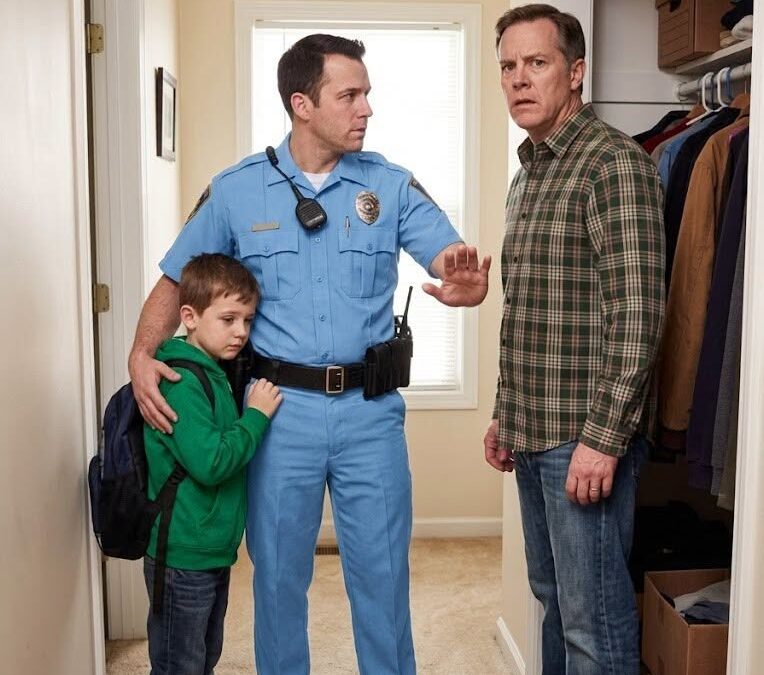
A Seven Year Old Boy Asked Me to Walk Him Home, but One Request at the Front Door Made Me Realize Something Was Seriously Wrong
The father moved first.
I moved faster.
He took one step toward the open storage room, and I shifted across the hallway before he could reach it.
“Stay where you are.”
He stopped.
For half a second, something passed through his face.
Not fear.
Calculation.
Then he lifted both hands.
“There’s nobody else in there.”
Another faint scrape came from behind the plastic bins.
The seven year old boy beside me tightened his grip on the back of my uniform.
His father smiled.
Too quickly.
“He does this,” the man said. “He creates stories when he gets upset.”
I kept my eyes on him.
“Do not move.”
“This is my house.”
“I understand.”
“You have no right to search anything.”
“I’m not searching.”
Another sound.
This time, unmistakable.
A small cough.
The boy whispered:
“I told her to stay quiet until I brought you.”
His father’s jaw tightened.
I shifted just enough to keep him in my peripheral vision while reaching for the nearest plastic container.
The bin was heavy.
Winter clothes, from the feel of it.
I dragged it sideways.
Another stood behind it.
I moved that one too.
And then I saw a shoe.
Small.
Pink.
A child’s sneaker.
Then two thin legs pulled tightly against a chest.
A little girl was wedged into the narrow space between the storage bins and the concrete wall.
She couldn’t have been older than five.
Maybe six.
Her knees were pulled beneath an oversized gray sweatshirt.
Both hands covered her mouth.
Her eyes were enormous.
She stared at my uniform.
Then at her brother.
The boy stepped around me just enough for her to see him.
“It’s okay,” he whispered.
His voice changed when he spoke to her.
Softer.
Older somehow.
“I brought the officer like I promised.”
That sentence stayed with me.
Not because of what it said about the father.
Because of what it said about the boy.
Seven years old.
Maybe eight.
And he had made a plan.
He had gone to school.
Memorized my name.
Waited until dismissal.
Asked me to walk home.
All so he could bring an adult to his little sister.
The girl still did not move.
I crouched.
“My name is Officer Dunham.”
She stared.
“You’re not in trouble.”
Nothing.
“You don’t have to come out until you’re ready.”
Her eyes moved toward her father.
I looked over my shoulder.
He had shifted another half step.
“Stay there.”
He lifted his hands higher.
“I’m standing still.”
I turned back.
The girl’s hands remained pressed over her mouth.
The boy whispered:
“Lucy.”
So now I had her name.
“Lucy.”
Her eyes moved to me.
“Your brother asked me to come.”
Her lower lip began shaking.
I continued.
“I’m going to make sure both of you are safe while we figure out what’s happening.”
The father laughed.
Not loudly.
A short, disbelieving sound.
“Safe?”
I ignored him.
Lucy slowly lowered one hand.
Then the other.
Her lips were dry.
There was a faint red line across one cheek.
Not fresh enough for me to know what caused it.
Her hair was tangled on one side.
She reached toward me.
Not my hand.
My sleeve.
Just like her brother.
She pinched the fabric between two fingers.
Then crawled forward.
The boy immediately knelt beside her.
“You did it,” she whispered.
He nodded.
“I told you.”
I felt something hard settle in my chest.
“What did you tell her?” I asked.
The boy looked at me.
“That I’d bring somebody who couldn’t be sent away.”
His father snapped:
“Enough.”
Lucy flinched so violently that her shoulder hit the concrete wall.
I stood.
“Sir, do not address the children right now.”
“They are my children.”
“Yes.”
“I’m their father.”
“Yes.”
“And you are standing inside my house encouraging them to lie.”
I touched the radio on my shoulder.
“Unit Twelve requesting an additional unit and child welfare response at my location.”
The father’s face changed.
“There’s no reason for that.”
I gave the address.
“Two minor children. One room capable of being secured only from outside. Second child located concealed inside the room. Request supervisor and medical evaluation.”
The father stepped forward.
I raised my hand.
“Stop.”
He did.
But his voice changed.
Less polished now.
“You’re going to traumatize them.”
Behind me, the boy made a small sound.
Not laughter.
Something close.
I looked at him.
He was staring at his father.
The man continued.
“My son has behavioral problems.”
“What kind?”
“He lies.”
“About what?”
“Everything.”
“Specific examples?”
The father hesitated.
“He tells teachers he doesn’t get dinner.”
The boy whispered:
“Sometimes I don’t.”
“Stop.”
I stepped forward.
The father’s eyes moved to me.
“Do not tell him to stop speaking to me.”
“You have no idea what you’re doing.”
“I know enough to wait for additional officers.”
He pointed toward the storage room.
“That is a time-out area.”
“There is no interior door handle.”
“He broke it.”
“Your son says you removed it.”
“He lies.”
“Why is Lucy behind the storage bins?”
The father stopped.
For the first time, he had no answer ready.
I glanced toward her.
She had moved fully out of the gap.
The boy had taken off his backpack and placed it around her shoulders even though the room was not cold enough to require another layer.
She held his hand.
“Was Lucy placed in this room?” I asked.
The father answered:
“No.”
The boy said:
“Yes.”
At the same time.
Silence.
The father looked at him.
The boy moved closer to me.
“How long has she been in here today?” I asked.
The boy swallowed.
“Since breakfast.”
My stomach tightened.
The father immediately said:
“That is absolutely false.”
“What time was breakfast?”
He did not answer.
I looked at the boy.
“What time did you leave for school?”
“Seven forty.”
“Was Lucy in the room when you left?”
He nodded.
I looked at Lucy.
“Were you here when your brother went to school?”
She pressed her face into his shoulder.
The father scoffed.
“Now you’re interrogating a five year old.”
“No.”
I kept my voice level.
“I’m documenting immediate safety concerns.”
“You are destroying my family because a child wanted attention.”
The boy whispered:
“I didn’t want attention.”
His father heard him.
“You brought a police officer home.”
“I wanted Lucy out.”
The father’s face hardened.
“What did I tell you about talking over adults?”
The boy stepped backward.
I shifted again.
“He can speak.”
“You’re teaching him disrespect.”
“No.”
I looked directly at the man.
“I’m showing him that he is allowed to answer a question about his own experience.”
He stared at me.
Then at the children.
The front door opened.
For one split second, the father moved.
Not toward me.
Toward the living room.
I put one hand out.
“Stay.”
A familiar voice called from the entrance.
“Portland Police.”
The father stopped.
My partner from a nearby sector, Officer Reyes, appeared at the hallway entrance.
Behind him was Sergeant Mills.
Relief moved through me, but I didn’t show it.
Reyes looked once at the children.
Then at the open storage room.
Then at the father.
“Sir, step into the living room for me.”
“This is ridiculous.”
“Living room.”
“I haven’t done anything.”
“Then we’ll talk.”
The father looked at the boy.
That look mattered.
Not because it was dramatic.
It wasn’t.
Just controlled anger.
The look an adult gives a child when they want the child to understand that punishment has merely been postponed.
The boy saw it.
He pressed closer to Lucy.
I stepped between them.
“Do not look at him like that.”
The father stared at me.
“What?”
“You heard me.”
Sergeant Mills came closer.
“Sir.”
Finally, the father turned.
He walked toward the living room with Reyes.
The second they disappeared around the corner, both children sagged.
Not relaxed.
Collapsed.
As if staying upright had required permission.
I crouched again.
“Can I ask your names?”
The boy swallowed.
“Eli.”
“Eli what?”
He gave me his last name.
Lucy whispered hers too.
Same.
Brother and sister.
“How old are you?”
“Seven.”
Lucy held up five fingers.
“Five?”
She nodded.
“Does Lucy go to school?”
Eli looked toward the hallway.
Then whispered:
“No.”
“Why?”
“Dad says she’s not ready.”
“Has she ever gone?”
“She went to kindergarten for a little bit.”
Lucy whispered:
“I made trouble.”
I turned toward her.
“What happened?”
She looked at Eli.
He answered:
“She cried at school.”
“That isn’t trouble.”
“Dad said it was.”
“When did she stop going?”
Eli thought.
“Before Christmas.”
It was May.
Five months.
A five year old child had apparently stopped attending school before Christmas.
“How does she learn?”
He pointed toward the worksheets beside the mattress.
I picked up nothing.
Did not disturb the area.
But I looked.
Alphabet practice.
Numbers.
A page of handwriting exercises.
Several worksheets had been completed in pencil.
“You do school here?” I asked Lucy.
She nodded.
“With your dad?”
“No.”
“Who helps?”
Eli raised his hand slightly.
“I do after school.”
That answer hit me harder than expected.
“You’re seven.”
He looked confused.
“I know.”
“You help her with school?”
“Dad leaves the pages.”
“What happens if she gets them wrong?”
Neither child answered.
I stopped asking.
There is a moment in some calls when curiosity becomes harmful.
You realize the immediate job is not uncovering everything.
It is reducing danger.
Backup.
Separation.
Medical care.
Documentation.
Then trained child interviewers can do what they do without forcing a child to repeat trauma to every adult wearing authority.
I stood.
“Do either of you hurt anywhere?”
Lucy looked at Eli.
He whispered:
“Tell him.”
She touched her stomach.
“Your stomach hurts?”
Nod.
“When did you eat?”
She whispered:
“Yesterday.”
Eli immediately said:
“She had crackers.”
“When?”
“This morning.”
Lucy nodded.
“How many?”
He held up two fingers.
I kept my voice steady.
“Okay.”
Not okay.
But I did not let my face tell them that.
A paramedic unit arrived shortly afterward.
The father objected immediately.
“I do not consent to medical treatment.”
Sergeant Mills answered from the living room:
“We have documented immediate safety concerns involving minors.”
The father began arguing about rights.
Jurisdiction.
Parental authority.
Everything except:
Are my children all right?
That stayed with me.
The paramedic knelt beside Lucy.
She refused to let him touch her at first.
Eli said:
“He’s okay.”
Lucy looked at her brother.
Then allowed the pulse oximeter.
The medic asked:
“Can I look at your hands?”
She nodded.
“Can I listen to your heart?”
Nod.
Everything was permission.
One step at a time.
Eli watched closely.
Not because he was afraid of the equipment.
Because he had learned to monitor adults around his sister.
The medic noticed too.
“Eli, you can sit down.”
“I’m okay.”
“You’ve got a heavy backpack.”
“I’m okay.”
The paramedic smiled gently.
“You’ve been taking care of a lot today.”
Eli looked confused.
Then started crying.
No warning.
No sound at first.
His face simply folded.
I sat beside him.
He tried to wipe his cheeks.
“Sorry.”
“No.”
He looked at me.
“You do not have to apologize.”
“I’m making things stressful.”
My throat tightened.
“Eli.”
He stared at the floor.
“Crying does not make things stressful.”
He looked at me.
I continued.
“Being scared does not make you bad.”
His eyes filled again.
“And asking for help does not cause trouble.”
That was the sentence he needed.
I could see it.
He leaned into me for half a second.
Then pulled away, embarrassed.
Lucy reached for him.
The paramedics recommended both children be evaluated at a hospital.
Child welfare arrived.
Then a detective from our family services unit.
The house became crowded.
Photographs were taken.
The storage room documented.
The latch.
Missing handle.
Camping mattress.
Flashlight.
Worksheets.
Water bottle.
The laminated rules.
I read them more carefully now.
FAMILY RULES.
- Peaceful children stay with the family.
- Complaining creates stress.
- Crying is manipulation.
- Children who lie lose privileges.
- Disrespect requires reflection.
- Apologies must include full responsibility.
- Family problems stay inside the family.
That final line made me stare.
Family problems stay inside the family.
Eli had violated the most important rule.
He brought me inside.
I looked at him.
He was sitting beside Lucy on the sofa now.
Both had blankets around their shoulders.
I wondered how many afternoons he had read those words.
How many times he had thought about what would happen if he ignored them.
The detective spoke with the father separately.
I heard pieces from the kitchen.
“My children require structure.”
“You cannot understand what their mother did to them.”
“Eli exaggerates.”
“Lucy has attachment problems.”
“I created a calm-down room.”
“She refuses food when emotional.”
Not:
I withheld food.
She refuses it.
Not:
I locked the door.
He needs a calm-down room.
Not:
I isolated them.
They have behavioral problems.
Eli had been right.
His father made everything sound normal.
That was his talent.
He could translate fear into discipline before anyone had time to recognize the original language.
Child welfare located an emergency placement.
Their maternal aunt.
Claire.
The name changed both children immediately.
Lucy lifted her head.
“Aunt Claire?”
The worker nodded.
“Do you know her?”
Eli stared.
“Dad says she hates us.”
That sentence changed the worker’s expression.
“She says she wants very much to see you.”
Eli looked at me.
“Really?”
“Really.”
His father shouted from the other room:
“She has no rights to them.”
Sergeant Mills closed the door between rooms.
Lucy began crying again.
Eli asked:
“Can we go now?”
The caseworker nodded.
“We’re going to the hospital first.”
“Then Claire?”
“That is the plan.”
Eli looked at me.
“You’re coming?”
I hesitated.
I had told him I would not leave him alone while we figured out what was happening.
I also had a job.
A chain of command.
Reports.
Procedures.
But Sergeant Mills heard him.
“Dunham.”
I looked over.
“Ride with them.”
I nodded.
Eli’s shoulders lowered.
“Okay.”
At the hospital, Lucy was examined first.
Mild dehydration.
Underweight, though not critically.
Several bruises in different stages of healing.
Nothing by itself explained where it came from.
Everything documented.
No dramatic hidden fracture.
No catastrophic injury.
In a way, that was important.
Abuse does not require a body to be broken beyond recognition.
Sometimes the evidence is a door with no handle.
A five year old who believes crying is misconduct.
A seven year old who apologizes for being afraid.
Eli’s exam showed similar concerns.
Too small shoes had rubbed blisters into his heels.
He had lost weight since his previous medical visit.
The hospital social worker found records showing missed pediatric appointments.
School staff arrived later.
His teacher cried when she learned where he had been sleeping during “reflection periods.”
She kept saying:
“I knew he was tired.”
Nobody blamed her.
At least I didn’t.
She had reported several concerns.
Eli falling asleep at his desk.
Bringing the same lunch repeatedly.
Becoming frightened when he received anything below perfect marks.
Asking permission to use the bathroom even during recess.
None of those things individually proved what waited behind the laundry room.
His father had explanations.
Eli was anxious.
Eli liked routine.
Eli forgot food.
Eli was dramatic.
Each explanation plausible enough alone.
That is how children become invisible inside systems full of adults who each see only one piece.
Around eight that evening, Claire arrived.
She ran through the hospital doors before the receptionist finished pointing.
Early thirties.
Hair pulled into a messy ponytail.
Still wearing office clothes.
Her face was already wet with tears.
“Eli.”
He froze.
Lucy did too.
Claire stopped several feet away.
She did not run at them.
Did not grab.
She knelt.
“Hi.”
Eli stared.
“You came.”
Claire laughed through tears.
“Of course I came.”
“Dad said you didn’t want us.”
Her face collapsed.
“What?”
“He said you were too busy.”
Claire covered her mouth.
Lucy moved first.
She ran.
Claire caught her.
The sound she made when she held that little girl was one I still remember.
Not relief.
Grief.
The sound of somebody discovering that years they thought were unavailable had actually been stolen.
Eli stayed still.
Claire opened one arm.
He walked into it slowly.
Then broke.
He sobbed into her shoulder.
“I’m sorry.”
Claire pulled back.
“For what?”
“I made trouble.”
“No.”
“I brought the police.”
“You asked for help.”
“Dad’s mad.”
Claire held his face.
“Eli.”
He looked at her.
“You are not responsible for your father’s feelings.”
He stared.
Like she had spoken in another language.
She repeated it.
“You are not responsible for making adults calm.”
I watched his face.
Some sentences have to be heard more than once because they contradict entire childhoods.
Claire looked toward me.
“Are you Officer Dunham?”
“Yes.”
She stood.
Then hugged me.
I was not prepared.
Police officers are often prepared for resistance.
Not gratitude.
“Thank you.”
“It was Eli.”
She pulled back.
“What?”
“He came to me.”
I looked at the boy.
“He made the plan.”
Claire started crying again.
“You saved your sister.”
I stepped in before Eli could carry that sentence the wrong way.
“He helped her.”
Both looked at me.
“Adults are responsible for saving children.”
I knelt near him.
“You did something very brave.”
“But what happened was never your responsibility to fix by yourself.”
Eli stared.
Then nodded.
That distinction mattered.
I learned that later from one of the child therapists.
Calling abused children heroes can accidentally give them another burden.
If they saved everyone once, maybe they believe they must keep doing it.
Eli deserved to be seven.
Not a guardian.
Not a rescuer.
Seven.
The father was not arrested that evening.
People sometimes imagine cases like this end with handcuffs the moment the door opens.
Real investigations are slower.
Statements.
Evidence.
Medical assessments.
Search warrants.
Records.
Interviews designed not to contaminate children’s accounts.
He was removed from contact while protective orders were arranged.
The children left with Claire under an emergency placement.
Before they went, Eli looked at me.
“Officer?”
“Yes?”
“You said I wouldn’t be alone.”
“I remember.”
He glanced at Claire.
“So this counts?”
I smiled.
“Yes.”
He nodded.
Then:
“Will Dad make me go home tomorrow?”
The truth mattered.
“I don’t know what the court will decide.”
Fear returned.
“But a lot of adults now know what you showed me.”
I pointed gently toward the hospital hallway.
“Your aunt knows.”
“The doctors know.”
“The child welfare workers know.”
“The detectives know.”
“The court will know.”
I held his gaze.
“You do not have to carry the secret by yourself anymore.”
That was enough.
He left holding Claire’s hand.
Lucy held the other.
I stood in the emergency department until the doors closed behind them.
Then I went back to the station and wrote for three hours.
Every detail.
The key shaking in his hand.
The latch.
The missing handle.
The mattress.
The water bottle.
The girl behind the bins.
The father blocking the children’s exit.
His exact words when possible.
Police reports are strange things.
You take the worst afternoon of somebody’s life and force it into objective paragraphs.
No poetry.
No emotional language.
Observed.
Stated.
Located.
Documented.
Necessary.
Still, when I reached the line where Eli said:
She’s the real reason I wanted you to come.
I stopped typing.
Sergeant Mills passed my desk.
“You all right?”
“Yes.”
He looked at me.
“You’re lying.”
I leaned back.
“How did we miss it?”
He knew what I meant.
I had driven past that house hundreds of times.
Morning patrol.
Afternoons.
Traffic stops nearby.
Noise complaints one street over.
The house had been there.
The latch had been there.
The children had been there.
Mills sat.
“You didn’t miss what you never had access to see.”
“That sounds convenient.”
“It’s true.”
“I saw Eli at school.”
“And when he asked for help?”
“I went.”
I looked at him.
“What about all the times before?”
“Dunham.”
“What?”
“You’re trying to become responsible for the part of the story before you entered it.”
He pointed toward my report.
“Don’t.”
I wanted to argue.
Didn’t.
The investigation expanded over the next several weeks.
I learned things because I became a witness.
Not because I was assigned to investigate my own call.
That separation mattered.
Detectives handled the case.
Child interview specialists spoke with Eli and Lucy.
Claire provided family history.
The school provided attendance records.
Doctors documented the children’s physical condition.
What emerged was not one dramatic incident.
It was a system.
Their mother, Hannah, had died three years earlier after a sudden illness.
Eli was four.
Lucy two.
Their father, Daniel Mercer, had apparently become intensely controlling after her death.
At first, family members interpreted it as grief.
Schedules.
Clean house.
Strict routines.
Reasonable after chaos.
Then the rules multiplied.
Children could not cry loudly because crying “made the house unstable.”
They could not discuss their mother without permission because it “triggered everyone.”
Food became tied to behavior.
Dessert disappeared first.
Then snacks.
Sometimes dinner was delayed until apologies were accepted.
The storage room began as what Daniel called a “quiet corner.”
No door latch.
No missing handle.
Over time, it changed.
A mattress appeared.
Then the latch.
Then the handle came off.
Nobody outside the house saw the progression.
Claire had.
Partly.
She challenged Daniel after seeing Eli standing with his nose against a wall during a family visit.
Daniel accused her of undermining his parenting.
Contact decreased.
Then stopped.
He told the children Claire was busy.
He told Claire the children became “emotionally destabilized” after seeing her.
He told the school Lucy had transferred to a home education program.
There was no valid home education registration.
She had simply vanished from school records after withdrawal paperwork that was later questioned.
The most disturbing thing investigators found was not hidden in the storage room.
It was written openly.
A spiral binder in Daniel’s office.
Behavior logs.
Dates.
Infractions.
Consequences.
Eli cried during breakfast.
Thirty minutes reflection.
Lucy asked for Mom.
Loss of family time.
Eli contradicted Dad.
Apology exercise.
Lucy would not stop crying.
Quiet room.
The phrases were clean.
Administrative.
Almost professional.
The harm became easier to commit when translated into paperwork.
That was one reason Eli had struggled to name it.
Everything had a title.
Reflection.
Reset.
Calm down.
Responsibility statement.
Family restoration.
Children rarely know the difference between a rule and abuse when the adult enforcing both uses the same calm voice.
The criminal case eventually included allegations of unlawful confinement and child maltreatment.
I won’t pretend I remember every statutory phrase now.
I remember the hearing.
I remember Daniel in a suit.
Clean shave.
Controlled expression.
He looked nothing like the angry man in the hallway.
That was instructive.
People expect dangerous parents to look dangerous.
Often they look organized.
He spoke about grief.
About two difficult children.
About losing his wife.
About trying to create structure.
His lawyer described the storage room as “an unconventional but nonviolent disciplinary space.”
Then photographs appeared.
The exterior latch.
Missing interior handle.
Camping mattress.
Flashlight.
Child sized worksheets.
The phrase nonviolent sounded different after that.
Claire attended with an advocate.
The children did not sit in the courtroom for everything.
Thank God.
At one stage, the judge reviewed emergency custody findings.
Daniel’s attorney argued that removing children from their surviving parent could create greater trauma.
That is not a ridiculous argument in general.
Family separation can traumatize children.
But it cannot become an excuse to return them to the environment causing the immediate harm.
The judge extended protective placement.
Daniel was prohibited from unsupervised contact.
Later, his contact became dependent on treatment, evaluations, and the developing case.
Eli asked Claire afterward:
“Did I get Dad in trouble?”
She called me.
Not because I was the investigator.
Because he had asked to talk to me.
I checked with my supervisor and the caseworker.
Then met them in a supervised office.
Eli looked different.
New shoes.
Correct size.
Hair growing out evenly.
Still thin.
Still watching doors.
He sat across from me.
“Did I get Dad arrested?”
I answered carefully.
“You told me what was happening.”
“But if I didn’t…”
“No.”
He stopped.
“What?”
“You are not responsible for the consequences of an adult’s choices.”
He looked down.
“He says I lied.”
“Did you?”
“No.”
“Did you put the latch on the door?”
“No.”
“Did you remove the handle?”
“No.”
“Did you decide Lucy should stay there?”
“No.”
“Then what did you do?”
He thought.
“I showed you.”
“Yes.”
I leaned closer.
“You did not create the problem by showing it.”
His eyes filled.
“That is important.”
He nodded.
Then asked:
“Do police get scared?”
I smiled.
“Yes.”
“Were you scared at my house?”
A little.
Not because I thought Daniel was about to overpower me.
Because children were involved and I did not know what would happen next.
“Yes.”
Eli looked surprised.
“You didn’t look scared.”
“That’s training.”
“What does training do?”
“It helps you know what to do while you’re scared.”
He considered that.
Then smiled.
“I had a plan.”
“Yes, you did.”
“Was that training?”
“No.”
“What was it?”
I thought.
“Courage.”
He liked that answer.
But I added:
“And I hope you don’t have to be that brave all the time anymore.”
His smile disappeared.
Then returned smaller.
“Me too.”
Lucy struggled differently.
Claire later told me she hated closed doors.
Every interior door in Claire’s house had to remain open at first.
Bathroom included unless Claire stood outside speaking to her.
At bedtime, Lucy slept with the hallway light on.
If a door clicked shut somewhere, she cried.
Claire removed a decorative hook latch from a pantry because Lucy stared at it.
The first week, Lucy hid crackers under her pillow.
Not because Claire restricted food.
Because she had learned food could disappear when adults became unhappy.
Claire found them.
Did not confront her.
She placed a small basket of snacks on a shelf in Lucy’s room.
Always available.
The first few days, Lucy emptied it.
Claire refilled it.
Then Lucy stopped hoarding as much.
Consistency teaches safety more effectively than speeches.
Eli struggled with apologies.
If he spilled juice, he gave long explanations.
“I’m sorry, I should have held the cup with two hands, I was not being careful, I caused the problem and I promise to make better choices.”
Claire told me the first time he said that, she had to leave the room because she was crying too hard.
She returned with a towel.
“It’s juice.”
Eli froze.
“Aren’t you mad?”
“No.”
“What do I have to say?”
“Nothing.”
He stared.
“You can help me wipe it up.”
“That’s it?”
“That’s it.”
He cried.
Sometimes freedom is terrifying when punishment has been predictable.
Therapy became part of their routine.
Slowly.
Lucy returned to kindergarten.
She was behind academically.
Not catastrophically.
Eli helped less.
That sounds like a strange measure of progress.
But it was.
Teachers taught Lucy.
Claire parented Lucy.
Therapists helped Lucy.
Eli became her brother instead of her substitute adult.
At first he resisted.
When Lucy forgot homework, he tried to fix it.
Claire stopped him.
“She has adults.”
“But she’ll get in trouble.”
“No.”
“What if she does it wrong?”
“She gets to learn.”
He stared.
Eventually he went outside to play.
That was progress.
The school installed additional training after the case.
Not because anyone claimed teachers caused it.
Because institutions learn.
Staff reviewed patterns associated with coercive control and neglect.
Repeated hunger.
Extreme fear of minor mistakes.
Children who use unusually adult language about family responsibility.
Siblings who function as caregivers beyond their age.
They also changed one small thing.
The school resource officers introduced themselves more deliberately.
Names.
What we did.
How kids could find us.
That mattered because Eli had known my name.
Later I asked him how.
“You helped Marcus.”
“Who?”
“The kid who lost his lunch.”
I remembered.
Months before, a first grader had dropped his lunch bag near the bus lane and burst into tears.
I helped him find it.
That was all.
Eli had seen.
“You remembered that?”
He nodded.
“You didn’t get mad.”
“At Marcus?”
“He was crying.”
I sat quietly.
“That’s why you chose me?”
He nodded.
I had spent years thinking community policing was about presence.
Uniform visibility.
Relationships.
Safety education.
I had never considered that one child might be watching how you respond to another child’s tears and using that moment to decide whether you were safe enough for his secret.
After that, I never treated small school calls as small again.
Lost lunch.
Skinned knee.
Argument.
They were not emergencies.
But somebody was always watching what kind of adult I became when a child was inconvenient.
Daniel’s case moved slowly.
Months.
Then longer.
He denied some allegations.
Admitted others.
Insisted he never intended harm.
Intent became a recurring word.
“I intended structure.”
“I intended accountability.”
“I intended calm.”
At one hearing, Claire told me later, the judge said something simple:
“Intent does not erase what a child experiences.”
That sentence stayed with her.
Eventually Daniel entered a plea related to the children’s confinement and neglect.
There were restrictions.
Treatment requirements.
Court supervision.
I won’t pretend the legal outcome satisfied everyone.
Nothing could return three years.
Nothing could make Lucy forget the latch.
Nothing could give Eli the childhood hours he spent listening for his sister from school.
Courts can impose consequences.
They cannot manufacture childhood.
What mattered most to me happened outside court.
Nearly a year after that afternoon, Evergreen Elementary held a spring carnival.
I was assigned traffic duty.
I saw Claire first.
Then Lucy.
She ran toward a game booth wearing a glittery purple jacket.
Hair brushed.
Face painted like a butterfly.
She laughed loudly.
That sound stopped me.
Not because laughter should be extraordinary.
Because once, she had been taught crying and noise made a house unsafe.
Now she was shouting because she missed a ring toss.
Eli stood nearby.
He was taller.
New backpack.
Shoes that fit.
He saw me.
For a second, he became serious.
Then walked over.
“Officer Dunham.”
“You remembered.”
“You’re at my school all the time.”
“Fair.”
He looked at my radio.
Then smiled.
“Can I ask something?”
“Sure.”
“Have you ever caught a criminal?”
I stared.
Then laughed.
It was the most ordinary seven—no, eight now—year old question he had ever asked me.
“A few.”
“Can I touch the radio?”
“Not the emergency button.”
He reached carefully.
Claire watched from a few feet away.
Her eyes filled.
She knew why the question mattered too.
Eli was finally curious about ordinary things.
Sirens.
Radios.
Police stories.
Not escape plans.
He tapped the radio casing.
“Cool.”
Then ran toward Lucy.
That might have been the moment the case stopped living in my head every day.
Not because I forgot.
Because I saw what came after.
A year later, Claire petitioned for longer term guardianship.
The legal arrangements evolved with the court case.
The children stayed together.
That mattered deeply.
Eli once told his therapist he would go anywhere as long as Lucy went too.
Claire worked hard to teach him:
“You do not have to trade yourself for her.”
He did not understand at first.
Eventually he did.
Daniel’s supervised contact remained complicated.
Some visits happened.
Some were paused.
The children reacted differently.
Lucy often refused.
Eli sometimes wanted answers.
Why did you take the handle off?
Daniel initially said:
“You broke it.”
Eli ended the visit.
Later, after treatment, Daniel acknowledged:
“I removed it.”
Not enough.
But truth matters.
Eli asked:
“Why?”
Daniel cried.
“I thought if you couldn’t leave, you would calm down.”
“That made me more scared.”
“I know.”
“You didn’t know then.”
“No.”
“You should have.”
“Yes.”
Eli told Claire afterward that hearing yes helped.
Not forgiveness.
Not reunion.
A piece of reality returned.
For years, his father had made him question his own memory.
The handle had not broken.
It had been removed.
He had known.
Adults had denied it.
Now someone finally said:
Yes.
That happened.
You remember correctly.
Children need reality more than adults understand.
Without it, they learn to distrust their own fear.
I saw Daniel once after the case concluded.
Not socially.
Outside a municipal building.
He recognized me.
I expected anger.
Instead he said:
“My son picked you.”
I stopped.
“Yes.”
“He watches people.”
“Yes.”
“He always did.”
I said nothing.
Daniel looked older.
“I thought he was manipulative.”
There was nothing useful I could say.
He continued.
“He was watching for danger.”
“Yes.”
He nodded.
Then:
“I still think people don’t understand what it was like after my wife died.”
“I’m sure they don’t.”
He looked surprised.
I continued.
“Grief can explain why somebody becomes unstable.”
His face softened.
“It cannot make a locked room safe.”
He looked away.
“No.”
I left.
That was all.
I did not need to hate him.
My job was never to create a villain simple enough to understand.
It was to respond to what happened.
A child locked behind a door without an interior handle.
Another child hidden behind bins.
A father blocking the exit.
Facts.
Human beings can be grieving and harmful.
Loving and controlling.
Broken and responsible.
Complexity should deepen accountability.
Not erase it.
Years passed.
I stayed assigned near schools longer than I expected.
Kids grow fast when you watch in uniforms.
Kindergarteners become fifth graders.
Shy children become loud teenagers.
Eli became one of those kids who greeted me with a nod instead of running over.
Normal.
At eleven, he joined a robotics club.
At twelve, basketball.
Not well, according to Claire.
But enthusiastically.
Lucy became obsessed with drawing.
Not dark pictures.
Houses.
Colorful ones.
Too many windows.
At least one door in every drawing was wide open.
Claire noticed first.
She did not make it symbolic in front of Lucy.
Neither did I.
Adults are sometimes too eager to turn children’s healing into metaphors.
Sometimes a door is just a door.
But I kept one drawing.
With permission.
Lucy gave it to me after a school safety event.
A blue house.
Green roof.
Four windows.
Sun too large for the page.
Two children standing outside.
One police officer drawn almost twice as tall as the house.
On the back, in careful handwriting:
Thank you for listening.
Not thank you for saving us.
Listening.
That became the thing I remembered.
Because before anything else happened, Eli needed one adult to believe seeing mattered.
He did not ask:
Can you arrest my dad?
He did not ask:
Can I move away?
He asked:
Can you walk me home?
I need you to see something.
He understood something many adults forget.
Abuse survives through explanation.
It becomes easier to defend when nobody sees the actual room.
When people hear:
Time out.
Discipline.
Behavior plan.
Difficult child.
Family stress.
They imagine something familiar.
A chair.
A bedroom.
Loss of television.
A frustrated parent.
Eli needed somebody to see the latch.
The missing handle.
The mattress.
The flashlight.
The bins.
Lucy.
Once I saw those things, language could not hide them as easily.
That was why his request was so intelligent.
And so heartbreaking.
Seven year old children should not have to build evidence.
He did.
I asked Claire once whether he remembered that afternoon clearly.
“Everything.”
“Does he talk about it?”
“Sometimes.”
“What does he remember most?”
She smiled.
“The walk.”
That surprised me.
“Not the room?”
“He remembers that too.”
“Then what?”
“He says you didn’t hurry him.”
I thought back.
The route had been only a few blocks.
I had asked questions.
He watched doors.
I matched his pace.
“He says everybody else always told him to stop being dramatic or hurry up.”
I swallowed.
“He remembers that you just walked.”
That is the strange thing about helping children.
Adults remember intervention.
Calls.
Reports.
Court orders.
Children often remember tone.
Whether you knelt.
Whether you believed them.
Whether you touched them without asking.
Whether you rushed.
Whether you let them finish.
I changed how I worked after Eli.
Not radically.
Procedure still mattered.
Safety mattered.
But I stopped filling silence so quickly.
Children use silence differently.
Adults experience it as empty space.
Kids sometimes use it to decide whether the next sentence is safe.
Eli had done that the first day.
“If I show you what’s inside…”
Pause.
“…you won’t let them make me come back and pretend everything is okay, right?”
I could not promise the legal outcome.
I knew better.
So I promised what I could control.
I will listen.
I will not leave you by yourself while we figure it out.
Years later, I still think that was one of the better promises I ever made.
Specific.
Honest.
Possible.
Too many adults make children huge promises because we want to remove fear.
Everything will be fine.
You’ll never go back.
Nothing bad will happen.
We cannot always guarantee those things.
Broken promises teach children not to trust reassurance.
Better to promise presence.
I am here now.
I am listening.
We are getting help.
You are not alone.
Those promises can be kept.
When Eli was fourteen, he came by the station with Claire.
I barely recognized him.
Tall.
Braces.
Hair carefully styled in the way only teenagers pretend took no effort.
Lucy was twelve.
She carried a sketchbook.
They had come because Eli had something for me.
An envelope.
Inside was a school essay.
Title:
THE PERSON WHO BELIEVED THE DOOR.
I looked at him.
“What is this?”
“English assignment.”
“You write about police for English?”
“Sometimes.”
I read it later.
Not in front of him.
He wrote about the latch.
He wrote that for years, every adult explanation had been stronger than his own memory.
Dad said it was normal.
Dad said the door was safe.
Dad said he broke the handle.
Dad said Claire did not want them.
Dad said crying made families worse.
Then:
Officer Dunham looked at the door before he looked at my dad.
I read that sentence twice.
Another line:
He did not decide my father was right because he was older.
And:
When he said the door was not normal, I felt like somebody had given my brain back to me.
I had to stop reading.
Police officers are supposed to become accustomed to difficult things.
You do not.
You become functional around them.
Different.
At the end, Eli wrote:
I used to think asking for help meant you failed to solve your own problem. Now I think asking the right person is sometimes how you solve it.
I kept the essay.
Still have it.
Lucy drew something too.
Not a house this time.
A hallway.
At one end, a closed storage room.
At the other, an open front door.
Between them, two children walking toward light.
No police officer.
No father.
Just them.
I liked that better.
Their story no longer needed me in the center.
It never should have.
The most powerful outcome was not that they remembered the officer who came.
It was that eventually they could imagine themselves leaving without him.
Claire eventually adopted them.
The legal path was long.
Complicated.
Painful.
Daniel’s parental rights became a matter for courts and specialists far beyond my initial role, and the final arrangement came only after years of proceedings.
I attended the adoption celebration.
Not the hearing.
The party.
Backyard.
Too many balloons.
Cake with blue frosting.
Eli pretended he was too old for everything.
Lucy painted my fingernails because apparently retired dignity was not an option.
Claire gave a toast.
She thanked teachers.
Social workers.
Therapists.
Doctors.
Attorneys.
Detectives.
Then she looked at Eli.
“And mostly,” she said, “I want to thank a little boy who knew something was wrong even when every adult around him told him it was normal.”
Eli immediately looked uncomfortable.
Claire corrected herself.
“No.”
She shook her head.
“That is not fair.”
Everyone waited.
“You should never have had to save yourself or your sister.”
Eli looked up.
Claire’s voice broke.
“I’m sorry the adults took so long to reach you.”
That was the better toast.
Eli cried.
So did everyone else.
Except Lucy, who was eating frosting directly from a plate with her finger.
Again:
Normal.
Beautifully normal.
Afterward, Eli came over.
“Do you remember what I asked you at the door?”
“Yes.”
“All of it?”
“Most.”
He looked toward the yard.
“I thought you might say you couldn’t promise anything.”
“I almost did.”
“Why didn’t you?”
“Because there were some things I could promise.”
He nodded.
“I thought if you didn’t believe me, I was going to stop telling people.”
That sentence scared me even years later.
“How many people had you told?”
“Not exactly told.”
“What did you do?”
“Tried.”
Teacher questions.
A neighbor.
His father’s friend.
He had said:
Dad gets mad when we make the house stressful.
People answered:
All parents get stressed.
He said:
Sometimes I sleep somewhere else.
People assumed couch.
He said:
Lucy doesn’t go outside much.
People assumed shy.
Children rarely disclose abuse in language adults expect.
They test.
Offer fragments.
Watch reactions.
Eli had learned fragments were easy to explain away.
So he changed strategy.
Show, don’t tell.
A seven year old had solved an evidentiary problem.
I wish that sentence were impressive instead of tragic.
At seventeen, Eli decided he wanted to study law.
Claire blamed the court system.
I blamed his personality.
Lucy said he liked arguing.
All probably true.
He visited the station once before college.
I was older.
Gray beginning at my temples.
He was taller than me.
That offended me personally.
“Officer Dunham.”
“Eli.”
“You look old.”
“Get out.”
He laughed.
Then serious:
“I’m writing my college essay.”
“Please don’t make me responsible for admissions.”
“No.”
He smiled.
“I want to write about the room.”
I hesitated.
“Do you?”
“That’s what Claire asked.”
“What did you say?”
“I don’t know.”
I thought.
“You do not owe anybody your worst story just because it is powerful.”
He stared.
“That sounds like therapy.”
“Claire has infected me.”
He laughed.
Then:
“What if I want to?”
“Then write it.”
“But make sure you’re telling it because it belongs to you.”
He nodded.
Not because admissions officers want a dramatic essay.
Not because adults love resilience stories.
His story.
His choice.
He ended up writing about robotics.
I loved that.
The storage room did not get to become the most interesting thing about him.
Lucy later wanted to become an architect.
That made Claire laugh.
“Of course.”
Why?
“Doors.”
Lucy rolled her eyes.
“I just like buildings.”
Exactly.
A door can become a door again.
I retired from patrol years later.
At my retirement gathering, Sergeant Mills—also older, equally offended by it—gave a speech full of lies about my driving.
Then somebody handed me a package.
From Eli and Lucy.
Inside was a small wooden plaque.
Not fancy.
Probably custom made online.
It read:
THANK YOU FOR WALKING HOME WITH US.
Us.
Not him.
Them.
I ran my thumb over the letters.
For all the cases I worked, arrests I made, reports I wrote, traffic collisions, domestic calls, missing children, school incidents, that one walk remained different.
Because nothing about it began dramatically.
No 911 call.
No screaming.
No visible injury.
A child stood beside me after school and asked for company.
That was all.
If I had been distracted.
If I had said:
Ask your teacher.
If I had told him:
You’re old enough to walk home.
If I had assumed he wanted to show me a toy.
The thought still bothers me.
But I learned not to turn that into guilt.
The useful lesson is simpler.
When a child uses unusual courage to ask an adult for attention, give it.
Not because every strange request hides a crime.
Most do not.
But because the cost of listening is usually small.
And sometimes listening is the bridge between a child and a door they cannot open from the inside.
Years after retirement, I ran into Eli at a coffee shop.
College student.
Laptop.
Too much caffeine.
He waved.
We talked for twenty minutes.
Classes.
Claire.
Lucy.
Normal things.
Then before leaving, he said:
“You know Dad used to tell me police would take kids away if they complained.”
I frowned.
“He told you that?”
“All the time.”
“What did you think when you came to me?”
“I thought there was a fifty percent chance you’d take me somewhere bad.”
“And you came anyway?”
He smiled.
“Lucy was five.”
That answer said everything about the boy he had been.
Then he added:
“But you didn’t take us away.”
I looked confused.
He explained.
“You got other people.”
“Claire. Doctors. Social workers.”
“You didn’t act like you owned what happened next.”
I smiled.
“That’s mostly because I didn’t.”
“I know.”
He picked up his coffee.
“That helped.”
He left.
I sat there for a long time.
Adults sometimes imagine rescuing children as one heroic act.
Break the door.
Carry them out.
Punish the bad parent.
But safe systems work differently.
One person notices.
Another documents.
Another examines.
Another interviews.
Another advocates.
Another provides housing.
Another teaches.
Another counsels.
Another judges.
Another simply cooks dinner every night and keeps the pantry full.
Eli and Lucy were not saved by one officer.
I was simply the first adult in that chain who was invited through the door.
That is enough.
More than enough.
I still remember the house.
Bleach.
Perfect cushions.
No toys.
FAMILY RULES taped to the refrigerator.
The hallway.
The latch.
The exposed concrete.
The mattress.
And the inside of the door.
A metal plate where the handle should have been.
Four screws.
Four little screw heads.
Sometimes I think that was the entire story.
A child knew a door was wrong.
An adult told him it was normal.
He needed somebody else to look at it.
So he found me.
“That means it isn’t normal, does it?”
“No,” I told him.
“A child should never be shut inside a room where he cannot open the door.”
Maybe that was the first moment anything changed.
Before backup.
Before the hospital.
Before court.
Before Claire.
Before every official process.
One child asked:
Is what I’m feeling real?
And one adult answered:
Yes.
That was what opened the door.
Not physically.
I had already lifted the latch.
The other door.
The one inside a child’s mind.
The one adults can lock when they repeatedly tell a child:
You are dramatic.
You are difficult.
You caused this.
You make the house stressful.
You cannot trust what you feel.
Eli had lived behind that door too.
So had Lucy.
And years later, when I think about them, I do not picture the storage room first anymore.
I picture the spring carnival.
Lucy laughing too loudly.
Eli asking to touch my radio.
Claire standing nearby.
An open schoolyard.
No one watching doorways.
No one apologizing for taking up space.
No one waiting to become “sorry the right way.”
Just children.
That was the thing they had been denied.
And the thing every adult around them eventually worked to return.
Childhood.
Nothing heroic.
Nothing complicated.
Just the right to be small while adults handle the adult problems.
The afternoon Eli asked me to walk him home, he thought he was bringing me there to see his sister.
He was.
But he also showed me something I carried through the rest of my career.
Children usually know when something is wrong before they have language for why.
They may not know the law.
They may not know the word abuse.
They may not know what a safe home is supposed to look like.
But they know fear.
They know when a door should open and doesn’t.
They know when love requires them to disappear.
They know when every apology somehow ends with them accepting blame.
And sometimes, if they are lucky, they find one adult willing to walk slowly enough for the truth to catch up.
That day, Eli found me.
I followed him home.
He showed me the door.
Then Lucy.
And after years of being told their fear was the problem, both children finally learned something their father had spent a long time teaching them not to believe.
They were never the problem.
The locked door was.
The missing handle was.
The silence was.
The adult who needed children to accept blame was.
And the moment Eli stopped pretending everything was normal was not the moment he destroyed his family.
It was the moment he gave himself and his sister a chance to have one.
REVIEW
A Seven Year Old Boy Asked Me to Walk Him Home, but One Request at the Front Door Made Me Realize Something Was Seriously Wrong
The father moved first.
I moved faster.
He took one step toward the open storage room, and I shifted across the hallway before he could reach it.
“Stay where you are.”
He stopped.
For half a second, something passed through his face.
Not fear.
Calculation.
Then he lifted both hands.
“There’s nobody else in there.”
Another faint scrape came from behind the plastic bins.
The seven year old boy beside me tightened his grip on the back of my uniform.
His father smiled.
Too quickly.
“He does this,” the man said. “He creates stories when he gets upset.”
I kept my eyes on him.
“Do not move.”
“This is my house.”
“I understand.”
“You have no right to search anything.”
“I’m not searching.”
Another sound.
This time, unmistakable.
A small cough.
The boy whispered:
“I told her to stay quiet until I brought you.”
His father’s jaw tightened.
I shifted just enough to keep him in my peripheral vision while reaching for the nearest plastic container.
The bin was heavy.
Winter clothes, from the feel of it.
I dragged it sideways.
Another stood behind it.
I moved that one too.
And then I saw a shoe.
Small.
Pink.
A child’s sneaker.
Then two thin legs pulled tightly against a chest.
A little girl was wedged into the narrow space between the storage bins and the concrete wall.
She couldn’t have been older than five.
Maybe six.
Her knees were pulled beneath an oversized gray sweatshirt.
Both hands covered her mouth.
Her eyes were enormous.
She stared at my uniform.
Then at her brother.
The boy stepped around me just enough for her to see him.
“It’s okay,” he whispered.
His voice changed when he spoke to her.
Softer.
Older somehow.
“I brought the officer like I promised.”
That sentence stayed with me.
Not because of what it said about the father.
Because of what it said about the boy.
Seven years old.
Maybe eight.
And he had made a plan.
He had gone to school.
Memorized my name.
Waited until dismissal.
Asked me to walk home.
All so he could bring an adult to his little sister.
The girl still did not move.
I crouched.
“My name is Officer Dunham.”
She stared.
“You’re not in trouble.”
Nothing.
“You don’t have to come out until you’re ready.”
Her eyes moved toward her father.
I looked over my shoulder.
He had shifted another half step.
“Stay there.”
He lifted his hands higher.
“I’m standing still.”
I turned back.
The girl’s hands remained pressed over her mouth.
The boy whispered:
“Lucy.”
So now I had her name.
“Lucy.”
Her eyes moved to me.
“Your brother asked me to come.”
Her lower lip began shaking.
I continued.
“I’m going to make sure both of you are safe while we figure out what’s happening.”
The father laughed.
Not loudly.
A short, disbelieving sound.
“Safe?”
I ignored him.
Lucy slowly lowered one hand.
Then the other.
Her lips were dry.
There was a faint red line across one cheek.
Not fresh enough for me to know what caused it.
Her hair was tangled on one side.
She reached toward me.
Not my hand.
My sleeve.
Just like her brother.
She pinched the fabric between two fingers.
Then crawled forward.
The boy immediately knelt beside her.
“You did it,” she whispered.
He nodded.
“I told you.”
I felt something hard settle in my chest.
“What did you tell her?” I asked.
The boy looked at me.
“That I’d bring somebody who couldn’t be sent away.”
His father snapped:
“Enough.”
Lucy flinched so violently that her shoulder hit the concrete wall.
I stood.
“Sir, do not address the children right now.”
“They are my children.”
“Yes.”
“I’m their father.”
“Yes.”
“And you are standing inside my house encouraging them to lie.”
I touched the radio on my shoulder.
“Unit Twelve requesting an additional unit and child welfare response at my location.”
The father’s face changed.
“There’s no reason for that.”
I gave the address.
“Two minor children. One room capable of being secured only from outside. Second child located concealed inside the room. Request supervisor and medical evaluation.”
The father stepped forward.
I raised my hand.
“Stop.”
He did.
But his voice changed.
Less polished now.
“You’re going to traumatize them.”
Behind me, the boy made a small sound.
Not laughter.
Something close.
I looked at him.
He was staring at his father.
The man continued.
“My son has behavioral problems.”
“What kind?”
“He lies.”
“About what?”
“Everything.”
“Specific examples?”
The father hesitated.
“He tells teachers he doesn’t get dinner.”
The boy whispered:
“Sometimes I don’t.”
“Stop.”
I stepped forward.
The father’s eyes moved to me.
“Do not tell him to stop speaking to me.”
“You have no idea what you’re doing.”
“I know enough to wait for additional officers.”
He pointed toward the storage room.
“That is a time-out area.”
“There is no interior door handle.”
“He broke it.”
“Your son says you removed it.”
“He lies.”
“Why is Lucy behind the storage bins?”
The father stopped.
For the first time, he had no answer ready.
I glanced toward her.
She had moved fully out of the gap.
The boy had taken off his backpack and placed it around her shoulders even though the room was not cold enough to require another layer.
She held his hand.
“Was Lucy placed in this room?” I asked.
The father answered:
“No.”
The boy said:
“Yes.”
At the same time.
Silence.
The father looked at him.
The boy moved closer to me.
“How long has she been in here today?” I asked.
The boy swallowed.
“Since breakfast.”
My stomach tightened.
The father immediately said:
“That is absolutely false.”
“What time was breakfast?”
He did not answer.
I looked at the boy.
“What time did you leave for school?”
“Seven forty.”
“Was Lucy in the room when you left?”
He nodded.
I looked at Lucy.
“Were you here when your brother went to school?”
She pressed her face into his shoulder.
The father scoffed.
“Now you’re interrogating a five year old.”
“No.”
I kept my voice level.
“I’m documenting immediate safety concerns.”
“You are destroying my family because a child wanted attention.”
The boy whispered:
“I didn’t want attention.”
His father heard him.
“You brought a police officer home.”
“I wanted Lucy out.”
The father’s face hardened.
“What did I tell you about talking over adults?”
The boy stepped backward.
I shifted again.
“He can speak.”
“You’re teaching him disrespect.”
“No.”
I looked directly at the man.
“I’m showing him that he is allowed to answer a question about his own experience.”
He stared at me.
Then at the children.
The front door opened.
For one split second, the father moved.
Not toward me.
Toward the living room.
I put one hand out.
“Stay.”
A familiar voice called from the entrance.
“Portland Police.”
The father stopped.
My partner from a nearby sector, Officer Reyes, appeared at the hallway entrance.
Behind him was Sergeant Mills.
Relief moved through me, but I didn’t show it.
Reyes looked once at the children.
Then at the open storage room.
Then at the father.
“Sir, step into the living room for me.”
“This is ridiculous.”
“Living room.”
“I haven’t done anything.”
“Then we’ll talk.”
The father looked at the boy.
That look mattered.
Not because it was dramatic.
It wasn’t.
Just controlled anger.
The look an adult gives a child when they want the child to understand that punishment has merely been postponed.
The boy saw it.
He pressed closer to Lucy.
I stepped between them.
“Do not look at him like that.”
The father stared at me.
“What?”
“You heard me.”
Sergeant Mills came closer.
“Sir.”
Finally, the father turned.
He walked toward the living room with Reyes.
The second they disappeared around the corner, both children sagged.
Not relaxed.
Collapsed.
As if staying upright had required permission.
I crouched again.
“Can I ask your names?”
The boy swallowed.
“Eli.”
“Eli what?”
He gave me his last name.
Lucy whispered hers too.
Same.
Brother and sister.
“How old are you?”
“Seven.”
Lucy held up five fingers.
“Five?”
She nodded.
“Does Lucy go to school?”
Eli looked toward the hallway.
Then whispered:
“No.”
“Why?”
“Dad says she’s not ready.”
“Has she ever gone?”
“She went to kindergarten for a little bit.”
Lucy whispered:
“I made trouble.”
I turned toward her.
“What happened?”
She looked at Eli.
He answered:
“She cried at school.”
“That isn’t trouble.”
“Dad said it was.”
“When did she stop going?”
Eli thought.
“Before Christmas.”
It was May.
Five months.
A five year old child had apparently stopped attending school before Christmas.
“How does she learn?”
He pointed toward the worksheets beside the mattress.
I picked up nothing.
Did not disturb the area.
But I looked.
Alphabet practice.
Numbers.
A page of handwriting exercises.
Several worksheets had been completed in pencil.
“You do school here?” I asked Lucy.
She nodded.
“With your dad?”
“No.”
“Who helps?”
Eli raised his hand slightly.
“I do after school.”
That answer hit me harder than expected.
“You’re seven.”
He looked confused.
“I know.”
“You help her with school?”
“Dad leaves the pages.”
“What happens if she gets them wrong?”
Neither child answered.
I stopped asking.
There is a moment in some calls when curiosity becomes harmful.
You realize the immediate job is not uncovering everything.
It is reducing danger.
Backup.
Separation.
Medical care.
Documentation.
Then trained child interviewers can do what they do without forcing a child to repeat trauma to every adult wearing authority.
I stood.
“Do either of you hurt anywhere?”
Lucy looked at Eli.
He whispered:
“Tell him.”
She touched her stomach.
“Your stomach hurts?”
Nod.
“When did you eat?”
She whispered:
“Yesterday.”
Eli immediately said:
“She had crackers.”
“When?”
“This morning.”
Lucy nodded.
“How many?”
He held up two fingers.
I kept my voice steady.
“Okay.”
Not okay.
But I did not let my face tell them that.
A paramedic unit arrived shortly afterward.
The father objected immediately.
“I do not consent to medical treatment.”
Sergeant Mills answered from the living room:
“We have documented immediate safety concerns involving minors.”
The father began arguing about rights.
Jurisdiction.
Parental authority.
Everything except:
Are my children all right?
That stayed with me.
The paramedic knelt beside Lucy.
She refused to let him touch her at first.
Eli said:
“He’s okay.”
Lucy looked at her brother.
Then allowed the pulse oximeter.
The medic asked:
“Can I look at your hands?”
She nodded.
“Can I listen to your heart?”
Nod.
Everything was permission.
One step at a time.
Eli watched closely.
Not because he was afraid of the equipment.
Because he had learned to monitor adults around his sister.
The medic noticed too.
“Eli, you can sit down.”
“I’m okay.”
“You’ve got a heavy backpack.”
“I’m okay.”
The paramedic smiled gently.
“You’ve been taking care of a lot today.”
Eli looked confused.
Then started crying.
No warning.
No sound at first.
His face simply folded.
I sat beside him.
He tried to wipe his cheeks.
“Sorry.”
“No.”
He looked at me.
“You do not have to apologize.”
“I’m making things stressful.”
My throat tightened.
“Eli.”
He stared at the floor.
“Crying does not make things stressful.”
He looked at me.
I continued.
“Being scared does not make you bad.”
His eyes filled again.
“And asking for help does not cause trouble.”
That was the sentence he needed.
I could see it.
He leaned into me for half a second.
Then pulled away, embarrassed.
Lucy reached for him.
The paramedics recommended both children be evaluated at a hospital.
Child welfare arrived.
Then a detective from our family services unit.
The house became crowded.
Photographs were taken.
The storage room documented.
The latch.
Missing handle.
Camping mattress.
Flashlight.
Worksheets.
Water bottle.
The laminated rules.
I read them more carefully now.
FAMILY RULES.
- Peaceful children stay with the family.
- Complaining creates stress.
- Crying is manipulation.
- Children who lie lose privileges.
- Disrespect requires reflection.
- Apologies must include full responsibility.
- Family problems stay inside the family.
That final line made me stare.
Family problems stay inside the family.
Eli had violated the most important rule.
He brought me inside.
I looked at him.
He was sitting beside Lucy on the sofa now.
Both had blankets around their shoulders.
I wondered how many afternoons he had read those words.
How many times he had thought about what would happen if he ignored them.
The detective spoke with the father separately.
I heard pieces from the kitchen.
“My children require structure.”
“You cannot understand what their mother did to them.”
“Eli exaggerates.”
“Lucy has attachment problems.”
“I created a calm-down room.”
“She refuses food when emotional.”
Not:
I withheld food.
She refuses it.
Not:
I locked the door.
He needs a calm-down room.
Not:
I isolated them.
They have behavioral problems.
Eli had been right.
His father made everything sound normal.
That was his talent.
He could translate fear into discipline before anyone had time to recognize the original language.
Child welfare located an emergency placement.
Their maternal aunt.
Claire.
The name changed both children immediately.
Lucy lifted her head.
“Aunt Claire?”
The worker nodded.
“Do you know her?”
Eli stared.
“Dad says she hates us.”
That sentence changed the worker’s expression.
“She says she wants very much to see you.”
Eli looked at me.
“Really?”
“Really.”
His father shouted from the other room:
“She has no rights to them.”
Sergeant Mills closed the door between rooms.
Lucy began crying again.
Eli asked:
“Can we go now?”
The caseworker nodded.
“We’re going to the hospital first.”
“Then Claire?”
“That is the plan.”
Eli looked at me.
“You’re coming?”
I hesitated.
I had told him I would not leave him alone while we figured out what was happening.
I also had a job.
A chain of command.
Reports.
Procedures.
But Sergeant Mills heard him.
“Dunham.”
I looked over.
“Ride with them.”
I nodded.
Eli’s shoulders lowered.
“Okay.”
At the hospital, Lucy was examined first.
Mild dehydration.
Underweight, though not critically.
Several bruises in different stages of healing.
Nothing by itself explained where it came from.
Everything documented.
No dramatic hidden fracture.
No catastrophic injury.
In a way, that was important.
Abuse does not require a body to be broken beyond recognition.
Sometimes the evidence is a door with no handle.
A five year old who believes crying is misconduct.
A seven year old who apologizes for being afraid.
Eli’s exam showed similar concerns.
Too small shoes had rubbed blisters into his heels.
He had lost weight since his previous medical visit.
The hospital social worker found records showing missed pediatric appointments.
School staff arrived later.
His teacher cried when she learned where he had been sleeping during “reflection periods.”
She kept saying:
“I knew he was tired.”
Nobody blamed her.
At least I didn’t.
She had reported several concerns.
Eli falling asleep at his desk.
Bringing the same lunch repeatedly.
Becoming frightened when he received anything below perfect marks.
Asking permission to use the bathroom even during recess.
None of those things individually proved what waited behind the laundry room.
His father had explanations.
Eli was anxious.
Eli liked routine.
Eli forgot food.
Eli was dramatic.
Each explanation plausible enough alone.
That is how children become invisible inside systems full of adults who each see only one piece.
Around eight that evening, Claire arrived.
She ran through the hospital doors before the receptionist finished pointing.
Early thirties.
Hair pulled into a messy ponytail.
Still wearing office clothes.
Her face was already wet with tears.
“Eli.”
He froze.
Lucy did too.
Claire stopped several feet away.
She did not run at them.
Did not grab.
She knelt.
“Hi.”
Eli stared.
“You came.”
Claire laughed through tears.
“Of course I came.”
“Dad said you didn’t want us.”
Her face collapsed.
“What?”
“He said you were too busy.”
Claire covered her mouth.
Lucy moved first.
She ran.
Claire caught her.
The sound she made when she held that little girl was one I still remember.
Not relief.
Grief.
The sound of somebody discovering that years they thought were unavailable had actually been stolen.
Eli stayed still.
Claire opened one arm.
He walked into it slowly.
Then broke.
He sobbed into her shoulder.
“I’m sorry.”
Claire pulled back.
“For what?”
“I made trouble.”
“No.”
“I brought the police.”
“You asked for help.”
“Dad’s mad.”
Claire held his face.
“Eli.”
He looked at her.
“You are not responsible for your father’s feelings.”
He stared.
Like she had spoken in another language.
She repeated it.
“You are not responsible for making adults calm.”
I watched his face.
Some sentences have to be heard more than once because they contradict entire childhoods.
Claire looked toward me.
“Are you Officer Dunham?”
“Yes.”
She stood.
Then hugged me.
I was not prepared.
Police officers are often prepared for resistance.
Not gratitude.
“Thank you.”
“It was Eli.”
She pulled back.
“What?”
“He came to me.”
I looked at the boy.
“He made the plan.”
Claire started crying again.
“You saved your sister.”
I stepped in before Eli could carry that sentence the wrong way.
“He helped her.”
Both looked at me.
“Adults are responsible for saving children.”
I knelt near him.
“You did something very brave.”
“But what happened was never your responsibility to fix by yourself.”
Eli stared.
Then nodded.
That distinction mattered.
I learned that later from one of the child therapists.
Calling abused children heroes can accidentally give them another burden.
If they saved everyone once, maybe they believe they must keep doing it.
Eli deserved to be seven.
Not a guardian.
Not a rescuer.
Seven.
The father was not arrested that evening.
People sometimes imagine cases like this end with handcuffs the moment the door opens.
Real investigations are slower.
Statements.
Evidence.
Medical assessments.
Search warrants.
Records.
Interviews designed not to contaminate children’s accounts.
He was removed from contact while protective orders were arranged.
The children left with Claire under an emergency placement.
Before they went, Eli looked at me.
“Officer?”
“Yes?”
“You said I wouldn’t be alone.”
“I remember.”
He glanced at Claire.
“So this counts?”
I smiled.
“Yes.”
He nodded.
Then:
“Will Dad make me go home tomorrow?”
The truth mattered.
“I don’t know what the court will decide.”
Fear returned.
“But a lot of adults now know what you showed me.”
I pointed gently toward the hospital hallway.
“Your aunt knows.”
“The doctors know.”
“The child welfare workers know.”
“The detectives know.”
“The court will know.”
I held his gaze.
“You do not have to carry the secret by yourself anymore.”
That was enough.
He left holding Claire’s hand.
Lucy held the other.
I stood in the emergency department until the doors closed behind them.
Then I went back to the station and wrote for three hours.
Every detail.
The key shaking in his hand.
The latch.
The missing handle.
The mattress.
The water bottle.
The girl behind the bins.
The father blocking the children’s exit.
His exact words when possible.
Police reports are strange things.
You take the worst afternoon of somebody’s life and force it into objective paragraphs.
No poetry.
No emotional language.
Observed.
Stated.
Located.
Documented.
Necessary.
Still, when I reached the line where Eli said:
She’s the real reason I wanted you to come.
I stopped typing.
Sergeant Mills passed my desk.
“You all right?”
“Yes.”
He looked at me.
“You’re lying.”
I leaned back.
“How did we miss it?”
He knew what I meant.
I had driven past that house hundreds of times.
Morning patrol.
Afternoons.
Traffic stops nearby.
Noise complaints one street over.
The house had been there.
The latch had been there.
The children had been there.
Mills sat.
“You didn’t miss what you never had access to see.”
“That sounds convenient.”
“It’s true.”
“I saw Eli at school.”
“And when he asked for help?”
“I went.”
I looked at him.
“What about all the times before?”
“Dunham.”
“What?”
“You’re trying to become responsible for the part of the story before you entered it.”
He pointed toward my report.
“Don’t.”
I wanted to argue.
Didn’t.
The investigation expanded over the next several weeks.
I learned things because I became a witness.
Not because I was assigned to investigate my own call.
That separation mattered.
Detectives handled the case.
Child interview specialists spoke with Eli and Lucy.
Claire provided family history.
The school provided attendance records.
Doctors documented the children’s physical condition.
What emerged was not one dramatic incident.
It was a system.
Their mother, Hannah, had died three years earlier after a sudden illness.
Eli was four.
Lucy two.
Their father, Daniel Mercer, had apparently become intensely controlling after her death.
At first, family members interpreted it as grief.
Schedules.
Clean house.
Strict routines.
Reasonable after chaos.
Then the rules multiplied.
Children could not cry loudly because crying “made the house unstable.”
They could not discuss their mother without permission because it “triggered everyone.”
Food became tied to behavior.
Dessert disappeared first.
Then snacks.
Sometimes dinner was delayed until apologies were accepted.
The storage room began as what Daniel called a “quiet corner.”
No door latch.
No missing handle.
Over time, it changed.
A mattress appeared.
Then the latch.
Then the handle came off.
Nobody outside the house saw the progression.
Claire had.
Partly.
She challenged Daniel after seeing Eli standing with his nose against a wall during a family visit.
Daniel accused her of undermining his parenting.
Contact decreased.
Then stopped.
He told the children Claire was busy.
He told Claire the children became “emotionally destabilized” after seeing her.
He told the school Lucy had transferred to a home education program.
There was no valid home education registration.
She had simply vanished from school records after withdrawal paperwork that was later questioned.
The most disturbing thing investigators found was not hidden in the storage room.
It was written openly.
A spiral binder in Daniel’s office.
Behavior logs.
Dates.
Infractions.
Consequences.
Eli cried during breakfast.
Thirty minutes reflection.
Lucy asked for Mom.
Loss of family time.
Eli contradicted Dad.
Apology exercise.
Lucy would not stop crying.
Quiet room.
The phrases were clean.
Administrative.
Almost professional.
The harm became easier to commit when translated into paperwork.
That was one reason Eli had struggled to name it.
Everything had a title.
Reflection.
Reset.
Calm down.
Responsibility statement.
Family restoration.
Children rarely know the difference between a rule and abuse when the adult enforcing both uses the same calm voice.
The criminal case eventually included allegations of unlawful confinement and child maltreatment.
I won’t pretend I remember every statutory phrase now.
I remember the hearing.
I remember Daniel in a suit.
Clean shave.
Controlled expression.
He looked nothing like the angry man in the hallway.
That was instructive.
People expect dangerous parents to look dangerous.
Often they look organized.
He spoke about grief.
About two difficult children.
About losing his wife.
About trying to create structure.
His lawyer described the storage room as “an unconventional but nonviolent disciplinary space.”
Then photographs appeared.
The exterior latch.
Missing interior handle.
Camping mattress.
Flashlight.
Child sized worksheets.
The phrase nonviolent sounded different after that.
Claire attended with an advocate.
The children did not sit in the courtroom for everything.
Thank God.
At one stage, the judge reviewed emergency custody findings.
Daniel’s attorney argued that removing children from their surviving parent could create greater trauma.
That is not a ridiculous argument in general.
Family separation can traumatize children.
But it cannot become an excuse to return them to the environment causing the immediate harm.
The judge extended protective placement.
Daniel was prohibited from unsupervised contact.
Later, his contact became dependent on treatment, evaluations, and the developing case.
Eli asked Claire afterward:
“Did I get Dad in trouble?”
She called me.
Not because I was the investigator.
Because he had asked to talk to me.
I checked with my supervisor and the caseworker.
Then met them in a supervised office.
Eli looked different.
New shoes.
Correct size.
Hair growing out evenly.
Still thin.
Still watching doors.
He sat across from me.
“Did I get Dad arrested?”
I answered carefully.
“You told me what was happening.”
“But if I didn’t…”
“No.”
He stopped.
“What?”
“You are not responsible for the consequences of an adult’s choices.”
He looked down.
“He says I lied.”
“Did you?”
“No.”
“Did you put the latch on the door?”
“No.”
“Did you remove the handle?”
“No.”
“Did you decide Lucy should stay there?”
“No.”
“Then what did you do?”
He thought.
“I showed you.”
“Yes.”
I leaned closer.
“You did not create the problem by showing it.”
His eyes filled.
“That is important.”
He nodded.
Then asked:
“Do police get scared?”
I smiled.
“Yes.”
“Were you scared at my house?”
A little.
Not because I thought Daniel was about to overpower me.
Because children were involved and I did not know what would happen next.
“Yes.”
Eli looked surprised.
“You didn’t look scared.”
“That’s training.”
“What does training do?”
“It helps you know what to do while you’re scared.”
He considered that.
Then smiled.
“I had a plan.”
“Yes, you did.”
“Was that training?”
“No.”
“What was it?”
I thought.
“Courage.”
He liked that answer.
But I added:
“And I hope you don’t have to be that brave all the time anymore.”
His smile disappeared.
Then returned smaller.
“Me too.”
Lucy struggled differently.
Claire later told me she hated closed doors.
Every interior door in Claire’s house had to remain open at first.
Bathroom included unless Claire stood outside speaking to her.
At bedtime, Lucy slept with the hallway light on.
If a door clicked shut somewhere, she cried.
Claire removed a decorative hook latch from a pantry because Lucy stared at it.
The first week, Lucy hid crackers under her pillow.
Not because Claire restricted food.
Because she had learned food could disappear when adults became unhappy.
Claire found them.
Did not confront her.
She placed a small basket of snacks on a shelf in Lucy’s room.
Always available.
The first few days, Lucy emptied it.
Claire refilled it.
Then Lucy stopped hoarding as much.
Consistency teaches safety more effectively than speeches.
Eli struggled with apologies.
If he spilled juice, he gave long explanations.
“I’m sorry, I should have held the cup with two hands, I was not being careful, I caused the problem and I promise to make better choices.”
Claire told me the first time he said that, she had to leave the room because she was crying too hard.
She returned with a towel.
“It’s juice.”
Eli froze.
“Aren’t you mad?”
“No.”
“What do I have to say?”
“Nothing.”
He stared.
“You can help me wipe it up.”
“That’s it?”
“That’s it.”
He cried.
Sometimes freedom is terrifying when punishment has been predictable.
Therapy became part of their routine.
Slowly.
Lucy returned to kindergarten.
She was behind academically.
Not catastrophically.
Eli helped less.
That sounds like a strange measure of progress.
But it was.
Teachers taught Lucy.
Claire parented Lucy.
Therapists helped Lucy.
Eli became her brother instead of her substitute adult.
At first he resisted.
When Lucy forgot homework, he tried to fix it.
Claire stopped him.
“She has adults.”
“But she’ll get in trouble.”
“No.”
“What if she does it wrong?”
“She gets to learn.”
He stared.
Eventually he went outside to play.
That was progress.
The school installed additional training after the case.
Not because anyone claimed teachers caused it.
Because institutions learn.
Staff reviewed patterns associated with coercive control and neglect.
Repeated hunger.
Extreme fear of minor mistakes.
Children who use unusually adult language about family responsibility.
Siblings who function as caregivers beyond their age.
They also changed one small thing.
The school resource officers introduced themselves more deliberately.
Names.
What we did.
How kids could find us.
That mattered because Eli had known my name.
Later I asked him how.
“You helped Marcus.”
“Who?”
“The kid who lost his lunch.”
I remembered.
Months before, a first grader had dropped his lunch bag near the bus lane and burst into tears.
I helped him find it.
That was all.
Eli had seen.
“You remembered that?”
He nodded.
“You didn’t get mad.”
“At Marcus?”
“He was crying.”
I sat quietly.
“That’s why you chose me?”
He nodded.
I had spent years thinking community policing was about presence.
Uniform visibility.
Relationships.
Safety education.
I had never considered that one child might be watching how you respond to another child’s tears and using that moment to decide whether you were safe enough for his secret.
After that, I never treated small school calls as small again.
Lost lunch.
Skinned knee.
Argument.
They were not emergencies.
But somebody was always watching what kind of adult I became when a child was inconvenient.
Daniel’s case moved slowly.
Months.
Then longer.
He denied some allegations.
Admitted others.
Insisted he never intended harm.
Intent became a recurring word.
“I intended structure.”
“I intended accountability.”
“I intended calm.”
At one hearing, Claire told me later, the judge said something simple:
“Intent does not erase what a child experiences.”
That sentence stayed with her.
Eventually Daniel entered a plea related to the children’s confinement and neglect.
There were restrictions.
Treatment requirements.
Court supervision.
I won’t pretend the legal outcome satisfied everyone.
Nothing could return three years.
Nothing could make Lucy forget the latch.
Nothing could give Eli the childhood hours he spent listening for his sister from school.
Courts can impose consequences.
They cannot manufacture childhood.
What mattered most to me happened outside court.
Nearly a year after that afternoon, Evergreen Elementary held a spring carnival.
I was assigned traffic duty.
I saw Claire first.
Then Lucy.
She ran toward a game booth wearing a glittery purple jacket.
Hair brushed.
Face painted like a butterfly.
She laughed loudly.
That sound stopped me.
Not because laughter should be extraordinary.
Because once, she had been taught crying and noise made a house unsafe.
Now she was shouting because she missed a ring toss.
Eli stood nearby.
He was taller.
New backpack.
Shoes that fit.
He saw me.
For a second, he became serious.
Then walked over.
“Officer Dunham.”
“You remembered.”
“You’re at my school all the time.”
“Fair.”
He looked at my radio.
Then smiled.
“Can I ask something?”
“Sure.”
“Have you ever caught a criminal?”
I stared.
Then laughed.
It was the most ordinary seven—no, eight now—year old question he had ever asked me.
“A few.”
“Can I touch the radio?”
“Not the emergency button.”
He reached carefully.
Claire watched from a few feet away.
Her eyes filled.
She knew why the question mattered too.
Eli was finally curious about ordinary things.
Sirens.
Radios.
Police stories.
Not escape plans.
He tapped the radio casing.
“Cool.”
Then ran toward Lucy.
That might have been the moment the case stopped living in my head every day.
Not because I forgot.
Because I saw what came after.
A year later, Claire petitioned for longer term guardianship.
The legal arrangements evolved with the court case.
The children stayed together.
That mattered deeply.
Eli once told his therapist he would go anywhere as long as Lucy went too.
Claire worked hard to teach him:
“You do not have to trade yourself for her.”
He did not understand at first.
Eventually he did.
Daniel’s supervised contact remained complicated.
Some visits happened.
Some were paused.
The children reacted differently.
Lucy often refused.
Eli sometimes wanted answers.
Why did you take the handle off?
Daniel initially said:
“You broke it.”
Eli ended the visit.
Later, after treatment, Daniel acknowledged:
“I removed it.”
Not enough.
But truth matters.
Eli asked:
“Why?”
Daniel cried.
“I thought if you couldn’t leave, you would calm down.”
“That made me more scared.”
“I know.”
“You didn’t know then.”
“No.”
“You should have.”
“Yes.”
Eli told Claire afterward that hearing yes helped.
Not forgiveness.
Not reunion.
A piece of reality returned.
For years, his father had made him question his own memory.
The handle had not broken.
It had been removed.
He had known.
Adults had denied it.
Now someone finally said:
Yes.
That happened.
You remember correctly.
Children need reality more than adults understand.
Without it, they learn to distrust their own fear.
I saw Daniel once after the case concluded.
Not socially.
Outside a municipal building.
He recognized me.
I expected anger.
Instead he said:
“My son picked you.”
I stopped.
“Yes.”
“He watches people.”
“Yes.”
“He always did.”
I said nothing.
Daniel looked older.
“I thought he was manipulative.”
There was nothing useful I could say.
He continued.
“He was watching for danger.”
“Yes.”
He nodded.
Then:
“I still think people don’t understand what it was like after my wife died.”
“I’m sure they don’t.”
He looked surprised.
I continued.
“Grief can explain why somebody becomes unstable.”
His face softened.
“It cannot make a locked room safe.”
He looked away.
“No.”
I left.
That was all.
I did not need to hate him.
My job was never to create a villain simple enough to understand.
It was to respond to what happened.
A child locked behind a door without an interior handle.
Another child hidden behind bins.
A father blocking the exit.
Facts.
Human beings can be grieving and harmful.
Loving and controlling.
Broken and responsible.
Complexity should deepen accountability.
Not erase it.
Years passed.
I stayed assigned near schools longer than I expected.
Kids grow fast when you watch in uniforms.
Kindergarteners become fifth graders.
Shy children become loud teenagers.
Eli became one of those kids who greeted me with a nod instead of running over.
Normal.
At eleven, he joined a robotics club.
At twelve, basketball.
Not well, according to Claire.
But enthusiastically.
Lucy became obsessed with drawing.
Not dark pictures.
Houses.
Colorful ones.
Too many windows.
At least one door in every drawing was wide open.
Claire noticed first.
She did not make it symbolic in front of Lucy.
Neither did I.
Adults are sometimes too eager to turn children’s healing into metaphors.
Sometimes a door is just a door.
But I kept one drawing.
With permission.
Lucy gave it to me after a school safety event.
A blue house.
Green roof.
Four windows.
Sun too large for the page.
Two children standing outside.
One police officer drawn almost twice as tall as the house.
On the back, in careful handwriting:
Thank you for listening.
Not thank you for saving us.
Listening.
That became the thing I remembered.
Because before anything else happened, Eli needed one adult to believe seeing mattered.
He did not ask:
Can you arrest my dad?
He did not ask:
Can I move away?
He asked:
Can you walk me home?
I need you to see something.
He understood something many adults forget.
Abuse survives through explanation.
It becomes easier to defend when nobody sees the actual room.
When people hear:
Time out.
Discipline.
Behavior plan.
Difficult child.
Family stress.
They imagine something familiar.
A chair.
A bedroom.
Loss of television.
A frustrated parent.
Eli needed somebody to see the latch.
The missing handle.
The mattress.
The flashlight.
The bins.
Lucy.
Once I saw those things, language could not hide them as easily.
That was why his request was so intelligent.
And so heartbreaking.
Seven year old children should not have to build evidence.
He did.
I asked Claire once whether he remembered that afternoon clearly.
“Everything.”
“Does he talk about it?”
“Sometimes.”
“What does he remember most?”
She smiled.
“The walk.”
That surprised me.
“Not the room?”
“He remembers that too.”
“Then what?”
“He says you didn’t hurry him.”
I thought back.
The route had been only a few blocks.
I had asked questions.
He watched doors.
I matched his pace.
“He says everybody else always told him to stop being dramatic or hurry up.”
I swallowed.
“He remembers that you just walked.”
That is the strange thing about helping children.
Adults remember intervention.
Calls.
Reports.
Court orders.
Children often remember tone.
Whether you knelt.
Whether you believed them.
Whether you touched them without asking.
Whether you rushed.
Whether you let them finish.
I changed how I worked after Eli.
Not radically.
Procedure still mattered.
Safety mattered.
But I stopped filling silence so quickly.
Children use silence differently.
Adults experience it as empty space.
Kids sometimes use it to decide whether the next sentence is safe.
Eli had done that the first day.
“If I show you what’s inside…”
Pause.
“…you won’t let them make me come back and pretend everything is okay, right?”
I could not promise the legal outcome.
I knew better.
So I promised what I could control.
I will listen.
I will not leave you by yourself while we figure it out.
Years later, I still think that was one of the better promises I ever made.
Specific.
Honest.
Possible.
Too many adults make children huge promises because we want to remove fear.
Everything will be fine.
You’ll never go back.
Nothing bad will happen.
We cannot always guarantee those things.
Broken promises teach children not to trust reassurance.
Better to promise presence.
I am here now.
I am listening.
We are getting help.
You are not alone.
Those promises can be kept.
When Eli was fourteen, he came by the station with Claire.
I barely recognized him.
Tall.
Braces.
Hair carefully styled in the way only teenagers pretend took no effort.
Lucy was twelve.
She carried a sketchbook.
They had come because Eli had something for me.
An envelope.
Inside was a school essay.
Title:
THE PERSON WHO BELIEVED THE DOOR.
I looked at him.
“What is this?”
“English assignment.”
“You write about police for English?”
“Sometimes.”
I read it later.
Not in front of him.
He wrote about the latch.
He wrote that for years, every adult explanation had been stronger than his own memory.
Dad said it was normal.
Dad said the door was safe.
Dad said he broke the handle.
Dad said Claire did not want them.
Dad said crying made families worse.
Then:
Officer Dunham looked at the door before he looked at my dad.
I read that sentence twice.
Another line:
He did not decide my father was right because he was older.
And:
When he said the door was not normal, I felt like somebody had given my brain back to me.
I had to stop reading.
Police officers are supposed to become accustomed to difficult things.
You do not.
You become functional around them.
Different.
At the end, Eli wrote:
I used to think asking for help meant you failed to solve your own problem. Now I think asking the right person is sometimes how you solve it.
I kept the essay.
Still have it.
Lucy drew something too.
Not a house this time.
A hallway.
At one end, a closed storage room.
At the other, an open front door.
Between them, two children walking toward light.
No police officer.
No father.
Just them.
I liked that better.
Their story no longer needed me in the center.
It never should have.
The most powerful outcome was not that they remembered the officer who came.
It was that eventually they could imagine themselves leaving without him.
Claire eventually adopted them.
The legal path was long.
Complicated.
Painful.
Daniel’s parental rights became a matter for courts and specialists far beyond my initial role, and the final arrangement came only after years of proceedings.
I attended the adoption celebration.
Not the hearing.
The party.
Backyard.
Too many balloons.
Cake with blue frosting.
Eli pretended he was too old for everything.
Lucy painted my fingernails because apparently retired dignity was not an option.
Claire gave a toast.
She thanked teachers.
Social workers.
Therapists.
Doctors.
Attorneys.
Detectives.
Then she looked at Eli.
“And mostly,” she said, “I want to thank a little boy who knew something was wrong even when every adult around him told him it was normal.”
Eli immediately looked uncomfortable.
Claire corrected herself.
“No.”
She shook her head.
“That is not fair.”
Everyone waited.
“You should never have had to save yourself or your sister.”
Eli looked up.
Claire’s voice broke.
“I’m sorry the adults took so long to reach you.”
That was the better toast.
Eli cried.
So did everyone else.
Except Lucy, who was eating frosting directly from a plate with her finger.
Again:
Normal.
Beautifully normal.
Afterward, Eli came over.
“Do you remember what I asked you at the door?”
“Yes.”
“All of it?”
“Most.”
He looked toward the yard.
“I thought you might say you couldn’t promise anything.”
“I almost did.”
“Why didn’t you?”
“Because there were some things I could promise.”
He nodded.
“I thought if you didn’t believe me, I was going to stop telling people.”
That sentence scared me even years later.
“How many people had you told?”
“Not exactly told.”
“What did you do?”
“Tried.”
Teacher questions.
A neighbor.
His father’s friend.
He had said:
Dad gets mad when we make the house stressful.
People answered:
All parents get stressed.
He said:
Sometimes I sleep somewhere else.
People assumed couch.
He said:
Lucy doesn’t go outside much.
People assumed shy.
Children rarely disclose abuse in language adults expect.
They test.
Offer fragments.
Watch reactions.
Eli had learned fragments were easy to explain away.
So he changed strategy.
Show, don’t tell.
A seven year old had solved an evidentiary problem.
I wish that sentence were impressive instead of tragic.
At seventeen, Eli decided he wanted to study law.
Claire blamed the court system.
I blamed his personality.
Lucy said he liked arguing.
All probably true.
He visited the station once before college.
I was older.
Gray beginning at my temples.
He was taller than me.
That offended me personally.
“Officer Dunham.”
“Eli.”
“You look old.”
“Get out.”
He laughed.
Then serious:
“I’m writing my college essay.”
“Please don’t make me responsible for admissions.”
“No.”
He smiled.
“I want to write about the room.”
I hesitated.
“Do you?”
“That’s what Claire asked.”
“What did you say?”
“I don’t know.”
I thought.
“You do not owe anybody your worst story just because it is powerful.”
He stared.
“That sounds like therapy.”
“Claire has infected me.”
He laughed.
Then:
“What if I want to?”
“Then write it.”
“But make sure you’re telling it because it belongs to you.”
He nodded.
Not because admissions officers want a dramatic essay.
Not because adults love resilience stories.
His story.
His choice.
He ended up writing about robotics.
I loved that.
The storage room did not get to become the most interesting thing about him.
Lucy later wanted to become an architect.
That made Claire laugh.
“Of course.”
Why?
“Doors.”
Lucy rolled her eyes.
“I just like buildings.”
Exactly.
A door can become a door again.
I retired from patrol years later.
At my retirement gathering, Sergeant Mills—also older, equally offended by it—gave a speech full of lies about my driving.
Then somebody handed me a package.
From Eli and Lucy.
Inside was a small wooden plaque.
Not fancy.
Probably custom made online.
It read:
THANK YOU FOR WALKING HOME WITH US.
Us.
Not him.
Them.
I ran my thumb over the letters.
For all the cases I worked, arrests I made, reports I wrote, traffic collisions, domestic calls, missing children, school incidents, that one walk remained different.
Because nothing about it began dramatically.
No 911 call.
No screaming.
No visible injury.
A child stood beside me after school and asked for company.
That was all.
If I had been distracted.
If I had said:
Ask your teacher.
If I had told him:
You’re old enough to walk home.
If I had assumed he wanted to show me a toy.
The thought still bothers me.
But I learned not to turn that into guilt.
The useful lesson is simpler.
When a child uses unusual courage to ask an adult for attention, give it.
Not because every strange request hides a crime.
Most do not.
But because the cost of listening is usually small.
And sometimes listening is the bridge between a child and a door they cannot open from the inside.
Years after retirement, I ran into Eli at a coffee shop.
College student.
Laptop.
Too much caffeine.
He waved.
We talked for twenty minutes.
Classes.
Claire.
Lucy.
Normal things.
Then before leaving, he said:
“You know Dad used to tell me police would take kids away if they complained.”
I frowned.
“He told you that?”
“All the time.”
“What did you think when you came to me?”
“I thought there was a fifty percent chance you’d take me somewhere bad.”
“And you came anyway?”
He smiled.
“Lucy was five.”
That answer said everything about the boy he had been.
Then he added:
“But you didn’t take us away.”
I looked confused.
He explained.
“You got other people.”
“Claire. Doctors. Social workers.”
“You didn’t act like you owned what happened next.”
I smiled.
“That’s mostly because I didn’t.”
“I know.”
He picked up his coffee.
“That helped.”
He left.
I sat there for a long time.
Adults sometimes imagine rescuing children as one heroic act.
Break the door.
Carry them out.
Punish the bad parent.
But safe systems work differently.
One person notices.
Another documents.
Another examines.
Another interviews.
Another advocates.
Another provides housing.
Another teaches.
Another counsels.
Another judges.
Another simply cooks dinner every night and keeps the pantry full.
Eli and Lucy were not saved by one officer.
I was simply the first adult in that chain who was invited through the door.
That is enough.
More than enough.
I still remember the house.
Bleach.
Perfect cushions.
No toys.
FAMILY RULES taped to the refrigerator.
The hallway.
The latch.
The exposed concrete.
The mattress.
And the inside of the door.
A metal plate where the handle should have been.
Four screws.
Four little screw heads.
Sometimes I think that was the entire story.
A child knew a door was wrong.
An adult told him it was normal.
He needed somebody else to look at it.
So he found me.
“That means it isn’t normal, does it?”
“No,” I told him.
“A child should never be shut inside a room where he cannot open the door.”
Maybe that was the first moment anything changed.
Before backup.
Before the hospital.
Before court.
Before Claire.
Before every official process.
One child asked:
Is what I’m feeling real?
And one adult answered:
Yes.
That was what opened the door.
Not physically.
I had already lifted the latch.
The other door.
The one inside a child’s mind.
The one adults can lock when they repeatedly tell a child:
You are dramatic.
You are difficult.
You caused this.
You make the house stressful.
You cannot trust what you feel.
Eli had lived behind that door too.
So had Lucy.
And years later, when I think about them, I do not picture the storage room first anymore.
I picture the spring carnival.
Lucy laughing too loudly.
Eli asking to touch my radio.
Claire standing nearby.
An open schoolyard.
No one watching doorways.
No one apologizing for taking up space.
No one waiting to become “sorry the right way.”
Just children.
That was the thing they had been denied.
And the thing every adult around them eventually worked to return.
Childhood.
Nothing heroic.
Nothing complicated.
Just the right to be small while adults handle the adult problems.
The afternoon Eli asked me to walk him home, he thought he was bringing me there to see his sister.
He was.
But he also showed me something I carried through the rest of my career.
Children usually know when something is wrong before they have language for why.
They may not know the law.
They may not know the word abuse.
They may not know what a safe home is supposed to look like.
But they know fear.
They know when a door should open and doesn’t.
They know when love requires them to disappear.
They know when every apology somehow ends with them accepting blame.
And sometimes, if they are lucky, they find one adult willing to walk slowly enough for the truth to catch up.
That day, Eli found me.
I followed him home.
He showed me the door.
Then Lucy.
And after years of being told their fear was the problem, both children finally learned something their father had spent a long time teaching them not to believe.
They were never the problem.
The locked door was.
The missing handle was.
The silence was.
The adult who needed children to accept blame was.
And the moment Eli stopped pretending everything was normal was not the moment he destroyed his family.
It was the moment he gave himself and his sister a chance to have one.








