A 7 YEAR OLD BOY ASKED ME TO WALK HIM HOME THEN I SAW THE BOLT OUTSIDE HIS SISTER’S DOOR AND CALLED FOR BACKUP
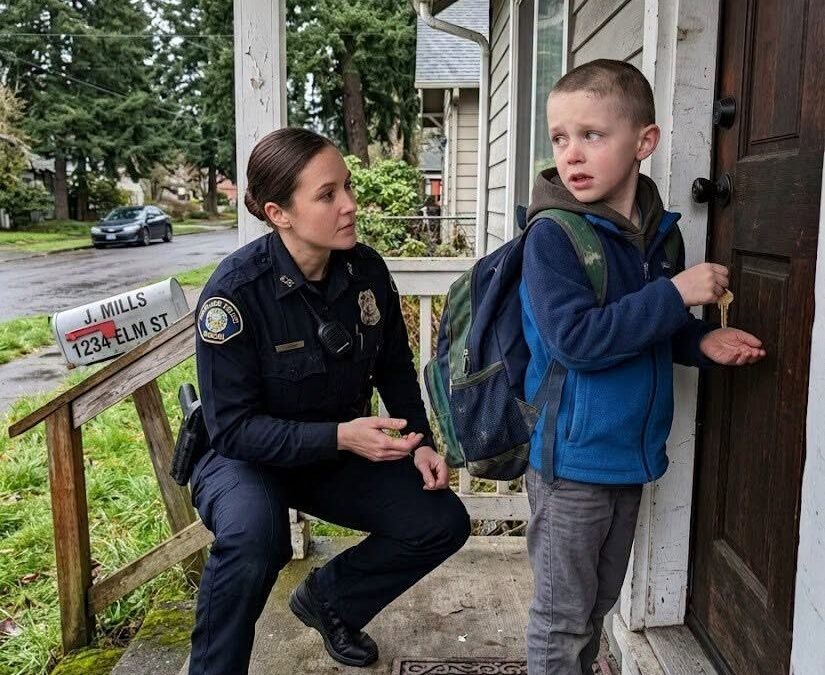
A 7 YEAR OLD BOY ASKED ME TO WALK HIM HOME THEN I SAW THE BOLT OUTSIDE HIS SISTER’S DOOR AND CALLED FOR BACKUP
The seven-year-old boy kept the brass house key pressed into his palm while he waited for my answer.
His fingers were shaking so badly that the metal tapped against his skin.
Once.
Twice.
Then again.
“If I show you what’s inside,” he whispered, “you won’t let them make me go back and act like everything is okay… right?”
I had worn a patrol uniform around Evergreen Elementary in West Portland for several years.
Children had asked me hundreds of questions.
Could I turn on the siren?
Was my badge real?
Had I ever chased a robber?
Did handcuffs hurt?
Could police arrest teachers for giving too much homework?
I had learned that most children approached uniforms with curiosity.
Some with excitement.
A few with fear.
This boy had approached me with a plan.
That was different.
I did not tell him everything would be fine.
Children know when adults say those words because they are afraid to tell the truth.
Instead, I kept one hand near my radio and looked directly at him.
“I can promise I’ll listen.”
He watched my face.
“I can promise I’ll look at whatever you want to show me.”
His grip tightened around the key.
“And?”
“And I won’t pretend I didn’t see it.”
His eyes searched mine for a loophole.
“Even if my dad says I’m lying?”
“Even then.”
He stood still for another second.
Then nodded.
It had taken nearly fifteen minutes to reach the house.
But in truth, the walk had begun long before dismissal.
I just had not known it yet.
My name is Officer Daniel Dunham.
At the time, part of my patrol assignment included several elementary schools in West Portland, including Evergreen.
The work was not glamorous.
Most days, the biggest problem was traffic.
Parents double-parking.
Cars blocking crosswalks.
Arguments over pickup lanes.
Occasionally a lost child.
Sometimes a student who refused to go home.
Sometimes something more serious.
But schools teach officers a particular kind of attention.
Children rarely use the same language adults do.
An adult might say:
I don’t feel safe at home.
A child might say:
Can you stay until my dad gets here?
An adult might say:
I am being punished in a way that frightens me.
A child might say:
I don’t like Tuesdays.
An adult might report neglect.
A child might ask whether crackers count as dinner.
You learn to listen around the sentence.
That afternoon, dismissal had looked ordinary.
Cedar Street was lined with minivans and SUVs.
Parents waved from driver’s seats.
Teachers stood on the school steps.
Backpacks bounced.
Car doors slammed.
A second-grade girl had stopped me near the front gate because she wanted to show me her new soccer cleats.
They were bright enough to be seen from space.
“You like them?”
“They’re impressive.”
“They make me faster.”
“Scientifically proven?”
She thought.
“My dad said so.”
“Then it must be true.”
She laughed.
That was when I noticed him.
He stood beside me.
Close enough that the sleeve of his jacket nearly brushed my uniform.
Small boy.
Seven, maybe eight.
Oversized backpack.
Shoes too tight.
Hair buzzed unevenly.
Not professionally.
More like someone at home had put clippers against his head and decided good enough was good enough.
Nothing about those details alone meant danger.
Children grow fast.
Parents cut hair badly.
Backpacks are often too large.
But his face stopped me.
He was not smiling.
Not shy.
Not nervous in the usual way.
He had the flat, guarded expression of a child who had practiced making his face reveal as little as possible.
He said my name carefully.
“Officer Dunham?”
“Yes?”
“Can you walk me home?”
I glanced toward the buses.
“Is your parent late?”
“No.”
“Did somebody bother you?”
“No.”
“Do you know your address?”
“Yes.”
“Then why do you need me to walk with you?”
He looked toward the line of houses beyond Cedar Street.
Then back at me.
“I need you to see something.”
His voice dropped.
“But I can’t tell you here.”
That changed the conversation.
I crouched.
“Is somebody hurting you?”
His eyes moved toward the teachers.
Then parents.
Then back.
He shook his head.
“Another kid?”
“No.”
“Someone near your house?”
“No.”
“Then what do you want me to see?”
He swallowed.
“They all think it’s normal.”
“Who is they?”
“Everybody.”
His voice became smaller.
“If I tell somebody, they’ll say I’m making trouble.”
“Who says that?”
“My dad.”
I waited.
He continued.
“But if you see it yourself…”
His eyes locked onto mine.
“…they can’t say that.”
There are moments in police work when a child asks a question that sounds simple but carries the weight of every adult who failed them before.
This was one.
I looked toward the teacher monitoring dismissal.
Then back at the boy.
“Okay.”
His shoulders dropped perhaps half an inch.
“I’ll walk with you.”
We notified the school that he was leaving with me so no one would think he had vanished.
Then we started toward his neighborhood.
He stayed close.
No skipping.
No chatter.
Children usually ask officers questions on walks.
He asked none.
He watched doors.
Windows.
Driveways.
At one house, a dog barked behind a fence.
He flinched but kept moving.
At another, two older boys were tossing a football.
He moved to my other side.
I did not point it out.
“What grade are you in?”
“Second.”
“Like your teacher?”
“Yes.”
“You like school?”
“Mostly.”
“What’s your favorite subject?”
He thought.
“Science.”
“What kind?”
“Animals.”
“Good choice.”
Silence again.
Then I asked,
“Does your dad know you’re bringing me home?”
“No.”
“Will he be there?”
“I don’t know.”
“Anyone else?”
He hesitated.
“My sister.”
“How old?”
“Six.”
“Is she at school?”
His face changed.
“No.”
“Was she sick today?”
He did not answer.
That registered.
“What’s your sister’s name?”
“Sophie.”
We crossed another street.
His gaze went to a blue sedan pulling from a driveway.
Not his.
He relaxed.
Then I asked,
“Does your father know you’re asking an officer for help?”
He stared straight ahead.
“He thinks this is just how families are.”
“What is?”
The boy did not answer directly.
“Everyone I know thinks families are like this.”
I stopped walking for half a step.
Everyone I know.
Not just Dad.
Not just Grandma.
Everyone.
That sounded less like a single bad day and more like a system.
We reached a neighborhood I had driven through hundreds of times.
Small single-story homes.
Some cared for.
Some tired.
Lawns a little overgrown.
A sedan with two wheels on the curb.
Wind chimes hitting a sagging porch railing.
Nothing dramatic.
That is something people misunderstand about dangerous homes.
They expect signs.
Broken windows.
Screaming.
Police cars.
Sometimes danger lives behind a faded welcome mat and blinds pulled too tightly shut.
The boy stopped in front of one of those houses.
No toys outside.
No bicycle.
No chalk.
Nothing that announced children lived there.
Just a leaning mailbox.
Closed blinds.
Faded mat.
“This is it?”
He nodded.
Then took out the key.
That was when his hand started shaking.
Three times he tried to guide the key into the lock.
Missed.
I did not take it from him.
He needed to control this part.
Finally, metal slid into metal.
He turned it.
The door opened only a few inches.
Chain.
He immediately reached through the gap.
Lifted the chain.
Opened the door.
Practiced.
Too practiced.
The smell hit first.
Bleach.
Strong.
Sharp.
Not fresh.
Not clean in a comfortable way.
Clean in a way that made the house feel erased.
The second thing was silence.
No television.
No music.
No child calling from another room.
The boy stepped inside.
Then carefully placed his backpack against the wall.
He lined it up exactly with two pairs of shoes beneath a narrow table.
He adjusted one strap until it lay flat.
Then put a finger to his lips.
“He checks if things moved.”
I stayed near the open door.
Called my supervisor.
Explained that a child had asked me to accompany him home after reporting a possible safety problem.
I gave the address.
Asked for another unit to remain available.
Then ended the call.
The boy had not moved.
“Can I show you now?”
“Yes.”
He led me through the living room.
Couch cushions perfectly square.
Blinds aligned.
Remote control centered.
No toys.
No papers.
No half-finished child projects.
Nothing messy.
That did not prove anything.
Some families are extremely orderly.
Then the kitchen.
A schedule taped to the refrigerator.
Wake.
Breakfast.
School.
Chores.
Homework.
Quiet time.
Dinner.
Sleep.
Again, nothing necessarily alarming.
Families use schedules.
Then I saw marks beside two names.
Small tally marks.
Numbers.
15.
16.
17.
I leaned closer.
“What are these?”
The boy answered.
“Minutes.”
“For what?”
He looked toward the hallway.
“The room.”
I turned.
At the end of the hallway stood a narrow pale door.
Could have been a closet.
Could have been laundry.
Metal sliding latch attached to the frame.
Adult shoulder height.
On the outside.
My stomach tightened.
The boy stopped several feet away.
“She’s not supposed to answer if somebody knocks.”
“Who?”
“Sophie.”
My hand moved toward my radio.
“But she knows my knock.”
He approached.
Tapped twice.
Pause.
Once.
Silence.
Then something moved behind the door.
A little girl’s voice.
“Is Dad back?”
The boy looked at me.
“No.”
His voice softened.
“It’s me.”
Pause.
“I brought somebody.”
I stepped to the door.
Looked at the latch.
Moved it.
Opened.
The room was barely wider than the washer and dryer.
Utility room.
No bed.
No proper chair.
Folded blanket on the floor.
Plastic cup.
Workbook.
A six-year-old girl sat with her knees against her chest.
Faded sweatshirt.
Leggings.
Hair tangled on one side.
An elastic band wrapped around her wrist had left a deep pink mark from twisting.
No blood.
No obvious physical injury.
She looked at her brother.
Then me.
Then the open latch.
And asked,
“Did I finish all my minutes?”
The boy dropped beside her.
“You’re done.”
His voice was urgent.
“You don’t have to do any more.”
She looked past him.
“Dad said you can’t decide that anymore.”
The boy’s shoulders folded.
That was the moment I understood the real structure.
He had not brought me to show what was being done only to him.
He had brought me because someone had forced him to participate in what was being done to her.
I crouched.
“Sophie?”
She looked at me.
“My name is Officer Dunham.”
Nothing.
“Do you want to come into the kitchen?”
She looked at her brother.
Not me.
He held out his hand.
She took it.
Then stepped over the threshold as though crossing a line she was not allowed to cross.
“How long have you been in here?”
She looked at him again.
He stared at the floor.
“Before school.”
I checked the time.
Nearly four.
My chest tightened.
“She didn’t go to school?”
“Dad called.”
“Said what?”
“That she was sick.”
Sophie shook her head.
“I talked after lights-out.”
The boy gripped her hand.
“I told her not to.”
He looked at me.
“I was supposed to make sure she stayed quiet.”
Confession.
His face said confession.
I said,
“That wasn’t your job.”
He looked genuinely confused.
“Then whose job is it?”
I had no quick answer.
Because inside this house, someone had taught him that punishment was a job.
Someone had to monitor.
Someone had to enforce.
Someone had to count.
If Dad was gone, oldest child became deputy.
That belief was stronger than the latch.
I radioed again.
Requested another officer.
Requested child-safety response.
Then I moved both children to the kitchen where I could keep them in sight.
Front door stayed open.
The boy watched it constantly.
Sophie drank water.
Tiny sips.
After each one, she stopped.
As if waiting to be told she had taken too much.
I opened a cabinet.
Crackers.
“Hungry?”
Neither child answered.
I set the box on the counter.
The boy stared.
“Those are for Thursday.”
It was Tuesday.
I looked at him.
“What happens if you eat them today?”
He lowered his eyes.
“Then there aren’t enough Thursday.”
Again, maybe strict food planning.
Maybe something more.
I did not search.
I did not start opening drawers without need.
The immediate danger was already visible.
Outside latch.
Child confined.
Timeline.
Schedule.
Statements.
I did not need to tear the house apart to know help had to arrive.
The boy kept watching the door.
Twelve minutes later, a vehicle stopped.
His whole body changed.
Back straight.
Hand released Sophie.
He stepped in front of her.
Not because I told him.
Instinct.
A man entered carrying coffee and a plastic grocery bag.
Work pants.
Faded flannel.
Forties.
Tired face.
He saw me.
Then the utility-room door.
His bag slipped.
He caught it.
“What are you doing in my house?”
I identified myself.
Explained that I was checking on the safety of his children.
His eyes went to his son.
The anger did not explode.
It narrowed.
“You brought him here?”
The boy stepped backward.
I moved between them.
The father pointed toward the utility room.
“That is a cool-down space.”
“Was Sophie inside?”
“Yes.”
“How long?”
“She had a consequence.”
“How long?”
“She had water.”
“That was not my question.”
His jaw tightened.
“She wasn’t in danger.”
I looked at the latch.
“Can she open that door from inside?”
He stared at me.
“The door isn’t locked.”
“It was latched.”
“That’s semantics.”
“No.”
I looked at the hardware.
“That’s mechanics.”
His voice hardened.
“Kids need boundaries.”
“Boundaries don’t require a child to be unable to open a door.”
“People call anything abuse now.”
Sophie pressed against her brother.
The father saw.
He softened his voice instantly.
“Come on, sweetheart.”
She did not move.
“Tell the officer you were fine.”
Her eyes dropped.
He tried again.
“You had water.”
Nothing.
“Your brother checks on you.”
That sentence changed the center of everything.
I looked at the boy.
His face crumpled.
“I didn’t always add the minutes.”
The father’s jaw tightened.
“What?”
“Sometimes I erased them.”
“We’ll discuss that later.”
“No.”
I said it before he could continue.
“You won’t discuss that with him right now.”
He looked at me.
Anger.
Confusion.
Then something else.
Offense.
As though I had entered not just his house but his role.
“My son knows the rules.”
“Your son is seven.”
“He’s responsible.”
“He’s seven.”
“He’s mature.”
The boy looked at his father.
Then at me.
Then whispered,
“I’m seven.”
It landed differently coming from him.
His father looked away.
I asked,
“Why is he responsible for timing Sophie’s punishment?”
“Because I work.”
“So?”
“He’s the oldest.”
“So?”
“He helps.”
The boy said,
“I have to write down if she talks.”
His father’s head snapped toward him.
“That is not what—”
“And if she cries loud.”
“Enough.”
“And if she knocks.”
“Stop.”
I stepped between them again.
The boy stopped.
But now everyone in the room understood.
This was not a parent using a quiet space.
This was a system.
One child confined.
Another deputized.
Silence enforced.
Minutes added.
Fear transferred downward.
The father said,
“My father did the same thing.”
The force went out of his voice.
I waited.
“All four of us had quiet-room time.”
He put the grocery bag on the counter.
“We learned not to scream.”
“Not to talk back.”
“Not to make the house harder.”
He looked toward the children.
“My brothers raise their kids the same way.”
“Nobody called police on us.”
The boy’s words returned.
Everyone I know thinks this is what families are like.
His father had confirmed it.
This was inheritance.
Not excuse.
Inheritance.
Some families pass down recipes.
Some traditions.
Some holiday routines.
Some pass down fear and call it discipline.
I said,
“Your childhood may explain why this seems normal to you.”
His eyes narrowed.
“But it does not make it safe.”
“You don’t know my family.”
“I know your six-year-old was in that room since before school.”
His face shifted.
“She was supposed to be checked.”
“By whom?”
He looked at his son.
That was the problem.
“My son knows the routine.”
I felt anger then.
Real anger.
But anger in uniform has to be managed.
“You assigned a seven-year-old to manage confinement of a six-year-old.”
“I assigned him responsibility.”
“No.”
I kept my voice level.
“You assigned him adult authority without adult capacity.”
“He needs to learn.”
“Learn what?”
“How to help the family.”
His son whispered,
“I don’t want to.”
The father looked at him.
“What?”
The boy’s face went white.
Still, he repeated.
“I don’t want to do it.”
“You don’t understand.”
“I don’t want to count Sophie.”
His sister reached for his hand.
“I don’t want to tell you if she cries.”
The father’s face hardened.
“We’ll talk later.”
The boy almost folded.
I stepped in.
“No.”
His father looked at me.
“The conversation stops now.”
Second unit arrived.
Child-safety workers followed shortly after.
The father became cooperative for several minutes.
Then angry.
Then cooperative.
Then angry again.
People often imagine abusive or controlling parents as constant explosions.
Reality can be more complicated.
He answered questions.
Provided birth information.
Explained school.
Medical contacts.
Then discovered the children would not stay with him that night.
His face changed.
“You’re taking my children because of a latch?”
The boy flinched at the word taking.
I answered.
“This is not only about a latch.”
“What else?”
“A child was confined for hours.”
“She had water.”
“Another child was made responsible for enforcing the confinement.”
“He helps me.”
“He is seven.”
“He’s my son.”
“That doesn’t change his age.”
The father looked at him.
“I gave you the house key because I trust you.”
The boy reached into his pocket.
Brass key.
His hand shook.
“You gave it because you said I’m the man when you’re not here.”
The father’s expression softened.
“That means I depend on you.”
The boy swallowed.
“I’m seven.”
Silence.
No one interrupted.
The father looked at his coffee.
Set it down.
He did not apologize.
Not then.
He asked where the children would go.
How long.
Who would be with them.
What rights he had.
What phone number.
Whether he could call.
He argued every restriction.
But when Sophie asked whether she had to take the blanket from the utility room, I saw him look at the floor.
Her brother automatically said,
“No.”
Then immediately looked at me.
As if he needed permission to stop being the authority.
I said,
“She can leave it.”
Sophie did.
The boy placed the house key on the table.
His father picked it up.
Held it toward him.
“You’ll need this when you come back.”
The boy stared.
Did not take it.
Small refusal.
Easy to miss.
Huge to him.
The children left together.
Temporary care.
Same placement.
That mattered.
The boy sat beside Sophie in the back seat.
She leaned into him.
He did not look relieved.
Not exactly.
Children do not always celebrate rescue.
Sometimes rescue means losing the only world they know.
Two days later, I saw him at school.
Counselor’s office.
Backpack at his feet.
He asked,
“Is Dad arrested?”
“No.”
He looked disappointed.
Then relieved.
Both at once.
“Why not?”
“Because adults are still figuring out what happened and what needs to change.”
He nodded.
“I don’t want him gone forever.”
“I understand.”
“I just wanted him to see it’s not normal.”
There it was.
He had believed there were only two options.
Accept everything.
Or destroy his family.
Children in controlling homes often get trapped between terrible choices created by adults.
I told him,
“You asking for help did not create what happened.”
He looked at me.
“Then who did?”
“That isn’t yours to carry.”
He frowned.
“I still brought you.”
“Yes.”
“But what happens next is not your punishment.”
He thought about that.
Then asked,
“Can Sophie go to school tomorrow?”
“Yes.”
He nodded.
That mattered more to him.
Over the next weeks, the father’s explanations shifted.
First:
The children exaggerated.
Then:
Sophie was in the room, but not that long.
Then:
He did not know how long because he had expected his son to release her.
That claim changed the case emotionally, if not legally.
Because once he blamed his son for leaving Sophie confined, his childhood stopped explaining the central problem.
He had transferred responsibility down.
The adult created the system.
Then when it failed, the seven-year-old became responsible.
I saw that boy again after one meeting.
He was sitting outside with a juice box.
I asked,
“How are you doing?”
“Okay.”
“Really?”
He shrugged.
“Dad said I should have opened the door.”
I crouched.
“What do you think?”
He stared at the straw.
“I think I should have.”
“Why?”
“Because Sophie was scared.”
“That’s different.”
He looked up.
“You can wish you had helped your sister sooner without accepting that it was your job to punish or release her.”
He frowned.
“That sounds confusing.”
“It is.”
“What part is my fault?”
“Your feelings are yours.”
I paused.
“But the system was built by adults.”
He stared at me.
“Not me?”
“Not you.”
He took a long drink.
Then:
“Okay.”
Not convinced.
But listening.
During an early supervised visit, the father arrived with snacks and new coloring books.
For half an hour, things looked hopeful.
He hugged Sophie.
Told his son he was proud of him for being brave.
Asked about school.
Then Sophie spilled water.
Half a plastic cup.
Nothing.
The father’s shoulders tightened.
His face changed.
I saw the old reaction arrive.
He caught himself.
Stopped.
Took paper towels.
Wiped the table.
No yelling.
No minutes.
The boy watched every movement.
When the visit ended, the father reached into his pocket.
House key.
He placed it in his son’s palm.
Closed his fingers around it.
“Keep helping me hold things together.”
The words sounded loving.
That was why they were dangerous.
They placed the old system back in his hand without mentioning the latch.
His son froze.
Then opened his fingers.
The key fell onto the table.
Metal against laminate.
Small sound.
Huge room.
“I can help Sophie with her shoes.”
His father stared.
“I can play with her.”
The boy swallowed.
“But I’m not the grown-up.”
His father’s face tightened.
“Who taught you to talk to me that way?”
Fear flashed across the boy’s face.
He did not pick up the key.
Sophie stepped beside him.
The father looked at both children.
Then the key.
Something changed.
Not redemption.
Not transformation.
A crack.
“No one taught me how to do this differently.”
His son answered with the simplicity children sometimes use to cut through decades of adult excuses.
“Then learn.”
Silence.
No dramatic music.
No instant apology.
Just a father looking at a key.
The child did not go home that day.
Or the next.
Change had to be proven.
The father removed the outside latch from the utility room while another adult documented it.
Then similar latches from bedroom doors.
He stopped calling the utility room a cool-down space.
That mattered.
Language had protected him.
Cool-down space sounded therapeutic.
Confinement sounded different.
Eventually he said the word.
“I confined her.”
Not:
She had a consequence.
Not:
She needed space.
“I confined her.”
Progress.
Not absolution.
He attended required meetings.
Parenting classes.
Family sessions.
He complained.
Sometimes loudly.
He believed questions were insulting.
He believed professionals judged him without understanding how hard single parenting was.
Maybe some did.
But difficulty did not make the latch safe.
He learned alternatives.
Time-ins instead of isolation.
Loss of privileges instead of confinement.
Adult supervision instead of making his son enforce.
Food that was not tied to behavior.
Doors that did not close from the outside.
The people working with him did not let him use his own childhood as a shield.
They used it as a starting point.
What happened to you?
What did you learn?
What did it cost you?
What will you do differently?
That distinction matters.
Trauma can explain behavior.
It cannot become permission.
The children remained outside the home while those changes were tested.
Supervised visits.
Then longer visits.
Daytime.
No overnights.
The boy was interviewed privately multiple times.
Each time, he gave the same conditions.
No locked rooms.
No counting minutes.
No making him responsible for Sophie.
That was all.
Not:
Dad can never raise his voice.
Not:
I want a new house.
Not:
I never want to see him.
Three conditions.
Safety.
Age.
Boundaries.
Months after that afternoon, the family began gradual returns under a safety plan.
No one told the children,
“Everything is fine now.”
That would have been a lie.
Instead:
“We’re testing whether the changes stay.”
The father had to prove it in ordinary moments.
A spilled drink.
A late bedtime.
A child talking back.
A messy room.
A tired parent.
The true test of change is rarely a meeting.
Anyone can behave for fifty minutes in an office.
Change shows up at 7:40 p.m. when two children are arguing and dinner is burning.
One early overnight, the father later admitted he barely slept.
He walked the hallway repeatedly.
Open doors bothered him.
His entire childhood had taught him closed doors meant control.
Open meant disorder.
He did not close them.
That mattered more than any apology.
At Evergreen, I continued my regular assignment.
At first, the boy found me every afternoon.
Did not always speak.
He would stand beside me.
Jacket sleeve nearly touching my uniform.
Exactly like the first day.
Sometimes he asked,
“Are they still checking?”
“Yes.”
“Did Dad remove the latch?”
“Yes.”
“Can they put it back?”
“Not under the plan.”
“What if he does?”
“You tell someone.”
“What if nobody believes me?”
“I did.”
He would nod.
Then leave.
Over time, he stopped checking daily.
That was progress too.
The goal was never for him to depend on me forever.
The goal was for him to believe more than one adult could be safe.
Teacher.
Counselor.
Caseworker.
Relative.
Father, eventually, if earned.
One afternoon, I saw Sophie at school.
Backpack covered in marker drawings.
Apparently she had discovered personalization with enthusiasm.
Her brother complained.
“She drew on mine too.”
“I did not.”
“You put a star.”
“One star.”
“That counts.”
I listened.
Ordinary sibling argument.
No one checking a schedule.
No one counting minutes.
Beautiful.
Near the end of the school year, they walked toward me together.
Their father waited several blocks away near the same house.
I looked.
Blinds open.
Front door partly open.
Afternoon light inside.
The boy asked,
“Can you walk with us?”
My chest tightened.
“All the way?”
He shook his head.
“Just the corner.”
“Why the corner?”
“Dad can do the rest.”
I smiled.
“Okay.”
We walked.
This time he talked.
Science project.
Volcano.
Sophie said he used too much tape.
He argued tape made it stronger.
She said tape made it ugly.
They bickered.
I barely spoke.
At the corner, the boy stopped.
Reached into his pocket.
Brass house key.
Same one.
I recognized the worn edge.
“Dad gave it back.”
I looked at him.
“You wanted it?”
“He asked.”
“And?”
“I said yes.”
“What does it mean now?”
He looked at the key.
“It opens the door.”
“That’s all?”
“That’s all.”
Sophie ran ahead.
Their father bent to catch her near the porch.
The boy looked at me once.
Then followed.
He did not unlock the door.
It was already open.
That image stayed with me.
Door open.
Blinds open.
Children visible.
Not because open doors solve everything.
Because in that family, they symbolized something specific.
No barrier one child had to control for another.
No hidden room.
No child assigned to act like a parent.
Later, people asked whether I believed the father changed.
That question always made me careful.
Change is not an event.
It is behavior across time.
He changed some things.
He learned others.
He failed sometimes.
Caught himself sometimes.
Accepted oversight he resented.
There were setbacks.
Arguments.
Moments when his first instinct was still control.
But the system around the children no longer depended on his instincts alone.
That was important.
Safety plans.
School contact.
Professionals.
Relatives.
Children allowed to speak privately.
No family should depend on one adult’s promise that everything is different now.
Promises are easy.
Structure matters.
The boy understood that earlier than most adults.
He had asked me not to make him go back and pretend everything was okay.
He did not ask me to destroy his father.
He asked me not to lie.
That was the heart of the entire case.
Children can survive difficult truth better than false normal.
He knew the house was wrong.
He just did not have language.
So he found a uniform.
Asked me to walk.
Asked me to see.
That took extraordinary courage.
But I became careful about calling him brave too often.
Children who survive controlling homes are frequently praised for maturity.
Responsible.
Strong.
Old soul.
Sometimes those compliments accidentally reward the very burden hurting them.
He did not need to be strong.
He needed to be seven.
That meant forgetting homework.
Arguing about tape.
Wanting snacks before Thursday.
Being annoyed at his sister.
Losing a key.
Asking adults to handle adult problems.
I remember the first time I saw him crying at school after everything.
A teacher looked worried.
“What happened?”
He had lost part of his science project.
Nothing about Dad.
Nothing about Sophie.
Nothing about the house.
Just cardboard.
He cried openly.
I almost smiled.
Not because he was upset.
Because months earlier he would have hidden it.
Now he was allowed to fall apart over something small.
That is what childhood should include.
Small disasters.
Tape.
Cardboard.
Soccer.
Missing pencils.
Not calculating how long your sister has been behind a door.
Sophie changed too.
The first time I saw her after returning to school, she asked her teacher before getting water.
“Can I have three sips?”
The teacher said,
“You can drink until you’re not thirsty.”
Sophie stared.
“Any amount?”
“Yes.”
She drank.
Five sips.
Stopped.
Looked around.
Nothing happened.
A week later, she drank without asking.
That was progress.
There were other habits.
She apologized for making noise.
Asked whether laughing was too loud.
Looked at clocks constantly.
Expected ordinary mistakes to trigger punishment.
Healing meant thousands of small corrections.
Spilled water.
Nothing.
Forgotten worksheet.
Conversation.
Talking after bedtime.
Reminder.
Messy bedroom.
Cleanup.
Not latch.
Not isolation.
Not hours.
The father had to learn those things too.
One worker told him,
“You keep asking what consequence replaces the room.”
He said,
“Yes.”
She answered,
“Sometimes the replacement is teaching.”
That frustrated him.
He wanted formulas.
Rule broken equals consequence.
But parenting is often slower.
A six-year-old spills water.
Teach her to wipe it.
A seven-year-old talks back.
Ask what happened.
Set a limit.
Repair.
He had grown up with control as the only vocabulary.
Now he needed another language.
One family session became important.
The father said,
“My son betrayed me by bringing police.”
The boy went still.
Everyone in the room felt it.
The therapist stopped him.
“Try again.”
“That’s how I feel.”
“You can feel betrayed.”
She pointed toward his son.
“But do not assign him responsibility for protecting a system that frightened him.”
The father looked angry.
Then ashamed.
He tried again.
“I felt betrayed when police came.”
Better.
“I was embarrassed.”
Better.
“I thought he should have talked to me first.”
The therapist asked the boy,
“Did you feel safe talking to Dad first?”
“No.”
Silence.
The father looked at him.
“Why not?”
The boy said,
“Because if I told you I didn’t like the room, you added minutes.”
The father looked away.
There it was.
Evidence from the relationship itself.
Not a report.
Not police.
His son.
The father whispered,
“I didn’t know you thought that.”
The boy frowned.
“I told you.”
That sentence landed harder than any accusation.
I told you.
Children often do.
Adults do not always hear the language.
Maybe the child complains.
Avoids.
Refuses.
Cries.
Whispers.
Acts out.
The father had heard disobedience.
The boy had been saying fear.
That is why listening matters.
Months later, there was a setback.
The father raised his voice during a visit.
Not violence.
Not confinement.
But enough that the boy froze.
The visit ended early.
The father was furious.
“At what point do I get to be a normal parent?”
The worker answered,
“When your children stop needing to scan your anger for danger.”
Hard truth.
He stormed out.
Came back the next day.
Apologized.
Not perfectly.
But without blaming the boy.
That mattered.
The gradual return paused.
Then resumed later.
Safety did not move in a straight line.
That was another lesson.
People like neat stories.
Officer finds abuse.
Children rescued.
Father learns lesson.
Family healed.
Real life is slower.
Messier.
Good intentions fail.
Old patterns return.
Progress stalls.
Then restarts.
The boy once asked me,
“What if Dad does it again?”
I said,
“Then you tell.”
“What if it’s only a little?”
“You tell.”
“What if he gets mad?”
“You tell.”
“What if Sophie wants me not to?”
“You find an adult.”
He nodded.
“And that isn’t tattling?”
“No.”
“What is tattling?”
“Trying to get someone in trouble for something small.”
“What am I doing?”
“Trying to keep someone safe.”
He thought.
“Okay.”
Words matter.
Troublemaker had been used against him.
We replaced it.
Reporter.
Helper.
Child asking for safety.
Not family destroyer.
The father eventually acknowledged something difficult.
During a meeting, he said,
“I wanted my son to be tougher than I was.”
The therapist asked,
“What did tougher mean?”
“Not afraid.”
“Did making him responsible for Sophie make him less afraid?”
The father stared at his hands.
“No.”
“What did it make him?”
“Quiet.”
Exactly.
Adults confuse quiet with strong all the time.
Quiet children are easier.
They are not always safer.
I thought back to the first afternoon.
The boy beside my uniform.
No questions about sirens.
No excitement.
Just fixed face.
Practiced hiding.
Months later, he was louder.
Good.
Annoying sometimes.
Also good.
He challenged Sophie.
Complained.
Ran ahead.
Once kicked a ball into a teacher’s flowerbed and tried to deny it.
The teacher stared.
He sighed.
“Fine. I did it.”
Normal child dishonesty.
I almost congratulated him.
Did not.
Children do not need applause for every sign of recovery.
Sometimes recovery deserves to be ordinary.
I stayed connected to the school long enough to see that family move into a more stable phase.
Not perfect.
Never described that way.
The father had extended unsupervised daytime contact.
Then overnights.
Then more time.
The children had their own contacts if they felt unsafe.
Doors remained without external latches.
The utility room became a real laundry room.
No blanket.
No cup.
No workbook.
Just detergent.
Baskets.
Machines.
The father told one worker he avoided the room at first because looking at it made him ashamed.
Good.
Shame can be useful briefly if it points toward responsibility.
Dangerous if it becomes self-pity.
He learned that too.
He once told his son,
“I was wrong.”
Simple.
No:
Because my father.
No:
Because work.
No:
Because you were difficult.
“I was wrong.”
The boy asked,
“About what?”
Smart.
Specificity matters.
The father said,
“About putting Sophie in there.”
“And?”
“About making you watch.”
“And?”
His father almost smiled.
“About telling you to be the man of the house.”
The boy nodded.
“Okay.”
No hug.
No dramatic reconciliation.
Okay.
That was enough.
Sophie asked,
“What about the crackers?”
Everyone looked at her.
The father blinked.
“What crackers?”
“For Thursday.”
He closed his eyes.
“Those too.”
She nodded.
Then asked for a snack.
Everyone laughed.
Even him.
That was one of my favorite moments from the entire case.
Not because it erased harm.
Because a child turned a symbol of control back into food.
A cracker.
Nothing more.
The same way the house key became just a key.
Objects can change meaning when systems change around them.
The last day I remember clearly was late spring.
Warm.
School nearly out.
The boy and Sophie came down the steps together.
Their father waited at the same corner.
Not directly at the school gate.
That had been agreed.
The boy saw me.
Walked over.
“Officer Dunham?”
“Yes?”
“You’re still here.”
“Apparently.”
He grinned.
That was new.
“Can you walk with us?”
“All the way?”
“Just the corner.”
We started.
Sophie complained about a science poster.
He complained she drew on his backpack.
She said one star did not count.
He said it absolutely did.
At the corner, their father waved.
Not at me first.
At them.
Sophie ran.
The boy stayed.
Pulled out the brass key.
“Still got it?”
“Yes.”
“Still just a key?”
He smiled.
“Still just a key.”
Then he looked toward the house.
Front door open.
Blinds open.
His father bent to pick up Sophie.
The boy said,
“I don’t have to unlock it.”
“I see that.”
“Dad leaves it open when he knows we’re coming.”
“Good.”
He hesitated.
“Officer?”
“Yes?”
“Did I get my family in trouble?”
The question was months old.
Still there.
I answered carefully.
“No.”
He watched me.
“You told the truth about something that scared you.”
“What happened after belonged to the adults.”
He nodded.
Then:
“Dad said that too.”
That surprised me.
“What did he say?”
“He said I should’ve told somebody sooner.”
I frowned slightly.
The boy noticed.
“What?”
“Nothing.”
I almost said the father should not place even that burden on him.
Then the boy continued.
“But then he said that wasn’t fair because I did try to tell him.”
Better.
I smiled.
“Sounds like he’s learning.”
The boy shrugged.
“Slow.”
I laughed.
“Most adults are.”
He ran toward the house.
I stayed at the corner.
Watched.
Sophie opened the front door wider.
Their father held it.
The boy entered.
Did not check the hallway.
Did not inspect the shoes.
Did not look at the utility room.
He dropped his backpack beside Sophie’s.
Then disappeared toward the kitchen.
Their father looked down the street.
Our eyes met.
He gave a small nod.
I returned it.
Nothing more.
I never needed gratitude from him.
The point was never for him to like me.
It was for those children to be safe.
That afternoon remained with me for years.
Not because of the latch alone.
I had seen worse hardware.
Worse injuries.
Worse homes.
It stayed with me because of the boy’s condition at the door.
“If I show you what’s inside, you won’t let them make me go back and act like everything is okay, right?”
He understood something many adults struggle to articulate.
Pretending can be its own form of harm.
A child knows when adults see.
A bruise.
Fear.
Hunger.
A locked room.
A pattern.
Then choose comfort.
Maybe because intervention is messy.
Maybe because the parent has explanations.
Maybe because nobody wants to “break up a family.”
But pretending the latch is only discipline does not preserve a family.
It preserves the system hurting it.
That boy did not ask me to punish his father.
He asked me to witness.
That is one of the most powerful things a child can ask.
See this.
Do not explain it away.
Do not tell me every family has problems.
Do not say Dad is trying his best before you look at what his best is doing.
Do not call me dramatic.
Do not send me back behind the same door with a speech about gratitude.
See it.
I did.
And once adults saw it clearly, everyone’s job changed.
His father’s job was no longer to defend the rule.
It was to learn.
The system’s job was not to punish him for having a bad childhood.
It was to require him to stop repeating it.
The boy’s job was not to save Sophie.
It was to be seven.
Sophie’s job was not to earn freedom minute by minute.
It was to be six.
That distinction was the whole case.
Years later, I still think about his first question.
Not because I gave a perfect answer.
I did not.
I could not promise where he would sleep.
Could not promise his father would change.
Could not promise court decisions.
Could not promise he would never feel afraid again.
Adults often fail children by promising outcomes they do not control.
So I promised only what I could.
I would look.
I would listen.
I would not pretend.
That was enough to get the key into the lock.
Sometimes that is all help begins with.
One honest promise.
One open door.
One adult willing to see what a child has spent years being told is normal.
And sometimes the most important thing an officer does is not arrest someone.
It is not draw a weapon.
It is not chase a suspect.
Sometimes it is walking beside a seven-year-old boy for six blocks while he gathers enough courage to unlock his own front door.
Then believing what he shows you.
Because children are not responsible for making unsafe homes easier for adults to tolerate.
They are not responsible for protecting family reputations.
They are not responsible for enforcing punishments.
They are not responsible for carrying keys that really mean authority.
They are children.
The boy eventually learned that.
His father had to learn it too.
And the last time I saw that brass key in his palm, it no longer meant:
Watch Sophie.
Count the minutes.
Be the man.
Hold the house together.
It meant one thing.
Door.
That was all.
And when he reached home that afternoon, he did not even need it.
The door was already open.
REVIEW
The seven-year-old boy kept the brass house key pressed into his palm while he waited for my answer.
His fingers were shaking so badly that the metal tapped against his skin.
Once.
Twice.
Then again.
“If I show you what’s inside,” he whispered, “you won’t let them make me go back and act like everything is okay… right?”
I had worn a patrol uniform around Evergreen Elementary in West Portland for several years.
Children had asked me hundreds of questions.
Could I turn on the siren?
Was my badge real?
Had I ever chased a robber?
Did handcuffs hurt?
Could police arrest teachers for giving too much homework?
I had learned that most children approached uniforms with curiosity.
Some with excitement.
A few with fear.
This boy had approached me with a plan.
That was different.
I did not tell him everything would be fine.
Children know when adults say those words because they are afraid to tell the truth.
Instead, I kept one hand near my radio and looked directly at him.
“I can promise I’ll listen.”
He watched my face.
“I can promise I’ll look at whatever you want to show me.”
His grip tightened around the key.
“And?”
“And I won’t pretend I didn’t see it.”
His eyes searched mine for a loophole.
“Even if my dad says I’m lying?”
“Even then.”
He stood still for another second.
Then nodded.
It had taken nearly fifteen minutes to reach the house.
But in truth, the walk had begun long before dismissal.
I just had not known it yet.
My name is Officer Daniel Dunham.
At the time, part of my patrol assignment included several elementary schools in West Portland, including Evergreen.
The work was not glamorous.
Most days, the biggest problem was traffic.
Parents double-parking.
Cars blocking crosswalks.
Arguments over pickup lanes.
Occasionally a lost child.
Sometimes a student who refused to go home.
Sometimes something more serious.
But schools teach officers a particular kind of attention.
Children rarely use the same language adults do.
An adult might say:
I don’t feel safe at home.
A child might say:
Can you stay until my dad gets here?
An adult might say:
I am being punished in a way that frightens me.
A child might say:
I don’t like Tuesdays.
An adult might report neglect.
A child might ask whether crackers count as dinner.
You learn to listen around the sentence.
That afternoon, dismissal had looked ordinary.
Cedar Street was lined with minivans and SUVs.
Parents waved from driver’s seats.
Teachers stood on the school steps.
Backpacks bounced.
Car doors slammed.
A second-grade girl had stopped me near the front gate because she wanted to show me her new soccer cleats.
They were bright enough to be seen from space.
“You like them?”
“They’re impressive.”
“They make me faster.”
“Scientifically proven?”
She thought.
“My dad said so.”
“Then it must be true.”
She laughed.
That was when I noticed him.
He stood beside me.
Close enough that the sleeve of his jacket nearly brushed my uniform.
Small boy.
Seven, maybe eight.
Oversized backpack.
Shoes too tight.
Hair buzzed unevenly.
Not professionally.
More like someone at home had put clippers against his head and decided good enough was good enough.
Nothing about those details alone meant danger.
Children grow fast.
Parents cut hair badly.
Backpacks are often too large.
But his face stopped me.
He was not smiling.
Not shy.
Not nervous in the usual way.
He had the flat, guarded expression of a child who had practiced making his face reveal as little as possible.
He said my name carefully.
“Officer Dunham?”
“Yes?”
“Can you walk me home?”
I glanced toward the buses.
“Is your parent late?”
“No.”
“Did somebody bother you?”
“No.”
“Do you know your address?”
“Yes.”
“Then why do you need me to walk with you?”
He looked toward the line of houses beyond Cedar Street.
Then back at me.
“I need you to see something.”
His voice dropped.
“But I can’t tell you here.”
That changed the conversation.
I crouched.
“Is somebody hurting you?”
His eyes moved toward the teachers.
Then parents.
Then back.
He shook his head.
“Another kid?”
“No.”
“Someone near your house?”
“No.”
“Then what do you want me to see?”
He swallowed.
“They all think it’s normal.”
“Who is they?”
“Everybody.”
His voice became smaller.
“If I tell somebody, they’ll say I’m making trouble.”
“Who says that?”
“My dad.”
I waited.
He continued.
“But if you see it yourself…”
His eyes locked onto mine.
“…they can’t say that.”
There are moments in police work when a child asks a question that sounds simple but carries the weight of every adult who failed them before.
This was one.
I looked toward the teacher monitoring dismissal.
Then back at the boy.
“Okay.”
His shoulders dropped perhaps half an inch.
“I’ll walk with you.”
We notified the school that he was leaving with me so no one would think he had vanished.
Then we started toward his neighborhood.
He stayed close.
No skipping.
No chatter.
Children usually ask officers questions on walks.
He asked none.
He watched doors.
Windows.
Driveways.
At one house, a dog barked behind a fence.
He flinched but kept moving.
At another, two older boys were tossing a football.
He moved to my other side.
I did not point it out.
“What grade are you in?”
“Second.”
“Like your teacher?”
“Yes.”
“You like school?”
“Mostly.”
“What’s your favorite subject?”
He thought.
“Science.”
“What kind?”
“Animals.”
“Good choice.”
Silence again.
Then I asked,
“Does your dad know you’re bringing me home?”
“No.”
“Will he be there?”
“I don’t know.”
“Anyone else?”
He hesitated.
“My sister.”
“How old?”
“Six.”
“Is she at school?”
His face changed.
“No.”
“Was she sick today?”
He did not answer.
That registered.
“What’s your sister’s name?”
“Sophie.”
We crossed another street.
His gaze went to a blue sedan pulling from a driveway.
Not his.
He relaxed.
Then I asked,
“Does your father know you’re asking an officer for help?”
He stared straight ahead.
“He thinks this is just how families are.”
“What is?”
The boy did not answer directly.
“Everyone I know thinks families are like this.”
I stopped walking for half a step.
Everyone I know.
Not just Dad.
Not just Grandma.
Everyone.
That sounded less like a single bad day and more like a system.
We reached a neighborhood I had driven through hundreds of times.
Small single-story homes.
Some cared for.
Some tired.
Lawns a little overgrown.
A sedan with two wheels on the curb.
Wind chimes hitting a sagging porch railing.
Nothing dramatic.
That is something people misunderstand about dangerous homes.
They expect signs.
Broken windows.
Screaming.
Police cars.
Sometimes danger lives behind a faded welcome mat and blinds pulled too tightly shut.
The boy stopped in front of one of those houses.
No toys outside.
No bicycle.
No chalk.
Nothing that announced children lived there.
Just a leaning mailbox.
Closed blinds.
Faded mat.
“This is it?”
He nodded.
Then took out the key.
That was when his hand started shaking.
Three times he tried to guide the key into the lock.
Missed.
I did not take it from him.
He needed to control this part.
Finally, metal slid into metal.
He turned it.
The door opened only a few inches.
Chain.
He immediately reached through the gap.
Lifted the chain.
Opened the door.
Practiced.
Too practiced.
The smell hit first.
Bleach.
Strong.
Sharp.
Not fresh.
Not clean in a comfortable way.
Clean in a way that made the house feel erased.
The second thing was silence.
No television.
No music.
No child calling from another room.
The boy stepped inside.
Then carefully placed his backpack against the wall.
He lined it up exactly with two pairs of shoes beneath a narrow table.
He adjusted one strap until it lay flat.
Then put a finger to his lips.
“He checks if things moved.”
I stayed near the open door.
Called my supervisor.
Explained that a child had asked me to accompany him home after reporting a possible safety problem.
I gave the address.
Asked for another unit to remain available.
Then ended the call.
The boy had not moved.
“Can I show you now?”
“Yes.”
He led me through the living room.
Couch cushions perfectly square.
Blinds aligned.
Remote control centered.
No toys.
No papers.
No half-finished child projects.
Nothing messy.
That did not prove anything.
Some families are extremely orderly.
Then the kitchen.
A schedule taped to the refrigerator.
Wake.
Breakfast.
School.
Chores.
Homework.
Quiet time.
Dinner.
Sleep.
Again, nothing necessarily alarming.
Families use schedules.
Then I saw marks beside two names.
Small tally marks.
Numbers.
15.
16.
17.
I leaned closer.
“What are these?”
The boy answered.
“Minutes.”
“For what?”
He looked toward the hallway.
“The room.”
I turned.
At the end of the hallway stood a narrow pale door.
Could have been a closet.
Could have been laundry.
Metal sliding latch attached to the frame.
Adult shoulder height.
On the outside.
My stomach tightened.
The boy stopped several feet away.
“She’s not supposed to answer if somebody knocks.”
“Who?”
“Sophie.”
My hand moved toward my radio.
“But she knows my knock.”
He approached.
Tapped twice.
Pause.
Once.
Silence.
Then something moved behind the door.
A little girl’s voice.
“Is Dad back?”
The boy looked at me.
“No.”
His voice softened.
“It’s me.”
Pause.
“I brought somebody.”
I stepped to the door.
Looked at the latch.
Moved it.
Opened.
The room was barely wider than the washer and dryer.
Utility room.
No bed.
No proper chair.
Folded blanket on the floor.
Plastic cup.
Workbook.
A six-year-old girl sat with her knees against her chest.
Faded sweatshirt.
Leggings.
Hair tangled on one side.
An elastic band wrapped around her wrist had left a deep pink mark from twisting.
No blood.
No obvious physical injury.
She looked at her brother.
Then me.
Then the open latch.
And asked,
“Did I finish all my minutes?”
The boy dropped beside her.
“You’re done.”
His voice was urgent.
“You don’t have to do any more.”
She looked past him.
“Dad said you can’t decide that anymore.”
The boy’s shoulders folded.
That was the moment I understood the real structure.
He had not brought me to show what was being done only to him.
He had brought me because someone had forced him to participate in what was being done to her.
I crouched.
“Sophie?”
She looked at me.
“My name is Officer Dunham.”
Nothing.
“Do you want to come into the kitchen?”
She looked at her brother.
Not me.
He held out his hand.
She took it.
Then stepped over the threshold as though crossing a line she was not allowed to cross.
“How long have you been in here?”
She looked at him again.
He stared at the floor.
“Before school.”
I checked the time.
Nearly four.
My chest tightened.
“She didn’t go to school?”
“Dad called.”
“Said what?”
“That she was sick.”
Sophie shook her head.
“I talked after lights-out.”
The boy gripped her hand.
“I told her not to.”
He looked at me.
“I was supposed to make sure she stayed quiet.”
Confession.
His face said confession.
I said,
“That wasn’t your job.”
He looked genuinely confused.
“Then whose job is it?”
I had no quick answer.
Because inside this house, someone had taught him that punishment was a job.
Someone had to monitor.
Someone had to enforce.
Someone had to count.
If Dad was gone, oldest child became deputy.
That belief was stronger than the latch.
I radioed again.
Requested another officer.
Requested child-safety response.
Then I moved both children to the kitchen where I could keep them in sight.
Front door stayed open.
The boy watched it constantly.
Sophie drank water.
Tiny sips.
After each one, she stopped.
As if waiting to be told she had taken too much.
I opened a cabinet.
Crackers.
“Hungry?”
Neither child answered.
I set the box on the counter.
The boy stared.
“Those are for Thursday.”
It was Tuesday.
I looked at him.
“What happens if you eat them today?”
He lowered his eyes.
“Then there aren’t enough Thursday.”
Again, maybe strict food planning.
Maybe something more.
I did not search.
I did not start opening drawers without need.
The immediate danger was already visible.
Outside latch.
Child confined.
Timeline.
Schedule.
Statements.
I did not need to tear the house apart to know help had to arrive.
The boy kept watching the door.
Twelve minutes later, a vehicle stopped.
His whole body changed.
Back straight.
Hand released Sophie.
He stepped in front of her.
Not because I told him.
Instinct.
A man entered carrying coffee and a plastic grocery bag.
Work pants.
Faded flannel.
Forties.
Tired face.
He saw me.
Then the utility-room door.
His bag slipped.
He caught it.
“What are you doing in my house?”
I identified myself.
Explained that I was checking on the safety of his children.
His eyes went to his son.
The anger did not explode.
It narrowed.
“You brought him here?”
The boy stepped backward.
I moved between them.
The father pointed toward the utility room.
“That is a cool-down space.”
“Was Sophie inside?”
“Yes.”
“How long?”
“She had a consequence.”
“How long?”
“She had water.”
“That was not my question.”
His jaw tightened.
“She wasn’t in danger.”
I looked at the latch.
“Can she open that door from inside?”
He stared at me.
“The door isn’t locked.”
“It was latched.”
“That’s semantics.”
“No.”
I looked at the hardware.
“That’s mechanics.”
His voice hardened.
“Kids need boundaries.”
“Boundaries don’t require a child to be unable to open a door.”
“People call anything abuse now.”
Sophie pressed against her brother.
The father saw.
He softened his voice instantly.
“Come on, sweetheart.”
She did not move.
“Tell the officer you were fine.”
Her eyes dropped.
He tried again.
“You had water.”
Nothing.
“Your brother checks on you.”
That sentence changed the center of everything.
I looked at the boy.
His face crumpled.
“I didn’t always add the minutes.”
The father’s jaw tightened.
“What?”
“Sometimes I erased them.”
“We’ll discuss that later.”
“No.”
I said it before he could continue.
“You won’t discuss that with him right now.”
He looked at me.
Anger.
Confusion.
Then something else.
Offense.
As though I had entered not just his house but his role.
“My son knows the rules.”
“Your son is seven.”
“He’s responsible.”
“He’s seven.”
“He’s mature.”
The boy looked at his father.
Then at me.
Then whispered,
“I’m seven.”
It landed differently coming from him.
His father looked away.
I asked,
“Why is he responsible for timing Sophie’s punishment?”
“Because I work.”
“So?”
“He’s the oldest.”
“So?”
“He helps.”
The boy said,
“I have to write down if she talks.”
His father’s head snapped toward him.
“That is not what—”
“And if she cries loud.”
“Enough.”
“And if she knocks.”
“Stop.”
I stepped between them again.
The boy stopped.
But now everyone in the room understood.
This was not a parent using a quiet space.
This was a system.
One child confined.
Another deputized.
Silence enforced.
Minutes added.
Fear transferred downward.
The father said,
“My father did the same thing.”
The force went out of his voice.
I waited.
“All four of us had quiet-room time.”
He put the grocery bag on the counter.
“We learned not to scream.”
“Not to talk back.”
“Not to make the house harder.”
He looked toward the children.
“My brothers raise their kids the same way.”
“Nobody called police on us.”
The boy’s words returned.
Everyone I know thinks this is what families are like.
His father had confirmed it.
This was inheritance.
Not excuse.
Inheritance.
Some families pass down recipes.
Some traditions.
Some holiday routines.
Some pass down fear and call it discipline.
I said,
“Your childhood may explain why this seems normal to you.”
His eyes narrowed.
“But it does not make it safe.”
“You don’t know my family.”
“I know your six-year-old was in that room since before school.”
His face shifted.
“She was supposed to be checked.”
“By whom?”
He looked at his son.
That was the problem.
“My son knows the routine.”
I felt anger then.
Real anger.
But anger in uniform has to be managed.
“You assigned a seven-year-old to manage confinement of a six-year-old.”
“I assigned him responsibility.”
“No.”
I kept my voice level.
“You assigned him adult authority without adult capacity.”
“He needs to learn.”
“Learn what?”
“How to help the family.”
His son whispered,
“I don’t want to.”
The father looked at him.
“What?”
The boy’s face went white.
Still, he repeated.
“I don’t want to do it.”
“You don’t understand.”
“I don’t want to count Sophie.”
His sister reached for his hand.
“I don’t want to tell you if she cries.”
The father’s face hardened.
“We’ll talk later.”
The boy almost folded.
I stepped in.
“No.”
His father looked at me.
“The conversation stops now.”
Second unit arrived.
Child-safety workers followed shortly after.
The father became cooperative for several minutes.
Then angry.
Then cooperative.
Then angry again.
People often imagine abusive or controlling parents as constant explosions.
Reality can be more complicated.
He answered questions.
Provided birth information.
Explained school.
Medical contacts.
Then discovered the children would not stay with him that night.
His face changed.
“You’re taking my children because of a latch?”
The boy flinched at the word taking.
I answered.
“This is not only about a latch.”
“What else?”
“A child was confined for hours.”
“She had water.”
“Another child was made responsible for enforcing the confinement.”
“He helps me.”
“He is seven.”
“He’s my son.”
“That doesn’t change his age.”
The father looked at him.
“I gave you the house key because I trust you.”
The boy reached into his pocket.
Brass key.
His hand shook.
“You gave it because you said I’m the man when you’re not here.”
The father’s expression softened.
“That means I depend on you.”
The boy swallowed.
“I’m seven.”
Silence.
No one interrupted.
The father looked at his coffee.
Set it down.
He did not apologize.
Not then.
He asked where the children would go.
How long.
Who would be with them.
What rights he had.
What phone number.
Whether he could call.
He argued every restriction.
But when Sophie asked whether she had to take the blanket from the utility room, I saw him look at the floor.
Her brother automatically said,
“No.”
Then immediately looked at me.
As if he needed permission to stop being the authority.
I said,
“She can leave it.”
Sophie did.
The boy placed the house key on the table.
His father picked it up.
Held it toward him.
“You’ll need this when you come back.”
The boy stared.
Did not take it.
Small refusal.
Easy to miss.
Huge to him.
The children left together.
Temporary care.
Same placement.
That mattered.
The boy sat beside Sophie in the back seat.
She leaned into him.
He did not look relieved.
Not exactly.
Children do not always celebrate rescue.
Sometimes rescue means losing the only world they know.
Two days later, I saw him at school.
Counselor’s office.
Backpack at his feet.
He asked,
“Is Dad arrested?”
“No.”
He looked disappointed.
Then relieved.
Both at once.
“Why not?”
“Because adults are still figuring out what happened and what needs to change.”
He nodded.
“I don’t want him gone forever.”
“I understand.”
“I just wanted him to see it’s not normal.”
There it was.
He had believed there were only two options.
Accept everything.
Or destroy his family.
Children in controlling homes often get trapped between terrible choices created by adults.
I told him,
“You asking for help did not create what happened.”
He looked at me.
“Then who did?”
“That isn’t yours to carry.”
He frowned.
“I still brought you.”
“Yes.”
“But what happens next is not your punishment.”
He thought about that.
Then asked,
“Can Sophie go to school tomorrow?”
“Yes.”
He nodded.
That mattered more to him.
Over the next weeks, the father’s explanations shifted.
First:
The children exaggerated.
Then:
Sophie was in the room, but not that long.
Then:
He did not know how long because he had expected his son to release her.
That claim changed the case emotionally, if not legally.
Because once he blamed his son for leaving Sophie confined, his childhood stopped explaining the central problem.
He had transferred responsibility down.
The adult created the system.
Then when it failed, the seven-year-old became responsible.
I saw that boy again after one meeting.
He was sitting outside with a juice box.
I asked,
“How are you doing?”
“Okay.”
“Really?”
He shrugged.
“Dad said I should have opened the door.”
I crouched.
“What do you think?”
He stared at the straw.
“I think I should have.”
“Why?”
“Because Sophie was scared.”
“That’s different.”
He looked up.
“You can wish you had helped your sister sooner without accepting that it was your job to punish or release her.”
He frowned.
“That sounds confusing.”
“It is.”
“What part is my fault?”
“Your feelings are yours.”
I paused.
“But the system was built by adults.”
He stared at me.
“Not me?”
“Not you.”
He took a long drink.
Then:
“Okay.”
Not convinced.
But listening.
During an early supervised visit, the father arrived with snacks and new coloring books.
For half an hour, things looked hopeful.
He hugged Sophie.
Told his son he was proud of him for being brave.
Asked about school.
Then Sophie spilled water.
Half a plastic cup.
Nothing.
The father’s shoulders tightened.
His face changed.
I saw the old reaction arrive.
He caught himself.
Stopped.
Took paper towels.
Wiped the table.
No yelling.
No minutes.
The boy watched every movement.
When the visit ended, the father reached into his pocket.
House key.
He placed it in his son’s palm.
Closed his fingers around it.
“Keep helping me hold things together.”
The words sounded loving.
That was why they were dangerous.
They placed the old system back in his hand without mentioning the latch.
His son froze.
Then opened his fingers.
The key fell onto the table.
Metal against laminate.
Small sound.
Huge room.
“I can help Sophie with her shoes.”
His father stared.
“I can play with her.”
The boy swallowed.
“But I’m not the grown-up.”
His father’s face tightened.
“Who taught you to talk to me that way?”
Fear flashed across the boy’s face.
He did not pick up the key.
Sophie stepped beside him.
The father looked at both children.
Then the key.
Something changed.
Not redemption.
Not transformation.
A crack.
“No one taught me how to do this differently.”
His son answered with the simplicity children sometimes use to cut through decades of adult excuses.
“Then learn.”
Silence.
No dramatic music.
No instant apology.
Just a father looking at a key.
The child did not go home that day.
Or the next.
Change had to be proven.
The father removed the outside latch from the utility room while another adult documented it.
Then similar latches from bedroom doors.
He stopped calling the utility room a cool-down space.
That mattered.
Language had protected him.
Cool-down space sounded therapeutic.
Confinement sounded different.
Eventually he said the word.
“I confined her.”
Not:
She had a consequence.
Not:
She needed space.
“I confined her.”
Progress.
Not absolution.
He attended required meetings.
Parenting classes.
Family sessions.
He complained.
Sometimes loudly.
He believed questions were insulting.
He believed professionals judged him without understanding how hard single parenting was.
Maybe some did.
But difficulty did not make the latch safe.
He learned alternatives.
Time-ins instead of isolation.
Loss of privileges instead of confinement.
Adult supervision instead of making his son enforce.
Food that was not tied to behavior.
Doors that did not close from the outside.
The people working with him did not let him use his own childhood as a shield.
They used it as a starting point.
What happened to you?
What did you learn?
What did it cost you?
What will you do differently?
That distinction matters.
Trauma can explain behavior.
It cannot become permission.
The children remained outside the home while those changes were tested.
Supervised visits.
Then longer visits.
Daytime.
No overnights.
The boy was interviewed privately multiple times.
Each time, he gave the same conditions.
No locked rooms.
No counting minutes.
No making him responsible for Sophie.
That was all.
Not:
Dad can never raise his voice.
Not:
I want a new house.
Not:
I never want to see him.
Three conditions.
Safety.
Age.
Boundaries.
Months after that afternoon, the family began gradual returns under a safety plan.
No one told the children,
“Everything is fine now.”
That would have been a lie.
Instead:
“We’re testing whether the changes stay.”
The father had to prove it in ordinary moments.
A spilled drink.
A late bedtime.
A child talking back.
A messy room.
A tired parent.
The true test of change is rarely a meeting.
Anyone can behave for fifty minutes in an office.
Change shows up at 7:40 p.m. when two children are arguing and dinner is burning.
One early overnight, the father later admitted he barely slept.
He walked the hallway repeatedly.
Open doors bothered him.
His entire childhood had taught him closed doors meant control.
Open meant disorder.
He did not close them.
That mattered more than any apology.
At Evergreen, I continued my regular assignment.
At first, the boy found me every afternoon.
Did not always speak.
He would stand beside me.
Jacket sleeve nearly touching my uniform.
Exactly like the first day.
Sometimes he asked,
“Are they still checking?”
“Yes.”
“Did Dad remove the latch?”
“Yes.”
“Can they put it back?”
“Not under the plan.”
“What if he does?”
“You tell someone.”
“What if nobody believes me?”
“I did.”
He would nod.
Then leave.
Over time, he stopped checking daily.
That was progress too.
The goal was never for him to depend on me forever.
The goal was for him to believe more than one adult could be safe.
Teacher.
Counselor.
Caseworker.
Relative.
Father, eventually, if earned.
One afternoon, I saw Sophie at school.
Backpack covered in marker drawings.
Apparently she had discovered personalization with enthusiasm.
Her brother complained.
“She drew on mine too.”
“I did not.”
“You put a star.”
“One star.”
“That counts.”
I listened.
Ordinary sibling argument.
No one checking a schedule.
No one counting minutes.
Beautiful.
Near the end of the school year, they walked toward me together.
Their father waited several blocks away near the same house.
I looked.
Blinds open.
Front door partly open.
Afternoon light inside.
The boy asked,
“Can you walk with us?”
My chest tightened.
“All the way?”
He shook his head.
“Just the corner.”
“Why the corner?”
“Dad can do the rest.”
I smiled.
“Okay.”
We walked.
This time he talked.
Science project.
Volcano.
Sophie said he used too much tape.
He argued tape made it stronger.
She said tape made it ugly.
They bickered.
I barely spoke.
At the corner, the boy stopped.
Reached into his pocket.
Brass house key.
Same one.
I recognized the worn edge.
“Dad gave it back.”
I looked at him.
“You wanted it?”
“He asked.”
“And?”
“I said yes.”
“What does it mean now?”
He looked at the key.
“It opens the door.”
“That’s all?”
“That’s all.”
Sophie ran ahead.
Their father bent to catch her near the porch.
The boy looked at me once.
Then followed.
He did not unlock the door.
It was already open.
That image stayed with me.
Door open.
Blinds open.
Children visible.
Not because open doors solve everything.
Because in that family, they symbolized something specific.
No barrier one child had to control for another.
No hidden room.
No child assigned to act like a parent.
Later, people asked whether I believed the father changed.
That question always made me careful.
Change is not an event.
It is behavior across time.
He changed some things.
He learned others.
He failed sometimes.
Caught himself sometimes.
Accepted oversight he resented.
There were setbacks.
Arguments.
Moments when his first instinct was still control.
But the system around the children no longer depended on his instincts alone.
That was important.
Safety plans.
School contact.
Professionals.
Relatives.
Children allowed to speak privately.
No family should depend on one adult’s promise that everything is different now.
Promises are easy.
Structure matters.
The boy understood that earlier than most adults.
He had asked me not to make him go back and pretend everything was okay.
He did not ask me to destroy his father.
He asked me not to lie.
That was the heart of the entire case.
Children can survive difficult truth better than false normal.
He knew the house was wrong.
He just did not have language.
So he found a uniform.
Asked me to walk.
Asked me to see.
That took extraordinary courage.
But I became careful about calling him brave too often.
Children who survive controlling homes are frequently praised for maturity.
Responsible.
Strong.
Old soul.
Sometimes those compliments accidentally reward the very burden hurting them.
He did not need to be strong.
He needed to be seven.
That meant forgetting homework.
Arguing about tape.
Wanting snacks before Thursday.
Being annoyed at his sister.
Losing a key.
Asking adults to handle adult problems.
I remember the first time I saw him crying at school after everything.
A teacher looked worried.
“What happened?”
He had lost part of his science project.
Nothing about Dad.
Nothing about Sophie.
Nothing about the house.
Just cardboard.
He cried openly.
I almost smiled.
Not because he was upset.
Because months earlier he would have hidden it.
Now he was allowed to fall apart over something small.
That is what childhood should include.
Small disasters.
Tape.
Cardboard.
Soccer.
Missing pencils.
Not calculating how long your sister has been behind a door.
Sophie changed too.
The first time I saw her after returning to school, she asked her teacher before getting water.
“Can I have three sips?”
The teacher said,
“You can drink until you’re not thirsty.”
Sophie stared.
“Any amount?”
“Yes.”
She drank.
Five sips.
Stopped.
Looked around.
Nothing happened.
A week later, she drank without asking.
That was progress.
There were other habits.
She apologized for making noise.
Asked whether laughing was too loud.
Looked at clocks constantly.
Expected ordinary mistakes to trigger punishment.
Healing meant thousands of small corrections.
Spilled water.
Nothing.
Forgotten worksheet.
Conversation.
Talking after bedtime.
Reminder.
Messy bedroom.
Cleanup.
Not latch.
Not isolation.
Not hours.
The father had to learn those things too.
One worker told him,
“You keep asking what consequence replaces the room.”
He said,
“Yes.”
She answered,
“Sometimes the replacement is teaching.”
That frustrated him.
He wanted formulas.
Rule broken equals consequence.
But parenting is often slower.
A six-year-old spills water.
Teach her to wipe it.
A seven-year-old talks back.
Ask what happened.
Set a limit.
Repair.
He had grown up with control as the only vocabulary.
Now he needed another language.
One family session became important.
The father said,
“My son betrayed me by bringing police.”
The boy went still.
Everyone in the room felt it.
The therapist stopped him.
“Try again.”
“That’s how I feel.”
“You can feel betrayed.”
She pointed toward his son.
“But do not assign him responsibility for protecting a system that frightened him.”
The father looked angry.
Then ashamed.
He tried again.
“I felt betrayed when police came.”
Better.
“I was embarrassed.”
Better.
“I thought he should have talked to me first.”
The therapist asked the boy,
“Did you feel safe talking to Dad first?”
“No.”
Silence.
The father looked at him.
“Why not?”
The boy said,
“Because if I told you I didn’t like the room, you added minutes.”
The father looked away.
There it was.
Evidence from the relationship itself.
Not a report.
Not police.
His son.
The father whispered,
“I didn’t know you thought that.”
The boy frowned.
“I told you.”
That sentence landed harder than any accusation.
I told you.
Children often do.
Adults do not always hear the language.
Maybe the child complains.
Avoids.
Refuses.
Cries.
Whispers.
Acts out.
The father had heard disobedience.
The boy had been saying fear.
That is why listening matters.
Months later, there was a setback.
The father raised his voice during a visit.
Not violence.
Not confinement.
But enough that the boy froze.
The visit ended early.
The father was furious.
“At what point do I get to be a normal parent?”
The worker answered,
“When your children stop needing to scan your anger for danger.”
Hard truth.
He stormed out.
Came back the next day.
Apologized.
Not perfectly.
But without blaming the boy.
That mattered.
The gradual return paused.
Then resumed later.
Safety did not move in a straight line.
That was another lesson.
People like neat stories.
Officer finds abuse.
Children rescued.
Father learns lesson.
Family healed.
Real life is slower.
Messier.
Good intentions fail.
Old patterns return.
Progress stalls.
Then restarts.
The boy once asked me,
“What if Dad does it again?”
I said,
“Then you tell.”
“What if it’s only a little?”
“You tell.”
“What if he gets mad?”
“You tell.”
“What if Sophie wants me not to?”
“You find an adult.”
He nodded.
“And that isn’t tattling?”
“No.”
“What is tattling?”
“Trying to get someone in trouble for something small.”
“What am I doing?”
“Trying to keep someone safe.”
He thought.
“Okay.”
Words matter.
Troublemaker had been used against him.
We replaced it.
Reporter.
Helper.
Child asking for safety.
Not family destroyer.
The father eventually acknowledged something difficult.
During a meeting, he said,
“I wanted my son to be tougher than I was.”
The therapist asked,
“What did tougher mean?”
“Not afraid.”
“Did making him responsible for Sophie make him less afraid?”
The father stared at his hands.
“No.”
“What did it make him?”
“Quiet.”
Exactly.
Adults confuse quiet with strong all the time.
Quiet children are easier.
They are not always safer.
I thought back to the first afternoon.
The boy beside my uniform.
No questions about sirens.
No excitement.
Just fixed face.
Practiced hiding.
Months later, he was louder.
Good.
Annoying sometimes.
Also good.
He challenged Sophie.
Complained.
Ran ahead.
Once kicked a ball into a teacher’s flowerbed and tried to deny it.
The teacher stared.
He sighed.
“Fine. I did it.”
Normal child dishonesty.
I almost congratulated him.
Did not.
Children do not need applause for every sign of recovery.
Sometimes recovery deserves to be ordinary.
I stayed connected to the school long enough to see that family move into a more stable phase.
Not perfect.
Never described that way.
The father had extended unsupervised daytime contact.
Then overnights.
Then more time.
The children had their own contacts if they felt unsafe.
Doors remained without external latches.
The utility room became a real laundry room.
No blanket.
No cup.
No workbook.
Just detergent.
Baskets.
Machines.
The father told one worker he avoided the room at first because looking at it made him ashamed.
Good.
Shame can be useful briefly if it points toward responsibility.
Dangerous if it becomes self-pity.
He learned that too.
He once told his son,
“I was wrong.”
Simple.
No:
Because my father.
No:
Because work.
No:
Because you were difficult.
“I was wrong.”
The boy asked,
“About what?”
Smart.
Specificity matters.
The father said,
“About putting Sophie in there.”
“And?”
“About making you watch.”
“And?”
His father almost smiled.
“About telling you to be the man of the house.”
The boy nodded.
“Okay.”
No hug.
No dramatic reconciliation.
Okay.
That was enough.
Sophie asked,
“What about the crackers?”
Everyone looked at her.
The father blinked.
“What crackers?”
“For Thursday.”
He closed his eyes.
“Those too.”
She nodded.
Then asked for a snack.
Everyone laughed.
Even him.
That was one of my favorite moments from the entire case.
Not because it erased harm.
Because a child turned a symbol of control back into food.
A cracker.
Nothing more.
The same way the house key became just a key.
Objects can change meaning when systems change around them.
The last day I remember clearly was late spring.
Warm.
School nearly out.
The boy and Sophie came down the steps together.
Their father waited at the same corner.
Not directly at the school gate.
That had been agreed.
The boy saw me.
Walked over.
“Officer Dunham?”
“Yes?”
“You’re still here.”
“Apparently.”
He grinned.
That was new.
“Can you walk with us?”
“All the way?”
“Just the corner.”
We started.
Sophie complained about a science poster.
He complained she drew on his backpack.
She said one star did not count.
He said it absolutely did.
At the corner, their father waved.
Not at me first.
At them.
Sophie ran.
The boy stayed.
Pulled out the brass key.
“Still got it?”
“Yes.”
“Still just a key?”
He smiled.
“Still just a key.”
Then he looked toward the house.
Front door open.
Blinds open.
His father bent to pick up Sophie.
The boy said,
“I don’t have to unlock it.”
“I see that.”
“Dad leaves it open when he knows we’re coming.”
“Good.”
He hesitated.
“Officer?”
“Yes?”
“Did I get my family in trouble?”
The question was months old.
Still there.
I answered carefully.
“No.”
He watched me.
“You told the truth about something that scared you.”
“What happened after belonged to the adults.”
He nodded.
Then:
“Dad said that too.”
That surprised me.
“What did he say?”
“He said I should’ve told somebody sooner.”
I frowned slightly.
The boy noticed.
“What?”
“Nothing.”
I almost said the father should not place even that burden on him.
Then the boy continued.
“But then he said that wasn’t fair because I did try to tell him.”
Better.
I smiled.
“Sounds like he’s learning.”
The boy shrugged.
“Slow.”
I laughed.
“Most adults are.”
He ran toward the house.
I stayed at the corner.
Watched.
Sophie opened the front door wider.
Their father held it.
The boy entered.
Did not check the hallway.
Did not inspect the shoes.
Did not look at the utility room.
He dropped his backpack beside Sophie’s.
Then disappeared toward the kitchen.
Their father looked down the street.
Our eyes met.
He gave a small nod.
I returned it.
Nothing more.
I never needed gratitude from him.
The point was never for him to like me.
It was for those children to be safe.
That afternoon remained with me for years.
Not because of the latch alone.
I had seen worse hardware.
Worse injuries.
Worse homes.
It stayed with me because of the boy’s condition at the door.
“If I show you what’s inside, you won’t let them make me go back and act like everything is okay, right?”
He understood something many adults struggle to articulate.
Pretending can be its own form of harm.
A child knows when adults see.
A bruise.
Fear.
Hunger.
A locked room.
A pattern.
Then choose comfort.
Maybe because intervention is messy.
Maybe because the parent has explanations.
Maybe because nobody wants to “break up a family.”
But pretending the latch is only discipline does not preserve a family.
It preserves the system hurting it.
That boy did not ask me to punish his father.
He asked me to witness.
That is one of the most powerful things a child can ask.
See this.
Do not explain it away.
Do not tell me every family has problems.
Do not say Dad is trying his best before you look at what his best is doing.
Do not call me dramatic.
Do not send me back behind the same door with a speech about gratitude.
See it.
I did.
And once adults saw it clearly, everyone’s job changed.
His father’s job was no longer to defend the rule.
It was to learn.
The system’s job was not to punish him for having a bad childhood.
It was to require him to stop repeating it.
The boy’s job was not to save Sophie.
It was to be seven.
Sophie’s job was not to earn freedom minute by minute.
It was to be six.
That distinction was the whole case.
Years later, I still think about his first question.
Not because I gave a perfect answer.
I did not.
I could not promise where he would sleep.
Could not promise his father would change.
Could not promise court decisions.
Could not promise he would never feel afraid again.
Adults often fail children by promising outcomes they do not control.
So I promised only what I could.
I would look.
I would listen.
I would not pretend.
That was enough to get the key into the lock.
Sometimes that is all help begins with.
One honest promise.
One open door.
One adult willing to see what a child has spent years being told is normal.
And sometimes the most important thing an officer does is not arrest someone.
It is not draw a weapon.
It is not chase a suspect.
Sometimes it is walking beside a seven-year-old boy for six blocks while he gathers enough courage to unlock his own front door.
Then believing what he shows you.
Because children are not responsible for making unsafe homes easier for adults to tolerate.
They are not responsible for protecting family reputations.
They are not responsible for enforcing punishments.
They are not responsible for carrying keys that really mean authority.
They are children.
The boy eventually learned that.
His father had to learn it too.
And the last time I saw that brass key in his palm, it no longer meant:
Watch Sophie.
Count the minutes.
Be the man.
Hold the house together.
It meant one thing.
Door.
That was all.
And when he reached home that afternoon, he did not even need it.
The door was already open.








