**They Offered $20,000 to Anyone Who Could Hit Three Plates at 400 Yards in 60 Seconds—Then a 78-Year-Old Vietnam Veteran Did It in 41.**
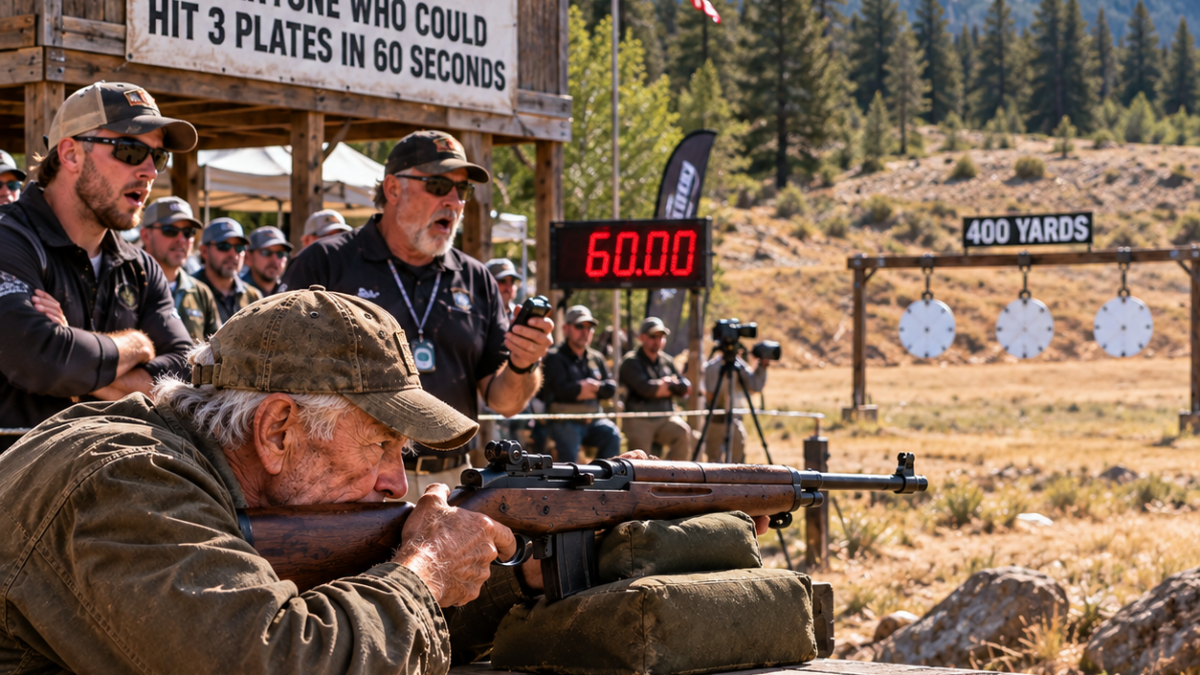
They Offered $20,000 to Anyone Who Could Hit Three Plates at 400 Yards in 60 Seconds—Then a 78-Year-Old Vietnam Veteran Did It in 41.
Thirty-one younger shooters had already failed the 400-yard iron-sight challenge when a stooped seventy-eight-year-old man in a faded work jacket quietly raised his hand from the back of the crowd and asked if he could borrow a rifle.
Forty-one seconds later, all three steel plates had rung, the sponsored shooter who had mocked him was standing speechless, and a Sergeant Major from Fort Moore was walking toward the firing line with tears in his eyes.
Then everyone learned why Walter Driscoll had never bothered telling anyone what he had done in Vietnam—and why the old veteran had absolutely no intention of keeping the $20,000 prize.
“LAST CALL, LADIES AND GENTLEMEN!”
The announcer’s voice cracked through the loudspeakers for what felt like the hundredth time that afternoon.
“Twenty thousand dollars to whoever rings all three plates in sixty seconds!”
The crowd near the firing line barely reacted.
Most of them had heard the challenge enough times by then.
Mesquite Valley Shooting Expo had started Friday morning with almost four thousand visitors moving through vendor tents, demonstration ranges, food trucks, and rows of polished rifles displayed beneath white canopies.
By late Saturday afternoon, the place looked tired.
The October Texas heat had settled over the range like a blanket.
Dust hung above the parking area.
Half-empty plastic bottles rolled beneath folding tables.
Competitors were packing cases.
Vendors were peeling banners from tent poles.
Children who had begged their fathers to stay “just ten more minutes” were sleeping against truck windows.
And across the main firing line, three twelve-inch steel plates stood four hundred yards away beneath the fading sun.
Left.
Center.
Right.
They did not look impressive from the firing line.
That was part of the trick.
At four hundred yards, twelve inches became very small.
Especially through iron sights.
No scopes.
No magnification.
No electronic range aid at the firing point.
One round for each plate.
Three rounds total.
Call the plate before each shot.
Sixty seconds.
Hit all three and walk away with twenty thousand dollars.
Miss once?
Finished.
Run out of time?
Finished.
Thirty-one shooters had tried.
Thirty-one had failed.
Some missed the first plate.
Some reached two.
PART2:
One had rung all three eventually but took seventy-three seconds.
Another competitor fired his third shot just after the buzzer.
The closest official attempt belonged to Bryce Callaway.
Bryce was thirty-four.
Fit.
Confident.
Sponsored by three companies whose logos covered his competition jersey.
He traveled the regional precision circuit.
He had the kind of social-media following that made people recognize him before he recognized them.
That morning, Bryce had hit the first target quickly.
Then the second.
He spent the rest of the minute trying to settle himself for the third.
The buzzer sounded before he could finish.
Fifty-eight seconds.
Two plates.
The crowd applauded anyway.
Bryce smiled.
Told the announcer:
“I’ll get it next year.”
Then spent the afternoon explaining to anyone who asked that the challenge was more difficult than it looked.
He was right.
That was why when the announcer made his final call at 3:42 p.m., almost nobody moved.
“Come on!”
The announcer tried.
“We have money sitting here.”
He pointed toward the sponsor pavilion.
“Twenty thousand dollars.”
“No scope.”
“No tricks.”
“Three pieces of steel.”
“Anybody?”
A teenager near the snack tent shouted:
“You do it!”
People laughed.
The announcer laughed too.
“Not with my eyes.”
Then a hand rose near the back.
Slowly.
No dramatic movement.
Just one old hand above a faded brown Carhartt jacket.
The announcer squinted.
“Sir?”
The man stood.
He was thin.
Maybe five-nine before age had taken a little height.
White hair beneath a plain olive cap.
Work jeans.
Old boots.
His shoulders curved forward slightly.
He moved carefully when he stepped around folding chairs.
Not weakly.
Carefully.
There is a difference.
A young Marine veteran named Caleb Morrow stood beside him.
Caleb was twenty-nine.
He had returned from Afghanistan with a damaged left knee, a permanent limp, and the habit of becoming quiet whenever anybody mentioned deployment.
He watched the old man.
“Walt?”
Walter Driscoll looked at him.
“What?”
“You’re serious?”
Walter nodded.
“I’d like to try.”
Bryce Callaway turned from a sponsor table.
He saw Walter walking toward the line.
Then smiled.
Not cruelly at first.
More like somebody watching his grandfather enter a basketball contest.
“Pops.”
Walter stopped.
Bryce gestured toward the targets.
“That’s four hundred yards.”
Walter looked past him.
“I heard.”
“I’m just saying.”
Bryce chuckled.
“That’s a long walk for a long shot.”
A couple people smiled.
Caleb did not.
Bryce continued:
“You sure you don’t want to save your back for the drive home?”
Walter looked at him.
No anger.
No wounded pride.
No desire to prove anything.
Just looked.
Then said:
“I didn’t drive this far to watch you pack.”
The people closest to them laughed.
Bryce’s smile tightened.
Walter continued walking.
Caleb followed.
Nobody in the crowd knew much about Walter Driscoll.
Including Caleb.
Walter lived three houses from Caleb’s mother outside Henderson.
Small one-story home.
Chain-link fence.
Detached garage.
1996 Ford F-150 that made a squeal on cold mornings until Walter replaced one pulley he insisted “still had another year in it.”
He had been Caleb’s neighbor since Caleb was fourteen.
He mowed his own yard.
Changed his own oil.
Fixed lawnmowers for people who brought them over.
Kept a bird feeder in the back.
Drank coffee black.
Went to church irregularly.
Never married again after his wife died.
And almost never discussed the Army.
Caleb knew Vietnam.
That was about it.
Walter had mentioned it once while they were sitting on Caleb’s back steps.
Caleb had been struggling after returning from Helmand.
His mother worried because he slept four hours a night.
Stopped seeing friends.
Would sometimes sit outside until sunrise.
Walter came over with coffee.
Did not ask:
“What’s wrong?”
Did not say:
“I understand.”
He simply sat.
Eventually Caleb asked:
“Were you ever over there?”
Walter said:
“Vietnam.”
Caleb turned.
“What did you do?”
Walter stared into coffee.
“Army stuff.”
That was the entire explanation.
Caleb respected it.
Veterans learn quickly which questions belong to curiosity and which belong to trust.
So when Caleb heard about the Mesquite Valley expo months later, he walked over to Walter’s house.
“You should come.”
“Why?”
“Rifles.”
Walter looked at him.
“That’s your sales pitch?”
“You said you liked rifles.”
“I said I used to shoot.”
“Same thing.”
Walter finally agreed.
Saturday morning, he climbed into his old F-150 with a stainless-steel thermos and drove seventy-three miles.
They spent four hours walking the expo.
Walter ignored the flashiest booths.
He stopped at old service rifles.
Wood stocks.
Steel.
Mechanical sights.
He talked to one collector for almost twenty minutes about an M1 Garand.
At another table he picked up an M14-pattern rifle and held it for three seconds.
Then put it down.
The vendor tried explaining features.
Walter thanked him.
Walked away.
Caleb teased:
“You know more than you’re saying.”
Walter answered:
“Everybody knows more than they’re saying.”
That was Walter.
Around noon, they found the plate challenge.
Walter dragged a folding chair beneath shade.
He watched.
Not casually.
Caleb noticed.
When shooters came to the line, Walter’s eyes changed.
He watched feet.
Body position.
How they settled.
How long they waited.
How they reacted after misses.
But he never commented.
Bryce made his attempt.
First plate rang.
Second.
Then nothing.
When the buzzer sounded, Bryce muttered a curse.
Walter sipped coffee.
Caleb asked:
“Think you could do it?”
Walter said:
“No idea.”
That should have been warning.
Range coordinator Marcus Hennessey had noticed Walter too.
Marcus was sixty-one.
Former rangemaster at a large public facility outside San Antonio.
Twenty-six years working around guns had taught him something.
You can often tell how comfortable someone is with firearms before they touch one.
Novices often stare at the gun.
Experienced people watch everything around it.
Muzzle.
People.
Backstop.
Hands.
Mechanical condition.
Walter watched that way.
Not nervous.
Not excited.
Familiar.
Marcus could not place him.
Now Walter approached.
“You the coordinator?”
Marcus nodded.
“Marcus Hennessey.”
“Walter Driscoll.”
They shook.
“You want the challenge?”
“Yes.”
“Bring a rifle?”
“No.”
Walter looked toward loan rack.
“I need one.”
Marcus gestured.
“We have three approved rifles set up with irons.”
Walter examined them.
Not like shopper.
Like mechanic choosing wrench.
He picked middle rifle.
An M14-pattern competition rifle supplied by a private collector.
Walter lifted it.
Checked balance.
Shouldered.
Lowered.
Looked through rear aperture.
Adjusted nothing.
“This will do.”
Marcus stared.
“You familiar?”
“A little.”
Bryce had wandered closer.
Now maybe twenty people gathered.
Then thirty.
Most because old man about to attempt impossible challenge was entertaining.
The announcer came down from platform.
He went over rules carefully.
“Three targets.”
“Left, center, right.”
“Four hundred yards.”
“Call your target before firing.”
“One shot per plate.”
“Sixty seconds.”
Walter nodded.
“No sighters?”
“No.”
“Same ammunition everybody gets?”
“Yes.”
Walter nodded.
“Fine.”
Bryce crossed arms.
“You ever shot an M14 before, Pops?”
Walter turned.
“Once or twice.”
Something about the answer made Marcus look at him harder.
Walter removed jacket.
Folded it carefully.
Set cap beside.
Underneath, his hair was close-cut.
White.
His hands trembled slightly when he reached for the rifle.
Bryce saw.
So did Caleb.
Caleb suddenly felt nervous.
Not because Walter might miss.
Because he realized everybody was watching the old man now.
He stepped closer.
“Walt.”
Walter glanced.
“You don’t have to.”
Walter smiled faintly.
“Caleb.”
“Yes?”
“Neither do they.”
He nodded toward plates.
Then lowered himself to the firing position.
Slowly.
His right knee had been replaced twice.
Getting down took time.
Once there, however, something changed.
The old man did not disappear.
But age became less relevant.
His movements became economical.
No wasted adjustment.
No fidgeting.
He settled the rifle.
Shoulder.
Cheek.
Breath.
The tremor in his hands seemed to matter less when supported.
Marcus looked toward Bryce.
Bryce was no longer smiling.
The announcer raised microphone.
“Shooter ready?”
Walter answered:
“Ready.”
Timer operator raised hand.
A small crowd moved closer behind safety line.
Caleb stood with arms folded tight across chest.
He did not know why he felt like crying before anything had happened.
Maybe because Walter looked different.
Not younger exactly.
Recognizable in a way Caleb had never seen.
As if he had been walking past a locked door for fifteen years and somebody had opened it half an inch.
The buzzer sounded.
Walter did not jerk.
He breathed.
Then said:
“Left.”
The shot broke nine seconds later.
A pause.
Then steel answered.
CLANG.
People murmured.
Walter did not.
“Center.”
Second shot.
Fourteen seconds later.
CLANG.
Marcus looked at timer.
Twenty-three seconds.
Bryce’s arms fell from crossed position.
Walter stayed down.
The final target shimmered in afternoon heat.
He took longer.
Caleb could see his shoulder rise slightly.
Fall.
Walter said:
“Right.”
The shot broke.
For one second, there was nothing.
Then:
CLANG.
Marcus looked down.
The announcer looked at him.
“What?”
Marcus held timer up.
“Forty-one seconds.”
The crowd went completely silent.
Not cheer-first silence.
The strange kind.
People recalibrating reality.
Walter engaged safe.
Set rifle down.
Then began pushing himself up.
Slowly.
His knee made him stop halfway.
Caleb moved forward.
Walter waved him off.
“I’ve got it.”
He stood.
The announcer still had microphone halfway to mouth.
Three plates continued swaying.
Each had been hit.
One shot each.
Three rounds.
Forty-one seconds.
Bryce stared downrange.
Then at Walter.
Then at the rifle.
“No.”
Nobody responded.
Bryce stepped closer.
“He had to have ranged it.”
Marcus frowned.
“Range was confirmed.”
“No.”
“I mean beforehand.”
“He had to scope it.”
Marcus looked at him.
“He’s been sitting in my view most afternoon.”
Bryce shook head.
“You don’t just walk up cold.”
Walter picked up jacket.
Bryce’s voice grew louder.
“Did anybody see him with a rangefinder?”
Somebody behind said:
“No.”
Marcus raised hand.
“Bryce.”
“I’m not accusing.”
“You are.”
“I’m saying it doesn’t make sense.”
Marcus pointed toward rifle.
“Same rules.”
“Same line.”
“Same targets.”
“Same ammunition.”
“Borrowed gun.”
Bryce looked at Walter.
The arrogance had gone.
Now confusion.
Almost respect.
“Who taught you?”
Walter stopped.
“A man named Powell.”
He picked up cap.
“Long time ago.”
Ten yards away, a man in Army uniform froze.
Sergeant Major Eli Bowen had been walking from the Army recruiting pavilion toward the sponsor tent.
He was six-foot-three.
Broad.
Late forties.
Senior enlisted instructor connected to the Army’s sniper training community at Fort Moore.
He had not seen Walter shoot.
But he heard one word.
Powell.
He had spent enough of his career studying the history of American sniper training that the name caught him instantly.
Bowen looked toward the bench.
M14.
Old man.
Registration clipboard.
He stepped toward Janelle Park, the sponsor representative holding contestant paperwork.
“Can I see that?”
She handed it over.
Bowen scanned.
Walter Driscoll.
Age 78.
No military affiliation listed.
Bowen stared at name.
Then face.
Something from an old photograph surfaced.
Not certainty.
Possibility.
He walked forward.
“Sir?”
Walter turned.
Bowen stopped ten feet away.
“Walter Driscoll?”
“Yes.”
Bowen swallowed.
“Master Sergeant Walter Driscoll?”
Walter’s expression changed.
Not much.
But enough.
He looked at Bowen’s uniform.
Then his face.
“I haven’t been called that in a long time.”
Caleb stared.
Master Sergeant?
Bryce slowly removed his cap.
Bowen stepped closer.
“My name is Eli Bowen.”
“Sergeant Major.”
Walter nodded.
Bowen continued:
“My grandfather was Daniel Bowen.”
Walter went still.
It was the first time that afternoon anyone truly surprised him.
“Daniel Bowen?”
“Yes, sir.”
“Charlie Company?”
“Yes.”
Walter’s eyes lost the range.
The expo.
The crowd.
For a moment, he was somewhere else.
“Skinny kid?”
Bowen laughed once through a tightening throat.
“Very.”
“Always carried books?”
“Yes.”
“Steinbeck?”
Bowen’s voice broke.
“Yes, sir.”
Walter looked down.
“Daniel.”
He said the name again.
Caleb felt something in his stomach twist.
Bowen stood straighter.
“My grandfather told me about you.”
Walter looked uncomfortable.
“He talked about a lot of men.”
“He talked about you.”
Walter said nothing.
Bowen continued.
“He said you kept his platoon alive in sixty-nine.”
The crowd around them had grown.
Nobody announced it.
People simply noticed something happening and came closer.
Walter glanced around.
He disliked attention.
That was obvious.
He put cap on.
Bowen seemed to recognize discomfort.
He lowered voice.
“Sir, I apologize.”
“For what?”
“For making this public.”
Walter looked at him.
“Too late now.”
A few people smiled.
Janelle Park stepped closer.
“Sergeant Major.”
She looked at Bowen.
“For those of us who don’t know…”
She stopped.
Not wanting to turn Walter into display.
Bowen looked at Walter first.
Permission.
Walter gave tiny shrug.
Bowen turned partly toward crowd.
“Master Sergeant Walter Driscoll served with the Ninth Infantry Division during Vietnam.”
Walter stared toward targets.
Bowen continued.
“He was part of an early sniper program developed under Major Willis Powell.”
Several military veterans in crowd became very still.
“The program helped shape techniques that were later formalized in Army sniper doctrine.”
Walter shifted his weight.
“You’re making it sound bigger.”
Bowen looked back.
“My grandfather thought it was big.”
Walter sighed.
Bowen continued more carefully.
“Some historical training references still cite men from those early programs.”
“He was one of them.”
The announcer slowly lowered microphone.
Nobody needed it.
Caleb stared at Walter.
All those mornings.
Coffee.
Lawnmowers.
Truck.
Quiet man beside him after Afghanistan.
“Army stuff.”
That was how Walter described it.
Army stuff.
Bowen looked at him.
“My grandfather said there was one night near the Delta…”
Walter’s face closed.
Bowen stopped immediately.
Understood.
No war story without invitation.
Instead he said:
“He made it home.”
Walter looked up.
“Daniel?”
“Yes, sir.”
“He came home?”
“Yes.”
Walter swallowed.
“When?”
“Nineteen seventy.”
“And after?”
“Married.”
“Two daughters.”
“Worked for electric company.”
“Grandchildren.”
Bowen smiled faintly.
“I’m one.”
Walter stared at him.
Then nodded.
“Good.”
One word.
But Caleb heard everything inside it.
Bowen said:
“He died in 2014.”
Walter closed eyes briefly.
“He talked about you until the end.”
“Did he?”
“Yes.”
“Good kid.”
Bowen laughed through tears.
“My grandfather was seventy-eight when he died.”
“He’d have hated you calling him kid.”
“He was nineteen when I knew him.”
That sentence hit the crowd harder than any heroic story could have.
Because that was what old veterans carried.
Young men.
Frozen in memory.
Walter looked at Bryce.
Bryce was staring at ground.
No sponsor grin.
No crossed arms.
No performance.
He walked toward Walter.
“Sir.”
Walter turned.
“I owe you an apology.”
“For what?”
“For talking to you like…”
He could not finish.
Walter helped.
“Old man?”
Bryce almost smiled.
“Yes.”
“You weren’t wrong.”
A few people laughed softly.
Bryce shook head.
“I was disrespectful.”
Walter looked at him.
“You shoot well.”
Bryce blinked.
“What?”
“You shoot well.”
“You rushed third plate.”
“Your body started chasing time instead of letting shot happen.”
Bryce listened.
Walter gestured slightly.
“You’re strong in position.”
“Couple small things.”
“You’d cut time.”
Bryce looked stunned.
After mocking him, Walter was coaching him.
“You’d show me?”
Walter shrugged.
“If you want.”
Bryce nodded.
“Yes, sir.”
Walter patted his shoulder.
“Then stop looking like somebody died.”
The crowd laughed.
Pressure broke.
That was when Janelle remembered the money.
She hurried back to sponsor pavilion.
Returned holding a ceremonial oversized check and a normal envelope.
“Mr. Driscoll?”
Walter looked.
“Sir, challenge prize is twenty thousand dollars.”
He nodded.
“You earned it.”
She held check.
The crowd finally began applauding.
Walter did not reach for it.
Janelle waited.
Walter stared at amount.
Twenty thousand dollars.
Caleb knew Walter’s truck needed work.
His roof had a patch above garage.
He complained about property taxes.
Twenty thousand dollars mattered.
Walter looked at Caleb.
Then Bowen.
Then back at Janelle.
“Can you make it to somebody else?”
Janelle hesitated.
“Within sponsor rules, yes.”
“Gold Star scholarship.”
“What?”
“Nearest legitimate Gold Star family scholarship program.”
“Education fund.”
“Whatever your legal people approve.”
Janelle stared.
“All of it?”
Walter nodded.
“Sir, you don’t have to decide now.”
“I did.”
Caleb covered his mouth.
Walter glanced.
“What’s wrong with you?”
Caleb laughed and cried at same time.
“You.”
“What about me?”
“You drove a truck here that barely has air conditioning and you’re giving away twenty grand.”
“Air conditioning works.”
“It blows warm.”
“Eventually gets cool.”
“Walt.”
Walter looked downrange.
“I didn’t come here for money.”
“Then why did you raise your hand?”
Walter thought.
“Because nobody else did.”
That was Walter.
The announcer raised microphone again.
His voice softer.
“Ladies and gentlemen…”
Walter turned immediately.
“No.”
The announcer paused.
“No speech?”
“No.”
“Photo?”
Walter grimaced.
Janelle asked:
“Can we at least get one photo for sponsor records?”
Walter looked like she had requested dental surgery.
Bowen stepped in.
“I’ll stand with you.”
Walter:
“That does not improve.”
People laughed.
Eventually he agreed.
One picture.
Walter holding nothing.
Janelle with check.
Bowen.
Caleb.
Marcus.
Bryce stood off to side until Walter waved.
“You too.”
Bryce pointed at himself.
“Yes.”
“Get over here.”
He joined.
The photograph later spread everywhere.
That annoyed Walter.
But in moment, simple.
When done, Walter reached for jacket.
He wanted leave.
Bowen walked with him.
Caleb followed.
They reached old F-150.
Bowen opened passenger door.
Walter looked.
“I can open door.”
“I know.”
“Then why?”
“Because my grandfather would haunt me if I didn’t.”
Walter laughed.
He climbed.
Caleb got driver? Wait Walter drove in source. Let’s keep Walter driving.
Walter moved behind wheel.
Bowen stood outside.
“Master Sergeant.”
“Yes?”
“Sniper Course would be honored if you visited.”
Walter shook head.
“I’m not teaching twenty-year-olds how to shoot.”
“They already know.”
“Then why need me?”
“Because shooting isn’t only thing we teach.”
Walter looked.
Bowen continued.
“History matters.”
“Restraint matters.”
“Judgment matters.”
“The people who built lessons matter.”
Walter looked through windshield.
“I’ll think.”
Bowen nodded.
“That’s more than no.”
Walter started truck.
Engine coughed.
Then caught.
Bowen smiled.
“You should use prize money on that.”
Walter:
“You should mind your business.”
Caleb laughed.
Before Walter closed door, he looked at Bowen.
“Tell students something.”
Bowen waited.
Walter said:
“The rifle doesn’t know how old you are.”
Bowen nodded.
“It only knows whether you’ve been paying attention.”
Bowen stood at attention.
Not theatrical.
Not because Walter demanded.
Walter definitely did not.
Bowen saluted.
Walter looked uncomfortable for half second.
Then returned it.
Small.
Old.
Precise.
The Ford rolled away.
The announcer never really recovered the closing ceremony.
Nobody cared.
The steel plates were taken down near sunset.
Marcus walked out with crew.
Three fresh marks.
Not perfect center.
Nobody needed perfect.
All three hits.
Marcus rubbed one with thumb.
Then said to range worker:
“Save these.”
“Why?”
“Because someone’s going to ask.”
He was right.
By Sunday morning, somebody had posted video.
Walter’s three shots.
Crowd silence.
Bowen recognizing him.
Donation.
The clip exploded.
Hundreds of thousands of views.
Then millions.
The captions became ridiculous.
78-YEAR-OLD SECRET SNIPER HUMILIATES PRO.
Bryce hated that almost as much as Walter.
He posted his own video.
“This wasn’t humiliation.”
He looked directly into camera.
“I acted like a jerk to a man because he was old.”
“He beat challenge.”
“Then treated me better than I treated him.”
“That is the story.”
That response changed how people saw Bryce.
Some followers mocked him.
Most respected.
Walter never watched.
Caleb tried showing comments.
Walter waved phone away.
“People got too much time.”
But mail started.
Letters.
Veterans.
Families.
Young shooters.
One envelope contained photograph.
Black-and-white.
Vietnam.
Six young soldiers.
Walter recognized every face.
The sender was daughter of one man.
My dad said you saved his life.
Thank you.
Walter sat at kitchen table a long time.
Caleb was there.
He did not read over shoulder.
Walter eventually pushed photo across.
“That’s Danny.”
“Bowen’s grandfather?”
“No.”
“Different Danny.”
He pointed.
“That’s Reynolds.”
“That’s McKee.”
“That’s Powell.”
Caleb looked.
A young Walter stood near edge.
Thin.
Expression serious.
No white hair.
No tremor.
No replaced knees.
Twenty-two.
Caleb stared.
“You were a kid.”
Walter smiled sadly.
“So were they.”
That became first time he spoke more than two sentences about Vietnam.
Not the shooting.
The people.
He told Caleb Powell loved terrible instant coffee.
Daniel Bowen traded cigarettes for paperbacks.
McKee sang badly.
Reynolds wrote his wife every day.
He talked about mosquitoes.
Mud.
Heat.
Fear.
Waiting.
Mostly waiting.
Caleb listened.
At one point asked:
“Why didn’t you ever tell me?”
Walter looked.
“You needed to talk about your war.”
“Not hear mine.”
Caleb looked down.
That sentence stayed with him.
After Afghanistan, people kept offering stories.
“I know guy who…”
“My uncle served…”
“My dad…”
Walter had done opposite.
He sat.
That was why Caleb trusted.
Months later, Fort Moore called again.
Bowen.
Walter had been ignoring.
Finally Caleb said:
“You should go.”
“Why?”
“Because they asked.”
“That isn’t reason.”
“Because you told me stories only when I was ready.”
“Maybe those kids are ready.”
Walter frowned.
“Dirty trick.”
“Learned from old guy.”
Walter went.
No press.
His condition.
No promotional announcement.
No staged rifle demonstration.
No giant check.
He sat in a classroom with twenty-four sniper students.
Most under thirty.
Bowen introduced him only:
“Master Sergeant Walter Driscoll.”
Walter hated standing front.
He looked at room.
Said:
“I’m not here to teach shooting.”
Everybody smiled nervously.
“You have instructors for that.”
He sat on edge of desk.
“What do you want know?”
A student asked:
“How did you make those three hits at seventy-eight?”
Walter shrugged.
“Same way you make one.”
That answer disappointed.
He explained not mechanics, but patience.
Not rushing because clock.
Not becoming angry because previous shot imperfect.
Not letting crowd enter head.
“Young men think speed means hurry.”
“It doesn’t.”
“Speed comes from not wasting motion.”
Another asked about Vietnam.
Walter went quiet.
Then answered carefully.
Not kill counts.
Not dramatic missions.
He talked about responsibility.
About target identification.
About coming home.
About men whose faces remain younger than yours forever.
He said:
“If what you remember most about war is what you hit, you weren’t paying enough attention to what it cost.”
Nobody wrote for a few seconds.
Bowen stood at back.
Eyes down.
Another student asked:
“Do you miss it?”
Walter responded immediately.
“No.”
That startled.
“I miss people.”
“Not war.”
“Don’t confuse those.”
That line traveled through school.
Not publicly.
Among instructors.
Years later Bowen heard a student repeat it to another class.
That pleased him more than viral video.
The scholarship donation also had consequences Walter never expected.
The sponsor matched it.
Twenty thousand became forty.
Then Mesquite Valley Expo created annual Walter Driscoll Gold Star Education Challenge Fund.
Walter objected to name.
They compromised.
Eventually it became simply:
Mesquite Gold Star Scholarship.
No Walter.
He preferred.
First recipient was a nineteen-year-old woman named Emily Torres.
Her father had died while serving overseas when she was six.
She studied nursing.
Walter received thank-you letter.
He called sponsor.
“Why did she write me?”
“Because your donation funded award.”
“Tell her she doesn’t owe me.”
“She already mailed.”
Walter sighed.
He wrote back.
Emily,
You don’t owe me anything.
Study hard.
Help somebody.
That will settle account.
Walter Driscoll
That letter ended up framed on Emily’s desk.
She later became emergency-room nurse.
Walter never knew? Could know later. Let’s let Caleb tell him a few years later.
Bryce did come by.
Not immediately.
Three months after expo, an unfamiliar pickup stopped at Walter’s house.
Bryce stepped out.
No sponsor jersey.
Jeans.
Plain shirt.
He carried rifle case.
Walter opened garage.
“You actually came.”
“You said.”
Walter pointed toward coffee.
“You drink?”
“Yes.”
“Bad?”
“Depends.”
“This is bad.”
Bryce laughed.
They drove to private range belonging to Caleb’s uncle.
Walter did not transform Bryce into champion through secret sniper magic.
He mostly watched.
Asked questions.
Why are you changing position?
Why are you rushing after good hit?
Why do you care who is watching?
Bryce eventually said:
“You know everybody expected some hidden technique.”
Walter shrugged.
“There are techniques.”
“But yours isn’t hidden.”
“People just don’t like boring answers.”
“What boring answer?”
“Pay attention.”
“Practice.”
“Don’t lie to yourself.”
Bryce considered.
“That was your line at expo.”
“No.”
“My line was rifle doesn’t know your age.”
“Same family.”
They became friends.
Strange friends.
Thirty-four-year age difference.
Bryce called once every few weeks.
Walter rarely called first.
Bryce helped repair truck air conditioning.
Walter admitted it had never actually gotten cool.
Caleb considered major victory.
The tremor in Walter’s hands worsened over next few years.
That matters.
People wanted myth where old sniper could shoot forever.
Bodies do not care about mythology.
At eighty-one, Walter stopped shooting unsupported entirely.
At eighty-three, his eyesight made long-distance iron-sight shooting frustrating.
He accepted reluctantly.
One afternoon Caleb asked:
“Does it bother you?”
Walter looked at hands.
“Some.”
“You were good.”
“Still am at some things.”
He picked up coffee.
Spilled a little.
“Not this apparently.”
They laughed.
Walter said:
“The mistake is thinking skill means ownership forever.”
“What does that mean?”
“You borrow abilities.”
“Body loans them.”
“Time takes some back.”
Caleb stared.
“That depressing?”
“No.”
Walter looked toward yard.
“You use them while you have them.”
That was his philosophy.
Not nostalgia.
The forty-one-second run became more impressive because it did not last forever.
One afternoon, Bowen visited from Georgia.
Brought his son.
Sixteen.
Tall.
Quiet.
Named Daniel after great-grandfather.
Walter opened door.
Looked at boy.
“Another one?”
Bowen smiled.
“He wanted meet you.”
Walter groaned.
“Kids need better hobbies.”
Young Daniel laughed.
Inside, Bowen brought old paperback.
The Grapes of Wrath.
Cover worn.
“My grandfather’s.”
Walter stared.
“He kept it?”
“Apparently.”
Inside cover:
D. BOWEN
69
Walter touched initials.
Bowen said:
“My grandmother found it after he died.”
“He told her you used to give him hell for reading on watch.”
Walter smiled.
“He read everywhere.”
They sat.
Walter held book.
Not crying.
Almost worse.
“He made it.”
Bowen said.
“You asked at expo.”
Walter nodded.
“I always wondered.”
“Now you know.”
They talked until evening.
Before Bowen left, Walter gave book back.
“No.”
Bowen said.
“It’s yours.”
Walter shook head.
“Belongs to family.”
“You’re part of why family exists.”
Silence.
Walter finally accepted.
That book remained beside his chair.
Years later, after Walter died, Caleb returned it to Bowen.
With one note tucked inside:
Daniel,
Your great-grandfather was exactly as stubborn as yours.
Keep reading.
—Walt
Walter Driscoll died at eighty-five.
Not dramatically.
Sleep.
His heart simply stopped.
Caleb found out when Walter’s niece called.
The funeral was supposed to be small.
Walter had specifically written:
NO BIG MILITARY NONSENSE.
His niece showed Caleb the note.
Caleb laughed through tears.
“What counts as big?”
Nobody knew.
Word traveled.
Bryce came.
Marcus Hennessey.
Janelle Park.
Sergeant Major Bowen flew in.
Several instructors.
Emily Torres, first scholarship recipient, drove five hours.
A few veterans Walter had known.
Most wore no uniforms.
The Army provided honors because Walter had earned them.
Flag.
Taps.
No speeches longer than necessary.
Bowen spoke anyway.
Brief.
“Master Sergeant Driscoll once told my students that a rifle doesn’t know how old you are.”
A few people smiled.
“He was talking about attention.”
“But Walter’s life taught something larger.”
“History does not announce itself.”
“It may be sitting in a folding chair at the back.”
“It may be driving an old Ford.”
“It may be your quiet neighbor who never mentions what he did.”
“So be careful who you dismiss.”
“More importantly—be careful who you fail to ask about.”
Then Caleb spoke.
He had resisted.
But Walter’s niece asked.
Caleb stood.
His limp worse in cold.
“I knew Walt fifteen years before I knew what unit he served in.”
People smiled.
“I thought that meant he was private.”
“It did.”
“But later I understood something else.”
“He never needed his worst years to be most interesting thing about him.”
Caleb looked at casket.
“He fixed my mower.”
“He yelled because I borrowed wrench and didn’t return.”
“He brought coffee when I couldn’t sleep.”
“He listened when I came home and didn’t know how to be home.”
“He let me talk without competing.”
“That is what I’ll remember.”
Then:
“And yes.”
“He could shoot.”
Laughter through tears.
After funeral, Caleb drove Walter’s old F-150 home.
Walter had left it to him.
The air conditioning worked now.
Bryce had fixed.
On passenger seat sat thermos.
Caleb drove past county range.
Thought about first invitation.
“There’s going to be rifles, Walt.”
“You said you liked rifles.”
Such a small decision.
If Walter said no, nothing.
No prize.
No scholarship.
No Bowen reunion.
No Fort Moore classroom.
No Bryce friendship.
No Emily letter.
Life turns on ordinary yes.
Mesquite Valley kept running challenge.
Eventually changed.
Prize varied.
Rules adjusted.
Technology changed.
But once a year, announcer told Walter story.
Not embellished.
Marcus insisted.
“Forty-one seconds.”
“Three shots.”
“Three hits.”
“Borrowed rifle.”
“Seventy-eight.”
“And he gave the money away.”
Someone always asked if record still stood.
For several years, yes.
Eventually a younger competitor beat time.
Thirty-six seconds.
People expected awkwardness.
Caleb sent video to Walter before he died.
Walter watched.
Smiled.
“Good.”
“That’s it?”
“What?”
“He beat you.”
“Supposed to.”
Caleb laughed.
“You don’t care?”
“Records are targets.”
“If nobody beats them, what’s point?”
Then Walter noticed shooter.
“His position better than Bryce’s used to be.”
Caleb:
“You are impossible.”
The new competitor later learned whose record he broke.
He wrote Walter.
Walter replied:
Good shooting.
Now do it again.
That was all.
Perfect.
The original three steel plates ended up stored in Marcus’s garage after expo upgraded.
When Walter died, Marcus asked family if they wanted one.
Caleb took right plate.
The third.
The one rung at forty-one seconds.
Fresh dent had rusted slightly around edges.
He mounted it in garage.
Not polished.
Not restored.
Underneath:
41 SECONDS
No name.
Anyone who knew, knew.
Years later Caleb’s own son asked:
“What is that?”
Caleb told story.
Old neighbor.
Expo.
Three plates.
Sergeant Major.
Vietnam.
Twenty thousand dollars.
At end boy asked:
“Was he famous?”
Caleb thought.
“For a little while.”
“Did he like it?”
“No.”
“Then why did he do challenge?”
Caleb smiled.
“Because somebody asked if anyone wanted to try.”
The boy nodded.
Simple.
Maybe that was truest reason.
Walter did not walk up to reclaim honor.
He did not need young man humbled.
He did not want crowd to discover secret history.
He did not go for money.
He saw a difficult thing.
He still believed he might be able to do it.
So he raised his hand.
Everything afterward belonged to other people.
Their surprise.
Their tears.
Their admiration.
His part was only three shots.
That is why story lasted.
Quiet competence makes people uncomfortable.
We are trained to look for symbols.
Sponsors.
Uniforms.
Equipment.
Youth.
Confidence.
Social proof.
Walter brought none.
Faded jacket.
Old truck.
Tremor.
No résumé.
No logo.
No explanation.
Bryce saw age.
Crowd saw age.
Caleb saw his neighbor.
Marcus saw familiarity.
Bowen eventually saw history.
All were looking at same man.
Only context changed.
Walter had always been Walter.
Before plates rang.
After.
That is another lesson.
Recognition does not create worth.
It reveals what was already there.
Bowen understood.
At expo, when he saluted Walter, people later said:
“That was moment Walter became somebody.”
No.
Walter had been somebody for seventy-eight years.
The crowd had simply found out.
That distinction matters.
People walk past history every day.
Old man buying coffee.
Woman with walker.
Quiet veteran.
Retired teacher.
Mechanic.
Grandmother.
We reduce people to visible age because their earlier versions are hidden.
But they carry every version.
Walter was simultaneously:
seventy-eight-year-old neighbor,
twenty-two-year-old soldier,
widower,
mechanic of his own truck,
friend to Caleb,
former sniper,
man who missed Daniel Bowen for fifty years,
and old fellow whose knee hurt when standing.
None canceled another.
The range only made layers visible for forty-one seconds.
The last thing Sergeant Major Bowen ever received from Walter was a Christmas card.
No photograph.
No long message.
Just:
Bowen,
Tell those kids to pay attention.
Walt.
Bowen kept it in desk.
Every new class, sometime first week, he repeated:
“The rifle doesn’t know how old you are.”
Students assumed motivational quote.
Bowen never explained immediately.
Later, when class became exhausted, overconfident, frustrated, he told them about Walter.
Not to teach shooting.
To teach humility.
Because expertise can be quiet.
Because age is not incompetence.
Because equipment does not replace judgment.
Because one dismissive sentence can reveal more about speaker than target.
And because the person you call “Pops” from across a firing line may have forgotten more about your craft than you have learned yet.
Bryce understood that best.
Years later, after his own competition career slowed, a reporter asked about most memorable match.
He could have named championship.
Podium.
Sponsor deal.
He said:
“Day Walter Driscoll beat me without trying to beat me.”
Reporter asked:
“What does that mean?”
Bryce answered:
“I thought competition was me versus whoever stood next to me.”
“Walter showed me it’s you versus noise in your own head.”
“He never mocked me.”
“That’s why I remembered.”
Bryce later became coach.
Whenever a young shooter dismissed older competitor, he ended conversation quickly.
“You don’t know who you’re talking to.”
Sometimes they asked why.
He pointed to photograph on wall.
Walter.
Janelle.
Caleb.
Marcus.
Bowen.
Bryce himself with cap in hand.
“What happened?”
Bryce said:
“I learned manners.”
Good answer.
The $20,000?
It never bought Walter anything.
That was point.
It became scholarship money.
Then match money.
Then more donations.
By time Walter died, the fund inspired by that afternoon had helped fourteen Gold Star family students with tuition or books.
Fourteen.
Nursing.
Engineering.
Teaching.
Welding.
Business.
Walter knew only a few names.
He did not track total.
When Janelle once told him:
“You started all this.”
Walter said:
“No.”
“You wrote checks.”
She laughed.
“You’re impossible.”
“Correct.”
He truly believed money was sponsor’s.
He just redirected.
Maybe that made generosity easier.
Or maybe he had spent enough of life thinking about men who never got old enough to need roofs, trucks, property taxes.
We cannot know.
Walter rarely explained his deepest decisions.
That was also right.
Not everything belongs to audience.
At Mesquite Valley today, the firing line has new benches.
Electronic timers.
Better shade.
The old plates are gone.
The sponsor changed.
The challenge changed.
But if you ask Marcus—retired now—what he remembers most from decades around shooters, he does not say record groups.
He says silence after Walter’s third hit.
“Why?”
Someone once asked.
Marcus answered:
“Because everybody in that crowd realized at same time they had misjudged a man.”
That kind of silence is rare.
It happened at forty-one seconds.
Steel still ringing.
Old man getting slowly to feet.
Young Marine crying.
Sponsored shooter staring down.
Sergeant Major walking from pavilion.
For a few seconds, nobody knew what to do with what they had seen.
Then history caught up.
That was all.
Walter Driscoll never asked anyone to type respect.
Never asked for applause.
Never told strangers they should honor veterans.
Never called himself hero.
He would have hated the word.
He raised his hand.
Borrowed rifle.
Called:
“Left.”
“Center.”
“Right.”
Three shots.
Three plates.
Forty-one seconds.
Then gave the money away and tried to go home before anybody made a fuss.
Maybe that is why people never forgot him.
The loudest men at that expo had sponsors.
Walter had memory.
The youngest had stronger knees.
Walter had patience.
The fanciest rifles belonged to people who had spent thousands tuning equipment.
Walter borrowed his.
And when somebody finally asked him how a seventy-eight-year-old man with shaking hands had done what thirty-one competitors could not, he never claimed age had disappeared.
He never said veterans were superhuman.
He never said Vietnam gave him magic.
He simply looked toward the distant steel and said what Sergeant Major Bowen would repeat for years afterward:
“The rifle doesn’t know how old you are.”
Then he paused.
“It only knows whether you’ve been paying attention.”








