PART 2: HOA Karen Held Her Daughter’s Wedding on My Farm Without Permission—So I Gave Her the “Rustic” Venue She Asked For
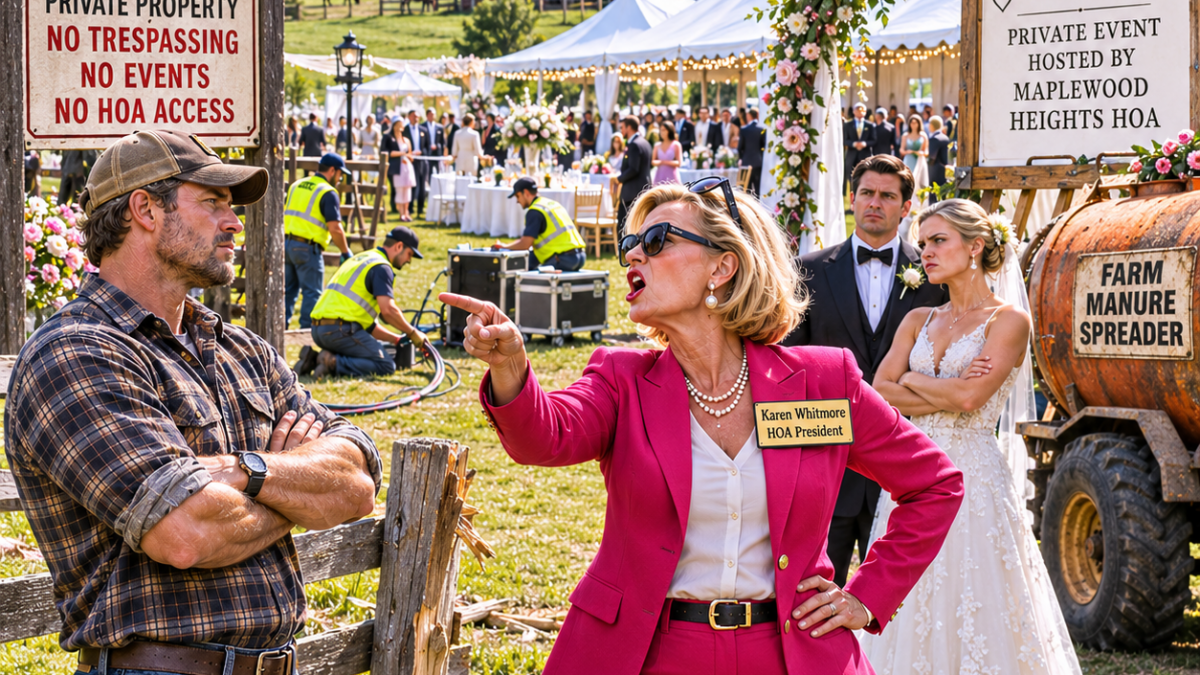
The morning I rode my ATV into the north pasture and found two hundred strangers turning my family’s hay field into a luxury wedding venue, HOA president Karen Whitmore stood beneath a flower arch planted directly over my irrigation line, lifted her designer sunglasses, and told me—with a straight face—that my deeded farmland had become “community property” because her board had voted to use it for her daughter’s wedding.
By the time I realized they had already removed part of my fence, run electrical cables across the pasture, driven delivery vans over ground my grandfather had worked since 1948, and hired vendors who genuinely believed Karen had legal authority to give away my land, I understood this was no longer one of her ridiculous complaints about cow smells or ugly fences—it was a deliberate test of whether I would finally surrender if she made the trespass expensive, public, and embarrassing enough.
I could have called the sheriff and spent the rest of the weekend arguing beside a row of white tents, but when Karen laughed at my warning, told the workers to ignore me, and promised the ceremony would be finished before I could stop her, I looked across that picture-perfect field and noticed one ordinary piece of farm equipment sitting beside my barn that suddenly made me wonder whether Karen truly understood what “rustic country charm” meant.
My name is Daniel White, and that farm has been in my family for three generations.
Two hundred acres of rolling pasture, oak trees, cattle, and a red barn my grandfather built in 1948. I grew up fixing fence beside my father, hauling hay before sunrise, and learning that land is not scenery when your family depends on it. Every gate, ditch, post, and worn tractor track had a reason for being there.
Five years before the wedding, the county sold a large parcel bordering my north side to a developer.
Maplewood Heights appeared almost overnight.
The new houses were expensive, polished, and marketed as “modern country living.” Most of the residents were decent enough, but Karen Whitmore treated the countryside like a themed resort whose employees had forgotten to hide the cows.
The first time she drove her spotless white SUV to my fence, she lowered her sunglasses and said, “Are you aware your cattle are visible from our cul-de-sac?”
I thought she was joking.
She wasn’t.
After that came complaints about manure odor, tractor noise, my rooster, hay bales, and the red barn she called “an aesthetic liability.”
My farm sat outside Maplewood Heights and outside its covenants, but Karen never seemed emotionally prepared for that fact.
A few weeks before the wedding, I found orange survey flags in my north pasture.
Two men with clipboards were measuring the field.
“Who gave you permission to be here?” I asked.
One of them looked at the other.
“We’re with the Maplewood event committee.”
“This isn’t Maplewood.”
They left quickly.
Then Karen found me near the mailbox.
“My daughter is getting married,” she said. “We’d love to use the field. Hay bales, oak trees, all that authentic rustic charm.”
“I don’t rent my land for events.”
Her smile tightened.
“Everyone in the community benefits.”
“I’m not in your community.”
She called me selfish and drove away.
I assumed that was the end of it.
Friday morning proved otherwise.
Generators woke me before seven.
When I stepped onto the porch, white tents covered the pasture. Caterers unloaded champagne. Florists were building an arch. Workers had mowed a broad section of grass and pushed my cattle into the far corner.
I rode down on the ATV.
A coordinator waved.
“You’re the hay supplier?”
“I’m the landowner.”
His face drained.
Then Karen appeared carrying a latte.
“Daniel, isn’t it beautiful?”
“You have five minutes to start removing this.”
She laughed.
“Relax. It’s community property now.”
I pulled out my phone.
“Say that again.”
For the first time, her smile shifted.
But instead of stopping, Karen turned toward the workers and said the words I needed recorded.
“Keep setting up. He can’t do anything about it.”
I looked at the tents, the cut fence, the nervous cattle—and then at Karen.
She thought the wedding was already too big for me to stop.
PART 2
I didn’t argue with her again.
That confused Karen more than shouting would have.
She watched me slide my phone back into my pocket.
“That’s it?” she asked.
“For now.”
Her eyes narrowed.
“What does that mean?”
“It means you’ve been told to leave.”
She laughed again.
“Daniel, please. We’re all adults here.”
“Then act like one.”
That wiped the smile off her face.
Behind her, the event coordinator pretended to study his clipboard.
I turned my ATV around and drove back toward the house.
I could feel Karen watching me the whole way.
She probably thought I was retreating.
I wasn’t.
I was done giving her material for the performance she wanted.
People like Karen loved arguments because arguments created ambiguity. Two angry neighbors shouting about property lines could look like a misunderstanding.
A deed didn’t misunderstand anything.
Neither did a recording.
I went inside and called the county land office.
A woman named Beth answered.
I gave her my parcel number.
“I’m dealing with a boundary dispute.”
“What kind?”
“My neighboring HOA is setting up a wedding in my north pasture.”
There was a pause.
“A wedding?”
“Yes.”
“On your parcel?”
“That is what I need you to confirm.”
I heard typing.
Then:
“Daniel White?”
“Yes.”
“Two hundred acres?”
“Yes.”
“North boundary abuts Maplewood Heights subdivision?”
“Yes.”
“Give me a second.”
More typing.
Then she said:
“Mr. White, according to the recorded GIS data and deed reference, the fence line along that subdivision edge is your boundary. The pasture south and west of it is entirely within your parcel.”
“Can you email me that?”
“I can send the map, but GIS isn’t a substitute for a survey if this turns into litigation.”
“I have the recorded survey too.”
“Then keep both.”
“I plan to.”
She emailed the map before we hung up.
I printed it.
Then I pulled the old survey out of the fireproof cabinet in my office.
My grandfather’s name appeared in the original chain.
Then my father’s.
Then mine.
That paper was older than every house in Maplewood Heights.
I laid it beside Karen’s face on my phone screen.
**Relax. It’s community property now.**
I played the clip again.
For the first time that morning, I smiled.
Then I called Sheriff Don McAllister.
Don and I had gone to school together.
He had been the kind of kid who followed rules even when nobody was watching, which made him deeply irritating at seventeen and extremely useful at fifty.
He answered:
“McAllister.”
“Don, I’ve got an HOA problem.”
He sighed.
“Whitmore?”
“How’d you know?”
“Because nobody else makes you say HOA like it’s a medical condition.”
I looked through the window toward the tents.
“She’s setting up her daughter’s wedding in my pasture.”
Silence.
Then:
“I’m sorry. What?”
“Full wedding. Tents. Catering. Arch. Lights.”
“Did you give permission?”
“No.”
“Rental agreement?”
“No.”
“Verbal permission?”
“I specifically told her no.”
Don let out a slow breath.
“You recording?”
“Everything.”
“Good.”
“I’ve got the county map and survey.”
“Better.”
“I want to know where the line is.”
“The property line?”
“The legal one.”
“That depends what you’re planning.”
“I haven’t planned anything.”
“Danny.”
“I’m asking.”
He went quiet.
Then his professional voice replaced the friend voice.
“You have the right to control access to your property. If they refuse a lawful demand to leave, trespass issues can arise. If there’s a genuine boundary dispute, that can complicate immediate enforcement, although your survey helps.”
“Okay.”
“And before your brain invents anything creative, do not assault anybody, damage anybody’s equipment, cut power while people are using it, trap vehicles, or create a safety hazard.”
“You make me sound unstable.”
“I’ve known you since ninth grade.”
“Fair.”
“Document. Give clear notice. Call us if it becomes confrontational.”
“What if I need to do normal farm work?”
Another pause.
“What normal farm work?”
“Just asking.”
“Danny.”
“I’ll call if I need you.”
“That’s not comforting.”
***
I printed three copies of the parcel map.
One went into my truck.
One into the barn office.
One into a plastic sleeve.
Then I returned to the field.
The setup had expanded.
A florist’s truck sat where I normally turned the hay wagon.
A catering crew had driven stakes into the ground beside one irrigation line.
Two workers had taken down a section of my fence.
That was no longer just insulting.
It created a livestock problem.
I walked toward the coordinator.
He looked less cheerful when he saw me.
“Sir.”
“What’s your name?”
“Marcus.”
“Marcus, did Mrs. Whitmore tell you she owns this field?”
“She told our company the HOA had authorization.”
“From who?”
“The association.”
“That association doesn’t own this land.”
He swallowed.
“She gave us an event authorization.”
“Can I see it?”
He hesitated.
Then handed me a photocopy.
At the top:
**MAPLEWOOD HEIGHTS COMMUNITY EVENT AUTHORIZATION**
Below it:
**Location: North Meadow Community Buffer**
I almost admired the wording.
Not pasture.
Not White Farm.
Community buffer.
Karen had renamed my land on a form and apparently believed that transformed title.
The signature at the bottom belonged to her.
**Karen Whitmore, HOA President.**
“Marcus, this document gives you no permission to be here.”
He looked toward the tents.
“We’ve already installed everything.”
“That’s between your company and Karen.”
He lowered his voice.
“We were paid a deposit.”
“Also between your company and Karen.”
He looked genuinely worried now.
I felt bad for him.
He wasn’t the problem.
“I’m not trying to make your crew miserable,” I said. “But you need to contact your company and tell them the landowner has denied permission.”
He nodded.
“I will.”
“Today.”
“Yes.”
“Good.”
Then Karen appeared.
Of course.
“Daniel, stop harassing my vendors.”
“I am the property owner.”
“You’ve made your position clear.”
“Apparently not.”
I held up the county map.
“This line is the HOA boundary.”
She barely looked.
“I’ve seen maps.”
“Then you’ve seen the one showing you’re trespassing.”
“The board designated this area as shared visual buffer.”
“You can’t designate land you don’t own.”
“We have maintained the view corridor for years.”
“You complained about the view for years.”
She stared.
“That isn’t the same thing.”
“No, it isn’t.”
Karen stepped closer.
“This wedding is tomorrow. My daughter has planned it for eighteen months.”
“Then you should’ve booked property you had permission to use.”
Her voice dropped.
“Do you have any idea what cancelling now would do to her?”
That was the first time she mentioned her daughter like a person rather than an extension of herself.
It hit me.
I didn’t want to ruin some young woman’s wedding.
I didn’t know her well.
She had never harassed me.
Never complained about my cows.
Never sent inspectors.
This was Karen’s decision.
I said:
“Move the wedding to the clubhouse lawn.”
“Too small.”
“The community park.”
“Already rejected.”
“An actual venue.”
“Do you know what venues cost?”
I looked at the tents.
“Apparently forty or fifty thousand dollars.”
Her eyes flashed.
“You think this is funny.”
“No. I think you created a problem and now you’re trying to make your daughter the reason I have to accept it.”
For one second, she had no response.
Then her pride came back.
“We are not moving.”
“Then you own what happens next.”
Her face hardened.
“Is that a threat?”
“No.”
I looked around the pasture.
“It’s your final notice.”
***
That night, I sat on my porch with Ranger at my feet.
He was a shepherd mix with enough intelligence to recognize trouble and enough loyalty to sit near it anyway.
Across the pasture, fairy lights glowed under the tents.
Workers had finally left around midnight.
My cows stayed near the southern fence.
They didn’t like the strange structures.
Neither did I.
The farm felt occupied.
That sounds dramatic.
It wasn’t.
There’s a strange feeling that comes when strangers rearrange land you know better than your own hands.
The arch stood where my tractor normally crossed.
A dance floor covered grass I’d cut every summer since I was sixteen.
Electrical cables hung from fence posts my father and I had replaced after an ice storm.
Everything looked temporary.
But the disrespect didn’t.
I thought about Granddad.
He had built the red barn in 1948 with lumber milled fifteen miles away.
He used to say:
“A man’s land is his word made solid.”
As a kid, I thought that was one of those old-country sayings adults repeated because they liked the sound of themselves.
That night I understood.
The farm represented a promise.
We worked it.
Protected it.
Passed it forward.
Karen saw empty space.
I saw seventy-five years of decisions.
My eyes moved toward the barn.
Under the lean-to sat the manure spreader.
Heavy steel.
Wide hopper.
Used every season.
Nothing exotic.
Nothing illegal about fertilizing a pasture.
I remembered Don.
**No property damage.**
That complicated the fantasy currently forming in my head.
I wasn’t going to smash chairs.
I wasn’t going to cut tents.
I wasn’t touching anyone’s vehicles.
But the field itself?
The field was mine.
And Sunday morning was normally when I planned to fertilize that section before the next rain.
The thought was petty.
I knew it.
I also knew I should probably call my attorney before letting petty become expensive.
So at 12:17 a.m., I sent Franklin Pierce an email.
**Urgent question. Call me early. HOA trespass/wedding. Don’t laugh.**
He called at 5:42.
And laughed.
***
“Daniel.”
“Morning.”
“Tell me the phrase ‘HOA trespass wedding’ is some kind of joke.”
“It isn’t.”
I explained everything.
He became quieter as I went.
“You have video of her acknowledging your objection?”
“Yes.”
“Written survey?”
“Yes.”
“Event form she signed?”
“Copy.”
“Did you give vendors notice?”
“Yes.”
“Sheriff aware?”
“Yes.”
“And now tell me the part you’re not telling me.”
I looked toward the manure spreader.
“I need to fertilize my north field.”
Franklin went silent.
Then:
“No.”
“You haven’t heard—”
“I know you.”
“It’s legitimate agricultural use.”
“Daniel.”
“I fertilize that pasture.”
“While forty-seven thousand dollars’ worth of rental equipment is sitting on it?”
“I don’t know what it costs.”
“You know exactly why I said that number.”
I smiled.
“Hypothetically—”
“No.”
“What can I legally do?”
“I am not giving you permission to intentionally destroy third-party property.”
“I didn’t ask that.”
“You are asking with impressive creativity.”
I looked toward the pasture.
“So I just let them take it?”
“No. You document. You call law enforcement. You seek damages if needed. You don’t become the defendant because someone else behaved badly.”
That irritated me because it was responsible.
“What if I spread manure on portions of my field?”
“Where no third-party property is sitting?”
“Yes.”
“Normal agricultural use after clear notice is different from deliberately coating rented equipment.”
“So boundaries.”
“Daniel.”
“I’m listening.”
“If this becomes a lawsuit, I want to be able to look a judge in the eye.”
“Understood.”
“Do not make me regret answering at six in the morning.”
“It’s 5:50.”
“Goodbye.”
***
At seven, the wedding traffic began.
Mercedes.
Cadillacs.
SUVs.
A limousine.
People in suits and dresses walked through the gap where my fence used to be.
Some complained about mud.
One woman looked at a cow and said:
“Oh, how authentic.”
Authentic.
My cow stared back.
I could almost hear Daisy considering murder.
I didn’t interfere.
I filmed.
At nine, the string quartet began.
Violins drifted across the pasture.
I watched from an upstairs window because Karen had stationed two event staff near the path to keep “unauthorized personnel” away from the ceremony.
Unauthorized personnel.
On my farm.
I recorded that too.
The bride walked between rows of white chairs.
She looked happy.
Nervous.
Beautiful.
For a moment, my anger softened.
None of this was her fault unless she knew.
I honestly didn’t know whether she did.
When the officiant reached the vows, I lowered the camera.
Some battles don’t need to be fought during somebody else’s promise.
I let them finish.
Maybe that made me weak.
Maybe it made me human.
I don’t regret it.
***
By noon, the ceremony had become a reception.
The music changed.
Champagne appeared.
People wandered farther into the pasture.
One guest leaned against my gate and flicked a cork into the cattle area.
Another threw a dinner roll toward Max, my bull.
That one got my attention.
I walked down.
“Don’t feed him.”
The man smiled.
“It’s just bread.”
“He’s not a petting-zoo animal.”
“Relax.”
I stared.
That word again.
“Don’t feed my livestock.”
He raised both hands.
“All right, farmer.”
I recorded his face.
He stopped smiling.
***
At 1:30, Don’s cruiser came down the road.
I met him at the porch.
He looked over the field.
Then at me.
“That’s bigger than I pictured.”
“I tried.”
He removed his hat.
“Karen called.”
“Of course.”
“She says you’re harassing the wedding.”
“I’ve been in my house.”
“She says you’re photographing guests.”
“I’m documenting trespass.”
Don took the parcel map.
“I checked records before coming.”
“And?”
“Fence line is what you said.”
“Good.”
He looked toward the gap.
“Did they remove that?”
“Yes.”
“You have before pictures?”
“Yes.”
“Of course you do.”
I handed him coffee.
He accepted it.
“Danny, this is where you need to be smarter than angry.”
“I know.”
“You sure?”
“No.”
He almost smiled.
“I can speak to Karen and advise her of the property issue. If you want formal trespass enforcement, we’re going to start identifying people and potentially turn this into a giant scene.”
I watched the bride dancing with the groom.
“What happens if I don’t?”
“You preserve your civil remedies. Doesn’t waive anything automatically. Franklin can handle that.”
“I don’t want two hundred people arrested.”
“Good.”
“I want them gone.”
“Then tell her once more in front of me.”
We walked across the pasture.
Karen saw us.
Her face changed when she recognized Don.
Then recovered.
“Sheriff. Thank goodness.”
She hurried over.
“This man has been stalking my guests.”
Don looked at me.
I said:
“From my bedroom window.”
Karen ignored that.
“He has threatened the event.”
“I told her she doesn’t have permission.”
Don turned to Karen.
“Mrs. Whitmore, I reviewed the parcel information.”
Her smile faltered.
“This field belongs to Mr. White.”
“The HOA has community-buffer rights.”
“Show me the recorded easement.”
She blinked.
“Our board authorization—”
“Isn’t a deed.”
Her husband had approached behind her.
I saw his expression shift.
He knew.
Karen didn’t want to hear it.
“We’ve used the edge of this field for events before.”
“No, you haven’t,” I said.
“Residents have.”
“People have walked near the fence.”
“Exactly.”
Don held up a hand.
“Walking near a fence does not automatically give an HOA event rights.”
Karen looked around.
Guests were beginning to notice.
Her voice dropped.
“Sheriff, if you shut down my daughter’s wedding, this county will hear about it.”
Don’s face stayed neutral.
“I’m telling you that the owner has objected to your use.”
She turned to me.
“Daniel, don’t do this.”
I looked at the bride.
She was standing fifty yards away now, watching us.
My anger shifted into something more complicated.
I said:
“The ceremony is over.”
Karen’s eyes narrowed.
“The reception isn’t.”
“You have until tonight to remove people and equipment.”
“Absolutely not.”
“Then tomorrow the field returns to agricultural use.”
That got her attention.
“What does that mean?”
I looked at Don.
He looked at me.
“Daniel.”
“Normal farm work.”
His eyes narrowed.
Karen laughed.
“Is that supposed to scare me?”
“No.”
She stepped closer.
“We have a brunch here tomorrow.”
I hadn’t known that.
“A brunch?”
“Yes. Family breakfast. Photographs. Gift opening.”
I looked at Don.
Then Karen.
“You’re planning to occupy my property another day?”
“It is all reserved.”
“By who?”
“Me.”
“Exactly.”
Don rubbed his forehead.
I said:
“Everything off my land by midnight.”
Karen smiled.
“You won’t do anything.”
That sentence decided more than it should have.
***
At three, Karen took the microphone.
I heard her from my porch.
“Before we toast this beautiful couple, I want to thank Maplewood Heights for helping us transform this old farmland into something truly special.”
Applause.
I stopped with my coffee halfway to my mouth.
**This old farmland.**
Not Daniel’s farm.
Not neighboring private property.
Not even borrowed land.
Something waiting to be improved by her taste.
That was the moment my sympathy for Karen ran out.
Not for her daughter.
For Karen.
I lifted my phone and recorded the rest.
She continued thanking the HOA, the event committee, the vendors.
Never mentioned me.
Never mentioned permission.
Never mentioned the sheriff.
At sunset, guests finally left.
The tents stayed.
Chairs stayed.
Tables stayed.
Arch stayed.
Dance floor stayed.
Bar equipment stayed.
The sign at the entrance read:
**WHITMORE WEDDING — HAPPILY EVER AFTER**
Workers would return at seven for the Sunday brunch.
At 11:30, I walked the pasture with Ranger.
Everything was quiet.
I photographed every piece of equipment.
Every tire rut.
Every missing fence post.
Every stake.
Every cable.
Then I sent a final message to Karen.
**You were given repeated notice that this is private property. The ceremony is over. All remaining use is unauthorized. Remove all persons and equipment before agricultural operations resume tomorrow morning.**
Delivered.
No reply.
At 12:04:
Read.
Still no reply.
I sent the same notice to the event coordinator and the rental company.
Marcus responded.
**I informed Mrs. Whitmore. She says HOA counsel approved continued access. Crew scheduled 7 a.m.**
I wrote:
**No permission has been granted by landowner.**
He replied:
**Understood. Forwarding to management.**
That mattered later.
***
At 5:15 Sunday morning, I was in the barn.
The sky was gray-blue.
Ranger followed me.
The manure spreader sat behind the John Deere.
I had spent half the night thinking about Franklin’s warning.
Do not intentionally destroy third-party property.
So I adjusted my plan.
I was going to fertilize my pasture.
All of it that remained safely accessible.
I would not drive over electrical equipment.
I would not damage tents.
I would not intentionally strike vehicles or people.
But I also wasn’t going to preserve a pristine wedding lawn around property that had been left on my field after repeated notice.
The spreader was full.
Fresh manure.
Daisy and the herd had contributed generously.
I started the tractor.
The diesel engine rolled through the dawn.
Ranger barked once.
“Don’t judge me.”
He wagged his tail.
“That’s what I thought.”
***
I began along the western side of the pasture.
The spreader turned.
Manure scattered across the grass in broad arcs.
The first strip went nowhere near the tents.
Then another.
Then another.
Normal fertilizer coverage.
Strong smell.
Very strong.
The morning breeze carried it directly toward the white venue.
I laughed inside the cab.
Petty?
Absolutely.
Legal enough that Franklin might still represent me?
I hoped so.
I worked closer.
The field around the tents darkened with fresh fertilizer.
The neat pathways guests planned to use for brunch disappeared beneath exactly what Karen had spent five years complaining should never smell near Maplewood Heights.
I kept clear of the major rental pieces.
But the spray didn’t understand decorative boundaries.
Mist and flecks reached table skirts.
Chair legs.
The flower arch.
The edge of the dance floor.
The **HAPPILY EVER AFTER** sign.
By the time the hopper emptied, the pasture no longer smelled like roses and champagne.
It smelled like a cattle farm.
Because it was one.
I shut off the tractor.
Silence returned.
Then flies began arriving.
I climbed down.
Ranger looked delighted.
“You’re disgusting.”
He wagged harder.
I took photographs.
Not because I wanted to go viral.
Because Franklin would kill me if I didn’t document the exact condition.
Then I found an old scrap board.
Painted:
**PRIVATE PROPERTY**
Below it:
**ACTIVE FARM FIELD**
I planted it by the entrance.
I resisted adding anything about trespassers getting fertilized.
Barely.
***
The catering van arrived at 7:08.
Two men got out.
One took three steps.
Stopped.
The other said:
“What?”
Then the smell hit him.
He bent forward.
“Oh, hell no.”
They walked farther.
Saw the field.
Saw the tables.
Saw me standing near the barn.
The first man called:
“Mr. White?”
“Morning.”
“What happened?”
“Farm work.”
He stared.
“You fertilized?”
“Yes.”
“Today?”
“Yes.”
He looked at the tents.
“Mrs. Whitmore said we had the site through noon.”
“She did not have the site at all.”
He pulled out his phone.
“I’m calling my manager.”
“Good idea.”
They left.
The florist arrived next.
Same sequence.
Door opens.
Smile.
Smell.
Horror.
One woman looked at the flower arch and whispered:
“Oh, my God.”
I almost felt sorry for her.
“Your company was notified last night.”
She checked her phone.
Then looked embarrassed.
“We were told the property dispute was resolved.”
“By Karen?”
“Yes.”
“It wasn’t.”
She started calling somebody.
***
At 7:42, the first Whitmore vehicle arrived.
Karen’s husband was driving.
Karen sat beside him.
Her daughter and new son-in-law were behind them in another car.
Karen got out.
For half a second, nothing happened.
Then she inhaled.
Her face changed.
She turned toward the field.
Her mouth opened.
“No.”
She took several steps.
Her shoes sank into fertilized grass.
“No. No, no, no.”
The bride got out.
“What happened?”
Karen spun.
“Stay in the car!”
Too late.
Her daughter saw the field.
The tables.
The stained fabric.
The drooping flowers.
Then she saw me.
Karen marched toward the fence.
“What did you do?”
I raised my coffee.
“Morning.”
“You destroyed it!”
“No.”
“You covered everything in filth!”
“I fertilized my pasture.”
She looked like she might explode.
“You knew we had brunch!”
“I knew you were trespassing.”
“My daughter’s wedding!”
“Was yesterday.”
“You did this intentionally.”
“Yes.”
Silence.
Her husband closed his eyes.
The bride stared at her mother.
That was the first moment I realized she might not have known the truth.
“Mom?”
Karen ignored her.
“You’re going to pay for every chair, every flower, every tablecloth.”
I said:
“Send the invoices to your lawyer.”
“I’m calling the sheriff.”
“Good.”
“I’ll have you arrested.”
“Okay.”
The calmness bothered her more than arguing.
She pulled out her phone.
Her daughter walked closer.
“Mom.”
“Not now.”
“Mom, does he own this?”
Karen froze.
The groom looked from her to me.
I didn’t answer.
This wasn’t my conversation.
Her daughter repeated:
“Does he own the field?”
Karen’s jaw tightened.
“It is complicated.”
“No.”
I finally spoke.
“It isn’t.”
Karen turned on me.
“Stay out of this.”
Her daughter stared.
“You told me Maplewood owned it.”
“I told you it was approved.”
“By who?”
“The board.”
“The board doesn’t own his farm.”
Karen said nothing.
The bride’s face changed.
Not rage.
Humiliation.
That was harder to watch than Karen’s anger.
“You knew?”
“Sweetheart, I was trying to give you the wedding you wanted.”
“I wanted a barn wedding.”
“And this was perfect.”
“On somebody else’s land?”
“It was unused.”
I felt something twist inside me.
Unused.
As if work only counted when she recognized it.
Her daughter looked at me.
“Did you tell her no?”
“Yes.”
Karen snapped:
“Daniel.”
I continued because the daughter deserved the truth.
“Several times.”
She closed her eyes.
Her husband touched her shoulder.
Then she looked at Karen.
“You told the vendors he agreed.”
Karen’s face hardened.
“I handled it.”
“No. You lied.”
That was the first consequence Karen couldn’t dismiss as farmer stubbornness.
***
Sheriff Don arrived ten minutes later.
He stepped out.
Paused.
Smelled the air.
Looked toward the pasture.
Then at me.
His expression said everything.
“Danny.”
“Morning.”
“What did we discuss?”
“No violence.”
“Anything else?”
“No deliberate destruction.”
His eyes moved toward the chairs.
“I fertilized the field.”
“Of course you did.”
Karen ran toward him.
“Arrest him!”
Don raised a hand.
“Slow down.”
“He destroyed tens of thousands of dollars in wedding property.”
Don looked toward me.
“Did you?”
“I performed normal agricultural work on my property after written notice that unauthorized equipment needed to be removed.”
Karen screamed:
“Normal?”
I handed Don my phone.
The message.
Timestamp.
Read receipt.
Then Marcus’s response acknowledging the dispute.
Don looked through them.
He took a long breath.
“This is becoming a civil lawyer festival.”
Karen pointed.
“He admitted he did it intentionally.”
“I admitted I fertilized my field.”
“You sprayed manure on my decorations.”
“Your decorations were left on my field.”
Don looked between us.
“Everybody stop.”
He called in a deputy to document.
Then he photographed the property line and remaining setup.
He spoke to the vendors separately.
Most of them were furious.
But not at me.
Their contracts had been based on Karen’s representation that the venue was authorized.
One rental manager arrived and immediately asked Karen for her event authorization.
She showed him the HOA paper.
He read it.
Then looked at her.
“This isn’t a land-use agreement.”
Karen said:
“It is authorization from Maplewood.”
“Does Maplewood own this field?”
She didn’t answer.
The man’s face hardened.
“You represented the venue as HOA-controlled property.”
“I believed it was.”
I almost laughed.
That was a new version.
Yesterday:
**It’s community property now.**
Today:
**I believed it was.**
Good thing I had video.
***
I played it for Don.
Karen’s own voice came through:
**Relax. It’s community property now.**
Then:
**Ignore him. He’s bluffing.**
Then:
**By the time you finish, the ceremony will already be over.**
The rental manager stared at Karen.
Her husband looked at the ground.
Her daughter walked back toward the car.
Karen said:
“That recording is taken out of context.”
I asked:
“What context makes it better?”
No answer.
Don handed back my phone.
“Mrs. Whitmore, I’m advising you again that county records identify this as Mr. White’s parcel.”
She crossed her arms.
“He damaged property.”
“That’s a civil issue that owners of the equipment can pursue if they believe damages were unlawful.”
She smiled triumphantly.
Then Don continued:
“And they may also have claims regarding whoever represented that they had lawful permission to place their equipment here.”
The smile vanished.
The rental manager said quietly:
“We will.”
***
By nine, the Sunday brunch was dead.
No speeches.
No champagne.
No photography.
Vendors removed what they could.
The bride and groom left before Karen.
I saw her daughter crying in the passenger seat.
That took the fun out of the moment.
I hadn’t wanted to hurt her.
I walked over before they left.
The groom lowered the window.
The bride looked at me with red eyes.
“I’m sorry,” I said.
She shook her head.
“You didn’t lie to me.”
I looked toward Karen.
“No.”
“She said you had agreed but were complaining about setup details.”
“I didn’t.”
“I know now.”
Her voice cracked.
“This was supposed to be one weekend I remembered forever.”
I didn’t know what to say.
Finally:
“You’ll remember the marriage longer than the venue.”
She gave a broken little laugh.
“I hope so.”
Then:
“I’m sorry they were on your property.”
That surprised me.
“You didn’t set it up.”
“I still should’ve asked.”
She looked at the pasture.
“Mom kept saying she handled everything.”
Her husband squeezed her hand.
They drove away.
I stood in the road feeling much less victorious than I had expected.
Ranger came up beside me.
I scratched his neck.
“This is why revenge gets complicated, buddy.”
He sneezed.
Probably the manure.
***
Karen stayed.
One heel had snapped.
Her coral jacket had a brown streak near the cuff.
She stood in the pasture staring at the ruined brunch setup while vendors packed.
Finally she walked toward me.
“You humiliated my daughter.”
“No.”
“You did.”
“I told you no before anything was built.”
“She didn’t know that.”
“I know.”
Karen stopped.
That landed.
“You knew she didn’t know?”
“I figured it out this morning.”
Her voice lowered.
“You could’ve stopped yesterday.”
“I tried.”
“You could’ve called police.”
“I did.”
“You could’ve sued.”
“Probably.”
“You didn’t have to do this.”
That was true.
I could have chosen something else.
I wasn’t going to lie.
“No.”
She seemed surprised.
I continued.
“I didn’t have to.”
“Then why?”
I looked at the field.
“Because after five years of you telling me how my farm should look, smell, sound, and operate, you finally decided you could take part of it because it made a pretty background.”
She stared.
“I wanted you to understand that this isn’t scenery.”
Her eyes filled with anger.
“So you destroyed my daughter’s celebration to make a point.”
“The ceremony happened.”
“You ruined everything after it.”
“Yes.”
I wasn’t proud of how satisfying that sounded.
Karen stepped closer.
“I will destroy you in court.”
“Then bring the deed.”
Her face twisted.
She walked away.
***
I thought that was the end of the weekend.
Then my phone buzzed around four.
Jim Porter.
He lived inside Maplewood Heights and had spent years quietly telling me which absurd rule Karen planned next.
His message:
**ARE YOU ON THE INTERNET?**
I replied:
**Unfortunately.**
**NO. I MEAN REALLY ON THE INTERNET.**
He sent a link.
Someone had filmed the tractor from the county road.
The video showed me crossing the field at sunrise with the spreader running.
The angle made it look far more dramatic than it had felt from the tractor seat.
White tents.
Sunrise.
Manure arcing behind the spreader.
Caption:
**FARMER FINDS HOA WEDDING ON HIS LAND — RESPONDS WITH FERTILIZER**
Twenty thousand views.
I refreshed.
Twenty-three thousand.
“This is bad.”
Ranger looked up.
I refreshed again.
Twenty-six thousand.
“Very bad.”
By dinner, local radio had called.
Then a television producer.
Then a newspaper.
I declined all of them.
Franklin called.
“You’re viral.”
“I know.”
“You sound disappointed.”
“I was hoping only Karen would smell it.”
“That sentence is why you’re not doing interviews without me.”
“Understood.”
“Also, we’re likely getting sued.”
“I know.”
“Do you regret it?”
I looked across the pasture.
“Ask me after the bill arrives.”
***
Maplewood Heights imploded faster than I expected.
Karen had apparently told some board members that I had verbally agreed to use of the land.
Others believed the north pasture belonged to the development as a shared landscape buffer.
Nobody had checked.
Why would they?
Karen had run the HOA for years.
She spoke confidently.
People mistook confidence for documentation.
Jim attended an emergency meeting Sunday night.
He texted me from inside.
**THEY’RE PLAYING YOUR VIDEO.**
Then:
**TREASURER JUST ASKED KAREN FOR THE LEASE.**
Then:
**THERE IS NO LEASE.**
Then:
**THIS IS INSANE.**
I wrote:
**Helpful reporting, Walter Cronkite.**
Five minutes later:
**THEY’RE VOTING.**
I put the phone down.
Didn’t want to watch.
Ten minutes passed.
Then:
**REMOVED. EFFECTIVE IMMEDIATELY.**
I stared.
Another message.
**6-1 BOARD VOTE. SHE VOTED NO.**
I laughed so hard Ranger started barking.
Then another.
**COME TO WINDOW.**
I walked to the porch.
Far across the road, I could hear shouting from the subdivision clubhouse.
Not words.
Just Karen’s voice carrying through the night.
Her empire was collapsing.
And I hadn’t attended a single meeting.
***
The official notice arrived two days later.
Karen Whitmore had been removed as HOA president for unauthorized use of adjacent private property, misrepresentation to vendors, failure to secure required approvals, and conduct exposing the association to financial liability.
I pinned it inside the barn.
Right beside the old letter she’d sent me years earlier demanding that my livestock remain within “acceptable community odor standards.”
Ranger sat under it.
“Art.”
He wagged his tail.
***
Then the certified envelope arrived.
**WHITMORE v. WHITE**
I stopped smiling.
Forty-seven thousand dollars in alleged wedding losses.
Emotional distress.
Intentional property damage.
Defamation.
Interference with contract.
Environmental harm.
She even alleged I had created a public nuisance through manure application.
That one was ambitious for a cattle farm.
Still, lawsuits stop being funny when your name is on the front.
My stomach tightened.
For the first time, I wondered whether my manure stunt had turned a clean trespass case into something I could lose.
I called Franklin.
His secretary said:
“He’s in a deposition.”
“Tell him Karen sued.”
“How urgent?”
“Forty-seven-thousand-dollar-wedding urgent.”
He called twenty minutes later.
“Send everything.”
I did.
Videos.
Maps.
Messages.
Event authorization.
Vendor correspondence.
Photographs.
Sheriff records.
Drone footage.
My fertilizer schedule from prior years.
Yes.
I had fertilizer records.
Farmers keep more paperwork than people imagine.
Two days later, I sat in Franklin’s office.
He closed the complaint.
“You were reckless.”
My stomach dropped.
“Great.”
“I didn’t say liable.”
“Comforting.”
“Spreading manure while third-party rentals remain on-site creates arguments I would rather not have.”
“I kept distance.”
“Mostly.”
“Mostly?”
He showed me a photograph.
A white chair with manure splattered across the back.
“Physics has betrayed you.”
“Apparently.”
He continued.
“But Karen has larger problems.”
He laid out the evidence.
Repeated denial of permission.
Misrepresentation of ownership.
Cut fence.
Altered irrigation area.
Use of land after notice.
Recorded instruction to workers to ignore the owner.
Vendor notifications.
Sheriff confirmation.
“Most importantly,” Franklin said, “her lawyer seems to have filed before seeing your footage.”
“That sounds unhealthy.”
“For them.”
***
Karen’s attorney requested evidence.
Franklin sent the first video.
Then the county map.
Then the authorization Karen had signed.
Then the message showing she read my midnight warning.
The attorney called Franklin the next morning.
I only learned what was said later.
According to Franklin:
“His exact first question was, ‘She told us this was HOA land. Are you telling me it isn’t?’”
“What did you say?”
“I asked whether he had checked the deed.”
I smiled.
“What did he say?”
“Something unprintable.”
Within days, Karen’s attorney moved to withdraw from representing her in the broader dispute after disagreements over factual representations.
The original suit unraveled.
Some vendor claims remained separate long enough to make me sweat.
The rental company had damaged linens and chairs.
But their contracts contained representations from Karen and the event organizer that they had lawful venue authority.
Insurance lawyers got involved.
So did Franklin.
Eventually, the vendors directed their strongest claims toward the parties who had hired them and misrepresented the location.
I still paid a modest amount through a negotiated resolution for incidental cleaning tied to material directly hit during the fertilizing.
Franklin made me write the check.
“Consider this tuition.”
“For what?”
“Learning that satisfying revenge can generate invoices.”
I signed.
“Worth it.”
He stared.
“Do not say that around me.”
***
Karen’s own lawsuit against me collapsed under the weight of her recordings and property records.
There was no dramatic trial.
No judge delivering a speech about farmers.
No gavel smashing.
Just motions, exchanged evidence, lawyers realizing which facts could be proved, and a withdrawal before she dug herself deeper.
That disappointed people online.
Real life often does.
But Franklin was thrilled.
“A case that ends before trial is often a good case.”
“Less cinematic.”
“You own cattle, Daniel. Stop needing cinema.”
***
The viral video crossed a million views by the end of the week.
That brought a new problem.
Strangers.
Phone calls.
Messages.
People driving past the farm to see “the manure wedding field.”
One guy tried to take a selfie at my gate.
I told him to leave.
A radio host offered money for an interview.
Declined.
A shirt company emailed:
**JUSTICE SMELLS LIKE MANURE**
Declined.
Someone mailed me a hat saying:
**PROPERTY LINES MATTER**
I kept that one.
Karen disappeared from public view.
For the first time in five years, no white SUV idled near my fence.
No HOA letters.
No county complaints.
No comments about smell.
Peace returned.
Sort of.
***
Three weeks later, the new Maplewood Heights president came to my gate.
His name was Walter Hollis.
Retired teacher.
Soft voice.
Carried a pie.
I opened the gate.
“Is that a bribe?”
“My wife made it.”
“What kind?”
“Apple.”
“Accepted.”
He smiled nervously.
“Mr. White, I came to apologize.”
“You didn’t hold the wedding.”
“No.”
“But we let a culture develop where Karen could claim she spoke for everyone.”
That was more honest than I expected.
He continued.
“The board should have verified permission.”
“Yes.”
“We didn’t.”
“No.”
“We’re rewriting our event policy.”
“Good.”
“No HOA activity can take place outside HOA-owned property without a written lease or owner authorization reviewed by counsel.”
“Seems like something that shouldn’t need writing.”
“You would be amazed what needs writing.”
I looked at him.
“Fair.”
He offered to pay for fence repairs and irrigation inspection.
That, I accepted.
Not as revenge.
Because their contractors had caused the damage.
“What about cleanup?” he asked.
I looked over the pasture.
New grass was already appearing.
“Consider it fertilizer.”
He stared.
Then laughed.
“I was told you might say that.”
***
The field recovered quickly.
Better than quickly.
It turned greener.
Thicker.
By late summer, the exact strip Karen had called “old farmland” was some of my best grass.
Jim came over one afternoon.
He leaned on the repaired fence.
“Look at that.”
“What?”
“Best pasture you’ve got.”
“Apparently weddings are good for soil.”
He laughed.
“Karen would hate that.”
“Probably.”
Then he became serious.
“She put her house up for sale.”
I looked toward Maplewood Heights.
“When?”
“Yesterday.”
I didn’t feel the surge of victory I expected.
Just relief.
“You happy?”
“I’m not unhappy.”
“That’s farmer poetry for yes.”
I smiled.
***
I saw Karen once before she moved.
Hardware store parking lot.
She was loading groceries into her SUV.
Different hair.
No pastel outfit.
No clipboard.
She noticed me.
For a few seconds, neither of us spoke.
Then:
“You think you won.”
I closed the tailgate of my truck.
“I wasn’t trying to win.”
She laughed bitterly.
“Please.”
“I wanted you off my land.”
“You embarrassed me in front of everyone.”
“You held a wedding on property I told you not to use.”
“You humiliated my daughter.”
That still bothered me.
“I regret that she got caught in it.”
Karen’s expression shifted.
Not softened.
But changed.
“She barely speaks to me now.”
I looked at her.
“Because of me?”
“Because you exposed me.”
“No.”
Her jaw tightened.
“You lied to her.”
Silence.
“You told her you had permission.”
“She wanted that field.”
“Then you should’ve told her the owner said no.”
“She would have been devastated.”
“And what is she now?”
Karen looked away.
That landed harder than I meant it to.
She whispered:
“I was trying to give her something perfect.”
For the first time, I heard a motive underneath the entitlement.
Not a good excuse.
But a human one.
Her daughter wanted a beautiful country wedding.
Karen wanted to be the mother who delivered it.
Maybe she had told one small lie at first.
Then another to cover it.
Then by the time tents arrived, backing down would mean admitting everything.
Pride did the rest.
I said:
“Perfect isn’t worth stealing.”
Her eyes filled.
She looked furious about that too.
“I know that now.”
There wasn’t anything left to say.
She slammed the trunk.
Before getting in, she turned.
“Do you know what I hate most?”
“What?”
“The field looks better.”
I laughed before I could stop myself.
She almost smiled.
Almost.
Then she drove away.
That was the last conversation we ever had.
***
After Karen moved, Maplewood Heights changed.
Not overnight.
People still complained.
They still had meetings.
They still argued about lawns and parking and holiday lights.
But Hollis was boring.
I mean that as the highest compliment.
He followed documents.
Asked questions.
Told people no without enjoying it.
When residents proposed a farmers market, he called me first.
“We’d like to invite you.”
“To sell?”
“Eggs, honey, produce, whatever you want.”
“On whose land?”
He laughed.
“The clubhouse parking lot.”
“Do you own it?”
“I checked.”
“Then maybe.”
I went.
It was strange.
Five years earlier, some of those same people had complained about my cows.
Now they bought eggs from me.
A woman who once reported tractor noise asked if I sold beef.
I said:
“Only if you promise not to complain about where it comes from.”
She laughed.
“I deserved that.”
Maybe she did.
But I sold her the beef.
Community isn’t built by keeping every grudge alive.
***
A month later, a check arrived from Maplewood Heights.
One thousand dollars.
Memo:
**COMMUNITY GOODWILL / FENCE AND INCONVENIENCE**
I called Hollis.
“You don’t owe me another thousand.”
“The members voted.”
“Why?”
“People feel bad.”
“That isn’t a budget category.”
“It is now.”
“I don’t want it.”
“Then donate it.”
So I did.
The local 4-H club used it for livestock projects.
When I told Hollis, he laughed.
“Karen would hate that.”
“Apparently that’s becoming the community measurement system.”
“Unhealthy.”
“Probably.”
***
The county agriculture office invited me to speak at a rural-property awareness event.
I refused twice.
They called a third time.
“Daniel, farmers are dealing with more suburban development every year. Your situation is unusual, but the boundary issue isn’t.”
That convinced me.
I didn’t tell the manure story first.
I talked about surveys.
Deeds.
Documentation.
Communication.
How development changes expectations.
How new residents often don’t understand agricultural operations.
How farmers sometimes make things worse by assuming everyone should automatically know rural norms.
Then somebody asked:
“Would you do the manure thing again?”
The room laughed.
Franklin was sitting in the back.
He shouted:
“No.”
I smiled.
“Talk to my lawyer.”
More laughter.
Then I answered seriously.
“I would document sooner, send written notice sooner, and make sure every vendor knew before they unloaded.”
Franklin nodded.
“And the manure?”
I looked at him.
He shook his head.
“No comment.”
***
That was the truth.
The revenge made a great video.
But the part I was proudest of wasn’t the spreader.
It was the evidence.
My phone.
Survey.
County records.
Written notices.
The fact that when Karen claimed community property, I could prove otherwise without yelling.
People online turned me into some kind of country avenger.
I wasn’t.
I was angry.
Petty.
Stubborn.
And lucky my stunt didn’t cost me more.
Franklin reminded me of that often.
But I had also been right about the one thing that mattered.
It was my land.
And no vote in a neighboring subdivision could change that.
***
Months passed.
Ranger and I fell back into routine.
Feed before sunrise.
Fence repairs.
Hay.
Equipment maintenance.
Coffee on the porch.
The field stopped looking like a wedding venue.
The holes from the arch disappeared.
The fence section was rebuilt stronger.
I replaced the old posts with heavy oak.
On the first one, I carved a simple word:
**PRIVATE**
Not because I hated neighbors.
Because boundaries work better when everyone can see them.
Jim came by while I was setting the last post.
“You should write something more inspirational.”
“Like what?”
“Respect boundaries.”
“Too long.”
“Karen memorial fence.”
I gave him a look.
He laughed.
“What?”
“No memorials.”
“Cow Manure Historic District?”
“Go home, Jim.”
***
The story refused to die online.
Letters began arriving.
Some were funny.
Some weren’t.
Homeowners dealing with HOAs.
Farmers dealing with developments.
People whose long-held property now bordered subdivisions built decades later.
One man wrote that his HOA tried to fine him for keeping chickens even though his farm wasn’t part of the association.
A woman said her board tried to claim a private access road.
I pinned a few letters on the kitchen corkboard.
Not because I wanted to feel famous.
Because they reminded me my fight wasn’t entirely ridiculous.
Development creates friction when people forget that arriving later doesn’t erase what existed before.
But I noticed something else in those letters.
People wanted revenge stories.
They loved the manure.
The embarrassment.
Karen stepping into the pasture.
But the healthiest outcomes usually came from something far less entertaining.
A survey.
A lawyer.
A county record.
A calm letter.
A board vote.
Boring things protect property better than viral things.
I started telling people that whenever they asked.
Some were disappointed.
Too bad.
***
One afternoon, a group of high school students visited through the county agriculture program.
Their teacher asked if I would talk about land stewardship.
We stood beside the red barn.
I showed them the 1948 beams.
The repair marks.
The old nails.
Then we walked to the north pasture.
A kid raised his hand.
“Is this where the wedding happened?”
The teacher closed her eyes.
I laughed.
“Yes.”
“Did you really cover it in cow manure?”
“Parts of the site got an extremely agricultural morning.”
The kids laughed.
Then a girl asked:
“Why didn’t you just let them use it?”
That was a better question.
I looked across the field.
“Because asking matters.”
She waited.
“If Karen had asked and I said yes, it would have been hospitality.”
I pointed at the grass.
“She asked. I said no. She came anyway.”
The girl nodded.
“So it became stealing?”
“Using something after the owner says no can become a lot of things legally. But morally?”
I shrugged.
“Yeah. It stopped being neighborly.”
That answer seemed to make sense.
***
The teacher later told me one student wrote an essay about boundaries.
Not property boundaries.
Personal ones.
That surprised me.
Maybe there was something useful in the whole ridiculous mess after all.
***
A year after the wedding, Hollis invited me to Maplewood Heights’ summer picnic.
I hesitated.
Then went.
It was held on HOA property.
I checked.
Repeatedly.
Jim accused me of trauma.
He wasn’t entirely wrong.
The picnic was ordinary.
Burgers.
Kids.
Cornhole.
No luxury florist.
No champagne tower.
Nobody stole land.
Perfect.
Karen’s former house had new owners.
A young couple with a toddler.
They approached me.
The husband said:
“We’ve heard the story.”
I sighed.
“Of course.”
His wife laughed.
“We promise not to hold any weddings on your farm.”
“Appreciated.”
Their toddler pointed toward my hat.
“Cow?”
I looked at his mother.
“Does he want to see one?”
Her face brightened.
“Really?”
“Sure.”
They came by the next weekend.
The boy met Daisy.
Daisy attempted to eat his sleeve.
He thought it was the greatest experience of his life.
That was the kind of neighborly relationship I had wanted from the beginning.
Ask.
Respect the answer.
Share when people treat it well.
Simple.
***
Two years after the incident, the grass where the reception had stood was still unusually thick.
Jim called it Karen’s Garden.
I refused.
Hollis called it the Fertility Zone.
Worse.
I just called it north pasture.
One evening, I stood there after moving cattle.
The sun was dropping behind the oaks.
No tents.
No lights.
No applause.
Only wind through grass.
I remembered Karen saying:
**A perfect use of all this empty space.**
She hadn’t understood.
There was no empty space.
Not on a working farm.
The pasture fed cattle.
The trees held soil.
The ditch moved stormwater.
The fences kept animals safe.
Even silence had a use.
Karen saw unused land because nobody had put a price tag on the view.
That had been the real conflict from the start.
She believed beautiful things became community property when enough people wanted them.
I believed beauty could belong to someone and still be admired from the other side of a fence.
***
Ranger sat beside me.
Older now.
Gray around the muzzle.
I lowered myself onto the fence rail.
“You remember the wedding?”
He looked at me.
“Of course you don’t.”
He scratched.
“Probably healthier.”
I watched him trot into the grass.
That farm had survived storms.
Drought.
Bad markets.
Broken equipment.
Family arguments.
One HOA wedding wasn’t going to define it forever.
That mattered.
For a while after the video went viral, I had let the conflict become part of my identity.
People called me:
The Manure Farmer.
The HOA Farmer.
The Wedding Revenge Guy.
Funny for five minutes.
Then tiring.
I was Daniel White before Karen arrived.
I would be Daniel White long after people forgot the video.
That realization brought more peace than her removal ever did.
***
Franklin stopped by one morning carrying a folder.
I looked at it.
“No.”
“Relax.”
“If that’s another lawsuit, I’m leaving the country.”
“Conservation paperwork.”
I frowned.
“What?”
“You asked last year about long-term protection along the development boundary.”
I had.
Quietly.
After the wedding, I began wondering what would happen after I was gone.
Developers would keep coming.
Maplewood could change boards.
Future owners could sell portions.
My grandfather protected the farm by working it.
My father protected it by maintaining it.
Maybe my job was to protect the next chapter.
Franklin laid out options.
Agricultural conservation easement.
Development restrictions.
Estate planning.
No dramatic anti-HOA clause.
Just legal structure making sure the most productive farmland stayed agricultural.
“This won’t prevent every dispute,” he said.
“Nothing does.”
“It will make future intentions clearer.”
I looked toward the pasture.
“Do it.”
***
The process took months.
Surveys.
Appraisals.
Meetings.
Government forms.
Enough paperwork to make even Karen tired.
When the final documents recorded, the north pasture gained permanent agricultural protections consistent with the agreement.
I took a copy to the barn.
Pinned it beneath the old HOA odor complaint and Karen’s removal notice.
Three pieces of paper.
One complaining that my farm smelled like a farm.
One confirming the woman who wrote it had lost authority.
One protecting the farm long after both of us would be gone.
That felt like a better ending than the manure.
***
I eventually removed the orange wedding footage from my phone’s favorites.
Kept backups.
Evidence habits die hard.
But I stopped watching it.
There was no need.
Karen moved away.
Her daughter, according to Hollis, eventually reconciled with her enough to have Thanksgiving together.
I was glad.
Not because Karen deserved a perfect redemption.
Because her daughter didn’t deserve to lose her mother over a pasture.
People can do awful, entitled things and still remain connected to people who love them.
Life is inconvenient that way.
***
One December, an envelope arrived with no return address.
Inside was a Christmas card.
No family photograph.
Just handwriting.
**Daniel,**
**I still believe what you did was excessive.**
I laughed.
Of course.
Then:
**But I also know now that I had no right to use your property after you refused. I told myself I was creating something beautiful for my daughter, and once people started spending money, I became more afraid of admitting I had lied than I was of doing something wrong.**
I stopped smiling.
The next line:
**That fear turned into entitlement.**
Then:
**I am sorry for putting my daughter, the vendors, the HOA, and you in that position.**
Signed:
**Karen Whitmore**
I sat at the kitchen table for several minutes.
Ranger slept near the stove.
I read it again.
No request for forgiveness.
No excuse.
No threat.
Just an apology with one final stubborn disagreement about the manure.
That sounded like Karen.
I wrote one card back.
**Karen,**
**I accept the apology.**
**I still think you should have moved the wedding.**
**Daniel**
Then I added:
**The field looks great.**
I stared at that line.
Removed it.
Growth has limits.
***
The following spring, Maplewood Heights asked whether I would sell produce at their farmers market again.
I said yes.
Hollis put my stall at the entrance.
Eggs.
Honey.
Sweet corn.
A few jars of pickles from my sister’s recipe.
A woman picked up a carton.
“Are these from the famous farm?”
“Unfortunately.”
She smiled.
“Do they smell like justice?”
“Ma’am, they’re eggs.”
She bought two dozen.
***
Near noon, I saw Karen’s daughter.
I recognized her immediately even without the wedding dress.
She approached alone.
My stomach tightened.
“Hi.”
“Hi.”
“I wasn’t sure whether to come over.”
“Neither was I.”
She smiled faintly.
“I wanted to say something.”
I waited.
“My mom apologized to me.”
“Good.”
“She told me she wrote you too.”
“She did.”
The daughter looked toward the pasture visible beyond the subdivision.
“For a long time, I couldn’t look at wedding pictures.”
I felt awful.
“I’m sorry.”
“No.”
She raised a hand.
“I was angry at you. Then I was angry at her. Then I was embarrassed that everyone knew.”
She laughed quietly.
“Now it’s just a ridiculous story.”
“That’s probably healthy.”
“My husband says our anniversary brunch was unforgettable because it never happened.”
I smiled.
“He’s still your husband?”
Her face lit.
“Yeah.”
That made me genuinely happy.
“Good.”
She picked up a jar of honey.
“How much?”
“On the house.”
“No.”
She put money down.
“I’ve had enough free things from your farm.”
I laughed.
Fair.
Before leaving, she turned.
“For what it’s worth, the ceremony was beautiful.”
I nodded.
“I watched some of it.”
“You did?”
“From the house.”
“Why didn’t you stop it?”
I thought.
“Because you were already walking down the aisle.”
Her eyes filled.
“Thank you.”
That moment mattered more than the viral video ever had.
***
Years passed.
The red barn remained red.
The cattle remained offensively visible from the cul-de-sac.
The rooster still crowed at sunrise.
Maplewood Heights learned to survive.
Nobody’s property values collapsed because they could see cows.
Nobody died because hay bales lacked aesthetic consistency.
The world continued.
Hollis eventually stepped down.
His replacement came to my house before taking office.
Her name was Rebecca.
She stood at the gate carrying a folder.
I looked at it.
“That’s concerning.”
She laughed.
“Just introductions.”
“Any wedding plans?”
“Absolutely not.”
“Good start.”
She held out her hand.
“I wanted to make sure we had current contact information for neighboring-property issues.”
That sentence alone showed how far Maplewood had come.
Neighboring property.
Not community buffer.
Not shared landscape.
Neighboring property.
I shook her hand.
“Coffee?”
“Sure.”
We sat on the porch and talked about drainage, fencing, road maintenance, and livestock safety.
Boring.
Productive.
Perfect.
***
Ranger died at fourteen.
I buried him beneath an oak near the red barn.
That afternoon, I sat beside the grave until sunset.
The farm seemed too quiet.
He had been there for the wedding.
The manure morning.
The reporters.
The rebuilding.
The peace.
I realized how many years had passed.
Conflict feels permanent when you’re inside it.
It rarely is.
The land remains.
People move through.
That thought hurt and comforted me at the same time.
***
I replaced one fence post the following spring.
The old one had rotted near the ground.
When I pulled it loose, I found faint marks from where wedding workers had once attached a power cable.
I stood holding the post.
For a moment, the whole weekend returned.
Karen’s sunglasses.
White tents.
The sheriff.
The smell.
The shouting.
Her daughter’s face when she learned the truth.
Then the memory passed.
I cut a new oak post.
Set it.
Leveled it.
Packed the soil.
No plaque.
No joke.
Just a fence.
Jim came over.
“You’re getting sentimental.”
“I’m fixing a post.”
“Same thing at your age.”
“Go home.”
He laughed.
***
That evening, after chores, I carried coffee to the porch.
The sun lowered over the north pasture.
The grass moved in long waves.
Somewhere near the far fence, Daisy’s granddaughter grazed.
Maplewood Heights sat beyond the trees.
Lights coming on.
Families making dinner.
Children riding bikes.
No war.
No queen.
No wedding.
Just neighbors.
I thought about what Granddad used to say.
A man’s land is his word made solid.
Maybe he was right.
But age had added something to it for me.
A boundary isn’t there only to keep people out.
Sometimes it makes a relationship possible.
Once Maplewood understood where its authority stopped, we could finally act like neighbors.
They could invite me to a market.
I could let their kids visit cows.
We could talk about drainage without talking about ownership.
Permission became meaningful again because nobody treated it as an obligation.
I looked toward the strip where the wedding arch once stood.
The grass really was greener there.
Annoyingly so.
I lifted my coffee.
“Fine, Karen.”
No one heard me.
“You were good for the fertilizer.”
Then I smiled.
Not because I had won.
Because I no longer needed to.
I finished my coffee, called the cattle toward the barn, and closed the gate behind them.
The latch clicked into place.
Same land.
Same fence line.
Same red barn my grandfather built in 1948.
And after all the noise, lawsuits, cameras, manure, and humiliation, the farm was finally what it had been before Karen Whitmore ever looked across the fence and mistook somebody else’s life for an empty backdrop.
Home.
[END OF STORY]








