I Waited Beside the Highway for Two Days Because I Thought My Mom Was Coming Back—Then a Stranger Carried Me Home and Sat Outside the Door to Tell Me Something I Wasn’t Ready to Hear
I Waited Beside the Highway for Two Days Because I Thought My Mom Was Coming Back—Then a Stranger Carried Me Home and Sat Outside the Door to Tell Me Something I Wasn’t Ready to Hear
I waited beside the highway for two days because I believed my mom had only forgotten the way back.
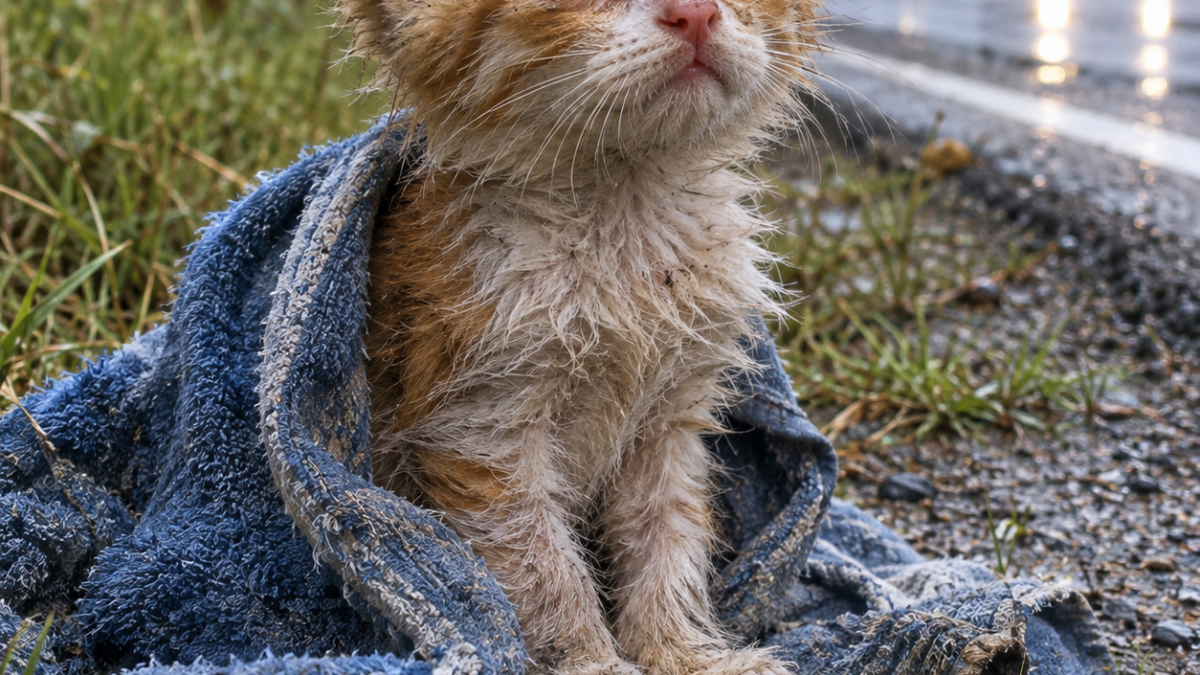
I did not understand hunger yet, not the way humans think of hunger—I only understood that she had touched my head, closed the car door, driven away, and left my old blue towel in the grass, so I stayed there because what if she came back and I was gone?
Then a stranger stopped, wrapped me in that same towel, and carried me all the way back to the apartment where I had spent eleven years waiting beside the same woman every night—only to sit down outside the locked door and tell me something I was not ready to understand.
My name used to be Pumpkin.
I did not know that name was about to become part of a life I could no longer reach.
I only knew the woman who had loved me since I was small had set me down near the ditch with my towel.
The towel smelled like our apartment.
Laundry soap.
The couch where I slept against her leg.
The corner by the television where warm light fell across the carpet every afternoon.
Her hand lotion.
A little bit of coffee because she spilled everything.
And underneath all of that—
her.
My person.
My home.
She touched my head once.
Not long.
Just once.
Then the car door shut.
The engine started.
The car became smaller.
Smaller.
Smaller.
Gone.
I stayed exactly where she left me.
At first, I thought she was coming back with food.
Maybe she had forgotten my carrier.
Maybe she was upset and needed a minute.
Humans did that sometimes.
They left rooms.
They slammed doors.
They cried into their hands.
They said words cats did not understand but hearts could still feel.
But they came back.
My mom always came back.
So I waited.
The first night was cold.
The grass under my paws turned wet.
Headlights swept over me again and again, bright and sharp, like pieces of lightning thrown across the road.
Big trucks shook the ground.
PART2:
Their wind rolled over me and pushed my fur backward.
Every time a car slowed, I stood so fast my legs trembled.
Once, a dark car looked like hers.
I ran toward the shoulder.
I cried until my throat hurt.
It did not stop.
By the second day, my belly felt like it was chewing itself.
My tongue stuck to my mouth.
A plastic bag blew across the road and frightened me so badly that I flattened myself beneath a bush.
Still, I did not leave.
Because what if Mom came back and I was not there?
Near sunset, another car pulled over.
This one was dusty, with a dent near the back bumper.
A woman stepped out.
She was not Mom.
So I stayed beneath the bush.
The woman did not walk directly toward me.
That mattered.
Humans who want cats often make the mistake of becoming enormous.
They lean over you.
Reach.
Grab.
Say things like, “Come here, sweetheart,” while doing exactly what a frightened animal does not want.
This woman sat down.
Right there beside the highway.
Cars roared past.
She folded her legs underneath herself and placed something on the grass.
Food.
I smelled it before I saw it.
My stomach tightened.
I looked toward the road.
Nothing.
Back to the food.
Then toward the place where Mom’s car had disappeared.
The stranger waited.
She did not move the bowl closer.
She did not reach for me.
“Hey, little one.”
My ears turned toward her.
“That towel yours?”
I looked at the blue towel.
“Yeah?”
Her voice was quiet.
“You’ve been here a while, haven’t you?”
I did not know what she wanted.
I knew the food wanted me.
That was different.
I crawled forward.
One paw.
Wait.
Another.
The stranger stayed still.
I reached the bowl and ate too fast.
My teeth clicked against the metal.
I barely chewed.
The woman made a small sound.
Not laughter.
Something sadder.
“Slow down.”
I could not.
Food disappeared.
When the bowl was empty, I searched it three times.
Then the grass around it.
Maybe something had fallen.
Nothing.
The stranger poured water.
I drank.
Then I backed away.
I returned to my towel.
She watched me.
“Are you waiting for somebody?”
Yes.
I looked toward the highway.
The stranger followed my eyes.
“Oh.”
She understood something.
Humans occasionally do.
She stood and walked toward a gas station across the frontage road.
I thought she was leaving.
For one second, panic moved through me.
Not because I wanted her.
Because I had started to understand how quickly people could disappear.
But she came back.
With another woman.
The second woman wore a blue shirt with the gas station logo.
“She’s still here,” the stranger said.
“Same place?”
“Same towel.”
The gas-station woman nodded.
“She was here yesterday morning when I opened.”
My ears moved.
Yesterday.
“Customer said she saw her the night before too.”
The stranger looked at me.
“So two days.”
“Maybe longer.”
“She won’t leave.”
“No.”
“Anybody see who dropped her?”
The gas-station woman hesitated.
“One guy said an older woman in a dark sedan.”
My heart jumped at the sound.
Older woman.
Dark car.
Mom.
“Did he get a plate?”
“No.”
“Could be hers?”
“He said the cat kept following the car until it got onto the highway.”
The stranger looked down at me.
I looked back at the road.
For a long moment, neither woman said anything.
Then the stranger crouched again.
“Okay.”
She unfolded my blue towel.
I became alert.
That belonged to me.
To Mom.
To home.
When she tried moving it, I put one paw on the corner.
She stopped.
“You want that?”
Yes.
She smiled slightly.
“Then it comes too.”
She placed a carrier on the grass.
I hated it immediately.
It smelled like other animals.
Fear.
Plastic.
Strange blankets.
I backed away.
The stranger did not chase me.
She put my towel inside.
That changed things.
I could still smell home.
She placed more food near the entrance.
I stepped closer.
Then farther inside.
The door closed.
I threw myself backward.
The carrier rattled.
“No, no, no. Easy.”
I screamed.
My voice came out broken from two days of crying beside the road.
The stranger lifted the carrier carefully.
“I know.”
She did not know.
She could not.
Mom might come back.
I twisted around inside.
The highway disappeared behind us.
My towel shifted beneath my feet.
I cried louder.
“What if she comes back?”
That was what I was saying.
Over and over.
Humans heard only meowing.
The woman placed the carrier on the passenger seat.
She stayed beside the open door.
“I’m not leaving you here.”
That was the first promise she made me.
I had stopped trusting promises I could not understand.
She drove.
Her name was Mara.
I learned that later.
That evening, Mara carried me into a small veterinary clinic.
Bright lights.
Cold metal.
Dog barking somewhere behind a wall.
I pressed myself into the back corner of the carrier.
A technician opened the door.
I hissed.
The technician stopped.
“Okay.”
Good.
Someone here understood basic language.
Mara explained where she found me.
Highway.
Blue towel.
Two days.
Maybe longer.
No collar.
No identification visible.
A scanner passed over my shoulders.
Beep.
Everyone stopped.
Microchip.
The technician scanned again.
Then smiled.
“She has one.”
Mara exhaled.
“Thank God.”
I did not understand why they were relieved.
The technician typed numbers.
My name appeared on a screen.
PUMPKIN.
I heard it.
My head came up.
“Pumpkin?”
The technician looked at me.
My ears pointed forward.
Mara noticed.
“That’s her.”
Again:
“Pumpkin.”
I stepped toward the front of the carrier.
Home had entered the room through one word.
Then another name.
Elaine Porter.
My mom.
They said it.
I pressed myself against the door.
Yes.
Yes.
That one.
Go there.
Take me there.
The phone number attached to the chip was called.
Disconnected.
Another number.
No answer.
Email.
No response.
The address still existed.
Apartment 3B.
I knew none of those numbers.
But Mara wrote something down.
I felt hope before I understood why.
The veterinarian examined me.
Eleven years old.
Female.
Underweight.
Dehydrated.
Fleas.
Small sore on one back paw.
No catastrophic injuries.
My kidneys needed testing because I was older and dehydrated.
My teeth were not good.
But otherwise, I was still a cat capable of going home.
That was all I cared about.
They gave me fluids beneath my skin.
I hated the needle.
Mara let me bite the sleeve of her jacket.
She did not complain.
They offered food.
I ate.
More slowly this time.
Then Mara said:
“Can we try the address?”
The technician looked at her.
“Tonight?”
“She keeps reacting to the name.”
“Could be old information.”
“I know.”
“What if the owner moved?”
“Then we find out.”
I did not understand every word.
But I heard Mom’s name again.
I began crying.
Mara looked at me.
“All right, Pumpkin.”
She knew my name now.
“Let’s go home.”
Those words.
Home.
My body changed instantly.
I stood in the carrier.
My tail lifted.
Mara saw.
Her face changed too.
“Oh, sweetheart.”
We drove through streets I recognized by smell before I recognized anything else.
Gasoline.
Restaurants.
Wet pavement.
A bakery.
Then the sound of a railway crossing.
I knew that sound.
We were close.
I moved around the carrier.
Left.
Right.
Sniffing through the vents.
Then the car turned.
There.
The big sycamore tree.
The laundromat.
The dumpster behind our building.
Home.
I shouted.
Mara nearly cried.
“I know.”
The car stopped.
She carried me toward the apartment building.
My heart beat so hard my whole body shook.
Three steps.
Front door.
Lobby.
The smell hit me.
Dust.
Old carpet.
Cooking.
Cleaning solution.
Every apartment building has a smell.
Ours lived inside me.
Mara carried me upstairs.
Second floor.
Then third.
I knew exactly where we were.
Apartment 3B.
My door.
I began pushing against the carrier.
Mom.
Mom.
Mom.
Mara put me down.
I scratched at the carrier door.
“Wait.”
She knocked.
No answer.
Again.
“Ms. Porter?”
Nothing.
I cried.
The hallway smelled wrong.
The familiar scent from beneath our door was faint.
Very faint.
There were other smells.
Paint.
Cardboard.
Cleaning chemicals.
Mara knocked harder.
A door across the hall opened.
An older man looked out.
He saw the carrier.
Then me.
His face changed.
“Oh my God.”
I knew him.
Mr. Alvarez.
He used to smell like peppermint and newspaper.
Sometimes he gave me turkey when Mom pretended not to notice.
He stepped into the hallway.
“Pumpkin?”
I pressed against the carrier.
He covered his mouth.
“Where did you find her?”
“Beside Highway 16.”
Mr. Alvarez closed his eyes.
Mara looked toward my door.
“Do you know Elaine Porter?”
He leaned against the wall.
“Yes.”
“Is she here?”
“No.”
The word meant nothing to me.
Not yet.
“Did she move?”
Mr. Alvarez stared at the floor.
“Sort of.”
Mara waited.
He looked at me again.
“How long was Pumpkin out there?”
“Gas-station staff think at least two days.”
He whispered something in Spanish.
Then:
“She shouldn’t have done that.”
My ears turned.
Done what?
Mara crouched beside the carrier.
“Can you tell me what happened?”
Mr. Alvarez did not answer immediately.
Instead, he unlocked his apartment.
“Come inside.”
I objected.
Loudly.
Wrong door.
My home was right there.
Mara understood.
She did not carry me into Mr. Alvarez’s apartment.
Instead, she sat on the hallway floor.
Beside my door.
Carrier between her knees.
Mr. Alvarez sat across from us.
That was when I knew something was wrong.
Humans do not sit on dirty apartment hallways when good news is coming.
Mr. Alvarez looked at Mara.
“Elaine was sick.”
I knew that word.
Sick.
Mom had been sick for months.
She slept more.
Sometimes she sat on the kitchen floor because standing was too difficult.
Bottles covered the counter.
People came to the apartment.
A nurse once.
A woman from the building office.
Her daughter, who lived far away and cried every time she visited.
I stayed beside Mom.
Always.
When she slept, I slept against her ribs.
When she woke at night, I followed her.
When she cried, I pressed my forehead beneath her chin.
Cats do not cure human illness.
But we know how to keep someone from being alone inside it.
Mr. Alvarez continued.
“Cancer.”
Mara’s face softened.
“She had been getting worse?”
“For months.”
Yes.
I remembered.
Mom’s hand sometimes shook while opening my food.
Some mornings she sat beside the bowl afterward because she needed to rest.
She smelled different.
Medicine.
Sweat.
Fear.
Still—
she stayed.
Until the car.
Mara asked:
“What happened to her?”
Mr. Alvarez glanced at me.
As though I understood too much.
Maybe I did.
“She was admitted to hospice five days ago.”
Hospice.
Another human word.
I did not know it.
Mara did.
Her shoulders dropped.
“Five days?”
“Yes.”
“Then who abandoned the cat?”
Mr. Alvarez shook his head.
“Elaine.”
I stopped crying.
Something in his voice changed the room.
“She drove?”
“She should not have.”
He rubbed his face.
“Her daughter wanted to take Pumpkin, but her apartment doesn’t allow pets. They were trying rescues. Shelters were full. Elaine became convinced Pumpkin would be euthanized if she surrendered her.”
Mara looked horrified.
“So she dumped an eleven-year-old cat beside a highway?”
“I’m not defending it.”
He sounded angry now.
“She loved that cat more than almost anything. But toward the end… she wasn’t thinking clearly.”
Mara looked at me.
Mr. Alvarez continued.
“The day before hospice transport, Elaine disappeared for almost two hours. Her daughter thought she was sleeping. Elaine took Pumpkin.”
The blue towel.
The car.
Mom’s hand on my head.
The highway.
“She came back alone.”
Mara whispered:
“Did she say where?”
“No. She cried all night.”
My ears moved at the word.
Cried.
I remembered the last touch.
Her hand had smelled wet.
Salt.
Tears.
I thought she was angry.
Maybe she had been saying goodbye.
Mr. Alvarez’s voice became quieter.
“She told me she put Pumpkin somewhere near houses and businesses because somebody would find her.”
Mara stared.
“She thought leaving a senior cat beside a highway was safer than surrendering her?”
“No.”
He looked toward my apartment door.
“I think she knew it was terrible.”
Then:
“I think she was terrified.”
I did not understand terror.
Not hers.
I only understood mine.
Mara asked:
“Where is Elaine now?”
“St. Catherine’s Hospice.”
“Is she conscious?”
“Sometimes.”
“Does she know Pumpkin survived?”
Mr. Alvarez shook his head.
“No.”
Silence.
I reached one paw through the carrier door.
Toward my apartment.
Mara noticed.
She opened the carrier.
Slowly.
I stepped out.
The hallway felt enormous.
I walked directly to 3B.
Sniffed beneath the door.
Nothing.
I scratched.
Once.
Twice.
Again.
Mom.
I called.
The apartment did not answer.
Mara sat behind me.
I kept scratching.
Eventually the sound became weaker.
Then I sat.
Facing the door.
Mara did not pull me away.
Five minutes passed.
Maybe ten.
Then she said:
“Pumpkin.”
I did not look.
“Your mom isn’t in there.”
I scratched again.
“Pumpkin.”
No.
I knew this door.
I knew this home.
I knew where Mom slept.
Where my bowl sat.
Where the couch was.
Where the afternoon sun landed.
Home cannot disappear because a stranger says it has.
Mara’s hand touched the floor near me.
Not my body.
Just nearby.
“She didn’t forget the way back.”
I turned toward her.
Her eyes were wet.
“She can’t come back.”
I did not understand.
So I returned to the door.
Humans think animals do not understand loss because we do not understand their sentences.
That is not true.
We understand absence.
We understand routines that stop.
We understand a smell growing weaker.
We understand waiting.
What we cannot understand is why.
That night, Mara brought me home with her.
I hated her house.
Not because it was bad.
Because it was not mine.
She placed my blue towel on a chair.
Food beside it.
Water.
Litter box.
A small bed.
I ignored everything except the towel.
I curled on top of it.
Pressed my nose into the fabric.
Home.
The smell was already fading.
Mara slept on the couch.
I knew because I heard her turn over throughout the night.
At 3:17 in the morning, I walked to the front door.
I cried.
Mara opened her eyes.
“What is it?”
I looked at the door.
She understood.
“No, sweetheart.”
I cried louder.
Mom could be outside.
She might have found us.
Mara came over and sat down.
She did not pick me up.
For almost an hour, we sat facing the door together.
The next morning, Mara made phone calls.
A lot of them.
I hated phones.
Mom’s phone used to ring whenever she was trying to sleep.
But this time, one call made Mara sit very still.
“Yes, my name is Mara Bennett.”
Pause.
“I found Elaine Porter’s cat.”
Another pause.
“Yes. Pumpkin.”
Longer silence.
Then Mara covered her mouth.
I looked up.
“Is she awake?”
Pause.
“Would it be possible?”
More silence.
“I understand.”
Mara looked at me.
“We’re going somewhere.”
She put my towel into the carrier.
I entered without fighting.
We drove.
Not home.
A large brick building.
Quiet parking lot.
Trees.
People walking slowly.
Inside, everything smelled like disinfectant and flowers.
A woman in scrubs met us.
“You’re Pumpkin?”
I recognized my name.
She smiled sadly.
“I’ve heard about you.”
Mara spoke with her.
Then another woman arrived.
Younger than Mom.
Same eyes.
I had seen her before.
Rachel.
Mom’s daughter.
Rachel stared at me.
Then started crying so hard she had to lean against the wall.
“Oh, Pumpkin.”
I backed away.
Too much emotion.
Too fast.
She crouched.
“I’m sorry.”
Her voice broke.
“I’m so sorry.”
Mara explained where I had been found.
Rachel covered her mouth.
“She told me somebody would find her.”
Mara’s voice remained gentle.
“Someone did.”
“I should’ve stopped her.”
“You didn’t know.”
“I knew she was desperate.”
Rachel looked at me.
“She kept saying she couldn’t die knowing Pumpkin might be put down.”
Die.
I knew that word only from tone.
The way humans use it when a room becomes still.
Rachel wiped her face.
“She was trying to find a rescue for weeks.”
She pulled out her phone.
Emails.
Messages.
Waitlists.
Senior cat rescues.
No space.
Temporary fosters full.
One shelter had warned that surrender did not guarantee outcome because of Pumpkin’s age and medical status.
Rachel said:
“Mom heard one sentence and stopped hearing everything else.”
Mara nodded.
“She was scared.”
“She loved her.”
Rachel looked at me.
“That’s the terrible part.”
She whispered:
“She really loved her.”
Humans want love to make them good at everything.
It does not.
People can love and still fail.
They can love while frightened.
Love while sick.
Love while making a terrible decision.
A terrible decision remains terrible.
But sometimes the person making it is not a monster.
Sometimes they are simply falling apart.
Rachel stood.
“Mom’s awake.”
She looked at Mara.
“Do you think bringing Pumpkin in will upset her?”
Mara looked at me.
Then at Rachel.
“I think not seeing her again would be worse.”
A nurse guided us down a hallway.
Mara carried the carrier.
I smelled Mom before I saw her.
Faint.
Changed.
But there.
Medicine covered it.
Soap.
Hospital sheets.
Something metallic.
Yet underneath—
Mom.
I began screaming.
Not meowing.
Screaming.
Mara stopped walking.
Rachel cried.
The nurse opened a door.
Mom lay in a bed.
Smaller than before.
Her hair thin.
Her skin pale.
Eyes closed.
I clawed at the carrier door.
“Open it.”
Rachel could barely speak.
Mara opened it.
I ran.
Onto the bed.
A nurse tried to stop me.
Rachel said:
“Please.”
I climbed onto Mom’s chest.
She did not move.
I pushed my face against her neck.
Mom.
Mom.
Mom.
My whole body vibrated.
I purred so hard my throat hurt.
Then her fingers moved.
Barely.
Touched my back.
I froze.
Her eyes opened.
Slowly.
Confused at first.
Then she saw me.
“Pumpkin?”
That voice.
Thin.
Weak.
Still hers.
I pressed my forehead under her chin.
Mom began crying.
“Oh, baby.”
Her hand moved over my head.
Again.
Again.
The same hand that touched me once beside the highway.
Now it would not stop.
“I’m sorry.”
I purred.
“I’m so sorry.”
I did not understand apology.
I understood her.
That was enough.
She kept saying my name.
Pumpkin.
Pumpkin.
Pumpkin.
As though repeating it could rebuild something.
I curled against her.
Rachel sat beside the bed crying silently.
Mara stood near the door.
The nurse looked away.
Mom whispered:
“I thought someone would take you.”
My ears moved.
“I thought…”
She stopped to breathe.
“I thought if I left you near apartments, somebody would see you.”
The highway had not been part of her plan.
Rachel later explained Mom had become confused driving back.
She probably believed she had stopped near a residential street.
The place where she left me was beside an apartment complex, yes—
but separated from it by a busy highway ramp.
Mom’s illness had taken more from her than any of them realized.
“I couldn’t take you where they said.”
Mom’s fingers stopped on my head.
“They said they couldn’t promise.”
She cried again.
“I couldn’t let them kill you.”
Rachel leaned closer.
“Mom, they weren’t saying they would.”
“I couldn’t.”
Her voice became panicked.
“I couldn’t.”
The nurse touched Rachel’s shoulder.
Mara remained quiet.
Mom looked at me.
“I thought somebody would see how sweet you are.”
I placed one paw on her chest.
Humans break themselves trying to explain things to animals.
I did not need explanation anymore.
I had found her.
That was all.
I stayed for almost two hours.
Sometimes Mom slept.
Sometimes her hand rested on my back.
Once, she woke suddenly and looked frightened until she felt me.
“Pumpkin?”
I lifted my head.
She smiled.
There.
The smile I knew from the couch.
The one she made when I climbed onto her book.
The one she made when I stole warm laundry.
For a moment, we were home again.
Then the nurse said Mom needed rest.
Rachel asked whether I could stay.
Hospice had rules.
But hospice also had humans.
Someone made an exception for another hour.
Then another.
Eventually Mara whispered:
“We have to go.”
No.
I dug my claws into the blanket.
Mom’s eyes opened.
She looked at Mara.
“You found her?”
“Yes.”
“Highway?”
“Yes.”
Mom closed her eyes.
A tear moved toward her ear.
“I’m sorry.”
Mara said:
“She waited.”
Mom looked at me.
“How long?”
Mara hesitated.
“About two days.”
Mom made a sound I had never heard from her.
A broken sound.
She put both hands around me.
“Oh, Pumpkin.”
I wanted her to stop being sad.
So I did the only thing I knew.
I licked the salt from her cheek.
Mom laughed.
Weakly.
Then she looked at Mara.
“Will you take her?”
The room went still.
Mara glanced at Rachel.
Rachel nodded through tears.
“I can’t keep her where I live.”
Mom’s fingers tightened slightly in my fur.
“Please.”
Mara crouched beside the bed.
“For as long as she needs.”
Mom shook her head.
“No.”
She looked directly at Mara.
“Forever.”
Mara did not answer immediately.
She had known me three days.
I had screamed at her.
Bit her jacket.
Kept her awake.
Ignored every bed she offered.
Waited at her front door for another woman.
Taking me forever was not a small promise.
Mom understood.
“If you can’t, I understand.”
Mara looked at me.
I looked at Mom.
Then she said:
“I can.”
Mom exhaled.
Something in her face softened.
“Thank you.”
She turned toward me.
I pushed beneath her chin again.
Mom whispered:
“You’re going home, Pumpkin.”
No.
Home was here.
Home was the apartment.
Home was her.
But I would learn later that home can change without asking permission.
Before we left, Rachel took the blue towel from the carrier.
She placed it on Mom’s bed.
Mom touched it.
Then folded half around me.
Half stayed beside her.
I did not want to leave.
Mara waited.
Eventually Mom’s hand stopped moving.
Not forever.
Just sleep.
The nurse gently helped me into the carrier.
This time I did not scream.
I watched Mom through the little holes until the door disappeared.
Mara drove home.
I sat on my towel.
Half of it, anyway.
The other half smelled like me and stayed with Mom.
That night, I did not wait at Mara’s door.
I slept beside it.
There is a difference.
Waiting means you believe someone might arrive.
Sleeping means some part of you knows they probably will not.
Two days later, we returned to hospice.
Mom was weaker.
She still knew me.
I climbed beside her.
She whispered my name.
The next day, we returned again.
She barely spoke.
But when my paw touched her wrist, her fingers curled around it.
The fourth visit never happened.
Mara received the call before sunrise.
She sat on the edge of her bed.
I was sleeping near her feet.
Her phone rang.
She answered.
Listened.
Then put the phone down.
She cried.
I woke.
Walked toward her.
Mara lifted me.
I usually disliked being held.
That morning I let her.
“Pumpkin.”
Her face pressed into my fur.
“Your mom died last night.”
There it was.
The sentence I had not been ready to hear in the apartment hallway.
The truth Mara had tried to tell me before I could understand absence.
Mom was not coming back.
Not to the highway.
Not to apartment 3B.
Not to Mara’s front door.
I did not understand death the way Mara did.
But I understood the next weeks.
No Mom smell growing stronger.
No familiar footsteps.
No voice.
No hand.
Her scent faded from the towel.
Slowly.
Cruelly.
Every day I pressed my nose deeper into the fabric and found less of her.
That was how I learned.
Not from words.
From smell disappearing.
Mara never washed the towel.
She wanted to.
It was dirty.
Stained from the highway.
Covered in my fur.
But she understood.
So it stayed.
For months.
I slept on it.
Sometimes Mara found me with my face pressed into the corner Mom had held at hospice.
She never moved me.
Grief looks different in cats.
Some stop eating.
Some search.
Some cry.
Some sleep more.
Some appear normal until a sound changes everything.
For me, doors became important.
Whenever a car pulled into Mara’s driveway, I ran to the front window.
Whenever a woman spoke outside, I listened.
Whenever Mara returned from work, I watched the space behind her.
For a while, part of me expected Mom to appear.
Mara never told me not to.
She simply came home.
Every day.
That mattered.
Morning.
Mara.
Evening.
Mara.
Food.
Mara.
Clean litter.
Mara.
Veterinary visits.
Mara.
Warm blanket.
Mara.
At first, I thought she was temporary.
Humans always are until enough days prove otherwise.
I still slept on Mom’s towel.
But I started sitting near Mara on the couch.
Not touching.
Just near.
Then one evening, she fell asleep watching television.
Warm light covered the carpet.
Exactly the way it had in apartment 3B.
I stared at the patch.
Then at Mara’s leg.
The old memory hurt.
I almost returned to my towel.
Instead, I jumped onto the couch.
Mara woke slightly.
Did not move.
I walked across her.
Turned twice.
Lay against her leg.
Her hand hovered above me.
Waiting.
I pushed my head into it.
She started crying.
Humans cry about everything.
“I’ve got you.”
Yes.
She did.
Mara changed my name once.
Not completely.
Pumpkin stayed on my veterinary records because it belonged to Mom.
But Mara started calling me Pippa.
At first accidentally.
“Pumpkin—Pip—Pippa.”
Something lighter.
A name that belonged to the house I was learning.
Rachel liked it.
She said Mom would have too.
Eventually, I answered to both.
Pumpkin was who Mom loved.
Pippa was who survived.
I did not need to choose between them.
Months passed.
My weight returned.
The fleas disappeared.
My coat became soft again.
The sore on my paw healed.
Blood tests showed early kidney disease, common for a cat my age, but manageable.
Mara bought special food.
I hated it.
She bought another kind.
I hated that too.
The third was acceptable if she warmed it.
I trained her quickly.
Rachel visited.
The first time, I hid.
Then I smelled Mom on her scarf.
I came out.
Rachel sat on the floor.
“You remember me?”
Yes.
I climbed into her lap.
She cried.
Of course.
She brought something.
A small cardboard box from apartment 3B.
Mom’s belongings had been sorted after she died.
Rachel kept a few things for me.
My old ceramic bowl.
A fabric mouse with one ear missing.
Mom’s green blanket.
And one photograph.
Mom sitting on the couch.
Me on her chest.
I did not understand pictures.
But I understood the blanket.
I buried myself in it.
For the rest of that winter, the green blanket and blue towel stayed together on my bed.
Past and present touching.
Not fighting.
One afternoon, Rachel told Mara the full story.
I was sleeping nearby.
Elaine had adopted me when I was four months old.
A shelter kitten.
Orange coat.
Round belly.
Too loud.
She chose me because I reached through the cage and caught the sleeve of her sweater.
The shelter worker warned her I had “personality.”
Mom replied:
“So do I.”
We had lived together eleven years.
Through two apartments.
One breakup.
A job loss.
Mom’s mother dying.
Rachel moving away.
Cancer.
Eleven years.
Humans talk about animals being adopted as if the human is the one giving a home.
Sometimes it goes both directions.
When Mom became sick, I slept beside her.
Rachel said there were nights Mom called her crying because she was terrified of dying.
Then she would say:
“But Pumpkin is here.”
I had not known I was doing anything important.
I was sleeping.
Purring.
Existing.
Sometimes that is enough.
Mom’s final mistake remained what it was.
Leaving me beside that road could have killed me.
A truck could have hit me.
A dog could have found me.
I could have wandered away.
Heat.
Cold.
Dehydration.
Anything.
Love did not make that choice safe.
Illness did not make it right.
But understanding the truth changed how Mara carried the story.
She never told people:
“My cat was dumped because her owner didn’t care.”
That would have been easier.
Cleaner.
More shareable.
Instead, she said:
“Pippa was abandoned by a dying woman who loved her and made a terrible decision because fear and illness convinced her it was the only way to save her.”
Complicated.
Life usually is.
A year after the highway, Mara drove me past the place.
She did not plan to stop.
I recognized it anyway.
Maybe smell.
Maybe the shape of the road.
Maybe memory lives somewhere deeper than either.
I stood in my carrier.
Cried.
Mara pulled over.
Not exactly where Mom had left me.
A safer parking lot nearby.
She opened the carrier door but did not let me outside.
“I know.”
The highway roared.
Same trucks.
Same wind.
For one moment, I was back under the bush.
Hungry.
Waiting.
Then Mara’s hand appeared.
I touched it with my nose.
She was here.
The road was no longer where my story ended.
It was where two lives had crossed.
Mine.
Mara’s.
She told me later that she had almost not stopped that evening.
She was tired.
Late for dinner with her sister.
Had groceries in the back.
She saw a flash of orange beside the road and kept driving for nearly half a mile.
Then something bothered her.
A towel.
She had seen a cat sitting on a towel.
Not hiding.
Not roaming.
Waiting.
Mara turned around.
If she had not—
I do not know.
That is the part humans call luck.
Animals call it nothing.
We simply live inside whatever happens next.
Mara eventually began volunteering with a rescue group.
Senior cats especially.
She said I had ruined her finances.
She meant that affectionately, I think.
Sometimes temporary fosters came to the house.
Old cats.
Scared cats.
Cats whose owners died.
Cats surrendered after ten or fifteen years because someone moved or became sick.
I disliked all of them on principle.
Mara called me “management.”
I hissed from the hallway.
Then, usually, I softened.
One old gray cat named Walter arrived after his owner went into assisted living.
He cried at the front door every night.
I understood.
For three nights, I watched him.
On the fourth, I slept near him.
Not touching.
Just close enough.
Walter stopped crying sooner after that.
Mara found us in the morning.
She cried.
Obviously.
“You know, don’t you?”
Yes.
I knew doors.
I knew waiting.
I knew that sometimes the person you love does not come through.
I also knew another thing now.
Someone else might.
On March 18, two years after Mara found me, Rachel came over with a small wooden box.
Inside were Mom’s ashes.
Humans have strange customs.
She planned to scatter some beneath a flowering tree at a park Mom loved.
She asked if Mara wanted to come.
Mara looked at me.
Cats were not allowed inside that part of the park.
So I stayed home.
Before leaving, Rachel placed the blue towel beside me.
It no longer smelled like Mom.
Not really.
Time had taken that.
But I still knew.
She whispered:
“She loved you, Pumpkin.”
I blinked.
Slowly.
Rachel smiled.
“That’s what Mom used to say you did when you told her you loved her.”
Humans always need translations.
Maybe she was right.
That evening, Rachel returned with a small branch of white flowers.
She placed it beside Mom’s photograph.
I sniffed it.
Then knocked it onto the floor.
Mom would have laughed.
Mara did.
Years continued.
My orange fur developed white strands around the face.
I slept more.
Jumped less.
Mara bought steps for the couch.
I refused them for three weeks because they were insulting.
Then used them when nobody was looking.
My kidney disease progressed slowly.
Medication appeared.
More veterinary appointments.
Special food.
Mara became the person whose hands I allowed to give me pills.
That may be the highest form of trust a cat can offer.
At night, I slept against her leg.
Exactly where I had slept with Mom.
For a long time, that felt disloyal.
Then I realized something animals probably understand better than humans.
Love is not a chair.
Someone new sitting there does not erase the person who sat there before.
My love for Mom did not become smaller because Mara became home.
The two existed together.
One life had ended.
Another had opened.
I carried both.
There was one thing Mara never did.
She never threw away the blue towel.
Even when it became thin.
Even when one corner tore.
She folded it beneath my bed.
On bad days, I searched for it.
On good days too.
Eventually, it smelled almost entirely like Mara’s house.
Like me.
Sunlight.
Laundry detergent.
The couch.
Warm blankets.
A little bit of coffee because apparently every woman I loved spilled coffee.
Home had changed its smell.
That was how I knew I had stopped waiting.
Not because I forgot Mom.
I never did.
But one evening, Mara came home late.
Her key turned in the lock.
I heard it from the couch.
Years earlier, every car door had made me look for Mom.
Every woman’s voice had lifted my head.
Every opening door carried a question.
This time, there was no question.
The key turned.
I knew who was coming.
Mara stepped inside.
“Pippa?”
I got up.
Walked to her.
Slowly now.
Old legs.
She crouched.
I pressed my forehead into her hand.
“You missed me?”
Obviously not.
I had simply been standing directly beside the door waiting for unrelated reasons.
She picked me up.
I allowed it.
For ten whole seconds.
Then demanded release.
Some dignity must remain.
Mara laughed.
That sound filled the hallway.
And I realized the most important thing a cat abandoned beside a highway could learn.
Coming back is not something every human does.
But some do.
Again.
And again.
And again.
Until your body stops preparing for goodbye.
Until the front door becomes only a door.
Until a car leaving the driveway no longer feels like the end of the world.
Until food bowls are ordinary.
Warm couches are ordinary.
Hands are ordinary.
Love is ordinary.
Mom loved me.
That remained true.
Mom abandoned me beside a highway.
That was also true.
She was dying.
Afraid.
Confused.
She made a terrible decision while trying, in her damaged human way, to save the animal she could not bear to leave behind.
That truth did not make the highway less cold.
It did not make two days without food disappear.
It did not erase the trucks or the wet grass or the way I ran toward cars that looked like hers.
But it gave those memories somewhere to rest.
Mom had not forgotten the way back.
She had known there would be no way back for her.
She just did not know how to leave me safely.
A stranger did.
Mara found me sitting on an old blue towel beside Highway 16 because I believed the woman I loved would return.
She fed me.
Waited.
Carried me to a clinic.
Found my name.
Found my apartment.
Sat outside the locked door while I scratched and cried.
Then told me:
“Your mom isn’t coming back.”
I was not ready to hear it.
Maybe no animal ever is.
Maybe no human is either.
But Mara stayed beside me until the words became something I could survive.
Then she carried me into the next part of my life.
Not away from Mom.
Forward with her.
My name used to be Pumpkin.
It still is, somewhere.
On an old microchip record.
In Rachel’s memories.
In the stories Mom told about the kitten who caught her sweater through shelter bars.
In a photograph of an orange cat sleeping across a sick woman’s chest.
Mara calls me Pippa now.
Most days, I answer.
And whenever I curl against her leg beneath the evening light, there is an old blue towel folded underneath my bed.
I no longer sit on it because I think Mom might come back.
I sit on it because she loved me.
I leave it because Mara loves me too.
And after spending two days beside a highway afraid that leaving the spot where I was abandoned would mean missing the person who mattered most, I eventually learned something I could never have understood then.
Sometimes staying is not loyalty.
Sometimes love is the person who comes back for you.
And sometimes—
when the person you were waiting for never can—
love is the stranger who stops.




