She Worked as a Quiet Nurse for Five Years—Then a Retired Military K9 Ignored His Handler and Gave Her a Classified Signal
# She Worked as a Quiet Nurse for Five Years—Then a Retired Military K9 Ignored His Handler and Gave Her a Classified Signal
For five years, everyone at Providence General thought I was just the quiet nurse who never panicked, never talked about her past, and somehow always knew where the nearest exit was.
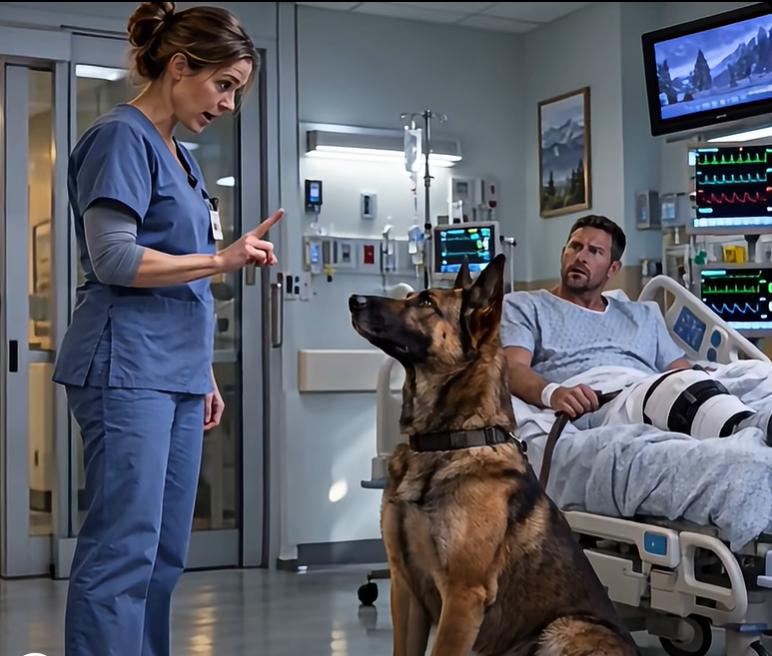
Then a scarred retired military K9 walked into my ward, ignored the Ranger holding his leash, stopped three feet in front of me, and performed a recognition signal I had not seen since a classified operation ended with six men dead and my own name erased.
By sunrise, federal agents were surrounding the hospital, the man who had buried my old life was standing outside room 412, and every lie I had built around Madeline Hayes was burning behind me in the Portland rain.
For five years, I wore pale blue scrubs like camouflage.
Not because the color hid anything.
It did not.
Pale blue is a terrible color for hiding. It makes a person look soft, clean, ordinary, harmless. It belongs beneath hospital lights and beside IV poles. Eventually, it smells like antiseptic, latex gloves, cafeteria coffee, and the strange metallic exhaustion of people who spend twelve hours trying to keep strangers alive.
That was exactly why I chose it.
Nobody looks for ghosts in pale blue scrubs.
They look for ghosts in classified files, burned compounds, grainy surveillance photographs, dead drops, false passports, intercepted phone calls, and mission reports that have been rewritten too many times.
They look for them in countries where official records insist no American team ever stood.
They look for them in shallow graves.
Black water beneath bridges.
Abandoned safe houses.
They do not look for ghosts at Providence General Hospital in Portland, Oregon, walking quietly through a surgical ward at three in the morning with a medication tray in one hand and vending-machine tea cooling at the nurses’ station.
My name was Madeline Hayes.
That was not the name I was born with.
It was not even the second name I had carried.
But Madeline Hayes was the name printed on my hospital badge, nursing license, apartment lease, bank statements, and the tiny mailbox where I received bills nobody important had bothered tracing.
Madeline was quiet.
Madeline was polite.
Madeline did not discuss her family because she supposedly had none nearby.
She did not discuss childhood because she said hers had been boring.
She did not date coworkers.
She did not post photographs.
She did not attend political rallies.
She did not use social media except for a nearly empty account hospital HR insisted was not necessary but everyone seemed to have anyway.
Madeline drove a ten-year-old gray Volvo with a dent in the rear bumper.
She never parked in the same hospital space twice.
She paid cash for cafeteria coffee whenever possible.
She volunteered for graveyard shifts.
She rented a one-bedroom apartment in a building full of graduate students, divorced fathers, and traveling nurses where nobody noticed who came home at four in the morning.
She never made mistakes.
That was what frightened people, although most of them did not know how to say it.
Dr. Harrison Wright once told a resident I had ice water in my veins.
He said it after a six-car pileup flooded the trauma department with blood, screaming, and one twenty-two-year-old man whose femoral artery had opened like a broken fire hose.
A junior nurse dropped a tray.
A surgical intern went pale.
Someone shouted for vascular.
Someone else shouted for pressure.
PART2:
I stepped in, packed the bleed, locked eyes with the patient, and told him to breathe with me.
Not because I was fearless.
Fear is useful.
Panic is not.
Afterward, Harrison looked at me across the trauma bay and said, “Maddie, you act like you’ve done this in a war zone.”
Everybody laughed.
I did not.
I kept my eyes on the bloody gauze I was dropping into a biohazard bin.
“I just like to stay focused,” I said.
That became the explanation everyone accepted.
Focused.
Calm.
Private.
Maybe slightly odd.
Nobody wanted the truth badly enough to earn it.
The truth was that I scanned every room before entering.
Door.
Window.
Blind corner.
Reflective surface.
Objects heavy enough to become weapons.
Objects broad enough to become shields.
Nearest exit.
Secondary exit.
I knew which supply closets at Providence had steel-core doors.
I knew which stairwell cameras had blind spots.
I knew how long the backup generator took to engage because I counted during every quarterly drill.
When a helicopter came low over the helipad, one muscle between my shoulders still tightened before I could stop it.
When somebody dropped a metal tray, my right hand sometimes moved toward a weapon I had not carried in five years.
When a patient woke screaming in post-op, I occasionally heard another language beneath the sound.
I built a life from ordinary things because ordinary things were predictable.
Charts.
Shift schedules.
Medication rounds.
Post-op vitals.
Coffee at 2:10 a.m.
The quiet hum of machines that told me exactly what was failing and how quickly.
I believed, foolishly, that if I made myself useful enough and forgettable enough, eventually the past would stop looking.
Then the VA caught fire.
It happened on a wet Thursday in late autumn.
Not a cinematic inferno.
No burning roof collapsing into the street.
An electrical fire in an older wing of the Veterans Affairs Medical Center across town.
Contained quickly.
Still serious enough to force immediate evacuation of several surgical recovery and critical-care patients.
Providence General was the nearest Level One trauma center.
By four that afternoon, our corridors changed.
VA transport teams arrived.
Veterans.
Respiratory equipment.
Rolling beds.
Duffel bags.
Wheelchairs.
Service animals.
Military liaison officers.
Clipped voices.
Old men with new prosthetics.
Young men with old eyes.
The hospital acquired that particular atmosphere that develops whenever too many people carrying old wounds are forced into unfamiliar rooms.
Some wounds were visible.
Missing limbs.
Burn scars.
Surgical hardware.
Eye patches.
Tremors.
Others moved quietly beneath the skin.
I saw them in clenched jaws.
Hands locked together.
Men who tracked doorways.
Veterans who laughed too loudly.
Veterans who did not speak at all.
Wives answering questions before their husbands were forced to.
Service dogs lying alert beneath beds.
Patients looking at hospital windows like they were measuring blast radius.
The floor became crowded.
The staff became tense.
I became calmer.
That was another thing people misunderstood about me.
Chaos did not unsettle me the way silence did.
Chaos had rules.
Noise had direction.
People revealed themselves when fear entered a room.
At 6:45 p.m., fifteen minutes before my shift officially began, Charge Nurse Evelyn Foster dropped a transfer chart onto the counter with a sigh heavy enough to bend paper.
“You’ve got room 412.”
I tied my hair back tighter.
“What’s in 412?”
“Army Ranger. Sergeant First Class Jason Carmichael. Post-op femur reconstruction, complicated pain management, severe PTSD markers, and one very large dog with teeth.”
“Service animal?”
“Retired military working dog.”
Evelyn picked up another chart.
“Special exception from administration because apparently nobody here wants to argue with the VA, the Army, or the dog.”
I opened the file.
Jason Carmichael.
Thirty-six.
Decorated Army Ranger.
Multiple deployments.
Purple Heart.
Bronze Star with Valor.
Old blast injury.
Recent reconstructive surgery on his left femur.
Pain-control complications after the VA evacuation.
I read the medications.
Allergies.
Surgical notes.
Mental-health alerts.
Then:
AUTHORIZED RETIRED MWD ACCOMPANIMENT — ROOK, BELGIAN MALINOIS, AGE 10.
My fingers stopped on the page.
Rook.
For a second, I heard nothing in the nurses’ station.
Not Evelyn talking.
Not phones.
Not the printer.
Not rain striking the windows.
Rook.
It was not an unusual military K9 name.
Could have been coincidence.
I had known three dogs named Rex and two named Duke.
Still, my body reacted before logic arrived.
Pulse faster.
Mouth dry.
Left hand tightening around the chart.
Evelyn noticed.
“You okay?”
“Fine.”
“You look pale.”
“Didn’t eat enough.”
“Again?”
“Again.”
I closed the chart.
“How long has Carmichael been here?”
“About twenty minutes.”
“Dog already inside?”
“Yep.”
I forced myself to ask casually.
“What kind?”
“Malinois.”
Of course.
“Scarred up?”
Evelyn looked at me.
“Why?”
“No reason.”
She thought.
“One scar across the muzzle, I think.”
Something cold moved through me.
I placed the chart down.
“Where was he transferred from?”
“The VA.”
“I mean Carmichael.”
“Oh.”
She checked.
“Originally assigned out of Joint Base Lewis-McChord. Why?”
“No reason.”
Too many no reasons.
Evelyn stared at me another second.
Then got distracted by an alarm.
I stood alone.
Rook.
Ten years old.
Scar across muzzle.
Washington.
Impossible.
The Rook I had known should have been twelve.
Maybe thirteen.
Military records were often approximate in conversation.
Maybe the name meant nothing.
Maybe the scar meant nothing.
Maybe I had built such a fragile life that one dog’s name could still crack it.
I took a breath.
Picked up Jason Carmichael’s medications.
Walked toward room 412.
I reached the door.
Stopped before entering.
Listened.
Male voice.
Low.
Calm.
“Stay.”
No barking.
I knocked.
“Come in.”
The room was dim.
Jason Carmichael sat partially upright in bed with his left leg elevated and immobilized.
Dark hair.
Short beard.
Military tattoos along one forearm.
Face thinner than the photograph in his chart.
Pain had gray-edged his skin.
Beside the window sat a Belgian Malinois.
Large.
Older.
Dark face gone silver around the muzzle.
One ear slightly torn.
And a pale scar beginning beside the right nostril and disappearing beneath the eye.
The room narrowed.
Five years vanished.
Dust.
Hot metal.
Diesel smoke.
A dog bleeding from his face.
A man screaming my call sign.
Red emergency lights inside a concrete room that officially never existed.
I almost dropped the medication cup.
Rook stood.
Jason looked at him.
“Easy.”
The dog ignored him.
Rook’s eyes were on me.
Not normal interest.
Not a dog watching a stranger.
Recognition.
Absolute.
Terrible.
His ears lifted.
Body became still.
I had seen that posture before.
My entire chest tightened.
“No.”
The word escaped me quietly.
Jason frowned.
“What?”
I stepped backward.
Rook moved.
Jason grabbed the leash attached loosely to the dog’s collar.
“Rook.”
The dog continued forward.
Not pulling violently.
Just walking.
Jason tightened his grip.
“Rook, stay.”
Rook ignored him.
That alone changed Jason’s expression.
He had not expected disobedience.
Rook came within three feet of me.
Stopped.
Sat squarely.
Front legs aligned.
Head high.
Eyes locked on mine.
Then he did something no ordinary visitor would have understood.
He lifted his right paw.
Touched it once against the center strap of his old working harness.
Held it there for two seconds.
Lowered it.
Turned his head toward the nearest exit.
Looked back at me.
Then touched his nose to the inside of my left wrist.
I stopped breathing.
Jason went white.
The medication cup fell from my hand.
Pills scattered across the floor.
Rook did not move.
Jason whispered:
“No.”
I looked at him.
His eyes went from the dog to me.
Back to the dog.
“No way.”
I should have denied it.
Laughed.
Asked what the dog was doing.
Called security.
Left.
Anything.
Instead I said the phrase I had not spoken in five years.
“Clear left.”
Rook turned instantly.
Positioned himself at my left side.
Facing the doorway.
Jason closed his eyes.
“Jesus Christ.”
I wanted the floor to open.
Evelyn appeared behind me.
“What happened?”
Jason answered before I could.
“Nothing.”
She looked at the medication scattered on the floor.
“Doesn’t look like nothing.”
“Dog startled her.”
“I’m fine.”
Evelyn glanced at Rook.
The dog stood beside my leg with the quiet certainty of an animal who believed he had finally returned to a place he knew.
She shrugged.
“Apparently he likes you.”
I almost laughed.
Instead, I crouched and collected the pills.
My hands were shaking.
That was what frightened me most.
Evelyn had worked with me three years and had never seen my hands shake.
Jason saw it too.
He waited until she left.
Then said:
“Who are you?”
I stood.
“You have my name on the badge.”
“That’s not what I asked.”
“Madeline Hayes.”
Rook looked up at me.
Jason’s jaw tightened.
“Rook has performed that signal four times in his life.”
I stayed silent.
“Three were documented.”
Still nothing.
“The fourth was supposed to be impossible.”
I checked his IV line because I needed my hands occupied.
“You’ve had anesthesia today. Confusion can—”
“Don’t.”
His voice changed.
Not loud.
Military.
Command without volume.
“Don’t do that.”
I met his eyes.
Jason continued.
“That sequence has a name.”
I knew.
He said it anyway.
“Guardian recognition.”
The words hung between us.
Classified five years ago.
Probably still restricted.
The behavior was simple enough to look meaningless.
Right paw to harness.
Check exit.
Nose contact to wrist.
To the people who designed it, the sequence meant:
AUTHORIZED MEDICAL RECOVERY ASSET IDENTIFIED.
TRUST FOR EXTRACTION.
It existed because voices could be mimicked.
Uniforms could be stolen.
Faces could be obscured.
Radio authentication could fail.
Dogs remembered scent.
Movement.
People.
Rook had been trained to identify exactly five members of a medical recovery cell.
Four were dead.
The fifth was supposed to be dead too.
Me.
Jason whispered:
“Haven.”
I felt something old tear open inside my chest.
“That name means nothing to me.”
Rook looked up.
Jason gave one bitter laugh.
“It means something to him.”
I stepped away.
“You should rest.”
“Captain.”
I froze.
“Don’t call me that.”
He watched me.
“So I’m right.”
“You are medicated.”
“You saved my life.”
I closed my eyes.
There it was.
The sentence I had spent five years avoiding.
I remembered Jason now.
Not this face.
A younger one beneath blood.
Dust.
Night-vision shadows.
A tourniquet high on his leg.
Unconscious by the time we moved him.
I remembered his voice before he passed out.
“Dog.”
He kept asking about Rook.
Even while bleeding.
“Dog.”
Rook had taken shrapnel across the muzzle.
I stitched him beneath red light while the walls shook.
I had forgotten Jason’s name.
I had not forgotten the dog.
Jason said:
“You were at Kestrel.”
“Stop.”
“You were the medic in the basement.”
“Stop.”
“Everybody said Haven died.”
“Jason.”
His name came too naturally.
He noticed.
“You do remember.”
Rook leaned against my leg.
I looked down.
The scar beneath his eye was mine.
Not the injury.
The repair.
I had held his head while another medic restrained him.
Seven stitches.
No sedative available.
He had never tried to bite me.
Afterward, someone taught him the Guardian recognition pattern using members of our medical cell.
I had participated once.
One afternoon.
A dirt yard behind a compound with no official designation.
I thought the dog would forget me.
Dogs do not forget the people around their worst moments as easily as humans hope.
Jason said:
“Why are you alive?”
I stared at the rain on the window.
“Because someone decided I was more useful breathing.”
“To who?”
“I don’t know anymore.”
That was partly true.
Jason’s expression hardened.
“Why did they tell us you were dead?”
“Because if you believed it, other people would too.”
“Who?”
I looked at the door.
Hallway empty.
“People who were still searching.”
His anger disappeared.
Not completely.
Changed shape.
“You’re in protection.”
“Was.”
“Was?”
“Protection implies someone is still protecting you.”
Jason stared.
I immediately regretted saying it.
He lowered his voice.
“What happened at Kestrel?”
“You were there.”
“I was unconscious for most of it.”
“Lucky you.”
“Six men died.”
I did not answer.
“My team lead died.”
Still nothing.
“Caleb Reed died.”
I looked away.
That told Jason enough.
He continued.
“They said an insurgent cell found the extraction route.”
“That was the report.”
“You don’t believe it.”
“I don’t discuss classified operations with patients.”
His eyes narrowed.
“That line might work better if my dog hadn’t just saluted you.”
“He did not salute me.”
“You know what I mean.”
Rook sat between us.
Old.
Calm.
Apparently unconcerned with the destruction he had just caused.
I finished Jason’s medication.
Changed his IV bag.
Checked circulation in his repaired leg.
Professional motions.
Normal motions.
I almost convinced myself they could rebuild the room.
Then Jason said:
“I came to Portland because someone contacted me.”
I stopped.
“What?”
“Three weeks ago.”
“Who?”
“Anonymous.”
“What did they say?”
Jason watched me.
“That the official Kestrel report was false.”
My pulse changed.
He noticed.
“They sent me part of an old transmission log.”
“What part?”
“One line.”
“Jason.”
He leaned back despite pain.
“Extraction route altered by authorization code H-6.”
Everything inside me went cold.
H-6.
Haven Six.
My authorization.
Or something made to look like it.
Jason said:
“I spent five years believing someone on the recovery team sold us out.”
I couldn’t move.
“The message said the person responsible was alive.”
Rook’s head lifted.
“And in Portland.”
There are moments when your life does not change dramatically.
No explosion.
No gunshot.
No door slamming open.
The room simply becomes impossible to stand in the way you stood in it before.
I looked toward the hallway.
“Who knows you’re here?”
“VA.”
“Army liaison.”
“Hospital.”
“Who knows about the message?”
“Two people.”
“Names.”
Jason hesitated.
I looked at him.
“Names.”
“Retired Colonel Thomas Vale.”
My stomach dropped.
Jason noticed.
“And Major Reed’s widow.”
I barely heard the second one.
Thomas Vale.
Five years vanished again.
Colonel Thomas Vale had been the intelligence liaison attached to Kestrel.
Never on the ground.
Always in a command center.
Clean uniform.
Calm voice.
He was the man who changed our extraction route ninety minutes before the ambush.
He was also the man who signed the preliminary report blaming a compromised local asset.
I had questioned him after returning.
Three days later, the apartment where I was being debriefed caught fire.
A witness disappeared.
The protection order came twelve hours after that.
My name died by the end of the week.
“Where is Vale now?”
Jason frowned.
“Regional security consultant for the VA.”
I stared at him.
The VA building had caught fire that afternoon.
“You need to call security.”
Jason looked confused.
“Why?”
“Now.”
“Madeline—”
“Do it.”
Rook stood.
My tone had changed.
Jason reached for his phone.
I went into the hall.
Evelyn looked up.
“What’s wrong?”
“Who coordinates security for the VA transfers?”
She checked the board.
“Some consultant is coming over.”
“Name?”
She squinted.
“Vale.”
I felt the blood leave my face.
“When?”
“Supposedly twenty minutes ago.”
“Has he arrived?”
“Don’t know.”
I looked toward the elevator.
“Lock down 412.”
Evelyn stared at me.
“What?”
“Restrict visitors to this wing.”
“On whose authority?”
I opened my mouth.
Nothing safe came.
“Mine.”
Her eyebrows rose.
“That is not how hospitals work.”
I grabbed the desk phone.
“Then call Harrison.”
“What the hell is happening?”
Dr. Harrison Wright appeared from the medication room.
“Maddie?”
I looked at two people who had known me for years without knowing me at all.
“Room 412 is a security risk.”
Harrison frowned.
“Based on what?”
I almost said:
Classified information.
That would have been absurd.
Instead:
“The patient may be connected to the VA fire investigation.”
It was enough.
Harrison called hospital security.
Evelyn kept staring at me.
“You knew that how?”
“Patient history.”
“Not in the chart.”
“No.”
“Then where?”
I looked at her.
“Evelyn, please.”
She had never heard me say please like that.
She stopped asking.
Hospital security sent two officers upstairs.
Jason made a call.
Then another.
Nobody answered the old emergency number I still remembered.
Five years earlier, I had been given a card with one number.
Memorize it.
Burn it.
Call if compromised.
I had burned the card.
I had never forgotten the number.
I dialed from an unused phone in the staff lounge.
Seven rings.
Nothing.
Then a recording.
“This line is no longer active.”
I almost laughed.
Of course.
Ghost protection for a ghost program.
I hung up.
When I returned to 412, Jason had opened a small duffel.
“Where did that come from?”
“My transfer bag.”
He removed a sealed waterproof envelope.
I stared.
“What is it?”
“The reason I think somebody burned the VA.”
“You brought evidence into a hospital?”
“I didn’t know somebody was going to set the building on fire.”
“Jason.”
“I’m a patient, not a spy.”
“That distinction is becoming less convincing.”
He opened the envelope.
Inside was a flash drive.
Old photograph.
Printed communication log.
I ignored the photograph.
Read the log.
Kestrel.
Timestamp.
Authorization change.
H-6.
My code.
But beneath it:
Relay origin 7-C.
I knew that node.
Command trailer.
Vale’s station.
I looked at Jason.
“Where did you get this?”
“Caleb Reed’s widow.”
“Why would she have it?”
“Caleb mailed a storage key to himself before the mission.”
My heart tightened.
Caleb.
Twenty-nine.
Married six months.
Kept a photograph of his wife inside his vest.
One of the six who never came home.
“His widow opened the box last month.”
“Why now?”
“She moved.”
Jason’s mouth twisted sadly.
“Five years of somebody’s life ends up in a garage until you change houses.”
I understood that better than he knew.
“What else was in it?”
“Audio.”
My eyes lifted.
“Of what?”
“Vale.”
Before I could answer, Rook growled.
Not at us.
Door.
Jason reached for the leash.
I moved beside the wall.
The handle turned.
Hospital security officer appeared.
Behind him stood a man with silver hair, expensive raincoat, and the same calm eyes I remembered from a command screen five years earlier.
Thomas Vale.
He looked older.
Of course.
I probably did too.
For one fraction of a second, he saw Nurse Madeline Hayes.
Then he saw me.
Recognition moved through his face so quickly nobody else would have caught it.
I did.
Rook did too.
The dog’s growl became deeper.
Vale smiled.
“Sergeant Carmichael.”
Jason’s face hardened.
“Colonel.”
“Retired.”
Vale stepped in.
“I heard you were transferred.”
His eyes moved to me.
“Everything all right?”
I said:
“Visiting is restricted.”
Vale’s smile remained.
“I’m coordinating VA transfer security.”
“Then you can coordinate it outside.”
Jason looked from him to me.
The room understood more than our words said.
Vale’s gaze dropped to Rook.
“Still have the dog.”
Rook’s lips lifted.
Jason said:
“He still remembers people.”
Vale looked at me again.
“So do some people.”
Harrison appeared behind the security officer.
“Sir, we need to limit traffic until—”
Vale produced identification.
Smooth.
Official.
He belonged there on paper.
Dangerous people usually do.
“I need five minutes with Sergeant Carmichael concerning the VA incident.”
I stepped between him and the bed.
“No.”
Vale’s eyes narrowed almost imperceptibly.
“That is not a nursing decision.”
“Tonight it is.”
Jason said:
“She stays.”
Vale smiled.
“You always were difficult, Sergeant.”
The word always landed badly.
Jason noticed.
“You haven’t seen me in four years.”
Vale corrected himself immediately.
“Your file is memorable.”
Rook shifted closer to me.
Vale saw it.
That bothered him.
I had spent five years hiding my reflexes.
Now every old instinct was awake.
Distance.
Door.
Security officer.
Vale’s right hand visible.
Left hand in coat pocket.
Potential weapon.
No.
Too obvious.
Phone maybe.
I spoke quietly.
“Take your hand out.”
Everyone froze.
Vale looked amused.
“Excuse me?”
“Left hand. Out of the coat.”
Harrison stared at me.
“Madeline?”
Vale said:
“You’ve become cautious.”
Wrong sentence.
He knew.
Now everyone else knew he knew.
Jason sat straighter despite pain.
“How does he know you?”
Vale sighed.
The performance ended.
“Apparently this evening is going to be more complicated than I hoped.”
Hospital security stepped forward.
“Sir, remove your hand.”
Vale did.
Phone.
Nothing else.
He smiled.
“Happy?”
“No.”
Rook growled.
Vale looked at the dog.
“I never liked that animal.”
Jason’s face went still.
“You’ve never met him.”
Vale’s mistake.
Small.
Fatal.
He realized it.
Too late.
Jason whispered:
“You know Rook.”
Vale looked toward the door.
Security moved closer.
I said:
“Thomas.”
First time I had used his name.
His eyes returned to mine.
“You changed the route.”
He said nothing.
“You used H-6.”
Jason stared.
Vale smiled sadly.
“You always did jump too quickly from suspicion to certainty.”
“Caleb saved the relay log.”
The smile vanished.
Just slightly.
Enough.
Jason reached for the envelope.
Vale’s gaze followed.
Rook barked once.
Sharp.
Vale moved.
Not toward Jason.
Toward the fire alarm.
He pulled it.
The hallway exploded with sound.
Red lights.
Alarm.
Doors releasing.
People shouting.
Patients waking.
Perfect chaos.
Vale shoved the security officer aside and disappeared into the hall.
Jason tried to stand.
Pain folded him.
“Don’t.”
“You can’t let him—”
“I know.”
Rook pulled toward the doorway.
Jason grabbed his leash.
“Rook!”
The dog fought him for the first time.
Not aggression.
Purpose.
I crouched beside Rook.
“Eyes.”
His gaze snapped to mine.
I used the old hand signal before thinking.
Two fingers down.
Palm left.
Rook froze.
Jason stared.
I said:
“Guard.”
Rook moved beside Jason’s bed.
Exactly as trained years earlier.
Harrison looked at me as if I had grown another face.
“What the hell are you?”
“Nurse.”
“That is becoming less convincing.”
I ran.
Not after Vale.
Toward the nurses’ station.
Fire protocols.
Evacuation zones.
Security cameras.
A hospital is a terrible place to chase anyone.
It is also an excellent place to contain them if you know how it breathes.
“Evelyn.”
She turned.
Alarm screaming.
“Tell facilities not to release Stairwell C exterior door.”
She blinked.
“What?”
“Do it.”
“Why?”
“Vale knows the main exits will be covered. C opens into the loading dock blind spot.”
“How do you know that?”
“Because I work here.”
She stared.
Then grabbed the phone.
I called security.
“Suspect left 412. Silver hair, dark raincoat. Do not chase through patient floors. Cover ground exits.”
The dispatcher asked:
“Who is this?”
“Madeline Hayes, surgical.”
“Ma’am, stay in your area.”
I hung up.
Vale was not trying to escape yet.
He needed the flash drive.
Jason still had it.
That meant he would circle back.
I returned to 412.
Harrison stood at the doorway.
“Where is Jason?”
My stomach dropped.
Bed empty.
Rook gone.
“What?”
Harrison pointed toward the service hall.
“He said he wasn’t letting you do this alone.”
I swore.
Harrison’s eyebrows rose.
First time he had heard that too.
I found Jason twenty yards away, one hand gripping a walker, Rook beside him.
His face was gray from pain.
I grabbed the walker.
“Have you lost your mind?”
“Frequently.”
“You had femur reconstruction today.”
“I noticed.”
“Back to bed.”
“Vale wants the drive.”
“Yes.”
“He’ll come to me.”
“That is exactly why you should not be wandering a hallway.”
Jason looked at me.
“You disappeared once.”
The words hit harder than they should have.
“I’m not letting you do it again.”
Before I could answer, the lights flickered.
Backup power engaged.
One second.
Two.
Three.
I counted.
Vale knew hospitals too now.
Or had prepared.
Security radio crackled.
Power interruption in west stairwell.
Camera feeds down.
Jason whispered:
“He planned this.”
“Maybe.”
Rook suddenly stopped.
Nose lifted.
Turned toward the service elevator.
His body changed.
I recognized it.
Scent.
I looked at Jason.
“Give me the drive.”
“No.”
“Jason.”
“If you have it, he’ll follow you.”
“Exactly.”
“No.”
I almost smiled.
“Still difficult.”
“You remember.”
“Unfortunately.”
Rook pulled toward the stairwell.
I stopped him.
“Rook.”
He looked.
I held my left fist at chest level.
Old cue.
Search-hold.
He stayed.
Jason’s eyes widened.
“You really were Haven.”
I took the drive from his hand.
“No.”
“What?”
“Haven died.”
I put the drive inside my scrub pocket.
“Madeline learned better.”
We moved Jason into an empty treatment room closer to the nurses’ station.
Rook stayed with him.
I made one call.
Not the dead number.
A different one.
A person I had promised myself never to contact.
Daniel Shaw answered after two rings.
No greeting.
Silence.
I said:
“Blue rain.”
Longer silence.
Then:
“Identify.”
“Haven Six.”
Nothing.
I almost thought he had hung up.
Then a voice older than I remembered:
“You’re dead.”
“So I keep hearing.”
“Where are you?”
“Providence General. Portland.”
“Are you secure?”
“No.”
“Threat?”
“Thomas Vale.”
Daniel stopped breathing.
“Say again.”
“Vale is here.”
“Do not approach him.”
“Little late.”
“Madeline—”
I hated hearing my cover name from him.
“How do you know that name?”
“Because I wrote half your relocation package.”
That silenced me.
Daniel continued.
“Federal team is twenty-eight minutes out.”
“He can be gone in ten.”
“Then let him go.”
“No.”
“Your life is not worth a flash drive.”
“This isn’t about the drive.”
“What is it about?”
Six men.
Caleb.
Jason.
Rook.
Five years of waking at three in the morning.
“Ending it.”
Daniel swore softly.
“Stay alive long enough to enjoy the ending.”
I hung up.
The fire alarm stopped.
Rain hammered the windows.
People began returning to rooms.
Then Rook barked.
Three times.
The old pattern.
Alert.
Hold.
Alert.
I turned.
Vale stood at the far end of the corridor.
No raincoat now.
Dark shirt.
Hospital transport vest over it.
He had taken clothing from somewhere.
In one hand:
Nothing.
Other hand visible.
Smart.
He called:
“Mara.”
Every nurse at the station looked at me.
Mara.
My first name.
The one that had supposedly died.
I stepped forward.
Evelyn whispered:
“Madeline?”
I did not look at her.
Vale smiled.
“Mara Vance.”
There.
Full burial undone.
Five years erased in four syllables.
Jason appeared in the treatment-room doorway behind me.
Rook at his side.
Vale saw them.
“You should have stayed dead.”
I answered:
“I tried.”
“Apparently not hard enough.”
Harrison whispered behind me:
“Should I call police?”
“Already coming.”
Vale laughed.
“Police?”
He looked at me.
“You think this ends with police?”
“No.”
“What then?”
“Inspector General.”
His smile changed.
I held up the flash drive.
Vale’s eyes went to it.
“Is this what you’re worried about?”
“You have no idea what’s on that.”
“Enough.”
He stepped closer.
Rook growled.
Vale stopped.
“Still using dogs as shields?”
I felt something almost like anger.
Not fear.
Anger was more dangerous.
“Rook saved more people at Kestrel than you did.”
“Kestrel was necessary.”
Jason said:
“Six Americans died.”
Vale looked at him.
“Six Americans prevented a regional war.”
“By dying?”
“By remaining deniable.”
The corridor went silent.
There it was.
Not a confession exactly.
Something worse.
Belief.
Vale continued.
“The team had been compromised.”
Jason’s grip tightened on the walker.
“So you rerouted us into an ambush?”
“I rerouted you away from a larger exposure.”
“You killed them.”
“I reduced the loss.”
My stomach turned.
This was how men like Vale slept.
They changed nouns.
Murder became loss management.
Betrayal became operational necessity.
People became numbers beneath a briefing slide.
I said:
“You used my authorization.”
“You were medical.”
“Exactly.”
“No one would question a medevac route approved under Haven.”
“Caleb did.”
Vale’s face hardened.
“Yes.”
“Which is why he made the copy.”
Vale said nothing.
I held up the drive.
“You burned the VA to get it.”
His eyes told me before he answered.
The fire had not been an accident.
Jason whispered:
“Jesus.”
Vale looked at him.
“No one was supposed to be hurt.”
“There were ICU patients inside.”
“The fire was controlled.”
“That makes it better?”
“It was meant to trigger evacuation.”
“To move me.”
“To separate you from the archive.”
Vale’s gaze shifted to Rook.
“I did not anticipate the dog.”
I almost laughed.
“That seems to be a recurring problem for you.”
Vale’s jaw tightened.
Then the elevator opened behind him.
Two federal agents.
Daniel Shaw.
Older.
Broader.
Hair almost completely gray.
And four military investigators.
Vale looked back.
Then at me.
He understood.
Game over.
But people who build their lives on control rarely accept the moment it disappears.
Vale moved toward a side door.
Rook surged.
Jason shouted:
“Rook, hold!”
The dog stopped.
Vale froze too.
Rook did not attack.
Did not need to.
He stood between Vale and the exit.
Teeth visible.
Silent.
Daniel said:
“Thomas Vale, hands where I can see them.”
Vale looked at me.
“You did this for a dog?”
I stared.
“No.”
Then I looked at Jason.
At the drive.
At the agents.
“At first I did it because I was tired of people dying for your decisions.”
Vale’s shoulders lowered.
“And now?”
I looked at my hospital badge.
MADELINE HAYES, RN.
“Now I’m doing it because hiding stopped being survival a long time ago.”
Agents handcuffed him.
No gunfight.
No heroic tackle.
No dramatic last shot.
Just wrists behind his back.
Metal click.
A man who had controlled other people’s lives for decades finally losing control of his own hands.
As they walked him away, Vale looked back once.
Not at me.
At Rook.
The dog watched silently.
Vale had underestimated him twice.
Five years apart.
By sunrise, the rain had become lighter.
Portland looked washed clean in that gray way it sometimes does after a night storm.
I sat alone in an empty staff room.
My pale blue scrubs were stained near one knee.
No blood.
Coffee.
That felt appropriate.
Evelyn came in.
Closed the door.
Sat opposite me.
For almost a minute, she said nothing.
Then:
“Mara?”
I looked down.
“My name was Mara Vance.”
“Was?”
“Madeline is legally real.”
“That was not my question.”
“I know.”
Evelyn studied me.
“You were military?”
“Attached civilian medical officer first. Then commissioned clinical support.”
“That explains absolutely nothing.”
I laughed.
Actually laughed.
It sounded strange.
She continued.
“You can command a military dog.”
“One dog.”
“You recognized a retired colonel who just got arrested by federal agents.”
“Yes.”
“You have a fake name.”
“Protected identity.”
“Different.”
“Technically.”
“And for five years you let me think you were shy.”
“I am shy.”
Evelyn stared.
“That may be the most offensive thing you’ve said tonight.”
I smiled.
Then her expression softened.
“Were you in danger?”
“Yes.”
“Are you still?”
“I don’t know.”
“Good.”
I looked up.
“Good?”
“At least that answer sounds like the truth.”
That hurt.
Because it was.
People imagine lies as sentences.
I learned that the hardest lies are routines.
Every time Evelyn asked what I did on Thanksgiving and I said “nothing.”
Every birthday I refused to celebrate.
Every coworker I kept at arm’s length.
Every neighbor whose name I knew but never allowed into my apartment.
Every man I stopped dating the moment he asked too many ordinary questions.
None of those were official deceptions.
They were habits built around one belief.
Anyone close enough to love me would become someone else an enemy could use.
Five years later, the enemy had walked into my hospital anyway.
Jason was awake when I returned to 412.
Federal investigators had already taken his statement.
Rook lay beside the bed.
The moment he saw me, his ears lifted.
Jason smiled.
“Your accomplice.”
“He caused this.”
“He solved this.”
“He exposed me.”
“He recognized you.”
“Same thing.”
I sat.
Jason looked at my badge.
“So what do I call you?”
“Madeline.”
“You sure?”
I thought about it.
“Yes.”
“What about Mara?”
“She existed.”
“Does she not anymore?”
I looked down at Rook.
He was watching me.
Dogs do not care what names humans use to divide their lives.
They care who smells familiar.
Who stays.
Who is safe.
“Mara survived Kestrel.”
I touched my badge.
“Madeline survived what came after.”
Jason nodded.
“Then Madeline.”
“Thank you.”
He was quiet for a moment.
Then:
“What happened that night?”
I knew which night.
Kestrel.
I had avoided telling him because I believed the truth was dangerous.
Now the man who made it dangerous was in custody.
So I told him.
Not everything.
Some things never belong in hospital rooms.
But enough.
We had been operating from a temporary medical recovery site near a border that officially had no U.S. presence.
Jason’s team was sent to extract an intelligence asset and two local family members.
They were supposed to use Route Blue.
Ninety minutes before movement, headquarters changed extraction to Route Cedar.
Authorization H-6.
Mine.
Except I had not sent it.
Caleb Reed noticed the authentication sequence looked wrong.
He copied the relay log.
Before anyone could verify, the team was already moving.
Ambush.
First vehicle disabled.
Six killed.
Jason badly wounded.
Rook injured.
Two others evacuated.
The intelligence asset disappeared.
I went into the site after the first recovery team failed to reach them.
That was how Jason and Rook ended up in my basement treatment room.
“What happened after?”
“I reported the authorization fraud.”
“To Vale?”
“He was part of the investigation.”
Jason closed his eyes.
“Of course.”
“Three days later, a source scheduled to corroborate me disappeared.”
“The apartment fire?”
“Yes.”
“You were inside?”
“No.”
“Lucky.”
“I was supposed to be.”
Jason looked at me.
That landed.
“They thought you died in it.”
“Eventually, yes.”
“And that became your protection.”
“My death was convenient.”
“Did you agree?”
“I was twenty-nine, sleep-deprived, and had just watched six body bags leave a place no one would acknowledge existed.”
I shrugged.
“I agreed to whatever kept the next one from being mine.”
Jason reached down.
Rook lifted his head into Jason’s hand.
“Caleb’s widow deserves the truth.”
“She’ll get it.”
“Will the families?”
I hesitated.
“That depends on what can be declassified.”
Jason’s jaw tightened.
“The truth shouldn’t need permission.”
“I used to believe that.”
“And now?”
“I believe truth and exposure are not always the same thing.”
He studied me.
“You really became a nurse again.”
“I never stopped.”
“You know what I mean.”
I did.
At Kestrel, I treated people in places where medicine was wrapped around objectives.
Mission first.
Extraction first.
Identity first.
At Providence, the patient came first.
A broken hip did not care what intelligence value the person carried.
A heart did not ask who deserved to keep beating.
Medicine became simple again.
Not easy.
Simple.
Jason looked toward the window.
“Rook remembered you five years.”
“Apparently.”
“You remember what you said when you stitched him?”
I shook my head.
Jason smiled.
“I was more awake than you thought.”
I looked at him.
“You said, ‘You stay with me, I stay with you.’”
My throat tightened.
I remembered.
Rook bleeding.
Walls trembling.
My hands covered in somebody else’s blood.
“You stayed.”
Jason rubbed the dog’s ear.
“So did he.”
Two days later, the VA fire was officially reclassified as deliberate sabotage.
Three weeks later, Thomas Vale was charged under several federal statutes I had no desire to memorize.
The Kestrel investigation reopened.
Six months after that, a heavily redacted report acknowledged unauthorized route manipulation had contributed to the deaths.
Not enough.
More than before.
Caleb Reed’s widow received a letter.
Then a visit.
I did not attend.
That belonged to her.
My own legal situation became complicated.
Madeline Hayes was not fake in the ordinary sense.
The government had created the identity lawfully under protective relocation.
My nursing license remained valid.
My degree history had been reconstructed through sealed records.
Nobody at Providence had unknowingly employed a fraud.
That mattered greatly to hospital administration.
Not for emotional reasons.
Insurance reasons.
Hospitals have priorities.
Harrison found me in the supply room one morning after the story began leaking through staff gossip.
He closed the door.
“So.”
I kept counting syringes.
“So.”
“You were some classified combat medic.”
“No.”
“Special operations nurse.”
“Closer.”
“Spy?”
“No.”
“Assassin?”
I looked at him.
“Harrison.”
“Had to ask.”
“You watch too much television.”
He leaned against the shelf.
“You really saved Carmichael?”
“I treated him.”
“Under fire?”
“Technically.”
He grinned.
“I knew it.”
“That is your takeaway?”
“I told everyone you acted like you’d worked in a war zone.”
“You also told everyone I alphabetize my spice cabinet.”
“Do you?”
“Yes.”
“I know you.”
“No, you don’t.”
The words came out harder than intended.
Harrison stopped smiling.
I lowered my eyes.
“Sorry.”
He said:
“Maybe we know parts.”
I looked at him.
“That’s usually all anybody gets.”
He shrugged.
“Parts count.”
I thought about that for a long time.
Evelyn started inviting me to breakfast after night shifts.
For five years, I had always declined.
The first time I said yes, she did not make it emotional.
That helped.
We ate eggs at a diner near the river.
She talked about her teenage son failing algebra.
I listened.
Halfway through, she asked:
“Do you actually hate brunch?”
“Yes.”
“Thank God.”
“No secret-identity reason?”
“No.”
“Good. I needed one normal flaw.”
My apartment felt different after Vale’s arrest.
Not safer exactly.
Less staged.
I stopped checking my car twice before leaving.
Stopped moving parking spaces deliberately.
Bought a plant.
It died.
Evelyn said that also qualified as a normal flaw.
Jason remained at Providence six days.
Rook spent most of that time near him.
Except when I entered.
Then the dog often stood.
Sometimes came to me.
He never repeated Guardian recognition.
He did not need to.
Once had been enough.
On Jason’s discharge morning, Rook wore no military harness.
Just a plain leather collar.
I noticed.
Jason saw me noticing.
“He’s retired.”
“I know.”
“I figured he’d earned the right not to look tactical everywhere.”
“Good.”
Rook came over.
Pressed his head against my hip.
I scratched beneath his chin.
The scar felt faint beneath the fur.
Jason said:
“You know he hated everyone touching that side of his face after Kestrel.”
“He let me.”
“Exactly.”
I looked down.
Dogs do not flatter.
That is one reason their trust can feel heavier than human praise.
Jason held out something.
A small metal object.
Old.
Scratched.
I recognized it.
Rook’s original military identification tag.
“No.”
“Take it.”
“It belongs with him.”
“He has another.”
“Jason.”
“He recognized you before I did.”
“That’s because you were unconscious.”
“Technicality.”
I laughed.
He put the tag in my hand.
On the back, beneath serial numbers, someone had scratched a tiny symbol.
Square.
Single diagonal line.
Guardian designation.
I had forgotten.
Jason said:
“Proof you’re not as forgettable as you tried to become.”
I closed my fingers around it.
“That is exactly what I was afraid of.”
“Still?”
I thought.
“No.”
Not completely true.
Closer than before.
Rook and Jason left.
The elevator doors closed.
I stood there holding an old dog tag.
For five years I believed survival required becoming invisible.
Maybe it did for a while.
But survival strategies have expiration dates.
A tourniquet can save your life.
Leave it on forever and it destroys the limb.
Hiding had been my tourniquet.
I had simply forgotten to remove it.
Months passed.
I kept the name Madeline Hayes.
That surprised Daniel Shaw.
He called after the federal case stabilized.
“You can petition to restore Mara Vance.”
“I know.”
“Your original records can be unsealed selectively.”
“I know.”
“Then why keep Hayes?”
I looked around my apartment.
Dead replacement plant.
Hospital schedule on refrigerator.
Coffee mug Evelyn bought me that said WORLD’S MOST SUSPICIOUS NURSE.
“Because Mara didn’t build this.”
Daniel was quiet.
“Madeline did.”
“That name was assigned to you.”
“Maybe.”
I smiled.
“I kept it.”
There is a difference between being given something and choosing it later.
Providence administration offered to move me to another facility.
I declined.
They offered a leave of absence.
Declined.
Risk management suggested keeping my name out of any press involving the VA investigation.
I enthusiastically agreed.
That was one old habit I planned to keep.
The story stayed mostly inside military and hospital circles.
Rumors grew anyway.
Nurses are more effective intelligence networks than most governments.
Depending on who told it, I had been:
CIA.
Delta Force.
Navy intelligence.
An Army surgeon.
A hostage negotiator.
A combat spy.
One respiratory therapist claimed I had killed twelve men with a scalpel.
I asked him where he heard that.
He said dietary services.
Of course.
I corrected almost nothing.
Ordinary gossip made a better cover than secrecy ever had.
Six months after Jason’s discharge, I was working a night shift when the elevators opened around 8:30.
I heard claws on tile.
My body recognized the sound before my mind did.
Rook.
Jason came beside him without a cane.
Slight limp.
Much better.
I crossed my arms.
“This is a hospital, not a social club.”
Jason smiled.
“Follow-up.”
“At eight-thirty at night?”
“Appointment ran late.”
“Convenient.”
Rook walked toward me.
No leash tension.
No hesitation.
Sat.
Jason raised an eyebrow.
“Go ahead.”
“What?”
“Do the secret salute thing.”
I stared at him.
“That is not how it works.”
“Worth asking.”
Rook leaned into my leg.
I scratched his ear.
Jason’s expression softened.
“He’s slowing down.”
I looked closer.
Gray had spread around the muzzle.
Back legs slightly stiffer.
“How old now?”
“Almost eleven.”
“You said ten.”
“Records disagree.”
“Military efficiency.”
“Exactly.”
We walked outside after his appointment.
Portland rain again.
Light this time.
The three of us stood beneath the awning.
Jason said:
“I visited Caleb’s wife.”
I looked over.
“How was she?”
“Angry.”
“Good.”
He laughed softly.
“Why good?”
“Anger means she finally has somewhere accurate to put it.”
“She asked about you.”
My chest tightened.
“What did you say?”
“That you survived.”
“Nothing else?”
“That you became a nurse.”
I looked at him.
“Why?”
“Because she asked whether Haven ever got out.”
The rain moved across the parking lot beneath yellow lights.
“What did she say?”
Jason smiled sadly.
“She said, ‘Good.’”
One word.
Enough.
Rook sat between us.
Jason looked down at him.
“Sometimes I think he knew before any of us.”
“Knew what?”
“That the report was wrong.”
“He’s a dog, Jason.”
“I know.”
“Dogs do not review classified casualty lists.”
“I know.”
“He recognized scent.”
“Movement.”
“Voice.”
“Fine.”
Jason scratched Rook’s head.
“Still feels bigger.”
I understood.
Humans build meaning around what animals do because sometimes their certainty gives us permission to trust something we were afraid to believe.
Rook did not know Madeline Hayes was Mara Vance.
He did not know I had been declared dead.
He did not know Kestrel had been buried beneath redactions.
He knew a person.
The same hands.
The same voice.
The same smell beneath soap and hospital antiseptic and five years.
To him, nothing about me had died.
That became one of the kindest things anyone ever gave me.
A year after Vale’s arrest, Providence asked me to speak at a staff recognition dinner.
I said no.
They asked again.
No.
Evelyn threatened to submit a photograph of me asleep in the break room to the hospital newsletter.
I agreed.
My speech lasted four minutes.
I did not mention Kestrel.
Vale.
Guardian recognition.
Nothing classified.
I talked about observation.
How patients often tell us what they need before they can say it clearly.
Fear changes breathing.
Pain changes posture.
Grief changes silence.
Good nurses watch.
Then I said something I had learned from a retired military dog.
“The loudest behavior in a room is not always the most important information.”
Evelyn cried.
Harrison pretended something was in his eye.
I left before dessert.
Some things do not change.
Rook retired completely the following spring.
Jason sent a photograph.
Dog on a couch.
Head on pillow.
One paw hanging dramatically over the edge.
Caption:
CLASSIFIED OPERATIONS.
I replied:
Looks dangerous.
Jason:
He stole half my sandwich.
Me:
Court-martial him.
Jason:
He outranks me emotionally.
Months later, Rook became sick.
Cancer.
I knew before Jason finished the first phone call.
The word “mass” changes voices.
They treated what they could.
Comfort.
Medication.
Good days.
Fewer good days.
One Friday, Jason asked if I wanted to visit.
I drove north.
His house stood outside Vancouver, small place with a fenced yard and two old maple trees.
Rook lay on a blanket near the sliding door.
He lifted his head when I entered.
For one awful second, I wondered whether he would remember me.
His ears moved.
Then his tail struck the floor once.
I sat beside him.
“Hey, soldier.”
Jason left us alone.
Rook sniffed my wrist.
No classified signal.
No salute.
No old training.
Just an old dog recognizing somebody from another life.
I rested my forehead against his.
Five years earlier, I had stitched his face while men died above us.
Years later, he had walked into a hospital and ripped my hiding place open without understanding what he was doing.
I whispered:
“You caused a lot of trouble.”
His tail moved again.
“Worth it.”
I stayed until dark.
Before leaving, I put the old original tag Jason had given me beside Rook’s blanket.
Jason saw.
“No.”
“It’s his.”
“He gave it to you.”
“You gave it to me.”
“He would’ve agreed.”
“How do you know?”
Jason looked at the dog.
“He ignores me whenever you’re around.”
Fair.
I kept the tag.
Rook died three weeks later.
At home.
Jason beside him.
No hospital.
No alarm.
No military ceremony until afterward.
Jason called me first.
I sat on my kitchen floor for a long time.
Grief has strange geometry.
You can mourn an animal for himself.
For the person you were when you knew him.
For the people he connects you to.
Rook carried Kestrel back to me.
But he also carried me out of it.
I had spent five years treating my past like an active explosive.
Do not touch.
Do not name.
Do not approach.
Rook approached anyway.
Then looked at me as if the years between us were irrelevant.
After his death, Jason gave me one more thing.
A photograph.
Old.
Grainy.
Taken behind the recovery compound.
Rook younger.
Scar freshly healed.
Sitting beside me.
My hair hidden beneath a cap.
Medical bag across my chest.
I looked exhausted.
Alive.
On the back, Caleb Reed had written:
HAVEN + ROOK. TWO CREATURES TOO STUBBORN TO DIE.
I laughed and cried at the same time.
Jason said:
“Caleb took it.”
“I know.”
“How?”
“That was his handwriting.”
I traced the words.
Somewhere between Kestrel and Providence, I had convinced myself Mara Vance was only a dangerous fact.
The photograph reminded me she had also been a person.
She laughed.
Got tired.
Loved people.
Cared about a dog.
Lost friends.
Survived.
Madeline did not need to replace her.
Maybe they could finally occupy the same life.
Providence still knows me as Madeline Hayes.
My badge still says it.
My nursing license too.
I still work nights.
Still hate brunch.
Still prefer cash.
Still sit where I can see entrances without thinking about it.
Some habits are scars.
Scars are not the same thing as wounds.
I park wherever there is space now.
Sometimes the same space twice.
Evelyn considers this major psychological progress.
Harrison still tells residents I have ice water in my veins.
Now he adds:
“Don’t ask her why.”
People usually assume he’s joking.
I let them.
There is a framed photograph in my apartment.
Not hidden.
That is new.
Rook sits beside a younger version of me beneath hard foreign sunlight.
On the frame hangs his identification tag.
No classified documents.
No explanation.
Visitors sometimes ask:
“Was that your dog?”
I say:
“No.”
Then, after a second:
“Old friend.”
That is enough.
Jason visits Providence occasionally for follow-up.
We drink terrible coffee.
Talk about people who are gone.
Sometimes about Rook.
Mostly about ordinary things.
He remarried last year.
His daughter wants a dog.
Jason says absolutely not.
His wife says that means they will have one by Christmas.
I believe his wife.
The VA rebuilt the damaged wing.
Thomas Vale’s case disappeared into the slow machinery of federal court.
Some parts became public.
Most didn’t.
Kestrel was never fully declassified.
Maybe it never will be.
But the families received corrected findings.
The names of the six dead were cleared of the ugly implication that someone on the ground had compromised the mission.
That mattered.
Not enough.
Nothing is ever enough after five years.
But enough to let the truth breathe.
People ask sometimes whether I regret hiding.
No.
Hiding kept me alive.
I regret forgetting that survival was supposed to lead somewhere.
I had turned temporary camouflage into a permanent identity.
Then one old military dog walked into my ward.
Ignored his handler.
Sat three feet in front of me.
Touched one paw to his harness.
Checked the exit.
Pressed his nose against my wrist.
A simple movement.
Three seconds.
To everybody else, nothing.
To me, an entire life opening its eyes.
He did not expose me because he understood secrets.
He exposed me because dogs have no respect for the stories humans invent when scent tells them otherwise.
I had changed my name.
Hair.
Home.
Car.
Routine.
Job.
Country-facing history.
Rook smelled through all of it.
Not metaphorically.
Literally.
He remembered the woman who had knelt beside him while his face bled.
The voice that told him:
Stay with me.
I stay with you.
And when he found her again, he did exactly what he had been trained to do.
He identified a trusted recovery asset.
What none of us understood then was that I was the one who needed recovering.
Not from Thomas Vale.
Not anymore.
From five years spent believing invisibility was the same thing as safety.
Rook broke that belief in a hospital room without ever knowing he carried it.
That is why I still think about the moment before the signal.
The three feet between us.
Jason holding the leash.
My medication cup shaking.
Rook looking straight through Madeline Hayes toward someone the government had pronounced dead.
I remember thinking:
Please don’t know me.
Then he lifted his paw.
And somewhere beneath the fear, a smaller thought answered.
Please do.
By sunrise, the lies were gone.
Not every secret.
Not every classified page.
But the important lies.
That I had no past.
That nobody would recognize me.
That distance protected everyone.
That being ordinary required being alone.
Portland rain streaked the hospital windows while federal agents led Thomas Vale away.
Behind me, a retired military K9 rested his head against the leg of a Ranger who should have died five years earlier.
I looked down at my pale blue scrubs.
For years, I had worn them like camouflage.
That morning they became something else.
Not a disguise.
A uniform I had chosen.
And for the first time since Kestrel, when someone in the hallway called, “Madeline,” I turned without wondering which woman they meant.
By sunrise, federal agents were surrounding the hospital, the man who had buried my old life was standing outside room 412, and every lie I had built around Madeline Hayes was burning behind me in the Portland rain.
For five years, I wore pale blue scrubs like camouflage.
Not because the color hid anything.
It did not.
Pale blue is a terrible color for hiding. It makes a person look soft, clean, ordinary, harmless. It belongs beneath hospital lights and beside IV poles. Eventually, it smells like antiseptic, latex gloves, cafeteria coffee, and the strange metallic exhaustion of people who spend twelve hours trying to keep strangers alive.
That was exactly why I chose it.
Nobody looks for ghosts in pale blue scrubs.
They look for ghosts in classified files, burned compounds, grainy surveillance photographs, dead drops, false passports, intercepted phone calls, and mission reports that have been rewritten too many times.
They look for them in countries where official records insist no American team ever stood.
They look for them in shallow graves.
Black water beneath bridges.
Abandoned safe houses.
They do not look for ghosts at Providence General Hospital in Portland, Oregon, walking quietly through a surgical ward at three in the morning with a medication tray in one hand and vending-machine tea cooling at the nurses’ station.
My name was Madeline Hayes.
That was not the name I was born with.
It was not even the second name I had carried.
But Madeline Hayes was the name printed on my hospital badge, nursing license, apartment lease, bank statements, and the tiny mailbox where I received bills nobody important had bothered tracing.
Madeline was quiet.
Madeline was polite.
Madeline did not discuss her family because she supposedly had none nearby.
She did not discuss childhood because she said hers had been boring.
She did not date coworkers.
She did not post photographs.
She did not attend political rallies.
She did not use social media except for a nearly empty account hospital HR insisted was not necessary but everyone seemed to have anyway.
Madeline drove a ten-year-old gray Volvo with a dent in the rear bumper.
She never parked in the same hospital space twice.
She paid cash for cafeteria coffee whenever possible.
She volunteered for graveyard shifts.
She rented a one-bedroom apartment in a building full of graduate students, divorced fathers, and traveling nurses where nobody noticed who came home at four in the morning.
She never made mistakes.
That was what frightened people, although most of them did not know how to say it.
Dr. Harrison Wright once told a resident I had ice water in my veins.
He said it after a six-car pileup flooded the trauma department with blood, screaming, and one twenty-two-year-old man whose femoral artery had opened like a broken fire hose.
A junior nurse dropped a tray.
A surgical intern went pale.
Someone shouted for vascular.
Someone else shouted for pressure.
I stepped in, packed the bleed, locked eyes with the patient, and told him to breathe with me.
Not because I was fearless.
Fear is useful.
Panic is not.
Afterward, Harrison looked at me across the trauma bay and said, “Maddie, you act like you’ve done this in a war zone.”
Everybody laughed.
I did not.
I kept my eyes on the bloody gauze I was dropping into a biohazard bin.
“I just like to stay focused,” I said.
That became the explanation everyone accepted.
Focused.
Calm.
Private.
Maybe slightly odd.
Nobody wanted the truth badly enough to earn it.
The truth was that I scanned every room before entering.
Door.
Window.
Blind corner.
Reflective surface.
Objects heavy enough to become weapons.
Objects broad enough to become shields.
Nearest exit.
Secondary exit.
I knew which supply closets at Providence had steel-core doors.
I knew which stairwell cameras had blind spots.
I knew how long the backup generator took to engage because I counted during every quarterly drill.
When a helicopter came low over the helipad, one muscle between my shoulders still tightened before I could stop it.
When somebody dropped a metal tray, my right hand sometimes moved toward a weapon I had not carried in five years.
When a patient woke screaming in post-op, I occasionally heard another language beneath the sound.
I built a life from ordinary things because ordinary things were predictable.
Charts.
Shift schedules.
Medication rounds.
Post-op vitals.
Coffee at 2:10 a.m.
The quiet hum of machines that told me exactly what was failing and how quickly.
I believed, foolishly, that if I made myself useful enough and forgettable enough, eventually the past would stop looking.
Then the VA caught fire.
It happened on a wet Thursday in late autumn.
Not a cinematic inferno.
No burning roof collapsing into the street.
An electrical fire in an older wing of the Veterans Affairs Medical Center across town.
Contained quickly.
Still serious enough to force immediate evacuation of several surgical recovery and critical-care patients.
Providence General was the nearest Level One trauma center.
By four that afternoon, our corridors changed.
VA transport teams arrived.
Veterans.
Respiratory equipment.
Rolling beds.
Duffel bags.
Wheelchairs.
Service animals.
Military liaison officers.
Clipped voices.
Old men with new prosthetics.
Young men with old eyes.
The hospital acquired that particular atmosphere that develops whenever too many people carrying old wounds are forced into unfamiliar rooms.
Some wounds were visible.
Missing limbs.
Burn scars.
Surgical hardware.
Eye patches.
Tremors.
Others moved quietly beneath the skin.
I saw them in clenched jaws.
Hands locked together.
Men who tracked doorways.
Veterans who laughed too loudly.
Veterans who did not speak at all.
Wives answering questions before their husbands were forced to.
Service dogs lying alert beneath beds.
Patients looking at hospital windows like they were measuring blast radius.
The floor became crowded.
The staff became tense.
I became calmer.
That was another thing people misunderstood about me.
Chaos did not unsettle me the way silence did.
Chaos had rules.
Noise had direction.
People revealed themselves when fear entered a room.
At 6:45 p.m., fifteen minutes before my shift officially began, Charge Nurse Evelyn Foster dropped a transfer chart onto the counter with a sigh heavy enough to bend paper.
“You’ve got room 412.”
I tied my hair back tighter.
“What’s in 412?”
“Army Ranger. Sergeant First Class Jason Carmichael. Post-op femur reconstruction, complicated pain management, severe PTSD markers, and one very large dog with teeth.”
“Service animal?”
“Retired military working dog.”
Evelyn picked up another chart.
“Special exception from administration because apparently nobody here wants to argue with the VA, the Army, or the dog.”
I opened the file.
Jason Carmichael.
Thirty-six.
Decorated Army Ranger.
Multiple deployments.
Purple Heart.
Bronze Star with Valor.
Old blast injury.
Recent reconstructive surgery on his left femur.
Pain-control complications after the VA evacuation.
I read the medications.
Allergies.
Surgical notes.
Mental-health alerts.
Then:
AUTHORIZED RETIRED MWD ACCOMPANIMENT — ROOK, BELGIAN MALINOIS, AGE 10.
My fingers stopped on the page.
Rook.
For a second, I heard nothing in the nurses’ station.
Not Evelyn talking.
Not phones.
Not the printer.
Not rain striking the windows.
Rook.
It was not an unusual military K9 name.
Could have been coincidence.
I had known three dogs named Rex and two named Duke.
Still, my body reacted before logic arrived.
Pulse faster.
Mouth dry.
Left hand tightening around the chart.
Evelyn noticed.
“You okay?”
“Fine.”
“You look pale.”
“Didn’t eat enough.”
“Again?”
“Again.”
I closed the chart.
“How long has Carmichael been here?”
“About twenty minutes.”
“Dog already inside?”
“Yep.”
I forced myself to ask casually.
“What kind?”
“Malinois.”
Of course.
“Scarred up?”
Evelyn looked at me.
“Why?”
“No reason.”
She thought.
“One scar across the muzzle, I think.”
Something cold moved through me.
I placed the chart down.
“Where was he transferred from?”
“The VA.”
“I mean Carmichael.”
“Oh.”
She checked.
“Originally assigned out of Joint Base Lewis-McChord. Why?”
“No reason.”
Too many no reasons.
Evelyn stared at me another second.
Then got distracted by an alarm.
I stood alone.
Rook.
Ten years old.
Scar across muzzle.
Washington.
Impossible.
The Rook I had known should have been twelve.
Maybe thirteen.
Military records were often approximate in conversation.
Maybe the name meant nothing.
Maybe the scar meant nothing.
Maybe I had built such a fragile life that one dog’s name could still crack it.
I took a breath.
Picked up Jason Carmichael’s medications.
Walked toward room 412.
I reached the door.
Stopped before entering.
Listened.
Male voice.
Low.
Calm.
“Stay.”
No barking.
I knocked.
“Come in.”
The room was dim.
Jason Carmichael sat partially upright in bed with his left leg elevated and immobilized.
Dark hair.
Short beard.
Military tattoos along one forearm.
Face thinner than the photograph in his chart.
Pain had gray-edged his skin.
Beside the window sat a Belgian Malinois.
Large.
Older.
Dark face gone silver around the muzzle.
One ear slightly torn.
And a pale scar beginning beside the right nostril and disappearing beneath the eye.
The room narrowed.
Five years vanished.
Dust.
Hot metal.
Diesel smoke.
A dog bleeding from his face.
A man screaming my call sign.
Red emergency lights inside a concrete room that officially never existed.
I almost dropped the medication cup.
Rook stood.
Jason looked at him.
“Easy.”
The dog ignored him.
Rook’s eyes were on me.
Not normal interest.
Not a dog watching a stranger.
Recognition.
Absolute.
Terrible.
His ears lifted.
Body became still.
I had seen that posture before.
My entire chest tightened.
“No.”
The word escaped me quietly.
Jason frowned.
“What?”
I stepped backward.
Rook moved.
Jason grabbed the leash attached loosely to the dog’s collar.
“Rook.”
The dog continued forward.
Not pulling violently.
Just walking.
Jason tightened his grip.
“Rook, stay.”
Rook ignored him.
That alone changed Jason’s expression.
He had not expected disobedience.
Rook came within three feet of me.
Stopped.
Sat squarely.
Front legs aligned.
Head high.
Eyes locked on mine.
Then he did something no ordinary visitor would have understood.
He lifted his right paw.
Touched it once against the center strap of his old working harness.
Held it there for two seconds.
Lowered it.
Turned his head toward the nearest exit.
Looked back at me.
Then touched his nose to the inside of my left wrist.
I stopped breathing.
Jason went white.
The medication cup fell from my hand.
Pills scattered across the floor.
Rook did not move.
Jason whispered:
“No.”
I looked at him.
His eyes went from the dog to me.
Back to the dog.
“No way.”
I should have denied it.
Laughed.
Asked what the dog was doing.
Called security.
Left.
Anything.
Instead I said the phrase I had not spoken in five years.
“Clear left.”
Rook turned instantly.
Positioned himself at my left side.
Facing the doorway.
Jason closed his eyes.
“Jesus Christ.”
I wanted the floor to open.
Evelyn appeared behind me.
“What happened?”
Jason answered before I could.
“Nothing.”
She looked at the medication scattered on the floor.
“Doesn’t look like nothing.”
“Dog startled her.”
“I’m fine.”
Evelyn glanced at Rook.
The dog stood beside my leg with the quiet certainty of an animal who believed he had finally returned to a place he knew.
She shrugged.
“Apparently he likes you.”
I almost laughed.
Instead, I crouched and collected the pills.
My hands were shaking.
That was what frightened me most.
Evelyn had worked with me three years and had never seen my hands shake.
Jason saw it too.
He waited until she left.
Then said:
“Who are you?”
I stood.
“You have my name on the badge.”
“That’s not what I asked.”
“Madeline Hayes.”
Rook looked up at me.
Jason’s jaw tightened.
“Rook has performed that signal four times in his life.”
I stayed silent.
“Three were documented.”
Still nothing.
“The fourth was supposed to be impossible.”
I checked his IV line because I needed my hands occupied.
“You’ve had anesthesia today. Confusion can—”
“Don’t.”
His voice changed.
Not loud.
Military.
Command without volume.
“Don’t do that.”
I met his eyes.
Jason continued.
“That sequence has a name.”
I knew.
He said it anyway.
“Guardian recognition.”
The words hung between us.
Classified five years ago.
Probably still restricted.
The behavior was simple enough to look meaningless.
Right paw to harness.
Check exit.
Nose contact to wrist.
To the people who designed it, the sequence meant:
AUTHORIZED MEDICAL RECOVERY ASSET IDENTIFIED.
TRUST FOR EXTRACTION.
It existed because voices could be mimicked.
Uniforms could be stolen.
Faces could be obscured.
Radio authentication could fail.
Dogs remembered scent.
Movement.
People.
Rook had been trained to identify exactly five members of a medical recovery cell.
Four were dead.
The fifth was supposed to be dead too.
Me.
Jason whispered:
“Haven.”
I felt something old tear open inside my chest.
“That name means nothing to me.”
Rook looked up.
Jason gave one bitter laugh.
“It means something to him.”
I stepped away.
“You should rest.”
“Captain.”
I froze.
“Don’t call me that.”
He watched me.
“So I’m right.”
“You are medicated.”
“You saved my life.”
I closed my eyes.
There it was.
The sentence I had spent five years avoiding.
I remembered Jason now.
Not this face.
A younger one beneath blood.
Dust.
Night-vision shadows.
A tourniquet high on his leg.
Unconscious by the time we moved him.
I remembered his voice before he passed out.
“Dog.”
He kept asking about Rook.
Even while bleeding.
“Dog.”
Rook had taken shrapnel across the muzzle.
I stitched him beneath red light while the walls shook.
I had forgotten Jason’s name.
I had not forgotten the dog.
Jason said:
“You were at Kestrel.”
“Stop.”
“You were the medic in the basement.”
“Stop.”
“Everybody said Haven died.”
“Jason.”
His name came too naturally.
He noticed.
“You do remember.”
Rook leaned against my leg.
I looked down.
The scar beneath his eye was mine.
Not the injury.
The repair.
I had held his head while another medic restrained him.
Seven stitches.
No sedative available.
He had never tried to bite me.
Afterward, someone taught him the Guardian recognition pattern using members of our medical cell.
I had participated once.
One afternoon.
A dirt yard behind a compound with no official designation.
I thought the dog would forget me.
Dogs do not forget the people around their worst moments as easily as humans hope.
Jason said:
“Why are you alive?”
I stared at the rain on the window.
“Because someone decided I was more useful breathing.”
“To who?”
“I don’t know anymore.”
That was partly true.
Jason’s expression hardened.
“Why did they tell us you were dead?”
“Because if you believed it, other people would too.”
“Who?”
I looked at the door.
Hallway empty.
“People who were still searching.”
His anger disappeared.
Not completely.
Changed shape.
“You’re in protection.”
“Was.”
“Was?”
“Protection implies someone is still protecting you.”
Jason stared.
I immediately regretted saying it.
He lowered his voice.
“What happened at Kestrel?”
“You were there.”
“I was unconscious for most of it.”
“Lucky you.”
“Six men died.”
I did not answer.
“My team lead died.”
Still nothing.
“Caleb Reed died.”
I looked away.
That told Jason enough.
He continued.
“They said an insurgent cell found the extraction route.”
“That was the report.”
“You don’t believe it.”
“I don’t discuss classified operations with patients.”
His eyes narrowed.
“That line might work better if my dog hadn’t just saluted you.”
“He did not salute me.”
“You know what I mean.”
Rook sat between us.
Old.
Calm.
Apparently unconcerned with the destruction he had just caused.
I finished Jason’s medication.
Changed his IV bag.
Checked circulation in his repaired leg.
Professional motions.
Normal motions.
I almost convinced myself they could rebuild the room.
Then Jason said:
“I came to Portland because someone contacted me.”
I stopped.
“What?”
“Three weeks ago.”
“Who?”
“Anonymous.”
“What did they say?”
Jason watched me.
“That the official Kestrel report was false.”
My pulse changed.
He noticed.
“They sent me part of an old transmission log.”
“What part?”
“One line.”
“Jason.”
He leaned back despite pain.
“Extraction route altered by authorization code H-6.”
Everything inside me went cold.
H-6.
Haven Six.
My authorization.
Or something made to look like it.
Jason said:
“I spent five years believing someone on the recovery team sold us out.”
I couldn’t move.
“The message said the person responsible was alive.”
Rook’s head lifted.
“And in Portland.”
There are moments when your life does not change dramatically.
No explosion.
No gunshot.
No door slamming open.
The room simply becomes impossible to stand in the way you stood in it before.
I looked toward the hallway.
“Who knows you’re here?”
“VA.”
“Army liaison.”
“Hospital.”
“Who knows about the message?”
“Two people.”
“Names.”
Jason hesitated.
I looked at him.
“Names.”
“Retired Colonel Thomas Vale.”
My stomach dropped.
Jason noticed.
“And Major Reed’s widow.”
I barely heard the second one.
Thomas Vale.
Five years vanished again.
Colonel Thomas Vale had been the intelligence liaison attached to Kestrel.
Never on the ground.
Always in a command center.
Clean uniform.
Calm voice.
He was the man who changed our extraction route ninety minutes before the ambush.
He was also the man who signed the preliminary report blaming a compromised local asset.
I had questioned him after returning.
Three days later, the apartment where I was being debriefed caught fire.
A witness disappeared.
The protection order came twelve hours after that.
My name died by the end of the week.
“Where is Vale now?”
Jason frowned.
“Regional security consultant for the VA.”
I stared at him.
The VA building had caught fire that afternoon.
“You need to call security.”
Jason looked confused.
“Why?”
“Now.”
“Madeline—”
“Do it.”
Rook stood.
My tone had changed.
Jason reached for his phone.
I went into the hall.
Evelyn looked up.
“What’s wrong?”
“Who coordinates security for the VA transfers?”
She checked the board.
“Some consultant is coming over.”
“Name?”
She squinted.
“Vale.”
I felt the blood leave my face.
“When?”
“Supposedly twenty minutes ago.”
“Has he arrived?”
“Don’t know.”
I looked toward the elevator.
“Lock down 412.”
Evelyn stared at me.
“What?”
“Restrict visitors to this wing.”
“On whose authority?”
I opened my mouth.
Nothing safe came.
“Mine.”
Her eyebrows rose.
“That is not how hospitals work.”
I grabbed the desk phone.
“Then call Harrison.”
“What the hell is happening?”
Dr. Harrison Wright appeared from the medication room.
“Maddie?”
I looked at two people who had known me for years without knowing me at all.
“Room 412 is a security risk.”
Harrison frowned.
“Based on what?”
I almost said:
Classified information.
That would have been absurd.
Instead:
“The patient may be connected to the VA fire investigation.”
It was enough.
Harrison called hospital security.
Evelyn kept staring at me.
“You knew that how?”
“Patient history.”
“Not in the chart.”
“No.”
“Then where?”
I looked at her.
“Evelyn, please.”
She had never heard me say please like that.
She stopped asking.
Hospital security sent two officers upstairs.
Jason made a call.
Then another.
Nobody answered the old emergency number I still remembered.
Five years earlier, I had been given a card with one number.
Memorize it.
Burn it.
Call if compromised.
I had burned the card.
I had never forgotten the number.
I dialed from an unused phone in the staff lounge.
Seven rings.
Nothing.
Then a recording.
“This line is no longer active.”
I almost laughed.
Of course.
Ghost protection for a ghost program.
I hung up.
When I returned to 412, Jason had opened a small duffel.
“Where did that come from?”
“My transfer bag.”
He removed a sealed waterproof envelope.
I stared.
“What is it?”
“The reason I think somebody burned the VA.”
“You brought evidence into a hospital?”
“I didn’t know somebody was going to set the building on fire.”
“Jason.”
“I’m a patient, not a spy.”
“That distinction is becoming less convincing.”
He opened the envelope.
Inside was a flash drive.
Old photograph.
Printed communication log.
I ignored the photograph.
Read the log.
Kestrel.
Timestamp.
Authorization change.
H-6.
My code.
But beneath it:
Relay origin 7-C.
I knew that node.
Command trailer.
Vale’s station.
I looked at Jason.
“Where did you get this?”
“Caleb Reed’s widow.”
“Why would she have it?”
“Caleb mailed a storage key to himself before the mission.”
My heart tightened.
Caleb.
Twenty-nine.
Married six months.
Kept a photograph of his wife inside his vest.
One of the six who never came home.
“His widow opened the box last month.”
“Why now?”
“She moved.”
Jason’s mouth twisted sadly.
“Five years of somebody’s life ends up in a garage until you change houses.”
I understood that better than he knew.
“What else was in it?”
“Audio.”
My eyes lifted.
“Of what?”
“Vale.”
Before I could answer, Rook growled.
Not at us.
Door.
Jason reached for the leash.
I moved beside the wall.
The handle turned.
Hospital security officer appeared.
Behind him stood a man with silver hair, expensive raincoat, and the same calm eyes I remembered from a command screen five years earlier.
Thomas Vale.
He looked older.
Of course.
I probably did too.
For one fraction of a second, he saw Nurse Madeline Hayes.
Then he saw me.
Recognition moved through his face so quickly nobody else would have caught it.
I did.
Rook did too.
The dog’s growl became deeper.
Vale smiled.
“Sergeant Carmichael.”
Jason’s face hardened.
“Colonel.”
“Retired.”
Vale stepped in.
“I heard you were transferred.”
His eyes moved to me.
“Everything all right?”
I said:
“Visiting is restricted.”
Vale’s smile remained.
“I’m coordinating VA transfer security.”
“Then you can coordinate it outside.”
Jason looked from him to me.
The room understood more than our words said.
Vale’s gaze dropped to Rook.
“Still have the dog.”
Rook’s lips lifted.
Jason said:
“He still remembers people.”
Vale looked at me again.
“So do some people.”
Harrison appeared behind the security officer.
“Sir, we need to limit traffic until—”
Vale produced identification.
Smooth.
Official.
He belonged there on paper.
Dangerous people usually do.
“I need five minutes with Sergeant Carmichael concerning the VA incident.”
I stepped between him and the bed.
“No.”
Vale’s eyes narrowed almost imperceptibly.
“That is not a nursing decision.”
“Tonight it is.”
Jason said:
“She stays.”
Vale smiled.
“You always were difficult, Sergeant.”
The word always landed badly.
Jason noticed.
“You haven’t seen me in four years.”
Vale corrected himself immediately.
“Your file is memorable.”
Rook shifted closer to me.
Vale saw it.
That bothered him.
I had spent five years hiding my reflexes.
Now every old instinct was awake.
Distance.
Door.
Security officer.
Vale’s right hand visible.
Left hand in coat pocket.
Potential weapon.
No.
Too obvious.
Phone maybe.
I spoke quietly.
“Take your hand out.”
Everyone froze.
Vale looked amused.
“Excuse me?”
“Left hand. Out of the coat.”
Harrison stared at me.
“Madeline?”
Vale said:
“You’ve become cautious.”
Wrong sentence.
He knew.
Now everyone else knew he knew.
Jason sat straighter despite pain.
“How does he know you?”
Vale sighed.
The performance ended.
“Apparently this evening is going to be more complicated than I hoped.”
Hospital security stepped forward.
“Sir, remove your hand.”
Vale did.
Phone.
Nothing else.
He smiled.
“Happy?”
“No.”
Rook growled.
Vale looked at the dog.
“I never liked that animal.”
Jason’s face went still.
“You’ve never met him.”
Vale’s mistake.
Small.
Fatal.
He realized it.
Too late.
Jason whispered:
“You know Rook.”
Vale looked toward the door.
Security moved closer.
I said:
“Thomas.”
First time I had used his name.
His eyes returned to mine.
“You changed the route.”
He said nothing.
“You used H-6.”
Jason stared.
Vale smiled sadly.
“You always did jump too quickly from suspicion to certainty.”
“Caleb saved the relay log.”
The smile vanished.
Just slightly.
Enough.
Jason reached for the envelope.
Vale’s gaze followed.
Rook barked once.
Sharp.
Vale moved.
Not toward Jason.
Toward the fire alarm.
He pulled it.
The hallway exploded with sound.
Red lights.
Alarm.
Doors releasing.
People shouting.
Patients waking.
Perfect chaos.
Vale shoved the security officer aside and disappeared into the hall.
Jason tried to stand.
Pain folded him.
“Don’t.”
“You can’t let him—”
“I know.”
Rook pulled toward the doorway.
Jason grabbed his leash.
“Rook!”
The dog fought him for the first time.
Not aggression.
Purpose.
I crouched beside Rook.
“Eyes.”
His gaze snapped to mine.
I used the old hand signal before thinking.
Two fingers down.
Palm left.
Rook froze.
Jason stared.
I said:
“Guard.”
Rook moved beside Jason’s bed.
Exactly as trained years earlier.
Harrison looked at me as if I had grown another face.
“What the hell are you?”
“Nurse.”
“That is becoming less convincing.”
I ran.
Not after Vale.
Toward the nurses’ station.
Fire protocols.
Evacuation zones.
Security cameras.
A hospital is a terrible place to chase anyone.
It is also an excellent place to contain them if you know how it breathes.
“Evelyn.”
She turned.
Alarm screaming.
“Tell facilities not to release Stairwell C exterior door.”
She blinked.
“What?”
“Do it.”
“Why?”
“Vale knows the main exits will be covered. C opens into the loading dock blind spot.”
“How do you know that?”
“Because I work here.”
She stared.
Then grabbed the phone.
I called security.
“Suspect left 412. Silver hair, dark raincoat. Do not chase through patient floors. Cover ground exits.”
The dispatcher asked:
“Who is this?”
“Madeline Hayes, surgical.”
“Ma’am, stay in your area.”
I hung up.
Vale was not trying to escape yet.
He needed the flash drive.
Jason still had it.
That meant he would circle back.
I returned to 412.
Harrison stood at the doorway.
“Where is Jason?”
My stomach dropped.
Bed empty.
Rook gone.
“What?”
Harrison pointed toward the service hall.
“He said he wasn’t letting you do this alone.”
I swore.
Harrison’s eyebrows rose.
First time he had heard that too.
I found Jason twenty yards away, one hand gripping a walker, Rook beside him.
His face was gray from pain.
I grabbed the walker.
“Have you lost your mind?”
“Frequently.”
“You had femur reconstruction today.”
“I noticed.”
“Back to bed.”
“Vale wants the drive.”
“Yes.”
“He’ll come to me.”
“That is exactly why you should not be wandering a hallway.”
Jason looked at me.
“You disappeared once.”
The words hit harder than they should have.
“I’m not letting you do it again.”
Before I could answer, the lights flickered.
Backup power engaged.
One second.
Two.
Three.
I counted.
Vale knew hospitals too now.
Or had prepared.
Security radio crackled.
Power interruption in west stairwell.
Camera feeds down.
Jason whispered:
“He planned this.”
“Maybe.”
Rook suddenly stopped.
Nose lifted.
Turned toward the service elevator.
His body changed.
I recognized it.
Scent.
I looked at Jason.
“Give me the drive.”
“No.”
“Jason.”
“If you have it, he’ll follow you.”
“Exactly.”
“No.”
I almost smiled.
“Still difficult.”
“You remember.”
“Unfortunately.”
Rook pulled toward the stairwell.
I stopped him.
“Rook.”
He looked.
I held my left fist at chest level.
Old cue.
Search-hold.
He stayed.
Jason’s eyes widened.
“You really were Haven.”
I took the drive from his hand.
“No.”
“What?”
“Haven died.”
I put the drive inside my scrub pocket.
“Madeline learned better.”
We moved Jason into an empty treatment room closer to the nurses’ station.
Rook stayed with him.
I made one call.
Not the dead number.
A different one.
A person I had promised myself never to contact.
Daniel Shaw answered after two rings.
No greeting.
Silence.
I said:
“Blue rain.”
Longer silence.
Then:
“Identify.”
“Haven Six.”
Nothing.
I almost thought he had hung up.
Then a voice older than I remembered:
“You’re dead.”
“So I keep hearing.”
“Where are you?”
“Providence General. Portland.”
“Are you secure?”
“No.”
“Threat?”
“Thomas Vale.”
Daniel stopped breathing.
“Say again.”
“Vale is here.”
“Do not approach him.”
“Little late.”
“Madeline—”
I hated hearing my cover name from him.
“How do you know that name?”
“Because I wrote half your relocation package.”
That silenced me.
Daniel continued.
“Federal team is twenty-eight minutes out.”
“He can be gone in ten.”
“Then let him go.”
“No.”
“Your life is not worth a flash drive.”
“This isn’t about the drive.”
“What is it about?”
Six men.
Caleb.
Jason.
Rook.
Five years of waking at three in the morning.
“Ending it.”
Daniel swore softly.
“Stay alive long enough to enjoy the ending.”
I hung up.
The fire alarm stopped.
Rain hammered the windows.
People began returning to rooms.
Then Rook barked.
Three times.
The old pattern.
Alert.
Hold.
Alert.
I turned.
Vale stood at the far end of the corridor.
No raincoat now.
Dark shirt.
Hospital transport vest over it.
He had taken clothing from somewhere.
In one hand:
Nothing.
Other hand visible.
Smart.
He called:
“Mara.”
Every nurse at the station looked at me.
Mara.
My first name.
The one that had supposedly died.
I stepped forward.
Evelyn whispered:
“Madeline?”
I did not look at her.
Vale smiled.
“Mara Vance.”
There.
Full burial undone.
Five years erased in four syllables.
Jason appeared in the treatment-room doorway behind me.
Rook at his side.
Vale saw them.
“You should have stayed dead.”
I answered:
“I tried.”
“Apparently not hard enough.”
Harrison whispered behind me:
“Should I call police?”
“Already coming.”
Vale laughed.
“Police?”
He looked at me.
“You think this ends with police?”
“No.”
“What then?”
“Inspector General.”
His smile changed.
I held up the flash drive.
Vale’s eyes went to it.
“Is this what you’re worried about?”
“You have no idea what’s on that.”
“Enough.”
He stepped closer.
Rook growled.
Vale stopped.
“Still using dogs as shields?”
I felt something almost like anger.
Not fear.
Anger was more dangerous.
“Rook saved more people at Kestrel than you did.”
“Kestrel was necessary.”
Jason said:
“Six Americans died.”
Vale looked at him.
“Six Americans prevented a regional war.”
“By dying?”
“By remaining deniable.”
The corridor went silent.
There it was.
Not a confession exactly.
Something worse.
Belief.
Vale continued.
“The team had been compromised.”
Jason’s grip tightened on the walker.
“So you rerouted us into an ambush?”
“I rerouted you away from a larger exposure.”
“You killed them.”
“I reduced the loss.”
My stomach turned.
This was how men like Vale slept.
They changed nouns.
Murder became loss management.
Betrayal became operational necessity.
People became numbers beneath a briefing slide.
I said:
“You used my authorization.”
“You were medical.”
“Exactly.”
“No one would question a medevac route approved under Haven.”
“Caleb did.”
Vale’s face hardened.
“Yes.”
“Which is why he made the copy.”
Vale said nothing.
I held up the drive.
“You burned the VA to get it.”
His eyes told me before he answered.
The fire had not been an accident.
Jason whispered:
“Jesus.”
Vale looked at him.
“No one was supposed to be hurt.”
“There were ICU patients inside.”
“The fire was controlled.”
“That makes it better?”
“It was meant to trigger evacuation.”
“To move me.”
“To separate you from the archive.”
Vale’s gaze shifted to Rook.
“I did not anticipate the dog.”
I almost laughed.
“That seems to be a recurring problem for you.”
Vale’s jaw tightened.
Then the elevator opened behind him.
Two federal agents.
Daniel Shaw.
Older.
Broader.
Hair almost completely gray.
And four military investigators.
Vale looked back.
Then at me.
He understood.
Game over.
But people who build their lives on control rarely accept the moment it disappears.
Vale moved toward a side door.
Rook surged.
Jason shouted:
“Rook, hold!”
The dog stopped.
Vale froze too.
Rook did not attack.
Did not need to.
He stood between Vale and the exit.
Teeth visible.
Silent.
Daniel said:
“Thomas Vale, hands where I can see them.”
Vale looked at me.
“You did this for a dog?”
I stared.
“No.”
Then I looked at Jason.
At the drive.
At the agents.
“At first I did it because I was tired of people dying for your decisions.”
Vale’s shoulders lowered.
“And now?”
I looked at my hospital badge.
MADELINE HAYES, RN.
“Now I’m doing it because hiding stopped being survival a long time ago.”
Agents handcuffed him.
No gunfight.
No heroic tackle.
No dramatic last shot.
Just wrists behind his back.
Metal click.
A man who had controlled other people’s lives for decades finally losing control of his own hands.
As they walked him away, Vale looked back once.
Not at me.
At Rook.
The dog watched silently.
Vale had underestimated him twice.
Five years apart.
By sunrise, the rain had become lighter.
Portland looked washed clean in that gray way it sometimes does after a night storm.
I sat alone in an empty staff room.
My pale blue scrubs were stained near one knee.
No blood.
Coffee.
That felt appropriate.
Evelyn came in.
Closed the door.
Sat opposite me.
For almost a minute, she said nothing.
Then:
“Mara?”
I looked down.
“My name was Mara Vance.”
“Was?”
“Madeline is legally real.”
“That was not my question.”
“I know.”
Evelyn studied me.
“You were military?”
“Attached civilian medical officer first. Then commissioned clinical support.”
“That explains absolutely nothing.”
I laughed.
Actually laughed.
It sounded strange.
She continued.
“You can command a military dog.”
“One dog.”
“You recognized a retired colonel who just got arrested by federal agents.”
“Yes.”
“You have a fake name.”
“Protected identity.”
“Different.”
“Technically.”
“And for five years you let me think you were shy.”
“I am shy.”
Evelyn stared.
“That may be the most offensive thing you’ve said tonight.”
I smiled.
Then her expression softened.
“Were you in danger?”
“Yes.”
“Are you still?”
“I don’t know.”
“Good.”
I looked up.
“Good?”
“At least that answer sounds like the truth.”
That hurt.
Because it was.
People imagine lies as sentences.
I learned that the hardest lies are routines.
Every time Evelyn asked what I did on Thanksgiving and I said “nothing.”
Every birthday I refused to celebrate.
Every coworker I kept at arm’s length.
Every neighbor whose name I knew but never allowed into my apartment.
Every man I stopped dating the moment he asked too many ordinary questions.
None of those were official deceptions.
They were habits built around one belief.
Anyone close enough to love me would become someone else an enemy could use.
Five years later, the enemy had walked into my hospital anyway.
Jason was awake when I returned to 412.
Federal investigators had already taken his statement.
Rook lay beside the bed.
The moment he saw me, his ears lifted.
Jason smiled.
“Your accomplice.”
“He caused this.”
“He solved this.”
“He exposed me.”
“He recognized you.”
“Same thing.”
I sat.
Jason looked at my badge.
“So what do I call you?”
“Madeline.”
“You sure?”
I thought about it.
“Yes.”
“What about Mara?”
“She existed.”
“Does she not anymore?”
I looked down at Rook.
He was watching me.
Dogs do not care what names humans use to divide their lives.
They care who smells familiar.
Who stays.
Who is safe.
“Mara survived Kestrel.”
I touched my badge.
“Madeline survived what came after.”
Jason nodded.
“Then Madeline.”
“Thank you.”
He was quiet for a moment.
Then:
“What happened that night?”
I knew which night.
Kestrel.
I had avoided telling him because I believed the truth was dangerous.
Now the man who made it dangerous was in custody.
So I told him.
Not everything.
Some things never belong in hospital rooms.
But enough.
We had been operating from a temporary medical recovery site near a border that officially had no U.S. presence.
Jason’s team was sent to extract an intelligence asset and two local family members.
They were supposed to use Route Blue.
Ninety minutes before movement, headquarters changed extraction to Route Cedar.
Authorization H-6.
Mine.
Except I had not sent it.
Caleb Reed noticed the authentication sequence looked wrong.
He copied the relay log.
Before anyone could verify, the team was already moving.
Ambush.
First vehicle disabled.
Six killed.
Jason badly wounded.
Rook injured.
Two others evacuated.
The intelligence asset disappeared.
I went into the site after the first recovery team failed to reach them.
That was how Jason and Rook ended up in my basement treatment room.
“What happened after?”
“I reported the authorization fraud.”
“To Vale?”
“He was part of the investigation.”
Jason closed his eyes.
“Of course.”
“Three days later, a source scheduled to corroborate me disappeared.”
“The apartment fire?”
“Yes.”
“You were inside?”
“No.”
“Lucky.”
“I was supposed to be.”
Jason looked at me.
That landed.
“They thought you died in it.”
“Eventually, yes.”
“And that became your protection.”
“My death was convenient.”
“Did you agree?”
“I was twenty-nine, sleep-deprived, and had just watched six body bags leave a place no one would acknowledge existed.”
I shrugged.
“I agreed to whatever kept the next one from being mine.”
Jason reached down.
Rook lifted his head into Jason’s hand.
“Caleb’s widow deserves the truth.”
“She’ll get it.”
“Will the families?”
I hesitated.
“That depends on what can be declassified.”
Jason’s jaw tightened.
“The truth shouldn’t need permission.”
“I used to believe that.”
“And now?”
“I believe truth and exposure are not always the same thing.”
He studied me.
“You really became a nurse again.”
“I never stopped.”
“You know what I mean.”
I did.
At Kestrel, I treated people in places where medicine was wrapped around objectives.
Mission first.
Extraction first.
Identity first.
At Providence, the patient came first.
A broken hip did not care what intelligence value the person carried.
A heart did not ask who deserved to keep beating.
Medicine became simple again.
Not easy.
Simple.
Jason looked toward the window.
“Rook remembered you five years.”
“Apparently.”
“You remember what you said when you stitched him?”
I shook my head.
Jason smiled.
“I was more awake than you thought.”
I looked at him.
“You said, ‘You stay with me, I stay with you.’”
My throat tightened.
I remembered.
Rook bleeding.
Walls trembling.
My hands covered in somebody else’s blood.
“You stayed.”
Jason rubbed the dog’s ear.
“So did he.”
Two days later, the VA fire was officially reclassified as deliberate sabotage.
Three weeks later, Thomas Vale was charged under several federal statutes I had no desire to memorize.
The Kestrel investigation reopened.
Six months after that, a heavily redacted report acknowledged unauthorized route manipulation had contributed to the deaths.
Not enough.
More than before.
Caleb Reed’s widow received a letter.
Then a visit.
I did not attend.
That belonged to her.
My own legal situation became complicated.
Madeline Hayes was not fake in the ordinary sense.
The government had created the identity lawfully under protective relocation.
My nursing license remained valid.
My degree history had been reconstructed through sealed records.
Nobody at Providence had unknowingly employed a fraud.
That mattered greatly to hospital administration.
Not for emotional reasons.
Insurance reasons.
Hospitals have priorities.
Harrison found me in the supply room one morning after the story began leaking through staff gossip.
He closed the door.
“So.”
I kept counting syringes.
“So.”
“You were some classified combat medic.”
“No.”
“Special operations nurse.”
“Closer.”
“Spy?”
“No.”
“Assassin?”
I looked at him.
“Harrison.”
“Had to ask.”
“You watch too much television.”
He leaned against the shelf.
“You really saved Carmichael?”
“I treated him.”
“Under fire?”
“Technically.”
He grinned.
“I knew it.”
“That is your takeaway?”
“I told everyone you acted like you’d worked in a war zone.”
“You also told everyone I alphabetize my spice cabinet.”
“Do you?”
“Yes.”
“I know you.”
“No, you don’t.”
The words came out harder than intended.
Harrison stopped smiling.
I lowered my eyes.
“Sorry.”
He said:
“Maybe we know parts.”
I looked at him.
“That’s usually all anybody gets.”
He shrugged.
“Parts count.”
I thought about that for a long time.
Evelyn started inviting me to breakfast after night shifts.
For five years, I had always declined.
The first time I said yes, she did not make it emotional.
That helped.
We ate eggs at a diner near the river.
She talked about her teenage son failing algebra.
I listened.
Halfway through, she asked:
“Do you actually hate brunch?”
“Yes.”
“Thank God.”
“No secret-identity reason?”
“No.”
“Good. I needed one normal flaw.”
My apartment felt different after Vale’s arrest.
Not safer exactly.
Less staged.
I stopped checking my car twice before leaving.
Stopped moving parking spaces deliberately.
Bought a plant.
It died.
Evelyn said that also qualified as a normal flaw.
Jason remained at Providence six days.
Rook spent most of that time near him.
Except when I entered.
Then the dog often stood.
Sometimes came to me.
He never repeated Guardian recognition.
He did not need to.
Once had been enough.
On Jason’s discharge morning, Rook wore no military harness.
Just a plain leather collar.
I noticed.
Jason saw me noticing.
“He’s retired.”
“I know.”
“I figured he’d earned the right not to look tactical everywhere.”
“Good.”
Rook came over.
Pressed his head against my hip.
I scratched beneath his chin.
The scar felt faint beneath the fur.
Jason said:
“You know he hated everyone touching that side of his face after Kestrel.”
“He let me.”
“Exactly.”
I looked down.
Dogs do not flatter.
That is one reason their trust can feel heavier than human praise.
Jason held out something.
A small metal object.
Old.
Scratched.
I recognized it.
Rook’s original military identification tag.
“No.”
“Take it.”
“It belongs with him.”
“He has another.”
“Jason.”
“He recognized you before I did.”
“That’s because you were unconscious.”
“Technicality.”
I laughed.
He put the tag in my hand.
On the back, beneath serial numbers, someone had scratched a tiny symbol.
Square.
Single diagonal line.
Guardian designation.
I had forgotten.
Jason said:
“Proof you’re not as forgettable as you tried to become.”
I closed my fingers around it.
“That is exactly what I was afraid of.”
“Still?”
I thought.
“No.”
Not completely true.
Closer than before.
Rook and Jason left.
The elevator doors closed.
I stood there holding an old dog tag.
For five years I believed survival required becoming invisible.
Maybe it did for a while.
But survival strategies have expiration dates.
A tourniquet can save your life.
Leave it on forever and it destroys the limb.
Hiding had been my tourniquet.
I had simply forgotten to remove it.
Months passed.
I kept the name Madeline Hayes.
That surprised Daniel Shaw.
He called after the federal case stabilized.
“You can petition to restore Mara Vance.”
“I know.”
“Your original records can be unsealed selectively.”
“I know.”
“Then why keep Hayes?”
I looked around my apartment.
Dead replacement plant.
Hospital schedule on refrigerator.
Coffee mug Evelyn bought me that said WORLD’S MOST SUSPICIOUS NURSE.
“Because Mara didn’t build this.”
Daniel was quiet.
“Madeline did.”
“That name was assigned to you.”
“Maybe.”
I smiled.
“I kept it.”
There is a difference between being given something and choosing it later.
Providence administration offered to move me to another facility.
I declined.
They offered a leave of absence.
Declined.
Risk management suggested keeping my name out of any press involving the VA investigation.
I enthusiastically agreed.
That was one old habit I planned to keep.
The story stayed mostly inside military and hospital circles.
Rumors grew anyway.
Nurses are more effective intelligence networks than most governments.
Depending on who told it, I had been:
CIA.
Delta Force.
Navy intelligence.
An Army surgeon.
A hostage negotiator.
A combat spy.
One respiratory therapist claimed I had killed twelve men with a scalpel.
I asked him where he heard that.
He said dietary services.
Of course.
I corrected almost nothing.
Ordinary gossip made a better cover than secrecy ever had.
Six months after Jason’s discharge, I was working a night shift when the elevators opened around 8:30.
I heard claws on tile.
My body recognized the sound before my mind did.
Rook.
Jason came beside him without a cane.
Slight limp.
Much better.
I crossed my arms.
“This is a hospital, not a social club.”
Jason smiled.
“Follow-up.”
“At eight-thirty at night?”
“Appointment ran late.”
“Convenient.”
Rook walked toward me.
No leash tension.
No hesitation.
Sat.
Jason raised an eyebrow.
“Go ahead.”
“What?”
“Do the secret salute thing.”
I stared at him.
“That is not how it works.”
“Worth asking.”
Rook leaned into my leg.
I scratched his ear.
Jason’s expression softened.
“He’s slowing down.”
I looked closer.
Gray had spread around the muzzle.
Back legs slightly stiffer.
“How old now?”
“Almost eleven.”
“You said ten.”
“Records disagree.”
“Military efficiency.”
“Exactly.”
We walked outside after his appointment.
Portland rain again.
Light this time.
The three of us stood beneath the awning.
Jason said:
“I visited Caleb’s wife.”
I looked over.
“How was she?”
“Angry.”
“Good.”
He laughed softly.
“Why good?”
“Anger means she finally has somewhere accurate to put it.”
“She asked about you.”
My chest tightened.
“What did you say?”
“That you survived.”
“Nothing else?”
“That you became a nurse.”
I looked at him.
“Why?”
“Because she asked whether Haven ever got out.”
The rain moved across the parking lot beneath yellow lights.
“What did she say?”
Jason smiled sadly.
“She said, ‘Good.’”
One word.
Enough.
Rook sat between us.
Jason looked down at him.
“Sometimes I think he knew before any of us.”
“Knew what?”
“That the report was wrong.”
“He’s a dog, Jason.”
“I know.”
“Dogs do not review classified casualty lists.”
“I know.”
“He recognized scent.”
“Movement.”
“Voice.”
“Fine.”
Jason scratched Rook’s head.
“Still feels bigger.”
I understood.
Humans build meaning around what animals do because sometimes their certainty gives us permission to trust something we were afraid to believe.
Rook did not know Madeline Hayes was Mara Vance.
He did not know I had been declared dead.
He did not know Kestrel had been buried beneath redactions.
He knew a person.
The same hands.
The same voice.
The same smell beneath soap and hospital antiseptic and five years.
To him, nothing about me had died.
That became one of the kindest things anyone ever gave me.
A year after Vale’s arrest, Providence asked me to speak at a staff recognition dinner.
I said no.
They asked again.
No.
Evelyn threatened to submit a photograph of me asleep in the break room to the hospital newsletter.
I agreed.
My speech lasted four minutes.
I did not mention Kestrel.
Vale.
Guardian recognition.
Nothing classified.
I talked about observation.
How patients often tell us what they need before they can say it clearly.
Fear changes breathing.
Pain changes posture.
Grief changes silence.
Good nurses watch.
Then I said something I had learned from a retired military dog.
“The loudest behavior in a room is not always the most important information.”
Evelyn cried.
Harrison pretended something was in his eye.
I left before dessert.
Some things do not change.
Rook retired completely the following spring.
Jason sent a photograph.
Dog on a couch.
Head on pillow.
One paw hanging dramatically over the edge.
Caption:
CLASSIFIED OPERATIONS.
I replied:
Looks dangerous.
Jason:
He stole half my sandwich.
Me:
Court-martial him.
Jason:
He outranks me emotionally.
Months later, Rook became sick.
Cancer.
I knew before Jason finished the first phone call.
The word “mass” changes voices.
They treated what they could.
Comfort.
Medication.
Good days.
Fewer good days.
One Friday, Jason asked if I wanted to visit.
I drove north.
His house stood outside Vancouver, small place with a fenced yard and two old maple trees.
Rook lay on a blanket near the sliding door.
He lifted his head when I entered.
For one awful second, I wondered whether he would remember me.
His ears moved.
Then his tail struck the floor once.
I sat beside him.
“Hey, soldier.”
Jason left us alone.
Rook sniffed my wrist.
No classified signal.
No salute.
No old training.
Just an old dog recognizing somebody from another life.
I rested my forehead against his.
Five years earlier, I had stitched his face while men died above us.
Years later, he had walked into a hospital and ripped my hiding place open without understanding what he was doing.
I whispered:
“You caused a lot of trouble.”
His tail moved again.
“Worth it.”
I stayed until dark.
Before leaving, I put the old original tag Jason had given me beside Rook’s blanket.
Jason saw.
“No.”
“It’s his.”
“He gave it to you.”
“You gave it to me.”
“He would’ve agreed.”
“How do you know?”
Jason looked at the dog.
“He ignores me whenever you’re around.”
Fair.
I kept the tag.
Rook died three weeks later.
At home.
Jason beside him.
No hospital.
No alarm.
No military ceremony until afterward.
Jason called me first.
I sat on my kitchen floor for a long time.
Grief has strange geometry.
You can mourn an animal for himself.
For the person you were when you knew him.
For the people he connects you to.
Rook carried Kestrel back to me.
But he also carried me out of it.
I had spent five years treating my past like an active explosive.
Do not touch.
Do not name.
Do not approach.
Rook approached anyway.
Then looked at me as if the years between us were irrelevant.
After his death, Jason gave me one more thing.
A photograph.
Old.
Grainy.
Taken behind the recovery compound.
Rook younger.
Scar freshly healed.
Sitting beside me.
My hair hidden beneath a cap.
Medical bag across my chest.
I looked exhausted.
Alive.
On the back, Caleb Reed had written:
HAVEN + ROOK. TWO CREATURES TOO STUBBORN TO DIE.
I laughed and cried at the same time.
Jason said:
“Caleb took it.”
“I know.”
“How?”
“That was his handwriting.”
I traced the words.
Somewhere between Kestrel and Providence, I had convinced myself Mara Vance was only a dangerous fact.
The photograph reminded me she had also been a person.
She laughed.
Got tired.
Loved people.
Cared about a dog.
Lost friends.
Survived.
Madeline did not need to replace her.
Maybe they could finally occupy the same life.
Providence still knows me as Madeline Hayes.
My badge still says it.
My nursing license too.
I still work nights.
Still hate brunch.
Still prefer cash.
Still sit where I can see entrances without thinking about it.
Some habits are scars.
Scars are not the same thing as wounds.
I park wherever there is space now.
Sometimes the same space twice.
Evelyn considers this major psychological progress.
Harrison still tells residents I have ice water in my veins.
Now he adds:
“Don’t ask her why.”
People usually assume he’s joking.
I let them.
There is a framed photograph in my apartment.
Not hidden.
That is new.
Rook sits beside a younger version of me beneath hard foreign sunlight.
On the frame hangs his identification tag.
No classified documents.
No explanation.
Visitors sometimes ask:
“Was that your dog?”
I say:
“No.”
Then, after a second:
“Old friend.”
That is enough.
Jason visits Providence occasionally for follow-up.
We drink terrible coffee.
Talk about people who are gone.
Sometimes about Rook.
Mostly about ordinary things.
He remarried last year.
His daughter wants a dog.
Jason says absolutely not.
His wife says that means they will have one by Christmas.
I believe his wife.
The VA rebuilt the damaged wing.
Thomas Vale’s case disappeared into the slow machinery of federal court.
Some parts became public.
Most didn’t.
Kestrel was never fully declassified.
Maybe it never will be.
But the families received corrected findings.
The names of the six dead were cleared of the ugly implication that someone on the ground had compromised the mission.
That mattered.
Not enough.
Nothing is ever enough after five years.
But enough to let the truth breathe.
People ask sometimes whether I regret hiding.
No.
Hiding kept me alive.
I regret forgetting that survival was supposed to lead somewhere.
I had turned temporary camouflage into a permanent identity.
Then one old military dog walked into my ward.
Ignored his handler.
Sat three feet in front of me.
Touched one paw to his harness.
Checked the exit.
Pressed his nose against my wrist.
A simple movement.
Three seconds.
To everybody else, nothing.
To me, an entire life opening its eyes.
He did not expose me because he understood secrets.
He exposed me because dogs have no respect for the stories humans invent when scent tells them otherwise.
I had changed my name.
Hair.
Home.
Car.
Routine.
Job.
Country-facing history.
Rook smelled through all of it.
Not metaphorically.
Literally.
He remembered the woman who had knelt beside him while his face bled.
The voice that told him:
Stay with me.
I stay with you.
And when he found her again, he did exactly what he had been trained to do.
He identified a trusted recovery asset.
What none of us understood then was that I was the one who needed recovering.
Not from Thomas Vale.
Not anymore.
From five years spent believing invisibility was the same thing as safety.
Rook broke that belief in a hospital room without ever knowing he carried it.
That is why I still think about the moment before the signal.
The three feet between us.
Jason holding the leash.
My medication cup shaking.
Rook looking straight through Madeline Hayes toward someone the government had pronounced dead.
I remember thinking:
Please don’t know me.
Then he lifted his paw.
And somewhere beneath the fear, a smaller thought answered.
Please do.
By sunrise, the lies were gone.
Not every secret.
Not every classified page.
But the important lies.
That I had no past.
That nobody would recognize me.
That distance protected everyone.
That being ordinary required being alone.
Portland rain streaked the hospital windows while federal agents led Thomas Vale away.
Behind me, a retired military K9 rested his head against the leg of a Ranger who should have died five years earlier.
I looked down at my pale blue scrubs.
For years, I had worn them like camouflage.
That morning they became something else.
Not a disguise.
A uniform I had chosen.
And for the first time since Kestrel, when someone in the hallway called, “Madeline,” I turned without wondering which woman they meant.

