They Laughed at His Age in the Gun Shop—Then the Owner Walked In, Stood at Attention, and Said, “Sir, It’s an Honor”
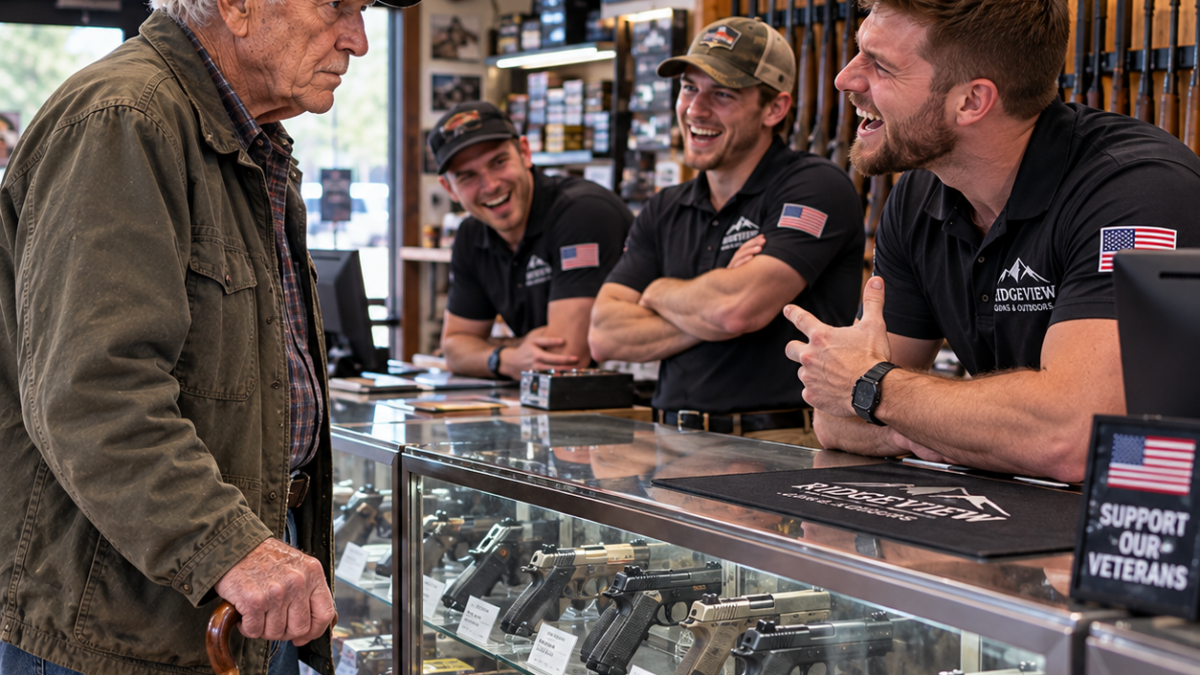
They Laughed at His Age in the Gun Shop—Then the Owner Walked In, Stood at Attention, and Said, “Sir, It’s an Honor”
Three young gun-store employees laughed when seventy-two-year-old Arthur Calloway asked for a reliable home-defense firearm, and one of them told him he should buy a medical-alert button instead.
Arthur never raised his voice, never mentioned his thirty-four years in the Marine Corps, and never told them that the hands they were mocking had once carried wounded Marines through the streets of Fallujah.
Forty minutes later, the store owner walked through the door, dropped the box in his arms when he saw Arthur, stood at attention in the middle of his own shop, and said five words that turned every laughing face white: “Colonel Calloway, sir—it’s an honor.”
Arthur Calloway almost turned around before he ever reached the counter.
Not because anyone had insulted him yet.
That came later.
He almost left because the bell above the door was too loud.
It gave a cheerful little jingle when he stepped inside Blue Ridge Arms, and for half a second the sound reminded him of the brass bell Elaine used to keep beside the back door.
His wife had hated shouting across the house.
Whenever dinner was ready and Arthur was working in the garage, she would ring that bell twice.
Not once.
Not three times.
Twice.
Arthur would wipe grease from his hands, come inside, and complain that no grown man should be summoned like livestock.
Elaine would say:
“Then stop taking twenty minutes to come when I call.”
He would tell her he needed at least fifteen of those minutes to finish whatever he was pretending was urgent.
She would roll her eyes.
Forty-six years.
That was how long they had been married.
Three years since pancreatic cancer took her.
The house still felt wrong without the bell.
Arthur stood just inside the gun shop with one gloved hand on the door and let the memory pass.
Then he stepped inside.
He was seventy-two.
Six-foot-one when his back cooperated.
A little stooped now.
Thin silver mustache.
Faded canvas jacket.
Work boots with old oil stains around the seams.
Plain navy ball cap.
No veteran patches.
No campaign ribbons.
No unit insignia.
No “USMC RETIRED.”
Nothing that announced anything.
He had stopped wearing those things years earlier.
Not because he was ashamed.
Quite the opposite.
He simply got tired of strangers asking questions they did not really want answers to.
“What was it like over there?”
“Did you ever kill anybody?”
“Were you in combat?”
People asked war questions the way they asked about weather.
Curious.
Casual.
Then uncomfortable when answers became real.
So Arthur stopped giving strangers invitations.
PART2:
He lived eight miles outside the little Virginia town on property his family had owned before the interstate came through.
Six acres.
White farmhouse.
Detached garage.
A garden behind the kitchen.
The garden was Elaine’s.
Technically, Arthur supposed the soil belonged to him now.
The county certainly mailed the tax bill to his name.
But he never thought of it that way.
Elaine had chosen where everything went.
Tomatoes along the south fence.
Basil and parsley by the back door.
Beans on the trellis.
Peppers near the shed.
Zucchini in the far corner.
“Why there?”
Arthur had asked forty years earlier.
“Because zucchini needs room.”
“So?”
“It spreads like children.”
“We don’t have children.”
She looked at him.
“You miss the point professionally.”
That was Elaine.
After she died, Arthur kept planting tomatoes.
He kept the herbs.
Some beans.
The rest of the rows slowly emptied.
Not because he could not garden.
He had grown food since boyhood.
He just could not make himself put plants in her places.
It felt too much like replacing something.
That winter had been worse.
Not emotionally.
Arthur had learned grief did not respect seasons.
But practically.
Three homes on the county roads near his property had been burglarized in six weeks.
Not daytime thefts.
Night.
The first family slept through it.
The second woke after their back door had been forced.
The third was Dorothy Hines.
Seventy-six.
Retired schoolteacher.
Widowed.
Arthur had known her fifteen years.
Dorothy woke at 2:00 a.m. because she heard a floorboard squeak.
She opened her eyes and saw a man standing at the end of her bed.
He ran when she screamed.
Dorothy’s heart did not handle the terror well.
She spent nearly two weeks in the hospital.
Arthur visited once.
She looked smaller beneath the blanket than he remembered.
“Worst part?”
She told him.
“I couldn’t do anything.”
Arthur sat beside her.
“You screamed.”
“He ran.”
“That sounds like something.”
Dorothy shook head.
“You know what I mean.”
He did.
Arthur drove home that afternoon and walked every window and door in his house.
Checked locks.
Replaced two screws in the rear-door strike plate with longer ones.
Tested porch lights.
Changed batteries in motion sensors.
Then stood in his bedroom looking at the nightstand on Elaine’s side.
Empty.
He had owned firearms most of his adult life.
Rifles.
Shotguns.
A couple of older handguns stored properly in a locked safe in his garage office.
But nothing accessible for emergency use while still secured responsibly.
He spent several days thinking.
He was not impulsive about weapons.
Perhaps that was why he had waited.
Tuesday morning, after coffee at the VFW, he drove to Blue Ridge Arms.
Arthur had heard good things.
The owner was supposedly a retired Marine.
Arthur did not know him.
Or so he thought.
The gun shop sat in a converted brick hardware store near the highway.
Mounted deer heads on the walls.
Long glass handgun counter.
Racks of rifles.
Ammo shelves.
A small classroom in back.
Everything neat.
Three young employees were on the floor.
Tyler Benson saw Arthur first.
Tyler was twenty-four.
Tactical vest over black polo even though he worked retail.
Close-trimmed beard.
Muscular enough to know it.
He spent weekends shooting local practical matches and most evenings posting clips about optics, holsters, and “real-world setups.”
Marcus Lee stood beside him.
Twenty-six.
Tall.
Baseball cap backward.
He knew specifications for almost every gun in the store and made sure people knew that he knew.
Devin Shaw worked register.
Twenty-one.
The youngest.
Eager.
Talkative.
Still at age when being included by older guys sometimes mattered more than being decent.
The owner, Ray Dalton, was out.
Arthur approached the counter.
Removed cap.
“Morning.”
Tyler nodded.
“What can I do for you?”
“I’m looking for something for home defense.”
Tyler glanced at Marcus.
Tiny glance.
Arthur saw it.
He had spent too many years reading rooms not to.
Tyler leaned against glass.
“For you?”
Arthur looked behind himself.
“No.”
“For the mailman.”
Marcus snorted.
Tyler smiled.
“Just checking.”
Arthur ignored.
“I’d like something reliable.”
“Easy to secure in bedside lockbox.”
“Manageable recoil.”
“I don’t need anything exotic.”
Tyler reached into case.
Pulled compact 9mm.
Set it down.
Arthur extended hand.
Tyler moved the handgun back two inches.
“Easy there, Gramps.”
Arthur stopped.
Tyler smiled toward Marcus.
“Let’s make sure you can hold it steady first.”
Marcus laughed.
Devin looked up.
Arthur studied Tyler.
No anger.
Not yet.
Mostly disappointment.
“I can hold it.”
Tyler shrugged.
“Sure.”
He began explaining.
Fast.
Magazine capacity.
Barrel length.
Trigger.
Optics compatibility.
Accessory rail.
Arthur listened.
Not because he needed all of it.
Because information costs nothing to hear.
Then Tyler said:
“If recoil is a concern at your age, we could look at .380.”
Arthur said:
“I didn’t say recoil was a concern.”
“You said manageable.”
“I also said reliable.”
Marcus joined.
“Honestly, sir, most older shooters do better with something lighter.”
Arthur looked at him.
“Most?”
Marcus smiled.
“You know.”
“Grip strength.”
“Vision.”
“Tremor.”
Arthur’s right hand did tremble slightly.
Not much.
Age.
Nerve damage.
It came and went.
He tucked it behind his back.
Tyler saw.
That made everything worse.
“See?”
Tyler laughed.
“No offense.”
Arthur had learned long ago that “no offense” usually meant somebody knew exactly what they were doing.
Devin leaned over register.
“Maybe one of those medical-alert buttons would be safer.”
Marcus chuckled.
Devin grinned.
“You know.”
“I’ve fallen and I can’t find my Glock.”
All three laughed.
Arthur did not.
The silence should have warned them.
It did not.
Arthur looked at Tyler.
Then Marcus.
Then Devin.
Not angry.
Not embarrassed.
Level.
“Is there somebody else I can speak with?”
Tyler shrugged.
“Owner’s out.”
“You’re stuck with us.”
Arthur nodded.
“All right.”
He put cap back on.
Then walked toward front window.
There was a folding chair beside a rack of hunting magazines.
He sat.
Removed a small leather notebook from inside coat.
Uncapped pen.
Started writing.
Tyler watched.
Then made a circular motion beside his temple.
Marcus laughed again.
Arthur heard.
He kept writing.
The notebook was not a complaint ledger.
He did not intend to “get” anyone fired.
Arthur kept notes because memory was not what it once was.
Groceries.
Doctor appointments.
Numbers.
Things he wanted to remember.
He wrote:
Dorothy — call Thursday.
Back-door strike plate finished.
Lockbox — fingerprint? mechanical backup.
Garden — seeds March.
Then, after a moment:
Young men mistake being informed for being wise.
He paused.
Crossed out “young.”
Wrote:
People mistake being informed for being wise.
Better.
Arthur had made enough mistakes when young not to pretend age automatically made anybody decent.
Thirty-eight minutes passed.
Tyler helped another customer.
Marcus restocked ammunition.
Devin complained about a delivery.
Arthur sat.
He considered leaving twice.
Then decided the shop owner deserved a chance to earn or lose his business personally.
At 10:47, a black Ford pickup pulled into the space beside the door.
Ray Dalton climbed out.
Fifty-one.
Broad shoulders.
Gray crew cut.
Blue Ridge Arms polo.
He carried a cardboard box of inventory under one arm and a paper bag of sandwiches in the other.
Ray had retired from the Marine Corps as Master Sergeant after twenty-two years.
Three combat deployments.
Two Bronze Stars.
One marriage that had somehow survived both the Corps and opening a small business.
He had owned Blue Ridge Arms almost nine years.
His rules were simple.
Safe gun handling.
Honest sales.
Do not talk down to beginners.
Do not push people into purchases.
Do not turn politics into customer service.
Respect everybody.
He had told Tyler those rules.
Repeatedly.
Ray opened door.
Bell jingled.
“Morning, degenerates.”
Devin laughed.
“Brought lunch?”
“Maybe.”
Ray shifted box.
Then his eyes moved toward folding chair.
He stopped.
The box slipped.
Hit floor.
One corner burst open.
Cleaning kits spilled onto carpet.
The sandwich bag followed.
Tyler started:
“Hey Ray, this old guy—”
Ray raised one hand.
Not looking at him.
Tyler stopped.
Ray stared at Arthur.
Arthur looked up from notebook.
For several seconds neither moved.
Then Ray’s back straightened.
Completely.
His shoulders came back.
Chin lifted.
His hands fell to his sides.
The shop owner who joked with everybody disappeared.
A Marine stood there.
He walked toward Arthur.
Not fast.
Precise.
Stopped two paces away.
Came to attention.
“Colonel Calloway, sir.”
Arthur’s eyes narrowed slightly.
Recognition came slower.
Ray’s face had been younger last time.
Dustier.
Bloodier.
Twenty years younger.
Arthur closed notebook.
Ray swallowed.
Then said:
“It’s an honor.”
No one in the store moved.
Arthur stood slowly.
His knees objected.
He smiled faintly.
“At ease, Marine.”
Ray remained at attention another second.
Maybe two.
Then relaxed.
Barely.
“Sir.”
“Ray Dalton?”
Ray’s eyes widened.
“You remember me?”
Arthur looked at him.
“Fallujah.”
Ray’s jaw tightened.
“Yes, sir.”
“You had a head wound.”
Ray gave a short laugh.
“Everybody had something.”
Arthur looked at scar near hairline.
“That one bled a lot.”
Ray suddenly looked twenty-three.
Not fifty-one.
He pulled a chair over.
“Please.”
Arthur sat.
Ray sat across.
Only then did he seem to remember employees.
He looked over shoulder.
“Boys.”
Nobody answered.
“Do you know who this is?”
Tyler’s face had gone pale.
Marcus stared at floor.
Devin stood frozen behind register.
Ray turned back.
“This is Colonel Arthur J. Calloway.”
“United States Marine Corps.”
“Retired.”
Arthur raised hand.
“Ray.”
“No, sir.”
Arthur sighed.
Ray looked toward employees.
“He commanded Second Battalion, Fourth Marines during Operation Phantom Fury in Fallujah.”
Tyler swallowed.
Ray continued.
“I was a corporal.”
“Twenty-three.”
“Thought I knew everything.”
That earned no laugh.
Ray stared past them.
The shop walls vanished for him.
There was dust.
Concrete.
Smoke.
Fallujah.
November 2004.
He had been attached to a company pushing through a block of buildings when fire locked down movement.
One structure was damaged badly enough that everybody knew it might not stay standing.
Ray remembered the sound more than anything.
The building settling.
Metal groaning.
Rounds striking outside walls.
Men trying to communicate through noise.
One Marine bleeding from neck.
Another with a shattered ankle.
Their squad leader pinned.
Radio traffic confused.
Routes exposed.
And then a voice.
Calm.
“Stay with me, Marine.”
Arthur.
Not “Colonel Calloway” in Ray’s memory.
Just the voice.
Ray said:
“Third night.”
Arthur lowered eyes.
“You don’t need to tell this.”
“Yes, sir.”
“I do.”
Ray’s voice tightened.
“We got pinned in a building.”
“Two Marines wounded badly.”
“Route out was covered.”
“We called support.”
“Everybody had problems of their own.”
He looked at Tyler.
“The battalion commander didn’t have to come anywhere near us.”
Arthur shook head.
“Ray.”
“He came anyway.”
The employees listened.
Ray continued.
“He moved through four blocks with security element.”
“Fire the whole way.”
“Got to us.”
“One of my Marines couldn’t walk.”
“Another was barely conscious.”
Arthur interrupted quietly:
“There were other men with me.”
“I know.”
“I did not do it alone.”
Ray nodded.
“But you came.”
Arthur did not argue.
Ray looked at Devin.
“The building started coming apart.”
“I remember the ceiling.”
“Dust so thick I couldn’t see.”
“I remember somebody grabbing my vest.”
“He pulled me toward door.”
Ray pointed at Arthur.
“He carried Lance Corporal Reyes until another Marine could take him.”
“He came back inside.”
Tyler whispered:
“Why?”
Ray heard.
“Because we were still there.”
That answer changed the room.
Ray walked behind counter.
Removed a framed photograph from wall.
It had been hanging there since shop opened.
Tyler had dusted it.
Marcus had walked past it thousands of times.
Devin had once moved it while changing a display.
None had asked.
Ray carried photograph over.
Set on glass.
A group of exhausted Marines stood in front of a shattered concrete building.
Armor filthy.
Faces gray.
One man had head bandage.
Young Ray Dalton.
Near center stood a taller officer.
Arthur.
Younger.
Broader.
But same eyes.
Ray tapped photo.
“Six hours later.”
“That’s me.”
Then Arthur.
“That’s him.”
Tyler looked from picture to old man.
Arthur seemed uncomfortable.
Ray returned photo to counter.
Then faced employees.
“Tell me what happened before I came in.”
Silence.
Arthur said:
“Nothing worth losing jobs over.”
Ray looked.
“Sir.”
“They were rude.”
“That’s all.”
“That isn’t nothing.”
Arthur shrugged.
“People are rude.”
Ray looked at Tyler.
“What did you say?”
Tyler opened mouth.
Nothing.
“Tyler.”
He swallowed.
“I made a joke.”
“What joke?”
“Ray…”
“What joke?”
Tyler stared floor.
“About him needing a cane with flashlight.”
Ray’s face changed.
Marcus spoke quickly:
“I laughed.”
Ray turned to Devin.
Devin was already red.
“What did you say?”
Devin whispered:
“Medical alert.”
“Louder.”
“I said maybe he needed a medical-alert button instead of a gun.”
Ray closed eyes for one second.
Arthur said:
“Ray.”
Ray opened.
“No, sir.”
“This matters.”
Arthur studied him.
Ray addressed three.
“A seventy-two-year-old customer walked in asking for help.”
“You decided age made him funny.”
“You didn’t ask what experience he had.”
“You didn’t ask what he actually needed.”
“You saw hands.”
“Gray hair.”
“Old jacket.”
“And decided you knew man.”
Tyler’s eyes watered.
Ray continued, controlled.
“Now you are embarrassed because he happened to be Colonel Calloway.”
“That is not the lesson.”
All three looked.
Ray pointed toward door.
“The next old man might have worked at a feed store forty years.”
“No medals.”
“No combat.”
“No picture on my wall.”
“He deserves exact same respect.”
Arthur looked at Ray then.
Something like approval.
Ray said:
“If you only regret disrespect because you discovered he was important, you learned nothing.”
That sentence stayed.
Tyler stepped forward first.
“Sir.”
Arthur turned.
“I’m sorry.”
“No excuse.”
“I was showing off.”
Arthur watched him.
Then nodded.
“Young men show off.”
Tyler’s mouth tightened.
“I should’ve known better.”
“Yes.”
Arthur did not soften truth.
Then:
“Now you do.”
Marcus apologized.
Short.
No explanation.
Arthur accepted.
Devin did not move initially.
His eyes were wet.
Twenty-one feels old until someone exposes how young it is.
Finally he came around register.
Stopped.
“Sir.”
Arthur looked.
“I’m sorry.”
His voice broke.
“I thought I was being funny.”
Arthur nodded.
“Most cruel things begin that way.”
Devin looked down.
Arthur extended hand.
Devin took.
“Learn something.”
“Yes, sir.”
“Then don’t waste mistake.”
Ray exhaled.
“Now.”
He looked at Arthur.
“What brought you in?”
Arthur explained.
The burglaries.
Dorothy Hines.
Nightstand lockbox.
Something dependable.
Ray listened.
No assumption that decorated Marine automatically needed powerful firearm.
No performance.
He asked practical questions.
“Any grandchildren in house?”
“No.”
“Visitors?”
“Occasionally.”
“Arthritis?”
“Some.”
“Dominant hand?”
“Right.”
“Eyes?”
“Left cataract done.”
“Right next spring.”
“Current handgun experience?”
Arthur smiled.
“Enough.”
Ray laughed.
“Yes, sir.”
They walked counter.
Ray brought several options.
Not one.
They discussed grip.
Controls.
Ease of manipulation.
Safely securing it.
Arthur tested.
Tyler watched from distance.
Arthur’s hands told different story now.
Not because tremor disappeared.
It didn’t.
But his movements were deliberate.
Muzzle direction.
Trigger discipline.
Chamber check.
Slide.
Sight picture.
Nothing flashy.
Muscle memory older than employees.
Arthur rejected first option.
“Too small.”
Ray nodded.
Second.
“Grip angle doesn’t agree.”
Third.
“Better.”
No need to fetishize exact model. A compact 9mm suited.
Ray said:
“This one?”
Arthur nodded.
“Probably.”
Then lockbox.
Arthur insisted on mechanical backup.
“Biometrics fail.”
Ray smiled.
“Still colonel.”
“Still engineer-minded.”
“Different thing.”
Paperwork began.
Background check.
Forms.
Ray tried employee discount.
Arthur refused.
Ray insisted.
Arthur refused harder.
Finally Ray said:
“Then let me buy lockbox.”
“No.”
“Sir.”
“No.”
“You saved my life.”
“That was job.”
Ray stared.
Arthur:
“Don’t start.”
Ray laughed.
“Some things don’t change.”
While paperwork processed, Ray made coffee.
Better than VFW.
They sat.
Employees worked quietly.
Nobody joked.
Ray asked:
“How’s Mrs. Calloway?”
Arthur’s face changed.
“Elaine passed.”
Ray’s expression fell.
“When?”
“Three years.”
“Cancer.”
“I’m sorry.”
Arthur nodded.
“Me too.”
Ray waited.
That was correct.
Not:
She’s in better place.
Not:
At least you had years.
Not:
Everything happens for reason.
Just wait.
Arthur spoke eventually.
“House is too quiet.”
Ray nodded.
“Garden worse.”
“Garden?”
“She started it.”
Arthur smiled faintly.
“Every row had orders.”
“Tomatoes south fence.”
“Herbs by door.”
“Zucchini far corner because they need room to spread out like children.”
Ray laughed softly.
“Sounds like her.”
“You met once.”
“She scared hell out of young lieutenant because he called house at midnight.”
Arthur smiled.
“She enjoyed rank when it benefited her.”
They talked.
Fallujah briefly.
Mostly after.
Marriages.
Children.
Careers.
Men they remembered.
Some alive.
Some not.
Arthur asked:
“Reyes?”
Ray looked down.
“He didn’t make it.”
Arthur already knew.
But sometimes people ask because they need hear name.
Ray said:
“His mother still sends Christmas card.”
Arthur nodded.
“I wrote her.”
“I know.”
“How?”
“She showed me.”
Ray’s voice softened.
“Your letter.”
Arthur looked uncomfortable.
“I wrote families.”
“Every family?”
“As many as I could.”
Ray knew more.
Arthur had handwritten condolence letters to families of every Marine killed under his command.
Not form letters.
Not signatures on staff-prepared templates.
He wrote about specifics.
How their Marine laughed.
What they were good at.
What other Marines said.
What happened if details could be shared.
Some letters took hours.
Ray had seen Reyes’s mother holding hers at funeral against chest.
He never forgot.
Background check cleared.
Arthur completed purchase.
Ray walked him to truck personally.
Case locked.
Lockbox.
Arthur placed everything securely.
Before Arthur started engine, Ray leaned in.
“Colonel.”
“Arthur.”
Ray smiled.
“Arthur.”
“If you ever need anything.”
“Call.”
“I’ll send somebody.”
Arthur looked back toward store.
Through glass, Tyler, Marcus, Devin were visible.
Then at Ray.
“The way you treat people who can do nothing for you.”
Ray listened.
“That’s who you are.”
Ray nodded slowly.
Arthur put truck in gear.
Drove away.
Ray watched until gone.
Then returned inside.
Locked front door.
Turned sign:
CLOSED.
Tyler asked:
“Are we fired?”
Ray looked.
“No.”
That surprised.
“Not today.”
He pulled four chairs into circle.
“What you did deserves consequences.”
“But firing you lets you leave with lesson unfinished.”
They sat two hours.
Ray did not lecture constantly.
He asked questions.
Why funny?
Why assume incompetence?
Why does age invite disrespect?
Why did Colonel title suddenly matter?
Would apology have been same if Arthur was retired plumber?
Tyler admitted he performed for Marcus.
Marcus admitted he laughed because Tyler did.
Devin admitted he wanted them to think he belonged.
Ray said:
“There it is.”
“Three grown men outsourcing character to room.”
Nobody liked that.
Good.
Then Ray told stories.
Not to glorify war.
About older veterans.
Men invisible.
Women whose service people never guessed.
Customers who came in confused because spouses died and had never managed household protection decisions.
New shooters ashamed they did not know terminology.
Older hunters losing eyesight.
People with tremors.
Disabled veterans.
Young mothers.
Everybody walking through door carried some history employees could not see.
“You sell firearms.”
Ray said.
“That demands more humility, not less.”
The next morning, shop reopened.
A wooden sign appeared a week later above counter:
EVERY PERSON WHO WALKS THROUGH THIS DOOR HAS A STORY YOU DON’T KNOW.
TREAT THEM ACCORDINGLY.
Tyler changed first in small ways.
He stopped wearing tactical vest to work.
Not because vests evil.
Because Ray asked:
“Why?”
Tyler had no answer beyond looking knowledgeable.
He began asking customers:
“What do you need?”
Then listening.
Not:
“What are you looking for?”
There is difference.
One invites assumption.
The other invites story.
Marcus volunteered at local veterans hospital after Ray mentioned program needing weekend help.
At first from guilt.
Guilt does not last.
After three months he kept going because he liked people.
He became close with Korean War veteran named George Webb who cheated shamelessly at cards.
Marcus visited every Saturday for two years.
Even after nobody remembered why he started.
Devin changed differently.
Saturday after Arthur’s visit, Devin drove eight miles outside town.
He nearly turned around twice.
Arthur’s driveway was gravel.
Mailbox old.
House white.
Garden behind.
Devin knocked.
Arthur answered wearing work shirt.
“Yes?”
“Mr. Calloway.”
“Arthur.”
“Arthur.”
Devin swallowed.
“I wanted to apologize again.”
“You already did.”
“I know.”
Awkward.
Arthur waited.
Devin looked toward yard.
“Do you need help with anything?”
Arthur almost said no.
Habit.
Then remembered Elaine telling him years ago:
“You complain people don’t help, then refuse every offer.”
So he looked around.
“Can you pull weeds?”
Devin laughed nervously.
“Yes.”
“Good.”
They spent two hours in garden.
Mostly silent.
Devin expected war stories.
None.
Arthur showed tomatoes.
Explained soil.
Asked about Devin’s family.
His mother was nurse.
Father had left when Devin nine.
Older brother in construction.
Devin had not gone college.
He felt behind.
That surprised Arthur.
Young men who appear arrogant often feel late.
Devin came next Saturday.
No invitation.
Arthur saw his truck.
Said:
“You again?”
“Yes.”
“Why?”
“You have weeds.”
Arthur looked.
“Fair.”
They rebuilt empty rows.
Devin asked:
“What went here?”
Arthur stared at far corner.
“Zucchini.”
“Want plant some?”
Arthur took too long to answer.
Devin noticed.
“Mrs. Calloway’s?”
Arthur nodded.
Devin said:
“We don’t have to.”
Arthur looked at bare earth.
Three years.
Then:
“She said they needed room.”
“Why?”
“Spread like children.”
Devin smiled.
“Sounds right.”
They planted.
Arthur cried later.
Not while Devin was there.
After.
He stood at kitchen window looking toward new green leaves emerging in Elaine’s corner.
Grief had convinced him planting again erased her.
Instead it made garden look more like hers.
He wished somebody had explained earlier that continuing is not replacing.
Devin became regular.
Not every Saturday forever.
Life happened.
Girlfriend.
Work.
Eventually marriage.
But often enough.
Arthur taught him gardening.
Woodworking.
Basic marksmanship, safely and without ego.
More importantly:
patience.
Devin once asked:
“Why didn’t you tell us who you were?”
They were planting beans.
Arthur sat on overturned bucket.
“Why should I?”
“Would’ve shut us up.”
“Yes.”
“So why not?”
Arthur thought.
“Because if I need résumé to get respect, respect isn’t worth much.”
Devin stared.
Arthur continued:
“A man who has to tell you who he is usually isn’t.”
Devin smiled.
“That sounds like something a colonel says.”
“No.”
“Something old man says.”
“You admit old?”
“Careful.”
They laughed.
Arthur’s firearm stayed locked beside bed.
He never needed it.
That is worth saying.
No dramatic burglar broke in and got lesson.
No midnight shootout.
No heroic home-defense scene.
Arthur hoped it would remain unused.
Protection is most successful when nothing happens.
Police eventually arrested two men connected to local burglaries.
Dorothy Hines returned home.
Arthur installed better deadbolts for her.
Tyler helped.
That surprised Dorothy.
“Who’s this?”
Arthur said:
“Reformed idiot.”
Tyler laughed.
“Accurate.”
They installed lights.
Door reinforcements.
No charge.
Dorothy baked pie.
Community improved not because somebody shot villain.
Because people noticed one another.
Ray and Arthur became friends again.
Not commander and corporal.
Older Marines.
Ray visited garden.
Arthur visited shop.
Sometimes veterans recognized Arthur after story spread.
Because of course story spread.
One customer had recorded Ray standing at attention from across store.
Not employee humiliation.
Just moment.
Video reached social media.
Titles became exaggerated.
GUN SHOP WORKERS MOCK SECRET WAR HERO.
OWNER DISCOVERS LEGEND IN HIS STORE.
COLONEL HUMILIATES ARROGANT EMPLOYEES.
Arthur hated all.
“They weren’t humiliated.”
He told Ray.
“They learned.”
Ray nodded.
“Internet likes blood.”
Arthur looked.
“Even metaphorically.”
“Yes, sir.”
One local reporter asked interview.
Arthur declined twice.
Third time she said story was becoming inaccurate and wanted his side.
He agreed with condition.
No house address.
No firearm details.
No sensational combat recreation.
She interviewed at VFW.
Reporter asked:
“What hurt most about jokes?”
Arthur considered.
“Nothing.”
She looked surprised.
“Nothing?”
“I’ve been insulted by professionals.”
He smiled.
“Those boys were amateurs.”
Reporter laughed.
Then Arthur grew serious.
“What bothered me was how easy it was.”
“How easy what was?”
“To decide who another person is by looking.”
Reporter wrote that.
She asked:
“Do you think veterans deserve special respect?”
Arthur answered carefully.
“Service deserves respect.”
“Age deserves basic respect.”
“But cashier shouldn’t need to know I wore uniform before treating me like human being.”
“That’s bigger point.”
That quote became most shared.
Ray framed article.
Arthur complained.
Ray ignored.
At Blue Ridge Arms, sign became policy and culture.
New employee training began with customer respect.
Not because every customer secretly colonel.
Because every customer was person.
Tyler eventually became store manager.
That shocked earlier version of him.
He became excellent.
Patient with beginners.
Especially elderly.
One afternoon, an eighty-year-old woman came in after husband died.
He had handled everything.
She did not even know how to open safe containing guns he left.
Tyler did not laugh.
He helped arrange lawful transfer guidance and safe handling education.
Spent an hour.
Sold nothing.
Ray watched.
Later:
“You lost sale.”
Tyler smiled.
“Learned from you.”
Ray shook head.
“No.”
“You learned from him.”
They both knew who.
Marcus completed veterans-outreach certification.
Eventually worked part-time for nonprofit connecting older vets with transportation and services.
Devin stayed at shop for another year, then began landscaping business.
Guess who became first client?
Arthur.
Devin refused payment.
Arthur refused refusal.
They compromised:
Arthur paid materials.
Devin accepted one dollar labor.
Framed dollar? No, that’s cliché. He kept it in truck visor for years perhaps. Let’s keep subtle.
He kept the dollar in wallet until wallet wore out.
The garden recovered fully.
Tomatoes.
Herbs.
Beans.
Peppers.
Zucchini spreading irresponsibly in far corner.
Arthur stood one summer evening with basket.
Devin beside.
Ray stopped by and took photograph.
Arthur hated.
“Put phone away.”
“Too late.”
That photograph later hung beside Fallujah picture in shop.
Not because Arthur was colonel.
Because life after mattered.
One photo showed war.
One showed garden.
Both Arthur.
That was important.
Years passed.
Arthur’s hands trembled more.
Not drastically.
Enough.
He voluntarily stopped driving at night.
Later gave up certain shooting activities he no longer felt confident doing.
That was another lesson.
Competence includes knowing when to stop.
Tyler once said:
“Colonel, we can adapt.”
Arthur nodded.
“We can.”
“Doesn’t mean we always should.”
Age was not punchline.
Neither was it imaginary.
He refused both disrespect and denial.
At seventy-seven, Arthur moved bedroom downstairs because stairs irritated knee.
At seventy-eight, he finally let Devin mow front acreage sometimes.
At seventy-nine, Dorothy died.
Arthur attended funeral.
At eighty, VFW friends fewer.
Chairs emptier.
He kept garden.
One afternoon Ray asked:
“You ever lonely?”
Arthur looked over tomatoes.
“Yes.”
No joke.
Ray waited.
Arthur:
“Lonely isn’t emergency.”
“Sometimes it’s weather.”
“You dress for it.”
Ray thought about that later.
Elaine remained part of house.
Arthur did not “move on” from her.
He moved with.
Her bell still by back door.
Her recipes.
Garden.
A scarf in closet he never touched.
Grief became less loud.
Not absent.
That is how long marriages work after one person leaves.
Devin and his wife eventually had daughter.
Named Grace.
They brought baby to Arthur.
He held awkwardly.
“I haven’t done this.”
“You commanded battalion.”
“Babies ignore chain of command.”
Grace grabbed mustache.
Arthur winced.
Devin laughed.
Years later Grace called him Grandpa Arthur.
Nobody formally decided.
Family sometimes happens because people continue showing up.
Ray saw.
Never said.
Arthur had no children.
Elaine had once wanted.
It had not happened.
They had made peace mostly.
But seeing Arthur with Grace made Ray understand why garden had empty rows.
Some grief predates death.
Arthur never discussed.
Did not need.
At eighty-one, Arthur’s health declined.
Heart.
Nothing dramatic at first.
Medication.
More appointments.
Ray drove sometimes.
Devin more.
Tyler visited once with sandwiches.
Arthur looked at him.
“What happened to beard?”
“Wife said shave.”
“Smart woman.”
Tyler laughed.
They sat porch.
Tyler finally asked question that had been bothering years.
“Did you really remember Ray from Fallujah immediately?”
Arthur thought.
“No.”
Tyler blinked.
“No?”
“I remembered face after he gave name.”
“So when he stood at attention…”
“I knew he was Marine.”
Arthur smiled.
“He still stands like one when nervous.”
Tyler laughed.
“Why didn’t you say?”
“Moment mattered to him.”
That answer captured Arthur.
He understood dignity in others.
Even when they gave it to him.
Tyler said:
“I’m glad you didn’t get us fired.”
Arthur:
“Ray considered.”
“Seriously?”
“Probably.”
“He has temper.”
“Yes.”
“Why did you stop?”
Arthur stared ahead.
“Because firing is sometimes easier than teaching.”
Tyler looked.
“Did we deserve teaching?”
Arthur shrugged.
“You stayed.”
That was enough.
At eighty-two, Arthur died.
Not in battle.
Not protecting anybody.
Not cinematic.
He had gone to bed.
Did not wake.
Devin found out from Ray.
He drove to house.
Sat on back steps.
Garden dormant for winter.
He cried.
Ray stood beside.
No words.
The funeral overflowed.
Marines.
Neighbors.
VFW.
Blue Ridge employees.
People Arthur had commanded.
Some flew across country.
Families of Marines.
Ray wore dress blues for first time in years.
They fit tightly.
He did not care.
Military honors.
Flag.
Taps.
Arthur had requested simple service.
No long list medals.
His niece read brief biography.
Thirty-four years Marine Corps.
Grenada.
Desert Storm.
Iraq.
Afghanistan.
Silver Star.
Purple Hearts.
Legion of Merit.
Commands.
Teaching.
It sounded enormous.
Devin listened and thought of dirt under Arthur’s fingernails.
That seemed more real.
Ray spoke.
Short.
“I met Colonel Calloway in a city on fire.”
“He was everything a young Marine thought leader should be.”
“Calm.”
“Certain.”
“Impossible to move.”
“Twenty years later I met him again in my shop.”
“An old man sitting in folding chair because three employees had forgotten manners.”
People smiled sadly.
Ray looked toward Tyler, Marcus, Devin.
“They learned.”
“So did I.”
He paused.
“I thought I was honoring him by standing at attention.”
“Later I realized Arthur honored all of us by never requiring it.”
Ray’s voice cracked.
“He once told me the way you treat people who can do nothing for you is who you are.”
“He lived reverse too.”
“The way he treated people who could do nothing for him showed exactly who he was.”
Then sat.
Devin spoke last.
Not planned.
He walked to podium.
Hands shaking.
“I made a joke the first day I met him.”
People knew story.
“He forgave me in maybe thirty seconds.”
“I needed years to forgive myself.”
He looked at Arthur’s folded flag.
“He let me help rebuild Mrs. Calloway’s garden.”
“That was how he corrected me.”
“Not by telling me what kind of man he was.”
“By giving me chance to become better kind myself.”
Devin cried.
No hiding.
“He never had children.”
“I think maybe I became something close.”
The room broke.
After funeral, Arthur’s will contained surprise.
House went to niece.
Some land sold.
Garden portion and a small trust were left to local veterans community program and Devin was asked to help maintain it if he wished.
A handwritten note:
Devin,
Zucchini in far corner.
You know why.
—Arthur
Devin framed that.
Absolutely.
The house eventually became transitional respite home for older veterans recovering after hospital stays.
The garden remained.
Volunteers.
Tomatoes.
Herbs.
Zucchini.
Grace helped plant.
The bell from Elaine’s back door stayed in kitchen.
Nobody knew significance except Devin.
He told volunteers:
“Ring twice when dinner ready.”
They did.
A tiny ritual surviving two people gone.
Blue Ridge Arms kept sign.
Every person who walks through this door has a story you don’t know.
Treat them accordingly.
Below it eventually hung three photos.
Fallujah.
Arthur in folding chair? No, perhaps not humiliating.
Better garden.
And one of Arthur shaking Devin’s hand at first shop day? Nobody took. So two photos enough.
Young Marines in dust.
Old colonel with basket tomatoes.
War.
Peace.
Same life.
Tyler became owner when Ray retired.
First day, Ray handed keys.
“You keeping sign?”
Tyler looked offended.
“Forever.”
Ray smiled.
“Good.”
Tyler added one rule to employee manual:
Never assume age equals inexperience.
But more important:
Never assume experience is required for respect.
Ray approved.
Marcus continued veteran work.
Devin’s landscaping business grew.
He employed two veterans and one kid who had gotten out of juvenile detention program.
When the kid mocked elderly customer once, Devin stopped truck.
“Get out.”
The kid thought fired.
Devin said:
“Go apologize.”
After:
“Why big deal?”
Devin looked at him.
Then told story.
Not colonel first.
Old man first.
“That’s the point.”
The story kept traveling.
Usually title:
They Laughed at His Age in Gun Shop—Until Owner Walked In and Said, “Sir, It’s an Honor.”
True.
But incomplete.
The dramatic part lasted five minutes.
The important part lasted years.
Tyler learned listen.
Marcus learned serve.
Devin found family.
Ray reconnected with man who saved his life.
Arthur’s garden grew again.
That is what consequences should look like when people are fortunate.
Not humiliation forever.
Change.
We like stories where arrogant people are exposed.
Because justice feels immediate.
They laugh.
Reveal.
Silence.
Apology.
End.
Real life gives harder question.
What do you do after silence?
Tyler could have become defensive.
Marcus could have blamed Tyler.
Devin could have avoided Arthur forever from shame.
Ray could have fired all and congratulated himself.
Arthur could have demanded respect because rank.
Nobody did.
Arthur accepted apologies.
Ray taught.
Employees stayed.
That is why story mattered beyond twist.
The owner saying:
“Sir, it’s an honor”
was powerful.
Arthur saying:
“They didn’t know”
was wiser.
Because dignity cannot depend on hidden résumé.
If Arthur had spent life delivering mail, joke still wrong.
If he had never worn uniform, wrong.
If he had been confused customer with shaking hands, wrong.
If he had been poor.
Weak.
Forgetful.
Still wrong.
You do not earn right to basic respect with medals.
Arthur understood because he had commanded men.
The Marine Corps teaches rank.
War teaches how little rank matters when somebody is bleeding beside you.
He had watched young privates show extraordinary courage.
Senior officers fail.
Quiet Marines save lives.
Loud ones freeze.
Appearance tells little.
That is perhaps why Arthur never defended himself in shop.
He was not waiting for Ray to vindicate him.
He simply wanted see what they would do without knowing.
And what they did told truth.
Then, fortunately, they changed.
Years after Arthur’s death, Grace—Devin’s daughter—asked why his picture was in gun store.
Devin took her.
She was twelve.
Tyler showed Fallujah photo.
Then garden.
Grace looked.
“He was soldier?”
“Marine.”
“Was he famous?”
“For a little while.”
“Was he nice?”
Devin smiled.
“Yes.”
“That matters more.”
Grace shrugged.
“I guess.”
Children sometimes reach conclusions adults take decades.
Devin pointed to sign.
“Read.”
She did.
“Every person who walks through this door has a story you don’t know. Treat them accordingly.”
“Who wrote that?”
“Ray.”
“Because Grandpa Arthur?”
“Yes.”
She looked at Devin.
“Were you mean to him?”
Devin hesitated.
“Yes.”
Grace stared in horror.
“You?”
“Yes.”
“Why?”
“Because I was twenty-one and thought being funny was same as being worth listening to.”
Grace frowned.
“That’s dumb.”
“Yes.”
“Did he forgive?”
“Yes.”
“Why?”
Devin looked at garden photo.
“Because he was better at being old than I was at being young.”
Grace considered.
Then accepted.
The store bell rang.
An elderly man walked in.
Bent posture.
Hearing aids.
Tyler came from behind counter.
“Morning, sir.”
“What can I help you with?”
No smirks.
No assumptions.
Just question.
The old man said he needed help finding cleaning kit for shotgun his father left.
Tyler walked with him.
Slow pace.
Listened.
Grace watched.
The story continued without anyone announcing.
That is what Arthur left.
Not just medals.
Not photo.
Not dramatic memory from Fallujah.
A change in how people treated next stranger.
That is the only kind of legacy that proves itself.
Ray Dalton still visited after retirement.
Gray hair became white.
One afternoon he stood beneath sign with Arthur’s old leather notebook.
Arthur’s niece had found it and thought Ray might want.
Ray opened.
Lists.
Appointments.
Garden.
Then line from day in shop:
People mistake being informed for being wise.
Ray smiled.
Further down:
Tyler — wants to impress.
Marcus — follows room.
Devin — young enough to change fast.
Ray stopped.
Arthur had understood them immediately.
Not condemned.
Diagnosed.
Then given chance.
Ray closed notebook.
He whispered:
“Still teaching.”
No one heard.
Good.
Arthur Calloway had spent a lifetime in institutions built on rank and command.
Colonel.
Sir.
Orders.
Authority.
Yet one of his final lessons had nothing to do with rank.
It was what he told Ray from truck window.
The way you treat people who can do nothing for you—that’s who you really are.
Not how you treat colonel after reveal.
Not decorated veteran after photograph.
Not famous person after recognition.
The stranger before you know.
The old man before owner walks in.
That is test.
Tyler, Marcus, and Devin failed it once.
Then spent years answering again.
That is why Ray did not fire them.
And that is why Arthur did not identify himself.
He did not need to tell three young men he had spent thirty-four years as Marine.
He did not need mention Silver Star.
Purple Hearts.
Fallujah.
Quantico.
He did not need point at photograph.
He had entered as customer.
That should have been enough.
Everything they learned later was not reason to respect him.
It was reason to understand how foolishly little they had known when they chose not to.
And perhaps that is why Ray Dalton stopped dead when he saw Arthur Calloway sitting quietly beside front window.
Ray was not seeing a frail seventy-two-year-old man with trembling hands.
He was seeing smoke.
Dust.
A collapsing building.
A Marine officer moving toward danger instead of away.
A hand grabbing his vest.
A voice cutting through gunfire:
“Stay with me, Marine. We’re walking out of here.”
Twenty years later, Arthur was the one sitting alone.
And Ray finally had the chance to walk toward him.
So he did.
He put the box down.
Straightened his back.
Came to attention.
And before anybody in that gun shop knew why, he gave the old man the respect he should have received the moment he walked through the door.
“Colonel Calloway, sir.”
A breath.
“It’s an honor.”








