The Shelter Planned to Put Down the Gray Dog Who Wouldn’t Stop Crying—Then Her File Revealed Who She Had Lost
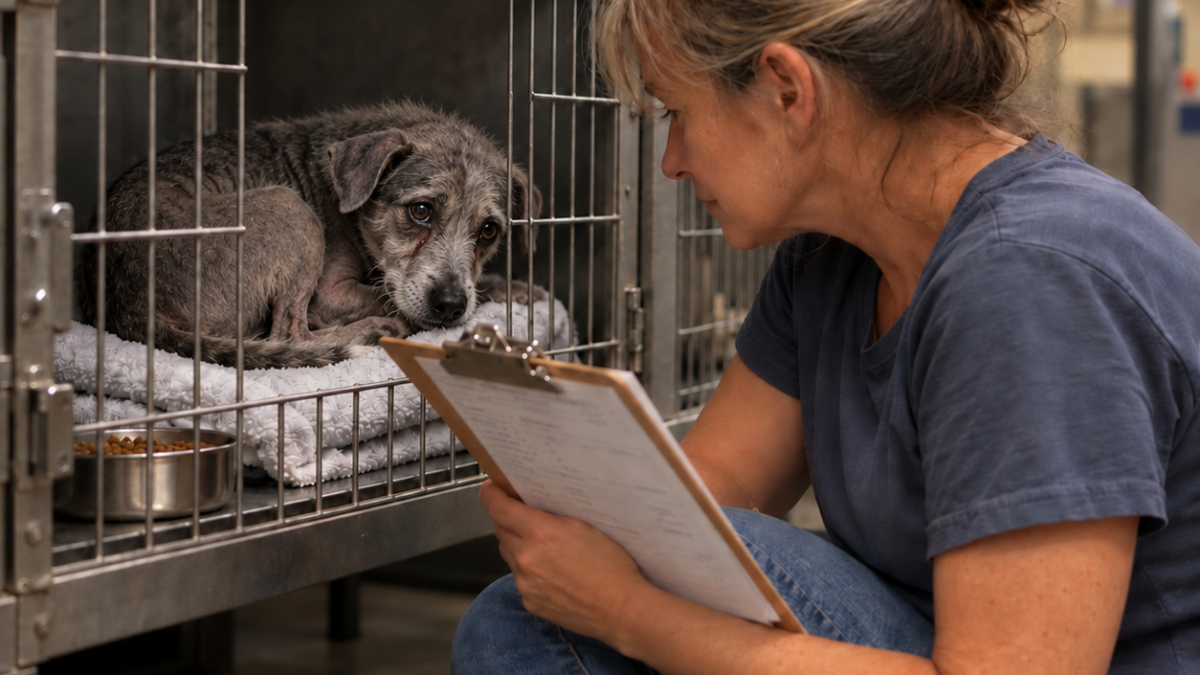
The Shelter Planned to Put Down the Gray Dog Who Wouldn’t Stop Crying—Then Her File Revealed Who She Had Lost
They had already marked her for morning, but she never growled, never bit, and never tried to escape.
She only cried from the back of her kennel like her heart had been left somewhere no one cared enough to search.
Then I opened her file after midnight and found one forgotten line that proved this poor dog had not come through our doors alone.
My name is Erin Cole.
I work evening intake at a small animal shelter in Ohio, the kind of place that always smells like bleach, wet fur, old towels, canned food, and fear that has nowhere else to go.
People imagine shelters as sad places, and they are, but not in the way most outsiders think.
The sadness is not always dramatic.
Most days, it is practical.
Laundry that never ends.
Bowls stacked in sinks.
Vaccines logged in messy handwriting.
Phones ringing.
Dogs barking until their throats go hoarse.
People at the front desk crying because they cannot keep an animal anymore, and people in the back room crying because they know there is no space for the next one.
By the time this happened, I thought I had seen every kind of heartbreak there was.
Old dogs tied to fences.
Puppies dumped in cardboard boxes.
Pets surrendered because rent went up, because somebody moved, because a boyfriend said no, because a baby was coming, because life got hard and the animal was the first thing to go.
I had seen people lie.
I had seen people break down.
I had seen good people do the worst thing they had available because every better option had already collapsed.
I had learned not to judge too quickly.
And still, that gray dog got to me.
She was a full-grown mixed-breed dog with a wiry gray coat, one torn ear, and eyes so tired they looked almost human.
Not pretty in the easy way.
Not the kind of dog people stopped for immediately.
Her fur was dull from stress. Her muzzle had white around it, though she was not old enough to be called elderly. One side of her face had a pale streak that made her expression look permanently uncertain. Her paws were small for her body. Her tail stayed tucked so tightly beneath her that it looked like she was trying to disappear into herself.
She was not aggressive.
She did not lunge at the bars.
She did not snap when we opened the kennel.
She did not throw herself against the gate.
She just curled in the back corner on a thin blue blanket and made that sound.
That low, broken cry.
Every few seconds.
PART2:
Like a question nobody wanted to answer.
The first night, we assumed she was scared.
Most dogs are scared their first night in a shelter.
Imagine it from their side.
One day, there is a home.
Maybe not a perfect home.
Maybe loud.
Maybe crowded.
Maybe full of neglect, confusion, grief, or too many changes.
But still, it is known.
Known smells.
Known furniture.
Known voices.
Known footsteps coming down the hall.
Then suddenly there is concrete beneath them, metal around them, strange dogs barking from every direction, strangers reaching in with leashes, and no way to ask where their person went.
So we gave her time.
Her intake name was Misty.
It was written in black marker on her kennel card.
PART3:
MISTY. FEMALE. GRAY MIX. OWNER SURRENDER. HOLD COMPLETE.
Below that, someone had written in red pen:
MONITOR. NOT ADJUSTING.
On day two, I brought her chicken.
She looked at it, sniffed once, then turned her head away and cried.
On day three, I sat outside her kennel during my lunch break with my back against the wall and read intake forms aloud in a soft voice, because sometimes nervous dogs do better when you don’t stare at them.
She did not come forward.
She did not sleep.
She just kept making that low, aching sound.
Every few seconds.
By the fourth day, people had started using words animals rarely survive.
“She’s shut down.”
“She’s suffering.”
“She isn’t adoptable like this.”
“She’s not eating enough.”
“We don’t have room to keep a dog who’s deteriorating.”
Nobody said it cruelly.
That was the worst part.
Cruelty is easier to fight when it has a sneer on its face.
This was tired voices, full kennels, unpaid bills, and a shelter director named Marlene who had been doing this work for twenty-two years and had learned to make decisions that left pieces of her behind.
“She can’t go on like that,” Marlene told me late Thursday evening.
I stood in the hall outside Misty’s kennel, holding a stainless steel bowl she still had not touched.
“She needs more time.”
“She has had four days.”
“Four days in here feels like four hours to some dogs and four years to others.”
Marlene rubbed her eyes.
“We have six dogs coming in tomorrow from the county seizure. Three are medical. Two kennels are already doubled. If she were improving, I would fight for her. But she isn’t.”
Misty cried again.
Soft.
Steady.
Hopeless.
Marlene looked toward the sound and swallowed.
“She’s on the morning list,” she said.
The morning list.
Everyone in shelter work knows what that means.
I did not argue right away because I knew the numbers. I knew the empty kennels we did not have. I knew the donations that were not coming. I knew the dogs waiting in police cruisers because there was nowhere to put them.
But knowing why something happens does not make it easier to watch.
After Marlene left, I stayed.
The night crew was thin. Two kennel techs, one receptionist finishing paperwork, and me.
The building quieted after closing. That was when the shelter became hardest to bear.
During the day, noise covered the grief.
At night, every cry had space to echo.
I finished medications. I changed water bowls. I checked locks. Then, just after midnight, I walked back to Misty’s kennel and sat on the floor.
She was still awake.
Still crying.
Her eyes were open, fixed not on me, not on the door, not on the food bowl.
On the kennel across the aisle.
It was empty.
I had noticed that before, but I had not thought about it.
Dogs stare at doors. They stare at people. They stare into corners. Fear makes strange things important.
But Misty was not staring randomly.
She was watching that empty kennel as if something had been there and should have still been there.
I stood slowly.
“Misty,” I whispered.
Her ears twitched.
At the sound of her name, she lifted her head.
Not much.
Just enough.
Then she looked past me again.
Across the aisle.
I went to the file cabinet.
Every animal had a paper file and a digital record, but paper told the truth differently. Paper had scribbles, rushed notes, things typed into the wrong box, things people forgot to transfer.
I pulled Misty’s folder.
The first page was ordinary.
Female dog. Gray mixed breed. Approximate age six years. Surrendered by family member. Intake condition: underweight, anxious, vocalizing.
Then I turned the page.
And there it was.
One line, written near the bottom in blue ink.
ARRIVED WITH COMPANION DOG: LEO, MALE, SMALL BROWN SENIOR MIX. BONDED PAIR PER OWNER’S NOTE.
I stopped breathing.
Bonded pair.
Per owner’s note.
I flipped through the rest of the file so fast I nearly tore the pages.
No transfer note.
No adoption note.
No medical closure.
No attached kennel card.
Nothing.
Misty cried from down the hall.
I ran to the computer and searched Leo.
Nothing.
Then I tried alternate spellings.
Lio.
Lee.
Brown senior male.
Owner surrender.
The system froze, then loaded a record.
UNKNOWN MALE. BROWN DOG. HOLDING KENNEL C-12. INTAKE SAME DATE.
My hands went cold.
Unknown male.
C-12 was in the overflow wing.
The old overflow wing was used for quarantine, medical holds, and dogs who were not ready for the adoption floor. It was quieter back there, but it was also where animals disappeared from the daily rhythm if people stopped asking about them.
I grabbed the ring of keys and hurried down the hall.
The shelter at night has its own sound.
Fluorescent lights humming.
Air vents rattling.
Dogs shifting in their sleep.
My shoes squeaking against damp concrete.
C-12 was the second kennel from the end.
At first, I saw only a pile of blankets.
Then the pile moved.
A small brown dog lifted his head.
He was old. Much older than Misty. His face was frosted white, his eyes cloudy, and one of his back legs trembled when he tried to stand. His ears were too big for his narrow head. A faded red collar hung loosely around his neck.
The name tag was shaped like a bone.
I crouched.
“Leo?”
The little dog froze.
Then his entire body changed.
His ears lifted. His nose pushed through the kennel bars. His cloudy eyes searched wildly, and from his chest came a hoarse, desperate bark that sounded like it had been waiting four days to come out.
Down the hall, from the adoption wing, Misty answered.
Not a cry.
A bark.
One sharp, broken bark.
Then another.
Leo began shaking so hard I thought his legs might give out.
“Oh my God,” I whispered.
I unlocked his kennel.
He was too weak to run, but he tried anyway. He stumbled into my arms, trembling, licking my wrist, then twisting toward the sound of Misty’s voice.
I carried him.
The whole way down the hall, Misty barked and cried and clawed weakly at her kennel door.
The two kennel techs appeared from laundry, confused and alarmed.
“What’s happening?” Jenna asked.
“She came in with him,” I said. “They separated them.”
“What?”
“They’re bonded. It was in the file.”
When I turned the corner with Leo in my arms, Misty saw him.
I have witnessed reunions between people and animals before.
Lost dogs finding owners.
Pets returned after disasters.
Military dogs seeing handlers.
But I had never seen grief reverse itself in a single breath.
Misty stood.
For the first time in four days, she stood fully.
Her tail came out from beneath her body. Her ears lifted. Her whole face broke open with recognition.
I set Leo inside the kennel.
He stumbled forward.
Misty pressed her nose to his neck, then his face, then his ears, sniffing so frantically it was as if she had to count every part of him to believe he was real. Leo tucked his head beneath her chin and leaned his tiny body against her chest.
Misty stopped crying.
Just stopped.
The silence that followed was so sudden that all three of us stood there with tears on our faces.
Jenna whispered, “She wasn’t shut down.”
I touched the kennel door.
“She was grieving.”
By morning, everything changed.
Misty ate with Leo beside her.
Not much at first, but enough.
She drank water.
She slept for twenty-three minutes with her chin resting across his back while he snored softly under her throat.
When Marlene came in, I was waiting outside her office with both files in my hands.
“She’s not being euthanized,” I said before she could set down her coffee.
Marlene looked at me.
“Erin.”
“She came in with a bonded companion. It was documented. He was mislabeled and moved to overflow. She has been crying because we separated them.”
Marlene’s face went pale.
I handed her the file.
She read the line.
Then read it again.
“Who processed intake?”
I knew the answer.
A part-time employee named Chris had done the paperwork that day, but he was not the one I wanted to talk about.
“Who surrendered them?” I asked.
Marlene turned back to the first page.
“Darren Whitaker. Relationship to owner: nephew.”
Owner.
That word pulled my eyes to another note I had missed in my panic.
Previous owner: Helen Morris, deceased.
I read the name twice.
Helen Morris.
Something about it sounded familiar.
Then I remembered the little envelope clipped to the back of the folder.
It was marked PERSONAL ITEMS.
Inside were two worn collars, one vet receipt, and a folded piece of stationery with shaky handwriting.
Please keep Misty and Leo together. They have slept side by side for six years. Leo is nearly blind. Misty guides him. If I am gone, they will not understand, but they must not be separated. I have enclosed money for their care.
My throat tightened so hard I could barely speak.
“She wrote this,” I said.
Marlene sat down slowly.
The shelter did not receive any money.
There was no donation logged.
No care fund.
No note in the digital record.
Only this paper, folded and nearly ignored, inside a file attached to a dog scheduled to die in the morning.
Marlene closed her eyes.
“Call Darren Whitaker.”
He arrived two hours later in a black pickup that took up two spaces.
Darren was in his forties, clean-shaven, wearing a pressed jacket and the annoyed expression of a man inconvenienced by someone else’s conscience.
“I already surrendered the dogs,” he said at the front desk. “I signed whatever you people needed.”
Marlene invited him into the intake office.
I stood in the corner with the files.
Darren looked at me, then at Marlene.
“What is this about?”
“Helen Morris left a note with Misty and Leo,” Marlene said.
His jaw tightened.
“So?”
“She also indicated money was enclosed for their care.”
He laughed once.
“My aunt was confused at the end.”
I opened the envelope and laid the note on the desk.
“Her handwriting seems very clear.”
Darren’s eyes flicked toward me.
“She was eighty-one.”
“And she loved those dogs,” I said.
His face hardened.
“They were dogs. She treated them like children, and that was part of the problem.”
Marlene’s voice stayed calm.
“Mr. Whitaker, when you surrendered them, did you inform intake they were bonded?”
“I don’t remember.”
“It was written in the note.”
“I didn’t read every scrap of paper in my aunt’s junk drawer.”
I stepped forward.
“You told intake Misty was unstable.”
“She cried the whole ride here.”
“Because Leo was in the back of your truck and she couldn’t reach him?”
He stared at me.
That was when I knew.
He remembered everything.
He remembered separating them.
He remembered the note.
He remembered the money.
He just hadn’t cared.
Marlene folded her hands.
“We’ll need documentation regarding the funds Helen Morris sent for their care.”
Darren stood.
“I don’t know what you think you’re accusing me of, but you’d better be careful.”
“No accusation,” Marlene said. “Just documentation.”
He looked at me.
“You people are ridiculous. You waste all this energy on unwanted animals, then act shocked when nobody wants them.”
From the kennel wing, Misty barked.
One time.
Darren flinched.
I do not know why that sound got to him, but it did.
Maybe because it was no longer broken.
Maybe because grief had become witness.
He left without another word.
By the end of the day, Marlene had contacted Helen Morris’s estate attorney, whose number was listed on an old vet bill in the envelope. By the next morning, we learned the truth.
Helen had left a small care fund specifically for Misty and Leo.
Darren had taken the envelope from her apartment, surrendered the dogs, and failed to disclose the money. The attorney had been searching for confirmation that the dogs were alive.
What Darren had dismissed as two unwanted animals was, legally and morally, a responsibility he had tried to erase.
The consequences came quickly.
Not dramatic movie consequences.
Real ones.
Paperwork.
Phone calls.
Legal notices.
A police report.
An estate claim.
A shelter board review into how a bonded pair had been separated and mislabeled.
Chris, the intake worker, admitted Darren had rushed him, talked over him, and shoved multiple forms across the counter while saying, “Just take them. I don’t care what you do after that.”
That did not excuse the mistake.
But it explained how cruelty often works.
Not always with shouting.
Sometimes with pressure, impatience, arrogance, and the confidence that nobody will look closely enough to stop it.
Misty and Leo were moved into a larger quiet room together.
Their room had two beds, but they only used one.
Leo slept curled into Misty’s stomach. Misty rested her chin over his shoulders. When he got up, she got up. When he bumped into the water bowl, she nudged it toward him. When volunteers came in, Misty placed herself between Leo and the door, not aggressively, but firmly.
She was not unadoptable.
She was loyal.
She was not shut down.
She was heartbroken.
There is a difference.
A week later, Helen Morris’s neighbor came to the shelter.
Her name was Ruth Bell, a retired librarian with silver hair, red glasses, and hands that trembled when she saw them.
“Oh,” she whispered from the doorway.
Misty lifted her head.
Leo sniffed the air.
Ruth covered her mouth.
“Hello, babies.”
Misty stood slowly.
Then her tail moved.
Not much.
Just once.
But Ruth saw it and began to cry.
She told us Helen had lived next door to her for fourteen years. Misty had been rescued as a young stray from a roadside ditch. Leo had already been Helen’s dog then, half-blind and bossy, and Misty had appointed herself his guardian from the first day.
“They were her family,” Ruth said. “After Helen got sick, I promised I would help if anything happened. But Darren told me he had placed them with a private rescue. He said I didn’t need to worry.”
Her voice shook.
“I believed him.”
Marlene looked at her gently.
“Would you like to sit with them?”
Ruth walked into the room and lowered herself onto the floor.
Leo reached her first, wobbling into her lap like he had been there a hundred times.
Misty watched for a moment.
Then she stepped forward, pressed her gray head against Ruth’s chest, and closed her eyes.
Ruth wrapped both arms around her.
“I’m sorry,” she whispered. “I’m so sorry, sweetheart. I should have found you sooner.”
Misty did not cry.
Not once.
The adoption was approved three days later.
Not rushed.
Not careless.
Checked, verified, home-visited, and blessed by every exhausted person in that building who needed to see one thing go right.
Ruth had a small yellow house with a fenced yard, two soft beds in the living room, and Helen’s old quilt folded beneath the front window.
When we loaded Misty and Leo into Ruth’s car, Misty hesitated at the shelter door.
For one second, she looked back at the building that had almost misunderstood her grief as a reason to end her life.
I knelt beside her.
“You were right to keep crying,” I whispered.
She leaned forward and touched her nose to my cheek.
Then Leo barked from the back seat, impatient and raspy, and Misty climbed in beside him.
Ruth sent us a photo that night.
Leo was asleep under Helen’s quilt.
Misty was curled around him, eyes half-open, one paw resting across his back as if she still could not risk letting him disappear again.
The caption said:
Home.
I printed that photo and taped it inside our intake office above the file cabinet.
Not because every story ends that way.
They don’t.
Not because love fixes everything.
It doesn’t.
I taped it there because shelters are full of files, and files can make living creatures look like problems to be solved.
Vocalizing.
Not adjusting.
Owner surrender.
Behavior concern.
Morning list.
But behind every line is a life.
A history.
A bond.
A grief no one may have bothered to name.
Misty was almost put down because everyone heard her crying, but nobody asked what the crying meant.
One forgotten line saved her.
One old note told the truth.
One small brown dog in an overflow kennel turned a hopeless case back into a family.
And I have never forgotten the lesson that gray, trembling dog taught me from the back of her kennel.
Sometimes an animal is not broken.
Sometimes she is simply waiting for someone to notice who is missing.








