The Injured Puppy Wouldn’t Lie Down—Then One Tiny Clue in Her Towel Sent Us Racing Back Into the Rain
The Injured Puppy Wouldn’t Lie Down—Then One Tiny Clue in Her Towel Sent Us Racing Back Into the Rain
The injured puppy had every reason to collapse, but every time I lowered her onto the clinic blanket, she forced herself back up like sleep itself was a betrayal.
We thought she was terrified of us until she dragged her broken little body toward the carrier, crying as if the one thing she loved most had been taken away.
Then I found a tiny tuft of gray fur tangled in her dirty blue towel, and suddenly we understood that this poor dog had not been fighting to save herself.
I had treated frightened dogs before.
I had seen puppies pulled from drainage pipes, dogs hit on back roads, strays found frozen beneath porches, and starving little bodies carried into our clinic by people who could barely speak through their guilt.
But I had never seen one like her.
She came through the door wrapped in an old blue towel pressed against a man’s chest, and before he even opened it, I knew something was wrong.
Not just injured wrong.
Urgent wrong.
The man’s name was Daniel Mercer. I knew that because he said it three times while trying to explain where he had found her, like repeating his name might prove he was not the reason she looked the way she did.
“I’m Daniel,” he said, rain dripping from his jacket onto the clinic floor. “I work at the storage facility off County Road 18. I heard scratching behind the maintenance buildings. I thought it was a raccoon at first. I swear I didn’t ignore it on purpose.”
His hands were shaking.
Good people shake like that when they find suffering too late.
“I pulled back some boards,” he continued, his voice cracking. “She was under there. Stuck, I think. Or hiding. I don’t know. She made this little sound, and I just… I couldn’t leave her there.”
I had heard some version of that story hundreds of times.
Found under a shed.
Found by a dumpster.
Found behind a grocery store.
Found because somebody heard one small cry and decided it mattered.
Still, nothing prepares you for the moment the towel opens.
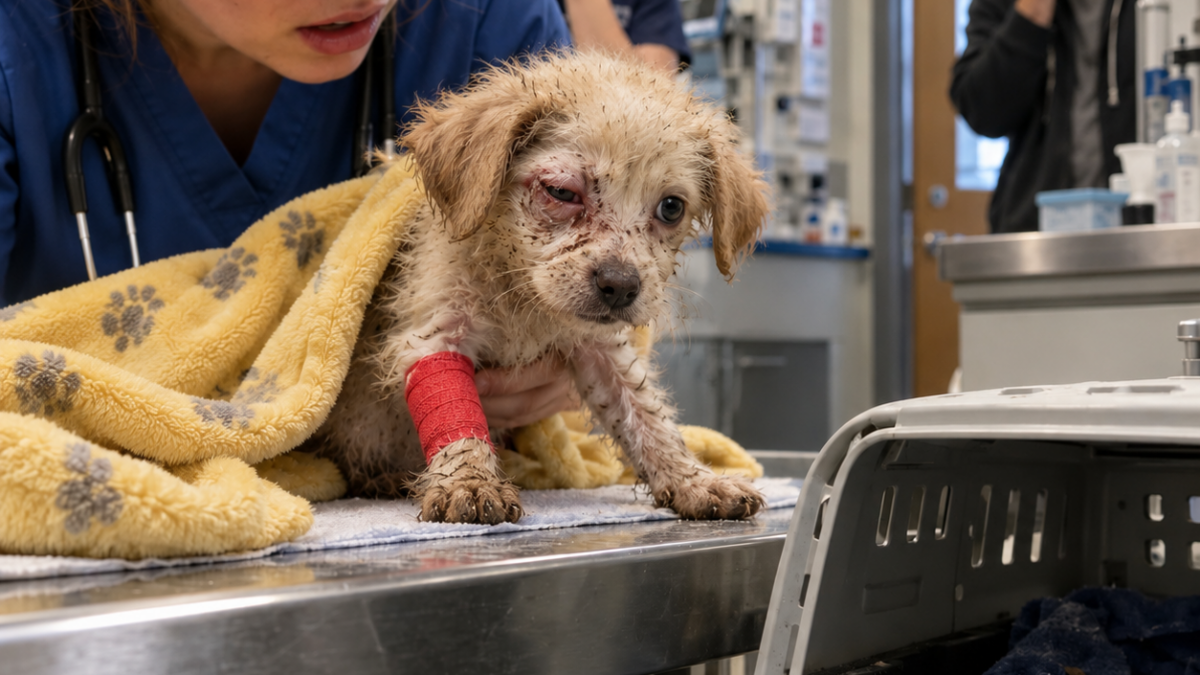
The puppy inside was so small that for half a second, I wondered how she had survived long enough to reach us. Her fur should have been pale cream, maybe almost white in better light, but it was matted with mud, oil, and dark streaks from whatever she had crawled through. One eye was swollen nearly shut. Her breathing came fast and shallow, her tiny ribs fluttering beneath skin that had no softness left to spare.
One front leg hung wrong.
Not grotesquely wrong.
Subtly wrong in the way that makes veterinary nurses move faster.
I reached for her carefully.
“Hey, sweetheart,” I whispered. “Let’s see what happened to you.”
She did not growl.
She did not snap.
She did not even try to pull away.
That scared me more than if she had.
Healthy puppies complain. They wiggle, whine, chew fingers, and announce their outrage to every human in the building. This puppy barely moved.
My coworker Jenna appeared at my side before I even called her.
“What do we have?”
“Female puppy,” I said. “Dehydrated. Chilled. Eye trauma. Possible front limb fracture.”
Daniel swallowed hard.
“Is she going to die?”
PART2:
No matter how many times people ask that question, there is never a gentle enough answer when you do not know.
“We’re going to work on her,” I said. “Right now, she’s alive, and that matters.”
He nodded like I had given him an order.
“What do you need me to do?”
“Tell the front desk exactly where you found her. Exact location, landmarks, anything you remember. Then stay close.”
He looked down at the puppy one more time.
“I thought she was alone.”
Something about the way he said it stayed with me, though at the time I did not know why.
We moved quickly.
Jenna checked her temperature while I assessed the injured leg. Dr. Patel was finishing surgery, so we began with what every cold, hurt puppy needs before anyone worries about the larger story.
Warmth.
Fluids.
Pain control.
Quiet hands.
A safe room.
I cleaned around her swollen eye as much as she would tolerate, which was far more than she should have. Jenna started warmed fluids. Her gums were pale. Too pale. We wrapped her in soft yellow fleece and placed her on the warming pad.
“Let’s call her Sunny for now,” Jenna said.
I glanced at the filthy, trembling little dog in front of us.
“Sunny?”
“She needs something good.”
PART3:
Sunny blinked her one good eye at us. It was dark brown, glossy with pain and exhaustion, but not empty.
That eye was watching everything.
The door.
The table.
The carrier Daniel had brought in after filling out the intake form.
The moment he set it near the wall, Sunny lifted her head.
At first, I thought the movement was a reflex. Then she tried to stand.
“No, no, no,” I whispered, placing my hand gently across her shoulders. “You don’t have to do that.”
Her legs trembled beneath her. Her injured front paw barely touched the blanket. Her ears flattened against her head, and a thin, desperate sound came from her throat.
Jenna frowned.
“She’s trying to get up.”
“I see that.”
I eased her back down.
Sunny fought me.
Not with strength.
She had almost none.
But with will.
She pushed her small chest up, shook, collapsed halfway, then tried again. Her body was begging to shut down, yet something inside her refused.
“Maybe she’s scared of the table,” Jenna said.
“Maybe.”
We moved slower. Softer. I dimmed the light. Jenna warmed another blanket. Daniel stood just outside the treatment room window, both hands pressed against the glass, looking like a man watching his own heart being operated on.
When Dr. Patel came in, his face changed the moment he saw her.
“How long since she was found?”
“Less than an hour,” I said.
“Any sign of a mother?”
“Daniel said no.”
Dr. Patel leaned close, listening to Sunny’s chest, checking her belly, her jaw, her paws.
“She’s young,” he said. “Eight weeks, maybe nine. Undernourished. Leg likely fractured. Eye infection or trauma. We need X-rays, antibiotics, pain meds, and a full exam once she stabilizes.”
Sunny tried to stand again.
This time, she nearly slid off the warming pad.
I caught her with both hands.
“Sweetheart, stop,” I whispered, more frightened than frustrated. “You’re going to hurt yourself.”
Dr. Patel watched her carefully.
“What is she trying to reach?”
We all turned.
Sunny’s one open eye was locked on the carrier.
It was a cheap plastic carrier with a cracked handle and mud smeared along the bottom. Daniel had used it to bring in the towel, then carried her the rest of the way in his arms. It sat by the cabinet, empty except for a few clumps of dirt.
Dr. Patel nodded toward it.
“Move it.”
Jenna picked up the carrier and shifted it across the room.
Sunny made a sound I will never forget.
It was not a normal puppy whine. It was higher, broken, panicked. She dragged herself toward the edge of the table with her bandaged little leg tucked beneath her, her body shaking so hard I thought her heart might give out.
Daniel stepped into the doorway.
“What happened?”
“Stay there,” Dr. Patel said.
Sunny cried again, eyes fixed on the carrier.
I looked at Jenna.
Then at the towel.
The dirty blue towel lay half-folded on the counter where Daniel had placed it. I picked it up to check for debris, glass, burrs, anything that might tell us more about where she had been trapped.
That was when I saw it.
A tiny tuft of gray fur caught in a fold of the towel.
I held it between my gloved fingers.
Sunny was cream-colored.
This fur was not hers.
It was soft, short, and pale gray, the kind of fur you see on very young puppies before their adult coat comes in.
My stomach tightened.
“Daniel,” I said slowly, “when you found her, was there anything else under those boards?”
His face went white.
“I didn’t see anything.”
“Did you hear anything else?”
He opened his mouth.
Closed it.
Then whispered, “Scratching.”
The room went still.
Jenna stepped closer.
“More than one?”
Daniel’s eyes filled with horror.
“I thought it was her.”
Sunny cried again, still staring at the carrier like it held a doorway back to somewhere we had no idea existed.
Dr. Patel’s expression hardened into the calm focus I had seen during emergencies.
“Get animal control on the phone. Tell them we may have more puppies trapped at the storage facility.”
Daniel shook his head.
“No, we can’t wait.”
“You are not going back alone,” Dr. Patel said.
“The owner will lock the gate,” Daniel said. “He already told me not to mess around behind the maintenance buildings. He said if there were strays back there, he’d handle it.”
The way he said handle it made my skin go cold.
“Who’s the owner?” I asked.
“Wade Harlan.”
I knew that name.
Everyone in our county knew Wade Harlan. He owned storage units, rental lots, half-empty garages, and a towing business that seemed to profit from everyone else’s bad day. He had a reputation for smiling in public and treating people like trash in private.
Daniel looked ashamed.
“I should’ve checked more.”
I stepped closer to him.
“You brought her in.”
“But I left the rest.”
“You didn’t know.”
Sunny let out another weak cry.
Daniel looked at her, and something in him changed.
“I know now.”
Within ten minutes, Jenna was on the phone with animal control, Dr. Patel was stabilizing Sunny for X-rays, and Daniel was pacing our lobby while rain hammered the windows.
Then Wade Harlan walked in.
He was a broad man in a black raincoat with slick silver hair, expensive boots, and the kind of smile that never reached his eyes.
“Daniel,” he said loudly. “You want to explain why my afternoon has been interrupted by a call about police and dogs?”
Daniel froze.
Wade looked through the treatment room window and saw Sunny on the table.
His mouth curled.
“You brought that thing here?”
Jenna’s head snapped up.
I stepped into the hallway before she could say what her face promised.
“That puppy is receiving emergency treatment,” I said.
Wade looked me over like I was a piece of furniture blocking his path.
“That puppy came from my property.”
“Then your property may contain other injured animals.”
“My property contains old lumber, junk, and whatever strays crawl in from the road. That doesn’t make them my responsibility.”
Daniel’s hands clenched.
“You heard scratching yesterday.”
Wade turned on him.
“You want to be very careful right now.”
Daniel’s voice shook, but he did not back down.
“You told me to ignore it.”
“I told you not to waste company time chasing pests.”
The lobby went silent.
A woman waiting with a golden retriever stared at him. An older man near the front desk lowered his magazine.
Wade noticed the attention and smoothed his expression.
“People get emotional about animals,” he said, laughing lightly. “But this is private property and a liability issue.”
“A suffering animal is not a liability issue,” I said. “It’s an emergency.”
His eyes sharpened.
“You a vet or a receptionist?”
“I’m the person standing between you and that treatment room.”
For a second, no one breathed.
Then a deputy sheriff walked in behind him with two animal control officers.
Wade’s confident smile disappeared.
Daniel pointed toward the door.
“I’ll show them.”
Wade grabbed his arm.
“You step off this property, don’t come back tomorrow.”
Daniel looked down at Wade’s hand.
Then he looked through the glass at Sunny.
The puppy had finally stopped trying to stand, not because she had given up, but because the pain medication had softened the war she was fighting inside her body. Her good eye was still open.
Still watching.
Daniel pulled his arm free.
“Then I guess I don’t work for you anymore.”
I stayed at the clinic while they left. Somebody had to stay with Sunny. But every minute felt like an hour.
Dr. Patel took X-rays. Her leg was fractured, but repairable. Her eye was badly infected, but not hopeless. She was underweight, dehydrated, bruised, and exhausted.
Still alive.
Still fighting.
Nearly forty minutes later, Daniel called the clinic.
Jenna put him on speaker.
His voice was breathless.
“We found them.”
I gripped the counter.
“How many?”
There was a pause, then a sound in the background.
Tiny crying.
“Three,” Daniel said, and his voice broke. “Three puppies.”
Jenna covered her mouth.
Daniel kept talking fast.
“They were behind the maintenance shed, under a collapsed pallet rack. One gray one was wedged under a board. The others were in a drainage gap. Sunny must have crawled out. There’s blood on the boards where she pushed through.”
Dr. Patel closed his eyes for one second.
Not weakness.
Grief.
Then action.
“Bring them now.”
When Daniel returned, he was soaked to the bone and carrying a cardboard file box lined with towels. Behind him came one animal control officer, also drenched, holding a gray puppy against her chest.
The gray one was the smallest.
The tuft of fur in Sunny’s towel had come from him.
He was cold, muddy, and weak, but alive.
Sunny heard him before we even opened the box.
Her head lifted.
A sound came out of her—not the panicked cry from before, not pain, not fear.
Recognition.
The gray puppy answered.
It was barely a squeak.
But Sunny heard it.
She tried to rise again.
This time, I did not stop her completely. I supported her chest and let her see them.
Three puppies.
One gray.
One brown with white toes.
One black with a tan stripe above one eye.
They were filthy, starving, and shaking. But they were breathing.
Sunny stretched her neck toward them, sniffing frantically. The gray puppy rooted blindly toward her face. She licked the mud from his forehead with tiny, trembling strokes, as if she had been holding that kiss inside her the whole time.
Daniel turned away and wiped his face.
The animal control officer spoke quietly.
“She was lying across the gap when he found her.”
I looked up.
“What?”
“When Daniel pulled the boards away, he found blood and fur where she’d been squeezing through. Best we can tell, she got out, but kept trying to get back in. That’s how she hurt the leg worse.”
Dr. Patel looked at Sunny.
“She wasn’t trying to escape.”
“No,” the officer said. “She was trying to get help.”
That sentence settled over the room like a prayer.
This tiny injured puppy, starving and hurt and terrified, had dragged herself out from under those boards not to abandon the others, but because they were trapped and she was the only one who could move.
She had stayed awake because somewhere behind her, her family was still crying.
News travels fast in a small town.
By morning, everyone knew what had happened behind Harlan Storage. Photos of the rescue spread across local pages. Not graphic photos. Just Daniel in the rain. The cardboard box. The muddy blue towel. Sunny’s one open eye watching over the puppies beside her.
Wade Harlan tried to deny everything.
He claimed he never knew the dogs were there.
Then the deputy reviewed security footage.
The cameras behind the maintenance buildings had captured more than Wade expected. They showed a stray mother dog weeks earlier, limping near the sheds. They showed workers complaining to Wade. They showed Wade ordering old boards stacked across the gap beneath the building.
And worst of all, they showed Daniel pointing toward the shed the day before the rescue, clearly concerned, while Wade waved him off and walked away.
Animal control opened a neglect investigation. The sheriff’s office cited him for obstruction and false statements. The county inspected his property and found violations that had nothing to do with dogs and everything to do with arrogance. Unsafe structures. Illegal dumping. Blocked drainage. Improper storage of chemicals.
Wade Harlan had spent years treating people like they were too small to matter.
In the end, it was a five-pound puppy that exposed him.
Daniel came to the clinic every day.
At first, he stood outside the recovery room like he was afraid to ask for permission.
Then Sunny began wagging her tail when she heard his voice.
It was the smallest wag at first. Barely a flick beneath her blanket. But Daniel saw it, and it nearly broke him.
“Hey, brave girl,” he whispered, sitting beside her kennel. “You still mad at me for not finding them sooner?”
Sunny blinked at him slowly, then rested her chin on the blanket.
Jenna leaned toward me and murmured, “That dog has already forgiven him.”
“I’m not sure he’s forgiven himself.”
The puppies improved day by day.
The brown one with white toes turned into a noisy little troublemaker. The black one tried to chew every towel we gave him. The gray one, the smallest, stayed close to Sunny whenever we let them visit.
Sunny’s surgery went well. Dr. Patel repaired her fractured leg, and although she would always have a slight limp, she would run one day. Her eye healed better than we expected. The swelling went down. The cream color of her coat slowly returned.
Daniel paid what he could.
The rest of the town covered without being asked.
A retired teacher brought blankets. A mechanic brought puppy food. The woman with the golden retriever donated money and said, “For the one who wouldn’t lie down.”
Two weeks later, Wade Harlan appeared in court for his first hearing.
Daniel was there.
So were Jenna, Dr. Patel, the animal control officers, and half the town.
Wade walked in wearing a pressed suit and the same polished smile, but it didn’t work anymore. Not after everyone had seen the footage. Not after everyone had seen Sunny trying to crawl back to that carrier with a broken leg and a heart bigger than any man in that courtroom.
When the judge reviewed the evidence, Wade’s attorney tried to call it a misunderstanding.
The judge looked over her glasses.
“A misunderstanding is when someone misses a sign,” she said. “This was a choice.”
Wade was fined heavily, ordered to pay restitution, and barred from owning or keeping animals. His storage facility was placed under county review. Daniel’s wrongful termination complaint moved forward. By the time it was over, Wade Harlan no longer looked untouchable.
He looked small.
After the hearing, Daniel found me outside on the courthouse steps.
“I’m adopting her,” he said.
I smiled because I had known that for days.
“Sunny?”
“And the gray one,” he added. “If that’s allowed.”
I raised an eyebrow.
“Only the gray one?”
He looked embarrassed.
“My apartment’s small.”
Jenna, standing beside me, coughed into her hand.
“Daniel,” she said, “you lost your job saving four puppies in a rainstorm. The town knows. You think nobody’s going to help you find a bigger place?”
Three months later, Daniel moved into a small rental house with a fenced yard owned by the retired teacher who had donated blankets. She gave him half off rent and said Sunny had already provided “excellent references.”
Sunny went home with him on a bright Saturday morning.
She wore a soft blue harness, almost the same color as the towel that had carried her into our clinic. Her leg had healed enough for slow walks. Her fur was clean and cream-colored. Her once-swollen eye was clear.
The gray puppy trotted beside her, round-bellied and clumsy, trying to step exactly where she stepped.
Daniel named him Scout.
When Sunny reached the clinic door, she stopped.
For a moment, she looked back at us.
I knelt in front of her.
“You did good, sweetheart,” I whispered.
She leaned forward and pressed her nose against my hand.
Then she turned and limped into the sunlight beside the man who had heard one small sound and decided it mattered.
People like to say animals don’t understand sacrifice.
I don’t believe that anymore.
I saw a starving little puppy refuse warmth, refuse rest, refuse sleep, and refuse to lie down because three tiny lives were still trapped in the dark behind her.
I saw a man risk his job because guilt turned into courage.
I saw a cruel man exposed not by power, money, or pride, but by one dirty blue towel and a tuft of gray fur.
And every time I think about Sunny, I remember her on that treatment table, trembling on broken legs, fighting the hands trying to save her because she thought we had taken her away from the ones who still needed her.
She was never just an injured puppy.
She was a sister.
She was a survivor.
And before any of us understood what love had cost her, she had already shown us what it meant.








