The Honor Guard Kept Dropping the Rifle During Practice—Then an 80-Year-Old Veteran Raised One Finger and Spun the M1 Garand Like It Weighed Nothing
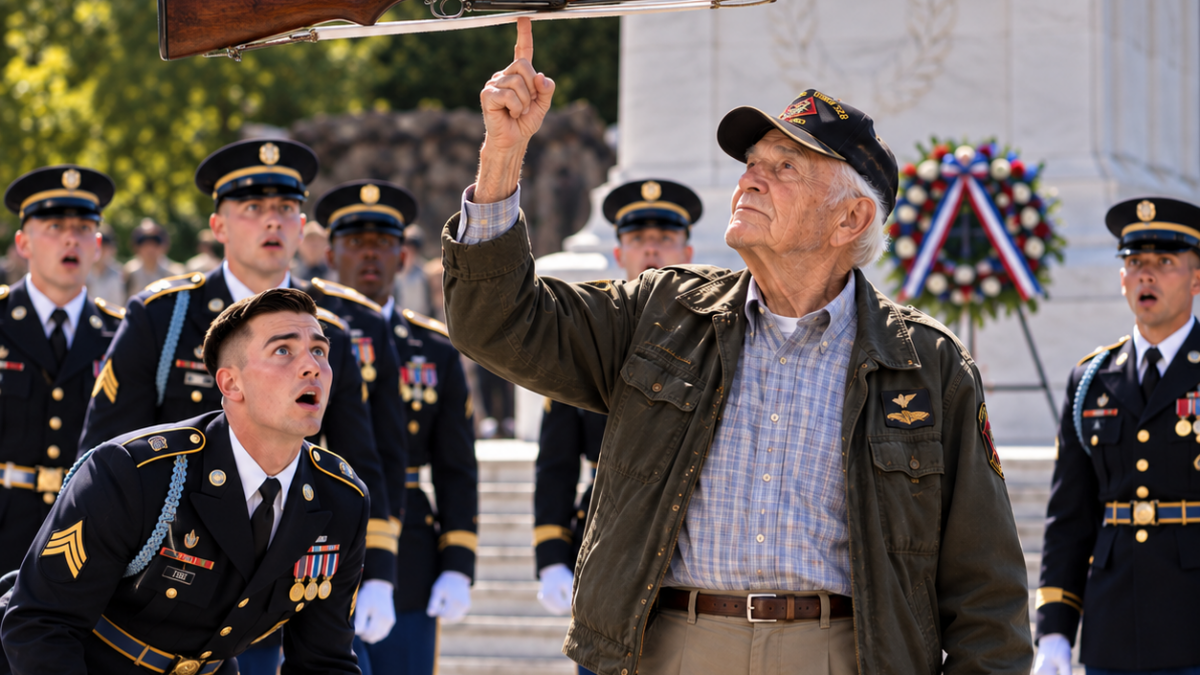
PART2:
A controlled ceremonial sequence built around timing, balance, rhythm, and months of repetition.
A rifle moved from shoulder to hand, hand to air, air to blind catch.
Nobody in the audience was supposed to think about physics.
Nobody was supposed to imagine what happened if a palm was two inches wrong.
Done correctly, it looked effortless.
That illusion was the product.
Jenkins could perform the sequence.
He had done it.
Hundreds of times.
In the gym.
On grass.
On the indoor floor.
During rehearsals without an audience.
But that morning every time Staff Sergeant Vance said:
“Ready.”
Jenkins could see the ceremony.
The cameras.
The generals.
His platoon commander.
His parents watching from Pennsylvania.
And then his hands stopped belonging to him.
“Set.”
Jenkins inhaled.
“Move.”
The rifle came up.
His right hand pushed.
The weapon rotated.
Too fast.
Jenkins reached behind him.
Missed.
Clang.
Second drop.
Vance closed his eyes.
Nobody spoke.
Jenkins whispered:
“Damn it.”
Vance heard.
“What was that?”
“Nothing, Staff Sergeant.”
“Good.”
Vance stepped closer.
He was thirty-seven, compact, dark-haired, and so disciplined that even his frustration seemed organized.
He had spent fourteen years in the Army.
Two deployments before transferring into ceremonial duty.
He loved the work more fiercely than he admitted.
People outside ceremonial units sometimes saw polished shoes and synchronized rifles and assumed pageantry.
Vance knew better.
Ceremony was not war.
It was not supposed to be.
But precision mattered because families remembered details.
A flag folded wrong at a funeral could live in a widow’s mind for years.
A misstep at a memorial could become the moment a Gold Star father saw instead of the honor surrounding it.
Perfection was not vanity to Vance.
It was service.
That belief could make him hard.
Sometimes too hard.
He walked around Jenkins.
“You know the sequence?”
“Yes, Staff Sergeant.”
“You know the timing?”
“Yes.”
“You know the release?”
“Yes.”
“Then what are you doing?”
Jenkins stared ahead.
“I don’t know.”
“Wrong answer.”
Vance leaned closer.
“You are thinking.”
Jenkins blinked.
“You are thinking about missing.”
“You are thinking about everyone watching.”
“You are thinking about whether I’m angry.”
“I am angry, by the way.”
A few soldiers nearly smiled.
Vance continued.
“But none of that belongs in the movement.”
He tapped Jenkins’s forearm.
“This does.”
“Your hand.”
“Your timing.”
“The rifle.”
“That’s all.”
“Yes, Staff Sergeant.”
“Again.”
Third drop.
Then fourth.
By the fifth, sweat had soaked the back of Jenkins’s ceremonial undershirt.
By the sixth, Vance was afraid the young soldier had crossed the line between correcting a mistake and expecting one.
That was dangerous.
Once a body learned fear into a movement, repetition could reinforce the fear as easily as the skill.
Vance knew that.
He also knew they had seventy-two hours.
“Water break.”
The line relaxed.
Jenkins did not.
He stood staring at rifle in his hands.
Across the narrow fence separating the training pad from a shaded public walkway, an old man sat beneath an oak tree.
He had been there almost an hour.
Nobody had paid attention to him.
He wore a short-sleeved checkered shirt tucked into tan trousers pulled slightly too high.
Orthopedic walking shoes.
A faded green windbreaker folded beside him despite heat.
A wooden cane rested against bench.
He was feeding small pieces of plain bagel to a squirrel that had learned elderly men were easier targets than children.
His name was Thomas Miller.
He was eighty years old.
His left hand trembled slightly when it rested.
His right knee had been replaced.
His lower back complained whenever humidity climbed.
And he had spent the last forty-five minutes watching Jenkins make one mistake over and over.
Not with the rifle.
With himself.
Miller broke another piece of bagel.
“He’s gripping too hard.”
The squirrel did not care.
“The boy’s trying to win a fight with it.”
Vance heard.
He turned.
“Excuse me?”
Miller looked up.
“Nothing.”
“You said something about my soldier.”
Miller considered pretending he had not.
Age had made him less interested in arguments but not necessarily wiser about avoiding them.
“He’s gripping too hard.”
Several soldiers looked toward fence.
Vance walked over.
“Sir, this is an active training area.”
“I can see that.”
“We need minimal distractions.”
“I’m sitting on a bench.”
“You’re commenting on training.”
Miller nodded.
“That was probably unnecessary.”
Vance waited.
Miller looked toward Jenkins.
Then added:
“Still true.”
A soldier coughed to hide laugh.
Vance turned his head.
Nobody moved.
He faced Miller.
“And what exactly are you seeing?”
Miller pointed toward Jenkins.
“Shoulders.”
“What about them?”
“Up around his ears.”
“His right forearm is locked before release.”
“He’s squeezing harder each attempt.”
“He thinks more grip means more control.”
“It doesn’t.”
Vance stared.
Miller continued:
“The rifle needs a clean pivot.”
“If he fights rotation, he moves centerline every time.”
Vance looked back at Jenkins.
The old man was right.
Not magically right.
Technically right.
Vance had been focused on Jenkins’s release angle and catch position.
He had missed the tension building before the throw.
Vance did not enjoy realizing a stranger on a park bench had seen something first.
“And you know this because?”
Miller shrugged.
“I’ve held one.”
“A rifle?”
“Yes.”
Vance glanced at cane.
Then faded shoes.
“Sir, a lot of people have held rifles.”
“True.”
“This is precision exhibition drill.”
“I noticed.”
“It takes months.”
“Yes.”
“Years to master at the highest level.”
“Yes.”
Vance’s irritation returned.
“And you’re diagnosing it from a park bench?”
Miller smiled faintly.
“You asked.”
One of the soldiers looked down quickly.
Vance sighed.
“Sir, I appreciate your interest.”
“But I need to get these men back to work.”
Miller nodded.
“Then get the boy to loosen his hand.”
Vance’s jaw tightened.
“Have a good morning.”
“You too.”
Vance turned away.
Miller returned to squirrel.
Jenkins had heard everything.
That made it worse.
A random old man now understood his failure too.
Vance called:
“Jenkins.”
“Yes, Staff Sergeant.”
“Come here.”
Jenkins approached.
Vance lowered voice.
“Forget him.”
“Yes.”
“But he’s right about one thing.”
Jenkins looked surprised.
“Your shoulders are locked.”
“Shake them.”
Jenkins did.
“Again.”
He rolled shoulders.
“Loosen right hand.”
Jenkins opened and closed fingers.
Vance positioned them slightly.
“Stop strangling the rifle.”
“Yes.”
“You don’t get extra points for bruising walnut.”
A tiny smile.
Good.
“Now reset.”
Jenkins stepped back.
Vance hoped.
“Ready.”
Jenkins raised rifle.
“Move.”
The weapon left his hand.
For one beautiful instant the rotation looked correct.
Then Jenkins saw himself succeeding.
That single thought disrupted timing.
His palm came late.
The rifle clipped shoulder.
Dropped.
Clang.
Jenkins did not move.
Vance stared at ground.
The old man under tree winced.
Not because failure.
Because rifle had landed on edge of stock.
Jenkins whispered:
“I can’t do it.”
Vance heard.
His instinct said attack statement.
Destroy it.
No soldier says can’t.
But something in Jenkins’s face stopped him.
The kid was nineteen.
He looked sixteen.
Vance stepped closer.
“You can.”
Jenkins shook his head once.
Not insubordinate.
Broken.
“I’m sorry.”
Vance looked at rifle.
Then line.
Then clock.
His frustration beat against better judgment.
“Take five.”
“Staff Sergeant—”
“Five.”
Jenkins stepped away.
That should have ended it.
But Miller stood.
He picked up cane.
Slowly crossed toward gate.
Vance saw.
“Oh, no.”
Miller opened public-side latch.
“Sir.”
Miller stepped through.
“Sir, stop.”
The old man walked onto pad.
His cane tapped concrete.
Tap.
Tap.
Tap.
The squad watched.
Vance moved toward him.
“This is restricted.”
Miller stopped.
“My mistake.”
“Then please go back.”
He looked toward Jenkins.
“The boy isn’t done.”
Vance stared.
“Sir—”
“He thinks dropping rifle means he doesn’t belong here.”
Jenkins looked up.
Miller continued.
“That’s what you’re fighting now.”
“Not the spin.”
Vance crossed arms.
“And you propose what?”
“Let him see it slower.”
“We’ve broken it down.”
“I know.”
“You’ve watched for an hour.”
“Yes.”
“You think you can demonstrate?”
Miller looked at rifle.
Then cane.
Then Vance.
“I think I can show him balance.”
Vance almost said no.
Should have, by procedure.
A civilian handling ceremonial weapon in an active training area was not something to improvise.
But this was a drill rifle under controlled conditions, cleared and maintained for exhibition use, and Miller’s technical observations were increasingly difficult to dismiss.
Still:
“Sir, how old are you?”
“Old enough to dislike question.”
A couple soldiers smiled.
Vance did not.
“That rifle weighs nearly ten pounds.”
“I know.”
“If you drop it—”
“I’ll apologize.”
“If you injure yourself—”
“My granddaughter will blame you.”
“That is exactly what I’m trying to avoid.”
Miller looked at Jenkins.
“May I show him grip?”
Jenkins looked to Vance.
Vance exhaled.
“Only grip.”
“No toss.”
Miller nodded.
“Fair.”
Vance took rifle from Jenkins himself.
Checked safe ceremonial condition.
Then handed it to Miller muzzle controlled, deliberate.
Something changed the instant Miller’s hands touched wood.
Not youth.
Not magic.
He still had age spots.
His left hand still trembled faintly.
But the rifle settled.
There is a difference between holding unfamiliar weight and receiving a familiar object.
Miller did the second.
His right hand moved without searching.
The tremor disappeared under purposeful tension.
He balanced rifle horizontally.
Shifted fingers.
“See this?”
Jenkins stepped closer.
“Yes, sir.”
“You keep putting pressure here.”
Miller indicated position near lower band.
“So?”
“It moves pivot.”
“You spend entire throw correcting something you created.”
Jenkins frowned.
Miller repositioned hand slightly.
“Feel where rifle wants to balance.”
He held it lightly.
Almost insultingly lightly.
Jenkins reached.
Miller transferred part of weight.
Jenkins’s eyes widened.
“That feels different.”
“Of course.”
“You’ve been carrying it.”
“You’re supposed to guide it.”
Vance watched.
That was good instruction.
Simple.
Clear.
No mysticism.
Miller glanced toward him.
“Staff Sergeant?”
“Yes?”
“May I do one rotation?”
Vance gave disbelieving laugh.
“No.”
Miller nodded.
“Fair.”
He returned rifle toward Vance.
Then Jenkins said:
“Staff Sergeant.”
Vance looked.
“Please.”
Vance stared at kid.
Then old man.
“This is a terrible idea.”
Miller said:
“Most memorable ones are.”
“That is not reassuring.”
Vance rubbed face.
“One controlled spin.”
“No aerial release.”
“No behind-the-back.”
“Understood?”
Miller’s eyes warmed.
“Understood.”
The squad subtly leaned forward.
Miller set cane down.
He widened stance only enough to stabilize knee.
The rifle came to port position.
Quick.
Clean.
Crisp enough that sling snapped lightly against stock.
Vance’s expression changed.
That movement was not improvised.
Not learned at county parade.
Miller rotated rifle once across right palm.
The weapon rolled through controlled circle.
Then another.
His index finger found balance.
For perhaps two seconds, rifle spun horizontally around a single pivot, not flying, not defying gravity, but moving with such efficient control that it looked weightless.
Then Miller stopped it.
Perfect.
No flourish.
No smile.
Jenkins whispered:
“How?”
Miller handed rifle back.
“Practice.”
Vance narrowed eyes.
“No.”
Miller looked.
“No what?”
“That’s not backyard practice.”
Miller picked up cane.
“Never said it was.”
“What unit?”
The old man hesitated.
“Army.”
Vance nearly laughed.
“What unit?”
“Third Infantry.”
Several heads snapped.
The Old Guard.
Vance stepped closer.
“When?”
“Long time ago.”
“What element?”
Miller looked annoyed now.
“Does it matter?”
“Yes.”
“Why?”
“Because that hand sequence you just used resembles old exhibition drill.”
Miller’s mouth twitched.
“Resembles?”
Vance stared harder.
There was a thin scar under Miller’s chin.
A diagonal white line almost hidden by age.
Something stirred in memory.
Photographs in hallway.
Unit history.
Black-and-white images.
A younger man spinning M1 during ceremonial demonstration.
Different face.
Same scar?
Vance shook it off.
Too many veterans.
Too many stories.
He said:
“One more.”
Miller frowned.
“You told one.”
“I changed mind.”
Jenkins almost smiled.
Miller looked at line.
Young soldiers.
Sweat.
Expectation.
Then at Vance.
“Behind-the-back?”
Vance’s mouth opened.
“You can still do that?”
Miller gave smallest shrug imaginable.
“We’re about to find out.”
“No.”
Jenkins laughed nervously.
Vance pointed:
“If I regret this, all of you will regret it.”
“Yes, Staff Sergeant.”
Miller handed cane to Jenkins.
“Hold that.”
Jenkins took.
Miller reset.
For first time, squad saw his posture.
Heels near together.
Back straighter than age suggested.
Chin level.
The old body seemed to remember geometry.
The rifle came up.
Miller initiated controlled toss.
Not twenty feet.
Not circus.
A compact exhibition rotation just above shoulder line.
One full horizontal turn.
His eyes stayed forward.
Left hand received behind back.
Clean.
He brought rifle around.
Palm rolled.
Another rotation.
Catch.
Then, because old habits are often stronger than common sense, Miller let the stock travel into a finger-balanced spin.
Three revolutions.
Four.
Five.
Wood and steel blurred around pivot.
The squad collectively stopped breathing.
Vance whispered:
“No way.”
Miller arrested motion.
Brought rifle vertical.
Order arms.
Butt settled on pad beside shoe with a soft controlled tap.
Silence.
Miller exhaled.
Then immediately bent slightly at waist.
His back had opinions.
Jenkins handed cane.
“You okay, sir?”
Miller grimaced.
“That was considerably easier in 1964.”
The line burst into laughter.
Even Vance.
Tension broke.
Then Sergeant First Class Owens, who had been walking from admin building carrying water cooler, stopped twenty yards away.
He stared.
Dropped one side of cooler.
“Staff Sergeant.”
Vance looked.
Owens walked closer.
He was forty-four and the unit history obsessive every platoon has.
He looked at Miller.
Then face drained.
“Sir.”
Miller sighed.
“Oh, hell.”
Owens came to attention.
Not theatrically.
Instinctively.
“Sergeant Major Miller?”
Jenkins looked from one to other.
Vance said:
“What?”
Owens stared at old man.
“Thomas Miller?”
Miller closed eyes briefly.
“Yes.”
Owens turned to line.
“Platoon.”
Vance stopped him.
“Hold.”
He looked at Miller.
“Is he right?”
Miller seemed suddenly embarrassed.
“Yes.”
Vance whispered:
“Thomas Miller.”
The name landed.
Not because every soldier knew instantly.
Jenkins did not.
Several others did not.
But Vance did now.
A photograph in regimental history display.
Young staff sergeant.
M1 Garand.
Demonstration team.
Then another photograph from later years.
Senior NCO instructing ceremonial platoon.
Thomas “Iron” Miller.
Not a superhero.
Not record-holder guarding one post six uninterrupted years.
The stories soldiers told had grown.
The actual career was enough.
Miller had served in The Old Guard during the 1960s.
Part of ceremonial and exhibition drill assignments.
Later an instructor.
Later Vietnam service? Could deepen. Let’s give him combat service after ceremonial duty, then returned to training. Plausible: first Old Guard, then Vietnam, then back later. Need avoid overclaim.
He had served in Vietnam after his first ceremonial tour.
Returned to The Old Guard years later as senior instructor.
Retired as sergeant major.
His name appeared in internal drill history because he helped standardize portions of exhibition training and was known for teaching balance rather than brute force.
Vance looked at cane.
Then rifle.
“You trained this?”
Miller shook head.
“Not this exact sequence.”
“Parts.”
“Long time ago.”
Owens said:
“Sir, there’s photo of you in regimental hall doing finger pivot with M1.”
Miller groaned.
“I told them not to hang that.”
“You were twenty-six.”
“I was stupid.”
The soldiers laughed again.
Owens continued:
“You were on the Army Drill Team?”
“Yes.”
“For years?”
“On and off.”
“You trained teams?”
“Yes.”
Vance looked embarrassed.
“Sir, I owe you apology.”
Miller waved.
“No.”
“I talked to you like—”
“Like civilian wandered into restricted training area.”
“Which I did.”
“You did job.”
Vance glanced at soldiers.
“I was disrespectful.”
Miller studied him.
“Maybe a little.”
The line became very still.
Then Miller smiled.
“But I’ve survived worse.”
Vance nodded.
“Yes, Sergeant Major.”
Miller turned immediately.
“Don’t.”
“Sir?”
“I’m retired.”
“Mr. Miller works.”
“Thomas if you’re buying coffee.”
Vance tried smile.
Then his eyes shifted toward Jenkins.
Miller followed.
The young soldier still held rifle.
Shoulders slightly lowered now.
But shame had not disappeared completely.
Miller stepped closer.
“What’s your first name?”
“Ethan, sir.”
“Ethan.”
“Stop calling me sir every breath.”
“Yes, sir.”
Miller raised eyebrow.
A few soldiers grinned.
Jenkins swallowed.
“Yes.”
“Better.”
Miller touched rifle lightly.
“You dropped it six times?”
Jenkins looked down.
“Seven.”
“Good.”
Jenkins blinked.
“Good?”
“Now you know seven ways not to catch it.”
“That’s not how Staff Sergeant sees it.”
Vance folded arms.
“I’m listening.”
Miller turned to him.
“You ever drop one?”
Vance hesitated.
The soldiers watched.
“Yes.”
“How many?”
“Enough.”
“Then why pretend otherwise?”
Vance’s face changed.
Fair.
Miller looked at Jenkins.
“I dropped one.”
Jenkins stared.
“You?”
“Yes.”
“When?”
“First month.”
“What happened?”
“My sergeant made me strip and clean it.”
“Then practice basic manual until my shoulders stopped working.”
“Did you ever drop again?”
Miller smiled.
“Of course.”
Vance laughed.
Owens looked scandalized.
“History board says—”
“History board lies.”
Miller pointed at him.
“Don’t believe everything under glass.”
That became first real lesson of morning.
People improve old men into legends.
Legends are easier than humans.
Miller had been exceptional.
He had also missed catches.
He had been young once.
Scared.
Proud.
Tired.
Hands sweating.
He knew Jenkins because he had been Jenkins.
Miller said:
“You know why you keep failing?”
Jenkins looked at Vance.
Then Miller.
“Pressure.”
“Partly.”
“You care too much about proving you belong.”
Jenkins’s eyes dropped.
Miller continued:
“That rifle is not exam result.”
“Ceremony is not about you looking perfect.”
“Then why does perfect matter?”
Jenkins asked.
Good question.
Miller considered.
“Because people watching deserve care.”
“Not because they need magic.”
“Because detail tells them you prepared.”
“That you showed up.”
“That their dead aren’t being handled casually.”
He nodded toward memorial grounds.
“When you make ceremony about yourself, pressure becomes unbearable.”
“When you make it about service, your job gets smaller.”
Jenkins whispered:
“How?”
“Do one movement.”
“Not entire ceremony.”
“Not president.”
“Not cameras.”
“Not your mother.”
Jenkins looked up, startled.
“How’d you know?”
Miller smiled.
“Everybody’s mother watches.”
Even Vance laughed.
“Close your eyes.”
Jenkins did.
“Hold rifle.”
He did.
Miller adjusted fingers perhaps half inch.
“Feel weight.”
“Yes.”
“Where?”
“Front-heavy.”
“Good.”
“Don’t correct.”
“Notice.”
Jenkins breathed.
“Now loosen thumb.”
He did.
“Shoulders.”
They dropped.
“Again.”
Miller stepped back.
“Open eyes.”
Jenkins did.
“Do only first release and catch.”
Vance started:
“Sergeant Major—”
Miller looked.
Vance stopped.
“Mr. Miller.”
“Better.”
Jenkins reset.
No behind-the-back.
No full sequence.
Just simple controlled rotation.
“Ready?”
Miller asked.
“Yes.”
“Don’t say it like confession.”
“Yes.”
Miller nodded.
“Go.”
Jenkins released.
Rifle rotated.
Caught.
Clean.
His face changed.
“Again.”
Second.
Clean.
“Again.”
Third.
Slight wobble.
Caught.
Miller said:
“Good.”
Jenkins smiled.
“Now behind.”
The young soldier looked at Vance.
Vance nodded.
Jenkins inhaled.
Not huge.
Just breath.
Released.
Rotation.
Hand behind back.
Smack.
Caught.
The squad erupted.
Jenkins’s eyes went wide.
“I got it.”
Miller immediately said:
“Again.”
The cheering died.
“Why?”
“Because one successful catch is coincidence.”
“A thousand is skill.”
Jenkins grinned.
“Yes.”
He repeated.
Caught.
Again.
Caught.
Fourth wobbled.
He nearly lost.
Saved.
Miller said:
“That one teaches more than clean ones.”
Vance watched everything.
Something uncomfortable grew in him.
He had spent morning telling Jenkins to calm down while increasing stakes after every mistake.
One more drop and you’re out.
One more and you’re done.
He had been trying to force precision with fear.
Fear works sometimes.
Short term.
But fear narrows.
Ceremonial drill needed awareness.
Vance stepped toward Miller during water break.
“Can I ask something?”
“You just did.”
Vance smiled reluctantly.
“Did you teach like this back then?”
“No.”
“Why not?”
“I was worse than you.”
That surprised.
Miller leaned on cane.
“I thought pressure made men stronger.”
“Sometimes it reveals strength.”
“Not same as creating it.”
“When I was young, I confused those.”
“What changed?”
Miller looked toward distant memorial stones.
“War.”
The word settled.
Vance knew not to ask more.
Miller volunteered anyway.
“I left ceremonial assignment and went where mistakes weren’t embarrassing.”
“They were permanent.”
“When I came back, I had less appetite for breaking people over practice errors.”
Vance nodded.
“You served Vietnam?”
“Yes.”
“Infantry?”
“Army.”
He smiled.
“Let old man keep a few things.”
“Of course.”
There.
Boundary.
Vance respected.
Miller had not come to plaza hoping recognition.
His granddaughter had dropped him nearby because she was attending medical appointment.
He came early because he liked memorial grounds before crowds.
The bagel was breakfast.
The squirrel was opportunist.
That was all.
He had no intention of touching rifle.
Then Jenkins dropped.
Again.
Again.
Again.
And Miller recognized fear.
Not because he was legendary.
Because fear does not change much across generations.
At noon, granddaughter called.
“Grandpa?”
“Hello, sweetheart.”
“Where are you?”
“Near memorial.”
“Are you staying out of trouble?”
Miller looked at twenty ceremonial soldiers pretending not to listen.
“Yes.”
Vance coughed.
Miller glared.
Granddaughter said:
“What was that?”
“Nothing.”
“I’ll be there in forty minutes.”
“Fine.”
“Don’t wander.”
“I’m eighty.”
“You wander professionally.”
Call ended.
Jenkins whispered:
“Your granddaughter talks to you like recruit.”
Miller said:
“Worse.”
The soldiers laughed.
Vance looked at schedule.
They had forty minutes.
He made decision.
“Mr. Miller.”
“Yes?”
“Would you watch the sequence?”
Miller hesitated.
“I don’t want interfere.”
“You already have.”
Fair.
“Just watch.”
“Tell us what you see.”
Miller looked at line.
Then watch.
“Thirty minutes.”
Vance nodded.
The platoon formed.
Sequence began.
This time Miller watched not as performer but teacher.
He stopped them after ninety seconds.
“Too fast.”
Vance said:
“We’re on count.”
“Count is fine.”
“You’re rushing between counts.”
Silence.
“Rifle isn’t audience’s first concern.”
“What is?”
“Stillness.”
“Movement only looks sharp if stillness around it is complete.”
He demonstrated with cane.
Odd.
Effective.
“Here.”
“Everyone thinks precision means speed.”
“No.”
“Precision means same.”
“Same start.”
“Same stop.”
“Same angle.”
“Same breath if you can manage.”
He walked line.
One soldier tilted muzzle two degrees.
Miller saw.
Another’s elbow floated.
Saw.
A third anticipated command.
Saw.
Not mystical.
Decades trained eyes.
Vance absorbed.
Jenkins repeated problematic sequence at end.
One clean catch.
Then another.
Then drop.
Clang.
Everyone froze.
Jenkins’s face went pale.
Miller said immediately:
“Pick it up.”
Same words Vance had used.
But tone different.
Jenkins lifted.
Miller asked:
“What happened?”
“Released early.”
“Why?”
“Thought about catch.”
“Good.”
Jenkins blinked.
“Good?”
“You know why.”
“Fix.”
No shame.
No catastrophe.
Just information.
Jenkins reset.
Caught next.
Vance understood.
Mistake stopped being verdict.
It became data.
That did not lower standard.
It made standard reachable.
At 12:37 a silver SUV pulled near public walkway.
A woman in her forties stepped out.
“Miller!”
Every soldier turned.
Thomas winced.
“That’s me.”
She walked toward fence.
“Why are you inside?”
“Long story.”
“Grandpa.”
“Short story.”
She looked at rifle line.
Then Vance.
“Did he talk his way into something?”
Vance stood straighter.
“Ma’am, your grandfather has been assisting us.”
She closed eyes.
“Of course he has.”
Miller said:
“I was sitting quietly.”
“No one believes that.”
Jenkins stepped forward.
“Ma’am?”
She looked.
“Your grandfather helped me.”
Her expression softened.
“With what?”
Jenkins raised rifle slightly.
She looked at Miller.
“Did you spin one?”
Miller said nothing.
“Grandpa.”
“One.”
Vance looked away.
“More than one?”
Silence.
She pointed.
“Your cardiologist said no showing off.”
“It wasn’t cardiovascularly demanding.”
“You are impossible.”
The platoon was trying not to laugh.
Then she hugged him.
Miller pretended not to enjoy.
She looked around.
“My name’s Emily.”
“Thank you for not letting him fall.”
Miller protested.
“I did not fall.”
“Yet.”
Vance said:
“He’s steadier than most of us.”
Emily smiled.
“He’ll repeat that for six months.”
Miller picked up windbreaker.
Time to go.
Jenkins approached.
“Mr. Miller.”
“Yes?”
“Will you be at ceremony?”
Miller shook head.
“No ticket.”
Vance said:
“I can fix that.”
Miller immediately:
“No.”
“Why?”
“Because ceremony isn’t about me.”
“You wouldn’t be honored.”
“You’d be guest.”
Miller looked at Jenkins.
“Do you want me there?”
Jenkins nodded.
“Yes.”
Miller sighed.
“You’re using emotional manipulation.”
Jenkins smiled.
“Learning from leadership.”
Vance said:
“Careful.”
Miller laughed.
“All right.”
He attended.
Three days later, morning was cooler.
Crowds filled seating.
Security heavy.
Families in designated sections.
Veterans in wheelchairs.
Children holding flags.
Cameras.
Everything Jenkins had feared.
Miller sat beside Emily several rows back, wearing dark blazer over same checkered shirt.
No medals.
No ceremonial ribbons.
Just small Army lapel pin Emily had insisted on.
Vance saw him before formation.
They did not speak.
Jenkins saw too.
His heart accelerated.
Then he remembered:
Not entire ceremony.
One movement.
The unit entered.
Stillness.
Command.
Rifles moved as one.
Miller watched.
Not searching for mistakes.
Just watching.
The difficult sequence approached.
Jenkins felt sweat beneath glove.
A whisper of old panic.
What if—
He stopped.
Shoulders.
Hand.
Balance.
One movement.
Command came.
Rifle launched.
Rotation clean.
Behind-the-back catch landed with crisp slap.
Every soldier around him caught within fraction.
Sequence continued.
Jenkins did not smile.
Ceremony discipline.
But inside something unclenched.
After event, Vance found Miller near walkway.
“Sir.”
Miller gave look.
“Thomas.”
“That feels wrong.”
“Practice.”
Vance smiled.
“They did well.”
“Yes.”
“Jenkins.”
“Yes.”
“He was good.”
Miller nodded.
“Your squad was good before I got there.”
Vance looked surprised.
“They didn’t need me to make them good.”
“Maybe needed another voice.”
Vance stared at memorial.
“I was too hard.”
Miller shrugged.
“You care.”
“That can make us cruel if we’re not careful.”
Vance absorbed.
Miller continued:
“Don’t become soft because I said fear isn’t useful.”
“Standards matter.”
“Consequences matter.”
“But humiliation is lazy instruction.”
That sentence hit.
Vance nodded.
“Yes.”
“You’re not bad sergeant.”
“Thanks.”
“You’re still loud.”
“Working on it.”
Miller smiled.
Jenkins joined.
In uniform.
Perfectly composed until out of public line.
Then grin.
“Sir—Thomas.”
Miller raised eyebrow approvingly.
“I didn’t drop it.”
“I saw.”
“My hand started shaking before sequence.”
“What’d you do?”
“Loosened.”
“Good.”
“Thought about men we were honoring.”
Miller nodded.
“Better.”
Jenkins hesitated.
“Can I ask you something?”
“Apparently everybody can.”
“Why did you sit there so long?”
“At practice?”
“Yes.”
Miller considered.
“Because I miss it.”
Not rifle.
Jenkins understood.
“The unit?”
“Some of it.”
“Not polishing.”
“I do not miss polishing.”
They laughed.
Miller said:
“When you’re old, people think nostalgia means you want go backward.”
“I don’t.”
“I like medicine now.”
“I like phones.”
“I like grandchildren.”
“I like not sleeping in barracks.”
“But sometimes you miss being surrounded by people who understand exact same small things.”
Jenkins looked at his squad.
“Like what?”
“How silence sounds before command.”
“How rifle feels when balance right.”
“How somebody standing next to you breathes when nervous.”
“Things nobody else needs to know.”
Jenkins nodded.
That made sense.
Miller left.
No standing ovation.
No public recognition.
No president shaking hand.
That would have embarrassed him.
But within the unit, story spread.
As stories do, it started changing immediately.
By next month:
An eighty-year-old former sergeant major wandered onto pad and performed impossible twenty-foot rifle toss.
False.
He spun rifle blindfolded.
False.
He had never dropped a rifle in life.
Very false.
He guarded Tomb for six years without leaving.
Nonsense.
He invented entire drill team.
Definitely false.
Vance hated mythology.
So he started telling real version.
“He dropped rifles.”
“He made mistakes.”
“He got old.”
“He needed cane.”
“And he still understood balance better than any of us.”
That was enough.
Thomas Miller had served with ceremonial units early in career.
Had become respected drill instructor.
Had deployed overseas.
Had later returned to senior leadership and trained young soldiers in precision, bearing, and restraint.
His reputation among those who knew him came not from never failing.
It came from knowing how to teach failure without letting it become identity.
That was worth preserving.
Jenkins stayed in ceremonial duty another two years.
Then reenlisted.
Eventually became sergeant.
The first time one of his own soldiers froze during rehearsal, Jenkins heard Vance’s old voice forming in his mouth.
One more drop and—
He stopped.
Walked over.
“Why’d you miss?”
The soldier stared.
“I don’t know, Sergeant.”
“Then find out.”
Not:
You’re useless.
Not:
You’re done.
Find out.
They broke movement.
Hand position.
Shoulders.
Breathing.
The soldier improved.
Jenkins called Miller that night.
Emily had given contact only after asking permission.
Miller answered on fourth ring.
“Yes?”
“Mr. Miller?”
“Who?”
“Ethan Jenkins.”
Pause.
“The dropper.”
Jenkins laughed.
“Yes.”
“How many today?”
“None.”
“Boring.”
“I had soldier dropping.”
“Good.”
“Why do you keep saying good?”
“Because now you get to teach.”
Jenkins sat on barracks steps.
“What if I teach wrong?”
“You will.”
“That’s not helpful.”
“You’ll correct.”
Miller’s voice had grown weaker over year.
Still dry.
Jenkins said:
“I almost yelled at him like Vance yelled at me.”
“And?”
“I didn’t.”
“Why?”
“Remembered you.”
Silence.
Then Miller said:
“That’s nice.”
For him, practically emotional speech.
Jenkins visited months later.
Miller lived in modest townhouse in Alexandria with shelves of books, model airplanes, framed family photographs, and almost no military memorabilia.
One shadow box.
Retirement flag.
A photograph of drill team from 1963.
Young Miller stood third from right.
Jenkins stared.
“You looked twelve.”
“We all did.”
On shelf was old wooden practice rifle.
Not service rifle.
Weighted training replica.
Jenkins pointed.
“Still spin?”
Miller glared.
“No.”
“Good.”
“My granddaughter confiscated.”
Jenkins laughed.
Emily from kitchen shouted:
“You’re welcome.”
Miller’s health declined.
Nothing dramatic.
Age.
Heart.
Lungs.
A fall.
Rehab.
Cane became walker some days.
His hands shook more.
The famous balance point existed in mind even when fingers no longer followed.
That did not erase skill.
It transformed role.
He could see.
Teach.
Remember.
One afternoon Jenkins brought three young soldiers.
With permission.
No rifles.
They sat in living room.
Miller talked.
Not tricks.
Standards.
Ceremony.
Respect.
One soldier asked:
“Sergeant Major, what was hardest ceremony you ever did?”
They expected president funeral.
State event.
Unknown Soldier.
Miller said:
“Private funeral in winter.”
“Why?”
“Mother was twenty-three.”
“Her husband died overseas.”
“We folded flag.”
“She had baby.”
“Baby kept reaching for flag.”
Room silent.
Miller looked at hands.
“That’s when I understood you’re not performing for cameras.”
“You’re carrying somebody’s worst day.”
No one spoke.
That became Jenkins’s real inheritance.
Not finger spin.
Not catch.
Perspective.
Years later, when Jenkins became Staff Sergeant himself, a young soldier dropped rifle during rehearsal for military funeral.
The soldier went white.
Whispered:
“I’m sorry.”
Jenkins walked over.
Picked rifle.
Handed back.
“What happened?”
“My hand slipped.”
“Why?”
“Rain.”
“Then dry it.”
“That’s it?”
“No.”
“Then do it again until rain doesn’t own you.”
The soldier nodded.
Jenkins added:
“But don’t confuse dropping rifle in rehearsal with dishonoring anyone.”
“That’s why we rehearse.”
He heard Miller.
Clear.
Thomas Miller died at eighty-four.
His funeral was small.
Family.
Friends.
Former soldiers.
Emily asked whether Jenkins would attend.
He did.
So did Vance.
Now First Sergeant Vance.
Hair more gray.
Still compact.
Still intimidating.
They stood beside each other before service.
Vance whispered:
“You think they’ll tell finger-spin story?”
“Probably.”
“He’d hate it.”
“Yes.”
During eulogy, Emily did something better.
She told bagel story.
“He was feeding a squirrel.”
People laughed.
“He could make any animal dependent.”
Then:
“He saw a scared nineteen-year-old.”
“And because my grandfather was incapable of watching somebody struggle quietly, he got involved where nobody asked.”
More laughter.
Jenkins looked down.
Emily continued:
“People liked to talk about what he could do with rifle.”
“He preferred talking about what young people could become.”
“That was his real talent.”
After service, military honors were rendered.
Simple.
Precise.
Jenkins watched hands.
No drops.
Not important.
Care was important.
At reception, Vance handed Jenkins old photograph.
Miller on practice pad.
Someone had taken day they met from far away.
He was standing with rifle balanced, soldiers around.
Jenkins said:
“I didn’t know photo existed.”
“Public affairs guy snapped it.”
Vance flipped.
On back, in Miller’s shaky handwriting:
Fear makes the hands slippery.
Pride makes them sticky.
Calm hands.
Jenkins swallowed.
“He wrote this?”
“Emily found.”
Vance added:
“He left practice rifle to museum.”
“Not you.”
“Good.”
“Why?”
“I have enough stuff.”
They smiled.
Years passed.
Miller’s story became part of informal unit culture.
But Jenkins corrected exaggerations.
“He didn’t toss twenty feet.”
“He didn’t spin for thirty seconds.”
“He wasn’t superhuman.”
“He had arthritis.”
“He nearly needed ibuprofen after.”
Young soldiers laughed.
Then listened.
Jenkins would say:
“Point isn’t old man could still do trick.”
“Point is he saw what fear was doing before anybody else did.”
“That’s leadership.”
One lieutenant once asked:
“Was Staff Sergeant Vance embarrassed?”
Jenkins smiled.
“Probably.”
“Did Miller humiliate him?”
“No.”
“Why not?”
“Because he didn’t need to.”
That may have been deepest part.
Miller could have made Vance look foolish.
He could have enjoyed recognition.
Could have turned whole squad into audience.
Instead he corrected technique.
Then left for bingo.
Mastery without needing applause.
That was rare.
At fifty-two, Jenkins visited memorial plaza as civilian.
Retired from Army.
Knees hurt now.
Hair thinning.
He sat under same oak tree.
Different bench.
A ceremonial unit practiced beyond fence.
Young soldier missed a catch.
Rifle hit padded training surface.
Instructor corrected.
Again.
The young soldier tried.
Missed.
Jenkins felt old reflex.
He almost called:
“Loosen your shoulders.”
Stopped.
Smiled.
Let instructor teach.
A squirrel approached.
Jenkins had granola bar.
He broke tiny piece.
“Don’t get used to this.”
Squirrel ignored.
The soldier across fence finally caught.
Clean.
Jenkins whispered:
“Good.”
No one heard.
That was enough.
He thought about morning Miller wandered onto pad.
At nineteen, Jenkins believed greatness looked like never dropping rifle.
At fifty-two, he knew better.
Greatness was not perfect hands.
It was knowing what to do after hands failed.
Pick it up.
Understand why.
Try again without letting shame become teacher.
Thomas Miller had once been young enough to throw rifles through air.
Then old enough to need cane.
Both versions were same man.
Skill changed.
Body changed.
Value did not.
That is what young soldiers often miss when they look at elderly veterans.
They see what time removed.
Strength.
Speed.
Balance.
They rarely see what time left.
Judgment.
Pattern recognition.
Patience earned through mistakes.
A thousand invisible repetitions.
Miller’s hands shook when resting.
They steadied around rifle because the movement lived deeper than tremor.
But even that was not miracle.
Repetition.
Practice.
Memory.
Then age took that too.
Eventually he could no longer spin.
Did not make him less.
Because movement had never been the real thing he carried.
The real thing was standard.
Care.
Ability to make frightened soldier believe a mistake was not sentence.
That survives differently.
Through Vance.
Through Jenkins.
Through soldiers Jenkins trained.
Through one phrase scribbled behind photograph.
Calm hands.
People still occasionally tell exaggerated story:
The honor guard kept dropping rifle, then eighty-year-old spun it on one finger.
Fine.
Good hook.
But if you stop there, you miss everything Thomas Miller cared about.
He did not step onto pad to prove old man could outdo young men.
He stepped onto pad because one nineteen-year-old soldier had begun to believe his failure meant he did not deserve uniform.
Miller recognized that kind of fear.
He knew what fear did to hands.
So he showed him balance.
Half an inch.
Looser grip.
Lower shoulders.
Smaller problem.
Then Jenkins caught.
Not because an old legend transferred magic.
Because somebody finally taught him how to stop fighting himself.
Years afterward, when people asked Jenkins what he remembered about Miller’s impossible spin, he rarely described it.
He said:
“I remember what he told me before I tried again.”
“What?”
Jenkins would smile.
“Don’t perform for the crowd.”
“Perform for the people who deserve to be remembered.”
Then he would add:
“And loosen your hand.”
Because even the biggest lessons sometimes begin with something as small as half an inch.








